









































































 In stock
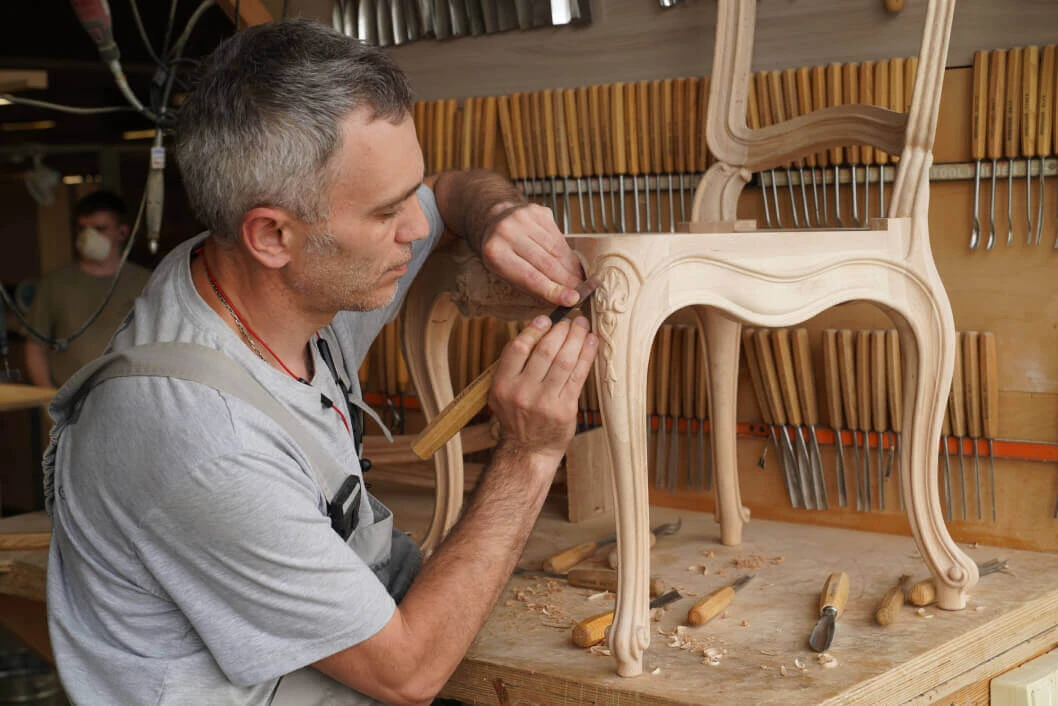
The company's success began in 2002, when two artists — Andrey Ragozin and Evgeny Tsapko — created a small creative workshop for producing wooden carved items. The masters' work was quickly noticed, and within a year they were invited to participate in the reconstruction of the Konstantinovskiy Palace in Strelna.
After the success of this project, the company focused on recreating palace interiors, furniture, church furnishings, and carved decorations in various artistic styles. They worked with cultural heritage sites: The Hermitage, the Alexandrovsky Palace, the Troitsko-Izmaylovsky Cathedral, the Sheremetyevsky Mansion, and many others.
The masters' task — and still is — to create wooden items with the highest level of detail and understanding of every element, based on impeccable knowledge of artistic laws and interior styles.

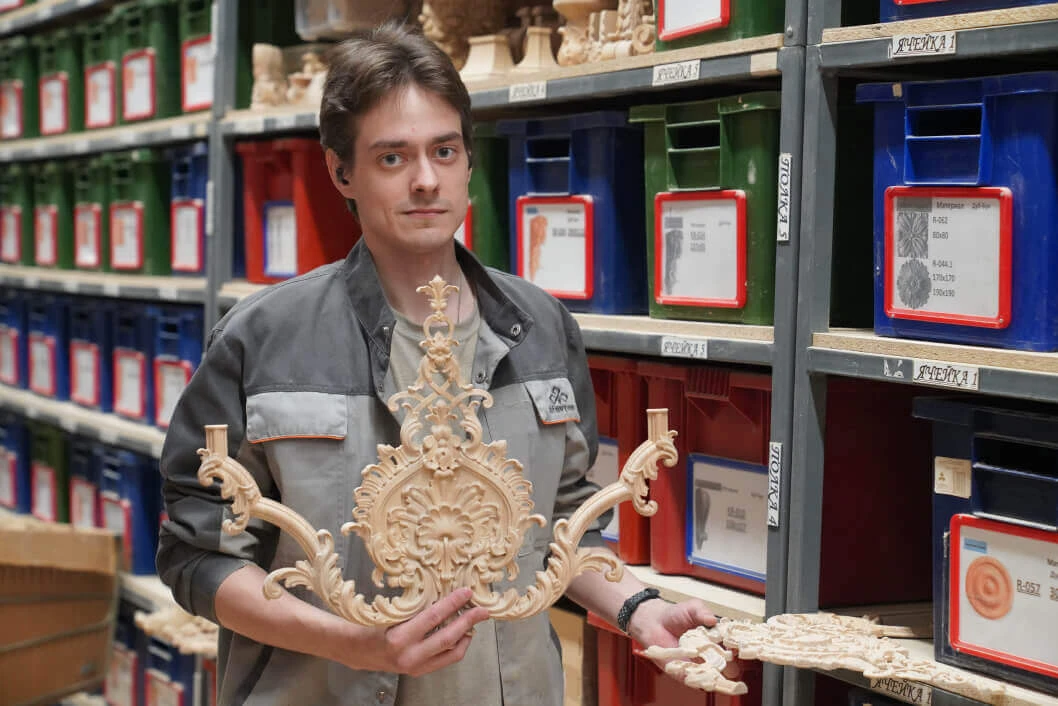
We save your time, peace of mind, and budget
We solve your tasks with maximum speed
Streamlined process reduces all risks
Quality service regardless of order volume
Reliable partner — the foundation of your business
Our showrooms are located in Saint Petersburg and Moscow. Production is located in Saint Petersburg.
Moscow contacts: /contacts_all/
Contacts of Saint Petersburg: /contacts_all/
Send us the product codes, quantities and delivery destination. Contact our team to confirm availability and order details.
Please contact us to confirm shipping availability, costs and delivery times for your destination.
Delivery cost depends on the size, weight of the item, and delivery address.
Please ask our team to confirm shipping costs and delivery arrangements for your destination before placing an order.
Prices and availability of items on the website are always current. Data is updated daily.
Note: items in stock are stored on the warehouse in unpolished form and shipped within 3 working days.
If the item is not in stock, average production time: 5–10 working days.
This is the quality of polishing of the items.
Standard — machine polishing, at a more attractive price.
Prestige — detailed hand polishing, items do not require further work.
More details: /information/kachestvo/
This is the type of veneer of the items.
Under enamel: produced by gluing wooden laminates without color and texture matching. Contrast tonal and textural differences are noticeable. This blank should be chosen if the item is intended for opaque coating.
Under tinting: produced by gluing wooden laminates with color and texture matching. Tonal and textural differences may occur. This blank should be chosen if the item is intended for semi-transparent finish.
More details: /information/kachestvo/
Beech — dense, non-porous wood, most often used for items covered with enamel.
Oak — dense, porous wood with clearly visible natural grain. Due to its strength and decorative properties, it is often used in items with semi-transparent coating, highlighting the wood pattern.
Custom-made, if non-standard items are required, we can produce products from other types of wood, including blanks provided by the customer, manufactured according to our technical specifications.
All our furniture legs can withstand a vertical load of at least 100 kg.
Average production time for custom-made items: 5–10 working days.
Most items are stored on the warehouse in unpolished form. We need time to polish and pack orders.
Yes, we manufacture non-standard items according to individual projects, but we only accept orders with a minimum quantity.
We can manufacture items of the desired size, but we only work with bulk orders. For details, please consult the sales department manager.
Yes, some of our products can be used outdoors. For example, polyurethane items, as well as carved door casings made of pine.
Other items are produced to order using PUR glue, if minimum quantity is available. No warranty is provided for such products, as outdoor conditions are considered aggressive.
Please contact our team to confirm available finishes, minimum quantities and a quotation for your order.
More details: /information/sovety/
Apply adhesive to the decor. Place it on the surface and press briefly. Then, lift the decor from the surface and leave it open for 3–5 minutes. Press the decor firmly onto the surface and hold for 5–10 seconds.
More details: /information/sovety/
Ideally, you should prepare a design project before placing an order.
You can do this yourself by downloading drawings of our products from our website, or you can order a project from us.
If the number of decorative elements and fittings is small, our company's manager can assist you with selection.
Unfortunately, this service is not provided.
The packaging method depends on the type of items, but in each case, we ensure sufficient protection for safe transportation.
We most often use corrugated cardboard and stretch film. Fragile items are additionally secured on a rigid base to prevent damage during transport.
Please confirm the minimum order quantity for your selected products and finishes with our team.
Please contact our team to discuss measurement and installation requirements for your project and destination before ordering.
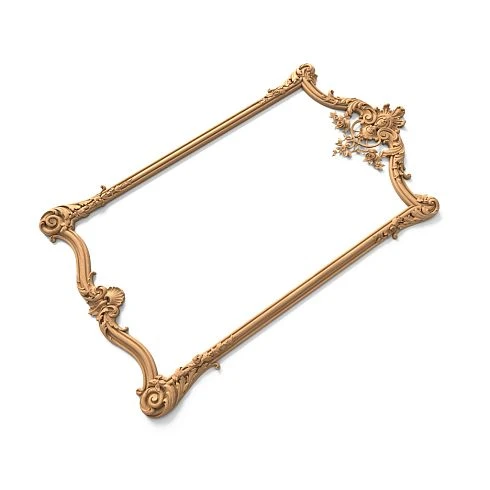
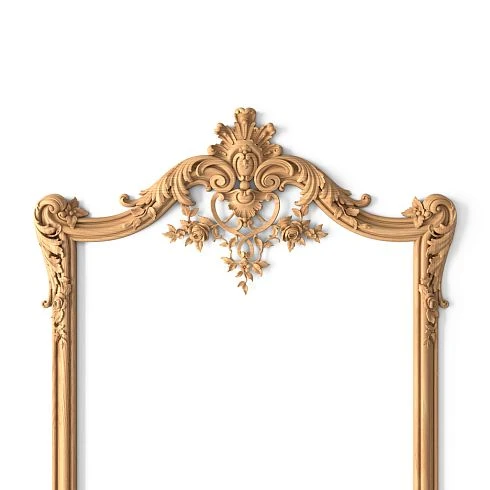
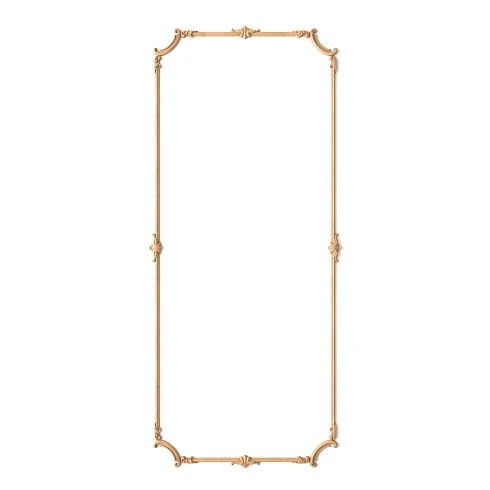
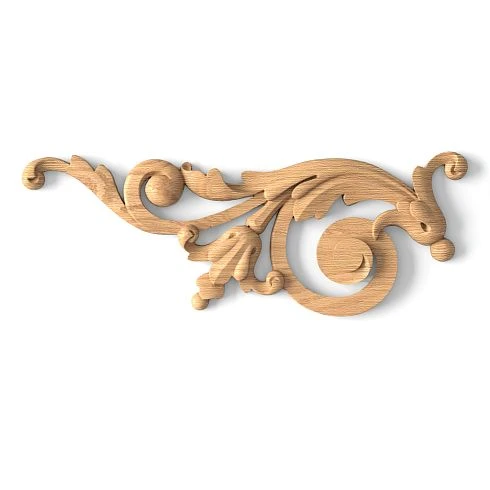
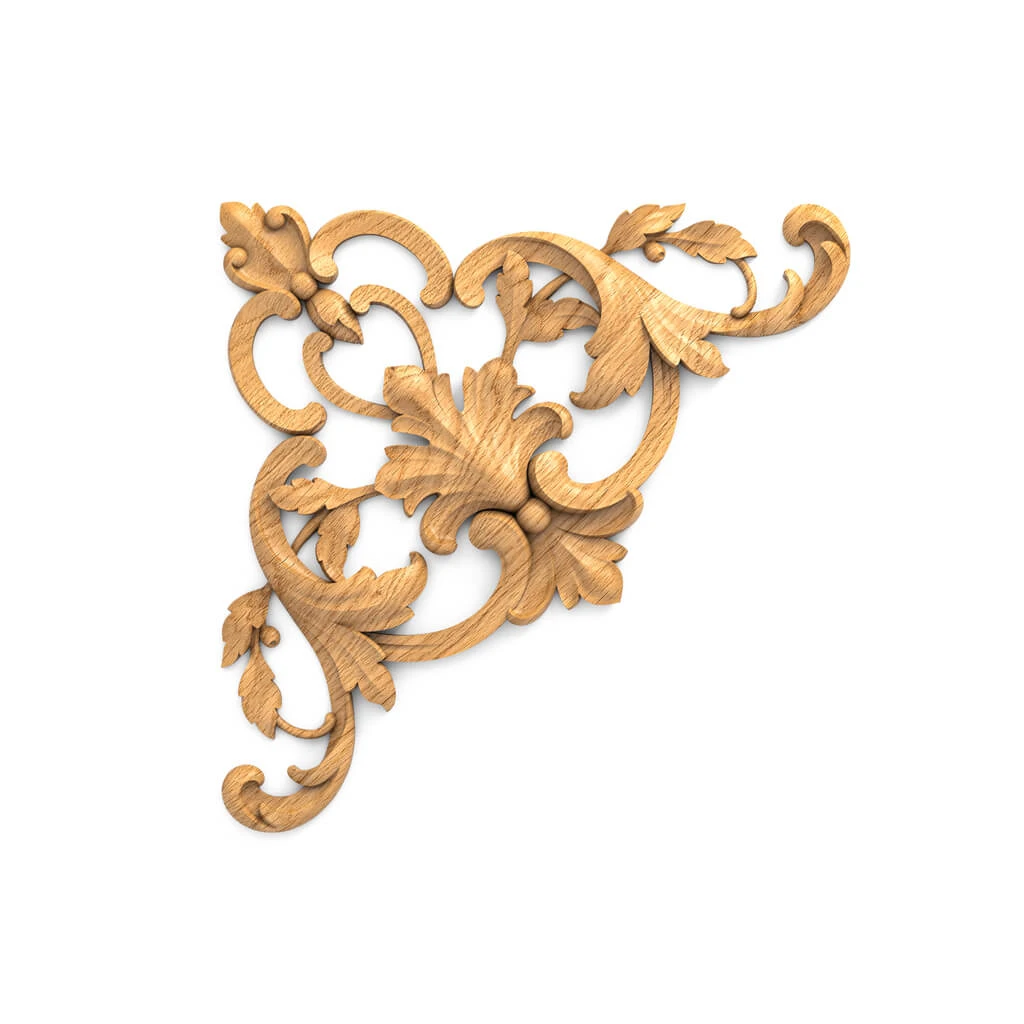
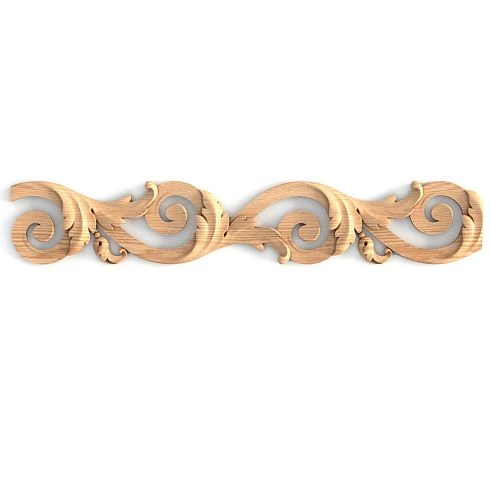
Wooden decor N.VRS-018 is an expressive carved overlay in a corner format with floral ornament, large leaves, smooth scrolls and openwork sections. The composition is built so that the piece can work not just as a separate decorative ornament, but as a full-fledged architectural accent: form the corner of a frame, complete a panel, emphasize the edge of a furniture facade, decorate a mirror, portal, wall panel or another interior structure.
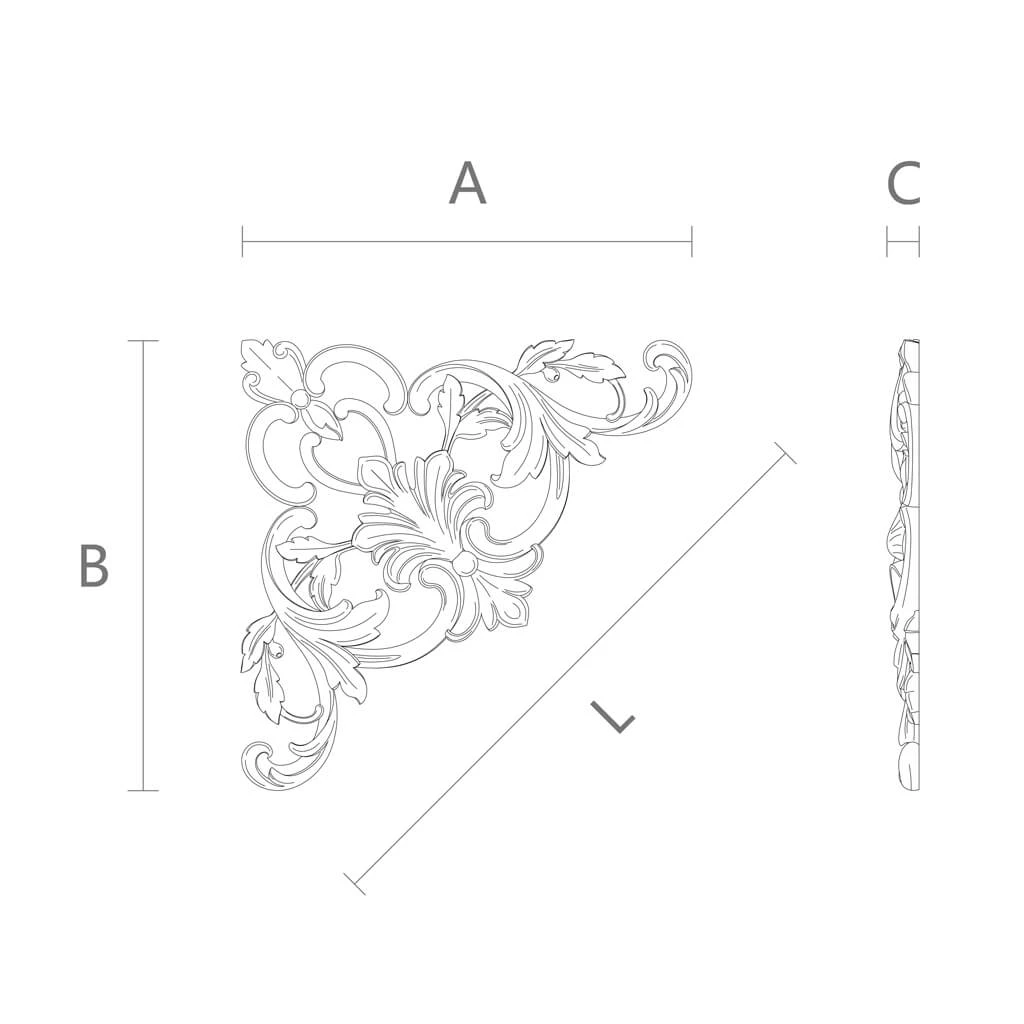
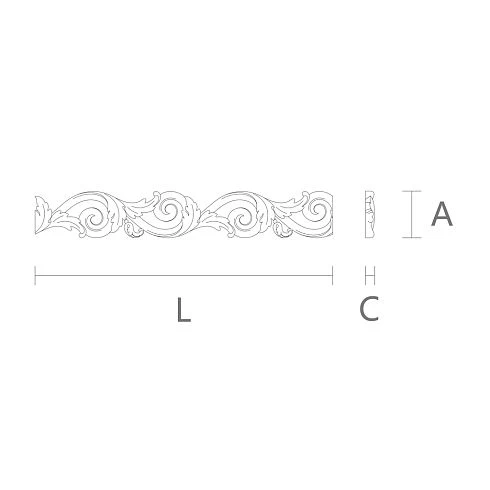
The size of the decor is 196 × 196 mm, thickness — 14 mm, diagonal dimension L — 265 mm. Such proportions make N.VRS-018 a noticeable but not overly massive element. The ornament is large enough to read well from a distance, while retaining many small details and relief transitions that are especially striking after tinting, lacquering or other finishing.
The model is made of natural wood — beech or oak. This allows selecting the material for specific furniture, wall panels, doors and other products made of solid or veneered materials. For the decor, sanding quality options “Standard” and “Prestige” are available. The manufacturing time, according to the specified product characteristics, is from 5 to 10 days.
N.VRS-018 is especially interesting for projects that require not a flat ornament, but a truly three-dimensional wooden piece with pronounced plasticity. Thanks to the combination of large leaves, scrolls and open sections, the overlay creates complex light and shadow and is well perceived both on light and deeply tinted wood.
| Characteristic | Value |
|---|---|
| Article number | N.VRS-018 |
| Product type | carved wooden overlay decor |
| Shape | corner decorative composition |
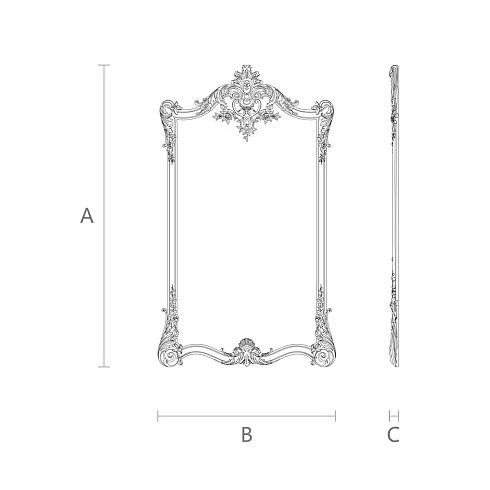
| Size A | 196 мм |
| Size B | 196 мм |
| Thickness C | 14 мм |
| Overall dimensions L | 265 мм |
| Material | Beech or oak |
| Sanding quality | "Standard" or "Prestige" |
| Estimated production time | 5–10 days |
| Main motif | floral ornament, leaves, scrolls |
| Usage method | overlay interior and furniture decor |
Dimensions 196 × 196 mm allow the decor to be planned in advance in the drawing of a facade or wall composition. When designing, it is important to consider not only the width and height of the part, but also its actual relief. A thickness of 14 mm means that the overlay protrudes noticeably above the main plane and creates a full-fledged volume, rather than the effect of engraving or shallow embossing.
The basis of the N.VRS-018 composition is a classic floral motif. In the center is a large group of leaves, from which smooth stems and scrolls radiate. Toward the edges, the composition becomes lighter: massive carved elements transition into thinner arcs, leaf endings, and small decorative accents.
This construction of the ornament has an important practical advantage. The eye does not stop at one heavy detail, but moves along the entire overlay. Due to this, the decor visually connects the two sides of the corner and helps shape the transition between the vertical and horizontal parts of the frame.
The ornament contains both dense, voluminous areas and open spaces. It is precisely this combination that makes the wooden overlay visually lighter. If the entire area of 196 × 196 mm were filled with solid carving, the product would look considerably heavier. Here, however, the openwork fragments let the base color show through and create contrast between the decor and the surface on which it is mounted.
This feature works especially well on paneled facades, wall panels, decorative frames, and large furniture elements. Light travels across the relief at different angles, so the same overlay can be perceived somewhat differently throughout the day: deep areas become darker, protruding parts reflect light more strongly, and thin scrolls form their own shadows.
N.VRS-018 has a distinctive corner composition. This fundamentally distinguishes the model from central rosettes, horizontal overlays, or elongated furniture ornaments.
The side dimensions are identical — 196 mm along A and 196 mm along B. Thanks to this, the decor is easy to integrate into rectangular and square compositions. It can be placed in the corner of a decorative frame, door panel, furniture facade, mirror, or wall panel.
At the same time, the design does not look geometrically rigid. The ornament merely follows the corner format, while developing freely within it. Leaves and scrolls extend beyond the conventional lines of the composition, so the decor does not resemble a technical corner piece or an applied frame. It retains the character of classical artistic carving.
It is precisely this combination that is convenient in interior design: the dimensions of the part are predictable and clear for the designer, while visually the product remains lively and plastic.
If N.VRS-018 is used together with moldings, frame trim, or panels, it can serve as a connecting element. The straight lines of the profiles approach the carved area, after which the geometry of the frame gives way to an organic plant ornament.
Decor should not be chosen by design alone. It is very important to match its size to the surface area.
N.VRS-018 with dimensions of 196 × 196 mm is a prominent decorative overlay. On a small drawer or narrow door, such a piece may take up too much of the surface area. However, on cabinet fronts, wall panels, doors, portals, mirror frames, and large decorative inserts, this size allows the ornament to fully unfold.
The approximately twenty-centimeter side is well perceived from a distance. This is important for furniture and architectural decor: carving that is too small may look excellent when viewed from a few dozen centimeters away, but practically disappear in the overall interior. N.VRS-018 is able to remain legible even as part of a fairly large composition.
The L dimension of 265 mm helps evaluate the extent of the product along the diagonal direction. This is especially useful when working with a corner composition, since the visual mass of N.VRS-018 is distributed not only along the horizontal and vertical, but also diagonally from the upper edge to the lower part.
Before manufacturing furniture or a decorative panel, it is recommended to transfer the actual dimensions of the overlay onto a drawing or make a 1:1 paper template. This allows you to immediately see how large the decor will be relative to the panel, door, frame, or wall section.
The thickness of the N.VRS-018 decor is 14 mm. For a carved overlay, this is an important parameter, since it is the depth of the relief that largely determines the character of the product after installation.
The decor does not merge with the main surface. It forms additional volume and clearly protrudes above the front or panel. Thanks to this, the floral design gains real depth: some areas are closer to the base, others protrude forward, and natural shadows appear between the leaves and scrolls.
On dark wood or with deep tinting, such plasticity can look especially contrasting. On light beech, the relief is perceived more softly, but reads beautifully thanks to the shadows on the curves.
The 14 mm thickness must also be taken into account when designing functional elements. If the decor is installed next to an opening door, drawer, adjacent front, casing, or another protruding part, a sufficient technological gap must remain between the elements.
The same applies to furniture handles. The carved overlay and hardware should not compete for the same space or interfere with hand movement. At the design stage, it is advisable to determine the centers of the handles, hinges, and opening directions, and only then finalize the position of the carved decor.
One of the execution options for N.VRS-018 — beech.
Beech is widely used in furniture production and interior finishing due to its dense, uniform structure. On carved decor, this wood allows fine surface transitions and fairly complex floral patterns to be rendered well.
The natural pattern of beech usually does not distract attention from the carving form itself. Therefore, the material is especially interesting in cases where the ornament should remain the main visual element.
Beech decor can be used with furniture and interior products where beech is used, and can also be included in combined projects after appropriate finishing. Depending on the design task, the surface can retain the natural shade of the wood or receive a different color through a compatible finishing system.
On light finishing, smooth transitions between leaves and curls are clearly visible. With darker tinting, recesses and shadows are emphasized more strongly.
When selecting a carved overlay for an existing product, it should be taken into account that natural wood has its own shade and texture. Even parts made from the same species are not absolutely identical in grain pattern. This is a natural property of real wood, not a defect of the material.
The second material option is oak.
Oak has a well-recognized texture and is traditionally used in furniture, doors, cabinet interiors, classic finishing, and decorative joinery products. On model N.VRS-018, the oak grain adds additional visual depth to the ornament.
If beech is perceived as calmer and more uniform, oak more strongly reveals the natural grain of the wood. This is especially noticeable on the large leaves in the central part of the decor, where the surface area is sufficient for the texture to remain legible.
Oak N.VRS-018 is logical to use together with oak facades, frames, panels, doors, furniture elements, and other decor made of the same species. In such a project, the carved overlay looks like a continuation of the main product rather than a separate foreign ornament.
The combination of oak texture and a classic floral ornament is suitable for interiors where the naturalness of the material is important. The decor can be made calmer while preserving the natural character of the wood, or the volume can be enhanced through tinting and another suitable finishing system.
When developing sets of several parts, the natural difference in fiber pattern should be taken into account. If the most cohesive visual perception is required, the material, grain direction, and finish are best planned for the entire composition at once.
For N.VRS-018, sanding quality options “Standard” and “Prestige” are available.
The choice of preparation level is especially important specifically for carved wooden decor. A simple flat part can, if necessary, be relatively easily processed further, but with complex relief the situation is different. Here there are internal curves, narrow areas, transitions between leaves and stems, small recesses, and thin edges.
Therefore, the degree of surface preparation should be selected based on the subsequent finishing technology and the requirements of the specific project.
If the decor is planned to be used in a premium furniture composition, coated with clear lacquer, stain, oil, or another system that preserves the visibility of the wood, the condition of the surface is of particular importance. With a transparent coating, the wood grain and the quality of preparation remain visible.
If, however, the product is part of the technological chain of an in-house furniture or joinery production, the final choice of sanding type should be agreed with the craftsman who will perform the finishing.
It is not recommended to independently change the geometry of thin carved areas during additional sanding. N.VRS-018 has many small elements, so excessively intensive processing can smooth out the characteristic lines of the ornament.
One of the most obvious applications of N.VRS-018 is furniture decoration.
The corner overlay can be used on large hinged fronts of cabinets, display cases, buffets, chests of drawers, bookcases, bar cabinets, and other classical-style furniture pieces.
The model looks especially expressive in combination with a framed front. In this case, there are several ways to build the composition.
The first is placing N.VRS-018 directly in the corner of the inner panel. The carving becomes an accent within the calm rectangular frame.
The second option is to connect the overlay with the profile molding. Then the straight trim visually approaches the floral elements and creates the impression of a unified decorative system.
The third way is to use N.VRS-018 as a standalone corner accent on a large free surface. This approach is suitable for fronts where a large number of decorative details is not required.
It is important to maintain scale. One well-chosen large ornament often looks more convincing than many small overlays placed too close to each other.
On paired doors, the composition must be checked in full layout beforehand. If a mirrored arrangement is required, the orientation of each carved piece and the compatibility of the pattern in the right and left parts of the furniture must be determined in advance.
N.VRS-018 is suitable not only for furniture. Thanks to its dimensions and pronounced corner shape, the model can be used in decorative wall panels.
In boiserie and classic wall layouts, a combination of straight moldings and more complex corner details is often used. This is exactly where N.VRS-018 can replace a standard geometric corner and make the composition significantly richer.
For example, a large rectangular frame can be formed on the wall from wooden trim, and carved elements can be installed in one or several corners. This technique breaks up excessive geometric strictness and adds plasticity to the interior.
Another option is to use the overlay on the upper part of a vertical panel. Then the scrolls and leaves visually connect the side and top lines of the design.
For a large wall, several identical elements can create rhythm. However, the distance between them must be sufficient. Carving needs visual space, otherwise complex patterns begin to compete with each other.
When designing boiserie, it is necessary to take into account the 14 mm thickness of the decor relative to the moldings and other elements. The profiles do not necessarily have to have the same thickness, but the transition between them should look intentional.
The carved wooden overlay N.VRS-018 can become part of the design of a door leaf or decorative portal.
On a classic door, the model can emphasize the corner of a large panel. Thanks to its dimensions of 196 × 196 mm, the decor is clearly visible and does not get lost on a full-size door leaf.
At the same time, it is important not to place the carving too close to the handle, lock, hinges, or the edge of the opening door. The decorative element should remain precisely part of the composition and not interfere with the operation of the product.
On portals, a freer approach is possible. N.VRS-018 can be used in the upper corner of the decorative trim, combined with vertical casings, capitals, cornices, or other carved details.
A design in which a single motif is repeated at different levels looks especially convincing. For example, a large floral pattern is used in the upper corners of the portal, while calmer linear profiles continue it downward.
If the portal has a considerable width, N.VRS-018 does not have to be the only decorative element. The model can work as part of a multi-level composition, but it is advisable to select the surrounding details so that they support its plasticity rather than overload the space with a large number of different ornaments.
The corner nature of the product makes N.VRS-018 an interesting solution for making decorative frames.
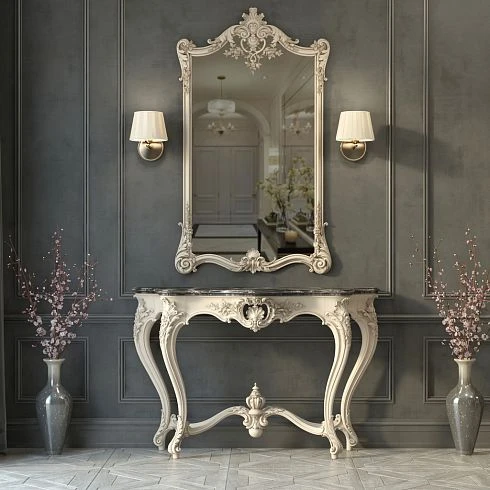
A mirror can be framed with a profiled wooden frame and complemented with a carved overlay in one, two, or four corners. The number of elements depends on the style of the project.
Four large carved corners create a solemn classical composition. Two elements make the design lighter. A single asymmetrically placed N.VRS-018 can be used in freer original projects.
A similar principle works with decorative panels. A carved overlay can emphasize the corner of a wooden base, a panel, or a frame structure.
When working with mirrors, it is especially important to relate the size of the carving to the width of the frame itself. If the profile is too thin, a 196 × 196 mm overlay may be perceived separately from it. A wider or multi-layered frame allows the carving to be better connected to the overall architecture of the product.
One can also use the contrast between the smooth mirror surface and the complex texture of natural wood. In this case, the decor becomes even more noticeable because the reflective plane has almost no pattern of its own.
By the character of its pattern, N.VRS-018 is naturally perceived in classical styles.
Large leaves, scrolls, smooth S-shaped lines and asymmetrical movement of the ornament go well with traditional furniture, wall panels, framed facades, cornices and decorative portals.
However, it is not necessary to use the model exclusively in a historically accurate interior.
In neoclassicism, you can limit yourself to a few carved accents against the backdrop of calmer architecture. For example, a smooth wall panel with a thin molding and one expressive N.VRS-018 overlay looks significantly lighter than a classical composition fully saturated with carving.
An interesting effect is also possible in a modern eclectic interior. Natural wooden ornament can act as an independent artistic object on a laconic panel or furniture facade. In this case, the surrounding space is deliberately made calmer in order to emphasize the complexity of the carved form.
Thus, the model does not require mandatory repetition of a historical interior. The key question is the dosage of decor and its correct combination with the main lines of the furniture or room.
For a complex interior composition, it is important not just to select several beautiful elements, but to unite them into a single system.
N.VRS-018 has a rich plant pattern, so neighboring profiles can be noticeably calmer. This allows you to create a hierarchy: the carved overlay becomes an accent, while the moldings form the frame and direction.
If several equally complex ornaments are used nearby, there is a risk of visual overload. This is especially noticeable on a small facade.
The working principle looks different: a large carved detail — a simpler connecting profile — a free plane — the next accent.
For classic facades, N.VRS-018 can be combined with wooden moldings, framed trim, carved rosettes, center overlays, and other elements. However, it is advisable to maintain a similar character of the floral pattern.
If large acanthus leaves are used in one area, a geometric ornament in another, and a completely different floral motif in a third, the composition may lose its integrity.
It is better to first identify the main element. If N.VRS-018 is the main one, the other details should support it rather than compete with it.
Natural wood makes it possible to adapt the appearance of N.VRS-018 to a specific interior.
The decor can retain the natural shade of the wood or undergo additional finishing within the technology of a specific project. The choice of coating depends on the wood species, operating conditions, desired color, and compatibility of the materials used.
On a light transparent finish, the natural pattern of beech or oak is clearly visible.
Tinting makes it possible to tie the carved overlay to existing furniture or other wooden elements. On complex relief, the color is often perceived as deeper than on a flat surface, since the recesses receive less light.
Matte finishes emphasize the naturalness of the wood, while finishes with a more pronounced sheen highlight the protruding areas of the relief more strongly.
For decorative interior projects, more complex effects are also possible: contrasting highlighting of the relief, patination, painting, and local decorative accents. However, it is better to first test the technology on a sample of compatible wood, especially if an exact color match with finished furniture is required.
The main rule is that the finishing should not hide the delicate carving pattern. Too thick a layer of coating can visually smooth out fine transitions.
Before final installation of N.VRS-018, it is recommended to perform a dry fit.
The decor is placed on the intended location without fixing and several parameters are checked:
For serial furniture production, it is reasonable to make a placement template. This significantly reduces the likelihood that on several identical fronts the overlays will be installed with a small but noticeable offset.
It is especially important to control the position of the central elements of the design. Even if the overall dimensions are maintained, a slight change in the angle of inclination can alter the perception of the entire composition.
Before installation, the base must correspond to the chosen fastening and finishing technology. The method of fixation is determined by the type of base, the design of the product, and the installation system for wooden decor used by the manufacturer or furniture enterprise.
The best result is achieved when N.VRS-018 is included in the project in advance, rather than added to an already fully formed facade at the last moment.
First, the size of the main surface is determined. Then frames, moldings, and panels are marked on the drawing. After that, an area of 196 × 196 mm is reserved for the carved overlay, taking into account its actual contour.
At the same time, one cannot rely solely on the conventional 196 × 196 mm square. The design itself has a complex shape, and part of the area remains free. Therefore, it is important to consider exactly how the leaves and scrolls approach the adjacent lines.
If the part must visually connect with the molding, it is advisable to check in advance the position of the outermost scrolls relative to the profile. Sometimes shifting the overlay by just a few millimeters allows for a much more natural transition.
In a project with several facades, the overall rhythm must be determined immediately. For example, it is not necessary to place N.VRS-018 on every door. On a large furniture wall, decorated outer or central sections may look more expressive, while the remaining facades stay calmer.
This is how carved wooden decor begins to work as a means of composition, rather than as a randomly added ornament.
Classical furniture and wall panels often require mirror symmetry.
When using N.VRS-018, this issue must be resolved before installation. The ornament has a pronounced direction of movement: leaves and scrolls form a specific visual trajectory. Therefore, simply placing identical elements on two sides is sometimes insufficient to achieve a perfectly mirrored composition.
If the project involves a left and right corner, the specific orientation of the parts in the chosen configuration should be checked. This is especially important for door portals, large mirrors, two-door wardrobes, and symmetrical boiserie.
In other projects, on the contrary, slight asymmetry can be an advantage. A single decorative element in the upper corner of a facade or panel creates a more relaxed style of decoration.
N.VRS-018 is well suited for both approaches, but the result must be planned in advance.
For serial installation of multiple parts, it is convenient to create a full-scale diagram with reference points marked on it. Then distances and angles will be repeated precisely, and the ornament will maintain a consistent rhythm on all elements.
Caring for N.VRS-018 largely depends on the chosen finish coating.
The complexity of a carved ornament lies in the fact that dust can accumulate in the recesses between leaves and scrolls. Therefore, periodic careful cleaning is especially important for preserving the expressiveness of the pattern.
For regular care, it is preferable to use soft accessories that allow dust to be removed without damaging the delicate areas of the carving and the coating.
Do not rub protruding edges intensively with hard materials. The most delicate decorative elements require careful handling.
If N.VRS-018 is part of furniture, a door, or a wall panel, it is advisable to use the products recommended for the entire coating system. Do not apply aggressive compounds separately only to the carved part.
A properly selected coating facilitates further maintenance, as it protects the wood surface and helps keep the decor in good condition without excessive mechanical treatment.
N.VRS-018 is a case where material and pattern work together.
The floral ornament imitates leaves, shoots, and smooth natural lines. The natural texture of beech or oak logically continues this theme. The wood fibers become an additional decorative layer that cannot be fully reproduced on an artificial uniform surface.
On large leaves, the natural structure of the material is clearly visible. On thin curls, it is less pronounced, but the shape is perceived more strongly.
As light moves across the relief, the wood constantly reveals different areas of texture. That is why a real carved overlay looks more complex than its frontal image on a white background.
In addition, wooden decor is convenient to combine with other elements of a joinery product. If the facade, frame, or wall panel is made of matching wood, N.VRS-018 becomes an organic part of the entire structure.
For projects where the naturalness of materials is especially important, this is a significant advantage.
Carved wooden decor N.VRS-018 is especially appropriate where there is enough free surface around the ornament.
This could be:
The size of 196 × 196 mm allows the piece to be perceived as an independent element of the composition. That is why it does not need to be surrounded by a large amount of additional carving.
In some projects, a single N.VRS-018 can produce a greater decorative effect than several small overlays.
The main advantage of the model lies in the combination of a clear corner format and a complex artistic pattern.
From a structural point of view, the designer works with specific dimensions — 196 × 196 × 14 mm and an overall length of L 265 mm. From a design point of view, what lies before them is not a geometric insert, but a dynamic floral ornament with large leaves, scrolls, and openwork gaps.
Thanks to this, N.VRS-018 can be used in very different ways.
In traditional furniture, it supports the classic character of the facade. In wall panels, it turns a simple corner of the frame into an intricate decorative knot. In a mirror frame, it becomes an expressive accent. In a modern eclectic interior, it can act almost as a standalone carved object.
Choosing between beech and oak allows the model to be further adapted to the material of the main product. The Standard and Prestige sanding options make it possible to select the degree of surface preparation for the subsequent production and finishing technology.
N.VRS-018 is intended for cases where ordinary molding or a simple overlay is not enough. It is a noticeable three-dimensional detail capable of changing the perception of the entire surface.
On a furniture facade, it creates a focal point. In the corner of a wall frame, it softens rigid geometry. On a mirror, it turns a functional frame into a decorative object. On a door portal, it connects the vertical and horizontal trim.
At the same time, the product dimensions remain compact enough for integration into furniture and interior structures: 196 mm in width, 196 mm in height, 14 mm in thickness, and 265 mm in overall L dimension.
Natural beech or oak helps preserve the feel of a genuine joinery product, while the intricate floral carving emphasizes the depth of the material.
To make N.VRS-018 look as expressive as possible, it is better to consider it not as a separate decoration added at the last moment, but as part of the overall architecture of the product. The position of the overlay, the dimensions of the frames, the direction of the moldings, the free fields, the material, the color, and the final finish should preferably be thought through as a single composition.
It is precisely with this approach that the wooden decor N.VRS-018 becomes not just an applied carved detail, but a full-fledged element of furniture or interior — with its own rhythm, volume, and character.
Our manager will contact you within 5 minutes