Article Contents:
- K-043 or K-046: short answer before ordering
- What is carved baguette molding
- Frame profile
- Independent frieze
- Length 2000 mm
- Short element 300 mm
- Molding for subsequent finishing
- K-043 width 40 mm
- K-043 width 50 mm
- K-043 width 60 mm
- K-043 width 80 mm
- Why four widths are more convenient than one
- Short modules do not replace long linear footage
- What K-043 pairs best with
- K-046 width 90 mm
- K-046 width 130 mm
- Why "spoons" work on an extended line
- Frieze without additional overlays
- Office and Library
- Wall panel
- What K-046 can be combined with
- Different character of the ornament
- Different scale system
- Different place in the composition
- Different risk of overload
- Different work with accompanying decor
- When K-043 80 mm looks better
- When K-046 90 mm looks better
- A paper mockup is insufficient without a side profile
- Don't automatically choose 90 mm for larger furniture
- Start with the inner field
- Consider the outer offset
- Compare the profile with the handle
- The number of identical doors enhances the rhythm
- The door height is also important
- Make two layout levels
- Upper cabinets
- Lower doors
- Tall pencil case
- Island and buffet
- Sink and steam area
- Bedside table
- Commode
- Cabinet
- Walk-in closet
- Connection with bed and panels
- Distance to screen
- Frame on wall panel
- Lighting
- Sockets and cables
- Width 90 mm
- Width 130 mm
- Joint of several sections
- Top cornice
- Horizontal above bookcases
- Vertical inserts
- Connection with doors
- Socket and smooth molding
- Upper boiserie belt
- Central portal
- Long Wall
- Combination with K-043
- Scale sample
- Test swatch
- Small insert
- Comparison of two models
- Frame on a furniture door
- Frieze above the cabinet
- Wall panel
- Transportation and storage
- Example of one furniture frame
- Example of four identical doors
- Example of a frieze 4800 mm long
- Why you cannot assign a universal margin percentage
- How to use leftovers
- 45-degree bevel cut
- Direct abutment
- On the vertical division of furniture
- Not in the center of the main facade
- Under a trim or rosette
- On a long wall
- Beech for enamel
- Oak for tinting
- Why you shouldn't choose oak just for strength
- Why beech doesn't replace oak under clear varnish
- One wood species for the entire set
- "Standard"
- "Prestige"
- Consistent quality of adjacent elements
- When the extra cost for preparation is justified
- Pre-finishing
- Finishing after assembly
- Dry assembly before finishing
- Part marking
- MDF base
- Solid wood base
- Wall panel
- Painted plaster
- Temporary fixation
- Mechanical fasteners
- Bagette and regular smooth molding
- Frame bagette and wide furniture cornice
- Short sample and long plank
- Furniture bagette and ready-made picture frame
- Interior trim and exterior decor
- Need to design a small cabinet door
- Need to assemble a frame on the dresser door
- Need a main belt on a large cabinet
- Need to combine library sections
- Need to design a TV area
- Need to use both profiles in one room
- Consider K-043 only with a 40 mm profile
- Consider K-046 as an enlarged version of K-043
- Choose based on a large photo
- Install K-046 130 mm on a small door
- Use K-043 40 mm as the main library frieze
- Do not check handles and hinges
- Forget about the plank length
- Place the joint in the center
- Mix batches without samples
- How is K-043 different from K-046?
- Which profile to choose for a small furniture door?
- What is better for a large wardrobe?
- Can K-046 be considered an enlarged version of K-043?
- What lengths are the planks sold in?
- What is the short 300 mm element for?
- How to calculate the amount of baguette?
- Is a spare needed?
- What to choose: beech or oak?
- What do "Standard" and "Prestige" mean?
- Can the baguette be painted after installation?
- Can the oak be tinted before installation?
- Which profile should I choose for the TV area?
- What should I choose for the library?
- Can K-043 and K-046 be combined?
- Is K-043 suitable for kitchen fronts?
- Can K-046 be used on the wall?
- Is the baguette suitable for a painting or mirror?
- Where to buy K-043?
- Where to buy K-046?
- Where can I see other models?
- How to choose matching decor for K-043?
- What to add to K-046?
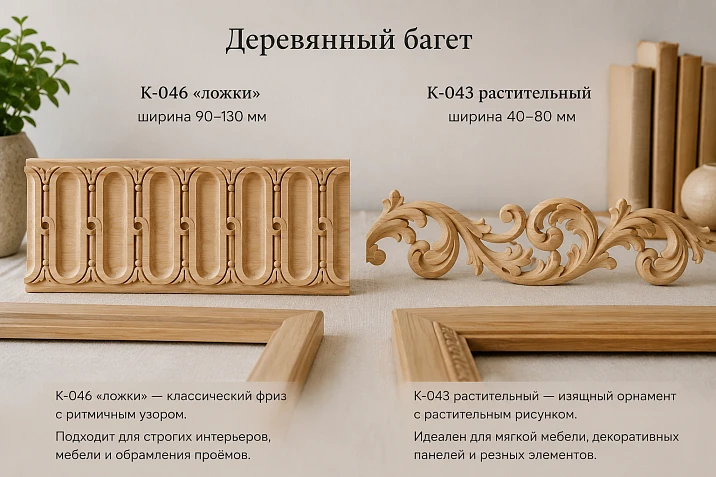
Framed floral profile or standalone classic frieze for furniture, doors, cabinets, libraries, and wall panels
K-043 or K-046: short answer before ordering
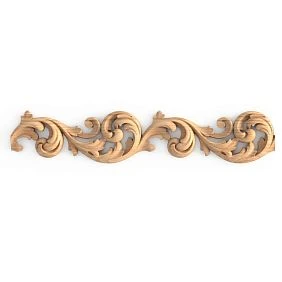
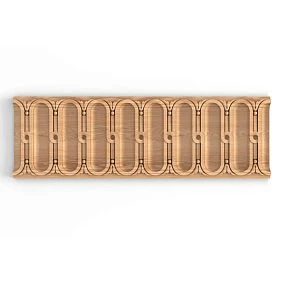
K-043 is worth buying when you need a carved floral baguette for furniture fronts, doors, and frames, and it's important to match the profile width to the surface scale. One ornament is available in four widths — 40, 50, 60, and 80 mm; long planks are 2000 mm long, and for widths 40, 50, and 60 mm, short elements of 300 mm are available. K-046 is better to choose when the decorative strip should become a standalone classic frieze. Widths of 90 and 130 mm are suitable for a large cabinet, library, study, wall panel, and furniture portal. Both models are made from beech and oak, in the "Standard" or "Prestige" quality: beech is prepared for enamel, oak for tinting.
Buy the plant-based wooden baguette K-043 Buy the wide classic frieze K-046 Buy wooden picture frame molding Compare K-043 and K-046 in person Order baguette layout on the facade
K-043: 40 × 8, 50 × 10, 60 × 12, and 80 × 16 mm; main slat length — 2000 mm, short elements of 300 mm are confirmed for widths 40, 50, and 60 mm.
K-046: 90 × 8 and 130 × 12 mm; main length — 2000 mm, short element 90 × 8 × 300 mm is suitable for a sample or local insert.
Main difference: K-043 forms a frame and decorative contour, K-043 works as a wide architectural belt.
Finishing: Beech is chosen for covering enamel, oak for tinting while preserving texture.
Before purchasing: Make a full-size paper mockup, check the distance to handles, hinges, door gaps, and the position of longitudinal joints.
The query "buy wooden baguette" combines very different products: thin frame profiles, carved molding for furniture, wide frieze, planks for wall panels, and elements for a portal. K-043 and K-046 are next to each other in the catalog, made from the same wood species and have the same surface preparation logic, but solve different tasks. One helps build a flexible frame, the other itself becomes the main decorative band.
K-043 is convenient because one plant ornament is available in four scales at once. On a small door, you can use a width of 40 mm, on a dresser front — 50 or 60 mm, on a cabinet door and wall panel — 80 mm. The buyer does not have to change the pattern just because the surface size is different. This is especially useful for a bedroom, kitchen, or dressing room, where several pieces of furniture need to be tied together with one motif.
K-046 starts where K-043 ends. A width of 90 mm is already perceived not as a frame line, but as a frieze. The 130 mm version forms a large horizontal band and requires an appropriate scale of the cabinet, library, office, or wall panel. The ornament with oval "spoon" recesses creates a repeating classical rhythm and can be used without additional central overlays.
It is convenient to compare models through the cards: choose K-043 with a width of 40–80 mm и choose K-046 with a width of 90 or 130 mm. If the scale from the photo is not obvious, it is better order samples of beech and oak and apply them to the actual facade.




What is carved baguette molding
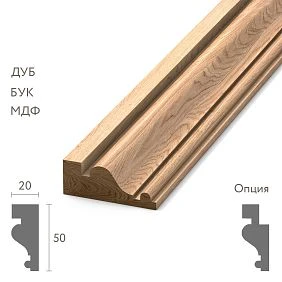
Carved baguette molding is a long wooden profile with a repeating ornament. It is not sold as a ready-made frame, but as an element from which a decorative contour, frieze, band, or framing is assembled. The buyer selects the pattern, width, projection, length, wood species, and surface preparation, and then calculates the footage for a specific piece of furniture or wall.
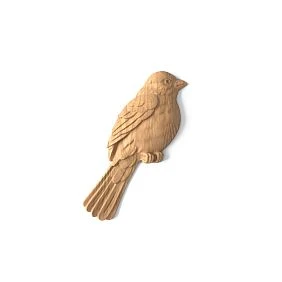
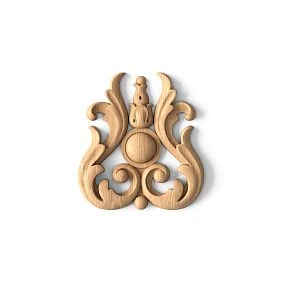
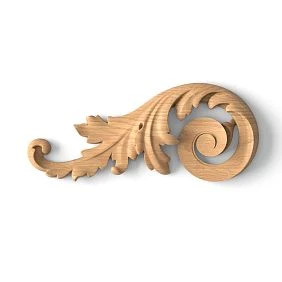
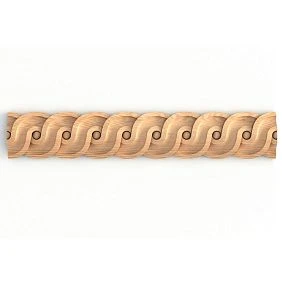
Our factory also produces:
Frame profile
Frame baguette works along the perimeter of the facade, mirror insert, panel, or wall section. Its width should leave enough free field inside and outside. K-043 is better suited for this task because it offers four widths and adapts relatively flexibly to doors of different sizes.
Get Consultation
Independent frieze
A frieze does not have to be closed into a frame. It can run horizontally along the top of a cabinet, under a furniture cornice, along a wall panel, or above library sections. K-046 is designed specifically for this role: a width of 90 or 130 mm and a short ornament step form an extended classical strip.
Length 2000 mm
A two-meter plank reduces the number of longitudinal joints. For a furniture door or panel up to two meters long, the profile can be used as a single element after trimming. On a long wall, joints are pre-distributed to inconspicuous areas and the pattern repeat is aligned.
Short element 300 mm
A short module is needed for a sample, small insert, and finish testing. It does not replace a long plank in a large frame because many joints disrupt the rhythm. For K-043, the 300 mm size is confirmed in widths of 40, 50, and 60 mm; for K-046, in a width of 90 mm.
Molding for subsequent finishing
Beech and oak are offered not as randomly painted finished strips, but as a base for custom finishing. Beech is chosen for enamel, oak for tinting. This allows matching the baguette with furniture, doors, panels, and other wooden elements in one order.
Confirmed specifications for K-043 and K-046
| Parameter | K-043 | K-046 | Practical significance |
|---|---|---|---|
| Type | Scalable carved molding | Wide classical frieze | K-043 builds a contour, K-046 forms an independent strip. |
| Ornament | Rich floral, Baroque style | Oval recesses ("spoons") and fine floral pattern | The first works more actively in a frame, the second creates a classic repeat. |
| Widths | 40, 50, 60 and 80 mm | 90 and 130 mm | The ranges hardly overlap and are designed for different scales. |
| Protrusion | 8, 10, 12 or 16 mm | 8 or 12 mm | Width and depth change disproportionately; a side layout is needed. |
| Main length | 2000 мм | 2000 мм | It is convenient to calculate the footage based on the same length of strips. |
| Short elements | 300 mm for 40, 50 and 60 mm | 300 mm for a width of 90 mm | You can check the scale and finish before ordering a long batch. |
| Materials | Beech and oak | Beech and oak | In one room, models can be matched with the same wood species and finish. |
| Preparation | Beech under enamel, oak under tinting | Beech under enamel, oak under tinting | The material is chosen together with the future coating. |
| Sanding quality | "Standard" or "Prestige" | "Standard" or "Prestige" | Paired and adjacent elements are best ordered in the same quality. |
| Main scenarios | Furniture fronts, doors, frames, TV area, wardrobe | Large cabinet, study, library, wall panel, portal | First, determine the role of the profile, then the size. |
K-043: a botanical baguette that can be scaled for furniture
K-043 is the choice for a project where one ornament should repeat on surfaces of different sizes. A width of 40 mm suits a small door, 50–60 mm for a medium front, 80 mm for a large door, wall section, or furniture portal. This allows the kitchen, bedroom, wardrobe, and study to have a unified botanical rhythm without mechanically using the same width everywhere.
K-043 40 mm wide
The 40 × 8 mm format works like a thin carved line. It is convenient to try on a narrow cabinet door, a small drawer, a wardrobe panel, or a compact frame. On a large facade, such a profile may get lost, especially if there is a wide cornice or an active carved overlay nearby. The 2000 mm length is suitable for a full frame, while the 300 mm element is for a sample, a small insert, or testing a future color.
K-043 50 mm wide
The 50 × 10 mm size gives more relief but retains a frame-like character. It is suitable for a dresser door, a medium-width kitchen facade, an inner frame of a sideboard, and a decorative door section. This option often becomes a compromise when 40 mm looks too thin and 60 mm starts to crowd the handle or panel.
K-043 60 mm wide
The 60 × 12 mm format is noticeable from a normal viewing distance and can work not only as a contour but also as a decorative belt. On a facade 500–700 mm wide, it maintains a free field and does not look small. The short 300 mm version is useful for checking scale on furniture and for test painting.
K-043 80 mm wide
The 80 × 16 mm option is the largest in the line. It is suitable for a wide wardrobe door, a wall panel, a TV area, and a furniture portal. Although the width is close to K-046 90 mm, the role remains different: K-043 retains a rich floral pattern and frame logic, while K-046 is perceived as a repeating classic frieze.
Why four widths are more convenient than one
A furniture set rarely consists of identical facades. In the kitchen, there are narrow drawers, wide doors, and a tall pantry; in the bedroom, there are nightstands, a dresser, and a wardrobe; in the office, there are library sections of different heights. K-043 allows distributing 40, 50, 60, and 80 mm across these groups while maintaining the overall character of the carving.
Short modules do not replace long lengths
A 300 mm element is convenient as a sample, a small insert, or part of local decor. Assembling a long frame from many short segments is impractical: joints will disrupt the pattern repeat and complicate finishing. For a full contour, it is better to use 2000 mm strips and pre-calculate the cutting.
What K-043 pairs best with
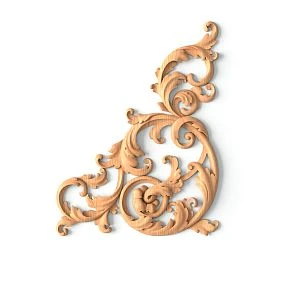
The floral ornament works well alongside paired overlays, furniture panels, and classic handles. The related products include N-158L and N-158R. They can only be used after checking dimensions and the overall scheme, but the combination itself shows the direction: K-043 can become the basis of a symmetrical composition, not just a single strip.
For such a scenario, you can buy baroque carved molding and separately check how it works with paired overlays on the facade.
K-046: classic frieze for large furniture and architectural walls
K-046 is chosen not for a flexible frame, but for a strong horizontal line. The width of 90 or 130 mm makes the profile independent. The repetition of "spoons" and fine floral pattern creates a rhythm that is well perceived on a large cabinet, library, study, wall panel, and furniture portal.
K-046 width 90 mm
The 90 × 8 mm format is interesting for combining large width with a relatively small projection. It is noticeable from the front but does not protrude too far forward. The 300 mm version helps check the pattern and finish, while the 2000 mm strip is suitable for cabinets, panels, and extended friezes.
K-046 130 mm wide
Size 130 × 12 mm — a full-fledged architectural frieze. It requires a large surface and sufficient viewing distance. On a small door, such a frieze will overload the facade, reduce the free field, and may conflict with the handle. On a library or portal, on the contrary, a wide repeat looks convincing and brings the composition together.
Why "spoons" work on an extended line
Oval indentations create a regular step. On a long plank, the eye reads not an individual leaf, but a sequence. This makes K-046 suitable for the upper belt of a cabinet, wall panel, and classic furniture where a calm repeat is needed, rather than a separate central overlay.
Frieze without additional overlays
K-046 can work independently. Its width and rhythm already create a decorative strip. Additional elements are needed only when the project requires a multi-level frame, rosette, or transition to the cornice. In an overloaded composition, the frieze will lose clarity.
Study and library
These spaces usually have large furniture, long horizontals, and sufficient viewing distance. K-046 can run along the top of library cabinets, connect several sections, or form a frieze above the work area. The 130 mm version is suitable for particularly large structures.
Wall panel
On the wall, K-046 can separate the upper and lower zones, complete a boiserie, or become a horizontal belt. Before ordering, you need to check the room height, the position of switches, door trims, and furniture. The wide profile should not accidentally cross other architectural lines.
What K-046 can be combined with
Among the related products are MLD-013 and R-023. A smooth molding helps build a multi-level frame, a rosette supports a classic decor system. Dimensional compatibility and precise placement are confirmed with a drawing so that the wide frieze does not conflict with neighboring elements.
If the project needs such a belt, you can check the sizes of K-046 and compare the width of 90 and 130 mm on a full-size template.
Why K-043 and K-046 are not two sizes of the same baguette
The transition from 80 to 90 mm seems small. Because of this, the buyer may perceive K-046 as the next width of K-043. But not only the millimeters differ. The artistic role changes: K-043 builds a plant frame, K-046 creates a classic frieze with its own repetition.
Different character of the ornament
K-043 is rich in plant motifs and works better in a contour where the pattern goes along the perimeter. K-046 is based on regular oval indentations and a thin plant line, so it is perceived as a rhythmic strip.
Different scale system
K-043 offers four widths from 40 to 80 mm. This is a tool for adapting to several facades. K-046 has two large formats: 90 and 130 mm. Its task is to choose the strength of the frieze, not to adjust to every small door.
Different place in the composition
A frame baguette is placed around a panel, mirror, TV zone, or facade field. A wide frieze often runs horizontally along the top of a cabinet, panel, or portal. Using K-046 as a small frame is only possible on a very large surface.
Different risk of overload
K-043 with a width of 40–60 mm can be repeated on several small facades. K-046 at 130 mm on each door will create a heavy rhythm and reduce the usable field. The width should match the scale of the furniture and the number of repetitions.
Different work with accompanying decor
K-043 often requires overlays, corner elements, or a central composition. K-046 itself is already a strong belt and requires calmer neighbors. Therefore, the set of "what to buy together" differs for the two models.
Direct comparison by customer tasks
| Task | Preliminary K-043 | Preliminary K-046 | What to finally check |
|---|---|---|---|
| Small cabinet door | 40 or 50 mm | Usually too wide | Free field, handle, and panel size. |
| Dresser front | 50 or 60 mm | Only on large furniture | Drawer height and number of repeats. |
| Cabinet door | 60 or 80 mm | 90 mm for large door | Frame needed or wide belt. |
| Large library | For individual frames | 90 or 130 mm | Length of the overall horizontal and viewing distance. |
| TV zone | Frame 60 or 80 mm | Frieze above the panel | Does the profile intersect the screen, acoustics, and backlight. |
| Wall panel | Sections and frames | Main horizontal belt | Wall height and adjacent moldings. |
| Furniture portal | Plant contour | Wide top frieze | Can both models be used at different levels? |
| Need to change the scale of one drawing | Fits better | Only two large formats | Is a single ornament needed on different furniture? |
| Need independent decor without overlays | Available in 80 mm size | Preferable | Does the frieze overload the surface? |
K-043 80 mm or K-046 90 mm: the most difficult choice boundary
The difference between 80 and 90 mm is only ten millimeters, but the pattern and role of the profile change more than the number. K-043 80 mm remains a large plant frame with a 16 mm projection. K-046 90 mm has a smaller 8 mm projection but a wider frontal rhythm of "spoons". Therefore, comparing models only by width is incorrect.
When K-043 80 mm looks better
Choose it for a large panel, a frame around a TV, a tall cabinet door, or a furniture portal where a rich plant contour is needed. The 16 mm projection creates a pronounced shadow, so the profile is noticeable not only from the front but also from the side.
When K-046 90 mm looks better
It suits a horizontal belt and an extended strip. The 8 mm projection makes the frieze relatively calm in depth, while the 90 mm width provides an architectural scale. On a large cabinet or wall panel, it may look lighter than the more relief K-043 80 mm.
A paper mockup is insufficient without the side profile
The front rectangle shows the width but not the depth. For K-043 80 mm, add a 16 mm strip to the mockup; for K-046 90 mm, add 8 mm. See how the shadow falls next to a handle, shelf, cornice, or adjacent molding.
Do not automatically choose 90 mm for larger furniture
If the project is already built on the plant ornament of K-043, switching to K-046 just for ten millimeters will ruin the unity. It is better to check if 80 mm is sufficient or immediately switch to K-046 as a separate frieze with a different role.
How to choose the baguette width based on the facade size
There is no universal formula that the width of the baguette equals a certain percentage of the door. Ornament, protrusion, handle, panel, and the number of repetitions have a stronger influence than a single proportion. Nevertheless, the choice can be made consistent by evaluating the useful field and the role of the profile.
Start with the inner field
Draw the future frame and see how much space remains inside. On a facade 300 mm wide, two side strips K-043 60 mm will take up 120 mm, leaving 180 mm before accounting for outer offsets. K-046 90 mm will reduce the field even more and may turn the door into a heavy strip.
Consider the outer offset
The baguette should not come close to the edge of the facade. A section is needed for visual breathing, hinge attachment, and safe processing. The specific offset depends on the door design and pattern, so it is checked with a mockup.
Compare the profile with the handle
On a small facade, a large handle and a wide baguette compete. If the handle is the main accent, K-043 40–50 mm helps maintain balance. If the handle is minimalist, a 60–80 mm profile can take on the decorative role.
The number of identical doors enhances the rhythm
One facade with K-046 130 mm may look convincing, but ten identical doors will create a dense repeating wall. On a series of cabinets, the width is better evaluated not on a single door, but on the overall unfolded facade.
The height of the door is also important
A narrow tall door allows for a more noticeable vertical frame, but K-046 as a wide frieze is often more logically placed horizontally at the top. K-043 50–80 mm more easily goes around the perimeter and maintains the proportion of a tall leaf.
Create two layout levels
First use a simple paper rectangle, then apply a real 300 mm sample. The paper shows the scale, the sample shows the pattern, depth, wood color, and how the profile looks next to the facade finish.
K-043 for kitchen facade
Kitchen furniture consists of many elements and is used regularly. Carved molding here should not only look expressive but also not interfere with handles, opening, cleaning, and adjacent facades. K-043, thanks to four widths, allows distributing one ornament across different modules.
Upper cabinets
For small doors, 40 or 50 mm are often more suitable. The profile should leave enough inner field and not overload a row of identical facades. If cabinets are tall and wide, 60 mm can be checked.
Lower doors
A size of 50–60 mm is usually more noticeable and supports a larger lower row. But the handle, hinges, and adjacent drawer limit the space. The layout needs to be checked with the leaf open.
Tall pencil case
On a large door, K-043 80 mm creates a convincing frame. If the profile goes around the entire perimeter, corner cuts must be precise, and the pattern consistent. For a central frieze at the top, K-046 can be considered separately.
Island and buffet
A plant-based baguette helps connect the island facades with the main set. On the sideboard, 50–60 mm can be used on doors and 80 mm on the central panel. One ornament maintains unity, while different widths account for scale.
Washing and steam area
Cards confirm interior use but do not guarantee universal moisture resistance. Before use near a sink, dishwasher, or steam source, the finish and operating conditions must be approved.
K-043 for bedroom, dresser, and wardrobe
Bedside table
On a small facade, 40 mm usually looks more proportional. A size of 60–80 mm can occupy most of the door and approach a handle. A short sample helps quickly assess the scale.
Chest of drawers
For medium-height drawers, 40 or 50 mm are suitable. On a wide central door, 60 mm can be used. It is important that horizontal frames do not create too dense a striping on each drawer.
Wardrobe
A large door allows 60 or 80 mm. If the cabinet consists of several sections, the same profile on all doors creates rhythm. K-046 can be used separately in the upper belt, but only after checking ornament compatibility.
Wardrobe
Many facades require a calm system. K-043 is easy to scale: 40–50 mm on small drawers, 60–80 mm on tall doors. All elements are best ordered from the same wood species and with the same sanding.
Connection with bed and panels
If the plant motif is repeated on the headboard or wall panel, K-043 can unify furniture and interior. But there is no need to use carved profile on every surface. A few logical repetitions are enough.
K-043 for TV zone and wall frame
The frame around the TV must account for the screen, ventilation, mounting, acoustics, and backlighting. K-043 is suitable for this task due to its width of 60 or 80 mm, but the profile should not encroach on the equipment area or create reflections on the screen.
Distance to the screen
Leave a free gap between the molding and the TV. A too-close plant ornament visually conflicts with the image and complicates access to the mounting.
Frame on wall panel
K-043 can run along the perimeter of a painted or wooden panel. The wood species and finish are coordinated with the furniture. If the profile is tinted, a test sample is compared with the screen light on.
Lighting
The 16 mm protrusion of the 80 mm version creates a noticeable shadow. A hidden tape can emphasize the relief, but its position must be checked on a sample. A ready-made lighting scheme cannot be promised without a separate project.
Sockets and cables
Electrical points, cable channels, and ventilation openings are marked on the layout before cutting. The molding must not block access to the equipment.
General principles are covered in the material How to design a TV area with wooden baguette.
K-046 for a large cabinet
On a large cabinet, K-046 can run along the top of the facades, become the base of a furniture cornice, or divide tiers. It is especially useful when a narrow baguette visually gets lost and does not connect several sections into a single object.
Width 90 mm
Suitable for cabinets of medium and tall height. The relatively small protrusion of 8 mm makes the frieze noticeable from the front, but not too massive from the side. This option is easier to combine with handles and panels.
Width 130 mm
Requires large furniture. It can become the main belt under the cornice, but on each individual door it is usually excessive. It is better to use it as a common horizontal line uniting the entire cabinet.
Joint of several sections
If the cabinet is longer than two meters, several planks will be needed. The longitudinal joint cannot be placed in a random center. It is better to tie it to the vertical division of the body or hide it in an inconspicuous area, preserving the pattern step.
Upper cornice
K-046 can work under a smooth or profiled cornice, but does not replace a structural part. All elements must have a consistent width and protrusion to avoid forming an accidental staircase.
K-046 for the study and library
The study interior can accommodate larger, more regular decor. Cabinets, books, and long walls create a scale where K-046 reads naturally. The frieze can unify library sections and support the classical rhythm of the room.
Horizontal above bookshelves
2000 mm planks reduce the number of joints. If the library is long, the ornament repeat is aligned across the entire wall. The frieze should not be randomly interrupted above each section.
Vertical inserts
K-046 can be used vertically only on a wide panel or portal. On a narrow 130 mm post, it will take up too much space. K-043 is more suitable for vertical frames.
Connection with doors
A wide frieze can be repeated above a door portal or on the upper part of built-in furniture. The heights must match, otherwise the room will have several competing horizontals.
Rosette and smooth molding
MLD-013 and R-023 are listed among the related products for K-046. They can be included in the project only after checking dimensions, but the direction is clear: a wide frieze can be surrounded by calmer profiles and supported by a separate carved rosette.
K-046 for wall panel and furniture portal
Upper belt of boiserie
K-046 can finish a panel in front of a painted wall or cornice. Width 90 mm suits moderate classics, 130 mm — a large hall and high wall. The belt height is determined by doors, furniture, and overall architecture.
Central portal
Above a door, niche, or furniture section, a wide frieze creates a finish. It should rest on vertical elements compositionally, even if it does not bear load. The width of the stiles and frieze must be coordinated.
Long wall
On an extended surface, K-046 can connect several panels. It is important to determine joints, corners, and transitions to door trims in advance. A cut ornament in the center of a visible area will be noticeable.
Combination with K-043
In one room, K-043 can build frames on doors, and K-046 — a common upper belt. Such a hierarchy is logical if the wood species, finish, and scale are coordinated. Using both active patterns on one small facade is usually not advisable.
When a short element of 300 mm is needed
Short elements cannot be considered as the main format for a long frame. Their value lies elsewhere: they allow checking the profile before purchasing meterage, making a local insert, or preparing a test finish. For K-043, a length of 300 mm is confirmed in widths of 40, 50, and 60 mm; for K-046 — in a width of 90 mm.
Scale sample
The photo shows the ornament in close-up and almost always makes the profile visually more massive. The short strip gives the actual size, protrusion, and pattern. It can be applied to the facade next to a handle, molding, or edge.
Test paintout
Beech and oak perceive finishing differently. On a short element, it is convenient to check enamel, tinting, patina, and gloss level without risking a long batch. For carved relief, a test is especially important: recesses become darker, while protrusions reflect more light.
Small insert
A 300 mm fragment can be used in a narrow area if the pattern and edges allow completing the composition. But such a scenario must be calculated from the drawing. The short element should not be cut randomly in the middle of the ornament.
Comparison of two models
It is useful to place K-043 60 mm and K-046 90 mm next to each other on the same facade or wall panel. This makes it clear whether a framed floral profile or a standalone frieze is needed. Such a comparison is more accurate than any visualization.
When to choose a 2000 mm strip
The two-meter length is the main format for frames, cabinets, wall panels, and portals. It reduces the number of joints and allows preserving the pattern repeat. But even one long strip requires precise cutting and transport verification.
Frame on a furniture door
If the frame side is shorter than two meters, it can be cut from one strip. The calculation takes into account corner cuts and pattern direction. The remainder can be used on another side only after checking the length and repeat.
Frieze above the cabinet
A cabinet up to two meters wide can receive one continuous K-046. On longer furniture, it is better to align the joint with the central axis or a vertical section, rather than leaving it in a random place.
Wall panel
Two-meter strips are convenient for repeating frames. First, a cutting map of the entire wall is built, then it is determined which segments can be obtained from one strip. Without a map, remnants quickly turn into short unusable fragments.
Transportation and storage
A long carved profile must be transported and stored on a flat support. Bending, impact on protruding ornament, and a damp base can damage the product before installation. Specific conditions for receiving are checked before ordering.
How to calculate the amount of wooden baguette
Calculation begins with the actual lengths of all sides. You cannot buy 'by facade area': linear footage is calculated in linear meters and strips of a specific length. Corner cuts, pattern repeat, joints, and reserve are considered separately.
Need in linear meters = sum of all sides of frames and friezes + technological allowance for corners, joints, and pattern selection.
Example of one furniture frame
The facade receives a frame measuring 600 × 1200 mm. The net perimeter is:
600 + 600 + 1200 + 1200 = 3600 mm, or 3.6 m.
Two planks of 2000 mm are theoretically sufficient for the total length, but corner cutting and pattern may require additional material. Therefore, the cutting map is made before ordering.
Example of four identical doors
If each frame has a perimeter of 3.6 m, the net requirement is 14.4 m. This is eight planks of 2000 mm without accounting for waste and reserve. The actual quantity depends on whether offcuts can be used for the short sides.
Example of a frieze 4800 mm long
For one continuous horizontal line, at least three planks of 2000 mm will be needed. Two joints must be placed according to architectural logic and the pattern aligned. The remaining fragments can be used on side sections if the pattern allows.
Why a universal percentage of waste cannot be assigned
Waste depends on the number of corners, pattern complexity, side lengths, and the installer's experience. A frame with eight corners requires more material than a single straight frieze of the same length. The specific reserve is calculated based on the cutting layout.
How to use offcuts
Offcuts longer than the required short side can be included in the next frame. Fragments without a usable pattern section are best not planned as visible joints. The specification should show which plank each part comes from.
General principles are covered in the material how to calculate wooden molding.
Corner cut and pattern repeat
A carved profile is more complex than a smooth one. The angle must match not only geometrically but also visually. A leaf or "spoon" cut in the wrong place creates a noticeable gap. Before mass cutting, assemble one test corner.
45-degree miter cut
Suitable for a rectangular frame, but the cut line may pass through the active part of the ornament. For K-043, choose a position where the plant elements meet neatly. For K-046, check how the "spoons" fit the corner.
Direct abutment
In some frieze schemes, the horizontal profile may meet the vertical one without a diagonal. Such a joint requires a closing element or a well-designed end. Not
Where to place the longitudinal joint
On the vertical division of furniture
The joint is easier to hide above a post, section boundary, or other architectural line. It looks like part of the structure, not a random break in the ornament.
Not in the center of the main facade
The center is in direct line of sight. Even a neat seam will be noticeable on tinted oak and under side lighting. It is better to shift it to a less important area.
Under the overlay or socket
This solution is only possible with a confirmed layout. The decor should not be used as a random mask for an error. Its size and style must be planned in advance.
On the long wall
The joints of several planks are distributed symmetrically relative to the center of the wall or doorway. An irregular sequence makes the pattern repeat restless.
Beech for enamel or oak for tinting
Both models are available in beech and oak. This allows you to choose not the "best wood in general," but the material for a specific finish and interior. Beech is rational for opaque enamel, oak for transparent or semi-transparent tinting.
Beech for enamel
A calm texture helps achieve an even color. The carved profile is primed in thin layers to avoid filling the plant pattern and the recesses of the "spoons." Beech is especially convenient for white, colored, and dark furniture under an opaque finish.
Oak for tinting
The porous structure emphasizes naturalness. On K-043, the texture complements the plant ornament; on K-046, it enhances the rhythm of the recesses. A test coat is needed on a profile of the same sanding quality.
Why you shouldn't choose oak just for strength
If the entire profile will be covered with dense enamel, the visual advantage of oak disappears. Without confirmed structural necessity, beech may be a more logical choice. The decision is made based on the finish, not on the abstract prestige of the species.
Why beech does not replace oak under clear lacquer
Beech has a different pattern and visual character. If the project requires a pronounced oak texture, tinted beech will not produce the same result. This is especially noticeable next to oak facades and countertops.
One wood species for the entire set
K-043, K-046, overlays, molding, and rosette are best ordered in the same wood species if they will be located nearby. Under a transparent finish, the mixing of oak and beech is noticeable. Under enamel, the difference is smaller, but the preparation is still coordinated.
'Standard' or 'Prestige'
"Standard"
Machine sanding is suitable for a workshop that is ready to perform additional finishing. On carved profiles, recesses, leaf edges, oval indentations, and ends after cutting are checked. For dense enamel, some minor differences may be less noticeable, but the relief must remain clean.
"Prestige"
Manual detailed preparation is useful for tinted oak, close-up viewing, patination, and complex finishes. It reduces the amount of finishing work but does not eliminate batch control and treatment of fresh ends after cutting.
Consistent quality of adjacent elements
K-043 in "Prestige" next to an overlay in "Standard" may differ in surface cleanliness and tone absorption. For a single composition, it is better to choose the same level or include a common manual finishing in advance.
When overpayment for preparation is justified
On furniture viewed at arm's length, the quality of the relief is noticeable. On a high wall frieze, some small details are perceived less. The decision depends on the finish, installation height, and the workshop's capabilities.
Painting Before or After Installation
Pre-finishing
Convenient for accessing recesses and ends. Strips can be evenly tinted or painted on a horizontal surface. After installation, corners and joints will need to be locally finished.
Finishing after assembly
Helps achieve a uniform color for the frame, facade, and adjacent elements. But glue and putty should not contaminate the relief. For oak under tinting, wide joint filling will be noticeable.
Dry assembly before finishing
Regardless of the painting order, first assemble the frame or frieze without final fixation. Check angles, lengths, pattern, joints, and position relative to handles. Adjusting a painted profile is more difficult.
Marking of parts
Each plank receives a number, side, and orientation. After trial assembly, elements are not swapped. This is especially important for tinted oak, where texture and shade differ.
Installation of K-043 and K-046 on furniture and wall panel
Carved baguette cannot be installed as a random decorative strip. Length, ornament, and material require precise marking. Glue, mechanical fixation, and surface preparation depend on the facade, wall, and chosen finish. A universal scheme without a drawing cannot be assigned.
MDF base
The surface must be smooth, durable, and prepared. If the profile is attached to a painted facade, the glue holds it together with the enamel layer. Peeling coating must be removed or restored before installation.
Solid wood base
Wooden baguette and facade must have stable humidity. An oak plank on oak furniture is conveniently finished in one system. Glue should not contaminate the pores if tinting is done after assembly.
Wall panel
On boiserie or MDF panels, it is easier to build an even grid. For the long K-046, check the horizontal level across the entire wall. A slight difference, unnoticeable on a smooth surface, will become obvious with the repetition of "spoons".
Painted plaster
The base is checked for strength and evenness. The long strip should not bend, following the wave of the wall. Unevenness is eliminated by surface preparation, not by a thick adhesive layer.
Temporary fixation
While the adhesive gains strength, the profile must maintain its position. Tape, stops, and clamps should not damage the threads and finish. The specific fixation time depends on the chosen compound.
Mechanical fasteners
The need for pins, studs, or other points is determined by the size, base, and design. Do not drill into the relief without checking the wood thickness. On the facade, fasteners should also not interfere with hinges and internal elements.
Before starting work, it is useful to open the painting and installation recommendations and coordinate materials for the specific surface.
What to buy together with K-043 and K-046
Carved trim rarely completes a project alone. K-043 can be supplemented with paired overlays to build a symmetrical plant facade. K-046 logically connects with a calmer molding and a classic rosette. For both models, samples, finishing materials, and an accurate layout will be needed.
| What to add | Why | For which scenario | What to Check |
|---|---|---|---|
| Wooden molding samples | Compare width, projection, beech, and oak before ordering the footage | Any furniture, door, wall panel | The required sample size in the specific model's card |
| Left overlay N-158L | Create the left part of a symmetrical plant decor | Composition with K-043 on the facade | Size, orientation, and compatibility per drawing |
| Right overlay N-158R | Complete the paired composition | Cabinet, sideboard, door, furniture portal | Common axis and distance to K-043 |
| Wooden Moulding MLD-013 | Complement the wide frieze with a calmer profile | Multi-level frame with K-046 | Breed, ledge, width, and distance between levels |
| Wooden socket R-023 | Support the classic decor system | Cabinet, library, wall panel | Size and position relative to the K-046 frieze |
| Materials for installation and finishing | Select glue, primer, and finish | Beech for enamel and oak for tinting | Compatibility with profile and base |
| Layout of the baguette on the facade | Calculate footage, joints, and model combination | Large cabinet, portal, library, facade series | Transfer dimensions, ornament, stone type, and finish |
How not to confuse K-043 and K-046 with similar products
Baguette and regular smooth molding
Carved baguette features an active repeating pattern and can become the main decor. Smooth molding often builds contours and separates planes. If the interior is already rich in carvings, MLD-013 may be calmer than a second active profile.
Frame baguette and wide furniture cornice
K-046 can be placed under the cornice but does not automatically replace its structural form. The cornice has its own profile, projection, and attachment method. The frieze is responsible for the ornamental band.
Short sample and long plank
A 300 mm element is not a convenient way to assemble a two-meter line. It is used for testing or local decor. For frames and friezes, the main format of 2000 mm is needed.
Baguette for furniture and ready-made picture frame
Cards do not confirm a special rabbet for glass, mirror, or painting. K-043 and K-046 can be used as decorative profiles only after checking the back side and the frame project.
Interior moldings and exterior decor
Use in wet or outdoor areas is not confirmed. Do not use wooden molding on building facades, in bathrooms, or unheated rooms without coordinating material and coating.
Practical choice for specific situations
You need to design a small cabinet door
Start with K-043 40 mm. If the profile gets lost, compare 50 mm. K-046 is usually too wide and will reduce the clear field. Check the handle and hinge.
Need to assemble a frame on the dresser door
K-043 50 or 60 mm works better. A short sample will help choose the scale. Calculate the perimeter and corner cuts before buying 2000 mm planks.
Need a main belt on a large cabinet
Choose K-046 90 mm for a moderate frieze or 130 mm for a large architectural band. Do not break it into small frames without a full-size mockup.
Need to combine library sections
K-046 works for the overall horizontal. Place joints along vertical cabinet divisions and align the repeat of 'spoons'. For an additional level, MLD-013 can be checked.
Need to design the TV area
K-043 60 or 80 mm creates a frame. K-046 can be used as a top frieze if the screen and panel are large enough. First, apply the equipment and cables to the layout.
You need to use both profiles in one room
Assign roles: K-043 on facades and frames, K-046 in the general top belt. Choose one wood species, one sanding level, and a coordinated finish. Do not place both active ornaments close together.
Mistakes when purchasing K-043 and K-046
Consider K-043 only as a 40 mm profile
The model has four widths. A buyer who sees only the narrowest option may reject a suitable ornament for a large facade. The card should compare the entire range up to 80 mm.
Consider K-046 as an enlarged version of K-043
The pattern and role differ. K-046 is a classic frieze, not the fifth width of a plant baguette.
Choose based on a large photo
The scale of the ornament without a ruler is deceptive. A 300 mm sample and a paper template give a real idea.
Place K-046 130 mm on a small door
A wide frieze will take up most of the field and approach the handle. This size is needed for large furniture and walls.
Use K-043 40 mm as the main library frieze
A thin line will be lost at a distance. For a large cabinet, it's worth comparing K-043 80 mm and K-046 90–130 mm.
Do not check handles and hinges
The molding may overlap the installation area, interfere with grip, or collide with an adjacent door. All moving elements are checked on the mockup.
Forgetting about the length of the strip
Net footage is not enough. You need to understand how many segments can be made from 2000 mm and where the joints will be.
Place the joint in the center
On a visible surface, the seam disrupts the pattern. It is tied to an architectural division or hidden in a less noticeable area.
Mixing batches without samples
Oak can vary in tone and texture. It is better to order adjacent elements simultaneously and distribute them before finishing.
Who K-043 is suitable for
- furniture fronts of different sizes;
- kitchen, bedroom, and wardrobe with a unified botanical motif;
- frame around the panel or TV zone;
- cabinet, chest of drawers, and sideboard door;
- project with profile width of 40, 50, 60, or 80 mm;
- compositions with paired overlays N-158L/R;
- beech for enamel or oak for tinting.
When it is better not to choose K-043
- a separate frieze 90–130 mm wide is needed;
- a thin plant profile gets lost on a large bookcase;
- the project requires a calm, repeating classical belt;
- a width of 80 mm is still insufficient;
- the 'spoon' ornament suits the interior better.
Who is K-046 suitable for
- a large cabinet and bookcase;
- a study and classic wall panel;
- a furniture portal;
- the upper belt under the cornice;
- project with a frieze width of 90 or 130 mm;
- elongated horizontal composition;
- system with MLD-013 and R-023 after checking dimensions.
When it's better not to choose K-046
- small door leaves no free space;
- a flexible system of four widths is needed;
- the profile should go as a thin frame;
- the active frieze overloads the facade series;
- the floral baroque pattern K-043 suits the project better.
What to Check Before Ordering
- article K-043 or K-046;
- role of the profile: frame, outline, frieze or upper belt;
- width 40, 50, 60, 80, 90 or 130 mm;
- projection 8, 10, 12 or 16 mm;
- length 300 or 2000 mm;
- actual dimensions of the facade, wall or portal;
- distance to handles, hinges, door gaps and adjacent profiles;
- beech for enamel or oak for tinting;
- 'Standard' or 'Prestige' sanding;
- number of planks according to the cutting map;
- locations of corner cuts;
- arrangement of longitudinal joints;
- alignment of repeating pattern;
- availability of a short sample of the required width;
- combination with N-158L/R, MLD-013 or R-023;
- adhesive, primer and finish for the specific base;
- dry assembly before final finishing;
- reserve strip for a large project;
- storage and transportation conditions for two-meter linear elements;
- current parameters and deadlines in the product card.
How to buy K-043 or K-046 at STAVROS
First, determine the role of the decor. For a furniture frame, panel, door, TV zone, and a project with multiple facade sizes, open the product card and order oak K-043 for tinting or choose beech for enamel. Compare widths of 40, 50, 60 and 80 mm on the mockup.
For a large cabinet, library, study, wall panel, and furniture portal, open the card and order oak K-046 or beech for painting. Check if the width of 90 mm is sufficient or if the project requires a 130 mm frieze.
A broad category request is best handled through the catalog of carved moldings, where you can compare floral, geometric, and classic ornaments. Before a large batch, it is useful to check the scale of the carved profile on actual furniture.
If the project includes multiple facades, a wall panel, and accompanying decor, it is better to order a layout of the baguette on the facade. Before payment, check the footage, wood species, sanding, set, and delivery conditions. Current information is collected on the payment and delivery terms page.
FAQ: questions about K-043 and K-046
How is K-043 different from K-046?
K-043 is a plant-based frame baguette with widths of 40, 50, 60, and 80 mm. K-046 is a wide classical frieze with a "spoon" ornament in widths of 90 and 130 mm.
Which profile should I choose for a small furniture door?
Usually K-043 with a width of 40 or 50 mm. It leaves more free space and conflicts less with the handle.
What is better for a large cabinet?
K-043 80 mm is suitable for a plant frame, K-046 90 or 130 mm for an independent upper belt. The choice depends on the role of the decor.
Can K-046 be considered an enlarged version of K-043?
No. The models have different ornaments and different compositional functions. K-046 is not a fifth width of K-043.
What lengths are the planks sold in?
The main length for both models is 2000 mm. Short elements of 300 mm are confirmed for K-043 with widths of 40, 50, and 60 mm and K-046 with a width of 90 mm.
What is the purpose of a short 300 mm element?
For a sample, test color, scale check, and small insert. It does not replace a long strip in a large frame.
How to calculate the amount of baguette?
Add up the lengths of all sides of frames and friezes, then create a cutting plan for 2000 mm strips considering corners, joints, and pattern matching.
Is a reserve needed?
Yes, for miter cuts, pattern alignment, and possible damage. The specific amount depends on the project, so a universal percentage is not assigned.
What to choose: beech or oak?
Beech — for opaque enamel, oak — for tinting while preserving natural texture.
What does "Standard" and "Prestige" mean?
'Standard' involves machine sanding, 'Prestige' involves more detailed hand preparation. For one composition, it's better to choose the same quality.
Can the baguette be painted after installation?
Yes, if the chosen technology is compatible with wood, glue, and base. But dry assembly must be done before painting.
Can oak be tinted before installation?
Yes. Pre-finishing is convenient for accessing the relief, but after assembly, corners and joints will need careful finishing.
Which profile to choose for the TV zone?
K-043 60 or 80 mm fits the frame. K-046 can be used as a top frieze on a large panel after checking the equipment, cables, and lighting.
What to choose for the library?
K-046 90 or 130 mm better forms the overall horizontal line. K-043 is suitable for individual frames on doors and panels.
Can K-043 and K-046 be combined?
Yes, if they perform different roles: K-043 builds frames, K-046 creates a common belt. The species and finish must be coordinated.
Is K-043 suitable for kitchen fronts?
Yes, the card indicates kitchen furniture among the scenarios. You need to check the distance to handles, operating conditions, and finish.
Can K-046 be used on a wall?
Yes, as a wide frieze or belt of a wall panel. The base must be level, and the joints must be pre-calculated.
Is the baguette suitable for a painting or mirror?
Without DWG, a special quarter for glass or mirror cannot be guaranteed. The profile can only be used according to the developed frame design.
Where to buy K-043?
In the card, you can Buy the plant-based wooden baguette K-043 in the required width.
Where to buy K-046?
In the card, you can Buy the wide classic frieze K-046 90 or 130 mm wide.
Where can I see other models?
You can compare floral, geometric, and classic ornaments in the general category.
How to choose matching decor for K-043?
Check N-158L and N-158R, but be sure to compare dimensions and layout according to the drawing.
What to add to K-046?
You can consider MLD-013 and R-023, listed among the related products, after checking the scale and overall pattern.
Result: a framed plant profile or a standalone classic frieze
K-043 and K-046 are designed for different customer needs. K-043 offers four widths from 40 to 80 mm and helps replicate one plant ornament on facades of different sizes. It is suitable for kitchens, bedrooms, dressing rooms, wardrobes, doors, TV zones, and furniture frames.
K-046 offers two large formats — 90 and 130 mm. It is chosen for large wardrobes, libraries, studies, wall panels, and portals where a thin contour is not needed, but a standalone classic band is. The 'spoon' ornament creates a repeating rhythm and works well on a long horizontal line.
Before ordering, it is important to check the width on a full-size mockup, calculate strips 2000 mm long, determine joint locations, choose beech for enamel or oak for tinting, and coordinate the related decor. STAVROS allows you to compare both cards, order samples, and assemble a set without accidentally mixing sizes and ornaments.