Article Contents:
- Choose the legs before calculating the final height of the chest of drawers
- What to note down before opening the catalog
- Catalog for chests of drawers
- What height to choose for chest of drawers legs
- How to choose within the range
- The "by eye" mistake
- First calculate the total height of the chest of drawers
- How to calculate taking the model into account
- About structural elements
- Example table
- Floor clearance: why it's needed beyond design
- About glides and floor covering
- Clearance and cleanliness
- Quick check
- Four legs are not always enough
- Simple rough calculation
- What determines the number of supports
- Set
- Mounting plate is more important than a beautiful shape
- What to look at in the product card
- Bottom material
- Error based on photo
- How far from the edge of the cabinet to place the legs
- About the facade and countertop
- Symmetry
- Why a leg may visually "stick out" from under a dresser
- About the profile and rotation
- Useful words for checking
- Geometric wooden legs for a modern dresser
- What matters when choosing
- Model MN-186-1 and a ready-made solution
- Geometric leg MN-209 for a modern dresser
- MN-215: when legs become a striking design element
- Turned legs for a dresser
- How to choose a turned shape
- About light
- MN-145.2: an example of a turned leg in a dresser project
- A cheap leg doesn't mean a bad one
- Leg with a metal accent: the MN-200 example
- Beech or oak for dresser legs
- Glue-up grade
- Sanding level
- Ash and other species
- Unfinished legs or a ready-made finish
- Recommended finishing sequence
- Timelines
- How to check the legs with a template before drilling the cabinet
- What else to check
- Why do all this on paper
- Buy one leg or a whole set at once
- Conditions for the sample
- Calculating the set
- Replacing the legs on an old dresser
- When to replace just one
- Broken nest
- Where to buy wooden legs for a chest of drawers
- Order terms
- What to clarify with the manager
- Craftsmen's questions
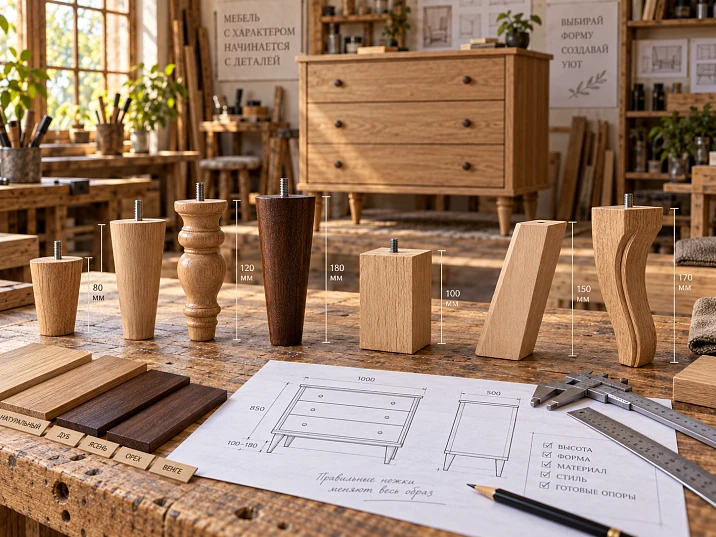
The chest of drawers is assembled, the drawers slide smoothly, and all that's left is to put it on its legs. It's at this step that it most often turns out the final height came out nine centimeters more than in the sketch. Or that a beautiful turned support widens toward the bottom and sticks out from under the side panel. Installation has nothing to do with it: the mistake happened earlier, during selection.
Legs for a chest of drawers are chosen before calculating the final height of the furniture, not after assembling the carcass. The order is this: carcass, final height, required clearance from the floor, leg height, mounting plate, shape, material, item code, sample, set, purchase. Below is a breakdown of how to calculate the height, how many supports are needed, how to check the dimension with a 1:1 template before drilling the carcass, and which ready-made STAVROS models are already selected specifically for chests of drawers, wardrobes, and cabinets. How to screw in the studs and what is needed for that is not covered here: that is the subject of a separate step-by-step guide to installing legs on a chest of drawers.
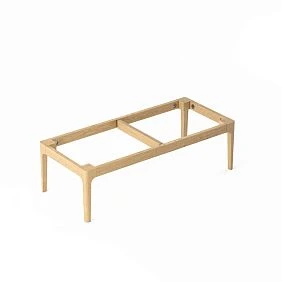
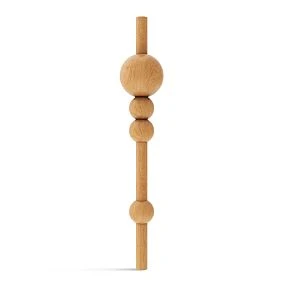
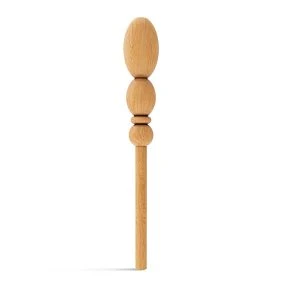
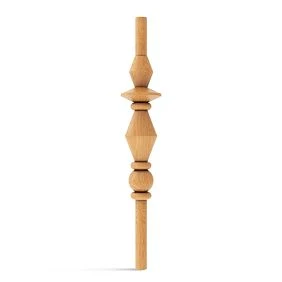
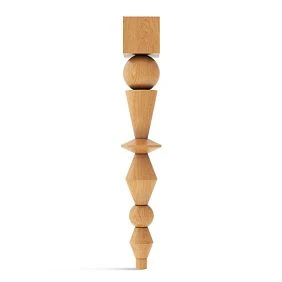
Legs are chosen before calculating the final height of the chest of drawers
The basic formula is simple: carcass height plus leg height equals the base final height of the chest of drawers. But this formula only works when you know both values in advance. If the carcass is already glued at 700 mm, and you choose the leg later to taste, the final height will be random.
So first determine three things: the carcass height, the desired height of the top of the chest of drawers, and the required clearance from the floor. Then look for an item code that falls within the required range. The reverse order (first a beautiful leg, then "we'll see what happens") leads to furniture that is either inconvenient to use or doesn't fit the interior.
There is also a structural reason. The leg attachment point must be provided for in the bottom drawing: reinforcement, thickness of the battens, position of the holes. If the carcass is assembled without taking the mounting plate into account, it will have to be reinforced retroactively, and that is extra work.




What to write down before opening the catalog
Five dimensions: body height without legs, target top height of the dresser, minimum clearance, size of the available mounting area at the bottom, and body weight with an approximate load. These figures turn the choice from "I like it" into selection by parameters.
Our factory also produces:
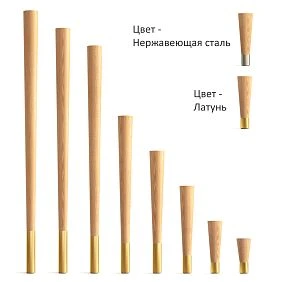
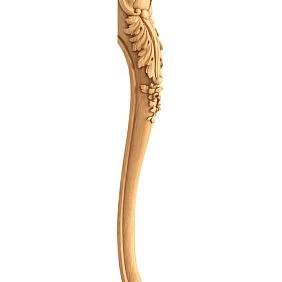
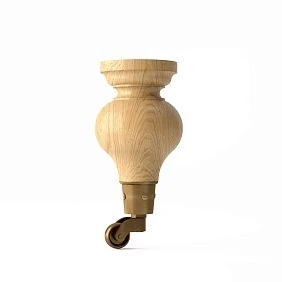
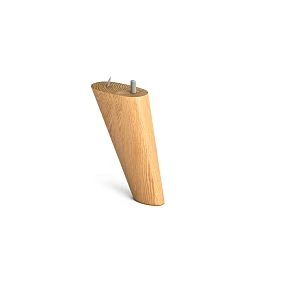
Catalog for dressers
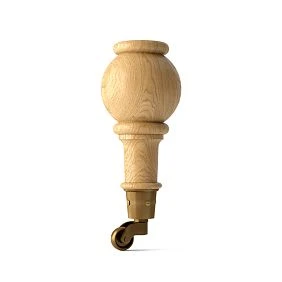
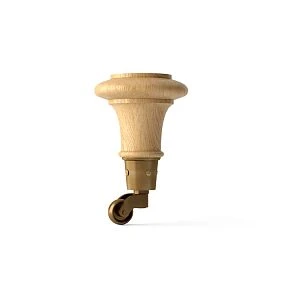
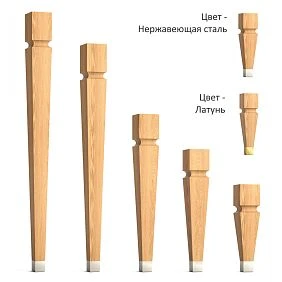
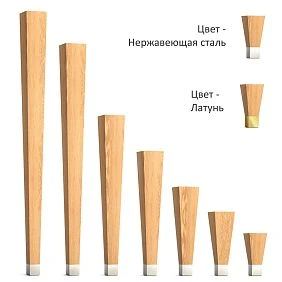
For this task, it is convenient to start with the section wooden legs for a dresser, cabinet, and nightstand. It is already filtered by application, and it contains about thirty models: turned, geometric, modern, with metal and polyurethane decor. Prices in the list start at 370 rubles (MN-222) and go up to 8,790 rubles (spherical MN-235), data at the time of checking. A spread of more than twenty times shows that the choice of shape affects the budget more than the choice of wood species.
Get Consultation
What height of legs to choose for a dresser
There is no universally correct height; there is a dependency. A tall leg raises the body more, increases the clearance, visually lightens the furniture, and changes the overall proportion. A low one makes the body visually more massive, reduces the clearance, and brings the dresser closer to a plinth composition.
What this means in practice. A dresser on tall legs looks airier and is better suited to small rooms: the floor beneath it is visible, and the space reads as wider. A dresser on low legs or almost on a plinth looks solid, but it is harder to clean underneath. The question of taste comes down to function: the lower the leg, the more important it is to decide in advance how you will clean under the dresser.
In the general text description of the section, the manufacturer calls 100–200 mm the usual range for cabinet furniture. This is a guideline, not a standard: the catalog itself includes noticeably lower supports and higher ones. For example, the geometric leg MN-209, according to the product card description, is available in two heights, 130 and 160 mm, which fits within this range.
How to choose within the range
Set a tolerance for the final height, say ±10 mm, and select models from the catalog whose heights fall within the required range. Then compare by shape. If no tolerance is set, you will pick the first height you come across and adjust everything else to fit it.
The "by eye" mistake
People often choose the height by looking at a photo of the chest of drawers in the catalog. But the photo shows neither the height of the cabinet nor the scale of the room. The same chest of drawers on a 150 mm leg looks one way in an interior photo, and another way in your room with a low ceiling. Check the numbers, not your impressions.
First, calculate the final height of the chest of drawers
A simple example. Cabinet 700 mm, leg 150 mm: base final height 850 mm. If you replace the 150 mm leg with a 240 mm one, the chest of drawers rises by another 90 mm and reaches 940 mm. A difference of nine centimeters substantially changes three things.
Ergonomics. The top drawer ends up higher, and it becomes harder to reach. For a tall person this is not a problem; for a short person it may become one.
Proportion. A chest of drawers stretched in height looks slimmer, but its relationship to width changes. A proportion that worked in the sketch is lost at +90 mm.
Relationship to neighboring furniture. A chest of drawers next to a windowsill, bed, or nightstand should read at the same height as them. A nine-centimeter difference catches the eye.
How to calculate with the model in mind
For MN-209 with a 700 mm cabinet, the result is 830 mm with a 130 leg and 860 mm with a 160 leg. The difference between the options is 30 mm, so you can finely adjust the final height. But remember: the formula does not account for the thickness of the glide, mounting plate, or adjustable support. If they are present, add them. For MN-209, the recommended glide is square 25 × 25 mm (FUR-023, 110 rubles at the time of checking); confirm its thickness in the product page.
About structural elements
The formula "body plus leg" works when the leg is attached under the bottom. If the leg goes into the plinth, apron rail, or mounting frame, part of its height may "disappear" inside the body, and the result is different. Check the drawing to see how the leg connects to the body in your project, and calculate the visible height, not the full length of the part.
Example table
| Body | Leg | Final height | Change |
|---|---|---|---|
| 700 мм | 130 мм | 830 мм | Base |
| 700 мм | 150 мм | 850 мм | +20 mm |
| 700 мм | 160 мм | 860 мм | +30 mm |
| 700 мм | 240 мм | 940 мм | +110 mm |
Body 700 mm as a placeholder. Substitute your own.
Floor clearance: why it is needed beyond design
The designer chooses the leg height based on appearance, while clearance is a functional parameter. It determines whether you can clean under the furniture, whether a robot vacuum can pass, and whether the chest of drawers will hit the baseboard or an outlet.
Check five things. Cleaning access: whether a mop and vacuum attachment can pass under the chest of drawers. Robot vacuum: if you have one, find out its height, and the clearance should be noticeably greater. Baseboard: a chest of drawers placed flush against the wall rests against the baseboard with its protrusion, so the distance from the wall to the leg and the depth of the chest of drawers need to be coordinated. Wall outlets: protruding outlet bodies and covers may prevent the chest of drawers from being placed flush. Visual lightness: clearance creates a sense of air under the furniture.
About glides and floor covering
A glide adds height and protects the floor. Felt ones for parquet and laminate, hard ones for soft coverings. The catalog offers, for example, the square FUR-023 (110 rubles) and other options from the recommended hardware. Their thickness reduces the clearance by exactly their size.
Clearance and cleanliness
In the general section description, the manufacturer notes that furniture on legs is easier to clean under and air out, and the load is distributed through the supports. This is an argument in favor of noticeable clearance where hygiene matters: in bedrooms and children's rooms. But in pantries and entryways, where furniture stands along the wall and cleaning underneath is not needed, you can choose a low support.
Quick check
Take the item that should pass under the dresser (a vacuum attachment, a mop, the height of a robot vacuum) and measure it. Then subtract the thickness of the foot pad from the height of the leg. Compare the resulting clearance with the measured height of the item, allowing for extra margin.
Four legs are not always enough
You cannot write that "any dresser is placed on four legs." It depends on the width, depth, bottom construction, weight, drawer load, rigidity of the body, and the way the load is transferred.
For a compact dresser with a rigid base, four corner legs are usually sufficient. For a long or heavy body, the designer must separately check whether an additional central support is needed. In the general text of the section for dressers, the manufacturer also notes that long dressers require intermediate supports to avoid sagging, but does not specify exact thresholds, so the decision is made by the product designer.
Simple rough calculation
Suppose the body weighs 60 kg and the contents weigh 90 kg. That is 150 kg total, or 37.5 kg on average per each of four supports. But the load is uneven: if heavy items are placed at one edge, two supports may take twice the average, that is about 75 kg each. The manufacturer states a vertical load of at least 100 kg for all furniture legs. In our conditional example there is a margin, but it is small. For a dresser weighing 300 kg, the average on four supports will be 75 kg, and with uneven loading the stated minimum will easily be exceeded. Then six supports or more massive legs are needed, and the specific values must be confirmed with the manager for the selected model.
The figures are conditional: they show the order of reasoning, not a design calculation. The engineering check of the structure and bottom is performed by the furniture designer.
What determines the number of supports
Width: the longer the dresser, the more the bottom sags between the supports. Bottom rigidity: a solid bottom or a bottom with a frame resists sagging better. Load: a dresser with books or dishes is heavier than a dresser with linens. Drawer placement: heavy lower drawers load the center.
Set
For a complete set, you can order four, five, or six identical legs. The center support must be the same height as the corner ones, with a tolerance of fractions of a millimeter, otherwise the dresser either wobbles or sags. Order all supports in one batch and one model.
The mounting plate matters more than a beautiful shape
Before buying a SKU, check the top part of the leg. It must physically fit under the bottom, onto the rail or reinforcement, within the allowable offset from the edge. If the leg is 90 mm wide and the available zone under the body is 65 mm, a beautiful design no longer matters.
Check not only the dimensions A × B × C, but also the mounting plate. This is the surface of the top part where the leg meets the body. On a turned leg it is round; on a geometric one it is square or rectangular. The size of the plate determines the minimum zone that must be provided for in the bottom drawing.
What to look for in the product card
Part dimensions, the diameter or side of the top, the mounting method (hanger bolt, screw, plate), and the recommended hardware. In the recommended hardware for the legs in this section, you will find a metric hanger bolt or M8x60 self-tapping screw (FUR-001-1, 72 rubles), FUR-001 (117 rubles) and FUR-012 (152 rubles) fastener sets, and glides. A hanger bolt length of 60 mm means the block under the leg must be thick enough.
Bottom material
Fasteners behave differently in particleboard, MDF, and solid wood. In particleboard and MDF, a leg on a hanger bolt holds worse than in solid wood, and reinforcement is usually added at the bottom: a block or a mounting insert. The load on the dresser is transferred through this reinforcement, not through the thin panel. Such issues are resolved by the designer, and the catalog leg only needs to fit the plate dimensions.
Photo error
You cannot choose the mount and size from a photograph. The image does not show the top diameter or the hole position. Always check against the dimensions in the product card table, which opens via the "All sizes and prices" button.
How far from the cabinet edge to place the legs
There is no single universal size, there is a system. Take into account the edge of the side panel, the front line, the overhang of the countertop, the plinth, and the visual vertical.
If a leg is placed too close to the edge, the side panel acts under cantilever bending. If it is too far from the edge, the leg looks "sunken" and the chest of drawers appears to stand on a small spot. The middle ground between these extremes is determined by the design and appearance.
This is especially important for a shaped leg: its overall dimensions may extend beyond the mounting axis. A conventional example. A side panel 18 mm thick, the top plate of the leg 60 × 60 mm, an offset to the outer edge of 20 mm. Then the center of the mount is 50 mm from the edge. But if the leg widens downward to 80 mm, its outer contour in the lower part will extend beyond the cabinet edge by 10 mm on each side. The mounting axis is fine, but the appearance is ruined.
About the front and the countertop
A chest of drawers with an overhanging countertop visually "hangs" over the legs, and the legs can be placed slightly deeper. A chest of drawers with a countertop flush with the side panels requires the legs to be closer to the edge for a stable look. A protruding front also matters: the front legs are often placed with reference to the front line rather than the side panel.
Symmetry
Position the legs symmetrically relative to the axes of the chest of drawers: offsets from the front and rear edges, offsets from the left and right side panels. Asymmetry is clearly visible on low furniture. Mark the position of each leg with a template before drilling.
Why a leg may visually "stick out" from under the chest of drawers
A typical mistake: the drawing only marks the center of the mounting point. But the actual leg widens toward the bottom, has an asymmetrical profile, or is rotated at an angle. As a result, an extra protrusion appears on the side that was not in the sketch.
The reason is simple. A chest of drawers drawing usually shows the overall dimensions of the carcass and the mounting points, while the leg contour is schematic. When the leg is installed, its actual profile extends beyond the line the designer expected.
How to check this. Draw the leg contour at full scale according to the drawing from the product card and align it with the carcass contour in the front and side views. Pay attention to three places: the bottom diameter or width, the greatest widening along the height, and how the contour behaves relative to the outer edge of the side panel.
Profile and rotation
Tapered legs narrow toward the bottom, so their largest dimension is at the top and they do not protrude. Legs that widen toward the bottom (with a ball, onion, or cabriole shape) protrude at the bottom. Legs rotated at an angle protrude in the direction of rotation. For a chest of drawers standing against a wall, the side protrusion is less noticeable than for one standing in the middle of a room.
Useful words for checking
Leg overhang, contour, template, position relative to the front, symmetry. If you cannot apply at least one of these words to your project, then the check is not complete.
Geometric wooden legs for a modern chest of drawers
Geometric legs are suitable for minimalism, modern classics, clean-lined fronts, and straight lines. In the section geometric legs supports with facets, bevels, and crisp edges are collected.
The list for chests of drawers includes many geometric items at very different prices: MN-146 from 470 rubles, MN-193 from 520, MN-192 from 930, MN-186 from 990, MN-214 from 1,240, MN-227 from 1,400, MN-186-1 from 2,220, MN-206 from 2,660, MN-205 from 4,020, MN-186-2 from 6,860 rubles. Prices at the time of checking. The difference reflects the size and complexity of the shape.
What matters when choosing
A geometric leg has no decorative elements that draw attention, so proportions and the wood surface come to the fore. Sharp edges require high-quality sanding. The “Prestige” level (hand sanding with no need for additional finishing) is justified here more often than for turned shapes intended for enamel.
On installation: straight geometric legs usually have a square top plate, which is more convenient for mounting onto a block. But orientation matters: the face of the leg should run parallel to the face of the cabinet. Even a slight rotation is immediately noticeable.
Model MN-186-1 and a ready-made solution
Leg MN-186-1 is made from oak and beech; in the list for chests of drawers it is priced from 2,220 rubles. On STAVROS it is used in a ready-made solution chest of drawers KMD-016. This page did not open when preparing the article, so check the composition and dimensions of the chest of drawers on it yourself. The idea matters regardless of the details: a leg should be evaluated not on its own, but as part of the lower composition of the furniture. For MN-186-1, the recommended glides are: round FUR-021 (d=19 mm, 130 rubles) and felt FUR-027 (d=24 mm, 55 rubles).
Geometric leg MN-209 for a modern chest of drawers
Leg MN-209 is described in the product page as a geometric support made of solid beech or oak without painting. It is suggested for use on chests of drawers, benches, poufs, tables, and consoles. There are two height options: 130 and 160 mm. Fasteners are not included: the recommended option is the square glide FUR-023 (25 × 25 mm, 110 rubles). The lead time according to the product page is 5–10 days. In the related products block, the following handles are offered: Tetras HL-033 (from 680 rubles), Carre HL-016 (from 1,010), and Plato HL-015 (from 1,100), a mirror frame, and molding MLD-063 (from 360 rubles).
Note two points. First: the description states that the legs are fitted with metal tips that protect the wood from abrasion, while the recommended hardware suggests a separate glide. Clarify exactly what is included in the set and whether an additional part is needed. Second: the general benefits stated in the description (treatment against moisture, fungus, and insects) are not confirmed in the Q&A section, so do not include them in the project without checking with the manager.
An example of MN-209 in use is shown in the completed solution KMD-018 chest of drawers, whose page did not open when preparing the article. The point of the section is that you should choose a leg not separately from the cabinet, but as part of the entire lower composition: the proportions of the leg, plinth, and front should be read together.
MN-215: when legs become a noticeable design element
Sometimes a leg stops being background and becomes the main accent. The geometric model MN-215 is one of them. Its use is shown in the solution KMD-020 chest of drawers. Both pages did not open when preparing the article, so see the dimensions, price, and specifications of MN-215 in the product card.
When a leg becomes an accent, the rules change. The cabinet should be calmer so it does not compete: smooth fronts, minimal decor, simple hardware. The color and species of the leg are chosen as part of the overall concept, not adjusted to match the cabinet. Check the composition on the template: an accent leg is often larger than a standard one, and its dimensions have a stronger effect on the side view.
Turned legs for a chest of drawers
Turned legs suit a more classic and softer furniture geometry. Lathe turning produces a round cross-section, beads, necks and transitions. The section Turned Legs contains supports of various shapes.
In the list for chests of drawers, turned models occupy the widest price range: MN-222 from 370 rubles, MN-145 from 470, MN-153 from 730, MN-155 from 740, MN-194 from 750, MN-145.2 from 670, MN-234 from 1,140, MN-148 from 1,250, MN-094 from 1,340, MN-149 from 1,360, MN-220 from 1,390, MN-217 from 1,490, MN-152 from 2,000, MN-233 from 2,200, MN-199 from 2,240, MN-239 from 5,370, the spherical MN-235 from 8,790 rubles. Prices at the time of checking.
How to choose a turned shape
A simple cone without decorative elements (like MN-145) suits minimalist chests of drawers and is inexpensive. A leg with beads and necks adds rhythm. Legs with metal or polyurethane decor (MN-199, MN-152) provide an accent, but require coordination with the rest of the hardware.
The round cross-section of a turned leg has no front side, and rotation during installation does not affect its appearance. This simplifies the work compared to a geometric shape.
About lighting
Transitions and beads create shadows, but on low furniture the legs are often in half-shadow. Small profile details blend together in this case. If the chest of drawers stands in a dark corner, choose a profile with large and contrasting transitions.
MN-145.2: an example of a turned leg in a chest of drawers project
The MN-145.2 leg in the list for chests of drawers costs from 670 rubles. This is a simple turned support, which STAVROS produces in two versions. The unpainted model MN-145.2 suitable for painting together with the body. Version with coating MN-145.2M is already ready for installation. An example of use in a finished project is shown on the page dresser KMD-014. Neither the product cards nor the solution page opened while preparing the article, so check the dimensions and features there.
The division into unpainted and coated versions is typical for the catalog. If you need the body color, take the unpainted one and paint it with one system. If a ready-made coating works and you only have one dresser, take the coated version and save time.
An inexpensive leg doesn't mean a bad one
Compare: a set of four MN-145.2 will cost 2,680 rubles, while four MN-186-1 will cost 8,880 rubles. The difference is 6,200 rubles per dresser. For a series of ten dressers, it grows to 62,000 rubles. If a simple shape suits the project, there's no reason to pay for a complex one. This is a conditional calculation based on "from" prices; the actual price depends on size, wood species, and sanding.
Leg with a metal accent: example MN-200
Modern legs for a dresser often combine wood and metal. Leg MN-200 is classified as a turned leg with metal decor. An example of use is shown in the solution Chest of drawers KMD-017. The product card and solution page did not open while preparing the article, so I did not include prices and dimensions for MN-200. In the list for chests of drawers, a similar-in-concept model MN-199 (turned leg with metal decor) starts at 2,240 rubles.
The metal accent serves two purposes. It adds a modern touch to the turned shape and protects the lower edge of the wood from abrasion. When choosing such a leg, check how the metal combines with the chest of drawers' hardware: handles, hinges, and locks should be coordinated in color and sheen. A brass accent on the leg next to black handles looks accidental.
Beech or oak for chest of drawers legs
Briefly, because the comparison of species is covered separately. Here only the logic as it applies to a chest of drawers.
Beech is a dense, non-porous wood that the manufacturer recommends for products to be finished with enamel. Prioritize it for enamel, colored coating, and a calm, uniform surface. A chest of drawers painted white, gray, or colored is best placed on beech legs.
Oak is a dense, porous wood with a pronounced texture. Consider it when the texture is visible, oil, stain, or clear lacquer is used, and the body also has a visible oak structure. A chest of drawers made of solid oak finished with oil is logically placed on oak legs so that the species reads as a whole.
Glue-up grade
For opaque finishing, choose the "for enamel" grade; for semi-transparent, choose the "for tinting" grade. The difference matters: with a transparent coating, the contrasting lamellas of the "for enamel" grade will show through.
Sanding level
"Standard" is machine sanding at a more attractive price, "Prestige" is detailed hand sanding, after which the products require no additional finishing. For geometric legs with sharp edges intended for a transparent finish, "Prestige" is the smarter choice. For simple turned legs under thick enamel, "Standard" is often sufficient.
Ash and other species
The general description of the section mentions ash, walnut, larch, and coniferous species. But the cards of verified models list oak and beech. As stated in the FAQ section, products from other species are possible on a custom order basis if it is not a one-off item, that is, for batch production. For a single chest of drawers, expect oak and beech.
Unfinished legs or a ready-made finish
The choice is determined by who will finish the chest of drawers and how.
Unfinished legs are chosen when the craftsman wants to paint them together with the body, match the color of the fronts, or tint them independently. This is the main option for a workshop: you get a unified finishing system. In the section unfinished solid wood legs the main part of the catalog is collected.
Legs with a ready-made finish are chosen when a ready-to-use component is needed and the existing finish is suitable. The section legs with a ready-made finish saves time but limits the choice of color.
Recommended finishing sequence
The manufacturer provides four steps for lacquer or enamel: dust removal after sanding, even priming, matting after the primer has fully dried, and a final coat of lacquer or enamel in two layers with interlayer drying. It is better to paint the legs separately from the body, and install them after they have fully dried.
Regarding painting by the manufacturer: it is possible when ordering products totaling from 150,000 rubles. For a single chest of drawers this amount is unattainable, so plan your own finishing or a ready-made coating.
Timeline
Items in stock are stored in the warehouse unsanded and are shipped within three business days. If the item is not available, the average production time is 5–10 business days. For a chest of drawers, take this into account in advance: the legs must arrive before final assembly.
How to check the legs with a template before drilling the body
This is the cheapest way to avoid a mistake. The procedure is as follows.
-
Take the dimensions of the selected leg from the product card, including height, top platform, and maximum overall size.
-
Draw the outline of the leg at full size on cardboard: front view and side view.
-
Cut out the outlines and place the templates on the four corners of the bottom of the body.
-
Check the front view: whether the leg protrudes beyond the side panel, and whether the offsets are symmetrical.
-
Check the side view: how the leg aligns with the line of the front and the tabletop.
-
Step back three meters and assess the proportion.
-
Only after that, mark the fasteners.
This protects against the situation where the holes are already drilled, but the legs visually sit too wide or too deep.
What to check additionally
Template height: place a ruler against the cabinet and assess the final height of the dresser. Clearance: place cardboard of the required height under the cabinet and check whether the needed item will pass. Distance to the wall: if the dresser stands against the baseboard, make sure the legs do not rest against it.
Why do all this on paper
Paper costs pennies, while fixing holes in a finished cabinet is expensive. A 1:1 template lets you see what is not visible on a drawing: the real contour, the overhang, the proportions.
Buy one leg or a full set at once
For a new project, the scheme works like this: one sample, approval, then four, five, or six pieces. Until the sample is test-fitted on the cabinet, the batch is not ordered.
For an already proven model, you can work with an approved article number: you have the dimensions, knowledge of the fit, and the finishing result.
For a small series of chests of drawers, the rule is: one series equals one article number, one material, one finish. Mixing article numbers within a series produces different chests of drawers. Record in the specification the article number, wood species, glue-up grade, sanding level, size, and finishing system.
Conditions for a sample
The catalog ships items from a single piece, so you can take a sample without any commitment to a production run. Keep the lead times in mind: in-stock items ship within three business days, the rest within 5–10 business days. Order the sample in advance, before the final assembly of the carcass.
Calculating the set
A chest of drawers with four legs requires four identical ones. With six (with center supports), six identical ones. For a series of ten chests of drawers with four legs each, you need 40 pieces. Price example "from": leg MN-145.2 gives 40 × 670 = 26,800 rubles, leg MN-186-1 gives 40 × 2,220 = 88,800 rubles. Add hardware to this: for geometric legs with a square glide FUR-023 (110 rubles), that's another 4,400 rubles for 40 pieces. Determine the reserve based on the risk of defects during finishing and record it as a separate line.
Replacing legs on an old chest of drawers
This is a separate scenario, but it is not the focus of the article. Before purchasing, do five checks.
-
Remove the old leg and measure the height, the top plate, and the diameter or side.
-
Check the old holes: whether they are worn out and whether the fasteners have come loose.
-
Check the bottom: are there any cracks, rot, or signs of woodworm.
-
Check the other legs: are they the same in height and wear.
-
Determine the final new height: it may differ if you decided to change the shape.
If the exact old model is not available, it is often more sensible to replace the whole set rather than a single support. A new leg next to the old ones will differ in height by fractions of a millimeter, in tone, and in wear, and the chest of drawers will either wobble or look mismatched.
When to replace one
If one leg out of four is broken and the rest are intact, a model matching in height, diameter, profile, and mounting has been found to the nearest millimeter. In practice, this is rare.
Broken socket
If the socket for the dowel screw is broken, first restore it: with a sleeve, an insert, or an epoxy compound. A new leg will not hold in a broken socket. If restoration is impossible, a reinforced joint or another mounting method is needed, and that is up to a specialist.
Where to buy wooden legs for a chest of drawers
The main product destination for this task: the section wooden legs for a dresser, cabinet, and nightstand. It is already filtered by application.
Additional Items:
-
Wooden furniture legs: general catalog of supports.
-
Unpainted legs: for painting and tinting.
-
Turned Legs и geometric legs by shape type.
Order conditions
Items are shipped from one piece. Delivery is available across Russia and to CIS countries via CDEK and DPD, with pickup also possible. Showrooms are located in St. Petersburg and Moscow, production is in St. Petersburg. Cutting items to size is not performed. Non-standard items and required sizes are manufactured only for bulk orders. Before ordering, the manufacturer recommends preparing a design project by downloading drawings from the website. Check the current price and availability in the product card.
What to clarify with the manager
Availability of the complete set in one delivery, the hardware kit, exact top dimensions and height, the possibility of reserving the SKU for a repeat order, and for heavy chests of drawers, the permissible load for the selected model.
Craftsmen's questions
What height should the legs for a chest of drawers be?
One that makes the final height fall within your tolerance. Add the body height and the leg height with the foot pad: a 700 mm body and a 150 mm leg give 850 mm. The range of 100–200 mm is mentioned as typical for cabinet furniture, but the exact value is determined by the project.
Where to buy wooden legs for a chest of drawers?
In the STAVROS catalog in the section legs for a chest of drawers, wardrobe, and nightstand. Ordering is possible from one piece.
How many legs are needed for a dresser?
For a compact dresser, usually four. For a long or heavy body, the designer should check whether a central support is needed. Aim for a stated load capacity of at least 100 kg per leg and consider the actual weight of the loaded dresser.
Does a long dresser need a central support?
Often yes, so the bottom doesn't sag. The decision depends on the rigidity of the bottom and the weight, so check the construction. The central support should be the same height as the corner ones.
How do you calculate the total height of a dresser with legs?
Add the body height, the leg height, and the thickness of the foot pad or plate. Example: 700 + 150 = 850 mm. Replacing a 150 mm leg with a 240 mm one adds 90 mm.
Which legs are better: turned or geometric?
Turned for classic and soft geometry, geometric for modern minimalist dressers. First check the mounting plate and height, then choose the shape.
What to choose: oak or beech?
Beech for enamel and colored finishes, oak for oil, stain, and lacquer with visible texture. Choose the glue-up grade "for enamel" or "for tinting" according to the finish.
Can the legs be painted to match the front color?
Yes, this is the standard process for unfinished legs. Sequence: dust removal, primer, sanding, two coats of finish. Paint separately from the cabinet and attach after drying.
How do I check the leg size before drilling the cabinet?
Make a 1:1 cardboard template using the dimensions from the product card, place it on the bottom corners, and evaluate the front and side views. Only then mark the mounting points.
Can I replace just one leg of an old dresser?
Yes, if the height, profile, diameter, and mounting match to the millimeter. If the exact model is unavailable or the others are worn, it's better to replace the whole set.
Prices and contents of the dresser legs section, information about MN-209, ordering terms, glue grades, sanding levels, and the recommended finishing sequence were verified against the STAVROS catalog at the time of preparation. Calculations are illustrative.