


























Article Contents:
- Carved overlay L or R: what the sides mean in the article number N‑161.1
- When you need to buy N‑161.1L and N‑161.1R for furniture fronts
- When it is acceptable to order two identical wooden overlays
- How to arrange carved decor on two doors before placing an order
- Wooden overlay size 90 × 61 × 13 mm: checking the fields and gaps of the front
- How to calculate a mirror pair on fronts of different widths
- Four doors: how to count the number of L and R without the automatic "2 + 2"
- Scheme 1. Two independent mirror pairs
- Scheme 2. One large composition relative to the central axis of the cabinet
- Scheme 3. Repeating module
- Finish before installation
- Finishing after installation
- Mistake 1. Ordered two L for a mirror pair
- Error 2. Ordered two R's for the same reason
- Error 3. Decided the left one could simply be flipped over
- Error 4. Chose the sides before developing the composition
- Error 5. Measured the entire facade instead of the useful panel
- Error 6. Did not account for the 13 mm relief
- Error 7. Chose different material for the two halves of the pair
- Error 8. Mixed "Standard" and "Prestige"
- Error 9. Painted the parts without labeling L/R
- Error 10. Glued the first part before trying on the second
- Error 11. Automatically ordered 2 L + 2 R for four doors
- Error 12. We didn't check the article numbers upon receipt.
- How is N‑161.1L different from N‑161.1R?
- Can the left overlay be flipped and used instead of the right one?
- Which parts to buy for a two-door cabinet?
- Can I order two overlays N‑161.1L?
- Will the overlays fit an MDF facade?
- What should I choose for enamel: beech or oak?
- Do I need to paint the decor before gluing it on?
- How can I check the direction of the ornament before purchasing?
- What is the size of N‑161.1L and N‑161.1R?
- Can I place one L on the left door and one R on the right without a layout?
- How do I mark the overlays on two identical facades?
- What should I do if I bought two L ones?
- Do I need to order L and R at the same time?
- How not to confuse parts after priming?
- Can N‑161.1 be used on one door?
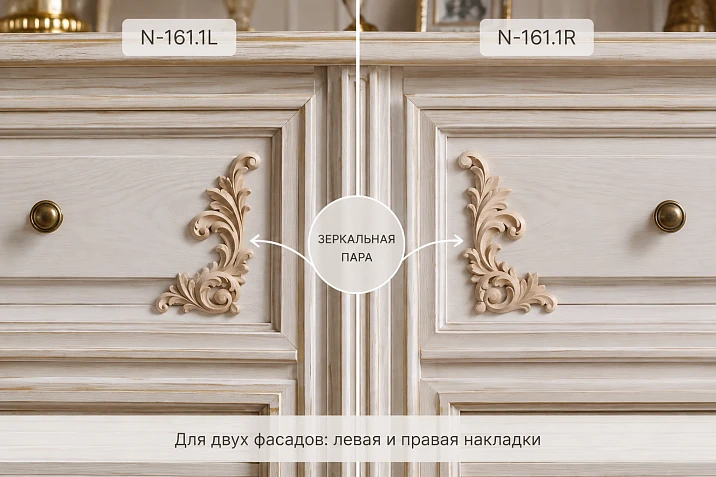
Two identical cabinet doors can be aligned to the millimeter, have identical frames, handles, and finish — and still look like two different halves of a composition. The reason is sometimes only discovered after a dry fitting of the carved decor: on both doors, the ornament "faces" the same direction. For a symmetrical two-door facade, this is perceived not as an intentional repeat, but as a direction error. It happens simply: the buyer saw almost identical names N‑161.1L and N‑161.1R, did not note the side on the diagram, and put two items of the same article into the order.
If a mirror composition is needed on two identical facades, the basic set is one buy wooden overlay N‑161.1L and one buy wooden overlay N‑161.1R. This is not a universal rule for any project: if the designer deliberately builds a repeating unidirectional rhythm, two L or two R may be needed. Therefore, the final decision is made not by the letter in the name or by a photo of one part, but by the layout of specific facades in their actual position.
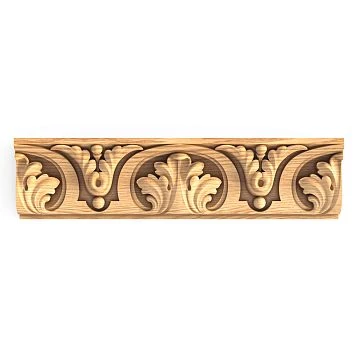
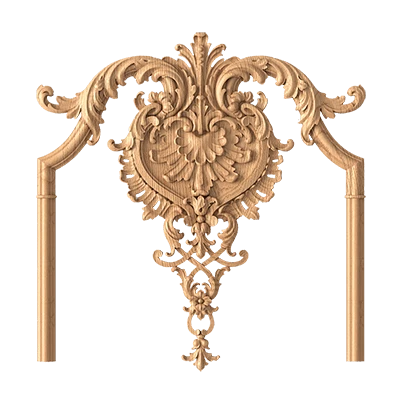
Both cards show the same size A × B × C × L — 90 × 61 × 13 × 90 mm, materials beech or oak, two sanding qualities — “Standard” and “Prestige”, as well as an enamel finish in the selected configuration. N‑161.1L and N‑161.1R are sold as separate items. Consequently, for the buyer, the question “which part is larger or smaller” is not central at all. You need to determine the direction of the ornament, the number of left and right elements, the margins on the facade, and the installation order.
Below is a practical selection scheme: how to read L/R, when a mirror pair is needed, when two identical overlays are acceptable, how to check the 90 × 61 mm rectangle on the facade, how not to confuse the sides after painting, and what to write in the order if the decor is placed on two, four, or more doors.
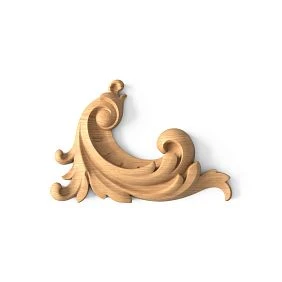
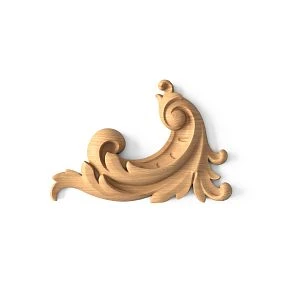
Carved overlay L or R: what the sides mean in the article N‑161.1
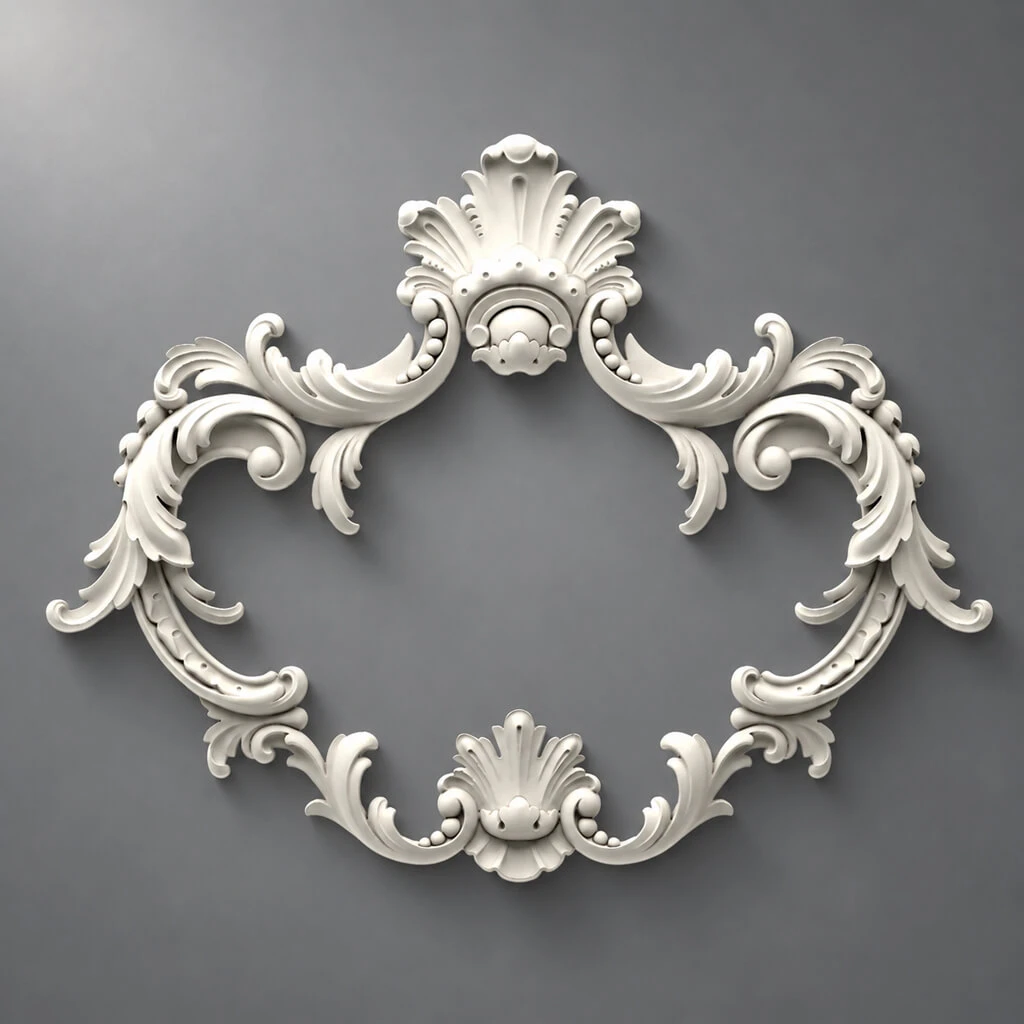
In the N‑161.1 line, there are two independent products — N‑161.1L and N‑161.1R. The designation L is used for the left version, R for the right. In practical design, this means that the parts should be perceived as oriented elements, not as two interchangeable instances of the same symmetrical ornament.
At the same time, the letters cannot be interpreted too primitively: “L is always placed only on the left door, R only on the right.” On the facade, what matters is not the name of the door, but how exactly the pattern should unfold relative to the central axis of the composition. If the doors are swapped, if the overlays are located not at the center but at the outer edges, if the facades are stacked one above another, or if the decor is used on side panels, the verbal “left/right” without a diagram easily leads to a new error.
The correct working principle is different: first draw the final composition, then compare it with the drawings of N‑161.1L and N‑161.1R, and only then assign a specific article to each position. If the finished ornament should mirror away from the central gap of a two-door cabinet, one side is made L, the other R. If the motif should run in the same wave from left to right across two facades, this is already a unidirectional repeat, where two identical versions may be needed.
Why can’t you choose based on the thumbnail in the catalog? A small photo does not show the context. The user sees one overlay without the adjacent part, and the brain easily perceives the direction as insignificant. The error becomes obvious only when two parts are placed side by side. Therefore, for oriented carved decor, the quantity is counted not only in pieces, but also by sides.
| Composition task | What to check | Probable assembly |
|---|---|---|
| Mirror pair on two doors | Ornaments should mirror each other relative to the central axis | 1 × N‑161.1L + 1 × N‑161.1R |
| Unidirectional repetition | Both motifs should face the same direction | 2 × L or 2 × R after checking the drawing |
| Four symmetrical panels | Determine the axis of each pair and the overall rhythm | The number of L/R is counted according to the scheme, not automatically 2 + 2 |
| One door | Direction relative to the handle, frame, and adjacent decor | One L or one R |
| Decor on the side panels of furniture | Evaluate the product's appearance from the left and right in the interior | According to the visual scheme of the object |
Once the L/R difference is understood, you can proceed to the section where they are presented Buy decorative overlays for furniture facades, but for the specific pair N-161.1, it is important to keep the article numbers separate in the specification. The entry "two wooden overlays N-161.1" is not precise enough: it does not specify which two.

When you need to buy N-161.1L and N-161.1R for furniture fronts
The clearest scenario is a two-door wardrobe with identical doors. The furniture has a central vertical axis: the gap between the doors. If the carved motif is meant to be perceived as a pair, the pattern on the left and right must be mirror-aligned relative to this axis. In such a situation, one L and one R piece provide the original structure for symmetry.
But mirror symmetry is needed not only for a wardrobe. The same principle works on two identical dresser doors, on paired panels of a sideboard, on cabinet fronts, on a double furniture panel, and on the doors of a tall cabinet if they form a single decorative plane. Everywhere, one question applies: does a person see two pieces simultaneously as a pair? If yes, the direction of the ornament becomes part of the composition.
For example, there are two doors each 400 mm wide with a technical gap between them. The overlays are planned to be installed at the top of each door at the same distance from the center. If L is used on both doors, the geometric coordinates will be symmetrical, but the motifs themselves will not be: they will repeat the same direction. Using L and R allows you to create a visual reflection.
There is another scenario — handles are located near the central gap, and the overlays should "frame" the handle area. Then it is especially important to decide whether the pattern should tend toward the center or diverge outward. Both logics can be design-justified, but they correspond to different L/R assignments. Therefore, in the order it is useful not only to specify "1 L + 1 R", but also to keep a small sketch showing which version goes on which door.
For two identical furniture fronts, the working algorithm consists of five steps:
- Determine the central axis of the entire pair.
- Draw the contours of both doors as two rectangles.
- Place a conditional overlay contour of 90 × 61 mm on each.
- According to drawings N‑161.1L and N‑161.1R, unfold the motifs as they should look after installation.
- Label each rectangle with the specific article number and only then transfer the quantity to the cart.
If the scheme looks mirrored and the article numbers are different — the initial logic is correct. If both rectangles are labeled L or both R, but the task was specifically mirrored, this is a reason to stop before payment.
Our factory also produces:
When it is acceptable to order two identical wooden overlays
Two identical versions are not an error in themselves. The error is ordering them for a project that required mirroring. A unidirectional ornament can be a deliberate decision, especially if the facades are read not as paired halves, but as a sequence of identical modules.
Imagine a long dresser with four identical vertical facades. The designer wants to create a rhythm in which each overlay repeats from left to right with the same direction of the plant motif. Here, two L's, four L's, or the corresponding number of R's may well be the correct order. A mirrored layout, on the contrary, would break the rhythm into pairs.
Another example — two overlays are installed not on adjacent doors, but on different pieces of furniture in the same room: on a nightstand to the left of the bed and on a console against the opposite wall. If the elements are not perceived as a mirrored pair, the same orientation can support a unified motif of the space.
The third situation is an asymmetric composition. On one door, next to N‑161.1, there is another carved element, and the direction of the entire group is set by that neighboring ornament. Then the choice of L/R is determined not by the pair of doors, but by the local composition of the specific door.
There is also a technical scenario of repeated renovation: one old overlay has been preserved, the second needs to be replaced. If the task is to repeat the existing direction, first determine which article corresponds to the preserved part. Automatically ordering a "mirrored second" is wrong if the original furniture design was unidirectional.
Therefore, before purchasing two identical parts, it is useful to complete the phrase: "I am choosing two L's (or two R's) because...". Good answers are specific: "a unidirectional rhythm of four facades is needed", "I am repeating an existing part", "the two panels are in different places and do not form a pair". A bad answer is "they look almost the same".
Get Consultation
How to lay out carved decor on two doors before placing an order
The most reliable way to avoid an L/R error is to do a dry layout before purchasing. If physical parts are not yet available, use a printed image or a contour from a drawing. It is important to preserve the direction, not the artistic accuracy of the drawing.
First, measure each door. Record the width and height not according to the furniture design, but according to the finished facade, if it has already been made. Separately measure the frame, panel, distance to the handle, hinge zone, milling, and other applied decor. Then determine the useful field — the part of the facade where N-161.1 does not conflict with neighboring elements.
Next, make two paper rectangles measuring 90 × 61 mm. This is not a copy of the carving, but a dimensional template. Place them on the fronts at the intended location. If the pattern should be mirrored, draw an arrow or a conditional branch on one template for L, and a mirrored one for R on the other. Such a simple mock-up is much better than a verbal explanation like "left, sort of here."
After choosing the position, draw center lines. For two identical doors, it is desirable that the installation height be measured from the same reference point — for example, from the top edge of the front. The lateral position is also set by the same principle: from the central gap, from the outer edge, or from the vertical axis of each door. You cannot measure from the outer edge on one leaf and from the inner edge on the second if the frame dimensions differ.
For a cabinetmaker, it is convenient to create a table:
| Position | Facade | Article | Vertical offset | Horizontal offset | Direction of the motif |
|---|---|---|---|---|---|
| 1 | Left leaf | N‑161.1L or R per drawing | From a common baseline | From the selected axis | To the center / from the center |
| 2 | Right leaf | Mirror version | Same value | The same rule | Mirror of position 1 |
If the facades are not yet hung, temporarily label each on the back as "left" and "right" relative to the finished cabinet. Otherwise, after rearranging on the workbench, you might accidentally swap them and transfer the correct layout to the wrong leaf.
Wood overlay size 90 × 61 × 13 mm: checking the fields and gaps of the facade
Cards N‑161.1L and N‑161.1R indicate the same size A × B × C × L — 90 × 61 × 13 × 90 mm. For checking flat placement, the dimensions 90 and 61 mm are critical, while the relief dimension 13 mm must be considered when adjacent to a handle, protruding frame, or other parts. The exact A/B orientation on a specific facade should be taken from the drawing, so the calculation is performed in two possible positions if the orientation is not yet determined.
A simple formula is used for centering:
Field on each side = (size of available area − size of overlay along that axis) ÷ 2.
Suppose the useful width of a smooth panel is 300 mm. If the 61 mm dimension is placed horizontally, centering will leave:
(300 − 61) ÷ 2 = 119.5 mm of free field on each side.
If the overlay is rotated so that it occupies 90 mm horizontally:
(300 − 90) ÷ 2 = 105 mm.
Both options fit, but the visual proportion will be different. Now let's imagine a narrow panel of 140 mm. With 90 mm horizontally, only 25 mm remains on each side. Mathematically, the part fits, but a practical assessment should consider the frame pattern, relief depth, proximity of the handle, and whether the ornament looks cramped.
If the facade has a frame construction, you need to measure not the entire door width, but the inner usable field. For example, a door of 400 mm, with a frame of 70 mm on each side. The central zone is about 260 mm. This is what is used in the calculation if the overlay should not extend onto the frame profile.
For a symmetrical pair, additionally check the equality of the margins. Suppose the left door has a usable zone of 260 mm, the right one after adjustment or due to a design difference — 256 mm. With a horizontal overlay size of 90 mm, the margins will be 85 and 83 mm respectively. The difference is small, but if a strict panel runs nearby, it may be noticeable. In this case, it is better to set the position from the common central axis of the cabinet, rather than centering each overlay independently.
The thickness/relief of 13 mm also matters. If a furniture handle with a small height above the plane is installed nearby, or the door of another cabinet passes by, check for a volumetric conflict. The overlay may fit comfortably in the 90 × 61 mm projection and still interfere with an adjacent part in space.
How to calculate a mirror pair on facades of different widths
Sometimes doors visually form a pair but have different widths. For example, one covers the main compartment, the second covers a narrow pencil case. Trying to center N‑161.1L and N‑161.1R on each door separately will result in the overlays being at different distances from the central joint. For a mirror composition, this may be undesirable.
Here, first choose what symmetry is more important relative to: each door or the common axis of the furniture. If the overlays should "frame" the central gap, set the same distance from the joint to the nearest reference point of the overlay. If they should be perceived as an independent sign in the center of each panel, center them on each panel.
Consider a conditional example. The left usable area is 320 mm wide, the right one is 260 mm. The overlay is oriented with a size of 61 mm horizontally. With independent centering, the side margins will be 129.5 and 99.5 mm. From the central joint, the overlays will be at different distances if the inner frames are the same. If you set the same indent, for example 60 mm from the inner edge of the usable area, the outer margins will be different, but the central composition will become rhythmic.
There is no universally correct solution. It is important to decide before ordering, because the chosen L/R orientation may depend on whether the motif is directed toward the central axis or toward the center of each individual panel.
Four doors: how to count the number of L and R without the automatic "2 + 2"
A four-door wardrobe seems simple: two pairs of doors — that means two L and two R. But this is only true for one specific composition logic. There are at least three possible schemes.
Scheme 1. Two independent mirror pairs
Doors 1–2 form the left pair, 3–4 form the right pair. Each needs its own mirror reversal. Here, indeed, it can result in 2 L + 2 R.
Scheme 2. One large composition relative to the central axis of the wardrobe
All four facades are read as a single canvas. The inner overlays can be directed toward the center, the outer ones can repeat or reverse the motif differently. Simple 2 + 2 no longer guarantees the desired pattern: you need to draw all four positions.
Scheme 3. Repeating module
All four overlays go in the same direction. Then the set can consist of four L or four R. This option is especially natural for a long rhythmic facade without a pronounced center.
Therefore, for a serial order, a positional list is used: "facade 1 — N‑161.1L, facade 2 — N‑161.1R…". Recording only the total quantity "4 pcs." is insufficient. The more leaves there are, the higher the cost of an error: you may need to reorder not just one part, but sometimes half a set.
Carved overlays from beech or oak: what to choose for enamel and tinting
Both versions of N-161.1 are available in beech and oak. For a paired composition, the material must be selected as a single characteristic of the set. Mixing beech on one door and oak on the other is only acceptable as a deliberate design choice; for a regular mirrored pair, this creates an unnecessary difference in texture and reaction to transparent finishes.
If the decor will be covered with opaque enamel, preparation "for enamel" is important. In STAVROS materials, this option is described as a blank where lamellas are not matched by color and texture, since the surface is intended for dense tinting or enamel painting. For transparent or semi-transparent finishes, a different approach is used—matching by color and texture, meaning the finishing scenario must be agreed upon before purchase.
This is especially important for a mirrored pair. Two overlays are placed side by side, so any difference in treatment is more noticeable than for parts in different rooms. It is better to order L and R simultaneously, from the same wood species, with the same preparation quality and one finishing plan.
Oak is chosen when the wood grain should participate in the composition under stain, tinting, or clear varnish. Beech has a calmer texture and is convenient for even coloring. But the card of the specific selected configuration shows "for enamel," so if the task is transparent finishing, the available combination of material and gluing quality must be rechecked at the time of ordering.
In the general section, you can to buy carved wooden decor and to select additional elements for N-161.1, but combining different parts into one furniture composition should be based on a single material and finish. Carved decor on two facades quickly reveals accidental mixing of textures.
Sanding "Standard" or "Prestige" for furniture decor
STAVROS divides surface treatment quality into "Standard" and "Prestige". For "Standard", milling and machine sanding are provided; slight traces of the cutter, roughness, and fuzz within the manufacturer's established limits are allowed. "Prestige" additionally includes detailed manual sanding, especially important in hard-to-reach areas of the carving.
For N‑161.1L and N‑161.1R, the sanding issue must be resolved simultaneously. If one half of the pair is ordered in "Standard" and the other in "Prestige", after opaque painting the differences may diminish, but the technological preparation path will be different. For transparent finishing, inconsistency may manifest more strongly. Therefore, the specification of a mirrored pair must be identical in surface quality.
"Standard" is suitable when the workshop performs the preparation itself, controls priming, intermediate sanding, and finishing. "Prestige" is more convenient when a more thoroughly prepared surface is required before applying paint and varnish materials. The choice depends on the project technology, not on which label looks "more premium."
Before painting, both parts need to be laid out in the correct orientation and marked on the back side. Otherwise, after priming and the first coat of enamel, visual directional cues may become less obvious, especially if the parts are lying separately from the facades.
Can the N‑161.1L be flipped over and used instead of the N‑161.1R
This is one of the most dangerous ways to "fix" a mistaken order. In a flat graphic ornament, mirroring can be achieved by reflecting the image. A physical carved part has a front and back side, relief, a contact surface, and a machining direction. Simply flipping it face toward the facade does not create a proper right-hand version.
Rotating the part 180 degrees in its plane is a different action: it changes the top and bottom of the motif but does not turn left geometry into mirrored right geometry. In some compositions, a rotated ornament may look acceptable, but that is a new design scenario, not a technical replacement of R for L.
Therefore, the rule is simple: if the project requires a mirrored pair, use separate L and R versions. Check the possibility of an unusual rotation on the full drawing, not as a way to salvage an incorrect quantity after receipt.
How to attach wooden decor to a furniture facade
Installation begins not with glue, but with a dry fit. STAVROS recommends first placing the decor on the surface to be decorated and making markings. For the N‑161.1 pair, this is the ideal moment for a final check of the sides: both overlays must lie on their respective facades, and the craftsman must see the final direction of the ornament before applying glue.
After the dry fit, it is useful to apply masking tape along the reference lines. On two doors, the markings are made from the same base points. If the facades can be removed, lay them out side by side on a flat surface in exactly the order they will hang on the furniture. Do not turn one door "for convenience of work," otherwise the mirrored layout will visually change.
The choice of glue depends on the decor material and the surface condition. In the manufacturer's recommendations for small solid wood decor on an unpainted surface, PVA Kleiberit 303.0 D3 is specified, and for primed or painted small decor, supergel. For large elements and painted bases, the scheme is different. N‑161.1 has a maximum dimension of 90 mm, so according to the table classification it belongs to small decor, but the actual glue should always be selected based on the specific facade and finish materials.
The provided linking scheme includes a card Buy mounting adhesive for wooden decorThe mere fact that this product is in the catalog does not mean that it is automatically the only correct glue for any N‑161.1 on any facade. First, match the surface and finish condition with the manufacturer's table.
After applying the compound, the part is pressed according to the markings in accordance with the recommendations of the chosen glue. Excess is removed in a way that does not damage the primer or finish. Until full setting, displacement of one half of the pair must not be allowed: even a few millimeters of difference on two identical doors is more noticeable than on a single facade.
Paint the overlays before gluing or after installation
There is no single answer for all furniture manufacturers. There are two technological schemes, and each requires L/R control.
Finishing before installation
The advantage is that the craftsman can thoroughly paint the relief and end sections without fear of staining the facade. The disadvantage is that you need to choose a glue compatible with already painted surfaces, and avoid damaging the finish when gluing. Before finishing, the parts must be marked on the back as L and R and indicate the position on the facade.
Finishing after installation
The overlay and facade are primed and painted as a single surface. This is convenient for opaque enamel and a seamless visual result. But after gluing, correcting a side error is much more difficult. Therefore, a dry fit becomes a mandatory control operation.
If L and R are painted separately on different days or with different batches of material, a slight difference in shade or gloss is possible. For a paired facade, it is better to run both parts through the same technological sequence.
MDF facade overlays: what to check
The mere fact that N‑161.1 is made of wood does not require a wooden facade. Decorative overlays are often used on various types of furniture surfaces, but compatibility is determined by the base, finish coating, and attachment method.
For MDF, check whether the facade is raw, primed, painted, or laminated. These surfaces have different adhesion. With a smooth factory coating, you cannot automatically use the technology for raw MDF. If the facade is already finished, it is useful to test the system on an inconspicuous sample.
Also consider the milling. The overlay should rest on a flat surface, not cover a deep groove where a significant part of the back side will remain without contact. If the facade is framed, the useful area is measured inside the profile.
For a mirrored pair of MDF facades, separately check whether their actual dimensions differ after edging and adjustment. The decor is marked on installed furniture or according to an accurate assembly diagram.
How to buy decorative overlays for furniture and not mix up the L/R quantity
The most reliable order is positional. Instead of "N‑161.1 — 2 pcs.", write two lines:
- N‑161.1L — 1 pc.;
- N‑161.1R — 1 pc.
Next to it, indicate the material, sanding quality, and surface preparation. If there are four or six facades, list each item according to the scheme. This takes a few minutes but eliminates the main source of error.
For furniture production, it is convenient to assign numbers to facades. For example: F1, F2, F3, F4. Then the specification looks like "F1 — L, F2 — R, F3 — L, F4 — R". Upon receiving the parts, you can lay them out directly on the labeled positions and check the set before painting.
If you need Buy Wooden Covers along with other elements, do not combine all positions into one line "carved decor - set". For oriented parts, the article number is more important than the general name.
Commercial queries like "buy furniture overlays" or "buy decorative overlays for furniture facades" describe the correct product group but do not solve the side issue. The buyer must get down to the level of a specific article number.
What to check when receiving N‑161.1L and N‑161.1R
Acceptance of a pair starts with the article number. Do not rely only on external similarity. Verify the marking and documents: it must be exactly the L/R combination that is recorded in your scheme.
Then place the parts side by side with the front side up and compare the direction of the ornament. If a mirror pair was ordered, they should visually reflect each other in the required orientation. After that, place each on a paper or real facade and repeat the check already in the context of the furniture.
Also check the dimensions, material, sanding quality, and the selected preparation option. If one part is oak and the other is beech, or the surface qualities differ, such an error is better detected before finishing.
Do not mix parts from several pairs at once. When ordering, for example, ten overlays for five cabinets, it is better to first sort them into sets. For natural wood, it is also useful to assess the visual compatibility of adjacent elements, especially if a transparent finish is planned.
Mistakes when purchasing N‑161.1L and N‑161.1R
Mistake 1. Ordered two L for a mirror pair
The reason — they relied on the general name N‑161.1 and did not include the side in the specification. The consequence — the ornaments look the same. The solution — treat L and R as separate product items.
Mistake 2. Ordered two R for the same reason
The error mechanism is identical. Before payment, check not the "2 pcs" amount, but the cart lines.
Error 3. Decided that the left one can simply be flipped over
Rotating a physical carved part does not create a mirror copy. A mirror ornament requires the corresponding version.
Error 4. Chose the sides before developing the composition
Even correct L and R can be placed in the wrong direction if it hasn't been decided whether the motif should face the center or outward. Sketch first, then article numbers.
Error 5. Measured the entire facade instead of the useful panel
The overlay fits within the overall door width but overlaps the frame or routing. Check the actual installation area.
Error 6. Did not account for the 13 mm relief
Everything fits on the plane, but the decor conflicts with the handle or the adjacent door leaf. Check the volume.
Error 7. Different material was chosen for the two halves of the pair
After transparent finishing, the difference between beech and oak will become part of the facade. If this is not a design idea, the set must be uniform.
Error 8. Mixed "Standard" and "Prestige"
Two adjacent parts undergo different surface preparation, which complicates achieving an identical finish.
Error 9. Painted parts without labeling L/R
After finishing, elements were placed on the wrong fronts. Marking on the back side solves the problem in advance.
Error 10. Glued the first part before test-fitting the second
The position of the first seems good on its own, but after installing the second, a difference in heights or offsets is revealed. Always mark the pair simultaneously.
Error 11. For four doors, automatically ordered 2 L + 2 R
The quantity turned out to be formally balanced, but the design required a unidirectional rhythm. Counting should be done by positions.
Error 12. Did not check article numbers upon receipt
The error was only discovered after priming. L/R control should be the first action upon unpacking.
When not to buy N‑161.1L/R for a facade
Not every furniture facade benefits from this pair. If the usable area is so small that there is no visual breathing room around the 90 × 61 mm footprint, it is better to choose a smaller decor or change the composition. Physically "it fits" does not equal good proportion.
N‑161.1 should also not be used where the surface does not allow reliable fastening with the chosen method. A heavily textured, soft, peeling, or unstable base requires a different solution.
If the doors have pronounced asymmetric milling, a mirrored pair of overlays may conflict with the existing pattern. In that case, the oriented decor should be selected based on the existing geometry, rather than trying to make the facade symmetrical solely through L/R.
For a minimalist smooth facade without other classical elements, a carved overlay may look out of place. In such a project, it's better to first assemble a visualization of the entire piece of furniture, rather than choosing an element separately based on a pretty product card.
How to combine N‑161.1 with other carved decor on the facade
If N‑161.1 is used not alone, but together with a rosette, molding, central overlay, or carved frame, the L/R direction must be coordinated with the entire group. A mistake often occurs when each piece is chosen separately, and on the facade their motifs "pull" the eye in different directions.
Start with the main axis of the composition. The central element sets the point of balance, and the side overlays support it. If N‑161.1 are placed on the sides of a large central motif, L and R most often form a pair around it. If they are integrated into a continuous floral frieze, a unidirectional repetition is possible.
When selecting additional elements, the section carved furniture decor for sale is useful as a general catalog, but the size of each adjacent element should be checked at the same scale. A small N‑161.1 next to an excessively large central overlay may visually get lost.
A full-size layout on the facade works best. Print out the contours or cut out paper templates of all elements and evaluate the composition from the distance at which the furniture is usually seen in the room.
Two doors, but the handles are asymmetrical: how to choose L/R
Sometimes the doors are the same, but the hardware is not. For example, on one door the handle is closer to the center, on the other there is a lock or a decorative keyhole. A formal mirrored arrangement of N‑161.1 can lead to different visual gaps.
In such a case, first determine what should remain symmetrical: the overlays themselves relative to the center of the cabinet, or the distance from the overlay to the handle. If the priority is the central architecture of the facade, the decor is marked along the common axis, and the difference in hardware is accepted as secondary. If the overlay functionally frames the handle, its position is adjusted to fit the hardware.
L/R are chosen after this decision. The mere presence of two doors does not dictate a mirrored scheme.
Reordering one side: how not to repeat the mistake
If a mistake has already occurred and two identical parts have been received, do not rush to order another "opposite" one by eye. First, lay out the existing overlays on the facades and determine which one will remain in the project. Then, based on the drawing, confirm which version is needed as its pair.
If one extra overlay can be used elsewhere in the furniture, keep it with the article number marked. But do not try to change the composition just to avoid having an extra part if the result gets worse.
When reordering, it is especially important to repeat the material, sanding quality, and surface preparation. If the first batch has already been painted, achieving a completely identical shade depends not only on the wood but also on the finishing technology. For transparent coatings, differences in natural wood are possible even within the same species.
How many N‑161.1L and N‑161.1R to order for typical furniture scenarios
| Scenario | Original quantity logic | What to confirm before ordering |
|---|---|---|
| Two-door wardrobe, mirrored pair | 1 L + 1 R | Direction toward center or outward per drawing |
| Two doors, unidirectional motif | 2 L or 2 R | Which version sets the required direction |
| Two identical wardrobes, each with a mirrored pair | 2 L + 2 R | Same layout for both cabinets |
| Four doors as a single panel | According to the positional scheme | Common axis and rhythm of all four motifs |
| One single facade | 1 L or 1 R | Connection with the handle and adjacent decor |
| Replacement of a lost part | 1 corresponding version | Side of the existing ornament |
This table does not replace a drawing, but it sets the right mindset: the number of L/R is determined by the role of each position, not by the total number of parts.
How to place an order for N-161.1L/R as a technical specification
For a private customer, a short note is sufficient:
- N‑161.1L — 1 pc.;
- N‑161.1R — 1 pc.;
- material — beech or oak;
- grinding — "Standard" or "Prestige";
- preparation — selected option;
- purpose — mirror pair on two facades.
For furniture production, add the project number, facade numbers, and a diagram. If parts are to be enameled, specify a unified technological process. If a translucent finish is required, clarify in advance the available preparation for it.
The average production time for custom orders is listed as 5–10 days on the cards, so it is better to correct an L/R quantity error before production starts rather than reordering after fitting.
How to check a small facade before purchase: the size fits, but the composition may not work
For a compact door, it is especially dangerous to rely only on the formal inequality “facade larger than 90 × 61 mm.” The overlay may physically fit yet still cover visually important fields, come too close to the handle, or end up almost flush with the frame. Therefore, the minimum suitability of a facade is determined not only by the size of the decor but also by the remaining margins.
First, measure the useful flat area. Let's say it is 130 × 170 mm. If the N‑161.1 is positioned with a size of 90 mm horizontally, the free remaining width is 40 mm, meaning when centering, 20 mm on each side. Along the second axis, with a dimension of 61 mm, 109 mm will remain, or 54.5 mm at the top and bottom. Mathematically, placement is possible, but the side margins of only 20 mm may visually press the relief against the frame.
The practical test is simple: cut out two rectangles of 90 × 61 mm, mark them with a conditional L/R direction, and attach them with masking tape to the closed facades. Look at the furniture from a normal distance—not from 20 cm, but from the point where the cabinet or dresser is seen in the room. If the margins look cramped, it is better to change the position, reduce the saturation of the adjacent decor, or choose another element, rather than convincing yourself that "everything fits by millimeters."
Where to buy wooden overlays N‑161.1L and N‑161.1R
N‑161.1L and N‑161.1R are presented as separate STAVROS cards. For a mirrored composition, open both items and add each to the order as a separate line. This is simpler and safer than trying to order two pieces through one card with the expectation that the second will automatically become mirrored.
If the task is broader than the N‑161.1 pair, the catalog offers wooden carved elements for cabinets, dressers, door portals, or wall panels. But the main rule remains the same: the oriented element is first placed on the layout, then ordered by article number.
Before placing the order, it is also useful to check payment and delivery terms for the order, especially if several elements must arrive in one batch for joint finishing.
For two identical doors, the conclusion is as specific as possible: if a mirror pattern is needed, the basic set is one N‑161.1L and one N‑161.1R. Two L or two R are purchased only when a unidirectional pattern is chosen deliberately and confirmed by a mockup.
Frame facade and panel: where exactly to center N‑161.1L/R
On a smooth door, centering seems obvious: draw vertical and horizontal axes and place the decor relative to them. On a frame facade, a second contour appears—the inner panel. The center of the door and the center of the useful field may coincide, or they may differ due to the width of the stiles, decorative milling, the handle, or structural asymmetry.
Before marking, you need to decide which geometry N‑161.1 belongs to. If the overlay visually serves as decor for the panel, it is more logical to center it inside the panel. If it works as part of the overall door composition together with the handle and frame, anchoring to the axis of the entire leaf is possible. You cannot first center the left overlay by the panel and the right one by the outer door dimension: two identical leaves will immediately start to look offset.
To check, measure four values on each door: total width, inner panel width, distance from the inner edge of the frame to the central joint, and handle position. Then mark on painter's tape the axis of the entire door and the axis of the panel. If they coincide, the issue is resolved. If not, choose one coordinate system for both leaves.
An example is useful. A door 420 mm wide has a left frame stile of 75 mm and a right one of 65 mm due to decorative construction. The useful field starts asymmetrically. If the overlay is mechanically placed in the center of the entire door, it will be offset by 5 mm relative to the panel. On one door, this may be unnoticeable, but in a mirror pair, the offset visually doubles. Therefore, geometry is checked not by a single dimension, but by the contour that a person perceives as the background of the decor.
If N‑161.1 is placed in the corner of the panel, instead of centering, two offsets are set—from the vertical and horizontal boundaries. For L and R, the values must be mirror-coordinated. For example, both pieces are 35 mm from the inner vertical frame and 40 mm from the top. Then the direction of the ornament changes, but the coordinates are preserved.
Corner cabinet and facades at different angles: is a mirror pair needed
In corner furniture, two doors may be identical in size but not lie in the same plane. One faces straight, the other is turned at 90 or 45 degrees. Here, the usual rule of a mirror pair requires additional checking: the human eye perceives the composition from a viewpoint, not from an orthogonal furniture drawing.
First, choose the main point from which the cabinet is most often seen: the room entrance, kitchen center, bed area, or passage. Take a photo without decor and overlay two images of N‑161.1L/R on top of it. Then compare three options: L+R, L+L, and R+R. In a corner composition, sometimes a unidirectional motif visually connects the planes better than strict mirroring relative to an invisible geometric axis.
This does not cancel the L/R letters, but shows why the article does not provide a mechanical rule "left door = L". The article is selected for the final visual direction. If two doors are at an angle, the mirror axis may not pass along the door joint, but along the angle bisector, or may not be perceived by the viewer at all.
For a corner cabinet, additionally check the 13 mm relief when opening. Two adjacent doors may pass close to each other. The overlay located at the edge should not fall into the trajectory of the adjacent facade or handle. Mark the doors in closed and open positions before gluing.
Serial order: how not to confuse L/R on ten, twenty, or more facades
In a single cabinet, an error can be caught with two paper templates. In a furniture series, a different level of control is needed. If a project has 20 facades and ten mirror pairs, the entry "N‑161.1 — 20 pcs." practically provokes confusion. Even the correct purchase of 10 L + 10 R does not yet guarantee correct installation if the positions are not linked to specific facades.
Use a list with four identifiers: product number, facade number, overlay article, and top direction. For example: cabinet A01, facade F01, N‑161.1L, top ↑. The next line — A01/F02/N‑161.1R/top ↑. For the next cabinet, the same logic is repeated. This format is easy to check before issuing parts to the finishing workshop.
After receiving the batch, physically sort L and R into separate containers, but do not keep them there until installation. The next stage is kitting by furniture: exactly the two versions provided by the map are placed in the bag or tray of one cabinet. The packaging indicates the facade numbers.
If parts undergo transparent finishing, kitting in pairs helps additionally select adjacent elements by the visual tone of the wood. It is impossible to promise absolute identity of natural wood, but you can avoid aggravating natural variability by randomly mixing batches.
The control procedure before painting is simple: the master lays out all facades of one product in order from left to right, places overlays on them without glue, and takes a photo. The photo goes into the production map. After finishing, the actual installation can be compared with the approved layout.
Transparent finishing: why it is better to select and finish a mirror pair together
With enamel, the direction of the ornament remains the main visual difference between L/R. With transparent or semi-transparent finishing, wood texture is added to it. Oak and beech are natural materials, so adjacent parts do not have to have an identical fiber pattern. For a paired facade, this is not a defect in itself, but the set is better perceived when finishing is performed as a single process.
If the project involves tinting, do not order one L now and an R a few months later without necessity. When reordering, preserve exact information about the wood species, preparation, tint formula, primer, varnish, and gloss level. Even when repeating the shade name, the result may depend on the wood batch and application technology.
Before finishing, lay out L and R on their respective doors and see how the texture interacts with the carving direction. Sometimes the grain rotation visually enhances one side. If there is a choice from several pieces of the same batch, adjacent overlays can be selected so that the contrast is calmer.
For opaque enamel, this stage is simpler, but it is still useful to prime and paint both parts with the same system. If one half of the pair receives an extra layer of primer or a different degree of matting, the relief may look different under side lighting.
Control after hanging facades: why final marking is better checked on assembled furniture
Even perfectly marked doors on the table may slightly change their relative position after hanging. Hinges adjust gaps, one door rises by 1–2 mm, another shifts relative to the cabinet body. For regular furniture, this is standard adjustment, but paired decorative overlays increase the visibility of small deviations.
If technology allows, final control marking is done after installing and adjusting the facades. Close all doors, set an even central gap, check horizontals. Then temporarily fix paper templates N‑161.1L/R with painter's tape and step back a few meters.
Look not only at the distance from the overlay to the top edge, but also at the imaginary line connecting characteristic points of the ornament. In a mirrored pair, they should be at the same visual height. If one piece seems lower, first check the facade adjustment, not move the decor itself by eye.
On a tall cabinet, it is useful to take a frontal photo and overlay a horizontal grid. The camera should be approximately at the center of the furniture without strong perspective distortion. This does not replace a tape measure, but it well reveals visual discrepancies that are hard to notice standing close.
After agreeing on the position, transfer control marks to each door and label L/R. Only then does gluing begin. This order is especially useful when facades are made in one workshop, and carved decor is installed already at the site.
FAQ about wooden overlays N‑161.1L and N‑161.1R
How is N‑161.1L different from N‑161.1R?
These are left and right versions of one oriented carved motif. Their dimensions and available basic characteristics match, but the direction of the ornament differs.
Can the left overlay be flipped and used instead of the right one?
No, not as a universal solution. Rotating the physical part changes its orientation in the plane but does not create the mirrored geometry of the other version. If a mirrored pair is needed, choose L and R.
Which parts should be purchased for a two-door cabinet?
If the goal is a mirrored composition on two identical doors, the initial set is 1 × N‑161.1L and 1 × N‑161.1R. Verify the final direction against the drawing and the facade layout.
Can I order two N‑161.1L overlays?
Yes, if the project requires a unidirectional repeat. The quantity of 2 L by itself is not an error; it is only incorrect for a composition where a mirrored reflection was required.
Will the overlays fit on an MDF facade?
Wooden decor can be used on furniture facades, but the surface condition, contact plane, and compatible adhesive system must be checked. Mounting conditions differ for painted, primed, and untreated MDF.
What to choose under enamel: beech or oak?
Both species are available, and the card shows the configuration under enamel. For opaque painting, surface preparation and the overall technological process are crucial; for transparent finishing, the texture of the species becomes much more important.
Do I need to paint the decor before gluing?
Not necessarily. Both installation before finishing and installation of already painted parts are possible. The choice depends on the facade technology and the adhesive. In any case, the L/R and position of each part are fixed before the final operation.
How to check the direction of the ornament before purchasing?
Draw two facades, print L and R images or use contour templates, lay them out mirrored, and label the article numbers. For a complex composition, refer to the product drawing.
What is the size of N‑161.1L and N‑161.1R?
The cards specify the size A × B × C × L — 90 × 61 × 13 × 90 mm for both versions.
Can I place one L on the left door and one R on the right without a layout?
It is better not to do this automatically. You need to determine how the motif should be oriented relative to the central axis, handles, and other elements. The name of the door itself is not sufficient.
How to mark overlays on two identical facades?
Use the same vertical baseline and a single horizontal reference principle. First mark both positions, attach both parts, compare symmetry, and only then glue.
What to do if two L-shaped pieces were purchased?
If the project requires a mirror pair, determine which L remains, and order the R with the same material, sanding quality, and preparation. Do not try to compensate for the mistake by randomly rotating the part.
Is it necessary to order L and R at the same time?
For one mirror pair, this is rational: it is easier to get a single material, identical preparation, and perform joint finishing. But technically, the items are presented as separate positions and are ordered individually.
How not to mix up parts after priming?
Mark the back side before finishing: article number, facade number, and top direction. Do not apply markings to the front surface.
Can N-161.1 be used on one door?
Yes. Then choose one of the versions based on the direction relative to the facade composition. A mirror pair is not required if there is no second element.
Before finalizing the cart, it is useful to take a final control screenshot or printout of the project: it should show two doors, the direction of the ornament, L/R labels, and the quantity. This simple document is especially useful if one person places the order and another performs the installation. It preserves the original design intent and prevents replacing the precise positional scheme with a verbal explanation like "left one here, right one there," which can easily be interpreted differently.
Summary: for a mirror composition, count not "two overlays" but one L and one R
N‑161.1L and N‑161.1R have the same size 90 × 61 × 13 × 90 mm and the same basic logic of materials and finishing, but they are different oriented parts. On two identical doors, it is the direction that determines whether you get a mirror composition or two identically rotated motifs.
Before purchasing, draw the facades, select the central axis, place the dimension 90 × 61 mm on the scheme, and determine the direction of each part. If reflection is required, the order must include two separate lines: N‑161.1L — 1 pc. and N‑161.1R — 1 pc. If a unidirectional rhythm is needed, two L or two R may be the right solution, but this must be deliberate.
Then check the facade margins, the 13 mm relief, material, sanding, surface preparation, and installation technology. For four or more doors, use a positional list rather than just the total quantity. This way, the L/R problem is solved before payment — at the moment when fixing it costs one edit in the scheme, not a reorder and repeated finishing after installation.