


























Article Contents:
- KN-012 or KN-014: short answer before detailed comparison
- Confirmed dimensions, materials and prices
- Why the same 34 mm hole does not mean the same purpose
- KN-012: how the cone direction works
- Elongated transition instead of heavy node
- Two orientation options for KN-012
- Width 130 mm as a compositional center
- One accent or a repeating series
- Cost in the bouquet at the time of check
- Cost in oak at the time of inspection
- Scheme KN-012 — KN-014 — KN-012
- KN-014 between quiet separating elements
- Console or narrow table
- Bed post
- Composite table leg
- Partition
- Decorative baluster
- Interior column or reception desk
- Small-format custom furniture
- Choosing only by large photo
- Ignoring the orientation of KN-012
- Calculation of quantity only by dividing height
- Purchasing different breeds in one visible series
- Adjustment after painting
- Expecting a load-bearing function from a decorative part
- Ordering at the price of a single piece
- Lack of a test sample
- Accidentally adding too many shapes
- Not accounting for delivery of the long axis
- Which module is better for a 34 mm axle — KN-012 or KN-014?
- Can KN-012 be replaced with KN-014 without changing the project?
- How is KN-012 taller than KN-014?
- How much wider is KN-014?
- Can KN-012 be rotated?
- Can KN-012 and KN-014 be used together?
- What wood species are available?
- What is better under enamel?
- What is better under tinting?
- How many KN-012 fit on a 1,000 mm axle?
- How many KN-014 fit on 1,000 mm?
- What to choose if KN-014 is too wide?
- What to choose if the KN-012 cone is too directional?
- Is the MLD-060 axle needed?
- Can the hole be reamed after painting?
- Are the modules suitable for a table support leg?
- How can I check the scale before purchasing?
- Where can I see the current price?

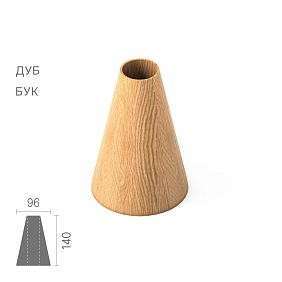
When you need to buy wooden geometric shapes for a furniture leg, decorative post, or partition, the same mounting hole often creates a false sense of interchangeability. KN-012 and KN-014 have a 34 mm diameter hole, both models are made from beech and oak, both fit onto a compatible central axis. But after assembly, they give a completely different silhouette. KN-012 elongates the transition and sets the direction, while KN-014 expands the structure to a noticeable node 130 mm wide.
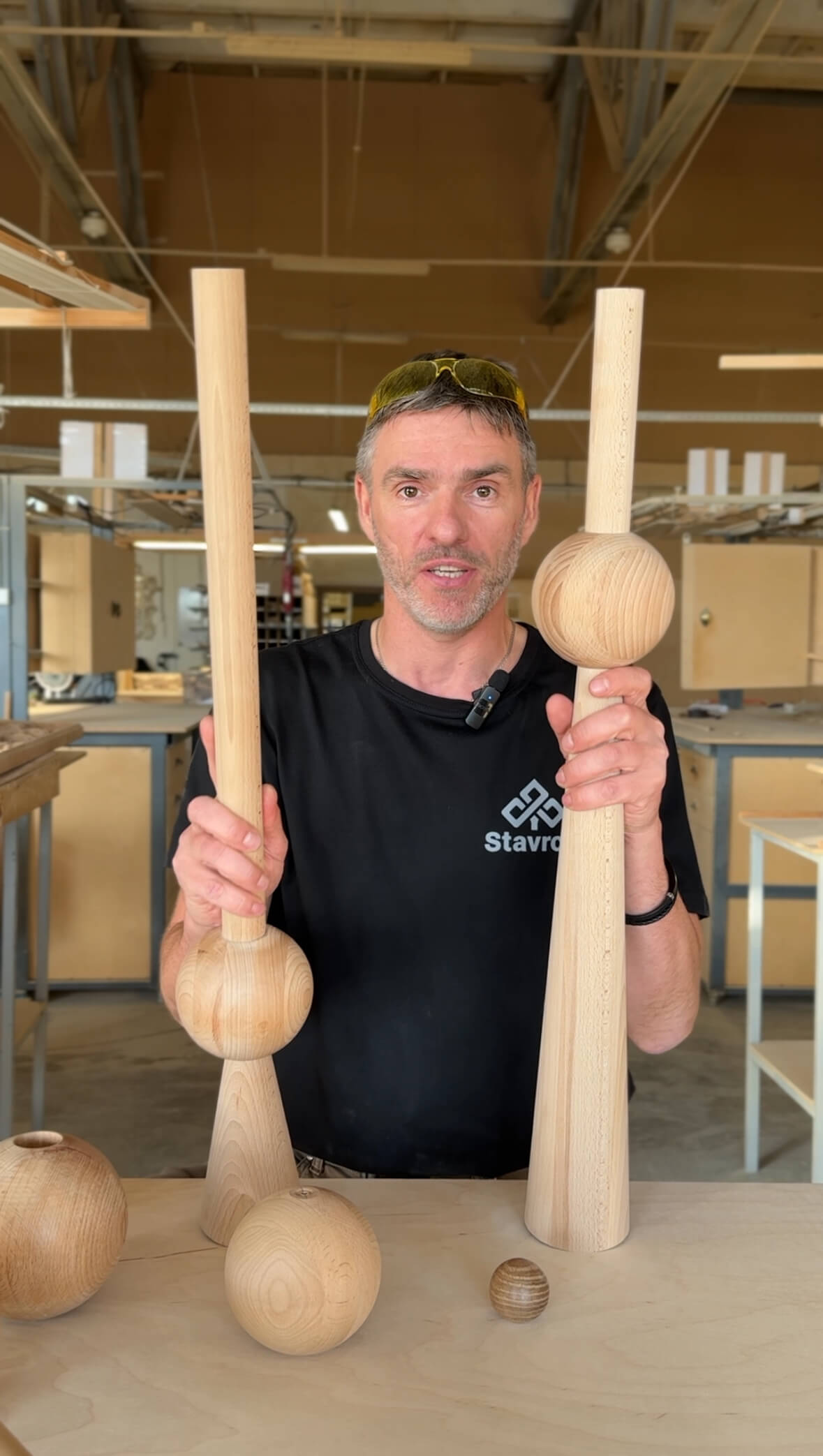
This difference is more important than a formal price comparison. The conical KN-012 is 16 mm taller, but KN-014 is 34 mm wider. Therefore, one model helps smoothly transition from a narrow axis to an adjacent part, while the other fixes the center, base, or a large accent. In a composite support, they can replace each other only when the designer consciously intends to change the entire pattern of the post. In most projects, the choice is determined not by which shape is liked individually, but by the role it must perform between other modules.
A short guideline is: buy the conical wooden shape KN-012 is for a directional transition, visual narrowing, or changing the orientation of a part. Buy the large wooden shape KN-014 is reasonable when a wide central node, massive base, or noticeable vertical expansion is needed. In a complex post, they can be combined: the cone guides the eye to the wide module, and the wide element stops the rhythm and gathers the composition.
Neither KN-012 nor KN-014 should be perceived as an independent load-bearing leg without structural calculation. These are elements of a wooden construction set. Their performance depends on the axis, adjacent parts, method of fixation, overall height, load, and the furniture or partition project. Before ordering, you need to check not only the external size but also the full composition of the future product, because an error in one module changes the height, width, budget, and proportions of the entire series.


KN-012 or KN-014: short answer before detailed comparison
| Buyer's task | What to choose | Why |
|---|---|---|
| Need a conical transition and a directed silhouette | KN-012 | The shape narrows, so the eye moves along the rack, and the rotation of the part changes the nature of the transition. |
| Need a wide central node | KN-014 | The maximum width of 130 mm makes the module a noticeable assembly point. |
| Need to assemble a calm repeating series | Depends on the scale | KN-012 gives a lighter rhythm, KN-014 gives a more massive and sparse one. |
| Need to combine two characters in one rack | KN-012 + KN-014 | The cone connects the axis with a large node and helps avoid a sharp jump in width. |
| The width of 130 mm is too large | Compare with KN-013 | A compact alternative is useful when a node is needed, but KN-014 overloads the silhouette. |
| Conical directionality is not needed | Compare with KN-008 | An elongated symmetrical module provides a vertical accent without a pronounced narrowing. |
The main selection principle: the 34 mm hole confirms compatibility with the axis, but does not determine the decorative role. First, design the silhouette, then select the module, material, and quantity.
Confirmed dimensions, materials, and prices
| Characteristic | KN-012 | KN-014 |
|---|---|---|
| Type | Conical wooden module | Wide geometric node |
| Size | 140 × 96 × 96 × 34 mm | 124 × 130 × 34 × 34 mm |
| Height along the axis | 140 мм | 124 мм |
| Maximum width | 96 мм | 130 мм |
| Mounting hole | 34 мм | 34 мм |
| Material | Beech or oak | Beech or oak |
| Beech, price at time of check | 1 990 ₽ | 2 780 ₽ |
| Oak, price at time of check | 3 310 ₽ | 3 680 ₽ |
| Visual role | Directs, pulls, narrows or expands depending on rotation | Forms a wide center, base or large transition |
| Repetition in the series | Directed, relatively light rhythm | Massive repeating nodes |
Prices are based on card data at the time of material preparation. For publication in Bitrix and especially before ordering, they need to be rechecked: cost, wood availability and stock may change. It is most practical to display the current price from the product card or leave a direct link to it in the article without promising a fixed amount.
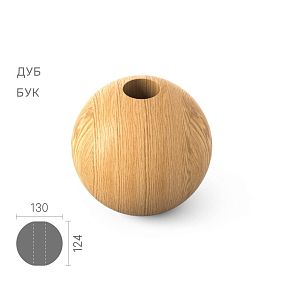
The size 140 × 96 × 96 × 34 mm for KN-012 is read as follows: 140 mm is the module length along the axis, 96 mm is its maximum width, 34 mm is the diameter of the through hole. For KN-014, the height along the axis is smaller — 124 mm, but the width reaches 130 mm. The difference seems small on screen, but in a real rack, the extra 34 mm of width is especially noticeable when next to a thin axis, narrow molding or furniture drawer.
Beech and oak are available for both models, so shape comparison can be done separately from wood selection. This is convenient: the buyer is not forced to change geometry just for the material. First, the desired silhouette is determined, then the wood and future finish. This order reduces the risk that an expensive oak part will be beautiful on its own but disrupt the proportions of the entire support.
Our factory also produces:


Why the same 34 mm hole does not mean the same purpose
The mounting size answers only one technical question: whether the module can pass along the selected axis. It does not indicate how the part will look in the finished product, where its center of gravity will be located, how much space it will take up in width, and how it will interface with adjacent shapes. Therefore, the phrase "both fit 34 mm" is insufficient for ordering. On the same axis, you can assemble a lightweight vertical, a heavy support, a rhythmic partition, or a decorative post, and each scenario will require its own sequence.
KN-012 primarily works through direction. Its wide end and taper create a clear movement: up, down, toward the center, or away from the center. KN-014 is perceived differently. It doesn't so much guide the eye as stop it. The wide contour forms a node, next to which other parts appear thinner. If both models are placed at the same height on two adjacent posts, the post with KN-014 will look more massive even with the same axis diameter.
Compatibility also does not eliminate the need to check adjacent parts. Between the module and the furniture part, a transition, separator, or section of open axis may be required. Their dimensions must be coordinated in advance. You cannot choose KN-014 just because the hole matches, only to later find that the 130 mm width overlaps with the facade, protrudes beyond the edge of the tabletop, or interferes with the adjacent post. Similarly, you cannot assume that KN-012 will automatically cover any diameter difference: its role depends on the orientation and the part it adjoins.
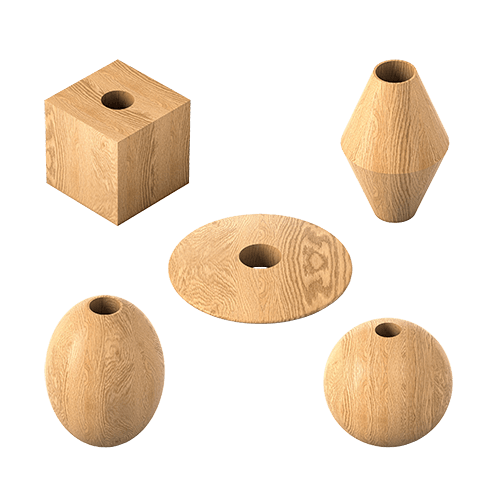
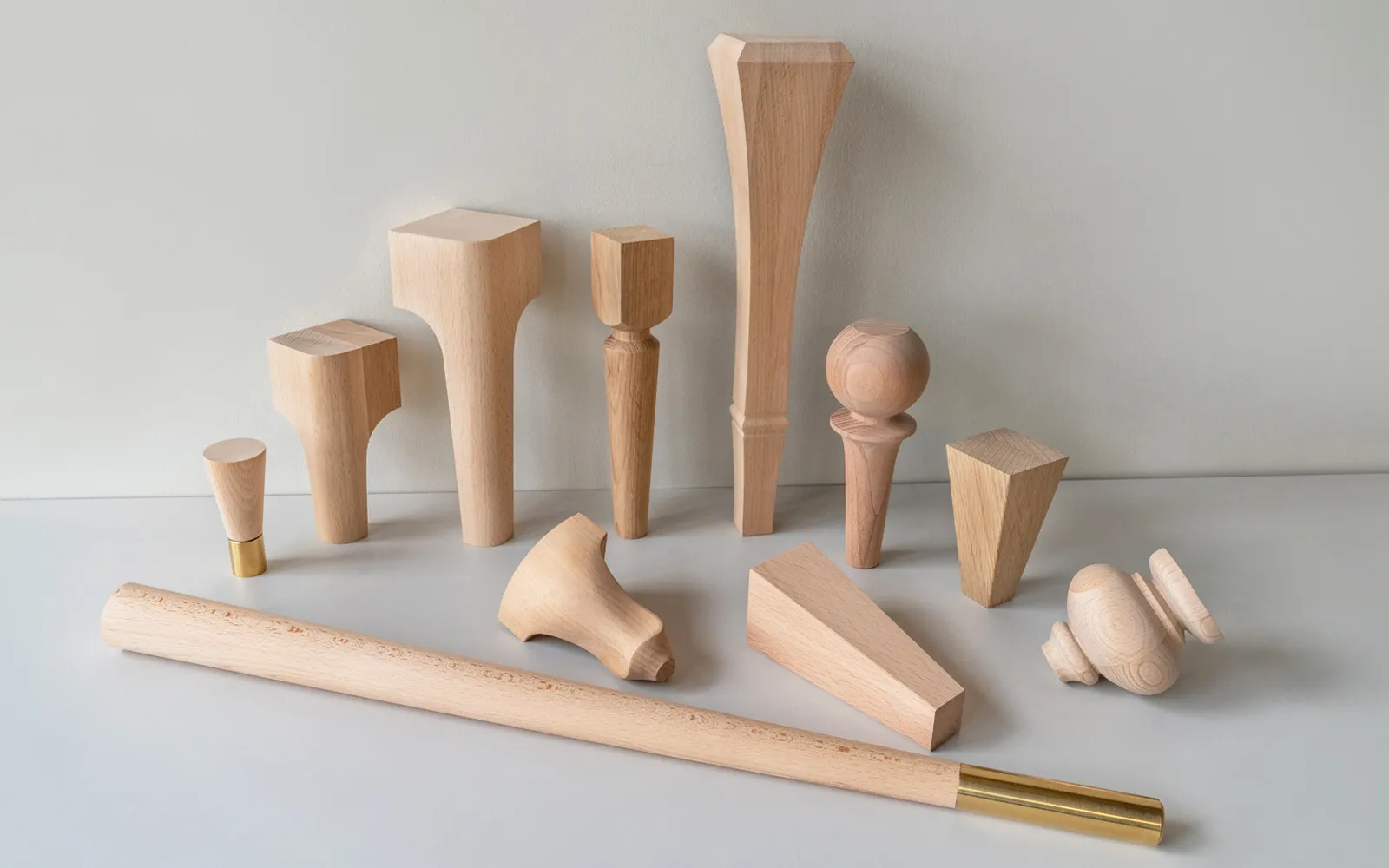
For initial selection, it is convenient to open all wooden geometric shapes and compare modules not by individual photos, but as a set of parts from one system. The category helps to see which shapes can continue KN-012 or KN-014, as well as to move to the axis and ready-made kits. After choosing the silhouette, the dimensions still need to be transferred to your own sketch.
Get Consultation
KN-012: how conical directionality works
Elongated transition instead of a heavy node
The 140 mm height makes KN-012 a noticeable vertical fragment. With a width of 96 mm, the module remains relatively slender and does not turn every assembly point into a major accent. This is useful in furniture where the support should look assembled but not excessively thick: for a console, decorative bed post, interior column, or a series of partition elements.
The conical shape allows visually connecting different diameters, even if the actual structure is aligned on a single axis. The wide part can support a massive module, while the narrow part leads the composition to a straight rod. This makes the transition look designed, rather than assembled from random parts. The effect is especially noticeable with a monochromatic finish, where the wood grain does not distract from the geometry.
However, the elongation requires free height. In a short furniture leg, KN-012 can take up too much of the vertical space, leaving little room for other elements. Before ordering, you need to create a scale diagram: mark the total height, attachment points, gaps, adjacent modules, and only then decide how many cones fit without visual crowding.
Two orientation options for KN-012
If the wide part of KN-012 is at the bottom, the module is perceived as a base or support for the transition. The silhouette gradually narrows upward, making the post seem lighter as it rises. This orientation is convenient when you need to connect a wide lower part of a furniture leg with a thinner middle section.
When the wide part is at the top, the effect changes. The cone seems to lead to a large central element, capital, or the next module. In the KN-012 — KN-014 — KN-012 composition, two cones can be oriented with their wide sides toward KN-014. Then the wide node appears assembled in the center and does not look like a randomly placed massive part.
The orientation must be determined before finishing and final fixation. After painting or staining, it is undesirable to experiment with drilling, trimming, or rotating already fitted parts. It is better to do a dry layout on the axis, photograph both options, check them at room scale, and only then confirm the sequence.
KN-014: why a wide nodal module is needed
Width of 130 mm as a compositional center
KN-014 is shorter than KN-012 but noticeably wider. Therefore, it has a stronger influence on the cross-sectional dimension of the post. In a furniture support, a width of 130 mm can visually support a massive tabletop, although the structural load should still be calculated by the craftsman. In a partition, such a module creates rare large nodes that are easily readable from a distance and do not get lost in a long vertical line.
A wide shape is useful where a regular axis looks too thin next to furniture or an architectural element. For example, at a large console, the base of a decorative column, or a central post in a spacious room. KN-014 adds scale without the need to make the entire structure uniformly thick.
But it is precisely the width that becomes a limitation. You need to check the distance to the wall, adjacent post, facade, drawer, baseboard, and passage. In a visualization, one module may seem compact, but in reality, a diameter of 130 mm is already comparable to a large furniture support. If the project is built in a narrow wall niche, it is better to make a full-scale cardboard template in advance.
One accent or a repeating series
A single KN-014 works as a center. It can be placed in the middle part of the support, between calmer elements, or used closer to the base. Several identical KN-014s create a different character: the post becomes rhythmic and massive. Such repetition is not suitable for every piece of furniture. The more wide nodes there are, the more important it is to maintain sufficient calm sections between them.
In a partition, the repetition of KN-014 is clearly visible in perspective. But too frequent alternation can make a transparent structure visually heavy. Therefore, the quantity is assessed not only by the available height but also by the distance between the posts. In a tight series, it is better to use one large node per vertical or alternate KN-014 with the more elongated KN-012.
When ordering several parts, it is especially important to check the wood species and future finish of the entire batch. Different shapes already create contrast; an additional random color discrepancy can fragment the composition. For a natural wood finish, it is reasonable to agree on material selection requirements in advance and look at information about how to choose beech, oak, and surface preparation quality.
Comparison of widths 96 and 130 mm: what will change in real furniture
The difference of 34 mm is not an abstract number. 17 mm is added on each side relative to the axis. If the post is located next to a facade or inside a frame, it is these 17 mm that can determine whether the technical gap remains. In a pair of posts, the total difference in occupied space is already 68 mm, and in a series of four verticals, wide nodes form a significantly denser rhythm.
For a dining or console support, the width affects the perception of stability. KN-014 looks more powerful and visually supports a large volume better. KN-012 leaves more air and emphasizes the vertical. This does not mean that a wide part structurally withstands a greater load: the load-bearing capacity is determined by the project. It is about how a person perceives the proportions.
In a decorative partition, 96 mm is easier to repeat frequently. The modules remain noticeable, but transparency is maintained between the posts. A width of 130 mm requires a more careful step: with dense installation, large elements can block the view and turn a light partition into a visually heavy grid. Therefore, for KN-014, a preliminary layout on the room plan is especially useful.
When choosing for existing furniture, you need to measure not only the leg itself. The overhang of the tabletop, the depth of the plinth, the position of doors and drawers, the height of the baseboard, and the distance to the wall are important. A wide module may look beautiful in a sample but protrude beyond the furniture's structural contour. The KN-012 cone is usually easier to fit into a limited transverse space, but its additional height also requires checking.
Comparison of heights 140 and 124 mm: how the vertical rhythm changes
KN-012 occupies 140 mm along the axis, KN-014 — 124 mm. The difference of 16 mm on one module seems small, but accumulates with repetition. Four KN-012s occupy 560 mm, four KN-014s — 496 mm. The difference is already 64 mm, meaning space appears for an additional separator, a section of open axis, or adjustment of the total height.
The tall cone creates a more extended movement. It should not be broken up by too frequent adjacent parts: the form should be read as a whole. KN-014 is more compact vertically and stronger horizontally, so it can be used as a short stop between long straight sections. As a result, two parts with the same mounting diameter form an opposite rhythm.
When calculating, you cannot simply add up the heights of the modules. In a real product, there are joints, fastening zones, possible gaps, and top and bottom connections. The theoretical division of the axis length by 140 or 124 mm only shows the upper limit of the quantity. The order is placed according to an approved scheme that accounts for all elements and the actual assembly length.
Paired furniture supports are calculated especially carefully. Even a small difference in sequence can result in a different final height or a different accent position. Before finishing, it is useful to assemble both supports side by side, check the horizontal lines of the modules, and mark the parts to avoid mixing up the order during final installation.
How shape changes the furniture leg and support
In a composite furniture leg, each module must support the overall architecture of the piece. KN-012 helps make the silhouette more dynamic: the wide part catches the massive section, the narrow part returns the support to the axis. This technique is suitable for furniture with a pronounced vertical, where the leg should look elongated rather than assembled from identical beads.
KN-014 forms a large node. It is useful in the center of the leg, at the base, or under the top part, when you need to visually connect the support to a wide apron or tabletop. However, you cannot mechanically place the widest element in the narrowest spot: the contour must be checked against the furniture body and the free space around it.
For a pair of legs, mirroring is important. KN-012 is asymmetrical in direction, so all cones can be oriented identically or mirrored relative to the center of the piece. Both approaches are acceptable but yield different results. Identical orientation creates a general flow up or down; mirrored orientation gathers the accent toward the center. KN-014 is more neutral, but its height position must match on all supports.
For a buyer assembling custom furniture for the first time, it is useful to start not by purchasing a large number of parts, but with one test post. It will show the actual width, quality of transitions, and character of the finish. After approving the sample, you can calculate a repeatable series and order an identical set for the remaining supports.
What to choose for a decorative post and interior column
A decorative post is usually perceived from all sides, so the module shape works not only in the frontal view. KN-012 creates a smooth change in diameter when walking around the structure. Its directionality remains noticeable but does not turn the post into a heavy column. This is a good option for a narrow vertical next to furniture, a mirror, or an entrance area.
KN-014 is needed when the post should become an independent object. The wide node holds the scale well in a spacious room, lobby, showroom, or reception area. However, in a small room, the same width of 130 mm appears larger, so it is better to reduce the number of nodes and leave long calm sections between them.
In a tall structure, a combination of two models is especially useful. KN-012 can lead to KN-014 from below, and the second cone can lead out of the node upward. Such a three-part group forms a complete theme that can be repeated once or twice. Too frequent repetition reduces expressiveness: the composition begins to look like a mechanical garland instead of an architectural post.
When the project depends on the exact scale of the room, it is reasonable to order a calculation of a decorative post from KN modules. This is especially relevant for multiple verticals, complex patterns, and furniture of non-standard height, where an error in the sequence multiplies by the number of parts.
What is suitable for a decorative partition
In a partition, modules are perceived as a series. Here, not only the structure of one post is important, but also the overall pattern of dozens of repeats. KN-012 creates a directed rhythm: cones can be oriented identically, alternated, or assembled with wide sides toward the center line. Such a pattern remains relatively light due to the width of 96 mm.
KN-014 creates rarer and heavier accents. It is convenient to place it at the same height in all racks to create a clear horizontal line. Another option is to shift wide modules in a checkerboard pattern, but this technique requires precise visualization. Without a project, the shift can be perceived as an installation error.
In the ready-made KON-006 set, both models are used together: two KN-012 and two KN-014. This confirms that they complement each other. You can view KN-012 and KN-014 as part of the KON-006 partition, to see a practical example of joint use and understand the logic of alternation.
An alternative sequence shows the possibility of buying a ready-made KON-007 rack set. A ready-made set is convenient when the buyer does not want to calculate the full set independently. Individual assembly gives more freedom, but requires checking the height, quantity, axis, and all transitions.
For a floor-to-ceiling partition, you cannot limit yourself to decorative calculation. Verification of the base, upper and lower mounting, stability, room geometry, and permissible loads is necessary. KN modules determine the pattern, but the safety of the entire structure depends on a professionally developed installation unit.
How to use KN-012 and KN-014 in a prefabricated baluster
In a decorative baluster, KN-012 helps form the classic logic of transitions: wide base, narrowing, central section, and completion. Rotating the cones allows assembling a symmetrical silhouette. KN-014 adds a large center and makes the baluster more noticeable in the space.
However, the term "baluster" can refer to both a decorative furniture detail and a railing element. In the latter case, appearance alone is insufficient: strength calculations, compliance with safety requirements, correct spacing, and reliable fastening are needed. The article discusses the compositional selection of modules and does not replace engineering design of the railing.
For a decorative post without a railing function, you can work more freely with rhythm. One KN-014 in the center and two KN-012 on the sides create clear symmetry. For a lighter option, the wide figure is replaced with a compact alternative or only cone transitions are left.
Before placing a series order, it is useful to assemble a full-height sample. On a table, individual modules look larger than in a tall vertical, and indoors their scale depends on the viewing distance. A full-size prototype helps to see whether one wide node is enough and whether the cones repeat too often.
How many modules fit in a section of a given height
Below is a theoretical calculation without gaps, adjacent parts, fastening zones, or allowances. It shows only the mathematical maximum and is not a ready order specification. The actual quantity will always depend on the complete post layout.
| Available height | Maximum KN-012 at 140 mm | Maximum KN-014 at 124 mm | What remains |
|---|---|---|---|
| 500 мм | 3 pcs. = 420 mm | 4 pcs. = 496 mm | 80 mm or 4 mm respectively |
| 1,000 mm | 7 pcs = 980 mm | 8 pcs = 992 mm | 20 mm or 8 mm |
| 1 500 mm | 10 pcs = 1,400 mm | 12 pcs = 1,488 mm | 100 mm or 12 mm |
| 2,000 mm | 14 pcs = 1,960 mm | 16 pcs = 1,984 mm | 40 mm or 16 mm |
| 2,400 mm | 17 pcs = 2,380 mm | 19 pcs = 2,356 mm | 20 mm or 44 mm |
Such filling is almost never required: a rack made of identical modules without calm sections will be overloaded. The table is needed to check arithmetic and understand the accumulated height difference. For example, on a 1,000 mm section, one more KN-014 module fits than KN-012, but visually eight wide nodes may be much heavier than seven cones.
For a mixed scheme, the heights of each part are summed. The composition KN-012 — KN-014 — KN-012 occupies 404 mm without considering joints: 140 + 124 + 140. Two such groups are 808 mm. The remaining space is distributed between straight sections, other modules, and abutments. It is at this stage that it becomes clear whether a 1,000 or 2,400 mm axis is needed and how many parts to order.
For several identical racks, the calculation is done once, then the quantity for each position is multiplied. But the margin and permissible deviations cannot be assigned arbitrarily: it depends on the project, processing method, and the master's requirements. It is better to agree on the specification before purchase than to try to compensate for shortages with random parts of a different size.
How much 1, 2, 4, and 8 elements cost
Cost in the bouquet at the time of check
| Quantity | KN-012 at 1,990 ₽ | KN-014 at 2,780 ₽ | Difference |
|---|---|---|---|
| 1 pc. | 1 990 ₽ | 2 780 ₽ | 790 ₽ |
| 2 pcs. | 3 980 ₽ | 5 560 ₽ | 1 580 ₽ |
| 4 pcs. | 7 960 ₽ | 11 120 ₽ | 3 160 ₽ |
| 8 pcs. | 15 920 ₽ | 22 240 ₽ | 6 320 ₽ |
Oak price at time of check
| Quantity | KN-012 at 3,310 ₽ | KN-014 at 3,680 ₽ | Difference |
|---|---|---|---|
| 1 pc. | 3 310 ₽ | 3 680 ₽ | 370 ₽ |
| 2 pcs. | 6 620 ₽ | 7 360 ₽ | 740 ₽ |
| 4 pcs. | 13 240 ₽ | 14 720 ₽ | 1 480 ₽ |
| 8 pcs. | 26 480 ₽ | 29 440 ₽ | 2 960 ₽ |
In beech, the difference between models is more noticeable. If eight nodes are required, the wide KN-014 increases the cost of modules by 6,320 rubles compared to KN-012 at the prices at the time of check. In oak, the difference between shapes is smaller because the material cost has a stronger impact on both items. Therefore, KN-012 cannot be automatically considered a "budget" option in all configurations: the total depends on the wood type, quantity, and other details.
Comparing only the price of a single piece is incorrect. KN-014 is lower, so theoretically at the same height more of it may be needed, but a wide module is usually repeated less often. KN-012 is taller and lighter in silhouette, so sometimes several cones are used. The actual budget is determined by the approved sequence, not the cost of an individual item.
The estimate also includes the axis, adjacent elements, finishing, preparation, installation, and delivery. These costs should not be hidden behind the module price. Before ordering, it is useful to create a table: item number, wood type, quantity, price from the card, purpose in the scheme, and project reserve. This makes it easier to compare two complete options rather than two random parts.
How to combine KN-012 and KN-014 in one post
Scheme KN-012 — KN-014 — KN-012
This is the most straightforward three-part group. Two cones connect the wide center with a thin axis. If the wide sides of KN-012 face KN-014, the group looks assembled and symmetrical. The total height of the modules is 404 mm excluding connections.
The scheme can be used once in the center of a tall post or repeated with a long gap. One accent is suitable for furniture where the leg should have a pronounced middle. Two accents are appropriate in a partition or interior column if the height allows for calm sections.
Turning the cones with their narrow sides towards KN-014 creates a sharper transition and usually requires additional justification. This option can be interesting in an avant-garde composition, but it must be tested on a mockup. For a classically assembled silhouette, it is often more logical to direct the wide sides towards the large node.
KN-014 between calm separating elements
A wide module can be highlighted not with cones, but with straight or compact adjacent parts from the same system. Then KN-014 becomes the only expansion. This is a good way to avoid excessive ornamentation and maintain a modern character.
Separators should be chosen based on confirmed compatibility and actual dimensions. You cannot substitute a random wooden washer based only on a photo: the hole, outer diameter, and height must match the axis and pattern of the post. In the constructor category, you can compare available shapes and create a unified specification.
For solid-color enamel, contrast is built on shadow and geometry, so even a small separator will be noticeable. When tinting oak, the wood grain works more strongly, and transitions may be perceived as softer. This is another reason to test the assembled sample in the intended finish.
When choosing compact KN-013 instead of KN-014
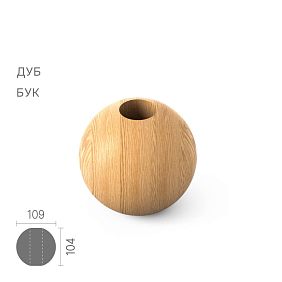
If KN-014 with a width of 130 mm seems too large, it is useful to compare with the compact figure KN-013. KN-013 has dimensions of 104 × 109 mm and is also compatible with a 34 mm fit. It occupies an intermediate position: it creates a node but protrudes less to the sides.
The compact alternative is especially useful in narrow furniture, frequent partitions, and posts located close to a wall. It does not fully replicate the character of KN-014, so the replacement should be evaluated based on the silhouette. Not only the width but also the strength of the central accent will decrease.
In a large room, KN-013 can get lost, whereas KN-014 will maintain scale. Therefore, the decision depends on the viewing distance. For a cabinet or a small console, compactness is often an advantage; for a tall column or a spacious hall, a wide node can work more convincingly.
When replacing, the height of the entire assembly is recalculated. You cannot simply change the article number in the order without updating the diagram. Even a small difference in length along the axis will shift adjacent elements and the overall center of the composition.
When instead of KN-012, an elongated KN-008 is needed
Conical directivity is not always suitable. If an elongated but more symmetrical module is needed, it is worth looking at the elongated geometric shape KN-008. It helps maintain a vertical character without obvious movement from a wide end to a narrow one.
KN-008 is appropriate in a repeating series where all elements should read the same when viewed from above and below. KN-012 depends more on orientation and requires a deliberate rotation. Therefore, in a complex partition, a symmetrical module is sometimes easier to coordinate among many posts.
Detailed scenarios are collected in the material about how to use the elongated module KN-008. The new comparative task remains different: choose the directional cone KN-012 or the wide node KN-014. KN-008 is considered only as an alternative when neither of these characters is suitable.
It is not worth replacing KN-012 with KN-008 just because of similar width. The shape of the side contour is more important. A cone creates a transition, a symmetrical figure creates an independent repetition. On a finished stand, this difference is more noticeable than on product cards.
Other shapes: when a cone and a wide node are not needed at all
Sometimes the choice problem is posed incorrectly. The buyer needs a round, faceted, or cubic shape, but compares KN-012 and KN-014 only because they saw them first. In this case, it is worth returning to the overall furniture architecture and determining the nature of the shape before selecting the article.
A comparison of the other three geometries is given in the material on how
Beech for enamel or oak for tinting: how to choose the material
Both models are made of beech and oak, so the material can be chosen after the shape is approved. Beech is often considered for even painting and enamel, where geometry plays the main role. Oak is valued for its expressive texture and tinting, if the wood grain should remain part of the design. The specific finishing system and preparation must be coordinated with the technologist.
On KN-012, the direction of the fibers and chiaroscuro can enhance the elongated shape. On KN-014, the wide surface makes the texture more noticeable. With transparent or semi-transparent finishes, differences between parts of the same batch may be more pronounced, so material selection requirements should be discussed in advance.
For solid-color enamel, joint preparation is especially important. Color unifies the parts but highlights gaps, steps, and sloppy joints. First, assemble and check the geometry, then perform coordinated preparation and finishing. Attempting to adjust an already painted module usually leads to coating damage.
Price comparison shows that in beech, the difference between KN-012 and KN-014 is higher than in oak. But savings should not force a change in shape if the project requires a wide node. It is more rational to reduce the number of accents than to replace the required geometry with an unsuitable one and get a weak silhouette.
How to choose a wooden axis MLD-060 with a diameter of 34 mm
The central foundation of the system is the possibility buy a wooden axis MLD-060 with a diameter of 34 mm. The confirmed data specifies lengths of 1,000 and 2,400 mm, materials — beech or oak. The axis must match the modules in diameter and be included in the overall height calculation.
The choice of length depends not on the number of individual parts, but on the finished product. A 1,000 mm axis is convenient for a short stand or test sample. A length of 2,400 mm is suitable for a tall vertical and partition solutions, but it cannot be automatically considered a finished floor-to-ceiling stand: the actual room dimensions, mounting points, and trimming are determined by the project.
The wood species of the axis is coordinated with the modules and finish. With a transparent coating, mixing beech and oak will create a noticeable texture difference. With an opaque enamel, the external difference is reduced, but technological compatibility and preparation must still be confirmed.
Before final assembly, check the free passage of each module, the sequence, and orientation. Do not assume that force or subsequent reaming will fix an improper fit. Any adjustment must be planned before the final finish and performed by a specialist.
Practical selection for different buyer tasks
Console or narrow table
In a narrow console, it is important to maintain passage and not extend the support beyond the tabletop contour. KN-012 with a width of 96 mm is often easier to fit into a limited depth and use as an elongated transition. KN-014 is suitable for a large console, where a wide node supports the scale of the facade. Before ordering, measure the tabletop overhang, the position of the apron, and the knee clearance.
The practical procedure is the same: draw the furniture contour to scale, mark the 34 mm axis, apply the outer width of the module, check adjacent movements, and assemble a trial sequence. Only after this, choose the wood species, quantity, and finish option. This route is faster than ordering parts from a photo and then rebuilding the entire item to fit their actual size.
Bed post
For a bed, the module must correspond to the headboard height and post thickness. KN-012 helps extend the vertical and direct it towards the finial. KN-014 creates a noticeable node that is better used once to avoid overloading the sleeping area. Check proximity to textiles, the wall, and bedside furniture.
The practical procedure is the same: draw the furniture contour to scale, mark the 34 mm axis, apply the outer width of the module, check adjacent movements, and assemble a trial sequence. Only after this, choose the wood species, quantity, and finish option. This route is faster than ordering parts from a photo and then rebuilding the entire item to fit their actual size.
Composite table leg
For the KN-014 table leg, it visually reinforces the center or base, while KN-012 connects a wide area to the axis. However, the decorative module does not confirm the load-bearing capacity of the entire leg. The load, attachment to the apron, and stability are calculated by the furniture manufacturer.
The practical procedure is the same: draw the furniture contour to scale, mark the 34 mm axis, apply the outer width of the module, check adjacent movements, and assemble a trial sequence. Only after this, choose the wood species, quantity, and finish option. This route is faster than ordering parts from a photo and then rebuilding the entire item to fit their actual size.
Partition
In the series of posts, KN-012 provides a more airy, directional rhythm. KN-014 forms a wide horizontal line of accents. In a small room, wide nodes are placed less frequently to maintain transparency. Calculation of the attachment and safety check of the entire structure are mandatory.
The practical procedure is the same: draw the furniture contour to scale, mark the 34 mm axis, apply the outer width of the module, check adjacent movements, and assemble a trial sequence. Only after this, choose the wood species, quantity, and finish option. This route is faster than ordering parts from a photo and then rebuilding the entire item to fit their actual size.
Decorative baluster
For symmetry, it is convenient to place KN-014 in the center and turn two KN-012 with their wide sides facing it. If the baluster is part of a railing, the compositional selection is supplemented with an engineering calculation. For a purely decorative post, there is more freedom, but the full height must still be coordinated.
The practical procedure is the same: draw the furniture contour to scale, mark the 34 mm axis, apply the outer width of the module, check adjacent movements, and assemble a trial sequence. Only after this, choose the wood species, quantity, and finish option. This route is faster than ordering parts from a photo and then rebuilding the entire item to fit their actual size.
Interior column or reception desk post
In a large space, KN-014 better maintains the scale, while KN-012 helps connect the node with long straight sections. For a commercial interior, the repeatability of all posts and the maintainability of the finish are especially important. A full-size sample reduces the risk of costly series rework.
The practical procedure is the same: draw the furniture contour to scale, mark the 34 mm axis, apply the outer width of the module, check adjacent movements, and assemble a trial sequence. Only after this, choose the wood species, quantity, and finish option. This route is faster than ordering parts from a photo and then rebuilding the entire item to fit their actual size.
Small-format custom furniture
For a cabinet, stand, or compact item, KN-014 may be too wide. Start with KN-012 or KN-013 and check with a full-size template. One wide element is acceptable as a deliberate accent if it does not interfere with the facades and does not look heavier than the body.
The practical procedure is the same: draw the furniture contour to scale, mark the 34 mm axis, apply the outer width of the module, check adjacent movements, and assemble a trial sequence. Only after this, choose the wood species, quantity, and finish option. This route is faster than ordering parts from a photo and then rebuilding the entire item to fit their actual size.
What to buy together with KN-012 or KN-014
| What to add | Why | When especially needed | Verified page |
|---|---|---|---|
| MLD-060 axle with a diameter of 34 mm | Base for sequential installation of KN modules | Assembled leg, post, partition | buy a wooden axis MLD-060 with a diameter of 34 mm |
| Other KN modules | Assemble transitions and complete rhythm | Individual composition | view all wooden geometric shapes |
| KN-013 | Reduce the width of the central node | When KN-014 is large | compare with the compact figure KN-013 |
| KN-008 | Get an elongated symmetrical shape | When cone directivity is not needed | looking at the elongated geometric shape KN-008 |
| Ready KON-006 | Get a verified sequence with two KN-012 and two KN-014 | Partition without self-assembly of all parts | see the composition of KON-006 |
| Ready KON-007 | Compare another drawing of the finished stand | When an alternative sequence is needed | Select KON-007 kit |
| Materials for assembly and finishing | Coordinate preparation, fixation, and finishing | Any final assembly | Select glue and materials for assembling wooden modules |
The "buy together" block starts not with glue, but with a full specification. The buyer needs the axis, all decorative modules, top and bottom connections, coordinated finishing, and installation solution. If at least one item is unknown, premature purchase of part of the kit may tie the project to an inconvenient height or wood species.
Ready-made kits are useful as a guide even for custom assembly. They show that KN-012 and KN-014 can work together and that one post requires more than two prominent figures. A self-assembled set is justified when furniture or room dimensions differ from the ready-made solution and the buyer is ready to coordinate all transitions.
Installation materials are selected based on the actual base, wood species, finish, and assembly method. One universal glue cannot be assigned for any furniture or partition. The article provides only the commercial logic of the kit; the technological map must be confirmed by a craftsman.
How not to confuse KN-012 and KN-014 with similar products
The first mistake is to focus only on the 34 mm hole. Matching fit does not mean matching height and outer diameter. In the product card, you need to check the full size: KN-012 — 140 × 96 × 96 × 34 mm, KN-014 — 124 × 130 × 34 × 34 mm.
The second mistake is to consider KN-012 simply a reduced KN-014. The shapes differ fundamentally. The cone has a direction and changes when rotated. The wide node is perceived more neutrally and works with mass. Replacement changes the composition, not just the dimension.
The third mistake is to confuse the module with a ready-made furniture leg or post. The KN part is part of a system. A finished product requires an axis, adjacent elements, fastening, and calculation. The card of one figure does not confirm the safety of the entire structure.
The fourth mistake is choosing a breed based on a photo. Beech and oak have different visual characteristics, and the result depends on the finish. Current options, preparation quality, and batch requirements are checked before ordering. For paired supports, it is advisable to obtain a coordinated set rather than assembling it from random purchases at different times.
The fifth mistake is confusing KN-014 with KN-013. The compact model has different dimensions and protrudes less in width. It is useful as an alternative but does not provide the same large central accent.
Mistakes when ordering wooden modules
Choosing only based on a large photo
The card shows the shape but not the actual scale. Print the outline of 96 and 130 mm or make cardboard templates. This will immediately show how much wider KN-014 is.
Ignoring the orientation of KN-012
The cone changes direction when rotated. Fix the wide and narrow sides on the diagram, otherwise two identical posts may be assembled differently.
Calculating quantity only by dividing height
The mathematical maximum does not account for adjacent parts, fasteners, and junctions. Compile a full specification rather than a list of identical modules.
Purchasing different breeds in one visible series
With a transparent finish, beech and oak will differ. Even under enamel, preparation and compatibility must be agreed upon in advance.
Fitting after painting
Drilling, trimming, and sanding damage the finished coating. Dry assembly and all adjustments are done before finishing.
Expecting a load-bearing function from a decorative part
The strength of furniture or a partition is determined by the entire structure. Calculation of the axis, fasteners, base, and load is required.
Ordering at the price of a single piece
The cheaper module may not be the one needed in shape. Compare the cost of a complete rack made from all parts.
Lack of a test sample
In a series of many supports, the error scales. One full-size prototype is cheaper than reworking the entire batch.
Accidentally adding too many shapes
Each new geometry complicates the rhythm. Limit the composition to one main node and one type of transition.
Failure to account for long axis delivery
An axis of 2400 mm requires a suitable method of transportation and storage. Conditions must be checked before placing an order.
Before placing an order, it is useful to clarify payment and delivery of STAVROS products, especially if the set includes a long axis, several types of wood, or a large batch of modules. Delivery conditions should not be carried over from an old article: current data is checked on the relevant page.
Who KN-012 suits, and who should choose a different option
KN-012 suits those who need a directional transition, an elongated silhouette, and the ability to control the pattern by rotating the part. It is convenient in narrow supports, vertical compositions, and connections with a large central module. The cone is especially appropriate when adjacent parts differ in visual weight and a gradual transition is needed between them.
It may not be suitable for a very short leg, where the height of 140 mm takes up too large a share, or for a strict symmetrical series, in which the direction of the cone creates unnecessary movement. In such cases, compare KN-008, KN-013, or other forms of the kit.
KN-014 is suitable for a large central node, a massive base, and a noticeable rhythm point. It is chosen for spacious interiors, wide furniture supports, and partitions where accents should be readable from a distance.
It may be redundant next to compact furniture, in a narrow wall space, with frequent upright spacing, or where the 130 mm width conflicts with facades. In that case, it is better to reduce the number of wide units or switch to KN-013.
Both models are not suitable as the sole foundation for a project without checking the axis, load, and fasteners. For a buyer who needs a fully finished partition post, it is more rational to start with KON-006 or KON-007, and use individual KN modules for deliberate adaptation.
How to buy KN-012 or KN-014 on STAVROS without configuration errors
Start with a drawing or at least a scaled sketch. Specify the total height, axis diameter of 34 mm, position of each module, external width, wood species, and orientation of KN-012. For paired supports, add mirroring and the same mark for the wide node.
Then open the product cards: view price of KN-012 и view price of KN-014. Check the dimensions, available wood species, current price, and stock. The prices in this article cannot be used as a final commercial offer because they reflect the time of material preparation.
After selecting the shapes, check the axis and other elements. For an individual project, compile a specification for each post. For a ready-made solution, compare KON-006 and KON-007. If the sequence is complex or there are many verticals, request a design calculation before purchasing the batch.
Finishing is agreed upon after dry assembly. Do not order enamel or tinting until all transitions and orientation are confirmed. If the modules must match existing furniture, prepare a color sample and photos under normal lighting.
Before paying, double-check the quantity. Count KN-012, KN-014, axles, and adjacent parts separately. For several identical stands, multiply the approved set, not the approximate set. This procedure allows you to buy wooden geometric shapes as a system, not as a collection of beautiful but mismatched blanks.
How to check the proportions of KN-012 and KN-014 before purchase
The most reliable way to assess geometry is to transfer dimensions to full scale. On a sheet of cardboard or thick paper, draw a circle or a cross-section contour with a width of 96 mm for KN-012 and 130 mm for KN-014. Separately mark the heights of 140 and 124 mm. Such templates can be applied to furniture, placed on the floor at the intended support location, or attached to a temporary batten. Already at this stage, it becomes clear whether the wide shape extends beyond the cabinet dimensions or if the cone looks too long.
For a vertical stand, a profile mockup is useful. On a strip of paper at a 1:1 scale, mark the axis, each module, the direction of the cones, and free sections. If the entire height does not fit on one sheet, join several strips. The mockup allows you to check the position of the accent relative to the tabletop, headboard, handle, mirror, sconce, or other reference point. An abstract mark like "center of the stand" does not always coincide with the visual center of the furniture, so the position of KN-014 is best assessed together with surrounding objects.
The next stage is a simple three-dimensional model. It does not require precise reproduction of threads or texture: cylinders and truncated cones of the corresponding width are sufficient. The model can be assembled from foam board, paper, or temporary wooden blanks. The goal is to check the silhouette from different angles. KN-014 is especially important to view from the side, because the 130 mm width may be more noticeable in a passage than in a frontal view. KN-012 should be evaluated from above and below to choose the orientation.
Photograph the mockup from the distance at which the furniture will be perceived daily. A close-up exaggerates the importance of small transitions, while a distant view shows the overall rhythm. For a partition, make several identical paper stands and arrange them with the design spacing. One wide module may look appropriate, but ten repetitions will create a completely different density.
If enamel is planned, consider primarily the shadows and contour. For oak under a transparent or tinted finish, add a sample of wood texture to the mockup, because an active pattern can enhance the wide surface of KN-014. In any case, the mockup does not replace structural calculation, but it allows you to eliminate compositional errors before purchasing the batch.
Full-scale testing is especially beneficial when ordering four, eight, or more identical elements. The cost of one test module or a simple mockup is incomparable to reworking the entire series. After approving the shape, photographs, dimensions, order, and orientation are recorded. These materials are passed to the craftsman along with the specification, so that the visual solution is not lost during the assembly stage.
Control specification before ordering
Before placing an order, compile all decisions into one table. For each item, specify the article number, full name, wood species, quantity per stand, number of stands, total quantity, and position in the sequence. For KN-012, add a separate "orientation" column: wide side up, down, or towards the central node. Without this note, identical parts may be installed differently.
Record the external dimension separately. For KN-012 it is 96 mm, for KN-014 — 130 mm. The mounting hole of 34 mm cannot be used instead of the external size. The specification also indicates the axle length, axle type, total calculated height of modules, and the remaining free section. The sum must match the approved sketch but account for actual interfaces and installation zones.
The next part is finishing. Record whether opaque enamel, tinting, or another agreed option is planned, whether a color sample is needed, and how the parts should match existing furniture. Do not transfer the shade name without a sample: identical commercial names from different systems may look different. For transparent finishing, specify requirements for visual wood selection.
In the commercial section, record the price from each current card and the date of verification. This will help understand where the total came from if the price changes. Add separate lines for the axle, adjacent modules, materials, design, finishing, installation, and delivery. Such a calculation shows the full cost of the solution and does not create a false impression that the budget is limited to two nice figures.
For paired furniture supports or a series of partition posts, marking of kits is useful. For example: post A — parts A1–A6, post B — B1–B6. After dry assembly, the marking is retained until final installation. This reduces the risk of swapping modules with different orientations or minor visual wood characteristics.
The final check is conducted on four questions. Does the axle diameter match? Does the external width exceed the allowable contour? Does the final height match? Is the role of each part clear? If there is no precise answer to any question, the specification is not yet ready. It is better to return to the diagram before payment than to compensate for uncertainty during installation.
FAQ: questions about KN-012 and KN-014
Which module is better for a 34 mm axle — KN-012 or KN-014?
Both are compatible with the mounting hole, but the choice depends on the shape. KN-012 creates a conical directional transition, KN-014 — a wide node of 130 mm. First, determine the part's role in the silhouette.
Can KN-012 be replaced with KN-014 without changing the project?
Usually not. The height along the axle, external width, and post character will change. After replacement, the entire sequence needs to be recalculated and adjacent parts checked.
How is KN-012 higher than KN-014?
KN-012 occupies 140 mm along the axis, KN-014 — 124 mm. The difference is 16 mm per part.
How much wider is KN-014?
The maximum width of KN-014 is 130 mm, KN-012 — 96 mm. The difference is 34 mm.
Can KN-012 be rotated?
Yes, orientation changes the compositional effect. The wide part can act as a base or be directed towards the central module. The specific option is approved during dry assembly.
Can KN-012 and KN-014 be used together?
Yes. A practical example is in the KON-006 and KON-007 kits. The clear scheme is KN-012, KN-014, KN-012 with cones directed with their wide sides towards the center.
What wood species are available?
In the confirmed cards, both models are listed in beech and oak. Current availability and cost should be checked before ordering.
What is better under enamel?
Beech is often considered for a smooth opaque finish, but the specific coating system and preparation are agreed upon with a technologist. You cannot make a conclusion based solely on the species name.
What is better under stain?
Oak is chosen when you need to preserve a pronounced texture. The result depends on the stain sample, batch of wood, and surface preparation.
How many KN-012 fit on a 1,000 mm axis?
Theoretically, without gaps and other parts — seven pieces, that is 980 mm. This is not a finished layout: the actual rack includes junctions, fasteners, and other elements.
How many KN-014 fit on 1,000 mm?
The theoretical maximum is eight pieces, 992 mm. In practice, such dense filling may look heavy and not account for structural zones.
What to choose if KN-014 is too wide?
Compare KN-013 with dimensions 104 × 109 mm. It creates a more compact node and is compatible with a 34 mm fit.
What to choose if the KN-012 cone is too directional?
Compare the elongated KN-008. It provides a vertical accent without such a pronounced narrowing.
Is the MLD-060 axis needed?
To assemble the system, a compatible base with a diameter of 34 mm is required. The catalog lists a wooden MLD-060 axis with a length of 1,000 or 2,400 mm made of beech or oak.
Can the hole be reamed after painting?
This should not be done without an agreed-upon technology. Adjustments after finishing damage the coating. All checks and corrections are performed before the finish.
Are the modules suitable for a table support leg?
They can be part of a furniture support, but the load-bearing capacity is determined by the entire structure. A calculation of the axis, fasteners, connection to the apron, and load is required.
How to check the scale before purchasing?
Make templates of the outer contour 96 and 130 mm, apply them to the sketch or furniture, and assemble a full-size prototype of one post.
Where can I see the current price?
In the product cards KN-012 and KN-014 on the STAVROS website. The amounts in the article are provided only as data at the time of preparation.
Result: a conical transition or a wide node
KN-012 and KN-014 share a system with a 34 mm hole, but their purchasing tasks differ. KN-012 is taller, narrower, and more directional. It helps to extend the post, create a transition, and control the movement of the form through rotation. KN-014 is lower, wider, and more massive. It fixes the center, base, or a large accent.
For small-scale furniture with a frequent rhythm, the conical KN-012 or a compact alternative is usually more convenient. For a spacious composition, a large support, and rare prominent nodes, KN-014 works better. When a complex post is needed, the models are combined: cones connect the wide figure to the axis and make the transition meaningful.
Before ordering, you need to check dimensions, wood species, orientation, quantity, axis, adjacent elements, finish, and installation. The cost is compared based on the full post, not a single part. Prices and availability are rechecked in the product cards.
STAVROS allows you to select individual modules, a compatible axis, and ready-made kits. A thoughtful project turns these elements into a cohesive furniture support or interior vertical. A random set of even expensive parts does not guarantee such a result, so the best route is first a diagram and full-size check, then a precise specification and order.