

























Article Contents:
- Confirmed specifications of KN-005, KN-006, and KN-011
- Shape comparison: which figure to choose
- What are STAVROS construction set figures
- Why these are not toys or craft blanks
- How the 34 mm hole works
- KN-005: compact rounded shape
- When to choose KN-005
- KN-006: faceted medium-scale module
- When to choose KN-006
- KN-011: Large cubic block
- When to choose KN-011
- Why the same hole does not make models interchangeable
- One large figure or several small ones
- Can KN-005 and KN-006 be combined
- Can KN-006 and KN-011 be combined
- How to use KN-005 next to KN-011
- How not to turn the stand into a random set of shapes
- How to calculate the total height of a modular stand
- How to calculate the free length of MLD-060
- How to calculate multiple KN-005 on one axis
- How to calculate multiple KN-006
- How many cubes of KN-011 to use
- How to make a symmetrical layout
- How to make an asymmetrical composition
- How to check the scale on a paper template
- How to check the volume on a full-size model
- Selection for a small furniture leg
- Selection for a tall furniture leg
- Selection for a console
- Choice for coffee table
- Choice for dining table base
- Choice for furniture stand
- Choice for decorative rod
- Choice for assembled baluster
- Choice for interior column
- Choice for screen
- Choice for zoning partition
- How to repeat posts in partition
- How to create central section of partition
- How to use KN-005 in a classic interior
- How to use KN-006 in a modern interior
- How to use KN-011 in an architectural composition
- Wooden axis MLD-060: what to check
- Axis 1000 mm long
- Axis 2400 mm long
- Wooden axis or metal pipe
- How to check a metal pipe
- How to check the fit on MLD-060
- Why the hole needs protection when painting
- How to paint figures on a separate mandrel
- Dry assembly before fixing
- How to mark the order of elements
- How to fix figures on the axis
- Can figures be left movable
- How to connect two parts of the axis inside a figure
- When to watch KN-013
- When to watch KN-014
- How to combine figures with discs and washers
- Why smooth sections between figures are needed
- How to alternate KN-005 and discs
- How to alternate KN-006 and washers
- How to frame KN-011 with smaller parts
- Beech for enamel
- Oak for tinting
- Beech or oak for furniture leg
- Can I use oil
- How to preserve the texture of oak
- How to get the same color for all modules
- How to care for the finished structure
- KN-005 in the living room
- KN-006 in the study
- KN-011 in the hall
- Figures for the bedroom
- Figures for the hallway
- Figures for the kitchen
- Figures for the dressing room
- Figures for commercial interiors
- How not to confuse furniture figures with balls and beads
- How not to confuse KN-005 with a ball
- How not to confuse KN-006 with a decorative polyhedron
- How not to confuse KN-011 with an ordinary wooden cube
- Mistake: choosing only by shape
- Error: consider the 34 mm hole universal
- Error: paint the hole with a thick layer
- Error: use the shape as a finished leg
- Error: do not account for accumulated height
- Error: install too many KN-011
- Error: mix shapes without order
- Error: choose different wood species for one stand
- Error: ordering parts at different times
- Error: do not assemble a control sample
- Error: do not check orientation of KN-006
- Error: outdoor use without protection
- Who is KN-005 suitable for
- Who might KN-005 not suit
- Who is KN-006 suitable for
- Who might KN-006 not suit
- Who is KN-011 suitable for
- Who might KN-011 not suit
- How to buy figures on STAVROS
- What to check before payment
- What to buy together with KN-005, KN-006 and KN-011
- What not to do from scratch
- Ready-made element or random blank
- Practical choice: light leg for white enamel
- Practical choice: oak stand for the office
- Practical choice: central partition block
- Practical choice: several identical stands
- How to save data for reordering
- How to accept a batch of figures before finishing
- How to store figures before installation
- Is a backup module needed
- How to check several stands next to each other
- How to check the stand after fixing
- How to account for the weight of a large cube
- How to choose the distance between partition stands
- How to prepare an assembly list
- How to compare the cost of three options
- Final check before placing an order
- How to choose a figure based on viewing distance
- How to account for top and bottom nodes
- How to build a three-level stand
- When it's better to stick with one model
- When a project is needed, not just a product selection
- How to perform a test assembly before serial order
- How to check the finished composition from different angles
- FAQ: questions about KN-005, KN-006, and KN-011
- How is KN-005 different from KN-006?
- When is it better to choose KN-011?
- What is the mounting size for all three figures?
- Is MLD-060 compatible with all models?
- What lengths does MLD-060 come in?
- Can a metal pipe be used?
- Which model should I choose for a small leg?
- Which figure is better for a partition?
- Can KN-005 and KN-006 be combined?
- Won't KN-011 be too large?
- What to choose for enamel?
- What to choose for tinting?
- When should painting be done?
- How to calculate the number of elements?
- Can KN be used as a standalone leg?
- How to secure figures on the axis?
- How are figures different from children's toys?
- Can the hole be widened?
- How to avoid damaging the hole with enamel?
- Can multiple KN-011 be placed in a row?
- Where to buy KN-005?
- Where to buy KN-006?
- Where to buy KN-011?
- What to buy together?
- What should I check before ordering?

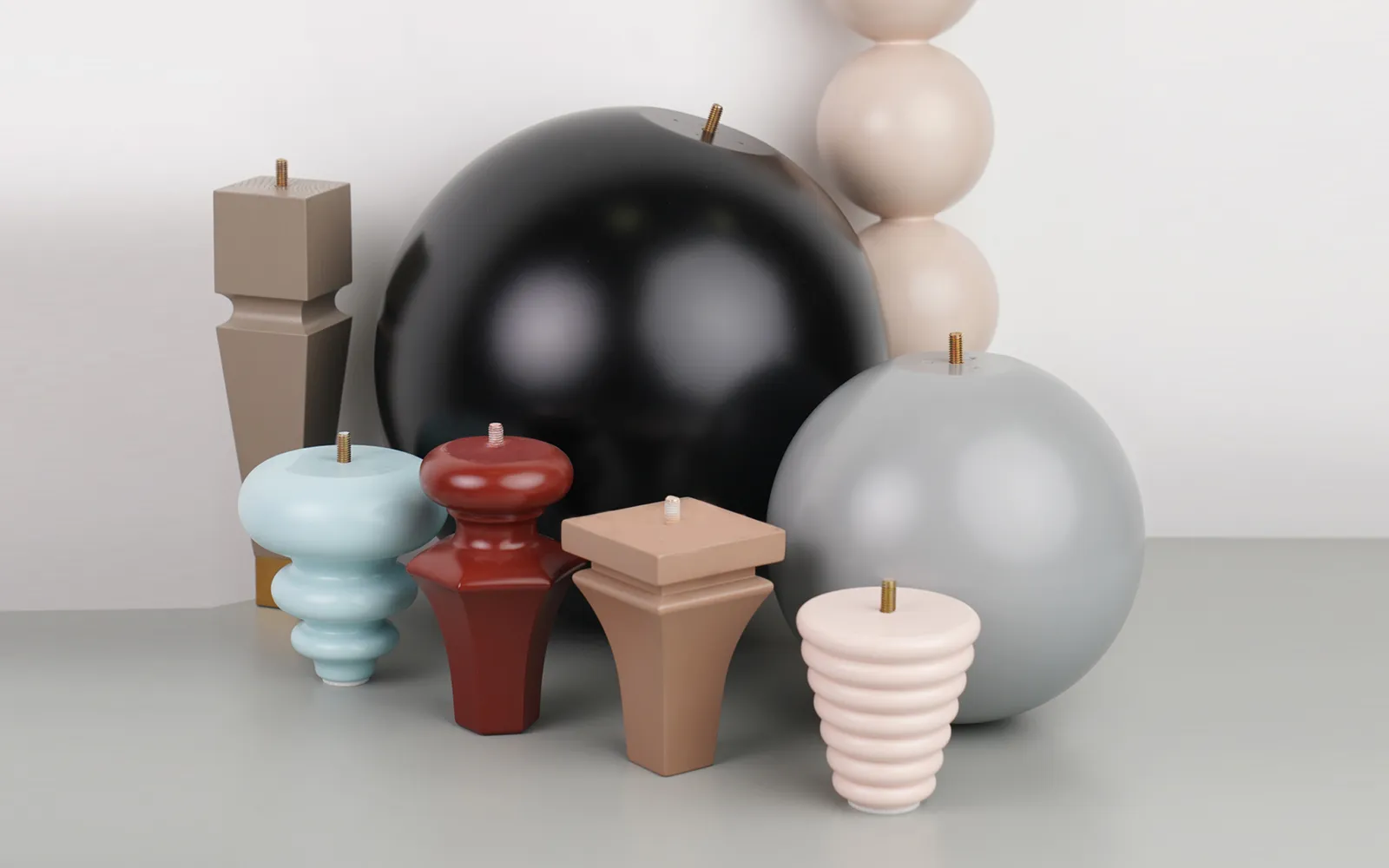
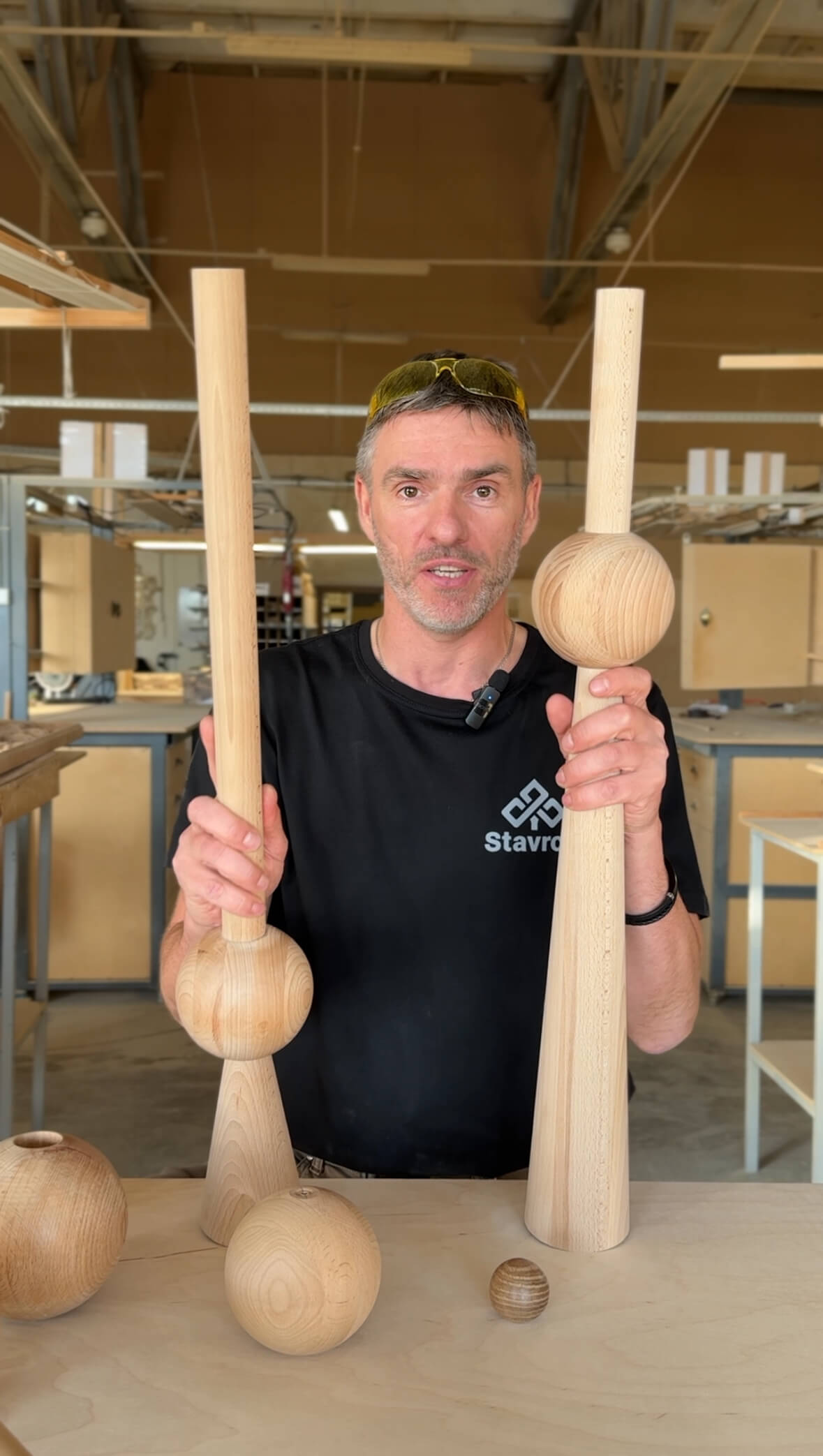
Wooden geometric shapes should be purchased when a furniture leg, stand, partition, baluster, or decorative rod needs to be assembled from ready-made modules, rather than carving each part from scratch. KN-005, KN-006, and KN-011 are mounted on an axle with a mounting size of 34 mm, are made of beech or oak, and belong to the same STAVROS construction system. The similarity ends there: the rounded shape, faceted element, and large cube affect proportions, light and shadow, and the overall height of the structure differently.
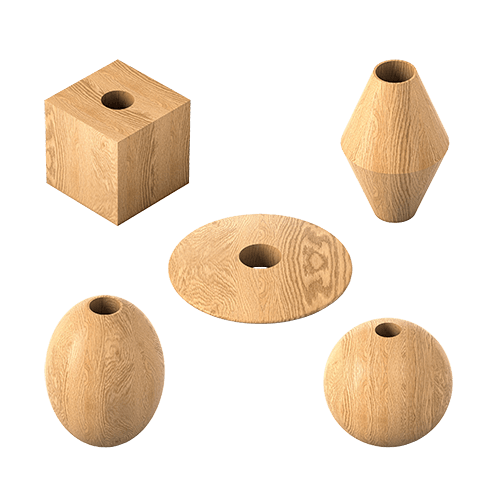
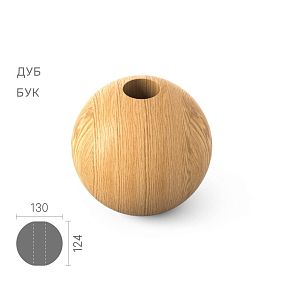
KN-005 measures 66 × 76 × 76 mm and is suitable for a light furniture leg, thin stand, and repeating rhythm. KN-006, measuring 90 × 72 × 72 mm, creates a stricter geometric transition and noticeable play of light on the edges. KN-011 is a large cube 105 × 105 × 105 mm, which acts as a central block, pronounced joint, or architectural pause within a tall partition.
The same 34 mm hole does not mean full interchangeability. The models differ in height, maximum width, shape, and visual mass. Several KN-005 can be repeated on one axle, KN-006 is convenient to alternate with discs and smooth sections, and KN-011 is often best used once—as the main node. The choice begins with the scale of the future structure, the length of the MLD-060 axle, the number of modules, the material, and the finishing method.
These elements are not children's toys, flat blanks for crafts, or painting sets. They are three-dimensional parts of a furniture construction set. They are used in supports, stands, partitions, and interior columns, but cannot be considered independent load-bearing legs or safe fencing without calculating the entire system.
Short answer. KN-005 is chosen for a compact rounded shape and repeating modules. KN-006 is suitable for a modern, geometric, or art deco composition where pronounced edges are needed. KN-011 should be used as a large cubic accent, central block, or visual divider of a tall stand.
All three shapes have a 34 mm hole and can be mounted on a wooden MLD-060 axle or a suitable metal pipe after technical verification. First, a dry layout is performed, then beech or oak is selected, and only after that the finish and fixation are approved.
Buy KN-005 Buy KN-006 Buy KN-011 Select MLD-060 axis View full constructor


Confirmed specifications of KN-005, KN-006, and KN-011
| Parameter | KN-005 | KN-006 | KN-011 |
|---|---|---|---|
| Size | 66 × 76 × 76 mm | 90 × 72 × 72 mm | 105 × 105 × 105 mm |
| Mounting hole | 34 мм | 34 мм | 34 мм |
| Material | Beech or oak | Beech or oak | Beech or oak |
| Shape character | Rounded, soft | Faceted, geometric | Cubic, architectural |
| Visual scale | Compact | Medium | Large |
| Main role | Delicate transition or repeating module | Geometric transition and independent accent | Central block or expressed connection node |
| Typical scenarios | Legs, thin posts, supports, partitions | Racks, balusters, partitions, furniture bases | Large supports, columns, high partitions |
| Compatible axis | MLD-060 34 × 34 mm after fit check | MLD-060 34 × 34 mm after fit check | MLD-060 34 × 34 mm after fit check |
| Axis MLD-060 | Length 1000 or 2400 mm | Length 1000 or 2400 mm | Length 1000 or 2400 mm |
| Self-supporting structural part | Not confirmed | Not confirmed | Not confirmed |
| Fasteners included | Specified in the card | Specified in the card | Specified in the card |
Shape comparison: which figure to choose
| Criterion | KN-005 | KN-006 | KN-011 |
|---|---|---|---|
| Module height | 66 мм | 90 мм | 105 мм |
| Maximum width | 76 мм | 72 мм | 105 мм |
| Repeat in series | Especially convenient | Convenient for rhythm | May overload a row |
| Central accent | Soft | Medium | Strong |
| Small furniture leg | Most appropriate | Possible after layout | Often too large |
| High partition | Repeating soft module | Faceted rhythm | Central block or rare divider |
| Modern interior | Calm plasticity | Most pronounced geometry | Large architectural form |
| Classic interior | Soft transition | Suitable for strict geometry | Used as a massive node |
Our factory also produces:


What are the STAVROS constructor figures
KN-005, KN-006 and KN-011 are ready-made volumetric parts with a central through hole. The buyer threads them onto an axle, alternates them with smooth sections and other modules, and then assembles a furniture or interior structure.
The main benefit of ready-made figures is repeatable size and shape. There is no need to manually carve several identical rounded parts, create precise edges, or drill a large cube through the center.
However, a ready-made module does not relieve you from design. Height, quantity, order, fixation, and load-bearing scheme are calculated separately.
Get Consultation
Why these are not toys or craft blanks
Key features — dimensions, 34 mm hole, and use in furniture posts, supports, and partitions.
The products are not children's sorters, educational sets, flat figures, beads, or decoupage blanks.
They are purchased for professional or DIY assembly of furniture and interior structures. The safety of such a structure is determined by the frame, axle, and fastening.
How the 34 mm hole works
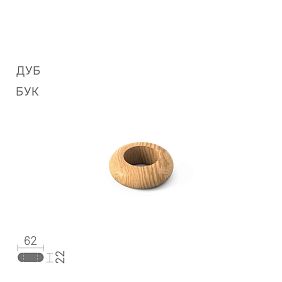
The through hole allows the figure to be mounted on a wooden axle MLD-060 with a cross-section of 34 × 34 mm or on a technically compatible metal tube.
Matching the nominal size does not guarantee a free fit after painting. It is necessary to check the actual hole size, axle geometry, and coating thickness.
Before serial assembly, one figure is tried on a short axle sample. The part should not crack from forced fitting and should not dangle freely without the intended fixation.
KN-005: compact rounded shape
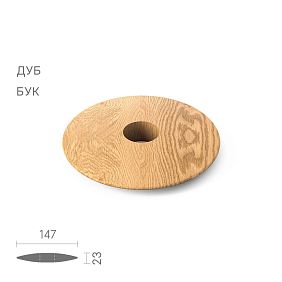
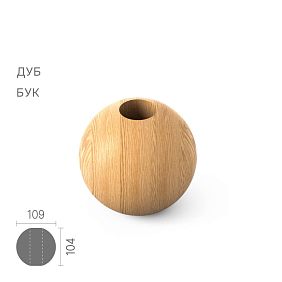
KN-005, 66 mm high and 76 mm wide, creates a smooth transition around the axle. It is noticeable but does not turn a thin post into a massive column.
The model is convenient to repeat several times, alternating with smooth sections, discs, or washers after checking their dimensions.
If you need a lightweight module, you can Buy KN-005 and first assemble a full-size sample of the leg or post.
When to choose KN-005
A rounded shape is suitable for a small furniture leg, thin decorative rod, light partition, and smooth transition between elements.
It is suitable when sharp edges and a large cube make the composition heavy.
Several KN-005 create a repeating rhythm, but the quantity is still calculated based on the total height and free axis length.
KN-006: faceted medium-scale module
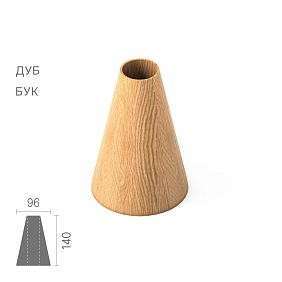
KN-006 has a height of 90 mm and a width of 72 mm. It is more compact in width than KN-005, but taller and more noticeable due to its facets.
Light falls differently on the planes, so the element supports modern geometry and Art Deco motifs well.
For a pronounced rhythm, you can buy faceted figure KN-006 and check it next to the selected disks and smooth axis.
When to choose KN-006
The model suits a stand, partition, baluster, and furniture base where a rounded module looks too traditional.
It helps connect the rectangular furniture facade with a round or square axis.
In the series, several faceted parts create active chiaroscuro, so the distances between them must be equal.
KN-011: large cubic block
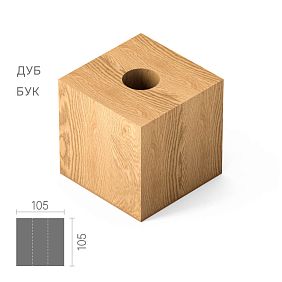
The cube 105 × 105 × 105 mm is significantly larger than the other two models and creates a strong architectural pause.
It suits the central part of a tall stand, a pronounced joint, a large support, or a partition where one dominant block is needed.
Open the detailed card to buy wooden cube KN-011 and compare its scale with the project.
When to choose KN-011
The cube is appropriate if the structure is large enough and can visually accommodate a width of 105 mm.
It can divide a long axis into parts, become the center of a symmetrical composition, or support cubic furniture.
Several cubes on a small leg often overload it. A full-scale mockup is needed before ordering.
Why the same hole does not make models interchangeable
Mounting on one axis only solves the central size issue. The external shape determines height, width, and visual weight.
Replacing KN-005 with KN-011 increases one module in height by 39 mm and in maximum width by 29 mm.
With multiple repetitions, the difference accumulates and changes the overall height of the stand. Therefore, replacement requires a new calculation.
One large figure or several small ones
One KN-011 creates a central accent and leaves long calm sections of the axis.
Several KN-005 provide a soft rhythm, while KN-006 offers more dynamic geometry.
The choice depends on the height of the structure, viewing distance, and number of adjacent parts. The formula does not replace a full-size sketch.
Can KN-005 and KN-006 be combined
Rounded and faceted shapes can work on the same axis if the alternation has a clear logic.
For example, two KN-005 create soft edge transitions, and KN-006 becomes the central module.
Random mixing looks like a shortage of identical parts. The order is fixed in the layout before purchase.
Can KN-006 and KN-011 be combined
A faceted figure can lead the composition to a large cube, supporting strict geometry.
The difference in scale should be noticeable and deliberate, not resembling a mismatch in sizes.
For a small base, such a combination is usually too massive; for a tall partition or interior column, it may be appropriate.
How to use KN-005 next to KN-011
A soft rounded detail can soften the rigidity of a cubic center.
On a symmetrical stand, KN-011 is placed on the axis, and KN-005 is repeated above and below.
The height is calculated based on the actual dimensions of all modules and the free sections of MLD-060.
How not to turn a stand into a random set of shapes
First, choose one main module, then one supporting one. A third shape is added only when there is sufficient height.
Repetitions, distances, and the central axis should be readable at first glance.
The smaller the furniture piece, the more strictly the number of element types is limited.
How to calculate the total height of a modular stand
The total height consists of the length of visible sections of the axis, the height of all figures, discs, washers, connecting elements, and mounting zones.
For KN-005, the calculation includes 66 mm; for KN-006, 90 mm; for KN-011, 105 mm. If one figure partially overlaps with an adjacent element, simple addition becomes inaccurate.
First, create a digital layout, then perform a dry assembly on the axis. Only the actual arrangement shows the final size.
How to calculate the free length of MLD-060
MLD-060 is produced in lengths of 1000 and 2400 mm with a cross-section of 34 × 34 mm. Subtract the sections occupied by figures, connections, and fixation from the total length.
The remaining part forms smooth gaps between modules. They can be made equal or a central zone can be highlighted.
It cannot be assumed that the entire length of the axis will remain visible: the upper and lower nodes may consume part of the material.
How to calculate multiple KN-005 on one axis
Multiply the quantity by 66 mm and add the length of all gaps. For example, four figures occupy 264 mm without considering discs and clearances.
This calculation helps understand whether enough calm axis remains for a light rhythm.
If modules are placed too close, soft forms merge into a massive block. The layout shows this before final fixation.
How to calculate several KN-006
Each faceted figure adds 90 mm of height. Three parts occupy 270 mm without gaps.
Facets make the rhythm more active, so equal distances are especially important. A small error immediately shows in the light and shadow.
For a high partition, the quantity is calculated for each post separately if heights and top nodes differ.
How many KN-011 cubes to use
One cube is often expressive enough for a furniture stand or the central part of a partition.
Two cubes create symmetry from top and bottom or divide a long axis into three zones. A larger quantity requires a large scale.
Each additional cube increases height by 105 mm and the visual block width to 105 mm.
How to make a symmetrical layout
First, mark the geometric center of the stand. Place the central figure at this mark or leave an equal free area.
The remaining modules are mirrored above and below. Distances are measured not along the edges of the axis, but along the working part after deducting the mounting zones.
A photo of the dry layout and a dimension sheet help to replicate several identical stands.
How to make an asymmetrical composition
Asymmetry can be appropriate in modern furniture if the large KN-011 is shifted to one part, and the small KN-005 balance the other.
Random displacement looks like an assembly error. A clear connection with the facade, countertop, shelf, or adjacent partition is needed.
The axis and fasteners must still maintain structural logic, even if the decorative pattern is asymmetrical.
How to check the scale on a paper template
Cut out silhouettes of 66 × 76, 90 × 72, and 105 × 105 mm from cardboard. Place them on a strip representing MLD-060.
This way you can compare three options without buying sample parts and see the accumulated height.
The template is especially useful for a small cabinet, console, or coffee table where the KN-011 cube may be disproportionate.
How to check the volume on a full-size model
A flat drawing does not show the protrusion and play of light. Simple three-dimensional mockups made of cardboard or foam material are used for checking.
The model is examined at the height of the future leg or partition, next to real furniture.
This makes it clear how much more active the faceted KN-006 is compared to the rounded KN-005 and whether the KN-011 cube overloads the space.
Choice for a small furniture leg
A compact leg usually suits KN-005: a height of 66 mm maintains lightness and allows the shape to be repeated several times.
KN-006 is possible if the furniture has strict facades and sufficient height. KN-011 often dominates the body.
No figure is a finished leg by itself. An axle, support, and fastening units designed for the furniture are needed.
Choice for a tall furniture leg
The tall support allows combining different modules and longer smooth sections.
KN-006 creates a modern geometry, KN-011 can be a central block, and KN-005 can soften transitions.
Stability, load, and attachment to the body are calculated separately. Decorative layout does not confirm load-bearing capacity.
Choice for a console
A console often has a narrow body and prominent front supports. KN-005 helps maintain lightness, KN-006 supports a geometric facade.
The KN-011 cube is only suitable for sufficiently massive furniture or a single central post.
All supports must have the same layout and overall height after final fixation.
Choice for a coffee table
Low furniture requires particularly careful scaling. Several large modules quickly take up the entire leg height.
KN-005 allows creating a rounded transition without visual heaviness. KN-006 is suitable for a countertop with clear geometry.
KN-011 is used only after a full-size layout and checking the free space under the countertop.
Choice for the base of a dining table
Large furniture can accept KN-011 or a combination with KN-006, but decorative figures do not replace the calculated underframe.
The axis, top mount, bottom support, and stability must be designed as a single system.
If only a decorative casing around the load-bearing element is needed, this is reflected separately in the drawing.
Choice for a furniture leg
In a leg, rhythm along the entire height is important. KN-005 creates a soft repetition, KN-006 — pronounced edges, KN-011 — a large center.
The shape must support the furniture facade, handles, cornices, and adjacent legs.
Before ordering one batch, calculate the exact number of each model and a reserve for test assembly.
Selection for decorative rod
A long vertical or horizontal rod can include multiple figures, but the position must be fixed.
Round KN-005 catches the eye less and is suitable for frequent repetition. KN-006 creates noticeable stops.
KN-011 on a horizontal rod requires checking the fixation and overall structure; simply threading a cube is not enough.
Selection for prefabricated baluster
Figures can be part of a decorative baluster, but they do not confirm the safety of the stair railing.
KN-005 suits a soft silhouette, KN-006 suits modern geometry, KN-011 suits a large interior column.
The step, height, fastening, and load of the railing are determined by the project, not by the module cards.
Selection for interior column
A tall decorative column allows using one KN-011 as a center and several KN-005 or KN-006 as supporting elements.
The higher the structure, the more important the ratio of large and small modules.
A decorative column does not become load-bearing without a separate engineering solution.
Choice for a screen
In a screen, several posts are visible simultaneously, so repeatability is especially important.
KN-005 helps create a light grid, KN-006 creates a clear modern rhythm.
KN-011 cubes are used rarely and symmetrically to avoid weighing down the portable structure.
Choice for a zoning partition
A partition can be assembled from a row of posts on identical axes. Geometric shapes form the pattern, while the top and bottom frames bear the structural load.
KN-006 is especially expressive with side lighting, KN-005 creates a calm rhythm, KN-011 highlights the central section.
A practical example can be seen if view the finished KON-006 partition and compare it with your own layout.
How to replicate the posts in the partition
For each post, a similar specification is made: axis length, number of shapes, distances, and center position.
Even a deviation of a few millimeters is noticeable when the modules are in the same row.
First, assemble one control post, then transfer the dimensions to the others.
How to create the central section of the partition
The central post can be highlighted with a KN-011 cube, while the side ones can be assembled from KN-005 or KN-006.
The difference should maintain overall symmetry and not create an accidental height drop.
The fastening of the central section is calculated as carefully as the side ones, regardless of the decorative scale.
How to use KN-005 in a classic interior
The soft rounded shape easily combines with turned legs, smooth profiles, and traditional furniture.
Under enamel, beech makes the module part of a painted composition, while oak under tinting preserves the natural grain.
Frequent repetition should be separated by smooth sections of the axis to prevent the stand from looking overloaded.
How to use KN-006 in a modern interior
The edges support straight facades, ribbed panels, metal details, and strict geometry.
The model suits art deco and modern projects where chiaroscuro should be noticeable.
With multiple stands, the orientation of the edges must match, otherwise the pattern will look irregular.
How to use KN-011 in an architectural composition
The cubic block works well next to a massive cornice, wide countertop, or large frame.
It can mark the center, transition, or connection of two sections of a decorative axis.
For a more detailed analysis, you can check the material on a wooden cube with a 34 mm hole, without replacing the comparison of three forms.
Wooden axis MLD-060: what to check
MLD-060 has a confirmed cross-section of 34 × 34 mm and is produced in lengths of 1000 and 2400 mm. These dimensions make it the main commercial bundle for KN figures.
Before ordering, you can buy a wooden axis MLD-060 with a diameter of 34 mm and compare the length with the full rack diagram.
The axis should not be shortened until all figures, gaps, top and bottom fastenings are calculated.
Axis length 1000 mm
A meter-long axis is suitable for a furniture support, a small stand, a console, or a partition test sample.
It is easier to check the combination of several KN-005 or KN-006 and one central module on it.
Part of the length may go into fastening units, so the visible height will be less than 1000 mm.
Axis 2400 mm long
The long MLD-060 is suitable for a tall decorative stand or partition.
At this height, the accumulated error of distances is especially noticeable. A detailed map of the placement of all elements is needed.
Transportation, straightness, attachment to the frame, and possible intermediate fixation are checked before assembly.
Wooden axis or metal pipe
A wooden axis allows finishing the structure in one wood species and one color. A metal pipe can become a hidden or contrasting internal element.
The nominal size of 34 mm does not guarantee compatibility of any pipe. The outer diameter, geometry, coating thickness, and fixation method are checked.
Metal does not automatically make a decorative structure load-bearing: calculation of the entire system is required.
How to check a metal pipe
A short pipe sample is inserted into each model before purchasing the entire batch.
Coating, weld seam, or diameter deviation may interfere with fit. Force pressing can split the wood.
If the pipe remains visible, its color and surface are coordinated with beech or oak.
How to check fit on MLD-060
The dry part should fit without excessive force and without unintended play not provided by the fastening.
Actual fit is checked before primer, enamel, and varnish. After coating, the hole size may decrease.
If a discrepancy is found, the hole must not be widened with random tools without assessing the center and wall thickness.
Why the hole needs to be protected during painting
A buildup of primer or enamel inside the hole changes the mounting size and prevents the figure from being placed on the axle.
The cavity is temporarily masked in a suitable way, keeping the surface clean where there will be contact or glue.
After finishing, a repeat dry fit is performed. Scraping a thick layer inside a finished part is risky.
How to paint figures on a separate mandrel
For painting work, a temporary mandrel can be used that holds the figure and protects the hole.
The method should not deform the wood or leave marks on visible faces.
KN-006 is oriented uniformly so that all faces receive an even coat. The KN-011 cube is painted with control of corners and edges.
Dry assembly before fixing
All figures are placed on the axle in the approved order, adjacent discs are added, and free gaps are noted.
The assembly is placed next to furniture or in a partition frame and evaluated as a whole.
Only after checking the height, symmetry, and scale is the final fixation chosen.
How to mark the order of elements
Each part is assigned a number from top to bottom or bottom to top. The diagram indicates the article, species, and position.
For several identical posts, separate marking kits are used.
After painting, similar KN-005 and KN-006 can easily be confused by location if the layout is complex.
How to fix figures on the axis
The method depends on the design, axis material, load, and the possibility of disassembly.
Glue, hidden pin, clamping unit, or mechanical connection is chosen by the master according to the project.
Figure cards do not confirm universal fasteners, so one scheme cannot be promised for furniture and partitions.
Can the figures be left movable
Free movement may only be permissible in a special decorative structure where parts do not create noise, impacts, or risk of damage.
For a regular furniture leg or post, accidental play looks like a defect and can damage the coating.
Position and fixation are determined before final assembly.
How to connect two parts of an axle inside a shape
Large KN-011 may seem like a convenient place for a hidden joint, but such a function is not automatically confirmed.
The connection must have sufficient length, strength, and centering accuracy so that the shape does not take on unintended load.
If a docking module is needed, it is better to compare special construction elements and obtain technical confirmation.
When to look at KN-013
KN-013 belongs to adjacent connecting shapes and may be better suited for the task of joining or an assembled post.
Before using a cube as a connector, it is worth view the connecting figure KN-013 and study its card.
The dimensions and functions of KN-013 cannot be transferred to KN-005, KN-006, or KN-011.
When to view KN-014
KN-014 represents a larger adjacent figure of the construction set.
If KN-011 is not expressive enough or a different docking node is needed, you can view the large figure KN-014.
The choice is made based on the confirmed dimensions and purpose of each card.
How to combine figures with discs and washers
Thin round elements separate large shapes, create a pause, and help emphasize the transition from the axis to the figure.
First, select the main module, then choose discs by diameter and thickness. Without confirmed URLs and sizes, the article does not assign a specific model.
The total height is recalculated after adding each washer.
Why smooth areas between shapes are needed
A free axis allows each shape to be read separately. If the modules touch, they turn into one complex block.
KN-005 allows more frequent repetition, KN-006 requires noticeable pauses for light play, KN-011 usually needs the largest free field.
Distances are chosen based on the layout, not by a random rule.
How to alternate KN-005 and discs
A rounded shape and a thin disc create a soft stepped sequence.
This set is suitable for a classic leg or a light partition if the outer diameter of the disc does not conflict with the 76 mm width.
The repetition is fixed in the table so that all posts match.
How to alternate KN-006 and washers
A faceted module next to a round washer creates a contrast of straight and smooth lines.
This combination works well in modern furniture, but too frequent alternation overloads a small support.
The test sample is examined under side lighting.
How to frame KN-011 with smaller parts
The cube can be separated from the axis by two discs or placed between a pair of KN-005 after checking dimensions.
Thus, a large block gets a clear beginning and end.
Additional elements increase the height, so they cannot be added after calculation without a new recalculation.
Beech under enamel
Beech is chosen for white, colored, or dark opaque finishes. Enamel makes different parts of a single form.
The edges of KN-006 and corners of KN-011 require careful preparation because side light shows defects.
The hole and contact areas are protected from a thick layer of coating.
Oak under tinting
Oak retains its natural pattern and is suitable for furniture where texture is part of the design.
On the KN-011 cube, large planes show the wood particularly prominently. On KN-006, the pattern changes from face to face.
It is better to order all elements of one rack in the same wood species and finish them in one batch.
Beech or oak for a furniture leg
Beech is rational for painted cabinets and modern colored furniture. Oak is associated with natural countertops, doors, or facades.
The wood species does not determine the permissible load and does not change the need for a calculated axis.
Before choosing, you can choose beech or oak and check the preparation for enamel and tinting.
Can oil be used
Oil can be considered as a design finish for suitable wood, but it should not be considered a confirmed standard configuration of the cards.
The system must be compatible with the purpose, adhesive, and subsequent care.
The test sample shows the oak shade and uniform absorption on the end sections of the hole.
How to preserve the oak texture
The tint is applied thinly and evenly, without turning the surface into an opaque coating.
Cubic planes and edges may absorb the compound differently, so a test application is mandatory.
The parts are laid out in the future order before finishing and matched by overall tone.
How to achieve the same color for all modules
Shapes, the axis, and additional elements are finished with a single batch of materials.
The number of layers, application method, and drying time must match.
When transparent
How to care for the finished structure
Dust is removed with a soft cloth or brush, choosing the tool based on the finish coating.
Do not pour water into joints and openings. Loosening of fixation requires structural inspection, not just cosmetic repair.
General rules can be clarified in the section care for solid wood products.
KN-005 in the living room
Rounded modules are suitable for a light console, coffee table, decorative stand, and partition between zones.
The shape does not conflict with upholstered furniture and the smooth lines of the interior.
For a large living room, KN-005 is better repeated several times than using one too small figure without support.
KN-006 in the study
Faceted details support a strict desk, library, and geometric partition.
Side lighting emphasizes the edges and helps connect the stand with straight facades.
Tinted oak makes the structure calmer, colored enamel makes it more noticeable.
KN-011 in the hall
A large cube suits a tall counter, a central partition, or an architectural support in a spacious hall.
In a small passage, a width of 105 mm can look heavy and reduce the feeling of open space.
A full-size mockup is installed at the actual location before purchasing several cubes.
Figures for the bedroom
For bedside furniture and a light console, KN-005 is more suitable. KN-006 is appropriate on a strict dressing table or a wardrobe counter.
KN-011 requires a sufficiently large body and a free wall.
The coloring is tied to the facades, headboard, and doors.
Figures for the hallway
In a narrow space, the maximum width of the module is especially important. KN-005 has 76 mm, KN-006 has 72 mm, KN-011 has 105 mm.
The faceted KN-006, despite its smaller width, looks more dynamic due to the light on the planes.
The stand should not interfere with doors, clothes, or passage.
Shapes for the kitchen
Modules can be used in a furniture stand, decorative island leg, or partition after structural verification.
The coating must match the cleaning conditions, but the specific system is chosen separately.
KN-005 and KN-006 are easier to integrate into furniture scale; KN-011 requires a large base.
Shapes for the dressing room
Stands can frame a mirror, open shelves, or a central module.
Rounded details create a calm vertical line, faceted ones create a stricter one.
The figure must not overlap fittings, pull-out elements, or passage.
Figures for commercial interiors
In a hotel, salon, restaurant, or showroom, repeating stands help form a recognizable pattern.
Before a series order, one control sample is assembled to check coating, stability, and maintenance.
For a complex system, it is reasonable to order a calculation of a decorative stand or partition.
How not to confuse furniture figures with balls and beads
KN have large sizes, a 34 mm hole, and are designed for the axis of a furniture construction set.
Wooden beads are usually much smaller and serve a different purpose.
The buyer must check the article number, three dimensions, and purpose, not just the hole shape.
How not to confuse KN-005 with a ball
KN-005 has a rounded silhouette but is not an ordinary wooden ball.
Its size 66 × 76 × 76 mm shows the difference in height and width, and the central hole is designed for a 34 mm axle.
Replacing it with a random ball will disrupt the fit and proportions.
How not to confuse KN-006 with a decorative polyhedron
The faceted shape must have a confirmed central hole and dimensions of 90 × 72 × 72 mm.
A random blank may not match in centering, wood species, and surface quality.
For a repeating stand, the same article number is more important than external similarity.
How not to confuse KN-011 with an ordinary wooden cube
KN-011 has a through hole of 34 mm and is designed for a modular system.
A regular cube without a hole requires precise drilling in the center, which is easy to do with deviation.
A ready-made card reduces the risk of mismatch of several parts.
Error: select only by shape
A cube or rounded module you like may be too large for furniture.
You need to compare height, width, number of repeats, and total axis length.
The shape is chosen together with the scale, not separately.
Error: consider a 34 mm hole universal
The nominal size does not confirm compatibility with any rod or pipe.
Coating, geometry deviation, and axis shape affect fit.
Before ordering a batch, a trial fitting is performed.
Error: painting the hole with a thick layer
Primer and enamel reduce the passage and may make assembly impossible.
The contact surface is masked or cleaned according to approved technology.
Force fit after painting creates a risk of cracks.
Error: using the shape as a finished leg
KN-005, KN-006, and KN-011 are modules, not independent furniture supports.
An axle, top mount, bottom assembly, and load calculation are required.
Size and solid wood alone do not confirm load capacity.
Error: not accounting for accumulated height
Replacing several KN-005 with KN-006 or KN-011 significantly increases the stand.
The difference needs to be multiplied by the number of parts and the smooth sections recalculated.
Without a new calculation, the finished leg may not match the others.
Error: placing too many KN-011
A cube 105 mm wide creates a strong visual block.
Frequent repetition on a small stand makes it heavy and reduces the role of the smooth axis.
One or two cubes are usually tested with a mockup before increasing the quantity.
Error: mixing shapes without order
Three different modules on a short axis look like leftover kit parts if there is no symmetry or clear center.
It's better to choose a main shape and one supporting one.
The order is recorded before purchase.
Error: choosing different wood species for the same rack
Beech and oak look different under a transparent finish and may even differ under enamel due to preparation.
It is better to order the axis and figures in the same wood species if the project is not based on a deliberate contrast.
The material is fixed in the specification.
Error: ordering parts at different times
Different batches of wood and finish may differ in tone.
For several identical racks, it is better to order the entire set at once.
The spare figure is also finished together with the main batch.
Error: not assembling a control sample
In the drawing, it is easy to underestimate the width of KN-011 or the activity of the edges of KN-006.
One dry rack shows the real proportions, fit, and height.
After approval, it is used as a reference for the series.
Error: do not check orientation KN-006
Faceted parts may be rotated relative to the facade in different ways.
On several racks, orientation mismatch is noticeable under side lighting.
The position is fixed with a mark before final fixation.
Error: outdoor use without protection
Beech and oak require a suitable system for specific conditions.
Cards do not give the right to consider the interior module ready for outdoor use.
The outdoor structure, coating, and fastening are agreed upon separately.
Who is KN-005 suitable for
The model suits small legs, lightweight stands, repeating verticals, and projects with soft lines.
It is chosen when the cube is too large and the edges are too active.
Several details can be conveniently arranged symmetrically.
Who KN-005 may not suit
The figure may get lost on a tall massive column or next to a large cornice.
For a strong central accent, consider KN-011 instead.
For strict modern geometry, KN-006 is more expressive.
Who suits KN-006
The faceted model suits modern furniture, art deco, partitions, and medium-scale stands.
It is more noticeable than KN-005, but more compact than the cube KN-011.
Works especially well with directional lighting.
Who KN-006 may not suit
On soft classic furniture, edges may appear too harsh.
Frequent repetition without pauses overloads a small leg.
If you need one strong block, it's better to consider KN-011.
Who suits KN-011
The cube suits large stands, high partitions, architectural supports, and central nodes.
It is needed when the shape must be visible from a distance.
The model supports cubic furniture and wide surfaces well.
Who KN-011 may not suit
The cube is often too massive for a low base, a small leg, and a thin rod.
Several parts can reduce the free length of the axle more than expected.
In a compact design, KN-005 or KN-006 is more rational.
How to buy figures on STAVROS
First, choose the shape and make a dimensional layout, then determine the quantity of each model.
If you need a wider selection, you can buy wooden geometric shapes in the constructor category.
After that, select MLD-060, wood species, finish, and mounting materials.
What to check before payment
Check the article numbers, sizes, 34 mm hole, beech or oak, and quantity.
Add an axis of the required length and save the layout diagram.
Current terms of payment and delivery of constructor elements are checked before ordering.
What to buy together with KN-005, KN-006 and KN-011
A geometric figure is just one module. For a full-fledged leg, stand, or partition, you need an axis, adjacent elements, a mounting diagram, and coordinated finishing. The main product bundle is MLD-060 with a cross-section of 34 × 34 mm. Adjacent KN-013 and KN-014 are considered if a different connecting or large module is required.
The finished KON-006 partition helps to see the practical principle of assembling figures on an axis, but does not mean that any custom set will automatically replicate its design and safety. For a complex composition, it is worth preparing a project with precise distances, top and bottom fastening.
| What to add | Why | For which scenario | What to Check | Link |
|---|---|---|---|---|
| KN-005 | Create a compact rounded transition | Leg, thin stand, repeat | Quantity and total height | compact rounded figure for furniture |
| KN-006 | Add faceted geometry | Modern counter, partition | Face orientation | Wooden module for modern counter |
| KN-011 | Form a large central block | Column, support, high partition | Scale and number of repeats | Large figure with 34 mm hole |
| MLD-060 | Get axis for 34 mm hole | All three models | Length 1000 or 2400 mm and fit | Select axis for KN figures |
| KN-013 | Compare connection module | Modular post | Custom dimensions and purpose | element for modular post |
| KN-014 | Select another large element | Expressive post or partition | Scale and compatibility | select a connection element |
| KON-006 | See an example of a finished system | Decorative partition | Do not copy the structure without calculation | example of assembling figures on an axis |
| Materials | Finish and secure the figures | Beech or oak | Compatibility with axis and coating | buy materials for installation and finishing of wooden figures |
| Design project | Calculate the stand and repeat | Complex furniture or partition | Mounts, height and load | to order a calculation of a decorative stand or partition |
What not to do from scratch
The buyer does not need to manually carve identical rounded shapes, create precise edges, or drill a 105 mm cube strictly in the center.
Ready-made KN reduce the complex part of the work and provide confirmed dimensions with a 34 mm hole.
Main focus can be directed to axis calculation, module order, finishing, and secure fastening.
Finished element or random blank
A random blank may differ in hole centering, wood species, size, and geometry.
Even a slight mismatch becomes noticeable in a single rack.
A finished item is easier to repeat, order in batches, and link with MLD-060.
Practical choice: light leg for white enamel
Choose KN-005 from beech and MLD-060 axis of the same wood species if the design allows such a combination.
Assemble a dry sample, check the height, and protect the hole during priming.
Use KN-006 if the furniture has strict faceted fronts.
Practical choice: oak rack for the office
KN-006 made of oak creates a pronounced geometry and preserves the natural texture.
The edges are oriented identically relative to the facade.
The tinting is checked on a sample together with the axis and furniture.
Practical choice: central partition block
KN-011 is placed in the center of one or several posts, while the side sections are left plain.
Before ordering, the position of all cubes is calculated at the overall height.
The load-bearing frames and partition mounting are designed separately.
Practical choice: several identical posts
First, one reference is assembled, distances are recorded, and the position of the edges is marked.
Then the full quantity of figures is ordered in one wood species.
The control template prevents error accumulation across a series.
How to save data for reordering
Save the article numbers, quantity, axis length, distances, wood species, and finish recipe.
Add a photo of the dry and finished assembly.
When expanding a partition or during repairs, this data will speed up selection, although the current cards still need to be checked.
How to accept a batch of figures before finishing
Check the quantity of KN-005, KN-006, and KN-011, dimensions, wood species, and center hole. Place several identical parts next to each other and compare the shape, edges, and direction of the wood grain.
Try each model on the control section MLD-060. Fit issues are resolved before priming, tinting, and final assembly.
How to store figures before installation
Modules are placed in a dry room on a flat surface, and edges are protected from impacts. KN-011 is not placed with an unprotected corner on a hard floor, and KN-006 is not stacked so that the load falls on one edge.
The axis is stored with support along its length to avoid creating a bend.
Is a backup module needed
The stock depends on the number of racks, the complexity of the finish, and the ability to replace a damaged part. A universal percentage cannot be assigned.
For a large series, it is reasonable to consider one backup figure for each actively repeated article. It is finished simultaneously with the main batch to preserve the color.
How to check several racks side by side
Finished dry assemblies are installed in a line and the height of the central modules is checked. KN-006 must have the same orientation of faces, and KN-011 must match by mark.
A slight deviation of one rack is more noticeable in a series than in a single structure.
How to check the rack after fixation
After assembly, the absence of play, cracks, and module displacement is checked. Figures should not rotate if the project requires rigid fixation.
Then verticality, overall height, and connection to furniture or frame are checked. Cosmetic touch-up is performed after structural inspection.
How to account for the weight of a large cube
KN-011 is larger than the other two models and adds not only visual but also actual mass to the structure. The exact weight value is not confirmed in the diagram, so it cannot be invented.
When calculating the fastening, the actual mass of the specific part, axle, and entire assembly is used.
How to choose the distance between partition posts
The pitch is determined by the overall structure, frame, safety, and desired transparency, not just the width of the figures.
KN-011 with a width of 105 mm requires more visual space, while KN-005 and KN-006 allow for a lighter rhythm. A full-size mockup of several posts shows the actual density.
How to prepare an installation list
For each post, record the axle length, order of part numbers, distances, wood species, finish, and fixing method. Place a front sketch and a photo of the control assembly next to it.
This way, the painter, cabinetmaker, and installer use the same diagram and do not swap figures at their own discretion.
How to compare the cost of three options
You need to compare not only the price of one figure, but also the number of modules, axle length, finish, fastening, and labor. A post with several KN-005 may include more parts than a composition with one KN-011.
A complete estimate helps choose a shape based on the task, not on the price of a single card.
Final check before order launch
Ensure the specification includes exact article numbers, dimensions, quantity, beech or oak, MLD-060 length, and working height. Separately confirm the 34 mm fit, paint protection of the hole, and the structural joint.
If at least one parameter remains an assumption, first perform a test fitting.
How to choose a shape based on viewing distance
A furniture leg is viewed up close, so even the compact KN-005 reads well. A tall partition is visible from several meters, and small modules on it may get lost without repetition.
KN-006 retains its faceted character at medium distance, while KN-011 remains noticeable as a large block. Scale is checked not only at the work desk but also from the main entry point to the room.
How to account for the top and bottom joints
The shapes occupy only the middle part of the structure. Above and below remain the attachment zones to furniture, floor, ceiling, or frame.
Their length is subtracted before calculating the decorative layout. You cannot fill the entire axis with modules and then discover there is no space left for fasteners.
How to build a three-tier stand
For a tall composition, the axis can be divided into lower, central, and upper zones. Large KN-011 is placed in the center, KN-006 is used as intermediate geometric modules, and KN-005 as soft transitions.
This scheme requires sufficient height. On a short leg, three forms will look overloaded.
When it's better to limit yourself to one model
One form is more convenient for a series of identical stands, small furniture, and a calm interior. Repeating KN-005 gives a soft rhythm, repeating KN-006 gives a strict one.
Using only one item number also simplifies quantity calculation, finishing, and replacement of a damaged part.
When a project is needed, not just a product selection
A project is necessary if the stand bears a load, the partition is mounted from floor to ceiling, a metal pipe is used, or a hidden axis joint is required.
In such cases, the form is chosen together with the structural node, not after it. The designer's sketch and technical calculation must match.
How to conduct a test assembly before a serial order
For a project with several identical legs or posts, first assemble one complete sample on the actual axis. On it, check the fit of all figures, height, position of edges, free areas, top and bottom fasteners, as well as the appearance next to furniture or a partition frame.
The control sample is painted according to the approved system and refitted after drying. If the hole becomes tighter, drips appear, or the overall height changes, the technology is adjusted before processing the entire batch.
After the sample is approved, a detailed list is compiled: article number of each figure, quantity, distances, length of MLD-060, wood species, finish, and orientation of KN-006. Only this list is used for the remaining posts.
How to check the finished composition from different points
The furniture leg is evaluated while sitting and standing, the partition from both sides of the room, and the tall post from near and far distances. KN-005 should maintain lightness, KN-006 readability of edges, KN-011 the role of the central block.
If one form is lost or dominates more than expected, the quantity and spacing are changed until final fixation. Such a review protects against a choice that was convincing only on a flat drawing.
FAQ: questions about KN-005, KN-006, and KN-011
How is KN-005 different from KN-006?
KN-005 is lower and has a rounded shape, KN-006 is higher and creates faceted geometry.
When is it better to choose KN-011?
When a large central cubic block is needed for a tall post, support, or partition.
What is the mounting size for all three figures?
The through hole is 34 mm.
Is MLD-060 compatible with all models?
Yes, as the main product axis is 34 × 34 mm, but the actual fit is checked before painting.
What lengths does MLD-060 come in?
Confirmed options are 1000 and 2400 mm.
Can a metal pipe be used?
It can be used after checking the outer size, geometry, coating, and fixing method.
Which model should I choose for a small leg?
Most often KN-005; KN-006 is suitable for more strict furniture, KN-011 is often too large.
Which shape is best for a partition?
KN-005 suits a soft repeat, KN-006 suits a geometric rhythm, KN-011 suits a central accent.
Can KN-005 and KN-006 be combined?
Yes, if the order and distances are predetermined in the layout.
Won't KN-011 be too large?
It might be for low furniture. Check the 105 × 105 × 105 mm template at full scale.
What to choose for enamel?
Usually beech, if the selected batch is confirmed to be prepared for such finishing.
What to choose for tinting?
Oak, when it's important to preserve the texture.
When should painting be done?
It's more convenient to do the main finishing before assembly, protecting the opening; after installation, perform local touch-ups.
How to calculate the number of elements?
Add up the height of all figures, gaps, and fastening zones and compare with the working length of the axis.
Can KN be used as an independent leg?
No. An axis, support nodes, and load calculation are required.
How to secure figures on the axis?
The method is chosen according to the project: glue, a hidden mechanical node, or combined fixation.
How are figures different from children's toys?
These are large furniture modules with a 34 mm hole for posts, supports, and partitions.
Can the hole be enlarged?
Self-boring may disrupt centering and wall thickness. First, clarify the technical solution.
How not to damage the hole with enamel?
Mask the inner surface and check the fit after drying.
Can multiple KN-011 be installed in a row?
Only possible in a large structure after layout; frequent repetition of cubes often overloads the rack.
Where to buy KN-005?
In the card of a compact rounded figure on the STAVROS website.
Where to buy KN-006?
In the card of a faceted geometric element.
Where to buy KN-011?
In the card of a large wooden cube with a 34 mm hole.
What to buy together?
Axis MLD-060, compatible adjacent modules, finishing materials, and calculated fastening.
What should be checked before ordering?
SKU, dimensions, quantity, wood species, axis length, fit, overall height, fixation, and finish.
Result: which wooden geometric shape to buy
KN-005 is suitable for a compact furniture leg, thin post, and soft repeating rhythm. The size 66 × 76 × 76 mm allows using several identical modules without turning the structure into a heavy column.
KN-006 with dimensions 90 × 72 × 72 mm is chosen for modern geometry, art deco, partitions, and posts with pronounced light play. KN-011 105 × 105 × 105 mm works as a large cubic center and requires a sufficiently large scale.
All three shapes are made of beech or oak and have a 34 mm hole. For assembly, select MLD-060 with a length of 1000 or 2400 mm or a technically compatible metal pipe. The nominal size match must be confirmed by dry fitting before applying the coating.
On the STAVROS website, you can open three cards, compare construction elements, select the axis and materials. Ready-made modules allow you to avoid turning complex shapes yourself, but the height, fixation, and load of the entire post or partition must be calculated before ordering.