Article Contents:
- Wooden finial L-022: what exactly can be ordered
- Why four dimensions cannot be reduced to a single "height"
- How to read the dimension line correctly
- Why the drawing is more important than a photo
- Reason 1. One large dimension does not prove the fit
- Reason 2. The post may have a complex top
- Reason 3. External scale and mounting compatibility are different levels
- First, determine the upper reference geometry
- Then open drawing L-022
- Why you cannot measure an 'approximate square from above'
- If the column has not been manufactured yet
- Practical rule
- What cannot be done
- What needs to be done
- Working table
- Why such a table is more useful than 'small size'
- On a small column
- On a massive column
- On a staircase with simple balusters
- On a very ornate carved balustrade
- How much larger is this option compared to the first line
- What to check against the drawing
- When 127 mm may appear visually stronger than 96 mm
- When the second option becomes too active
- Simple front template
- So the order is this
- Why you can't use only the first and second numbers of the line
- The transition from 127 to 150 mm is not the same as from 96 to 127
- When the third size becomes an obvious candidate
- What to check near the ceiling or landing
- What to Check
- Why this check is especially important for 150 and 181 mm
- Comparison with the smallest
- Why you shouldn't choose 181 mm just "for solidity"
- When 181 mm can be a strong solution
- When it's better to go back to 150 or 127
- Why "too massive" is not defined by a single number
- Step 1. Find the four designations
- Step 2. Record the geometric datums
- Step 3. Write out the required row
- Step 4. Find equivalent geometric bases on the mating element
- Step 5. Check all four
- Step 6. Perform a scaled visual check
- Working formulation
- What to do
- Why declining the purchase can be the right choice
- Take a frontal photo of the post
- Scale L-022 according to a known drawing dimension
- Place the options side by side
- compare
- Why not compare all four if two are already technically unsuitable
- Oak
- Oak
- Why oak should not be chosen solely for durability
- The price difference grows with the size
- Why price should not determine the size
- Commercial order
- Cannot be counted
- Why this is especially important on the finial
- For enamel
- For tinting
- Why you cannot automatically say "oak = under tinting"
- What to check in the cart
- 1. Geometry of the upper zone
- 2. Post axis
- 3. Condition of the upper surface
- 4. Finish
- Example of logic
- Why
- Need to determine
- What changes
- Why you cannot select L-022 separately and "find a post later"
- A more reliable sequence
- Front view mockup
- Side
- From a distance
- Why one column in a workshop is insufficient
- Why balusters affect the size of the finial
- But you cannot select balusters by a single height
- What this prevents
- What remains the main point in this article
- If the required size is in stock
- If the required option is made to order
- When a warehouse oak can change the choice of wood species
- Example
- What to write to the manager
- Why "one batch" is useful for natural wood
- What not to do
- What can be done
- SKU
- Size
- Material
- Sanding
- Glue joint quality
- Quantity
- Availability city
- Delivery
- Mistake 16. Order one finial for two symmetrical posts and look for the second one later
- Mistake 17. Not checking the free space around the large L-022
- Error 18. Not checking the finial together with the balusters
- Error 19. Choosing a column after the finial without an overall check
- Error 20. Using dimensions from an old article instead of the current card
- If the column is already installed
- If the column is only being designed
- What to evaluate
- From below
- From the landing
- From the adjacent room
- What can happen
- Criterion 1. Post scale
- Criterion 2. Balusters
- Criterion 3. Handrail
- Criterion 4. Room height
- Criterion 5. Number of identical finials
- Criterion 6. Finish
- Therefore, the final layout is better done in a close color
- What not to demand
- What can be demanded as designed
- What is important
- Working specification
- Why you need to write all four numbers
- Why it is worth specifying the pole model
- Why it is useful to keep the phrase "verified by drawing"
- Why such a table
- Therefore, under a transparent finish
- Under enamel
- For furniture, it is checked
- What remains unchanged
- Options
- Why fitting the nearest size is dangerous
- Layout
- What must not be forgotten
- Can L-022 of different sizes be mixed
- What to Check
- Alternative
- What to do
- Needed
- Oak
- Oak
- What price decides
- What price does not decide
- Why the second column cannot be filled from the article
- SKU
- Size
- Material
- Quantity
- Surface
- Comparison with the drawing
- Why re-checking is needed
- Why
- When you don't need to open ten neighboring categories
- When components really need to be checked
- Why the size in the picture is not equal to the real size
- If a physical template is needed
- Why you cannot scale photo L-022 only to the card's height
- Safe option
- What to ask the manager for
- What not to do
- Work discipline
- But this cannot be inferred from that
- Why this is a normal clarification stage
- For example
- What not to do
- Therefore, the list looks like this
- A good principle
- Bad
- What sizes are available for L-022?
- What do A, B, C, and E mean?
- Can A be considered the overall height?
- Can E be considered the mounting size?
- How to choose between 96 and 127 mm?
- How does 127 mm differ from 96 in scale?
- How much larger is 181 mm compared to 96 mm?
- Which L-022 is suitable for a 100×100 mm post?
- Can I choose an option where the table has a number close to the post width?
- What to do if the post is already installed?
- What to do if the post has not been manufactured yet?
- What material is available?
- Which is better — beech or oak?
- Can an oak finial be installed on a beech column?
- What does 'Prestige' mean?
- Can L-022 be varnished immediately?
- What are the prices for L-022?
- Why does the oak surcharge increase for large sizes?
- Is L-022 in stock?
- What is the production lead time for custom orders?
- What happens if it is in stock?
- Can L-022 be ordered for furniture rather than a staircase?
- Can L-022 be trimmed if it does not fit slightly?
- What to do if none of the four sizes fit?
- Should the handrail be taken into account?
- Why are balusters important?
- Where can I see posts that match the style?
- Can I choose the size just from a photo of L-022 installed at another client's place?
- Is a physical mockup needed?
- How to create a mockup?
- What should be checked on the mockup?
- Where can I order the L-022 itself?
- 1. What is the full size selected?
- 2. Why this one?
- 3. What material?
- 4. What finish?
- 5. How many pieces?
- Object passport
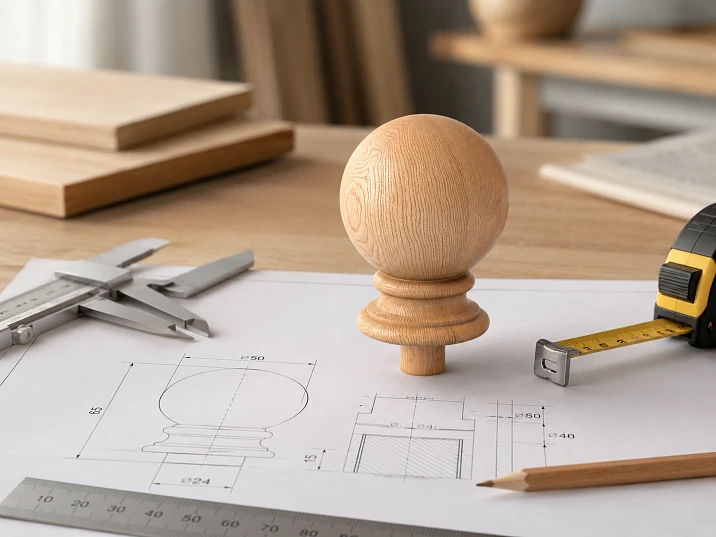
The L-022 has a trap that is not visible in the nice product photo: the card shows four similar lines A×B×C×E, and the buyer easily starts reading them "by meaning" — for example, taking A as height, B as base width, C as depth, and E as mounting size.
This cannot be done.
For L-022, the safe path is different: the letters A/B/C/E should only be read according to the official product drawing, where each arrow is tied to specific geometry. The table provides four numerical sets, but by itself does not explain from which edge to which edge each value is measured.
At the time of the check, the L-022 card shows four versions:
| Option | A×B×C×E, mm | Beech, "Prestige" | Oak, "Prestige" |
|---|---|---|---|
| 1 | 96×48×60×78 | 1 340 ₽ | 1 780 ₽ |
| 2 | 127×64×80×104 | 2 090 ₽ | 3 290 ₽ |
| 3 | 150×77×96×125 | 2 690 ₽ | 4 490 ₽ |
| 4 | 181×97×120×156 | 3 490 ₽ | 5 990 ₽ |
Prices and availability change, so they need to be rechecked in the product card before payment. But the geometric task remains the same: first understand which specific dimensions of the mating post or furniture element correspond to arrows A/B/C/E, and only then select the row.
That is why this article does not provide a universal answer like "take 150 mm for an average post." Such advice would seem convenient, but it would be technically weak. The user already has a specific L-022, a specific post, and a specific drawing. The choice should be made through geometric compatibility, not through conditional words like "small," "medium," and "large."
If you already like the model, you can first open the category and buy a wooden finial only after comparing dimensions, and then proceed to the exact product card and buy a finial for post L-022 in the row confirmed by the drawing.
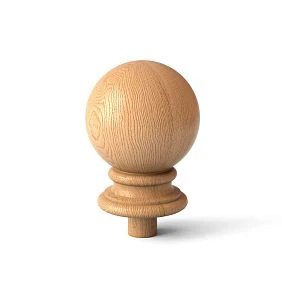
Wooden finial L-022: what exactly can be ordered
L-022 is made of beech and oak. In the current product card, the "Prestige" sanding is indicated for the selected rows, and surface preparation options depend on the material and configuration: the card includes "for enamel" and "for tinting" finishes.
The manufacturer shows four standard sizes:
-
96×48×60×78 mm;
-
127×64×80×104 mm;
-
150×77×96×125 mm;
-
181×97×120×156 mm.
The product itself is described as a wooden finial in a classic style for decorative completion of posts and other interior elements. The card links it to stair posts and balusters, and the related products block indeed shows stair elements.




Why four lines cannot be reduced to a single "height"
Even if one of the dimensions visually seems primary, the other three determine the shape and connection.
Let's imagine a buyer comparing only the first number:
-
96;
-
127;
-
150;
-
181 mm.
He sees a clear ladder of sizes and decides that it is enough to pick a "general scale."
But in each line, the other values change simultaneously:
| A | B | C | E |
|---|---|---|---|
| 96 | 48 | 60 | 78 |
| 127 | 64 | 80 | 104 |
| 150 | 77 | 96 | 125 |
| 181 | 97 | 120 | 156 |
That is, choosing one option changes the entire volume of the product, not just a single dimension.
Our factory also produces:
How to read the line correctly
There is no need to guess what the letter means.
You need to:
-
open the official drawing L-022;
-
find arrow A;
-
see between which geometric points it passes;
-
repeat the same for B, C, and E;
-
measure the corresponding mating dimensions on the actual column or project;
-
compare them with one of the four lines.
If one of the values does not fit, the product cannot be considered compatible just because "the overall height is appealing."
Get Consultation
Why a drawing is more important than a photograph
A photograph answers the questions:
-
whether the shape is appealing;
-
whether the style fits;
-
what the carving looks like;
-
how active the silhouette is.
A drawing answers other questions:
-
where the bases are located;
-
which size corresponds to a specific section;
-
how the product connects to the post.
-
which option physically corresponds to the project.
These two sources solve different tasks.
Why the size of a wooden finial cannot be chosen only by overall height
When choosing a finial, one wants to start with the most obvious: a large post — a large finial, a small one — a small one.
As primary visual logic, this is acceptable. As a final technical choice — no.
Reason 1. One large size does not prove the fit
Two finials may have similar overall height but differ in joint geometry.
For L-022, all four sizes grow simultaneously, but one should not assume that any post with a nominal width of "about 100 mm" automatically gets a specific variant.
Reason 2. The post may have a complex top
The upper part of a stair post can be:
-
square;
-
turned;
-
stepped;
-
with a chamfer;
-
with a transition profile;
-
with a separate platform for the pommel.
Therefore, you need to measure exactly the geometry to which L-022 actually attaches.
Reason 3. External scale and mounting compatibility are different levels
The pommel may physically fit, but look too heavy.
And vice versa: a visually ideal size may have unsuitable mating geometry.
The right choice consists of two filters:
Filter 1 — compatibility with the drawing.
Filter 2 — visual proportion within the composition of the column, balustrade, and room.
They cannot be swapped.
How to measure an existing column before choosing L-022
If the column is already installed, the buyer has an advantage: all actual dimensions can be measured physically rather than taken from the project.
First, determine the upper support geometry
You need to understand where exactly the finial comes:
-
onto a flat top platform;
-
onto a transition element;
-
onto the turned part;
-
onto a separate neck;
-
onto the prepared seating area.
Then open drawing L-022
And from arrows A/B/C/E, transfer the measurements to the column.
Why you cannot measure an "approximate square from above"
Because the same column can have:
-
an outer dimension of 100 mm;
-
an internal seating platform of smaller size;
-
chamfer;
-
a decorative transition.
If card L-022 requires checking not the outer square but a different base, the selection based on 100 mm will be erroneous.
If the column has not been manufactured yet
Then the process goes in reverse:
-
the design system of the staircase is selected;
-
the column is determined;
-
L-022 is selected;
-
the joint is coordinated on the drawing;
-
only then are both parts put into production.
Why values A/B/C/E cannot be "deciphered" by proportions
The four rows have a noticeable scale dependency. For example, the first parameter grows from 96 to 181 mm, the second from 48 to 97, the third from 60 to 120, and the fourth from 78 to 156.
This can create an illusion:
"everything is almost proportional, so I understand the shape without a drawing."
But even approximately proportional numbers do not explain the geometric meaning of measurement.
For example, two quantities can relate to:
-
the overall width;
-
a local transition;
-
the base;
-
the height to a certain point.
Without arrows on the drawing, it is impossible to reliably determine which one.
Practical rule
If the specification says A/B/C/E, keep the same letters in the worksheet.
Do not rewrite them as:
-
height;
-
width;
-
base;
-
diameter,
unless this is confirmed by the drawing.
This reduces the risk that the designer, manager, and carpenter will start using different terms for the same value.
L-022 96×48×60×78 mm: which dimensions to check before adding to cart
The most compact option is 96×48×60×78 mm.
At the time of checking, the beech version costs 1,340 ₽, the oak version — 1,780 ₽. Oak is shown as in stock in Saint Petersburg, beech is available by order.
What cannot be done
You can't say:
“96 mm means a finial for a 96 mm post.”
The number A=96 must be read from the official drawing.
What needs to be done
Open the DWG/scheme and write out:
-
A=96;
-
B=48;
-
C=60;
-
E=78.
Next to it — four corresponding actual dimensions of your assembly.
Working table
| Parameter L-022 | Option | Actual assembly dimension | Matches/fits |
|---|---|---|---|
| A | 96 | ___ | Yes/No |
| B | 48 | ___ | Yes/No |
| C | 60 | ___ | Yes/No |
| E | 78 | ___ | Yes/No |
Why such a table is more useful than a "small size"
It forces you to check the entire assembly.
If three values fit but the fourth does not, the option is not considered confirmed.
How to evaluate the scale of the 96-millimeter option after technical verification
After the geometry is compatible, you need to look at the product as part of the staircase.
On a small post
The compact L-022 can look neat.
On a massive post
It can visually get lost.
On a staircase with simple balusters
A laconic finial works naturally.
On a very ornate carved balustrade
It may turn out to be too calm.
This is no longer a question of A/B/C/E, but of visual balance.
Wooden finial L-022 127×64×80×104 mm: when to consider the second size
The second line looks like a natural step after the 96-millimeter version, but it cannot be chosen on the principle of "the first is too small — I'll take the next one."
Parameter set:
127×64×80×104 mm.
At the time of checking:
-
beech — 2,090 ₽, made to order;
-
oak — 3,290 ₽, the card shows 1 pc. in Moscow.
How much larger is this option compared to the first line
Let's compare numerically:
A:
127 / 96 ≈ 1,32.
B:
64 / 48 ≈ 1,33.
C:
80 / 60 ≈ 1,33.
E:
104 / 78 ≈ 1,33.
That is, the second size is indeed about a third larger than the first across all four values.
This is a good sign of a scaled series, but not a license to choose it "by eye."
What to check on the drawing
The same table:
| Parameter | L-022 №2 | Your node |
|---|---|---|
| A | 127 | ___ |
| B | 64 | ___ |
| C | 80 | ___ |
| E | 104 | ___ |
If the product mates with an existing column, measurements should be taken from the actual part.
If the column is being designed, the comparison is made against the approved column drawing.
When 127 mm may visually appear stronger than 96 mm
For example, if:
-
the column already has a noticeable upper volume;
-
medium-scale balusters;
-
the stair flight is wide;
-
the ceiling is high;
-
The finial should be readable from several meters away.
When the second variant becomes too active
if:
-
The column is thin;
-
The railing is light;
-
There is little decor nearby;
-
The upper platform is visually compact.
How to make four scale templates L-022 without buying four products
Since the main issue of the article is choosing the size, it is useful to see all four variants at once.
Simple frontal template
For each version, a rectangle is made according to the two dimensions that actually describe the frontal silhouette on the official drawing.
Before viewing the drawing, it cannot be automatically determined whether this is A×B or A×C.
Therefore, the order is as follows
-
open the drawing;
-
determine the frontal dimension;
-
write out the corresponding letters;
-
make a template;
-
apply to the photo or the actual pole.
Why can't only the first and second numbers of the line be used
Because the notation A×B×C×E is technical, not a promise that A and B form a frontal rectangle.
This is another example where the drawing is more important than the habit of reading dimensions from left to right.
Finial L-022 150×77×96×125 mm: proportion check before ordering
Third option:
150×77×96×125 mm.
At the time of checking:
-
beech — 2,690 ₽, on order;
-
oak — 4,490 ₽, the card shows 2 pcs in Saint Petersburg.
The transition from 127 to 150 mm is not the same as from 96 to 127
By A:
150 / 127 ≈ 1,18.
By B:
77 / 64 ≈ 1,20.
By C:
96 / 80 = 1,20.
Along E:
125 / 104 ≈ 1,20.
That is, the third size is approximately 18–20% larger than the second.
The series does not grow with a uniform absolute step:
A:
96 → 127 = +31 mm;
127 → 150 = +23 mm;
150 → 181 = +31 mm.
Therefore, you cannot invent a missing size by linear interpolation and assume that the manufacturer offers a continuous scale.
When the third size becomes an obvious candidate
Only when its four parameters match the node.
After that, visually it is especially suitable for:
-
a more massive starting column;
-
a staircase with a large handrail;
-
a railing where the finial should be a readable architectural completion.
What to check near the ceiling or landing
A large finial may physically fit on the post, but conflict with:
-
a low ceiling;
-
a windowsill;
-
the handrail of the second flight;
-
furniture;
-
a decorative panel.
For the finished object, not only the post is needed, but also the volume of free space around the future L-022.
How to check the free volume around the finial
After choosing a technically compatible size, make a three-dimensional mock-up.
There is no need to reproduce the carving.
A block or cardboard according to the actual maximum dimensions determined from the drawing is sufficient.
What to check
-
does not touch the wall;
-
does not extend into the passage;
-
whether it conflicts with the handrail;
-
does not block the view;
-
does not look too large relative to the balusters.
Why is this check especially important for 150 and 181 mm
The larger the finial, the more it ceases to be a "small detail on a post" and begins to be perceived as an independent architectural object.
L-022 181×97×120×156 mm: when a large wooden finial becomes too massive
The largest confirmed option:
181×97×120×156 mm.
At the time of checking:
-
beech — 3,490 ₽, made to order;
-
oak — 5,990 ₽, made to order.
Comparison with the smallest
By A:
181 / 96 ≈ 1,89.
By B:
97 / 48 ≈ 2,02.
By C:
120 / 60 = 2.
Along E:
156 / 78 = 2.
That is, the largest version is roughly twice as large as the minimum in three out of four parameters.
This is no longer a small difference.
Why you can't choose 181 mm just "for solidity"
A large finial can:
-
visually weigh down the top of the post;
-
make the balusters look too thin;
-
conflict with the handrail;
-
disrupt the vertical rhythm of the staircase.
When 181 mm can be a strong solution
-
large initial column;
-
high hall;
-
wide flight;
-
massive balustrade;
-
large classical elements;
-
large-scale furniture project.
When is it better to return to 150 or 127
If in a frontal layout the finial is visually wider/heavier than the column and begins to dominate the entire balustrade.
Why "too massive" is not determined by a single number
181 mm is not a universal threshold.
On one object, this is the ideal scale.
On another, it's overload.
Comparison of four L-022: technical table without invented letter decoding
| Option | A | B | C | E | Relative scale by A to variant 1 |
|---|---|---|---|---|---|
| 1 | 96 | 48 | 60 | 78 | 1,00 |
| 2 | 127 | 64 | 80 | 104 | 1,32 |
| 3 | 150 | 77 | 96 | 125 | 1,56 |
| 4 | 181 | 97 | 120 | 156 | 1,89 |
This table shows the growth of the series, but deliberately does not call A height, B width, or E seating.
This approach protects against a typical mistake: a person sees a number, invents a meaning for it, and then fits the object to their guess.
How to read the official L-022 drawing step by step
The card has a link "Product drawings." It leads to the official DWG file.
If an architect, designer, carpenter, or staircase workshop is working on the project, it's better to give them the original drawing.
Step 1. Find the four designations
A, B, C, E.
Step 2. Fix geometric bases
For each dimension, you need to answer:
-
from which point does the dimension line start;
-
where it ends;
-
whether it refers to the external overall dimension or a local area.
Step 3. Write out the required line
For example:
A=150;
B=77;
C=96;
E=125.
Step 4. Find equivalent geometric bases on the mating element
Do not substitute a "similar" dimension.
Step 5. Check all four
Compatibility is not confirmed by a single match.
Step 6. Perform a scaled visual check
Only after geometry.
Why it's useful to attach table A/B/C/E to the order
The manager sees which option is needed.
The carpenter sees which four parameters were checked.
The installer doesn't receive something abstract:
"L-022 medium."
Working formulation
L-022 / option 150×77×96×125 mm / oak / Prestige / preparation ___ / joint checked per official drawing A/B/C/E / column ___.
Such a line is better than:
"L-022 150 mm."
If one parameter matches between the column and L-022, but the other does not
There is no need to automatically resolve the conflict by filing "in place."
There may be various reasons:
-
the wrong size was selected;
-
the wrong base was measured;
-
the column is from a different series;
-
the assembly requires an adapter part;
-
the project is not compatible with the standard L-022 at all.
What to do
Return to the drawings of both products.
If mechanical modification of the cap itself is required, its admissibility must be confirmed with the manufacturer/workshop, not assumed.
Why "a little trimming" is a bad strategy before purchasing
The pommel has a carved/turned decorative volume.
Unauthorized trimming may:
-
change the symmetry;
-
expose a different layer of wood;
-
damage the prepared surface;
-
alter the fit;
-
ruin the finish.
First, a suitable standard size is selected.
Only then is non-standard modification discussed, if it is unavoidable.
What to do if none of the four sizes fit
This is an important verification result.
You don't need to buy the closest one just because L-022 is appealing.
Options:
-
choose a different pommel;
-
change the mating column at the design stage;
-
agree on an individual solution;
-
use a transition node if it is provided by a specialist.
Why refusing to buy may be the right choice
The standard grid of four sizes does not have to cover any existing column.
Expert selection begins with recognizing incompatibility, not with forcing a fit at any cost.
How to visually compare four sizes on the same column
After the technical filter, two compatible options may remain.
Then a collage helps.
Take a frontal photo of the column
Preferably without strong perspective.
Scale L-022 according to a known dimension from the drawing
Not "by eye."
Place the options side by side
For example:
127 and 150.
Compare
-
top weight of the composition;
-
relation to the handrail;
-
relation to the balusters;
-
free space.
Why not compare all four, if two are already technically unsuitable
They create a false choice.
First, geometry cuts off the incompatible.
Design chooses from what remains.
Beech or oak top: which L-022 to order for an existing staircase
After choosing the size, the material remains.
L-022 has confirmed beech and oak.
You cannot reduce the choice to a rule:
"oak is more premium, so it's better."
The wood species must be consistent with:
-
the post;
-
handrail;
-
balusters;
-
the steps;
-
the overall finish system.
Beech
Rational if:
-
the project is for a covering enamel;
-
the texture should not be the main accent;
-
the cost of the natural wooden part needs to be reduced;
-
Adjacent elements are also beech.
Oak
Stronger if:
-
Visible texture remains;
-
The staircase is oak;
-
The finial is tinted or coated with a transparent compound;
-
A unified material pattern with other large elements is needed.
Why oak should not be chosen solely for strength
The article does not include the calculation of the force function L-022.
The finial is a decorative element of the node.
Therefore, the choice of wood species here is determined primarily by:
-
system material;
-
finish;
-
visual consistency.
The price difference grows with size
At the time of checking:
96 mm:
1 780 − 1 340 = 440 ₽.
127 mm:
3 290 − 2 090 = 1 200 ₽.
150 mm:
4 490 − 2 690 = 1 800 ₽.
181 mm:
5 990 − 3 490 = 2 500 ₽.
The larger the L-022, the more noticeable the absolute surcharge for oak becomes.
This does not make oak "worse." But the buyer has an economic reason to first prove that natural oak texture is truly needed.
Price of four sizes L-022: what changes when the size increases
Let's compare beech.
| Size | Beech price | Increase from previous |
|---|---|---|
| 96×48×60×78 | 1 340 ₽ | — |
| 127×64×80×104 | 2 090 ₽ | +750 ₽ |
| 150×77×96×125 | 2 690 ₽ | +600 ₽ |
| 181×97×120×156 | 3 490 ₽ | +800 ₽ |
For oak:
| Size | Oak price | Increase |
|---|---|---|
| 96×48×60×78 | 1 780 ₽ | — |
| 127×64×80×104 | 3 290 ₽ | +1 510 ₽ |
| 150×77×96×125 | 4 490 ₽ | +1 200 ₽ |
| 181×97×120×156 | 5 990 ₽ | +1 500 ₽ |
Why price should not choose the size
Size is a matter of compatibility and proportion.
If the column requires 150, you cannot buy 127 just to save money.
If 127 fits and visually looks better, there is no point in taking 181 "because it is more expensive and more solid".
Commercial order
compatibility → scale → breed → price.
Not the other way around.
What does "Prestige" sanding mean for order L-022
In the current line item, the rows come with "Prestige" sanding quality.
It cannot be assumed
"Prestige = ready for any varnish without preparation."
"Prestige = ready for any varnish without preparation."
Different finishing systems require:
-
the primer;
-
interlayer sanding;
-
dust removal;
-
of a test sample.
Why this is especially important on the finial
The part has:
-
curved surfaces;
-
transitions;
-
carved/turned volume.
A thick or uneven layer can visually soften the shape.
"Under enamel" and "under tinting": check the specific line before payment
The card shows different quality options for re-lamination.
For the customer, this matters more than the wood species as a word.
Under Enamel
If the finished product will be covered with an opaque coating.
Under Tinting
If the wood texture should remain visually significant.
Why can't you automatically say "oak = for tinting"
The card can have different configurations.
You need to select a specific row.
What to check in the cart
Not only:
-
L-022;
-
size;
-
Oak.
But also:
-
sanding;
-
preparation.
What to compare on the stair post before buying a wooden finial
The finial and the post should be considered as one unit.
If the post already exists, take at least four groups of measurements.
1. Geometry of the top area
According to the bases specified on drawing L-022.
2. Column axis
The finial must be positioned predictably relative to the central axis.
3. Top surface condition
It must be:
-
level;
-
finished;
-
suitable for the chosen joining method.
4. Finish
Is the column already painted, tinted, or left raw?
This determines how to finish L-022.
Why the outer size of a column and the mounting size may not match
A column may have a large square cross-section, but taper to a smaller platform at the top.
If a buyer measures the lower/middle section and selects L-022 based on it, compatibility is not proven.
Example of logic
The column is visually 120×120.
The top part is different.
You cannot write:
"For a 120-mm column, you need a variant where 120 appears in the table."
For L-022, the number 120 appears in the row 181×97×120×156, but without a drawing, it cannot be claimed that C=120 refers to the column width.
This is a good example of how dangerous literal number matching can be.
If the column already has another cap
When replacing, first remove the old part and measure the joint itself, not the old cap.
Why
The old part could:
-
be made to individual size;
-
have a hidden fit;
-
cover the transition element;
-
be trimmed on site.
Copying its outer dimensions is not enough.
If L-022 is installed on furniture rather than on a staircase
The card allows the use of the finial as wooden decor in furniture and interiors.
Then the A/B/C/E principle remains the same.
It is necessary to determine
-
what element it is placed on;
-
where the reference geometry runs;
-
what the scale of the furniture is;
-
whether there is free volume.
What changes
Stair categories and balusters cease to be the main context.
But the article itself remains about the dimensional selection of L-022 according to the drawing.
Wooden finial and stair post: why they should be considered as one assembly
When L-022 is selected for a staircase, the post is the nearest mating product.
If the post has not been purchased yet, first it is worth buy staircase posts after checking which models are structurally and stylistically consistent with the project.
Why can't you choose L-022 separately and "find a post later"
There is a risk that:
-
the size chart won't match;
-
the top geometry will require a different node;
-
the scale will turn out to be incorrect.
A more reliable sequence
staircase → post → L-022 → general node drawing.
How to check the scale of L-022 relative to the height and thickness of the post
After geometric compatibility, you can do a simple visual comparison.
Frontal layout
Place the finial silhouette on the photo of the post.
Side
Check the total volume.
From a distance
View together with the handrail and balusters.
Why one post in the workshop is insufficient
In a real staircase, around it there are:
-
steps;
-
railing;
-
the ceiling;
-
landing;
-
other posts.
The finial is part of the overall composition.
Which balusters to consider when choosing L-022
Card L-022 itself connects it to the stair balusters.
If the project is still being assembled, you can buying wooden balusters for stairs after the scale of the post and the finial is clear.
Why balusters affect the size of the finial
Very thin balusters next to the large 181-millimeter L-022 can create a strong scale contrast.
Large carved balusters, on the contrary, require a more confident finish for the post.
But you cannot select balusters by a single height
You need to look at:
-
thickness;
-
drawing;
-
frequency;
-
step;
-
handrail.
Handrail and L-022: why their lines must be coordinated
The handrail meets the post at a certain height and at a certain angle.
The finial completes the top.
If it is too massive, it can visually "overlap" the handrail line.
If it is too small, the post seems unfinished.
When assembling, you can Buy a wooden handrail for stairs already after agreeing on the overall geometry.
Components for a wooden staircase: when you need to look at the whole assembly at once
If the project is not yet assembled, it is useful to open Components for wooden staircase and check how the post, balusters, and decorative elements form one system.
What this prevents
The situation:
-
a post from one scale series;
-
handrail from another;
-
balusters third;
-
L-022 selected only by photo.
What remains the main thing in this article
Even within a full set, size L-022 is selected according to its own drawing A/B/C/E.
Order L-022 from stock or wait for manufacturing: how to read the card status without error
The L-022 card shows different statuses by size and wood type.
At the time of checking:
-
96×48×60×78, beech — made to order;
-
96×48×60×78, oak — in stock in Saint Petersburg;
-
127×64×80×104, beech — made to order;
-
127×64×80×104, oak — in stock in Moscow;
-
150×77×96×125, beech — made to order;
-
150×77×96×125, oak — in stock in Saint Petersburg;
-
181×97×120×156, beech — made to order;
-
181×97×120×156, oak — made to order.
Status changes, so these figures cannot be taken as a permanent warehouse reference.
If the required size is in stock
The card indicates shipment from the warehouse within three business days if available.
This does not mean you should take this line just for speed.
If 150 fits the drawing and 96 is in stock, buying 96 is incorrect optimization.
If the desired option is made to order
The average production time is stated as 5–10 days.
For a staircase project, this should be taken into account in advance, because the finial is often installed at the final stage, when finishing and installation are already tied to the schedule.
When stocked oak can change the choice of wood species
Only if both materials are acceptable according to the project and finish.
If the customer fundamentally wants beech under enamel, the availability of oak should not automatically change the material.
Why the “in stock” status should be checked right before payment
The warehouse changes.
Especially if the card shows a small remaining quantity, for example one or two pieces.
Example
The project needs two identical L-022 150 mm for two posts.
The card at the time of check shows 2 oak items in St. Petersburg.
Theoretically, this is enough.
But until the order is placed, the stock is not a reserve.
What to write to the manager
L-022 / 150×77×96×125 / oak / 2 pcs. / confirm the available stock of one batch and the current lead time.
Why "one batch" is useful for natural wood
Two finials may differ in grain pattern.
If they are placed symmetrically, it is better to see them side by side before staining.
If the staircase has two identical starting posts
The quantity of L-022 changes from one to two.
This seems obvious, but in a paired composition a new task arises:
-
same size;
-
same breed;
-
identical preparation;
-
visual similarity of wood;
-
one finish.
What not to do
Order one oak 150 from stock, the second — later from another batch, without checking them together, if natural texture is critical.
What can be done
Get both, lay them side by side, determine orientation, and only then tint.
What to check in the cart before paying for a wooden finial
The card contains several size lines, so the final check should be formal.
SKU
L-022.
Size
Not "medium" or "large", but the full set:
A×B×C×E.
Material
Beech or oak.
Sanding
Confirmed configuration.
Quality of re-lamination
Under enamel or under tinting — according to the selected line.
Quantity
1, 2, or another design number.
City of availability
If the deadline matters.
Delivery
The product card states Contact us to confirm shipping to your destination. by a transport company.
Why you can't check only the price in the cart
Prices differ for two different sizes.
If a buyer accidentally selects 127 instead of 150, the total amount simply becomes smaller.
The system will not warn:
"you took a technically incompatible size".
Therefore, tse
Mistake 16. Order one finial for two symmetrical posts and later look for the second one
Batch/tone may differ.
Mistake 17. Not checking the free space around a large L-022
It technically fits, but conflicts with the wall or handrail.
Mistake 18. Not looking at the finial together with the balusters
The scale of the railing becomes random.
Mistake 19. Choosing a post after the finial without an overall check
The connection may not match.
Error 20. Use dimensions from the old article instead of the current card.
The primary source is more important than the old text.
How to check visual scale without a 3D model
You can do a very simple physical test.
If the column is already installed
A cardboard volume is temporarily placed on top according to the maximum dimensions of the compatible L-022.
If the column is only being designed
A full-size mockup of the balustrade section is used.
What to evaluate
Not the beauty of the cardboard, but:
-
the height of the visual center;
-
width;
-
free volume;
-
relation to the handrail.
Why the model should be viewed from the stair landing and from below
The finial is readable from different levels.
From below
It may appear larger.
From the landing
The top and the junction are visible.
From the adjacent room
The overall silhouette is readable.
What can happen
Option 181 looks ideal from the first floor level, but too massive next to the hand on the landing.
Then 150 might be stronger.
How to choose one of two technically compatible sizes
Sometimes the transition node allows two options.
Then a set of criteria is needed.
Criterion 1. Post scale
Criterion 2. Balusters
Criterion 3. Handrail
Criterion 4. Room height
Criterion 5. Number of identical finials
Two large finials are perceived as more active than one.
Criterion 6. Finish
Dark oak can visually appear heavier than light beech under enamel at the same size.
Color and size work together
A large 181 mm under dark tinting looks more massive.
The same dimension under light enamel can be perceived as lighter.
Therefore, the final mockup is better made in a close color
At least approximately.
White cardboard for a dark oak project can underestimate the visual weight.
Oak L-022 and natural wood variability
If the texture remains visible, each finial is unique.
For a pair of pillars, you need to check:
-
shade;
-
direction of fibers;
-
the nature of the pattern.
What you should not require
Two absolutely identical natural details.
What can be required by design
A coordinated finish and the absence of a sharp visual imbalance.
If L-022 is painted in the color of the pillar
The finial becomes part of a single vertical line.
This is a strong scenario if:
-
The form should be read as a relief;
-
The color should not break up the column.
What is important
Test coating.
Even one enamel code can look different on different wood species and surfaces.
What to send to the STAVROS manager before ordering L-022
A good specification should not look like:
"Need L-022 medium, oak."
The word "medium" exists only in conversation. The card has exact dimension lines.
Working specification
L-022 / A×B×C×E = ___×___×___×___ mm / material beech or oak / Prestige sanding / glue quality ___ / quantity ___ / connection to column ___ verified against the official drawing / finish ___ / confirm current availability and lead time.
Why you need to write all four numbers
This eliminates the risk that the manager and the buyer mean different options.
Why you should specify the post model
If the finial is chosen specifically for a staircase, the associated SKU helps to double-check the set.
Why it's useful to keep the phrase "checked against the drawing"
It records that the choice was made not based on the external photo.
If the post and L-022 are purchased at the same time
Then a single order sheet can be compiled.
| Node | SKU | Size/drawing | Material | Finish |
|---|---|---|---|---|
| Pillar | ___ | ___ | ___ | ___ |
| Finial | L-022 | A/B/C/E ___ | ___ | ___ |
| Balusters | ___ | ___ | ___ | ___ |
| Handrail | ___ | ___ | ___ | ___ |
Why such a table
It shows the staircase as a system.
If one row is oak and another is beech, this becomes visible before payment.
When the material of the post and the finial may differ
Technically, different wood species can be used in the same interior, especially under a covering enamel.
But if the wood remains visible, the difference:
-
of pores;
-
of the pattern;
-
of shade
will be noticeable.
Therefore, under a transparent finish
It is better to first check physical samples.
Under enamel
The main question is the compatibility of preparation and the final color.
If the post is oak, and L-022 is beech under enamel
This can only be rational if both elements are indeed covered with an opaque finish and the project allows for different substrates.
Such a combination cannot be described as universally equivalent.
If L-022 is needed for a bed or furniture
The card allows for broader decorative use, but stair dimension habits should not be transferred automatically.
For furniture, it is checked
-
mating element;
-
furniture height;
-
free space;
-
visual scale.
What remains unchanged
Reading A/B/C/E from the drawing.
Boundary scenario: an existing column is between two standard sizes
Suppose after a correct check it turns out that one L-022 is too small at the node, the next one is too large.
You cannot choose "the one that is closer."
Options
-
another SKU;
-
individual transition;
-
changing the column if it is still in the project;
-
non-standard production after approval.
Why fitting the nearest size is dangerous
It can change the landing geometry and artistic form.
Boundary scenario: geometry fits, but the finial is wider than the adjacent handrail
This is not necessarily a mistake.
The finial often needs to stand out.
But we need to check that the top of the post does not become visually heavy.
Layout
Handrail + post + L-022 in one frontal view.
Boundary scenario: geometry fits two sizes thanks to a transition piece
Then the size is selected based on:
-
proportions;
-
transition thickness;
-
common height;
-
price.
What not to forget
The transition piece itself must be designed accordingly.
Do not use it as an improvised way to "fit anything."
Boundary scenario: one post at the bottom and two on the landing
Different scales of finials may be required in a single project.
For example, the main starting post is larger.
Can L-022 of different sizes be mixed
This can be considered if the stair composition is truly hierarchical.
But then it is no longer the same series.
What to check
Does the difference not look random.
Boundary scenario: all posts are identical, but one is next to a wall
Don't reduce just one finial without a reason.
A wall can create visual tightness, but broken repetition can be worse.
Alternative
Check another size on all posts.
Edge case: L-022 almost touches the windowsill
Physical compatibility with the post is insufficient.
Free space around is needed.
What to do
Measure the minimum distance in three dimensions.
Don't invent a universal gap.
Edge case: the staircase is already coated with oil of unknown composition
The new oak L-022 cannot be stained with "approximately the same color" and expected to match.
Need
-
sample of existing coating;
-
test on new oak;
-
comparison after drying.
How to compare size and price simultaneously without substituting criteria
First, technically acceptable options.
Suppose, after the drawing, 127 and 150 remain.
Only then do we compare:
Beech
127 — 2 090 ₽.
150 — 2 690 ₽.
The difference:
600 ₽.
Oak
127 — 3 290 ₽.
150 — 4 490 ₽.
The difference:
1 200 ₽.
What price decides
If both sizes are equally good visually and technically.
What price doesn't solve
If 127 looks small, and 150 is properly scaled.
Selection matrix of four sizes L-022
| Question | 96 | 127 | 150 | 181 |
|---|---|---|---|---|
| Compatibility A/B/C/E | Check | Check | Check | Check |
| Compact scale | stronger | Medium | Larger | the largest |
| Small column | likely candidate | Check | Less often | Only after the layout |
| Large initial column | May get lost | Check | strong candidate | Check |
| Tall spacious hall | May be small | Possible | Strong | Strong |
| Limited space | More convenient | Check | Caution | especially check |
The table does not give an automatic answer. It shows the order of checking.
Why the first size that fits the drawing may not be the best visually
Compatibility answers:
whether it can be connected.
Design answers:
whether it is worth doing exactly this way.
If two sizes are allowed through one node system, you need to compare both physically or to scale.
Why the most beautiful option in the picture may be incompatible
Because the product photo doesn't know the dimensions of your pole.
It's trivial, but it's precisely on such details that errors often occur: the decorative element is chosen by eye, while the connection is left to the installer.
The correct sequence is the opposite.
How to prepare an A/B/C/E checklist for the object
You can print one page:
Object: ___
Pole: ___
L-022: ___
| Dimension letter | What the arrow on the drawing indicates | Actual pole data | L-022 | Result |
|---|---|---|---|---|
| A | describe per the drawing | ___ | ___ | fits/does not fit |
| B | describe per the drawing | ___ | ___ | fits/does not fit |
| C | describe per the drawing | ___ | ___ | fits/does not fit |
| E | describe per the drawing | ___ | ___ | fits/does not fit |
Why the second column cannot be filled from the article
Because it must exactly match the brand's size chart.
This protects against misinterpretation.
When L-022 can be considered ready for ordering
-
A specific column or furniture element has been selected.
-
The official L-022 drawing is open.
-
All four size bases are understood.
-
The actual mating unit has been measured.
-
One of the four sizes has been selected.
-
Visual mockup created.
-
Free space checked.
-
Breed selected.
-
Preparation selected.
-
Price checked.
-
Availability or delivery time checked.
-
Quantity confirmed.
Too early to buy
if:
-
only photo available;
-
drawing not opened;
-
only the overall size of the column is known;
-
finish not selected;
-
the column may still change;
-
the choice was made based on availability, not compatibility.
How to conduct acceptance of L-022 after delivery
Before finishing and installation:
SKU
L-022.
Size
Verify all four values.
Material
Beech/oak.
Quantity
according to the project.
Surface
Inspect before painting.
Comparison with the drawing
Re-apply to the node or mockup.
Why re-checking is needed
Even a correctly placed order is better to physically check before irreversible work.
If the wrong size arrived
Do not trim immediately.
Do not start tinting.
First, verify:
-
order;
-
marking;
-
the card;
-
drawing.
If the size is correct, but the wood noticeably differs from the post
For a transparent finish, resolve the issue before installation.
Possible options:
-
a different selection;
-
changing tint;
-
accepting natural variability.
How to save L-022 data after installation
It is useful to leave in the object passport:
-
article number;
-
full size A×B×C×E;
-
material;
-
finish;
-
photo;
-
order date.
Why
If the finial is damaged or a second one is needed, you won't have to re-decode the old node.
Where to buy wooden finial L-022 and its components
If the choice is already made, the path through the catalog should be short.
For the L-022 itself, an exact card is needed.
For an alternative finial — a category.
For the stair node — post, balusters, and handrail.
When you don't need to open ten adjacent categories
if:
-
the post already exists;
-
balusters are installed;
-
the handrail is ready;
-
only L-022 is needed.
Then expanding the selection only creates noise.
When components really need to be checked
If the staircase is still being designed as a whole.
Then the size of the finial cannot be separated from the rest of the balustrade.
How not to turn L-022 into another generic article about finials
The user has already selected a model.
They don't need the history of decorative post caps.
After reading, they should be able to perform specific actions:
-
open the drawing;
-
read four dimensional notations;
-
take the corresponding measurements from the joint;
-
exclude incompatible options;
-
compare the scale of the remaining;
-
select beech/oak;
-
form the exact order line.
If the article does not lead to these actions, it loses its meaning.
Control algorithm for selecting size L-022
-
Make sure that L-022 is exactly what is needed.
-
Open the card.
-
Open the branded DWG/drawing.
-
Find A.
-
Find B.
-
Find C.
-
Find E.
-
Do not rename letters by guess.
-
Determine the mating element.
-
If the column is already installed — measure it actually.
-
If designing — use the approved column drawing.
-
Fill in table A/B/C/E.
-
Check variant 96×48×60×78.
-
Check 127×64×80×104.
-
Check 150×77×96×125.
-
Check 181×97×120×156.
-
Filter out geometrically incompatible ones.
-
Make scaled templates from compatible ones.
-
Check frontally.
-
Check from the side.
-
Check the handrail.
-
Check the balusters.
-
Check the free space.
-
Select the size.
-
Choose birch or oak.
-
Select finish preparation.
-
Determine the quantity.
-
Check the current price.
-
Check availability/term.
-
Generate the specification.
-
When receiving, re-verify all parameters.
-
Only then start finishing and installation.
Drawing L-022 on screen and printout: how to avoid errors due to viewing scale
Even a correct official drawing can be used incorrectly.
The most dangerous mistake is measuring the image with a ruler directly on the screen or printout if the print scale is not confirmed.
Why the size in the picture does not equal the real size
PDF, DWG preview, browser, and printer can:
-
scale the image;
-
fit it to the page;
-
change size when printing;
-
show the drawing with different zoom.
Therefore, the number 150 on the dimension line is more important than how many millimeters you measured with a ruler on paper.
If a physical template is needed
It is rebuilt according to the numerical dimensions of the drawing or printed at a confirmed scale of 1:1.
After printing, you need to have a control dimension line with a known value and check it with a regular ruler.
Why you cannot scale the L-022 photo only by the card's height
If perspective or angle is distorted, the remaining dimensions cease to be accurate.
For a rough visual collage, the photo is suitable.
For checking alignment — no.
What to do if not every computer can open a DWG drawing
The card links to a DWG file. For a professional workshop this is a normal format, but a home user may not have CAD software.
Safe option
Send the file to:
-
a designer;
-
a carpenter;
-
a staircase workshop;
-
a specialist who assembles the unit.
What to ask the manager
If there is no way to open DWG, ask for:
-
PDF;
-
raster scheme;
-
clarification of the required dimensional bases.
What not to do
Do not replace an unavailable drawing with a guess based on a product photo.
Why dimensions need to be transferred to a single coordinate system
If one master measures the column and another measures L-022, their bases must match.
For example, one may take a measurement:
-
by the maximum external dimension;
another:
-
by the internal platform.
The numbers will look similar, but describe different things.
Work discipline
On the pole sketch, the same letters A/B/C/E are labeled next to the corresponding geometric lines after they are determined from the brand drawing.
Then the comparison becomes literal:
A pole/node ↔ A L-022
And not:
"the width roughly matches."
Four standard sizes as scale steps: what can be calculated and what cannot
Relative changes can be calculated from the table.
For example, the largest variant by C:
120 / 60 = 2 times larger than the minimum.
Along E:
156 / 78 = 2 times.
This helps to understand the visual range of the series.
But one cannot derive from this
-
the exact fit;
-
the allowable post size;
-
the load-bearing capacity;
-
installation clearance;
-
the possibility of trimming.
Relative scale — design analytics.
Compatibility — drawing.
If the designer sent only the post size without a drawing
For example:
Column 100×100 mm, select L-022.
this is not enough.
Need to clarify:
-
which part of the column 100×100;
-
what does the top look like;
-
is there a transition platform;
-
where is the connection intended.
Why is this a normal clarifying stage
Not because the product is complex, but because a multidimensional part is not selected by a single external dimension.
If the project has several different columns
Not everyone necessarily needs the same L-022.
For example
-
the main initial column is large;
-
Intermediate posts are smaller;
-
The platform post has a different geometry.
Then a separate table A/B/C/E is filled in for each type.
What not to do
Automatically multiply one selected size by the number of all posts.
How many L-022 to order: count by the number of actually completed elements
If one post receives one finial, the quantity seems obvious.
But the project may include:
-
posts that abut a wall;
-
posts under a handrail of a different design;
-
decorative posts without a finial;
-
symmetric pairs.
Therefore, the list looks like this
| Column | Need L-022 | Size | Material |
|---|---|---|---|
| S1 | Yes | ___ | ___ |
| S2 | Yes | ___ | ___ |
| S3 | No | — | — |
| S4 | Yes | ___ | ___ |
The quantity is taken from the list, not from the total number of posts on the staircase.
Why identical L-022 on all posts can be a good solution
Repetition creates cohesion.
If the geometry of the posts is the same, one size is simpler:
-
to order;
-
finish;
-
replace;
-
to visually connect.
When size hierarchy is better than uniformity
If the main post is objectively larger, the same small finial may look weak.
Then hierarchy is possible, but only if both size rows are compatible with their nodes and the transition looks intentional.
Good principle
The different size is explained by the different type of post.
Bad
The different size appeared because one was in stock and the other was not.
Control after installation of the first L-022 in a serial project
If several identical finials are needed, the first one should be considered the reference.
After installation, check:
-
axis;
-
junction;
-
scale;
-
finish;
-
relation to the handrail.
If everything is confirmed, the rest are installed according to the same map.
Thus, one mistake does not multiply across the entire staircase.
Final size check before confirming the order
Write down the selected L-022 line completely and compare it with the working drawing once more after the material and finish have already been determined. This brief re-check protects against the typical mistake where one size is chosen at the design stage, but a neighboring option from the same series later ends up in the cart.
FAQ about purchasing the L-022 wooden finial
What sizes does L-022 have?
At the time of the check, the card shows four options:
-
96×48×60×78 mm;
-
127×64×80×104 mm;
-
150×77×96×125 mm;
-
181×97×120×156 mm.
What do A, B, C, and E mean?
Their geometric meaning should be read from the official L-022 drawing. The article deliberately does not assign meanings to the letters by guesswork.
Can A be considered the overall height?
Only if the drawing directly shows this. Such a statement cannot be made based on a table alone.
Can E be considered the mounting size?
Only after checking dimension line E on the official diagram.
How to choose between 96 and 127 mm?
First, check both sets A/B/C/E against your node. If both are compatible, compare the visual scale.
How does 127 mm differ from 96 in scale?
By four numeric parameters, the second option is about a third larger than the first.
How much larger is 181 mm than 96 mm?
For some parameters, roughly twice; for A, about 1.89 times.
Which L-022 is suitable for a 100×100 mm post?
You cannot answer based on a single 100×100 figure. You need to open the L-022 drawing and understand which dimension base must match the top geometry of the post.
Can you choose a variant where the table has a number close to the post width?
No. The coincidence of the number does not prove the coincidence of the geometric parameter.
What to do if the column is already installed?
Take the actual dimensions of the top node based on the bases specified in drawing L-022.
What to do if the column has not been manufactured yet?
Coordinate the column drawing and L-022 before production starts.
What material is available?
Beech and oak.
Which is better — beech or oak?
It depends on the staircase material and finish. Under a covering enamel, beech is often rational; with a visible wood texture, oak may be stronger.
Can an oak finial be placed on a beech post?
Technically, different wood species can be combined, but under a transparent finish the differences will be visible. A design reason is needed.
What does "Prestige" mean?
This is the sanding quality specified in the card. It does not replace the technology of the final coating.
Can L-022 be varnished immediately?
It is necessary to follow the requirements of the selected finishing system and take into account the preparation of the specific configuration.
What are the prices for L-022?
At the time of checking, beech costs from 1,340 to 3,490 RUB, oak — from 1,780 to 5,990 RUB depending on the size.
Why does the oak surcharge increase for large sizes?
Because the price of specific options increases with the size and material. This is a fact of the current product page, not a universal pricing formula.
Is L-022 in stock?
At the time of checking, some configurations are in stock, some are made to order. The status needs to be re-checked before payment.
What is the production time for custom orders?
The average time indicated on the product page is 5–10 days.
What happens when it is in stock?
The product page indicates shipment from the warehouse within three business days.
Can I order L-022 for furniture instead of stairs?
The card allows decorative use in furniture and interiors. But the joint geometry still needs to be checked against the drawing.
Can L-022 be trimmed if it doesn't fit quite right?
You shouldn't plan such modification without consulting the manufacturer or workshop. First, you need to select a standard compatible size.
What to do if none of the four sizes fit?
Choose a different SKU or agree on a custom component. There's no need to buy the nearest size "on a whim."
Do I need to consider the handrail?
Yes. After technical compatibility, L-022 needs to be checked as part of the entire stair composition.
Why are balusters important?
They set the scale and decorative richness of the railing. A too large or too small finial can disrupt the balance.
Where can I see columns that are compatible in style?
In the STAVROS stair column category, then each specific pair needs to be checked against the drawings.
Can I choose the size just by looking at a photo of an installed L-022 at another client's place?
No. The photo helps assess the style, but not the geometry of your column.
Is a physical mock-up needed?
If after the drawing there are two visually possible sizes, a mock-up is very useful.
How do I make a mock-up?
Determine the actual external dimensions of the chosen option from the drawing and reproduce them with cardboard/foam material.
What should be checked on the mock-up?
Free space, visual weight, handrail, balusters, wall, and adjacent elements.
Where can I order the L-022 itself?
In the exact product card after checking A/B/C/E and material.
Final check before payment: five questions that must have precise answers
1. What is the full size selected?
Not "150".
But:
150×77×96×125 mm.
2. Why exactly this one?
Because four dimensional bases from the drawing are compatible with the project.
3. What material?
Beech or oak.
4. What finish?
Under enamel/tinting according to the specific configuration and project.
5. How many pieces?
Based on the actual number of posts/furniture elements.
If any answer sounds like "approximately," the order should be stopped.
Why the full set of numbers should be kept even after installation
After a few years, the owner may remember:
"there was L-022 approximately 150 mm."
But the card contains four parameters.
When replacing one part, "approximately 150" is not enough.
Object passport
L-022 / 150×77×96×125 / oak / finish ___ / 2 pcs.
Such a record turns future repairs from research into a repeat order.
Conclusion
L-022 does not have one universal size "for an average stair post." The card offers four different versions:
96×48×60×78 mm;
127×64×80×104 mm;
150×77×96×125 mm;
181×97×120×156 mm.
The main selection rule is not to guess the meaning of letters A/B/C/E by the order of numbers. You need to open the official drawing, see each dimension arrow, and transfer the same geometric bases to an existing or designed post.
Only after this can we talk about visual scale.
The smallest version is roughly twice as compact as the largest in terms of parameters, and transitions between adjacent versions do not have a single constant step. Therefore, "let's take the next size" is not a technical method.
If two versions are compatible, the decision moves to composition: how well L-022 matches the post, balusters, handrail, room height, and free space around.
The wood species is chosen after geometry. Beech is rational in projects under covering enamel and with a corresponding staircase material. Oak is especially logical when the natural texture should remain visible. At the time of checking, the price of beech is 1,340–3,490 rubles depending on size, oak — 1,780–5,990 rubles. Before payment, prices and stock need to be re-checked.
For a finished order, the specification must simultaneously include:
L-022 → full A×B×C×E → material → sanding/preparation → quantity → finish.
If one of the four dimensions from the drawing does not match the mating component, the product cannot be considered suitable just because it looks appealing externally.
If all checks are passed, the selected Wooden finial L-022 You can already order it as a specific compatible element, rather than as a decorative part that the installer will later have to "fit in place."
It is this exact order that makes the choice predictable:
drawing → A/B/C/E → actual assembly → compatibility → scale → beech/oak → finish → price/availability → order.