






























































Article Contents:
- Furniture handle Wave HL-006M 180 mm: how does the overall length differ from parameter D
- How to measure holes before buying a wooden furniture handle
- Measuring from identical edges
- Measuring between nearest edges
- Caliper
- Condition of the holes
- Hole diameter
- Thickness of the door or drawer
- Mounting surface
- Free space
- Rings around old bases
- Color difference
- Chips near holes
- Longitudinal dent
- Corner cabinet
- Facade next to a wall
- Two opposing facades
- Tall cabinet next to a refrigerator
- Mistake 1. Compared 128 mm with total length A
- Error 2. Bought 260 mm instead of 180 mm
- Error 3. Measured the wrong edges of the holes
- Error 4. Did not check the diameter
- Error 5. Did not check the trace of the old handle
- Error 6. Did not measure the thickness of the facade
- Error 7. Bought a set without a test handle
- Error 8. Decided to bore out the 126 mm hole to 128 mm
- Error 9. Did not check the opening angle
- Error 10. Chose the color by screen
- Error 11. Turned the handle vertically, keeping the horizontal holes
- Error 12. Mixed HL‑006M and HL‑006 without checking the finish
- What does parameter D mean in the Wave HL-006M card?
- Is the 180 mm version suitable for 128 mm holes?
- How to correctly measure the distance between holes?
- Can the distance be measured from the edges of the holes?
- Will the handle cover traces of the old mounting?
- Can Wave be installed vertically?
- Is Wave HL-006M suitable for kitchen fronts?
- How does the HL-006M version differ from HL-006?
- Is the mounting hardware included in the set?
- How to choose screw length based on front thickness?
- What to do if the actual distance is 126 or 130 mm?
- Do I need to order one sample handle before buying a set?
- If the old handle was also 180 mm, does that mean the holes are definitely 128 mm?
- Can I install a Wave 260 mm on 128 mm holes?
- Which Wave is needed for 320 mm holes?
- Can I use old screws?
- What matters more — D or the overall length?
- Do I need to remove the door to replace the handle?
- Can I buy a 128 mm handle without knowing its full length?
- Do I need to check the holes on each facade?
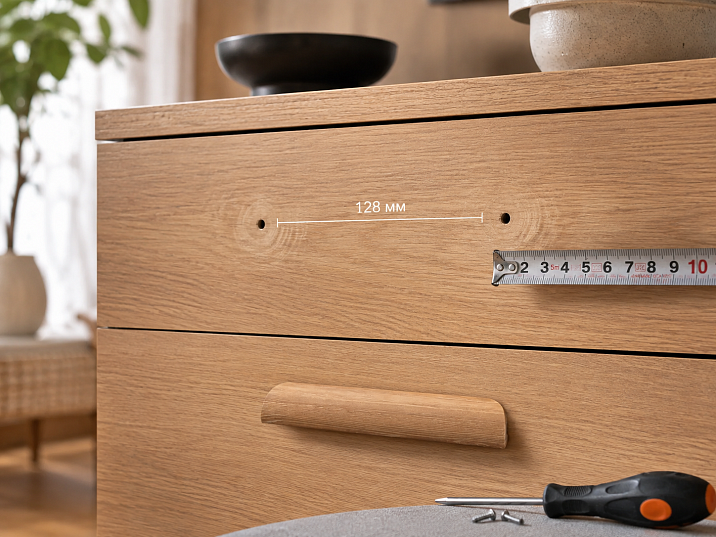
The old furniture handle was removed, the facade remained intact, but it already has two holes with a distance of 128 mm between centers. At this stage, the buyer often makes a mistake: they open the card of the new handle, see the "180 mm" option, and decide it doesn't fit because the old holes are spaced 128 mm apart. For the Wave HL‑006M, these two numbers describe different parameters. For the version with an overall length of A = 180 mm, the mounting parameter D is 128 mm. Therefore, this size is the first candidate to replace the old two-point hardware with a center distance of 128 mm without redrilling.
But the coincidence of D = 128 mm does not automatically mean it will fit any old facade. Before ordering, you need to check that your 128 mm is indeed measured between the centers of the holes, that the holes are not broken or shifted, that their diameter is compatible with the mounting of the new handle, that the Wave body covers traces of the previous hardware, that the screws match the thickness of the door or drawer, and that the handle itself, 180 mm long, does not conflict with the adjacent facade. Only after this check can you reasonably buy the Wave HL‑006M furniture handle as a replacement without new holes.
The main rule of the whole task is simple: when replacing a handle using existing markings, you compare not the total length A, but the parameter D from the drawing with the actual distance between the centers of the old holes. For the Wave HL‑006M 180 mm, this is the combination of A = 180 mm and D = 128 mm. The 260, 400, 500 mm options and others have different D values, so they do not standardly match the two old 128 mm holes.
Below we will break down not only the size table itself, but also the practical replacement on an already finished kitchen, wardrobe, or dresser facade: how to measure old holes, why you cannot measure from edge to edge without understanding the geometry, when the coincidence of the center distance is still insufficient, how to assess the trace from the old handle, how to check the fasteners, and what to do if instead of 128 mm you got 126 or 130 mm.

Wave HL‑006M 180 mm furniture handle: how the total length differs from the D parameter
In the Wave HL‑006M card, the dimensions are given through parameters A, B, C, and D. For the version that interests the owner of a facade with 128 mm holes, it is specified as 180 × 35 × 23 × 128 mm. Here, A = 180 mm is the overall size of the handle along the main axis, B = 35 mm is the width of the body, C = 23 mm is the protrusion, D = 128 mm is the mounting dimension that must be compared with the existing holes.
| Parameter | Value for Wave HL‑006M 180 mm | What it means when replacing |
|---|---|---|
| A | 180 мм | Overall size of the handle; used to assess the external dimensions and composition on the facade |
| B | 35 мм | Body width; important for covering traces of the old handle and proximity to the frame |
| C | 23 мм | Handle protrusion; checked against adjacent doors, wall, and grip area |
| D | 128 мм | Mounting dimension; compared with the distance between centers of existing holes |
It is the mixing of A and D that creates the problem. A person removes the old handle, places a tape measure between the two holes, and sees 128 mm. Then in the catalog they notice "Wave 180 mm" and look for a product named "128 mm," although the required mounting dimension is already present within the 180 mm variant.
For restoration or updating existing furniture, D is more important than A at the first stage. If the center-to-center distance of the old holes does not match D, the question of external design can be set aside for now: the handle will not fit into the existing layout in the standard way. If D matches, proceed to the second group of checks — body, holes, screws, traces of old hardware, and free space.
Therefore, the query "buy furniture handle 128 mm" is technically better interpreted as "handle with a center-to-center mounting dimension of 128 mm," not "handle with a total length of 128 mm." In the case of Wave, the required handle has a total length of 180 mm.




How to measure holes before buying a wooden furniture handle
The most important operation is performed before ordering and takes a few minutes. You need a ruler or caliper, access to two old holes, and the ability to measure them from the front or back side of the facade.
The correct value is the distance from the center of the first hole to the center of the second. If the holes are round and of the same diameter, the center can be determined in several ways.
Our factory also produces:



Measuring from identical edges
If both holes are of the same diameter, measure the distance, for example, from the left edge of the first hole to the left edge of the second. Geometrically, this will give the same center-to-center distance as center-to-center, because equal radii cancel each other out. This method is convenient when the center is visually difficult to determine.
Get Consultation
Measuring between the nearest edges
You can measure the distance between the nearest edges of the holes and add the diameter of one hole if both diameters are the same. For example, between the nearest edges is 123 mm, the diameter of each hole is 5 mm: 123 + 5 = 128 mm. If the holes are damaged or have different diameters, the method loses accuracy.
Caliper
For an old facade, this is the best option. It allows you to simultaneously check the center-to-center distance indirectly and the hole diameters. If the holes are oval due to years of load, measure their condition separately and do not try to get a "convenient" 128 mm at the expense of play.
After measuring, record at least four parameters: center-to-center distance, diameter of each hole, facade thickness, and distance from the holes to the nearest edge or frame. If the center-to-center distance is 128 mm, repeat the measurement. For a furniture set, it is useful to check several doors: old handles may have been installed manually using a template with slight error.
Will a profile handle with D = 128 mm fit an old furniture facade
If the existing holes are indeed spaced 128 mm between centers, the Wave HL‑006M, 180 mm long, geometrically matches this mounting dimension. This is a necessary condition for replacement without re-drilling, but not the only one.
Condition of the holes
The hole must hold the fastener in a predictable position. If the MDF, particleboard, or wood around it is damaged, the screw has significant lateral play, or the hole has become oval, a simple 128 mm match does not solve the problem. First, assess the suitability of the facade itself.
Hole diameter
The Wave card indicates the mounting hardware included, but does not provide a universal rule that any old hole of any diameter is suitable. Match the actual fastener to your facade before final installation.
Door or drawer thickness
Metal screws are supplied with the handle, but the screw length must ensure a proper connection for the specific facade thickness without under-tightening or risk of bottoming out. The exact screw size for your case cannot be determined from a single card — it must be physically checked against the kit and the part thickness.
Mounting surface
The new handle should rest on a sufficiently flat area. If the old mounting is on a framed facade and the holes run close to the profile transition, the Wave body may sit partly on the flat surface and partly on a bevel or milling.
Clearance space
The total length of 180 mm and the protrusion of 23 mm affect usability. Even with a perfect D, the handle may hit an adjacent door, cabinet corner, wall, or a handle on a perpendicular facade.
If all checks pass, D = 128 mm becomes a real basis for replacement without new holes. If at least one point raises doubt, it is better to do a trial fitting of one handle first.
Why a size of 180 mm does not mean the distance between holes is 180 mm
The total length determines the external scale of the product. The center-to-center distance determines installation. These parameters are related by the design of the specific model, but they are not equal to each other.
For the Wave HL‑006M 180 mm, the D parameter is 128 mm. The same is seen across the entire line. For the version with A = 260 mm, D = 192 mm; for A = 400 mm, D = 320 mm; for A = 500 mm, D = 384 mm. None of these options are intended for an existing pair of 128 mm holes without changing the layout.
Therefore, when restyling a kitchen, you cannot act on the principle of "I'll take a longer Wave, the old holes will still be under it." The handle is attached according to its standard scheme. Covering old holes with the body and simultaneously using other new holes is a different mounting scenario with re-drilling and possibly restoring the old markings.
Wooden furniture handles Wave: size range from 180 to 1800 mm
One of the strong features of Wave is its large size range. The HL‑006M card contains ten length options. At the same time, width B = 35 mm and protrusion C = 23 mm are preserved, while A and D change.
| Total length A | B | C | D | For old holes 128 mm |
|---|---|---|---|---|
| 180 мм | 35 мм | 23 мм | 128 мм | Yes, by center-to-center dimension |
| 260 мм | 35 мм | 23 мм | 192 мм | No |
| 400 мм | 35 мм | 23 мм | 320 мм | No |
| 500 мм | 35 мм | 23 мм | 384 мм | No |
| 600 мм | 35 мм | 23 мм | 512 мм | No |
| 700 мм | 35 мм | 23 мм | 576 мм | No |
| 900 мм | 35 мм | 23 мм | 832 мм | No |
| 1200 мм | 35 мм | 23 мм | 1120 мм | No |
| 1500 мм | 35 мм | 23 мм | 1440 мм | No |
| 1800 мм | 35 мм | 23 мм | 1728 мм | No |
The size range is useful for a new furniture project where holes have not yet been drilled: you can choose the length according to the facade scale and then drill according to D. But when replacing existing hardware, the direction of selection is reversed. First, the known D of the old holes, then among the table, a matching A option is sought.
If you need buy wooden handles for furniture of different sizes for one set, the Wave line allows you to keep one shape on small drawers and tall doors. But each size has its own mounting base D, so one old hole template does not fit all lengths.
Which profile handle to buy for holes 192, 320, 384, or 512 mm
The same table helps solve adjacent tasks. If after removing the old handle you got not 128 mm but another standard distance, the required Wave option is searched by D. For D = 192 mm, A = 260 mm is suitable, for D = 320 mm — A = 400 mm, for D = 384 mm — A = 500 mm, for D = 512 mm — A = 600 mm. Further, the size range continues with the same principle: 576 → 700, 832 → 900, 1120 → 1200, 1440 → 1500, and 1728 → 1800 mm.
This is especially useful when renovating a kitchen, where lower drawers and tall cabinets may have originally had different hardware. Instead of a random set of handles, you can choose a unified Wave shape for several existing center-to-center distances — but only if they match the size grid.
Section buy profile handles for furniture useful if no D Wave matches your old layout and you need to look for another model. In such a situation, it is better to change the model than to ruin a finished facade for the sake of a liked length.
Will a wooden handle cover traces from previous furniture hardware
This is the second main question after D matching. Old handles often leave not only two holes on the front surface, but also a contour: fading, indentations, scratches, coating residue, dark spots around the mounting. A new handle may fit the holes and still not hide these traces.
Wave HL‑006M has a body width of 35 mm, but one figure of 35 mm is not enough to guarantee covering any old stain. The trace may be wider, offset relative to the hole axis, or have the shape of round pads from the old handle.
A practical way to check is to make a paper template of the new handle from the drawing or use the test handle itself. Apply the axes of two holes with a distance of 128 mm onto transparent film or tracing paper, align them with the old layout, and trace the outer contour. Everything that remains outside the contour of the new handle will be visible after installation.
Rings around old bases
A bracket handle could have two wide round or square support pads. Wave has a different geometry, and the edges of the old pads may protrude from under the new body.
Color difference
The facade around the old handle faded and became dirty over the years, while the area beneath it retained its original shade. After removal, a "shadow" appears, which may be larger than the new handle.
Chips around holes
If the old hardware was overtightened, small chips may have appeared around the holes on the enamel or lamination. Matching D does not guarantee that Wave will cover them.
Longitudinal dent
A long old handle could have pressed into the soft coating along its entire length. The new Wave 180 mm may be shorter than the old mark.
If the mark remains visible, do not expect that a longer Wave will automatically solve the problem: the longer version will also have a different D, requiring new holes. Then the choice becomes a compromise between preserving the old layout and covering the surface.
What matters more when replacing: matching holes or covering the old mark
Sometimes these requirements conflict. The 180 mm option perfectly matches D = 128 mm but does not cover the long mark from the previous handle. The 260 mm option covers the spot better but requires D = 192 mm. The buyer must consciously choose the priority.
If the facade is expensive, painted, and cannot be easily restored locally, preserving existing holes usually has high priority. Then it is better to choose a model that matches D and visually covers the marks acceptably, or restore the finish in advance.
If the facade is planned to be completely repainted, the task changes: old holes can be professionally restored, then a new layout can be made. In this case, the D = 128 mm constraint ceases to be absolute, and the Wave length can be chosen by design.
For film, veneered, or laminated facades, local hole patching is often more noticeable, so preserving the existing center-to-center distance is especially valuable.
Oak handle with coating: black, white, brown, or transparent
Wave HL‑006M is the version with a ready-made coating. The current product card lists oak and four options: black, transparent, brown, and white. This is convenient when replacing handles on already finished furniture: you don't need to separately sand and paint each piece after purchase.
A black handle creates strong contrast on a light facade and complements black appliances, a faucet, or lighting fixtures. On a dark facade, it works more subtly, but before ordering, it's worth comparing shades: "black" can differ in depth and gloss across different coatings.
The white option stands out less on a white kitchen, but exact matching with existing enamel cannot be guaranteed by the color name on screen. If handles are installed on white facades, it's useful to first order one sample piece and view it next to the furniture in both daylight and artificial lighting.
Brown coating is logical for furniture where a warm wood tone is needed. Transparent preserves the visual presence of the oak texture and especially shows that the handle is made of wood, not painted metal.
If the main goal is to get ready-made hardware without additional finishing, you can buy wooden handles with coating and choose one color for the entire set. However, the D dimension of each item is still checked separately.
Wave HL‑006M with coating or uncoated Wave HL‑006: what to order
Wave has a separate version HL‑006 without a ready-made finish coating. It retains the same dimensional logic A/B/C/D: in particular, the 180 mm variant also has D = 128 mm. But the product task is different.
HL‑006M is chosen when a ready-made oak element with a factory color is needed — black, transparent, brown, or white. This reduces the amount of finishing work on site and is convenient when replacing hardware on a finished set.
The unpainted HL‑006 is more interesting if the handle needs to be tinted to match the furniture exactly, painted in an individual color, or integrated into the finishing technology of a new facade. The current card for the unpainted version offers beech and oak and shows the "Prestige" quality for selected options.
If the task requires your own coating, it is more logical to buy the unpainted Wave HL‑006 handle, than to remove the factory coating from HL‑006M and refinish the part.
When choosing between the M and regular versions, keep the main dimensional control: for old 128 mm holes, take exactly the version where D = 128 mm. The finish does not replace checking the mounting.
Quality and finish of wooden handles: what to consider with natural oak
Wood remains a natural material even under a factory coating. For the transparent option, the oak grain is visible, so handles in the same batch may have natural differences in texture. If dozens of handles stand side by side in a long kitchen, this is part of the material's natural character, not a symmetry defect of metal hardware.
For the unpainted version, preparation features depend on the blank category and subsequent finishing. STAVROS separately distinguishes blanks "for enamel" and "for tinting": the former is intended for dense tinting and opaque painting, the latter for semi-transparent finishing with more careful selection of lamellas by color and texture.
Before a complex individual project, it is useful to open the page quality and finish of wooden handles and agree on the technology before purchasing. This is especially important if some handles are ordered ready-made and some without coating: visually combining them with one finish can be more difficult than ordering one technological group.
What to check in the fasteners before installing a furniture handle
The Wave HL‑006M card indicates that fastening is done with metal screws supplied in the kit. This removes the issue of having basic mounting hardware, but does not eliminate the need to check the specific facade.
First, measure the thickness of the door or drawer front panel at the mounting point. Do not take the standard thickness of the furniture body as the facade thickness: they may differ.
Then insert the standard screw from the reverse side without tightening and assess whether its working length is sufficient to connect with the handle. The screw must ensure reliable thread engagement but should not press against the handle before the connection is tightened. The exact number of millimeters cannot be assigned without the dimensions of the specific fastener.
If the old holes are significantly wider than the screw, the handle may have lateral play before tightening. On one facade, this can still be aligned by marking, but on ten doors, the visual height of the handles will "drift." In such a case, a mounting template and a solution for restoring the holes are needed, not just stronger tightening.
Do not overtighten the screws on a thin facade. The task of the fastener is to press the handle and hold it during use, not to deform the panel. Be especially careful with painted MDF facades and materials where excessive force can push through the reverse surface.
How to check the location of holes relative to the facade edge
The 128 mm match does not indicate where exactly the pair of holes is located on the door. The old handle could have been shifted close to the edge, and the new Wave has a different overall contour. Therefore, measure the distance from the hole centers to the nearest edges.
If the handle is positioned horizontally on a drawer, the top and bottom edges of the facade, as well as the milling, are important. If vertically on a door, the inner edge, the central gap between the doors, and the adjacent handle matter.
For a framed facade, make a paper template 180 × 35 mm as a preliminary check of the outer area. Place it over the holes according to the drawing. If the template crosses the frame protrusion or decorative milling, the actual handle needs to be tried on with particular care.
The position also affects the grip. Too close to the edge, a long profile handle can visually "protrude" beyond the kitchen's compositional grid even with normal mounting.
When a handle 180 × 35 × 23 mm will interfere with an adjacent facade
The protrusion C = 23 mm must be checked in corner and tight furniture assemblies. On a straight kitchen line, it usually does not cause problems by itself, but when opening, the door changes its position in space.
Corner cabinet
Two doors converge at an angle. When opening, one handle may approach the facade or handle of the adjacent section. Here, a trajectory test is needed, not just the distance in the closed position.
Facade next to a wall
If the door opens toward a side wall, the handle protrusion may touch the wall first and limit the opening angle.
Two opposing facades
On a U-shaped kitchen, opposite handles may obstruct the passage or touch each other when drawers are opened simultaneously.
Tall cabinet next to the refrigerator
Check not only closed furniture, but also the refrigerator door at maximum opening. The new handle may fall into the trajectory.
For old hardware, such a conflict might not have existed because it had a smaller protrusion. Therefore, replacing "using the same holes" does not guarantee the same door kinematics.
Can the Wave HL‑006M be installed vertically
Yes, the Wave card directly provides for horizontal and vertical placement. Horizontally, the handle is used on drawers and swing fronts; vertically, including on cabinet doors.
However, when replacing an old handle, the existing holes already set the orientation. If they are horizontal with D = 128 mm, turning the new handle vertically will require new marking. Keeping the old holes and simultaneously changing the orientation by 90 degrees is impossible without structural modification.
Vertical mounting is especially interesting for long variants of 700, 900, 1200 mm and above, but each has its own D. You cannot order a 900‑millimeter handle just for the length and use the old pair of 128 mm.
Is the Wave HL‑006M suitable for kitchen fronts
The Wave profile overlay is used on swing fronts and drawers, so a kitchen set is a natural scenario. For a buyer who wants to purchase handles for kitchen furniture, the wide size range is especially valuable: short versions can be used on small drawers, long ones on tall fronts, maintaining one shape.
But when updating an existing kitchen, the range of sizes simultaneously becomes a trap. In a new project, the designer freely sets holes for the selected D. In an old project, each front already has its own marking. Therefore, you first need to inventory the kitchen set.
| Group of fronts | Quantity | Old center distance | Suitable Wave according to the table |
|---|---|---|---|
| Upper cabinets | 6 | 128 мм | A 180 / D 128 |
| Lower drawers | 4 | 192 мм | A 260 / D 192 |
| Wide drawers | 3 | 320 мм | A 400 / D 320 |
| Tall cabinets | 2 | Other value | Separate check or another model |
This makes it clear whether the entire set can be converted to Wave without re-drilling, or if some fronts will require a different solution. At the same time, you can check the uniform color, installation direction, and number of handles.
How to buy 128 mm furniture handles for the entire set in one batch
If all or many fronts have D = 128 mm, the next risk is ordering a set without a test fitting. For new furniture this is less critical, but for old fronts, individual marks and slight deviations in holes have accumulated.
Best order of work:
- Measure not just one, but several fronts from each group.
- Check the diameter and condition of the holes.
- Order or physically try one Wave 180/D128 in the desired color.
- Check overlap of old traces.
- Check standard fasteners against actual facade thickness.
- Open adjacent doors and drawers.
- Only after this order the entire set.
A trial handle is especially reasonable for 20–30 facades. If an error is discovered after purchasing one piece, its scale is small. If the same defect repeats on 30 handles, an exchange, re-delivery, or project modification will be required.
In the set specification, write not “handles 128 mm” but “Wave HL‑006M, A 180 mm, D 128 mm, color, quantity.” Such a record eliminates confusion between overall and mounting dimensions.
What to do if the actual distance is 126 or 130 mm
If measurement consistently shows 126 or 130 mm, you cannot declare that a handle with D = 128 mm “almost fits.” A 2 mm difference is not a decorative tolerance but a mismatch of mounting axes.
Attempting to force the screws together may cause misalignment, stress on threads, damage to hole edges, or facade deformation. Even worse is widening the hole with a file or drill to one side, turning it into an oval just to install a new handle. On finished furniture, such a solution reduces precision and may leave weak fastening.
First, rule out measurement error. Check hole centers with a caliper, measure from the back side if the front surface interferes. If the result remains 126 or 130 mm, look for a handle with the corresponding mounting size or plan a professional facade rework.
If the facade is going to be fully repaired and repainted anyway, old holes can be restored, and new ones can be made using a precise template. But this is no longer a replacement "without re-drilling."
Why you can't choose a longer Wave just for design on old 128 mm holes
On a tall facade, a 180 mm handle sometimes seems too short, and the buyer visually prefers 400 or 500 mm. For a new door, this is a normal choice. For an existing pair of 128 mm holes, it is not, because the 400 mm version has D = 320 mm, and the 500 mm version has D = 384 mm.
That is, a long handle requires different mounting points. Old holes will either remain visible or will need to be filled. New holes must be precisely drilled taking into account the material and finish of the facade.
If the design requires a long handle at any cost, first assess the possibility of professional restoration of the old markings. For enameled MDF, this is one task; for veneer, another; for laminated board, a third. Often it is wiser to keep D = 128 mm and choose a model that looks proportional than to create irreversible marks.
How to check the handle using a paper template before purchasing
If you cannot get a sample, use a template. Take thick paper or thin cardboard. Based on the drawing, mark the overall outline of the handle and two mounting points with D = 128 mm. Cut out the shape and poke holes at the points.
Attach the template to the facade so that the pokes align with the existing holes. Now you can see how 180 mm is perceived on a specific door, whether the trace of the old handle is covered, whether the body overlaps the milling, whether there is enough distance to the edge, and whether the new handle is too close to the neighboring one.
The template does not check the 23 mm three-dimensional protrusion and the actual grip shape, so the final assessment is better done with a physical handle. But for rejecting an obviously unsuitable option, it is very useful.
Replacing handles on framed, milled, and smooth facades
On a smooth facade, the task is simpler: if two holes are in a flat area, the handle body fits predictably. The main risks are old marks, hole diameter, and adjacent elements.
On a framed facade, holes may pass through the frame stile. If a new 35 mm wide handle has a different base contour, part of the body may overhang the transition to the panel. A paper template is mandatory here.
On deeply milled MDF, the relief may run between the holes. The old pull handle rested only on two small pads, while the profiled Wave may visually cross the relief. Even if the fastening works, the composition may look accidental.
On facades with integrated geometry—vertical grooves, frames, molding—check the handle axis relative to the existing pattern. A new handle longer than the old one may cross a decorative line.
What to do with old holes if Wave does not fit
If D does not match or the body does not cover the damage, do not force Wave to fit at any cost. Further options depend on the facade material and finishing plans.
On a facade intended for full repainting, old holes can be professionally restored, the surface leveled, and after priming, new precise marking done. On veneer and clear wood, such repair is much more demanding: the fill may remain visible in color and texture.
On a laminated surface, decorative restoration of old holes is limited by the coating's capabilities. Sometimes it is more rational to choose another handle with the same D than to start local repair.
If old hole marks must remain under the new handle, first check the full contour, not just the two mounting centers. This is more important than finding the longest model.
How to check several old facades if holes were drilled by hand
In an old cabinet set, nominally identical handles do not always mean perfectly identical hole spacing. If the craftsman drilled the fronts using a homemade template, one drawer might have 128 mm, another 127.5 mm, and a third 129 mm. An old metal handle could compensate for this with a slight play in its mounting.
Therefore, before ordering twenty Wave handles, measure several edge and center fronts. If the variation is minimal and a test handle fits without strain, the set can be planned. If some holes require noticeable screw offset, it's better to solve the problem before purchasing the entire batch.
For verification, it's convenient to create a table of actual values. It quickly shows whether the cabinet set truly has a uniform standard of D = 128 mm or only appears so visually.
Mistakes when replacing furniture handles without re-drilling
Mistake 1. Compared 128 mm with the total length A
The buyer decided that Wave 180 was not suitable because the number 180 is not equal to 128. You need to compare the old center-to-center distance with D.
Mistake 2. Bought 260 mm instead of 180 mm
The 260-mm Wave has D = 192 mm. It will not fit standardly on the old 128 mm holes.
Mistake 3. Measured the wrong edges of the holes
Got an incorrect value. The center-to-center distance is determined center-to-center or by the method of identical edges when the diameter is the same.
Error 4. Did not check the diameter
The distance matched, but the holes turned out to be heavily worn or too large for precise installation.
Error 5. Did not check the trace of the old handle
The new hardware fit, but a visible outline of the previous supports remained around it.
Error 6. Did not measure the thickness of the facade
The fasteners from the kit turned out to be inconvenient for the specific structure. The check must be performed before final tightening.
Error 7. Bought a kit without a trial handle
The same flaw repeated on all doors.
Error 8. Decided to bore out the 126 mm hole to 128 mm
Got an oval hole and weak positioning. If D does not match, it is better to change the model or professionally restore the facade.
Error 9. Did not check the opening angle
The new handle protrudes differently and touches the wall or the adjacent facade.
Error 10. Chose the color by screen
On the finished kitchen, the shade looks different. For a large batch, a physical sample is useful.
Error 11. Turned the handle vertically, keeping horizontal holes
This is geometrically impossible without new markings. The orientation of the mounting base must match.
Error 12. Mixed HL‑006M and HL‑006 without checking the finish
One version came with a ready coating, the other required its own finishing. A visually unified set did not happen automatically.
When Wave HL‑006M 180 mm should not be bought, even if D = 128 mm
A matching mounting size is a strong argument, but not an absolute one. It is better to refuse the purchase or postpone the decision if the old holes are severely damaged, the new handle does not cover visible defects, the body falls on the milling, the protrusion interferes with the adjacent door, or the facade is too thin or complex for the standard mounting scheme without additional verification.
Also, Wave 180 should not be chosen solely for the absence of re-drilling if the handle is visually clearly disproportionate to a large facade and the furniture is still planned to be repainted. In such a project, it is more rational to restore the old holes and choose a size for the new composition.
If you need a recessed handle, Gola profile, metal fittings, or a knob handle, Wave belongs to a different product logic. It is an overlay profile wooden furniture handle.
When replacement without re-drilling is especially beneficial
Preserving holes is valuable on finished enamel, veneer, laminated surfaces, and other finishes where a new incorrect puncture is difficult to hide. It is also useful when updating hotel, office, or serial furniture, when a large set needs to be quickly replaced without repairing facades.
In the kitchen, matching D can reduce the amount of work: old fittings are removed, the surface is cleaned, and the new handle is tried on the existing holes. But time savings are only real after a trial check; if traces of the old handle remain visible, repair will still be needed.
How to compile a specification for the entire kitchen set
To order dozens of handles, create a list. Do not mix facades with different D in one line.
| Position | Article | A | D | Color | Quantity | Note |
|---|---|---|---|---|---|---|
| Upper facades | HL‑006M | 180 мм | 128 мм | selected | As per actual | Old holes checked |
| Drawers | HL‑006M | 260 мм | 192 мм | The same | As per actual | Separate group |
| Wide drawers | HL‑006M | 400 мм | 320 мм | The same | As per actual | Check the trace of the old handle |
Before payment, the total quantity in the list must match the number of facades. You can only add extra stock deliberately; there is no functional need for an additional handle if all items are checked.
Where to buy the wooden profile handle Wave HL‑006M for 128 mm holes
If the old facade has a confirmed center-to-center distance of 128 mm, and a trial fitting showed normal overlap of traces and no conflicts, the required configuration is Wave HL‑006M with A = 180 mm and D = 128 mm. After such a check, you can buy the wooden profile handle Wave HL‑006M not by visual length, but by a technically matching mounting base.
For furniture requiring other types or shapes, the general catalog allows buy wooden furniture handles. The main thing is to review the drawing and mounting dimensions for each model anew: the center-to-center distance of 128 mm is not a universal property of all handles about 180 mm long.
Before a large order, check the current status of the selected color and payment and delivery terms for furniture fittingsThe specification states.
This order separates three different compatibilities: mounting, visual, and operational. Matching only one of them does not guarantee a good replacement.
How to check the symmetry of handles after replacement on several fronts
Even if all holes are old and not re-drilled, after installing new handles a difference in height or offset may appear. Old hardware could have wide support pads that visually hid small marking errors, while the more linear Wave will make them more noticeable.
After installing the first pair of fronts, step back a few meters and check the overall horizontal or vertical alignment. For a row of drawers, it is especially noticeable if one handle is a few millimeters higher than the neighboring one. If the play in the old holes allows movement, the handles should be aligned along a common line before final tightening, without deforming the mounting holes.
In the kitchen, it is convenient to stretch painter's tape along the reference line or use a laser level. This does not change D, but helps to properly use possible technological play and achieve a unified visual row.
Why one trial handle can be more useful than measuring the entire batch according to the catalog
The catalog gives exact product dimensions, but does not know the condition of a specific ten-year-old front. A trial handle immediately answers questions that cannot be solved with a table: how it sits on the milling, whether it covers the old imprint, whether the grip is comfortable, whether the shade matches the front, whether the screw is long enough, and whether the handle protrudes into the passage.
For ordering one or two handles, a trial may seem unnecessary. For a set of 20–40 fronts, it becomes a cheap control stage. Especially if the old furniture is expensive, the finish is no longer produced, and local restoration is difficult.
After confirmation, the trial piece is simply included in the overall set. If it does not fit, you change your decision before purchasing the rest.
One screw goes into the old hole, but the second does not align: what this means
During fitting, a deceptive feeling sometimes arises that the handle has "almost seated": the first screw easily catches the thread, while the second has to be slightly tilted or the handle pressed to the side. This is not confirmation of compatibility. For a two-point handle, both axes must align simultaneously without forced bending of the body and without lateral load on the fasteners.
There can be several reasons. The old pair of holes may actually not be 128 mm, but, for example, 126–127 mm. One hole could be worn out and visually provide additional play. The old handle might have had mounting pads that allowed slight compensation. Finally, the facade itself could have warped, or the holes were once drilled at a slight angle.
Proper diagnosis begins with re-measuring. Remove the handle, do not use the screw as a lever, measure the hole centers and their diameter. Then apply the mounting template D = 128 mm. If one center is consistently offset, Wave cannot be tightened "through force" hoping that the wood or screws will adjust.
For a wooden profile handle, forced installation is especially undesirable: the fasteners should press the product against the facade, not create constant internal tension. If, when released, the handle itself tends to shift relative to the hole, the geometry does not match.
On a furniture set, this test is best done before mass installation. If one trial handle only fits with force on several facades, the problem is systemic: the old marking standard does not match D = 128 mm, or the holes are made with variation.
Replacing a metal handle with a wooden Wave: why matching holes does not mean the same contact footprint
The old handle with a center distance of 128 mm could have been a metal bracket with two small legs. After its removal, two local contact zones remain on the facade. Wave is a wooden surface-mounted profile handle of a different shape, so the area of visual and physical contact with the facade will be different.
This could be an advantage: a more extended body can cover part of the old marks. But the opposite situation is also possible — the wide round base of the old metal handle may protrude beyond the new contour. Therefore, one cannot assume that the same D automatically means interchangeability in appearance.
There is also a difference in the nature of tightening. A metal support pad often transfers high local force without noticeable deformation of the handle itself. A wooden part should be installed carefully, evenly tightening both screws and monitoring the body's fit. Tightening should secure the hardware, not be used to correct misaligned holes or an uneven surface.
Before mass replacement, it is useful to remove one old handle from the least noticeable facade, clean the surface, apply Wave, and look specifically at the contact outline. After that, it will become clear whether old rings, scuffs, chips, or faded areas remain visible.
How to understand that 128 mm is the real standard for the entire set, not just the size of one door
If there are twenty identical handles in the kitchen, it is natural to assume that all holes are made using the same template. Most often this is the case, but with old, repaired, or partially replaced furniture, it is better to confirm this with a spot check.
Measure at least one door from each type of facade: upper cabinet, lower hinged door, narrow drawer, wide drawer, and tall cabinet. If the furniture was assembled in several stages, check one element from each visually distinct batch. Record the D value separately.
If all measurements give 128 mm, this size can be considered the working base for the group. If one furniture block shows 128 mm, and another shows 160 or 192 mm, do not try to unify the order just because the old handles look similar. For each group, its own variant is selected based on D.
Such an audit is especially useful before requesting "buy furniture handles" as a large set: the number of items is easy to count, but it is harder not to mix up mounting standards within one set.
FAQ about Wave HL‑006M and 128 mm holes
What does the D parameter mean in the Wave HL‑006M card?
D is the mounting size that must be matched with the distance between the centers of the holes in the facade. For variant A = 180 mm, D = 128 mm.
Is the 180 mm variant suitable for 128 mm holes?
Yes, by center distance: the card indicates for the 180 mm version D = 128 mm. But additionally, the diameter and condition of the holes, facade thickness, fasteners, overlap of traces, and free space are checked.
Where should the distance between holes be measured from?
From the center of the first hole to the center of the second. If the diameters are the same, you can measure the distance between the same edges of the two holes.
Can the distance be measured from the edges of the holes?
Yes, but only using the correct method. The distance from the left edge of the first to the left edge of the second, with the same diameter, equals the center distance. If measuring between the nearest edges, you need to add the hole diameter.
Will the handle cover the traces of the old mounting?
It cannot be guaranteed in advance. The body has a width of 35 mm and a total length of 180 mm, but the shape and size of the old trace are individual. Use a template or a test handle.
Can Wave be installed vertically?
Yes, the manufacturer allows vertical and horizontal placement. But the existing holes must lie on the corresponding axis; changing the orientation of an old pair requires new marking.
Is the Wave HL‑006M suitable for kitchen facades?
Yes, the model is designed for furniture facades and drawers. Before replacing on a finished kitchen, check the center distances of all door groups.
How does the HL-006M version differ from the HL-006?
HL-006M is a version with a ready-made coating; in the current product card, it is offered in oak in black, transparent, brown, and white options. HL-006 is an unpainted version for self-finishing.
Is the mounting hardware included in the kit?
Yes, the product card mentions metal screws included. Their actual length and compatibility with the thickness of a specific facade need to be checked before final installation.
How to choose screw length based on facade thickness?
First, measure the facade thickness and check the actual screw from the kit. It should fit properly into the threaded part of the handle and tighten the connection without bottoming out or insufficient engagement. A universal length cannot be specified without data on the specific fastener.
What to do if the actual distance is 126 or 130 mm?
Re-measure with a caliper. If the value is confirmed, Wave with D = 128 mm does not exactly match the old layout. Do not drill holes just because it "almost fits" without a professional solution.
Should I order one trial handle before purchasing the full set?
For old furniture, this is reasonable, especially if there are many handles. One trial will check not only D, but also old marks, color, grip, fasteners, and adjacent facades.
If the old handle was also 180 mm, does that mean the holes are exactly 128 mm?
No. The overall length of different models does not determine the center-to-center distance. You need to measure the holes or find a drawing of the old handle.
Can I install a Wave 260 mm on 128 mm holes?
Without changing the layout — no: for version A = 260 mm, D = 192 mm.
Which Wave is needed for 320 mm holes?
In the HL‑006M line, D = 320 mm corresponds to an overall length of A = 400 mm.
Can old screws be used?
Don't assume they are automatically compatible. The new handle comes with its own mounting kit. Thread, diameter, and length cannot be chosen based only on visual similarity.
What matters more — D or the overall length?
When replacing without re-drilling, D comes first. After D matches, evaluate the overall length, appearance, coverage of old marks, and available space.
Do I need to remove the door to replace the handle?
Not always. If there is convenient access to the back side and the facade is stable, the replacement can be done on the installed door. But for complex fitting or hole restoration, removal may make precise work easier.
Can you buy a 128 mm handle and not know its full length?
For technical search by old holes D = 128 mm is indeed the main filter, but before ordering you also need to know A: it is the total length that determines how the handle looks on the facade and whether it conflicts with neighboring elements.
Do you need to check the holes on each facade?
For large old furniture, it is advisable to check at least a few items from each group and all suspicious facades. If the marking was done manually, the actual distance may differ slightly.
Summary: for old 128 mm holes, look for Wave 180 mm with D = 128 mm, not a "128 mm long handle"
For Wave HL-006M, two numbers solve different tasks. A = 180 mm determines the overall size of the short version of the handle, D = 128 mm determines its mounting base. If after removing the old hardware you accurately measured 128 mm between hole centers, it is the 180 × 35 × 23 × 128 mm option that is a direct candidate for replacement without re-drilling.
But before ordering, check the entire facade: the diameter and condition of the old holes, panel thickness, fasteners from the kit, the contour of the previous handle's traces, location relative to the frame, and free movement of neighboring doors. If at least one of these parameters does not fit, the D match alone does not save the installation.
Do not choose 260, 400, or 500 mm just because they look better visually on a large door: their D is 192, 320, and 384 mm respectively. They will require different marking. If the task is to preserve the finished finish and old holes, technical compatibility should be higher than the desire to increase the handle length.
For a large kitchen set, first install one trial Wave 180/D128 on a real facade. If the holes match, old traces are covered, the color fits, the handle does not interfere with opening, and the standard fasteners work with your panel thickness, you can order the full set. This procedure allows you to update furniture without unnecessary drilling and without surprises after delivery of dozens of identical parts.