Article Contents:
- Wooden baluster L-040: which characteristics are confirmed by the product card
- Why a 1000×60 mm baluster cannot be ordered as a replacement based on just two numbers
- The old baluster must first be removed and measured, not photographed next to a tape measure
- How to verify whether the old baluster truly matches L-040
- Three new balusters among twenty old ones: why the wood color will almost certainly differ
- Oak baluster L-040 or beech: how to determine the material of the existing staircase
- "Standard" or "Prestige": what to order if only three elements are being replaced
- Can you order just three L-040 units
- When is it better to order four balusters, although only three are broken
- Why you cannot saw off L-040 "just in case" when ordering
- What to do if the existing baluster has a height of not 1000 mm
- When it is better not to buy the standard L-040 at all
- Can you order a baluster based on a sample of the old one
- Wooden balusters and an existing handrail: what to check on top
- Do you need to replace the handrail because of three damaged balusters
- Wooden baluster and stair post: why adjacent elements are needed for visual inspection
- If the whole span is being replaced: then count the number of wooden balusters
- How to place an order for three L-040 without ambiguity
- What to check in the cart before payment
- How to accept three balusters after delivery
- How to do a trial installation before final finishing
- How to match new finishing with an old staircase
- Why the cause of a crack matters more than the crack itself
- Mistakes when ordering three balusters for replacement
- Mistake 1. Measuring only the height and maximum width
- Mistake 7. Replacing the entire handrail without diagnostics
- Mistake 8. Ordering a custom copy without checking the minimum batch size
- Can I order exactly three L-040 balusters?
- Will L-040 fit instead of the old baluster if it is also 1000×60 mm?
- Do I need to remove the old baluster for measurements?
- How can I tell if the old baluster is oak or beech?
- Why might a new oak baluster differ from an old oak one?
- What should I choose for a local repair — "Standard" or "Prestige"?
- Is there any point in buying a fourth baluster as a spare?
- Can the manufacturer shorten L-040 to the old size?
- Can I simply shorten the 1000-millimeter baluster to the required length?
- Do I need to replace the handrail along with the three balusters?
- When is it better to replace the entire span rather than three balusters?
- Can I order an exact copy of an old baluster?
- What matters more when comparing — a photo or a drawing?
- Do I need to do a test paint?
- Can I place three new balusters from the same batch in different spots along the span?
- What should I do if the profile differs slightly after delivery?
- Do I need to keep the damaged old baluster?
- Where can I see other models if L-040 doesn't fit?
- Where can I see handrails and posts to match the balusters?
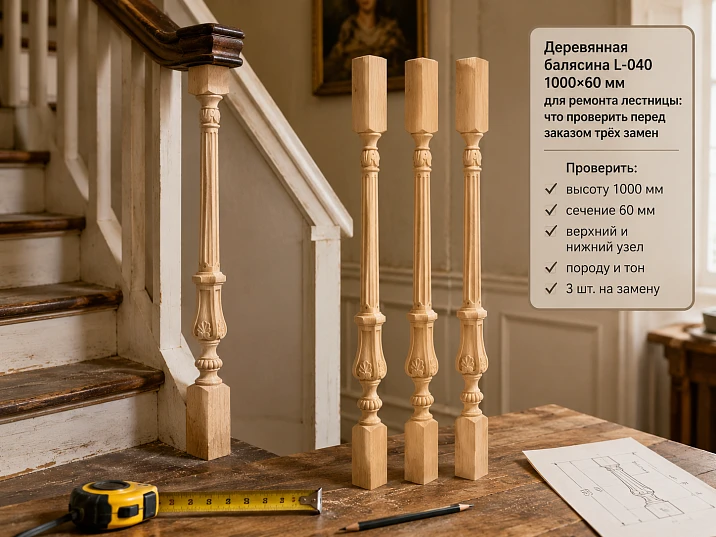
The staircase is already assembled, finished, and has been in use for several years. The handrail is intact, most of the railing doesn't need repair, but three balusters are cracked or have mechanical damage. Fully disassembling the row just for three elements isn't desirable: it's more expensive, takes longer, and will almost certainly affect the finish of the flight. In the catalog, a wooden baluster L-040 with dimensions 1000×60 mm was found. The logical question is whether it's possible to order just three pieces and install them in place of the damaged ones without redoing the entire railing.
The short answer: yes, the scenario of ordering three L-040s is possible, since the product card allows shipping from one piece, but matching the dimensions of 1000×60 mm isn't enough to confirm interchangeability. Before payment, you need to remove one old baluster or get full access to it, measure the mounting areas, compare the profile with the L-040 drawing, determine the material of the existing row, understand the connection scheme with the handrail and the lower part of the railing, and also address the finishing issue. If these parameters don't match, a local replacement with three standard items may turn out to be visually or structurally incorrect.
In this task, it is important not to confuse two different solutions. The first is to "select three ready-made balusters of the same type and replace the damaged ones." The second is to "make an exact copy of the old part." L-040 belongs to the first path. If the old baluster truly matches its geometry and mounting zones, the rest of the row can be preserved. If the similarity exists only in a photograph, but the turning, fit, or material differ, it is better to discover this before ordering.
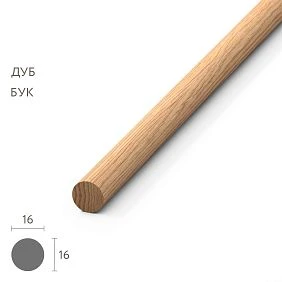
The L-040 card confirms one size — 1000×60 mm, two wood options — beech and oak, as well as sanding options "Standard" and "Prestige." For a missing item, the average production time is 5–10 working days. At the same time, the manufacturer does not perform cutting or trimming of the finished product to an individual size. This means the repair should be planned not on the principle of "we will order, and the installer will trim it on site," but rather the opposite: first determine what can be adjusted without violating the profile and fit, and only then place the purchase.
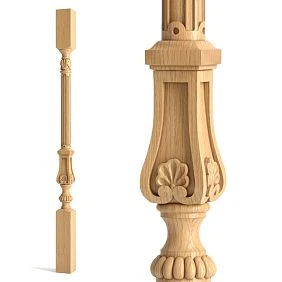
Wooden baluster L-040: which characteristics are confirmed by the card
For repairing an existing staircase, it is especially useful to separate published characteristics from parameters that still need to be verified on site. This protects against a typical mistake: the buyer sees a photo, size, and material, and automatically "fills in" the remaining properties.
| Parameter | What is confirmed for L-040 | What else to check |
|---|---|---|
| Size | 1000×60 mm | the actual geometry of the old baluster at control points |
| Material | Beech or oak | what wood the existing row is made of |
| Sanding | "Standard" or "Prestige" | what preparation the chosen finishing system requires |
| Quantity | ordering is possible from one piece | Are only 3 needed, or should a reserve be provided? |
| Duration if absent | Average duration 5–10 business days | Actual duration of a specific order |
| Trimmed by manufacturer | not performed | Where and by whom the permissible adjustment will be performed |
| Custom manufacturing | Possible based on sample/drawing/photograph with a bulk order | Is such a route suitable for the specific quantity |
If after checking the standard L-040 is suitable, you can order the product via the product card: buy baluster L-040.
By itself, the size 1000×60 mm solves only part of the task. It reports the overall length of the product and its cross-sectional dimension, but does not indicate how the geometry is distributed along the height. For a new staircase, this may be sufficient at an early selection stage. For repairing an old one, it is not, because neighboring balusters already form a rhythm, and the top and bottom seating are set by the existing joint.




Why a 1000×60 mm baluster cannot be ordered as a replacement based on only two numbers
Let's imagine that the old damaged baluster also has a total length of 1000 mm and a maximum width of 60 mm. At first glance, the match is complete. But two parts with the same external dimensions can differ so much that installing one instead of the other without rework will be impossible.
The first difference is the length of the square mounting sections at the top and bottom. On one baluster, decorative turning may start 120 mm from the end, on another — 160 mm. If the old joint is designed for a specific length of the straight section, the new part may fit too deeply into the connection or, conversely, the decorative part may end up where a straight mounting section is required.
The second difference is the position of the collars and thickenings. In a finished railing, these elements are read as horizontal lines. If three new balusters have decorative transitions at a different height, they will stand out even after identical painting. This defect is especially noticeable when the damaged parts are located not next to each other but through several intact ones: the eye immediately compares the repeating profiles.
The third difference is the seating method. The overall height of the old part before dismantling is not always equal to its actual length. Part of the baluster may fit into a groove, handrail strip, step, or under-baluster rail. Therefore, measuring "from floor to handrail" does not replace measuring the removed element.
Fourth, the maximum 60 mm does not describe the entire profile. In a turned part, there are several characteristic cross-sections. For visual matching, it is useful to compare not only the maximum but also the width/diameter at points where the main decorative zones begin and end.
Fifth, the axis and symmetry. The old baluster may have been installed after individual trimming or may have a slightly different pattern. If the new element mechanically fits into the opening, but the turning rhythm turns out to be shifted up or down, the repair will look like a replacement rather than a restoration.
Therefore, the correct formula for repair is as follows:
overall size + mounting sections + control cross-sections + profile + fit + material + finish = decision on interchangeability.
Only after this does the size of 1000×60 mm become useful confirmation, not the sole argument.
Our factory also produces:

The old baluster must first be removed and measured, not photographed next to a tape measure.
A photo with a ruler helps the manager understand the scale, but it is not enough for a replacement decision. Perspective distortion, shooting angle, and the inability to see hidden mounting sections introduce too much error. For repairs, a measurement protocol is needed.
The best option is to carefully dismantle one of the three damaged balusters so as to preserve it as a sample. If dismantling before purchase is impossible, you need access to as many control points as possible and use the old staircase documentation, if it has been preserved.
Record not only the final dimensions, but also the method of obtaining them. The minimum set looks like this:
-
full length of the removed baluster;
-
length of the upper straight mounting section;
-
length of the lower straight mounting section;
-
maximum width or diameter of the profile;
-
width at the entry point into the upper node;
-
width at the entry point into the lower node;
-
distance from the bottom end to the start of the first characteristic thickening;
-
distance to the center of the main decorative element;
-
distance to the start of the upper transition;
-
actual seating depth from the top;
-
actual seating depth from the bottom;
-
angle of trimming of the upper or lower end if the staircase runs along an inclined flight;
-
actual height of the baluster after installation;
-
distance between adjacent elements in the finished row;
-
method of mechanical fastening.
On the measurement sheet, it is useful to make a simple vertical sketch. A professional CAD model is not required: a height line and marks of key transitions are sufficient. Such a sketch is more convenient than a photo because it allows direct comparison of the old part with the drawing of the new one.
If the old baluster is already cracked and deformed, do not measure it only at the point of damage. Compare it with one intact neighboring part from the same row. The damage could have changed the width, angle, or length. For control, it is better to have two sources: the removed damaged element and the dimensions of the undamaged analog on the staircase.
Get Consultation
How to check whether the old baluster really matches L-040
After taking measurements, you need to move from the general impression of "similar" to a sequential comparison.
First, check the overall length. If the old part is noticeably shorter than 1000 mm, do not immediately plan to shorten L-040. First, determine which part of the new baluster is the mounting section and whether it can be reduced without entering the decorative profile.
Then compare the straight sections. Imagine two vertical diagrams side by side: on the left — the old baluster, on the right — L-040. Mark the bottom end, the start of turning, the centers of the main beads, the end of the decorative part, and the top end. If the lines almost coincide, proceed to the next check. If the main elements have "shifted" by several centimeters, you need to decide whether this will be noticeable in the row and whether such a replacement is acceptable.
Next, look at the mounting zones. Pay special attention to the width of the top and bottom parts, because the existing holes, grooves, or the handrail support strip already have fixed geometry. The new baluster may be wider than the maximum tolerance of the assembly, even if its overall size in the catalog looks suitable.
After that, evaluate the profile. For turned products, contour overlay is useful. The simplest way is to print the drawing at 1:1 scale or order a full-size template based on the available geometry and apply it to the old part. If this is not possible, compare several control cross-sections.
The next stage is a trial in the context of the row. Even mathematically similar parts can be perceived differently due to the distance between neighboring balusters. If three damaged ones stand close together, a slight difference may read as a separate group. If they are scattered along the span, the difference may repeat three times and be more noticeable.
Finally, the mounting method is checked. Decorative matching does not replace structural integrity. Local replacement is only acceptable when the craftsman understands how to safely dismantle damaged elements, prepare the mounting seats, and secure new ones without weakening the handrail or steps.
Three new balusters among twenty old ones: why the wood color will almost certainly differ
Even perfectly matched geometry does not guarantee that the repair will be visually unnoticeable. Natural wood changes over time. The shade of the old row is influenced by the initial staining, varnish or oil, ultraviolet light, cleaning, humidity, frequency of touch, and the inherent color of the specific batch of material.
If the old staircase is oak and the new L-040 ones are also oak, that is the right direction for a clear finish, but not a promise of identical color. Different oak blanks can vary in tone, texture, and pore prominence. After applying the same finish, this difference sometimes diminishes, and sometimes, on the contrary, becomes more noticeable.
The situation with beech is similar. A single species name does not turn different batches into visually identical material. Therefore, for a local repair, it is better to decide in advance: the goal is to bring the new elements as close as possible to the old ones, or, if an exact match is impossible, to refinish the entire local section.
Practical work order:
-
take a piece of the old finish or an inconspicuous part of the staircase as a reference;
-
obtain three or four new balusters from the same batch;
-
perform a test finish on a separate sample of compatible wood or on a minimally visible area;
-
compare not only the color but also the degree of gloss;
-
Evaluate the result under the lighting in which the staircase is used daily.
In a residential interior, the difference is sometimes masked by soft light. In a hallway with side lighting, relief and sheen are more pronounced. If there is a window near the balusters, daylight can emphasize the tone even more than artificial light.
When the staircase is covered with opaque enamel, the issue of wood species by color becomes less critical, but differences remain in surface preparation and wood behavior. The coating does not eliminate the need to properly prime and sand new parts.
Oak baluster L-040 or beech: how to determine the material of an existing staircase
The L-040 card allows you to choose beech or oak. For a new staircase, the material can be selected within the project. For repairs, the rule is different: first, determine what the existing row is made of.
You cannot reliably determine the wood species only by the color of a photo. Staining can make beech visually darker and oak lighter. A layer of varnish, dirt, and age further change perception.
Start with documents. If the contract for manufacturing the staircase, specification, invoice, or project has been preserved, the material is often indicated there. If there are no documents, you can inspect inconspicuous untreated areas: the end of a dismantled damaged baluster, the hidden seating part, or the bottom surface.
Oak usually has a well-defined characteristic porous structure. Beech is visually more uniform and fine-pored. But for an expensive repair, it is better to leave the final determination to a craftsman who sees the wood in person, rather than making a decision based only on a description of the texture.
If the existing staircase is oak and coated with a transparent finish, choosing beech L-040 only because it is more available or ready faster can create a noticeable contrast. If the entire row is painted with dense opaque enamel, matching the species is not always the only acceptable condition, but structural and finishing properties still need to be coordinated with the craftsman.
Another case is a combined staircase. For example, the steps and handrail are oak, while the balusters are beech under enamel. You cannot automatically transfer the handrail material to the balusters. You need the material of the old element being replaced.
"Standard" or "Prestige": what to order if only three elements are being replaced
For L-040, two surface preparation levels are available — "Standard" and "Prestige." In the source data, "Standard" is described as machine sanding, while "Prestige" is described as more detailed hand sanding.
For local replacement, the decision depends not on the number of balusters per se, but on the finishing process.
If the craftsman will fully hand-finish the three new elements, fit them to the old coating system, and perform interlayer sanding, it can be discussed which preparation level is rational. If the task is to get maximally prepared parts and reduce the amount of manual touch-up before the finish, the logic may lead to "Prestige."
However, even "Prestige" does not mean the product can be immediately placed in the old row without a control inspection. Before finishing, the surface, small profile transitions, ends, and areas where installation fitting will be performed are checked.
For transparent finishes, preparation requirements are especially high: a scratch that is almost invisible on raw wood may appear after stain or oil. Under enamel, there is a different set of risks — a solid-color coating emphasizes waves and unevenness through light and shadow.
Specify the sanding quality explicitly in the order. The wording "three L-040 as in the photo" does not define this parameter and creates unnecessary ambiguity.
Can I order just three L-040
Yes. For L-040, the source data confirms a minimum shipment of one piece. This is fundamentally important specifically for the repair scenario: the buyer does not need to automatically order a set for the entire span just because three elements are damaged.
First, count the actually replaced balusters. If three are damaged and each passes the geometric compatibility check with L-040, the base order is three pieces.
But the order quantity is not the same as the number of finally installed products. Before placing an order, you need to decide whether a reserve is needed. This is a separate economic and operational task.
For a regular planned replacement, when a repeat order does not create problems, three pieces can be a rational solution. For a facility where stopping the staircase or repeated dismantling is highly undesirable, a fourth element may make practical sense. But a reserve cannot be declared mandatory for everyone.
When it is better to order four balusters, although only three are broken
An additional baluster makes sense not because of the "stock rule," but when there is a specific risk.
The first reason is shade matching. Four products from the same batch give the craftsman more opportunities to distribute elements along the row. The three closest in pattern can be placed in visible spots, and the fourth can be kept as a reserve.
The second is installation fitting. If the existing staircase has complex seating nodes, one element may be damaged during trial fitting. This does not mean that defects should be considered the norm in advance; it is about reducing the risk of stopping the repair.
The third is future local replacement. If the staircase is already many years old and another baluster shows signs of wear, a reserve from the same batch may prove useful in a few years. With a repeat order, the shade and wood of the new batch may differ more significantly.
The fourth is timing. If a specific project is tied to a delivery date and waiting for production again is unacceptable, the cost of one spare part is compared with the cost of a repeat visit by the craftsman and rescheduling the work.
When is a fourth baluster not needed? If the budget is limited, a repeat order is not critical, the geometry is simple, and the finish is opaque and easily reproducible. The decision is made after assessing the risk, not automatically.
Why you cannot file down L-040 "just in case" already when ordering
Product source data directly indicate that the manufacturer does not perform cutting or trimming of the finished baluster to an individual size. This means the order should contain standard L-040, and local fitting should be arranged separately if necessary.
But the phrase "we'll trim it on site" should not become a universal solution either. A baluster is a profiled part. Shortening by 10, 30, or 80 mm affects different zones depending on where the straight mounting section is located.
If the old baluster has an actual length of 980 mm, and the new L-040 is 1000 mm, first you need to determine whether there are safe 20 mm on the straight section. If decorative turning extends almost to the end, arbitrary shortening may disrupt the profile or reduce the seating area.
Particular care is taken when working with an inclined flight. The top of the baluster may be cut at the angle of the handrail, and the actual cutting line differs on the two sides of the part. An error of a few millimeters can result in a noticeable gap.
Before ordering, the craftsman must answer three questions:
-
where adjustment is allowed;
-
how much material can be removed without changing the decorative part and mounting reliability;
-
with what tool and at what stage the cut will be made.
If there are no answers to these questions, buying three parts "with extra length" is premature.
What to do if the existing baluster has a height other than 1000 mm
A height mismatch does not always mean that L-040 is definitely unsuitable, but it also does not mean it can be unconditionally shortened.
First, clarify what exactly is measured. The height from the step to the lower surface of the handrail is the distance in the assembled staircase. The full length of the part after disassembly may be greater because the top and bottom fit into the seating zones.
If the removed old baluster is indeed shorter than 1000 mm, trace its outline onto diagram L-040 and determine which part of the new piece extends beyond the dimension. For local fitting, it is preferable that the difference falls on a straight technical section rather than on a decorative profile.
If the old baluster is longer than 1000 mm, the standard L-040 will most likely not be able to compensate for the missing length through installation alone. Extending a decorative part without an engineering solution should not be done.
If what differs is not the overall length but the visible height due to a different seating depth, the joint needs to be compared. Sometimes two identical balusters look different because one is seated deeper into the under-rail strip.
If there is a significant height discrepancy, it is better to stop the order and consider another model or a different method of restoration.
When it is better not to buy the standard L-040 at all
Professional selection also includes declining to purchase. L-040 should not become an "almost suitable" replacement just because it has already been found in the catalog.
Postpone the order if:
-
the overall profile noticeably differs from the existing row;
-
the mounting sections have a different length or width;
-
the old part has a non-standard angle or complex seating;
-
existing staircase is historical or restoration, where exact reproduction is required;
-
the material of the old row cannot be determined, and the finish is transparent;
-
three new balusters will clearly stand out in pattern and position of the belts;
-
the handrail or under-rail strip is damaged and local replacement does not solve the node problem;
-
installation would require cutting off part of the decorative profile;
-
repair requires an exact copy of the old product, not choosing a close serial model.
In such cases, it is more useful to spend time searching for a compatible model or developing another solution than to fit the standard L-040 at any cost.
Can I order a baluster based on a sample of the old one
The original STAVROS information states that non-standard products can be manufactured according to a sample, drawing, or photo, provided there is a volume order. For the task with three damaged elements, this is an important limitation: individual production cannot be automatically promised as a simple order of three unique copies.
If the standard L-040 does not match, and exact reproduction is required, you need to separately request the terms of individual production specifically for your quantity. The manager should be informed:
-
photo of a whole old element;
-
sizes;
-
drawing or sketch of control points;
-
material;
-
required quantity;
-
surface preparation requirements;
-
information about the existing finish.
After that, the seller will be able to say whether a custom route is applicable. Until a response is received, do not plan the renovation schedule based on the assumption that three parts will definitely be made to the sample.
Wooden balusters and the existing handrail: what to check from above
Three balusters do not exist separately from the handrail. The top of each part must fit correctly into the existing system.
If the handrail is straight and a sub-rail plate is used, measure the width of the top of the baluster and the geometry of the groove. If the flight is sloped, a junction angle appears. If the old balusters are secured via additional plates, dowels, or another joint, you need to understand whether it can be replicated for L-040.
Checking from above includes:
-
size of the top mounting area;
-
length of the straight section before the profile start;
-
actual cut angle;
-
width of the groove or under-rail strip;
-
distance from the top profile to the handrail after installation;
-
fixation method;
-
condition of the handrail itself.
If it turns out that the handrail is worn or damaged in three places, the repair may go beyond simply replacing the balusters. But there is no need to buy a new handrail in advance. First, the existing one is diagnosed.
If replacement or comparison of top assembly elements is still required, you can view the assortment by direction Buy a wooden handrail for stairs.
Do you need to replace the handrail because of three damaged balusters
No, the breakage of three balusters by itself does not mean that a functional handrail needs to be replaced.
The handrail is kept if it retains its geometry, has no critical damage at the removal points, its mounting locations are compatible with the new elements, and the craftsman can disassemble and reassemble the local section without destroying adjacent connections.
Replacing the handrail becomes a separate issue if it is cracked, deformed, has lost its rigidity, its groove is incompatible with the new geometry, or when dismantling old balusters it turns out that the assembly is structurally connected in such a way that local disassembly is impossible.
The main thing is not to turn repairing three elements into automatically buying the entire set. First, determine the actual cause of the damage. If three balusters cracked due to an impact and the handrail is intact, local replacement is logical. If the damage occurred due to deformation of the entire railing, you need to repair the system, not just the visible consequences.
Wooden baluster and stair post: why adjacent elements are needed for visual inspection
Posts are usually larger than balusters and define the beginning, end, or turn of the railing. Even if they are not planned to be replaced, they are important as a visual reference.
Imagine a short span: at the starting post there is one old baluster, then a new L-040, then several old ones. If the L-040 profile differs significantly in scale from the pattern of the post and the adjacent row, the replacement will be more noticeable than in a long span.
Therefore, before ordering, photograph the entire section strictly from the front and mark the three replacement spots. Insert the L-040 outline into the sketch or at least compare proportions using the drawing. This makes it easier to understand whether the new part will be perceived as part of the existing pattern.
If the repair grows into updating the entire assembly and you need to compare elements, you can use the section to buy staircase posts. But in a local task, this transition is needed specifically for style coordination, not for the mandatory purchase of a post.
If the entire span is being replaced: then count the number of wooden balusters
Sometimes the inspection leads to the conclusion that replacing only three elements is technically possible, but visually the result is unsatisfactory. For example, old balusters are discontinued, and L-040 differs in profile. Then a second scenario arises — replace the balusters of the entire local span, preserving the intact steps, handrail, and posts.
This is a different task. Here you need to count not three damaged elements, but the entire quantity in the selected section.
Before recalculating, record:
-
the span length;
-
the number of existing balusters;
-
the distances between them;
-
the design requirements for the railing;
-
the method of attachment to the handrail and the lower node;
-
the position of the outermost elements relative to the posts.
You cannot automatically keep the old quantity if the new baluster has a different cross-sectional size. A width of 60 mm affects the visual spacing and the clear gaps. The new row needs to be laid out on the sketch.
In this scenario, it is convenient to go to the catalog and buying wooden balusters for stairs after comparing several models. The same section fits the request balusters for stairs to buy, when the task has already gone beyond one L-040.
However, there is no need to change the entire span just for the convenience of purchase. If three L-040s truly match the existing row, local repair preserves more of the original structure and usually requires less work.
How to place an order for three L-040s without ambiguity
When the check is complete, compile the specification in a single line. It should contain not a promotional description, but parameters that the manager can verify.
Working format:
L-040 / 1000×60 mm / oak or beech / "Standard" or "Prestige" / required preparation option / 3 pcs.
If a spare is needed, the quantity is changed to 4 pcs., but in the comment you can specify that three items are intended for installation, one is a spare.
It is useful to attach to the request:
-
a photo of the entire staircase;
-
large photo of an old baluster;
-
diagram of control dimensions;
-
photo of the dismantled element;
-
description of the existing coating;
-
delivery city;
-
desired installation date.
Do not ask the manager to guarantee interchangeability based on a photo without dimensions. It is more correct to phrase the question specifically: "We ask to confirm the drawing and published dimensions of L-040; compatibility with the existing staircase is checked according to the attached measurement."
This is how responsibility is distributed: the seller confirms the product characteristics, and the craftsman or designer checks the existing assembly.
What to check in the cart before payment
Before payment, the order is re-checked once more. This takes a few minutes and protects against an expensive mistake during local repairs.
Check:
-
article number — L-040;
-
size — 1000×60 mm;
-
selected wood species;
-
sanding quality;
-
quantity;
-
Current availability;
-
actual production time if the item is not in stock;
-
delivery method and cost;
-
recipient details;
-
order comment, if it is important;
-
compliance of the ordered material with the existing staircase.
Prices in this article are deliberately not fixed. They may change, so before payment, rely on the current data in the product card and cart.
An average time of 5–10 business days when the item is out of stock should also not be turned into a guaranteed installation date. The renovation schedule includes production, delivery, acceptance, test painting, finishing, drying, and installation.
How to accept three balusters after delivery
Receiving the goods is another checkpoint. Do not hand over sealed packaging to the installer with instructions to “unpack on site.” First, check the set.
Verify the article number and quantity. Then place the three balusters side by side on a flat surface and compare them with each other. Natural wood does not have to be identical in grain, but you need to see the differences in advance and decide where to install each piece.
Measure the overall dimension and several control points that you used when comparing with the old baluster. If the compatibility decision was made based on the drawing, the actual product must match the expected geometry.
Inspect:
-
end faces;
-
angles of straight mounting sections;
-
turning transitions;
-
surface after sanding;
-
visible packaging damage;
-
cracks and chips;
-
areas that will be trimmed or fit into the seating.
If a transparent finish is planned, immediately distribute the items by pattern. Do not start painting until you are sure that all three match in geometry.
How to do a trial installation before the final finish
If the repair technology allows, it is useful to do a dry or temporary fitting of at least one element before the final finish.
The purpose of the fitting is to check not the external color, but the mechanics of the joint:
-
does the lower part fit into the seat;
-
does the top joint match;
-
does the decorative profile not press against anything;
-
does the visible height correspond to the adjacent balusters;
-
do the characteristic horizontal turning levels match;
-
is an unacceptably large trim not required.
Fitting is especially important when the old baluster was removed with damage and the exact seating depth could only be determined approximately.
After checking, the element is removed again, and necessary preparation and finishing are performed. You should not paint three parts completely and then try to install them into existing grooves for the first time: the coating can be damaged during fitting.
How to match new finishing with an old staircase
The old coating should not just be "matched by color," but identified as a system.
If the brand and code of the old material are known, that's a good start, but even the same product may be perceived differently years later due to changes in the wood. Therefore, they rely on the actual sample.
For a transparent coating, the sequence may include:
-
surface preparation of the chosen quality;
-
test coating;
-
tone adjustment;
-
application of the final protective layer;
-
comparison of gloss levels;
-
evaluation after complete drying.
For an opaque enamel, they check the adhesion of the primer to the wood, the compatibility of the finish, and the gloss level of the existing range.
If three new balusters are noticeably lighter, do not try to compensate for the difference with one thick coat of dark stain without a sample. Absorption density may vary across individual areas, and the grain will become uneven.
Sometimes it's neater to repaint the entire short section between two posts than to try to achieve a perfect match of three elements with the old coating. This is already a design decision made after testing, not in advance.
Why the cause of a crack matters more than the crack itself
Before replacing three elements, you need to understand why they are damaged. If the cause is not eliminated, new balusters may repeat the fate of the old ones.
Mechanical impact is a clear local scenario. For example, during furniture moving, three adjacent balusters got damaged. In this case, the remaining elements and the railing geometry may be intact.
Another situation is deformation of the handrail, loosening of fasteners, or movement of the base. If cracks appear without an obvious impact and are located in similar places, it is worth checking the entire assembly.
Inspect:
-
whether there is a noticeable sag in the handrail;
-
whether adjacent balusters are moving;
-
whether the gaps have changed;
-
whether there are signs of moisture;
-
whether the attachment points are damaged;
-
whether load from a deformed staircase element is being transferred to the row.
Local replacement is justified when the cause is local or has already been eliminated. If the source of damage is systemic, it is repaired first.
Mistakes when ordering three balusters for replacement
Mistake 1. Measuring only the height and maximum width
Why it happens: the product card shows 1000×60 mm, and the buyer looks for the same two numbers on the old part.
Consequence: the baluster arrives, but the decorative profile or mounting sections do not match.
How to prevent: take a map of control measurements along the entire height.
&Mistake 7. Replacing the entire handrail without diagnostics
Why it happens: it seems that railing elements are sold only as a set.
Consequence: extra expenses and increased scope of work.
How to prevent: check whether the intact handrail actually interferes with local replacement.
Error 8. Ordering an individual copy without checking the minimum print run
Why it occurs: the possibility of manufacturing to a sample is perceived as guaranteed for any quantity.
Consequence: the project is based on a variant that may be unavailable for three pieces.
How to prevent: separately obtain commercial terms for individual manufacturing.
When local replacement of three L-040 is rational
Local replacement looks like a strong solution when all the main conditions are met:
-
the three damaged balusters belong to a serial type matching L-040;
-
control dimensions are confirmed;
-
the material of the old row is determined;
-
installation areas are compatible;
-
The handrail and lower node are in good condition;
-
Local fitting is possible without altering the decorative profile;
-
The finish can be matched to the existing one;
-
The cause of the damage has been eliminated;
-
Production and delivery timelines fit within the repair schedule.
In this case, there is no reason to disassemble the entire row just for three parts. The buyer receives exactly the volume of goods needed for restoration.
When it is better to replace the entire section
Replacing the entire local section may be more logical if the three L-040 are structurally suitable but noticeably differ from the old balusters, or if the old row as a whole is heavily worn.
For example, on a short span there are eight old balusters, three of which are broken, and the remaining five have damaged coating and loose connections. Spot replacement of three items will not solve the condition of the entire railing. In such a situation, it is reasonable to compare the scope of local repair versus updating all eight elements.
But the transition to replacing a section should be a result of diagnostics, not a way to increase the order.
How to check visual rhythm before purchasing
One of the most useful ways is to create a frontal photomontage or a simple sketch.
Photograph the span so that the camera is approximately opposite the center and verticals are minimally distorted. Mark the positions of the three damaged balusters. Based on drawing L-040, draw a schematic outline of the new part and place it in these positions.
It is not necessary to create a photorealistic visualization. The goal is to see the levels of the main thickenings and their relationship with the handrail, steps, and posts.
If the new balusters are placed close together, assess whether they form a separate "block." If they are scattered, check whether three repeating deviations occur.
For a more serious project, you can print the L-040 silhouette at 1:1 scale and apply it to the old baluster. This check is much more reliable than comparing miniatures on a screen.
What to do if damaged balusters are on an inclined flight
An inclined flight adds complexity to the top cut and visual rhythm.
If the handrail runs at an angle, the top of each baluster may require an angled cut. In this case, the length on one side will differ from the other. You cannot simply take the vertical length of the old part and transfer it to the new one without checking the angle.
Before ordering, record:
-
the angle of the flight or handrail;
-
orientation of the old cut;
-
length of the baluster before trimming, if it can be determined;
-
position of the decorative profile relative to the handrail line;
-
size of the straight section that remains after the cut.
If three damaged elements are on different steps, the trimming geometry may repeat, but each position is still marked.
What to do if three balusters are damaged not side by side
Scattered damage is harder to see visually. When three new parts are placed side by side, they can be perceived as a single updated fragment. When old ones remain between them, each difference is compared directly with the neighbors.
In this case, the following are especially important:
-
same breed;
-
batch of new parts;
-
profile match;
-
individual shade adjustment;
-
exact position of characteristic elements by height.
It is useful to pre-assign balusters to places: L1, L2, L3. After a trial stain, the master chooses which of the three best suits the specific neighbors.
What to do if three adjacent balusters are damaged
Three adjacent elements give a different scenario. Here, a slight color or profile shift may be perceived as a local block.
If the geometry of L-040 matches, this sometimes simplifies selection: three new products from one batch stand next to each other and do not alternate with old ones. But it is important to check the transitions at the edges of the block — where the new first baluster neighbors the old one on the left and the new third baluster neighbors the old one on the right.
If the difference is noticeable, you can consider replacing one more baluster for symmetry, but only after a visual assessment. There is no need to automatically expand the order.
Do I need to keep the old damaged baluster after repair
Yes, it is better to keep at least one until the work is fully completed.
It is useful as:
-
a source of control dimensions;
-
sample of old wood;
-
reference for color and gloss;
-
confirmation of mounting geometry;
-
sample for possible future custom production.
After installing the new balusters, do not discard the old element until final acceptance. If coating adjustment or reordering is needed, the sample will greatly simplify the task.
How to organize labeling of three new balusters
Natural parts are useful to label before finishing and installation.
Assign positions, for example:
-
B1 — lower damaged;
-
B2 — middle;
-
B3 — top.
Place the same markings on the sketch. Apply the marking on the hidden end or on temporary painter's tape to avoid damaging the visible surface.
After sorting by pattern and color, do not swap parts without reason. This is especially important after individually matching the shade to adjacent old balusters.
How to link a baluster order with other staircase components
If diagnostics showed that three L-040 are the only required new parts, there is no need to expand the estimate.
If damage to a post, handrail, or other elements is found at the same time, it is more convenient to look at the general section Buy staircase components. It is needed as navigation for the node, not as an argument to replace everything.
This approach preserves commercial logic: the article first helps make a technical decision, and links lead to a product or category only where the reader already understands what exactly they need.
Where to buy wooden balusters L-040 and see alternatives
If all measurements confirmed compatibility, the specific route is — wooden baluster L-040.
If L-040 does not match the existing row in profile or mounting zones, do not force it to fit at any cost. Go to the section Buy wooden balusters and compare other models by drawings and dimensions.
If the renovation affects not only balusters, use the general components section and check each item separately.
Control checklist before paying for three L-040
Before placing the final order, it is convenient to go through a short table.
| Control question | Yes | No | What to do if "no" |
|---|---|---|---|
| Was the old baluster measured after dismantling or according to the full protocol? | take additional measurements | ||
| Is the total length compatible with 1000 mm? | check the possibility of another model | ||
| Is the maximum dimension compatible with 60 mm? | Do not order without rechecking the assembly | ||
| Do the mounting sections match? | Get the drawing and recalculate the fit | ||
| Does the profile visually match? | Consider an alternative | ||
| Is the material of the old row determined? | Determine the wood species before choosing beech/oak | ||
| Has the finish been tested? | Make a test swatch | ||
| Are the handrail and lower seating in good condition? | first repair the assembly | ||
| Has the cause of the cracks been eliminated? | diagnose the guardrail | ||
| Did the installer confirm the acceptable fit? | do not rely on cutting "in place" | ||
| Was the quantity of 3 or 4 determined deliberately? | assess the need for a reserve | ||
| Has the deadline for the specific order been confirmed? | clarify before payment |
If most critical items are not closed, the order is premature. This matrix is more useful than the universal advice "take three pieces" because it shows exactly where uncertainty remains.
Result: can three damaged balusters be replaced with L-040 without redoing the entire row
Yes, if L-040 is confirmed to match the existing staircase not only in overall size 1000×60 mm, but also in mounting sections, decorative profile position, material, and finishing method.
The product card allows ordering from a single piece, so the scenario of three replacements is commercially viable. You can choose between beech and oak, as well as between sanding quality 'Standard' and 'Prestige'. If the item is out of stock, the average production time is stated as 5–10 business days, but the exact date must be confirmed when ordering. Cutting or trimming to a custom size is not performed by the manufacturer.
The correct sequence looks like this:
dismantle or fully measure the old baluster → compare with the L-040 drawing → check the top and bottom fit → determine the wood → do a finish test → decide whether 3 or 4 pieces are needed → confirm the timeline → order.
If there is a match, replacing the entire row is not required. If only the two dimensions 1000×60 mm match, but the profile or mounting areas differ, it is too early to buy the standard L-040. In this case, it is better to find a more suitable standard model or separately agree on another restoration option than to fix the incompatibility already on the staircase.
FAQ
Can I order exactly three L-040 balusters?
Yes. According to the initial data on the product card, the minimum shipment is from one piece, so ordering three items is possible. Before payment, you need to confirm the material, sanding quality, and compatibility with the existing staircase.
Will L-040 fit instead of the old baluster if it is also 1000×60 mm?
Not necessarily. You need to compare the length of straight mounting sections, the position of decorative belts, the width at seating points, the profile, and the actual installation depth.
Do I need to remove the old baluster for measurements?
This is the most reliable option. If dismantling is not possible yet, you need to obtain the fullest possible set of control measurements on site and use documents or drawings of the existing staircase.
How to tell whether an old baluster is oak or beech?
First, look for the specification of the old staircase. If there is none, assess hidden untreated areas and the wood structure. When in doubt, it is better to show a sample to a carpenter.
Why can a new oak baluster differ from an old oak one?
Because natural wood varies by batch, grain, and tone, and the old finish changes under the influence of light, time, and wear.
What should you choose for a local repair — "Standard" or "Prestige"?
The choice depends on how much manual finishing and what type of finish the craftsman plans. "Prestige" involves more detailed hand sanding, but still requires acceptance and preparation for a specific finishing system.
Does it make sense to buy a fourth baluster as a spare?
Sometimes yes: if reorder lead times are critical, you need the ability to select the three closest items by grain, or there is a risk of complex installation fitting. But a spare is not automatically mandatory.
Can the manufacturer shorten L-040 to the old size?
According to the source data, the service of cutting or trimming to an individual size is not provided. Fitting must be planned separately.
Can I simply shorten a 1000-mm baluster to the required length?
Only after checking where the decorative profile is located and what length of the straight mounting section is available for fitting. Arbitrary cutting may disrupt the pattern or fit.
Do I need to replace the handrail along with the three balusters?
No, if the handrail is in good condition, its mounting points are compatible with the new elements, and local removal and installation are possible without damaging the assembly.
When is it better to replace the entire span rather than three balusters?
When the L-040 profile noticeably differs from the existing row, the other balusters are also worn, or a local replacement would give an unsatisfactory visual result.
Can I order an exact copy of an old baluster?
The source data indicates the possibility of custom manufacturing based on a sample, drawing, or photo, provided there is a batch order. Conditions for three individual items need to be clarified separately.
What is more important when comparing — a photo or a drawing?
Drawing and control dimensions. The photo is useful for general understanding and visual comparison, but does not confirm installation compatibility.
Do I need to do a test coat?
For local repair of an old staircase, this is highly desirable. A test coat helps evaluate not only the color, but also the gloss, which greatly affects the visibility of new parts.
Can three new balusters from one batch be installed in different places along the flight?
Yes, if each position is geometrically compatible. But it is better to distribute the parts in advance by shade and pattern relative to the neighboring old balusters.
What to do if the profile differs slightly after delivery?
Do not start cutting or painting. First, re-compare the product with the drawing and the old part, determine whether the difference is acceptable for your repair or a different model is needed.
Should the damaged old baluster be kept?
Yes, at least until the repair is completed. It will be useful as a sample of dimensions, material, color, and fit.
Where can I see other models if L-040 is not suitable?
In the section buying wooden balusters for stairs You can compare other standard options.
Where can I view handrails and posts for balusters?
Handrails are available in the corresponding section, and posts are in the stair post category. These elements should only be selected if diagnostics show that the repair affects them, not automatically along with three balusters.