








































































Article Contents:
- Why an interior needs hidden light: the physics of perception
- Three principles of hidden lighting in interior design
- How slatted panels with lighting work: the mechanics of the effect
- Lighting modes for slatted panels
- LED parameters for slatted panels: selection table
- Polyurethane ceiling decor: when architecture and light are inseparable
- Cornice with LED groove: the most effective ceiling lighting element
- Polyurethane beams with lighting: volume on the ceiling
- Coffered ceiling with lighting: depth instead of plane
- Sockets and medallions with LED: pinpoint light accent
- Light lines, shadows, relief and volume: visual physics of interior
- How light from slat gaps creates depth
- How ceiling cornice with LED creates a 'floating' ceiling
- How grazing light reveals the relief of polyurethane decor
- Where to use slatted panels with lighting and ceiling decor: rooms and scenarios
- Living room: light architecture of the main room
- Bedroom: atmosphere of tranquility through light minimalism
- Hallway and entrance: light as navigational architecture
- Kitchen: Light as a Working Tool and Atmosphere
- Bathroom: Moisture-Protected Solutions
- Combining Slatted Panels with LED and Polyurethane Decor: Five Concepts
- Concept: 'Warm Minimalism'
- Concept: 'Japandi with Beams'
- Concept: 'Neoclassical with Coffers'
- Concept: 'Scandinavian Forest'
- Concept: 'Monochromatic Dark Grotto'
- Installation Practice: From the First Wire to the Last Dimmer
- Electrical Planning: Before Any Finishing
- Installation of slatted panels with LED: sequence
- Installation of polyurethane decor with LED
- Design errors in lighting solutions with slats and polyurethane decor
- Error 1: LED is too bright
- Error 2: Cold-color LED on wooden slats
- Error 3: Visible 'hot spots' of the tape
- Error 4: One circuit for all lighting
- Error 5: Incorrect LED tape spacing behind slats
- Error 6: Cornice with LED without offset from the wall
- Error 7: Slat acclimatization skipped
- Frequently Asked Questions about Slatted Panels with Lighting and Polyurethane Decor
- Which LED strip is suitable for backlighting wooden slatted panels?
- Slatted panels with lighting — can they be installed independently?
- How to choose polyurethane ceiling decor with an LED groove?
- Can wooden slatted panels with LED be combined with a polyurethane coffered ceiling?
- Is it necessary to insulate the wall before installing a slatted system with LED?
- Slatted wall panels with LED and decorative ceiling beams — how to connect them into a single system?
- Conclusion
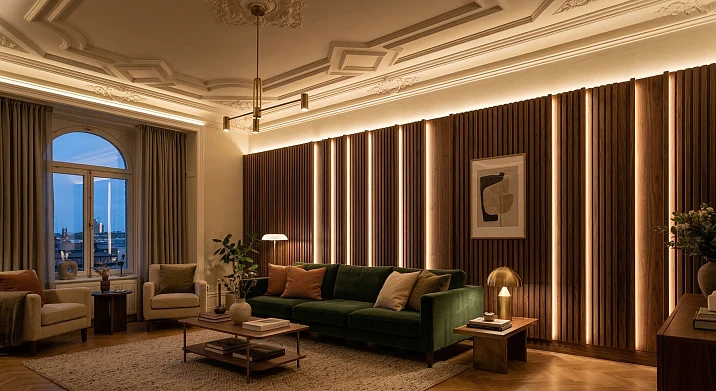
Light is the cheapest building material in interior design. And the most underrated. While some spend fortunes on expensive furniture and imported stone, others understand a simple truth: how light falls on a surface is more important than the surface itself. A properly directed beam turns an ordinary wooden slat into a sculptural object. Warm glow from behind a cornice makes the ceiling 'float'. A soft light line along the wall doubles the perceived depth of the room.
Slatted panels with lighting— is not 'an LED strip attached to a wall'. It is an architectural tool where wood and light exist as a single system: slats create relief, relief creates shadow, LED behind the slats fills the shadow with warmth. The result is a surface that lives, breathes, and changes depending on the lighting intensity.
Paired withpolyurethane ceiling decor— with cornices, beams, coffers, and baseboards — lighting solutions gain architectural scale. Ceiling decor with LED creates a 'floating ceiling.' Light lines in cornice profiles draw the horizon. A coffered ceiling with lighting in the grooves — an invaluable effect of depth in a flat room.
This article is about how light, slats, and polyurethane decor work together. Specifically, technically competently, and with examples that inspire action.
Why an interior needs hidden light: the physics of perception
Before talking about technique, we need to answer the question 'why.' Why does hidden light work fundamentally differently than an open source?
It all comes down to how the brain processes visual information. When the light source is visible — a bulb, a chandelier, a lamp — the brain registers it and 'calms down': the source is identified, the function is fulfilled. When the light source is hidden — a strip behind slats, LED in a cornice groove, light from a niche — the brain perceives only the result: glow without a source. This creates a feeling of 'magic,' mystery, architectural depth.
There is also a physical side to the issue. Hidden side lighting creates 'grazing light' — light that passes along a surface tangentially. This type of lighting 'reveals' any relief: every convexity casts a shadow, every indentation is filled with penumbra. A smooth plastered wall under grazing light becomes visibly textured. A wooden slatted surface under grazing light — sculptural, voluminous, alive.
Exactly thereforeSlatted panel with backlightinglooks many times more expressive than the same slatted surface under uniform frontal lighting. This is not a subjective feeling — it's physics.
And that is precisely whyPolyurethane ceiling decorationwith LED lighting — cornices, beams, coffers — creates an effect unattainable with a simple ceiling lamp. A profile cornice with an LED groove provides oblique light along the ceiling — and the ceiling, which was just a white slab, gains relief, a boundary, 'weight.'




Three principles of hidden lighting in interiors
Principle "source hidden — effect visible". LED strip, cornice, bracket — all physical elements are hidden. Only light emerges outward. No visible system components — only the result.
Principle "warm light — natural material". Wood in cold light (6500K) loses its amber quality, becomes "lifeless". Wood in warm light (2700–3000K) comes alive: amber tones become saturated, the wood grain pattern "awakens". For slatted surfaces — only 2700–3000K.
Principle "dimmer — mandatory". Hidden lighting without a dimmer is one intensity for all occasions. Systems with a dimmer create lighting scenarios: bright light for active tasks, 30% for evening relaxation, 10% for nighttime atmosphere. Each scenario — a different interior.
Our factory also produces:

How slatted panels with lighting work: the mechanics of the effect
Let's examine the system from the inside.Slatted wall panels with lighting— is a structure where several elements work as a single whole.
Element 1: Slats with gaps. Wooden or MDF slats with specific gaps between them — a "grille" through which light passes. The gap is a light "channel". Gap width determines the amount of visible light: narrow gap — thin light lines, wide gap — more glow volume.
Element 2: Backing or rear plane. The surface behind the slats — either the wall itself, or a dark backing (felt, plywood, fabric), or a special light screen. With LED lighting behind the slats, the rear surface reflects and diffuses the light. White rear surface — more light from the gaps, diffused effect. Dark rear surface — less reflection, more contrasting light "slits".
Element 3: LED strip. The light source — a flexible LED strip, fixed to the rear plane of the slatted field. Horizontal strips of the tape with a pitch of 150–200 mm ensure uniform glow across the entire height of the field without dark spots.
Element 4: Power supply and dimmer. Hidden behind the backing or in a niche — the technical components that the observer never sees.
What happens as a result: warm light from the LED strip on the back surface diffuses, part passes through the gaps between the slats, creating vertical light 'lines' on the floor or furniture in front of the wall. The slats are completely or partially dark — dark wooden verticals on a glowing background. Depth effect — the wall 'recedes' backward, the space is perceived as larger.
Get Consultation
Slat panel lighting modes
Mode: 'Backlight'. LEDs behind the slats illuminate the back plane, light passes through the gaps. Slats are dark silhouettes. Maximum depth effect and 'glowing grid'.
Mode: 'Frontlight'. LEDs are positioned in front of the slats — in the cornice above the slat field or in a special profile. Light falls on the front surface of the slats — reveals the relief, wood grain. Slats 'stand out' from a dark background. Maximum material expressiveness effect.
Mode: 'Dual lighting'. LEDs simultaneously behind the slats (backlight) and above the slats from the cornice (downlight). Combined effect: warm light 'slits' from the gaps + uniform illumination of the front wood surface. The most 'rich' lighting result, requiring two independent circuits with separate dimming.
Mode: 'Side lighting'. LEDs in the side moldings of the slat field — light is directed horizontally across the slats. Each slat receives a side highlight — sculptural effect. A rare technique for non-standard concepts.
LED parameters for slat panels: selection table
| Parameter | Value for warm lighting | Value for neutral |
|---|---|---|
| Color temperature | 2700–3000K | 3500–4000K |
| Power | 8–14 W/m | 8–14 W/m |
| CRI (Color Rendering Index) | ≥90 | ≥90 |
| Protection rating | IP20 (dry rooms) | IP20–IP44 |
| Strip type | COB or SMD 2835 | COB or SMD 2835 |
| Dimming | Required (0–100%) | Mandatory |
CRI ≥90 is a fundamental parameter. With low CRI (80 and below), natural oak loses its warm amber tones. With CRI ≥90, wood under 2700K light looks just like under candle flame — maximally natural.
Polyurethane ceiling decor: when architecture and light are inseparable
The ceiling is the 'fifth wall' of a room, and often the most overlooked one. Most people paint it white and consider the task solved. But it's precisely the ceiling that defines the vertical 'scale' of a space, and it's what creates the feeling of an 'expensive' or 'cheap' interior.
Polyurethane ceiling decoration— cornices, beams, coffers, rosettes — transforms the ceiling from a neutral 'top' into an architectural surface. Combined with hidden lighting, it's a qualitative leap: the ceiling isn't just 'decorated'; it 'glows,' 'floats,' and gains relief and depth.
Cornice with LED groove: the most effective lighting element for a ceiling.
A polyurethane cornice with an integrated or formed groove for an LED strip is the most commonly used ceiling lighting element. The principle is simple: the cornice is attached to the ceiling near the wall, and the LED strip in the groove is directed towards the ceiling. The light 'emerges' from behind the cornice and diffuses across the ceiling — creating a 'floating ceiling' effect.
Visually, the ceiling appears higher because the glowing contour along the walls creates an illusion of the ceiling 'detaching' from the walls. This is an optical effect proven in hundreds of projects: a cornice with an LED groove in a room with a 2.7 m ceiling visually 'raises' it to a perceived 3+ m.
decorative polyurethane elementsfor ceilings — in a wide range: from minimalist straight profiles 50×40 mm to classic multi-tiered cornices 120×90 mm.
Installation of a cornice with an LED groove:
-
Laser marking of the installation line along the perimeter of the ceiling
-
Mounting the cornice on liquid nails + finishing nails
-
The LED strip is installed in the groove after mounting the cornice
-
The wire is routed into a hidden channel through a technological hole in the cornice
-
Painting the cornice to match the ceiling color (for a hidden effect) or in a contrasting color
When painting the cornice to match the ceiling color: the light source is completely hidden—only a 'floating' glow near the ceiling is visible. With a contrasting cornice (dark profile against a light ceiling)—the cornice itself serves as a decorative element, and the LED enhances its expressiveness.
Polyurethane beams with lighting: volume on the ceiling
Ceiling beams made of polyurethane— a decorative element imitating wooden load-bearing beams. When placing an LED strip in the space between the beam and the ceiling, it creates an effect of 'illuminated beams': each beam is a dark wooden silhouette with a warm light 'halo' above it.
Parameters of decorative beams: height from 60 to 150 mm, width from 80 to 180 mm, section length 2–4 m. Surface—paintable or with a decorative 'wood-like' texture.
For interiors with slatted walls—polyurethane ceiling beams in a 'wood-like' finish create a vertical-horizontal wooden system: vertical slats on the walls + horizontal beams on the ceiling. Lighting the beams and slats in the same color temperature—a unified lighting architecture.
Coffered Ceiling with Lighting: Depth Instead of a Plane
Coffered ceiling—a system of rectangular 'cells' made of profiles, creating relief on a flat ceiling. With LED lighting in the grooves of the coffered beams, each cell appears to 'recede' upward—creating an illusion of architectural vaults.
Polyurethane ceiling decorationFor coffered systems: rib profiles 60×40 mm, 80×50 mm. Installation: with adhesive directly onto the ceiling, in a grid with a pitch of 400–600 mm. LED strip in the side grooves of the profiles—light is directed into the 'bottom' of the coffered cell, creating 'depth' where the ceiling is physically flat.
For small spaces (kitchen, hallway, entryway), a coffered ceiling with lighting is one of the most expressive techniques: it adds 'architectural scale' where square meters don't allow for it with furniture or volume.
Sockets and medallions with LED: a pinpoint light accent
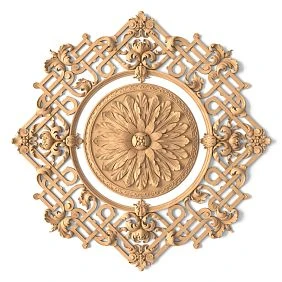
Moldingpolyurethane moldingon the ceiling with LED perimeter lighting — a circular light accent in a specific zone. Above the dining table, above the bed, above the fireplace — a medallion with LED defines the light 'center' of each functional zone.
This is a technique from classical architecture, adapted to modern lighting: instead of a chandelier in the center of the medallion — a hidden LED strip along the outer ring. Soft ring light 'reveals' the relief of the medallion — each profile 'petal' casts a shadow.
Light lines, shadows, relief, and volume: the visual physics of interior
Let's talk about what happens at the level of visual perception — because this understanding allows for designing lighting solutions consciously.
How light from slat gaps creates depth
When warm light emerges from the vertical gaps of a slatted wall, thin light strips form on the floor in front of the wall — an extension of the vertical rhythm of the slats. The gaze moves from these strips on the floor upward — to the gaps — 'reading' the slatted surface as a three-dimensional object with depth.
Psychologically, this creates a sense of 'space behind the wall.' A slatted wall with backlighting seems not like a flat surface, but a 'screen' behind which something exists. It's an illusion, but a powerful one — precisely because of it, slatted walls with LED appear 'more expensive' and 'more complex' than just wooden surfaces.
How a Ceiling Cornice with LED Creates a 'Floating' Ceiling
The light emerging from the cornice upwards diffuses across the ceiling plane. The boundary between the illuminated ceiling and the dark upper part of the wall is the visible 'breakaway line'. The brain perceives it as the distance between the ceiling and the wall: 'the ceiling floats above the walls'. Physically, nothing has changed—the height is the same. Visually, the ceiling has 'risen'.
The wider the cornice (the greater the distance from the LED groove to the wall), the wider the light 'halo' on the ceiling and the stronger the 'floating' effect.
How Grazing Light Reveals the Relief of Polyurethane Decor
A cornice with a profiled cross-section looks flat under ordinary frontal lighting—despite having several planes and ledges. Under grazing light from an LED groove (light travels along the surface), each ledge casts a shadow. The profile 'comes to life', gaining depth.
This is a critically important principle for working with polyurethane decor: without grazing light, the decor 'remains silent'. With properly directed LED—it 'speaks'.
Where to Use Slatted Panels with Lighting and Ceiling Decor: Rooms and Scenarios
Every room is a special scenario for combining slatted walls with LED and ceiling decor. Let's examine each.
Living Room: Light Architecture of the Main Room
The living room is the space with the greatest potential for lighting design. It features an accent TV wall, a sofa area, a dining area, and a corridor to the kitchen—each of these zones can have its own lighting scenario.
A slatted TV wall with dual lighting. LED behind the slats (backlight) + LED in the cornice above the slatted field (downward frontal light). Two independent dimmable circuits. 'Movie watching' scenario: backlight at 15–20% (bias lighting), frontal light off. 'Evening relaxation' scenario: backlight at 30–40%, frontal light at 20%. 'Active time' scenario: both circuits at 80–100%.
Slatted panels in the living room interiorWith such a lighting system, it becomes a full-fledged lighting architecture, creating different spatial sensations in a single room.
A ceiling cornice with LED around the perimeter of the living room. A 70–90 mm cornice with an LED groove along the entire perimeter—a 'floating ceiling' effect across the entire room. For living rooms with ceilings 2.6–2.8 m high, this technique is crucial: it 'lifts' the feeling of being grounded.
Decorative beams with lighting above the dining area. Two or three transverse polyurethane beams above the dining table with LED in grooves—a warm 'halo' over the dining zone. A separate dimmable circuit allows creating intimate lighting over the table while the rest of the room remains fully illuminated.
Bedroom: an atmosphere of tranquility through lighting minimalism
In the bedroom, the lighting solution should adhere to one principle: light should not disturb. This means only diffused, warm, and controllable light.
A slatted wall behind the headboard with backlighting. LED behind the slats at 10–15% brightness before sleep—warm light 'threads' from the gaps create a 'natural lantern' effect. The brain perceives this light level as 'nocturnal'—sufficient for orientation but insufficient for alertness.
slatted panels in the bedroomWith such lighting, it becomes one of the most physiologically appropriate lighting scenarios for a sleep space.
A ceiling cornice with LED on the wall behind the headboard. A 50–65 mm cornice with an LED groove directed at the ceiling, mounted on the wall behind the headboard—above the slatted surface. Warm light 'flows' down the slatted wall from the cornice, creating a 'light backdrop' behind the bed. At night, in complete darkness, it becomes the sole source of soft, warm glow, evoking a sense of natural shelter.
Hallway and Entrance: Light as Navigational Architecture
The hallway is a 'transit' space where most people don't see design potential. Meanwhile, the hallway is precisely where lighting design works most dramatically: a long, narrow space, little natural light, high traffic.
Slatted wall in the hallway with LED. One side wall of the hallway, fully clad with vertical slats with LED behind them, is a light 'tunnel'. The hallway transforms from a 'tube' into an architectural passage with a natural character. Warm light 'threads' on the floor from the slat gaps are a 'light path', guiding movement.
Coffered ceiling with LED in the hallway. Coffered profiles across the hallway with a pitch of 400–500 mm create a 'rhythmic' ceiling, visually 'shortening' the long hallway. LED in the grooves — each cell is illuminated. Effect: the hallway is perceived as a series of 'halls', not an endless tube.
decorative polyurethane elementsfor coffered ceiling systems — profiles with slots for LEDs, corner connecting elements.
Kitchen: Light as a Working Tool and Atmosphere
In the kitchen, the lighting solution simultaneously addresses two fundamentally different tasks: functional task lighting (bright, neutral, for working with knives and the stove) and atmospheric evening lighting (warm, diffused, for a candlelit dinner at 9:00 PM).
Slatted backsplash panel for the kitchen with LED. A slatted backsplash made ofMDF slats for paintingor from natural oak with a waterproof oil finish — the area between the countertop and wall cabinets. LED behind the backsplash slats (IP44 — moisture-protected) + task spotlights under the wall cabinets. Two separate circuits: task spotlights are off in the evening, LED behind the slats is on. The kitchen changes 'character' in seconds.
Ceiling cornice for kitchen with LED. Cornice around the perimeter of the kitchen ceiling with LED groove + coffer profiles above the dining area (if open plan). Two circuits: "work" (direct spotlights 4000K) and "ambient" (cornice 2700K). Switching by scenario.
Bathroom: moisture-protected solutions
For bathrooms - slatted panels with LED are possible subject to compliance with PUE zoning (IP44 in zone 2, IP65 in zone 1). Natural wood in the bathroom - only with good ventilation and varnish or oil-wax coating providing moisture protection.
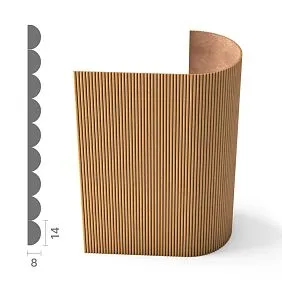
soft slat panelswith moisture-resistant backing and LED IP44 - for bathrooms with non-standard geometry (curved walls, niches). Warm light from the gaps between slats in the bathroom creates a "thermal spring" atmosphere.
Combination of slatted panels with LED and polyurethane decor: five concepts
From theory to ready-made looks. Five concepts, each demonstrating different potential of the "slats with lighting + polyurethane ceiling decor" system.
Concept "Warm Minimalism"
Slatted wall: natural oak "amber", slat 30 mm / gap 14 mm, vertical. LED behind slats 2700K, 10 W/m, back plane - white screen.
Ceiling decor: cornice of straight profile 65×45 mm, painted to match the ceiling (RAL 9010), LED groove directed at the ceiling. Without additional decorative elements.
Lighting scenarios:
-
"Daytime" — natural light + track spotlights 3000K
-
"Evening" — cornice LED 60% + rail LED 40%
-
"Night" — only rail LED 10%
Image: amber wooden glow from gaps + invisible "floating" ceiling. Minimalism where light is the only decor.
Concept "Japandi with beams"
Slat wall: ash "smoky", slat 22 mm / gap 10 mm, vertical. LED behind slats 2700K — only 5% brightness as night lighting. Back plane — dark graphite felt.
Ceiling decor: decorative cross beams made of polyurethane "under dark wood" with 800 mm spacing. LED in beam slots directed at the ceiling — warm "halo" above each beam. Cornice absent.
Image: horizontal dark beams with warm glow above them + vertical gray slats with minimal glow from gaps. Japanese wooden house in a city apartment.
Concept "Neoclassicism with coffers"
Slat wall: none. Walls — neutral paint RAL 1013 (warm beige).
Ceiling decor: coffered ceiling made of polyurethane profiles 70×50 mm with a 500×500 mm grid. LED in grooves of all ribs — warm light 2700K from each cell. Classic profile cornice 95×65 mm around perimeter with LED groove.
Accent:Slatted panel with backlighting only in the niche behind the sofa — 'niche-lamp' with horizontal slats and LED.
Image: architectural ceiling as the main decorative element. Slatted niche — natural accent in classic interior. Ceiling lighting — 'palatial' glow of coffers.
Concept 'Scandinavian Forest'
Slatted wall: whitewashed oak 'milk', slat 25 mm / gap 12 mm, vertical, three living room walls. LED behind slats 3000K, medium brightness.
Ceiling decor: cornice 55 mm with LED groove, painted white — 'floating ceiling'. On ceiling — additionally decorative beams 'under light wood' with 1000 mm spacing, without LED (visual element only).
Image: 'forest of white birches' — whitewashed slats on three walls with uniform soft glow create a feeling of being inside a light grove. White 'floating' ceiling with beams — natural 'canopy'.
Concept 'Monochrome Dark Grotto'
Slatted wall: MDF with enamel RAL 7016 (anthracite), slat 30 mm / gap 12 mm. LED behind slats 2700K — warm light from dark gaps.
Ceiling decor: cornice with LED groove RAL 7016 (anthracite) — an "invisible" dark cornice. LED 2700K in the groove — warm light on a dark ceiling, minimal "halo".
Additionally:slatted panels on the ceilingDark color in the area above the sofa — a "ceiling island" without LED.
Concept: a dark "grotto" with warm light "threads" from the gaps. An intense, meditative, somewhat theatrical interior for people with confident design taste.
Installation practice: from the first wire to the last dimmer
Technically competent installation of the "rails + ceiling decor" lighting system requires proper sequence and several key decisions "on the shore".
Electrical planning: before any finishing work
The main mistake is to start finishing installation without laid electrical wiring. All lighting solutions — rear LED behind rails, LED in cornice, LED in beams or coffers — require pre-laid wires.
Electrical diagram for the lighting system:
-
Low-voltage wire (12–24V) from the power supply to the LED strip behind the rails — laid in the wall before installing the battens
-
Low-voltage wire to the LED in the cornice — laid along the ceiling before installing the cornice
-
Low-voltage wire to LED in beams/coffers — laid in ceiling screed or in a chase.
-
Power cables (220V) to power supplies — in separate chases, shielded.
Power supplies and dimmers — concealed, in a distribution box or in a niche behind furniture.
Channels for wires when installing slatted walls:
Slatted wall frame depth 30–40 mm — a ready-made 'cable channel' behind the slats. The low-voltage LED strip wire and the power wire are laid horizontally in the space between the wall and the frame, exiting through a technological opening in the lower part of the slatted field behind the baseboard.
installation of slatted panelswith LED: sequence
-
Wall preparation: leveling, priming.
-
Marking the frame with a laser level.
-
Laying electrical wiring (chasing if necessary).
-
Installing the frame. Batten 25×40 mm, spacing 400–500 mm.
-
Installation of back lining (felt, plywood or MDF) between battens - if acoustic insulation or light screen is needed.
-
Installation of LED strip on the back lining in horizontal strips with 150-200 mm spacing. Connection to wire.
-
Acclimatization of wooden battens: 72-96 hours.
-
Installation of battens from bottom to top: adhesive + clips or finish nails. Spacers for even gaps.
-
Installation of decorative moldings around the perimeter of the batten field.
-
Connection of LED to dimmer and power supply. Test.
Installation of polyurethane decor with LED
Cornice with LED groove:
-
Marking of installation line with laser level around the entire perimeter.
-
Cutting cornice sections at 45° for external and internal corners.
-
Applying mounting adhesive. Installation. Securing with finishing nails.
-
Filling joints and holes. Sanding.
-
LED strip in groove after final cornice painting.
-
LED wire routed through hole in cornice into hidden channel.
-
Connection to dimmer. Test.
Decorative beams with LED:
-
Marking beam positions on ceiling.
-
Installation of load-bearing metal guides (for heavy beams) or direct mounting of beams on adhesive (for light ones).
-
LED strip mounted in space between beam and ceiling before final beam fixation.
-
LED wire routed through technical hole in beam end.
-
Painting. Connection.
Design errors in lighting solutions with slats and polyurethane decor
Errors in lighting design are not just 'ugly'. It's a result that wasn't worth spending money on materials for. A list of the most common errors.
Error 1: LED is too bright
LED behind slats at maximum brightness is a 'searchlight', not an atmosphere. The light shines harshly and aggressively from the gaps, destroying the delicacy of the wooden relief. A dimmer is a mandatory element of the system. Working brightness for an atmospheric effect: 15–40% of maximum.
Error 2: Cold-color LED on wooden slats
LED 5000–6500K on natural oak is a 'morgue', not a 'living room'. Cold light kills the amber quality of the wood, makes the surface look dead. Only 2700–3000K. For neutral minimalism with MDF slats — 3500K is acceptable.
Error 3: Visible 'hot spots' of the tape
Cheap LED tape with low diode density (30–60 diodes/meter) leaves visible 'spots' instead of uniform glow. For backlighting slats — tape with a density of 120–240 diodes/meter or COB tape with a continuous light field.
Error 4: One circuit for all lighting
A single switch for LED behind battens, LED in cornices, LED in beams, and task lighting — inability to create lighting scenarios. Each lighting element is a separate dimmable circuit. Minimum in the living room: 3–4 independent circuits.
Error 5: Incorrect spacing of LED strip behind battens
Horizontal strips of LED tape with spacing over 250 mm — dark 'stripes' between the tapes, visible through the batten gaps. Correct spacing: 150–200 mm. With larger gaps between battens (over 15 mm) — spacing no more than 150 mm.
Error 6: Cornice with LED without offset from the wall
A cornice mounted flush to the wall without a 'visor' (overhang above the wall) — light from the LED slot only reaches the ceiling in the center of the room, failing to create a 'halo' near the walls. Minimum cornice overhang above the wall: 40 mm. Optimum: 60–80 mm.
Error 7: Skipped acclimatization of battens
Wooden battens mounted without acclimatization change geometry after installation — battens 'warp', uneven gaps appear, surface flatness is compromised. With LED backlighting, uneven gaps are immediately visible: where the gap is wider, the light is brighter. 72–96 hours of acclimatization is mandatory.
Frequently asked questions about batten panels with lighting and polyurethane decor
Which LED tape is suitable for backlighting wooden batten panels?
COB tape 2700K, CRI ≥90, 10–14 W/m, IP20. Advantage of COB over SMD: a continuous light field without visible dots. Power of 10–14 W/m provides sufficient brightness when dimmed to 20–40%.
Slatted panels with lighting— can it be installed independently?
Yes, with basic skills in electrical work (low-voltage systems) and carpentry installation. Key conditions: electrical wiring is laid before mounting the battens, and the dimmer and power supply are selected with the correct specifications (current, power).
How to choosePolyurethane ceiling decorationwith an LED groove?
A cornice with an LED groove is selected based on the room height (cornice height = 1.5–2.5% of the ceiling height), overhang width (at least 40 mm for a 'floating ceiling' effect), and profile shape (straight — for modern concepts, profiled — for classic). The groove must be deep enough for mounting the chosen LED strip.
Can wooden slatted panels with LED be combined with a polyurethane coffered ceiling?
Yes, this is one of the most expressive combinations. Wooden vertical battens on the walls + horizontal coffered profiles on the ceiling + warm light 2700K in the battens and coffers. Condition: uniform LED color temperature across all sources, unified dimming for evening scenarios.
Is it necessary to insulate the wall before installing a slatted system with LED?
For interior walls without thermal loads — insulation is not required. For exterior walls in regions with cold climates — insulation (EPS 30–50 mm) is recommended to prevent condensation. LED behind the battens produces practically no additional heat (10–14 W/m — insignificant heating).
Slatted wall panelswith LED and decorative beams on the ceiling — how to integrate them into a unified system?
Unity is created through: identical LED color temperature (2700K everywhere), identical wood tinting of the battens and beams, a unified dimmable circuit (or two synchronized ones), one switch / smart system to control all circuits.
Conclusion
Light is architecture that isn't seen as architecture. It doesn't stand in a room like a wardrobe or hang on a wall like a painting. It exists in space as a quality—as a sensation of depth, warmth, naturalness. Slatted panels with backlighting and polyurethane ceiling decor—this is a system where material and light enhance each other: wood makes the light warm and natural, light makes the wood alive and voluminous. The polyurethane cornice creates an architectural context for both—and sets a scale that transforms a room into a space.
A properly designed lighting system is not an expensive luxury. LED strip, dimmer, power supply, and a quality cornice with a groove—this is an affordable tool whose result looks like an expensive designer project. Because in interior design, the one who understands wins: it's not the materials that are expensive, but the idea of their application.
Wooden slat panelsmade from natural oak and ash for slatted lighting systems,Polyurethane ceiling decoration—cornices with LED grooves, decorative beams, and coffered profiles,decorative polyurethane elementsfor ceiling lighting solutions—all of this is presented in the full range in the STAVROS company catalog.
STAVROS is a Russian manufacturer of slatted systems made from natural wood and polyurethane products. Full-cycle production: wood drying and processing, manufacturing of slatted panels, production of polyurethane cornices and decorative elements. Professional consultation on material selection and lighting solutions for your project—because the light that builds an interior begins with the correct choice of the surface it illuminates.