Article Contents:
- What is a decorative polyurethane grille: an accurate portrait of the product
- Constructive features
- Where can a polyurethane grille be used
- Wall: accent, panel, symmetrical composition
- Niche: architectural accent in depth
- Furniture facades: cabinets, sideboards, display cases, nightstands
- Radiator area: technically and aesthetically
- Entryway: First Impression
- Living room, study, bedroom
- Commercial interiors: restaurant, hotel, salon
- How a decorative grille differs from a regular PU overlay
- Decorative wall grille: how to create a complete composition
- Grille in a frame of moldings
- Symmetrical pair
- Single accent above the console
- Grille in a wall panel system
- Grille for furniture: from sideboard to display case
- Sideboard with openwork inserts
- Display cabinet in a classic interior
- Kitchen fronts
- Nightstand and chest of drawers in classic style
- Grille for niche and radiator area: practice and nuances
- Niche with built-in grille
- Radiator screen made of decorative grille
- Important warning about the radiator
- How to choose size and pattern: selection parameters
- Grille size
- Pattern scale
- Style of ornament
- How to combine grille with moldings and stucco decor
- Molding + grille system
- Grille and polyurethane stucco decor
- Color solutions for the system
- Painting and finishing of polyurethane grille
- Surface Preparation
- Choosing paint
- Application technique
- Gilding and patina
- Painting before or after installation
- Installation of a decorative polyurethane grille
- Tools and Materials
- Wall surface preparation
- Installation Sequence
- Trimming
- Mistakes when choosing a decorative grille
- Where to buy a decorative polyurethane grille
- FAQ: Answers to Popular Questions
- About the manufacturer
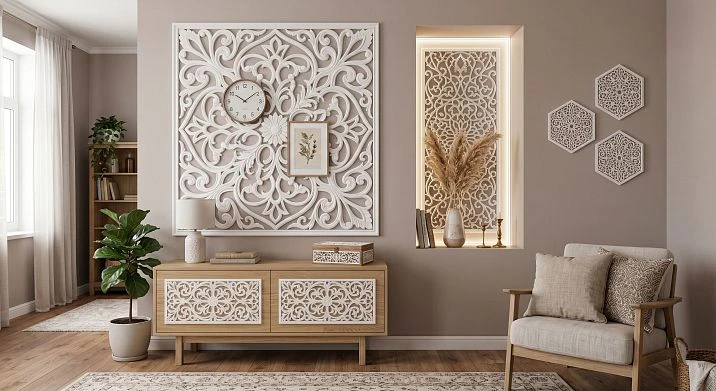
Decor with gaps is a special class of interior solutions. Where a regular overlay creates a plane, an openwork element creates depth. Where stucco ornament works as a relief, a grille works as space — rhythmic, airy, architectural. They are not the same, and the difference between them is fundamental.
Decorative polyurethane grille — is an openwork element with an ornamental structure that has gaps, rhythm, and its own geometry. It is used where not just surface decor is needed, but a visual accent with character: in a niche, on a wall in a frame of moldings, on a cabinet facade, in a radiator area, in a decorative panel. It is a product that simultaneously functions and decorates.
Polyurethane as a material for such an element is a smart choice. Lightweight, precise in details, moisture-resistant, capable of accepting any coating — a polyurethane grille lacks the drawbacks of wooden and plaster counterparts. It does not dry out, does not crack, and is not heavy for the wall. And at the same time, it imitates stucco decor with a persuasiveness unattainable by budget materials.
This article is a comprehensive guide to selecting, applying, and installing decorative polyurethane grilles. For those who want to use openwork decor wisely — not by chance, but systematically.
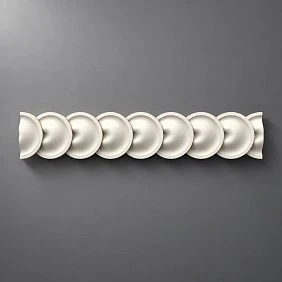
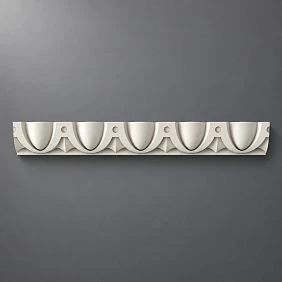
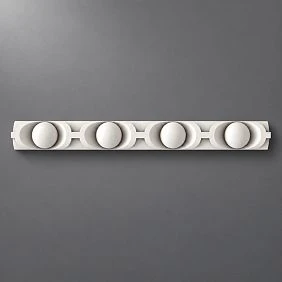
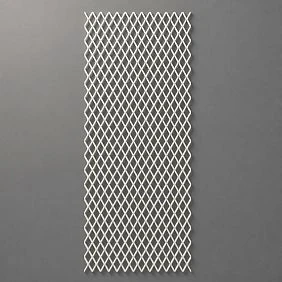
What is a polyurethane decorative grille: an accurate product portrait
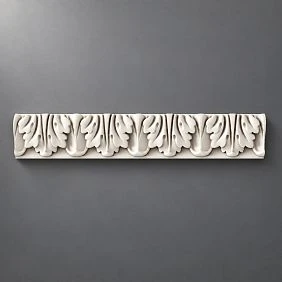
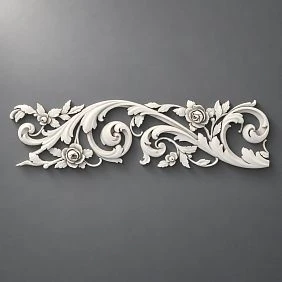
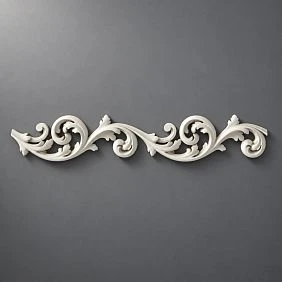
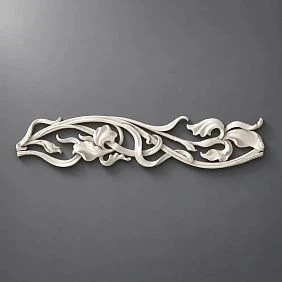
Polyurethane grille is a three-dimensional openwork element made of foamed polyurethane with an ornamental pattern featuring through or semi-through openings. Unlike applied decorative elements, which are a relief plane, the grille has an internal structure: ornament, cells, arched or geometric openings that create a feeling of lightness and air.
In appearance, it is a fragment of an openwork decorative panel: historically, such elements were used in Baroque and Renaissance interiors as decorative inserts in furniture facades, niches, railings, balustrades, and architectural panels.
The modern polyurethane grille reproduces this tradition in a format convenient for installation: a lightweight, precise, technological element that is attached to any surface with glue, painted in any color, and organically integrates into classic, neoclassical, Baroque, or modern classic interiors.




Structural Features
Material: high-density foamed polyurethane. It is not rigid plastic or soft rubber — it is an elastic material with a precise relief that does not deform under load and does not lose shape during installation.
Surface: smooth, uniform, without pores or cavities. It perfectly accepts primer and paint — any acrylic or enamel.
Thickness: from 15 to 40 mm depending on the model and pattern. The openwork structure creates volume but does not weigh down the construction.
Weight: minimal. A polyurethane grille is significantly lighter than a plaster or wooden counterpart — this is critical for mounting on a wall or furniture facade.
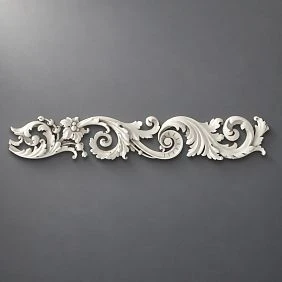
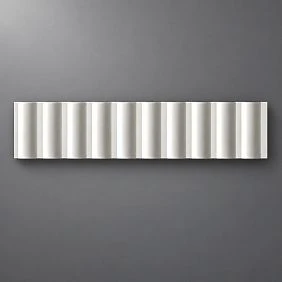
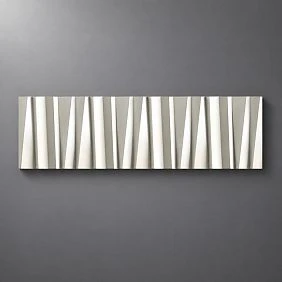
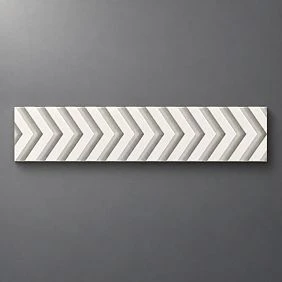
Our factory also produces:
Where can a polyurethane grille be used
The scope of application is broader than it seems. Let's break down each scenario with specifics.
Get Consultation
Wall: accent, panel, symmetrical composition
The wall is the most obvious place for a decorative polyurethane grille. On the wall, it works as an accent element:
-
above a console or vanity table;
-
in the center of the wall as the sole decorative accent;
-
in a frame made of of polyurethane moldings — in a 'frame + grille' system;
-
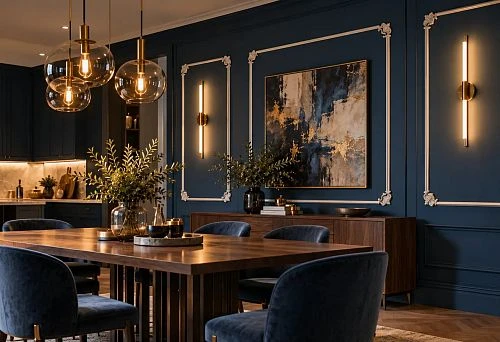
in a symmetrical pair on both sides of a mirror, fireplace, or TV;
-
as an element of a decorative panel combined with polyurethane wall decor.
A grille on the wall creates depth where ordinary decor only creates relief. Light falling on the openwork structure forms shadows in the gaps — this is a living, changing decor that depends on lighting.
Niche: an architectural accent in depth
A niche is an ideal place for openwork decor. A grille in a niche works as the "back wall" of a decorative insert: it covers the empty space of the niche, creates rhythm and pattern in it, and gives an architectural character to what without decor is simply a hole in the wall.
Technically: the grille is attached to the back wall of the niche or mounted in the opening as an insert panel. When backlit from inside the niche, the openwork structure creates the effect of a light pattern — one of the most expressive decorative techniques in modern interiors.
Furniture facades: cabinets, sideboards, display cases, nightstands
Polyurethane grille for furniture — a commercially active scenario. Furniture facades with decorative inserts are a classic of furniture production. A sideboard with openwork inserts instead of glass doors, a cabinet with grille facades, a nightstand with a decorative openwork element — all this is realized using a polyurethane grille.
Advantage over glass: the grille does not break, does not require a glazing bead, is mounted directly into a groove or glued onto the facade. If necessary, it can be painted to match the furniture.
Advantage over wood carving: several times cheaper, does not dry out, precise pattern without manual labor.
Radiator zone: technically and aesthetically
Decorative screen for a radiator is a popular request. Openwork polyurethane grille can be used as the facade of a decorative radiator box: it allows air to pass through the gaps (if they are large enough), creates a decorative screen, and integrates into the interior much more organically than standard metal grilles.
Important point: when used in the radiator zone, you need to ensure that the gaps in the pattern are sufficiently open for free circulation of warm air. Too fine an openwork reduces heat output.
Entryway: first impression
The hallway is the first thing guests see. A small decorative grille above a console or mirror in the hallway is an accent that sets the tone for the entire interior. A small detail with a big effect.
In the hallway, you can use one grille in the center of the wall or a symmetrical pair on both sides of the mirror. The size is medium, not overwhelming the small space.
Living room, study, bedroom
In the living room — above the fireplace, on the sides of the TV, in a wall panel system. In the study — in the spaces between bookshelves, in decorative niches. In the bedroom — as an accent above the headboard, paired with molded decoration made of polyurethane.
Commercial interiors: restaurant, hotel, salon
In commercial interiors, a decorative polyurethane grille is a practical and striking choice. A restaurant with a classic interior: grilles in niches and on columns. A hotel: grilles in the wall finishing system of corridors and lobbies. A beauty salon: openwork decor in waiting areas and on the walls of treatment rooms.
Polyurethane in commercial interiors is an optimal material: durable, easy to install, and requiring no special maintenance.
How a decorative grille differs from a regular PU overlay
This is an important question for understanding the product range.
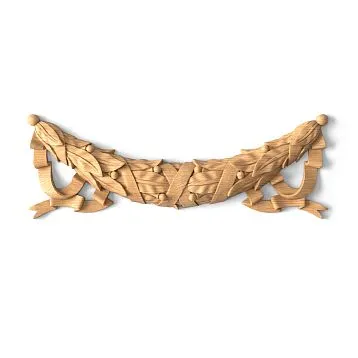
PU overlays — a broad category: these are any decorative elements made of polyurethane that are attached to a surface. This includes rosettes, medallions, cartouches, corner elements, ornamental bands, and capitals. All of these are flat or relief elements without gaps.
A decorative grille is a special type of overlay. Its distinguishing feature is an openwork structure with gaps. It doesn't just add relief to a surface—it creates a structure with an internal rhythm.
| Parameter | Regular PU overlay | Decorative PU grille |
|---|---|---|
| Structure | Flat or relief | Openwork, with gaps |
| Effect | Relief, ornament | Depth, rhythm, air |
| Application | Walls, ceilings, decor | Niches, furniture, panels, inserts |
| Installation | Glued to the surface | Into a groove, into a niche, or glued |
| Ventilation | No | Possible with large openwork |
| Decorative effect | Moderate | High |
When buying a grille, you are not just choosing a 'decorative element' — you are choosing a tool for creating spatial depth in the interior.
Decorative wall grille: how to create a complete composition
A single decorative element on the wall is either a strong accent or a random spot. The difference lies in how it is integrated into the overall context.
Grille in a molding frame
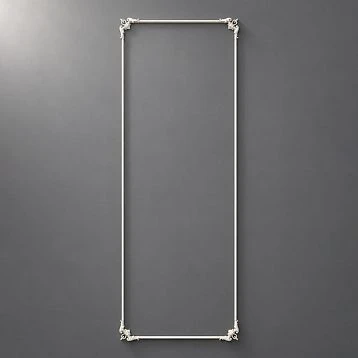
The most expressive technique is Moldings made of polyurethane creating a rectangular frame on the wall, inside which the grille is placed. This is a "frame + insert" system — a classic architectural technique familiar from palace interiors.
How it's done:
-
mark a rectangle of the desired size on the wall;
-
attach molding around the perimeter — profiled or smooth, depending on the style;
-
mount the grille inside the frame with glue;
-
paint everything in one color or in two different ones.
Result: a finished decorative panel that looks like an integrated architectural element.
Symmetrical pair
Two grilles on both sides of the central axis — mirrors, windows, doors, fireplace — is a technique that creates a sense of architectural order. Symmetry always works in a classic interior: it creates balance and a sense of thoughtfulness.
Single accent above the console
Console + mirror + grille above the mirror — this is a three-level vertical composition. The console is a horizontal accent. The mirror is a vertical reflective element. The grille is a decorative finish on top. Three elements, one axis — a complete look.
Grille in the wall panel system
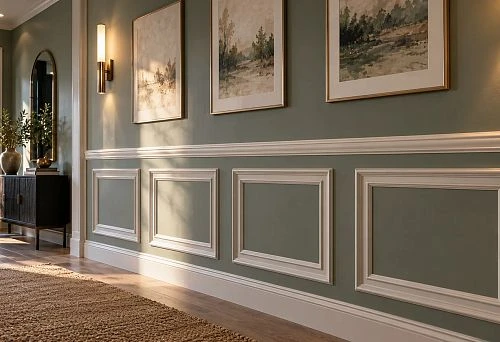
Polyurethane wall decor often used as a system: horizontal belts, frame moldings, ornamental elements. A grille can be organically integrated into this system — as a repeating element or as a single accent in the central panel.
Grille for furniture: from sideboard to display case
The furniture scenario is one of the most commercially significant. Let's examine it in detail.
Sideboard with openwork inserts
A classic sideboard with two sections and a middle section — traditionally has glass doors in the upper part. Replacing the glass with decorative openwork grille — is a design technique that turns a functional item into a decorative one. A sideboard with openwork inserts is no longer just storage furniture, but a piece with character.
Technically: the grille is mounted into the groove of a framed door instead of glass. The size is selected for the specific opening.
Display cabinet in a classic interior
A cabinet with decorative lattice inserts in the doors is furniture often made to order for classic interiors. Furniture manufacturers order PU overlays — including grilles — as decorative inserts for serial and custom products.
Kitchen fronts
Upper kitchen cabinets with openwork facades are a non-trivial solution for a classic or neoclassical kitchen. This allows you to visually lighten the top row, add rhythm to the facades, and create the feel of a "palace kitchen" without wood carving.
Chest and dresser in classic style
A decorative grille on the side walls of a chest or dresser is a rare but very expressive technique. A side wall with an openwork element in a frame of moldings turns an ordinary piece of furniture into a custom item.
Grille for a niche and radiator area: practice and nuances
Niche with built-in grille
A decorative niche in the wall is a common architectural element. Without decoration, it looks like an unfinished detail: an empty box in the wall. With a grille, it becomes a deliberate architectural accent.
Scheme: niche depth 100–200 mm → back wall painted in a contrasting color or finished with textured plaster → grille installed in the niche opening → if backlighting is present, an LED strip in the upper part of the niche illuminates the grille pattern from below or behind.
This technique creates the effect of a light pattern on the wall — especially in the evening with the main lighting turned off.
Radiator screen made of decorative grille
Decorative box for radiator with openwork grille made of polyurethane as a facade — this solution simultaneously hides the technical element and creates an interior accent.
Requirements for the radiator screen grille:
-
sufficiently large gaps for warm air circulation (at least 20–30% open area);
-
The material's heat resistance — polyurethane withstands temperatures up to 70–80°C, which is sufficient for a radiator screen under normal heating conditions;
-
The width and height of the grille must match the size of the facade opening of the box.
Installation: the grille is inserted into the grooves of the box or glued to its frame.
Important warning about the radiator
If the grille is used directly near the heating element — check the temperature specifications of the specific product. High-density polyurethane is resistant to moderate heat, but direct contact with hot surfaces may cause deformation.
How to choose size and pattern: selection parameters
Grille size
Size is the first and main parameter. It is determined not by preference but by the task: what area needs to be filled?
Large grille (400×400 mm and larger):
-
for the wall as an independent accent;
-
for a large niche;
-
for a large furniture front (cabinet door, sideboard).
Medium grille (200×300 — 400×400 mm):
-
for furniture inserts;
-
for decorative panels;
-
for small niches;
-
for symmetrical pairs on walls.
Small grille (up to 200×200 mm):
-
for small furniture doors;
-
for decorative accents in the panel system;
-
for repeating modular compositions.
Pattern scale
The scale of the lattice ornament should match the scale of the space and the viewing distance.
A large room with high ceilings and long viewing distances requires a large pattern with clear ornamental elements. A fine openwork on a large wall will "scatter" and get lost.
A small space, close-up view — here a fine openwork ornament works better: the detail of the pattern is readable up close and creates a feeling of jewelry-like craftsmanship.
Ornament style
Polyurethane Items are produced in different ornamental styles:
Classical ornament: acanthus leaves, scrolls, rosettes, garlands — for neoclassical, baroque, classicism.
Geometric ornament: diamonds, cells, squares — for a more modern or art deco style.
Arabesque and oriental motifs: for interiors with oriental or Moroccan motifs.
Neutral openwork: a regular structure without a pronounced stylistic ornament — a universal option for any interior.
When choosing a pattern, focus on the interior style, the ornament of the moldings, and the overall "vocabulary" of the decor.
How to combine a grille with moldings and stucco decor
A grille installed without context is a random element. A grille integrated into a decor system is architecture.
The "molding + grille" system
Moldings made of polyurethane form frames on the wall. Inside each frame is a grille. This is a modular system that can be repeated across the entire wall or highlighted in one area. All elements are painted in a single color — and the wall turns into an architectural surface.
Grille and molded decoration made of polyurethane
Above the grille — an ornamental band or cartouche. On the sides — applied pilasters. Below the grille — a horizontal molding. This is a full decorative panel composed of several types of products. The result is like that of a designer with a large budget, but at the price of standard renovation.
Color solutions for the system
Monochrome: everything — moldings, grille, wall — in one color. The decor is read through the chiaroscuro on the relief. A delicate, modern technique.
Two colors: the wall in one color, the moldings and grille in another (white, cream, gold). A classic technique that creates a clear visual rhythm.
Contrast accent: the wall is dark, the grille is light — or vice versa. A bold, expressive choice.
Painting and finishing of polyurethane grille
One of the main practical questions: how to properly paint a polyurethane grille?
Surface preparation
Polyurethane is a smooth material with low adhesion for paints without a special primer. Before painting, be sure to:
-
Degrease the surface with isopropyl alcohol or a special degreaser.
-
Apply a primer for polyurethane or a universal adhesion primer.
-
Let it dry completely — at least 2 hours.
Paint Selection
Acrylic water-dispersion paint is the optimal choice. It adheres well to primed polyurethane, does not crack, and is easy to touch up. Can be tinted to any color.
Alkyd enamel provides a harder surface. Suitable for furniture elements that are subject to mechanical stress.
Chalk paint is matte, popular in Scandinavian and Provencal interiors. Works well on polyurethane after priming.
Application technique
For an openwork grille — only a brush or spray gun. A roller does not work on an openwork surface: it misses all gaps and recesses. A brush allows you to paint every element of the pattern.
Spray gun (aerosol or compressor) — provides an even thin layer, especially effective for openwork elements. Two thin layers are better than one thick one.
Gilding and patina
For classic interiors — gilding the grille with potal or metallic paint. A gold grille on a white wall or in a dark niche — high decorative effect.
Patina: dark base layer + light paint on top, wiped off with a sponge from protruding parts. A classic technique for creating an "antique" look.
Painting before or after installation
For the grille — it is recommended to paint before installation: apply primer and base coat of paint on the removed element. After installation — touch up edges and joints with a brush. This provides a more even coating without drips at the edges.
Exception: if the grille and wall are painted the same color — you can install first, then paint everything together.
Installation of a decorative polyurethane grille
Tools and materials
-
installation adhesive for polyurethane (special PU adhesive or "liquid nails");
-
painter's tape for fixation while drying;
-
level and pencil for marking;
-
a metal saw or sharp knife for trimming (if necessary).
Wall surface preparation
The wall must be level, clean, free of dust and grease. A painted wall — pre-sand lightly with sandpaper to improve glue adhesion.
Installation order
-
Mark the position of the grille using a level and a pencil.
-
Apply mounting adhesive to the back of the grille — along the perimeter and in the center (if there is sufficient support area).
-
Attach the grille to the wall, press evenly over the entire area.
-
Secure with painter's tape or temporary spacers while the glue dries (15–30 minutes).
-
After the glue sets, remove the tape and seal the joints with acrylic sealant.
-
Touch up the paint.
Cutting
Polyurethane is cut with a sharp knife or saw. If the grille does not fit exactly into the niche or opening in size — it can be carefully trimmed along the contour without damaging the ornamental structure.
Mistakes when choosing a decorative grille
Let's list them briefly and precisely — so you don't make them.
Choosing a grille without measuring the niche or facade. The grille size must match the opening size where it is installed. A deviation of more than 5 mm is already noticeable.
Choosing a pattern that is too small for a large wall. At a distance of 3–4 meters, fine openwork is not readable. The scale of the ornament should match the viewing distance.
Not considering the depth and thickness of the element. If the grille is installed in a groove of a furniture facade, the product thickness and groove depth must be taken into account.
Forgetting about painting before installation. Painting an installed openwork grille is more difficult — brushes cannot reach deep gaps from different sides.
Mixing different ornaments. Classic leaf ornament + geometric openwork is a style conflict. All grilles and moldings in one area should belong to the same ornamental vocabulary.
Installing openwork decor without framing where a finished composition is needed. A grille without a molding frame looks like an unfinished element. Framing is mandatory for most application scenarios.
Not considering access to the radiator or technical area. If the grille covers a valve or faucet, removable installation must be provided.
Buying a grille without understanding the interior style. An openwork grille with a baroque ornament in a minimalist interior is not an 'accent', it's a mistake. The style of the grille should match the style of the space.
Where to buy a decorative polyurethane grille
Buy polyurethane grille important from the manufacturer who provides accurate dimensions, product photos from different angles, and information about compatibility with mounting materials.
In the Stavros catalog — decorative grille RSHPU-007 made of high-density polyurethane with an openwork pattern. Next — the full section PU overlays for walls and furniture, Polyurethane wall decor, Moldings made of polyurethane and entire catalog of polyurethane products — everything for creating classic and neoclassical decor. Full the STAVROS catalog — in one place.
FAQ: Answers to popular questions
Where are decorative polyurethane grilles used?
On walls as an accent element, in niches, on furniture facades (cabinets, sideboards, display cases), in radiator screens, in decorative panels and interior compositions.
How is a polyurethane grille different from an overlay?
An overlay is a flat or relief element without gaps. A grille is an openwork structure with gaps that creates depth and rhythm, not just relief.
Can a polyurethane grille be painted?
Yes. Primer for polyurethane + acrylic paint is the standard scheme. It is better to paint before installation. Tinting — in any color.
Is the grille suitable for furniture?
Yes. The grille is mounted into the groove of a frame door or glued onto the facade. It is used instead of glass in sideboards, cabinets, display cases.
Can the grille be used in a niche?
Yes. A grille in a niche creates a decorative accent with depth. With lighting behind the grille — the effect of a light pattern.
Is a polyurethane grille suitable for a radiator area?
Yes, provided there are sufficiently large gaps for air circulation. Polyurethane withstands temperatures up to 70–80°C.
How to choose the size of a decorative grille?
Measure the niche, facade, or area on the wall where you plan to install the grille. Choose a size with a 10–20 mm indentation from the edge — for framing with molding.
What to combine an openwork grille with in the interior?
With moldings of the same style, with PU stucco decor (overlays, cartouches), with decorative panels on the walls. Everything in a single ornamental system.
Can the grille be framed with moldings?
Yes — and it is recommended. A molding frame turns the grille into a complete decorative panel.
Where to buy a decorative polyurethane grille?
In the STAVROS catalog: RSHPU-007 grille with Contact us to confirm shipping to your destination.
About the manufacturer
STAVROS is a Russian manufacturer of decorative polyurethane and wood products for classic and modern interiors. The company's catalog includes — Decorative polyurethane grilles, PU overlays, Polyurethane wall decor, Moldings made of polyurethane and full catalog of polyurethane products for interior decor. If you are looking for a polyurethane grille for a wall, furniture, niche, or decorative panel — STAVROS offers quality, precision, and Contact us to confirm shipping to your destination.