
















































































Article Contents:
- Why the ceiling should not be left empty in a classic interior
- What is a ready-made ceiling decor kit
- How a kit is more convenient than selecting moldings, cornices, and rosettes individually
- What elements are included in ceiling decor
- Ceiling Cornices
- Ceiling Moldings
- Ceiling Rosettes
- Decorative Overlays and Corner Elements
- How to choose a kit based on room area
- For small rooms
- For medium-sized rooms
- For large and formal spaces
- How to choose a kit based on ceiling height
- Ceilings 2.5–2.7 m
- Ceilings 2.7–3 m
- Ceilings above 3 m
- Overview of the CPU-P1–CPU-P6 line
- Stucco decor set CPU-P1
- Stucco decor set CPU-P2
- Stucco decor set CPU-P3
- Stucco decor set CPU-P4
- Stucco decor set CPU-P5
- Stucco decor set CPU-P6
- How to combine ceiling decor with walls, cornices, and furniture
- Mistakes when choosing ceiling moldings
- Mistake 1. Choosing too small decor for a large room
- Mistake 2. Placing too elaborate decor in a low room
- Mistake 3. Buying individual elements without an overall scheme
- Mistake 4. Not considering the chandelier and lighting
- Mistake 5. Not connecting the ceiling with the walls
- Polyurethane or plaster: why polyurethane is better for ceiling decor
- Where to buy ready-made ceiling decor STAVROS
- FAQ: answers to popular questions about ceiling decor
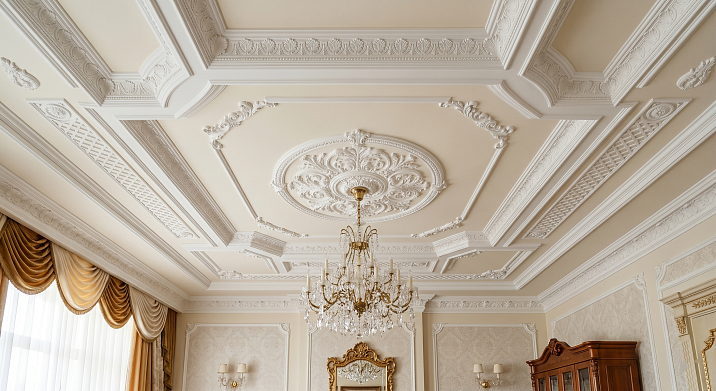
The ceiling is the only surface in the interior that cannot be hidden behind furniture or curtains. It is always above you — in daylight, in evening twilight, in any part of the room. And it is often left untouched while walls are adorned with moldings, furniture is chosen down to the smallest detail, and the floor is laid with precision.polyurethane ceiling decorIn the STAVROS catalog, this is not a scattering of individual elements that need to be assembled independently; it is six ready-made ceiling systems from the "Classic" collection: CPU-P1, CPU-P2, CPU-P3, CPU-P4, CPU-P5, and CPU-P6. Each set is an architecturally balanced solution for a specific space, a specific height, and a specific decorative scenario.


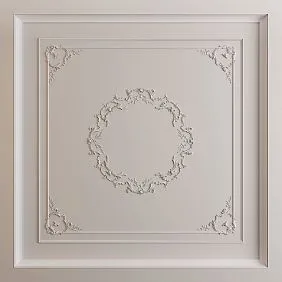
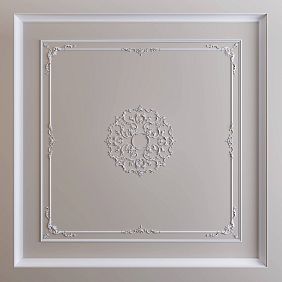

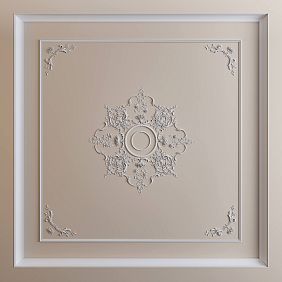
Why the ceiling cannot be left empty in a classic interior
There is a common misconception: you need to decorate what catches the eye at eye level. Walls, furniture, floor. The ceiling is a secondary matter. This logic works in minimalism, where emptiness is an artistic device. But in a classic and neoclassical interior, an empty ceiling is an architectural incompleteness that everyone entering the room feels, even without understanding why the space seems "unfinished."
Classical architecture is built on a hierarchy of planes. The floor is the base. The walls are the vertical context. The ceiling is the completion, the final architectural chord that closes the space from above and gives it a sense of fullness. When the walls are detailed with moldings and decorative frames, but the ceiling remains a white rectangle without a single detail, the interior looks like a book without a final chapter. Everything is written, but there is no ending.
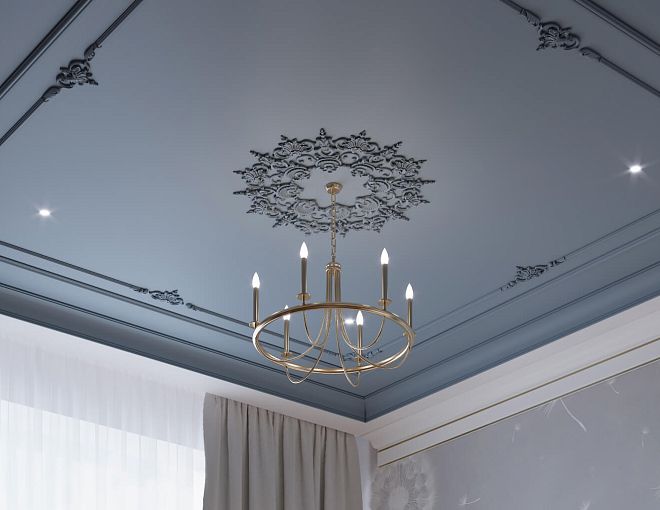
A decorative ceiling in a classic style solves several tasks at once. First, it creates a center: the ceiling area with a rosette, cornice, and molding contours focuses attention on the chandelier and forms an architectural dominant around which the entire furniture arrangement is built. Second, it sets a rhythm: molding contours in concentric levels create a sense of movement from the perimeter to the center—exactly the rhythm that makes the interior "readable" and harmonious. Third, it connects the ceiling to the walls through the cornice: the ceiling cornice is not just a decorative profile, but a structural element of transition between two planes, which is mandatory in classical architecture. A ceiling with stucco ceases to be just an "upper surface"—it becomes part of an architectural statement.
Decorating the ceiling with stucco is not a luxury in the sense of inaccessibility. Modernpolyurethane ceiling decorweighs many times less than a plaster counterpart, is installed without anchors and special equipment, and is available in the form of ready-made kits that require neither a design education nor special knowledge about the proportions of stucco systems. It is a luxury in the sense of beauty—and it is quite achievable.




What is a ready-made ceiling decor kit
When people say "buy ceiling decor," they most often imagine individual elements: a cornice in one place, a rosette in another, molding in a third. Then all this needs to be somehow combined into a single system, checking whether the scales match, whether the ornaments are compatible, and whether the size of the central element is correctly chosen for a specific chandelier. This is time-consuming, risky, and requires either experience or the help of a designer.
Ready-made ceiling decor kit— a fundamentally different approach. It is a pre-designed system of elements where every detail is coordinated with the others: the scale of the cornice matches the scale of the corner overlays, the ornament of the central element belongs to the same stylistic vocabulary as the ornament of the field inserts, and the molding contours are built in a correct proportional hierarchy from the perimeter to the center. All six sets of the CPU-P series are designed for a ceiling area of 3200 × 3200 mm and are sold as a complete ready-made set — without the need for independent layout design.
What is included in the ceiling stucco set: a single perimeter cornice A130V1 (100 × 83 mm, HIWOOD polystyrene) with a slot for an LED strip, one or more molding contours, polyurethane ornamental overlays for decorating the field, corner accent groups, a central element for a chandelier. Depending on the set number — from the basic minimum (CPU-P1) to the monumental 15-level system (CPU-P6) with an original central group MLDPU-027 and field elements up to 350 × 420 mm. This is the fundamental difference between ready-made ceiling decor sets and individual selection: you get not a set of SKUs, but a ready-made architectural system.
Our factory also produces:




How a set is more convenient than independent selection of moldings, cornices, and rosettes
This question should be examined honestly, without marketing evasions. Yes, it is technically possible to assemble a ceiling system piece by piece, choosing each element from the catalog. But practice shows that this path is fraught with several typical and costly mistakes.
Mismatched scale. A cornice of 100 mm + corner overlays of 60 × 40 mm + a central element of 150 × 150 mm — proportions that seem logical on paper, but in real space create decorative 'discord'. The large cornice overwhelms the small corner accents, the central element gets lost, the system does not 'sound' as a single whole. Buying a ready-made ceiling decor set means getting a system where these proportions are verified by a professional designer on implemented projects.
Stylistic inconsistency of ornaments. Overlays with an acanthus leaf + corner elements with geometric weaving + a rosette with baroque curls — three different ornamental styles in one system. Each element is classic on its own, but together — visual chaos. In the ready-made sets of the CPU-P series, the ornamental language is unified at all levels.
Incorrect layout geometry. How many corner elements are needed? Where to place field inserts so that they form a symmetrical system? What is the correct distance between the cornice and the first molding contour? The answers to these questions require either design experience or a ready-made set with a proven scheme. The price of a ceiling decor set essentially includes the cost of this design solution — and it is fully justified.
Difficulty in coordinating with the designer and craftsman. Showing a single set card to the craftsman is much easier than explaining a layout scheme of 12 individually ordered SKUs. Buying ready-made ceiling decor sets means significantly simplifying communication at all stages of the project, from discussion with the designer to installation.
What is included in a stucco decor set for the ceiling that makes it simpler and more reliable than independent selection? First of all — a ready-made design solution included in the price. You pay not only for the material but also for the architectural logic of the system.
Get Consultation
What elements are included in ceiling decor
Before moving on to choosing a specific set, let's break down the anatomy of a finished ceiling system by its components. This will help you better understand what exactly you are getting and properly combine the CPU-P system with the rest of the room's decor.
Ceiling Cornices
The perimeter cornice is the foundation of any ceiling system. It forms the outer contour of the zone, creates a transition from the vertical plane of the wall to the horizontal plane of the ceiling, and, if there is a technological groove, becomes the placement site for an LED strip for contour lighting. All six sets of the CPU-P series use the A130V1 cornice (100 × 83 mm, HIWOOD polystyrene) — a powerful profile with clear geometry and sufficient depth for LED installation.Polyurethane Crown MoldingThe full range is available in the STAVROS catalog — here you can select lighter profiles for decorating the room perimeter outside the CPU zone.
Ceiling moldings
Moldings form the internal geometry of the ceiling field: concentric contours, rectangular or square frames, decorative zoning lines. Depending on the set — one molding contour (CPU-P1) or several, including profiles of different widths and reliefs. CPU-P6 features a separate central molding system based on MLDPU-027 with two types of corner elements.Moldings made of polyurethane — an assortment for independently selecting additional profiles for an already chosen system.
Ceiling Rosettes
The central accent of the ceiling system is the element for a chandelier or light fixture. The decorative rosette completes the concentric hierarchy: zone → molding contours → corner accents → central element → rosette. It is at this point that the ceiling architecture and the chandelier's light architecture intersect.Polyurethane ceiling rosettes are selected based on the diameter of the chandelier base: delicate 200 mm — for the bedroom and study, large 350–450 mm — for a formal living room with a large crystal chandelier.
Decorative overlays and corner elements
Ornamental overlays are the "text" of the ceiling system. They create the decorative character, determine the stylistic richness, and form the first visual impression. From small punctuation inserts (66 × 45 mm in the CPU-P1 set) to monumental dominants (300 × 420 mm in the CPU-P6 set). Corner accents — symmetrical left and right ornamental pairs in the corners of the zone — form "power lines" converging towards the center and giving the system dynamics.molded decoration made of polyurethane — overlays, corner elements, ornamental inserts — in the catalog section for additional field saturation.
How to choose a set based on room area
The area of the room is the first and main criterion when choosing a set. The CPU-P zone is fixed: 3200 × 3200 mm. This means its visual weight in the space directly depends on how large the room itself is.
For small rooms
A bedroom of 12–18 m², a children's room, a study, a small living room — spaces where the 3200 × 3200 mm zone occupies a significant part of the ceiling surface. Here it is important not to overload the ceiling with ornamental richness: it should decorate, not overwhelm. Ceiling stucco for a small room means laconic systems with clean geometry and a minimal number of ornamental levels. The optimal choice:Stucco decor set CPU-P1orMolding decor set CPU-P5. Ceiling decor in the bedroom with these sets creates a classic accent above the bed without turning the ceiling into an overloaded ornamental "carpet." Ceiling decor for a study follows the same logic: strictness and conciseness work better than excessive richness in a space for focused work.
For medium-sized rooms
A living room of 20–35 m², a dining room, a master bedroom, a kitchen-living room — spaces where a medium-saturation system works without restrictions. The 3200 × 3200 mm zone here occupies the central third of the ceiling, leaving a proper perimeter offset. Ceiling decor for a living room with several molding contours and a developed corner system creates an architectural accent above the sofa or dining group. Ceiling stucco in a medium-sized living room —Molding decor set CPU-P2orMolding decor set CPU-P3. Ceiling decor in a living room of this scale acquires the necessary decorative weight: the room becomes architecturally complete without losing airiness.
For large and formal spaces
A hall in a country house, a grand hall, a spacious living room from 40 m², a representative area, a dining room with high ceilings — spaces where a laconic set risks being "lost." Ceiling decor in a country house with monumental elements and four levels of corner accents is not excess, but proportionality. A classic ceiling in a formal living room requires a rich system:Molding decor set CPU-P4 for a spacious living room orMolding decor set CPU-P6 for a formal hall with ceilings from 3 meters. A decorative ceiling in a house of this scale is not decor for decor's sake, but an architectural necessity.
How to choose a set based on ceiling height
Ceiling height is a criterion that scares many buyers more than area. "Don't overload the ceiling with stucco," "don't choose too massive a cornice" — these concerns are justified. Let's figure it out.
Ceilings 2.5–2.7 m
Standard height of a city apartment. At this height, the ceiling is psychologically "closer" to a person, and the decorative system is perceived from a shorter distance. This does not mean that stucco is contraindicated — it means that care is needed in choosing the scale. How to choose stucco for a ceiling height of 2.5–2.7 m: the A130V1 cornice (83 mm along the profile) is proportionate at this height, but ornamental field dominants should be chosen small. Stucco for low ceilings — CPU-P1 or CPU-P5: laconic systems without monumental overlays 300+ mm.
Ceilings 2.7–3 m
Optimal range for most kits in the series. At a height of 2.7–2.9 m, CPU-P2, CPU-P3, CPU-P4 are used without restrictions — systems of medium and high saturation. At a height of 2.9–3 m, the entire spectrum opens up, including more saturated options. How to choose stucco: first of all, focus on the area — at a height of 2.8 m and a room of 15 m², CPU-P1 is still preferable, and at a height of 2.8 m and a room of 40 m², CPU-P4 is organic without reservations.
Ceilings above 3 m
Stucco for high ceilings is the element of monumental systems. At a height of 3+ m, large field elements (300 × 420 mm as part of CPU-P6) are perceived proportionally, and the A130V1 cornice acquires the correct decorative weight: it does not press, but forms an architectural transition. How not to overload the ceiling with stucco at a high height — it is harder to make a mistake than at a standard one: the scale of the space accepts the scale of the decor. Here the potential of CPU-P6, the most saturated and architecturally complex kit in the series, is fully revealed.
Overview of the CPU-P1–CPU-P6 line
Six kits of the CPU-P series are six architectural scenarios of different scales and decorative density. Each is created for a specific type of space, and the choice between them is not a matter of taste in the sense of "like / dislike," but a matter of proportionality: which system is organic in your particular room.
Stucco decor kit CPU-P1
Basic three-circuit system — concise, clean, architecturally balanced.Stucco decor set CPU-P1 — this is a classic ceiling without visual overload. Cornice A130V1 along the perimeter of the zone, one molding contour LD32, single-level corner accents, small ornamental inserts in the field. Central element MLDPU-2U-1.1 (210 × 210 mm) for the chandelier. An ideal choice for a bedroom, children's room, study, or small living room, for interiors in a neoclassical style with clean lines and a minimal number of decorative levels. CPU-P1 is the answer to the question "I want classics, but I'm afraid of overdoing it."
Set of stucco decor CPU-P2
The next level of decorative richness.Molding decor set CPU-P2 — a system with an expanded corner group, more expressive field overlays, and additional detailing in the center. Suitable for a living room of 20–30 m², for a dining room, for a bedroom with a ceiling height of at least 2.7 m. This is a solution for those who want the presence of true classics — with character and ornamental expressiveness, but without the monumentality of formal halls. CPU-P2 is a universal choice for city apartments and medium-sized houses.
Set of stucco decor CPU-P3
Transitional level from intimate to formal.Molding decor set CPU-P3 — a system with in-depth ornamental detailing of the field, several levels of corner accents, and a richer molding pattern. This is a choice for those who need an expressive ceiling with a noticeable decorative composition: a living room of 25–35 m², a spacious bedroom, a master bedroom with a height of at least 2.8 m. CPU-P3 occupies the golden mean between the concise elegance of CPU-P2 and the monumentality of CPU-P4 — and that is why it often becomes the final choice for discerning buyers who hesitate for a long time between "a little" and "a lot."
Set of stucco decor CPU-P4
Rich multi-level system with 21 types of products.Molding decor set CPU-P4— это парадный потолок для гостиной, зала, холла, просторной столовой. Несколько уровней угловых акцентов, богатая орнаментальная система поля, развитые молдинговые контуры — система, которая в большом пространстве создаёт ощущение монументальной классики без аляповатости. Именно CPU-P4 чаще всего выбирают для загородных домов с высотой потолков 2,9–3,2 м и гостиными от 35 м². Это потолок, который хочется разглядывать.
Комплект лепного декора CPU-P5
Неожиданный в своей концепции комплект.Molding decor set CPU-P5— камерная классическая система с выразительными крупными акцентами при общей сдержанности состава. Это не «большой CPU-P1» и не «упрощённый CPU-P3» — это самостоятельная декоративная концепция с особым характером. CPU-P5 идеально работает в спальне, детской, кабинете или небольшой гостиной, где нужна не орнаментальная насыщенность, а точечная выразительность: несколько крупных акцентов в правильных местах создают больший эффект, чем плотный ковёр мелких деталей.
Комплект лепного декора CPU-P6
Самый насыщенный, архитектурно сложный и монументальный комплект серии.Molding decor set CPU-P6— это 15 видов изделий, четыре независимых уровня угловых акцентов (NPU-461L/R, NPU-430L/R, NPU-431L/R, NPU-470L/R), монументальные доминанты поля NPU-464 (300 × 420 мм) и NPU-475 (350 × 180 мм), оригинальная центральная молдинговая система MLDPU-027 с двумя типами угловых элементов. Это потолок для парадного зала загородного дома, для представительской гостиной с потолками 3+ метров, для интерьерного проекта с акцентом на классическую архитектуру как главный художественный инструмент. CPU-P6 — не для тех, кто сомневается. Для тех, кто точно знает: потолок должен быть главным.
Как сочетать потолочный декор со стенами, карнизами и мебелью
Потолочная система — не изолированный декоративный остров. Она работает в контексте всего помещения, и от того, насколько правильно выстроена связь потолка со стенами, мебелью и светом, зависит, превратится ли интерьер в единое архитектурное высказывание или останется набором красивых, но несвязанных элементов.
Как сочетать потолочную лепнину со стенами: ключевой принцип — единый орнаментальный язык. Если на потолке используется система CPU-P с акантовыми и геометрическими орнаментами в стиле «Классика», стеновые молдинговые рамки должны быть выполнены из тех же профилей или из профилей того же стилистического ряда.Polyurethane wall decorin the STAVROS catalog — molding frames, wall overlays, corner and intermediate elements for creating vertical "panels" in a unified style with the ceiling system.
How to combine ceiling cornices and moldings: the rule of decorative hierarchy. The ceiling zone cornice CPU-P (A130V1, 100 mm) is heavy and accent. The perimeter cornice of the entire room is lighter, 40–60 mm, not competing with the zonal one.Moldings made of polyurethanein the catalog section allow you to choose the correct hierarchy of profiles — from heavy zonal to light perimeter and even thinner wall.
Stucco on the ceiling in classic style works as a unified architectural system only when the ceiling, walls, doorways, and furniture are united by a single decorative code. The ceiling cornice should continue the style of door trims. The molding contours of the ceiling should rhyme with the frame "panels" of the walls. The central rosette under the chandelier should be related to the scale of the chandelier and the height of the ceiling. All these connections are not created by chance — they are designed. Andpolyurethane interior itemsfrom the STAVROS catalog provide the tools for building exactly such connections: cornices, moldings, rosettes, overlays, wall decor — all in a single stylistic key "Classic".
A ceiling with cornices and moldings, connected to wall decor through a unified ornamental vocabulary, is not just a beautiful interior. It is an architectural space where every detail is justified, every element works in a system, and nothing can be removed without breaking something. This is what classic design strives for.
Mistakes when choosing ceiling stucco
Mistakes when choosing is a separate and important topic. Not because it's easy to make a mistake, but because the cost is high: redoing an installed ceiling system is a labor-intensive and expensive undertaking. Let's look at the five most common ones.
Mistake 1. Choosing too small decor for a large room
Small ornamental inserts and thin moldings in a large space literally dissolve. The ceiling remains visually empty despite the presence of decor — the decor is simply not visible from a distance of 5–7 meters. How to choose the size of ceiling decor: for a living room of 35+ m², ornamental inserts should be from 150 × 100 mm, and the central element should be at least 250 × 250 mm. If the scale does not match, the decor loses its meaning.
Error 2. Placing overly rich decor in a low room
Monumental overlays 300+ mm on a 2.5 m ceiling create visual overload, making the ceiling feel heavy and literally reducing the perceived height. Which moldings cannot be placed on a low ceiling: CPU-P4, CPU-P6 for heights under 2.7 m and areas up to 20 m². How to create a classic ceiling without overload: CPU-P1 or CPU-P5 — the ceiling will be decorated, and the space will not lose its airiness.
Error 3. Buying individual elements without an overall scheme
The cornice was bought in one place, the rosette in another, the moldings in a third, and the corner overlays were chosen by eye. The result is a system without a system: elements are present but do not form a unified architectural composition. This is exactly the case when aready-made set of ceiling stucco decoris the only correct solution.
Error 4. Not considering the chandelier and lighting
The ceiling rosette for the chandelier should be proportional to the chandelier's diameter. A rosette with a diameter of 180 mm for an 80 cm chandelier is too small: the chandelier will completely cover the decor. How to choose a ceiling rosette for a chandelier: the rosette diameter should be 40–60% of the chandelier's diameter. For contour LED lighting, note that the A130V1 cornice already has a groove for the strip: this needs to be accounted for in the electrical plan in advance.
Error 5. Not connecting the ceiling with the walls
A ceiling in a rich classical style against completely empty walls looks like a foreign object that has 'fallen' into the interior without context. How to properly design a ceiling with polyurethane stucco: minimal wall context — a perimeter cornice around the entire room and molding frames on one or two accent walls. This creates a decorative connection between the surfaces and makes the ceiling system part of a unified interior, rather than an isolated decoration.
Polyurethane or plaster: why polyurethane is the better choice for ceiling decor
Polyurethane stucco molding on the ceiling: advantages — a topic worth considering separately, because the question "polyurethane or plaster" arises for almost every buyer.
Plaster stucco molding is a traditional material with a centuries-old history. It provides high relief accuracy, paints well, and has substantial "weight" both literally and figuratively. But it is the literal weight that is its main limitation for ceiling use: large plaster elements require anchor fastening with a drill, reinforcement, and professional installation. For a complex multi-element ceiling system, this turns into full-scale construction work.
How to decorate a ceiling without plaster stucco: polyurethane decor for the ceiling solves the problem much more simply. An element weighing 200–300 g is mounted with assembly glue without anchors. One person, without an assistant, without a drill. The polyurethane surface is pore-free — paint applies evenly, without priming. 100% moisture resistance — for a bedroom with air conditioning, for a children's room with unstable humidity. Temperature stability — polyurethane does not change geometry during seasonal fluctuations in unheated periods.
The price of polyurethane stucco molding for the ceiling, with a comparable decorative effect, is significantly lower than that of plaster analogs — taking into account the cost of professional installation of the latter. Installationmoldings from polyurethane is described in detail in the corresponding article — a practical guide for DIY work. Installationof the polyurethane molding — a separate guide covering corner joints, hidden seams, and painting techniques.
Where to buy ready-made decor for STAVROS ceilings
Buying decor for ceilings made of polyurethane means choosing a system, not a set of random elements. That is why in the STAVROS catalogceiling decor is organized not as a scatter of SKUs, but as a line of ready-made ceiling systems CPU-P1–CPU-P6 with clear characteristics, proven proportions, and an understandable selection logic.
All six sets are made of polyurethane and dense HIWOOD polystyrene — materials that are lighter than plaster, easier to install, more resistant to moisture, and match traditional stucco in precision of ornamental relief reproduction. The sets are designed for a 3200 × 3200 mm area and are suitable for classic and neoclassical interiors of any size — from a compact city apartment to a grand hall of a country house.
Buy polyurethane ceiling stucco in the STAVROS catalog directly through the product card — the "Add to Cart" or "To Order" button. Delivery across Russia by transport companies and courier services. Pickup — from showrooms in St. Petersburg and Moscow.
Want to design a ceiling in a classic style without independently selecting cornices, moldings, and rosettes? The STAVROS catalog features Ready-made molded decor kits CPU-P1–CPU-P6 for a ceiling area of 3200 × 3200 mm — choose the suitable option based on scale, richness, and interior style.
FAQ: answers to popular questions about ceiling decor
What is better: a ready-made ceiling decor set or individual elements?
A ready-made set is more convenient in every way if the goal is a cohesive and architecturally balanced ceiling system. Independent selection is justified only when a non-standard solution is needed for a specific project with atypical area dimensions or special stylistic requirements. In other cases, a set of stucco decor for the ceiling saves time, reduces the risk of errors, and guarantees a coordinated result.
Is polyurethane stucco molding suitable for the ceiling?
Yes,Polyurethane ceiling decoration — the optimal choice for residential interiors. Lightweight, moisture-resistant, precise in relief, ready for painting without priming. Installed with mounting adhesive without anchors. Compared to plaster stucco, it is significantly easier to install with a comparable decorative effect.
Which set should I choose for a small room?
For small rooms (up to 20 m²), it is better to choose laconic systems without overloaded ornamentation: CPU-P1orCPU-P5. These sets create a classic accent without making the ceiling visually heavy.
Can ceiling decor be combined with wall moldings?
Yes, this is one of the best interior scenarios. A ceiling cornice, molding contours on the ceiling, and frame molding "panels" on the walls from the same series create a unified architectural system within the room's volume. Moldings made of polyurethaneandWall Decor in the STAVROS catalog are selected in a unified stylistic key with ceiling sets.
Where can I buy a ready-made set of stucco decor for the ceiling?
In the STAVROS catalog, in the section "ceiling decor» ready-made kits CPU-P1–CPU-P6 are presented. Delivery across Russia, self-pickup in St. Petersburg and Moscow.
Is professional installation necessary?
CPU-P1 and CPU-P5 are available for self-installation: a small number of elements, a clear diagram, simple geometry. CPU-P6 is recommended to be installed with an experienced craftsman: the central molding system MLDPU-027 and four levels of corner groups require precise laser marking and experience with molding systems.
How to calculate ceiling decor?
The standard area of CPU-P series kits is 3200 × 3200 mm. All you need is to ensure that this area fits on your ceiling with sufficient perimeter clearance (recommended at least 400–600 mm from walls). For non-standard areas or rooms with atypical sizes — consultation with a STAVROS manager.
STAVROS is a Russian company with its own productionpolyurethane productsfor classic and neoclassical interiors. The catalog includes ready-made ceiling systems, cornices, moldings, ceiling rosettes, wall decor, overlays, and linear elements — all in the unified "Classic" style, which allows building architecturally coordinated spaces on all planes. STAVROS — when the ceiling ceases to be "just a ceiling" and becomes part of an architectural statement.