




























Article Contents:
- Wooden frame RM-047 1500×883×44 mm: which parameters are confirmed by the product card
- Niche 900 mm and frame 883 mm: why the clearance is only 8.5 mm on each side
- Scenario 1. The niche is indeed 900 mm across the entire height
- Scenario 2. The niche is 896 mm in the center
- Scenario 3. The niche is 892 mm at the bottom
- Scenario 4. Minimum width is 882 mm
- What is the size of RM-047?
- Will RM-047 fit into a 900 mm wide niche?
- What side clearance will remain at a width of 900 mm?
- Is 8.5 mm on each side enough?
- How to correctly measure a finished niche?
- Do I need to check the diagonals?
- What height remains at the top and bottom?
- Can 30 mm be considered a sufficient allowance for hanging?
- How is RM-047 hung?
- Is the mirror included?
- What thickness of mirror is provided?
- What thickness is the backing?
- What is a DWG template?
- Can the mirror be ordered in advance at size 1500×883 mm?
- What to do if the mirror already exists?
- What is RM-047 made of?
- What to choose — beech or oak?
- How is "Standard" different from "Prestige"?
- Can the size of RM-047 be changed?
- What to do if the niche is already finished
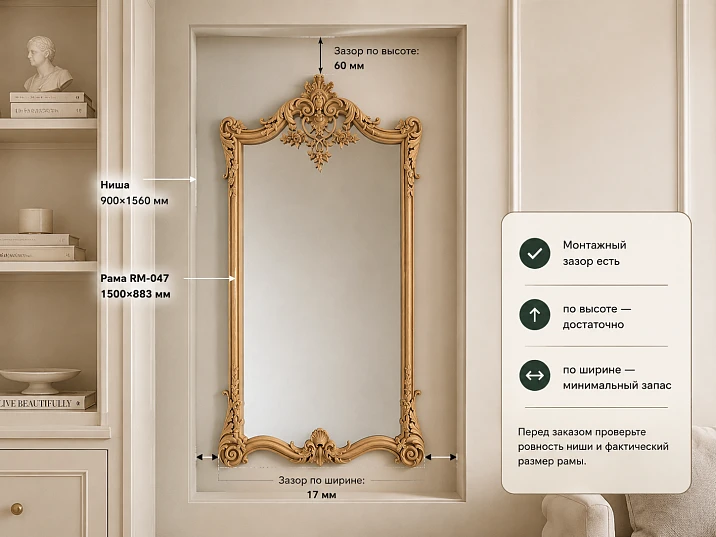
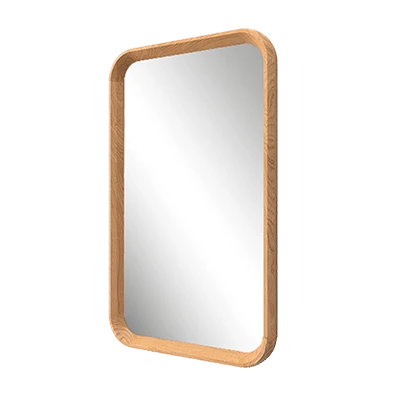
The dressing room is already finished. The walls are painted, the niche slopes are ready, and I don't want to redo the carpentry part and the plaster. A rectangular space of 900×1560 mm is left for the mirror. In the STAVROS catalog, a wooden frame RM-047 with external dimensions of 1500×883×44 mm is selected. By nominal arithmetic, it fits.
By width:
900 − 883 = 17 mm.
If the frame is placed strictly in the center:
17 / 2 = 8.5 mm
left and right.
By height:
1560 − 1500 = 60 mm.
With ideal centering:
60 / 2 = 30 mm
at the top and bottom.
On paper, the clearance is positive. That's why the buyer easily concludes: "883 is less than 900, 1500 is less than 1560 — you can order." But for an already finished niche, this is not enough. A dimensional "fits" does not equal an installation "mounts." The actual width of the niche may differ at the top, middle, and bottom. The side slopes may be non-parallel. The frame may physically pass through the opening, but to hang it on hinges, it will need to be lifted above its final position. With a side clearance of 8.5 mm, any construction error becomes significant.
Therefore, the direct answer is this: RM-047 can be considered for a niche of 900×1560 mm, but placing an order only based on the design dimensions of 900 and 1560 mm is risky. Before payment, you need to take the actual geometry of the niche in at least several sections, check the diagonals and verticality, obtain or confirm the position of the hinge points, and understand the installation trajectory.
For RM-047, one external size of 1500×883×44 mm is confirmed. Materials are beech and oak. Grinding quality is "Standard" or "Prestige". The beech version is offered with preparation for enamel. The frame is made to order. In the fresh STAVROS catalog as of the check on 31.08.2026, RM-047 was displayed at a price from 80,320 RUB. The specific cost of the selected material and quality must be re-opened in the product card before payment.
Separately, the issue of the mirror panel needs to be resolved. The external size is 1500×883 mm — this is the frame size, not the mirror. In the standard configuration of STAVROS frames, a seat for a 5 mm thick mirror is provided, a 6 mm MDF backing, screwed-in hinges for hanging, and a DWG file with a template for precise mirror cutting. The mirror itself is not automatically included in the standard frame configuration and is ordered separately based on the seating geometry.
The main goal of this article is to turn "17 mm seems enough" into a verifiable algorithm, after which one of two decisions can be made: either the standard RM-047 is indeed suitable and can be ordered, or the finished niche is too borderline and it is better to choose a different frame or adjust the opening itself before purchasing an expensive product.

Wooden frame RM-047 1500×883×44 mm: which parameters are confirmed by the product card
Before calculation, it is useful to separate confirmed characteristics from what still needs to be checked on site.
| Parameter | Confirmed for RM-047 | What else to check |
|---|---|---|
| External size | 1500×883×44 mm | actual niche geometry |
| Material | Beech or oak | compatibility with interior and finishing |
| Sanding | "Standard" or "Prestige" | amount of subsequent refinement |
| Preparation of beech | For enamel | selected primer and finish system |
| Status | Custom Order | actual batch date |
| Price | from 80,320 RUB as of check on 31.08.2026 | price of specific configuration |
| Mirror | STAVROS frame seating is designed for 5 mm | exact internal template |
| Underlay | MDF 6 mm in standard frame configuration | confirm order completeness |
| Hanging | screwed-in hinges | position of the hinges and installation trajectory |
| Template | DWG for mirror cutting | get the file specifically RM-047 |
If after checking this particular model fits, you can buy the RM-047 frame.
The most important caveat in the table is that the size 1500×883×44 mm describes the external geometry of the frame. It is not the size of the mirror panel and does not replace the drawing of the mounting seat.


Niche 900 mm and frame 883 mm: why the clearance is only 8.5 mm on each side
The calculation is simple:
900 − 883 = 17 mm.
But in a finished niche, what matters more is not the total 17 mm, but the distribution across the sides.
If the frame is positioned perfectly centered:
17 / 2 = 8.5 mm.
That is, the design line assumes only 8.5 mm of air between the external dimension of the frame and the side surfaces of the niche.
8.5 mm is not a standard, not a minimum allowable value, and not a guaranteed installation clearance. It is simply the result of arithmetic on two nominal dimensions.
To understand how borderline the project is, let's consider several actual niche measurements.
Our factory also produces:

Scenario 1. The niche is indeed 900 mm across its entire height
Then theoretically, 8.5 mm remain on each side.
Get Consultation
Scenario 2. In the center, the niche is 896 mm
896 − 883 = 13 mm.
When centering:
13 / 2 = 6.5 mm.
Scenario 3. At the bottom, the niche is 892 mm
892 − 883 = 9 mm.
With ideal centering:
9 / 2 = 4.5 mm.
The frame still "mathematically fits," but the actual side clearance is already almost half the original.
Scenario 4. Minimum width 882 mm
Then:
882 − 883 = −1 mm.
A standard frame physically does not fit into the narrowest point without modifying the niche or the product.
This is why a single design dimension of 900 mm is insufficient.
Niche height 1560 mm: why 60 mm of clearance looks more reassuring than 17 mm in width
Vertical calculation:
1560 − 1500 = 60 mm.
If centering the frame:
60 / 2 = 30 mm.
At first glance, the vertical looks significantly more comfortable than the side 8.5 mm. But these 30 mm cannot automatically be considered installation clearance.
Final height and installation trajectory are different things. If hinges require first lifting the frame above the final point, part of the top free space is used precisely for hanging. If the mounting is arranged differently, the lift may be minimal.
Therefore, 30 mm at the top is a good sign, but not a ready guarantee.
Also, the height should be measured in several vertical lines. The niche may be:
-
1560 mm on the left;
-
1555 mm in the center;
-
1552 mm on the right.
Then the minimum total vertical clearance:
1552 − 1500 = 52 mm.
If the vertical position is fixed asymmetrically, less than 30 mm may remain at the top.
The bottleneck of the project remains the width, but the height also needs to be checked in practice.
Why a wooden frame cannot be ordered based on a single measurement of a 900 mm niche
After finishing, a rectangular opening is rarely mathematically perfect.
Width may vary due to the layer of plaster, putty, paint, decorative panel, slight slope of the reveal, or misalignment of corners.
For RM-047, measure the niche at least at three levels: approximately 100–150 mm from the top edge, in the middle, and 100–150 mm from the bottom edge. If the niche is tall, it is useful to add two more intermediate points.
Example of notation:
| Level | Actual width |
|---|---|
| Top | 899 мм |
| Upper third | 897 мм |
| Center | 895 мм |
| Lower third | 894 мм |
| Bottom | 892 мм |
For the solution, neither the average value nor the "nice 900 at the top" is taken, but the minimum actual width — 892 mm.
Then the clearance:
892 − 883 = 9 mm.
It is already fundamentally different from the original 17 mm.
How to measure a finished niche correctly
A tape measure is suitable for a preliminary measurement, but a borderline gap requires care. Clean the reveals of protrusions and temporary protective materials, use the same tape measure or laser rangefinder, measure between the actual finished surfaces, and record each result. Repeat the smallest values again.
If there is decorative plaster with relief on the side slope, measure up to the most protruding point that could actually meet the frame.
Separately note the thickness of the finish layer. If the niche is only just puttied, and decorative paint or a panel is ahead, the final size may decrease.
Frame for a mirror in a finished niche: checking the verticality of the side slopes
Even if the width at the top and bottom is the same, the slopes may be tilted or slightly curved. Checking with a laser or a long level shows whether the actual verticality matches.
Let's imagine: at the top point, the left slope deviates inward by 2 mm, the right one outward by 1 mm. The total width may remain close to 900 mm, but the center of the niche shifts relative to the lower part.
A 1500 mm high frame will visually emphasize this defect because its side lines are almost parallel to the slopes and located very close.
With a gap of 8.5 mm, a skew of 3–4 mm already noticeably changes the picture.
Why check the diagonals of the niche
Diagonals help understand how close the opening is to a rectangle. For an ideal rectangle of 900×1560 mm, both diagonals should be equal. The calculated diagonal is approximately 1801 mm.
There is no need to achieve precision to tenths of a millimeter with a household tape measure. The point is to compare the two actual diagonals.
If one diagonal is 1800 mm and the other is 1812 mm, the opening is noticeably skewed. The frame may fit, but the side and top gaps will look uneven.
With a small difference in diagonals, the solution depends on the actual placement and installation trajectory.
Why RM-047 can physically fit into the niche, but it will be impossible to hang it properly
This is the main practical risk.
Let's imagine that the actual niche has a minimum width of 895 mm. The 883 mm frame passes easily: 12 mm remains in total.
But hinges are installed on the back side. To seat them onto the mounts, the frame may need to be lifted, slightly tilted, shifted sideways, guided onto the fastener heads, and lowered.
If the niche is very tight, the movement trajectory may be limited.
The final position is a static task. Hanging is dynamic.
That is why, before ordering, you need to obtain the actual hinge diagram or at least photos of the back side of the specific model.
Wooden mirror frame and installation trajectory: how much space is needed at the top
The STAVROS catalog confirms screwed-in hinges for hanging in the standard frame configuration.
But the exact frame movement during installation depends on the location of these hinges. If the hook must enter from bottom to top, one lift may be required. If other types of hangers are used, it will be different.
Therefore, 30 mm on top should not be declared sufficient just because the number looks large compared to 8.5 mm on the side.
The right question to ask the seller:
What is the minimum vertical movement required when hanging RM-047 on the standard hinges?
If there is no exact standard, the installer can check the assembly against a sample or drawing.
Why you cannot independently declare 30 mm as a sufficient mounting allowance
There is no universal rule that "30 mm is enough for all frames." Such a statement would be a fabricated standard.
The required clearance is influenced by the hinge type, diameter of the fastening element, direction of engagement, thickness of the backing, protrusions on the rear surface, hand access, need for tilting, and the weight of the assembled structure.
The article should provide a verification algorithm, not replace an unknown installation dimension with a convenient number.
Full-size mockup RM-047: the cheapest way to check the niche
Before ordering a frame costing from 80 thousand rubles, it is useful to spend an hour on a mockup.
A rectangle of 1500×883 mm is assembled from cardboard, foam board, or a strip of paper. The profile thickness can be marked with a conditional 44 mm strip on the side.
The mockup is placed in the niche and checked for visual scale, uniformity of gaps, position relative to slopes, height, lighting, ease of access, and whether the frame looks "squeezed."
The mockup does not test the real installation trajectory and weight, but immediately shows compositional errors.
Carved frame RM-047 and a side gap of 8.5 mm: will wall unevenness be visible
Yes. When the gap is large—for example, 40–50 mm—minor slope unevenness dissolves in the free space. When it is nominally 8.5 mm, a difference of a few millimeters becomes noticeable.
For example: 5 mm on the left, 12 mm on the right. The total gap is still 17 mm, but visually the frame looks shifted.
Therefore, the product must be centered relative to the actual geometry, not the mathematical center of the design rectangle.
Sometimes the best visual center will be slightly different from the geometric one if the niche itself is not ideal.
Why can't you just fill the side gaps with sealant
A carved wooden frame worth tens of thousands of rubles should not become an element that is forcibly "fitted" with a thick layer of sealant.
Sealant can address a local technological joint in a specific system, but it does not fix a niche that is too narrow, misalignment, lack of an installation path, crooked slopes, or incorrect frame positioning.
If there is 2 mm left on the right and 15 mm on the left, filling one side with sealant means hiding the symptom, not solving the geometry.
First, the structure is checked. Only then is the finish junction designed.
Do you need a decorative extension between RM-047 and the wall
Not automatically.
If after installation a uniform shadow gap of 5–10 mm remains and it looks neat, a separate strip may not be needed. If the niche is significantly wider than the frame, an extension can become an architectural element.
But in the current scenario, the margin is already minimal. Adding an extension eats up free space and complicates installation.
Therefore, the decision about the extension is made only after actual measurements.
RM-047 frame and mirror: why you first need to sort out the completeness
A mirror frame is not the same as a finished mirror.
The STAVROS catalog describes the standard configuration of a mirror frame: wooden frame, seat for a 5 mm thick mirror, 6 mm MDF backing, screwed-in hinges, and a DWG file for cutting the mirror glass.
The mirror glass itself is ordered separately.
This is important both for the budget and for installation. The finished weight of the frame with the mirror will be higher than the weight of the empty wooden structure. Wall fasteners are selected for the fully assembled unit.
Why the mirror cannot be ordered in the size 1500×883 mm
1500×883 mm is the external size of RM-047. There is a profile inside. The mirror occupies only the seating part.
If you order glass 1500×883 mm, it will physically not fit the internal groove.
The correct size is determined by the DWG template or the official drawing of the mounting seat.
The external size is needed to check the niche. The internal template is for the glazier.
These two sizes must not be mixed.
DWG template for a mirror: why it is needed after purchasing a wooden frame
DWG reduces the risk of manual errors.
The correct sequence: approve RM-047, confirm the specific configuration, obtain DWG, pass it to the glass workshop, agree on a thickness of 5 mm, order edge processing and other options, check the finished panel before assembly.
DWG is especially important for a carved frame, where the inner contour does not need to be calculated independently from a photo.
The mirror is already cut: why the external size of the panel cannot be compared only with RM-047
Let's imagine the customer already has a mirror of 700×1300 mm. Since RM-047 is 883×1500 mm on the outside, it seems that such a panel is "definitely smaller and should fit."
This is incorrect logic.
You need to know the internal seating geometry. A wide carved profile can leave a different light opening and groove.
The existing mirror is compared specifically with DWG RM-047.
If it does not match, reworking a standard expensive frame for a random piece of glass is not always rational.
Why it is better not to cut an expensive mirror before confirming the specific RM-047
A mirror with a bevel, special tint, protective film, or expensive edge treatment can cost a significant amount. An error of a few millimeters can make it unusable.
Therefore, it is safer to first approve the frame and the mounting template.
This is especially important for a project with a borderline niche: until it is confirmed that RM-047 can be mounted at all, ordering the glass is premature.
Mirror thickness of 5 mm: why this parameter should be considered separately
The catalog specifies the mounting for a mirror with a thickness of 5 mm.
This means that the glazier needs to be given not only the shape and dimensions, but also the thickness.
Do not replace 5 mm with 4 or 6 mm without approval.
Thickness affects the fit in the rebate, the position of the backing, and the overall rear package.
If a special mirror of a different thickness is required, this issue must be agreed upon before ordering.
MDF backing 6 mm: why it affects the depth of the assembly
RM-047 has an external depth of 44 mm. The mirror and backing are inside the structure. The 6 mm MDF backing covers the rear surface and is part of the overall assembly.
For a niche, it is important to check whether the rear elements, hinges, or fasteners protrude beyond the plane intended in the drawing.
Therefore, dimension C=44 mm should be considered together with the rear mounting package.
Depth 44 mm: check whether the frame conflicts with the slopes
The niche may be not only narrow, but also shallow. If the side slopes have protruding elements, trim, or decorative profile, the frame depth affects the fit.
The side section should show the wall, niche, 44 mm depth, mirror, backing, hinges, and fasteners.
This way, the installer will see where the rear plane runs and whether the frame hits the finishing.
Beech mirror frame RM-047: when to choose the enamel-ready option
Beech is logical if the frame is planned to be painted with opaque enamel — in white, matching the wall, the color of cabinets, or door trims.
The advantage of this scenario is that the interior is tied together by color, and the natural wood tone ceases to be the main focus.
But the finish needs to be planned in advance, especially in a tight niche. After painting, the coating thickness is small, but the geometry of the boundary joint is better checked against the fully finished product.
Oak frame RM-047: when natural texture matters
Oak is better revealed with a transparent or semi-transparent finish that shows the porous structure.
If the dressing room already has oak facades, wooden flooring, oak doors, panels, or a console, RM-047 in oak can become part of a unified material system.
But an exact shade match with existing oak cannot be guaranteed. A finish sample is needed.
"Standard" or "Prestige": what to choose for a frame in a narrow niche
STAVROS describes "Standard" as machine sanding, and "Prestige" as detailed hand sanding.
For a complex carved frame, "Prestige" reduces the amount of manual finishing. In a niche, side light can pass along the profile and emphasize the relief, so surface quality is visually important.
But if the finisher still performs complex decorative painting with additional sanding and primer, the decision should be made together with them.
When it is better not to buy the wooden frame RM-047 for a 900 mm niche at all
The standard RM-047 should not be forced to work at any cost.
Refusing the purchase is rational if the minimum actual width is less than 883 mm, there is too little clearance left for real hanging, the slopes are significantly non-parallel, the diagonals diverge so much that the frame visually wedges, there is insufficient top space for the hinge trajectory, the fasteners cannot be installed at the required points, the frame is visually too tightly squeezed, the 44 mm depth conflicts with the niche, the finished product needs to be filed down, or the existing mirror does not match the mounting DWG.
It is better to choose a different model than to fix a poor fit after production.
Can the size of RM-047 be changed to fit an existing niche
The STAVROS FAQ card indicates that manufacturing products of a different size is possible within batch orders, and non-standard products based on a sample, drawing, or photo are also accepted if there is a batch.
This means that for a single RM-047, changing the dimensions cannot be automatically promised.
If a size such as 1480×860 mm is needed, a separate request must be sent and commercial terms obtained.
Until written confirmation, the standard geometry remains 1500×883×44 mm.
Buy a mirror frame or first redo the niche
Commercial request buy mirror frame should lead not to an impulsive purchase, but to the correct sequence.
If the actual niche fits, they choose RM-047, confirm the material, quality, installation, and DWG, then order.
If the niche does not fit, they either choose another model, adjust the finishing, or separately discuss custom manufacturing.
An expensive frame is not used as a template to fix the wall after delivery.
Buy a mirror frame: why the external size should be the first catalog filter
When a user wants buy mirror frame, most often they first look at the ornament.
For a finished niche, the order is reversed: maximum outer size, shape, installation method, depth, material, finish, ornament, price.
If the model doesn't fit physically, the style no longer matters.
Buy a wooden mirror frame: when solid wood is essential
There are projects where a solid wood frame is a deliberate requirement. Reasons: existing oak furniture, natural finish, staining, carved decor, classic interior, or a desire to preserve the wood texture.
In such a case, it's convenient to buy a wooden mirror frame in a separate placement category and compare only solid wood.
RM-047 fits into this class because it is made from beech and oak.
Mirror framing: why the frame should be perceived together with the niche
The broad query "mirror framing" describes not just the product itself. Depth, background, slopes, shadows, carving, mirror glass, and lighting all work together in the niche.
If the gap is only 8.5 mm, the side slopes become almost part of the frame profile.
Therefore, their color and finish quality affect the perception of the RM-047. A light slope increases the visual gap. A dark one separates the frame more strongly. Side lighting highlights any irregularities.
How to check lighting before ordering
Place a paper mockup and turn on the standard wardrobe lighting.
Check whether there is a hard shadow on one side, whether the light fixture reflects in the mirror, whether the light emphasizes the curvature of the slope, whether the carved profile gets lost, and whether one side gap appears visually wider.
If the lighting is not yet installed, at least mark the positions of the light fixtures on the layout.
How to check the wall for hinges
The hinges must transfer the weight of the assembled frame with the mirror to a reliable base.
You cannot choose fasteners only by external size.
You need to determine the wall material: concrete, brick, block, frame partition, or drywall with a backing plate.
If it is a frame niche, find out the positions of the studs or backing plates in advance.
The position of the RM-047 hinge brackets must align with areas where the calculated fasteners can be installed.
Why the mirror's weight needs to be considered separately
A 5 mm thick mirror panel adds significant mass to the wooden frame.
The hanging system must not be designed based only on the weight of the empty product.
The exact weight depends on the actual mirror area, which is determined by the DWG. The mirror specialist can provide the mass of the finished panel after receiving the dimensions.
The installer must account for the frame, mirror, backing, fasteners, and the dynamics of hanging.
How to safely organize lifting and installation
RM-047 is 1500 mm high and 883 mm wide. It is a large item that is inconvenient for one person to install in a tight niche.
Before installation, check the width of the entrance to the dressing room, the turning space, the height of the doorway, space for two installers, the floor surface, the possibility of temporarily removing wardrobe doors, and mirror protection.
If the frame is assembled with the mirror before hanging, the weight and fragility increase.
Don't improvise with installation at the last moment.
What to do if the niche is 900 mm at the top and 884 mm at the bottom
At the top:
900 − 883 = 17 mm.
Bottom:
884 − 883 = 1 mm.
The frame theoretically fits only with 0.5 mm on each side with perfect centering of the bottom point. In practice, such a joint is extremely sensitive to any unevenness.
The correct conclusion: you need to consider the minimum width of 884 mm, not the nice top 900.
If the installation trajectory requires shifting, the standard RM-047 should be questioned.
What to do if the niche is minimally 890 mm
890 − 883 = 7 mm.
With perfect centering — 3.5 mm on each side.
Statically, the frame fits. But now you need to especially carefully check the slopes, installation clearance, finish, protrusions, and manufacturing accuracy.
The article should not declare 3.5 mm as sufficient.
What to do if the niche is 905 mm
905 − 883 = 22 mm.
11 mm on each side.
The margin is a bit more comfortable, but the algorithm itself doesn't change.
Even 11 mm does not eliminate the need to check the diagonals and hinges.
What to do if the height is actually 1515 mm
1515 − 1500 = 15 mm.
If the frame needs to be lifted during hanging by at least an amount exceeding the available upper travel, installation is impossible, even though the static size is smaller than the niche.
This is a perfect example of the difference between "fits" and "hangs over."
How to proceed if the frame must not be centered in the niche
Sometimes the composition requires shifting RM-047 to the left or right: nearby there is a wall lamp, cabinet, or decorative panel.
Then the formula 8.5+8.5 stops working.
For example, a 12 mm gap is needed on the right. On the left, there will be:
17 − 12 = 5 mm.
You need to check 5 mm as the minimum clearance.
Therefore, the frame position must be approved before ordering, not determined by the installer by eye.
What to do if the unevenness is hidden by a finishing panel
Sometimes the niche can be locally adjusted with a thin decorative panel or other finishing. But this is already a separate design solution.
It cannot be assumed that any curvature can be corrected with an extension without reducing the clear passage.
First, a new finished geometry is built, then 883 mm is subtracted again.
When it is more reasonable to choose a smaller frame
If the minimum actual width is 890–892 mm, the standard RM-047 may fit, but the assembly becomes very sensitive.
A smaller model sometimes offers more advantages: easy installation, uniform shadow gap, ability to correct unevenness, access to fasteners, and lower risk of damage.
The buyer is not obligated to use the largest possible frame just because it mathematically fits.
Why RM-047 cannot be filed down after delivery without approval
The frame has a complex carved structure and a finished geometry.
Unauthorized reduction of the external size may disrupt the ornament, damage the joints, change the mirror fit, shift the hinges, or ruin the finish.
If the standard size does not fit, it is better to choose another model or arrange custom manufacturing rather than turning a finished frame into a blank.
How to check RM-047 before placing an order
Final checklist:
-
the actual niche width is measured in at least three to five sections;
-
the minimum width is known;
-
the height is measured on the left, in the center, and on the right;
-
the diagonals are checked;
-
the slopes are checked for verticality;
-
a mock-up of 1500×883 mm is made;
-
hinge position confirmed;
-
the hanging trajectory is clear;
-
wall material is known;
-
the fasteners can be installed at the required points;
-
frame material selected;
-
"Standard" or "Prestige" selected;
-
the finish is approved;
-
the mirror has not yet been ordered by external dimensions;
-
the DWG has been received or confirmed;
-
the delivery route has been checked;
-
the current price and lead time have been confirmed.
If any of the first eight items is not closed, there is no need to rush to pay.
What to send to the STAVROS manager
The wording "niche approximately 90 centimeters" is too imprecise.
It is better to send:
Product: RM-047
External dimensions: 1500×883×44 mm
Design niche: 900×1560 mm
Actual width at top: ___ mm
Actual width at center: ___ mm
Actual width at bottom: ___ mm
Actual height on left: ___ mm
Height at center: ___ mm
Height on right: ___ mm
Diagonal 1: ___ mm
Diagonal 2: ___ mm
Wall material: ___
Frame material: beech / oak
Quality: Standard / Prestige
Finish: ___
And questions: confirm hinge position, describe installation trajectory, confirm standard configuration, provide DWG of the mirror, confirm current price and production time.
Price RM-047: how to account for it in the decision
Fresh STAVROS category as of check 31.08.2026 shows RM-047 from 80,320 RUB.
This is only the starting price of the model. The specific cost depends on the material and quality of polishing.
Added to the budget are mirror glass, mirror processing, delivery, lifting, mounting hardware, finishing, and installation.
That is why it is especially important to confirm the niche before purchasing: an error with 8.5 mm can lead not only to reworking the frame, but also to reworking the glass and finishing.
Where to buy the wooden frame RM-047
After full measurement, the specific model can be ordered via the product card wooden frame RM-047.
If the size of 883 mm is too borderline, use the catalog and buy a mirror frame of a smaller external size.
If you specifically need solid wood — buy a wooden mirror frame.
For a broader decorative composition, you can to buy carved wooden decor.
Control matrix: can order RM-047 be placed
| Question | Yes | No | Action on "no" |
|---|---|---|---|
| Is the minimum niche width greater than 883 mm? | standard frame does not fit in size | ||
| Is the actual side clearance acceptable? | choose another model/adjust the niche | ||
| Are the slopes parallel? | assess the visual skew | ||
| Are the diagonals close? | check the niche geometry | ||
| Height more than 1500 mm with installation allowance? | request the hanging trajectory | ||
| Are hinges and fasteners available? | get scheme | ||
| Does the wall support the full set? | design fasteners | ||
| Does the 1500×883 mm layout look harmonious? | choose another frame | ||
| Is the mirror not yet ordered by external size? | Stop production and get DWG | ||
| Is the material beech/oak selected? | Coordinate the interior | ||
| Is Standard/Prestige selected? | Decide with the finisher | ||
| Is the price of the specific execution confirmed? | Open the card before payment | ||
| Is the production time confirmed? | Get the batch date |
Result: will 17 mm total gap be enough for RM-047 in a 900 mm niche
According to the project arithmetic:
900 − 883 = 17 mm.
With ideal centering:
17 / 2 = 8.5 mm.
By height:
1560 − 1500 = 60 mmthat is, 30 mm at the top and bottom.
Mathematically, RM-047 fits into a 900×1560 mm niche. But 8.5 mm on each side is too borderline a value to buy the frame without an actual measurement and installation check.
Before ordering, use the minimum actual niche width, not the design 900 mm. If it is 900 at the top, 896 in the center, 892 at the bottom, the calculation is based on 892 mm, and the total clearance is reduced to 9 mm.
Also, check the diagonals, the verticality of the slopes, and the hanging trajectory on the standard hinges. 30 mm at the top cannot be declared sufficient installation clearance without a mounting scheme.
The external 1500×883 mm is not the mirror size. The 5 mm thick mirror panel is ordered according to the DWG seating template after approving the specific RM-047. The standard STAVROS frame package includes a 6 mm MDF backing and hinges for hanging, but the mirror is ordered separately.
If the actual niche retains sufficient clearance for the installer and the hinge trajectory is confirmed, RM-047 can be ordered. If the minimum width is almost equal to 883 mm or installation requires movement that the niche does not allow, it's better to choose a different model before production.
FAQ
What is the size of RM-047?
The external size is 1500×883×44 mm.
Will the RM-047 fit into a niche 900 mm wide?
By nominal size, yes: 17 mm remains in total. In practice, you need to measure the minimum width of the niche.
What side clearance will remain at a width of 900 mm?
8.5 mm on each side with perfect centering.
Is 8.5 mm on each side sufficient?
It cannot be stated without checking the actual geometry and hanging trajectory.
How to correctly measure the finished niche?
Minimum at the top, center, and bottom in width; left, center, and right in height; additionally check the diagonals.
Do I need to check the diagonals?
Yes. They help identify skew in a rectangular niche.
What height remains at the top and bottom?
According to design dimensions of 1560 and 1500 mm — 30 mm each when centered.
Can 30 mm be considered sufficient clearance for hanging?
No, not until the actual position of the hinges and the required travel are known.
How is RM-047 hung?
The standard frame package from STAVROS includes pre-screwed hinges. The specific hinge position for RM-047 needs to be confirmed.
Is a mirror included in the set?
The standard frame package describes the frame, backing, hinges, and DWG. The mirror panel itself is ordered separately.
What thickness of mirror is specified?
5 mm.
What thickness is the backing?
MDF 6 mm.
What is a DWG template?
Electronic drawing of the mounting contour for precise cutting of the mirror panel.
Can I order a mirror in advance with dimensions 1500×883 mm?
No. This is the external frame size, not the glass.
What to do if the mirror already exists?
Compare its exact geometry with the DWG of the RM-047 mounting seat.
What is RM-047 made of?
in beech or oak.
What to choose — beech or oak?
Beech is convenient for enamel, oak — when an expressive natural texture is needed. The choice depends on the interior and finish.
How does 'Standard' differ from 'Prestige'?
"Standard" — machine sanding, "Prestige" — detailed manual sanding.
Can the size of RM-047 be changed?
Conditions for non-standard manufacturing must be requested separately; STAVROS specifies such work for batch orders.