

























Article Contents:
- Wooden legs MN-145.2M: what to choose before cutting the cover
- Furniture support and removable cover: separating three layers
- How to remove the cover from an ottoman without unscrewing the wooden legs
- Where the cover ends: revealing turned legs, but not the technical upholstery
- Ready color of wooden legs for one or two covers
- First a trial cover on the assembled ottoman, then final sewing
- How much do MN-145.2M legs cost and what is paid separately
- How to order wooden legs for an ottoman with a removable cover
- Questions before purchasing wooden legs for an ottoman
- Can the 140 mm option be replaced with 90 mm after sewing?
- What to do if the fastener is accessible between the legs, but not near one of them?
- Can a second cover be made longer, almost to the floor?
- Can everything be approved via a video call with the workshop?
- Is one pattern enough for two different fabrics?
- How to order another cover in a year?
- Can the ottoman be used while the outer cover is being cleaned?
- Is it enough to check one ottoman before ordering several identical ones?

You are ordering an ottoman from a furniture workshop: turned wooden legs should remain visible, and the outer cover should be removable for care or replacement. You don't want to flip the furniture each time, look for tools, and disassemble the base. This requirement needs to be communicated to the craftsman before the frame is made and the fabric is cut.
Removing the cover without unscrewing the legs is only possible if the pouf itself is designed accordingly. The textile must have an independent fastening and a free removal path. The MN-145.2M model is chosen as a support with ready-made finishing, but it does not by itself turn any upholstery into a removable one.
Before buy wooden legs MN-145.2M, coordinate the execution of the supports and the lower part of the body with the furniture maker, and the cover design with the upholsterer. Below is an analysis of a new pouf project: component characteristics are taken from the catalog, and the fitting sequence is proposed for coordination with the workshop. This is not a test report on finished furniture.

Wooden legs MN-145.2M: what to choose before cutting the cover
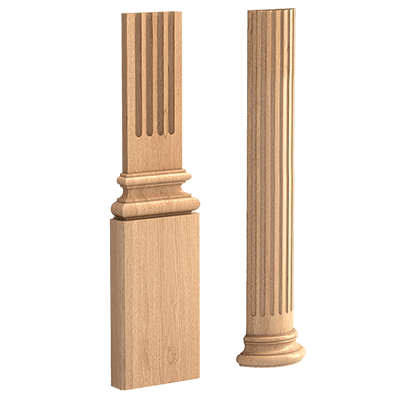
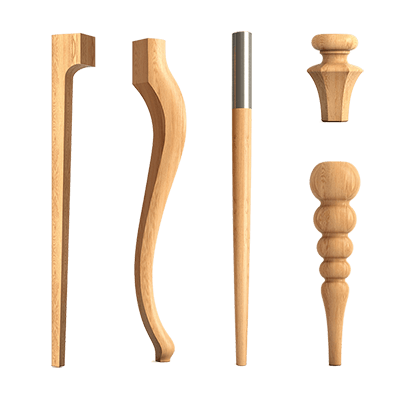
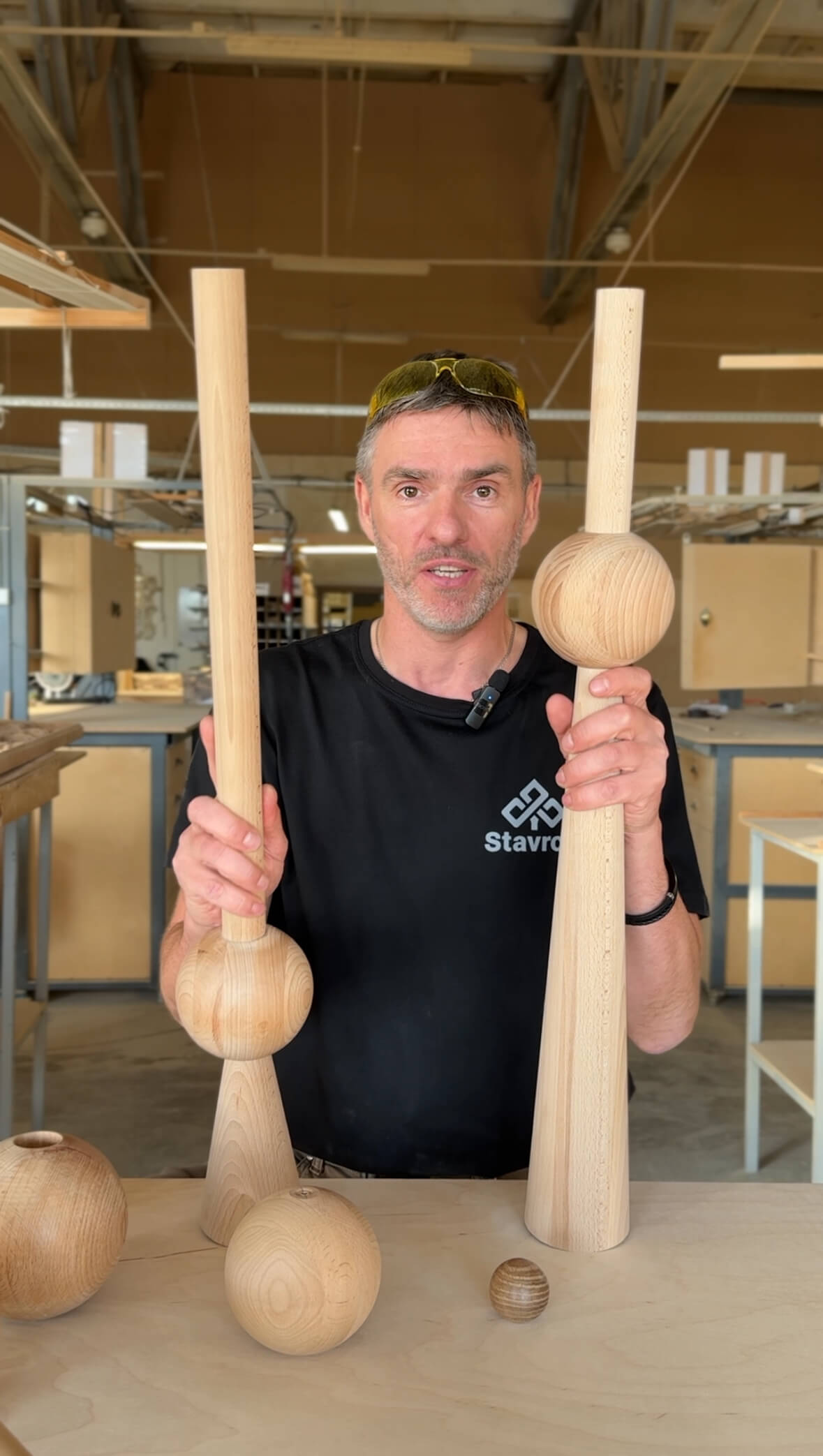
In the trade table, MN-145.2M has two sizes: 90 × 44 × 50 and 140 × 44 × 59 mm, in the manufacturer's designations A × B × C. For the order in question, we compare beech with white enamel RAL 9010 and oak with a walnut patina tint. These are specific options with applied coating, not blanks for subsequent painting. 1
One article number is not enough for the upholsterer. Replacing the smaller version with the larger one changes the set of dimensions: A differs by 50 mm, C by 9 mm. Therefore, it cannot be assumed that the finished pattern will necessarily remain, and only the exposed part of the wood will change. First, the supports are approved in the installed position, then the lower edge of the fabric.
The leg size also cannot be directly called the seat height. For a finished pouf, the body, the soft part, and the mounting connection matter. In the project, it is convenient to separately designate the distance from the floor to the selected plane of the body and the distance from it to the top of the unloaded seat. Their sum gives the design height; seating comfort is checked on a sample.
| What we record | What we send to the workshop | Who confirms |
|---|---|---|
| Execution of supports | Full size, wood, finished color | Customer and seller |
| Leg placement | Bottom view, designations H1–Hn, mounting units | Ottoman manufacturer |
| Seat geometry | Body, soft part, final height | Furniture maker and client |
| Lower part of the cover | Edge line, fastener location, removal direction | Upholsterer |
The number of legs and the suitability of the chosen joint are determined by the furniture manufacturer. The four items in the calculation below are a conditional configuration, not a universal support scheme. If the craftsman has not yet confirmed these parameters, comparison and buy wooden legs for furniture can be done after refining the project, without adjusting the body to a random purchase.
Furniture support and removable cover: separating three layers
On the sketch of the lower part of the pouf, highlight the load-bearing frame, the permanent technical fabric, if provided, and the outer cover. Externally, the last two layers may appear adjacent, but in the project under consideration they have different functions and different fastenings.
The load-bearing frame receives the connections of the supports. Their installation location, fastener details, and the direction of each leg pertain to the furniture structure. The outer textile should not become an accidental gasket that must be pulled out of this connection during every maintenance.
The permanent bottom fabric covers the technical part if the craftsman has chosen this solution. It does not need to be removed together with the decorative cover. The task should explicitly state: "The bottom technical upholstery remains attached during normal replacement of the outer textile."
The removable cover forms the visible surface and is held by its own designated fastening. It should be accessible to the user but does not have to coincide with the placement of the legs. The upholsterer shows where the fabric is released, and the furniture maker checks that this area is not occupied by the mounting plate.
This results in two independent chains: frame → support connection → leg, and frame → separate textile fixation → cover. The technical fabric remains an independent stationary layer. Such a record does not replace a working drawing, but it helps to detect contradictions already during discussion.
For example, the craftsman proposes to put on the cover and then install the legs through its bottom fold. If the fabric ends up clamped by the load-bearing connection, the specified requirement will not be met. The solution must be changed before sewing: move the fixation line of the outer textile or otherwise organize its opening. Simply leaving the connection under-tightened for convenience is not allowed.
Ask to show the bottom assembly in two states: with the cover on and after its removal. The comparison should answer a simple question: which parts remain on the furniture, and which go away with the textile? If a support or its working fastening appears in the list of removable elements, the original task has not yet been implemented. It is not necessary to complicate the structure: sometimes it is enough to change the fixation point of the edge, but the specific solution is chosen by the craftsman.
Our factory also produces:


How to remove the cover from a pouf without unscrewing the wooden legs
Two principal schemes are suitable for discussion with the upholsterer. In the first, the released cover is lifted upward from the frame. In the second, it opens along a designated line and is removed along an agreed trajectory. The choice depends on the shape of the pouf and the fabric, not on the preference for a particular fastener.
For a cover that is removed upward, check whether the opened bottom passes through the widest part of the body. Free space around the legs proves nothing: the fabric may come free at the bottom but stop at the protruding soft edge of the seat. In that case, change the opening or the cover design, rather than trying to force it through.
A separate trap is closed openings around each leg. Even unclamped fabric may remain "slipped over" the supports and fail to pass their widening. The upholsterer must show how this section is released. A small opening with a neat seam does not become convenient just because it looks unnoticeable in a photo.
A zipper, hook-and-loop tape, or elastic edge are possible solution elements, not a ready answer. Kvadrat separately warns: not all covers with zippers are designed for removal; the purpose must be clarified with the furniture manufacturer. 4 For a new ottoman, specify the actual user action, not just the word "zipper" in the specification.
Ask the workshop to demonstrate four stages:
- Open access. The ottoman is positioned stably, and the user reaches the start of the fastener without holding the furniture in the air.
- Release the bottom. All intended fasteners are opened, and the fabric is no longer held anywhere by a hidden staple or support connection.
- Remove the cover. The textile passes the body and legs; rigid fastener parts do not rub the finished covering.
- Put the cover back. It returns to its original position, closes, and does not require turning or loosening the legs.
This is a proposed convenience check, not an installation manual for MN-145.2M. If the design requires laying the ottoman on its side, the craftsman must show a stable position and surface protection. The promise "removable by one person" makes sense only after such a demonstration to the actual owner.
Check the reverse order of actions as well. The cover may easily come off the body, but when putting it on, its edge may be difficult to tuck behind the permanent fabric or align with the mating part of the fastener. Mark coordinated guides on the underside for the front side. Such marks help reproduce the fit but should not become a way to hide misalignment: after installation, seams and the bottom line return to their intended places.
Get Consultation
Where the cover ends: we expose the turned legs, but not the technical upholstery
The bottom line is approved on a volumetric sample. A too-short cover may expose the permanent bottom fabric and fasteners. A too-long one may cover selected supports or intrude into the fastener zone. The goal is not to maximize visible wood, but to achieve a finished composition and convenient maintenance.
On the mock-up, mark the bottom of the body, the boundary of the technical fabric, and the edge of the outer cover. Look at the ottoman from the front and side at a normal distance. Then the manufacturer checks the fabric fit under intended seat use: whether the bottom edge separates, whether an extra fold appears near the support, and whether technical layers remain covered.
A conditional example for marking: the lower visible boundary of the technical fabric is at a height of 146 mm from the floor, and the edge of the outer cover is at a height of 130 mm. In vertical projection, the outer layer extends lower by 146 − 130 = 16 mm. If the edge is raised to 150 mm, instead of overlap, a difference of 4 mm appears in the other direction: the technical fabric will be below it.
These numbers do not relate to the installed height of MN-145.2M and do not set a mandatory overlap. The example shows why the decision to "raise the cover slightly higher" is checked against two boundaries. Actual visibility is also determined by the body shape and viewing direction; a single subtraction is insufficient for acceptance.
If supports are angled, the upholsterer works with their actual position. The angle cannot be reliably assigned from a perspective photo. For a custom design, a drawing or an approved sample is needed, not an assumption that fabric will pass where free space remains in the image.
Separately assess the thickness of the edge itself: the hem, piping, and fastener participate in fitting along with the main fabric. A flat paper outline does not show this volume. Approve a photo of the chosen bottom line and attach it to the pattern version—phrases like "higher" and "almost covered" are too imprecise for an order.
Decide from which point the craftsman takes measurements for the pattern. The edge height from the floor is convenient for checking appearance, while the distance from the structural line of the body is for transferring tasks between workers. These are different measurements. Record both where needed and label the reference points so that a change in the footrest is not mistakenly taken as a change in the cover length itself.
Finished color of wooden legs for one or two covers
Once the bottom line is defined, evaluating the finish is easier: it is clear which part of the support will remain visible. Compare real fabric samples with the chosen coating. White enamel and oak tinting solve different visual tasks, but neither option should be declared the only correct one for the pouf.
With two removable covers, set an overall color goal. For example, one textile should support a calm atmosphere, the other should provide a noticeable accent. The legs remain the same. A second set of supports just for changing the fabric is not needed in such a project; first check both combinations on the existing finish option.
Do not claim a match with other furniture solely based on a photo or RAL designation. For coordination, place the sample next to the existing surface and look at it under the room's lighting. The client evaluates the visible result, not just the matching entry in two invoices.
In the catalog you can buy furniture legs with coating. For the selected ready-made versions of MN-145.2M, a separate painting stage should not be automatically added to the order. 1, 2 A different coating is already a separate approval that changes the original configuration.
Label both fabric samples: manufacturer, article number, color, pattern or pile direction if present. The color pair can be approved simultaneously, but the fit of each cover is checked separately. A satisfactory result with one fabric does not prove that the same cut will give the desired result with another.
First a trial cover on the assembled pouf, then the final sewing
The work requires two approval points. First, the furniture maker confirms the design and the selected supports: after that, components for the sample are purchased. Then, on the assembled base, the trial cover is checked and the final sewing is approved. This way, the fitting does not become an impossible requirement to check furniture for which the legs have not yet been determined.
One purchased instance of the support helps evaluate the finish and geometry, but does not replace the assembled pouf. To check the removal, a body with legs installed according to the approved scheme is needed. Do not depict the finished structure with random stands and then transfer the result to the real item.
A trial cover allows detecting a tight opening, an inconvenient start of the fastener, and a conflict of the lower edge with the support. The final fabric is also checked: a mock-up made of another material does not confirm all properties of the future textile. In the acceptance card, indicate what exactly was installed on the sample.
| Sample check | What to fix | When refinement is required |
|---|---|---|
| Access to the fastener | Position of the pouf, accessibility of the start and end | The leg interferes or a dangerous grip is needed |
| Removal path | On which section the edge of the cover passes | The fabric gets stuck on the body or support |
| Reverse installation | Seam alignment and closure of the fastener | Need to turn the leg or adjust the fabric |
| View of the lower part | Front and side photos | Technical fabric or attachment visible |
| Contact with the trim | Position of the slider and other rigid parts | They touch the surface during normal movement |
| Re-fitting after care | Material, allowed care method, result | The clean cover does not return to its aligned position |
Removability does not mean machine washing is allowed. In Kvadrat's recommendations, care methods vary by textile: for wool removable covers, dry cleaning is specified, while for some other materials, washing is permitted. 4 This is an example of differing requirements, not a prescription of a mode for your pouf's fabric.
Request the instructions specifically for the chosen material and finished cover. Do not insert a universal shrinkage percentage or temperature into the specification. If home washing is essential, agree on suitable textile before purchasing fabric, not after failed care.
Record the inspection date, pattern version, and base execution. Changes to the frame, fastener, or material after sample approval require re-fitting the affected area. The manufacturer performs strength and stability checks separately: successful fabric removal does not confirm seat safety.
For comments, use precise notes: not "the cover is tight," but "the edge does not pass through the right front section with the fastener fully open." Include a photo, the proposed change, and the date of re-inspection. This way, the upholsterer fixes the specific obstacle, and the client sees that the revision was checked, not another successful area shown. Store the completed map together with the approved sample.
How much do MN-145.2M legs cost and what is paid separately
The table shows prices for selected executions, re-verified on September 6, 2026. The last column is an arithmetic example for a project where the manufacturer has already confirmed four supports. This is not a ready-made pouf set. 1
| Size A × B × C, mm | Wood and finished coating | One leg | Four legs |
|---|---|---|---|
| 90 × 44 × 50 | beech, white enamel RAL 9010 | 940 ₽ | 3 760 ₽ |
| 90 × 44 × 50 | Oak, "walnut with patina" | 1 190 ₽ | 4 760 ₽ |
| 140 × 44 × 59 | beech, white enamel RAL 9010 | 1 120 ₽ | 4 480 ₽ |
| 140 × 44 × 59 | Oak, "walnut with patina" | 1 450 ₽ | 5 800 ₽ |
For four beech products, the difference between sizes is 4,480 − 3,760 = 720 ₽, for oak ones — 5,800 − 4,760 = 1,040 ₽. These amounts help compare the purchase after technical selection. They do not explain which size fits the cabinet and do not include pattern changes.
Separate the component supplier's quote from the furniture workshop's work. Then the finished covering will not be included in the estimate twice, and the cost of the cover will not be lost behind the price of the legs.
| Part of the project | What to consider | How to get the amount |
|---|---|---|
| Legs | Approved execution and quantity | By order line item |
| Joints and glides | Only agreed items, without double-counting bundled ones | According to the furniture maker's specification and invoice |
| Packaging and transportation | Actual shipment contents and address | According to the seller's or carrier's quote |
| Frame and soft part | Construction of the selected pouf | According to the workshop estimate |
| Covers | Trial sewing, main and spare if necessary | According to the agreed task for the upholsterer |
| Assembly and delivery | Installation, fitting, and verification of agreed functions | According to the manufacturer's proposal |
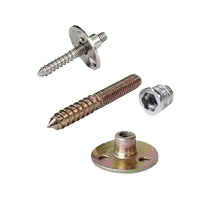
In this section you can Buy hardware for furniture legs: there are support pads, studs, and mounting plates. 3 However, the specific connection should be chosen based on the frame. The glider recommended for the product cannot be considered confirmation of the entire seat mounting system.
If a suitable trial leg remains in the project, include it in the total count. For a conditional set of four parts, after purchasing one, three more will be needed, not four. If the sample is damaged or does not match the approved design, it is not automatically included in the set. Possible repeat delivery is considered separately.
Before payment, check the current price and payment and delivery terms for the legs. The seller provides for order placement specifying the article number, material, size, and quantity. 5 Agree on the receipt date separately from the workshop's readiness date: a promise to sew the cover does not reserve the product in stock.
How to order wooden legs for a pouf with a removable cover
The seller needs an unambiguous product line, the furniture maker needs a connection diagram, and the upholsterer needs requirements for the outer textile. Do not replace these documents with a single photo of a pouf you like: it does not show what holds the fabric under the base.
Example of a request for a conditional project with four already confirmed supports:
Please quote MN-145.2M, size A × B × C — 140 × 44 × 59 mm, beech, white enamel RAL 9010, 4 pieces. The supports are intended for a new pouf; the quantity and mounting solution have been coordinated with its manufacturer. Please clarify the completeness of the fasteners, availability of the selected finish, packaging, cost, and delivery time. Address and recipient: ______. A list of additional hardware is attached separately after confirmation.
In the assignment to the upholsterer, secure the result with a different wording:
The outer cover is removed and reinstalled without unscrewing or loosening the supports. The permanent bottom fabric remains on the frame. The bottom line is per the approved layout; fastening and opening are per the agreed design. Upon delivery, demonstrate the full cycle of removal and installation, provide the pattern designation and care instructions.
For the spare cover, add your own fabric article number and a separate fitting note. In the bottom photos, the leg positions, fastener line, and outer fabric edge must be readable. These images are kept together with the final specification, not instead of it.
When it is better to postpone the order: the supports are not yet confirmed by the furniture maker; the bottom edge cannot be freed; the cover is only removable after turning the legs; no acceptable care mode is selected; the customer is not satisfied with the shown fit. In each case, first correct the corresponding decision. Buying additional hardware at random does not replace design approval.
After receiving the components, verify the execution, quantity, and coating condition before installation. After assembly, check the entire item against the approved assignment. Between these two inspections, the workshop work and cover check remain—they are not automatically included in the price of the wooden part.
Select size and color MN-145.2M
Questions before purchasing wooden legs for the pouf
Can the 140 mm option be replaced with 90 mm after sewing?
Such a replacement is considered a design change, not an equivalent swap. The furniture maker checks the new body position, and the upholsterer checks the bottom line and access to fastening. A good appearance of the cover on the previous supports does not confirm its convenience after the replacement.
What to do if the fastener is accessible between the legs but not near one of them?
The check should cover the entire opening line. Show the craftsman the specific area in the photo. Have him change the fastener placement or edge construction and show the result again. The ability to open most of the cover does not compensate for the single spot that remains blocked.
Can a second cover be made longer, almost down to the floor?
This is a separate pattern version. On the sample, check whether the edge touches the floor during intended use of the pouf, whether it moves freely past the supports, and whether the fastener is accessible. Do not transfer the approval of the short cover to the long one: it has a different bottom line and a different potential contact zone.
Can everything be approved via a video call with the workshop?
Video recording helps see the sequence but does not replace personal assessment of effort and convenience. Ask to show one continuous cycle, including problem areas underneath. Upon receipt, repeat it according to the manufacturer's instructions, especially if you plan to manage without an assistant.
Is one pattern enough for two different fabrics?
This is confirmed by the upholsterer after fitting. Preserve the overall body geometry, but do not require identical cutting against the material's properties. In the order, it is more convenient to include two fitting checks than to get a spare cover that matches by name but does not actually fit.
How to order another cover in a year?
Save the project number, pattern version, photos, fabric details, and exact leg execution. Inform the workshop of all pouf changes. Before re-sewing, clarify whether a new measurement is needed: the old file is useful as baseline information but does not guarantee the furniture has not changed.
Can the pouf be used while the outer cover is being cleaned?
Do not consider permanent technical fabric a replacement for custom upholstery. The permissible order of use is confirmed by the manufacturer. If the pouf is needed constantly, discuss a spare cover in advance; this resolves the issue of furniture availability without an additional set of supports.
Is it enough to check one pouf before ordering several identical ones?
A sample helps approve the design and pattern, but does not cancel the acceptance of other items. Secure the same execution of supports and the identifier of the approved project. For each finished pouf, check the availability of the fastener and the fit of the cover; the manufacturer controls compliance with the drawing and assembly quality.