
















































Article Contents:
- BR-001: which product items are involved in the calculation
- Why BR-001 cannot automatically be considered load-bearing structural timber
- Why you cannot take a "typical" saw kerf from the internet
- Why "the saw cuts along the line" does not save the calculation
- Trimming the end of the source strip can increase technological waste
- Why you can't count on "extra millimeters" from a supplier
- What happens with an order for 120 parts
- Why 40 strips cannot be declared a universal answer
- Why ten millimeters on a part can change an entire wholesale order
- 600 mm part
- 590 mm part
- What needs to be obtained from the workshop before purchasing a large batch
- Why the actual yield must be confirmed with a trial cutting layout
- How to calculate the 610 mm part
- Constraint 1 — geometric
- Constraint 2 — technological
- Why the 590 mm part requires a separate check rather than automatically concluding “four will definitely fit”
- How to compare two production maps before purchasing
- Map A
- Map B
- Why the purchaser should not change 600 to 590 mm on their own
- Why the new article does not choose between 20×20 and 40×40
- Beech and oak form different material pools
- What a full production specification line looks like
- How to use the remainder after three 600 mm parts
- A 580 mm remainder may have zero value for the main series
- List of usable remainders
- Why a free remainder and an assigned remainder are different states
- Why a long remainder should not automatically go to waste
- How to build a mixed map for 600 and 520 mm parts
- Why the map must be built before the first mass cut
- How to label finished 600-millimeter parts
- When identical 600 mm parts can truly be stored in a shared pool
- How to label source strips before cutting
- Why a whole 2400 mm strip is a more flexible reserve than several short pieces
- How to divide the reserve by function
- Whole planks 2400 mm
- Finished D-600
- Usable remnants
- Material for a test cut
- Why the test cut must be accounted for in the balance
- How changing a part from 600 to 590 mm affects material already purchased
- How changing from 600 to 610 mm affects remaining stock
- Why part size affects the logistics of the entire batch
- Conditional scenario for BR-001 20×20
- For 40×40 the effect is even stronger
- Why 20×20 and 40×40 produce different packaging economics
- How to compare supplier quotations
- Why the price per linear meter can be misleading here
- How to calculate the full cost of a series without made-up prices
- How to calculate the cost of one finished part
- Why the trial strip should be a separate budget line
- What to do if one actual strip differs in length
- Why straightness matters even for short parts
- Why the first run is needed even with an obvious formula
- How to keep the actual balance after the first run
- Why overspending needs to be classified
- Length error
- Additional trimming
- Defect
- Operator error
- Project change
- How to perform a revision if the length changes
- How to account for the sequence of cuts in a mixed map
- Why a stable cutting plan is sometimes more profitable than a mathematically ideal one
- Scheme A
- Scheme B
- How to calculate usable yield, not just theoretical
- How to distinguish a technological reserve from a defect reserve
- Technological material
- Production reserve
- How to organize delivery in batches
- Phase 1
- Queue 2
- Queue 3
- Why the first batch is useful for a large series
- How to maintain a repair stock after project completion
- Why short finished parts and full-length stock are needed at the same time
- How to tell that the wholesale cutting map is truly ready
- 1. Dividing 2400 by 600 and immediately buying 30 planks
- 2. Assuming the saw kerf is zero
- 3. Taking a universal kerf width "from the internet"
- 4. Not accounting for trimming the raw end
- 5. Confusing the finished part with the production blank
- 6. Calculate the order for "extra millimeters" beyond 2400
- 7. Declare 40 slats as a universal standard
- 8. Do not recalculate the cutting plan when changing 600 to 590 mm
- 9. Do not recalculate 600 to 610 mm
- 10. Mix 20×20 and 40×40
- 11. Mix beech and oak
- 12. Consider any leftover useful
- 13. Do not allocate a trial cutting plan
- 14. Set the reserve only as a percentage
- 15. Place a reorder using the words "10 more bars"
- What is the length of BR-001?
- What cross-sections are available?
- What materials are available?
- Can I buy BR-001 in bulk?
- How many 600 mm parts can be obtained from 2400 mm?
- How many cuts are needed for four parts?
- Should trimming be taken into account?
- What will change with a 590 mm part?
- What will change with a 610 mm part?
- How do I calculate 120 identical parts?
- Can leftovers be used?
- Can a 580 mm remainder be counted as a reserve for a 600 mm part?
- Should beech and oak be counted separately?
- Should 20×20 and 40×40 be counted separately?
- How do you calculate the reserve?
- How to place an additional order?
- What data should be sent to the supplier?
- What data should be sent to the workshop?
- Design level
- Production level
- Procurement level
- Final readiness matrix
- How to verify the final figure using the reverse method
- What a supplier request should look like
- How to check a commercial order before sending

In serial cutting, the most dangerous mistake sometimes begins with absolutely correct arithmetic. You need 120 identical parts of 600 mm each. BR-001 with a length of 2400 mm is selected. The calculator shows:
2400 / 600 = 4.
Then:
120 / 4 = 30 strips.
On paper, the calculation is flawless. In production, it is not. Four finished parts of 600 mm each already take up all 2400 mm:
600 + 600 + 600 + 600 = 2400 mm.
There is no free material left between them at all. But four separate parts cannot be obtained from a single solid strip without cut lines. Every real saw kerf removes some wood. If the finished length of each part after cutting must truly remain 600 mm, the scheme of "four parts from 2400" does not work with any non-zero kerf.
Therefore, BR-001 timber should be bought wholesale for a serial order after a technological check of the cutting plan, not after simply dividing the nominal length by the nominal part size.
Work sequence:
finished part length → number of parts → actual kerf width → end trimming and technological allowance → real yield from 2400 mm → remainder → number of whole BR-001 → usable offcuts → reserve → marking → wholesale order.
The main principle of the article:
mathematical divisibility of length does not yet mean physical divisibility in cutting.
This difference is especially important in a serial B2B order. An error in one strip seems like a trifle. An error in the assumption of "4 parts from each strip" on a batch of 120 workpieces can change the order by a dozen whole BR-001 even before accounting for reserve.

BR-001: which product items are involved in the calculation
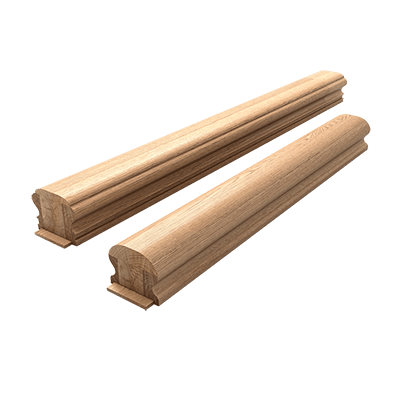
The current STAVROS product page shows four main versions of BR-001:
| Section | Material | Product length |
|---|---|---|
| 20×20 mm | Beech | 2400 мм |
| 20×20 mm | Oak | 2400 мм |
| 40×40 mm | Beech | 2400 мм |
| 40×40 mm | Oak | 2400 мм |
The product specifies "Prestige" sanding. For the selected beech version 20×20×2400 mm, the product page also specifies the "For enamel" finish.
Product card: Wooden Block BR-001.
This article does not address the question of what is better — 20×20 or 40×40. We assume that the required cross-section has already been chosen by the project. Likewise, we do not turn the material into a debate of "beech versus oak." The central task is different:
a specific BR-001 2400 mm is selected → the finished length of the serial part is known → it is necessary to determine the actual yield of parts from one plank and the exact number of source products.


Why BR-001 cannot automatically be considered a load-bearing structural timber
The product is in the interior wooden moulding section. It can be used in furniture and decorative tasks, but the product page itself does not turn BR-001 into a universal load-bearing structural element with a predetermined design load.
If a project uses the batten as a loaded structure, the load-bearing capacity must be confirmed by a separate structural calculation. This article is about serial cutting of an interior profile, not about calculating beams, house posts, or a load-bearing frame.
Our factory also produces:






Why 2400 / 600 = 4 is mathematically correct and technologically insufficient
In arithmetic, division answers the question:
how many 600-long segments are contained in a 2400-long segment, if the division does not consume material?
Answer:
4.
But sawing is a material process.
Between four finished segments, separation lines arise. To obtain four separate parts from one workpiece, a minimum of three internal separating cuts is required, if the original ends are already suitable and additional end trimming is not needed.
If the width of one saw cut is denoted K, the minimum length required for four finished parts will be:
4 × 600 + 3K.
In any case:
K > 0
We get:
4 × 600 + 3K > 2400.
Therefore, four finished parts of 600 mm each do not fit from a nominal 2400 mm board.
Get Consultation
What is kerf width
The kerf is not an abstract line of zero thickness.
The saw blade removes material.
The width of the removed strip depends on:
-
the specific equipment;
-
the saw blade;
-
the condition and geometry of the tool;
-
the cutting method;
-
requirements for edge cleanliness;
-
workshop technologies.
Therefore, the article does not assign a universal kerf value, such as 2, 3, or 4 mm.
For a real specification, the parameter must be obtained from the workshop that will cut the batch.
Why you cannot take a "typical" kerf from the internet
Even if a certain value is often found online, it does not become a characteristic of your machine.
Wholesale purchasing of BR-001 for a hundred parts is too sensitive to an error in the initial assumption.
The right question for the workshop:
what actual size do we account for per separating cut for this equipment, blade, and required edge quality?
After that, the cutting map uses the confirmed number.
How many cuts occur between four parts
Imagine a solid strip that needs to be divided into four separate segments.
There are three boundaries between them:
part 1 | part 2 | part 3 | part 4.
To physically separate four parts from each other, at least three internal divisions are required.
If both original ends are already clean and can be part of the finished parts, the formula is:
L = 4D + 3K,
Where:
-
L — required initial length;
-
D — finished length of one part;
-
K — width of one cut.
For D = 600:
L = 2400 + 3K.
When K > 0, L is always greater than 2400.
If the start of the strip also needs to be trimmed first, the scheme becomes even more demanding.
Why “the saw cuts along the line” does not save the calculation
On a drawing, a line has no thickness.
A saw blade does.
When a technician places a cut at a mark, part of the wood turns into sawdust. You cannot simultaneously keep all the material to the left and all the material to the right of a single physical strip that the blade has removed.
Therefore, in cutting layouts you need to think not in line coordinates, but in the final lengths of the finished parts plus the process losses between them.
Trimming the end of the source strip can increase process waste
Even the formula:
4D + 3K
is minimalist.
A real workshop may require:
-
to square the initial end;
-
to remove a chip;
-
to remove the damaged section;
-
to leave an allowance for final trimming;
-
to obtain a blank slightly longer than the final size;
-
to machine the second end of the part after the initial cutting.
Then a separate process waste is added to the calculation.
It cannot be invented in an article. It is defined by the production card of a specific workshop.
A finished part and a production blank are not the same thing
Bad technical specification:
cut 120 parts approximately 600 mm each.
Stronger:
finished length of the finished part — 600 mm;
And separately:
blank length at primary cutting — according to the workshop technology.
If after sawing the part is still milled, sanded on the end, or precisely fitted, the primary blank may be longer than the final 600 mm.
Then the purchasing card is populated with the blank size, not the finished element.
Why you cannot count on the supplier's "extra millimeters"
Nominal commercial length of BR-001:
2400 mm.
You cannot build a production specification on hope:
in fact, each strip will almost certainly be 2403–2405 mm, and that will be enough for the saw cut.
Even if an individual piece turns out slightly longer, this does not turn the extra length into a guaranteed parameter for the batch.
The wholesale cutting map must work with the declared commercial length.
Any additional actual length is only a bonus for the specific workpiece after acceptance, not a reason to reduce the order in advance.
A reliable preliminary scenario for 600 mm parts
Until the process engineer confirms a special scheme, the safe preliminary calculation is based not on four, but on a maximum of three finished 600 mm parts per 2400 mm strip.
Three parts occupy:
600 × 3 = 1800 mm.
Nominally remains:
600 мм
before accounting for saw kerfs, end trimming, and other process waste.
This is already a fundamentally different situation.
Within the 600 mm residual range, there is room for several cuts and process machining.
The specific actual length of the remainder is determined by the workshop.
What happens with an order for 120 parts
Naive calculation:
120 / 4 = 30 strips.
Preliminary technological scenario with a yield of three parts:
120 / 3 = 40 boards.
The difference:
10 whole BR-001.
In purchased length:
10 × 2400 = 24,000 mm = 24 m of source material.
This is a huge difference that appeared not because of a project change, but because of one forgotten physical fact: a cut has width.
Why 40 boards cannot be declared a universal answer
The number 40 applies only to the training scenario:
-
120 parts;
-
the finished length of each is exactly 600 mm;
-
the original stock length is 2400 mm;
-
four finished 600-millimeter pieces do not fit with a non-zero kerf;
-
a yield of three parts is tentatively assumed.
In a real project, there may be:
-
a different finished size;
-
a different blank size;
-
additional parts;
-
useful use of the remainder;
-
mixed cutting.
Therefore, 40 is not the “standard for BR-001,” but the result of a specific task.
What changes if the finished part is 590 mm
Let's check another scenario.
590 × 4 = 2360 mm.
Nominally remains:
40 mm.
These 40 mm must cover:
-
at least three internal cuts;
-
possible end trimming;
-
technological allowances.
Now four parts are no longer ruled out by the arithmetic itself.
The scheme may turn out to be workable if the confirmed total technological consumption fits within 40 mm.
But it is not the article that decides, but the workshop.
Why ten millimeters on a part can change the entire wholesale order
Let's compare:
Part 600 mm
Four finished:
2400 mm.
No room for the saw kerf.
Part 590 mm
Four finished:
2360 mm.
Nominal process budget:
40 mm.
If production confirms that 40 mm is sufficient, the yield may change:
there were 3 parts per strip;
now 4.
For 120 parts, this potentially changes the order:
40 planks → 30 planks.
That is, a project size just 10 mm smaller can change the purchase by a quarter.
That is exactly why the part size and the series cost are directly related.
Universal formula for checking multiplicity
For n identical finished parts:
n × D + T ≤ L,
Where:
-
n — number of parts;
-
D — finished length or the length of the production blank, if it is greater;
-
T — total technological consumption for the selected scheme;
-
L — actual calculated length of the original commercial plank.
if:
n × D + T > L,
the scheme does not exist.
if:
n × D + T ≤ L,
it potentially exists, but must be confirmed by a real technological process.
What needs to be obtained from the workshop before purchasing a large batch
The buyer needs more than general words:
the kerf is small.
But specific production input data:
-
finish size;
-
size of the primary blank;
-
permissible deviation;
-
actual kerf width;
-
whether trimming of the initial end is required;
-
whether a finishing allowance is required;
-
what equipment is used for cutting;
-
whether it is acceptable to use the last remaining piece;
-
which defects of the original end require trimming.
After this, the commercial calculation becomes a production one.
Why the actual yield must be confirmed by a trial cutting
Even if the formula shows that the layout should fit, it is better not to start a production batch without one trial cutting.
The reason is simple: the calculation operates with lengths, while production works with real ends, tools, and a specific sequence of operations.
The trial cutting must confirm:
-
the actual size of the first part;
-
the stability of the next one;
-
the width of each separating cut;
-
the need for preliminary cross-cutting;
-
the state of the last remaining piece;
-
the ability to repeat the operation dozens of times without accumulating error.
If three 600 mm parts fit confidently on the first strip, but the fourth physically no longer fits, this scheme becomes a production fact rather than an assumption.
How to calculate a 610 mm part
Now let's increase the finished size.
610 × 3 = 1830 mm.
Nominally remains:
570 мм
to technological losses.
Four parts:
610 × 4 = 2440 mm.
They do not fit even at the level of simple arithmetic.
That is, at 610 mm, the debate about kerf width for four parts is entirely unnecessary.
Four are impossible from a nominal 2400 mm even with a conditionally zero kerf.
This is a useful example because it shows two types of constraints:
Constraint 1 — geometric
The net lengths are already greater than the original strip.
Constraint 2 — technological
The net lengths are equal to or less than the strip, but kerfs and allowances make the layout impossible.
For 600 mm, the second constraint applies.
For 610 mm — the first one.
Why the 590 mm part requires a separate check rather than an automatic conclusion of "four will fit"
The 590 mm part has a nominal allowance:
40 mm.
But this allowance cannot automatically be considered sufficient.
Need to know:
-
how many cuts are actually needed;
-
whether the first end will need to be trimmed;
-
whether allowance is needed for final processing;
-
whether a workpiece longer than 590 mm is required;
-
whether the factory end can be used as a finished end.
Only after this is it determined:
4 parts from the strip — confirmed;
Or:
despite 40 mm, we use 3.
How to compare two production maps before purchasing
Let's imagine the project is still discussing two finished sizes.
Map A
Part:
600 mm.
Preliminary output:
3 pcs. from 2400 mm.
For 120 parts:
40 slats.
Map B
Part:
590 mm.
If the test cut confirms four parts:
120 / 4 = 30 strips.
The difference:
10 planks.
Now the designer and the engineer see the cost of changing the size.
This does not mean that the size should be reduced for the sake of saving.
If 600 mm is required structurally or visually, it is retained.
But the cost of the decision becomes transparent.
Why the purchaser should not independently change 600 to 590 mm
Procurement may see huge savings and suggest:
let's just make the parts a centimeter shorter.
This is not their decision.
Length can be linked:
-
to the furniture dimensions;
-
with a frame;
-
to the distance between nodes;
-
to the mounting geometry;
-
to the design grid.
Any change to the finished part must go through the project.
After the new length is approved, the procurement card is recalculated.
The 20×20 and 40×40 sections are counted separately
Both BR-001 are 2400 mm long.
But these are different SKUs.
Therefore, you cannot have a single map:
BR-001 / 600 mm parts — 120 pcs.
You need to:
BR-001 / 20×20 / 600 mm parts — ___;
Or:
BR-001 / 40×40 / 600 mm parts — ___.
If both cross-sections are used in the project at the same time, two independent maps are created.
The 40×40 remainder does not cover the 20×20 requirement, and vice versa.
Why the new article does not choose between 20×20 and 40×40
Such a choice already belongs to a different user task.
Here the logic is:
cross-section approved → we calculate the actual yield.
This avoids mixing two intents:
-
profile selection;
-
purchase calculation.
After reading the article, the reader should understand not “which cross-section looks nicer,” but how many whole BR-001 units to order for a specific production cutting plan.
Beech and oak form different material pools
Even with the same cross-section and the same part size:
BR-001 / 20×20 / beech / 2400
and:
BR-001 / 20×20 / oak / 2400
are not the same warehouse stock.
A beech remnant of 620 mm does not cover an oak part of 600 mm.
Therefore, the card must retain at minimum:
-
cross-section;
-
material;
-
length;
-
part code;
-
finishing.
What a full production specification line looks like
For example:
BR-001 / beech / 20×20×2400 / Prestige / For enamel / part D-600 / 120 pcs.
Or:
BR-001 / oak / 40×40×2400 / Prestige / part D-590 / 80 pcs.
This makes it immediately clear:
-
what are we buying;
-
what we are cutting;
-
how many finished parts are needed;
-
which batch the material belongs to.
Cutting the whole series is more efficient than "kit by kit"
Let's imagine 120 parts of 600 mm each go into 30 identical furniture modules of four pieces each.
Bad logic:
module 1 — four parts;
module 2 — four;
module 3 — four.
It psychologically pushes toward a false conclusion:
one 2400 strip = one set of four.
Stronger:
D-600 × 120.
First, the total production pool of identical parts is calculated.
Only after cutting are they returned to the sets.
This is how the physics of the material is separated from the logic of assembly.
How to use the remainder after three 600 mm parts
After three finished parts:
1800 мм
already occupied.
Nominal residual range:
600 mm before process losses.
The actual remainder will be less.
It does not cover another clean D-600.
But that does not mean it is useless.
Other project parts need to be checked.
For example:
-
lintel 520 mm;
-
filler 480;
-
sample 300;
-
test part 250.
If the cross-section, material, and finish match, the remnant can be assigned a purpose.
A 580 mm remnant may have zero value for the main series
This is an important production paradox.
There is a remnant in stock:
580 mm.
It looks long.
But all unfinished parts:
600 mm.
Therefore, for the main series its usefulness is:
0 parts D-600.
In meters, the warehouse has material.
In a functional sense — no.
Therefore, remnants must be accounted for not only by total amount, but also by their ability to cover specific parts.
Statement of usable remnants
Example:
| Code | Section | Material | Actual length | Status |
|---|---|---|---|---|
| O-001 | 20×20 | Beech | 575 мм | Spacious |
| O-002 | 20×20 | Beech | 520 мм | D-520 |
| O-003 | 20×20 | Oak | 610 мм | reserve D-600 |
| О-004 | 40×40 | Oak | 780 мм | another part |
This shows which remnants actually work.
Entry:
remnants BR-001 — 14.8 m
too coarse for production.
Why free remnant and allocated remnant are different states
While the 520 mm piece is free, it can be used on any suitable part.
After writing:
O-002 → D-520 / batch 03
it is no longer a shared reserve.
If it continues to be counted as free, the same material will be counted twice.
Therefore, each remnant needs a status:
-
free;
-
assigned;
-
repair;
-
technological;
-
written off.
Why a long remnant should not automatically go to waste
Even if it does not fit the main D-600, another cluster of parts may exist in a large project.
For example:
-
540;
-
450;
-
300 mm.
Mixed cutting sometimes reduces the overall order better than calculating each group separately.
But you can only mix identical ones:
-
cross-section;
-
material;
-
finishing;
-
surface requirements.
How to build a mixed map for 600 mm and 520 mm parts
Suppose that in addition to 120 parts of 600 mm, 40 parts of 520 mm are needed.
After three D-600, an actual remainder is left that is potentially close to 600 mm before technological losses.
If the workshop confirms that D-520 can be obtained from it, the combination:
600 + 600 + 600 + 520
may turn out to be advantageous.
But it must be calculated using the full technological consumption.
You cannot simply add:
2320 мм
and claim that everything is guaranteed to fit.
Why the cutting plan must be built before the first mass cut
Without a cutting plan, the worker chooses the most convenient cut at the current moment.
For example:
-
first cuts 520;
-
then 600;
-
then also short parts.
As a result, the strips that could have efficiently completed the batch disappear.
It is better to first determine:
-
priority long parts;
-
batch combinations;
-
rules for using the remainder.
And only then start the flow.
How to label finished 600-millimeter parts
If all 120 parts are fully interchangeable:
BR20-D600 / batch 01.
If they have different functions:
BR20-D600-A;
BR20-D600-B.
For example, one type goes to a horizontal crossbar, the other to a side element.
Although the length is the same, the production assignment may differ.
When identical 600 mm parts can indeed be stored in a common pool
If they match:
-
cross-section;
-
material;
-
finish;
-
edge treatment;
-
tolerances;
-
function or confirmed interchangeability.
Then the common pool simplifies logistics.
But interchangeability must be real, not assumed solely because of the identical number 600.
How to label the source strips before cutting
For example:
BR-001 / 20×20 / beech / 2400 / batch D-600.
For reserve:
BR-001 / 20×20 / beech / 2400 / reserve.
If two production runs are underway simultaneously, it is better to split the source long stock before work begins.
This reduces the risk that strips intended for one card end up in another.
Why a whole 2400 mm strip is a more flexible reserve than several short pieces
A whole BR-001 can be reassigned:
-
in D-600;
-
in D-590;
-
into a long part;
-
into several short elements.
A short piece is already limited by maximum length.
Therefore, it makes sense to store the reserve at least partially in whole planks.
How to divide the reserve by function
Not:
BR-001 +10 %.
Stronger:
Solid strips 2400 mm
For unforeseen re-cutting.
Ready-made D-600
For quick replacement already in production.
Useful remnants
For short parts.
Material for a test cut
So that equipment setup does not reduce the main production requirement.
Each group addresses a different risk.
Why a test cut must be accounted for in the balance
If one source board was used for machine setup, it cannot be counted as part of the main production map.
In balance:
production — 40;
test cutting — 1;
reserve — 2;
total to purchase — 43.
The specific numbers are determined by the project.
The key is not to hide the technological material inside the production quantity.
How changing a part from 600 to 590 mm affects material already purchased
If a batch has already been purchased according to the scheme “three D-600 per strip,” and the project is changed to D-590, the material is not wasted.
On the contrary, the new cutting layout may yield more parts from the same 2400 mm.
It is necessary to recalculate:
-
how many whole strips are still unopened;
-
how many parts have already been manufactured;
-
whether D-600 can be used in the new version;
-
how many new D-590 are required.
A new revision appears.
How a change from 600 to 610 mm affects the remnants
Four parts of 610 are impossible.
Three occupy:
1830 mm.
Residual range:
570 mm before technological losses.
It is smaller than in the 600 mm scenario.
This means that some short accompanying parts that previously fit into the remnant may no longer fit.
It is necessary to recalculate not only the number of main parts, but also the secondary use of waste.
Why the part size affects the logistics of the entire batch
Change in yield:
-
30 slats;
-
40 slats;
affects not only the cost of the item.
Changes:
-
number of packages;
-
shipping volume;
-
warehouse area;
-
number of issue operations;
-
remaining stock volume;
-
reserve size.
Therefore, technological multiplicity is a commercial parameter, not just a task for the cutter.
BR-001 packaging changes logistics when moving from 30 to 40 slats
The current BR-001 product page includes a rigid transport frame. Different packaging standards are specified for the two cross-sections:
-
20×20 mm — up to 5 items;
-
40×40 mm — up to 2 items.
At the time this material was prepared, the product page also shows a separate frame price, but the price must be checked again before ordering.
What matters more for the article is this: an error in calculating the parts yield changes not only the number of slats, but also the potential number of packaging units.
Hypothetical scenario for BR-001 20×20
If a naive calculation yielded:
30 planks,
with a maximum standard of 5 per frame, this produces one logistics picture.
If the production calculation yielded:
40 slats,
potentially more frames are required.
The actual packaging is confirmed by the supplier, but the difference in the initial quantity already affects delivery.
For 40×40 the effect is even stronger
With a maximum rate of up to 2 items per frame, an increase in the number of slats increases the number of packaging units more strongly.
Therefore, one cannot compare two scenarios only:
price of one strip × quantity.
Logistics must also be taken into account.
Why 20×20 and 40×40 yield different packaging economics
Both versions have a length of 2400 mm.
But the cross-sectional size differs.
Consequently, with the same quantity:
-
a batch of 20×20 is more compact;
-
a batch of 40×40 requires a different packaging structure.
This is another reason not to combine the two cross-sections into a single wholesale calculation.
In the new article, the choice of cross-section has already been made, but the logistics must correspond specifically to the selected item.
How to compare supplier commercial offers
for finishing material suppliers the same technical basis must be sent.
For example:
BR-001 / 20×20×2400 / beech / Prestige / For enamel / 43 pcs. including technological and repair reserve.
Or:
BR-001 / 40×40×2400 / oak / Prestige / ___ pcs.
If you send to one supplier:
72 linear meters are needed,
and to the other:
30 planks,
offers may count different things.
For serial cutting, the correct order unit is a whole product strip of a specific configuration.
Why the price per linear meter here can be misleading
Net requirement of 120 parts at 600 mm:
72,000 mm = 72 m.
If you count only the net linear meters, you get:
72 / 2.4 = 30 strips.
But the process sheet may require 40.
Therefore, the cost based on 72 net meters understates the actual purchase.
For the request building materials at wholesale prices you need to compare the cost of the finished purchasing configuration, not the mathematically ideal linear meters.
How to calculate the full cost of a series without invented prices
The formula might look like this:
cost of source BR-001 + transport packaging + delivery + cutting + processing + reserve − value of usable offcuts.
The last term does not need to be turned into a fictitious discount.
A useful offcut has value only if it actually gets assigned a purpose.
A 580 mm piece for the D-600 series does not reduce the requirement of the main batch.
If it goes into D-520 — yes, the material is being used.
How to calculate the cost of one finished part
After receiving a commercial proposal, you can determine:
full cost of procurement and technological operations / number of usable parts.
For example, if an order is calculated for 120 finished elements, you should divide not by the theoretical quantity, but by the actually obtained usable blanks.
If part of the material went to:
-
setup;
-
defects;
-
damage;
-
tests,
this also affects the actual cost.
Why the test strip should be a separate budget line
The test cut serves as a technology control.
If its material is hidden within the main quantity, after the test the production may be short by one strip.
Stronger:
production — 40 strips;
test cutting — 1;
reserve — ___;
total — ___.
This is how the buyer understands why the final number is higher than the net production requirement.
How to receive a wholesale batch of BR-001
Before mass cutting, the following are checked:
-
item code BR-001;
-
cross-section;
-
material;
-
nominal length 2400 mm;
-
sanding quality;
-
selected execution;
-
quantity;
-
damage;
-
end condition;
-
straightness;
-
batch marking.
Several planks can additionally be measured as part of incoming inspection according to the company's rules.
But you cannot find one long plank and decide:
the entire batch is definitely longer than nominal, so we reduce the technological allowance.
The production card is based on the approved commercial length.
What to do if one actual plank differs in length
If a specific BR-001 raises doubt:
-
it is set aside;
-
it is checked;
-
the result is recorded;
-
if necessary, it is coordinated with the supplier.
There is no need to extend the measurement of one plank to the entire batch.
And there is no need to plan serial cutting based on a random "extra" section.
Why straightness matters even for short parts
You might think:
we still cut BR-001 to 600 mm, a slight curvature of the long plank is not a problem.
But the defect may affect:
-
part of several future parts;
-
installation accuracy;
-
processing quality;
-
appearance.
Therefore, incoming inspection is still needed.
The article does not assign its own tolerances — they are set by the project and quality control.
How to organize the first production batch
It is not necessary to immediately cut all 40+ strips.
A reasonable first batch:
-
several BR-001;
-
confirmed saw setup;
-
D-600 series;
-
monitoring of actual output;
-
measurement of the remainder.
After the first, for example, 12–15 parts, it becomes clear:
-
whether the size is stable;
-
how much is actually lost to cuts;
-
whether the beginning needs to be trimmed;
-
how suitable the remainder is;
-
whether the actual output matches the cutting map.
Only after this is the series scaled up.
Why is the first batch needed even with an obvious formula
Formula:
4×600 + 3K > 2400
mathematically proves the impossibility of four finished parts.
But it does not answer:
-
how convenient the three-part scheme is;
-
whether the remainder can be used efficiently;
-
whether additional trimming is needed;
-
how to label the parts;
-
whether the size is stable on your equipment.
A trial run closes these questions.
How to keep the actual balance after the first batch
Example table:
| Indicator | Plan | Actual |
|---|---|---|
| Source planks | 5 | 5 |
| parts D-600 | 15 | 15 |
| defects | 0 | 0 |
| Useful leftovers | By map | As per actual |
| free stock | By map | As per actual |
If the actual yield is lower, the cause must be found before the main batch.
Why overconsumption needs to be classified
Entry:
an extra plank was used
does not help.
The reasons can be different:
Length error
The part is actually required to be longer.
Additional trimming
The initial process consumption was underestimated.
Defect
One workpiece became unusable.
Operator error
The part was cut too short.
Project change
A new length has appeared.
Each cause requires a different solution.
Increasing the "just in case" buffer does not fix the system.
How to process a revision if the length changes
Was:
Д
Then the actual value of the remainder depends on the confirmed length after all cuts.
That is exactly why the warehouse record:
remaining approximately 590 mm
insufficient.
An actual measured length is required, for example:
O-014 / 586 mm / suitable for D-580.
How to account for the sequence of cuts in a mixed map
Even with the same total of finished lengths, the cutting order can affect production convenience.
For example, the workshop may first cut the long serial D-600 pieces, then use the confirmed remainder for a short item.
It is not advisable to build a map where the operator has to constantly change size:
600 → 300 → 600 → 520 → 600.
Such a mathematically elegant scheme may be inconvenient and increase the risk of error.
Therefore, technological efficiency includes:
material consumption;
repeatability;
ease of setup;
quality control.
The best cutting layout is not always the one where the leftover is minimal down to the last millimeter.
Why a stable cutting layout is sometimes more profitable than a mathematically ideal one
Let's imagine two layouts.
Layout A
Minimal leftover, but many transitions between lengths and complex marking.
Layout B
Slightly more leftover, but the operator repeats the same cycle.
On a batch of hundreds of parts, Layout B can:
reduce the number of errors;
simplify control;
speed up production;
reduce defects.
Therefore, procurement should not independently choose the "densest" board without a process engineer.
How to calculate actual yield, not just theoretical
After the first batch, you need to measure:
how many good parts were obtained from the boards actually opened?
For example:
10 BR-001 opened;
theoretically, 30 D-600 were expected;
received 29 good ones;
one part rejected.
Actual output:
29 good parts per 10 strips.
This alone is grounds to check:
quality of the source material;
equipment;
setup;
the control system.
But you cannot automatically switch the entire card from 3 parts to 2 based on a single isolated defect.
A cause is needed.
How to distinguish a technological allowance from a defect allowance
These are two different functions.
Technological material
Needed for:
trial cutting;
settings;
samples;
mode confirmation.
Production reserve
Needed in case of:
damage;
random defects;
quantity changes.
If both functions are merged into one line "+10 %", it is impossible to understand what has already been used.
How to organize delivery by phases
If 120 parts are not needed all at once, the purchase can be split.
For example:
Phase 1
30 parts D-600.
Phase 2
Phase 3
But each phase must reduce one master specification.
There is no need to recalculate the reserve as a full percentage at each stage.
After the first batch, the following are recorded:
remnants;
full planks;
actual output;
the reserve used.
The next purchase is adjusted based on the balance.
Why the first batch is useful for a large series
If the actual process differs from the preliminary map, the error will be detected on the 10th–15th strip, not after receiving the entire batch.
For example, it turns out that:
additional end trimming is needed;
the last short part from the remainder is unstable;
the workpiece size needs to be increased;
the usable remainder is less than expected.
Then the main order can be adjusted before scaling.
How to maintain a repair stock after project completion
If BR-001 is used in an interior product, after handover it is useful to keep:
several whole strips;
some finished D-600;
material code;
cross-section;
finishing;
cutting map;
remainders of usable length.
A year later, the damaged part can be reproduced without restoring the entire technology from scratch.
Why short ready-made parts and a whole long-length piece are needed at the same time
The ready-made D-600 is convenient for quick replacement.
A whole 2400-mm strip is more flexible:
several D-600 can be obtained from it;
the new length after revision;
short accompanying elements.
Therefore, a good repair stock combines both types of inventory.
How to tell that the wholesale card is truly ready
The purchaser should be able to answer without guessing:
why not 30 strips;
why preliminary 40;
what the saw kerf consumes;
which parameter the workshop provided;
how much material goes into the sample;
which leftovers are useful;
how many whole planks remain as reserve;
how the order will change at 590 or 610 mm.
If the answers are in a single master sheet, the calculation is ready for a commercial order.
Fifteen mistakes in wholesale cutting BR-001
1. Divide 2400 by 600 and immediately buy 30 planks
Why it happens: the arithmetic gives a nice whole number.
Consequence: there is nowhere to place the kerfs.
How to prevent: account for the technological allowance between parts.
2. Treat the kerf as zero
Why it happens: on the drawing, a line has no thickness.
Consequence: the cutting map exists only on paper.
How to prevent: obtain the actual workshop parameter.
3. Using a universal kerf width "from the internet"
Why it happens: you want to finish the calculation quickly.
Consequence: the chosen figure does not match the specific machine and blade.
How to prevent: use data from the actual equipment.
4. Not accounting for trimming the raw end
Why it happens: it is assumed that the factory end is already finished.
Consequence: the first part consumes extra material.
How to prevent: confirm the first cut technology.
5. Confusing the finished part with the production blank
Why it happens: the documents show only one number, 600.
Consequence: the blank ends up short after final processing.
How to prevent: store both dimensions separately.
6. Calculating the order for “extra millimeters” beyond 2400
Why it happens: individual strips may actually be longer than the nominal length.
Consequence: the batch no longer reliably covers the cutting plan.
How to prevent: calculate using the stated product length.
7. Declaring 40 slats as a universal standard
Why it happens: a training example is mistaken for a ready-made recipe.
Consequence: a different part size receives an incorrect order.
How to prevent: recalculate each project from scratch.
8. Not recalculating the map when changing 600 to 590 mm
Why it happens: the difference seems insignificant.
Consequence: you may buy ten more slats than the new scheme requires.
How to prevent: a size change = a new cutting revision.
9. Do not recalculate 600 to 610 mm
Why it happens: the size changed by only one centimeter.
Consequence: the usable remainder and secondary combinations change.
How to prevent: recalculate the entire map, not just the main part.
10. Mixing 20×20 and 40×40
Why it happens: their length is the same.
Consequence: the remainder of one cross-section is counted as stock for another.
How to prevent: independent product and remainder pools.
11. Mixing beech and oak
Why it occurs: the dimensions match.
Consequence: a fictitious material stock is created.
How to prevent: the material is included in the code of each part and offcut.
12. Treat any offcut as useful
Why it happens: the warehouse only sees meters.
Consequence: a 580 mm piece is mistakenly considered a D-600 reserve.
How to prevent: evaluate the offcut based on specific needs.
13. Do not allocate a trial cut
Why it happens: it seems that setup is part of production.
Consequence: the first strip is used up, but the quantity of finished parts is not covered.
How to prevent: list trial material as a separate line.
14. Set the reserve only as a percentage
Why it happens: it is easier to calculate that way.
Consequence: there are many short pieces in stock, but no whole BR-001.
How to prevent: reserve by function.
15. Placing a reorder with the words “10 more bars”
Why it happens: the manager is already familiar with the item code.
Consequence: it is easy to get the wrong cross-section, material, or finish.
How to prevent it: use the full configuration of the product line.
Practical questions before payment
What is the length of BR-001?
In the current product page, the options under consideration have a length of 2400 mm.
What cross-sections are available?
20×20 and 40×40 mm.
What materials are available?
Beech and oak.
Can BR-001 be bought wholesale?
Yes, but for serial cutting, the quantity must be calculated in whole commercial strips after a technological check of the parts yield.
How many 600 mm parts can be obtained from 2400 mm?
Four finished parts of 600 mm each occupy all 2400 mm and leave no room for a non-zero saw kerf. Therefore, the "4×600" scheme does not work without additional length. Preliminarily, a different yield must be calculated and confirmed by a trial cut.
How many cuts are needed for four parts?
Between four separate parts, there are at least three internal separation lines, if the original ends do not require additional processing.
Should end trimming be taken into account?
Yes, if the workshop technology requires leveling the original end, removing a defect, or final fitting.
What will change with a 590 mm part?
Four finished parts occupy 2360 mm, leaving a nominal 40 mm for technological waste. The feasibility of the scheme must be confirmed by the workshop.
What will change with a 610 mm part?
Four parts take up 2440 mm and no longer fit into 2400 even without a cut.
How to calculate 120 identical parts?
First determine the actual yield of parts from one plank, then divide 120 by the confirmed yield and round up to a whole number of source planks. After that, separately add trial material and reserve.
Can remnants be used?
Yes, if the remainder has sufficient actual length and the cross-section, material, finish, and surface requirements match.
Can a 580 mm remainder be counted as reserve for a 600 mm part?
No. For D-600, its usefulness is zero.
Should beech and oak be counted separately?
Yes. Remainders and reserve of one species do not cover the demand for another.
Should 20×20 and 40×40 be counted separately?
Yes, these are different product items.
How to calculate the reserve?
Separate whole 2400 planks, finished serial parts, usable remainders, and material for trial cutting.
How to place an additional order?
Specify BR-001, material, cross-section, 2400 mm, sanding quality, finish, quantity, and production batch code.
What data should be sent to the supplier?
The exact product configuration and the number of whole strips.
What data should be sent to the workshop?
Finished size, blank size, tolerance, kerf width, end trimming, cutting sequence, offcut usage rules.
How to verify batch readiness before payment
Before the final order, three levels need to be finalized.
Project level
Approved:
cross-section BR-001;
material;
finished part length;
number of parts;
part function.
Production level
Known:
blank size;
saw cut width;
end cutting;
actual yield per strip;
trial cutting;
usefulness of the remainder.
Procurement level
Known:
number of strips for production;
separate material for testing;
reserve;
packaging diagram;
delivery queue.
If only the formula is known:
120×600 = 72 m,
purchasing level not closed.
Final readiness matrix
Check Status Section BR-001 approved Yes/No Material approved Yes/No Finished part length confirmed Yes/No Production blank size known Yes/No Kerf width received from the shop Yes/No End trimming accounted for Yes/No Test cutting completed Yes/No Actual part yield confirmed Yes/No Remnant classified Yes/No 20×20 and 40×40 separated Yes/No Beech and oak separated Yes/No Test material set aside separately Yes/No Reserve consists not only of offcuts Yes/No Packaging included Yes/No A reorder can be placed as a full line Yes/No If the key lines remain "no", a large wholesale order is premature.
How to verify the final figure by reverse calculation
Suppose, after the technical check, it is accepted:
40 strips for main production.
Additional Items:
1 strip for a trial cut.
and:
2 whole strips in reserve.
Total:
43 BR-001.
The reverse check must account for every line.
The main 40 give:
120 parts according to the confirmed scheme of "3 parts per strip".
The trial strip has a separate function.
Two reserve strips are not allocated in the main cutting plan.
If all 43 have already been used in the production map, and two of them are simultaneously called reserve, the reserve is counted twice.
What a supplier request should look like
Please calculate a wholesale batch of BR-001 with a length of 2400 mm for serial production of 120 identical parts. Cross-section — according to the specification, material — according to the specification. The finished length of the part and the technological cutting map have been coordinated with the workshop. The number of whole strips is calculated based on the confirmed yield of parts from one BR-001, taking into account the saw kerf and end trimming. Material for the trial cutting and the whole reserve are listed as separate lines. Please confirm the current price, availability or lead time, packaging, and delivery.
After the completed calculation, you can order BR-001 already in the exact quantity of commercial strips.
How to check a commercial request before sending
Before passing the order to the STAVROS manager, it is useful to verify the last line against the production map.
If the request states:
BR-001 / beech / 20×20×2400 / 43 pcs.,
it should be clear where all 43 items came from.
For example:
40 — main series D-600;
1 — trial cutting;
2 — full reserve.
If the number cannot be broken down by function, the specification is opaque.
Separately, they check that the reserve strips are not physically allocated in the main map, and that the trial material is not counted a second time as production material. Such a reverse reconciliation takes a few minutes, but it protects against the most unpleasant error in serial purchasing: a beautiful final quantity that cannot be explained through real parts and technological operations.
Checklist before wholesale ordering BR-001
Before payment, the following must be determined:
BR-001;
20×20 or 40×40;
beech or oak;
2400 mm;
"Prestige";
finish execution;
serial part code;
finished length;
production blank size;
number of parts;
saw cut width;
number of dividing cuts;
need for end trimming;
technological allowance;
trial cutting;
actual part yield;
remainder after one strip;
possible use of remainder;
separate card for the second section, if any;
separate card for the second species, if any;
marking of finished parts;
full reserve;
finished reserve;
material for setup;
packaging logic;
reorder format.
If the calculation still ends with only the phrase:
2400 / 600 = 4,
work is not completed.
The final specification should show not only the result, but also the reason for each quantity: how much BR-001 goes into serial cutting, how much goes to trial setup, how much remains intact in reserve, and which actual remnants already have an assigned purpose. Then the purchaser, process engineer, and warehouse work with the same production logic.
Final logic of the wholesale order BR-001
For a batch of 120 identical blanks, the order should be as follows:
BR-001 2400 mm
→ cross-section
→ material
→ FINISHED PART LENGTH
→ PRODUCTION BLANK SIZE
→ KERF WIDTH
→ END CUTTING AND ALLOWANCE
→ TEST CUTTING
→ ACTUAL YIELD FROM ONE STRIP
→ NUMBER OF WHOLE BR-001
→ USABLE REMAINDER
→ FULL SERIES MAP
→ PART MARKING
→ MATERIAL FOR SETUP
→ WHOLE RESERVE
→ PACKAGING
→ FIRST PRODUCTION RUN
→ ACTUAL BALANCE
→ MAIN BATCH
→ REORDER IN FULL CONFIGURATION
The main question here is not:
how many times does 600 fit into 2400?
But:
How many finished 600 mm parts does one commercial BR-001 strip actually yield after all physical cutting losses, and how many whole strips must be purchased to obtain 120 usable parts, excluding sawdust and awkward leftovers as full-value material?
Once this question is resolved, the wholesale specification stops being a calculator illusion. Production gets a feasible map, the buyer gets an explainable number of whole strips, and a change in a part by even a few millimeters can be immediately translated into a clear economic effect.