
























Article Contents:
- Why the central overlay is really not needed here
- What NPU.VRS-014L and NPU.VRS-014R are
- What exactly to measure before ordering
- Basic formula for the side field
- Table for quick side field check
- Why two templates are mandatory
- How to make the template more accurate
- Where the NPU.VRS-014L should be located
- Where the NPU.VRS-014R should be located
- Do not measure two sides independently if the wall should be symmetrical
- What to do if the picture is not centered on the panel
- If the picture is not hung yet, first determine its place
- A painting with a wide frame and a painting without a frame are calculated differently
- Do you need to account for a mat
- 335 × 300 mm — how large is this on a wall
- When a large size works in favor of the composition
- When 335 mm already requires caution
- When it's better to skip a pair
- Why two large overlays can be better than four small ones
- Compare the width of the painting and the total width of two overlays
- A depth of 21 mm also affects the composition
- What happens with directional lighting
- Where to position the pads by height
- Why you shouldn't automatically place pads at the center of the panel height
- Top diagram: pads along the top sides of the painting
- Side diagram: pads strictly on the left and right
- Is another element needed above the painting
- NPU.VRS-014L/R and moldings should work at different scales
- Are corner elements needed simultaneously with NPU.VRS-014L/R
- Painting in the wall color: when it's a particularly successful option
- Contrast painting increases the visual size
- When patina can be appropriate
- If the painting itself is very bright
- If the painting is monochrome
- If a mirror is used instead of a painting
- If a TV is used instead of a painting
- If there is a console under the painting
- If there is a fireplace portal under the painting
- How to count two identical wall panels
- Three panels, but the painting is only in the central one
- Two paintings in one long panel
- How to calculate the cost for several identical rooms
- If the left and right sides are needed in different quantities
- Error: buy two identical L or two identical R
- Error: measure only the total width of the wall
- Error: count the picture size without the frame
- Error: forget about the depth of the relief
- Error: automatically divide all free space in half
- Error: press the decor against the picture frame
- Error: press the overlays against the molding
- Error: add decor just because the wall seems empty in the photo
- Error: evaluate only one overlay
- How to determine that the pair is too large
- How to determine that the pair is too small for the panel
- When it is better to leave only the picture and molding
- When NPU.VRS-014L/R are especially logical
- How to check the wall in one evening before placing an order
- Where to buy NPU.VRS-014L and NPU.VRS-014R
- What to put in the cart for one symmetrical panel
- Practical example: 1800 mm panel and 900 mm painting
- Practical example: 2100 mm panel and 900 mm picture
- Practical example: 1700 mm panel and 900 mm picture
- Practical example: 1600 mm panel and 900 mm picture
- Practical example with an off-center picture
- Practical example: a large frame changed the entire calculation
- Practical example: two identical panels
- How to make a final decision
- FAQ
- What is the size of NPU.VRS-014L and NPU.VRS-014R?
- How much does a pair of NPU.VRS-014L/R cost?
- Is it mandatory to buy NPU.VRS-014L and NPU.VRS-014R as a pair?
- How can I tell if there is enough space on the sides of the painting?
- If the side field is 450 mm, does NPU.VRS-014 fit?
- And what if the side field is only 350 mm?
- Should the picture frame be taken into account?
- What to do if the frame hasn't been purchased yet?
- Why make two templates 335 × 300 mm?
- Can the NPU.VRS-014L/R be placed above the picture?
- Is it necessary to install another overlay above the picture?
- Can the overlays be painted to match the wall color?
- Does the contrasting color make the NPU.VRS-014L/R visually larger?
- What to do if there is more space on the left than on the right?
- Can a pair be used around a mirror?
- What is more important: the center of the molding panel or the center of the picture?
- When is it better not to buy NPU.VRS-014L/R?
- Where to buy the left NPU.VRS-014L?
- Where to buy the right NPU.VRS-014R?
- Where to look for other decorative overlays if NPU.VRS-014L/R are too large?
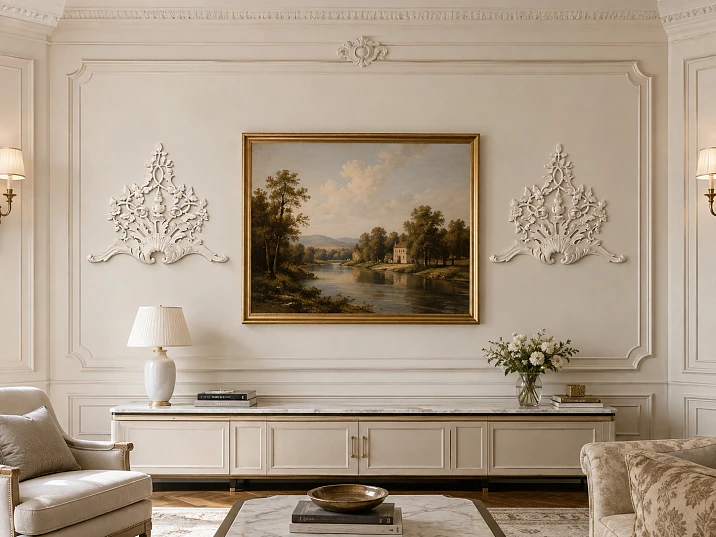
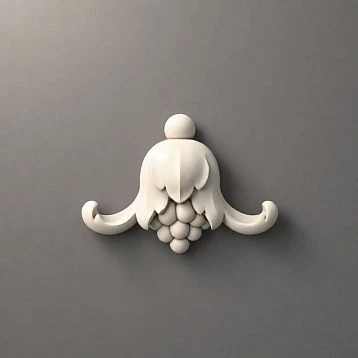
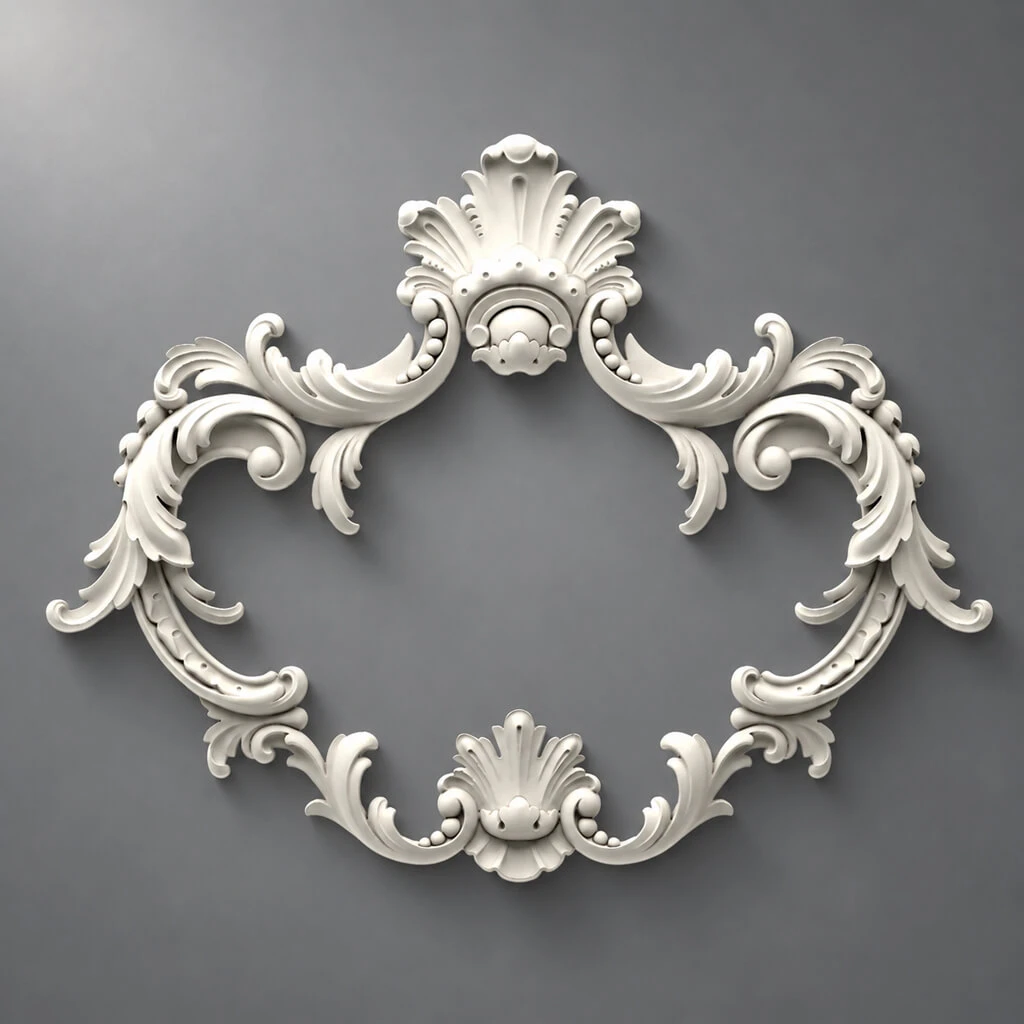
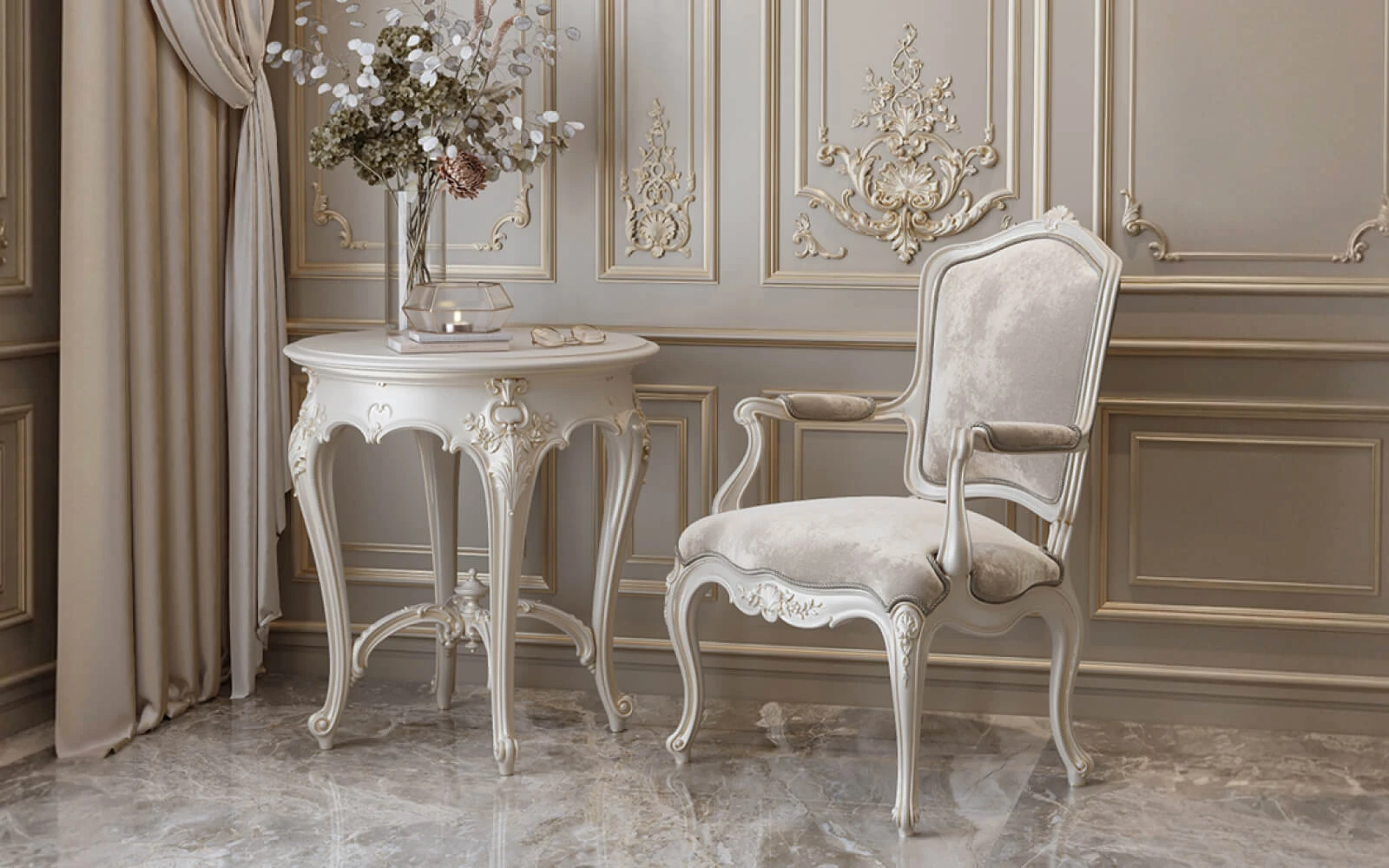
If a large molding panel has already been built around a picture, panel, or other central image, there is usually no room to add another large stucco element in the center. The center of the composition is already occupied. In such a situation, the decorative accent can be moved to the free side parts and a mirrored pair of large overlays can be used: left NPU.VRS-014L и right NPU.VRS-014R.
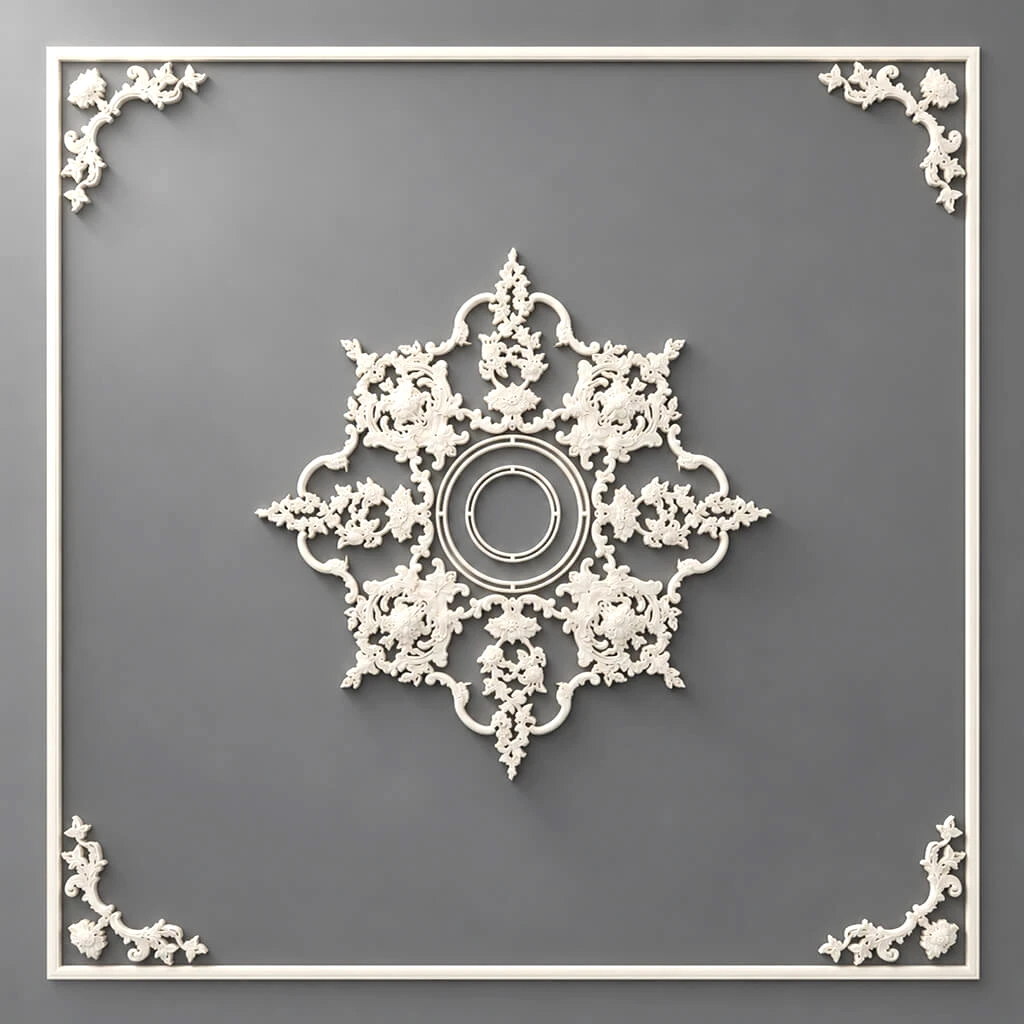
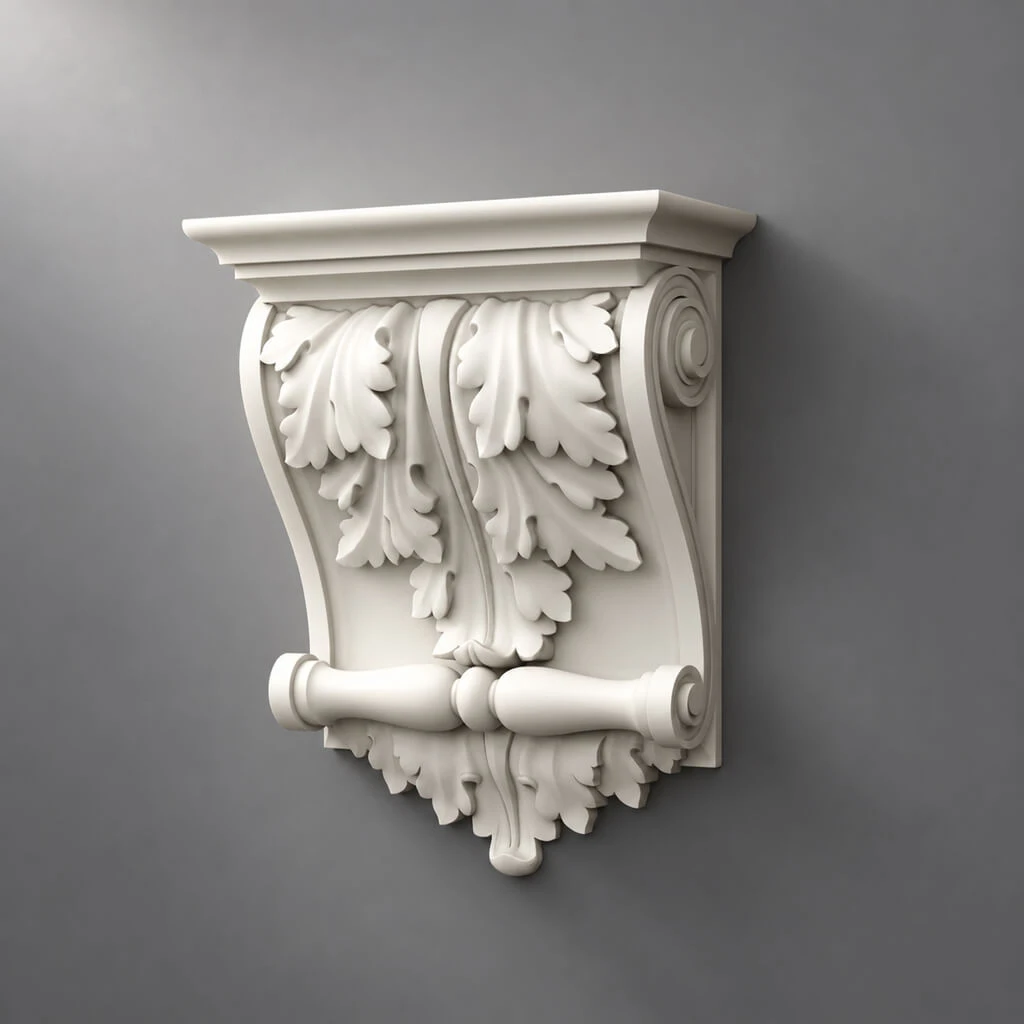
Each decorative overlay measures 335 × 300 × 21 mm. This is no longer a small accent piece. Along the wide side, the item takes up 33.5 cm, along the other — 30 cm, and the relief protrudes up to 21 mm from the surface. Therefore, you cannot order a pair based on a photo of the wall with the thought "there seems to be enough space." First, you need to measure the clean inner field of the molding panel, the outer size of the picture frame, and the actual side areas.
The price of one NPU.VRS-014L or NPU.VRS-014R at the time of checking is 6,810 ₽. A mirrored pair costs 13,620 ₽ excluding glue and finishing.
The most useful check before purchasing is simple: cut out two full-size templates of 335 × 300 mm, place them to the left and right of the picture, and look at the entire wall from your usual viewpoint. For a pair costing 13,620 ₽, such a fitting is much more sensible than discovering after delivery that the large overlays physically fit but almost touch the picture frame and molding.
Why a central overlay is really not needed here
A wall panel can have a large free field and at the same time an occupied compositional center.
For example, inside a molding frame 1800 mm wide, a painting 900 mm wide hangs. Visually, the wall still seems spacious because large empty areas remain on the right and left. But it is impossible to place another decorative overlay directly in the middle: the painting is already there.
Attempting to add stucco decor above the picture does not always solve the problem either. The composition starts to grow upward, while the side fields remain empty.
NPU.VRS-014L and NPU.VRS-014R allow using a different principle: the center remains for the image, and the stucco forms two mirrored side accents.
The result is a sequence:
left overlay → picture → right overlay.
This scheme differs from the classic solution with a single medallion in the center of the panel. Therefore, it should be evaluated specifically as a three-part composition, not as two randomly added details near the painting.
What are NPU.VRS-014L and NPU.VRS-014R
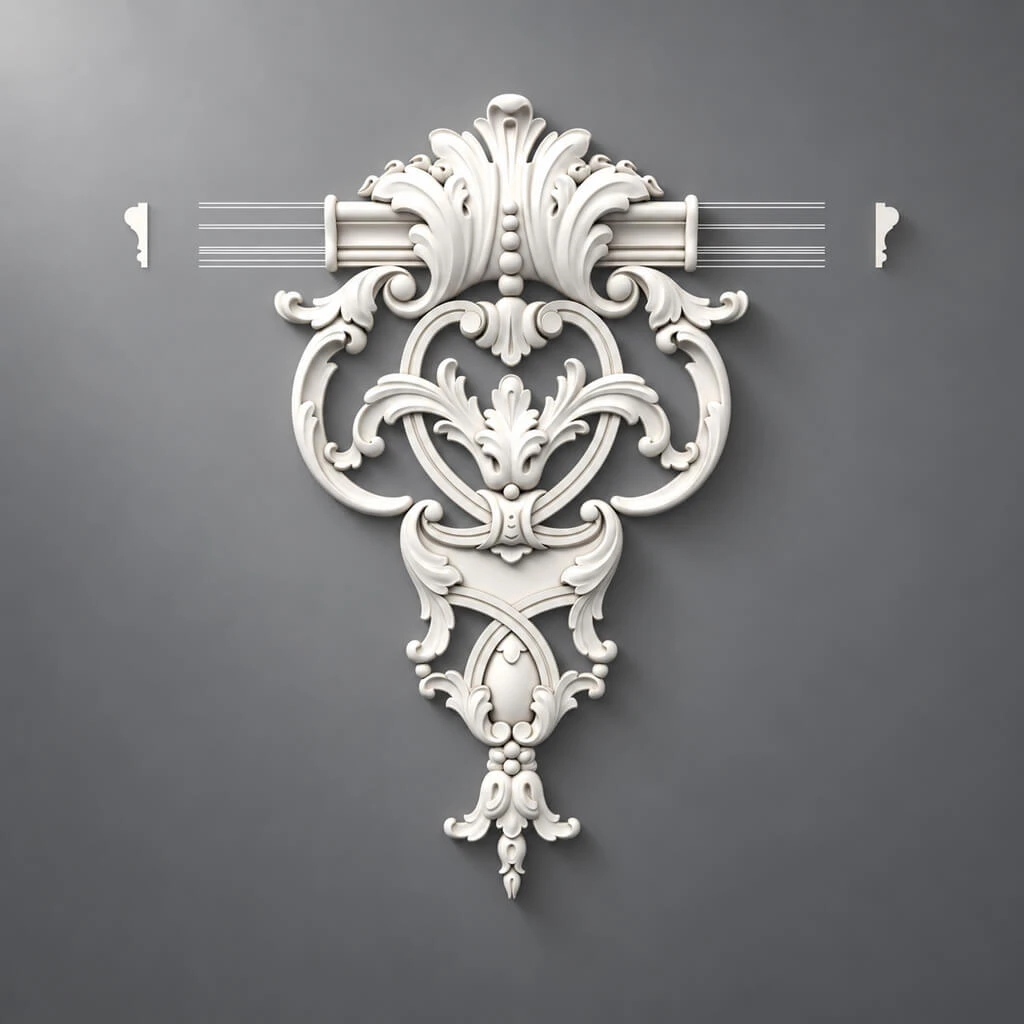
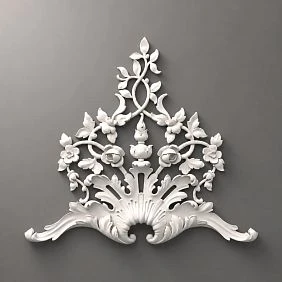
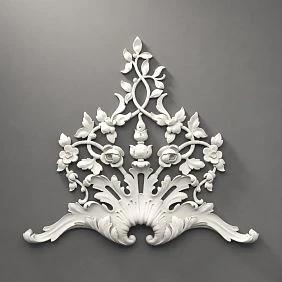
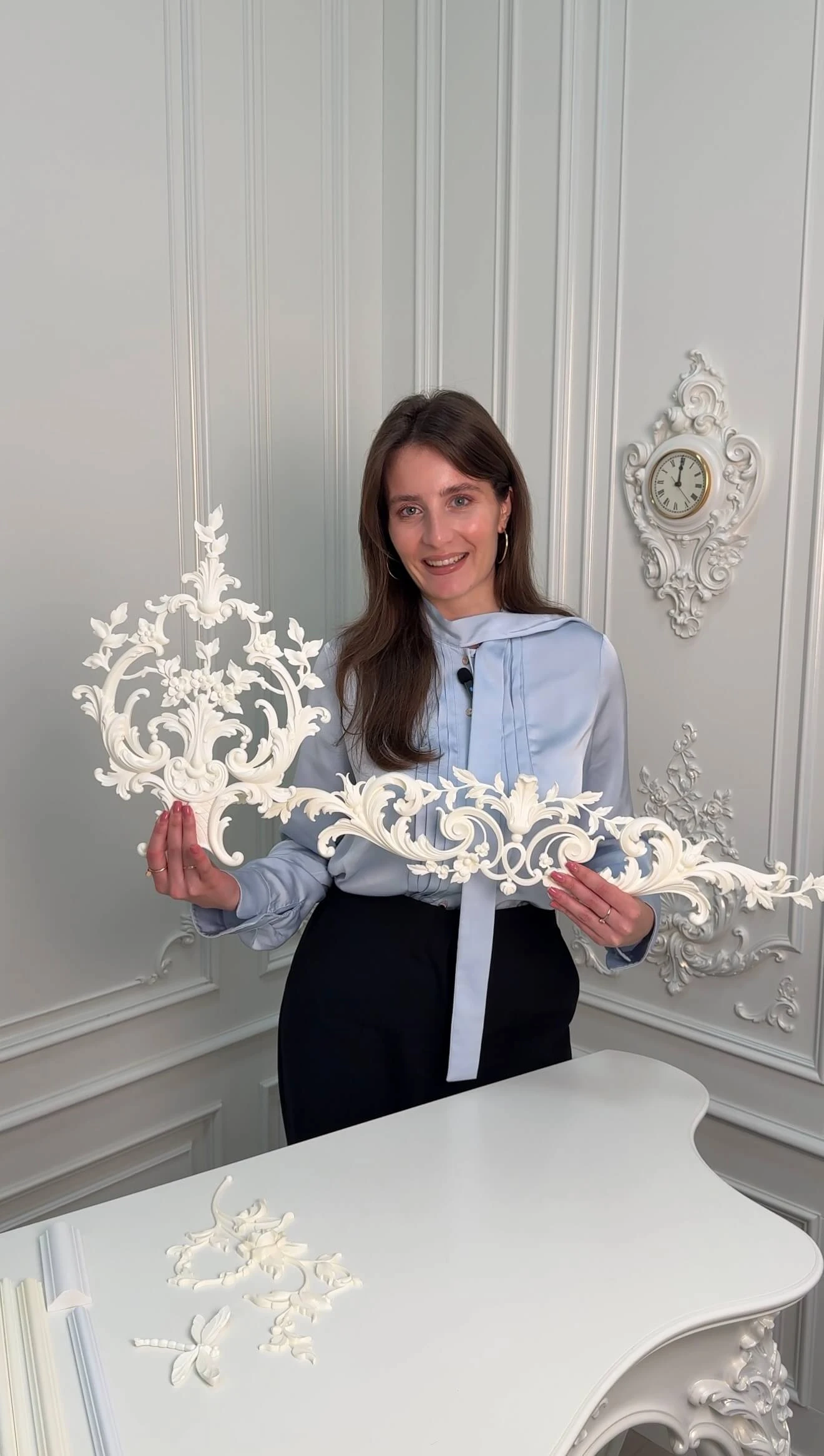
NPU.VRS-014L and NPU.VRS-014R are two separate decorative overlays made of polyurethane from the Versailles collection.
Each product has its own article number and its own card.
Left carved overlay NPU.VRS-014L has dimensions of 335 × 300 × 21 mm.
Right carved overlay NPU.VRS-014R has the same dimensions of 335 × 300 × 21 mm.
Therefore, L and R should be considered as a mirror pair when the wall composition itself is symmetrical.
| Parameter | NPU.VRS-014L | NPU.VRS-014R |
|---|---|---|
| Product type | Decorative overlay | Decorative overlay |
| Material | Polyurethane | Polyurethane |
| Size | 335 × 300 × 21 mm | 335 × 300 × 21 mm |
| Price at time of check | 6 810 ₽ | 6 810 ₽ |
| Price per pair | 13 620 ₽ |
The size here is crucial. If a small stucco piece can be estimated approximately, with NPU.VRS-014L/R this approach is already risky.
Thirty-three and a half centimeters on one side is a noticeable part of a typical wall panel.
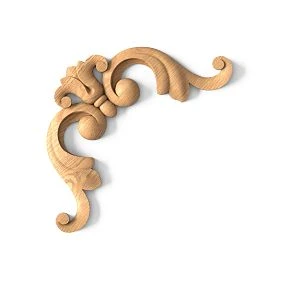
Our factory also produces:
What exactly to measure before ordering
The outer dimension of the molding frame is almost useless if the dimensions of its clear inner field are not known.
Suppose a molding panel has an external width of 1900 mm. The buyer sees this number and assumes that two overlays with a width of 335 mm will definitely fit.
But the molding itself takes up part of the space. The picture has a frame. Between the outer edge of the picture and the inner line of the molding, there may be much less space than it seems based on the external dimensions of the panel.
For the calculation, you need the clear width inside the molding.
The second dimension is the external width of the picture together with the frame, if there is a frame.
Not the width of the canvas.
Not the size of the image.
Not the size of the mat.
It is precisely the extreme overall width of the object that already occupies the center of the wall.
If a picture with a width of 700 mm is placed in a wide frame and the total size becomes 900 mm, then 900 mm is used for calculating the free wall.
Get Consultation
Basic formula for the side margin
For a symmetrical composition, when the picture is exactly centered on the panel:
inner panel width − outer picture width = total free space
Then:
total free space / 2 = side margin on each side of the picture
And only after this is the side margin compared with the size of the overlay.
Let's take the proposed scenario.
Net inner width of the panel:
1800 mm.
Outer width of the picture:
900 mm.
Free space:
1800 − 900 = 900 mm.
On one side:
900 / 2 = 450 mm.
This results in two fields each 450 mm wide.
NPU.VRS-014L/R occupy 335 mm along the wide side.
In one field remains:
450 − 335 = 115 mm.
If you place the overlay approximately in the middle of the side field:
115 / 2 = 57.5 mm.
That is, with this scheme, approximately 57.5 mm may remain between the overlay and the picture frame, and the same amount between the overlay and the inner edge of the molding.
Mathematically, the composition fits.
But 57.5 mm is not a universally "correct" gap. It is just the result of a specific calculation. Next, it needs to be checked visually.
Table for quick check of the side margin
If the overlay is positioned so that it occupies 335 mm horizontally, it is useful to check the remainder in advance.
| Width of one side margin | Remainder after NPU.VRS-014 with a width of 335 mm | If we conditionally divide the remainder equally |
|---|---|---|
| 650 мм | 315 мм | 157.5 mm |
| 600 мм | 265 мм | 132.5 mm |
| 550 мм | 215 мм | 107.5 mm |
| 500 мм | 165 мм | 82.5 mm |
| 450 мм | 115 мм | 57.5 mm |
| 400 мм | 65 мм | 32.5 mm |
| 370 мм | 35 мм | 17.5 mm |
| 350 мм | 15 мм | 7.5 mm |
The last lines particularly well show the limitation of arithmetic.
In a field 350 mm wide, a 335 mm overlay physically fits.
But only 15 mm remains around it.
If you divide them in half, that's about 7.5 mm each.
Such a solution can no longer be assessed with words like "fits" or "doesn't fit." You need to look at the actual wall. A large carved form will be almost squeezed between the picture frame and the molding.
Why two templates are strictly necessary
For a single item, sometimes one paper rectangle is enough.
For NPU.VRS-014L/R, this is not enough.
If you place one template to the left of the painting, it may seem that there is enough space and the large decorative element looks impressive.
After the same element appears on the right, the composition becomes significantly richer.
Therefore, make two templates of 335 × 300 mm.
They should appear on the wall simultaneously.
The template will not show the real ornament and openwork, but it will show the maximum footprint that each decorative overlay will occupy.
Already at this stage, you can see whether the side fields have become too crowded.
How to make the template more accurate
A simple rectangle of 335 × 300 mm slightly exaggerates the visual mass of a real carved overlay: the actual ornament has a contour, relief, and gaps, and is not perceived as a solid slab.
Therefore, the first stage is rectangles.
If they fit in scale, you can perform a second check: print images of NPU.VRS-014L and NPU.VRS-014R at approximately actual size.
The control size after printing should remain 335 × 300 mm. The automatic "fit image to page" function may change the scale.
Such a fitting better shows the direction of the ornament and the relationship of elements to the picture.
Where NPU.VRS-014L should be located
In the basic mirror scheme, NPU.VRS-014L is considered the left part of the composition.
But the concept of "left" alone is not enough.
It is necessary to check the direction of the pattern relative to the central picture.
Mirror decorative elements can have two visually different variants: the ornament seems to open outward from the center, or, conversely, gathers movement toward the picture.
Therefore, before installation, it is useful to lay out L and R at the same time and look at them specifically as a pair.
Do not glue one part and only then decide how to turn the second one.
Where the NPU.VRS-014R should be located
The right NPU.VRS-014R completes the mirror scheme.
If the panel, picture, and side fields are symmetrical, the right element usually repeats the position of the left one relative to the central vertical axis.
Suppose the inner edge of NPU.VRS-014L is located 80 mm from the picture frame.
Then, in the original symmetrical layout, NPU.VRS-014R should also be checked at a distance of 80 mm from the right edge of the frame.
The same applies to the height.
If the top point of the left overlay is at a certain level, the right one should be marked along the same horizontal line, unless the project intentionally provides for asymmetry.
Do not measure the two sides independently if the wall should be symmetrical
Imagine that on the left you measured the distance from the molding, and on the right — from the painting.
Each detail individually may be installed neatly, but the overall pair will end up slightly offset.
For a large wall, the error is more noticeable than for small decor.
It's better to first build the overall geometry:
center of the panel;
center of the painting;
vertical axis;
horizontal line of pad placement.
After that, both parts are linked to a single coordinate system.
What to do if the painting is not centered on the panel
This happens quite often.
For example, the painting was hung relative to the sofa, fireplace, or console, while the molding panel was built relative to the entire wall.
Then, on the left and right, there remain margins of different widths.
Suppose:
from the left of the painting to the molding — 520 mm;
on the right — 410 mm.
For NPU.VRS-014 with a width of 335 mm:
on the left remains:
520 − 335 = 185 mm;
on the right:
410 − 335 = 75 mm.
This results in completely different amounts of space around two identical overlays.
If you center each within its own field, the asymmetry will remain.
If you try to position them symmetrically relative to the painting, the right element may get too close to the molding.
In such a situation, buying a pair is no longer an automatic solution. First, you need to decide which geometry matters more for the wall: the picture, the molding panel, or the entire furniture composition.
If the painting is not hung yet, first determine its place
Sometimes the buyer plans all three elements simultaneously:
the painting;
NPU.VRS-014L;
NPU.VRS-014R.
This is more convenient because the central object can still be shifted slightly.
But starting with the position of the pads is wrong.
First, the logical position of the painting relative to the furniture, wall, and viewing level is determined.
After that, the remaining side margins are measured.
The stucco decor adapts to the main composition, rather than forcing the painting to hang in an inconvenient place just for the sake of perfectly equal gaps.
A picture with a wide frame and a picture without a frame — different calculations
Let's take a canvas of 700 mm.
In the first option, it hangs without a frame.
In the calculation, the central object has a width of about 700 mm.
In the second case, a frame is used, which adds 80 mm on each side.
The total width becomes:
700 + 80 + 80 = 860 mm.
The difference is 160 mm.
For each side field in a symmetrical composition, there is 80 mm less.
For large NPU.VRS-014L/R, this is a significant value.
Therefore, choosing molded decor based on the dimensions of the canvas itself before purchasing the frame is risky.
Do you need to account for the mat?
If the mat is inside the outer dimensions of the frame, there is no need to add its size separately.
For the wall's geometry, the outermost dimension of the finished image is what matters.
If the hanging system has additional external elements, decorative cords, or another visible contour, their impact on the composition should be checked visually.
The main principle remains the same: what is measured is what the viewer actually perceives as the boundary of the central object.
335 × 300 mm — how large is that on a wall
Catalog millimeters are easy to underestimate.
335 mm is 33.5 cm.
300 mm is 30 cm.
Two overlays together take up noticeable space.
If you place them on the sides of the painting, you get three distinct objects.
Therefore, NPU.VRS-014L/R are well suited for a large panel where fine stucco might get lost.
For a narrow wall section or a small frame, the scale of these items may be excessive.
When a large size works in favor of the composition
Let's imagine a wall panel 2200 mm wide.
The central picture with frame has a width of 900 mm.
Free space:
2200 − 900 = 1300 mm.
On each side:
1300 / 2 = 650 mm.
After installing the overlay with a width of 335 mm, the following remains:
650 − 335 = 315 mm.
If we conditionally place it in the center of the side field:
315 / 2 = 157.5 mm.
Here, around each decorative overlay, there is quite a lot of free wall space.
In such a composition, NPU.VRS-014L/R can be perceived as independent side accents and at the same time not blend with either the painting or the moldings.
When 335 mm already requires caution
Panel — 1700 mm.
Picture — 900 mm.
remains:
1700 − 900 = 800 mm.
On one side:
800 / 2 = 400 mm.
The overlay takes up 335 mm.
Remainder:
400 − 335 = 65 mm.
With a conditional uniform distribution — just 32.5 mm each.
Physically, the pair fits.
But the space becomes tight.
If the picture frame also has a rich ornament, and the molding is wide and figured, additional NPU.VRS-014L/R can visually merge with neighboring elements into one heavy mass.
This is where full-size templates are mandatory.
When it's better to skip the pair
If the side field only slightly exceeds 335 mm, the problem is obvious.
But there are also less noticeable cases.
For example, there is enough space, but the picture itself has a large carved gilded frame. It already contains a complex floral ornament. Adding two more large overlays creates three competing ornamental centers.
Another case is when sconces are additionally placed inside the molding panel.
The third is when a tall sideboard, fireplace portal, or console with complex decor stands directly under the picture.
Under such conditions, empty side sections of the wall can be more useful than additional stucco molding.
An empty field is also part of the composition.
Why two large overlays can be better than four small ones
A large panel often provokes the desire to fill it with many small details.
But four or six small overlays create a repeating pattern.
NPU.VRS-014L/R give a different structure: two large mirror accents.
For a wall with one large painting, this is often more logical, because the scale of the side decor begins to match the scale of the central object.
However, it cannot be said that large details are always better. If the painting is small, a pair of 335 × 300 mm can visually become stronger than the image itself.
That is why the size of the central object is compared with the molding before ordering.
Compare the width of the painting and the total width of the two overlays
For two NPU.VRS-014 along one of the main axes:
That is, in total, the two side decorative elements have a significant visual scale.
If the painting is 700 mm wide, the width of the two overlays together is almost comparable to the width of the central image.
If the painting is 1400 mm wide, the same two details become more subordinate.
If the painting is 1400 mm wide, the same two details become more subordinate.
This does not mean that you need to count some mandatory percentage. But such a comparison helps to understand the real scale before purchasing.
In the frontal photo, the main parameter seems to be the size 335 × 300 mm.
In the frontal photograph, the main parameter seems to be the size 335 × 300 mm.
But the third digit — 21 mm — is also important.
This is 2.1 cm of relief.
With side lighting, the ornament will create a noticeable chiaroscuro.
If the painting is in a deep massive frame, the overlays may look relatively calmer.
If the image is a thin poster in an almost flat frame, the stucco molding with a depth of 21 mm may appear visually stronger.
Therefore, it is useful to look at the wall not only straight on, but also from the side.
What will happen with directional lighting
Two identical carved overlays may look different if one side of the wall is lit more strongly than the other.
For example, the window is on the right.
During the day, NPU.VRS-014R receives pronounced side light, while the left overlay is in softer shadow.
Physically, the composition is symmetrical, but the visual weight of the sides differs.
If there are directional spotlights on the wall, the situation should also be checked in the evening.
For a relief of 21 mm, light is a full part of perception.
Where to place the overlays by height
The obvious option is to place NPU.VRS-014L/R approximately on the same horizontal axis as the central picture.
But this is not the only scheme.
If the picture is tall and narrow, the side overlays can be checked closer to its middle part.
If the image is wide and located below the center of the panel, the decor may look better slightly higher.
If there is furniture under the picture, the lower part of the composition is already occupied.
There is no universal height in millimeters from the floor for NPU.VRS-014L/R.
You need to base it on the picture, the molding frame, and the furniture.
Why you shouldn't automatically place the pads at the center height of the panel
Let's imagine a tall wall frame from the baseboard almost to the ceiling.
The painting hangs in its upper half above the console.
The geometric center of the entire panel is significantly below the painting.
If NPU.VRS-014L/R are placed strictly in the center of the panel, they will be too low relative to the picture.
The viewer will see the central image at the top and two decorative details below.
Therefore, for this article, it is the visual center of the composition with the painting that matters, not the abstract center of the large rectangle of moldings.
Top layout: overlays on the upper sides of the painting
For a very tall panel, you can check the position where NPU.VRS-014L/R are slightly above the horizontal axis of the painting.
This composition leaves more free space at the bottom.
It is especially interesting if the lower part is already occupied by furniture.
But large decor should not accidentally end up too close to the top molding.
Here again, the real template 335 × 300 mm helps.
Side layout: overlays strictly on the left and right
This is the most understandable initial layout.
The painting remains the central object.
NPU.VRS-014L and NPU.VRS-014R are located in the side fields approximately at the level of its compositional center.
The molding frame creates the outer contour.
The result is a clear hierarchy:
outer contour — molding;
center — painting;
side accents — NPU.VRS-014L/R.
It is this scheme that should be checked first.
Is another element needed above the painting
Usually not at first.
If two large overlays of 335 × 300 mm have already been used, a third central stucco element on top can make the wall overloaded.
Especially if the picture frame is also decorative.
It's better to first assemble the composition:
NPU.VRS-014L + picture + NPU.VRS-014R.
If after this the upper part of the panel really remains disproportionately empty, the issue of additional decor can be resolved separately.
You shouldn't buy a third piece in advance just to fill all the free space.
NPU.VRS-014L/R and moldings should work at different scales
The molding sets the boundary.
The overlay creates a local ornament.
If the molding has a pronounced complex pattern and is additionally equipped with corner elements, NPU.VRS-014L/R become part of an already rich system.
If the frame is simple, a pair of large carved overlays gets more visual freedom.
Therefore, with an already finished wall, the task is simpler: you can apply the template directly to the existing molding and see the result.
If the panel itself is only being designed, the range of profiles can be viewed in the section Buy polyurethane wall moldings.
Are corner elements needed simultaneously with NPU.VRS-014L/R
Not necessarily.
Corner decor works around the perimeter of the molding frame.
NPU.VRS-014L/R — inside it.
When both types are used, the amount of ornament increases sharply.
If NPU.VRS-014L/R are chosen specifically as two large accents around a painting, additional decoration of all four corners may be unnecessary.
If it is still necessary to finish the joints or corners of the moldings, suitable elements can be found in the section Decor for polyurethane moldings.
But first, it is worth looking at the wall with one pair of large overlays.
Painting in the color of the wall: when it is a particularly successful option
The size of 335 × 300 mm makes NPU.VRS-014L/R quite noticeable even without color contrast.
Therefore, for a large panel with a painting, one of the calmest options is painting the molding in the wall color.
Then the decorative overlay is revealed through relief and shadow.
The painting retains color priority.
The overlays create an architectural background.
This approach is especially useful if the image is bright and its frame is noticeable on its own.
Contrast coloring increases the visual size
A white overlay on a white wall and a gold overlay on a dark blue wall — the same product measuring 335 × 300 mm, but they will be perceived differently.
Contrast visually enhances the boundaries of the product.
Therefore, if two paper templates already seem large, a contrasting color will make the actual decor even more active.
If highlighting the molding is planned, it is useful to do the fitting with a template of a color close in contrast.
When patina may be appropriate
Patination makes sense if the interior is already built on pronounced classical decorativeness: an ornamental picture frame, complex moldings, furniture with carved details, aged metal elements.
On a calm, monochromatic wall, a strong patina turns NPU.VRS-014L/R into two separate, bright objects.
This can shift attention away from the painting.
Therefore, the more valuable the central image as the main accent of the room, the more restrained the side stucco decor should usually be.
If the painting itself is very bright
A bright abstract canvas, a large colored panel, or rich painting already have high visual weight.
In this case, NPU.VRS-014L/R does not necessarily need to be additionally highlighted with color.
Painting it in the tone of the wall allows adding architectural relief without two more color spots.
Thus, the painting remains the first object a person notices, and the molding is discovered later.
If the painting is monochrome
Calm graphics, engravings, or black-and-white photographs may have lower visual weight.
In that case, the side overlays can become a more prominent part of the framing.
But here an opposite risk arises: the rich ornament of the Versailles collection may turn out to be stylistically more active than the central image.
Therefore, one should compare not only sizes but also the character of the items.
If a mirror is used instead of a painting
The geometric logic of the calculation is almost the same.
The outer size of the mirror is measured together with the frame.
The side margins are determined.
Templates of 335 × 300 mm are checked.
But the mirror reflects the interior and light, so the visual richness of the central part constantly changes.
Large carved overlays on its sides may look more active than next to a matte painting.
This scenario requires especially careful fitting under real lighting conditions.
If a TV is used instead of a painting
The size can be calculated the same way, but the decorative task is already different.
A TV is a functional object with a black screen, wires, mounts, and operational requirements.
Large classical molding on its sides can only work in a specially constructed interior composition.
Do not automatically transfer the scheme with a painting to a TV wall.
If there is a console under the painting
The console adds a bottom horizontal line.
In this case, NPU.VRS-014L/R is useful to evaluate simultaneously with the furniture.
If the decorative overlays drop too low and start to visually press against the tabletop, they can be raised relative to the geometric center of the painting.
If the console itself has carved legs and rich decor, side molding on the wall may already be sufficient even without contrasting trim.
If there is a fireplace portal under the painting
A fireplace portal usually has its own architecture and significant visual mass.
Here, empty side fields may be needed for air between the portal, the painting, and the molding frame.
NPU.VRS-014L/R should only be added after a full-size check.
The overlays are large. Together with the portal and the painting, they can create a very saturated center of the wall.
How to calculate two identical wall panels
Suppose there are two identical large panels in the room.
Each contains a painting, and a mirror pair is used on the sides.
For one panel:
1 × NPU.VRS-014L;
1 × NPU.VRS-014R.
For two panels:
2 × NPU.VRS-014L;
2 × NPU.VRS-014R.
There are four decorative covers in total.
Cost:
4 × 6 810 = 27 240 ₽.
But the same quantity is justified only when the panels and paintings are truly the same size.
Three panels, but a painting only in the central one
Another scenario: the wall is divided by moldings into three large panels.
The painting is only in the middle one.
In this case, you don't need to automatically buy three pairs of NPU.VRS-014L/R.
The article scenario refers to a panel where the central space is already occupied by an image, leaving large side margins.
The side molding frames have a different compositional purpose and may remain empty or receive other decoration.
Therefore, the quantity of items is determined not by the number of molding frames in the room, but by the number of panels for which this particular scheme is suitable.
Two pictures in one long panel
If two paintings hang within one wide panel, the task changes significantly.
The central axis between the images is already free.
NPU.VRS-014L/R on the outer sides may stretch the composition too much.
Perhaps it is more logical to work with the central gap between the paintings, or just leave only the molding.
Such a scenario cannot be automatically solved with a pair of NPU.VRS-014L/R.
How to calculate the cost for multiple identical rooms
If one mirror pair costs:
6 810 + 6 810 = 13 620 ₽,
then for two identical rooms:
13 620 × 2 = 27 240 ₽.
For four:
13 620 × 4 = 54 480 ₽.
For six:
13 620 × 6 = 81 720 ₽.
This is the cost of the overlays themselves at the price at the time of verification.
If a series of hotel rooms, restaurant halls, or several identical rooms is being furnished, it is reasonable to first assemble one reference composition in full scale.
An error on one pair is 13,620 ₽ in product cost.
An error on six identical panels repeats six times.
If the left and right sides are needed in different quantities
With a classic symmetrical wall, the number of L and R is the same.
But in a complex project, this is not always the case.
For example, there are three symmetrical panels with paintings and one more asymmetrical zone where only the left overlay is needed.
Then the order will be:
NPU.VRS-014L — 4 pcs.;
NPU.VRS-014R — 3 pcs.
It is important to count items by individual SKUs, not just write "7 overlays NPU.VRS-014" in the estimate.
Mistake: buying two identical L or two identical R
Their size is the same.
The price is the same.
At first glance, it seems you can take any two parts.
But L and R are intended for a mirror composition.
Two identical sides create a repetition of one ornament direction, not a mirror pair.
If the wall is symmetrical, the base configuration is one NPU.VRS-014L and one NPU.VRS-014R.
Error: measure only the total wall width
The wall width can be 4000 mm, while the inner panel around the painting is only 1600 mm.
For purchase, the second number matters.
The overlays are not placed anywhere on the wall, but within a specific molding composition.
Therefore, the size of the room itself says nothing about the compatibility of the product with a specific field.
Error: count the painting size without the frame
If the frame has not been chosen yet, the calculation cannot be considered final.
An additional 60–100 mm on each side can noticeably reduce free zones.
Especially if the side field is currently around 400 mm and each NPU.VRS-014, 335 mm wide, already takes up a large part of it.
First, the final external dimensions of the painting are determined, then the decor is purchased.
Mistake: forgetting about the depth of the relief
On the plan, everything looks two-dimensional.
But NPU.VRS-014L/R have a third dimension — 21 mm.
The relief creates a shadow and a separate visual layer.
If the picture frame is almost flat, the overlays may protrude more than it.
If the frame is deep, the difference is perceived differently.
Before installation, it is useful to look at the composition from the side.
Mistake: dividing all free space in half automatically
The formula is useful for basic symmetry.
But the designer's position of the overlay does not have to be mathematically centered in each side margin.
Sometimes you need to leave more air around the picture.
Sometimes — around the molding.
For example, in a 500 mm field after NPU.VRS-014, 165 mm remains.
It is not necessary to make 82.5 mm on both sides.
You can check:
100 mm from the painting and 65 mm from the molding;
or 120 mm and 45 mm.
The main thing is that both sides of the wall follow the same logic.
Error: press the decor against the picture frame
If NPU.VRS-014L/R almost touch the frame, the three objects start to visually merge.
This is especially noticeable with similar finishes: for example, a gold frame and golden patina on the stucco molding.
Free space between them helps maintain hierarchy:
the picture remains a separate central object;
the overlays remain side architectural decor.
The specific gap size should be determined based on the scale of the actual wall.
Error: press the overlays against the molding
A similar situation occurs on the outside.
If the carved shape almost touches the frame, it is unclear whether it is part of the molding or an independent element.
In a large panel, it is usually useful to leave a readable wall space between two different types of decor.
If there is no room for this, the NPU.VRS-014L/R is likely too large for the specific panel.
Mistake: adding decor just because the wall looks empty in the photo
The photo reduces the scale.
On a phone screen, a panel two meters wide becomes an image several centimeters wide.
The empty spaces begin to seem much emptier.
After installing two real overlays of 335 × 300 mm, the impression may be completely different.
Therefore, the final decision is made on the wall at a 1:1 scale.
Mistake: evaluating only one overlay
This is especially dangerous for NPU.VRS-014L/R.
One element may look neat.
The second doubles the amount of carved decor and changes the balance of the entire wall.
Therefore, fitting is always done with two templates at once.
How to determine that the pair is too large
There are several practical signs.
After installing the templates, the eye first notices the stucco molding, and only then the painting.
The free space between the overlays, the painting, and the moldings almost disappears.
The ornament visually connects with the frame of the painting.
The side elements look like two heavy masses.
In such a situation, it is better to compare more compact ones Polyurethane decorative appliquesand not try to use NPU at any cost. VRS-014L/R.
How to determine that the pair is too small for the panel
The reverse situation is also possible.
In a very large panel 2500–3000 mm wide, two pieces 335 × 300 mm may look quite local.
If there is 200–300 mm or more left from each overlay to the painting and to the molding, the question arises: is a larger compositional decor needed.
But a small size relative to the wall is not always a disadvantage.
If the task is to make two restrained accents and leave a lot of free plane, NPU.VRS-014L/R can work exactly that way.
When it is better to leave only the painting and molding at all
If the painting has a rich frame, the molding frame is complex, sconces are already installed in the panel, or the lower part is occupied by decorative furniture, two more carved elements may be superfluous.
An empty painted plane separates objects from each other.
It makes the painting more noticeable.
It allows the molding to read as a separate architectural boundary.
Therefore, the conclusion "the side fields are empty, so overlays are needed there" is not always correct.
The product is worth buying when the templates genuinely improve the composition.
When NPU.VRS-014L/R are especially logical
The pair fits well with the scenario where the panel is large, the central image has already taken the middle, the side fields are approximately equal, the molding frame is spacious enough, and the interior needs noticeable symmetrical plant decor.
It is here that two independent articles, L and R, provide a clear solution without the need to introduce another central element.
How to check the wall in one evening before placing an order
First, measure the clean inner width of the panel.
Then, the outer width of the painting including the frame.
Calculate the left and right free margins.
Cut out two templates 335 × 300 mm.
Secure them with masking tape.
Check the position by height.
Look from the usual viewpoint.
Take a photo.
Turn on the evening light.
Remove the templates and compare the wall without them.
After this check, it usually becomes clear whether two large overlays are needed at all.
Where to buy NPU.VRS-014L and NPU.VRS-014R
For a mirror composition, items are added to the order separately.
You can buy the left carved overlay NPU.VRS-014L can be in a separate model card.
You can buy the right carved overlay NPU.VRS-014R needs to be a second standalone item.
If the size 335 × 300 × 21 mm does not fit, compare others Polyurethane decorative appliques it in the corresponding section of the catalog.
A wider range for wall decoration is presented in the section buy wall decor.
If the project combines several types of interior decor, you can view the general catalog You can buy ready-made stucco matching the Baroque style. Calculate the quantity: linear meters of cornices and moldings, number of rosettes, pilasters, consoles, corner elements. Add a ten to fifteen percent allowance for trimming..
What to put in the cart for one symmetrical panel
If after trying on two templates 335 × 300 mm fit the scale, the basic set is simple:
1 × NPU.VRS-014L — 6 810 ₽
1 × NPU.VRS-014R — 6 810 ₽
Total:
13,620 ₽ per pair at the time of checking.
You should not buy two left or two right pieces for a regular mirror composition.
You also don't need to buy a second set just because the panel is large. First, you need to see one pair on the wall.
Practical example: a 1800 mm panel and a 900 mm picture
Clear internal width:
1800 mm.
Picture:
900 mm.
Free space:
900 mm.
On one side:
450 mm.
NPU.VRS-014:
335 mm.
Remainder:
115 mm.
If the overlay is approximately in the center of the field:
about 57.5 mm remains on each side.
This is a working example for a full-size check. The overlay fits, but the free space can no longer be called large.
Practical example: panel 2100 mm and picture 900 mm
2100 − 900 = 1200 mm.
On one side:
600 mm.
600 − 335 = 265 mm.
With conditional centering:
132.5 mm each.
Compared to the previous option, there is noticeably more breathing room.
The same pair NPU.VRS-014L/R will be perceived as lighter.
Practical example: panel 1700 mm and picture 900 mm
1700 − 900 = 800 mm.
On one side:
400 mm.
400 − 335 = 65 mm.
32.5 mm each with conditional uniform distribution.
Physically, everything fits.
But this size already requires very careful fitting.
Practical example: a 1600 mm panel and a 900 mm picture
1600 − 900 = 700 mm.
On one side:
350 mm.
350 − 335 = 15 mm.
Only 7.5 mm remains on each side when centering.
For the scheme under consideration, this is a strong signal that the NPU.VRS-014L/R units are likely too large for the free side fields.
Practical example with an off-center painting
Left field — 550 mm.
Right — 420 mm.
On the left after overlaying:
550 − 335 = 215 mm.
on the right:
420 − 335 = 85 mm.
The pair physically fits.
But visually, the sides will differ.
Instead of automatically ordering, you first need to make two templates and decide whether the position of the picture or the overlays themselves can be adjusted.
Practical example: a large frame changed the entire calculation
The panel has an internal width of 1900 mm.
The canvas itself is 800 mm.
If calculating without the frame:
1900 − 800 = 1100 mm;
550 mm on each side.
It seems like there is plenty of space.
But the finished frame increases the outer width of the picture to 1000 mm.
New calculation:
1900 − 1000 = 900 mm;
450 mm each.
After NPU.VRS-014, what remains is:
450 − 335 = 115 mm.
That is, one frame has significantly reduced the free remainder around each overlay.
That is why the dimensions of the central object must be final.
Practical example: two identical panels
In the living room, there are two symmetrical panels, each with a painting.
For each, you need:
1 L + 1 R.
Total order:
2 × NPU.VRS-014L;
2 × NPU.VRS-014R.
Cost:
27,240 ₽ for four items at the time of verification.
Before such an order, it is useful to fully check at least one panel with two templates.
How to make the final decision
If after a full-size fitting the picture remains the main object, the overlays do not visually touch either the frame or the molding, both side areas have clear symmetry, and the 21 mm depth matches the character of the wall, the NPU.VRS-014L/R pair is suitable for this scenario.
If the templates take up almost the entire free space, the pattern conflicts with the picture frame, or two large details draw attention to themselves, it is better to choose a more compact decor or leave the wall without additional overlays.
The solution can be reduced to one practical formula:
first measure the panel and the picture → get the actual side margins → check the two dimensions 335 × 300 mm → evaluate L and R simultaneously → only then place an order for the pair.
FAQ
What is the size of NPU.VRS-014L and NPU.VRS-014R?
The size of each decorative trim is 335 × 300 × 21 mm. When selecting for a wall panel, it is important to consider not only the width and height, but also the relief depth of 21 mm.
How much does the NPU.VRS-014L/R pair cost?
At the time of checking, each trim costs 6,810 ₽. One left and one right together cost 13,620 ₽ excluding adhesive and finishing materials.
Is it mandatory to buy NPU.VRS-014L and NPU.VRS-014R as a pair?
For a symmetrical composition around a painting, the basic option is one left and one right trim. In an asymmetrical interior, single use is possible, but that is a different compositional task.
How to understand if there is enough space on the sides of the painting?
Subtract the outer width of the painting together with the frame from the inner width of the molding panel. If the painting is centered, divide the remainder by two. Compare the resulting side margin with the size of the overlay 335 mm along the corresponding axis.
If the side margin is 450 mm, does NPU.VRS-014 fit?
Yes, it fits in width of 335 mm. There will be 115 mm of free space left. With conditional centering, that is about 57.5 mm on each side of the trim. Further, a full-scale fitting is needed.
And what if the side field is only 350 mm?
After applying an overlay 335 mm wide, only 15 mm will remain. Formally, the product fits, but almost no free field is left. For such a size, it is especially reasonable to consider a different decor.
Do we need to take the picture frame into account?
Definitely. The calculation uses the outer width of the finished picture including the frame, not the size of the canvas or the image inside it.
What to do if the frame has not been purchased yet?
It is better to postpone the final order of NPU.VRS-014L/R until the outer size of the future frame is determined. It can significantly reduce the side fields.
Why make two templates 335 × 300 mm?
Because one overlay does not show the visual mass of the finished mirror composition. Two templates allow you to immediately see the left and right decor around the picture.
Can NPU.VRS-014L/R be placed above the picture?
You can check such a composition in a tall panel, but this already changes the direction of the entire scheme. For a start, it is better to evaluate the side placement, since the side fields are the original problem.
Do I need to place another overlay above the painting?
Not necessarily. Two NPU.VRS-014L/R already constitute a large stucco decor. A third element should only be added after evaluating the finished side pair.
Can the overlays be painted in the wall color?
This solution helps keep the painting as the main color accent, while the stucco decor is revealed through relief and chiaroscuro.
Does contrasting painting make NPU.VRS-014L/R visually larger?
Yes, the boundaries of the element become more noticeable. If two templates of 335 × 300 mm already seem large for the panel, strong color contrast will further enhance their presence.
What to do if there is more space on the left than on the right?
Measure each field separately and make two templates. If the difference is large, a strict mirror pair may emphasize the asymmetry. Sometimes it is better to adjust the position of the painting or abandon this scheme.
Can a pair be used around a mirror?
The overall calculation principle remains the same: the outer size of the mirror including the frame and the free side fields are taken into account. However, reflections and lighting can make the composition visually richer, so a separate fitting is needed.
What is more important: the center of the molding panel or the center of the painting?
If the article solves the task of framing an already installed painting, the starting point is the entire existing composition. If the centers coincide, the calculation is simple. If they do not coincide, you need to decide separately which axis to preserve.
When is it better not to buy NPU.VRS-014L/R?
When the side fields are only slightly wider than 335 mm, the painting frame is already very decorative, the panel is filled with sconces or furniture, or the templates show that the molding begins to dominate the image.
Where to buy the left NPU.VRS-014L?
Left decorative overlay NPU.VRS-014L can be added to the order in a separate product card.
Where to buy the right NPU.VRS-014R?
Right decorative overlay NPU.VRS-014R must be ordered as a separate item.
Where can I see other decorative overlays if NPU.VRS-014L/R are too large?
Other options are collected in the section Buy decorative polyurethane overlays.