Article Contents:
- What is NPU-488 and which three sizes really matter
- Don't count the number of fish until the map of the free field around the aquarium is built
- The best first tool is not a tape measure, but several paper fish 144 × 72 mm
- What to check on each layout
- Centered above the aquarium
- On one of the side fields
- In the top corner of the smooth zone
- When one is enough
- What can be done with two identical NPU-488 without promising mirroring
- How to check if a group fits by width
- Why five fish need more free space than it seems
- How to make five less mechanical
- Fish on top
- Fish on the sides
- Top and side simultaneously
- Top cover
- Removable front or top panel
- Filtration
- Wiring and lighting
- Feeding
- Possible equipment replacement
- The trim sits above the glass
- The overlay is positioned on the side
- The fish is located close to the edge of the illuminated aquarium
- One on each side
- Only on the wide side
- Two on the wide side, none on the narrow side
- Completely abandon side decor and move NPU-488 upward
- In the color of a smooth wall
- In the color of the slat panels
- In the color of the aquarium frame
- Contrast painting
- Mistake 1. Determining the quantity by the width of the aquarium
- Mistake 2. Considering two identical NPU-488 as a mirror pair
- Mistake 3. Occupying the service panel with decor
- Mistake 4. Looking only when the backlight is off
- Mistake 5. Adding new fish when the problem is actually in the scale of the first one
- Wrong scale
- Pattern doesn't fit
- Mirroring is needed
- How many NPU-488 fit into the free decorative field so that the aquarium remains the main object, maintenance doesn't worsen, and the repeat of shapes looks intentional?
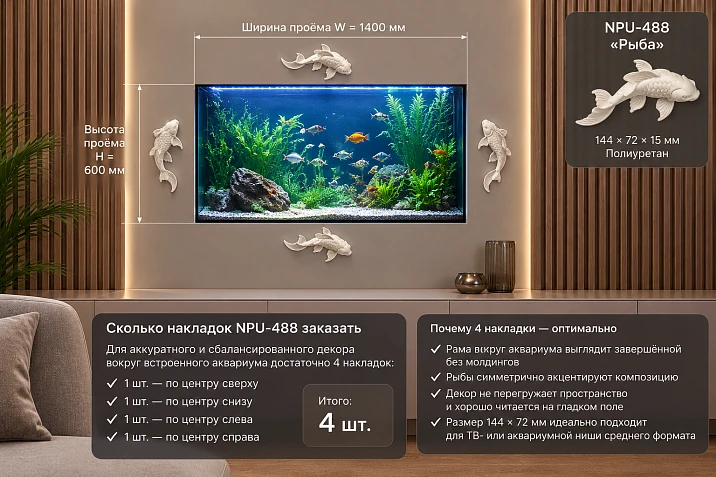
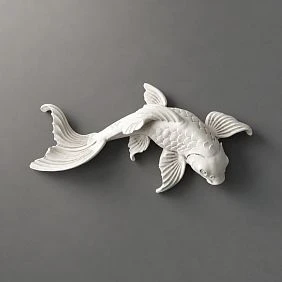
A built-in aquarium is already a strong visual center of the wall. Water, plants, fish, movement, and lighting constantly change the picture, so additional decor around the glass is not always needed. But if the aquarium is built into a wide smooth field, and there are slat panels on the left and right, the free part of the wall sometimes looks too neutral. Then, instead of a regular frame made of moldings, you can consider a thematic accent — the polyurethane overlay NPU-488 "Fish".
The NPU-488 has dimensions of 144 × 72 × 21 mm, the material is polyurethane, and the current price is 1,170 rubles per piece. The STAVROS card indeed describes the product as a decorative overlay in the shape of a fish; the average production time for custom orders is stated as 3–7 days.
But the question "how many to buy?" cannot be solved by the width of the aquarium with a single formula.
An aquarium 1200 mm long does not mean you need five fish, and a 600 mm aquarium does not mean one is enough. The quantity is determined simultaneously by:
- the size of the free smooth field;
- the position of the aquarium within it;
- the location of technical access;
- the direction of the backlight;
- the distance to the slat panels;
- on whether the NPU-488 should be a single sign or part of a group.
In practice, the choice comes down to four scenarios:
one NPU-488 — a single thematic accent;
two — a paired composition, but not necessarily mirrored;
three — already a small group with its own rhythm;
five is a full decorative "movement" that requires a fairly large calm surface.
Therefore, the correct order is:
measure the wall → make a 1:1 template of NPU-488 → mark the technical zones of the aquarium → try one, two, and a group → check the composition with the backlight on → only then calculate the quantity and cost.
What the NPU-488 is and which three sizes really matter
The NPU-488 is a polyurethane decorative fish-shaped overlay. The current product card specifies A = 144 mm, B = 72 mm, C = 21 mm, price 1,170 ₽/pc.
| Parameter | NPU-488 |
|---|---|
| Type | Decorative overlay "Fish" |
| Size | 144 × 72 × 21 mm |
| Material | Polyurethane |
| Price | 1,170 ₽/pc. |
| Order | From 1 pcs. |
| Made to order | 3–7 days |
Product card:
Other products in the same product group:
Buy decorative polyurethane overlays
For our project, the three dimensions have different functions.
144 mm determines the main extended size of the figure.
72 mm is the second size of the front projection.
21 mm is the depth of the relief along the third axis.
However, one cannot mechanically conclude from the notation A × B × C that A is always the horizontal and B is always the vertical. Therefore, all further calculations where 144 mm is used as the horizontal size of the fish are valid provided that NPU-488 is positioned exactly that way in the selected standard composition according to the image and the current drawing of the product.
This is especially important if the overlay is going to be rotated or used in an unusual position. First, the orientation of the shape is determined — then the margins are calculated.




Do not count the number of fish until the map of the free field around the aquarium is built.
The built-in aquarium has at least five dimensions that affect the decor.
Let us denote:
WA — visible width of the aquarium;
HA — visible height;
WT — width of the entire smooth insert between the slat panels;
TT — free strip above the aquarium;
SL and SR — free margins on the left and right.
It is TT, SL, and SR that are the places where NPU-488 could potentially be located.
A common mistake is to measure only the glass.
For example:
"An aquarium 1400 mm wide means five fish can be placed on top."
Nothing follows from this.
The aquarium may be raised almost flush to the upper edge of the smooth panel. Then there is no space for overlays on top at all.
In another project, a small 800 mm aquarium is in the middle of a two-meter smooth insert, and large side margins are available for decor.
Therefore, draw the wall as several rectangles:
slat panels | smooth field | aquarium | smooth field | slat panels.
After that, mark the zones that should remain free regardless of the design:
- opening lid;
- removable panel;
- access to filtration;
- wires;
- power supply;
- backlighting;
- ventilation or service openings;
- fasteners;
- a section that is removed for maintenance.
Exact service clearances should be taken from the documentation of the specific aquarium system. The decorative composition is designed around these requirements, not the other way around.
Our factory also produces:
The best first tool is not a tape measure, but several paper fish 144 × 72 mm
It is easy to imagine one NPU-488 as too large or too small if you only look at the product card.
Make five paper templates.
If in the selected orientation the figure occupies 144 mm horizontally and 72 mm vertically, each layout has a bounding rectangle:
144 × 72 mm.
It is advisable to print the actual silhouette of the fish, because the rectangle only shows the occupied space but poorly conveys the visual mass of the shaped part.
First, attach one.
Then two.
Then three.
Only after that, try five.
This is much more useful than starting with the question:
"How many fish are usually placed around an aquarium?"
There is no such standard.
Get Consultation
What to check on each layout
Photograph the entire wall, not just the decor in close-up.
The frame must include:
- the aquarium;
- both slat zones;
- the cabinet or lower structure;
- ceiling;
- adjacent furniture;
- the light fixtures.
Now ask four questions.
Is the aquarium still the main subject?
If the molded flock is perceived first, there is too much decor.
Is it clear why the NPU-488 is here?
One fish near the aquarium reads as a thematic detail. Five identical ones already form an independent pattern.
Is there a calm wall between the fish and the slatted panels?
Two active rhythms should not accidentally merge.
Did the template hit a technical zone?
If so, such a position is excluded regardless of beauty.
One NPU-488: when a single fish works better than a whole group
One overlay is not a "cheapest unfinished option."
In some compositions, this is the best option.
Cost:
1 × 1 170 = 1 170 ₽.
A single NPU-488 should be checked first if the smooth field is relatively small or the aquarium itself is already very expressive.
There are several working positions.
Centered above the aquarium
The simplest composition.
The fish's axis is linked to the aquarium's axis.
It works as a small thematic accent, not as a separate panel.
This option is especially useful to check if a calm horizontal strip remains above the glass.
On one of the side fields
If the aquarium is shifted inside a smooth insert or one side section is noticeably wider than the second, symmetry is not required.
One NPU-488 can become a small accent on a larger free part of the wall.
In the upper corner of the smooth zone
Here the figure stops emphasizing the center and starts working with the overall plane.
But you need to make sure that the fish does not accidentally end up squeezed between the aquarium and the outermost rail.
When one is enough
Leave one if after trying it on it is obvious:
- the water theme is already conveyed by the aquarium itself;
- NPU-488 is noticeable from a normal distance;
- the second piece adds nothing fundamentally;
- Symmetry is not required for the wall;
- there is enough air around the glass.
In such a situation, increasing the quantity just to fill the emptiness worsens the project.
Two NPU-488s: this is not automatically a mirror pair
Two pieces cost:
2 × 1 170 = 2 340 ₽.
It is with the pair that the most interesting problem of NPU-488 begins.
The article number has no L or R designation.
Unlike products that are manufactured in separate left and right versions, a single NPU-488 by itself is not a confirmed mirror pair.
Therefore, you cannot write:
"Buy two and turn the fish to face each other."
If the actual geometry of the product does not allow mirrored installation, a simple rotation of the second piece can yield a completely different result — up to an incorrect orientation of the figure.
The same applies to the idea of "let one swim to the right, the second to the left."
First, you need to see the actual product, 3D model, or drawing.
What can be done with two identical NPU-488s without promising mirror symmetry
Sequence.
Both fish are oriented the same way and create a sense of movement.
Different heights.
The second is slightly higher than the first. The group no longer looks like two identical emblems.
Diagonal arrangement.
One figure is closer to the aquarium, the other is slightly farther and higher.
Spacing across different fields.
One on the left, one on the right — but not necessarily as mirror twins. Each can work with its own space.
It's the layout that will show whether the same direction makes sense.
If a true mirror composition is needed, it's better to compare other catalog items rather than declare NPU-488 a mirror model without confirmation.
Three NPU-488 units already form a composition, so you need to count not only the pieces but also the intervals.
Cost of three:
3 × 1 170 = 3 510 ₽.
Three identical elements create a different perception than one or two.
Now the eye sees not an individual fish, but a group.
If all three are simply placed in one horizontal row with equal intervals, the composition may become too mechanical:
fish — fish — fish.
This is especially risky for a slat wall.
There is already a regular vertical rhythm on the sides. Adding a second absolutely regular row in the center is not necessary.
You can use three levels:
- first below;
- second above;
- third between them.
Or make a smooth diagonal movement.
The distances should look deliberate, not random.
How to check if a group fits by width
If in the chosen orientation one fish occupies 144 mm horizontally, the net length of three items is:
3 × 144 = 432 mm.
But this is not the actual width of the composition.
Need to add:
- left margin;
- two gaps between the fish;
- right margin.
Formula:
Wgroups = 3 × 144 + G1 + G2 + ML + MR
where G are the gaps, M are the side margins.
Therefore the phrase:
"For three fish, 432 mm is enough"
is incorrect as a design condition.
432 mm is only the sum of the dimensions of the items themselves, without air.
Five identical NPU-488: when a "school" appears, and when the wall becomes overloaded
Five panels cost:
5 × 1 170 = 5 850 ₽.
And this is already a completely different scenario.
Five identical fish become an independent decorative motif.
They cannot be considered as:
"I liked one, so we'll buy four more."
First, it is decided whether such an active composition is needed at all next to real fish inside the aquarium.
There is an interesting effect.
Movement is already happening inside the glass.
If you add five static figures around, they can:
- support the theme;
- create a beautiful continuation;
- or start competing with the aquarium.
Why five fish require more free space than it seems
With a conditional horizontal orientation, the net sum of their lengths is:
5 × 144 = 720 mm.
And again, this is only the material.
Between five figures, there are at least four intervals.
Plus free margins on the edges.
Therefore, the group easily occupies noticeably more than 720 mm.
If the top strip above the aquarium is only 800–900 mm wide, five elements can turn into a dense decorative frieze.
On a wide wall, this could be a design idea.
On a small field — with overload.
How to make five less mechanical
Don't place them on one line immediately.
Check:
- two levels;
- three levels;
- a smooth diagonal;
- a small arc;
- a group of 2 + 3.
At the same time, there's no need to artificially create ten different positions. Two or three fundamentally different schemes and photos of each are enough.
How much space a group needs: a formula is more useful than a universal "correct interval"
Assigning all projects a distance, for example, 50 mm between fish, would be a made-up rule.
It's better to calculate based on the available space.
Suppose you have a usable horizontal area with width W.
For N identical NPU-488 with a horizontal size of 144 mm, the net remainder after placing the shapes is:
R = W − N × 144.
This remainder still needs to be distributed between:
- external margins;
- intervals.
For example, for three elements:
W = 900 mm
900 − 3 × 144 = 468 mm.
These 468 mm do not mean that the interval should automatically be 234 mm.
They should be distributed across four visual gaps:
left margin + two inter-element intervals + right margin.
If the composition is centered and all four gaps are conditionally made equal:
468 ÷ 4 = 117 mm.
This is only a starting layout.
After that, the fish can be brought slightly closer together or the intervals can be made unequal.
The value of the calculation is not in finding the "ideal 117 mm," but in understanding how free or dense the group can be in a given field.
Decor above the aquarium and decor on the sides serve different purposes.
They should not be mixed into one question.
Fish on top
The group is perceived as a continuation of the aquarium upward.
This option especially depends on the distance to the ceiling and on whether there is a technical cover on top.
Need to check that the overlays do not interfere with:
- opening;
- to dismantling;
- to the luminaire;
- the service panel.
Fish on the sides
Here, the distance to the slat panels is more important.
If the NPU-488 gets too close to the first slat, the fish visually starts to collide with the vertical pattern.
The side composition can consist of one piece on each side or be intentionally asymmetrical.
From above and from the side simultaneously
This is already a full-fledged aquarium environment.
The number is growing rapidly.
For example:
1 top + 1 left + 1 right = 3 pcs.
or
3 on top + one on each side = 5 pcs.
But arithmetic should not dictate design.
First make all five paper fish, place them simultaneously, and photograph the wall.
Very often after such a check, you want to remove some elements.
An aquarium cannot be 'covered with decor' without considering maintenance.
This is the main difference between this article and the usual topic about wall molding.
The painting requires almost no maintenance.
An aquarium does.
Therefore, the aesthetic zone and service zone must be separated before gluing the NPU-488.
Top cover
If it opens upward, overlays cannot be placed in the path of movement.
Removable front or top panel
The decor must not accidentally connect the removable panel to the fixed part of the wall.
Filtration
If equipment access is from the side, the free space cannot be occupied just because a fish looks nice there.
Wiring and lighting
Access to serviceable connections must be maintained.
Feeding
If the main access is from the top, its path is more important than decorative symmetry.
Possible equipment replacement
Today one light or filter is installed, tomorrow another.
Too dense a composition complicates changes.
A useful principle:
first outline on the wall all zones that must open, be removed, or be serviced.
Only the remaining space is considered a decorative field.
Be especially careful with removable service panels.
A built-in aquarium often looks like a single smooth surface, although part of that surface may be a door or a removable panel.
If NPU-488 is glued so that it crosses the boundary of two elements, the service unit will stop working properly.
Even installing a whole overlay on one removable door requires a separate check:
- whether the relief interferes with its opening;
- whether the decor catches on the adjacent surface;
- whether it changes the ease of removing the panel;
- whether the handle or technological grip is preserved.
Therefore, on the paper mockup, be sure to draw lines for all opening parts, even if they are barely visible when the aquarium is closed.
The decor should not turn a neatly hidden service system into an inconvenient one.
A depth of 21 mm matters more near the glass than on a regular wall
The third dimension of NPU-488 is 21 mm.
On the front sketch, the depth disappears.
In a real interior, the relief is visible:
- from the side;
- in the reflection of the glass;
- with side lighting;
- with lighting from the aquarium.
Let's imagine a side wall composition:
slat panel → smooth field → NPU-488 → aquarium glass.
Each object has its own depth.
If the aquarium is recessed, a relief fish may appear closer to the viewer than the glass.
If the glass or frame protrudes, the effect will be the opposite.
The result cannot be determined from a single front-facing photo.
Make a simple mockup about 21 mm thick from cardboard or foam material and place it at the installation site.
Look from the walkway.
This check is especially important if the smooth strip between the glass and the rails is narrow.
Physically, 144 × 72 mm may fit, but the 21 mm relief can make the element too bulky in a tight area.
Aquarium lighting can turn a small overlay into a very noticeable object.
The aquarium often glows brighter than the surrounding wall.
Therefore, the NPU-488 next to it interacts not only with the interior light, but also with the light of the aquarium itself.
The overlay is placed above the glass.
Light directed upward can emphasize the lower edge of the relief.
The overlay is placed on the side.
A side shadow appears.
If the smooth field is light, it can noticeably increase the visual size of the figure.
The fish is close to the edge of the illuminated aquarium
The contrast between the bright glass and the relief figure is enhanced.
That is why five NPU-488s in the evening can look much more active than five paper silhouettes during the day.
The model should be evaluated in at least two modes:
aquarium off / daylight;
main aquarium lighting is on.
If the project includes separate wall lighting, a third viewing will be needed.
Identical NPU-488s do not have to form symmetry
Around a rectangular aquarium, symmetry seems like an obvious solution:
one on the left + one on the right.
But if both NPU-488s have the same figure direction, mathematical symmetry of placement does not yet create visual mirroring.
It may seem that both fish are "swimming" in the same direction.
This in itself is not a mistake.
On the contrary, the composition can gain movement.
The problem arises when the designer expected a mirrored pair, but bought two identical items, assuming mirroring by default.
Check the actual silhouette in advance.
STAVROS also has other fish-shaped decorative overlays: for example, individual cards NPU-486 and NPU-487 are also presented as fish-shaped decor.
Therefore, if you need not a repeating identical fish but a diverse marine composition, it is more logical to look at the entire section of overlays and compare several figures.
Sometimes three different fish are better than five identical NPU-488
This is already an alternative to the original basket.
Five identical elements create a rhythm.
Several different ones create a story.
The difference is fundamental.
If you want to get a decorative strip, repeating NPU-488 is quite logical.
If you want the effect of a small school, identical shapes can look too clichéd.
Then you can:
- leave one NPU-488 as the main element;
- add other fish-shaped overlays;
- differentiate the size;
- change heights.
The catalog does indeed contain other polyurethane fish elements, including NPU-484, NPU-486, and NPU-487.
At the same time, the article remains specifically about NPU-488: alternative products are only needed for cases where repeating one model doesn't achieve the desired composition.
You can proceed to the selection through the general section:
Buy decorative polyurethane overlays
The smooth field for NPU-488 is better evaluated separately from slatted panels
In the composition under consideration, each material has its own role.
Slat panels provide a regular linear rhythm.
The aquarium provides light, color, and movement.
The smooth part of the wall creates a visual pause.
NPU-488 adds a subtle thematic relief.
If the fish start entering directly onto the slats, this logic changes.
The back part of the shaped overlay may receive an uneven base:
- part on the protruding slat;
- part above the gap;
- part at another level.
Besides the technical issue, a visual one arises: the fish outline is cut by vertical lines.
Therefore, in the project under consideration, it is more reasonable to first check the placement entirely on a smooth surface.
If the required quantity does not fit without going onto the slats, this is a signal not to "glue it tighter," but to reduce the group.
How to leave the correct distance to slat panels without a made-up standard
Universal ones cannot be assigned:
"minimum 50 mm from the fish to the first slat."
For a large slat panel and a small NPU-488, 50 mm is perceived one way.
For thin, frequent lamellas — another way.
Instead, use a ratio.
Measure:
D — the distance from the extreme point of NPU-488 to the first slat.
Then compare three layouts:
- the minimum possible D;
- the average;
- more free.
Take photographs.
Look not for "correct millimeters," but for the moment when the two patterns stop merging.
If the fish almost touches the rail, the eye may begin to perceive it as part of the rail decor.
If there is too much empty space between them, the connection with the overall wall weakens.
In a specific project, a visual mockup is more useful than a standard that doesn't exist.
It is better to tie the position of the entire group not only to the aquarium, but also to the center of the wall
The aquarium is not always exactly in the middle of a smooth field.
Sometimes this is related:
- with engineering;
- furniture;
- to the niche construction;
- adjacent door.
Three different centers appear:
center of the aquarium;
center of the smooth field;
center of the entire wall between slat zones.
For one NPU-488, it is often logical to focus on the aquarium.
For a group of five, the entire wall may be more important.
For example, if five fish are centered strictly relative to a slightly shifted aquarium, the upper composition may emphasize its shift.
If the group is tied to a smooth insert, the fish can, on the contrary, visually stabilize the wall.
Therefore, draw all three axes on the drawing.
There is no need to automatically select one.
What to do if the fields on the left and right of the aquarium are different
Suppose:
SL = 260 mm
и
SR = 420 mm.
Mechanical idea:
"Place one fish on each side."
Physically, both can fit.
But the free fields after them will be completely different.
There are several solutions.
One on each side
The aquarium itself is emphasized, but the asymmetry of the overall field is preserved.
Only on the wide side
Decor is used to fill a truly empty area.
Two on the wide side, none on the narrow side
The composition becomes deliberately asymmetric.
Abandon side decor altogether and move NPU-488 upward
This way, the asymmetry of the side fields ceases to be the main variable.
There is no universally correct option.
It is necessary to understand whether the stucco should emphasize the geometry of the wall or work only with the aquarium theme.
The color of NPU-488 can make one fish more noticeable than five
Quantity and color cannot be chosen independently.
In the color of the smooth wall
The shape is read mainly through shadows.
Even a group of three to five elements remains relatively calm.
In the color of the slat panels
A connection appears between the central decor and the side zones.
This can bring the wall together into a unified system.
In the color of the aquarium frame
NPU-488 bonds directly with the glass and its structure.
Contrast painting
The figure turns into a graphic symbol.
One contrasting fish can be visually stronger than three solid-colored ones.
Therefore, if a feeling arises:
"One is not enough,"
first check not the second overlay, but the finish of the first.
Sometimes the problem is not in quantity, but in the too weak readability of the relief against this background.
Don't try to literally copy the colors of real fish from the aquarium
The aquarium changes.
The fish move.
The lighting has a different spectrum.
The plants grow.
Therefore, trying to paint each NPU-488 so that it looks "like a real fish inside" may tie the permanent wall decor too closely to the temporary aquarium contents.
For an interior composition, it is often more useful to use a color related to the wall:
- neutral;
- color of the slats;
- the color of the frame;
- one accent shade.
Then the NPU-488 remains architectural decor, not an imitation of aquarium contents.
Installation near the aquarium begins with checking the base, not with choosing the adhesive.
NPU-488 is intended for decorative installation, but a built-in aquarium creates additional conditions.
On a smooth surface, check:
- strength of the finish coat;
- absence of peeling paint;
- absence of a constantly damp area;
- evenness;
- ability to press the overlay properly;
- absence of a hidden removable panel.
Do not glue decor onto a problem surface, expecting that the mounting compound will simultaneously fix the base.
For the general selection of materials, there is KUDO HIGH TACK adhesive.
But the compatibility of the adhesive is checked with a specific surface.
It is especially important not to automatically transfer recommendations for a regular painted wall to:
- glass;
- silicone joints;
- plastic frame;
- removable aquarium panel.
The article considers NPU-488 as wall decor for the smooth area around the aquarium.
Do not glue NPU-488 to the glass just to bring it closer to the water
This is a different installation scenario.
Aquarium glass:
- is part of the technical structure;
- is cleaned;
- is located near water;
- may require access;
- reflects light.
We have no grounds to declare standard wall mounting of NPU-488 on glass as correct.
If a smooth wall is not enough, it is more logical to change the decorative composition than to transfer the overlay to the glass part without a confirmed mounting system.
Moreover, the figure on the glass visually competes directly with the live fish inside.
On the wall, NPU-488 works as a thematic architectural detail.
On the glass, it is already like an applique on the aquarium itself.
This is a different effect.
Placing it too close to the edge of the aquarium may interfere with wall cleaning
Even if the NPU-488 does not cover the technical opening, regular cleaning around the aquarium is required.
The glass is wiped.
The frame is cleaned.
Sometimes you need to run your hand or a napkin along the edge.
If the relief fish is placed almost flush, a narrow hard-to-reach area appears between it and the frame.
Therefore, the paper mockup should check one more thing:
whether the surface between the overlay and the edge of the aquarium can be properly maintained.
This is a good example of why "physically fits" and "well placed" are not the same thing.
When you need to buy one, two, three, or five NPU-488
After all checks, the decision can be summarized in a table.
| Quantity | Cost | Which scenario to check first |
|---|---|---|
| 1 | 1 170 ₽ | single accent above or to the side of the aquarium |
| 2 | 2 340 ₽ | paired/sequential placement |
| 3 | 3 510 ₽ | a small group with its own rhythm |
| 5 | 5 850 ₽ | full decorative school on a large smooth area |
The price of one NPU-488 at the time of checking is 1,170 rubles.
The most important column here is not the price.
But the scenario.
Don't start with:
"The budget allows five."
Start with:
"Does the wall need a group of five?"
If not, the additional 4,680 ₽ compared to one NPU-488 does not improve the composition quality.
When one overlay is enough
Choose one if:
- the aquarium is already visually active;
- the free space is small;
- only a thematic sign is needed;
- the composition is asymmetrical;
- from a normal viewing point, NPU-488 is well readable;
- the second piece looks added only for symmetry.
One fish is especially appropriate where the wall needs an accent, not an ornamental system.
When two are better
A pair makes sense if:
- there are two independent free fields;
- the same direction of the figures looks natural;
- the composition requires movement;
- two fish do not imitate the mirroring that is not confirmed for the product;
- around each one there remains calm space.
Before buying two, especially carefully check the actual silhouette.
When three give more benefit than two
Three allow building a group where strict pairing is not required.
They are suitable if:
- need to create a small plot;
- there is room for different heights;
- the aquarium and decorative field are quite large;
- the identical repetition does not yet look excessive.
Three items are often more interesting than a pair precisely because the composition stops requiring mirror symmetry.
When five are justified
Five should only be purchased after a full-size layout.
They are logical if:
- the smooth area is large;
- the fish become an independent wall picture;
- the slat panels are far enough away;
- Technical access is not restricted;
- the group does not draw attention away from the aquarium;
- Repeating one model is indeed the intention.
If the last condition is not met, compare several different figures in the catalog.
Five main mistakes when decorating the built-in aquarium NPU-488
Mistake 1. Determining the quantity by the width of the aquarium
Why it occurs: a person perceives the glass as a frame for molding.
Consequence: the group may not correspond to the actual free field.
How to check: measure TT, SL, and SR independently of the aquarium dimensions.
How to avoid: count only the actually accessible smooth surface.
Error 2. Counting two identical NPU-488 as a mirror pair
Why it occurs: the fish shape is associated with the direction of movement.
Consequence: after receiving the goods, it turns out that both figures have the same pattern.
How to check: look at the actual geometry of the product.
How to avoid: do not build the project on unconfirmed mirroring.
Error 3. Occupying the service panel with decor
Why it occurs: when the aquarium is closed, its boundaries are almost invisible.
Consequence: maintenance becomes more difficult or impossible.
How to check: mark all opening elements with painter's tape.
How to avoid: separate service areas before the artistic layout.
Mistake 4. Look only when the backlight is turned off
Why it occurs: design takes place during the day.
Consequence: in the evening, the 21-millimeter relief and shadows turn out to be much more active.
How to check: turn on the aquarium's standard lighting.
How to avoid: evaluate both lighting modes before installing the entire group.
Mistake 5. Add new fish when the problem is actually in the scale of the first one
Why it occurs: one NPU-488 seems not expressive enough.
Consequence: instead of the correct size, an overloaded group of identical small figures appears.
How to check: compare NPU-488 with other overlays.
How to avoid: choose between "more elements" and "a different element," rather than automatically multiplying the quantity.
When NPU-488 is not needed at all
This is a mandatory question.
The aquarium may already work perfectly without additional trim.
Do not add NPU-488 if:
- slat panels themselves form sufficient framing;
- a smooth field is needed as a visual pause;
- the aquarium is bright and saturated;
- there is already a lot of furniture and light around;
- technical panels occupy most of the free wall;
- shaped decor makes the interior too thematic.
Particular care should be taken with a literal "nautical theme."
A single small fish can be a delicate hint.
Five fish, shells, waves, and marine coloring already turn the wall into a thematic panel.
Such a result may be desirable, but it must be intentional.
When it's better to choose different decor instead of NPU-488
NPU-488 may not be suitable for three reasons.
Wrong scale
144 × 72 mm is too small or too large for a specific field.
The repeat doesn't fit
The same fish looks good on its own, but works poorly in a group.
Mirroring is needed
The project is built on two opposing figures, and identical NPU-488 units do not produce the required effect.
In these cases, the right next step is not to abandon the whole idea, but to open catalog of decorative polyurethane overlays.
For a more general wall composition:
For the entire product group:
Buy Polyurethane Molded Decoration
If the slat wall is still being designed, it is better to plan the aquarium and decor at the same time
In a finished wall, you have to work with what is left.
In a new project, the order is better changed.
First, the following are set:
- aquarium size;
- service zones;
- smooth field;
- potential NPU-488 locations;
- only then the boundaries of the slat trim.
This way, you can avoid a situation where the outermost slat lands exactly where the composition needs one more fish.
For a new project, the slat part can be selected in the section:
Buy slatted panels for wall finishing
It is especially useful to check in advance not only the distance on the left and right, but also the overall axis.
The aquarium, smooth insert, and slat panels should be perceived as one system even before adding shaped decor.
Ready-made algorithm for choosing the number of NPU-488
Before placing an order, perform the actions in this order.
- Measure the visible size of the aquarium.
- Measure the entire smooth field between the slat panels.
- Separately record the free zone at the top.
- Measure the left field.
- Measure the right margin.
- Mark all opening panels.
- Mark the cover and its trajectory.
- Mark the equipment service points.
- Check the position of cables and lighting.
- Do not include these zones in the decorative field.
- Verify the orientation of NPU-488 against the image or drawing.
- Make five templates of size 144 × 72 mm.
- First, place one.
- Photograph the entire wall.
- Check the pair.
- Make sure you are not expecting unconfirmed mirroring.
- Assemble three.
- Try different heights for the group.
- Only then check five.
- Look at the wall from the usual entry point to the room.
- Turn on the aquarium lighting.
- Check the relief from the side, taking into account the 21 mm size.
- Make sure there is convenient access for cleaning remains up to the edge of the aquarium.
- Check the distance to the first slats.
- Compare the option with NPU-488 and completely without stucco decor.
- If the repeat looks monotonous, compare other overlays.
- Record the final quantity.
- Calculate the cost.
- Select mounting material for the actual base.
- After that, place the order.
Result: how many NPU-488 to order around the built-in aquarium
There is no universal number.
NPU-488 measures 144 × 72 × 21 mm, is made of polyurethane, and costs 1,170 ₽ per piece.
Therefore, the cost of options is known in advance:
1 pc. — 1,170 ₽;
2 pcs. — 2,340 RUB;
3 pcs. — 3,510 ₽;
5 pcs. — 5,850 ₽.
But the quantity should be chosen not by budget and not by glass length.
One NPU-488 is suitable for a small thematic accent.
Two — for a paired or sequential composition, if the same direction of the figures does not interfere with the concept.
Three already allow building a small group without requiring mirror symmetry.
Five turn a single item into a full-fledged repeating motif and require a large calm surface.
Before order NPU-488 made of polyurethaneMake real 1:1 templates and apply them to the wall.
The main check is not phrased like this:
"How many fish should be beautifully placed around the aquarium?"
But like this:
How many NPU-488 fit into the free decorative field so that the aquarium remains the main object, maintenance does not worsen, and the repetition of figures looks intentional?
If the answer is one, buy one.
If the composition really needs a group — only then increase the quantity.
If five identical figures look too mechanical, do not try to fix it with a sixth. Open the catalog and assemble a more diverse composition.
And if after removing the paper templates the smooth field looks better without them, the absence of additional decor will be the correct result of the check.
FAQ
Can NPU-488 be glued to a removable panel above the aquarium?
Such a solution can only be considered if the panel itself still opens or detaches freely after the decor is installed, and the additional relief doesn't interfere with anything. Do not place the overlay on two parts at once if there is a working joint between them.
What to do if the aquarium protrudes from the wall and is not installed flush?
Be sure to evaluate NPU-488 from the side. The protruding aquarium frame and the 21 mm relief create several levels, so a frontal template is not enough.
Can a fish be placed directly above the opening lid?
Only outside its working trajectory. The specific gap is determined by the aquarium's design, so first fully open the lid and mark the area it occupies.
Should the NPU-488 be centered relative to the glass or the outer frame of the aquarium?
This depends on what is visually perceived as the main object. If the wide frame is noticeable, it's useful to compare both axes on a mockup rather than automatically focusing only on the glass.
What to do if the aquarium itself is not centered on the smooth field?
Do not try to hide the offset with a symmetrical group automatically. Compare the attachment of the NPU-488 to the aquarium and to the common axis of the smooth panel — these are two different compositions.
Can one fish be placed on the left and two on the right?
Yes, such an asymmetric scheme can be checked, especially if the right field is wider. The main thing is that the difference looks intentional and does not interfere with technical access.
Should the NPU-488 be placed near the equipment's ventilation grille?
Do not cover or obstruct access to technical elements. If there is a ventilation or service area nearby, first preserve its functionality, then determine the position of the decor.
What to do if moisture periodically appears on the wall near the aquarium?
First, you need to determine the cause and bring the base into a normal state. The decorative overlay should not be used to mask a problematic or unstable area of the wall.
Can a group be made of NPU-488 and other fish?
Yes. This option is especially useful to compare if three or five identical NPU-488s look too monotonous. The STAVROS catalog also has other polyurethane fish-shaped overlays.
Can the NPU-488 be rotated vertically?
Such mounting should not be considered automatically correct. First, check the pattern and orientation against the current image or 3D model: a shaped item may look unnatural after an arbitrary rotation.
What to do if the new aquarium will be wider after replacement?
If replacement is likely, do not press the decor too close to the current frame. It is useful to leave a reserve in the compositions so that a larger aquarium does not require dismantling all the panels.
Are NPU-488s needed if there is already bright decorative lighting behind the aquarium?
Not necessarily. Bright light can make even a smooth field expressive enough. First, evaluate the wall in the evening without the stucco decor.
Can NPU-488 be placed below the built-in aquarium?
You can check if there is a separate smooth surface there and the decor does not interfere with furniture, doors, or service access. The lower composition is perceived differently than the group above the glass, so it needs to be mocked up separately.
What to do if one NPU-488 seems small, but three are already too many?
It is not necessary to look for a compromise in two identical items. Compare one NPU-488 with a larger or different overlay from the catalog.
Do I need to buy five fish at once if a large composition is planned?
If the scale raises doubts, 1:1 mockups are enough first. For repeating shapes, a paper layout is especially informative: it immediately shows the density of the group without purchasing the entire set.
Can the fish be placed very close to each other as a single school?
Physically, this is possible if their contours do not conflict, but close placement changes the perception of individual figures into a solid ornament. Compare dense and loose layouts on templates.
Should the direction of the fish from the aquarium be repeated?
Live fish constantly change position, so building a permanent wall pattern based on their current direction is pointless. It is better to evaluate NPU-488 as part of the wall architecture.
Can NPU-488 be used without slat panels?
Yes, the card considers the product as an independent decorative element for interior surfaces. But this article specifically addresses a narrower task — a built-in aquarium in a smooth field between slat zones.
Where to buy NPU-488?
The product is in the card:
At the time of inspection, the dimensions were 144 × 72 × 21 mm, polyurethane, and the price was 1,170 ₽/pc.