Article Contents:
- High wooden skirting board PLT-003 160×16 mm: what data we record before calculating the batch
- PLT-003 made of moisture-resistant MDF 160×16×2600 mm
- Beech PLT-003 160×16×2400 mm
- Oak PLT-003 160×16×2400 mm
- Why a 2320 mm wall matters more than the total area of the room
- Why five short sections are better counted as a single pool
- Assign long walls to whole planks
- Add short partitions to the general list
- Why the fourth plank is used particularly poorly
- Group A
- Group E
- Remnants over 1500 mm
- Remnants 800–1500 mm
- Remnants less than 800 mm
- Why the current warehouse stock of PLT-003 is insufficient for a training batch
- Risk 1. Parts are almost equal to the length of the whip
- How to maintain a cutting map in Excel or a simple table
- Control number before launching the entire batch
- Repeated rooms are not always identical: how to account for construction tolerance
- PLT-003 or PLT-004 160 mm: we move the material comparison to a separate cluster
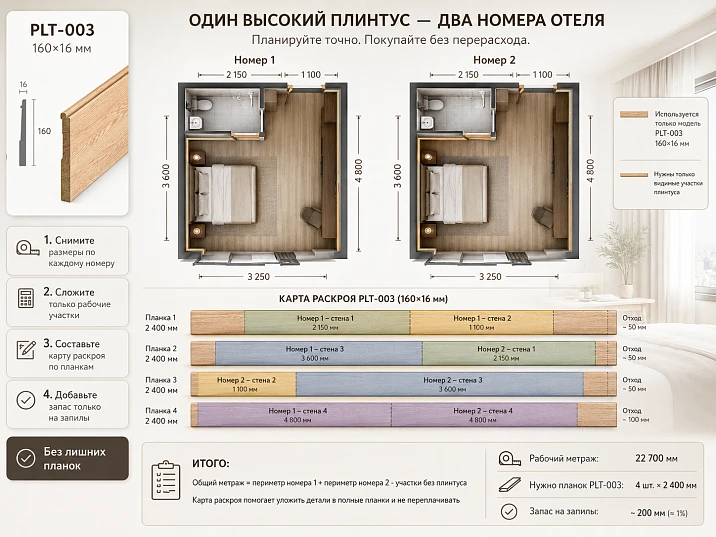
Twelve identical rooms cannot be considered as 'one room × 12'. For a serial project, this is too rough a model: it multiplies not only the useful footage, but also all unused remnants of each individual room.
If one room contains long sections of 2320 and 2180 mm, medium sections of 1460 and 880 mm, and a short section of 620 mm, with isolated cutting the installer easily opens four strips per room. For 12 rooms it turns out:
4 × 12 = 48 whole strips.
But if the same parts are counted not by rooms but as a single pool, the short 620 mm sections can be produced in series from individual rods, and the remnants cease to "belong" to the room in which they arose. On the training map for PLT-003 with a length of 2400 mm, a working batch of 40 strips is obtained, and for moisture-resistant MDF 2600 mm — 39 strips before accounting for the actual technological consumption of a specific workshop.
That is, the difference appears not from the overall reserve percentage, but from a different organization of procurement:
reference room → list of exact parts → common map for all 12 rooms → remnant bank → purchase of whole strips.
That is why a large project is more profitable to calculate centrally.
For such a task, you can order a tall wooden baseboard PLT-003 only after not the sum of linear meters, but a specific cutting sheet is approved.
The main idea of the article:
serial procurement of PLT-003 is a task of cutting a batch, not of multiplying the perimeter of one room.
In the future, we will use one training room type. Its dimensions are not characteristics of any real apart-hotel. They are needed to show the calculation mechanics and the principle of centralized use of remnants.
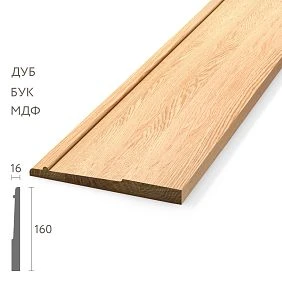
High wooden skirting board PLT-003 160×16 mm: what data we record before calculating the batch
The current PLT-003 card confirms three versions:
| Execution | Size, mm | Price at the time of check | Availability at the time of check |
|---|---|---|---|
| Moisture-resistant MDF | 160×16×2600 | 3,330 RUB | SPb — 1 pc. |
| Beech | 160×16×2400 | 7,790 RUB | SPb — 6 pcs. |
| Oak | 160×16×2400 | 11,120 RUB | SPb — 10 pcs. |
The card also indicates the "Prestige" sanding quality, preparation options for enamel/tinting for the corresponding versions, shipment of warehouse goods after preparation, Contact us to confirm shipping to your destination., and an average production time for custom orders of 5–10 working days.
For a serial project, another conclusion is important: the current warehouse stock does not cover the training batch of 12 numbers in any material. If the calculation requires 39–40 planks, the purchase must be approved as a production batch, not relying only on the "in stock" button.
The first product mention is — skirting board PLT-003 160×16 mm.




PLT-003 made of moisture-resistant MDF 160×16×2600 mm
MDF provides a length of 2600 mm — 200 mm more than beech and oak.
These 200 mm should not be considered an automatic advantage. They are only useful when they match the actual combinations of parts.
In our training series, the advantage will appear on short sections of 620 mm: four such parts fit into 2600 mm:
620 × 4 = 2480 mm.
Remaining before technological allowance:
2600 − 2480 = 120 mm.
This cannot be considered a ready clean remainder: the workshop must account for the saw kerf, end trimming, and the actual technology.
Our factory also produces:


Beech PLT-003 160×16×2400 mm
Beech has the same geometry of 160×16 mm, but a length of 2400 mm.
For the series card, this means that short parts of 620 mm are conveniently assembled in threes:
620 × 3 = 1860 mm.
540 mm remain to the technological consumption.
Beech cannot be considered just a "shorter MDF": it is a different material and a different finishing task.
Get Consultation
Oak PLT-003 160×16×2400 mm
In terms of cutting, oak repeats the beech map of 2400 mm.
The difference is in cost, texture, and requirements for wood distribution between numbers.
If the object must have uniform tinting, the oak batch needs to be sorted before sawing to avoid one number being noticeably darker than the adjacent one.
For a detailed comparison of materials, there is no need to repeat the already published article PLT‑003 or PLT‑004 160 mm. Here, the material matters only insofar as it determines the length of the log, finishing, and cost of the entire batch.
Typical number and wooden baseboard: why one common perimeter is not enough
For a serial purchase, the number needs to be broken down not by rooms, but by mounting parts.
The training number contains five segments:
| Code | Section | Finished length |
|---|---|---|
| A | Long wall | 2320 мм |
| B | second long wall | 2180 мм |
| C | middle wall | 1460 мм |
| D | Pier | 880 мм |
| E | door area/short section | 620 мм |
Total finished length of one room:
2320 + 2180 + 1460 + 880 + 620 = 7460 mm.
For 12 identical rooms:
7460 × 12 = 89,520 mm,
or 89.52 m.
If you stop at this figure, the calculation is still not ready.
Why the 2320 mm wall matters more than the total room area
For beech and oak, 2320 mm almost fully occupies a 2400-mm plank.
Nominal remainder:
80 mm.
This part cannot be "assembled" from two general meters without a direct joint.
It immediately reserves a separate strip.
The same applies to 2180 mm:
2400 − 2180 = 220 mm.
In 12 rooms, there are already 24 such long parts, and each one effectively blocks one original plank.
Why five short sections are better counted as a single pool
A 620 mm part in one room seems like a trifle.
But in 12 rooms:
620 × 12 = 7440 mm.
This is already an independent cutting group.
Instead of opening one additional strip in each room, 12 short elements can be produced in a series and then distributed among the kits.
This is where serial production starts saving material.
Buy wooden floor plinth: first, we build a cutting map for one reference room.
Before placing a serial order, it is useful to buy a wooden floor plinth only after verifying that the selected profile and material are indeed approved for the project.
For PLT-003, the reference room is needed not as a "consumption rate," but as a source of repeating parts.
We assign long walls to whole strips.
A=2320 mm.
B=2180 mm.
For 2400 mm beech/oak, both parts get their own whips.
For 2600 mm MDF — same: the 280 and 420 mm remnants do not cover other part numbers without additional logic.
We add the short piers to the common list.
C=1460 mm.
D=880 mm.
They make a good pair:
1460 + 880 = 2340 mm.
This combination fits into both 2400 and 2600.
For 2400, the remainder is:
60 mm before accounting for the saw kerf.
This is already a dense but non-zero map; it needs to be confirmed against the actual trimming technology.
External corners are calculated separately.
If one of the parts has an external corner, the finished length at the face point may differ from the length of the rectangular blank before cutting.
Therefore, mass B2B cutting is launched only after a control installation of the reference number and clarification of the blank lengths.
The door opening is not mechanically subtracted from the total footage before cutting.
In a regular calculation, the door simply reduces the perimeter.
In a serial map, what matters more is which two parts are formed to the left and right of the opening.
Two sections of 620 mm each are not "1240 mm of wall" in an abstract sense. These are two separate parts that can be combined with remnants of other numbers.
Oak and beech skirting PLT-003 2400 mm: how to lay out one number across whole planks.
If you count each number separately, the working scheme looks like this:
| Plank 2400 mm | Parts | Used | Nominal remainder |
|---|---|---|---|
| №1 | A=2320 | 2320 | 80 |
| №2 | B=2180 | 2180 | 220 |
| №3 | C=1460 + D=880 | 2340 | 60 |
| №4 | E=620 | 620 | 1780 |
Total:
4 slats per number.
For 12 numbers:
48 slats.
Purchased length:
48 × 2400 = 115,200 mm,
or 115.2 m.
Net usable length:
89.52 m.
The difference:
25.68 m of source material remains as offcuts and technological reserve if each number is fully covered from its own mini-kit.
This is the main defect of the "number × 12" calculation.
Why the fourth plank is used particularly poorly
Only a 620 mm piece is needed from it.
Even before accounting for the cut, there remains:
1780 mm.
If the installer treats the remainder as property of room number 101 and does not carry it over to the next rooms, a large useful fragment turns into a warehouse tail.
Why can't you simply take this remainder to the next long wall
1780 mm does not cover either A=2320 or B=2180.
But it can provide:
-
two sections of 620 mm each;
-
a short wall of another type;
-
several returns.
That is, the remainder is only useful if there is a centralized parts database.
12 identical numbers: how a single cut reduces 48 strips to 40
Now we stop treating the number as a separate purchasing unit.
We collect 12 copies of each part:
-
A 2320 mm × 12;
-
B 2180 mm × 12;
-
C 1460 mm × 12;
-
D 880 mm × 12;
-
E 620 mm × 12.
Group A
Each A takes one 2400 mm whip.
You need to:
12 planks.
Group B
Same:
12 planks.
Subtotal:
24 planks.
Group C+D
Each pair:
1460 + 880 = 2340 mm.
For 12 numbers you need:
12 planks.
Total so far:
36 slats.
Group E
12 pieces of 620 mm.
Nominally, three fit into one 2400 mm whip:
620 × 3 = 1860 mm.
For 12 pieces:
12 / 3 = 4 strips.
Overall total:
36 + 4 = 40 strips.
What changed
No room dimension has changed.
The profile is the same.
The material is the same.
The savings appeared only because parts E were no longer produced one per number.
Comparison:
48 − 40 = 8 strips.
The purchased length is reduced by:
8 × 2400 = 19,200 mm,
or 19.2 m.
This is no longer a symbolic remainder, but a full part of a large batch.
Why 40 is a working map, not a universal norm
It is only valid for educational sizes A–E.
On a real object, the following will change:
-
actual lengths;
-
external corners;
-
saw cut width;
-
end trimming;
-
number of number types.
Therefore, the algorithm needs to be repeated on the actual statement.
PLT-003 from moisture-resistant MDF 2600 mm: why it needs a different cutting map
For MDF, the length increases to 2600 mm.
This does not change all parts, but only those combinations for which the additional 200 mm are actually useful.
A=2320 mm
Remaining from 2600:
280 mm.
A second full part cannot be added.
B=2180 mm
Remainder:
420 mm.
Also not enough for E=620.
C+D
1460+880=2340 mm.
Remainder:
260 mm.
Compared to 2400, the map becomes freer, but the number of whips does not decrease.
The main difference is group E
Four short parts of 620 mm each:
620×4=2480 mm.
In 2600 remains:
120 mm to technological waste.
Therefore, 12 parts of E can be distributed by:
3 planks of 2600 mm.
Final working map:
-
A: 12 planks;
-
B: 12;
-
C+D: 12;
-
E: 3.
Total:
39 planks of 2600 mm.
How much purchased length
39 × 2600 = 101,400 mm,
or 101.4 m.
Why can't you say "MDF saves one plank, so it's more profitable"
Because different materials are being compared.
Correct output:
in this specific set of parts, the 2600 mm format allows packing four E=620 into one strip and reduces the number of initial planks from 40 to 39 relative to the 2400 mm map.
The material is selected according to the project and finish.
After that, the cutting layout is compared.
High wooden baseboard for an apart-hotel: creating a unified stock bank for 12 rooms
The stock bank is needed not as a box for 'put all useful things here,' but as a managed warehouse of semi-finished products.
Each leftover receives:
-
material;
-
actual usable length;
-
existing end;
-
source plank number;
-
surface status;
-
purpose.
Example labeling:
PLT003-DUB-07 / 940 mm / straight end / reserve.
Or:
PLT003-BUK-18 / 620 mm / N203-E.
Remnants over 1500 mm
This is an example of an organizational category, not a STAVROS standard.
It is reasonable to reserve such pieces for:
-
long wall sections;
-
parts of a different type number;
-
repair stock.
They should not be cut into test specimens while large parts remain on the list.
Remnants 800–1500 mm
Usually the most versatile group.
They can be used to cover:
-
areas near doors;
-
short walls;
-
sections next to the wardrobe;
-
niches.
Remnants less than 800 mm
Use only where the project actually contains short pieces.
Do not create an extra joint on a long wall just to utilize a 500–700 mm piece.
Why 800/1500 mm thresholds are not a manufacturer's rule
This is a convenient example of the object's internal logistics.
In a real project, bank boundaries are set by the actual lengths of repeating pieces.
If all short piers are 920 mm, the remaining 880 mm is already almost useless for this object, although formally it falls into the "medium" group.
How to label the remainder so that installers do not lose the batch savings
Poor labeling:
"oak, long piece."
Good:
PLT003-DUB-P24-07 / 940 mm / right end straight / free.
Where:
-
PLT003 — article number;
-
DUB — material;
-
P24 — original format 2400;
-
07 — rod number;
-
940 — usable length.
Why the source plank number is needed
For oak, it helps preserve information about tone and batch.
If two adjacent parts are better made from similar wood, the source can be restored.
Why write the existing end
A 940 mm remainder after an angled cut may have a shorter usable straight length.
A number without an end description is misleading.
Wooden baseboard PLT-003 on repeated floors: how to assemble sets by numbers
After centralized cutting, there is no need to return to chaos.
Parts are assembled into installation kits.
For each number:
-
A;
-
B;
-
C;
-
D;
-
E;
-
scheme;
-
floor number;
-
finish;
-
notes on corners.
Why first cut the pool, and then assemble the numbers
So short E's are produced in a series of four or three original rods, not one by one from the "personal" plank of the room.
After cutting, they are distributed:
-
E101;
-
E102;
-
E103;
-
…
What to do with the uncut reserve
Store separately.
Do not give it to the crew as "more material for the floor."
Otherwise, the reserve will easily go to a convenient but unintended cutting pattern.
Floor-by-floor logistics
If 12 rooms are located on three floors with four per floor, you can prepare:
-
four sets for floor 2;
-
four sets for floor 3;
-
four sets for floor 4;
-
a separate central reserve.
This reduces the risk that the 620 mm piece from room 402 will be trimmed by an installer on another floor.
Buy wooden baseboard in one batch: what should be included in the procurement specification
For a 12-room property, the order should look like a production specification, not like a line:
"Need about 90 meters of tall baseboard."
The specification records:
-
article PLT-003;
-
material;
-
cross-section 160×16 mm;
-
length of the original strip;
-
number of whole planks;
-
number and types of rooms;
-
cutting layout;
-
finishing;
-
reserve;
-
delivery address and conditions;
-
temporary storage location on site;
-
person responsible for accepting the batch.
If you need to buy wooden baseboard for a large facility, it is precisely this specification that reduces the risk of ordering the right product in the wrong quantity.
Why the article number and size should be written together
PLT-003 must not be shortened in the request to:
"high baseboard 160".
The assortment includes other profiles of similar height.
Working line:
PLT-003 / 160×16×2400 / oak / Prestige / quantity ___ pcs.
Why material and length are related
For the current card:
-
moisture-resistant MDF — 2600 mm;
-
beech — 2400 mm;
-
oak — 2400 mm.
If you send only "PLT-003 40 pcs." to the manager, without the material, the quantity alone does not complete the order.
Why quantity should be in pieces
Slats are sold in specific lengths.
89.52 m of net footage is not a product unit.
Need to order:
-
40 slats of 2400 mm;
-
either 39 slats of 2600 mm;
only if these exact cards are confirmed for the selected material.
Price of wooden baseboard: why we calculate whole slats for the object, not linear meters
Purchase formula:
cost of the main batch = number of whole slats × current price of the selected SKU.
Not:
finish footage × conditional price per linear meter.
At the time of check price of PLT-003 is:
-
moisture-resistant MDF 2600 mm — 3,330 RUB;
-
beech 2400 mm — 7,790 RUB;
-
oak 2400 mm — 11,120 RUB
This is a current snapshot. Before paying for a large batch, the price and availability need to be confirmed again.
If each number is counted separately — 48 slats
Beech:
48 × 7,790 = 373,920 RUB
Oak:
48 × 11,120 = 533,760 RUB
MDF:
48 × 3,330 = 159,840 RUB
If using a centralized balance bank
For 2400 mm cards:
40 slats.
Beech:
40 × 7790 = 311,600 RUB
Oak:
40 × 11,120 = 444,800 RUB
For MDF:
39 × 3330 = 129,870 RUB
The difference is only due to the cutting organization
Beech:
373,920 − 311,600 = 62,320 RUB
Oak:
533,760 − 444,800 = 88,960 RUB
MDF:
159,840 − 129,870 = 29,970 RUB
These amounts do not compare materials with each other. They show the difference within one execution between isolated and centralized cutting of a training batch.
What is not included in the calculation
-
delivery;
-
packaging;
-
finish;
-
installation;
-
glue/fasteners;
-
possible reserve;
-
technological rejection.
Therefore, this is not the final estimate for the object, but the cost of the main product item.
Why the current warehouse stock of PLT-003 is insufficient for the training batch
At the time of checking, the card shows:
-
MDF 2600 — 1 pc. in St. Petersburg;
-
beech 2400 — 6 pcs.;
-
oak 2400 — 10 pcs.
The training batch requires:
-
39 MDF;
-
or 40 beech/oak planks.
No warehouse stock covers the entire volume.
What does this change?
For a B2B project, you cannot build a schedule solely around the words "in stock."
Need to confirm:
-
how much is available now;
-
how much is being produced;
-
production time;
-
whether the batch will be from a single production period;
-
when a single shipment is possible.
The card indicates an average production time for custom orders of 5–10 business days.
Why you cannot split a large oak order into random small purchases without a reason
If some planks are bought now and some later, the risk increases:
-
shade differences;
-
of different batches;
-
separate logistics;
-
multiple deliveries.
For natural wood, this is especially important.
When phased delivery is justified
If the renovation proceeds floor by floor and the production schedule is agreed upon in advance.
Then the batch can be deliberately divided:
-
1st floor;
-
2nd floor;
-
3rd floor;
-
reserve.
But each stage should still have its own map.
Order oak skirting board PLT-003: when extra stock is really needed
Mechanical +10% for a 40-plank map would mean four more strips.
For oak at the current price:
4 × 11 120 = 44 480 rub.
This is too large an amount to add automatically.
Stock should address a specific risk.
Risk 1. Parts are almost equal to the length of the strip
A=2320 mm.
Up to 2400, there are 80 mm left before the technological allowance.
If the actual cutting length after the corner joint is longer, this group may become borderline.
Risk 2. External corners
They increase the likelihood of re-cutting and require precise orientation.
Risk 3. No suitable leftover to replace a long piece
The lost A=2320 cannot be replaced with two pieces of 1000+1400 without an additional visible joint.
Risk 4. Repair stock after project handover
For an apartment hotel, it is reasonable to consider several full slats or large leftovers of the same material and finish.
This is already an operational reserve, not an "installation allowance."
Which reserve to choose
Not a universal number.
In the work sheet, the reserve is marked as:
-
R1 — replacement of A/B;
-
R2 — repair after handover;
-
R3 — trial external corners.
This makes it clear why each additional strip is purchased.
Two types of room numbers: how to expand the system without multiplying each room separately
A real apartment hotel often has not one, but two or three types.
For example:
-
8 rooms of type A;
-
4 rooms of type B.
Type A — our training set:
2320 / 2180 / 1460 / 880 / 620.
Type B, for example:
2320 / 2050 / 1320 / 920 / 720.
This is a new training example.
Weak method
Calculate A separately.
Calculate B separately.
Multiply.
Strong method
Create a single 12× list of all parts and search for combinations between types.
For example, the remainder after B=1320 may fit with A=880:
1320 + 880 = 2200 mm.
In 2400, 200 mm remains.
And the remainder 720 from type B can combine with 1460:
1460 + 720 = 2180 mm.
That is, two types of numbers sometimes provide more optimization opportunities than twelve absolutely identical ones.
Why you cannot promise in advance that two types are always better
If the sizes do not combine well, the total pool will not reduce the quantity.
Actual bin-packing of parts is needed.
How to maintain a cutting map in Excel or a simple spreadsheet
A specialized program is not mandatory for 12 numbers if the parts list is controlled.
Minimum columns:
| Field | Content |
|---|---|
| Piece ID | A101, B101, E112 |
| Room type | A/B |
| Room | 101–112 |
| Clean length | Finish size |
| Blank length | blank size |
| Left end | straight/angled |
| Right end | straight/angled |
| Material | MDF/BEECH/OAK |
| Source plank | P001… |
| Cut order | cut order |
| Remainder | Remainder |
| Status | cut/installed/reserve |
Why two lengths are needed: clean and blank
Clean length is what should result on the wall.
Blank length is how much is actually needed from the original stick to the final cut.
For a serial project, it is the blank length that should be used in the cutting program.
When clean and blank can coincide
On a simple section with straight ends.
When they do not coincide
-
an external corner;
-
miter;
-
complex junction;
-
allowance for fitting.
Control number before launching the entire batch
You can't immediately cut 40 oak planks just because Excel added up.
First, you need to assemble one reference number.
What is being checked
-
actual lengths A–E;
-
angles;
-
trim;
-
wardrobe;
-
finished floor;
-
preparation dimensions;
-
visible joints.
After installing the reference
The list is adjusted.
For example:
A turned out to be not 2320, but 2332 mm.
D — not 880, but 867.
For one room, the difference is small.
For 12:
12 × 12 mm = 144 mm only along A.
More importantly: A has become closer to the limit of 2400.
When to start serial cutting
After the reference number:
-
is mounted;
-
is accepted;
-
dimensions are fixed;
-
typical construction deviations are assessed.
Repeated rooms are not always identical: how to account for construction tolerance
According to the project, the room numbers are identical.
In reality, the walls may differ.
Therefore, mass-cutting parts exactly 2320 mm for all 12 is risky if each room is not measured.
Approach 1. Final individual measurement
For each room, A101, A102, A103... are recorded.
The most accurate method.
Approach 2. Standard blank + final fitting
The workshop cuts parts with an agreed allowance, and the final size is adjusted on site.
The allowance size cannot be invented in an article — it is set by the contractor based on the profile, angles, and tool.
Approach 3. Grouping by actual ranges
For example, part of the numbers:
A = 2318–2324 mm.
Another:
A = 2330–2336 mm.
Then batches can be produced by groups.
Why "all numbers are the same" does not cancel the measurement
Serial production is an advantage of purchasing.
It does not guarantee construction identity.
PLT-003 or PLT-004 160 mm: we move the material comparison to a separate cluster
The new article should not repeat the large comparative material PLT-003 or PLT-004 160 mm.
For serial purchasing, it is enough to fix one principle:
if the skirting board model changes, the cutting map must be recalculated completely.
Even if the height remains 160 mm.
PLT-004 has a different construction of wood-based versions, and the product choice affects:
-
material;
-
price;
-
finishing;
-
delivery.
Therefore, you cannot first optimize 40 planks of PLT-003 and then replace the article "without changing the quantity."
How to calculate MDF skirting board and why a general article does not replace a B2B card
For one room, a general material is useful how to calculate MDF baseboard.
He explains:
-
perimeter;
-
doors;
-
allowance;
-
converting meters into planks.
This is not enough for 12 repeating numbers.
Difference in approaches
A regular calculation asks:
how many planks does the room need?
Serial:
which specific parts repeat 12 times and how to pack them into the minimum reasonable number of whole rods?
Why this is a different intent
In a B2B purchase, the user has already selected the product.
They don't need another introductory lesson on perimeter.
They need:
-
cut list;
-
bank of remnants;
-
batching;
-
reserve;
-
batch cost;
-
procurement specification.
Quality of wooden products: why one batch must have a uniform finish
For natural beech and oak, it is important to determine in advance quality of wooden products and the finishing system.
On a serial project, a weak scheme:
-
units 101–104 are painted by one crew;
-
105–108 — by another;
-
109–112 — after two weeks;
-
Trial tinting is not recorded.
Even a single article can look different after different finishes.
For beech under enamel
The main thing is a unified system:
-
primer;
-
intermediate preparation;
-
finish;
-
gloss.
For oak under tinting
Sorting is added by:
-
shade;
-
pattern;
-
direction;
-
batch.
Why finishing should be linked to part marking
If parts are already assigned numbers, they cannot be randomly swapped after tinting.
It is better to store the marking:
A101 / A102 / A103
until final installation.
Tips for finishing wooden baseboards: why a test number matters more than a color fan
Before mass treatment, it is useful to check tips for finishing wooden baseboards and make a real sample.
For a project with 12 numbers, it is not enough to approve only the paint or stain code.
You need to look at:
-
PLT-003 on the finished floor;
-
next to the wall;
-
near the door casing;
-
under actual room lighting.
Why one sample saves more than its cost
If the shade is unsuccessful, it's easier to change the system on one fragment than to repaint dozens of planks after cutting.
When to paint — before or after cutting
There is no single scheme for all projects.
But fresh ends after cutting still require treatment.
Therefore, the installation technology and finish must be coordinated before releasing the entire batch.
External corners and complex junctions: why they break perfect repeatability
Training room A–E was deliberately simple.
A real number can have:
-
a column;
-
a niche;
-
external corner;
-
built-in wardrobe;
-
a door portal.
Each such node adds not only length, but also the orientation of the part.
Left and right corners are not the same thing
A remainder with an already made left miter may not fit the right node.
Therefore, the remainder bank must store the geometry of the end face
Not just the length.
When serial production is especially useful
If 12 numbers have the same external corners, you can:
-
make a reference template;
-
repeat the setup;
-
reduce the number of trial cuts.
When serial production is dangerous
If the first template is erroneous.
Then the error is replicated across 12 rooms.
That is why the control number is installed before serial cutting.
Repair reserve after handing over the apartment hotel
Installation reserve and operational reserve are different concepts.
installation
Needed before handover for:
-
cut errors;
-
defect;
-
damage to the object.
Operational
Stored after delivery for:
-
room repair;
-
replacement of the damaged area;
-
local rework.
Why it is useful to preserve whole or large fragments for oak
In a year, a new batch may differ in tone.
The remainder from the original order is better suited for repair.
How to store
Marking:
-
article number;
-
material;
-
finish;
-
batch date;
-
length.
And a separate dry place.
Delivery of long baseboard PLT-003 to the site: check logistics before paying for the batch
Logistics are already covered in detail in the material how to check the delivery of PLT-003 with a length of 2400/2600 mm.
For serial purchasing, scale is added.
40 strips of 2400 mm are not one or two pieces that can be carefully carried by hand without organization.
Before payment, you need to check:
-
unloading;
-
temporary storage space;
-
elevator/stairs;
-
protection of finishes;
-
floor-by-floor distribution;
-
marking.
Why can't the entire batch be delivered directly to the finished rooms
Risk:
-
mix up sets;
-
damage the planks;
-
use the reserve;
-
clutter the passageways.
Better
Organize a central zone:
-
unsawn;
-
ready-made kits;
-
remnants;
-
reserve.
Clarify order delivery conditions needed before fixing the installation schedule.
Linear products made of wood and MDF: when one order includes not only PLT-003
If the project includes Wood and MDF moldings, there is no need to mix them into one stock bank just because they are ordered together.
Different profiles have:
-
a different cross-section;
-
a different function;
-
different article.
Can be combined
-
delivery;
-
acceptance;
-
finishing;
-
storage by material.
Cannot be combined
-
cutting;
-
remnants;
-
Quantity.
A PLT‑003 offcut does not replace a trim of a different article.
When a unified stock bank is not needed
A centralized bank is not always useful.
Numbers with different materials
For example:
-
first floor — MDF;
-
second — oak.
Remnants are incompatible.
Different colors
If PLT-003 is painted in different shades, physically identical pieces are no longer universal.
Installation is widely separated in time
If numbers are handed over in blocks and there is no place to store remnants, each stage can be counted separately.
Contractors are independent
If each floor is installed by a separate company without a common warehouse and accounting, the paper bank will not work.
What to do
Create a separate pool for each compatible cluster:
-
material;
-
color;
Cutting report after each floor: how to understand whether the calculation works in reality
Table before purchase — forecast.
After the installation of the first floor, it should receive actual data.
Suppose, for four numbers it was planned:
-
4 A;
-
4 B;
-
4 C;
-
4 D;
-
4 E.
After cutting, the following is recorded:
-
actual losses;
-
what leftovers went into the bank;
-
how many parts had to be redone;
-
which lengths systematically differ from the project.
If the plan and the actual match
The second floor is launched using the same map.
If one part systematically changes
For example, E turns out to be 635–645 mm instead of 620.
For three E's in 2400, this is not a problem:
645×3=1935 mm.
But for four E's in 2600:
645×4=2580 mm.
Only 20 mm remain before the technological allowance — the original MDF board for four parts already becomes risky.
This is a strong example of scale:
a change of just 25 mm in one short dimension can eliminate the advantage of the 2600 mm board for the entire batch.
If the consumption on the first floor is higher than forecast
There is no need to automatically increase the entire order by 10%.
First, find the cause:
-
walls differ;
-
incorrect blank length;
-
too large machining allowance;
-
damage;
-
cutting errors.
Only after this, adjust the remaining batch.
Piece-by-piece card vs. percentage: how to reserve for the remaining eight numbers
Suppose the first floor of four numbers is already installed.
Eight remain.
Instead of the formula:
remaining linear meters +10%,
recalculate the exact quantity:
-
A ×8;
-
B ×8;
-
C ×8;
-
D ×8;
-
E ×8;
-
plus actual stock on hand.
Example
After the first floor, the following remains:
-
one clean piece 940 mm;
-
two of 620 mm;
-
one 1500 mm.
Then the remaining requirement is no longer equal to a simple
8/12of the original 40 planks.Useful remnants are deducted as ready potential parts, not as linear meters.
Why this scheme is convenient for phased financing
The customer can:
-
purchase a confirmed initial batch;
-
verify actual consumption;
-
adjust the next production run;
-
keep the overall article and finish.
For natural wood, the risk of batch differences must be separately agreed upon. If a consistent tone is critical, a single material purchase may be more important than phased quantity optimization.
When it is better to order the entire PLT-003 as one production batch
A single batch is stronger if:
-
oak must have a similar tone;
-
finishing is done centrally;
-
the warehouse at the site is ready;
-
12 rooms are being installed in a short period;
-
the financial schedule allows.
When is it better to split the order
-
the rooms actually differ;
-
the first type is not yet confirmed;
-
storage is problematic;
-
installation is done in batches;
-
there is a risk of layout changes.
What not to do
Do not mix strategies randomly.
Bad:
"We'll take what's in stock now, then reorder what we can get later."
Good:
"First batch — reference plus four numbers; after acceptance, the rest of the batch is released per the same specification."
This keeps procurement manageable.
Errors in serial order PLT-003 that scale across all 12 numbers
Error 1: Multiply four strips of the reference number by 12
Reason: It's convenient to treat each number as independent.
Consequence: In the training example, the order grows to 48 strips instead of the working centralized map of 40/39.
Prevention: count all repeating short parts as one pool.
Error 2. Count only 89.52 m of finished length
Reason: it seems enough to divide by the length of the whip.
For 2400:
89,520 / 2400 = 37.3 → 38 planks.
But 24 long parts A/B already require 24 separate whips, and the remaining combinations do not allow assembling the entire list into 38.
Prevention: bin-packing of specific parts.
Error 3. First cut all short parts
Then good long whips lose the ability to cover A/B.
Prevention: long parts are reserved first, then medium, then the short pool.
Error 4. Counting 2600 mm as automatically more profitable than 2400
In the training map, MDF saves only one initial strip relative to the 2400 mm map.
200 mm do not change the number of A/B/C+D.
Prevention: compare two real maps.
Error 5. Not accounting for the cut
The combination 620×4=2480 in 2600 has a margin of 120 mm before technological waste.
If production has not checked the kerf width and end trimming, this remainder cannot be turned into "guaranteed 120 mm."
Mistake 6. Calling any piece a remainder
A fragment with damage or an incorrect angled end may have no usable length.
Mistake 7. Not securing parts by numbers after centralized cutting
Savings are achieved in the workshop but lost on site: installers re-cut parts.
Mistake 8. Mixing different materials in one bank
MDF residue does not replace oak.
Mistake 9. Mixing different finishes
Oak of one tint and oak of another tint are different stock items in the project, even if the article number is the same.
Mistake 10. Not creating a reference number
An erroneous length A of 10 mm is replicated 12 times.
Mistake 11. Ordering exactly according to current stock
At the time of checking, there are 1 MDF, 6 beech, and 10 oak slats in stock — this is insufficient for a training batch.
Mistake 12. Adding +10% instead of a real reserve
Four extra oak whips is a significant amount. It is better to understand which long part the reserve covers.
Mistake 13. Not checking delivery access and storage
Even a correct batch of 40 planks can be damaged by logistics.
Mistake 14. Considering the price per linear meter as the main indicator
A whole plank is purchased.
Mistake 15. Throwing away the useful remainder before completing the next floor
The remainder bank should only be closed after the installation of the entire compatible group of rooms.
How to accept the first delivery of PLT-003 for a serial project
Acceptance is part of the procurement system.
Check the quantity
Verify:
-
actual number of rods;
-
material;
-
length;
-
article number.
Check the surface
Set aside the planks separately:
-
for the main long walls;
-
with local features;
-
for short pieces;
-
reserve.
Check straightness and ends
Long A=2320 mm is more demanding on the source plank than E=620.
Therefore, the worst geometry whips cannot be randomly used on long visible walls.
Photo capture
Before cutting, do:
-
general frame of the batch;
-
marking;
-
Identified damages.
Why can't we distribute by numbers right away
First, production sorting.
Then cutting.
Then assembly.
When you don't need to buy the entire PLT-003 batch at once
Although the article is commercial, a single purchase is not always the best option.
The first type of number is not yet accepted
Do not start cutting 40 planks.
Construction dimensions continue to change
The serial production of the project is not yet confirmed on paper.
Material not approved
First decide on MDF/beech/oak for the project.
Finish not selected
For natural wood, this affects sorting.
No storage space
Long items can be damaged more on site than saved on one delivery.
Production schedule runs in batches
Sometimes it is wiser to order the first confirmed batch and simultaneously lock in the parameters of the next one.
Final check before paying for the entire PLT-003 batch
Before translating a large order, it is useful to print one page with four final figures:
-
the number of rooms of each type;
-
the quantity of parts of each length;
-
number of whole slats;
-
a separate reserve.
Two versions of the map should be nearby: the original and the one after the control number. If they differ, only the last approved revision is passed to the manager and production.
The current warehouse is checked separately. A training map for 40 beech/oak slats significantly exceeds the current 6 beech and 10 oak whips in St. Petersburg, so the payment date should be linked to the confirmed production lead time, not just to the availability of a few units in the card.
For natural oak, before payment, the finish and the batch sorting principle are also recorded. For MDF, the selected painting system is recorded. After that, the order becomes reproducible: if another standard number is needed in a month, not only the article number but also the cutting logic, marking, and reserve can be restored.
A large purchase is ready when any project participant can answer from one list: which slat, for which part, into which number, and what remainder should remain after it.
Final decision tree: how many PLT-003 to order for 12 standard numbers
Step 1. Is article PLT-003 approved?
-
no → product first;
-
Yes → continue.
Step 2. Material selected?
-
MDF → 2600;
-
beech/oak → 2400.
Step 3. Is there a control number?
-
no → first assemble/measure;
-
Yes → continue.
Step 4. Is the blank length known for each part?
-
no → do not start serial cutting;
-
Yes → continue.
Step 5. Are all numbers really of the same type?
-
no → divide into types;
-
Yes → continue.
Step 6. Are long parts assigned to separate rods?
-
no → assign;
-
Yes → continue.
Step 7. Are short parts collected into a common pool?
-
no → centralize;
-
Yes → continue.
Step 8. Can leftovers be transferred between numbers?
-
no → count by stages;
-
Yes → continue.
Step 9. Is the actual map 2400/2600 verified?
-
no → do not use only total footage;
-
Yes → continue.
Step 10. Is a specific reserve calculated?
-
no → determine risk;
-
Yes → continue.
Step 11. Do warehouse/production confirm the required quantity?
-
no → agree on the batch timeline;
-
Yes → continue.
Step 12. Are delivery and storage confirmed?
-
no → resolve logistics;
-
yes → place the order.
FAQ about ordering high wooden baseboard PLT-003 for standard rooms
What is the size of PLT-003?
The current product card shows a cross-section of 160×16 mm.
What is the length of PLT-003 made of oak?
2400 mm.
What is the length of PLT-003 made of beech?
2400 mm.
What is the length of PLT-003 made of moisture-resistant MDF?
2600 mm.
Can I simply multiply the calculation for one room by 12?
You can get an upper rough estimate, but it does not account for carryover of leftovers. In the training example, the isolated calculation gives 48 strips, the centralized one gives 40 or 39.
Can leftovers of one size be used in the next one?
Yes, if the material, finish, length, and end geometry match.
How to calculate long walls of almost 2400 mm?
As separate priority parts. For 2320 mm, a whole 2400 mm stick is reserved first.
When does 2600 mm actually reduce the number of strips?
When the extra 200 mm allows more needed parts to be assembled into one source stick. In our example, four parts of 620 mm fit into 2600, but only three into 2400.
What reserve should be set for PLT-003?
After the map. Not a universal 10%, but specific whole sticks for the risk of long parts, corners, and repair stock.
Where to buy wooden baseboard PLT-003?
The specific product is in the card. A wider selection is provided by Wooden Skirting Boards.
Where to check the price of PLT-003?
In the current product card, right before payment.
What should be specified when ordering a large batch?
Article number, material, size, length, quality/finish, number of whole slats, delivery address, and contact of the responsible person.
Do parts need to be marked by numbers?
Yes. Especially after centralized cutting.
How to check the delivery of slats 2400/2600 mm?
Verify the entry route, unloading, and storage before paying for the batch.
Do I need to store leftovers after installation?
It is reasonable to keep useful large remnants of natural wood as a repair reserve if there is space and clear labeling.
When does the remnant bank not work?
When the numbers have different materials, colors, contractors, or stages without a common warehouse.
Can remnants be counted by total length?
No. Three offcuts totaling 1800 mm do not make one solid piece of 1600 mm if each fragment is shorter than it.
Can all cutting be prepared in the workshop?
Yes, if the final dimensions and angles are confirmed. The STAVROS card itself does not confirm the cutting-to-size service, so specific cutting needs to be arranged with the chosen contractor.
What to do if one number differs from the rest?
Remove it from the standard pool and count it as a separate card or a new type.
Short conclusion
Serial order PLT-003 does not start with a formula:
footage of one room × 12.
It starts with five steps:
reference room → exact details → overall map of the entire series → leftover bank → purchase of whole sticks.
In the training room, the details:
2320 / 2180 / 1460 / 880 / 620 mm
give 7460 mm of finished baseboard.
For 12 rooms:
89.52 m.
If you calculate each room separately, you will need:
48 slats.
If you combine the cutting:
for beech/oak 2400 mm — working map of 40 planks;
for moisture-resistant MDF 2600 mm — 39 slats.
At the current product price, the difference between the isolated and centralized model in the training example is:
-
beech — 62,320 RUB;
-
oak — 88,960 RUB;
-
MDF — 29,970 RUB.
These figures are not a quote for a specific hotel. They show the effect of the methodology itself.
Before payment, you need to confirm the actual dimensions, control number, stock lengths, technological allowance for cutting, current price, production lead time, and logistics. Only after this does the batch become not a "stock for 12 rooms," but a managed purchase of a specific PLT‑003.
-