Article Contents:
- Why narrow furniture sections look technical
- N-506 is not a central overlay, but a decorative thread
- Confirmed specifications of N-506
- Why 12 mm does not equal the minimum post width
- Four working layout schemes
- Scheme 1. One vertical line on a narrow post
- Scheme 2. Paired framing of glass
- Scheme 3. Repetition on multiple doors
- Scheme 4. Narrow vertical and small central accent
- Full-size template before ordering
- How to measure the free field
- Do not confuse length N-506 with post height
- When one, two, or several overlays are needed
- How to connect the overlay with the cornice and base
- Proximity to the handle
- Proximity to glass
- Proximity to hinges and fasteners
- How to create a vertical rhythm on multiple facades
- How to design a corner display case
- How to work with a tall display case
- How to design a small drawer or narrow door
- Beech for enamel and even color
- Oak for preserving wood grain
- "Standard" or "Prestige"
- How finish changes the perception of 12mm decor
- Paint separately or together with the facade
- Can N-506 be cut to length
- N-506 is not a structural batten
- Installation begins with checking the base
- Marking before gluing
- What to buy together with N-506
- When K-012 is needed instead of N-506
- When a central decor is needed
- How not to confuse N-506 with a regular vertical overlay
- Practical scenario: two-door display case
- Practical scenario: four-door cabinet display case
- Practical scenario: sideboard with open and closed sections
- Practical scenario: framed kitchen
- Practical scenario: narrow furniture side panel
- How to create a facade map
- Why it's better to order a repeatable row as one batch
- What to specify in the order specification
- Common mistakes when choosing and placing mirrors
- Place N-506 in the center of a field that is too wide
- Consider a width of 12 mm sufficient for a 12 mm field
- Design only one door from the row
- Place paired elements at different heights
- Glue the decor before checking the hinges
- Place the overlay flush against the glass
- Cut the product without analyzing the ornament
- Mix beech and oak under clear finish
- Buy a row in parts
- Use N-506 as a power bar
- Select glue only by name
- Paint thickly without a test
- Where to use narrow wooden overlay N-506?
- What is the size of N-506?
- Does the 12 mm width mean the post can be the same width?
- Can N-506 be installed next to glass?
- How many overlays are needed for the display case?
- How to position N-506 on paired doors?
- Can N-506 be glued to MDF?
- What Adhesive to Use?
- Should the overlay be painted together with the facade?
- What to choose for enamel — beech or oak?
- Can the oak N-506 be tinted?
- What is the difference between "Standard" and "Prestige"?
- Can N-506 be cut to length?
- How to make a template?
- What gap should be left from the glass?
- Can I install N-506 on a pull-out drawer?
- Do I need to buy a spare?
- Why is it better to order the entire set in one batch?
- Can I use N-506 as a reinforcement rail?
- What should I send to the STAVROS manager?
- How is N-506 different from the central overlay?
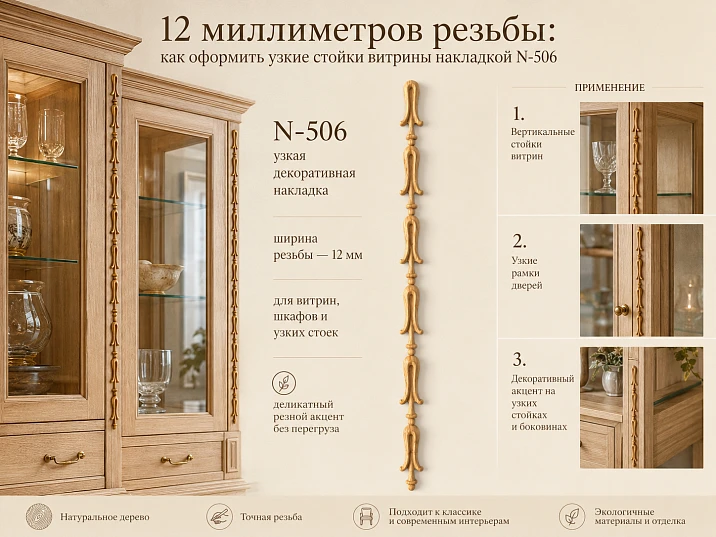
In furniture facades, large zones are usually well thought out: the cornice completes the top, the plinth forms the base, the panel gets a central accent, and the handles support the chosen style. But between these noticeable details, there remain narrow stiles, mullions, frame crosspieces, and small areas next to the glass. They are too tight for a regular carved overlay, so they are often left empty. As a result, an expensive display cabinet or wardrobe looks as if the decorative work stopped halfway.
Decor for narrow furniture facades requires a different logic. There is no need for a large cartouche, a wide rosette, or a massive vertical overlay here. The element must fit into a limited field, leave a safe margin from the glass, not block the hinge, and not conflict with the handle. At the same time, it should be visible from a normal viewing point and repeat on adjacent doors without accidental misalignment.
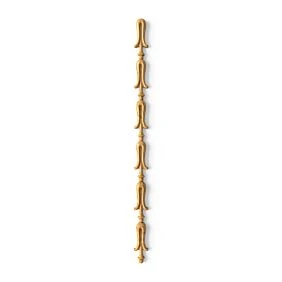
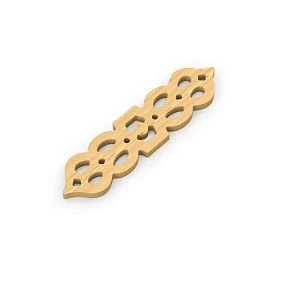
This problem is solved by narrow wooden overlay N-506Its size is 12 × 205 × 5 mm. The model is made from beech or oak and is offered with "Standard" or "Prestige" sanding. The width of only 12 mm allows working with furniture posts, frame fronts, small doors, and decorative slats, where a standard carved element would take up almost the entire available space.
But the compact size does not mean that N-506 can be glued into any free space. Errors in axis, height, and repeatability are especially noticeable with such an overlay. If two identical doors are decorated at different levels, the thin ornament emphasizes the misalignment. If the element is installed too close to the glass, the frame appears cramped. If one overlay appears on only one out of four fronts, the furniture loses its overall rhythm. Therefore, the path to purchase begins not with the quantity of items, but with a precise placement scheme.
Why narrow sections of furniture look technical
A display case post, narrow side panel, or frame crosspiece is often perceived as part of the structure, rather than as an independent decorative field. Their task is obvious: to hold the glass, separate doors, connect the top and bottom of the front. This is why the designer and craftsman focus on large details, while the narrow vertical remains without artistic continuation.
On simple modern furniture, such a solution can be intentional. In a classic, neoclassical, or Provencal front, an empty post sometimes looks accidental. The cornice and base have a profile, the central parts are decorated with panels, and between them runs a smooth technical strip. The eye perceives a break: the decorative language exists at the top and bottom but disappears on the connecting vertical.
Attempting to place a regular overlay on this strip often makes the situation worse. A wide element comes too close to the edges, visually overlaps the frame, and competes with the glass. The ornament ceases to be an addition and starts to look like a randomly reduced central decoration. N-506 works differently: it does not fill the field entirely but runs a thin carved line along it.




N-506 is not a central overlay, but a decorative thread
The main role of the model is to emphasize direction. The length of 205 mm forms a noticeable vertical fragment, while the width of 12 mm preserves free space around it. The overlay connects the upper and lower parts of the front, supports the frame geometry, and adds carving without visual heaviness.
A central element usually occupies the middle of a wide panel and gathers the composition around itself. N-506 is located on the periphery: on a post, slat, narrow door, mullion, or side field. It can be repeated several times and turn into a rhythm of the set. Therefore, it should be evaluated not as a separate miniature, but as a module that will work alongside glass, handles, frames, and adjacent overlays.
When an overview of the product group is needed, it is useful view wooden furniture overlays. This helps to see the difference between large central solutions, compact accents, and ultra-narrow vertical elements. In the new composition N-506, it is chosen precisely when the width of a standard overlay becomes the main obstacle.
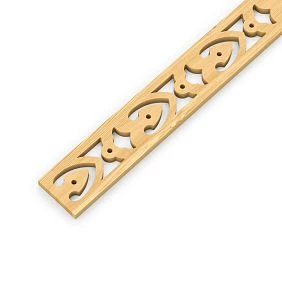
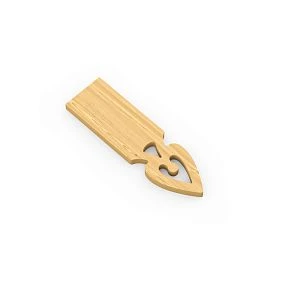
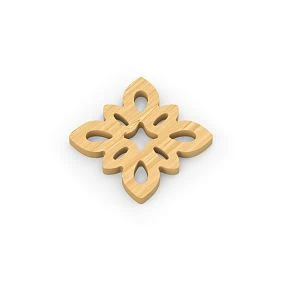
Our factory also produces:

Confirmed characteristics of N-506
| Parameter | Confirmed value | What this means for the project |
|---|---|---|
| Article number | N-506 | The exact article number must be specified in the specification and when reordering |
| Type | Wooden decorative element, carved overlay | The product performs a decorative, not a load-bearing function |
| Size | 12 × 205 × 5 mm | Need to check the width of the free field, the length of the post, and the relief protrusion |
| Material | Beech or oak | The wood species is chosen together with the future finish and the material of the adjacent decor |
| Sanding | "Standard" or "Prestige" | The processing level of the entire repeated row must be the same |
| Main application areas | Narrow furniture uprights, frame fronts, display cases, small doors, decorative strips | Before ordering, a full-size template on the actual furniture is required |
| Installation | Depends on the base and coating | The fixing method and glue compatibility are tested on the specific project |
The size must be perceived as a whole. The number 12 mm only corresponds to the width of the overlay itself, not the minimum width of the furniture upright. Indentations must remain around the product, and glass, groove, glazing bead, chamfer, hinge, or handle may be nearby. Therefore, a field exactly 12 mm wide is not automatically suitable.
Get Consultation
Why 12 mm is not equal to the minimum upright width
The furniture field is measured not by the external width of the part, but by the free plane on which the decor can be installed. The upright may appear wide from the front, but part of the space is occupied by the glass frame. On the back side, there may be a hinge, and along the edge, a rounding or chamfer. If the overlay falls on a surface transition, its fit becomes unpredictable.
Before ordering, mark the actual straight section. Separately measure the distance to the glass, internal profile, handle, and adjacent elements. Then apply the 12 × 205 mm template. If there is no visual clearance on either side or the contour touches structural zones, it is better to move N-506 or choose another solution.
The article does not assign a universal safe offset in millimeters. It depends on the shape of the front, the method of glass installation, the protrusion of the relief, and the overall composition. The correct criterion is that the overlay lies completely on the prepared plane, does not interfere with the operation of the hardware, and does not create a tight fit to the glass.
Four working layout schemes
| Scheme | How N-506 is positioned | What task is it suitable for | Main check |
|---|---|---|---|
| One vertical | One element along the axis of the narrow rack | Side display rack, small door, furniture rail | Alignment of the overlay axis and the field |
| Paired glass framing | Two elements on the sides of the glazed part | Showcase, buffet, cabinet with glass door | Same height and mirrored offsets |
| Repeat on multiple facades | Same overlay on each door or stile | Set, multi-door display case, series of cabinets | Single line across the entire row |
| Vertical plus center | N-506 supports the frame, a small element works in the center | Facade with narrow stiles and free panel | Scale difference without competing decor |
Scheme 1. One vertical on a narrow stile
The simplest scenario is one N-506 along the central axis of the stile. This scheme is suitable for the side vertical of a display case, a decorative rail, a narrow door, or a small field between two wide elements. The overlay is perceived as a carved line that emphasizes the height.
Simplicity is deceptive: at a width of 12 mm, even a slight offset is noticeable. The template should show not only the outline but also the central axis. If the stile has uneven width at the top and bottom, or a profiled frame runs nearby, the position is checked at several points.
A single vertical is appropriate when supported by other facade lines. If there is no frame, profile, or repeating element around, a small overlay may get lost on a too-wide empty field. In such a case, N-506 is not to blame: the scale of the field simply does not match its role.
Scheme 2. Paired framing of glass
Two overlays can be placed on both sides of the glazed section. The glass gets a thin carved frame, and the furniture becomes more expressive without a heavy cartouche. This scheme is especially suitable for a display case, sideboard, and cabinet, where the transparent part is already the main visual center.
Pairing requires precision. The top and bottom points of both overlays must be on the same line. Indentations from the glass and outer edges are compared not by eye but using a template. If the frame on the right and left differs due to door construction, first choose a common visual reference.
Do not place the element flush against the glass just to save space. The wooden overlay must rest on a stable surface, not overlap the glazing bead, and not interfere with servicing the glass insert. Before installation, it is useful to open the door and check the composition from frontal and side viewpoints.
Scheme 3. Repetition on multiple doors
When the same N-506 appears on each door, the individual detail turns into a vertical rhythm. This technique ties a display case, cabinet, or kitchen set into a unified solution. The narrow decor does not require a large empty field, so the repetition can be noticeable but not overloaded.
First, choose a reference line: the top of the overlay, its center, or its bottom point. Transfer this coordinate to all facades. Do not mark each door separately from the nearest edge if the frame dimensions vary slightly: the overall view will result in a wavy row.
For four identical doors, the basic calculation is simple: four working items. Add a reserve, the size of which depends on the installation method, number of facades, and the possibility of subsequent repurchase. Assigning a universal percentage without a project is incorrect. What matters is that the entire visible row should be ordered in one batch with the same material and processing level.
Scheme 4. Narrow vertical and small central accent
N-506 can work together with a compact overlay in the center of the wide part of the facade. The vertical supports the frame, and the second element assembles the composition in the panel. Here it is especially important to divide the roles: N-506 should not argue with the center, and the central part should not overlap the thin geometry of the stiles.
For a small additional accent, you can choose a compact overlay N-021. The model has several sizes, so it is evaluated based on the actual field. Another route is to add a small central overlay N-302. These products do not replace N-506, but help build the hierarchy of "narrow vertical — center of the facade."
Full-size template before ordering
A template 12 × 205 mm is the cheapest way to see a future mistake before purchase and installation. It is cut from thick paper or cardboard and applied to the furniture. The central axis, top, and bottom are marked on the template. For a paired scheme, two copies are made; for a row, as many as needed for simultaneous fitting.
One copy shows only the size of the part, but not the rhythm. If four doors are being designed, it is better to immediately attach four paper rectangles with masking tape that is safe for the surface. Then step back to the usual distance, look at the display frontally and from the side, open the doors, and evaluate the proximity to the handles.
The template checks:
- free width of the straight plane;
- distance to the glass and glazing bead;
- position of hinges and fastening zones;
- proximity to the handle;
- indents to the top and bottom frames;
- visibility of the element when the door is open;
- height alignment on adjacent fronts;
- scale of the overlay relative to the entire furniture.
How to measure the free field
Measurement begins with the front in the closed state. Determine the width of the stile, then exclude areas where decor cannot or should not be placed: bevel, rounding, groove, glass frame, protruding glazing bead. The resulting space is the working field.
After that, the reverse side is checked. The overlay is on the outside, but the installation location may coincide with a hinge or fastener. The decorative element itself should not interfere with the door structure, and the chosen fixing method should not damage the hardware.
The third stage is movement assessment. The door is fully opened. N-506 should not catch on the adjacent facade, body, side panel, or decorative strip. The thickness of 5 mm is small, but the protruding relief still changes the contour.
Do not confuse the length of N-506 with the height of the post
The length of the overlay is 205 mm. This is a finished decorative fragment, not a linear strip for the entire door height. On a tall display case, the element can be located in the upper third, center, lower part, or repeated twice with a large interval. The choice depends on the cornice, handle, panels, and viewpoint.
Attempting to mechanically stretch one element onto a two-meter post is impossible. Also, you cannot assume that two overlays will automatically solve the length issue. A pause occurs between them, and it must be part of the composition. Other product groups are intended for continuous wide framing.
When one, two, or several overlays are needed
| Situation | Preliminary quantity | How to check |
|---|---|---|
| One narrow post | 1 working N-506 | Try a full-size template along the axis |
| One glass door with paired framing | 2 workpieces | Check mirror offsets and equal height |
| Four identical doors, one overlay each | 4 workpieces | Place four templates simultaneously |
| Four doors, two overlays each | 8 workpieces | Check row of eight templates and axis pairs |
| Tall stand with two levels | 2 workpieces per stand | Align the interval and connection with the cornice, handle, and base |
A reserve is added to the working quantity based on the specific project conditions. If the decor is installed on expensive finished furniture and is repeated on many facades, the reserve is especially useful. However, a fixed percentage cannot be assigned without understanding the installation, processing, and the possibility of purchasing fully matching products.
How to connect the overlay with the cornice and base
A narrow vertical should not exist separately from the upper and lower parts of the furniture. On a display, it usually starts below the cornice and ends above the base. These distances form a frame around the decor. If the top gap is noticeably smaller than the bottom gap without a compositional reason, the overlay appears accidentally shifted.
First, determine the main horizontal reference. It could be the bottom line of the cornice, the center of the handle, the top of the panel, or the line of a neighboring decorative element. After that, the position of N-506 is transferred to all identical facades. This approach is more reliable than measuring separately from the floor or the edge of each door.
If the furniture has a tall, expressive cornice, N-506 can be raised closer to it to continue the vertical theme. If the base is visually heavy, placing the overlay too low may make the bottom of the facade look overloaded. Trying it on a template helps see the balance without installation.
Proximity to the handle
The handle and N-506 perform different functions but are on the same plane. If they are too close, the carved element may interfere with the grip or look like part of the hardware. If they are located at different levels without obvious logic, the facade breaks into several unrelated accents.
During design, not only the geometric distance is checked, but also the hand movement. The door is opened several times with a paper template in place. Fingers should not touch the intended relief, and the overlay should not interfere with a comfortable grip.
On paired doors, handles are often located near the central joint. Then N-506 is logically shifted to the outer stiles or becomes part of the frame around the glass. On a single narrow door, a different scheme is possible: the handle is placed lower, and the overlay is in the upper part. The decision is made based on the specific geometry.
Proximity to glass
A glass insert makes thin decor especially noticeable. Light passes through the display case, while carved wood creates a contrasting vertical line. However, glass requires careful clearances. N-506 must not overlap the glazing bead, touch the seal, or interfere with replacing the glass panel.
If a decorative element is placed on a separate wooden post between two panes of glass, ensure its entire width rests on the wood. Even a slight encroachment onto the material boundary impairs fit and complicates finishing.
When lighting a display case, check the shadow cast by the relief. A thickness of 5 mm creates a noticeable chiaroscuro pattern. Side lighting emphasizes the carving, while overly bright front lighting can visually flatten it. It is best to evaluate this effect on a sample or template with a temporarily created volume.
Proximity to hinges and fasteners
The hinge is located on the back side of the facade, but its cup and screws occupy a specific area. Before installing a narrow overlay, it is important to check the layout against the internal structure. This is especially relevant for small doors where free space is limited.
N-506 is not a structural rail and should not cover the hinge repair or adjustment area. If a decorative element is installed over a zone that may require future access, furniture maintenance becomes more difficult.
The craftsman receives a facade diagram with marked hinges, handles, glass, and decorative elements. Such a sheet eliminates the situation where the carpenter, painter, and installer work with different understandings of the finished product.
How to create a vertical rhythm across multiple facades
A repeating row is perceived not by each individual overlay, but by the overall line. Even if individual pieces are installed neatly, different heights ruin the impression. Therefore, it is better to mark all facades simultaneously.
It is convenient to draw a conditional horizontal line through the centers of the overlays or use a common template rail. It sets one coordinate for the row. Then, a vertical axis is marked on each door. The intersection of the lines determines the center of the N-506.
On furniture with facades of different widths, the axes may not align with the same indentation from the edge. In this case, the frame composition of each facade is used as a guide, but one height is maintained. The rhythm is built from the repetition of shape and level, not from the mechanical repetition of all dimensions.
How to design a corner display cabinet
In corner furniture, the front planes meet at a different angle, so identical overlays are perceived asymmetrically. One facade is seen directly, the other in perspective. Before ordering, templates are placed on both sides and evaluated from the main viewing point of the room.
Sometimes, on a corner section, one N-506 on the outer stile is sufficient, while a paired scheme is used on straight facades. This is not a mistake if the change supports the geometry of the furniture. It is important that the transition is deliberate and repeated on a symmetrical section, if one exists.
How to work with a tall display cabinet
On a tall door, the length of 205 mm occupies a small part of the stile. Therefore, it is necessary to decide where exactly to concentrate the decor. The upper third connects the overlay to the cornice and is more noticeable at eye level. The central position emphasizes the overall height. The lower zone can support the base, but is often outside the main viewing point.
Two elements on one stile create rhythm but require a large interval. You cannot simply place them end to end and imitate a long molding: the joint will look random. There must be a deliberate pause between the overlays, related to panels or other horizontal divisions.
How to design a small drawer or narrow door
The N-506 can be considered for a small door if the field is truly vertical and the length of 205 mm matches the height. On a low drawer, the element may not fit in length or disrupt the direction of the composition. Therefore, the word "small" does not mean "automatically suitable".
For a drawer, a compact central accent is often needed, rather than a long vertical one. If the facade is tall and narrow, the N-506 can emphasize its proportion. The decision is made based on a paper template, the position of the handle, and the trajectory of hand movement.
Beech for enamel and even color
Beech is often chosen for a project with opaque enamel. It is used when the wooden overlay should visually blend with the painted MDF facade, cornice, or other details. A light, milky, gray, or colored layer makes the row uniform, while the relief is read through shadows.
This does not mean that beech is automatically ready for any paint. Surface preparation, primer, and material compatibility must match the finishing technology. The specific configuration of the N-506 card should be checked before ordering.
If the overlays are painted together with the facades, the craftsman must receive the entire set in advance. Trial painting of one element helps to understand whether the coating fills small recesses and whether the relief is sufficiently pronounced after applying layers.
Oak for preserving wood grain
Oak is chosen when natural texture is important. Clear varnish, oil, stain, or tinting allows preserving the wood grain. On a narrow element, the fibers become part of the vertical rhythm and connect the overlay with the oak frame, cornice, or facade.
Under a transparent finish, batch differences are especially noticeable. Therefore, it is better to order all visible N-506 items simultaneously. During layout, the craftsman can distribute the products so that texture and tone do not create random contrast on adjacent doors.
Mixing beech and oak in the same repeating row under a transparent coating is not advisable. Even similar tinting does not hide structural differences. If the furniture is already made from another wood species, compatibility is checked on a sample.
'Standard' or 'Prestige'
The N-506 card offers two levels of sanding. "Standard" and "Prestige" should be considered not as an abstract rating, but as part of preparation for a specific finish. On a thin carved element, the condition of the recesses is especially important because after painting, correcting them on installed furniture is difficult.
For any repeating series, one level is selected. You cannot order half of the products in one finish and the other half in another if they will be placed next to each other. Differences in preparation may become apparent after enameling or tinting.
Before ordering, it is useful to check with the manager which configuration is available for the selected material and future coating. The specification includes not only "N-506" but also the wood species, sanding level, and planned finish.
How finishing changes the perception of 12mm decor
| Finishing scenario | How N-506 is perceived | What to Check |
|---|---|---|
| Enamel in the color of the facade | The overlay becomes part of the facade architecture, the relief is read through light and shadow | Layer thickness and preservation of fine pattern |
| Contrast enamel | A thin vertical line becomes a graphic accent | Doesn't a row of several doors overload it? |
| Light patina | Indentations may become more noticeable | Uniformity of application on all products |
| Transparent oak finish | Wood grain is preserved | Match of batch and shade of adjacent parts |
| Staining | The overlay matches the furniture in shade | Test coating on specific wood |
Too dark an opaque coating can make fine relief less noticeable, especially under uniform frontal light. Too thick a layer can soften small details. Therefore, a test coating is more useful than a verbal description of the color.
Paint separately or together with the facade
Both options are possible only within the chosen technology. Separate painting makes it easier to access edges and relief, but requires careful subsequent installation. Painting after installation helps achieve a uniform color, but complicates the processing of joints and may affect glass or adjacent surfaces.
The decision is made by the painter and furniture craftsman. Before installation, they agree on the sequence: facade preparation, trial fitting, painting, fixing, local finishing. The article does not prescribe a universal order because coatings and substrates vary.
Can N-506 be cut to length
The 205 mm size is part of a finished shape. Cutting may disrupt the pattern, edge, and symmetry. Therefore, the overlay cannot be automatically shortened just because the free space is smaller.
If the project requires a change in length, first evaluate the design and consult with a craftsman. Sometimes it is better to choose a different model than to turn a finished carved part into a random fragment. After cutting, edge treatment and finish coordination will also be required.
N-506 is not a structural batten
The narrow elongated shape may resemble a strip, but the product remains a decorative overlay. It should not hold glass, reinforce the facade, cover a movable joint, or replace a glazing bead. The load must be borne by the furniture structure.
This distinction is important during repairs. If the post is damaged or requires reinforcement, the overlay will not solve the problem. First, restore the base, then use N-506 as a decorative finish.
Installation begins with checking the base
Before fixing, the surface must be level, clean, and compatible with the chosen installation method. On a painted facade, adhesion to the coating is checked; on solid wood, the condition of the wood is checked; on MDF, the quality of the finish layer is checked. The relief overlay has a thickness of 5 mm and must fit without wobbling.
The SEO scheme includes a route Buy mounting adhesive for wooden decor. TYTAN Prof. Classic Fix is intended for wood and its derivatives, but compatibility with a specific enamel, varnish, or other facade coating is still checked before installation.
The glue should not get onto the glass or fill the carved relief. The quantity, application method, and fixing time are determined by the material's instructions and the project. On valuable finished furniture, first test on an inconspicuous sample.
Marking before gluing
On the facade, mark the central axis and the upper or central control line. Then apply the actual N-506 without glue and check alignment with the paper template. If a row is being arranged, all elements are temporarily laid out simultaneously.
After checking, the master photographs the composition and applies removable marks. Installing one door at a time without seeing the entire set increases the risk of different heights. This is especially important for paired glass framing.
What to buy together with N-506
| Element | Role in composition | When needed | Link |
|---|---|---|---|
| N-506 | Narrow vertical on a post or frame | When the standard overlay is too wide | buy narrow wooden overlay N-506 |
| N-021 | Compact additional accent | When there is a small free field nearby | choose a compact overlay N-021 |
| N-302 | Small central element | For the 'narrow vertical plus center' scheme | to add a small central overlay N-302 |
| K-012 | Wider extended framing | When a frame line is needed, not a separate accent | assemble wide framing from baguette K-012 |
| Construction adhesive | Fixation upon confirmed compatibility | After selecting the base and installation technology | Buy mounting adhesive for wooden decor |
The table does not mean that all listed items are needed simultaneously. The set is assembled according to the facade scheme. For a simple display case, N-506 and confirmed mounting material are sufficient. The central overlay or baguette is added only if there is a suitable field.
When K-012 is needed instead of N-506
If the task is to create a continuous wide frame, a separate 205 mm long overlay may be too localized. In this case, you can assemble wide framing from baguette K-012. This is a different compositional logic: the molding forms a long line, while N-506 is a separate vertical accent.
You cannot choose between them based only on a photo of the ornament. First, determine whether a finished module or a continuous frame is needed. Then check the field width and the joining method.
When central decor is needed
On a wide facade, N-506 may get lost if placed in the center of an empty panel. For such a task, it is better to choose central decor for a wide facade. The narrow model remains on the frame or post.
This division of roles protects the article and the buyer from the main mistake: trying to use one product in all zones. The size and position of the element must match the scale of the field.
How not to confuse N-506 with a regular vertical overlay
| Sign | N-506 | Regular wider overlay |
|---|---|---|
| Width | 12 мм | Takes up noticeably more facade space |
| Role | Thin vertical line, rhythm, rack decor | Independent accent or panel filling |
| Best place | Mullion, frame, narrow door, batten | Medium or wide field |
| Repeat | Often works in a series | Can be used as a single center |
| Main risk | Loss on too wide a field | Narrow stile overload |
Before ordering, it is useful view furniture facade decoration schemes, to determine the field type and the role of each element. N-506 is chosen not because it is smaller, but because the furniture requires a thin vertical line.
Practical scenario: two-door display cabinet
A two-door display cabinet usually has a central joint, two outer stiles, and glazed fields. If the handles are in the center, placing N-506 in pairs on the outer sides helps balance the facade. If the handles are moved to the outer edges, conversely, the thin decor can be placed closer to the central joint, but only after checking the distance to the grip.
To start, four templates are made: two for each door. They are fixed simultaneously and assessed to see if the rhythm becomes too frequent. Sometimes a display cabinet only needs two overlays — one on the outer stile of each door. Four elements may be excessive if the frames themselves are rich in profiles.
The quantity is determined not by the number of available stiles, but by the overall composition. The buyer should see one display cabinet, not four independent carved strips.
Practical scenario: four-door display cabinet
On four doors, repeatability is especially important. One N-506 on each door creates four verticals that tie the long facade together. If the doors are identical, the center lines of the overlays should be at the same height and follow the same offset principle.
Before ordering, a full-size layout of four templates is made. Then two distances are checked: between adjacent overlays and between the outermost elements and the cabinet sides. If the outer fields are noticeably wider than the inner ones, the row may require adjustment.
The working quantity is four items, but the reserve is determined by the project. The specification must indicate that the entire batch is intended for one visible facade. This helps coordinate the material, sanding, and subsequent finishing.
Practical scenario: a sideboard with an open and closed section
A sideboard often combines glass upper doors and solid lower facades. N-506 can be used as a vertical link between these levels. For example, the overlay is placed on the posts of the upper display case, and below it is repeated as a small central accent of a different shape.
There is no need to mechanically transfer N-506 to every lower drawer. If the facade direction changes from vertical to horizontal, a narrow long overlay may lose its meaning. It is better to keep one line on the upper level and choose a separate solution for the lower part.
Practical scenario: framed kitchen
In a framed kitchen, there are many narrow stiles and paneled doors, but the decorative rhythm should be particularly restrained. N-506 can appear on display modules, tall cabinets, or individual accent facades. If installed on every lower row door, the composition may become too fragmented.
Before ordering, key modules are marked: display case, tall cabinet, decorative tall cabinet. On these, the overlay creates vertical landmarks, while the remaining facades stay calm. This approach makes N-506 part of the hierarchy, not a repetition for the sake of quantity.
Practical scenario: narrow furniture side panel
The side surface of a cabinet is sometimes visible from the passage and remains empty, even though the front is richly decorated. If the side panel has a narrow vertical slat or frame, N-506 can continue the decorative language. But you cannot simply transfer the facade scheme to the side plane.
First, check the viewing direction and the distance to the wall. The overlay should be visible but not touch the adjacent surface when installing the furniture. If the side panel functions as a structural end without a frame field, thin decor may look accidental.
How to create a facade map
For furniture with multiple doors, a table where each facade is assigned a number is useful. It specifies the free field width, placement height, quantity N-506, material, sanding, and finish. Such a map eliminates verbal formulations like "place approximately in the center."
| Facade | Field | Scheme | Quantity | Control line |
|---|---|---|---|---|
| Door 1 | Outer post | One vertical | 1 | Center of overlay on common horizontal |
| Door 2 | Posts on the sides of the glass | Paired framing | 2 | Identical top and bottom |
| Door 3 | Narrow frame field | One vertical | 1 | Matches door 1 |
| Side panel | Decorative batten | Separate accent | 1 | Matches the cornice |
The map is needed not only by the installer. It is used to calculate the order, distribute products after acceptance, and check the finished furniture. For a repeatable row, the document
Why it's better to order a repeatable row in one batch
Buying one piece at a time may seem convenient when the project develops gradually. But a visible row of identical overlays is sensitive to differences in wood species, processing, and finish. A subsequent additional purchase may require a new selection.
Placing a simultaneous order simplifies acceptance, painting, and installation. The painter works with one set, and the master arranges all elements on a common line. For four doors, it is logical to order four working items and an agreed reserve, rather than starting with one overlay "for testing" if the template has already confirmed the composition.
A trial order may be justified when the finish is unknown or when a physical assessment of the relief is needed. But after the sample is approved, it is better to place the entire visible set together.
What to specify in the order specification
- article number N-506;
- size 12 × 205 × 5 mm;
- material — beech or oak;
- grinding level — "Standard" or "Prestige";
- number of working items;
- number of reserve items per project;
- planned finishing;
- number of facades and layout scheme;
- indication that the overlays are placed side by side and form one visible row;
- material and coating of the furniture base;
- intended installation method;
- need to coordinate mounting material.
The more precise the specification, the less likely the order will be perceived as a set of independent parts. For a complex display case, photos of the furniture with paper templates are attached.
Common mistakes in choosing and placing mirrors
Place N-506 in the center of a too wide field
On a large panel, a 12mm overlay can get lost. Its place is a narrow stile or frame. For a wide area, choose a central decor.
Consider a width of 12mm sufficient for a 12mm field
Free margins and a flat surface are needed. Glass, bevel, and glazing bead reduce the working width.
Decorate only one door in a row
If the facades are identical, one accent looks random. Either repeat the pattern or explain the difference by the furniture architecture.
Place paired elements at different heights
A thin vertical line emphasizes the skew. A common horizontal line is mandatory.
Glue decor before checking hinges
The facade may lose access to fittings or get damaged in the fastening area. Markings are checked against the reverse side.
Place the overlay flush against the glass
Such installation makes the frame tight and may interfere with servicing the glass insert.
Cut the product without analyzing the pattern
The cut disrupts the finished form. First, choose a different model or coordinate processing with the master.
Mix beech and oak under a clear finish
Tinting does not hide structural differences. The visible set must be matched by wood species.
Buying a series in parts
Different batches are harder to match in texture and finish. It's better to order working elements at the same time.
Use N-506 as a power bar
Decorative overlay. It does not replace a rail, glazing bead, or facade reinforcement.
Choosing glue only by name
Compatibility depends on the coating. Even material for wood needs to be tested on the specific enamel or varnish.
Painting with a thick layer without a test
Thin relief may lose expressiveness. A test coat shows the real result.
When N-506 is truly suitable
- on a furniture stand where a standard overlay is too wide;
- on the display frame next to the glass with sufficient free space;
- on several identical doors for vertical rhythm;
- on a small vertical door;
- on a decorative rail or mullion;
- in a scheme with a small central accent;
- in classic, neoclassical, or Provencal furniture where a delicate carved motif is needed;
- under enamel from beech or under a transparent finish from oak with a confirmed configuration.
When it's better to choose another solution
N-506 is not suitable if the free space is narrower than the overlay itself, the surface has a strong profile, or the element will interfere with the glass and hardware. On a wide empty panel, a thin vertical may be too weak. For continuous framing, consider moldings, and for the center, a rosette or compact overlay.
Another option is needed when the part is expected to have a structural function. The decor does not reinforce the stile and does not hold the glass.
How to place an order on STAVROS
The first step is to check the sizes and options in the product card. Then make a template of 12 × 205 mm and place it on the actual furniture. Only after this are the working quantity, material, and sanding level determined.
If the project is built around a narrow vertical line, you can buy narrow wooden overlay N-506 as one approved batch. For a scheme with multiple facades, the manager is given the number of doors, layout photos, and information about the future finish.
After the composition is approved, you can order decor N-506 for a frame facade, add a compact central element if necessary, and approve the mounting material. Before fixing, everything is laid out on the facade again without glue.
How light affects a thin relief
The 12 mm width makes N-506 delicate, so lighting directly affects its visibility. With side light, the relief gets a shadow and is more readable. With completely uniform frontal lighting, an overlay painted in the facade color can be perceived almost as a flat line. This is not a product flaw, but a feature of the light-and-shadow work of thin decor.
On a display with internal lighting, it is important to check where the light comes from. If the source is behind the glass, the overlay on a wooden stand can become a contrasting silhouette. If the light is directed only from above, the lower part of the ornament will be darker. Before final finishing, it is useful to place a temporary source in the intended position and look at the paper layout or the actual product.
Dark tinting reduces the contrast of small recesses in a poorly lit room. Light enamel, on the contrary, can make the shadow more expressive. But the result depends on the relief, coating gloss, and surroundings, so a product card photo does not replace a sample in the interior.
How to check composition in a photograph
After placing templates, furniture is photographed from three points: strictly frontally, from the usual entrance point to the room, and at the angle at which a person most often sees the display case. The frontal photo shows axes and symmetry. The distant shot helps to understand whether the 12mm decor is lost. The side shot checks the proximity to the frame relief and glass.
On screen, it's easier to notice different heights of elements and too frequent rhythm. It's useful to convert the photo to black and white: color stops distracting, leaving lines, scale, and distribution of empty zones. This technique does not replace live fitting but helps compare several schemes.
How to update a finished display case without completely redoing the facade
N-506 can be used not only in new furniture. On a finished display case, narrow posts sometimes remain smooth, even though the cornice and base already have a classic profile. A thin overlay allows adding a carved motif without replacing doors. But reconstruction requires a more thorough check of the base.
First, assess the condition of the coating. Old varnish, enamel, or polish may be incompatible with the chosen mounting material. Then check whether the future element covers cracks, moving joints, or defects that need to be repaired first. Decor should not hide a structural problem.
On finished furniture, a reversible fitting stage is especially important. Paper templates are left for several days and evaluated in daylight and evening light. Only after approval is surface preparation and installation carried out according to the agreed technology.
How to transfer a project from designer to craftsman
A good visualization shows the idea, but the craftsman needs measurable coordinates. The worksheet specifies the facade number, center of N-506, distance from the top control line, material, sanding, and finish. For paired elements, mirroring is recorded separately.
A photo with templates and a marked sketch are attached to the sheet. If a combination with N-021 or N-302 is used, each article gets its own designation. The installer should not determine the position by the phrase "as in the picture".
After accepting the products, the card is updated: each overlay is assigned a facade. This is especially useful for oak under a transparent finish, when the wood grain is distributed in advance.
How to store overlays before finishing and installation
Thin wooden elements should be stored on a flat support in conditions suitable for the wood and future furniture. They should not be mixed with metal fasteners or pressed down with heavy objects. The packaging is opened carefully, preserving the batch marking.
After sorting, each product is linked to a facade number. If finishing will be done later, the order is fixed with a photograph. The reserve is stored separately, but under the same conditions, so that it remains part of the project.
What to check after installation
The finished furniture is inspected in closed and open states. From the front, check for a single height and axes. When opening, check for contact with adjacent doors and the body. Near glass, assess whether the glazing bead is blocked and whether maintenance is hindered.
Traces of mounting material should not remain on the relief, glass, or facade coating. If the overlay is painted in the furniture color, compare the gloss and shade. In a repeating row, any difference is more noticeable, so control is carried out over the entire set, not just one door.
How to care for narrow carved decor
The relief collects dust more than a smooth post. Care is chosen considering the finish coating. Do not use a product just because it is suitable for wood: it must be compatible with the specific enamel, varnish, oil, or tint.
When cleaning, do not press on protruding parts of the carving and do not use tools that could catch the edge. Soft dry treatment and adherence to coating recommendations help preserve the pattern. If the furniture is located near a kitchen work area, contamination conditions should be considered when choosing the finish.
How to estimate project cost without made-up numbers
The cost of finishing depends not only on the price of one N-506. The estimate includes the working quantity, reserve, selected wood species, sanding level, finish, facade preparation, and installation. For a paired scheme on four doors, eight working pieces are required, which changes the volume of painting work and marking time.
The current price of each configuration is checked in the product card. It is correct to compare options based on the full specification, not on a single overlay. Sometimes a simpler row of four elements looks more convincing and is more cost-effective than an overloaded scheme of eight parts and an additional center.
When a paper template is no longer enough
A paper rectangle shows the dimensions and position well, but does not convey the 5 mm thickness and actual relief. For an expensive display case, complex tinting, or a series of identical facades, after a paper mock-up, it is useful to get one real sample of the selected configuration. It is applied without final fixation, evaluating the shadow, protrusion relative to the frame, and proximity to glass.
A test element is especially important if the facade has a deep profile. The overlay may fit in width but visually sink between protruding frames. In another case, it may turn out to be too convex next to an almost flat door. A real fitting helps make a decision before ordering the entire batch.
After approval, the sample is included in the overall set or kept as a finish standard. For serial painting, it is used to compare color, gloss level, and relief readability.
How to determine the reserve without a universal percentage
The reserve is calculated not by an abstract percentage, but based on project risks. For one display case with two overlays, one agreed-upon additional piece may be sufficient if the installation is complex and subsequent purchase is undesirable. For a large set, the decision depends on the number of facades, finish, and method of batch distribution.
The calculation includes the probability of damage during preparation, the need for a test coat, the presence of complex trimming, and plans for further expansion of the furniture. If the product is not cut and installation is performed by an experienced craftsman on a prepared base, the risk is one. If the decor is painted in several layers and installed on ready-made glass doors, the requirements are higher.
The main rule is that the reserve is ordered together with the main row and in the same configuration. A later purchased part may require a new selection of wood and finish.
Why narrow decor requires more precision, not less
The small width creates the feeling that an error will be unnoticeable. In practice, a thin vertical line acts like a marking line: it immediately shows axis deviation, different heights, and uneven gaps. Large ornament sometimes hides a few millimeters behind a complex shape, but N-506 emphasizes the geometry of the facade.
Therefore, a compact element requires full project discipline: a template, a common control line, simultaneous layout, facade numbering, and post-installation inspection. It is this precision that turns 12 millimeters of carving into a complete architectural detail, not a random strip on furniture.
FAQ: Questions about N-506 and narrow furniture facades
Where to use the narrow wooden overlay N-506?
On display stands, frame facades, small vertical doors, decorative slats, and mullions. The main condition is a sufficiently flat surface and no interference from glass, handles, and hinges.
What is the size of N-506?
The confirmed size is 12 × 205 × 5 mm.
Does the width of 12 mm mean that the stile can be the same width?
No. Free margins and a completely level base are required. The working field must account for chamfers, glass, glazing bead, and frame edges.
Can N-506 be installed next to glass?
Yes, if the overlay lies entirely on the wooden part, does not overlap the glazing bead, and does not interfere with servicing the glass insert.
How many overlays are needed for a display case?
The quantity depends on the scheme. One vertical requires one item per field, paired framing requires two, repetition on four doors requires four or eight if a pair is used on each door.
How to position N-506 on paired doors?
First, choose a common horizontal line, then mark the vertical axes. All templates are applied simultaneously and mirror offsets are checked.
Can N-506 be glued to MDF?
The possibility depends on the MDF coating and the chosen adhesive. Compatibility is checked on the specific facade or sample.
Which glue should I use?
The scheme specifies TYTAN Prof. Classic Fix for wood and its derivatives. But its compatibility with enamel, varnish, or other facade coating must be confirmed before installation.
Should the overlay be painted together with the facade?
It depends on the technology. Separate painting or finishing after installation is possible, but the sequence is coordinated by the painter and the furniture maker.
What to choose under enamel — beech or oak?
For opaque enamel, beech is often considered. Oak is chosen when they want to preserve the texture under a transparent or semi-transparent finish. The specific configuration is checked in the card.
Can oak N-506 be tinted?
Oak is suitable for projects preserving the wood grain and tinting. A test coat on the specific wood is needed before work.
What is the difference between "Standard" and "Prestige"?
These are sanding levels available in the card. For one visible row, choose the same finish and link it to the future coating.
Can N-506 be cut to length?
Cutting may damage the pattern and edge. It is done only after evaluating the design and consulting with the master; sometimes it is better to choose a different model.
How to make a template?
Cut a rectangle 12 × 205 mm from thick paper, mark the axis and top, then apply to the facade. For a row, make several identical copies.
What gap should be left from the glass?
A universal number cannot be assigned without a project. The overlay must lie on a stable wooden surface, not overlap the glazing bead, and leave visual air.
Can N-506 be installed on a pull-out drawer?
Only if the facade is tall enough and the vertical composition is justified. For a low horizontal drawer, a different type of decor is usually more suitable.
Do I need to buy a reserve?
A reserve is useful for a repeating row, but its size depends on the number of facades, installation, and the possibility of additional purchase. A universal percentage is not assigned.
Why is it better to order the entire set in one batch?
This makes it easier to match the wood species, sanding, shade, and subsequent finishing of adjacent elements.
Can N-506 be used as a reinforcement strip?
No. This is a decorative overlay, not a structural element.
What to send to the STAVROS manager?
SKU, material, sanding, working quantity, reserve, photos of furniture with templates, future finish, and description of the layout scheme.
How is N-506 different from the central overlay?
It works on a narrow peripheral area and creates a vertical rhythm. The central overlay is designed for a wider panel and an independent accent.
Conclusion
N-506 shows that decorative work on furniture does not end with large panels and cornices. A field several tens of millimeters wide can also receive a carved motif if an element of the appropriate scale is used. The overlay measuring 12 × 205 × 5 mm emphasizes the showcase post, forms a paired glass frame, and creates a repeatable vertical rhythm on several facades.
A conscious choice begins with a template, not with glue. You need to measure the free plane, check the glass, hinges, and handles, determine one control line, calculate the working quantity, and order a visible set in one batch. Beech or oak, "Standard" or "Prestige", enamel or tinting are chosen as a single system.
STAVROS allows you to move from an idea to a specific N-506 card, select adjacent overlays and mounting material. This route helps avoid random decor: the thin carved vertical occupies exactly the place for which it was created and turns the technical post into a finished part of the furniture composition.