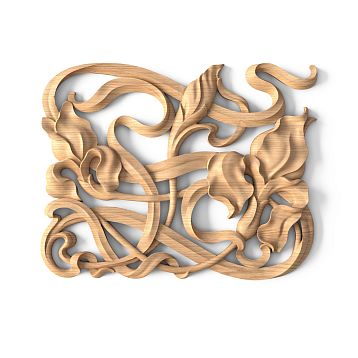
Article Contents:
- What is confirmed for NPU-095 600 × 209 × 12 mm
- Why this article does not repeat materials about furniture, the bedroom, and general molding with slats
- Why NPU-095 can be tested without a molding frame
- First measure not the entire wall, but the clean smooth field between the slat panels
- A full-size template 600 × 209 mm answers more questions than a render
- Vertical alignment: sofa, person, logo, and the real axis of the waiting area
- NPU centered on the wall
- NPU centered on the sofa
- NPU between two objects
- Logo is primary, NPU is secondary
- NPU forms the background for the logo
- Logo already fully fills the center
- In the color of a smooth wall
- In the color of the slat panels
- In the brand color of the interior
- Gold, bronze, silver
- Paint before installation
- Painting after installation
- Not enough width
- Not enough visual mass
- Not enough architectural connection
- Error 8. Considering any smooth surface suitable for adhesive
- Beauty salon or studio
- Clinic
- Showroom
- Office waiting area
- Minute 1–2: measure
- Minute 3: mark the axis
- Minute 4–5: place the 600 × 209 mm template
- Minute 6: look from the entrance
- Minute 7: seat a person
- Minute 8: turn on work lighting
- Minute 9: remove the template
- Minute 10: formulate one of two solutions
- Can NPU-095 be used on a wall without a single molding?
- Can NPU-095 be placed above a short banquette 900–1000 mm wide?
- Will NPU-095 work if slatted panels are only on one side?
- Can NPU-095 be placed vertically?
- If a TV hangs above the sofa, is NPU-095 needed?
- Can two NPU-095 units be placed symmetrically along the edges of the central wall?
- Will NPU-095 work for a wall with wallpaper?
- Can the color of NPU-095 be changed after installation?
- What to do if NPU-095 is barely visible on a wall 2.5–3 m wide?
- Where can I see other overlays if NPU-095 600 mm doesn't fit?
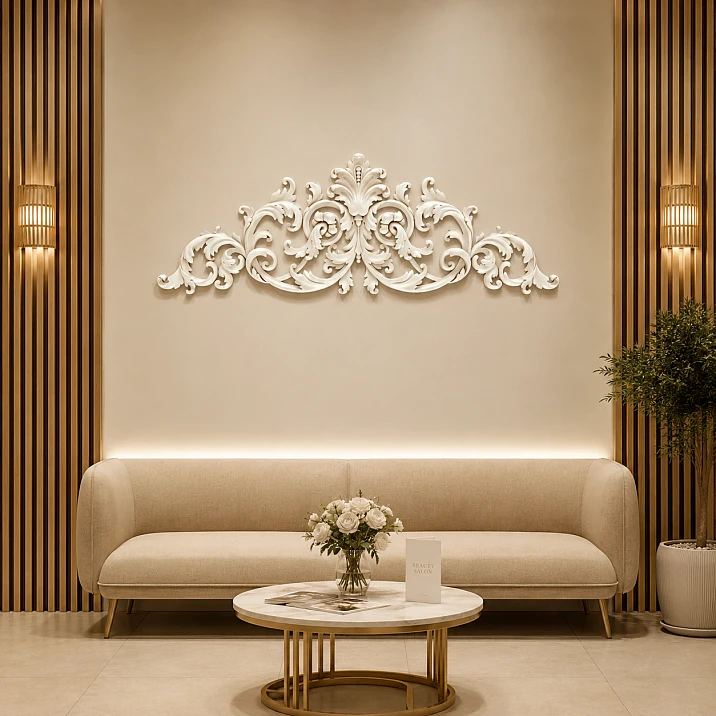
The waiting area already looks finished in terms of materials: decorative slatted panels stand on the side walls, below there is a sofa or a banquette, and the central part is left smooth. It is this smooth plane that raises doubt. It can work as a calm pause between two relief side fields—or it can seem empty and unfinished.
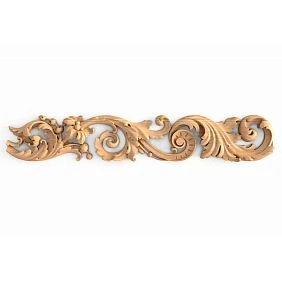
NPU-095 allows checking a third option: not adding a molding frame, not extending the slats into the center, but placing one large carved decorative overlay as an independent accent.
For the article, only one size is fixed—600 × 209 × 12 mm. The current STAVROS card confirms the polyurethane material and the current price of 8,680 ₽ per piece. In the official category of polyurethane overlays, parameter A denotes width, B—height, C—thickness. Therefore, for the selected NPU-095, one can confidently calculate:
-
600 mm horizontally;
-
209 mm vertically;
-
12 mm in relief.
The card also shows drawings and a 3D model, and the description directly indicates use in wall panels, accent zones, niches, arches, and other interior compositions. This makes wall fitting a correct scenario for the product itself.
But it does not follow from this that NPU-095 is necessarily needed for any smooth wall.
The commercial solution here is binary:
1 × NPU-095 for 8,680 ₽, if the overlay really organizes the central plane and does not conflict with the slat rhythm;
or
0 × NPU-095, if the smooth field already works as the needed architectural pause, and the 600-mm ornament only adds visual noise.
The correct order is as follows:
measure the central wall → make a full-size template 600 × 209 mm → check the position above the furniture → look from a distance → check the logo, light, and 12 mm relief → only then buy.
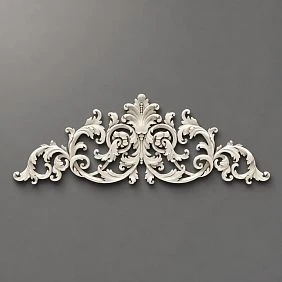
What is confirmed for NPU-095 600 × 209 × 12 mm
| Parameter | Value |
|---|---|
| Product type | carved decorative overlay / stucco decor |
| Article number | NPU-095 |
| Material | Polyurethane |
| Width A | 600 мм |
| Height B | 209 мм |
| Thickness C | 12 мм |
| Current price | 8,680 ₽/pc. |
| Quantity for the original composition | 1 pc. |
| Molding frame | not required to verify this scenario |
| The card contains | drawings and 3D model |
If the mockup confirms the decision, you can buy carved decorative overlay NPU-095 made of polyurethane.
This article number also has larger sizes, but the article deliberately does not compare them. The task here is not "which NPU-095 to choose", but whether the specific 600-millimeter version is suitable for an already finished wall.
This is important for search intent: a person is already looking at a specific SKU and must decide whether to put one item in the cart.




Why this article does not repeat materials about furniture, the bedroom, and general stucco with slats
NPU-095 already appears on STAVROS in broader content.
There is a separate material about polyurethane furniture facade decor, where NPU-095 is shown among options for cabinets, kitchens, dressers, and other furniture.
There is a bedroom with slatted panels, where NPU-095 appears in a product selection.
There is a broad article about decorative slatted panels and polyurethane stucco, which separately covers commercial spaces, lobbies, and waiting areas.
There is also general material about stucco decor for a beauty salon, where the waiting area is presented as one of the functional zones.
The new article differs from all of them by one specific question:
On an already finished central smooth wall between slat panels, is one NPU-095 600 × 209 × 12 mm without a molding frame sufficient — or is it better to leave the wall empty?
There is no furniture selection, no bedroom, no set of different molding elements, and no general theory of salon decoration.
There is one object, one article, one placement point, and one buyer's decision point.
For the general context of material combinations, you can use the article STAVROS how to combine decorative slat panels and polyurethane molding, and this page should cover the specific decision on NPU-095.
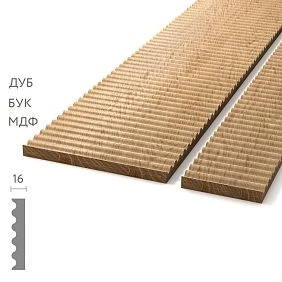
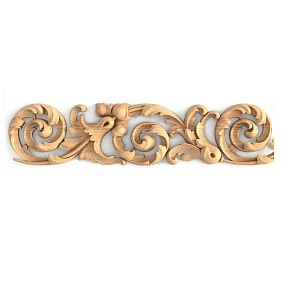
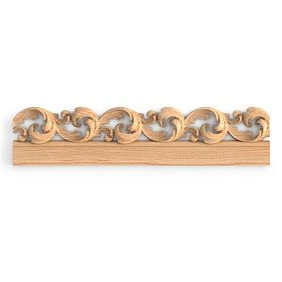
Our factory also produces:
Why NPU-095 can be checked without a molding frame
Not every decorative element needs a molding frame.
NPU-095 itself has a finished carved silhouette and dimensions of 600 × 209 mm. The card describes it as an independent decorative element for accent zones and wall compositions; no mandatory frame is listed in the specifications.
This allows building a minimal composition:
slat panels → smooth wall plane → one NPU-095 → smooth plane → slat panels.
This scheme has three advantages.
First, air is preserved. The central wall does not turn into another fully finished panel.
Second, there remains one focus. A frame would add four new lines and corners, but without it, only the carved ornament works.
Third, it is easier to understand whether an overlay is needed at all. If one element already looks convincing, an additional molding is not needed.
But the absence of a frame imposes stricter requirements on the position of NPU-095.
The frame itself explains where the center of the composition is. A single overlay must have its own clear connection:
-
with the sofa;
-
with the axis of the smooth wall;
-
with the logo;
-
with slatted fields;
-
with the light line.
If there is no such connection, the element can indeed look "glued on its own."
Get Consultation
First, measure not the entire wall, but the clean smooth field between the slat panels.
For this topic, the main horizontal value is the width of the central smooth field, not the width of the room.
Let's denote it S.
The width of NPU-095 is 600 mm.
If the overlay is centered in the field:
side free space = (S − 600) / 2.
For example:
| Width of the smooth field S | NPU-095 occupies in width | Free when centered on each side |
| 900 мм | 66,7% | 150 мм |
| 1200 мм | 50% | 300 мм |
| 1500 мм | 40% | 450 мм |
| 1800 мм | 33,3% | 600 мм |
| 2200 мм | 27,3% | 800 мм |
| 2600 мм | 23,1% | 1000 мм |
This table does not set standards.
It shows the scale of the same element on different walls.
On a smooth field of 900 mm, NPU-095 becomes almost the main mass of the composition.
At 1500 mm, it occupies 40% of the width and looks like a noticeable central accent.
At 2200–2600 mm, it may start to get lost if it has no support from furniture, logo, or light.
Therefore, the phrase "NPU-095 is large, 600 mm" by itself does not solve anything.
Size is always relative to the free plane.
A full-size template of 600 × 209 mm answers more questions than a render.
For NPU-095, a 1:1 test is especially useful.
On screen, 600 mm looks large because the product card shows the item separately. On a wall two meters wide, the same overlay may seem compact.
The cheapest way to understand the scale:
-
cut out a rectangle 600 × 209 mm;
-
better — print the NPU-095 image at 1:1 scale;
-
attach it to the central smooth wall;
-
take a photo from the entrance to the waiting area;
-
look from the chair or sofa opposite;
-
Check the evening light.
The rectangular template is needed for the first stage.
It shows:
-
the area it occupies;
-
installation height;
-
its relation to the sofa;
-
distance to the slats;
-
proximity to the logo.
A silhouette template is needed for the second stage.
The ornamental mass of NPU-095 is less than the full rectangle of 600 × 209 mm, because the carved shape does not fill every millimeter of the dimension evenly. Therefore, a regular paper rectangle can visually overestimate the heaviness of the element.
If the rectangle already looks too large, there is no point in purchasing the physical overlay.
If the rectangle fits, and the only remaining doubt is about the relief and plasticity, then it is worth moving on to the actual product.
Vertical alignment: sofa, person, logo, and the real axis of the waiting area
The central smooth wall can be 2700–3000 mm high, and the sofa occupies only the lower part.
If NPU-095 is placed in the mathematical center of the entire wall, it may end up too high relative to the waiting area.
For a person, the interior is read not as an empty rectangle of the wall, but as a composition:
sofa → backrest → free field → NPU-095 → ceiling.
Therefore, the vertical coordinate is better to start from the furniture.
You need to measure:
-
the height of the sofa back;
-
the distance from the back to the intended lower edge of the NPU;
-
the height of the pad itself — 209 mm;
-
the free space above it;
-
the ceiling cornice or light fixtures, if any.
The article does not set a universal gap like "there should be 300 mm above the sofa."
This depends on the specific furniture and the height of the room.
It is practically useful to make three positions of the template:
low — closer to the back;
medium — approximately in the visual center of the free field;
high — closer to the upper architectural line.
After that, you need to look not standing at the wall, but from the main entry point.
In a commercial space, the first image the client sees is important.
The sofa can be narrower, wider, or offset relative to the smooth field.
In an ideal visualization, the sofa is placed strictly in the center.
In reality, the waiting area is often dictated by the layout.
The sofa can be:
-
offset due to a door;
-
moved away from one slat panel;
-
supplemented with an armchair;
-
replaced with a banquette;
-
have a side table.
Then two axes appear:
center of the smooth field;
furniture center.
If they coincide, NPU-095 is easy to center.
If not, you need to decide what is the main object.
NPU in the center of the wall
Works when the central plane is perceived as an architectural panel, and furniture can change.
NPU in the center of the sofa
Works when the accent clearly belongs to the seating area.
NPU between two objects
For example, a sofa and a logo form a common system.
This is already a separate composition.
The most dangerous version is to place the NPU "approximately in the middle," without anchoring it to anything.
A large 600-millimeter overlay makes even a slight shift noticeable.
Is NPU-095 needed if there is already a salon logo in the center
For a commercial interior, this is one of the main questions.
A logo or brand name is already a visual center.
If you place NPU-095 directly below, above, or next to it, two competing systems arise.
Three scenarios are possible.
Logo is primary, NPU is secondary
Then the overlay should be calm:
-
in the color of the wall;
-
lower contrast than the logo;
-
at a sufficient distance;
-
without an additional frame.
NPU forms the background for the logo
This scenario requires a separate layout.
You cannot automatically glue letters onto carved ornament: the logo must remain readable.
The logo already completely fills the center
Then NPU-095 may be redundant.
In the showroom, a person should quickly read the brand.
If the decorative overlay distracts, the commercial function of the wall deteriorates.
Therefore, before purchasing NPU-095, you need to mock up a real logo at real size, not an empty wall.
One large element next to the slats can work better than a molding frame.
Slat panels create many vertical lines.
A molding frame would have added:
-
two verticals;
-
two horizontals;
-
four corners;
-
another geometric structure.
One NPU-095 adds only one center of gravity.
This is an important reason why the scenario without a frame makes sense specifically next to the slats.
Visually, the composition turns out to be:
frequent rhythm → pause → ornament → pause → frequent rhythm.
Instead of:
frequent rhythm → frame → ornament → frame → frequent rhythm.
The second scheme is richer, but also heavier.
For a waiting area, this may be unnecessary, especially if the room is small.
Therefore, the article should not consider the frame a "missing part" of NPU-095.
First, the simplest version is checked.
If it looks complete, there is no need to complicate it.
When NPU-095 looks random without a frame
There is also the opposite situation.
A single overlay may seem detached from the wall if:
-
the smooth field is very wide;
-
The NPU is too small relative to it;
-
There is no furniture nearby;
-
There is no central axis;
-
The color of the overlay contrasts sharply;
-
The installation height is inexplicable;
-
The slat zones are located far away.
For example, a smooth field of 2600 mm.
The NPU-095 occupies only 23% of its width.
If a short bench of 1000 mm stands under it, and there is a lot of empty space around, the overlay may look like a small ornament on a wall that is too large.
In this case, possible solutions are:
-
increase the scale of the decor;
-
use multiple elements;
-
add a frame system;
-
make the logo the main focal point;
-
leave the wall completely smooth.
But this article does not compare the sizes of NPU-095.
If the 600-millimeter version does not pass the scale check, the correct conclusion is not to buy it for this wall.
12 mm relief, slat shadows, and evening light
NPU-095 protrudes 12 mm from the wall.
This is a moderate volume, but it noticeably reacts to side light.
In the waiting area, the following are often used:
-
track lighting;
-
wall sconce;
-
hidden LED backlighting;
-
decorative pendants;
-
directed light on the logo.
The same white ornament can look different.
With frontal diffused light — softly.
With side light — embossed and contrasting.
With light from above — with a pronounced bottom shadow.
With light from below — unusual and dramatic.
Therefore, a paper mockup does not cover the issue of depth.
If light is an important part of the interior, you need either a 3D mockup or a real sample.
The STAVROS card has a 3D model, so before ordering it's useful to look not only at the frontal photo.
Slat panels also create shadows, and two reliefs can compete.
The slats already form a repeating light-and-shadow pattern.
NPU-095 creates a local complex shadow.
If the side fields are strongly lit and the center is also illuminated by a directional spotlight, the wall may become too textured.
Therefore, you need to check the hierarchy of light.
Option 1: slats are active, NPU is calm.
Option 2: slats are calm, NPU is accent.
Option 3: everything is active.
The third one more often requires caution.
If the relief of the slats is the main visual material of the waiting area, the NPU is better painted in the color of the wall and lit more softly.
If the NPU should be the center, the side slats can be left less contrasting.
This setting does not require changing the product.
Sometimes the problem is solved with light and color.
Color and visual hierarchy: wall, slats, brand, and metal accents
For a single overlay without a frame, color is especially important.
If the NPU-095 is painted in the color of the wall, it is perceived as part of the architectural relief.
If it is contrasting, it is perceived as a separate object.
For a waiting area with slat panels, it makes sense to start with a monochrome option.
Why:
-
The slats already provide color and texture;
-
The NPU-095 ornament is complex in itself;
-
12 mm of relief creates shadow;
-
Without a frame, the color stillness helps the overlay not look random.
In the color of the smooth wall
The calmest version.
Especially suitable if the slat panels are wooden or dark.
Then the central area remains light, and the carved relief is only visible in the shadow.
In the color of the slat panels
This way, you can try to connect the center and the side fields.
But the polyurethane overlay does not reproduce natural wood texture.
If you make it simply brown next to the oak, an imitation effect is possible.
A real color sample is needed.
In the brand's interior color
This is a strong solution.
If the brand uses, for example, deep green, burgundy, or graphite, the NPU can become part of the brand identity.
But then it competes with the logo more strongly.
Gold, bronze, silver
Such a finish turns the overlay into a separate jewelry accent.
It is justified only if the metallic shade is repeated in the interior:
-
lighting fixtures;
-
tables;
-
handles;
-
reception elements;
-
mirror frames.
Without repetition, metal NPU can look decoratively isolated.
The waiting area wall should also work in the photo
For a salon, studio, clinic, or showroom, the central wall often appears:
-
in stories;
-
in client reviews;
-
in portfolios;
-
in interior photos;
-
in advertising materials.
Therefore, the NPU-095 should be evaluated not only in person.
It is useful to take a few shots:
-
frontally;
-
from the entrance;
-
with a person sitting;
-
with the logo;
-
in evening light.
In the frame, a 600-millimeter ornament may be perceived differently.
On the wide-angle camera, it appears smaller.
In a close-up shot, it is more pronounced.
If the wall's purpose is a photo zone, you need to check that the overlay is not directly behind the person's head on the sofa.
This is especially important for low installation.
A person on the sofa is a real unit of scale
The empty waiting area and the occupied area look different.
If the NPU-095 is too low, a seated person covers a large part of the decor.
If it is too high, the ornament detaches from the furniture.
For verification, a real person or a conditional silhouette is needed.
For example:
-
seat a person of average height;
-
take a photo;
-
check where the top of the head passes;
-
compare with the lower edge of the NPU.
The article does not specify a "correct head height" or a universal gap.
The goal is different: to ensure that the overlay remains readable in a real waiting scenario.
For a commercial zone, this is more important than an ideal empty visualization.
If there are outlets, switches, or staff call buttons on the wall, the center may not be free.
In the waiting area, the following are often placed:
-
sockets;
-
USB;
-
switches;
-
call button;
-
thermostat;
-
signs;
-
information screens.
They change the composition.
NPU-095, 600 mm wide, may occupy exactly the zone where equipment is already present.
Then there are three options:
-
shift the overlay;
-
move the equipment, if that is still possible;
-
give up on NPU.
Shifting the decorative center by 100–150 mm just to bypass a switch is not always a good idea.
If the slat panels are symmetrical and the overlay suddenly shifts to one side, the error reads more strongly.
Therefore, before ordering, you need an actual wall plan with all devices.
The width of the sofa does not have to match the width of NPU-095
NPU-095 600 mm is not a "decor for a 600 mm sofa."
If the sofa is 1800–2200 mm wide, the overlay occupies only the central part.
This can look right: one ornamental center above long, calm furniture.
For example, a sofa 1800 mm.
NPU-095 600 mm takes up a third of its width.
Relative to the sofa, the side margins are approximately:
(1800 − 600) / 2 = 600 mm.
That is, it turns out almost symmetry 600–600–600:
free margin → decor → free margin.
This is an interesting special case.
But it does not mean that the NPU should always occupy a third of the sofa.
For a 2400 mm sofa, the same element occupies 25%.
For a 1200 mm bench, it is 50%.
That is why the scale needs to be considered relative to the specific furniture.
A too short bench can make the NPU-095 visually heavy
Let's imagine a bench 1000 mm.
NPU-095 with a width of 600 mm occupies 60% of its width.
If it is also contrasting, the top decor may appear visually heavier than the furniture itself.
In that case, it's better to:
-
raise the element;
-
make it the color of the wall;
-
check a lighter finish;
-
give up.
This is a different risk than on a very wide wall.
On a large wall, NPU gets lost.
On a small furniture group, it dominates.
The same SKU can be simultaneously "too small for the wall" and "too large for the sofa."
Therefore, you need to evaluate two coordinate systems at once.
Without a frame, horizontal symmetry is especially important.
A molding frame could organize the wide rectangle and visually hold even a slightly offset overlay.
Without a frame, NPU-095 remains a single point.
If the slat panels on the left and right are identical, and the sofa is centered, the most natural first test is to center the NPU along the common axis.
For a smooth field with a width of S:
left margin = right margin = (S − 600) / 2.
If the smooth center is 1500 mm:
(1500 − 600) / 2 = 450 mm.
If 1800 mm:
600 mm.
If 2200 mm:
800 mm.
The larger the free field, the more another anchor is needed — a sofa, a logo, light — so that the overlay does not get lost.
An asymmetric waiting area requires a different approach
Sometimes on the left there is a slat field of 700 mm, on the right 1000 mm.
Or the sofa is shifted to one side.
Then the geometric center of the smooth wall does not guarantee visual balance.
It is useful to make two layouts:
A — NPU in the center of the smooth field;
B — NPU in the center of the furniture.
If both look unconvincing, that's an important signal.
A single large overlay can be too strict an element for asymmetric architecture.
In such a space, sometimes it's better:
-
to use local decor on a smaller scale;
-
to work with light;
-
to leave the center empty;
-
to shift the emphasis to the logo.
The 12 mm relief needs to be checked in the walkway and service area.
NPU-095 is usually placed above the level of direct contact.
But the waiting area is a commercial space.
Staff can:
-
move the sofa;
-
wipe the wall;
-
change the decor;
-
place tall plants;
-
arrange seasonal materials.
If the trim is located low, its 12 mm protrusion may fall into the active zone.
This is especially relevant in narrow spaces where people pass close to the wall.
Before installation, it is useful to check the side profile:
-
does it catch on furniture;
-
does the high backrest not touch;
-
is it possible to wipe the relief normally;
-
does access to the wall around remain.
Installation, operation, and future changes of a commercial wall
The NPU-095 card indicates polyurethane and adhesive installation.
But the smooth central wall can be different:
-
painted plaster;
-
MDF;
-
laminated panel;
-
decorative plaster;
-
wallpaper;
-
other cladding.
You cannot choose an installation compound just because it is "for polyurethane."
It must also be compatible with the base.
If the surface is weak, the problem may not be in the adhesive, but in the layer beneath it.
For example, the overlay holds well to the paint, but the paint itself is poorly bonded to the wall.
Therefore, before permanent installation, you need to determine:
-
what the base is;
-
what the finish coating is;
-
whether it allows adhesive bonding;
-
whether the surface can be locally prepared;
-
what will happen during future dismantling.
If the finish is expensive and fresh, trial adhesion is especially useful.
Whether to paint NPU-095 before or after installation depends on the role of the element.
If the overlay should match the wall color, it makes sense to consider joint final painting.
This way, the relief visually becomes part of the architecture.
If it is contrasting, it is more convenient to prepare the color separately to avoid touching the slat panels and the wall.
Painting before installation
Suitable if:
-
the NPU color differs from the wall;
-
complex decorative finishing is required;
-
the slat panels are already fully finished;
-
it is important to avoid painting work near the wood texture.
Downside: after fixing, local touch-ups may be required.
Painting after installation
Suitable if:
-
the wall and the overlay are the same color;
-
the surface is still at the final finishing stage;
-
need to visually unify the transition.
A specific paint system cannot be assigned based solely on the article.
It must be compatible with polyurethane and the selected base.
If a general selection is required, you can You can buy ready-made stucco matching the Baroque style. Calculate the quantity: linear meters of cornices and moldings, number of rosettes, pilasters, consoles, corner elements. Add a ten to fifteen percent allowance for trimming. after approval of the type of decor and finish.
Why it's important to check relief cleaning in the showroom before purchasing
In a residential interior, a decorative element may be wiped down rarely.
In a commercial space, maintenance is more frequent.
A carved relief has more recesses than a smooth wall.
This does not automatically make NPU-095 impractical, but it increases accessibility requirements.
Check:
-
can you reach it without moving heavy furniture;
-
is the shelf directly above the sofa too close to the backrest;
-
does the lamp get in the way;
-
is it easy to clean the top edges;
-
does the finish leave too noticeable dust marks.
If the waiting area is cleaned daily by staff, it is better to explain in advance how to handle the decorative element.
The more complex the finish — patina, metallic, multiple shades — the more careful the maintenance should be.
Seasonal decor and promotional materials may conflict with NPU-095
In showrooms, the central wall is often not used consistently the same way.
It may feature:
-
New Year decorations;
-
certificates;
-
posters;
-
seasonal promotions;
-
photo decor;
-
flower arrangements;
-
temporary signs.
A single NPU-095 without a frame takes up less wall space than a large molding composition, and that's a plus.
But you still need to decide whether enough free space will remain around it for future tasks.
If marketing regularly changes the central wall, a too rigidly attached stucco accent can get in the way.
In that case, it's better to:
-
leave more air;
-
place the NPU higher;
-
abandon the large decorative center.
NPU-095 cannot be used as a base for a sign without a separate project
Carved overlay is a decorative element.
If a logo is to be on the wall, do not automatically attach letters or a plate directly to the NPU.
Causes:
-
the ornament is uneven;
-
the contact area is limited;
-
the sign has its own weight;
-
logo maintenance may require dismantling;
-
The carved pattern impairs readability.
It is better to consider the NPU and the sign as two independent layers.
If they need to visually interact, a unified composition is designed, but each element gets its own standard mounting.
What to do if the NPU-095 seems small without a frame
This is a critical scenario.
There is no need to automatically add molding just to "enlarge" the overlay.
First, you need to understand what exactly is not working.
Not enough width
On a wall of 2200–2600 mm, a 600-millimeter ornament may look compact.
Then it is worth considering a larger decor or a different composition.
Not enough visual mass
You can check:
-
contrast color;
-
directional light;
-
lower placement above the sofa.
Lacks architectural connection
Then a frame might indeed be appropriate.
But that is already a different project.
For selecting other items, see the section polyurethane decorative overlays.
It's important not to turn the frame into an automatic compensation for the incorrect scale of NPU-095.
What to do if NPU-095 seems too large
On a smooth field of about 900–1000 mm, NPU occupies a large share of the width.
If the sofa is short and the slats are close together, the pattern may become too dense.
Options:
-
decline;
-
choose a smaller overlay;
-
increase the visual field if the project is not yet completed;
-
make the element match the wall color;
-
raise it higher.
But you cannot "reduce" a finished NPU-095 by arbitrary trimming.
The card does not describe it as a blank for trimming the pattern.
The carved silhouette should be perceived as a complete form.
If the furniture in the waiting area is planned to be replaced, the architectural axis is more reliable than the furniture axis.
Commercial interiors are updated more often than residential ones. A sofa may become wider, narrower, or even be replaced by two armchairs after a few years. NPU-095, glued to the wall, will remain.
Therefore, before final marking, it is useful to ask: should the composition live only with the current sofa, or should it remain after furniture updates?
If the interior is designed for a long term, it is safer to anchor the panel to stable elements:
-
the center of a smooth field;
-
slat boundaries;
-
the logo, if it is permanent;
-
the architectural axis of the room.
If the waiting area is designed around a specific sofa as a single complete set, anchoring to the furniture is quite logical.
This even changes the height. If installed too low, a new tall backrest may cover NPU-095 in the future. With a more architectural placement above the furniture, the risk is lower.
But raising the element "just in case" is not allowed: it may lose its connection with the waiting area already today.
The best solution is to make a second mockup with conditionally different furniture. A rectangle of the future sofa on the wall photo is enough. If the NPU remains convincing even without an exact match with the current backrest, the composition is more resilient to redesign.
A paper template and a physical NPU-095 address different questions
For this article, it is especially important not to confuse the two fitting stages.
A 600 × 209 mm template is needed to check geometry and composition for free.
It answers the questions:
-
whether the 600 mm width is suitable;
-
whether the 209 mm height is suitable;
-
where the center is;
-
how the NPU relates to the sofa;
-
whether the logo interferes;
-
whether there is enough air left between the overlay and the slats;
-
Is a molding frame even needed?
If the template doesn't pass this stage, it's too early to buy the physical NPU-095.
The real NPU-095 is only needed for issues that paper doesn't reveal:
-
actual 12 mm relief;
-
shadow;
-
silhouette quality;
-
actual color after painting;
-
behavior under working lighting;
-
interaction with the mounting surface.
The original composition requires only one finishing overlay. So buying a single piece after a successful paper test doesn't create an unnecessary "sample" if the physical part passes inspection and then stays on the wall.
The scheme turns out to be economical:
template → scale confirmation → 1 × NPU-095 → full-scale check → this same NPU becomes the finish.
A technical sample appears only if experiments are conducted with the part, after which it cannot be left in the interior: several incompatible color samples, a destructive adhesive test, damage during disassembly.
This order is especially reasonable at a price of 8,680 ₽. It does not force you to pay for the product just to answer a question that can be resolved with a sheet of paper.
The depth of the central wall and slatted fields also affects the absence of a frame.
Slatted panels rarely lie in the same visual plane as a smooth wall.
They can protrude forward.
Then the central field becomes like a shallow niche.
And this changes the perception of a single NPU-095.
If the slats protrude noticeably, their inner edges already create a natural framing of the central zone. In this case, a molding frame around the NPU may indeed be redundant: the architectural frame is formed by the side panels themselves.
If the slatted areas are almost flush with the wall, the central field is less distinctly separated. Then a single overlay requires a more precise reference to furniture, light, or color.
Before purchasing, it is useful to look at the wall from the side and measure not only the NPU, but also the relative planes:
-
smooth wall;
-
front surface of the slats;
-
front point of the NPU after installation.
For NPU-095, its own relief is 12 mm.
But the article does not substitute a fabricated depth for the slat panel. It needs to be measured on the finished object.
A strong scenario looks like this:
the slats protrude → the central plane reads as a separate field → one NPU becomes the center of that field.
Weak:
all surfaces are almost flat → the NPU is not connected to the architecture in any way → the element seems random.
This is another way to honestly answer the question "is a frame needed": sometimes the role of the frame is already performed by the rack side panels themselves.
For a commercial facility, it is better to fix the NPU position in a simple mounting sheet.
Even if there is only one overlay, it is useful to record its position before installation.
Especially when the design is approved by the salon owner, and another contractor does the installation.
Minimum mounting L
Mistake 8. Considering any smooth surface suitable for adhesive
Why it occurs: the NPU material is known, but not the wall.
Consequence: weak adhesion or damage to the finish.
Check: identify the substrate.
How to avoid: select a mounting system for both materials.
When it's better not to buy NPU-095 on the central wall
It's better to exclude NPU-095 if:
-
the smooth central wall already looks finished;
-
there's a large logo on it;
-
the slatted panels are very active;
-
the free field is too narrow;
-
the free field is too wide, and 600 mm gets lost;
-
the sofa is significantly offset;
-
there's no clear axis;
-
the 12 mm relief is too active in evening light;
-
The central wall is regularly used for advertising;
-
The surface is poorly suited for adhesive mounting;
-
There is already a picture, sconce, mirror, or another focal point nearby;
-
A molding frame is only needed to justify an overly small overlay.
In this case, 0 × NPU-095 is a complete solution.
A commercial article should not turn empty space into a problem just to make a sale.
When a single NPU-095 without a frame is truly justified
The scenario passes the check if several conditions are met simultaneously:
-
The smooth field has a clear central axis;
-
600 mm does not look either randomly small or excessive;
-
a sofa or bench supports this axis;
-
the logo does not compete with the overlay;
-
the 12 mm relief is visible in real light;
-
the color does not overload the wall;
-
slat panels remain a background, not a rival;
-
the surface is suitable for installation;
-
a seated person does not block the decor;
-
an additional molding frame is indeed not needed.
Then one NPU-095 works as a central stucco accent, not as a missing fragment of a more complex composition.
At the current price, this is a concrete purchase:
1 × 8 680 ₽ = 8 680 ₽.
No cutting, paired configuration, or quantity calculation.
The main work happens before the cart, in scale checking.
The waiting area in a salon and in a clinic may require different decorative richness.
Formally, the object is the same: a sofa and a slatted wall.
But the perception scenario differs.
Beauty salon or studio
The interior often needs to support a more pronounced identity and photogenicity.
NPU-095 can work as a decorative center, especially if the style is neoclassical, art deco, or eclectic.
Clinic
Here, visual calm is often more important.
A large ornament can be appropriate, but it is better to test it in monochrome and without excessive contrast.
Showroom
The central wall may regularly participate in demonstrations.
The overlay should not interfere with changing the exhibition.
Office waiting area
Here, NPU can add a representative character, but only if it matches the furniture and branding.
These differences do not change the size of the product.
They change the permissible visual intensity.
Viewing distance can resolve the issue faster than all calculations
In the waiting area, a person does not see the wall from 30 cm.
Often, the main distance is several meters.
It is from this that the NPU-095 should be evaluated.
Check:
-
stand at the entry point;
-
look at the wall without zooming in;
-
then sit in the opposite chair;
-
take a photo with a regular camera;
-
compare the version with the template and without it.
If from the main distance the NPU almost disappears, the issue is not the 12 mm relief.
It's a scale problem.
If the opposite — the ornament first draws the eye away from the logo and furniture, it is too active.
This test is especially useful for wide spaces, where a single 600-millimeter piece may only seem large when placed nearby.
Quick check before ordering and decision matrix
The initial check can indeed be brief.
Minute 1–2: measure
Write down:
-
the width of the smooth field;
-
the width of the sofa;
-
the height of the backrest;
-
the free height of the wall.
Minute 3: mark the axis
Compare:
-
center of the wall;
-
the center of the sofa;
-
the center of the logo.
Minute 4–5: set the template 600 × 209 mm
First, strictly along the selected axis.
Minute 6: look from the entrance
Do not come close.
Minute 7: seat the person
Check the actual view of the waiting area.
Minute 8: turn on the work light
Especially if there are tracks or sconces.
Minute 9: remove the template
Compare the wall without decor.
Minute 10: formulate one of two solutions
"NPU-095 makes the center better"
or
"without it, the wall is calmer and more cohesive."
If there is no answer, it's better not to rush the purchase.
Commercial solution matrix
| Condition | Solution |
| Field 1200–1800 mm, there is a clear axis | NPU-095 should be prototyped first |
| Field about 900–1000 mm | check if it's too large |
| Field larger than 2200 mm | check if 600 mm is not lost |
| Sofa and wall are centered | single accent is simpler |
| Sofa is offset | compare two axes |
| There is a large logo | logo gets priority |
| Slat panels are very contrasting | start with NPU in wall color |
| There is strong side light | check 12 mm relief in the evening |
| The center is regularly used for advertising | NPU may interfere |
| Without a template, the wall looks better | 0 pcs. |
| The template looks complete without a frame | 1 pc. |
| The overlay is small without a frame | different scale or different composition |
| The frame is only needed to "save" the NPU | do not buy this scheme |
Practical algorithm from a finished slat wall to purchase
-
Measure the clear central field between the slat panels.
-
Confirm the width of NPU-095 — 600 mm.
-
Confirm the height — 209 mm.
-
Account for the relief separately — 12 mm.
-
Find the center of the smooth wall.
-
Find the center of the sofa or bench.
-
Check whether the axes align.
-
Mark the logo, sconces, outlets, and other equipment.
-
Make a full-size template 600 × 209 mm.
-
Check it without the molding frame.
-
Compare several heights above the furniture.
-
View from the main distance.
-
Seat a person on the sofa.
-
Take a photo.
-
Check the daylight and evening light.
-
Decide whether a physical check of the 12 mm relief is needed.
-
Choose a color: wall, slats, brand, or contrast.
-
Check the actual paint sample if the color is complex.
-
Clarify the material of the mounting surface.
-
Select a compatible mounting system.
-
Compare the wall with and without NPU.
-
Do not add a molding frame automatically.
-
If 600 mm looks out of scale, stop.
-
If everything is confirmed, order one NPU-095.
After such a check, you can order NPU-095 600 × 209 × 12 mm as an already confirmed element of the composition.
What to buy together with NPU-095, and what should not be added automatically
The overlay itself is sufficient for the original composition.
Do not add automatically:
-
a molding frame;
-
a second NPU;
-
corner elements;
-
additional pilasters;
-
another ornament above it.
If the design requires more decor, that is already a new composition.
For adjacent solutions, you can use:
But these links refer to different next steps.
If the waiting area is already ready, the buyer may only need one NPU-095 card.
Result: one large NPU-095 without a frame works only when a smooth wall really asks for a single center.
NPU-095 in the fixed size for the article is 600 × 209 × 12 mm, polyurethane, current price 8,680 ₽.
For the waiting area next to slat panels, its strong point is the ability to add one ornamental center without another line system.
This is especially useful if there is already a lot of vertical rhythm on the sides.
But the very fact of an empty central wall does not mean it needs to be filled.
Need to check:
-
the ratio of 600 mm to the width of the smooth field;
-
the ratio of 209 mm to the height of the free wall;
-
position relative to the sofa;
-
logo axis;
-
12 mm relief under real light;
-
view from a distance;
-
operation;
-
Base.
If the template looks convincing without a molding frame, the purchase is simple:
1 × NPU-095 = 8,680 ₽ at the current price.
If the overlay gets lost on a large wall, overloads a narrow one, conflicts with branding, or becomes redundant next to slats, the correct basket is 0 pieces.
It is this conclusion that makes the article commercially useful: it does not seek to sell NPU-095 at any cost, but helps to understand when a specific 600-millimeter carved accent truly improves an already finished waiting area.
FAQ
Can NPU-095 be used on a wall without a single molding?
Yes. For the original scenario, the overlay is considered as an independent decorative accent. The product card indicates use in accent zones and wall compositions; a mandatory molding frame is not stated.
Can NPU-095 be placed above a short banquette 900–1000 mm wide?
Only after a mockup. With such furniture, a 600 mm wide element becomes very noticeable and may visually outweigh the banquette.
Will NPU-095 work if slat panels are only on one side?
This is already an asymmetric composition. The overlay should be tied not to the formal center, but to the furniture, branding, and the overall wall. The symmetric logic of this article does not transfer automatically.
Can the NPU-095 be placed vertically?
Physically, the element can be rotated, but the article considers the standard size A = 600 mm in width and B = 209 mm in height. Before rotating, you need to separately check the pattern against the drawing and 3D model: the ornament may have a distinct top and bottom.
If a TV is hanging above the sofa, is the NPU-095 needed?
Most likely, this is already a different composition. The TV becomes a large functional center. You need to separately check whether there is any space for the ornamental overlay without competing with the screen.
Can two NPU-095 units be placed symmetrically along the edges of the central wall?
It can be designed, but this is a different product scenario. The original article deliberately addresses the issue of one large overlay without a frame.
Will the NPU-095 be suitable for a wall with wallpaper?
Only after checking the specific covering and mounting system. It is important not only the adhesion of the glue to the wallpaper, but also the strength of the wallpaper itself on the base.
Can the color of the NPU-095 be changed after installation?
Polyurethane decor allows painting, but the specific finish system must be compatible with the material and the existing coating. For a commercial facility, it is useful to keep the code of the approved color.
What to do if NPU-095 is barely visible on a wall 2.5–3 m wide?
Do not automatically enhance it with gold or a frame. First, acknowledge the scale problem and compare a different size or a different type of composition.
Where can I see other overlays if NPU-095 600 mm is not suitable?
In the category decorative polyurethane overlays STAVROS you can choose a different scale and pattern.