Article Contents:
- Why the contradiction between STL-020 and STL-021 cannot be considered a harmless typo
- What exactly is confirmed for the large table base 1900 × 1100 × 750 mm
- Which article number to write in the request right now
- Size 1900 × 1100 × 750 mm — the second identifier after the article number
- STL-020-1: why one extra digit means a different product
- Why the request "table base for an oval table" cannot be reduced to the shape of the tabletop
- How to check the oval tabletop before ordering the base
- Why the overhang of an oval cannot be calculated with a single formula
- What must match before payment: seven control points
- 1. Product page
- 2. Size
- 3. Article number
- 4. Material
- 5. Preparation
- 6. Drawing
- 7. Quantity
- Length
- Width
- Thickness
- Material
- Contour
- Edge
- Fastening
- One material and one tone
- Natural tabletop and painted underframe
- Dark base and light top
- Light table base and stone top
- Mistake 1. Deciding that Title is always more important
- Mistake 2. Deciding that H1 is always more important
- Mistake 3. Choosing the SKU by URL
- Mistake 4. Writing "need STL-020"
- Mistake 5. Writing "need STL-021"
- Mistake 6. Not specifying 1900 × 1100 × 750 mm
- Mistake 7. Not asking for a drawing
- Mistake 8. Ordering a tabletop before checking the base
- Mistake 9. Checking only the length
- Mistake 10. Checking only the overall size
- Error 11. Not checking fastening zones
- Error 12. Confusing STL-020-1 with the large model
- Error 13. Not specifying beech or oak
- Error 14. Not specifying under enamel or under tinting
- Error 15. Removing "Prestige" from the specification
- Error 16. Starting painting before checking completeness
- Error 17. Not assembling the base using the control method
- Error 18. Not checking the fit of chairs
- Error 19. Not considering the oval shape
- Error 20. Increasing the tabletop after ordering the base without a new check
- Error 21. Choosing a stone only by photo
- Error 22. Not checking delivery
- Error 23. Not saving the article confirmation
- Error 24. Paying an invoice with a single line "STL-020"
- Error 25. Assuming the same height proves the same model
- Error 26. Buying finishing materials before choosing the stone type
- Error 27. Considering article clarification as nitpicking
- Which article number is correct — STL-020 or STL-021?
- What should I write in the order instead of the disputed article number?
- Why is the size not enough?
- Why is the article number not enough?
- What size is the large card?
- What size is STL-020-1?
- Is STL-020-1 just another version of the name?
- Can I order STL-020-1 instead of the large underframe for the same tabletop?
- Will the large base fit an oval?
- Will it fit a circle?
- Can I use a rectangular tabletop?
- What matters more for an oval — length or width?
- Do I need to make a top view drawing?
- What is "Prestige" in the card?
- Can I choose beech?
- Can I choose oak?
- What is better under enamel?
- What is better under tinting?
- Is the tabletop included in the base price of the underframe?
- Which tabletop is mentioned next to the large base?
- Is the underframe delivered assembled?
- Is the mounting hardware for assembly included?
- What is the cross rail for?
- Can I place a heavy stone tabletop?
- Do you need to assemble the underframe first and then paint?
- What to do if the manager confirms STL-020?
- What to do if STL-021 is confirmed?
- Is a screenshot of the page needed?
- Can I rely on the URL?
- Can I rely on the Title?
- Can I rely on the H1?
- How not to confuse the large variant with STL-020-1?
- Is a size allowance for the tabletop needed?
- How to check seating for six people?
- Why is an oval shape more complex than a rectangular one?
- Is a 1:1 mockup needed?
- Where can I see other wooden table bases?
- Where can I see all frames and tabletops?
- What should I send to the manager for verification?
- When can I pay?
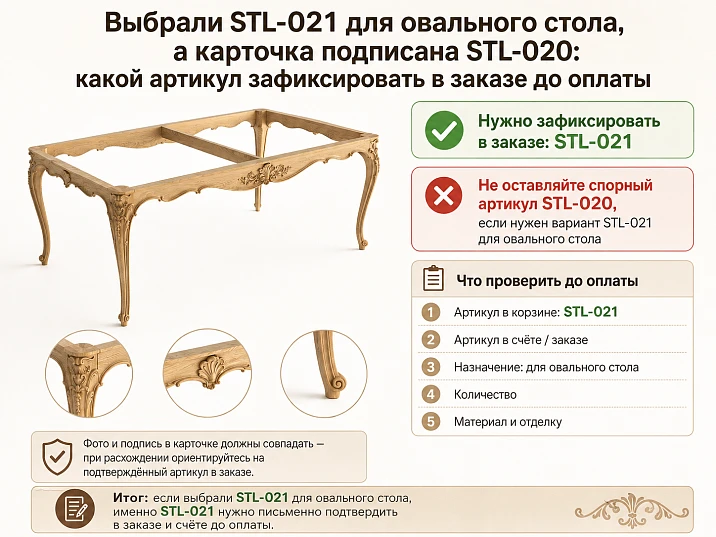
The table base for the oval table has already been chosen. The designer approved the proportions, the client agreed on a large dining table, and the estimate includes a wooden base measuring 1900 × 1100 × 750 mm. It would seem that all that remains is to open the product page, choose beech or oak, and pay for the order. But this is where a question arises that cannot be resolved by guessing: the page title mentions STL-021, while inside the same page it says STL-020.
For inexpensive decorative trinkets, such confusion is unpleasant. For a large wooden table base, it becomes a project risk. The article number goes into the estimate, invoice, working drawing, tabletop order, and documents for the finisher and installer. If the designer writes STL-021, the manager sees STL-020, and in a neighboring page there is also STL-020-1, one short designation is clearly not enough.
Therefore, before buy a table base for an oval tableit is necessary to fix not one disputed article, but a full set of features of the selected product: size 1900 × 1100 × 750 mm, material, quality "Prestige", the selected option for enamel or tinting, the current drawing and a written confirmed STAVROS article.
Until such confirmation, one cannot confidently write that the correct code is exactly STL-020 or exactly STL-021. The card itself contains a contradiction. It is much more reliable not to guess which inscription to consider the main one, but to make it unambiguously clear in the invoice and correspondence which underframe is being ordered.
This is especially important for an oval table. Here, an error in the base changes not only the name of the position. The dimensions, the size of the tabletop overhangs, the position of the legs, the distance between seating places, the external scale of the table, and the installation diagram all change.

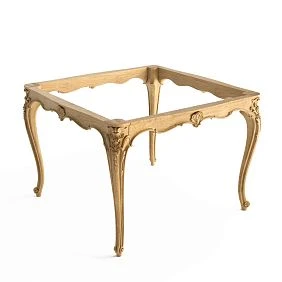
Why the contradiction between STL-020 and STL-021 cannot be considered a harmless typo
While the product is only open in the browser, STL-020 and STL-021 look like two very similar sequences of characters. After entering the project, the article turns into a product identifier.
The designer puts it in the specification. The buyer repeats it in the request. The manager transfers it to the commercial proposal. Production is guided by the order position. The carpentry workshop matches the base with the tabletop. The installer opens the drawing. If the same model is used at each stage, the article saves time.
If the original card uses two designations, the short code ceases to perform this function.
Let's imagine a simple scenario. In the designer's list, STL-021 is written. The customer calls and says: "We need an STL-021 underframe for an oval table." The manager opens the page where H1 states STL-020. Then STL-020 appears in the invoice. The buyer thinks this is just an internal designation and pays. Later, the tabletop is produced according to the drawing that was attached to another version of the project. The question arises only when the correction costs significantly more than one letter before payment.
Therefore, the problem of the article is not to find out which name is prettier or more logical. The problem is in identifying the item of the order.




What exactly is confirmed for the large underframe 1900 × 1100 × 750 mm
Despite the inconsistency in labeling, the card has characteristics that help to unambiguously describe the desired product.
| Parameter | What needs to be recorded |
|---|---|
| Product type | Wooden underframe for a large table |
| Size | 1900 × 1100 × 750 mm |
| Article number | Confirm with STAVROS before payment |
| Disputed designations | STL-020 / STL-021 |
| Material | Beech or oak |
| Sanding quality | «Prestige» |
| Preparation | Under enamel or under tinting — according to the selected item |
| Construction | Collapsible |
| Connection of legs and aprons | Dowels and reinforced eccentric fasteners |
| Additional reinforcement | Cross rail |
| Tabletop | Checked separately per project |
| Drawing | Must be current and relate specifically to the paid item |
| Quantity | According to the estimate |
This table shows the main point: even if the name on the page is corrected tomorrow, a competent order should still not consist of a single line "STL-021 — 1 pc.".
Size, material, and finish are not secondary comments. These are full product parameters.
Our factory also produces:
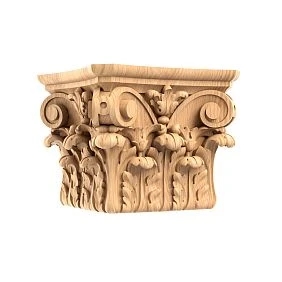

Which article number to write in the request right now
There is no need to independently choose a winner between STL-020 and STL-021.
The correct wording of the request should look approximately like this:
Table base per card, size 1900 × 1100 × 750 mm. The page simultaneously contains designations STL-020 and STL-021. Please confirm the current article number of the ordered item, material, selected finish, and send the current drawing. Please indicate the confirmed article number in the invoice along with the size 1900 × 1100 × 750 mm.
Such a message solves several tasks at once.
First, the manager understands which page the customer opened.
Second, the disputed designation is not hidden but explicitly brought up for verification.
Third, the size prevents accidentally switching to another item.
Fourth, the correspondence includes written confirmation that can be saved along with the invoice and drawing.
That is why in this situation the question "STL-020 or STL-021?" works less effectively than the question: "How to make the order unambiguous regardless of an error in the card?"
Get Consultation
Size 1900 × 1100 × 750 mm — the second identifier after the article number.
The article number is convenient because it is short. The size is useful because it describes the actual geometry.
The large underframe has a length of 1900 mm, a width of 1100 mm, and a height of 750 mm. These numbers should be repeated in the project, commercial proposal, and invoice.
Why is this so important?
Because the site has a standalone position STL-020-1 with dimensions 1100 × 1100 × 750 mm. The difference in name is small. In actual geometry — huge.
The large base has one side of 1900 mm. STL-020-1 has both main sides at 1100 mm. The difference along the long axis is 800 mm.
For an oval tabletop, this is a completely different scale.
If the tabletop was designed around a base 1900 mm long, replacing it with a square base of 1100 × 1100 mm will sharply increase overhangs along the long axis. The position of the legs relative to those seated will change. The external silhouette will become different. A different tabletop reinforcement system may be required.
Therefore, the phrase "underframe 1900 × 1100 mm" is useful not for an extra keyword. It actually protects the project from error.
STL-020-1: why one extra digit means a different product
A buyer who has already encountered STL-020 and STL-021 may easily decide that STL-020-1 is another way of writing the same article number.
This is an incorrect approach.
If you need buy STL-020-1 table base, we are talking about a separate card with dimensions 1100 × 1100 × 750 mm.
It is better to compare by parameters.
| Parameter | Big dispute card | STL-020-1 |
|---|---|---|
| Size | 1900 × 1100 × 750 mm | 1100 × 1100 × 750 mm |
| Long axis | 1900 мм | 1100 мм |
| Short axis | 1100 мм | 1100 мм |
| Height | 750 мм | 750 мм |
| Article scenario | Large oval table | Separate model |
| Risk of error | STL-020 and STL-021 on one page | Mixing with large STL-020 |
| Check before payment | SKU + size + drawing | SKU + size + drawing |
The height at both bases is the same. Therefore, a user who only looked at 750 mm may not notice the substitution.
But the table plan changes completely.
Why the request "underframe for an oval table" cannot be reduced to the shape of the tabletop
An oval is only a description of the contour.
It does not say:
-
what length the tabletop is;
-
what width;
-
how elongated the ends are;
-
whether there are straight sections;
-
what the thickness is;
-
what material the top is made of;
-
how much does it weigh;
-
where are the mounting points located;
-
what overhang is designed by the designer;
-
how many people should be seated at the table.
Therefore, even a large underframe 1900 × 1100 mm cannot be automatically declared suitable for any oval tabletop.
One oval can have a size of 2200 × 1200 mm.
Another — 2600 × 1400 mm.
The third visually resembles a rectangle with heavily rounded ends.
The fourth is almost round.
In all four cases, the ratio of the tabletop edge to the legs will be different.
How to check an oval tabletop before ordering the base
Two drawings are needed: the underframe and the tabletop.
They are aligned along the central axes.
The top view must clearly show:
-
the overall outline of the top;
-
the overall dimensions of the underframe;
-
the position of each leg;
-
the extreme points of the carved decoration;
-
aprons;
-
the transverse reinforcement;
-
fastening zones;
-
the tabletop overhang;
-
the seating positions of the chairs.
Such a drawing answers the question much more accurately than a photograph.
If the tabletop has not been chosen yet, you can order a tabletop for a wooden base after the geometry of the base has been confirmed.
Why the overhang of an oval cannot be calculated with a single formula
For a rectangular tabletop, we can take the difference in dimensions and divide it in half.
For example:
tabletop 2300 mm;
base 1900 mm;
difference — 400 mm;
with symmetrical placement along the central long axis, you get 200 mm on each end.
But on the oval contour, this value works only at one specific point — at the end of the main axis.
Further, the edge smoothly approaches the base. In the leg area, the distance to the edge may turn out to be completely different.
That is why the check must be graphical.
Draw the tabletop and the underframe at the same scale. Even on such a simple plan, you can see where the leg comes too close to the edge, and where the overhang becomes visually excessive.
What must match before payment: seven control features
It is useful for the buyer to think not in terms of a single SKU, but in terms of seven matching features.
1. Product page
The link should lead specifically to the large card 1900 × 1100 × 750 mm.
2. Size
The same dimension is repeated in all documents.
3. Article number
After written confirmation, one code is used.
4. Material
Not 'beech or oak', but the specific selected wood species.
5. Preparation
For enamel or for tinting.
6. Drawing
The current version of the exact model being paid for.
7. Quantity
Quantity of under-tables according to the estimate.
If all seven points match, the probability of error is significantly lower than when ordering by a single line 'STL-020'.
Beech or oak: the choice must be made before counting
For the large underframe, beech and oak are available.
Both wood species are used in furniture production, but they differ visually.
Beech has a calmer grain pattern. It is often chosen for opaque painting, when the natural texture goes under the enamel.
Oak is noticeably more expressive. The pores and grain of the wood become part of the design, especially with staining and transparent finishes.
But in the topic of the disputed article, there is a more practical point.
Imagine that the manager confirmed the article, but the request still says "beech/oak". Formally, the problem of STL-020 and STL-021 is solved, but the order item is still not fully described.
Therefore, you need to write specifically:
beech, Prestige, under enamel
or
oak, Prestige, for staining
— depending on the selected position and agreed finishing.
Under enamel and under tinting — these are not just two colors
The phrase "under enamel" means that the future finish will be opaque. The natural color and part of the wood grain pattern will be hidden.
"Under tinting" implies a different attitude to the texture: the wood remains visually readable.
For a large carved underframe, this difference is especially noticeable.
After opaque enamel, the viewer primarily sees:
-
silhouette;
-
carved elements;
-
chiaroscuro;
-
the shape of cabriole legs;
-
the plasticity of the aprons.
After tinting, the pattern of the material itself is added to this.
So, the finish affects not only the color. It changes the character of the entire piece of furniture.
Why the "Prestige" quality should be kept in the specification
The large underframe has a complex shape and carved decor. Here, the quality of sanding cannot be perceived as a secondary line.
The card specifies "Prestige".
For the client, this means that it is desirable to repeat exactly this level of preparation in the specification.
Especially if the underframe is sent to an external painting workshop. The finisher must receive exactly the level of preparation that was included in the estimate.
Do not rely on the manager to "understand it anyway".
A good specification eliminates the need to read between the lines.
Disassembled structure: what the buyer actually receives
The large underframe is delivered disassembled.
This is logical for a structure measuring 1900 × 1100 × 750 mm. A solid table of this scale is harder to transport, bring in, and protect from damage.
The card describes the connection system: the legs are connected to the side rails using wooden dowels and additionally tightened with reinforced eccentric Spiral Lock fasteners.
An additional cross rail strengthens the structure.
For the buyer, what matters here is not the terminology itself, but the completeness of the set.
If the base arrives disassembled, you need to understand which elements should be inside the order and upon receipt.
What to check in the set before starting assembly
Before painting and installation, lay out the parts and compare them with the drawing.
Need to check:
-
main legs;
-
longitudinal side rails;
-
cross elements;
-
additional central crossbar;
-
dowels;
-
tie rods;
-
wedge-type connecting elements;
-
number of fasteners;
-
absence of damage;
-
marking;
-
wood species compliance.
If the card for a specific version specifies eight Spiral Lock tie rods, this quantity must be checked against the actual package contents.
Do not start finishing until the kit has been checked.
Why you cannot paint first and then assemble "for a check"
The logic "the parts are beautiful anyway, let's give them to the painter first" is risky.
Imagine that the underframe has already been coated with a complex multi-layer tint. After that, during a test assembly, a discrepancy in a part or completeness was discovered.
It is no longer possible to return to the original commercial condition.
Therefore, the sensible sequence is different:
receiving → completeness check → drawing verification → preliminary assembly check → finishing → final assembly.
The specific technology is determined by the craftsman, but the commercial logic is exactly this: first, make sure that what you ordered has arrived.
What to buy together with the underframe 1900 × 1100 × 750 mm
One base does not yet make a table.
You will need at least a tabletop and a well-thought-out finishing system.
| What to add | Why | What to Check |
|---|---|---|
| Tabletop | Determines the size and function of the table | Contour, thickness, weight, overhang |
| Finishing materials | Needed for enamel or tinting | Compatibility with the breed and selected technology |
| Tabletop fastening | Connects the top and base | Position and installation depth |
| Floor protection | Needed after installation | Type of flooring |
| Design project | Connects all elements | Drawings, part numbers, and dimensions |
| Delivery | Large item requires logistics | Packaging and delivery route |
If finishing is done after delivery, it is possible to order materials for finishing the underframe after choosing the specific technology.
Why finishing materials cannot be purchased before the underframe
It would seem that the designer already knows the color. So, the paint can be ordered right away.
But color is only part of the system.
It is necessary to understand:
-
beech or oak;
-
for enamel or for tinting;
-
how open the texture should remain;
-
what will the gloss be;
-
which primer is used;
-
how the carving is treated;
-
what the reference sample will look like.
For oak under a translucent finish and beech under an opaque enamel, the technological route may differ.
Therefore, the material is fixed first.
Then a sample is made.
And only then is the finish scaled to the entire set.
How to choose a tabletop for a large wooden underframe
The request "underframe for a large tabletop" sounds clear, but "large" is not a size.
Specific values need to be known.
Length
It sets the overall scale and end overhangs.
Width
It is especially important for a base width of 1100 mm.
Thickness
It affects the visual mass and the final height of the table.
Material
Wood, MDF, stone, and other options have different weights and mounting logic.
Contour
Oval, circle, rectangle, or shaped forms interact with legs differently.
Edge
A massive shaped edge can reduce the useful lower area.
Mounting
Mounting points must fall on suitable sections.
Therefore order a tabletop for a wooden base It is reasonable after checking not only a beautiful pair by photo, but also technical compatibility.
Large oval tabletop and seating of people
The description of a large base relates to a dining table. But the number of seats cannot be determined only by the size of the underframe.
For an oval table, the position of the legs is especially important.
A person can sit at the long side, but knees will be near the cabriole leg.
Another chair stands at the end — there the oval shape already has an effect.
The third one is placed near the central part of the apron.
Therefore, it is useful to show real chairs in the drawing.
Not conventional squares of 400 × 400 mm, but the dimensions of the selected model.
Then it becomes clear:
-
whether you can sit comfortably;
-
whether the leg gets in the way;
-
whether there is enough space to pull it out;
-
what the distance between adjacent chairs looks like;
-
whether it is convenient to use the end seat.
Table mockup 1:1 — a simple way to see the mistake before buying
For large furniture, a full-size mockup on the floor is very useful.
Take paper, painter's tape, or cardboard.
Mark:
-
outline of the oval tabletop;
-
central axis;
-
dimensions 1900 × 1100 mm;
-
position of the legs according to the drawing;
-
edge of the chairs;
-
necessary walkways.
Place real chairs.
Walk around.
Try moving them aside.
Such a test doesn't replace design, but it instantly shows the scale.
On screen, a 2600-mm table may look elegant. In a room, it can take up almost all the free space.
What changes if you accidentally order STL-020-1 instead of a large underframe?
The difference between 1900 and 1100 mm is 800 mm.
That's too much to consider the two bases interchangeable.
If you keep the same oval tabletop, the following will happen:
-
the long overhang will increase;
-
the legs will be closer to the center;
-
the visual support of the table will change;
-
the seating of people will become different;
-
the load on the tabletop will be distributed differently;
-
a different reinforcement may be required;
-
the classic composition will become more compact.
Therefore buy STL-020-1 table base it is worth it only when this particular model is provided for by the project.
When broad queries are better directed to the catalog
A person who has not yet chosen a specific design searches differently.
He enters:
-
wooden table base for a table;
-
table base wooden for a table;
-
buy wooden table base;
-
table frame;
-
solid wood table base.
It is too early to show such a user one controversial card as the only correct one.
It is much more useful to give the opportunity Buy a wooden table base after comparing several bases.
If you need to look even wider — frames, table bases, and tabletops — you can choose solid wood table bases.
This way, internal links work according to the user's real intent, rather than just being distributed throughout the text.
When exactly a large model 1900 × 1100 mm is justified
A massive base is needed not because "the bigger, the more reliable."
It is justified when:
-
the tabletop is truly large;
-
the room allows for a large table;
-
classic plasticity matches the interior;
-
the legs do not interfere with seating;
-
the overhangs are coordinated;
-
the tabletop material is suitable;
-
the project requires exactly this composition.
For a small dining room, such a frame may be excessive.
For a spacious living-dining room, on the contrary, a too compact base can get lost under a large oval top.
The scale must be deliberate.
Carved pedestal and modern interior: there is no contradiction
A large base with cabriole legs and carved ornament seems obviously classic.
But furniture does not have to live only in a historical interior.
You can combine:
-
carved pedestal;
-
a laconic oval tabletop;
-
solid modern enamel;
-
minimalist chairs;
-
calm wall;
-
large modern lamp.
Then classical plasticity becomes the main decorative object, rather than part of an overloaded ensemble.
If you want to see different ways of integrating carved furniture, it is useful to look at ready-made solutions with STAVROS tables.
Beech under enamel: when it is a rational choice
If the entire frame is planned to be painted opaquely, the natural wood grain ceases to be the main aesthetic argument.
What comes to the forefront:
-
purity of relief;
-
even preparation;
-
geometry;
-
sanding quality;
-
uniformity of finish.
In such a project, beech can be a rational material.
Especially if the color is complex: milky, gray-beige, graphite, deep green, blue, or black.
The carving will be read through shadow, not wood grain.
Oak for tinting: when the material should be visible
Oak should be considered when the natural structure is part of the design.
A semi-transparent finish can emphasize:
-
pores;
-
fibers;
-
natural transitions;
-
depth of carving.
In this case, the large base area works as an independent material in the interior.
The oak underframe and oak tabletop can be finished in a similar tone.
Alternatively, the tabletop can be lighter, while the base is tinted deeper.
But such solutions need to be tested on samples.
Matching the color of the underframe and tabletop is not a mandatory rule.
Sometimes the client strives to make everything one color because they fear making a mistake.
But a large table has several working scenarios.
One material and one tone.
The result is a solid, monolithic piece.
Natural tabletop and painted underframe.
The top showcases the wood, while the base works as an architectural form.
Dark base and light top
The contrast visually lightens the tabletop and highlights the carving.
Light underframe and stone top
The classic shape combines with a more austere modern plane.
No scenario can be called universally best.
It is important that it is agreed upon before purchasing materials.
Stone tabletop: why a separate check is needed
The description of a large frame allows the use of heavy stone tabletops.
But this does not mean that you can take any slab of the required size.
A stone tabletop requires checking:
-
actual mass;
-
thicknesses;
-
fragility;
-
load distribution;
-
lifting methods;
-
installation diagram;
-
intermediate support;
-
transportation.
Especially if it is a natural slab of non-standard shape.
A large underframe can be the basis of such a project, but the specific slab needs to be approved separately.
How to prepare a project if the countertop has already been purchased
This scenario is common.
The customer first finds a beautiful oval tabletop, and then looks for a base.
In this case, the sequence is as follows:
-
take precise measurements of the tabletop;
-
obtain its top view drawing;
-
specify the thickness;
-
determine the weight;
-
mark the available mounting zones;
-
obtain the current underframe drawing;
-
combine the drawings;
-
check overhangs;
-
check the position of the legs;
-
confirm the article number;
-
Only then place the order.
If the tabletop is expensive and already finished, guessing compatibility is especially risky.
How to design a project if the underframe is purchased first
The situation here is simpler.
A large card 1900 × 1100 × 750 mm is confirmed.
After that, the designer receives an exact drawing of the base and produces the tabletop to match it.
The advantage is that you can control the overhang and mounting points before the top is produced.
If the project is non-standard, order a table design project it can be more reasonable than joining two expensive parts "by eye."
How to check the invoice before payment
The invoice is the last point where correction costs almost nothing.
In the product line, you need to check:
-
confirmed article number;
-
name;
-
size 1900 × 1100 × 750 mm;
-
material;
-
quality;
-
execution;
-
quantity;
-
additional services;
-
finishing, if it is included;
-
delivery.
If the manager confirmed STL-021, but STL-020 without size appeared in the invoice again, you should not pay silently.
Ask to bring the documents into a unified format.
The same works in reverse.
The main thing is clarity.
Why written confirmation is better than a phone call
You can quickly resolve an issue over the phone.
But a week later, no one is obligated to remember the exact wording of the conversation.
A written message records:
-
what the customer asked;
-
which card was meant;
-
what size was mentioned;
-
which article number did the manager confirm;
-
which drawing is attached.
Therefore, after a phone call, it is useful to send a short email:
I confirm the agreement: we order the underframe 1900 × 1100 × 750 mm, current article number — ..., material — ..., finish — ..., drawing — attached file.
This way, all participants work with one version.
What to do if the card is edited after your order
This is a normal situation for a live website.
Suppose today you placed an order when the Title showed STL-021, and the H1 showed STL-020.
A month later, the content was corrected.
If you have saved:
-
invoice;
-
manager confirmation;
-
a drawing;
-
size;
-
material;
-
correspondence,
there is no problem.
You ordered not a "text on the page," but a specific product with agreed characteristics.
That is why documents are more important than a screenshot.
Do I need to save a screenshot of the card?
As additional material — yes.
It can show why the buyer had a question.
But a screenshot does not replace confirmation.
The page may change.
The image may not show the selected material.
The screenshot may not include the drawing.
Therefore, the main set is the confirmed article number, size, specification, and drawing.
Delivery of a large wooden table base
Even a collapsible frame remains a large furniture purchase.
Before payment, it is worth calculating delivery of a large table base and understanding the route not only to the city but also to the specific premises.
Need to consider:
-
packaging dimensions;
-
rigid box;
-
door openings;
-
elevator;
-
staircases;
-
temporary storage space;
-
Acceptance conditions;
-
the ability to inspect the parts.
It's good if the designer thinks about this before ordering.
Why the delivery route needs to be checked before manufacturing the countertop
The underframe is delivered disassembled, while the countertop may be one piece.
This is a typical trap.
The base easily fits into the apartment in parts, but the finished oval countertop 2400–2800 mm long suddenly doesn't fit around the stair landing.
Therefore, logistics are considered for the entire table, not just for the disputed STL-020/STL-021.
Especially if the countertop is stone.
Test assembly without the countertop
After accepting the base, it is useful to check that the geometry matches the drawing.
The assembled underframe should allow measuring the actual:
-
length;
-
width;
-
height;
-
position of the legs;
-
diagonals;
-
mounting zones.
If the tabletop is still being produced, these values can be additionally passed to the manufacturer.
This reduces the risk of error.
Why the tabletop size cannot be changed after the underframe is approved without a new check
The designer initially approved an oval of 2400 × 1300 mm.
Then the client decided: "Let's go with 2600 × 1400, since space allows."
The change seems small.
But what changes:
-
overhang;
-
mass;
-
visual proportion;
-
distance from edge to legs;
-
load on top;
-
seating of people.
So, the drawings need to be aligned again.
Carved base and chairs: checking not only beauty
A table can look great in a visualization and be uncomfortable to use.
The reason is the position of the legs.
A cabriole leg has volume and curve. It takes up more space than a thin vertical metal support.
Therefore, near each seating place, you need to check the legroom.
Especially at the ends of the oval.
The simplest way is to place the chair outlines on the plan and draw a line for the knee position.
A large oval table in the living-dining room
In a spacious combined area, the 1900 × 1100 × 750 mm model can become an architectural centerpiece.
Here, it is useful to build the composition not from the wall, but from the table itself.
A light fixture is placed above it.
Around it is a group of chairs.
Further on, there is a rug, a sideboard, a console, or a display cabinet.
This way, the carved underframe is perceived from all sides.
If the table is squeezed between furniture, part of the sculptural quality is lost.
The underframe in a separate dining room
In a separate dining room, a more classic composition can be afforded.
The oval tabletop supports the smooth lines of the cabriole legs.
Oak under tinting emphasizes the material.
Beech under enamel allows the frame to be light and monolithic.
The main thing is to leave enough space around so that chairs can be pulled out without colliding with walls.
A large table in a commercial interior
A restaurant, meeting room, salon, club space, or executive office imposes different requirements.
Here, what matters is:
-
intensity of use;
-
number of seats;
-
cleaning;
-
repairability;
-
finish durability;
-
parts replacement logistics;
-
shade repeatability.
If a series of tables is ordered, it is especially important to fix one confirmed article number and one drawing.
Otherwise, the error will multiply across the entire batch.
Serial order: how to prepare a specification
For several identical tables, it is better not to write:
STL-021 — 6 pcs.
It is much more reliable:
Table base, confirmed article number ..., 1900 × 1100 × 750 mm, beech, Prestige, for enamel, drawing no./date ..., 6 pcs.
If some of the tables are oak, they are listed as a separate line.
If the finishes differ, they are also listed separately.
This way, production and assembly see a clear separation.
What to do if a non-standard size is needed
You cannot simply write "make it 100 mm shorter" in the notes.
Changing a large underframe affects proportions:
-
the length of the aprons;
-
position of the legs;
-
drawing;
-
the central reinforcement;
-
the fit of the tabletop.
If an individual modification is required, it must be documented as a separate approved decision.
For a complex project, it is better to use a service order a table design project, where the original model is considered together with the necessary changes.
When another wooden frame will be better
A large controversial model is not suitable for everyone.
Another option is needed if:
- the table is significantly smaller;
- a square top is needed;
- a round composition is needed;
- a modern minimalist form is required;
- the space is limited;
- a central support is desired;
- the designer uses a different style;
- the countertop already has incompatible mounting zones.
In this case, you can buy solid wood furniture frames after comparing available designs.
Twenty-seven errors when ordering STL-020 / STL-021
Error 1. Deciding that Title is always more important
The page Title should not independently determine the product when it conflicts with H1 and the description.
Error 2. Deciding that H1 is always more important
The problem is the same. The sources diverge.
Error 3. Choosing the SKU by URL
The URL may retain the previous technical name.
Error 4. Write "need STL-020"
There is STL-020-1.
Error 5. Write "need STL-021"
Inside the card, STL-020 is used.
Error 6. Not specifying 1900 × 1100 × 750 mm
The buyer loses the main additional identifier.
Error 7. Not asking for a drawing
The photo does not show the exact geometry.
Error 8. Ordering a countertop before checking the base
You can get an incompatible set.
Error 9. Check only the length
For an oval, you also need width and contour.
Error 10. Check only the overall size
Need to see the position of the legs.
Error 11. Not checking the mounting zones
A beautiful oval may not have a suitable place for connection.
Error 12. Confusing STL-020-1 with the large model
The difference on the long side is 800 mm.
Error 13. Not specifying beech or oak
The material is part of the order.
Error 14. Not specified under enamel or under tinting
Finishing logic changes.
Error 15. Remove "Prestige" from the specification
Preparation quality must match the agreed option.
Error 16. Start painting before checking completeness
After the finish, disputes are harder to resolve.
Error 17. Not assembling the base using the control method
Some discrepancies are only visible in geometry.
Error 18. Not checking the fit of the chairs
Legs may interfere with feet.
Error 19. Ignore the oval shape
Two ovals of the same dimensions look different.
Error 20. Increase the countertop after ordering the base without a new check
The overhang and load change.
Error 21. Choose stone only by photo
Actual weight is needed.
Error 22. Not checking delivery
Large parts require a delivery route.
Error 23. Not saving the article confirmation
After the site update, it will be harder to restore the agreement.
Error 24. Pay for an invoice with a single line "STL-020"
Ask to add the size.
Error 25. Consider the same height as proof of the same model
STL-020-1 also has a height of 750 mm.
Error 26. Buy finishing materials before choosing the wood species
Oak and beech may require different visual finishing logic.
Error 27. Consider clarifying the article number as nitpicking
For this card, this is a mandatory part of a normal order.
Who the 1900 × 1100 × 750 mm underframe is really suitable for
Such a frame is worth considering if the buyer needs a large dining table and the room allows showing the base in full scale.
It is especially appropriate when:
- a large oval tabletop is provided;
- an expressive classic silhouette is required;
- natural wood is important;
- a version for enamel or tinting is needed;
- the interior allows carved decor;
- the table is considered as a central piece;
- there is an opportunity to check the project against the drawing.
Who should look for another solution
Another model is more rational if:
- the table should be small;
- a minimalist design is required;
- a central support is required;
- the tabletop is already designed for a different base;
- the room is too cramped;
- the visual task requires a thin metal frame;
- the oval top has dimensions incompatible with 1900 × 1100 mm.
The underframe should not be "fitted" to the project just because a photo was liked.
Practical scenario: the designer specified STL-021
Do not fix anything yourself.
Send to the manager:
- link;
- size;
- drawing;
- the material;
- finish;
- a note that the Title says STL-021, but inside it is STL-020.
Ask to confirm the article number.
After the response, correct the specification.
Practical scenario: STL-020 is already in the estimate
First, find out which one exactly.
If there is no size nearby, the entry is ambiguous.
Add:
1900 × 1100 × 750 mm
and exclude STL-020-1.
Practical scenario: the tabletop is already in production
Don't wait for it to be ready.
Immediately get the base drawing and pass it to the countertop manufacturer.
Let the mounting areas be checked before final top processing.
Practical scenario: countertop is ready
Take actual measurements.
Even if the project specified 2400 × 1300 mm, the finished part may have slight technological differences.
For installation, the fact matters.
Practical scenario: need oak for tinting
Ask to confirm:
- Oak;
- "Prestige";
- for tinting;
- current article number;
- size;
- drawing.
Do not abbreviate to "oak STL-020".
Practical scenario: need beech under enamel
Similarly:
- Beech;
- "Prestige";
- under enamel;
- size;
- article number;
- drawing.
Practical scenario: order goes to a site in another city
Add logistics to the specification.
Before payment calculate delivery of a large underframe, and also check the route for bringing in the future tabletop.
How to form a set as a single purchase
The customer gets the best result when they perceive the table as a system.
Instead of:
underframe now, tabletop later, paint sometime
better to assemble:
- confirmed base;
- agreed top;
- mounting;
- finish;
- logistics;
- Installation.
If any element is unknown, it doesn't need to be invented. It needs to be raised as a question before payment.
Why the STL-020/STL-021 card is useful as a lesson for any complex orders
Such situations occur not only with underframes.
In a large catalog, there may be:
- similar SKUs;
- old URLs;
- new names;
- size variants;
- different materials;
- modifications;
- neighboring models.
The main rule is universal:
an expensive or complex product cannot be identified by a single attribute if other attributes contradict it.
Use SKU + size + material + drawing.
FAQ: frequent questions about the STL-020 / STL-021 underframe
Which article number is correct — STL-020 or STL-021?
Until official confirmation from STAVROS, you cannot confidently choose one of the two. The card contains different designations.
What should I write in the order instead of the disputed article number?
Provide the link to the card, size 1900 × 1100 × 750 mm, material, quality, execution, and ask to confirm the current article number.
Why is the size not enough?
The size significantly reduces the risk of error, but it is better to use it together with a confirmed article number and drawing.
Why is the article number not enough?
Because the page simultaneously contains STL-020 and STL-021, and nearby there is also STL-020-1.
What is the size of the large card?
1900 × 1100 × 750 mm.
What is the size of STL-020-1?
1100 × 1100 × 750 mm.
Is STL-020-1 just another version of the name?
No. It is a separate item of a different size.
Can I order STL-020-1 instead of the large underframe for the same tabletop?
Without a new calculation, they cannot be considered interchangeable.
Will the large base fit an oval?
It may fit if the dimensions, overhangs, fasteners, and tabletop weight are coordinated.
Will it fit a round tabletop?
Compatibility needs to be checked separately against the drawing.
Can a rectangular tabletop be used?
The shape and dimensions must be checked against the base. The underframe itself does not dictate a single possible contour.
Which is more important for an oval — length or width?
Both dimensions are important. In addition, the contour itself needs to be seen.
Is a top view drawing needed?
Yes. It best shows the overhangs and the position of the legs.
What is “Prestige” in the card?
This is the specified sanding quality. It is better to repeat it in the specification.
Can beech be chosen?
Yes, beech is presented as a material option.
Can I choose oak?
Yes, oak is also presented.
What is better under enamel?
The choice needs to be coordinated with the finish. For an opaque system, beech is often rational, but the final result depends on the project.
What is better under stain?
If you need to emphasize the texture, oak has a pronounced grain, but the specific option still needs to be selected in the card.
Is the tabletop included in the base price of the underframe?
It should not be considered included without a separate line item in the order.
Which tabletop is mentioned next to the large base?
The page mentions ST-020, but its compatibility and specific configuration need to be checked separately.
Is the underframe delivered assembled?
No, the structure is delivered disassembled.
Does the assembly hardware come included?
The description lists the included connecting elements. It is useful to confirm the actual completeness when ordering.
What is the cross rail for?
It is part of the reinforcement structure for the large base.
Can a heavy stone tabletop be installed?
The product card allows heavy options, but a specific stone top requires calculation based on size and weight.
Do I need to assemble the underframe first and then paint?
Before final finishing, it is useful to check the completeness and geometry. The master will coordinate the technological sequence of the finish.
What to do if the manager confirms STL-020?
Ask to include STL-020 with the size 1900 × 1100 × 750 mm in the invoice and keep the confirmation.
What to do if STL-021 is confirmed?
Act the same way: STL-021 + size + material + drawing must match in the documents.
Is a page screenshot needed?
As additional evidence of the original situation — it is useful. But the main document should be a written order confirmation.
Can we rely on the URL?
No, not as the only source of the article number.
Can we rely on the Title?
No, because internal page elements use a different designation.
Can we rely on the H1?
Also no, as long as the Title contradicts it.
How not to confuse the large variant with STL-020-1?
Always write the full size.
Is a margin in tabletop size needed?
A universal margin cannot be assigned without a drawing. The overhang is determined by the project.
How to check seating for six people?
Overlay the actual dimensions of the chairs on the plan and check the position of the legs relative to the legs of those sitting.
Why is an oval shape more complex than a rectangular one?
The distance from the edge of the tabletop to the base changes along the entire arc.
Is a 1:1 mockup needed?
For a large table, it is very useful for checking scale and walkways.
Where can I see other wooden underframes?
In the section where you can Buy a wooden table base.
Where can I see all frames and tabletops?
In the general catalog you can choose solid wood table bases and compare neighboring solutions.
What should be sent to the manager for verification?
Link to the product card, size 1900 × 1100 × 750 mm, screenshot of disputed markings, material, finish, tabletop drawing, and a request to confirm the article number.
When can I pay?
When the invoice and written confirmation unambiguously describe the same product.
Final checklist for ordering a large underframe
Check each item before payment.
- The selected card is exactly 1900 × 1100 × 750 mm.
- It is clear that STL-020 and STL-021 appear on the page simultaneously.
- Confirmation of the current article number has been received.
- The article number has been added to the invoice.
- The invoice specifies dimensions of 1900 × 1100 × 750 mm.
- STL-020-1 has been excluded from possible confusion.
- Beech or oak has been selected.
- The "Prestige" quality has been recorded.
- The option for enamel or tinting has been recorded.
- The current drawing has been received.
- The underframe drawing has been combined with the tabletop drawing.
- The overhangs have been checked.
- Mounting points have been checked.
- The weight of the tabletop has been checked.
- The position of the chairs has been checked.
- The completeness of the collapsible base is clear.
- The finish has been agreed upon.
- Delivery has been checked.
- Correspondence has been saved.
- The final invoice and drawing have been saved.
If all items are closed, the page title can no longer create uncertainty.
Do not guess the article number, but clearly describe the product.
In this story, the most dangerous decision looks like the simplest one: seeing STL-021 in the Title, STL-020 in H1, and deciding on your own which label is "more correct."
There is no need to do this.
The customer has already chosen not an abstract article number, but a specific large wooden table base measuring 1900 × 1100 × 750 mm. This very fact needs to be placed at the center of the order.
Lock in the size. Choose beech or oak. Specify "Prestige." Determine the option for enamel or tinting. Get the current drawing. Compare it with the oval tabletop. Check overhangs, fasteners, and mounting points. Then ask STAVROS to confirm in writing which article number — STL-020 or STL-021 — is current for this item.
After confirmation, the same code must appear in the invoice, project, and correspondence.
This is how a professional order works: not "I think it's probably STL-021," but "we are ordering a confirmed item with such an article number, size 1900 × 1100 × 750 mm, such material, such finish, according to such a drawing."
STAVROS allows you to assemble a table as a single system: choose a wooden table base, select a tabletop, finishing materials, design, and delivery. For the disputed card, one mandatory control step remains — confirm the article number before payment. Then the discrepancy between STL-020 and STL-021 will remain a problem of the text on the page, not a problem of the already manufactured table.