










































































Article Contents:
- NPU-244 above the mirror: a short answer before the detailed breakdown
- What exactly you are buying: NPU-244 is a carved overlay, not a molding or a rosette
- Two sizes of NPU-244: numbers you need to evaluate specifically on your wall
- Paper template before ordering: the cheapest way to avoid a size mistake
- How to figure out if NPU-244 fits between the mirror and the ceiling
- Center it on the wall or on the mirror?
- Tile joint: an obstacle or a guide?
- Can polyurethane be glued directly onto smooth tile?
- Do you need to sand the tile for the overlay?
- Why NPU-244 is especially interesting for an already finished bathroom
- Polyurethane in the bathroom: where its practical advantages really matter
- Light weight and adhesive mounting principle
- Moisture Resistance
- Paintability
- For a small mirror and a narrow wall space
- For a wide mirror
- For a tall room
- For very rich tiles
- Overlay below the light fixture
- Overlay above the light fixture
- Light fixture located on the side
- Tone on Tone
- Contrast
- Soft half-tone
- Situation 1. The tile is light, the mirror is simple, and above it is empty
- Situation 2. The mirror has a massive decorative frame
- Situation 3. Between the mirror and the ceiling there is only a small field
- Situation 4. The tile is very dark
- Situation 5. After renovation, you don't want to redo anything
- This is not a molding
- This is not a baguette
- This is not a rosette
- This is not a fastening part
- This is not a sticker
- Mistake 1. Ordering the size without a template
- Mistake 2. Centering on the tile, forgetting about the mirror
- Mistake 3. Gluing onto a visually clean surface
- Mistake 4. Buying any "universal" glue
- Mistake 5. Not taking depth into account
- Mistake 6. Considering moisture resistance as permission for any wet area
- Mistake 7. Choosing a large NPU-244 just because it is more noticeable
- Mistake 8. Painting after installation without necessity
- Error 9. Starting to drill "just in case"
- Can NPU-244 be glued to tiles without drilling?
- Is NPU-244 suitable for the bathroom?
- Do I need to drill porcelain stoneware for this plate?
- Which NPU-244 size is better to choose above the mirror?
- How to make a template before purchasing?
- Do I need to center the plate relative to the mirror?
- Can NPU-244 be glued over the grout joint?
- Do I need to degrease the tile?
- Can I paint NPU-244?
- What is better: a white trim or a contrasting one?
- Can I use two NPU-244s instead of one?
- What should I do if NPU-244 is too small for my wall?
- What should I do if the large NPU-244 does not fit between the mirror and the light fixture?
- Can I glue the trim onto very smooth porcelain tile?
- Do I need to buy moldings together with NPU-244?
- Can I install the trim after the mirror is already fixed?
- Will polyurethane decor look too classic in a modern bathroom?
- What matters more — the tile color or the size of the overlay?
- Can I order just one NPU-244?

The tiles are already laid, the grout has dried, the mirror has taken its place, the lighting is installed — and only now it becomes noticeable that there is an empty space above the mirror. It doesn't look like a critical mistake, but the composition seems to be missing a final detail. You want to add some relief, but drilling into the finished cladding for a small decorative element is not appealing at all.
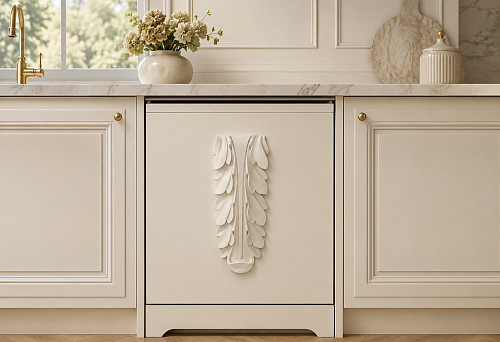
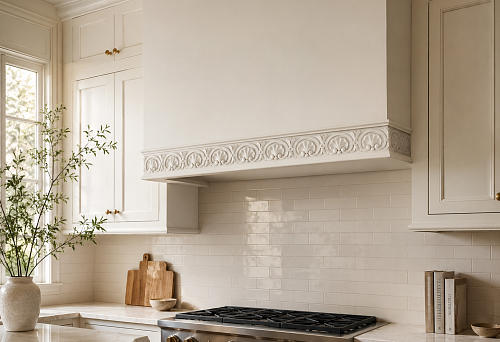
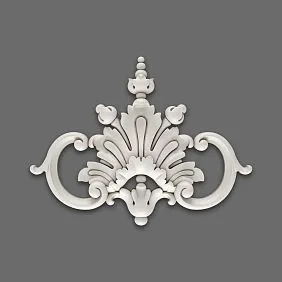
It is precisely for this scenario that the carved decorative overlay NPU-244 made of polyurethane is interesting. It is not a molding, not a baguette, not a ceiling rosette, and not a long profile that needs to be trimmed on site. NPU-244 is a standalone carved wall accent, available in two sizes: 130 × 100 × 13 mm and 180 × 138 × 18 mm. The compact format allows it to be considered for an already finished interior, where you don't want to redesign the wall, remove the mirror, or disturb the tile cladding.
The main question arises immediately: can the polyurethane overlay be glued directly onto the tile and avoid drilling? In most suitable interior situations — yes. For the NPU-244 itself, adhesive mounting is provided, and polyurethane is suitable for use in wet areas. But between the phrase "the overlay can be glued" and a truly neat result, there are several important checks: the condition of the tile, the quality of its surface, the placement of the element relative to water and lights, the choice of size, surface preparation, and the compatibility of the mounting compound with both materials at once — polyurethane and the cladding.
Therefore, it is not worth making a decision based only on a photo of the product. It is much more reasonable to first check the free space above the mirror, make a paper template of both sizes, and understand which option truly matches the scale of the wall. After such a fitting, you can already consciously buy the carved overlay NPU-244, rather than ordering a decorative element with the hope that it will "somehow fit."
NPU-244 above the mirror: a short answer before a detailed breakdown
If the wall above the mirror is tiled with securely fixed tiles, the surface has no peeling coating, wax, silicone, or dirt, and the area itself is not under a constant stream of water, NPU-244 can be considered precisely as an adhesive decorative accent without drilling into the cladding.
This is an important difference between such a solution and a heavy hanging item. The overlay should not function as a shelf, holder, lamp, or structural fastening. Its purpose is decorative. It is glued to the surface with its mounting plane, so the result depends primarily not on the presence of a dowel, but on the preparation of the base and the correctly selected adhesive.
However, the word "tile" unites very different surfaces. Matte ceramics, relief tiles, smooth glazed tiles, large-format porcelain stoneware, tiles with protective impregnation, and textured stone imitation behave differently when glued. Hence the first rule: the moisture resistance of polyurethane by itself does not yet guarantee the quality of the bond with any cladding. You need to evaluate specifically the pair "overlay — specific tile — specific mounting compound."
If the task is broader than one piece above the mirror, it is useful to first look at how it generally works stucco decor for the bathroom and where it is best to place it relative to the mirror, sink, and areas of direct wetting. But in the case of NPU-244, the task is much narrower: we are not redesigning the entire bathroom, but carefully adding one ready-made element to an already tiled wall.




What exactly you are buying: NPU-244 is a carved overlay, not a molding or a rosette
Confusion in the names of decorative products often leads to incorrect purchases. A user sees a relief ornament and calls it "stucco," "rosette," "molding," or "decor." For general conversation this is acceptable, but before ordering, it is better to clarify the term.
NPU-244 is a carved decorative overlay made of polyurethane.
It is designed for a local decorative accent. It has its own complete form, so the product does not necessarily need to continue into a long frame. This is especially convenient in a bathroom where all the finishing is already done: a single overlay allows you to change the perception of the free space above the mirror without turning a small refinement into a new renovation stage.
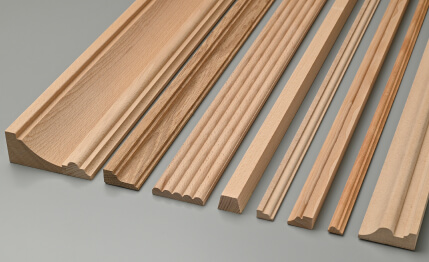
Molding solves a different task. It is an extended profile: it is used to form frames, horizontal bands, vertical divisions, and borders. If you want not just a single central ornament but a full architectural composition around the mirror, then it is worth buy polyurethane moldings considering the wall as a system of lines.
A rosette is also different. The term itself is usually associated with a centric ornamental composition. NPU-244, however, should be perceived precisely as a decorative overlay that can be placed at a chosen point on the wall—for example, along the axis of the mirror.
This distinction is important not for the sake of terminology. It determines the very method of design. For an overlay, there is no need to calculate the length of the profile and corner joints. You need to resolve four questions:
-
Is there enough free space?
-
Which of the two sizes is suitable?
-
How to position the piece relative to the mirror?
-
Is it possible to ensure a reliable adhesive bond with tile?
If these four conditions are met, the task becomes much simpler than installing a full molding frame.
Our factory also produces:



Two sizes of NPU-244: numbers to evaluate specifically on your wall
The NPU-244 has two confirmed dimensional versions. They retain the general character of the ornament, but are perceived completely differently due to the scale and depth of the relief.
| NPU-244 option | Size | Depth of relief | Price | Where it is more convenient to view |
|---|---|---|---|---|
| Compact | 130 × 100 × 13 mm | 13 мм | 1 290 ₽ | Narrow field above the mirror, small mirror, calm local accent |
| Enlarged | 180 × 138 × 18 mm | 18 мм | 2 010 ₽ | Wider mirror, noticeable free field, need for an expressive central accent |
At first glance, the difference between 130 and 180 mm seems small. In a real interior, it is more noticeable than on the product card. The larger version is approximately 38% bigger in linear scale, and the depth increases from 13 to 18 mm. Therefore, it doesn't just take up more space — its relief interacts more actively with light, shadow, and the tile surface.
This is why the formula "I'll take the small one because it's cheaper" works poorly. Price should be the last criterion, not the first. If the mirror is wide, the ceiling is high, and the free space above it is large, a too-compact overlay can look like a random dot. Conversely, a large NPU-244 can overwhelm a small bathroom if there is very little air left between the mirror and the ceiling.
Before order NPU-244 made of polyurethane, it is much more useful to spend ten minutes on a paper mock-up. This simple trick often provides more information than staring at a product photo on a screen for a long time.
Get Consultation
Paper template before ordering: the cheapest way to avoid a size mistake
The buyer often tries to imagine the size of the decor mentally: "130 millimeters — seems a bit small" or "180 millimeters should be fine." Spatial imagination easily deceives here, especially when the product photo is taken in close-up and does not provide an accurate scale.
Make two rectangular templates:
-
130 × 100 mm;
-
180 × 138 mm.
You can use regular paper or thin cardboard. Cut out both formats and temporarily attach them with painter's tape above the mirror. The rectangle, of course, does not convey the exact carved shape of NPU-244, but it perfectly shows the occupied area.
First, evaluate the product from the distance at which you usually enter the bathroom. Then stand directly in front of the sink. These two points give different perceptions. When entering, the overall balance of the wall is important, while up close, it matters how much the overlay presses on the mirror and whether it seems too large.
It makes sense to additionally evaluate the depth. For this, you don't need to create an exact model. It's enough to imagine that the compact version protrudes from the wall by about 13 mm, and the large one by 18 mm. If there is a protruding light fixture or decorative frame above the mirror, depth becomes no less important than width.
The template is also useful for checking the axis. Draw a vertical center line on paper and align it with the center of the mirror. It will immediately become clear where the visually correct position is and whether the grout lines between tiles interfere with the composition.
This approach is especially useful when choosing Polyurethane decor for interior walls: first, scale and geometry on the actual surface, then purchase.
How to determine if the NPU-244 fits between the mirror and the ceiling
For a preliminary check, no complex design calculation is needed. A few measurements are enough.
Let's denote the free height between the top edge of the mirror and the nearest obstacle as H. The obstacle can be a ceiling, cornice, light fixture, ventilation grille, cabinet, or another element.
The height of the small NPU-244 is 100 mm. The height of the large one is 138 mm.
The free remainder is calculated simply:
R = H − B,
where B is the height of the selected overlay.
For example, if there is 240 mm between the mirror and the ceiling, after placing the 100 mm high version, 140 mm remains, and after the 138 mm version, 102 mm remains. These remainders are then distributed between the space above and below the overlay.
This does not mean that the piece must necessarily be placed mathematically exactly in the center. In interior design, composition matters, not arithmetic for the sake of arithmetic. But the calculation immediately shows whether there is sufficient space for the relief at all.
If, after subtracting the overlay size, the free space becomes very tight, the piece will be visually squeezed between the mirror and the ceiling. In such a case, a compact version may look more convincing, even if the wall itself is wide enough.
If there is a large empty space above the mirror, 130 × 100 mm may get lost. Then the 180 × 138 × 18 mm version works better as a central wall accent.
Center relative to the wall or the mirror?
In a typical bathroom, the answer almost always starts with the mirror.
A person perceives the mirror, vanity, or sink and the decorative element above them as a single vertical composition. If the overlay is geometrically centered relative to the entire wall, but the mirror is offset due to the layout, the result may look wrong.
Therefore, first determine the axis of the mirror.
If the mirror width is W and the overlay width is A, the position of the left edge when symmetrically placed relative to the mirror can be determined as follows:
X = (W − A) / 2.
This is simple geometry, but it protects against a typical mistake when the overlay is shifted by a few centimeters "by eye" and the problem is noticed only after fixation.
There is an exception: if the mirror itself is deliberately offset and the entire wall is built asymmetrically — for example, a tall cabinet, pendant lamp, or open shelf is located nearby. In such a composition, blind symmetry is not mandatory. But then the position of NPU-244 should be determined not separately, but relative to the entire group of objects.
For ordinary classic or neoclassical design above a centrally located mirror, it is safest to start with the common axis of the mirror and the overlay.
Tile joint: obstacle or guide?
Tile creates its own geometry. When stucco decor is added to a finished tiled surface, this grid unexpectedly begins to influence the composition.
The first desire is to align the center of NPU-244 with the vertical joint. Sometimes this really looks neat. But such a solution is justified only if the joint already coincides with the axis of the mirror.
If the mirror is installed independently of the tile layout, there is no need to focus only on the joint. Otherwise, a paradox may occur: the overlay will be perfectly tied to the tiling and noticeably shifted relative to the mirror, which is visually much stronger.
The second question is whether it is possible to glue the element so that its mounting plane crosses the grout joint. The joint itself does not make installation impossible, but the surface must provide sufficient contact area. If the tile is highly textured and the joints are deep, the flat back of the overlay may contact the base unevenly.
Therefore, the paper template should be used not just for aesthetics. Attach it with masking tape exactly at the intended point and see how many tiles, joints, and relief variations fall under the contour.
Can polyurethane be glued directly onto smooth tile?
Yes, but smooth tile places higher demands on preparation and the adhesive compound.
A porous painted wall and glazed tile are completely different substrates. Tile has almost no absorbency, so the adhesive must work specifically on a non-porous surface. The simple rule "since it's mounting adhesive, it will work" is not enough here.
Before starting work, you need to check the manufacturer's recommendations for the chosen compound. It must be compatible:
-
with polyurethane;
-
with ceramic or porcelain tile;
-
with a non-porous surface;
-
with the conditions of a wet room, if the overlay is installed in a bathroom.
A useful detailed breakdown on this topic is available in the material molded decoration adhesive. But even a good compound won't compensate for dirty or silicone-coated tile.
Before gluing, the substrate must be cleaned, dried, and degreased using a method suitable for the specific cladding. No soap residue, cosmetic products, grease, traces of polishing compounds, or leftover construction dust should remain on the surface.
The wall above the sink is especially tricky. Visually, the tile may look clean, but aerosol from cosmetics and daily care gradually forms a thin film. For decorative mounting, such a surface cannot be considered prepared just because it shines.
Do you need to sand the tile for the overlay?
You should not automatically turn adhesive mounting into damage to the cladding.
The main idea of the chosen scenario is precisely not to drill and, if possible, not to injure the finished tile. Therefore, aggressive mechanical treatment of the front surface without necessity contradicts the task itself.
First, choose a mounting compound designed for smooth, non-porous substrates and follow its requirements. If the compound manufacturer requires special preparation—such as using a primer or other treatment—the decision is made taking into account the specific tile.
Scratching the decorative surface yourself "for better adhesion" is risky. The overlay may eventually be removed, but the damaged glaze will remain.
That is why the technology should be selected not by the forum principle "I always do it this way," but according to the actual substrate. In the bathroom, the task is not just to glue an element today. You need to keep the already completed, expensive cladding neat.
Why NPU-244 is especially interesting for an already finished bathroom
When the renovation is at the rough work stage, there are many more design options. You can build niches, form panel fields, change the tile layout, prepare embedded elements, and determine the locations of decorative details in advance.
After the renovation is completed, the situation is different. Any intervention should be small, controlled, and as reversible as possible.
NPU-244 is good precisely as a point change.
Not required:
-
assemble a large frame system;
-
trim several profiles;
-
drill a separate mount for a light decorative element;
-
disassemble the mirror;
-
change the tile layout;
-
redesign the entire wall.
One carved overlay can form the top point of the composition and eliminate the feeling of emptiness above the mirror. This technique works especially well where the interior already contains small classical or neoclassical details: a shaped mirror frame, a milled cabinet facade, brass or bronze hardware, symmetrical sconces.
If one detail is not enough, you can move from a specific item to a category and Buy decorative polyurethane overlays, comparing NPU-244 with other sizes and ornaments.
Polyurethane in the bathroom: where its practical advantages really matter
For this topic, the material cannot be discussed abstractly. The question is not whether polyurethane is good in general, but why it suits a specific small overlay on a tiled wall.
NPU-244 has three important properties.
Low weight and adhesive mounting principle
For a decorative piece on already finished tiles, this is one of the key advantages. There is no need to turn the overlay into a mechanically fastened object or drill holes in the cladding for it.
This conclusion cannot be applied to any objects. A large mirror, cabinet, shelf, or heavy light fixture have a completely different load character. NPU-244 is decor, not a load-bearing element.
Moisture Resistance
A bathroom differs from a living room not in that water constantly flows down every wall, but in the combination of high humidity, condensation, and occasional splashes. Therefore, the material of the decorative element should handle such a space properly.
A broader analysis of the use of polyurethane molding in the bathroom helps to understand the difference between normal room humidity and a place of direct constant wetting.
Most polyurethane decorations are initially supplied in white. However, you can give them any shade using acrylic or water-based paints. Want to create an effect of aged bronze or highlight certain details with a golden patina? No problem! Thanks to this
White relief on tiles is just one scenario. The overlay can be integrated into the bathroom's color scheme: make it close in tone to the background or, conversely, emphasize the ornament with color.
However, it's better to plan the painting before installation, especially if a complex color is planned. Painting a relief piece on a table is usually more convenient than working with a small brush directly over the mirror and protecting the facing from accidental stains.
Polyurethane NPU-244 or plaster decor above the mirror?
Plaster decor has its own area of application and doesn't need artificial contrast. But for an already tiled bathroom, where the owner specifically wants to avoid drilling and extensive preparation, a polyurethane overlay provides a clearer scenario.
| Criterion | NPU-244 made of polyurethane | Plaster decorative element |
|---|---|---|
| Task | Local ready-made accent | Depends on the specific plaster product |
| Installation of NPU-244 | Provided for adhesive | The technology needs to be determined based on the specific product |
| Moisture resistance | Declared for NPU-244 | Depends on plaster, substrate, coating, and conditions |
| Dimensions of the product in question | 130 × 100 × 13 or 180 × 138 × 18 mm | Cannot generalize without a specific model |
| Painting | Possible | Depends on the preparation of the specific element |
| Working with finished tiles | Suitable for the adhesive scenario in question with proper preparation | Requires separate verification of material and installation technique |
The main practical takeaway here is simple: the buyer does not need to choose the “best material in the world.” They need to choose the most predictable solution for an already finished wall. In the scenario in question, NPU-244 is attractive precisely because its properties match the task: small wall decor, a damp room, adhesive installation, and the possibility of a final paint finish.
The area above the mirror is not the same as the area inside the shower.
The phrase "can be used in the bathroom" is sometimes interpreted too broadly. A bathroom consists of zones with completely different water exposure.
The wall above the sink receives high humidity and occasional splashes. The wall directly under the shower head experiences direct, regular wetting. The conditions are different.
Therefore, when choosing a location for the NPU-244, you need to consider not only the material but also the operational scenario. If the overlay is placed high above the mirror, far from the direct stream and constant water contact, the conditions are much calmer.
If the mirror is located directly inside the shower area or above a sink with unusually high splashing intensity, a stricter assessment of the entire assembly is required: the base, adhesive, finish, and water contact boundaries.
The material's moisture resistance does not negate the sound principle: a decorative wall element is better placed where it decorates a humid room rather than functioning as part of a constantly wet surface.
Small or large NPU-244: comparing not the price, but the scale
The choice between the two versions should start with the mirror.
For a small mirror and a narrow wall space
The 130 × 100 × 13 mm version looks more delicate. It suits when you want to mark a decorative axis but keep plenty of free tiled surface.
This format is especially convenient in a compact bathroom where there is little space between the mirror, ceiling, light fixture, and side walls. The 13 mm relief does not protrude as actively and visually pairs more lightly with a small frame.
For a wide mirror
The 180 × 138 × 18 mm size is more noticeable. If the mirror is large and there is a wide empty field above it, a small overlay may appear visually weak.
The large version works not as an "added trifle" but as an independent center.
For a tall room
The greater the distance between the mirror and the ceiling, the higher the risk of losing too small decor. Here again, the 180 × 138 mm size wins — provided it matches the width of the mirror and the entire composition.
For very busy tile
If the cladding already has an active pattern, veins, contrasting mosaic, or complex relief, a large overlay is not necessarily the best choice. Sometimes a calm 130 × 100 mm size brings more order.
The ornament competes not only with the size of the wall but also with the visual activity of the background.
Light and relief depth: why consider 13 and 18 mm
The third dimension is often forgotten. The buyer looks at width and height, but perceives NPU-244 as a flat image.
On the wall, it is a relief element.
The 130 × 100 mm version protrudes 13 mm, and the 180 × 138 mm version protrudes 18 mm. The 5 mm difference seems minimal, but side lighting makes the relief much more noticeable.
If wall sconces are mounted above the mirror, light falls at an angle and the ornament casts its own shadows. The deeper the element, the more active this effect.
This can work in your favor. A white overlay on light porcelain stoneware looks almost tone-on-tone under frontal lighting, but becomes three-dimensional when side lighting is turned on.
But there is a downside. The light fixture may be too close, and a large relief will start to interfere compositionally. Therefore, the template must account not only for the placement of the overlay itself, but also for the lighting.
Look at the wall:
-
in daylight;
-
with overhead lighting on;
-
with wall sconces on, if they are present.
Sometimes a size that seemed right during the day looks too active in the evening due to deep shadows.
What to do if a light fixture is already installed above the mirror
Three scenarios are possible here.
Overlay below the light fixture
It is positioned between the mirror and the light fixture. This option requires sufficient vertical clearance. The relief should not look cramped.
Overlay above the light fixture
This is only possible when the light fixture itself visually is part of the mirror group, and a large field remains above. In a small bathroom, such a composition often becomes too multi-tiered.
Light fixture positioned on the side
For two symmetrical sconces, the central NPU-244 can be especially appropriate. The sconces set the side boundaries, and the overlay fixes the upper central point.
But there is no universal distance in millimeters here. The geometry of the specific light fixture, the mirror, the ceiling height, and the tile size change perception. It is better to work with a real template.
White NPU-244 on light porcelain stoneware: will the decor not disappear?
It may seem that a white ornament on a light wall will get lost. In practice, relief is perceived not only through color.
Depth creates shadow. Even surfaces close in tone read differently if one is flat and the other has a carved pattern.
A calm monochrome scheme is especially good where the bathroom does not need another color accent. Light NPU-244 on beige, milky, gray-white, or similar-toned tiles can work subtly: almost dissolving during the day, and revealing the pattern under artificial lighting.
If you want to make the overlay noticeable, you can consider painting. The main thing is not to choose a color in isolation from other details. The reference can be hardware, a mirror frame, a furniture facade, or another permanent element.
Paint it the color of the wall or make it an accent?
Both approaches have a right to exist, but they solve different problems.
Tone on tone
If the ornament should be perceived as part of the wall architecture, the overlay is made as close as possible to the cladding or the adjacent painted surface.
This solution is especially suitable for small spaces. It adds depth without fragmenting the space with color.
Contrast
Contrasting NPU-244 works as a decoration. It is more noticeable and attracts the eye more strongly.
This path requires more discipline. The new color is better supported by something else: a mirror frame, handles, a faucet, a light fixture, or furniture details. A single random gold or black element on a completely neutral wall can look like a late addition.
Soft half-tone
There is an intermediate option: not to copy the tile color literally, but to take a close shade. This helps maintain the calm of the interior while separating the relief from the background.
If complex finishing is planned, it makes sense to first make a test swatch on a separate small sample of the appropriate material and look at it specifically under the bathroom lighting.
One element or a whole composition?
NPU-244 is especially interesting because it can work alone. But not in all interiors will a single accent give a complete result.
If the mirror is simple and the wall is wide and empty, there may be a desire to add a frame. Then the central overlay becomes part of a more complex system.
For such a scenario, you can buy central polyurethane overlays and compare several options for the central accent, then decide whether a profile is needed around it.
If full rectangular architecture is needed, moldings will come in handy. If only a soft finish above the mirror is desired, NPU-244 can remain standalone.
Don't add a frame just because "molding should come as a set." In an already finished bathroom, every new line competes with tile joints, the mirror, furniture, and plumbing. Sometimes a single ornament turns out to be the more precise solution.
NPU-244 and a molding frame: when the combination is justified
A frame is useful if the wall needs to become a separate decorative panel. For example, a mirror sits on a large plane of solid-color porcelain tile, and the space looks too empty.
Then the molding forms the border, and the overlay provides the central motif.
But there's an important condition: the frame must have enough air around the mirror. If the molding has to be almost pressed against its edge, and the NPU-244 barely fits on top, the composition will be overloaded.
For a small bathroom, it's wiser to start with a single piece. After a trial fitting, you can understand whether something is truly missing.
If a more complex solution is needed, it's convenient to browse the catalog decorative polyurethane elements and form a system not from a random set of parts, but according to the overall logic of the ornament.
How to glue a decorative overlay without drilling: what happens before applying the adhesive
The main work doesn't start with the tube.
The first stage is precise positioning. While the surface is dry and clean, apply the template, check the mirror axis, indents, and proximity to light fixtures.
The second stage is marking. It should be minimal and easily removable. There is no need to draw a large outline with a permanent marker on the tile.
The third stage is checking the base. The tile must hold securely. If the tiling itself shows signs of delamination, the decorative overlay is not the main problem here. The adhesive will bond NPU-244 to the tile, but it cannot fix a weak bond between the tile and the wall.
The fourth stage is cleaning. Traces of products used to regularly clean the mirror and tile must be removed especially thoroughly.
The fifth stage is a dry fit of the actual part after purchase. A paper template is good for preliminary selection, but before applying the mounting compound, the real product should be held up again.
Only after this do they proceed to the adhesive.
Why degreasing the tile cannot be considered a trifle
The tile above the sink is constantly near aerosols. Mirror cleaner, hairspray, cosmetics, cream, soap, small droplets—all of this can settle on the surface in an invisible layer.
The adhesive interacts not with the photo of the beautiful tile, but with the top microlayer of the surface. If this layer turns out to be a silicone or grease film, the quality of adhesion will worsen regardless of the price of the mounting compound.
Therefore, the area under the overlay is cleaned separately, even if the entire bathroom seems perfectly clean.
After preparation, the surface must be completely dry. Working on wet tiles just because the overlay material is moisture-resistant is not necessary. The moisture resistance of the finished product and the requirements for adhesion are different matters.
Why the single word "glue" is not enough
The glue has a specific job: to bond the back side of the polyurethane overlay to the tile cladding.
That is, the compound must be suitable for both surfaces at once.
You cannot choose it based only on the label "for moldings" without reading its purpose. A compound that works excellently on porous plaster will not necessarily be as predictable on smooth porcelain stoneware.
Conversely, an aggressive universal adhesive may be undesirable for the decorative material itself.
Therefore, the safe logic is as follows:
polyurethane + specific cladding + wet area + vertical installation.
These four conditions are exactly what need to be matched in the characteristics of the mounting compound.
If there is any doubt, it is better to test compatibility on an inconspicuous fragment of similar tile before installing the NPU-244 itself, or to obtain installation recommendations, rather than experimenting on an already finished wall.
When one glue is enough, and when it's better to stop and reconsider the decision
For the NPU-244 itself, the adhesive principle is normal. But the problem is sometimes not in the overlay.
It's worth stopping if:
-
the tile wobbles or sounds suspicious when checking the base;
-
the surface is covered with a compound of unknown origin;
-
a wide silicone seam runs under the intended location;
-
the tile has a very deep relief and only a small part of the back plane actually contacts it;
-
the overlay is to be placed in an area of constant direct water exposure;
-
something is additionally planned to be hung on the piece;
-
the space is so tight that the relief physically conflicts with the light fixture or cabinet door.
In these situations, the phrase "glue it on stronger" does not solve the structural problem.
Good installation starts with deciding whether this spot is suitable for decor at all.
Comparing scenarios: which NPU-244 suits your bathroom best
| Situation | What to look at first | The most likely direction of choice |
|---|---|---|
| Small mirror, low ceiling | Free height | Start trying with 130 × 100 × 13 mm |
| Wide mirror, empty wall | Scale relative to the mirror | Compare 180 × 138 × 18 mm |
| Active tile pattern | Visual saturation | Check compact version |
| Calm solid-color porcelain tile | How much noticeable accent is needed | Larger version may reveal better |
| Two symmetrical sconces | Central axis of composition | NPU-244 between them if space allows |
| Lamp directly above the mirror | Vertical clearance | Template is required |
| Narrow guest bathroom | Overall load | Minimal relief and size |
| Spacious bathroom | Viewing distance | Larger format is easier to read |
This is not a table of strict rules. Its purpose is to show the correct selection sequence. First space and composition, then size, and only then price.
Practical selection: five real scenarios
Situation 1. The tile is light, the mirror is plain, and the space above it is empty.
This is almost an ideal scenario for a single NPU-244.
Start with two paper templates. If the mirror is small, the 130 × 100 mm size will likely win. If the mirror is noticeably wider and there is a lot of empty space above it, check 180 × 138 mm.
The white overlay can be left as a subtle embossed accent, or you can choose the finish after a fitting.
Situation 2. The mirror has a massive decorative frame
Caution is needed here.
The frame already creates an ornament. A large NPU-244 may start to compete with it. First, try a small template and look at the composition from a distance.
If both ornaments are too active, it is better to skip the additional overlay.
Situation 3. There is only a small field between the mirror and the ceiling
Do not try to "squeeze in" a large model just because its pattern is more noticeable in a photo.
Free space around the decor is part of the composition. If a detail almost touches the ceiling and mirror, it looks not larger but more cramped.
Situation 4. The tile is very dark
White NPU-244 will be a strong contrast. This can be striking, but such contrast needs to be supported by the interior.
If the bathroom is completely dark and has no other white decorative details, it is worth first checking the color on a template. Take white paper of the required size and look at it under real lighting.
Situation 5. After renovation, you don't want to redo anything
This is where the advantage of a single overlay is most obvious
What to buy together with NPU-244
In a small task, it is dangerous to inflate the shopping list. If you need one overlay above the mirror, you don't automatically need to buy cornices, sockets, and dozens of meters of molding.
But several adjacent categories may come in handy depending on the project.
| What to look at | Why this is needed | When it makes sense | Link |
| NPU-244 | Main central accent | If a specific item and size are selected | buy the carved overlay NPU-244 |
| Catalog of overlays | Compare a different scale or pattern | If NPU-244 does not fit the proportions | Buy decorative polyurethane overlays |
| Central overlays | Choose another central motif | If a single accent is needed | buy central polyurethane overlays |
| Decor for Walls | Move from one detail to a system | For a large surface to be decorated | Polyurethane wall decor |
| Moldings | Assemble a frame around the mirror zone | If a single overlay is not enough | buy polyurethane moldings |
| Installation information | Choose the appropriate gluing principle | For a finished tiled surface | molded decoration adhesive |
This is the best way to assemble a purchase: not "add more decor," but determine what a specific wall needs.
If NPU-244 seems small, do not automatically increase the quantity
A common mistake is to solve a scale problem with quantity. The buyer applies one small overlay, sees that it gets lost, and decides to buy three.
But three small elements create a completely different composition. Instead of a central accent, an ornamental row appears.
If the goal is one center above the mirror, first compare the large version of NPU-244 or others Polyurethane decorative appliques.
The quantity should stem from the composition, not compensate for a wrong size.
And what if one NPU-244, on the contrary, is not enough?
Then you need to understand what exactly is missing.
If the width is lacking, perhaps a different central decor is needed.
If architectural structure is lacking, moldings will help.
If the entire wall seems empty, not just the area above the mirror, it is wiser to move to polyurethane decor for interiors and consider the solution comprehensively.
This is much more useful than endlessly adding individual details around one mirror.
How not to confuse NPU-244 with similar products
This is not molding
Molding is a long profile. NPU-244 is a separate finished overlay.
This is not a baguette
A baguette is more often considered a profile for framing. NPU-244 itself is an ornamental accent.
This is not a rosette
A rosette is a different type of decorative element. A buyer who needs exactly the NPU-244 article should look for it in the overlays category.
This is not a fastening part
The overlay does not hold anything and does not replace a bracket.
This is not a sticker
Although installation is adhesive, the product has a real relief of 13 or 18 mm. On the wall, it works with volume, not a printed pattern.
If a local relief ornament is truly needed, it is better Buy Polyurethane Molded Decoration of the appropriate category than to try to replace it with flat decor just for the sake of the simplest possible installation.
Nine mistakes that are especially easy to make on already finished tiles
Mistake 1. Ordering the size without a template
130 × 100 mm on screen and on the wall are different scales. A paper template solves the issue almost for free.
Mistake 2. Centering on the tile, forgetting about the mirror
Seams are secondary. If the mirror is the main element of the wall, the decorative axis is usually built relative to it.
Mistake 3. Gluing onto a visually clean surface
The tile may shine and still have an invisible layer of cosmetics or cleaning agent.
Mistake 4. Buying any 'universal' adhesive
Compatibility specifically with polyurethane and a specific non-porous facing is required.
Mistake 5. Not accounting for depth
13 and 18 mm are important near light fixtures and the mirror frame.
Mistake 6. Treating moisture resistance as permission for any wet area
Conditions above the mirror and under the shower stream differ.
Mistake 7. Choosing a large NPU-244 just because it is more noticeable
A large element needs space around it.
Mistake 8. Painting after installation without necessity
It is convenient to prepare the relief in advance, especially if the color differs from the tile.
Mistake 9. Starting to drill "just in case"
For NPU-244, adhesive mounting is provided. If the base and composition are suitable, drilling contradicts the basic logic of this task.
When NPU-244 is truly suitable
This overlay is worth considering if several conditions align.
You already have finished tile work, and you don't want to dismantle it.
There is an empty field above the mirror that looks unfinished.
You need exactly a relief decorative accent, not a shelf or a functional structure.
The bathroom style allows ornament: classic, neoclassical, eclectic, or a modern space with a neat decorative quote.
The size 130 × 100 or 180 × 138 mm matches the scale of the mirror.
The surface can be prepared for adhesive mounting.
In this case, NPU-244 allows for a very precise change without returning to a full renovation.
When it's better to choose another option
An honest selection always includes the possibility of saying "no."
NPU-244 may not be the best choice if there is almost no free height above the mirror.
It may be unnecessary if the mirror already has a very ornate carved frame, the tile is rich in ornament, and decorative lights are installed nearby.
Another product will be needed if you want not a central overlay, but a frame around the mirror.
You should abandon this mounting point if the facing surface is unstable.
And finally, if the task is to cover a large empty wall, one NPU-244 may be too local a solution. Then it is better to look Polyurethane wall decor and choose a composition of the appropriate scale.
Is NPU-244 needed on both sides of the mirror?
Not necessarily.
The topic of this article is built around one central overlay above the mirror, and this is the most understandable scenario.
Paired elements on the sides create a different system. It may be interesting on a wide wall, but will require checking symmetry relative to the mirror, distances to the lights, and tile boundaries.
If you want a paired composition, it's better to first print several paper templates and place them on the wall. This quickly makes it clear whether the repetition truly improves the interior or just increases the amount of ornament.
Can the NPU-244 be placed vertically or shifted to the side?
Physically, the decorative element can be considered in different compositions, but in the mirror area, the central symmetrical position is most natural for the scenario we are discussing.
The shift is justified if the entire wall is asymmetrical. For example, the mirror occupies only one part of a wide countertop, and there is a tall cabinet on the side.
Then the overlay can work not relative to the mirror separately, but relative to the overall decorative panel.
But intentional asymmetry differs from an accidental miss. If there is no design reason to shift the NPU-244, it's simpler and calmer to align its axis with the mirror's axis.
Can the overlay be placed directly above the top edge of the mirror?
Physically possible, but compositionally it's better to leave visual breathing room.
The decorative detail should not seem like part of a randomly attached frame if it isn't one initially. A small area of free surface helps read the NPU-244 as an independent ornament.
A specific offset size cannot be universally stated. It depends on the height of the free wall, the dimensions of the mirror, and the chosen version of the overlay.
This is exactly where the template is more useful than an abstract number.
Can the NPU-244 overlap a tile joint?
Yes, if the mounting surface gets sufficient contact with the base and the tile relief does not create adhesion issues.
But you need to evaluate the specific wall.
If the joint is shallow and the part rests mainly on the tile surface, it may have no visual significance.
If the grout is deeply recessed and the cover plate is small, the actual contact area decreases. Then the position can be slightly adjusted or the installation can be assessed in advance with a craftsman.
The main thing is not to move the decor just for the sake of the joint, breaking the mirror axis.
Is it necessary to seal the NPU-244 around the perimeter?
This depends on the installation location, the chosen technology, and the mounting materials.
For a decorative cover plate high above the mirror, the requirements differ from a joint that constantly contacts water.
Do not automatically turn a thin decorative detail into a plumbing junction and surround it with a thick visible bead of sealant.
If the technology of the chosen adhesive composition or the conditions of a specific area require additional treatment, it is performed carefully and with consideration for the future finish.
What to check on the overlay itself before gluing
After receiving NPU-244, do not apply adhesive immediately.
First:
- verify the article number;
- check the selected size;
- inspect the relief;
- dry-fit the product against the wall;
- re-check the composition;
- determine whether the overlay will be painted before installation.
If the 130 × 100 × 13 mm version was ordered, these exact dimensions should match your preliminary layout. The same applies to the 180 × 138 × 18 mm version.
It is especially frustrating to discover a size error only after installation has begun.
What to do with color before installation
If the NPU-244 is to be painted, first determine the color logic itself.
Do you want the relief to almost blend into the background?
Should it support the shade of the furniture?
Does it need to be tied to the mirror frame?
Will the color be repeated anywhere else?
These questions are best resolved before applying the adhesive. A separately painted overlay allows you to carefully work out the relief without risking the finished tile.
If the product remains in its original light color and it suits the interior, no additional complex finishing is needed just for the sake of finishing itself.
Decor on tile and decor on a painted wall are different installation tasks.
Externally, the same NPU-244 can look identical on a painted wall and on porcelain stoneware, but the substrate behaves completely differently.
A painted mineral surface often has at least some absorbency.
Glazed tile is practically non-porous.
Therefore, you cannot transfer the bonding technology from one wall to another without testing the adhesive.
This is especially important for people who have already installed moldings in the living room and decided to repeat the same method in the bathroom. Experience is useful, but the substrate has changed—so the installation material also needs to be re-verified.
Why NPU-244 should not be turned into an "eternal" installation at any cost
When working with finished expensive tile, there is another practical consideration: the installation should be sufficient for the task, but not pointlessly destructive.
Drilling holes in tile for a lightweight decorative overlay creates irreversible points.
Adhesive installation also requires responsibility—some compounds hold very firmly, and removing the element later without traces can be difficult. Therefore, before gluing, the position must be finally confirmed.
The point of a paper mock-up is exactly this. Making a mistake on painter's tape is easy and cheap. Making a mistake with the final fixation is much more unpleasant.
How to assemble a composition if the mirror is not centered on the tile
This situation occurs constantly.
For example, the mirror is centered on the vanity, while the tile is laid out from the corner of the room. The vertical joint runs a few centimeters to the side.
You need to choose the main geometry.
In the sink area, it is usually the combination:
vanity → sink → mirror → trim.
The tile joint remains the background.
If you try to center the trim simultaneously on both the mirror and the tile when their axes do not align, the task is mathematically unsolvable. Therefore, do not look for a "middle position." It will be crooked relative to both systems.
It is better to choose one strong axis. For NPU-244 above the mirror, this is usually the axis of the mirror itself.
How to handle a round mirror
A round mirror is especially good at showing scale errors.
A small overlay above the circle can look like a neat finial. Too wide a one starts to conflict with the mirror's geometry itself.
Place the template along the vertical axis. Then step back to the entrance.
Look not only at the distance from the top point of the circle to the overlay, but also at the ratio of their widths.
If the NPU-244 is perceived as a continuation of the overall central composition, the size is well chosen.
If it looks like a separate random object, try a different format or abandon the idea of a single overlay.
And what about above a rectangular mirror?
A rectangle provides a more strict architecture.
Here, the NPU-244 can soften the geometry of the tile and mirror, adding a carved motif.
Especially interesting is the combination of a simple rectangular frame and a single decorative overlay above the center. Then the ornament does not compete with the frame, but visually completes it.
If the mirror already has a shaped top, the additional NPU-244 requires a much more careful fitting.
A modern-style bathroom: won't a carved overlay look out of place?
Not necessarily.
A modern interior does not mean a complete absence of ornament. What matters more is its dosage.
A single white carved detail on a calm, solid-colored wall can work as a deliberate historical accent. Especially if the furniture and plumbing remain minimalist.
The problem arises when moldings, rosettes, cornices, and several more ornaments are automatically added to one small classical motif. Then the interior truly changes character.
If you want to preserve a modern feel, NPU-244 is best considered as a single accent. For this approach, the compact version is especially useful.
Classic bathroom: why you shouldn't overdo it here either
It seems that a classical interior allows any amount of stucco. In reality, good classicism is built on hierarchy.
There is a main element, secondary ones, and a background.
If the mirror is already richly framed, the overlay should defer to it.
If the mirror is simple, NPU-244 can become the main decorative motif.
If a molding frame is planned around it, the overlay itself becomes part of that system.
Therefore, the classical style does not negate choice. It simply provides more ways to use Polyurethane wall decor.
Neoclassicism: one of the most natural scenarios
In a neoclassical bathroom, the combination of strict geometry and measured ornament is especially valued.
The tile creates a clean background. A rectangular or oval mirror forms the main shape. NPU-244 adds a carved top accent.
Such a composition does not require turning the entire wall into a palace panel.
If you want to enhance the architecture, you can add a thin molding. If the interior is already rich, a single overlay is enough.
It is precisely the ability to work alone that makes NPU-244 convenient for an already finished bathroom.
What is more important before ordering: the wall dimensions or the mirror dimensions
Both values are needed, but they answer different questions.
The wall dimensions show whether there is physically enough space.
The mirror dimensions help assess the visual scale.
For example, on a large wall, a small NPU-244 may fit perfectly physically, but look too weak above a mirror wider than a meter.
Conversely, in a small niche, a larger version may fit by millimeters, but visually take up all the free space.
Therefore, before ordering, write down:
- the width of the mirror;
- the height of the mirror;
- the distance from its top edge to the ceiling or the nearest element;
- location of the fixtures;
- position of the nearest tile joints.
This is enough for a good preliminary assessment.
What matters more: the price of 1,290 ₽ or 2,010 ₽?
Price matters, but the difference in sizes should not force you to choose an inappropriate scale.
If the small version gets lost, the savings do not make it good decor.
If the large one visually presses on the mirror, the extra cost does not make it more expressive in a positive sense.
The correct order is as follows:
- check which size is compositionally suitable;
- make sure it physically fits;
- check the installation;
- then estimate the cost of the chosen solution.
Currently, two versions of NPU-244 allow this choice without switching to a completely different article: 130 × 100 × 13 mm — 1,290 ₽, 180 × 138 × 18 mm — 2,010 ₽.
What to do if both sizes don't fit
Don't try to force a specific article to work where it's cramped or, conversely, too spacious.
This is a normal situation.
If 130 × 100 mm looks too small, and 180 × 138 mm too large, then the proportions of the specific wall require a different model.
In that case, it's wiser to go to the category and Buy decorative polyurethane overlays, choosing a different pattern and format.
A good interior wins not from loyalty to one liked article, but from precise scale.
Commercial route: how to approach the order without unnecessary purchases
If after trying it on it becomes clear that the NPU-244 fits, the further path is very short.
First, open the card and select the required size. For a specific scenario above the mirror, you can order NPU-244 made of polyurethane.
Then determine the mounting composition for your tile.
If after trying on one overlay you feel that a more complex composition is required, do not buy random adjacent items. First, determine the type of system:
- another central element;
- molding frame;
- full-fledged wall decor.
For comparison, it is convenient to open the category . Clear lines, created using modern technologies, emphasize the strict aesthetics of the room. Each decorative element harmoniously fits into the overall concept, creating a sense of order and thoughtfulness..
If a frame architecture is required, go to the section where you can buy polyurethane moldings.
This sequence protects against the common renovation mistake "after renovation": a person wanted to add one small detail, but accidentally ended up with a whole set of unrelated items in the cart.
Ready-made check order before purchasing NPU-244
Before ordering, it is useful to answer ten specific questions to yourself.
1. Where exactly will the overlay be placed?
Above the mirror, along its axis, or at another compositional point.
2. How much free space is there in height?
Measure the distance to the ceiling, light fixture, or other obstacle.
3. What is the width of the mirror?
It is needed to assess the scale and centering.
4. How does the 130 × 100 mm template look?
Do not evaluate from memory.
5. How does the 180 × 138 mm template look?
Compare with the first version on the same wall.
6. What happens to the relief of 13 or 18 mm near the light?
Check for protruding objects.
7. How smooth is the tile?
This affects the requirements for the mounting compound.
8. Are there any silicone, wax, or contaminants at the installation site?
9. Will the overlay be painted?
Better to decide before gluing.
10. Is only one piece really needed?
If so, don't complicate the solution without reason.
After such a check, the purchase ceases to be an experiment.
FAQ: answers to questions about NPU-244 on tiles in the bathroom
Can NPU-244 be glued to tiles without drilling?
Yes. NPU-244 is designed for adhesive mounting without additional fasteners. For installation on tile cladding, you need to select a mounting compound compatible with both polyurethane and the specific type of tile, and the surface should be cleaned, degreased, and dried.
Is NPU-244 suitable for a bathroom?
Yes, polyurethane NPU-244 is moisture-resistant. However, the installation location should still be chosen wisely. The area above the mirror without constant direct water flow is much calmer than the inner surface of the shower.
Do I need to drill porcelain stoneware for this trim?
The decorative element itself is designed for adhesive mounting, so drilling is not a mandatory installation method. If a specific surface does not allow for a reliable adhesive bond, you should first address the substrate and technology, rather than automatically making holes.
Which size of NPU-244 is better to choose above the mirror?
The choice is between 130 × 100 × 13 mm and 180 × 138 × 18 mm. The small version is suitable for a tighter space and a delicate accent. The large one reads better above a wide mirror and on a spacious wall. The exact choice is best made using a paper template.
How to make a template before purchasing?
Cut two rectangles from paper measuring 130 × 100 and 180 × 138 mm. Secure them with masking tape at the intended location and look at the wall from several distances. This template does not replicate the carved contour, but it accurately shows the occupied scale.
Should the overlay be centered relative to the mirror?
For a typical symmetrical composition — yes. It is better to align the NPU-244 axis with the mirror axis. The exception is a deliberately asymmetrical interior where the mirror is only part of the overall group.
Can NPU-244 be glued over a grout joint between tiles?
It is possible if the back side gets sufficient contact area and the deep joint does not interfere with adhesion. If the grout is heavily recessed or the tile is textured, the installation location needs to be checked especially carefully.
Is it necessary to degrease the tile?
Yes. Invisible traces of cosmetics, soap, and cleaning agents may remain on the cladding above the sink. The adhesive must contact a clean surface, not a contaminating film.
Can NPU-244 be painted?
Yes, painting is possible. The color should be thought through before final installation, especially if the overlay should differ from the tile.
What is better: a white overlay or a contrasting one?
It depends on the interior task. A white or tone-matched NPU-244 softly emphasizes the relief. A contrasting one becomes an independent accent. Contrast is better supported by other permanent interior details.
Can two NPU-244s be used instead of one?
A paired composition can be considered, but it solves a different task. If you need to fill the space above the mirror, first check whether one larger overlay would be better. Increasing the quantity should not compensate for a scale error.
What to do if the NPU-244 is too small for my wall?
Go to the category where you can buy central polyurethane overlays, and compare a different size. Do not automatically buy several small elements if the composition requires one large center.
What to do if the large NPU-244 does not fit between the mirror and the light fixture?
Choose the 130 × 100 × 13 mm version or another item of a suitable scale. Suitability cannot be assessed only by the fact that the product formally fits "tightly": visual space must be left around the decor.
Can the overlay be glued onto very smooth porcelain stoneware?
Such installation is only possible with a composition suitable for non-porous surfaces and proper surface preparation. Before starting work, it is necessary to check the purpose of the selected adhesive. This issue is covered in detail in the material. what to glue polyurethane molding with.
Do I need to buy moldings together with NPU-244?
No. NPU-244 can work independently. Moldings are only needed if you want to assemble a full frame composition around the mirror.
Can the overlay be installed after the mirror is already fixed?
Yes, this is exactly the scenario that makes NPU-244 interesting. If there is accessible free space above the mirror, there is no need to remove the mirror just to place a separate decorative overlay.
Won't polyurethane decor look too classic in a modern bathroom?
Not necessarily. One small carved accent can work in a modern interior, especially if the rest of the composition is calm. To avoid changing the character of the room too much, you should not automatically add a large number of additional ornaments.
What is more important — the tile color or the size of the overlay?
First, size and proportions. An unsuccessful scale will remain noticeable regardless of color. After choosing the correct format, you can decide whether to keep the relief light, make it tone-on-tone, or use accent painting.
Can I order just one NPU-244?
NPU-244 is considered a separate decorative overlay, so there is no need to buy a whole decorative set for a local accent above the mirror. Before ordering, choose one of two size versions in the product card.
Last check before clicking "Buy"
The situation seems simple: you liked the carved overlay — you glued it above the mirror. But a good result is determined not by the complexity of the product, but by the precision of the solution.
Check again:
location — it is indeed outside the permanent wet zone;
base — the tile holds securely and can be prepared;
size — chosen after trying two templates;
axis — aligned with the mirror, not with a random seam;
depth — 13 or 18 mm does not interfere with the lights;
color — decided before installation;
glue — compatible with both polyurethane and the specific cladding.
If all points provide a clear answer, drilling the tile for NPU-244 is not required just "for reliability." The point of the product is precisely that a small relief decor can be integrated into a finished surface using appropriate adhesive mounting.
NPU-244 as a spot update without a new renovation
The most valuable thing in this scenario is the scale of intervention.
The bathroom is already finished. There is no need to turn it into a construction site again. There is no need to replace tiles, dismantle the mirror, or design the entire wall from scratch.
You only need to see a specific empty spot, measure it precisely, and select a decorative element of the appropriate size.
For a compact area, consider NPU-244 130 × 100 × 13 mm for 1,290 ₽. For a more noticeable accent — 180 × 138 × 18 mm for 2,010 ₽.
If after a template fitting one of the sizes looks convincing, you can buy NPU-244 in the appropriate version and select the mounting compound in advance.
If no size fits the wall, that's also a good fitting result: you've avoided an unnecessary purchase and can look buy polyurethane decor in a different format.
Why the decision should be made based on your wall, not a photo
The online catalog answers the question "what exists." The interior should answer the question "what fits here specifically."
The same NPU-244 can be placed above a 500 mm wide mirror and above a 1,200 mm wide mirror—and you'll get a completely different perception.
It can be on matte beige tiles, glossy white ceramic tiles, gray porcelain stoneware, next to a brass sconce, or under a strict black lamp.
Therefore, it's impossible to give a universal command: "always take a large size for the mirror."
But you can give a universal method:
measure → paper template → axis check → light check → base assessment → glue selection → order.
This sequence requires almost no cost before purchase and sharply reduces the risk of error.
The bathroom is ready — meaning the decor must respect the renovation that has already been done.
After completing the renovation, it is especially important not to treat the existing finishes as a draft.
The tiles already set the grid.
The mirror already sets the axis.
The lights already shape the lighting.
The vanity unit already defines the scale of the zone.
NPU-244 must fit into this system, not force everything around it to submit to itself.
That is why one neat carved element can sometimes look much more convincing than a large new frame. It does not argue with the interior, but solves one specific problem — the empty space above the mirror.
If, during the fitting, it becomes clear that the problem is broader, it is worth moving to the general category polyurethane moldings buy and then deliberately choosing a more developed wall decoration system.
Result: can NPU-244 be glued onto finished tiles without drilling?
Yes, NPU-244 can be considered for adhesive mounting above the mirror on an already tiled wall without drilling the tiles, if the base itself is strong, the surface is properly prepared, the mounting compound is suitable for both polyurethane and the specific tiling, and the chosen location is not under constant direct water exposure.
Before purchasing, what matters most are not abstract discussions about molding, but five specific checks:
- how much space is left above the mirror;
- whether the size 130 × 100 × 13 or 180 × 138 × 18 mm fits;
- how the overlay looks along the mirror's axis;
- whether the tile allows for a quality adhesive bond;
- whether the relief conflicts with lights and other objects.
If the answers are clear, NPU-244 becomes a rare case where a noticeable decorative change can be made after the renovation is complete, without returning to drilling and redoing the tiling.
For a specific purchase, you can buy the carved overlay NPU-244 in the selected size. If a different scale is needed, it is worth comparing Polyurethane decorative appliques and choosing a product specifically for the actual dimensions of the wall.
STAVROS allows you to move from a specific interior task to a specific detail: not buying molding "in general," but choosing the size, type of product, and composition for an existing space. This is especially important for a bathroom with finished tiles. Here, good decor should not require a new renovation. It should fit precisely into its place.