Article Contents:
- Why leave a smooth section between slat panels at all
- What exactly is the MPU-002
- 49, 75, and 208 mm — how much do the three sizes differ
- First measure the smoothest field itself, not the entire wall
- How to determine the visual center between two batten zones
- What part of the smooth field will the MPU-002 occupy
- 400 mm field: the large MPU-002 becomes dominant
- 600 mm field: maximum difference between the three characters
- 900 mm field and wider: the small mascaron may get lost
- How to make three MPU-002 templates at full scale
- For the large 208 mm variant, a volumetric mockup is needed
- Why relief depth is no less important than width
- How to view a fitting: distance matters more than looking up close
- When to choose MPU-002 49 × 49 × 16 mm
- When to choose MPU-002 75 × 75 × 25 mm
- When to choose MPU-002 208 × 208 × 69 mm
- Why you shouldn't choose 208 mm just because it's more noticeable
- One mascaron or two symmetrical ones
- Why three small mascarons are not a replacement for one large one
- How to align the mascaron axis with the rhythm of the battens
- At what height to place MPU-002
- If there is already a console or cabinet against the wall
- If there is already a TV in the center
- If there is already a light fixture hanging in the center
- Classic lion and modern slat wall: how to avoid a random combination
- Paint to match the smooth field or highlight
- In the color of the wall
- In the color of the slat panels
- Contrast option
- Step 13. Form your order
- Mistake 1. Choosing the size based on a product card photo
- Mistake 2. Considering only the field width
- Mistake 3. Ignoring the 69 mm depth
- Mistake 4. Centering by eye
- Mistake 5. Choosing the maximum size just for visibility
- Mistake 6. Compensating for a small size with a bright color
- Mistake 7. Adding a couple of mascaroons without a new layout
- Mistake 8. Not considering a TV or a lamp
- Mistake 9. Immediately adding a molding frame
- Error 10. A smooth field must be considered incomplete
- Can MPU-002 be used if the slat panels are different colors on the left and right?
- Can MPU-002 be placed not in the center but closer to one edge?
- Will MPU-002 fit in a narrow niche between slat panels?
- Can the mascaron be placed above an outlet or switch?
- What to do if the smooth field is not perfectly rectangular?
- Can MPU-002 be installed on a wall with wallpaper?
- Does ceiling height matter?
- If the field is 600 mm, does that mean 208 mm is the best option?
- How can you tell that 49 mm is too small?
- How can you tell that 208 mm is too much?
- Do you need to use two identical mascaroons on a symmetrical wall?
- Can a small MPU-002 be used as part of a group of other decorative elements?
- Can you choose 208 mm just because its price is known?
- What to do if 75 mm is too small and 208 mm is too much?
- Can a mascaron be installed after the furniture has already been arranged?
- Do you need to buy a mascaron if the template looks fine, but the wall looks better without it?
- How to choose between modern slats and a classic lion if the styles seem too different?
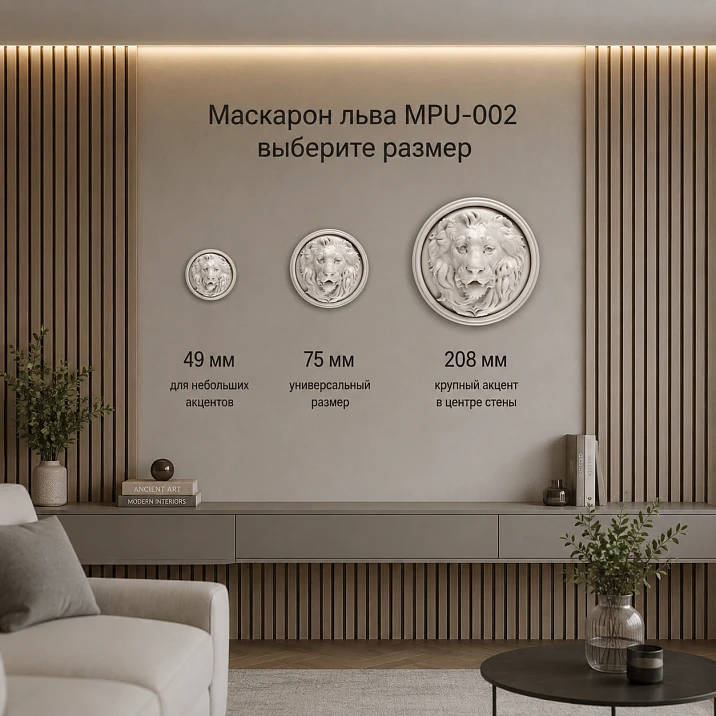
A slat wall does not necessarily need to be filled with panels from one corner to the other. Sometimes it is much more interesting to leave a smooth painted field between two rhythmic slat zones. It unloads the surface, gives the wall a compositional center, and allows using one expressive decorative element instead of several more square meters of panels.
But after finishing, the opposite problem may be discovered: the side sections work well due to the vertical rhythm of the slats, while the smooth middle seems too empty.
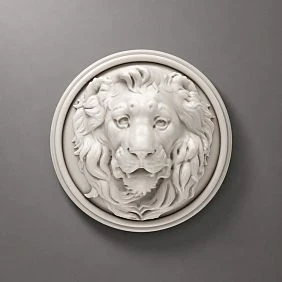
In such a situation, one carved mascaron MPU-002 in the shape of a lion's head can be considered.
Three significantly different scales are provided for MPU-002:
| MPU-002 option | Size | Material |
|---|---|---|
| Compact | 49 × 49 × 16 mm | Polyurethane |
| Medium | 75 × 75 × 25 mm | Polyurethane |
| Large | 208 × 208 × 69 mm | Polyurethane |
In the current STAVROS product card, the large 208 × 208 × 69 mm option is disclosed at a price of 10,340 ₽. For the 49 and 75 mm options, separate current prices are not confirmed in the source data, so their cost should not be calculated by assumption.
Here it is especially easy to make a mistake when choosing a product from a photo. A size of 49 mm and a size of 208 mm differ by more than four times in width and height, and the relief depth increases from 16 to 69 mm. This is no longer "the same lion, just a bit bigger," but three completely different options in terms of visual mass.
Therefore, the correct sequence before ordering looks like this:
measure the smooth field → determine its visual center → make three 1:1 templates → check the scale from a normal viewing point → account for furniture and lighting → choose the size → only then buy MPU-002.
After trying it on, the selected variant can be purchased as the carved mascaron MPU-002.
Why leave a smooth section between slatted panels at all
A slatted wall already has a strong visual rhythm. Parallel vertical elements create many lines, shadows, and repeating gaps.
If such panels cover the entire wall, the surface becomes uniform according to the principle:
slat → gap → slat → gap → slat.
This could be exactly the effect the project needs.
But another composition is possible:
slat zone → calm field → slat zone.
Then the smooth middle performs its own task. It separates two textured parts and creates a place where the eye can rest.
Therefore, the mere presence of an empty area does not mean the finish is "unfinished."
Sometimes the right option is to leave it without any additional decor.
The problem only arises when, after installing the panels, it becomes visible that the central field truly looks not calm but compositionally lost.
Then a single mascaron can work more powerfully than several randomly added details.




What exactly is MPU-002
On the site, the product is presented as polyurethane decor MPU-002, and in the description it is defined as a carved mascaron with a lion's head image. The model has three confirmed size variants — 49 × 49 × 16, 75 × 75 × 25, and 208 × 208 × 69 mm.
It is important to use the correct name in the article.
This is exactly a mascaron, not a molding, not a rosette, and not an ordinary oblong overlay.
Its compositional function is also different.
A molding creates a line.
Trim repeats the ornament along its length.
A small overlay can be a secondary detail.
A mascaron with a frontal lion image is perceived as an independent center of attention.
That is why the MPU-002 variant is especially logical to check in the middle of a pre-left smooth field.
If the pattern already forms a center, it is desirable to keep enough calm space around it.
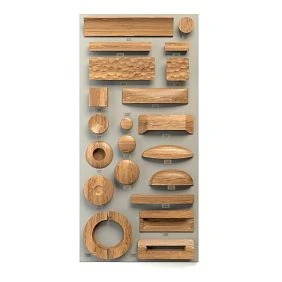
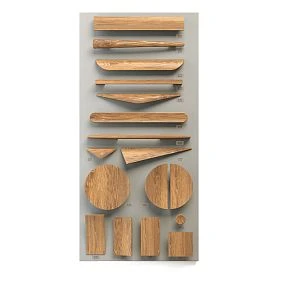
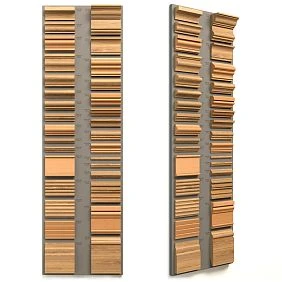
Our factory also produces:
49, 75, and 208 mm — how much the three sizes differ
Let's look not only at the absolute dimensions.
Between 49 and 75 mm:
75 − 49 = 26 mm.
The medium model is approximately 53% wider and taller than the compact one.
Between 75 and 208 mm the gap is much larger:
208 − 75 = 133 mm.
The large variant is approximately 2.77 times wider than the medium one.
Compared to the smallest:
208 / 49 ≈ 4,24.
That is, the large mascaron is more than four times wider and taller than the compact one.
The difference in depth is even more illustrative:
| Parameter | 49 мм | 75 мм | 208 мм |
|---|---|---|---|
| Width | 49 мм | 75 мм | 208 мм |
| Height | 49 мм | 75 мм | 208 мм |
| Depth | 16 мм | 25 мм | 69 мм |
| Attitude to the minimum size in width | 1× | 1,53× | 4,24× |
The depth increases from 16 to 69 mm:
69 / 16 ≈ 4,31.
This is a critically important difference.
The large MPU-002 not only takes up more wall space frontally. It protrudes significantly more from its plane and creates deeper chiaroscuro.
Therefore, you cannot make three paper squares, look only from the front, and consider the choice complete. For the 208-millimeter version, it is useful to separately simulate the depth.
Get Consultation
First, measure the smooth field itself, not the entire wall
Suppose the entire accent wall has a width of 3200 mm.
On the left, there is a slat zone with a width of 1000 mm.
On the right, there is another 1000 mm.
1200 mm remains between them.
This does not automatically mean that the decorative field is exactly 1200 mm.
Its perception can be influenced by:
-
outer slats;
-
technological gaps;
-
the trim of the adjacent door;
-
baseboard;
-
furniture;
-
switches;
-
sockets;
-
lighting fixtures;
-
a niche;
-
the television.
Therefore, two values need to be determined.
Physical field width — the distance between the actual edges of the slat trim.
Visually free width — the part of this field that is actually perceived as clean space for the central decor.
For selecting MPU-002, the second value is often more important than the first.
How to determine the visual center between two slat zones
With a fully symmetrical composition, the task is simple.
If the smooth field is 600 mm wide, its geometric center is:
600 / 2 = 300 mm
from each edge.
The vertical axis of the mascaron can be aligned with this line.
But in a real interior, deviations are possible.
For example:
-
the left block of slats is wider than the right;
-
there is a cabinet on the right;
-
there is a door on the left;
-
the console under the wall is shifted;
-
the ceiling light is not positioned along the geometric axis.
In this case, there are two centers:
The geometric center of the smooth field and the visual center of the entire composition.
It is still better to start with the geometric one.
Attach the template strictly in the middle.
Only after that compare a small deliberate shift, if the surrounding environment really makes the mathematical middle visually strange.
Do not place the mascaron "approximately in the center."
On a slat wall, vertical lines provide a very precise coordinate system, so an accidental shift is much more noticeable than on a plain wall without a geometric pattern.
What part of the smooth field will MPU-002 occupy?
Instead of many similar calculations, it is more convenient to view the range in a single table.
Below shows what proportion of the width of the smooth field each of the three mascaroons occupies.
| Width of the smooth field | MPU-002 49 mm | MPU-002 75 mm | MPU-002 208 mm |
|---|---|---|---|
| 300 мм | 16,3% | 25% | 69,3% |
| 400 мм | 12,3% | 18,8% | 52% |
| 500 мм | 9,8% | 15% | 41,6% |
| 600 мм | 8,2% | 12,5% | 34,7% |
| 700 мм | 7% | 10,7% | 29,7% |
| 900 мм | 5,4% | 8,3% | 23,1% |
| 1200 мм | 4,1% | 6,3% | 17,3% |
This is not a table of "correct percentages."
It does not say that the mascaron must occupy, for example, exactly one third of the central field.
Its purpose is to show the real difference in scale.
For a 600 mm field:
-
A 49-millimeter element occupies only about 8.2% of the width;
-
A 75-millimeter one — 12.5%;
-
A 208-millimeter one — about 34.7%.
This single figure alone shows why a product photo is not enough.
A 400 mm field: the large MPU-002 becomes dominant.
In a 400 mm wide field, the 208 mm mascaron takes up just over half the width.
This does not mean it is automatically too large.
If a large ceremonial center is specifically needed and there are no other objects around it, such a scale can be intentional.
But this is no longer a small decorative detail.
The smooth field actually begins to work as a background for one large object.
If this effect is not part of the design intent, it is worth carefully comparing 75 mm.
49 mm in the same field will be a much more local accent.
600 mm field: maximum difference between the three characters
For a 600 mm field, the choice is especially illustrative.
49 mm is a very compact point.
75 mm is still a relatively small central element.
208 mm is a full-fledged dominant mascaron.
In such a situation, there is no need to try to choose a size from the table.
Make three templates.
This is where a paper mock-up often proves more convincing than any recommendations.
A field of 900 mm and wider: a small mascaron may get lost
The wider the smooth insert, the more negative space surrounds it.
In a 900 mm field:
-
49 mm takes about 5.4%;
-
75 mm — about 8.3%;
-
208 mm — about 23.1%.
If the central element should be clearly visible from the room entrance, two small options may appear visually too delicate.
But there is an important exception.
If there is already a console under the mascaron and a lamp or other large decoration hangs above, even a small MPU-002 can work as part of the overall vertical composition.
Therefore, the fill percentage is only the first filter.
How to make three full-size MPU-002 templates
Prepare paper or thin cardboard and cut out:
-
49 × 49 mm;
-
75 × 75 mm;
-
208 × 208 mm.
You can write the size number on each one so you don't mix up the photos later.
Secure the template with masking tape at the intended center.
It's important to try on sequentially:
-
first 49 mm;
-
take a photo;
-
replace with 75 mm;
-
take a photo from the same point;
-
replace with 208 mm;
-
Take the photo again.
Do not change the camera position.
Otherwise, the comparison will be inaccurate: zooming in on the phone itself changes the perceived scale.
For the large 208-millimeter variant, a volumetric mockup is needed.
A flat square of 208 × 208 mm only conveys the frontal size.
But the actual depth of the large MPU-002 is 69 mm.
That is almost seven centimeters of protrusion relative to the wall plane.
Make a simple volumetric mockup:
-
square 208 × 208 mm;
-
a cardboard side profile of approximate depth;
-
light hollow construction.
No need to reproduce the lion's head.
The task is to understand the volume.
Look from the side.
Check how it works:
-
when entering the room;
-
with side lighting;
-
next to the rails;
-
near the furniture.
After such a test, the decision sometimes changes.
Frontally, 208 mm may seem ideal, but in profile, 69 mm may be too active for a small room.
Why the depth of the relief is no less important than the width
A slat wall is already voluminous by itself.
Each slat creates its own shadow.
If there is a flat painted central insert between two such surfaces, its calmness is built precisely on the absence of strong relief.
By adding MPU-002, you introduce a new volume.
The small version has a depth of 16 mm.
The medium one has 25 mm.
The large one has 69 mm.
That is, not only the area of the central spot changes, but also the light-and-shadow intensity.
Under frontal diffused light, the difference may appear moderate.
With side light from a sconce or sunlight, a large mascaron can create significantly deeper shadows.
This should be evaluated in the evening and during the day if different lighting scenarios are used in the room.
How to view a fitting: distance matters more than looking up close
Wall decor is not chosen from a distance of 30 centimeters.
Determine the actual viewing points.
For a living room, these could be:
-
entrance to the room;
-
sofa;
-
dining table;
-
passage between zones.
For the hallway:
-
entrance door;
-
end of the corridor;
-
Mirror.
For the bedroom:
-
a doorway;
-
bed.
Attach the template and look exactly from there.
The small MPU-002 can look great up close due to its pattern, but almost disappear from the main viewpoint.
The large one, on the contrary, can look impressive from a distance, but be too massive in a narrow passage.
When to choose MPU-002 49 × 49 × 16 mm
The smallest option is worth checking first if the task is not to create a large central medallion, but to add a small precise accent.
It can be successful when:
-
the central field is narrow;
-
the rack composition itself is already quite active;
-
there is furniture or a lamp nearby;
-
the mascaron is part of a larger vertical axis;
-
the decor should be discovered upon closer inspection;
-
we do not want to turn the lion's head into the main object of the wall.
The 49-millimeter option is especially interesting where the smooth insert itself should remain the main calm element.
The mascaron then does not fill it, but only marks the center.
On a large empty wall, this same size may get lost.
When to choose MPU-002 75 × 75 × 25 mm
The medium option is noticeably larger than the 49-millimeter one, but it is still very far from the 208 mm scale.
This makes it a standalone solution, not just a "middle ground."
75 mm is worth checking when:
-
49 mm is clearly lost;
-
208 mm overly dominates;
-
the field is relatively compact;
-
a readable but not monumental mascaron is required;
-
there is already furniture beneath it that forms most of the composition;
-
the walls are viewed from a medium distance.
For example, in a central field 400–600 mm wide, such a pattern will give a much calmer result than 208 mm.
But on a meter-wide field, 75 mm may still look like a very small detail.
When to choose MPU-002 208 × 208 × 69 mm
The larger variant is designed for a different level of expressiveness.
It suits a scenario where the lion's head should be perceived as an independent central object, not a small decoration.
Checking 208 mm is especially logical if:
-
the smooth field is wide enough;
-
the wall itself is large;
-
the room allows viewing the composition from a distance;
-
no many other small elements are planned around the mascaron;
-
the furniture below does not conflict with the central decor;
-
a strong ceremonial accent is needed.
But the large size requires a strict fitting.
On a 400 mm field, it occupies 52% of the width.
On a 600 mm field, it's about 34.7%.
This is already a significant part of the surface.
And the 69 mm depth further enhances the object's presence.
The price of the open large variant at the time of checking is 10,340 ₽.
After confirming the scale, you can order the lion mascaron MPU-002 made of polyurethane.
Why you shouldn't choose 208 mm just because it's more noticeable
A large object is indeed harder to lose on the wall.
But visibility itself is not a criterion of quality.
If the mascaron is too large relative to the central field, three problems may arise.
First, the smooth space ceases to serve as a visual pause.
Second, the classic lion head begins to conflict with the rhythm of modern slats.
Third, the entire composition becomes built around a single element, even though the architecture of the wall itself could have been the original center.
Therefore, the question should not be:
"Which size is more visible?"
But:
What role should the mascaron play specifically in this composition?
One mascaron or two symmetrical ones
The original scenario assumes one MPU-002 in the center.
And this is the most logical starting point.
The lion's head already has a pronounced frontal image. One element:
-
fixes the central axis;
-
does not compete with itself;
-
preserves a clear division of the wall;
-
emphasizes the smooth field.
Two elements create a completely different composition.
It appears:
-
left axis;
-
right axis;
-
empty space between them.
If the original task is "too empty in the center," a pair of mascaroons may not solve the problem but split the center.
Therefore, before buying two small MPU-002 instead of one large one, make two templates and see if this layout really fits the wall.
Why three small mascaroons are not a replacement for one large one
This is no longer a choice of size, but a transition to an ornamental row.
Three lion images:
-
create a repetition;
-
change the meaning of the central field;
-
require a new calculation of distances;
-
increase decorative saturation.
If one 75-millimeter option seems small, you don't need to automatically multiply its quantity.
First, check 208 mm.
If the larger option doesn't fit either, it's likely worth choosing a different decor format.
To do this, you can open the section Buy Polyurethane Molded Decoration and compare other models.
How to align the mascaron axis with the rhythm of the slats
Slat finishing has very precise geometry.
If the central field is between two panel zones, its boundaries are perceived more strongly than the usual edges of a painted wall.
Therefore, the marking order is as follows:
-
find the actual left edge of the smooth zone;
-
find the right one;
-
measure the distance;
-
divide it in half;
-
draw a vertical axis;
-
place the center of the template on this line.
After that, look at the outermost slats.
If the left and right zones are symmetrical, the system should look very stable.
If not, do not rush to shift the mascaron.
First, figure out whether the asymmetry is caused by the interior itself or only by individual furniture that can be moved later.
At what height to place MPU-002
In width, the center is relatively easy to find.
In terms of height, there is no universal number.
The position is influenced by:
-
wall height;
-
furniture below;
-
the ceiling;
-
a light fixture;
-
TV;
-
mirror;
-
other decorative elements.
Therefore, don't mechanically look for the "middle from floor to ceiling."
If there is a console under the mascaron, the visual composition can be built from it.
If the smooth field is empty from the baseboard to the ceiling, the geometric center becomes a more useful starting point.
Attach the template in three positions:
-
slightly below the assumed center;
-
in the center;
-
slightly above.
Take photos from the same point.
This makes it easier to see the correct height without invented universal standards.
If there is already a console or cabinet against the wall
Furniture becomes the second major object of the composition.
Then you need to align three axes:
mascaron → furniture → smooth field.
If the console is placed strictly in the center of the field, the solution is simple: the mascaron is positioned on its vertical axis.
If the furniture is offset, there is a choice:
-
center the decor relative to the wall's architecture;
-
center it according to the furniture;
-
reposition the furniture itself.
Do not automatically shift MPU-002 to follow a randomly placed cabinet.
First, determine which object is permanent.
A rack composition is usually fixed for a long time. An individual console is much easier to move.
If there is already a TV in the center
In that case, MPU-002 may turn out to be unnecessary altogether.
A TV is a large dark rectangle with very strong visual weight.
Attempting to place a lion's head above or next to it can create competition between two centers.
If the TV already occupies a smooth field, first evaluate the wall without additional molding.
Sometimes it is more correct to use a mascaron in another area of the room.
If the smooth central insert is significantly wider than the TV and the project provides for a separate upper decorative band, a new layout of the entire composition is needed, not just MPU-002 in a vacuum.
If there is already a lamp hanging in the center
A sconce or pendant lamp also forms an axis.
Here, the depth of the large mascaron is especially important.
Need to check:
-
whether the silhouettes overlap;
-
whether the light creates too sharp a shadow from the 69-millimeter relief;
-
whether the composition looks oversaturated;
-
whether there is enough vertical distance.
Sometimes it is side lighting that makes the lion's head relief more expressive.
But the same light can turn a large mascaron into an overly contrasty object.
Evaluate it with the standard lighting on, not just during the day.
Classic lion and modern slat wall: how to avoid an accidental combination
This is one of the most important questions of the entire topic.
Slat panels are often associated with modern architectural geometry.
The lion mascaron, on the contrary, features more decorative and classical plasticity.
The combination can be interesting precisely because of the contrast.
But only if it looks intentional.
Signs of a deliberate composition:
-
one strong mascaron instead of a scattering of small decor;
-
precise centering;
-
sufficient empty space around;
-
coordinated color;
-
repetition of the classical theme in at least one other interior detail;
-
absence of extra competing ornaments nearby.
If there is nothing at all in the room that supports such an artistic language, a small lion head in the middle of a minimalist wall can look random.
That is why the template should show not only the size.
Next to the paper square, you can temporarily print a photo of the mascaron itself at approximately life size.
Paint in the color of the smooth field or highlight
Color can noticeably change the perceived size.
Matching the wall color
The calmest approach.
The silhouette separates less from the surface, and expressiveness is created through relief and shadows.
It is especially useful to check this option for the large MPU-002 208 mm.
The large size will remain noticeable, but the color will not further enhance it.
In the color of the slat panels
The mascaron connects to the side zones.
This way you can visually unite three parts of the wall:
slats → mascaron → slats.
But the result depends on the actual color of the panels.
Contrast option
Creates the strongest possible central object.
At 49 or 75 mm, contrast can increase the visibility of a small element.
At 208 mm, it can make the mascaron an absolute dominant.
Before painting, it is useful to simulate the color on a paper template.
Why color cannot fix an incorrect size
If 49 mm look lost on a field 1200 mm wide, bright coloring will make the element more noticeable, but will not increase its architectural scale.
It will remain a small object on a large surface.
And vice versa.
If 208 mm fills a 300–400 mm field too much, painting it the color of the wall will slightly soften the contrast, but the physical 208 × 208 × 69 mm will not disappear.
Therefore:
size first → color second.
Not the other way around.
How a smooth field interacts with different slat panels
The central mascaron itself cannot be considered in isolation from the side texture.
In the section Buy slatted panels for wall finishing different slat finishing options are presented; this section is intended for wall slat solutions and contains panels and slats.
The more active the side surface, the more attention needs to be paid to the central pause.
If the slats:
-
dark;
-
contrasting;
-
have a deep rhythm;
a large mascaron is not always needed.
If the panels and the smooth field are painted in similar tones, on the contrary, the central large relief can become the main way to distinguish zones.
Therefore, MPU-002 is chosen after the decision on the wall, not the other way around.
If the slat finish is only planned, it is useful to first compare Slatted wall panels for interior finishing, and then determine the exact width of the smooth insert.
What to do if the boundaries of the smooth field turned out to be asymmetrical
For example:
-
on the left 700 mm of slats;
-
on the right 900 mm;
-
between them 600 mm of painted wall.
The central field itself can be geometrically regular, but the surrounding areas already differ.
In this situation, there are three approaches.
The first is to keep the mascaron strictly centered on the smooth field. This emphasizes the independence of the insert.
The second is to adjust it relative to the entire wall. But such a shift needs to be checked with a mockup.
The third is to abandon the central object altogether if it makes the asymmetry too obvious.
There is no rule that the mascaron must correct the geometry errors of the panel.
Sometimes it's the opposite: the exact center emphasizes an already existing imbalance.
If the smooth insert is very narrow
On a field about 300 mm wide, the large MPU-002 occupies approximately 69% of the width.
There is relatively little free surface left on the sides.
This is already almost a decorative panel, not a free painted insert.
If exactly this result is needed, it is possible.
But if the original idea was to create a calm pause between the slats, 208 mm may contradict the very concept.
Then first check 49 and 75 mm.
If the central field is very wide
On a field 1200 mm wide, the small variants occupy:
-
49 mm — about 4.1%;
-
75 mm — about 6.3%.
This does not mean they are automatically incorrect.
For example, if there is a wide console underneath and a large lamp above, the mascaron may be just a small connecting element.
But if the wall is completely empty, such a scale needs to be checked especially carefully.
The large MPU-002 in the same field occupies about 17.3% of the width and is already more noticeable in frontal scale.
Are moldings needed around the mascaron?
Not necessarily.
The main advantage of the original composition is its simplicity:
slat panels on the edges + smooth insert + one central mascaron.
If you immediately add:
-
a rectangular frame;
-
angles;
-
second frame;
-
additional overlays;
it will turn out to be a completely different project.
Sometimes this is justified.
But you don't need to add a frame just because one mascaron seems "too lonely."
First, check the correct size.
Very often, the feeling of loneliness of a small 49-millimeter element disappears after trying the 208-millimeter option.
When it's better to choose a different stucco decor
MPU-002 is a product with a very specific image.
If the lion itself doesn't match the interior, choosing between three sizes no longer makes sense.
You don't need to buy 49 mm just because "a small lion will be less noticeable."
It's better to go to the catalog Buy Polyurethane Molded Decoration and find another pattern.
If the task is broader and decor for a vertical surface is specifically needed, it's useful to look at Buy polyurethane wall decor.
And to choose between different product categories, you can open You can buy ready-made stucco matching the Baroque style. Calculate the quantity: linear meters of cornices and moldings, number of rosettes, pilasters, consoles, corner elements. Add a ten to fifteen percent allowance for trimming..
This is much more reasonable than forcing one specific mascaron to work where its artistic image doesn't fit.
When a smooth field is better left completely empty
Refusing the product can also be the right decision.
Leave the central insert without MPU-002 if:
-
the slats themselves provide a sufficiently expressive pattern;
-
an empty field helps to unload the wall;
-
there is already large furniture in the center;
-
the TV takes up the main attention;
-
there is an active light fixture nearby;
-
the lion is stylistically not supported by the interior;
-
All three templates seem redundant.
Emptiness in the composition is not a defect.
If the wall looks more cohesive without the mascaron, there is no need to buy the decorative element.
How to prepare the base for MPU-002
Once the size and position are approved, the installation phase begins, not the design phase.
First, determine what surface the mascaron will be installed on.
This could be:
-
painted wall;
-
plaster;
-
prepared panel;
-
another finished surface.
The base must be stable.
If the paint is peeling or the decorative layer adheres poorly, the reliability of the entire system will depend on the weak finish coating.
Before installation, you need to check:
-
surface strength;
-
cleanliness;
-
absence of dust;
-
absence of peeling areas;
-
compatibility of the selected compound with polyurethane and the specific base.
Do not assume that the same installation method automatically works equally on any wall.
Do not start with adhesive until the height is finally approved.
This especially applies to the version 208 × 208 × 69 mm.
While the element is not glued, its position can be changed.
Therefore, first:
-
draw an axis;
-
attach template;
-
check the height;
-
look from several points;
-
turn on lighting;
-
place the furniture in its permanent position;
-
only then transfer the markings to the real mascaron.
You cannot use installation as a way to “see if you like it or not.”
For this, there is a dry fitting.
Which glue to add to the order
In the MPU-002 STAVROS card, KUDO HIGH TACK 280 ml is shown among related products, the currently displayed price is 990 ₽.
You can view it via your link buy adhesive for mounting stucco decor.
But from the mere fact that a 280 ml tube exists, one cannot infer an unconfirmed consumption rate specifically for MPU-002.
It will depend on:
-
the size of the macaron;
-
actual contact surface;
-
condition of the base;
-
the chosen application pattern.
Therefore, the article should not invent a formula like "one macaron = so many milliliters."
Mounting material is added to the cart after the technology is verified.
How to avoid the effect of 'a lion simply glued onto a modern wall'
This is one of the main aesthetic risks of the project.
A high-quality detail by itself does not guarantee a good composition.
A mascaron looks alien when:
-
the size is chosen randomly;
-
it is not positioned on the axis;
-
there are too many other elements around;
-
the color is not related to the wall;
-
the classical theme is not supported anywhere else;
-
the lion's head is too small for the role of the center, but too expressive for the role of a background detail.
The solution is not to add even more decor.
First, fix this:
scale → position → color → environment.
If after this MPU-002 still looks random, choose another element.
Lighting can completely change the choice between 75 and 208 mm
Let's imagine two identical walls.
The first one has soft frontal lighting.
On the second one, sconces are placed on the sides of the smooth insert.
A large relief with a depth of 69 mm on the second wall will create a much more pronounced chiaroscuro.
In the evening, the mascaron may look significantly larger and more dramatic than during the day.
Therefore, the final test should be conducted in at least two states:
-
in daylight;
-
in the main evening light.
If 208 mm becomes too active in the evening, compare 75 mm before purchasing.
What matters more — the width or height of the smooth field
Since the MPU-002 has a square front dimension, both values matter equally.
Suppose the field has:
600 mm of width and only 300 mm of free height between furniture and the top element.
By width, the MPU-002 at 208 mm occupies 34.7%.
But by height:
208 / 300 × 100 ≈ 69,3%.
That is, horizontally it seems
Step 13. Place your order
MPU-002 of the selected size + suitable mounting material.
If none of the three scales fit, open Buy polyurethane wall decor and compare another type of wall decor.
Mistakes when choosing MPU-002 for a smooth field
Mistake 1. Choosing the size based on the product photo
Reason: all options on the screen look roughly the same.
Consequence: the real 49-millimeter element turns out to be unexpectedly small, or the 208-millimeter one is too large.
Check: three 1:1 templates.
How to avoid: do not buy before a full-size fitting.
Error 2. Considering only the field width
Reason: the mascaron is perceived as a central horizontal spot.
Consequence: in width, the large variant looks normal, but vertically it almost fills all the free space.
Check: measure W and H.
Error 3. Ignore the 69 mm depth
Reason: photos mostly show the front of the product.
Consequence: after installation, the large MPU-002 protrudes from the plane significantly more than expected.
Check: volumetric cardboard mock-up.
Error 4. Centering "by eye"
Reason: the field appears symmetrical.
Consequence: rack verticals emphasize even a slight offset.
Check: exact central axis.
Mistake 5. Choosing the maximum size only for visibility
Reason: wanting a guaranteed decorative effect.
Consequence: a smooth field loses its function as a visual pause.
Check: photograph the entire wall, not just one element.
Error 6. Compensating for a small size with a bright color
Reason: 49 or 75 mm get lost on a wide wall.
Consequence: the element becomes more contrasting, but its scale remains small.
Solution: first compare 208 mm.
Mistake 7. Adding a pair of mascaroons without a new layout
Reason: one small element seems insufficient.
Consequence: instead of one center, two appear.
Solution: design the paired composition separately.
Mistake 8. Not taking into account the TV or lamp
Reason: the mascaron is chosen separately from the already existing wall.
Consequence: two competing centers arise.
Check: a photograph of the entire composition.
Mistake 9. Immediately adding a frame of moldings
Reason: it seems that one MPU-002 is missing something.
Consequence: the minimal scheme turns into a heavy classical composition.
Solution: first check the correct size of one mascaron.
Error 10. A smooth field must be considered incomplete
Reason: the urge to fill every free surface.
Consequence: the wall becomes overloaded.
Solution: compare final photos with and without MPU-002.
Quick selection table
| Situation | 49 мм | 75 мм | 208 мм |
| Very compact smooth field | Check | Check | May dominate |
| Field 400–600 mm | Small accent | Calm accent | Strong dominant |
| Field 900 mm and wider | May get lost | May look small | Check first as a large center |
| Lots of other decor | Safer scale | Possible | May overload |
| Wall almost empty | May be too small | Check | Good candidate |
| Large furniture under the mascaron | Can work as a small bundle | Often convenient for trying on | Check together with furniture |
| Side expressive lighting | Small shadow | More noticeable relief | Very pronounced chiaroscuro |
| Need a calm modern composition | Check first | Possible | Only after the layout |
| Need a grand central accent | May get lost | Moderate option | Check first |
| Narrow room and close viewing point | Convenient | Check | 69 mm depth requires separate evaluation |
Where to buy and where to go if MPU-002 didn't fit
If the template confirmed a specific size, you can order the lion mascaron MPU-002 made of polyurethane.
If the lion image itself suits you, but none of the three scales fit the composition, it's better not to force the wall to match the product. Look at another one molded decoration made of polyurethane.
For a wider selection of wall decor specifically, you can go to the section Buy polyurethane wall decor.
If you need to assemble a unified set of items for a room, open You can buy ready-made stucco matching the Baroque style. Calculate the quantity: linear meters of cornices and moldings, number of rosettes, pilasters, consoles, corner elements. Add a ten to fifteen percent allowance for trimming..
If the textured part of the wall itself is also being designed, available Slatted wall panels for interior finishing.
The mounting kit shown in the MPU-002 card as an accessory product can be viewed via the link buy adhesive for mounting stucco decor.
FAQ
Can MPU-002 be used if the slat panels are different colors on the left and right?
This option can be considered, but the mascaron itself does not correct color asymmetry. First, determine which color belongs to the central field and what exactly should connect the two side zones. The template is best evaluated directly on the finished background.
Can the MPU-002 be placed not in the center, but closer to one edge?
Yes, if the asymmetry is a deliberate part of the entire wall. But on a composition with parallel slats, a random shift is especially noticeable. Before installation, be sure to compare the centered and offset options.
Will the MPU-002 fit into a narrow niche between slatted panels?
It depends on the actual width and height of the niche. For very narrow spaces, first check 49 × 49 and 75 × 75 mm. The 208 × 208 × 69 mm option requires significantly more free volume.
Can the mascaron be placed above an outlet or switch?
Physically, this is possible with sufficient distance, but it is better to check whether the two objects become competing elements on the same vertical axis. Access to the electrical fittings must remain unobstructed.
What to do if the smooth field is not perfectly rectangular?
First, determine the visual axis of the entire available surface. On complex geometry, a single width measurement is not enough; it is more useful to take a strictly frontal photo of the wall and overlay size options on it.
Can the MPU-002 be mounted on a wall with wallpaper?
The possibility of installation depends on the specific substrate, covering, and selected composition. The decorative wallpaper layer cannot automatically be considered a sufficient load-bearing base without checking its strength and installation technology.
Does ceiling height matter?
Yes, but not as a separate standard like 'with such a ceiling, such a size is needed.' Ceiling height changes the overall scale of the wall and the distance to surrounding boundaries, so a tall large area can visually reduce a small mascaron.
If the field is 600 mm, does that mean 208 mm is the best option?
No. It will take up about a third of the width and become a strong central object. This is only suitable when that exact effect is desired. For a more delicate design, compare 49 and 75 mm.
How to know that 49 mm is too small?
Look at the template from the main entry point to the room. If you have to deliberately search for the central detail with your eyes, and by design it should be a noticeable accent, it is worth comparing 75 and 208 mm.
How to understand that 208 mm is too much?
Signs — the mascaron almost fills the central insert, visually overlaps the function of the smooth field, conflicts with furniture, or seems excessively deep in profile. That is why the 208 × 208 × 69 mm mockup is important.
Do I need to use two identical mascarons on a symmetrical wall?
No. A symmetrical wall does not require paired decor at all. One MPU-002 along the central axis itself forms a symmetrical composition.
Can a small MPU-002 be used as part of a group of other decorative elements?
It is possible, but that is already a different project. In the original task, the advantage of MPU-002 lies precisely in the ability to test one independent central accent without a complex stucco composition.
Can I choose 208 mm just because its price is known?
No. Price is not a criterion for scale. For smaller options, individual current prices are not confirmed in the source data, so you need to first choose the geometry, and only then clarify the cost of a specific item.
What to do if 75 mm is too little, and 208 mm is too much?
This is a normal situation. You don't have to choose one of the three sizes. Go to the section Buy polyurethane wall decor and compare products of a different scale.
Can a mascaron be installed after the furniture is already arranged?
It is even more convenient to evaluate the composition with permanent furniture in place. Then you can see whether the MPU-002 should be centered only relative to the smooth field or also relative to a console, cabinet, or another large object.
Do I need to buy a mascaron if the template looks fine, but the wall is liked more without it?
No. Such a fitting result means that the smooth field performs its function independently. A commercially correct solution sometimes involves refusing additional decor.
How to choose between modern slats and a classic lion if the styles seem too different?
First, remove everything unnecessary from the composition and test one MPU-002 in the wall color. If even in such a calm execution the image looks alien, it is better to choose a different type of decor rather than try to fix the stylistic contradiction with size or contrasting coloring.
Result: 49, 75, and 208 mm solve three different tasks
MPU-002 indeed has one pattern — a carved mascaron in the form of a lion's head. But the three sizes work completely differently in the interior:
- 49 × 49 × 16 mm — a small local accent;
- 75 × 75 × 25 mm — a more noticeable but still compact option;
- 208 × 208 × 69 mm — a large central object with pronounced volume.
For the large version, at the time of checking, the card shows a price of 10,340 ₽.
But the correct size is determined not by price or photo.
First, the actual smooth field between the batten panels is measured.
Then its width and clear height are checked simultaneously.
After that, three templates are made:
49 × 49 → 75 × 75 → 208 × 208 mm.
The large version is additionally checked for a depth of 69 mm.
Then you need to look at the wall from a normal viewpoint, put furniture back in place, turn on standard lighting, and decide what function the lion should perform:
small detail → noticeable accent → full-fledged dominant.
Only after this does it make sense buy carved mascaron MPU-002.
If none of the three options looks natural, you don't need to force a specific item to work at any cost. Open Buy Polyurethane Molded Decoration or Buy polyurethane wall decor and choose a different scale or a different pattern.
And if after all the templates a smooth field without decor looks better, it should be left as is. A good slat wall doesn't have to be filled from edge to edge: sometimes it's the free center that makes the whole composition stronger.