Article Contents:
- Wooden baseboard PLT-005 120×16 mm: what exactly the card confirms
- PLT-005 made of MDF
- Oak PLT-005
- Scenario C. The new and old baseboards physically meet in the same room
- Renovation "in the spirit of the era"
- Step 4. Align two bases
- What is the size of PLT-005?
- What materials are available for PLT-005?
- What is the length of oak PLT-005?
- What is the length of MDF PLT-005?
- Can an old historical baseboard be replaced with PLT-005?
- Is a height match of 120 mm sufficient?
- How to compare two profiles?
- Can I order a wooden baseboard according to an old sample?
- What is needed to make a copy?
- How is the price for manufacturing a baseboard calculated?
- Which is cheaper — PLT-005 or an individual profile?
- Where to buy a wooden floor baseboard?
- Where to buy PLT-005?
- When is oak needed, and when can MDF be chosen?
- Can a profile be replicated from a photo only?
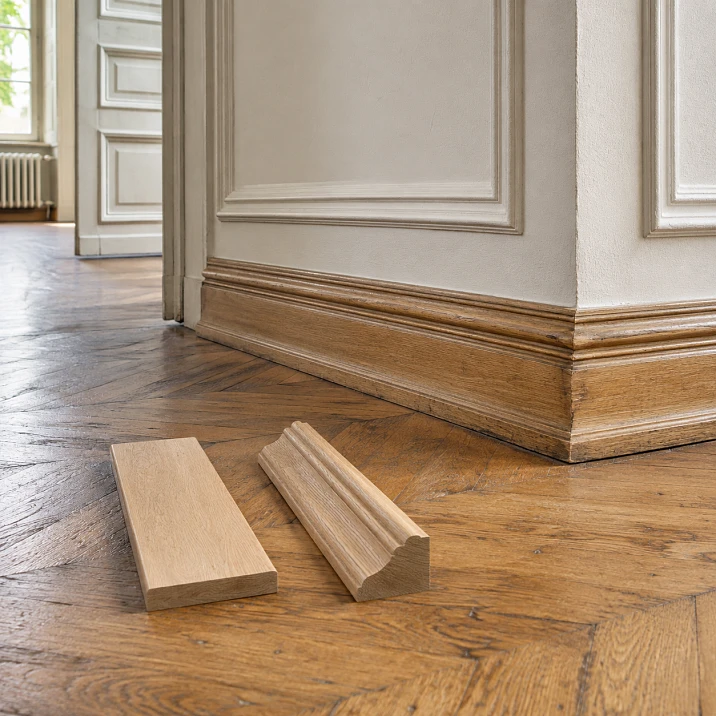
If at least one intact fragment of the original baseboard remains in the old apartment, it is more valuable than a photo from a catalog. It can be used to check not only the height, but also the actual shape of the end section: thickness at the wall, straight shelves, flutes, radii, rollers, chamfers, and depth of relief. This is what determines whether the ready-made PLT-005 120×16 mm is sufficient or whether the project truly requires an individual reproduction of the old profile.
The main mistake is to compare only two numbers:
old baseboard ≈ 120 mm in height → PLT-005 = 120 mm → therefore it fits.
The height matches only in one parameter. Two profiles of the same height can have completely different shapes: one has an almost vertical upper part, the other has a deep flute; one maintains thickness throughout its height, the other has a more massive base and a thinner upper part. On the wall, this changes the shadow, the junction with the casing, and the feel of the era.
Therefore, the correct choice is made as follows:
-
preserve and document the original fragment;
-
take its end contour;
-
compare this contour with PLT-005 at a 1:1 scale;
-
determine the required historical accuracy of the project;
-
estimate the volume of new linear footage;
-
only after this compare two commercial scenarios — ready-made SKU and individual manufacturing.
If PLT‑005 is visually close enough, and the old and new profiles do not meet in one visible node, the finished product may be the most rational solution. If the original remains in adjacent rooms, must physically join with the new molding, or is an important part of a historical composition, an individual copy becomes significantly more justified.
The first commercial action — buy a wooden baseboard PLT-005 — makes sense only after this check. If the match is insufficient, the next commercial step is already different: submit a sample, drawing, and volume for calculation of an individual profile.
The main principle of the article:
matching dimensions does not equal matching the historical profile.
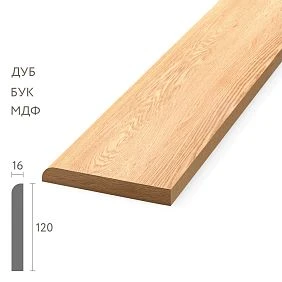
Wooden baseboard PLT-005 120×16 mm: what exactly the card confirms
The current PLT‑005 card shows one geometry — 120×16 mm — in four versions:
| Execution | Standard size | Price at the time of check | Status at the time of check |
|---|---|---|---|
| Moisture-resistant MDF | 120×16×2600 mm | 2,550 RUB | Custom Order |
| MDF | 120×16×2600 mm | 2,050 RUB | In stock |
| Oak | 120×16×2400 mm | 7,030 RUB | In stock |
| Beech | 120×16×2400 mm | 5,140 RUB | In stock |
The card also confirms the “Prestige” sanding quality, regluing options “Under enamel” and “Under tinting,” Contact us to confirm shipping to your destination., and an average production time for custom orders of 5–10 working days. Price and availability change, so they need to be checked again before payment.
Product anchor PLT-005 120×16 mm leads to the specific card.




PLT-005 made of MDF
MDF has a length of 2600 mm. In a historic interior, it is rational when shape matters rather than natural wood texture, and all new trim will be painted with opaque enamel.
This does not mean that MDF is "restorationally equal" to old wood. It can be a visually close serial solution for a project that does not require material identity with the original.
Moisture-resistant PLT-005
The geometry is the same — 120×16×2600 mm.
Choosing moisture-resistant MDF just because the apartment is old is not necessary. The material should meet actual operating conditions, not the age of the building.
Our factory also produces:


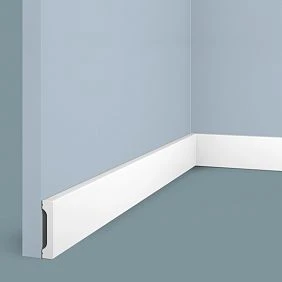
Oak PLT-005
Oak has dimensions of 120×16×2400 mm. If the new baseboard must retain visible wood texture, you can buy oak PLT-005 after comparing its profile with the historic sample.
Oak species by itself does not make the serial PLT-005 an accurate historical replica. Matching the species without matching the profile is only part of the task.
Beech PLT-005
Beech has the same size 120×16×2400 mm. It can be convenient for covering finishes if the project requires a wooden base, but the texture should not be visible after enamel.
Why the identical geometry of four SKUs is convenient for comparison with the original
First, you can resolve the main question—whether the PLT-005 120×16 mm shape is suitable. Only then choose:
-
MDF;
-
moisture-resistant MDF;
-
beech;
-
Oak.
This is stronger than simultaneously arguing about relief, species, and price.
Get Consultation
Old wooden baseboard: what dimensions to take before visiting the showroom or sending a sample
Phrase:
“The old baseboard is about 12 centimeters”
is not a technical specification.
Need to measure the profile as an object.
Overall height
Measured from the bottom base to the highest point. If the old baseboard is on an uneven floor, it's better to remove a separate fragment and measure the end outside the wall.
Maximum thickness
For PLT-005, a thickness of 16 mm is confirmed. For the historical sample, you need to find the maximum projection from the wall, not the thickness at a random point.
For example:
-
base — 18 mm;
-
top shelf — 12 mm;
-
roller — 16 mm.
Such a profile does not match a simple 16 mm rectangle even at the same height.
Thickness at the base
It affects the overlap of the floor gap, the junction with the architrave, and the visual massiveness of the lower part.
Height of the straight bottom shelf
Historical baseboards often have a calm flat area at the bottom, with decoration starting higher. If PLT-005 has a different proportion, the profile may look different even at the same height of 120 mm.
Position of beads and scotias
You need to measure not only their presence, but also the height from the floor. For example: the bead starts at 78 mm, the peak is at 88 mm, the upper scotia extends to 104–120 mm. Such a set can already be compared with the PLT-005 drawing.
Radii and chamfers
They don't have to be calculated with engineering precision at home. But you should at least take an end profile and pass it to the manufacturer or designer.
Relief Depth
A difference of 2–4 mm in profile depth can noticeably change the shadow on a long wall.
Length of the preserved fragment
If only 80–100 mm of the original remains, that is enough for an end profile, but it is difficult to assess straightness and material repeatability. If a meter is preserved, you can additionally check old joints and finish layers.
Old-style measurement sheet
| Parameter | Old sample | PLT‑005 |
|---|---|---|
| Height | ___ mm | 120 мм |
| maximum thickness | ___ mm | 16 мм |
| base thickness | ___ mm | According to the drawing |
| lower shelf height | ___ mm | According to the drawing |
| roller/quarter round | ___ | According to the drawing |
| top relief | ___ | According to the drawing |
| Material | unknown/___ | MDF/oak/beech |
| Finish | ___ | Project |
Only after such a table does the comparison become meaningful.
PLT-005 and the historical sample: how to understand that a mass-produced skirting board is close enough
It is impossible to assign a universal similarity percentage. For one project, stylistic closeness is acceptable; for another, an almost exact repeat is required.
Therefore, first determine the context of the meeting between the old and new profiles.
Scenario A. Only the height matches
The old skirting board is 120 mm. PLT-005 is 120 mm. The thickness and top relief differ noticeably.
For direct adjacency in the same room, this is not enough. But if the old original is preserved in a separate bedroom, and the new profile goes in another room, such a solution is sometimes acceptable as an interpretation "in the spirit of the era."
Scenario B. Height, thickness, and the general logic of the relief match
For example:
-
old — 119×16 mm;
-
PLT-005 — 120×16 mm;
-
the bottom shelf is close;
-
The upper molding is similar;
-
Differences are noticeable only when contours are directly overlaid.
PLT-005 becomes a real candidate. Then the material, finish, and junctions are checked.
Scenario C. New and old baseboard physically meet in the same room
For example, the original is preserved on one wall, while the lost section nearby is restored with new material. Requirements sharply increase.
The joint will reveal height, thickness, relief lines, color, and shadow. In such a situation, a "similar" mass-produced profile often looks like a repair insert.
Scenario D. Old profile remains only in a separate room
If rooms are separated by a door and the historic baseboard does not meet the new one, a freer interpretation is acceptable. Then PLT-005 is assessed as a new architectural profile of the same scale group, not as a physical copy.
Convenient rule
The closer the old and new profiles are to each other visually and physically, the higher the matching accuracy must be.
How to check without installation
You need an old-style end profile, drawing PLT-005, and alignment at 1:1 scale along the bottom and rear baselines. The difference is immediately visible.
Buy a wooden floor plinth or order a copy: first, we determine the required degree of historical accuracy
Before buy a wooden floor plinth, you need to answer a question that the catalog cannot resolve for the apartment owner: how precisely must the new molding replicate the old one?
This is not an abstract debate about restoration. The commercial scenario depends on the answer.
Renovation "in the spirit of the era"
The goal is to preserve the overall feel of the old housing stock, but not to reproduce every historical detail.
Then it is acceptable that the new PLT-005:
-
matches in scale;
-
has a similar classical shape;
-
is painted in the color of old joinery;
-
does not literally replicate the original profile.
In such a project, a ready-made serial SKU is often more rational than custom tooling.
Gentle apartment renovation
Preserved:
-
old doors;
-
trim;
-
part of the baseboard;
-
stucco decor;
-
parquet.
Here, the difference between the new and old profile is more noticeable, because historical elements continue to live alongside.
PLT-005 can only be used after a physical comparison. If the new profile conflicts with the casing or the surviving section, a custom copy has a strong advantage.
Recreating a historical interior
If the project's goal is to restore a lost decorative profile as accurately as possible, a ready-made production model is limited by its existing shape.
In this case, it is natural to study the direction Recreating historical interiors: STAVROS publishes individual reconstruction projects and describes work with historical samples, photographs, and custom models.
Then the preserved piece of baseboard becomes the source material for the specification, and PLT-005 is only one of the possible alternatives.
Why you cannot assign a single approach based on the age of the building
An apartment from 1905 does not automatically require museum-level precision. Conversely, an apartment from the 1950s may have valuable custom carpentry that the owner deliberately preserves.
The degree of precision is determined by:
-
the owner's goal;
-
the amount of preserved original;
-
direct joints between old and new;
-
architectural value of the profile for a specific interior.
Solution within budget
First, the level of precision is fixed. After that, the two prices are compared. Otherwise, a ready-made PLT-005 will always seem "cheaper" only because an individual copy solves a more complex task.
Making a wooden baseboard: the price of an individual profile starts not with a linear meter
A commercial query "making a wooden baseboard price" cannot be answered with a single figure per meter. An individual profile has a preparatory part that exists even before the first production strip is released.
STAVROS openly states that non-standard products can be made according to a sample, drawing, or photo, but only batch orders are accepted for production. This is an important limitation: an individual copy of a historical baseboard is not necessarily a reasonable scenario for just one fragment 700 mm long.
Anchor making a wooden baseboard to order logically leads to the production cluster.
What does an individual commercial calculation consist of
Instead of the formula:
meters × price per meter
need to consider at least:
-
study of a physical sample;
-
taking a profile;
-
development of a working drawing;
-
technological preparation;
-
material;
-
print run;
-
lengths;
-
cross-section complexity;
-
sanding quality;
-
finishing, if it is included in the order;
-
packaging;
-
delivery.
The article does not invent the cost of these operations. For a specific sample, a manufacturer's calculation is needed.
Why a small footage can be economically weak for a copy
Suppose only 4 meters of baseboard need to be restored in an apartment. With an individual profile, the preparatory work is distributed over a small batch.
If 70–100 meters are required across several rooms, the same preparation is distributed over a much larger volume.
This does not mean that 100 meters are automatically cheap. But it is precisely the batch size that affects the rationality of the production scenario.
Why you cannot compare "one price of PLT-005" with "the price of a custom per meter"
The ready-made PLT-005 is already developed and in the catalog. An individual copy includes the creation of a specific new profile for the project.
You need to compare two full baskets, not two numbers of one product unit.
What to send for a preliminary calculation
Minimum:
-
photo of the old baseboard;
-
photo of the end;
-
a ruler in the frame;
-
height and thickness;
-
total required footage;
-
material/desired finish;
-
information on where the original is stored.
This allows the manufacturer to understand the class of the task before physically sending the sample.
Finished PLT-005 120×16 mm: when a serial profile is economically more rational than a copy
Serial PLT‑005 is especially strong where precise historical identity is not required.
The product already exists
No need to develop a new profile from scratch. There are confirmed dimensions, materials, lengths, and the current product card.
Small volume is simpler
If 8–12 m need to be restored in one room, a ready-made model can be significantly simpler organizationally than a separate run of a new section.
The current price can be checked immediately
At the time of checking, the card shows:
-
MDF — 2,050 RUB per 2600 mm;
-
Moisture-resistant MDF — 2,550 RUB;
-
beech — 5,140 RUB per 2400 mm;
-
oak — 7,030 RUB per 2400 mm.
Re-check is needed before payment PLT-005 price.
It is easier to buy one physical sample
If the doubt is only about the geometry, there is no need to immediately buy the entire footage of the apartment. You can first get a small volume/one plank, if it is commercially acceptable, and physically compare it with the historical fragment.
When a serial profile is truly a good solution
For example:
-
the old baseboard is preserved only in the closed bedroom;
-
the new one goes in the living room and hallway;
-
there is no direct joint;
-
the height and scale are close;
-
everything is painted in one color;
-
the owner wants to preserve the character of the interior, but not museum-level accuracy.
Here, an individual copy may be excessive.
Why you can't write "serial is always cheaper"
Large footage of serial oak, complex cutting, and expensive finishing can result in a significant budget. Custom production with a large batch can also distribute preparatory costs.
A final conclusion is only possible after two commercial proposals.
Ordering a plinth based on an old sample: what you can't do with the only surviving fragment
If there is only one original, it should be treated as a document of the object.
Don't cut off excess without necessity
Each new cut destroys part of the original information. If the manufacturer needs an end, it's better to use an existing clean end or agree on a method for taking the profile.
Don't sand off the old relief
Layers of paint can hinder seeing the original shape, but you shouldn't aggressively remove them yourself. Along with the paint, you can alter the wood and radii.
First, take photographic documentation
Remove:
-
front side;
-
End strictly perpendicular;
-
the top;
-
bottom;
-
Scale with ruler;
-
The place where the baseboard stood.
Secure finishing layers
On a chip, several historical paint layers are sometimes visible. This can help understand whether the project needs natural material or the result will be opaque anyway.
Remove the paper/plastic template of the end
The contour can be transferred to paper, plastic, or another stable material. The main thing is not to deform the original.
Do not hand over the only original without an inventory
If a physical sample is transferred to the workshop, it is useful to record:
-
length;
-
condition;
-
photo;
-
date of transfer.
This is the usual discipline of working with a single reference.
Do not determine the wood species "by eye" under layers of enamel.
A white painted old baseboard may be oak, beech, pine, or other wood. Without confirmation of the species, it is safer to formulate the technical specification through shape and the required finish.
Oak PLT-005 or historic wood: why the species may also be part of the task
If the original profile is preserved with exposed wood, the material becomes one of the comparison criteria.
When the wood species matters
-
the new and old baseboards stand side by side;
-
the coating is semi-transparent;
-
the grain pattern is visible;
-
the baseboard is associated with historic trim and panels.
In such a scenario, oak PLT-005 can be a candidate only if the shape and material together provide acceptable similarity.
When the wood species is secondary
If all elements are painted with dense enamel, the exact species of old wood may not affect the final appearance. Then what matters more is:
-
geometry;
-
stability;
-
quality of preparation;
-
joints.
Why you cannot automatically copy the old wood species in a new piece
Even if the old profile is indeed oak, the new project may deliberately use a different substrate under an opaque finish.
This is no longer an exact material reconstruction, but it may be a correct design restoration of a private interior.
When the material needs to be professionally identified
If the wood species is part of the restoration specification and must be documented, visual assumption is insufficient. Then the material is determined by a specialist based on the preserved sample.
PLT-005 MDF baseboard under enamel: when the exact old wood species is not needed at all
PLT-005 has a separate relevant material PLT-005 under covering enamel, so there is no need to repeat the entire topic of base selection here.
For the historical scenario, one conclusion is important: if the new baseboard is fully painted with covering enamel and the project does not require material identity, the shape of PLT-005 made of MDF can be compared with the original without the need to replicate the wood species.
What still remains critical
-
height 120 mm;
-
thickness 16 mm;
-
end relief;
-
junction with the old trim;
-
line of the upper shadow.
When MDF does not solve the task
If the serial profile is geometrically different, covering enamel will not make it a copy. The color may match perfectly, but the silhouette will not.
When MDF is especially rational
If the old profile is preserved only as a historical hint, and the new room needs a close classical scale and a stable painted line.
Profile template: how to compare an old baseboard with PLT-005 without installation
The most useful check is overlaying end contours 1:1.
Step 1. Get the end of the old sample
It is better to use an existing clean end. If there is none, do not saw the original yourself unnecessarily. You can take a mold of the profile with a profile template.
Step 2. Get the drawing of PLT-005
The STAVROS card and catalogs provide the product geometry. Printing without "fit to page" scaling is needed.
Step 3. Check the print scale
Control 120 mm on paper must actually be 120 mm. Otherwise, comparison is meaningless.
Step 4. Align the two bases
The bottom line is the floor.
The back one is the wall.
It is along these that the contours are overlaid.
Step 5. Mark areas of discrepancy
For example:
-
top of PLT-005 is 2 mm higher;
-
base is 3 mm thinner;
-
roller is positioned 6 mm lower;
-
upper recess is deeper.
Step 6. Translate the difference into a real interior
If the profiles will be joined, the discrepancy is immediately visible.
If they are in different rooms, some differences may be visually acceptable.
Step 7. Check at the trim
Even a baseboard close in profile may fit poorly into a historical trim due to different thickness or top relief.
Step 8. Only after this, buy the footage
This is cheaper than discovering a mismatch after delivery of 30–40 m of serial profile.
Buy wooden baseboard PLT-005: when you need first one physical sample, not the whole batch
If comparison by drawing gives an uncertain result, the next step is not 40 meters of material, but a physical check.
What one PLT-005 sample provides
It allows you to see:
-
the actual top line;
-
thickness of 16 mm;
-
a shadow on the wall;
-
matching with the historical architrave;
-
material;
-
sanding quality;
-
a trial finish.
Why a sample is better than a catalog photo
In a photo, it is impossible to accurately assess the scale of 120 mm relative to the old door, parquet, and ceiling height. A physical fragment immediately shows whether PLT‑005 is massive or, on the contrary, too flat.
What to do if a short sample of exactly PLT-005 is not available
You can request:
-
one standard plank;
-
a technical sample, if available;
-
drawing 1:1;
-
photograph the end face with a scale.
But you cannot declare another similar plinth as an exact representative of PLT-005 without verification.
What to test before purchasing the main batch
Scale.
Attach to the wall next to the preserved original.
the joint with the trim.
Check whether the thickness matches and where the top line ends.
finish.
Make a real paint sample or tinting.
Light.
Look at it during the day and in the evening: shadow can enhance differences in relief.
When one sample is not enough
If the task is an exact copy and PLT-005 already noticeably differs in the end profile. In this case, further tests of the serial product will not fix the geometry. You need to move to an individual scenario.
PLT-005 near a preserved historical architrave: we check not only the floor
A baseboard rarely exists on its own. In an old apartment, it meets door joinery, portals, panels, and built-in furniture.
It is these vertical junctions that often show fastest whether the standard PLT‑005 fits.
The historical architrave is wider and deeper than the new PLT-005
If the architrave protrudes from the wall by 25–30 mm and the baseboard by 16 mm, a step appears in the lower corner. It may be historically normal, but it needs to be checked against the preserved joint.
The old baseboard fit into the architrave's plinth
In old joinery, the lower part of the architrave is sometimes deliberately widened. If the new PLT‑005 comes at a different height or with a different curve, the old joint is not reproduced.
The new profile ends before the architrave
This may be a deliberate decision if the rooms do not require a historical joint. But then the end must be designed as a new architectural element.
When an individual copy is especially justified
if:
-
the old architrave is preserved;
-
its lower joint is read from the entrance;
-
the new skirting board must physically continue the lost line.
Here, a mismatch of a few millimeters can be more noticeable than on a ten-meter straight wall.
Adjacent scenario with a pocket door
It is already separately analyzed in the article PLT-005 at the pocket door. In the new article, this joint is not repeated: here we are interested in historical joinery and the solution "serial or copy."
Making a skirting board from a sample: what technical specification to send to the manufacturer
Custom manufacturing begins not with the question "how much per meter," but with a good technical specification.
Minimum application form:
| Field | What to prepare |
|---|---|
| Object | apartment / house / historical interior |
| preserved sample | Yes / no |
| photo of the end face | attach |
| Height | ___ mm |
| maximum thickness | ___ mm |
| length of required volume | ___ m |
| Material | determine / oak / beech / other |
| Finish | enamel / tinting / visible texture |
| degree of correspondence | exact copy / visually close analogue |
| Lead time | ___ |
| Installation location | rooms / corridor / entrance hall |
| existing profile | where it is saved |
| PLT‑005 | considered as a ready-made alternative |
End photo
Shooting must be strictly perpendicular, otherwise the profile is distorted by perspective. The ruler or millimeter scale must lie in the same plane.
Total length
This is critical because STAVROS indicates the batch nature of non-standard production. One short section and the entire apartment are different commercial tasks.
Material
If the wood species is unknown, write it as:
"It is required to determine or select a material suitable for an opaque enamel."
There is no need to choose oak "for prestige" if the historical result depends on a different wood species.
Degree of accuracy
The phrase "make it similar" is too vague. Better:
-
exact reproduction according to the sample;
-
visually close profile without direct joint with the old one;
-
modern interpretation of the historical form.
Preserved original
Show on the plan where it remains. It is important for the manufacturer to understand whether the new profile will physically join the original.
Finishing
If the profile will be under enamel, some material differences are not visible. If under clear varnish, the wood species and grain become significantly more important.
Number of types of parts
If the same profile runs through all rooms in the apartment, the task is simpler. If the front door and bedroom have different historical baseboards, that is already two profiles and two separate solutions.
Price of wooden baseboard: how to honestly compare PLT-005 and custom manufacturing
A broad query like "wooden baseboard price" is only useful when comparing ready-made project baskets.
You cannot take the price of one PLT-005 plank and place it next to a hypothetical price per custom meter.
Option A — ready-made PLT-005
The estimate includes:
-
the product;
-
cutting;
-
corner and straight joints;
-
finish;
-
delivery;
-
Installation.
Option B — custom profile
The estimate includes:
-
profile preparation/removal;
-
a drawing;
-
technological preparation;
-
material;
-
print run;
-
polishing;
-
finish;
-
packaging;
-
delivery;
-
Installation.
Why the current price of PLT-005 still matters
It provides a real lower baseline for the serial scenario. For example, at the time of checking, an oak plank 2400 mm costs 7,030 RUB, beech — 5,140 RUB, MDF 2600 mm — 2,050 RUB.
But if a room needs 8 oak planks, the product portion is already:
8 × 7030 = 56,240 RUB.
Before finishing and installation.
Example of a small volume
Suppose you need 9.2 m of new baseboard.
For oak 2400 mm, pure arithmetic:
9200 / 2400 ≈ 3.84 → at least 4 planks.
But real cutting may require 5 if rooms have long independent segments.
Product portion with 5 planks:
5 × 7030 = 35,150 RUB.
For an individual profile, there is no exact price in the article — you need a quote based on the sample and print run.
Why a small volume often leans toward PLT-005
Not because custom is "always expensive." But because preparatory individual operations are spread over a small print run.
Why a large volume can justify a copy
If 60–100 linear meters must precisely continue historical doors and panels, the development cost is spread over a significant volume, and visual accuracy works throughout the entire apartment.
How to compare lead time
Ready-made serial products may be in stock or produced on a standard cycle. An individual profile requires separate approval. Lead time also has a cost if the renovation crew is waiting for the trim.
The entire estimate matters more than the "price per meter"
It is this that shows what is more rational in a specific project.
Training apartment 16.7 m: why the price of ready-made PLT-005 starts with a parts map, not the total footage
To honestly compare the serial PLT-005 with an individual profile, you first need to calculate the serial version as a real order.
Suppose that after measuring the apartment, eight independent sections are obtained:
-
A = 2550 mm;
-
B = 2500 mm;
-
C = 2450 mm;
-
D = 2350 mm;
-
E = 2100 mm;
-
F = 1950 mm;
-
G = 1600 mm;
-
H = 1200 mm.
Sum:
16,700 mm = 16.7 m.
Pure arithmetic of MDF 2600 mm
16,700 / 2600 ≈ 6.42 → 7 planks.
But seven rods do not cover eight independent parts.
Why?
The shortest pair that one would like to combine:
1600 + 1200 = 2800 mm > 2600 mm.
All other medium parts are even longer. Therefore, no two of the eight finishing parts fit into one standard MDF rod.
Actually required:
8 planks of 2600 mm.
This is a classic case:
mathematics says "7", layout says "8".
Product cost of MDF at the time of inspection
Regular MDF:
8 × 2050 = 16,400 RUB.
Moisture-resistant MDF:
8 × 2550 = 20,400 RUB.
This is only product PLT-005 without finish, delivery, and installation.
What happens with beech and oak 2400 mm
Total length:
16,700 / 2400 ≈ 6.96 → arithmetically 7 planks.
But three parts are longer than 2400 mm:
-
A=2550;
-
B=2500;
-
C=2450.
Each requires a direct joint.
A conditional map might look like this:
-
A = 2400 + 150;
-
B = 2400 + 100;
-
C = 2400 + 50;
-
D = 2350;
-
E = 2100;
-
F = 1950;
-
G = 1600;
-
H = 1200.
Small extensions 150+100+50 can be placed together with H=1200 in one additional strip, if the technological geometry and ends allow it:
150 + 100 + 50 + 1200 = 1500 mm.
Main whips:
-
A-base — 1;
-
B-base — 1;
-
C-base — 1;
-
D — 1;
-
E — 1;
-
F — 1;
-
G — 1;
-
H + extensions — 1.
Total again:
8 slats 2400 mm.
Current product base of beech and oak
Beech:
8 × 5140 = 41,120 rub.
Oak:
8 × 7030 = 56,240 RUB.
These figures are useful not as an argument “MDF is cheaper than wood,” but as a real product base for a serial scenario.
Why exactly this base is needed for comparison with an individual copy
If the owner asks:
"How much more expensive will it be to replicate the historical profile?"
the individual estimate should be compared not with abstract 16.7 m and not with a single card price, but with a full serial basket:
-
8 planks of the selected material;
-
the necessary straight joints;
-
finish;
-
delivery;
-
Installation.
Only after this is it clear how much the refusal of individual reproduction actually costs.
When an individual copy can also change the cutting
For a new profile made to a sample, the length of commercial blanks is determined by a separate production specification. It cannot be assumed in advance that it will also be 2400 or 2600 mm.
Therefore, the individual manufacturer must provide:
-
available lengths;
-
technological constraints;
-
packaging scheme.
Without this data, the number of linear meters does not yet translate into the number of items.
Why three long sections are especially important in a historic interior
A/B/C require direct connections with a standard 2400 mm board. If the old historic profile on these walls was seamless or joints were hidden differently, the production map can change not only the shape but also the nature of connections.
An individual copy must be compared with PLT‑005 on this criterion as well.
Conclusion from the example
Serial PLT‑005 becomes economically clear only after the parts map. In the training apartment, 16.7 m of net profile require 8 standard planks, not 7, which simple division shows.
This protects the comparison with an individual copy from underestimating the cost of the finished SKU.
When to buy PLT-005 is more reasonable than an individual copy
PLT-005 is a strong option if not only the height matches, but also the overall visual character
Order PLT-005 or an individual profile: final checklist before deciding
| Check | PLT‑005 | Individual copy |
|---|---|---|
| Height | 120 мм | By template |
| Thickness | 16 мм | By template |
| Relief | ready-made | is reproduced |
| Material | MDF / moisture-resistant MDF / beech / oak | is consistent |
| Length | 2600 / 2400 | according to the technical specification and production capabilities |
| Lead time | availability / standard order | Individual |
| Historical accuracy | limited by the SKU shape | set by technical specification |
| Price | Product card | Individual calculation |
| small volume | Usually simpler | may be irrational |
| direct joint with the old one | Only after checking | can be designed more precisely |
Final questions
-
Are the old and new profiles visible simultaneously?
-
Do the height and thickness match?
-
Do the key relief lines match?
-
Is there a physical joint with the old one?
-
What level of historical accuracy is required?
-
What is the total footage?
-
Is natural wood needed?
-
What finish?
-
How much does a full production set cost?
-
Is there a calculation for an individual profile?
Until these questions are answered, choosing between 'PLT-005 or a copy' is premature.
Boundary scenario: the original survives on one meter, but 30–40 m need to be restored.
This is one of the strongest cases for individual comparison. The surviving meter is large enough to see not only the end grain, but also straightness, old joints, fastening marks, and the actual finish. At the same time, the new volume is no longer small: dozens of meters can justify a separate technical calculation for the copy.
First, the old fragment is divided into two functions. The first is a geometry reference. The second is a historical element that remains in place. If it remains, the production sample should preferably be taken non-destructively; there is no need to turn the only surviving meter into consumable material.
Next, two lists are created.
List A — PLT-005.
Contains:
-
actual room segments;
-
2400/2600 mm;
-
number of whole slats;
-
straight joints;
-
material;
-
finish.
List B — historical copy.
Contains:
-
drawing of the original profile;
-
required print run;
-
lengths of new elements;
-
material;
-
finishing;
-
connection with the preserved meter.
Only after this can commercial proposals be compared.
If PLT‑005 differs in the upper cutout, but the old molding remains in a closed room, a serial profile may be sufficient. If the old molding remains in the front hallway and the new baseboard must continue it after the doorway without an obvious architectural boundary, an individual copy becomes significantly stronger.
Boundary scenario: the original baseboard is heavily painted and the profile appears thicker
Multi-layer enamel can add visual thickness and smooth out fine relief. If measurements are taken only from the painted surface and repeated literally, the new copy may reproduce not the original wood shape, but a century-old layer of coatings.
Therefore, in a precise project, it is necessary to decide what is considered the reference:
-
the current actual appearance;
-
the cleaned original wood geometry;
-
a reconstructed profile based on several samples.
This is already a question of the restoration assignment. In ordinary renovation, one can deliberately copy the current visual silhouette. In strict recreation, a more professional analysis is needed.
Boundary scenario: two different old profiles have been preserved
In an old apartment, this is possible after renovations from different eras. For example, the formal room has one baseboard, the bedroom has another.
You cannot choose a "middle" profile just because PLT‑005 120×16 is close to both. First, determine which contour belongs to the original architectural system and which rooms should continue it. Perhaps the standard PLT‑005 suits secondary rooms, while the formal area requires a copy of another historical sample.
Thus, the article preserves the main principle: the choice is made based on the specific system of the room, not on the desire to unify the entire object with one SKU.
Mistakes when choosing between PLT-005 and a copy of a historical baseboard
Mistake 1. Comparing only the height of 120 mm
Why it occurs: the number looks like the main parameter of the baseboard.
Consequence: the new profile may match in height but differ sharply in thickness, top curve, and shadow.
How to prevent: compare end contours at 1:1 scale.
Mistake 2. Buying the entire footage of PLT-005 before physical comparison
Why it occurs: the product card is already familiar, the price is clear, and you want to close the purchase.
Consequence: after delivery, it is discovered that the profile fits poorly into the historical architrave or looks too modern.
Prevention: first a sample/one strip/1:1 drawing, then the batch.
Mistake 3. Considering a similar serial profile a "restoration copy"
If PLT-005 is visually close, this makes it a suitable analogue only within a specific project. The term "copy" is correct when the profile is actually reproduced from the original.
Mistake 4. Determining the wood species of an old baseboard by the paint color
Under several layers of enamel, the wood may not be obvious. You cannot call an old profile oak just because it is heavy or dark on the break.
Mistake 5. Giving the only original for aggressive stripping
Consequence: radii and traces of the original shape are erased.
First, photo documentation, outline, and dimensions. Any intervention — only if necessary.
Mistake 6. Comparing the price of one serial strip with the "price per meter of a copy"
These are incomparable quantities. An individual estimate includes profile preparation and print run, while a serial one includes a finished SKU.
Mistake 7. Not specifying the total footage of an individual order
STAVROS explicitly states that non-standard products are accepted for production with a batch order. Without volume, the manufacturer cannot correctly assess the project.
Mistake 8. Making an exact copy where it never meets the original and is not needed for the task
Individual production may be technically possible but commercially excessive. If an apartment is styled "in the spirit of the era," a close PLT-005 can achieve the desired result more simply.
Mistake 9. Choosing MDF or oak before deciding on the shape
First the profile. Then the material. Otherwise, the species of a product that is geometrically unsuitable is being discussed.
Mistake 10. Not checking door abutments
On a long wall, the difference in profiles may be barely noticeable, but near a historic architrave it will show immediately.
Mistake 11. Treating old layers of paint as part of the original relief
Multiple layers of paint can noticeably smooth out small grooves and chamfers. Therefore, it is better to evaluate the profile at several points and, if necessary, with the involvement of a specialist.
Mistake 12. Sending only a frontal photo to the manufacturer
It shows the appearance but provides almost no data on the end cross-section. An end view with a scale is needed.
Mistake 13. Not distinguishing between a finished and a production sample
A fragment from the wall may have:
-
a layer of paint;
-
remnants of plaster;
-
a damaged bottom;
-
old nails.
The manufacturer must understand which part of the geometry is considered original and which is a trace of repair.
Error 14. Buying a ready-made PLT-005 only because of the current price
The price changes. What matters is whether the profile matches the task. Savings on an unsuitable SKU turn into the cost of rework.
Error 15. Ordering a custom copy without an approved level of accuracy
Phrases like "as close as possible" and "restore from a sample" can be understood differently. The technical specification should state: an exact copy or a visually similar profile.
Error 16. Not accounting for the remaining historical baseboard as a repair reference
Even after choosing PLT-005, it is better to keep the old sample. It remains a source of information about the original finish and will be useful for future work.
FAQ: PLT-005 or manufacturing a baseboard from a historical sample
What is the size of PLT-005?
All current versions of PLT-005 have a cross-section of 120×16 mm. MDF is produced in lengths of 2600 mm, beech and oak — 2400 mm.
What materials are available for PLT-005?
Regular MDF, moisture-resistant MDF, beech, and oak.
What is the length of the oak PLT-005?
2400 mm.
What is the length of the MDF PLT-005?
2600 mm.
Can the old historical baseboard be replaced with PLT-005?
Yes, if the required precision of the project allows for a serial analogue and physical comparison shows acceptable similarity. Matching the height of 120 mm is not sufficient.
Is matching the height of 120 mm sufficient?
No. You need to compare the thickness, the bottom shelf, the rollers, the flutes, the chamfers, and the overall end silhouette.
How to compare two profiles?
Take the contour of the historical sample and align it with the PLT-005 drawing at a 1:1 scale along the bottom and rear baseline lines.
Can a wooden baseboard be ordered according to an old sample?
STAVROS reports the possibility of manufacturing custom products based on a sample, drawing, or photo for bulk orders. The specific profile, material, volume, and timeline need to be agreed upon separately.
What is needed to make a copy?
A physical sample or quality photos and contour, dimensions, total footage, required accuracy, material/finish, and information about places where the old profile is preserved.
How is the price for manufacturing a skirting board calculated?
For a custom project: profile preparation, technological work, material, shape complexity, batch size, finishing, packaging, and delivery are taken into account. There is no universal price per meter without a technical specification.
Which is cheaper — PLT-005 or a custom profile?
For a small volume, the standard PLT-005 is often simpler, but there is no universal answer. You need to compare two full estimates.
Where to buy a wooden floor skirting board?
If a specific profile has not been chosen yet, use the skirting board category. If PLT-005 has already been approved, go to its product page.
Where to buy PLT-005?
In the STAVROS product card after checking the geometry and material.
When is oak needed, and when can MDF be chosen?
Oak is important when natural wood should be visible or the project requires a wooden base. MDF is rational under a covering finish if the exact wood species is not part of the historical requirement.
Can the profile be replicated from a photo alone?
STAVROS indicates a photo as one possible source for a custom project, but a physical sample and an accurate end profile provide significantly more information. A single frontal photo is not enough for precise reproduction.
Is it better to provide a physical sample or a drawing?
Ideally, both a sample and a drawing. The sample shows the actual geometry and finish layers, while the drawing records the accepted production profile.
What to do if the old baseboard is preserved only in one section?
Do not remove it unless necessary. First, take photos and measurements. If a physical reference is needed for the manufacturer, coordinate a safe method for taking a sample.
Is it necessary to keep the original after the new profile is made?
Yes, if possible. It remains a reference for future repairs and proof of the original shape.
Can PLT-005 be used in one room and a copy of the historical profile in another?
Yes, if it is a deliberate architectural and restoration scheme. But you need to determine in advance where the boundary between the two systems lies and whether they are visible simultaneously.
What to do if PLT-005 almost matches, but the upper scotia differs?
The solution depends on the location. In a separate room, the difference may be acceptable; in direct contact with the original, it is usually noticeable. A mock-up or physical overlay is needed.
How to submit a final request for serial PLT-005?
Specify the article number, material, length, quantity of whole planks, finish, cutting, address, and deadline. Check before payment. Payment and delivery of wooden baseboard.
How to submit a final request for an individual copy?
Provide a photo/sample, dimensions, total footage, material, degree of accuracy, finish, deadline, and installation location.
Final decision tree
Step 1. Is there a physical historical sample?
-
no → collect maximum iconography/photos and evaluate serial analogues;
-
yes → remove profile.
Step 2. PLT‑005 matches only in height?
-
yes → this is insufficient for a direct joint;
-
No → continue.
Step 3. Will the new and old baseboard physically meet?
-
yes → precision requirements are maximum;
-
no → stylistic similarity is possible.
Step 4. Does the project require precise historical reproduction?
-
yes → request an individual profile;
-
no → PLT‑005 remains a candidate.
Step 5. Is the total volume small or batch-sized?
-
small → serial SKU is usually organizationally simpler;
-
significant → individual calculation becomes more rational for comparison.
Step 6. Is the finish covering?
-
yes → the source wood species may be secondary;
-
no → the material becomes part of the match.
Step 7. Have two complete estimates been obtained?
-
no → do not make a decision based only on the price of one plank;
-
yes → compare cost, lead time, and accuracy.
Step 8. Only after this, place the order.
Final specification: ready-made PLT-005 or custom historical profile
For the serial version, the working line may look like this:
PLT‑005 / oak / 120×16×2400 mm / ___ planks / profile matched to historical sample 1:1 / no direct joint with old one / finish ___ / delivery ___ .
For MDF:
PLT‑005 / MDF / 120×16×2600 mm / ___ planks / for covering enamel / historical sample used as geometric reference / color ___ .
For an individual copy:
Historical baseboard / sample is transferred / height ___ / thickness ___ / profile per template and drawing / total length ___ / material ___ / finish ___ / required accuracy: exact copy / deadline ___ / please confirm quantity, production, and cost.
If PLT‑005 has passed physical inspection, after calculating the quantity you can order PLT-005 120×16 mm as a ready-made serial product. If not, there is no need to try to "refine" mismatched geometry with finishing; it is more correct to move to an individual profile.
For general material science inspection, use wooden trim items and section materials and quality of wooden moldings.
Short conclusion
The preserved original baseboard is not an obstacle to renovation, but the most useful measuring reference.
PLT-005 has a clear standard geometry of 120×16 mm, four materials, and standard lengths of 2400/2600 mm. If its end profile is visually close enough, the old and new baseboards do not join directly, and the project does not require precise historical reproduction, the ready-made SKU can be the most rational solution.
If the original remains nearby, the shape differs significantly, or the task is precisely to recreate a historical system, the preserved sample should be used for a custom technical specification. STAVROS confirms the possibility of non-standard production based on a sample, drawing, or photo for batch orders.
Correct sequence:
preserve the original → capture the end contour → compare with PLT-005 1:1 → determine the degree of historical accuracy → calculate the volume → get two estimates → choose the standard or custom scenario → place the order.
If after comparison only one profile detail remains in doubt—for example, the top cove—there is no need to immediately move to costly full reproduction. Record the discrepancy in millimeters, attach the two contours, and ask a designer or manufacturer to assess whether it will be noticeable in the specific location. Such an intermediate step is especially useful when the historical original is preserved not nearby but in an adjacent room: it allows a decision based on actual visibility rather than a formal requirement of absolute match.