











































































Article Contents:
- One broken overlay is a local issue, not a reason to buy the ceiling a second time
- NPU-306: what you need to verify before ordering
- Why the article number matters more than visual similarity in a photo
- NPU-306, NPU-112, and NPU-309: why you can't choose just any similar overlay
- Where NPU-306 appears in finished ceiling decor
- When buying the entire ceiling set is still not necessary
- When the problem is already more than just one NPU-306
- The part broke before installation: the simplest case
- The part was lost during installation
- NPU-306 is already glued and cracked: first decide whether it needs to be removed
- Don't try to rip out the old overlay in one motion
- The main thing during restoration is not the overlay itself, but its position
- Replacement after painting: the new polyurethane needs to fit into the existing color
- Paint before or after installation?
- What to do if the old color cannot be perfectly replicated
- How to choose glue for replacing one NPU-306
- What to buy along with NPU-306
- Order one NPU-306 or two or three at once?
- Installation is still ongoing
- There are many such overlaps in the composition
- The object is far from the order pickup location
- Only the single accidentally damaged element is being repaired
- Touch-up without a color sample
- Refusal to check adjacent elements
- Can NPU-306 be purchased separately from the ceiling kit?
- What is the correct name for NPU-306?
- What is the size of NPU-306?
- How much does NPU-306 cost?
- Is NPU-306 included in CPU-P3?
- Is NPU-306 used only in CPU-P3?
- Can I replace NPU-306 with a similar NPU-112 or NPU-309?
- What should I do if the article number is lost?
- Can NPU-306 be replaced after the ceiling is fully painted?
- Do I need to paint the new part in advance?
- How do I remove a broken NPU-306 without damaging the adjacent molding?
- What glue should I use for the new NPU-306?
- Do I need to buy several spare NPU-306 units?
- What to do if several different parts break at once?
- Can I order a whole CPU-P3 instead of individual parts?
- What matters more when selecting: the pattern or the size?
- Can I leave a space empty if the NPU-306 is very small?
- What to do if the damage occurred after a leak?
- Can I buy an additional NPU-306 if the original set was ordered a long time ago?
- Where can I buy exactly the carved overlay NPU-306?
One small piece of ceiling molding cracked during installation, got lost among the packaging, or was damaged after a failed painting. The whole composition is already assembled, the main elements are intact, the pattern is clear — and an unpleasant question arises: do you really have to buy a large set of ceiling decor again because of one overlay?
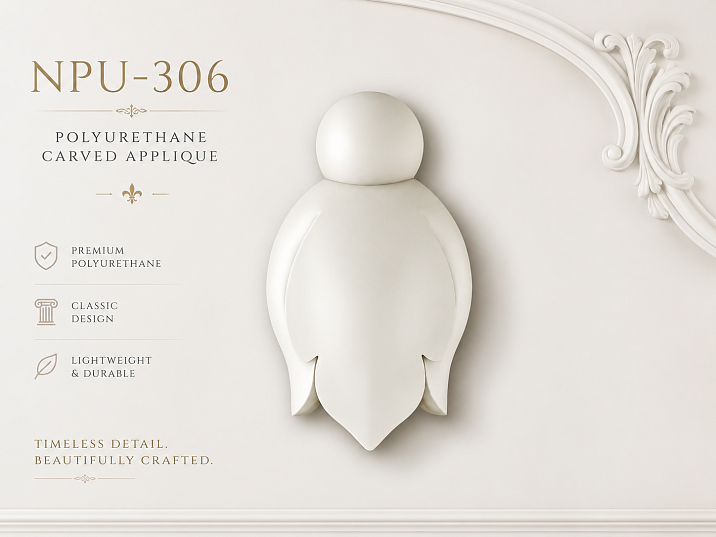
If the NPU-306 itself is damaged — a carved polyurethane overlay measuring 18 × 31 × 9 mm — you do not need to buy the whole set again. This part exists as a separate product item. It can be buy as a carved overlay NPU-306, after checking the article number, dimensions, and shape against the remaining elements of the ceiling composition before ordering.
At the time of preparing the material, the NPU-306 card shows a price of 320 rubles per piece. It is better to check the current price again in the card before placing an order: the price of a separate overlay and the cost of a whole ceiling set are fundamentally different values, so in the case of local damage, it first makes sense to find out whether only the lost part can be replaced.
This is where a small feature of the catalog becomes a big practical advantage. A ready-made set is convenient when creating a ceiling from scratch, but its composition does not turn into an inseparable monolith after purchase. If one ornamental element is damaged, you first need to determine its article number. When the marking NPU-306 is found on the surviving part or in the specification, the task is greatly simplified: instead of buying the entire system again, you can order a separate molding element, restore the damaged area, and preserve the original pattern.
But you still should not rush to press the "add to cart" button. In ceiling compositions, several small overlays may be used nearby. At a distance they seem similar, especially after painting in one color. An error in the article number can turn out to be more noticeable than the crack itself: a different width, height, or relief pattern will disrupt the repetition of the ornament.
Therefore, the correct path looks like this:
identify the damaged element → verify the article number → check the size 18 × 31 × 9 mm → compare the position in the composition → order NPU-306 separately → select suitable mounting material → restore the finish.
There is no need to automatically start repairing the entire ceiling here.

One broken overlay is a local problem, not a reason to buy a ceiling a second time
Ceiling molding is perceived as a single composition. Because of this, it is psychologically easy to draw the wrong conclusion: since the pattern was bought as a set, any part of it exists only within the set.
In practice, two things need to be distinguished.
A kit is a ready-made scheme of coordinated elements.
A separate overlay is an independent part that can be part of such a scheme and at the same time be sold separately.
For repairs, this is a fundamental difference.
Imagine a ceiling where dozens of elements are already installed and painted. One small decorative insert is damaged. Buying a full set just for it would mean that almost the entire new kit would remain unused.
If the needed item has a separate listing, it is more reasonable to restore exactly the missing link.
The NPU-306 has such a listing. Therefore, requests like "buy NPU-306 separately," "purchase additional NPU-306," "replace NPU-306 overlay" have a very specific purchasing meaning. This is not about abstract spare molding, but about replacing a specific article.
And here repairs gain another advantage. You do not have to match a similar pattern "by eye." You can restore the composition with the same model that was originally used.
This is especially important for the ceiling.
On a wall, a single overlay is sometimes perceived as an independent accent. In a ceiling ornament, small elements more often work in series: they repeat at equal intervals, mark intersection points, complete frame fragments, or support symmetry. If one of the identical parts differs, the rhythm is disrupted.
Therefore, good repair of ceiling molding starts not with the question "where to find something similar?", but with the question:
which exact article number was installed here before?
If the answer is NPU-306, no replacement needs to be sought.




NPU-306: what needs to be verified before ordering
The product name matters here. NPU-306 is a carved polyurethane overlay.
Not a molding.
Not a ceiling rosette.
Not a cornice.
Not a decorative corner.
Not an unnamed "small stucco detail".
For correct additional purchase, it is better to use the exact name and article number.
| Parameter | Data for NPU-306 |
|---|---|
| Article number | NPU-306 |
| Product type | Carved overlay |
| Material | Polyurethane |
| Size | 18 × 31 × 9 mm |
| Purchase format | Separate product item |
| Price at the time of material preparation | 320 ₽ per piece |
| Possible scenario | Replacement of a lost or damaged element |
| Application in ceiling system | May be part of ready-made decorative compositions |
| Main check before ordering | Article number, dimensions, orientation, and pattern of preserved elements |
| Product card | order NPU-306 made of polyurethane |
Size is especially useful here. A small element can easily be confused with another decorative insert by photo. The numbers 18 × 31 × 9 mm provide an objective check point.
If the removed damaged part is at least partially preserved, measure it.
If the element is no longer there, measure the adjacent intact overlay of the same repeating pattern.
If the composition was assembled according to a ready-made project, check the order specification.
If a ready-made kit was used, open its contents.
Only after this does it make sense buy NPU-306 separately.
Our factory also produces:


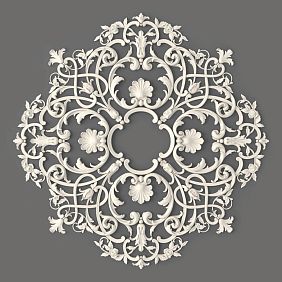
Why the article number matters more than visual similarity in photos
There is a dangerous phrase: "They seem the same."
For restoring a repeating stucco ornament, "seems" is not enough.
Small polyurethane overlays can be similar in overall character: a floral motif, a curl, a leaf, a compact ornamental insert. After painting, they are all additionally unified by one color. In a photo, especially one taken from below with a phone, the differences are even more smoothed out.
But the ceiling composition is built not on the name of the motif, but on the specific geometry.
One product has a different width.
Another has a greater height.
A third has a different relief projection.
A fourth has the pattern oriented differently.
In an isolated photo, these are trifles. In a series of identical elements, they become noticeable.
Imagine a row where nine identical parts repeat at equal distances, and the tenth is slightly wider and taller. A person may not identify the cause of discomfort, but the disruption of rhythm is perceived immediately.
Therefore, searching for a "small plant overlay of approximately the same size" is a bad strategy.
Searching for NPU-306 is a good one.
Catalog polyurethane decorative overlays It is useful when the original part number is unknown and has to be reconstructed by shape, size, and surroundings. But if NPU-306 is already installed in the composition, the task is not to select new decor. The task is to replicate the existing one.
Get Consultation
NPU-306, NPU-112, and NPU-309: why you cannot choose any similar overlay
In STAVROS ceiling systems, different decorative elements are used. That is why, when one small part is damaged, it is useful not to guess but to disassemble the composition like a construction set.
For example, next to NPU-306 in finished systems, other overlays may be found, including NPU-112 and NPU-309.
From below, the ceiling is seen from a distance. After priming and painting, all elements may be the same color. A person who did not assemble the composition personally may easily decide that the small inserts are interchangeable.
No.
Different part numbers exist because they have different shapes, dimensions, and roles in the pattern.
| Situation | What to do | What not to do |
|---|---|---|
| A fragment has been preserved | Compare it with the NPU-306 card and dimensions of 18 × 31 × 9 mm | Buy the first visually similar overlay |
| There is an adjacent intact part | Take measurements from it and compare the pattern | Focus only on the width |
| There is a kit specification | Find the part number of the damaged item in it | Assume the part number based on location |
| It is known that CPU-P3 was used | Verify kit composition | Purchase entire CPU-P3 automatically |
| Part number unknown | Compare part with pad catalog | Order several different models "on trial" without checking |
| Several elements lost | Calculate missing quantity for each part number | Count all small pads as one model |
If the original composition is based on NPU-306, replacing it with NPU-112 or NPU-309 just because these items also belong to polyurethane molded decor is not necessary.
In restoration, part number match is more valuable than approximate similarity.
Where NPU-306 is found in finished ceiling decor
A separate card for NPU-306 is important on its own, but the meaning of piece-by-piece replacement becomes especially clear when viewing the finished set.
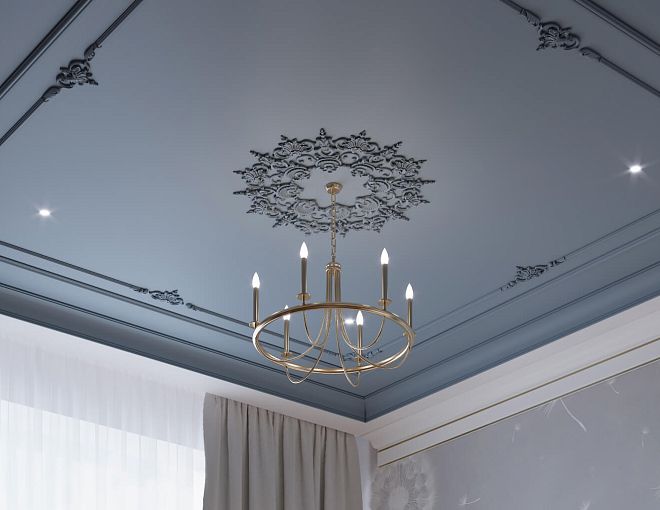
В ceiling molding set CPU-P3 NPU-306 is part of the composition as a separate item along with other overlays and profiled elements.
This is a good example of how the system works.
The set is not one large piece.
It consists of a set of elements.
Each performs its function in the overall pattern.
Large pieces define the main architecture.
Molding forms lines and frames.
Medium overlays develop the ornament.
Quite small elements complete individual points of the composition.
Therefore, damage to NPU-306 does not mean that the entire CPU-P3 is physically damaged. If the moldings, large ornaments, and other overlays remain intact, there is no practical point in replacing them.
That is why, during repair, it is useful to first open the composition CPU-P3, find NPU-306 and make sure that it is exactly this element that is lost.
NPU-306 is also found in another ready-made solution — the ceiling decor kit CPU-P1. This once again shows the principle: a small overlay can be part of a large composition while remaining an independent product.
For a buyer who is repairing an already assembled ceiling, this is almost an ideal situation.
The article number is known.
The size is known.
The product exists separately.
All that remains is to check the quantity and condition of the surrounding decor.
When buying the entire ceiling kit is still not necessary
Suppose a CPU-P3 is installed in the room.
One NPU-306 cracked.
The second one got lost.
The remaining elements are intact.
In this situation, repurchasing the entire kit does not solve the problem more rationally. On the contrary, along with the two needed overlays, you will get a large number of parts that are already present on the ceiling.
Therefore, the first option should be purchasing individual pieces.
Let's compare.
| Criterion | Buy NPU-306 separately | Buy the whole set again |
|---|---|---|
| One NPU-306 is damaged | Rational | Redundant |
| Two identical NPU-306 are lost | Rational | Redundant |
| The rest of the composition is intact | Rational | No need |
| Need to preserve the existing pattern | Yes, if the article number matches exactly | Yes, but with a lot of extra elements |
| A significant part of the ceiling system is destroyed | May not be enough | It already makes sense to recalculate the entire damaged area |
| The article numbers of the lost elements are unknown | Identification is needed | The kit is considered only after the scheme is restored |
| A completely new ceiling is planned | Separate NPU-306 is just one item | A ready-made kit may be more convenient |
Hence the main principle:
a whole set is bought for composition; a separate overlay for local replacement.
These two tasks should not be mixed.
When the problem is more than one NPU-306
There is also the opposite extreme: a person tries to repair the ceiling piece by piece, where the damage has long ceased to be local.
For example, after a leak, a large area of the finish was damaged.
The molding came off.
Several overlays are deformed or lost.
The base is damaged.
The marking is disrupted.
Some parts after dismantling cannot be confidently identified.
Then ordering one NPU-306 will not solve the situation.
First, you need to make a damage list: which part numbers are needed, how many of each item remain, which lines need to be restored, and whether it is possible to return the original pattern without reassembling the section.
In such a situation, it is useful to open the section Buy ceiling moldings made of polyurethane and compare the original system with the current state of the ceiling.
Perhaps piece-by-piece restoration is still more cost-effective.
Perhaps a whole repeating module is damaged.
Perhaps it is easier to restore part of the composition using a kit.
There is no universal answer here. Only the order is universal: first inventory, then purchase.
A part broke before installation: the simplest case
If the NPU-306 is damaged while it was lying on the site and not yet glued, the repair is as simple as possible.
There is no need to dismantle the old element.
There is no need to restore the ceiling covering.
There is no need to match paint to already aged finishes.
The main task is to make sure that the NPU-306 item is indeed damaged, recount the remaining parts, and order the missing quantity.
This is where it is convenient to immediately order NPU-306 made of polyurethane.
Before ordering, do not be lazy to recount the entire box.
Why?
If installation is not yet complete, one detected breakage sometimes turns out not to be the only one. It is better to find all problems before re-delivery than to discover another missing overlay two days later.
Lay out the elements by item numbers.
Check them against the specification.
Set aside NPU-306 separately.
Calculate the required quantity according to the scheme and the actual number of whole elements.
The difference will be the real need.
This way, repair turns from emotional "everything is lost" into ordinary arithmetic.
The part got lost during installation
For a small element, this is a quite realistic scenario.
NPU-306 has compact dimensions. On the site, boxes are open at the same time, with scraps, consumables, tools, and protective film lying around. A small overlay may end up where it is not expected to be seen.
Therefore, before ordering, conduct a quick check.
Look at the remaining packaging.
Verify the number of already installed NPU-306.
Check whether the part has been mistakenly used in another point of the composition.
Match the drawing with the project.
If the element is indeed missing, purchase it.
Do not change the ceiling scheme or replace the symmetrical pair with other overlays because of one lost position.
Exact carved overlay NPU-306 allows restoring the original logic without decorative improvisations.
NPU-306 is already glued and cracked: first decide whether it needs to be removed
Cracks are not all the same.
Sometimes the damage is superficial and practically disappears after local preparation and painting.
Sometimes the overlay has split.
Sometimes part of the relief is missing.
Sometimes the element has detached from the base and hangs on part of the adhesive seam.
Therefore, the first reaction should not be to sharply tear the decor off the ceiling.
First, inspect the damage.
If the geometry of the overlay is preserved and the defect is minimal, a full replacement may not be necessary.
If a fragment of the relief is lost, the two halves are shifted, or the restored seam will remain visible in a repeating pattern, a new NPU-306 will give a more predictable result.
During dismantling, the main task is not to turn one broken part into damage to neighboring elements and the ceiling surface.
You need to work locally.
Do not pull the overlay by its protruding edge.
Do not use the adjacent ornament as a support for the tool.
Do not tear off the part with a jerk.
Particularly careful handling is required with an already painted composition: the finish coating of the base may start to peel off along with the old adhesive layer.
If you are unsure about the method of attaching the old stucco molding, first study the recommendations on which adhesive for stucco decor is used with polyurethane products and how different joints behave during work.
Do not try to rip out the old overlay in one motion
The small size creates a false sense of security.
"What's there to remove? Pry it off — and done."
It is precisely after such a motion that a section of damaged paint or putty sometimes remains on the ceiling, which is several times larger than the NPU-306 itself.
The correct logic is the opposite: the smaller the replaced element, the more local the repair should be.
First, protect the adjacent decor.
Determine the boundary of the old overlay.
If there is a painted seam around the perimeter, carefully separate it from the surrounding coating.
Work with the joint, not the relief.
After removal, do not rush to glue the new NPU-306 right away. The base needs to be inspected: old buildup of mounting compound can change the position of the new part. In the series, this will be noticeable—one overlay will end up slightly higher than the others.
This means that before replacement, it is necessary to return the mounting surface to a state where the new element will sit on the same plane.
Here, precision is more important than speed.
The main thing during restoration is not the overlay itself, but its position.
Suppose you ordered the correct NPU-306.
The article number matched.
The size matched.
The relief matched.
Can it now simply be glued to a free spot?
If there are no reference points around — no.
In a ceiling composition, the position of a small piece is determined by the overall pattern. Even a matching article number, if shifted by a few millimeters, can disrupt the symmetry, especially if identical overlays are repeated nearby.
Therefore, before dismantling the damaged NPU-306, it is useful to take measurements of its position.
From the nearest molding line.
From the axis of the composition.
From the adjacent identical overlay.
From the corner of the decorative field.
You can take a photo strictly perpendicular to the ceiling and apply control points.
If the old part is already missing, use the mirrored or repeating section as a guide.
This is what distinguishes a neat restoration of stucco from simply gluing on a decoration.
You are not choosing a new location.
You are returning the element to its old one.
Replacement after painting: the new polyurethane needs to be matched to the existing color
The most interesting situation arises when the ceiling composition is fully finished.
The stucco is glued on.
The seams are treated.
Everything is painted.
And only after that one NPU-306 is damaged.
The new overlay comes as a separate element, and the ceiling already has its own actual finish.
Here you cannot rely only on the name of the color that was used to paint the interior before.
The shade on the ceiling may be perceived differently due to lighting.
The surface could have changed slightly over time.
Different application technology can change the gloss.
Even the same can of paint with a different number of layers sometimes gives a visually distinguishable result on a small relief.
Therefore, the finish of the new NPU-306 needs to be adjusted to the existing composition, not just to the old color number.
It is better to do a test first.
If the repair is done carefully, a new part after installation should not announce itself: "I was replaced yesterday."
It should again become part of the rhythm.
Paint before or after installation?
There is no single answer for all cases.
If the ceiling molding is not yet painted, the new NPU-306 is mounted into the overall system and then finished together with the other elements. This is the simplest visual scenario: a unified process smooths out differences.
If the entire ceiling is already painted, repainting a large area for the sake of one overlay seems excessive. Then you can prepare the color of the new part in advance, install it, and perform local touch-up painting in the joint area.
But it is important to consider the installation seam.
If you completely finish the overlay before gluing, local adjustment along the edges may still be needed after installation.
If you paint only after installation, you need to carefully protect the surrounding surface.
Therefore, the choice depends on the current condition of the ceiling.
A separate article about which adhesive for stucco decoris useful precisely at this stage: the installation method and subsequent finishing are interconnected.
What to do if the old color cannot be perfectly replicated
Do not panic and do not start repainting the entire ceiling after the first attempt.
First, assess the difference from a normal distance.
NPU-306 is a small part. What is noticeable ten centimeters from the sample may completely disappear when the ceiling is viewed normally from below.
Check in daylight.
Check under the main evening lighting.
Look at adjacent identical elements.
If the new overlay stands out sharply, adjust the color or gloss level.
If the difference is only visible during a directed inspection from a ladder, further intervention may do more harm than good.
Restoration does not have to turn into a total surface renewal.
Its task is to restore the integrity of the composition.
How to choose glue for replacing one NPU-306
For local repairs, you don't need a huge set of equipment, but the choice of mounting compound cannot be treated as an afterthought.
NPU-306 is made of polyurethane. This means the glue must be compatible with polyurethane decor and the specific ceiling base.
This is where the search query "glue for stucco decor" is appropriate: the buyer has already chosen the overlay itself and moves on to the accompanying item.
At STAVROS you can buy mounting glue for moldings. Before use, you should verify the characteristics of the specific compound and the conditions of the surface onto which the overlay is being returned.
Why is this better than grabbing the first tube from the household drawer?
Because the mistake here shows up later.
An unsuitable composition may not hold polyurethane well.
May interact with the finish.
May leave a noticeable seam.
May take too long to set on the ceiling surface.
For a small NPU-306, glue consumption is low, but the entire point of the repair depends on the correct connection.
What to buy together with NPU-306
Repairing one trim piece is a small job, but it still has several stages.
| What you will need | Why | Is it always necessary | Link |
|---|---|---|---|
| NPU-306 | Replacing a damaged part | Yes, if this exact article number is confirmed | Buy carved overlay NPU-306 |
| Mounting compound | Securing the new part | Yes | buy mounting glue for moldings |
| Material for local preparation | Restoring the base after removing the old element | Based on surface condition | Selected to match the existing finishing system |
| Finish paint | Matching the new element with the existing color | If the ceiling is already painted | The actual project finish is used |
| Spare NPU-306 | Quick replacement in case of future accidental breakdown | Depending on the situation | buy NPU-306 separately |
| Other system components | Needed if the damage is wider than one patch | Only after inventory | Buy ceiling moldings made of polyurethane |
The table is deliberately not turned into a "must buy everything" list.
For local repairs, extra purchasing is pointless.
First, determine the actual need.
Order one NPU-306 or two or three at once?
There is no clear rule here.
If one element in the finished composition is accidentally damaged and access to the ceiling is simple afterward, a single spare part may be sufficient.
But there are situations where a small reserve is reasonable.
Installation is still ongoing
Work is not finished, tools, ladders, boxes are nearby, and painting is being done. The risk of a second accidental breakage is higher than on a fully finished ceiling.
Ordering one extra NPU-306 as a spare may be practical.
There are many such trims in the composition
The more identical small elements are used, the higher the value of a small reserve. One or two spare parts take up little space but allow you to avoid searching for the article number again later.
The site is far from the place where the order is picked up
If repeated delivery of one small item is organizationally inconvenient, a reserve is sometimes justified.
The only accidentally damaged element is being repaired
Then buying a dozen pads "just in case" no longer makes sense.
The stock should be tied to real risk, not anxiety.
Why you don't need to buy a random universal "molding repair kit"
Molding decor is not tile grout, where a small amount of universal material can cover many identical defects.
Here, the pattern itself is part of the product.
If NPU-306 is lost, a pliable mass, a homemade impression, or a roughly similar decorative insert can restore volume, but not necessarily the original relief.
And when a ready-made NPU-306 is sold separately, the point of such a compromise is even less.
A ready-made part provides:
-
known part number;
-
known dimensions;
-
repeating geometry;
-
original ornament;
-
clear order point.
DIY restoration makes sense to discuss when the original part is completely unavailable.
Here the situation is the opposite.
It is available as a separate item.
If the NPU-306 was not enough in the initial calculation
A breakdown is not the only reason for an additional order.
Sometimes the kit was assembled not strictly according to the standard scheme.
The composition was adapted to the room size.
Added one more decorative module.
Increased the number of repetitions.
During layout, it turned out that additional overlays are needed for symmetry.
Then the request "NPU-306 was not enough" is actually equivalent to the request "can I buy one molding element separately".
Yes, if the project really needs exactly NPU-306.
In that case, first recalculate the quantity for the entire composition.
Do not order one piece just because one is needed right now.
It may turn out after the next section that three more are missing.
At the installation stage, it is more useful to do a full recalculation.
If NPU-306 was damaged during painting
Fine relief requires care.
With unsuccessful finishing, sags, clogged recesses, damaged surfaces, or mechanical marks may appear.
But before replacement, you need to understand the scale of the problem.
An excessive layer of paint does not always mean the overlay is lost.
If the geometry of the relief is preserved, sometimes proper surface preparation is enough.
If the ornament is physically damaged, the edges are worn down, or an attempt to fix it only worsened the shape, a new part is simpler and cleaner.
The decision should be made not on the principle of 'it's a pity to throw away,' but based on the final appearance.
One unsuccessfully restored overlay among a series of identical elements can be more noticeable than a neatly replaced new one.
Buying a separate part is especially beneficial at the stage of already completed renovation.
When the ceiling is only being designed, the cost is considered as the cost of the entire composition.
When the renovation is complete, the logic changes.
Most of the investments have already been realized.
The cornices are installed.
The moldings are aligned along the lines.
The overlays are distributed.
The surface is painted.
At this point, repurchasing a large quantity of existing products is not economically related to the actual problem.
One part is needed.
Therefore, the possibility to purchase additional NPU-306 Individually, it is especially valuable precisely after the completion of the main project.
And if you no longer remember the ceiling kit?
This happens more often than it seems.
The renovation was completed several years ago.
The documents were not preserved.
The order was placed by a designer or contractor.
The apartment owner only knows that the molding was purchased at STAVROS.
Then identification begins with the product itself.
Take a photo of a whole adjacent overlay strictly from the front.
Measure its dimensions as accurately as the installed position allows.
Capture the common ceiling area to make the context clear.
After that, open the section Buy decorative polyurethane overlays and compare not just one feature, but a combination:
shape;
proportions;
orientation;
size;
relief;
surroundings.
If all features match the NPU-306, finally verify the size 18 × 31 × 9 mm.
Only after such a check, place the order.
A photo of the ceiling helps, but does not replace the size
The photo is useful for restoring the overall scheme.
It shows where the part was located.
How many identical overlays are repeated.
Which elements are located nearby.
How the ornament is oriented.
But the photo poorly conveys the absolute scale.
Especially if a wide-angle phone lens is used.
Therefore, identifying "this is definitely NPU-306 because it looks similar" is unreliable.
Add a measurement to the photo.
Even one reliable dimension sharply reduces the chance of error.
And when all three dimensions are known — 18 × 31 × 9 mm — the check becomes significantly more accurate.
Ceiling molding consists of roles, not just beautiful details.
To understand why one small NPU-306 deserves an exact replacement, it helps to view the ceiling composition as an architectural system.
It has a contour.
There are directions.
There are major accents.
There are repeating connecting details.
There are small ornamental endings.
In the big picture, NPU-306 may occupy a small physical area, but its absence creates a visual "gap."
It's like a letter missing from a neat inscription.
The text is still legible, but the eye catches on the empty spot.
That's why local stucco repair often yields a disproportionately large visual effect: it's not just a piece of polyurethane that returns, but the disrupted rhythm that is restored.
Why polyurethane decor is convenient for local restoration
In this article, there is no point in turning the conversation into a general comparison of all molding materials. The situation is already set: the original element NPU-306 is made of polyurethane.
For repair, something else matters most.
The new part will be of the same material type as the original NPU-306.
There is no need to try to imitate polyurethane ornament with plaster casting or wood carving.
This helps preserve the overall logic of the existing decor.
But material is only one part of the match.
The accuracy of the article number still remains a top priority.
Two different polyurethane overlays do not become interchangeable just because they are made of the same material.
Individual NPU-306 or the entire CPU-P3: a simple test before purchase
Answer five questions.
Is only one small overlay damaged?
If yes — let's move on.
Are you sure this is the NPU-306?
If yes — great.
Are the remaining CPU-P3 elements intact and in their places?
If yes — there's no need to buy them again.
Does the ceiling base allow for local replacement of the part?
If yes — piece-by-piece replacement seems rational.
Are any other elements needed for restoration?
If not, order the NPU-306 and mounting materials.
If the answer is negative at one of the stages, you need to expand the diagnostics rather than automatically buy the kit.
When it is useful to reopen the CPU-P3 card
The kit card is needed during repairs not to necessarily buy the CPU-P3 a second time.
It works as a composition reference.
If you have forgotten which exact parts formed the ceiling ornament, buying the ceiling molding kit CPU-P3 is not the only action its card allows. Much more important is to first look at the list of components and compare it with the ceiling.
The same applies to the ceiling decor kit CPU-P1.
The ready-made solution card helps trace the origin of an individual part.
And the NPU-306 card becomes the point of purchase for the replacement itself.
This is good internal catalog logic: from the system to its component.
If the NPU-306 is not damaged, do not buy the NPU-306 'just in case'.
Sounds obvious, but errors of this type arise precisely because of the low price and small size of the item.
'I'll take it, maybe it will fit.'
For repairing a repeating pattern, this is a bad motive.
Touch-up without a color test
A new bright spot on an old calm ceiling can attract more attention than the original damage.
Failure to check adjacent elements
If one pad broke due to external impact, inspect the nearby ones. They may have unnoticeable damage to the mounting.
Practical procedure before placing an order
The purchase process itself is better to postpone for a few minutes and first conduct a check.
First, find a whole NPU-306 or a preserved damaged fragment.
Second, confirm the size of 18 × 31 × 9 mm.
Third, count how many elements actually need to be replaced.
Fourth, photograph the area before dismantling.
Fifth, assess the condition of the base.
Sixth, decide whether local painting will be required.
Seventh, determine the mounting material.
After that, you can Buy carved overlay NPU-306 without the risk that in a few minutes it turns out: a different article number or a different quantity was needed.
Is a reserve needed for a large ceiling project
When the interior is still being designed and polyurethane molding is purchased for the entire ceiling, a small reserve of individual repeating elements may be more reasonable than trying to order each item strictly down to the last piece.
But the reserve must be thoughtful.
For long linear elements, the reserve is related to trimming.
For small ornamental details, it is primarily about possible accidental loss or mechanical damage during work.
In the case of NPU-306, its separate sale reduces the criticality of an error: even if a reserve was not planned in advance, the part can be purchased later.
This is significantly calmer than a situation where, for the sake of one element, one would have to order an entire system.
Why the price of a single part should not be the only argument
320 RUB for the NPU-306 at the time of writing the article is, of course, incomparable to the cost of a large ceiling kit.
But the strongest argument is still not the price.
It's the precision of the repair.
You are not buying a cheap substitute.
You are returning to the composition the exact part number that should be there.
If the individual NPU-306 cost more, the principle would remain the same: for local damage, you first look for the original part, rather than repurchasing the entire surrounding assembly.
The price only makes this decision even more obvious.
When to contact a manager before purchasing
Not every problem needs to be solved on your own from a photo.
The consultation is especially useful if:
the article number was not preserved;
the size can only be measured approximately;
the composition is old;
a non-standard project was used;
it is unclear whether the part is included in a specific ceiling kit;
several different overlays are damaged;
there are doubts about the compatibility of the mounting compound with the existing coating.
It is much more reasonable to clarify the item before ordering than to buy several similar elements and choose on site.
Who is suitable for piece-by-piece replacement of NPU-306
This scenario is especially suitable for the owner of a finished interior where all the stucco molding is in good condition and only one small fragment has been lost.
It suits an installation crew that accidentally damaged a single overlay during work.
It suits a designer or a specifier if, after recalculating, a few NPU-306 units are missing to complete the layout.
It suits a restoration scenario where the original pattern needs to be preserved without changing the entire composition.
It suits a person who prudently wants to have one or two spare parts for a large ceiling with numerous repetitions.
Who one NPU-306 will not be enough for
One overlay will not help if the base itself has been compromised after ceiling damage.
It is also insufficient when an entire fragment of a system consisting of several different part numbers has been destroyed.
It will not solve the problem if the original composition was assembled with a different model altogether.
You should not buy NPU-306 just because it is an inexpensive small decor when the actual part number is unknown.
Finally, piece-by-piece repair may be unreasonable if a complete change of the ceiling pattern is planned. Then they consider polyurethane ceiling decor it as a new system, not as a source of a spare part.
Repair by yourself or a professional?
The small size of the NPU-306 makes local replacement a visually simple task.
But the decisive factor remains not the size of the part, but the condition of the surrounding surface.
If the old overlay is not yet installed and you just need to replace a damaged one before installation, the task is one thing.
If the element is at height, among finished stucco and expensive paintwork, it is quite another.
If access requires a tall stepladder or a construction tower, safety is more important than saving on a professional.
If it is unknown what compound the old part was glued with, dismantling requires caution.
If you are confident working with finishing materials, local replacement can be done independently.
If not, the cost of the master's work is often less than the cost of repairing a damaged ceiling.
What doesn't need to be redone from scratch if the original NPU-306 is available separately
There's no need to redesign the entire ornament.
There's no need to change the symmetrical overlay on the opposite side just for the sake of a pair.
There's no need to dismantle entire molding frames.
There's no need to buy a full CPU-P3 just to get one small part.
There's no need to look for a workshop to copy the ornament.
There's no need to pick an approximate analog from another collection.
There's no need to put up with an empty spot on the ceiling.
It is precisely the existence of a separate NPU-306 card that makes the repair simple in logic: find the original and put it back in place.
How to buy stucco molding after such a situation in the future
One case with a lost overlay greatly changes the approach to completing future projects.
When ordering a large decorative system, it is useful to keep:
specification;
names of sets;
article numbers of repeating elements;
several photos of the layout before installation;
leftovers of labeled packaging or an electronic list of items.
Then in a few years, the question "what was here?" does not arise.
You simply enter the article number.
It is especially useful to keep records of small elements. A large cornice is easier to identify by its profile and size. A small overlay after painting and installation looks less obvious.
Commercial route: from damage to finished repair
If you reduce the whole situation to a purchase, the route becomes very short.
First, make sure that the NPU-306 is damaged.
Then open the NPU-306 card and double-check 18 × 31 × 9 mm.
If the article number is unknown, open the section where you can Buy Molded Decoration and perform identification.
If the damage relates to a finished system, compare it with CPU-P3 or CPU-P1if one of these kits was used.
After that, select mounting adhesive for moldings taking into account the surface and repair conditions.
If the damage turned out to be wider than one position, only then go to the general section moldings from polyurethane or ceiling decor and place an extended order.
This is normal commercial logic: from a specific problem to a specific purchase.
FAQ: answers to popular questions about replacing NPU-306
Can I buy NPU-306 separately from the ceiling kit?
Yes. NPU-306 has its own product page, so if one overlay is damaged, you don't have to repurchase the entire ceiling kit. Before ordering, make sure that NPU-306 is indeed used in the existing composition.
What is the correct name for NPU-306?
NPU-306 is a carved polyurethane overlay. This is the exact name, which is convenient to use when searching for the product, placing an order, and discussing a replacement.
What is the size of NPU-306?
The size of NPU-306 is 18 × 31 × 9 mm. These values should be used for verification along with the article number and the external pattern.
How much does NPU-306 cost?
As of the time of writing the article, the price indicated in the product card is 320 ₽ per piece. Since the cost of the product may change, before placing an order, the current price should be re-checked directly in the product card.
Is NPU-306 included in CPU-P3?
Yes, NPU-306 is used as part of the CPU-P3 stucco decor set. But this does not mean that to replace one overlay you must buy the entire CPU-P3: NPU-306 is sold separately.
Is NPU-306 used only in CPU-P3?
No. NPU-306 can also be found in other ready-made compositions, in particular in CPU-P1. Therefore, when identifying, it is better to focus on the article itself, rather than only on the name of the ceiling kit.
Can I replace NPU-306 with a similar NPU-112 or NPU-309?
To restore an existing composition, it is better to use the same article that was originally installed. Even similar-looking overlays may differ in size and relief. In a repeating ceiling pattern, such a difference is noticeable.
What to do if the article number is lost?
Find a whole adjacent overlay, measure it, and take a frontal photo. Then compare it with the assortment polyurethane decorative overlays. For NPU-306, the control size is 18 × 31 × 9 mm.
Can NPU-306 be replaced after the ceiling has been fully painted?
Yes, local replacement is possible if the condition of the base allows removing the damaged part and installing a new one without destroying the surrounding decor. The main difficulty in this case is carefully aligning the new overlay with the existing finish.
Should the new part be painted in advance?
This depends on the condition of the composition. If the entire ceiling is still being prepared for painting, it is more convenient to install the new element along with the others. If an already finished surface is being repaired, preliminary color preparation is possible, followed by local final correction after installation.
How to remove a broken NPU-306 without damaging the adjacent molding?
Work only within the damaged part itself and the old adhesive joint. Do not use adjacent overlays or molding as a tool support. Before removal, it is useful to record the element's position with photos and control marks.
Which adhesive should be used for the new NPU-306?
An installation compound compatible with polyurethane and the existing substrate is needed. A detailed breakdown is available in the material molded decoration adhesive, and in the catalog you can buy mounting glue for moldings.
Do I need to buy several spare NPU-306 units?
Not necessarily. If only one accidentally damaged element is being repaired, you can order just the required quantity. A small reserve makes sense if installation is still ongoing, there are many identical overlays in the composition, or repeat delivery would be inconvenient later.
What to do if several different parts break at once?
First, make a list of damaged item numbers and quantities. Do not order several NPU-306 units if other models were among the lost elements. In case of extensive damage, it is useful to compare the existing ceiling with the section Buy ceiling moldings made of polyurethane and restore the full specification.
Can I order a whole CPU-P3 instead of individual parts?
Yes, if a new kit is really needed or most of the system is damaged. But with a single lost NPU-306, this is an excessive route: the individual overlay is available as a standalone product.
What matters more when selecting: the pattern or the size?
Both parameters plus the article number need to match. A similar pattern does not compensate for a different size, and matching dimensions do not guarantee the same relief.
Can I leave the space empty if the NPU-306 is very small?
Technically, yes, but in a repeating symmetrical composition, the absence of even a small element disrupts the rhythm. If the original NPU-306 is available separately, restoration usually looks neater than an empty space.
What should I do if the damage occurred after a leak?
First, you need to address the base issue and make sure the ceiling is ready for restoration. Ordering a new NPU-306 makes sense after assessing the entire damaged area. If moldings, paint, and several types of overlays are affected, the repair can no longer be considered a replacement of a single element.
Can I buy an additional NPU-306 if the original kit was ordered a long time ago?
If the product card is available and the characteristics match the existing overlay, a separate purchase can be considered. Before ordering, especially carefully verify the article number and size of the remaining element.
Where to buy exactly the carved overlay NPU-306?
The required item is in the STAVROS catalog: Buy carved overlay NPU-306. Before ordering, check the quantity, size 18 × 31 × 9 mm, and the current price.
One part should not force you to buy the entire set again
A broken NPU-306 looks unpleasant precisely because ceiling molding is perceived as a cohesive system. An empty spot or damaged ornament immediately disrupts the finished pattern.
But the integrity of the composition does not mean the order is indivisible.
If exactly the carved overlay NPU-306 made of polyurethane with dimensions 18 × 31 × 9 mm is installed, it can be purchased as a standalone item. Therefore, in case of local damage, a reasonable first step is not to repurchase the entire CPU-P3, CPU-P1, or another large set, but to accurately identify the lost article number.
Compare the remaining overlay.
Check the size.
Count the quantity.
Fix the old position.
Evaluate the base.
Select the mounting material.
And only then place the order.
If one NPU-306 is damaged, order one or the required quantity of NPU-306. If different elements are destroyed, restore the specification. If a large area is affected, then consider Polyurethane ceiling decoration comprehensively.
This approach saves not only money. It preserves the original composition and eliminates the need to invent a replacement where the original part already exists.
STAVROS is convenient in such situations precisely because of the systematic nature of the catalog: the finished ceiling composition can be viewed as a whole, and a separate carved overlay separately. Therefore, repair does not have to turn into a new large order. When the article number NPU-306 is known and the dimensions 18 × 31 × 9 mm are confirmed, the task becomes specific: order NPU-306 made of polyurethane, carefully return it to its place and restore the rhythm of the ceiling molding that was originally intended.