Article Contents:
- Wooden baluster L-049.1: what is confirmed by the product card
- Wooden balusters in a 3000 mm partition: precise row calculation
- Why 20 carved balusters were chosen for the decorative partition
- Beech baluster under enamel: a practical option for a restaurant
- Oak carved baluster: when natural texture matters
- "Standard" or "Prestige": what to order for 20 balusters
- Buy wooden balusters: product card or catalog section
- Height of a wooden partition with a baluster of 1000 mm
- Full-size mockup of a baluster partition
- Map of twenty carved balusters L-049.1
- Complete estimate for a wooden partition
- Finishing twenty wooden balusters in one batch
- Attaching carved balusters in a decorative screen
- How to order 20 balusters L-049.1
- Step 1. Measure the clear opening
- Step 2. Approve the frame
- Step 3. Check the 20 × 50 mm layout
- Step 4. Choose one wood species
- Step 5. Choose quality
- Step 6. Fix the specification
- Step 7. Confirm the deadline
- Step 8. Check logistics
- What is the size of L-049.1?
- What types of wood is it made from?
- What sanding options are available?
- How many balusters are needed for a 3000 mm row?
- How much space does a row of 20 pieces take up?
- Can I order 21 balusters?
- How much does a beech batch cost?
- How much does an oak batch cost?
- Can L-049.1 be shortened at the factory?
- Can a partition be used as a stair railing?
- What to choose for enamel?
- What to choose for visible texture?
- Where to order wooden balusters?
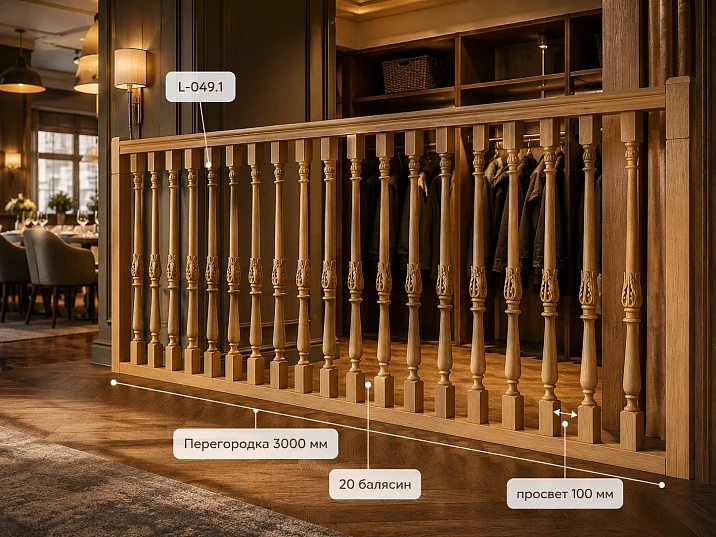
In a restaurant lobby, the cloakroom needs to be separated from the entrance area without turning the space into a narrow corridor. A solid wall would block light and visually reduce the space, so the designer suggested a through wooden partition 3000 mm long. The vertical rhythm is created by the carved baluster L-049.1, 1000 mm high and 50 mm wide.
The commercial task is specific: determine the number of items, check the layout, choose beech or oak, "Standard" or "Prestige", calculate the budget, and order a single batch. With 20 balusters and 100 mm gaps, the row takes up 2900 mm. The remaining 100 mm can be distributed along the edges, but only after accounting for the frame and mounting grooves.
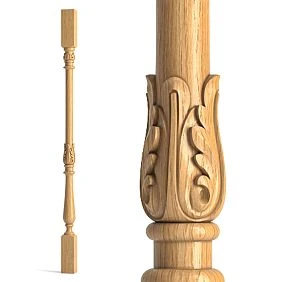
Wooden baluster L-049.1: what is confirmed by the card
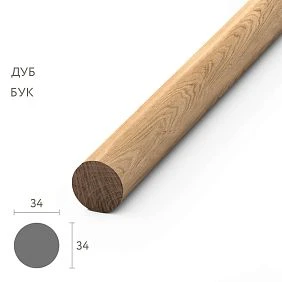
L-049.1 — a turned-carved wooden part with a floral ornament. The card indicates one size: 1000 × 50 mm. Beech and oak are available for order, as well as two levels of surface preparation — "Standard" and "Prestige".
All four versions were offered to order as of the check date. The average production time is stated as 5–10 working days. The exact date for a batch of 20 pieces must be confirmed before payment: the average time does not equal the guaranteed delivery date to the site.
The manufacturer does not perform cutting to size. Therefore, the height of the finished partition cannot be designed with the expectation that twenty balusters will later be uniformly shortened at the factory. The mounting assembly is developed around the published height of 1000 mm.
You can place a specific item through the card: buy wooden baluster L-049.1. In the request, the material, quality, and quantity must be repeated.




Wooden balusters in a 3000 mm partition: precise row calculation
The width of one L-049.1 is 50 mm. Twenty items occupy:
20 × 50 = 1000 mm.
Between twenty balusters there are 19 internal gaps. With each width of 100 mm:
19 × 100 = 1900 mm.
Total row width:
1000 + 1900 = 2900 mm.
In the given opening, 100 mm remains. With symmetry, this is two side fields of 50 mm each. The result is a clear rhythm: 50 mm from the edge, then a baluster of 50 mm, a gap of 100 mm, and repetition until the second edge.
However, this scheme is only valid for the clean dimension between boundaries. If the project includes two side posts 50 mm wide inside the opening, the free width for balusters decreases to 2900 mm, and the side fields disappear. If balusters fit into grooves of vertical elements, the visible width changes. Therefore, the arithmetic is transferred to the working drawing, not directly to the order.
Our factory also produces:
Why 20 carved balusters were chosen for the decorative partition
Nineteen balusters 50 mm wide will create 18 internal gaps. While maintaining a gap of 100 mm, the row will occupy 2750 mm, and a total of 250 mm will remain at the edges. The rhythm becomes noticeably freer, with side fields of 125 mm each.
Twenty-one balusters and 20 gaps of 100 mm will occupy 3050 mm, which will not fit into the 3000 mm opening without reducing the intervals. To fit 21 items without side fields, the average gap must be:
(3000 − 21 × 50) ÷ 20 = 97.5 mm.
Technically, this option is possible in a decorative project, but the 97.5 mm size is less convenient for marking, and purchasing another baluster increases the budget. Twenty pieces provide full 100-millimeter gaps and clear side margins.
The choice is not related to the regulatory stair railing. The partition does not protect against falls and should not be described as a stair system. If its purpose changes, the calculation and requirements are revised by a specialist.
Get Consultation
Beech baluster under enamel: a practical option for a restaurant
Beech has a calm, relatively uniform structure. In the card, it is shown as a base material under enamel. For a restaurant lobby, this is a logical option if the partition must match the color of doors, coat check counter, or wall panels.
Twenty beech balusters in "Standard" cost 106,000 RUB at the published price. In "Prestige" — 129,600 RUB. The difference is 23,600 RUB. It pays for more thorough preparation but does not eliminate the priming and topcoat technology.
"Standard" may be beneficial for a carpentry workshop that performs overall final sanding together with the frame anyway. "Prestige" is more convenient when the contractor wants to reduce manual work on complex carved areas. The choice is made after evaluating a real sample, not just the quality name.
Oak carved baluster: when natural texture matters
Oak is chosen if the wood grain should remain visible under oil, varnish, or translucent tinting. In a row of 20 pieces, natural differences form a large composition, so the pieces are laid out before finishing and each is assigned a specific place.
The cost of oak is noticeably higher. Twenty pieces in "Standard" — 176,400 RUB, in "Prestige" — 194,600 RUB. The difference between beech "Standard" and oak "Prestige" reaches 88,600 RUB. The overpayment is justified only when the project truly showcases the oak texture.
Buying oak and covering it with opaque enamel is technologically possible, but the commercial sense of such a solution needs to be explained. For a colored partition, beech usually allows directing the budget toward quality finishing and installation.
Before choosing a material, it is useful to check the quality of wooden balusters and to approve a reference sample with the designer.
"Standard" or "Prestige": what to order for 20 balusters
In a long repeating row, the quality of preparation is especially noticeable. Light glides across twenty identical profiles, so roughness, fuzz, or uneven carving work becomes more apparent than on a single piece.
When choosing "Standard," the estimate includes manual inspection of all 20 items, final sanding, dust removal, and checking carved recesses. You cannot compare only the product price while ignoring the workshop's work.
"Prestige" reduces the amount of preparation, but each baluster is still accepted before painting. Moisture, transport damage, or surface contamination do not disappear because of the category name. The final choice is made based on the full estimate of "product + preparation + finish."
Buy wooden balusters: product card or catalog section
The section is needed before approving the model. The buyer can Buy wooden balusters after comparing shape and size. But the finished partition must be assembled from a single article.
If L-049.1 seems too decorative, before ordering you can compare the wooden baluster L-060 or compare the wooden baluster L-054. After approval, you cannot replace two or three positions with a similar model for urgent completion.
For associated interior elements, you can to buy carved wooden decor, keeping moderation: the partition already creates an active repeating pattern.
Height of wooden partition with baluster 1000 mm
One thousand millimeters is the height of the product, not the finished structure. Below and above, elements are needed that fix the row: a base, a guide, a frame, or another calculated node. Their dimensions increase the total height or partially overlap the ends of the balusters.
If the lower and upper rails have a visible height of 60 mm each and the baluster is placed between them without recessing, the total module will be 1120 mm. If the ends fit into grooves of 15 mm at the top and bottom, the visible part of the baluster decreases to 970 mm, and the result depends on the rail dimensions.
Therefore, in the specification, the product size 1000 × 50 mm and the design height of the partition are recorded separately. You cannot substitute one for the other.
Full-size mockup of a baluster partition
Before placing an order, it is useful to check not only the arithmetic but also the perception of the row at full scale. On a wall or on sheets of cardboard, mark an opening of 3000 mm, twenty strips 50 mm wide, and nineteen gaps of 100 mm each. Show the upper and lower boundaries taking into account the future frame.
The mockup answers questions that are not visible in a small visualization. Is there enough through light near the wardrobe? Does the pattern look too frequent next to the administrator's desk? Are hangers and service items visible through the gaps? Does the screen height conflict with a switch, camera, evacuation sign, or decorative lamp?
If the rhythm seems too dense, you cannot simply remove one baluster after purchase. First, recalculate the 19 items, side margins, and gaps, then update the working drawing and estimate. If a denser composition is required, similarly check the option with 21 balusters and gaps of 97.5 mm.
To evaluate the profile itself, use a photograph or the contour of L-049.1 at a 1:1 scale. However, the image does not convey the depth of the carving. Before a large order, it is reasonable to approve a physical sample or inspect the product if such an opportunity is confirmed by the seller. The decision on twenty pieces is made after checking the repeating motif, not based on a single enlarged fragment of the card.
Map of twenty carved balusters L-049.1
Each position is assigned a number from B1 to B20 from left to right. On the layout, mark the axis, visible gap, depth of the upper and lower groove, and orientation of the front side. This map accompanies the batch from acceptance to final installation.
For oak, the layout is especially important: after inspecting the wood grain pattern, the craftsman distributes calmer and more expressive pieces so that transitions look natural. For beech under enamel, the map helps return painted items to their original places and avoid mixing up pieces fitted to specific frame grooves.
The same width of 50 mm does not guarantee that any baluster can be moved to any position without checking after assembly work. The actual opening and frame may have slight deviations. Therefore, marking is applied to the hidden end in a way compatible with the coating and transferred to the list.
If one baluster is damaged upon acceptance, the report should indicate not only the quantity but also its number. This makes it possible to understand whether frame production can continue and how the replacement will affect the overall schedule. Without a map, the phrase "one of twenty does not fit" leaves contractors with too much uncertainty.
Full estimate for a wooden partition
The price of twenty balusters is only one line in the budget. Added to it are the top and bottom rails, side posts, fasteners, embedded parts, joinery work, a test sample, primer, finish coating, packaging after painting, delivery to the site, and installation.
For the "Standard" option, the final sanding of twenty carved pieces is calculated separately. If the craftsman estimates the work by time, the buyer should compare the sum of "106,000 RUB for oak plus preparation" with the readiness of the "Prestige" option at 129,600 RUB. A cheaper product price does not always mean a lower cost for the finished partition.
The estimate also includes technological material losses. A test paint-out should not be considered an unnecessary expense: correcting an unsuitable shade on twenty finished balusters costs more. For oak, the method of preserving pores, grain, and an even degree of gloss in carved recesses is additionally agreed upon.
The reserve twenty-first baluster is not ordered automatically. It will increase the product budget by the cost of the chosen finish and will require storage. The reserve is justified if repeat production could delay the opening of a restaurant or if the partition is in a high-risk area for damage. The decision is recorded before requesting a commercial proposal.
Finishing twenty wooden balusters in a single batch
After acceptance, the pieces should not be divided among different painting workshops. Even one color code can yield different levels of gloss, coverage, and texture with a different primer, equipment, or drying mode. In a repeating row, this will be immediately visible.
First, one control sample is approved under the lighting of the restaurant hall. Then the manufacturer and material codes, primer, number of layers, application method, interlayer sanding, and final gloss are recorded. The sample is kept until the installation is complete.
A baluster cannot be held only by its decorative middle section during painting and transport. The workshop provides technological hanging or support points on hidden ends. After drying, each piece is protected from contact with neighboring ones; otherwise, the fresh surface is damaged even before installation.
Before assembly, a dry layout of B1–B20 is performed. The color is checked under frontal and side lighting, then the row is installed. If one piece noticeably differs, the cause is determined before fixing it in the frame, rather than trying to hide it near the side post without the designer's approval.
Fastening of carved balusters in a decorative screen
The product card is not a drawing of the entire partition. The designer determines the top and bottom frames, groove depth, fasteners, stability, fixation to the floor and walls, as well as the possibility of dismantling.
Special attention is paid to lateral stability. A visitor may touch the partition, a child may pull on a baluster, an employee may bump it with a coat rack or cart. Decorative purpose does not mean the structure can be wobbly.
Before drilling the floor, check heating, electrical wiring, and other hidden utilities. If the restaurant rents the premises, the fastening method is agreed with the owner. Installation only with adhesive without calculated mechanical fixation is not accepted as a universal solution.
Technical recommendations can be obtained on the page where you can study tips on finishing a wooden partition. The working assembly is still developed for a specific object.
How to order 20 balusters L-049.1
Step 1. Measure the clear opening
The width of 3000 mm is checked at the top, middle, and bottom after finishing is complete. Deviations are recorded, not hidden by adjusting individual gaps during installation.
Step 2. Approve the frame
Determine the thickness of the side posts, top and bottom guides, groove depth, and final height.
Step 3. Check the 20 × 50 mm layout
Draw twenty contours and nineteen gaps of 100 mm on the working drawing. Connect the remaining fields to the frame.
Step 4. Choose one wood species
Beech is mainly for enamel, oak for visible texture. Mixing them in one row without a design concept is not recommended.
Step 5. Choose quality
Compare not only the price of "Standard" and "Prestige" but also the cost of preparing all twenty items.
Step 6. Fix the specification
L-049.1, 1000 × 50 mm, selected wood species, selected quality, 20 pieces, one finish, one batch.
Step 7. Confirm the deadline
Made-to-order production takes 5–10 business days, verified for the specific volume. Then delivery, acceptance, and finishing are added.
Step 8. Check logistics
Before payment, you should check payment and delivery of balusters, especially the packaging of long carved parts.
What to check upon receiving batch L-049.1
Before handing over to the painter, verify:
-
item number L-049.1;
-
quantity — 20 pieces;
-
size 1000 × 50 mm;
-
one selected wood species;
-
same grinding quality;
-
integrity of the carved ornament;
-
condition of straight mounting sections;
-
absence of transport damage;
-
geometry and ability to lay out an even row;
-
marking of packages;
-
absence of unauthorized sawing;
-
conformity to the reference sample after trial finishing.
For transparent finishing, products are laid out in the future order and marked B1–B20. For enamel, marking is also useful: it links the part to a specific position and simplifies reassembly after painting.
Mistakes when buying wooden balusters
-
Count 3000 mm as the row size excluding the frame.
-
Order 21 items with unchanged gaps of 100 mm.
-
Cut each baluster without a design solution.
-
Mix beech and oak to shorten the deadline.
-
Assessing the 'Standard' only by its low price.
-
Painting twenty parts without a single sample.
-
Ordering products before the final measurement.
-
Not calculating the lateral stability of the screen.
-
Using a partition as a stair railing without a new project.
-
Not checking the utilities in the floor.
-
Accepting goods after painting.
-
Considering the price of balusters as the full cost of the partition.
-
Forgetting about packaging and storage space.
-
Placing different gaps to compensate for an error.
-
Order each part of the series at a different time.
When it is worth buying baluster L-049.1
The model is suitable if a classic carved rhythm is needed; the 1000 mm height is built into the calculated frame; twenty pieces form a consistent layout; the material and quality are chosen by finish; the structure is secured and stable; the production time fits into the project schedule.
When to place an order prematurely
The purchase is postponed if the opening is not yet finished; the frame thickness is unknown; a different height is required; the balusters are planned to be trimmed; the partition must perform a protective function; the color is not selected; the contractor has not calculated the final sanding; there is no space for receiving and painting the batch.
Wooden balusters L-049.1 for a restaurant: summary
Twenty L-049.1 pieces 50 mm wide and 19 gaps of 100 mm each occupy 2900 mm. In a 3000 mm opening, 100 mm remains — 50 mm on each side with a symmetrical layout without an internal side frame.
The product budget ranges from 106,000 RUB for beech "Standard" to 194,600 RUB for oak "Prestige". The choice is determined by the finish and the total cost of preparation, not just the price of a single item.
The order is ready when the clear opening is checked, the frame is designed, twenty items are approved, the wood species and quality are selected, a single finish sample is received, and the timeline and delivery are confirmed. Then the partition looks like a cohesive architectural detail, not a set of randomly placed balusters.
The commercial proposal must match all parameters: L-049.1, 1000 × 50 mm, twenty pieces, one wood species, one sanding level, and agreed preparation for finishing. The readiness date for the entire batch and the shipping city are specified separately. If the supplier offers partial delivery, the buyer decides in advance whether painting can begin without the remaining pieces. For a uniform color result, it is safer to receive and finish the set simultaneously. The final order is approved only together with the frame drawing and work schedule; otherwise, an accurate quantity calculation will not protect the project from delays during installation.
Frequently asked questions about baluster L-049.1
What is the size of L-049.1?
1000 × 50 mm.
What wood species is it made from?
made of beech and oak.
What sanding options are available?
"Standard" and "Prestige."
How many balusters are needed for a 3000 mm row?
In the considered scheme — 20 pieces with internal gaps of 100 mm and total side margins of 100 mm.
How long does a row of 20 pieces take?
2900 mm excluding the frame.
Can I order 21 balusters?
Yes, but with a 3000 mm opening, the gaps will have to be reduced or the frame scheme changed.
How much does a beech set cost?
106,000 RUB in "Standard" or 129,600 RUB in "Prestige" at prices as of the check date.
How much does an oak set cost?
176,400 or 194,600 RUB respectively.
Can the L-049.1 be shortened at the factory?
The card states that cutting to size is not performed.
Can a partition be used as a stair railing?
Not for this decorative calculation. For a protective function, a separate project is required under applicable requirements.
What to choose for enamel?
Beech is more often considered, but the final decision is made after a test finish.
What should I choose for visible texture?
Oak with a transparent or semi-transparent finish.
Where to order wooden balusters?
L-049.1 is ordered via the product card, other models are compared in the wooden balusters section.