Article Contents:
- Why a niche between slatted fields requires attention at all
- What is a carved overlay NPU-197 and how it differs from molding
- Why one NPU-197 and three NPU-197 are different visual solutions
- Four sizes — four different application scenarios
- 45 × 91 × 10 mm — for narrow niches and delicate ornament
- 65 × 131 × 14 mm — the most versatile option
- 75 × 151 × 16 mm — for medium-width niches and strong backlighting
- 95 × 192 × 21 mm — for wide niches and a pronounced accent
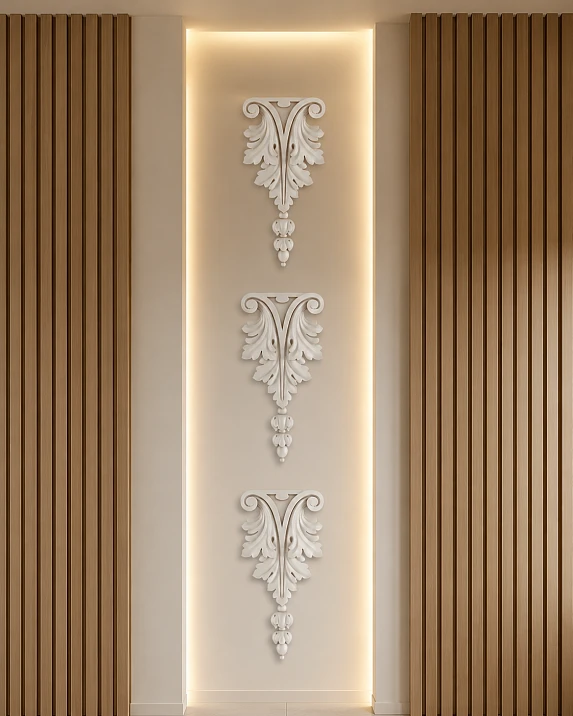
A smooth vertical strip between two fields of slat panels is one of the most ambiguous places in a modern interior. Without decor, it looks like a mounting joint. With long linear trim, it turns into another horizontal line in a room where the vertical is already set by the slats. The third option — a rhythm of three identical carved overlays NPU-197 along one vertical axis — the product card directly lists among recommended applications: walls, niches with lighting, decorative compositions.
Below — how to choose the right one from four sizes, how to position the overlays so they work with lighting, and when this scenario is not suitable.
Why a niche between slat fields requires attention at all
8 The lighting in a slatted structure is mounted in the gaps between the slats or behind the panel substrate, creating a soft, diffused glow. The slatted texture creates an effect of "floating" strips of light, making decorative niches truly picturesque.It is precisely this property that creates the problem. While the lighting operates inside the slatted panels, any smooth insert nearby appears dark and flat.7The entire decorative effect is built on the contrast of light and shadow: the higher the contrast, the sharper the sense of volume. An empty smooth niche breaks this contrast: it neither casts shadows nor diffuses light—it simply absorbs attention.
There are three options:
- Do nothing—the niche remains a mounting gap.
- Run a long carved molding—a horizontal or vertical line along the entire height of the niche.
- Place three identical carved overlays NPU-197 along the vertical axis—a repeating ornament with intervals.
The third option works differently than the first two, and its visual result depends on the specific size of NPU-197, the niche height, and the lighting power. This is precisely what requires calculation, not intuition.




What is the carved overlay NPU-197 and how does it differ from molding
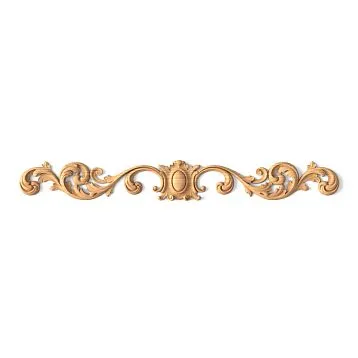
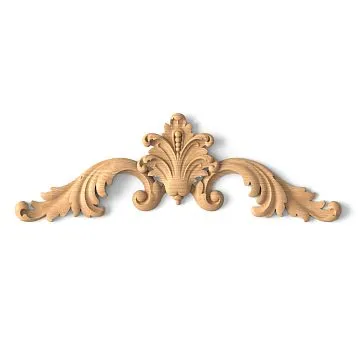
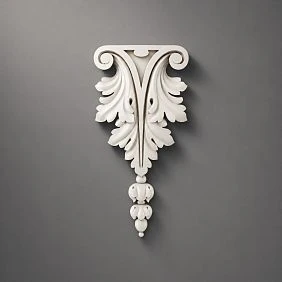
NPU-197 is a piece decorative element made of polyurethane with a carved ornament, designed for mounting on a flat surface. It is not molding—that is, it does not have length as a product parameter. Each overlay is a complete figure with fixed dimensions along three axes.
3 The material is high-quality polyurethane, featuring high strength, moisture resistance, and resistance to mechanical damage. The use of modern 3D technologies allows for the creation of a highly detailed pattern that produces the effect of three-dimensional carved molding.Current sizes and prices for NPU-197 — four options, sold from a single piece, production to order in 3–7 days:
| Size A × B × C, mm | Relief depth C | Price per unit | Price for 3 pcs. |
|---|---|---|---|
| 45 × 91 × 10 | 10 мм | 660 ₽ | 1 980 ₽ |
| 65 × 131 × 14 | 14 мм | 1 090 ₽ | 3 270 ₽ |
| 75 × 151 × 16 | 16 мм | 1 410 ₽ | 4 230 ₽ |
| 95 × 192 × 21 | 21 мм | 1 950 ₽ | 5 850 ₽ |
Important about orientation. Dimensions A and B in the card are marked as A × B × C and are detailed in the drawing located in the product gallery. Before ordering, you need to open the NPU-197 drawing and verify which of the two flat sides will be positioned vertically in the niche: this affects how wide the overlay will appear and how much it will cover the smooth surface. Without the drawing, considering "A — width" is not possible — it is an assumption.
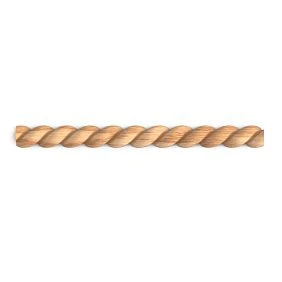
Molding from the same polyurethane is a separate product category with a different principle: it is sold by the meter and covers the surface with a continuous line. Section of carved polyurethane molding →
The difference between three NPU-197 and one molding is not only the price, but also the visual logic. The molding creates a line. Three overlays create a rhythm with pauses — a fundamentally different solution for a narrow vertical niche.
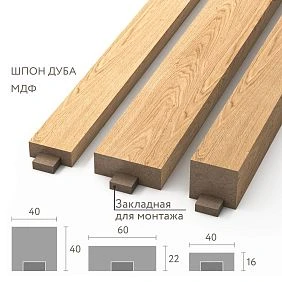
Our factory also produces:
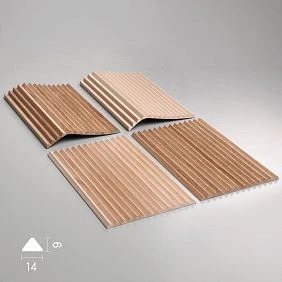
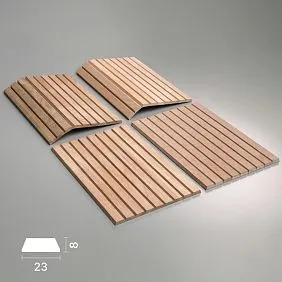
Why one NPU-197 and three NPU-197 are different visual solutions
This is the key question that defines the meaning of the article.
One overlay in the center of the niche is a decorative accent. It works well if the niche is low (up to 120–140 cm) and the overlay is large — for example, 95 × 192 mm. A single piece reads as a medallion. The problem arises with a tall niche: one small overlay in a two-meter opening looks random, as if it was forgotten to be removed.
Three overlays along one vertical axis create rhythm. The pattern repeats at equal intervals, and the eye perceives it as an intentional system rather than a random element. This principle works in architecture at any height: three identical elements set a rule, one is not enough, four can overload a narrow field.
An additional argument for a niche with backlighting: the relief of each overlay will create its own shadow. Three points with shadows work as three sources of visual volume — the backlight "activates" each of them differently depending on the angle of light and time of day.
Get Consultation
Four sizes — four different application scenarios
Before analyzing each size, one measurement needs to be taken: the actual width of the smooth part of the niche. This is the distance between the inner edges of the two slatted fields. Not the opening in the wall, but the visible smooth strip.
45 × 91 × 10 mm — for narrow niches and delicate ornament
The most compact option. Three pieces — 1,980 ₽.
The 10 mm relief is the minimum in the line. With side LED backlighting (when the strip is placed on the side or behind the niche), this depth gives a soft shadow without sharp contrasts. This is an advantage in light interiors where a subtle decorative touch is needed, not an accent.
Risk: in a tall niche (200 cm and above), three small overlays can get lost. They are visible up close, but from a distance of 3–4 meters, the rhythm stops being readable. This option works better in niches up to 150–160 cm in height.
65 × 131 × 14 mm — the most versatile option
Three pieces — 3,270 ₽.
Relief of 14 mm noticeably enhances the play of shadows under side lighting. The size is sufficient for the ornament to be readable from a distance of 2–3 meters. At the same time, the overlay does not cover a significant part of a narrow niche and does not compete with the slats in visual weight.
This is the option with which it makes sense to start fitting the template (more on this below).
75 × 151 × 16 mm — for niches of medium width and strong lighting
Three pieces — 4,230 ₽.
Relief of 16 mm under direct frontal lighting (for example, built-in LED strip along the edge of the niche) gives a pronounced shadow around the perimeter of each overlay. This makes the ornament "alive" — it changes with different light directions and different viewing angles.
Important limitation: if the niche is narrow (less than 150 mm in the visible smooth part), an overlay of this size will occupy almost the entire width. This is not a mistake, but you need to check in advance with a template how this option looks — an overlay flush against the slats is perceived differently than the same piece with side margins.
95 × 192 × 21 mm — for wide niches and a pronounced accent
Three pieces — 5,850 ₽.
Relief of 21 mm is the maximum. Under lighting, this option creates the deepest shadows and the strongest three-dimensional effect. Three overlays of this size, placed with a minimal interval, visually almost merge into a single vertical strip of ornament.
This is exactly where it's important to check the distance between the overlays before installation: if the interval is less than one height of the overlay itself, the three pieces are perceived as one composite figure, not as a rhythm. This may be the desired result — but it needs to be checked with a template, not guessed.
The difference between the smallest and largest variant of the trio is 3,870 ₽. This is the price of the solution, not just the price of the product.
Algorithm for choosing the size using a paper template
This is the only way to make a decision without error. Neither photos nor calculations replace a real template in real space.
1. Measure the width of the niche. Measure the visible smooth part between the edges of the slat panels. Write it down.
2. Measure the height of the niche. The distance from the floor (or the lower edge of the slat field) to the ceiling (or the upper edge). This will determine how much space remains for the intervals between the overlays.
3. Make paper templates. Cut out three rectangles of each selected size — first for 65 × 131 mm, then for 75 × 151 mm. The thickness of the paper does not imitate the relief, but it allows you to check the proportions.
4. Find the central vertical axis of the niche. Draw it with a pencil or mark it with masking tape. It is along this axis that the vertical line of three overlays is built. Starting from the ceiling "by eye" is not allowed: an error of 15–20 mm shifts the entire axis, and the ornament looks uneven.
5. Lay out three templates vertically with equal spacing. Secure with masking tape. The interval must be the same between all three elements. A good starting point is 50–70% of the height of the overlay itself. That is, for an overlay 131 mm high, the interval is about 65–90 mm.
6. Turn on the lighting in the evening. Not in daylight. Paper templates are flat, but the lighting will already show how the light will be distributed around the future overlays and whether the niche will look overloaded.
7. Look not only straight ahead, but also at an angle. At a 45° angle to the niche plane — this is exactly how a person passing by sees it.
8. Only after this — choose the option, open the NPU-197 card and order three pieces of the required size.
How relief interacts with backlighting: three scenarios
Relief is not just an aesthetic characteristic. In a niche with backlighting, it determines the depth of shadows and the angle at which light bends around the ornament. That is why the transition from 10 mm to 21 mm is not just "more noticeable decor": it is a different light character.
Scenario 1: Backlighting from behind (LED strip behind the niche backing)
7 Slat wall panels with backlighting do not require any box: one directional light source is enough — and the relief immediately "turns on." The entire decorative effect is built on the contrast of light and shadow. With backlighting from behind, light goes from the back wall of the niche forward. Relief of 10–14 mm works well in this case: the overlay gets side lighting and a soft halo. Relief of 21 mm can give too dark a shadow under the ornament — the lower part of the overlay "falls through."Scenario 2: Top lighting (built-in spot or strip along the top edge of the niche)
Light goes from top to bottom along the niche plane. With relief of 16–21 mm, the lower edges of each ornament element will be in shadow — this creates a pronounced three-dimensional effect. Relief of 10 mm with top lighting may look almost flat: the depth of shadows is insufficient for noticeable volume.
Scenario 3: Front lighting (tape around the niche perimeter or built-in spotlight)
This option neutralizes shadows. Front light "knocks out" the relief: the overlay becomes flat in silhouette. With NPU-197 with a relief of 10–14 mm, front lighting can make the ornament almost invisible. The best result here is achieved with a relief of 21 mm — it preserves shadows even under direct light.
Conclusion: the type of lighting must be known before choosing the NPU-197 size, not after.
Calculation of the interval between three overlays
The interval is not a random distance. It determines whether three overlays are perceived as a rhythm or as random elements.
Initial data for calculation:
- H_n = niche height in mm
- H_e = height of one overlay according to the size table (in the required orientation, specified per drawing)
- 3 overlays
Total height of three overlays: 3 × H_e
Free space that is divided into four parts (top margin + three intervals + bottom margin):
Free = H_n − (3 × H_e)
If all four parts are equal:
Each part = Free / 4
Example for a niche of 220 cm and an overlay height of 131 mm (65 × 131 mm):
text3 × 131 = 393 mm 2,200 − 393 = 1,807 mm free 1,807 / 4 = 452 mm for each margin and interval
This is a large interval — almost half a meter. For such a niche, the 65 × 131 mm option creates a sparse rhythm. A larger overlay (95 × 192 mm) with the same niche gives:
text3 × 192 = 576 mm 2,200 − 576 = 1,624 mm free 1,624 / 4 = 406 mm
The difference in interval is 46 mm. Visually, it is barely noticeable, but three large overlays take up 576 mm versus 393 mm — that is, almost a third more vertical surface.
For a niche of 150 cm and the same overlay of 65 × 131 mm:
text3 × 131 = 393 mm 1,500 − 393 = 1,107 mm 1,107 / 4 = 277 mm
The rhythm is denser. The overlays are read as a single group. This is a different character — closer to trim in perception.
Table of approximate intervals (with top/bottom offset = interval, i.e., uniform distribution):
| Niche height | NPU-197 45×91 (H=91) | NPU-197 65×131 (H=131) | NPU-197 75×151 (H=151) | NPU-197 95×192 (H=192) |
|---|---|---|---|---|
| 150 см | 280 мм | 265 мм | 257 мм | 232 мм |
| 180 см | 355 мм | 340 мм | 330 мм | 308 мм |
| 220 см | 452 мм | 438 мм | 427 мм | 406 мм |
| 260 см | 548 мм | 533 мм | 522 мм | 503 мм |
The table is calculated assuming that the top offset = bottom offset = interval between overlays. Orientation H is clarified per the card drawing.
If the interval exceeds the height of the overlay itself by more than 3.5 times, three overlays are perceived as scattered elements rather than a rhythm. This is not a rule, but a good checkpoint.
When three NPU-197 is not the best solution
An honest assessment of the scenario before purchase matters more than any advertising logic.
Niche wider than 200 mm in the smooth part. A narrow overlay (45 × 91 mm) on a wide background will look lost. Here, it is more reasonable to consider a larger overlay or another solution — for example, a frame molding.
Niche with access to the LED strip. If the LED profile is located in the niche and requires periodic access (strip replacement, adjustment), three overlays must not block this access. Check before installation whether the decor will cover the service area.
A niche less than 80 cm high. Three overlays physically do not fit with a reasonable interval. Here it is more logical to use one NPU-197 in the center or a completely different type of decor.
The interior style is minimalism without ornament. NPU-197 is an element with a carved pattern. In an interior where everything is built on clean lines and the absence of ornaments, three overlays will conflict with the concept. An alternative is simple profiled molding without a pattern.
The wall color does not match the niche color. NPU-197 is painted to match the surface color. If the niche is a different color, the overlays need to be painted separately. This is not difficult, but requires additional time and consideration before ordering.
What to put in the cart along with NPU-197
Three NPU-197 overlays are the main item. The product card shows related items alongside it.
KUDO HIGH TACK adhesive, 280 ml — recommended in the "Bought with this product" block on the NPU-197 card. It is a hybrid polymer adhesive suitable for mounting polyurethane decor on painted and puttied surfaces. Buy adhesive for mounting →
If related decorative tasks in the same niche or on the adjacent wall are being considered, it is worth opening:
- The entire section of polyurethane overlays →
- Polyurethane wall decor →
- Polyurethane molding — general catalog →
Final algorithm before ordering
Sequence that eliminates errors:
- Measure the width of the smooth part of the niche (not the overall opening — just the visible strip).
- Measure the height of the niche.
- Open the NPU-197 drawing in the product card and verify the orientation of A and B.
- Calculate the interval using the formula above for two or three sizes.
- Cut paper templates of two candidates — three of each.
- Arrange them along the niche axis with the calculated interval, secure with tape.
- Turn on the lighting in the evening, check from a distance of 2–3 m and at an angle.
- Make sure the decor does not overlap the LED profile service area.
- Choose the size and order three NPU-197 covers.
- Add KUDO HIGH TACK adhesive.
Production takes 3–7 days, sold from one piece.
FAQ
Can I order two NPU-197 instead of three?
Yes — sold from one piece. But the symmetry of two covers requires a different calculation: the central axis of the niche falls into the interval between the parts, not on the part. This works in niches of small height, where three covers do not fit with a normal interval.
Is NPU-197 available in stock or only made to order?
According to the product card, production takes 3–7 days. Before placing an order, availability should be checked on the website or by phone: the “In stock” status for individual sizes may change.
How to calculate the amount of adhesive?
One cover has a small contact area. A 280 ml tube of KUDO is enough for several meters of mounting seam. For three NPU-197, one tube is more than enough, if no other decorative elements are planned to be installed in parallel.
Can NPU-197 be painted to match the color of the slat panels, rather than the color of the niche?
Technically — yes, polyurethane can be painted with acrylic paint. But if the trims are the color of the slats and the niche is a different shade, the trims will visually "pop out" of the niche plane and start to be perceived as part of the slat field. This is a different design approach — workable, but requiring a deliberate decision.
Is priming required before installing NPU-197?
Polyurethane itself does not accept paint well without a primer. Before painting the trims, it is recommended to prime the surface of the product. The mounting surface of the niche (puttied or painted wall) should also be dry, clean, and dust-free — this is a standard requirement for any polymer adhesive.
The slat panels are already installed. Can NPU-197 be attached after renovation?
Yes. Installation with adhesive does not require dismantling the slat panels. A clean and flat niche surface is sufficient. This is why trims are a more flexible solution than molding, which requires precise cutting to fit the existing installation.