
























Article Contents:
- What is a wooden corner and why is it needed
- The corner as a weak point of finishing
- Corner profile: what it is
- Functions of a wooden corner
- Where wooden corners are used
- Areas of application — broader than it seems
- External and internal corner: which profile to choose
- Two types of corners — two types of tasks
- External (outer) corner
- Inside corner
- Furniture corner
- How a wooden corner differs from a batten, layout, and baguette
- One material — different profiles and tasks
- Summary table of differences
- How to choose the size of a wooden corner
- Parameters that determine the choice
- Proportion rule
- Panel thickness and corner width
- The angle is not always 90°
- Wooden corner for walls and panels
- Slat wall: how to finish corners
- Wooden panels and slopes
- Partitions and screens
- Wooden corner for furniture
- Furniture: where the corner is especially needed
- Consistency with furniture decor
- How to combine the corner with baseboard, batten, and baguette
- Molding system: unity of profiles
- Baseboard and corner: allies at the bottom
- Batten and corner: rhythm and border
- Baguette and corner
- Material and finish: solid wood, paint, varnish, tinting
- What type of wood is used for wooden corner guards
- Finishing options
- Can the corner guard be repainted after installation?
- Common mistakes when choosing a wooden corner guard
- Mistake 1: Corner guard too wide for thin furniture
- Mistake 2: Corner guard too narrow for a large wall panel
- Mistake 3: Color mismatch with baseboard and slats
- Mistake 4: Ignoring the type of corner
- Mistake 5: Choosing without considering the installation situation
- Mistake 6: Different wood species for the furniture corner and the body
- Wooden corner in the molding system: complete diagram
- What professional finishing looks like in wooden moldings
- FAQ: popular questions about wooden corners
- Where to buy wooden corners for finishing
- STAVROS: wooden corner and complete solid wood molding system
There is a rule in construction and finishing: the quality of work is determined not by the middle, but by the edges. Not by how evenly the tiles are laid in the center of the room, but by how they meet the baseboard. Not by how smoothly the wall is plastered, but by what happens in the corner where two walls meet.
It is here, in these joints and transitions, that lives Wooden Miter for Finishing — a profile element that covers and protects the corner, hides installation inaccuracies, and connects different materials into a neat transition. A small detail with a big task.
In this article — everything about how to choose Wooden corner bracket, what tasks it is needed for, how it differs from a batten, layout, and baguette, and how to organically fit it into the system of wooden moldings and interior decor.

What is a wooden corner and why is it needed
The corner as a weak point of finishing
Any corner in an interior is the meeting point of two planes. Wall and wall. Wall and panel. Furniture body and facade. Decorative batten and slope. Each such joint carries two problems: technical (how to neatly connect different materials) and visual (how to make the transition invisible or, on the contrary, expressive).
Wooden angle solves both. Technically — covers the gap, ends, uneven cuts. Visually — creates a clear line that organizes the corner and gives it completeness.
Our factory also produces:
Corner profile: what it is
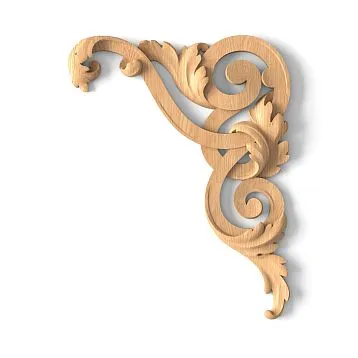
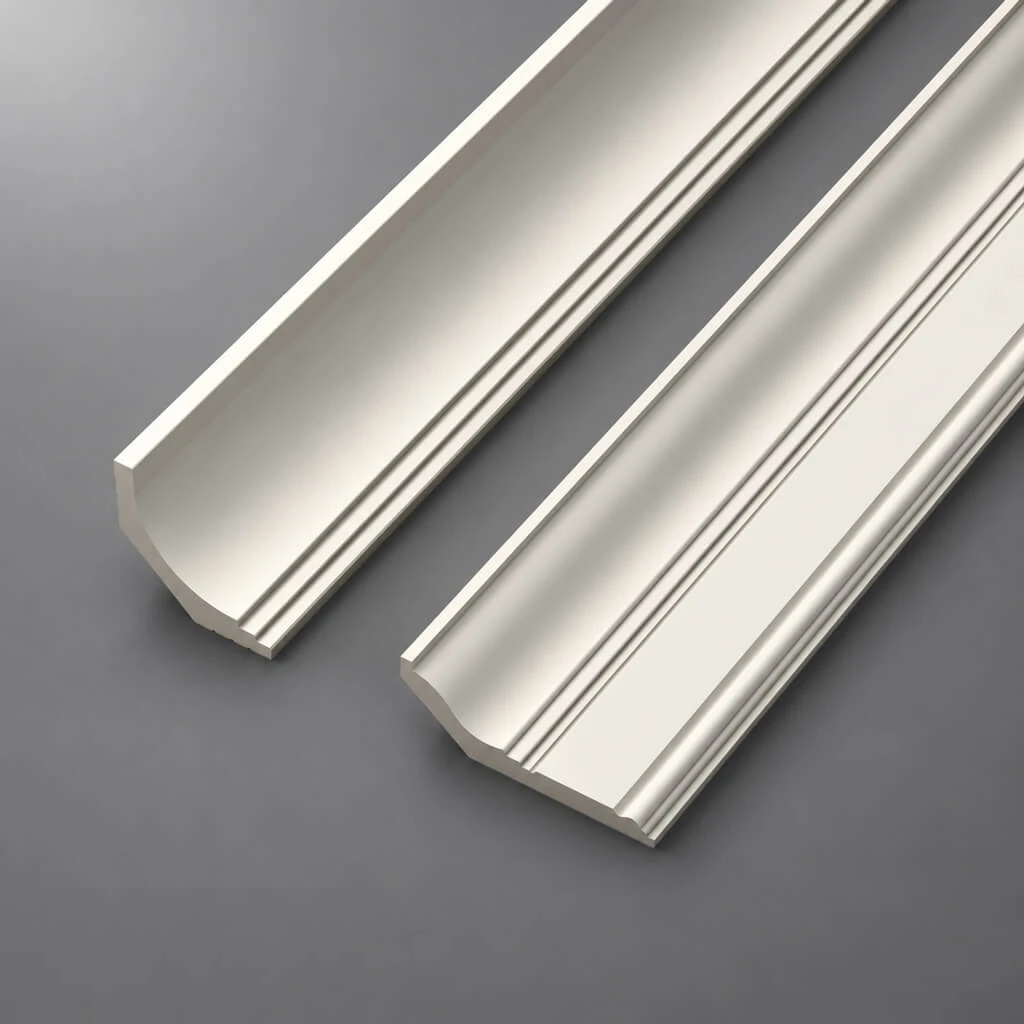
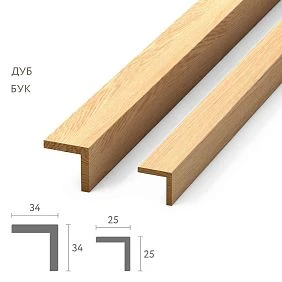
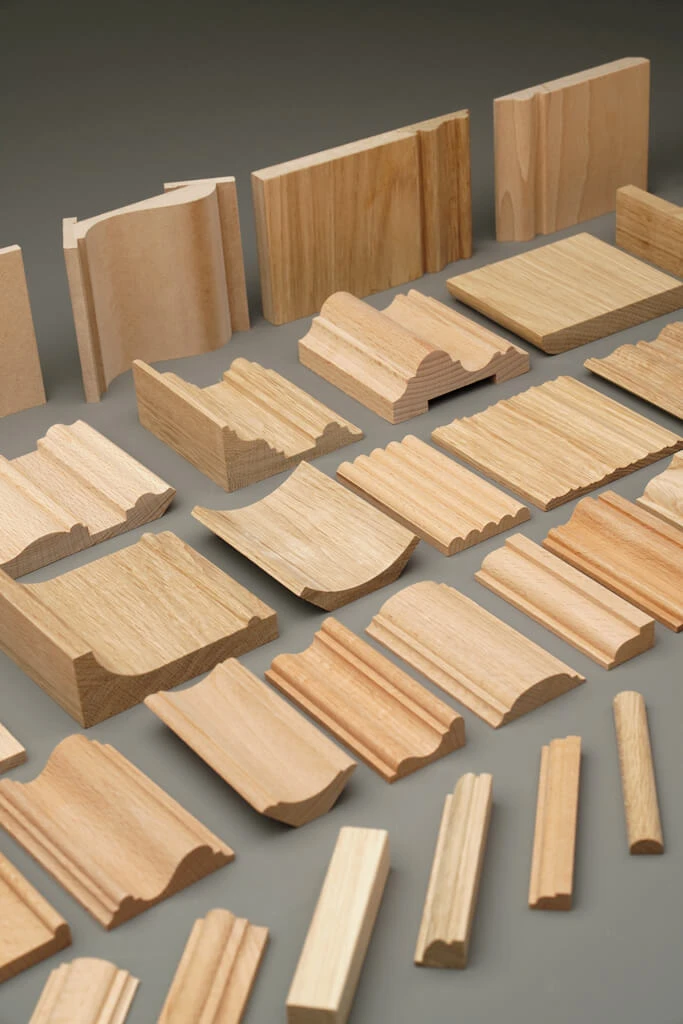
A wooden corner is a linear profile with a cross-section in the shape of the letter "L" (for external corners) or a triangle/rounded profile (for closing joints). The two "shelves" of the corner embrace the angle from both sides — each shelf adjoins its own plane. The joint is closed, the ends are hidden, the corner acquires a clear shape.
The standard length of a corner is 2.4 or 3.0 m. The width of the shelves is from 10 mm to 60 mm or more, depending on the task. The profile thickness is from 5 to 15 mm.
Get Consultation
Functions of a wooden corner
A wooden corner performs several tasks simultaneously:
-
Protective. An open wooden corner (panels, furniture) is vulnerable. Mechanical impacts, abrasion, chips. The corner covers the edge and increases the service life of the finish.
-
Decorative. The straight line of the corner piece visually organizes the corner — making it clear and neat.
-
Structural. Hides the mismatch of the ends of two meeting planes — always inevitable during finishing installation.
-
Connecting. Unites different materials and surfaces into a single transition.
Where a wooden corner piece is used
Applications — broader than it seems
When you say "wooden corner piece," most often you think of furniture. But the scope of application is much broader.
Wall finishing:
-
External corners when finishing with wooden slats or panels.
-
Transition from wooden slats to a wall of another material.
-
Designing corners in slatted partitions and decorative screens.
Door and window openings:
-
Finishing slopes with wooden panels.
-
Transition from trim to slope.
-
Closing the joint between wood and other finishing materials.
Furniture:
-
External corners of cabinets, chests of drawers, display cases.
-
Transition between side panel and front.
-
Decorative edges on vertical elements.
-
Furniture restoration — replacement of damaged corner edges.
Decorative panels and partitions:
-
Finishing the ends of decorative wooden panels.
-
Transition from panel to bare wall or other material.
Steps and stairs:
-
Protective corner on the front edge of the step (anti-slip and protective element).
External and internal corner: which profile to choose
Two types of corners — two types of tasks
Before choosing Buy Wooden Angle — you need to determine which corner is to be covered: external or internal. This fundamentally changes the shape of the required profile.
External (outer) corner
An external corner is a corner protruding into the space. For example, the outer corner of a decorative panel on a wall, the corner of a furniture body, the corner of a wooden partition.
For an external corner, a profile with two flanges covering the corner from the outside is needed. Both flanges fit against the surfaces on both sides of the corner. A standard L-shaped profile with flanges perpendicular to each other (90°).
The external corner is more vulnerable. It receives mechanical impacts. Therefore, the protective function is more important here.
Internal corner
The internal corner is a corner that "recedes" into the depth. The joint zone of two meeting planes in a room is a classic example. Or the internal corner of a wooden panel and an adjacent wall.
For an internal corner, a profile of triangular or quarter-round cross-section is needed — it closes the gap in the joint area without protruding into the space. This is a more delicate element, often decorative rather than protective.
Furniture corner
On furniture, the corner piece works differently. Here, the thinness of the profile and precise matching with the body details are important. A furniture corner piece is typically of small cross-section (10–20 mm), made from the same wood species as the body, with the same finish.
How a wooden corner piece differs from a batten, trim, and molding
One material — different profiles and tasks
In wooden millwork, there are several types of elements with similar functions but fundamentally different applications. Confusion between them is a common cause of incorrect selection.
Wooden corner bracket — a profile of "L"-shaped or triangular cross-section. Designed for closing and protecting corners (external or internal). Works at the transition of two planes. The main task is the corner.
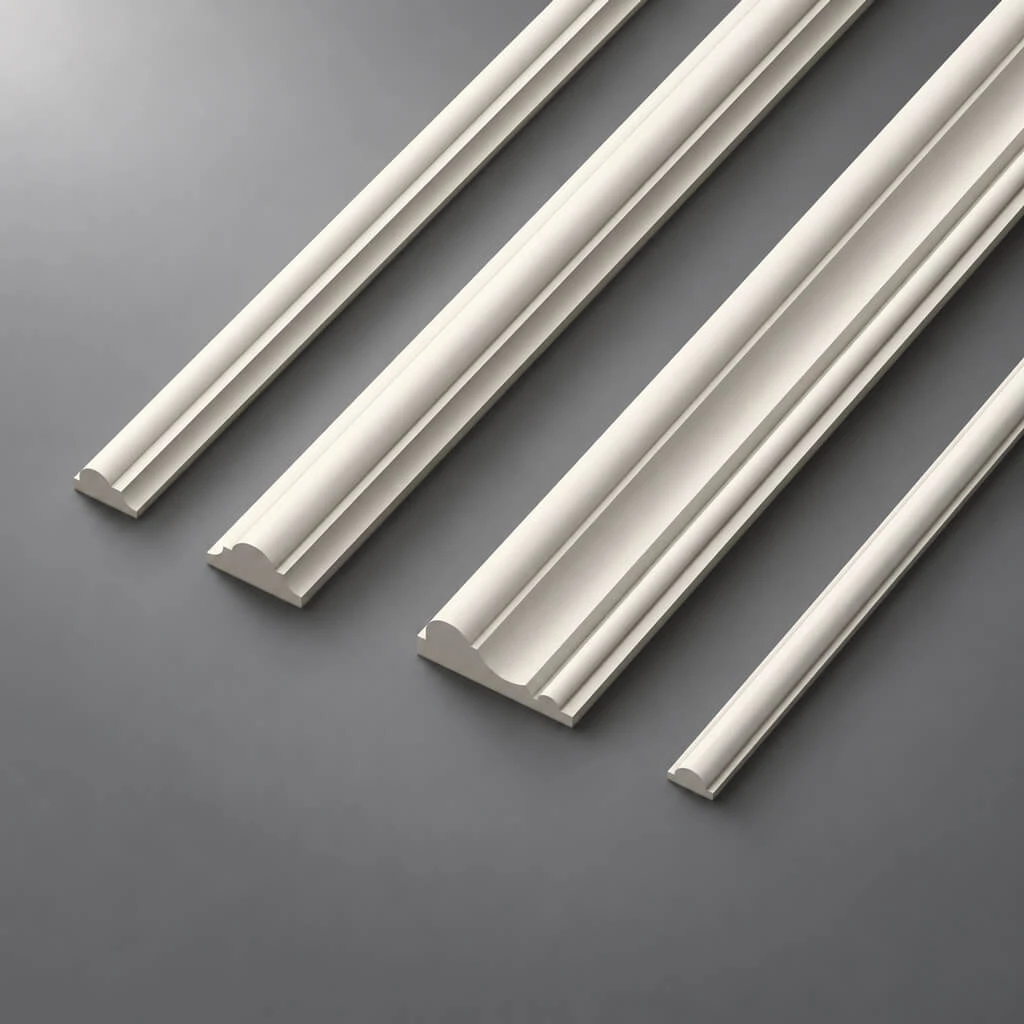
Wooden plank — a profile of rectangular or square cross-section. Creates a line, rhythm, decorative pattern on the surface. Used in slatted walls and ceilings, as a divider, accent. The main task is the line.
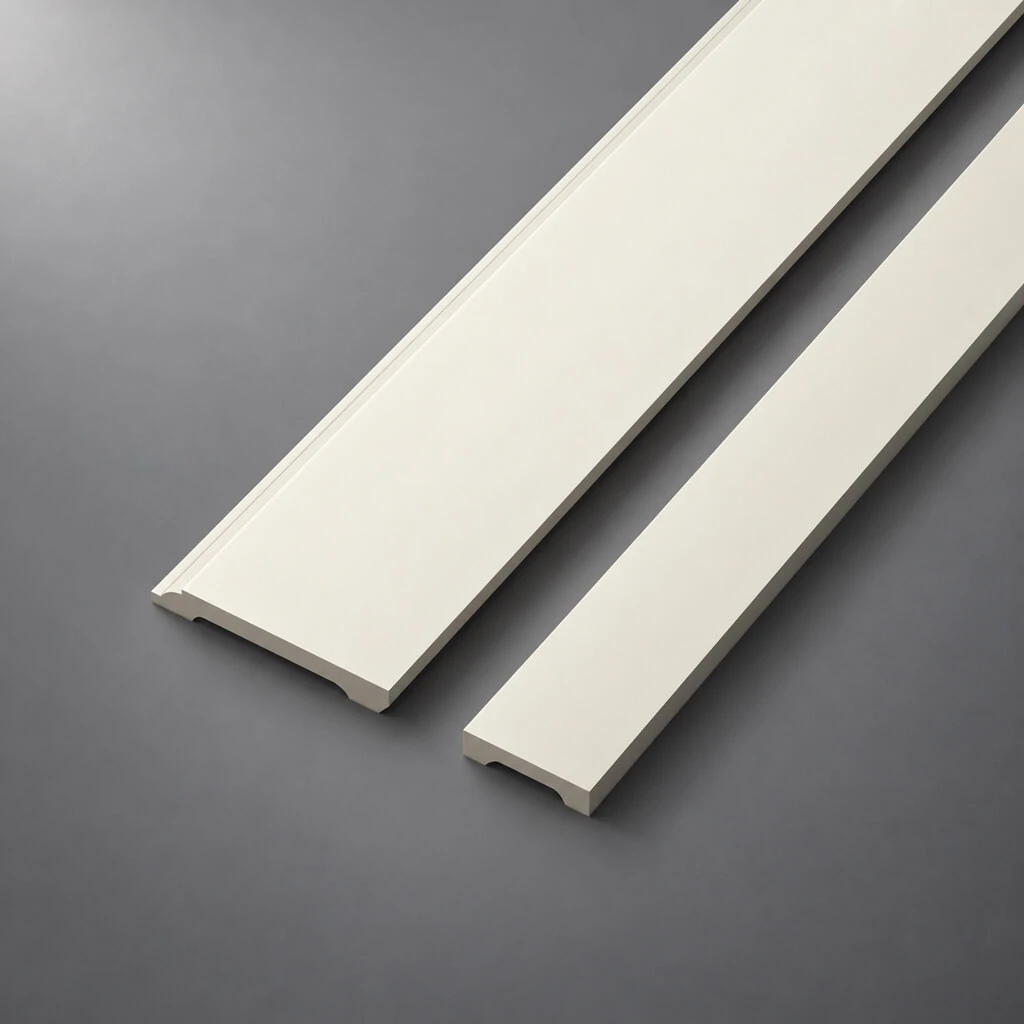
Wooden molding — flat or slightly profiled molding for closing joints of two planes (not corners). Closes gaps in the plane, not in the corner. The main task is a joint on the plane.
Wooden Picture Frame — profile with decorative relief for frames of paintings and mirrors, as well as for decorative wall design. Has a quarter for inserting images. The main task is decorative profile and frames.
Summary table of differences
| Profile | Cross-section shape | Main function | Where it is used |
|---|---|---|---|
| Wooden corner | "L" or triangle | Protection and decoration of the corner | Walls, furniture, openings |
| Wooden batten | Rectangle/square | Decorative line, rhythm | Slat walls, ceilings |
| Wooden layout | Flat/chamfered | Closing flat joints | Furniture, panels, trim |
| Wooden picture frame molding | L-shaped with relief | Picture/mirror frame | Frames, decorative molding |
for corner wooden layout there is a separate format — it's the same corner principle, but with a more pronounced decorative profile, often used in classical and neoclassical interiors.
How to choose the size of a wooden corner
Parameters that determine the choice
Size of a wooden corner for finishing are primarily the width of the shelves (both shelves are usually the same) and the thickness of the profile.
Proportion rule
The width of the corner shelves should match the scale of the object:
-
Furniture (cabinets, case furniture): shelves 10–20 mm, thickness 5–8 mm. A neat, almost invisible profile.
-
Medium-thickness decorative panels: shelves 20–30 mm.
-
Wall finishing, slatted panels, partitions: shelves 25–40 mm.
-
Large structural elements, slopes: shelves 40–60 mm.
A corner piece that is too wide on a thin furniture detail — it stands out and loses proportion. A corner piece that is too narrow on a large wall panel — the work is not visible, and it does not visually "hold" the corner.
Panel thickness and corner piece width
The corner piece is placed over the panel end. The shelf width must be at least the panel thickness — otherwise the end will not be covered. Optimal: shelf width = panel thickness + 5–8 mm overlap with the surface.
Example: a panel with a thickness of 16 mm — a corner piece with a shelf from 20 mm.
The angle is not always 90°
An important technical point: a standard wooden corner piece is designed for a 90° angle. If the angle is not right (in old houses, walls often deviate by several degrees) — either trimming the corner piece or a special profile with an adjustable angle is needed.
Wooden corner piece for walls and panels
Slat wall: how to finish corners
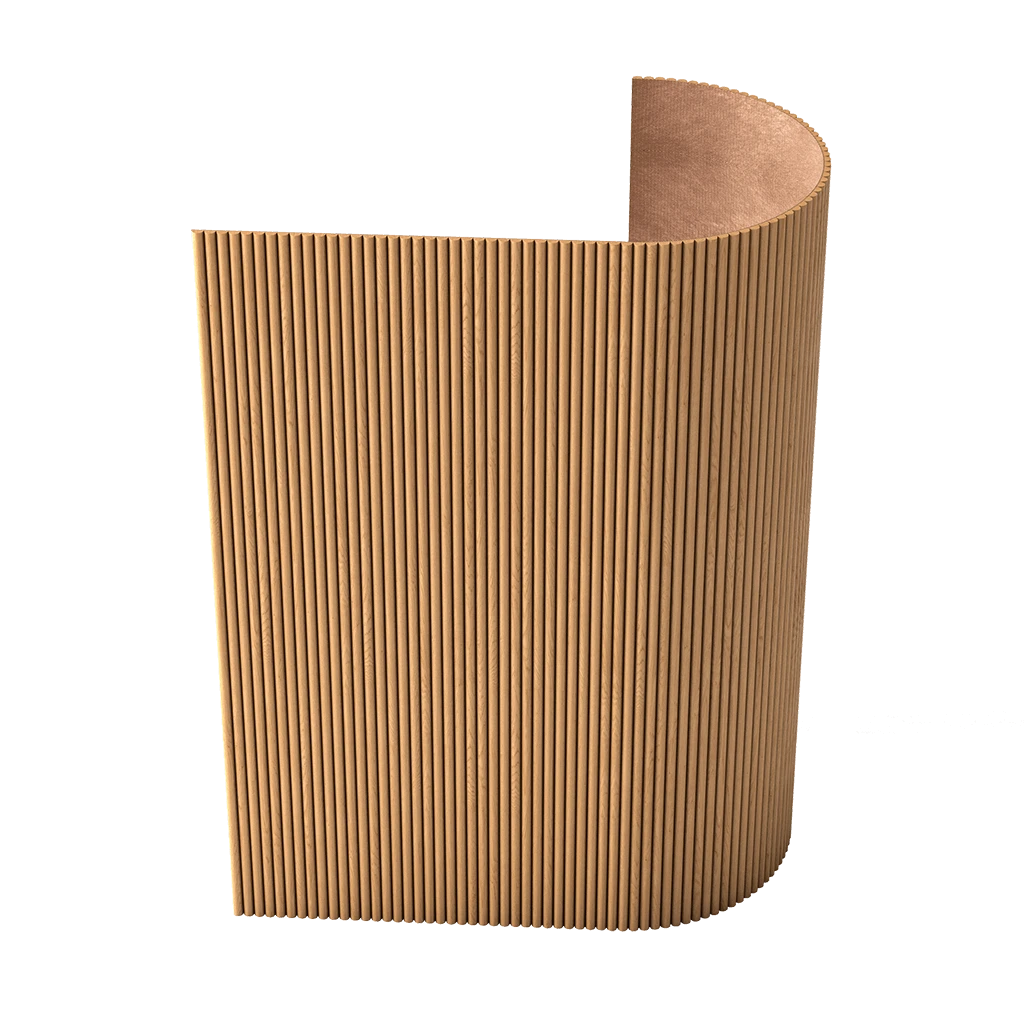
Slat walls are a hugely popular finishing technique in recent years. Vertical or horizontal wooden slats on the wall create a textured pattern. But there is a challenge: what to do at the corners?
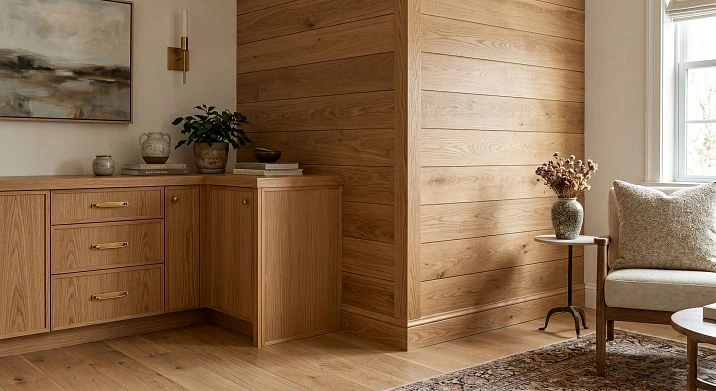
On the external corner (if the slat wall goes around the corner) — a corner piece made of the same solid wood, with the same finish as the slats. It wraps around the external corner and unites the slats of both walls into a single corner line.
On the inner corner (where the wall with slats meets another wall) — a triangular corner piece or a special corner profile covering the joint between the last slat and the bare wall.
Wooden panels and slopes
When finishing slopes with wooden panels, the corner piece transitions from the slope plane to the wall plane. This is an important detail often "left for later" and ultimately left uncovered — with a messy end.
A corner piece made of the same material as the slope panels, with the same tint — and the slope gains a completeness that characterizes quality installation.
Partitions and screens
A decorative wooden partition in an interior always has ends. The corner piece covers these ends, giving the partition a finished look. For tall (ceiling-height) partitions, standard 3.0 m corner pieces are needed, installed from floor to ceiling as a single element.
Wooden corner piece for furniture
Furniture: where the corner piece is especially needed
Furniture and Decor made of wood — a field where the wooden corner piece performs both technical and decorative functions. Let's consider key scenarios.
External corners of cabinet bodies. The corner of a cabinet is a vulnerable spot. Impacts, scratches, chips — all concentrate here. A thin 15–20 mm corner piece made of the same solid wood as the body solves the problem and makes the furniture neater.
Transition between the side panel and the back wall. In open shelving and shelves, this transition is visible. The corner piece covers it and gives the shelf a "finished" look.
Edge of tabletops and shelves. The front edge of a wooden shelf is vulnerable. The corner piece along the front edge protects it and adds a decorative accent.
Furniture restoration. An old cabinet with "battered" corners — a solid wood corner piece refreshes it without a complete overhaul. This is one of the cheapest and most effective restoration techniques.
Consistency with furniture decor
If used on furniture a decorative element for furniture — an applied rosette, carved frieze, corner appliqué — the wooden corner piece must be from the same wood species and in the same finish tone. Different species or different tones next to each other on the same item violate the unity of the design.
How to combine a corner piece with baseboard, batten, and molding
System of linear moldings: unity of profiles
Professional installation of wooden trim is always a system. Individual elements work together: with a classic profile creates a sense of solidity, reliability., wall batten, corner piece in the corner, Wooden molding at the junction. All these elements must be from one source, one breed, in one tint.
Baseboard and corner: allies at the bottom
with a classic profile creates a sense of solidity, reliability. runs along the perimeter of the room. In each corner, the baseboard goes into the corner — and here two solutions are possible:
Cutting the baseboard at 45° (miter joint). Each of the two baseboard pieces is cut at 45° — and they meet in the corner with sharp ends. Requires precision.
Corner block. A small square or corner wooden element into which the baseboard butts from two sides. A decorative solution — easier to install and looks neat.
In both cases, a wooden corner can be used as an additional element — for example, on the inner corner of a slatted panel joining the baseboard.
Slat and corner: rhythm and border
If Wooden plank creates a rhythmic pattern on the wall — the corner at the end of this wall (on the outer corner) should be of the same profile and in the same tone. The transition from a rhythmic slatted wall to the corner is the final point of the pattern. If the corner is of a different shade or a different breed, this transition "breaks."
Price of wooden strip and the corner from one catalog — a guarantee that the breed, tone, and finish will match.
Bagette and corner
Picture frame strip and a wooden corner can work in one system — for example, on a wall where a slatted panel ends with a baguette frame. In this case, the corner of the frame — the joint of two baguette segments — is finished with a corner element or a 45° cut.
Material and finish: solid wood, paint, varnish, tinting
What wood is the wooden corner made of
For a wooden finishing corner, the following are most often used:
Beech. Light homogeneous wood. Easy to process, sand, and paint. Under clear varnish — a warm cream-yellow tone. With tinting — takes on any shade. A good choice for light interiors and furniture for painting.
Oak. More expressive texture than beech. Characteristic natural pattern with radial rays. Under oil or varnish — a warm golden-brown tone. For classic and neoclassical interiors.
Pine. Softer and more budget-friendly wood. Suitable for finishing that is planned to be painted. Not recommended for open corner elements on furniture — softer and more vulnerable.
Finishing options
Natural under varnish. Clear varnish preserves the wood texture and protects the surface. For interiors with an emphasis on natural wood.
Tinting. A special compound that changes the color of the wood without hiding the texture. Allows matching the corner with existing furniture, baseboard, slats.
Painting. A corner for painting is a universal solution. After installation, it is painted together with the wall or furniture. Used in classic interiors with white or colored enamel.
Oil or wax. Eco-friendly impregnation that preserves texture. Less glossy than varnish. For natural interiors, eco-styles, Scandinavian design.
Can the corner be repainted after installation?
Yes — if the corner was primed and painted. Sanding, primer, a new coat of paint — and the corner is refreshed. This is important when repairing furniture or changing the color concept of the interior.
Common mistakes when choosing a wooden corner
Mistake 1: Corner too wide for thin furniture
A 40 mm corner on a cabinet body with a wall thickness of 16 mm — the disproportion is immediately noticeable. The corner should be slightly wider than the panel thickness, but not several times.
Mistake 2: Corner too narrow for a large wall panel
A 10 mm corner on a slatted wall 2.7 m high — a "thread" on a large surface. Wall panels require a corner from 25–30 mm so that it is visible and performs a decorative function.
Mistake 3: Color mismatch with baseboard and slats
A birch wooden corner under light varnish + an oak baseboard under dark oil — a conflict that cannot be resolved except by reordering. All trim elements in one area — from the same species in the same tint.
Error 4: Ignoring the type of angle
Buying a corner piece for an external corner, only to find out you need a profile for an internal one — a common story. Before purchasing, determine what type of corner needs to be covered.
Error 5: Choosing without considering the installation situation
If the wall angle is not 90°, a standard corner piece won't fit tightly. You'll need either on-site trimming or a flexible profile. Measuring the angle before buying is a must.
Error 6: Different wood species for furniture corner and body
A cabinet body made of oak veneer + a corner piece made of varnished pine — the difference in texture and tone will be obvious. The furniture corner piece should be made of the same wood species as the main body material.
Wooden corner piece in the molding system: complete scheme
What professional finishing looks like in wooden molding
Imagine a room finished according to all the rules of wooden decor:
-
At the floor: Wooden baseboard — horizontal transition line from wall to floor.
-
On walls: Wooden plank — rhythmic vertical pattern.
-
At joints of slats with adjacent surfaces: Wooden molding — covers flat joints.
-
At corners of slatted wall: Wooden corner bracket — neat L-shaped line wrapping around the corner.
-
On furniture: decorative elements for furniture and furniture corners — details that complete the look.
-
In frames of paintings and mirrors: Wooden trim In the form of a baguette — the final accent.
All these elements are from the same species, the same tint, the same catalog. This is what a professional wooden molding system is.
FAQ: popular questions about wooden corner trim
How does a wooden corner differ from a plastic one?
Natural texture, possibility of painting and tinting, durability with proper care. Plastic loses color and is brittle. Wood is a living material that can be restored if desired.
Can wooden corner trim be used in damp rooms?
With additional varnishing or treatment with a moisture-proof compound — yes, in kitchens and hallways. In bathrooms with direct contact with water — not recommended.
How to attach wooden corner trim?
With liquid nails or construction adhesive — for decorative installation. With small nails or hidden screws — for structural installation. On furniture — glue + clamps until dry.
How to cut corner trim at an external corner?
The corner trim is cut to length exactly. At the joint of two corner trims at an external corner, each is cut at 45° at the end. This way, the two corner trims meet at a neat corner point.
How to choose between a corner and a trim?
Corner — for corners. Trim — for flat joints. If you need to cover the joint of two panels in the same plane — use trim. If you need to cover a corner where two planes meet — use corner.
Which corner is better: beech or oak?
Depends on the main material nearby. Beech — for light interiors and furniture for painting. Oak — for natural wood interiors with pronounced texture.
Where to buy a wooden corner for finishing
Full range of wooden moldings and corners:
-
buy wooden corner piece — catalog of solid wood corners.
-
Wooden corner veneer — article and selection of corner trims.
-
Buy wooden trim — flat trims and moldings.
-
Flat wooden strip — detailed article.
-
Wooden plank — for slatted walls and ceilings.
-
with a classic profile creates a sense of solidity, reliability. — floor profile matched with the corner piece.
-
Wooden Picture Frame и Picture frame strip — for frames and decorative panels.
-
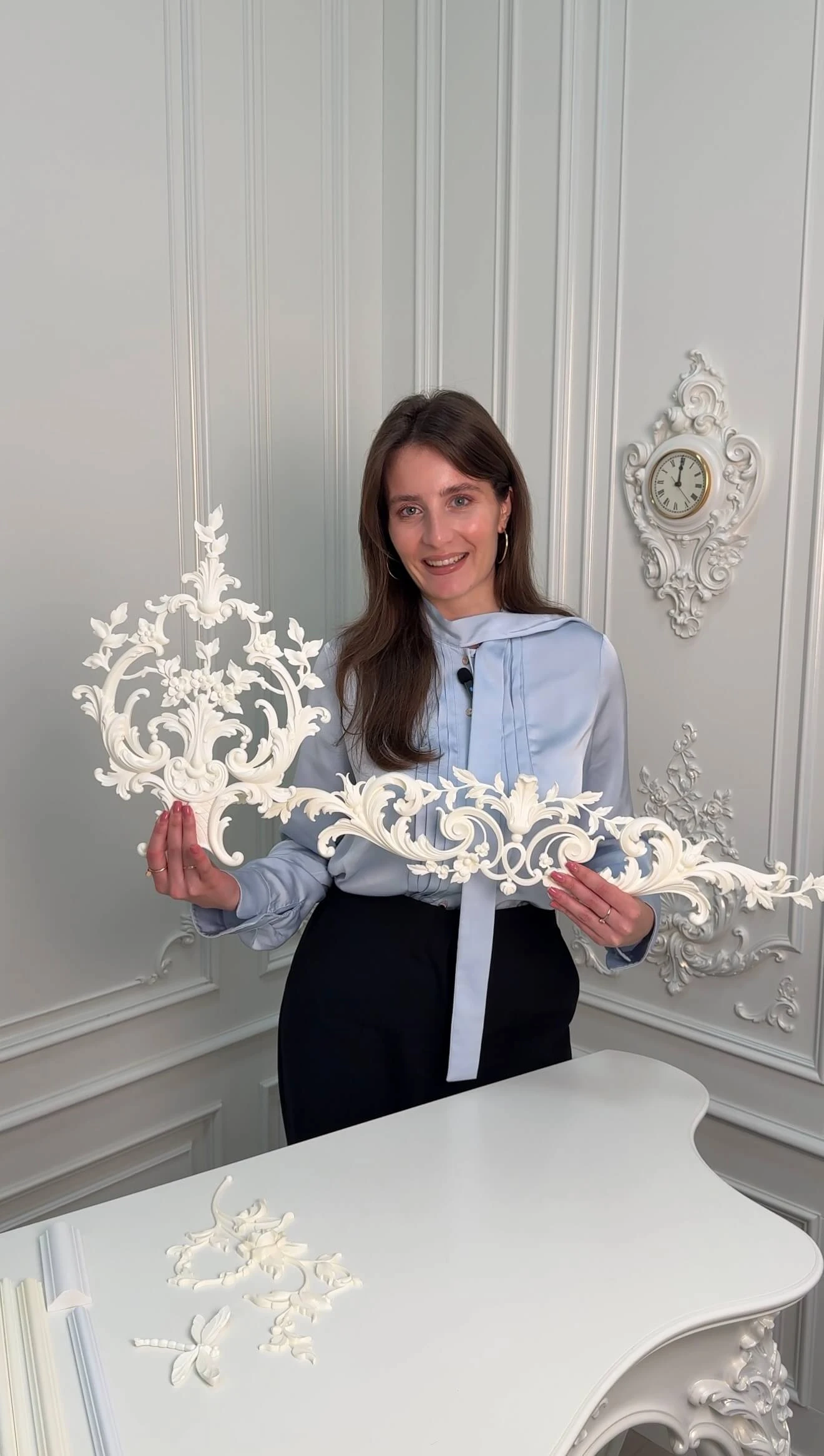
Wooden decoration — overlay elements for furniture and interiors.
-
Furniture and decor from solid wood — complete product catalog.
STAVROS: wooden corner piece and full system of solid wood moldings
Wooden Miter for Finishing — a small profile that solves a big task: turns neatly made corners from "normal" to "professional." Paired with baseboard, batten, trim, and molding, it becomes part of a system that defines the quality of all wooden finishing.
STAVROS produces and supplies a full range of solid wood moldings from beech and oak: corner pieces, battens, trims, baseboards, baguettes, and decorative overlays. Single wood species, single tone, single surface finish quality — the entire molding system from one source.
STAVROS works with craftsmen, designers, furniture manufacturers, and private clients across Russia. One catalog — all profiles for professional wooden finishing.