

































Article Contents:
- Adele 010-001 dressing table: why room size is just the first check
- Dressing table dimensions 780 × 1361 × 465 mm: what A, B, and C mean
- Why an assembled dressing table cannot be calculated as flat packaging
- How to check the delivery path for the Adele dressing table before placing an order
- 1. Entrance to the building or house
- 2. Vestibule
- 3. Elevator
- 4. Stairwell
- 5. Apartment door
- 6. Corridor
- 7. Turn before the bedroom
- 8. Bedroom door
- 9. Unpacking area
- 10. Final location
- White enamel RAL 9010
- Cherry tint
- Walnut with patina
- Mistake 1. Only checked the free wall
- Error 2. Took 780 × 1361 × 465 mm as the shipping package dimensions
- Error 3. Assumed that an "800 mm door" guarantees passage
- Error 4. Expected to disassemble the table on site
- Error 5. Did not clarify the weight
- Error 6. Measured the elevator but forgot the landing in front of it
- Error 7. Ordered the mirror as if it comes with the set
- Error 8. Made the same assumption about the lighting
- Error 9. Did not leave space in front of the three drawers
- Error 10. Did not account for the baseboard, radiator, and curtains
- Error 11. Planned to unpack the box in a narrow hallway
- Error 12. Route check left for delivery day
- First, recheck the measurement itself
- Then clarify the packaging
- Check the allowed orientation
- Consider a different route
- Do not plan unauthorized disassembly
- Apartment
- Country house
- Hotel
- Boutique or wedding salon
- Photo studio
- In what form is Adele 010-001 delivered?
- Can I order the table disassembled?
- What is the exact size of the product?
- How to find out the size of the plywood box?
- Will the table fit through an 800 mm door?
- Can it be carried vertically?
- Is the mirror included?
- Is there built-in lighting?
- Does the ottoman fit?
- What type of wood is the table made from?
- How many drawers are provided?
- What finishing options are available?
- Can a different enamel color be ordered?
- How is delivery to the floor organized?
- Where should the rigid box be unpacked?
- Can the turn be checked in advance without the table itself?
- What matters more: the product size or the packaging size?
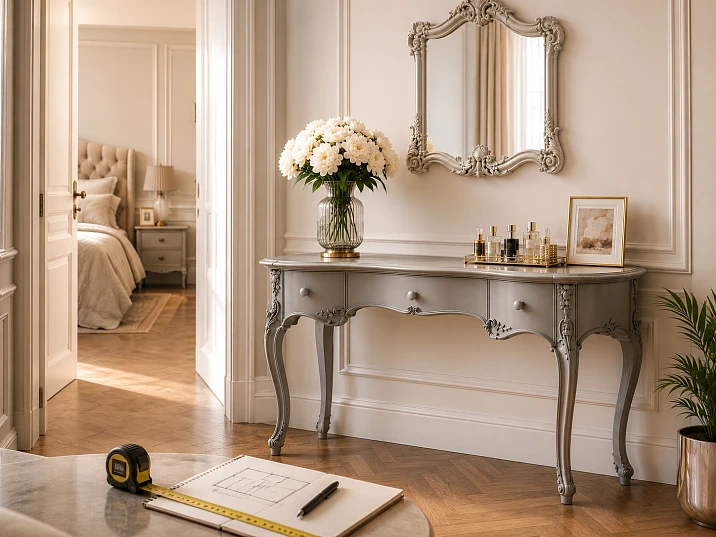
A free wall in the bedroom does not necessarily mean that the chosen furniture can get into the room. For the Adele 010-001 dressing table, this is especially important: the product card indicates dimensions A × B × C — 780 × 1361 × 465 mm, and the item itself is delivered assembled and painted, with a rigid plywood box used for transportation. Therefore, the buyer needs to check not only the final installation spot, but the entire route from the unloading point to the bedroom.
The main mistake occurs when furniture size is mentally compared only with the width of the door leaf. This cannot be done. For safe delivery, at least the external dimensions of the transport box, the permissible orientation of the item during carrying, the actual clear opening of each door, the dimensions of the elevator, stair landings, corridors, and space for turns are needed. Until this data is available, it cannot be claimed that any of the figures 780, 1361, or 465 mm is the "minimum width through which the table will definitely pass."
If you plan to buy dressing table Adele 010-001, the correct sequence is the reverse of the usual one: first check the delivery geometry, then confirm the spot in the room, after that choose the material and finish. This order is especially useful for apartments with an old elevator, a narrow vestibule, an L-shaped corridor, a bedroom door immediately after a turn, or for houses where large furniture has to be carried up the stairs.
The article does not attempt to calculate passage based on a single catalog dimension. That would be false precision. Here the task is practical: to understand which dimensions to request from the manufacturer or manager, how to take measurements of your own route, and at what point to stop the order if at least one section has not yet been checked.
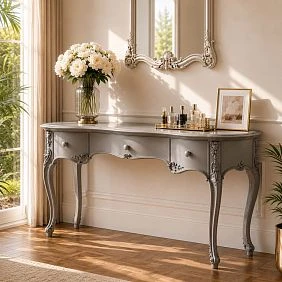
Dressing table Adele 010-001: why room dimensions are only the first check
Adele 010-001 is a classic carved dressing table designed for the bedroom, boudoir, dressing room, and a number of commercial interiors. The frame is made of solid beech or oak. The design includes three pull-out drawers: their fronts are made of solid wood, the inner parts are made of birch plywood, and Blum roller guides are used for extension. The tabletop, depending on the finish, can be made of MDF under enamel or be combined for a transparent finish.
The product card confirms the dimensions 780 × 1361 × 465 mm and delivery in assembled, painted form. It is this last characteristic that changes the purchasing logic. For furniture delivered in flat packaging, the delivery path can be assessed by individual panels. Here, this cannot be relied upon. The buyer must assume that a fully formed three-dimensional item inside a protective box will arrive at the home.
Checking the free space in the bedroom only answers the question "can the table be placed after unpacking." It does not answer the questions "can the box be brought into the entrance," "will it fit into the elevator cabin," "will it turn around on the landing," "will it pass the corridor turn," and "can the furniture be safely unpacked before final installation."
Therefore, a purchase has two independent geometries:
- the geometry of the delivery route — passages, elevator, stairs, turns, doors, and the unpacking spot;
- the geometry of use — the body's placement, opening of three drawers, seating area, passages, mirror, outlets, heating appliances, and neighboring furniture.
A successful check of the second geometry does not compensate for a failure of the first. A table can fit perfectly into a wall-width niche yet still fail to pass the last turn before the bedroom.
Before buy a solid wood dressing table, request from the seller data specifically on the transportation of the particular configuration. If the external box size or permissible orientation is not yet known, the route cannot be considered verified.


Dressing table dimensions 780 × 1361 × 465 mm: what A, B, and C mean
The Adele 010‑001 card shows size A × B × C = 780 × 1361 × 465 mm. An important limitation: based on a single line of specifications, one cannot arbitrarily assign these letters the everyday directions "height," "width," and "depth" without the corresponding drawing in front of you. For logistics, an error in interpreting the axes is more critical than for a regular product description.
Imagine a buyer sees the number 780 mm and a door marked "800." They conclude: a 20 mm margin, so the furniture will fit. This reasoning contains several unknowns at once. It is not confirmed which side of the product corresponds to 780 mm in the carrying position. The external dimensions of the plywood box are unknown. The actual width of the clear opening is unknown. It is unknown whether transporting the product on its side, vertically, or at an angle is allowed. Finally, the space behind the door for continuing the trajectory has not been checked.
Therefore, before ordering, what is needed is not a retelling of the card, but an additional set of logistics data:
| What to request | Why this is needed |
|---|---|
| Product drawing | To correctly understand parameters A, B, and C and protruding elements |
| External dimensions of the rigid box | It is the packaging that passes through doors, elevators, and turns before unpacking |
| Weight of the packed item | To determine the method of carrying and the required number of movers |
| Allowed orientation | To avoid basing calculations on a position in which the item cannot be carried |
| Can boxes be temporarily removed | Only if permitted by the manufacturer and it actually affects carrying or weight |
| Unpacking requirements | To plan the area in advance and avoid opening the crate in a narrow passage |
| Number of cargo units | To understand the actual receiving and moving scheme |
These data cannot be replaced with the assumption that "if turned, it will definitely fit." Sometimes diagonal maneuvering does help, but only if the three-dimensional geometry of the box is known, there is space for maneuvering, and the manufacturer allows such orientation. In a narrow corridor, the theoretical diagonal of the door solves nothing if there is no room to turn the box behind it.
Our factory also produces:


Why an assembled vanity unit cannot be calculated as flat packaging
Flat packaging and assembled furniture impose fundamentally different requirements on the route. A disassembled cabinet can pass through a narrow door in parts and be assembled already in the room. Adele 010‑001, according to the card, is supplied assembled and painted. Therefore, the delivery cannot be planned as if the tabletop, side panels, legs, and drawer bodies would be separate elements.
Transport geometry has four different dimensions that buyers often confuse:
- Product dimensions. In the card — 780 × 1361 × 465 mm as A × B × C.
- External dimensions of the transport crate. They need to be requested separately; they are not specified in the initial data of the article.
- Actual clear opening. This is the minimum distance between real obstacles when the door is open, not the nominal width of the door leaf.
- Maneuvering space. The area in front of and behind the opening, in which the box must change its direction of movement or orientation.
Even if the first three parameters are formally compatible, the fourth can stop the delivery. A typical example is a bedroom door wide enough for direct passage, but located right after a corridor turn. Long rigid packaging must first turn so that it can enter the opening. If the opposite wall is too close, the box physically cannot align to the required axis.
For painted furniture, a practical margin is also needed. A calculation that is "tight, with only a few millimeters left" is bad not because the math is wrong, but because real delivery does not happen in a perfectly static model. There are movers' hands, slight misalignments, door handles, trim, baseboards, and the need to avoid the box touching the finish. Without a confirmed external packaging size, calculating such a margin is pointless.
A rigid box protects the product but also makes the cargo less 'yielding.' It cannot be safely compressed, bent, or pulled through a complex corner like soft packaging. Therefore, for Adele, it is more important to check the entire route in advance than to rely on movers' improvisation on site.
Get Consultation
How to check the delivery route for the Adele vanity table before placing an order
It is better to walk the route in the same direction the furniture will move. You should start not from the bedroom, but from the unloading point. It is convenient to open notes on your phone and record the width, height, and depth/length of each area, as well as take photos of obstacles.
1. Entrance to the building or house
Measure the actual clear opening with the door leaf fully open. If the door is double-leaf, check whether the second leaf can be opened on the delivery day. Check the door closer, handles, threshold, intercom unit, and protruding elements. Sometimes a wide entrance group is actually narrowed by a fixed leaf or a stop.
2. Vestibule
For a vestibule, you need not only doors on both sides. Record the distance between them and the possibility of opening the leaves simultaneously. The box may pass through the first door but turn out to be too long to close it or turn toward the second.
3. Elevator
For the elevator, measure the clear opening of the doors, the height of the opening, the internal width, depth, and height of the cabin. Separately, measure the area in front of the elevator. The rated load capacity is important, but without confirmed box weight, you cannot compare numbers. If there is a freight elevator, record its data specifically.
4. Stairwell
If the elevator is unsuitable or absent, check the width of the flights, the size of the landings, the height above the steps, railings, windowsills, radiators, fire cabinets, and wall protrusions. The main problem often arises at the turn between flights.
5. Apartment door
Repeat the measurement of the clear opening, including the leaf in the open position, handles, and frame. Then assess the space inside the hallway—whether there is room to bring out a long load after passing through the door.
6. Corridor
Measure not only the minimum width but also the length of straight sections, the width at places with cabinets, consoles, and baseboards. If some furniture can be temporarily removed, it is better to do this before delivery, not during the carrying in.
7. Turn before the bedroom
This is one of the most risky points. Record the width of both corridor shoulders, the size of the internal angle, and the distance to the opposite wall. The presence of formally wide passages on both sides does not yet guarantee the turn of a rigid box.
8. Bedroom door
It is checked as thoroughly as the entrance door. If the door can be safely removed from its hinges, this should be decided in advance by the premises owner; it cannot be automatically assumed that movers will dismantle the door leaf.
9. Unpacking area
Space is needed where the box can be placed in an allowed position, opened without risk of damaging walls and floor, protective covering removed, and packaging material taken out. A narrow corridor is rarely suitable for careful unpacking of painted furniture.
10. Final location
Only as the last point are the bedroom wall, drawer opening, seat, passages, outlets, radiator, and future mirror with lighting checked.
For a complex object, it is useful to provide the manager not with the phrase "door 80 cm" but with a table of the entire route. The fewer unknowns remain before production and shipment, the lower the likelihood that a problem will be discovered at the closed bedroom door.
Rigid box for a vanity table: why packaging needs to be measured separately
The Adele 010‑001 card confirms transportation in a rigid plywood box. This is fundamentally useful information, but it does not provide the external dimensions of the packaging. Any attempt to add arbitrary "5 cm for packaging" or "10 cm for protection" to 780 × 1361 × 465 mm would be a fabrication.
The plywood box solves a different task: it protects the already assembled and painted product from impacts and contact with the external environment during transportation. Inside, fixing and protective elements may be used, but their specific thickness and layout for this delivery must be confirmed by the seller. For the buyer, the conclusion is one: the dimensions of the furniture and the dimensions of the cargo space are not interchangeable values.
Route verification is performed based on the larger of the two objects: if the table is in the box to the bedroom, the box is the reference. If, according to the agreed scheme, the packaging is allowed to be removed earlier and then the furniture is carried without it, the safety of such an operation and the route of the product itself must be separately assessed. Making the decision "we'll unpack in the hallway if it doesn't fit" on your own is not advisable: painted surfaces become more vulnerable after the rigid protection is removed.
On the page terms of payment and delivery of furniture STAVROS specifies the methods of packaging and delivery. For a large assembled product, it is useful to agree not only on the address but also on the specifics of lifting before payment: floor, availability of a suitable elevator, parking and unloading restrictions, the need for manual lifting, complex staircases, and a place where the box can be safely received.
Upon receipt, the packaging should be inspected before opening. On the warranty and returns page, the manufacturer separately recommends checking the number of cargo spaces against the waybill and inspecting the packaging for visible damage; if violations are found, opening in the presence of a transport company representative with an act drawn up is required. For painted furniture, it is especially reasonable to do this before the box is fully disassembled and taken away.
Will the dressing table fit through an 800 mm door
The answer "yes, because the specifications include a size of 780 mm" is incorrect. A nominal 800 mm door and the actual clear opening are different things. The number 800 often refers to the door leaf, while the opening is reduced by the frame, the open door, the handle, and installation features. At the same time, 780 mm is one of the parameters A × B × C of the table itself, not the confirmed external cross-sectional dimension of the rigid box in the permitted carrying position.
To answer the question about a specific door, three groups of data are needed:
- the actual clear opening of the door in width and height;
- the external dimensions of the transport box;
- the permitted orientation of the box and the place for its installation on the door axis.
A simple logical test can be used. Suppose for some furniture box the manufacturer confirmed a transverse dimension of 790 mm, but the actual clear opening after measurement turned out to be 760 mm. In a straight position it does not pass: 790 > 760. But from this one cannot automatically conclude that the load can be tilted. Tilting requires sufficient height and depth of space, and the item itself must allow such a position.
Reverse example: clear opening 820 mm, confirmed transverse box dimension 790 mm. Formal margin is 30 mm. This is already better, but the route is not yet proven. If immediately behind the door the corridor ends with a wall and the box needs to be turned 90 degrees, it is the turn that may become the limiting section.
At the bedroom door, measure the width between the actual protruding boundaries, the height of the passage, the position of the leaf at maximum opening, the handle, the stopper, the threshold, the distance to the opposite wall, and the free space on the left and right after entering. If the door is in a niche, also measure the depth of the niche. If a wardrobe, radiator, or console protrudes nearby, they become part of the route.
Elevator, staircase, and turn: how to check sections where width alone is not enough
The most unpleasant logistics errors occur not in a straight opening, but in a volumetric zone where the load needs to be turned around. Therefore, the elevator and stair landing cannot be described with a single number.
For the elevator, create a card with six parameters: door opening width, opening height, cabin width, cabin depth, cabin height, and the dimensions of the area in front of the doors. If the elevator doors do not open to the full stated width or there is a handrail inside, its protrusion is also taken into account. For old elevators, it is useful to measure physically rather than rely on the standard building passport.
The theoretical floor diagonal of the cabin can be calculated as √(width² + depth²), but by itself it does not prove that the box will fit. The load must first pass through the door opening, then turn inside a limited volume. It has height and thickness, not just length on a plan. Therefore, the diagonal is an auxiliary value, not permission for bringing in.
On the staircase, the restriction is often formed by three elements at once: the railing, the ceiling above the flight, and the opposite wall of the landing. If the box is long, its upper corner during lifting may approach the ceiling before the lower end clears the steps. Such a case cannot be checked from a photograph. Dimensions are needed, or a specialist visit if the route is truly complex.
For a 90-degree turn, practical marking is useful. After obtaining the external dimensions of the packaging, make a rectangular template on the floor from painter's tape at a 1:1 scale, or cut out a reduced model of the corridor and box at the same scale. The first method works for assessing area, the second for comparing trajectories. But the model does not account for height, so the final decision must consider the three-dimensional volume.
If there is a questionable point on the route, do not compensate for uncertainty with the phrase "the movers will figure it out." The correct action is to obtain the external dimensions of the cargo unit and provide the route diagram to the lifting contractor in advance.
How to calculate space for a dressing table in the bedroom
Once the delivery path is confirmed, a second check begins — operational. Here, the catalog dimensions of 780 × 1361 × 465 mm are indeed important, but they must be used together with the furniture plan of the room and the drawing to understand the orientation of A, B, and C.
A common mistake is to mark the rectangle of the cabinet on the wall and decide that the table fits. In reality, an additional area in front of it is needed for a seated person and for pulling out drawers. Adele has three drawers, so the front area must remain clear. If a bed is opposite, the passage between items is assessed in the most inconvenient state: a person sits at the table, a drawer is open, and another person needs to pass.
Wall elements are also considered. A baseboard can push furniture away from the wall. A high baseboard profile sometimes conflicts with the lower parts of the cabinet. An outlet behind the table should remain accessible if a hairdryer or separate lighting is connected to it. If the outlet ends up exactly behind a structural element, the furniture may not fit into the planned position.
The radiator requires special attention. The manufacturer, in the operating rules for wooden products, recommends not placing furniture closer than 1 m from heating devices. Therefore, a "free wall near the radiator" should not automatically be considered a suitable place. Similarly, prolonged direct sunlight, water, and strong heat sources must be taken into account.
Thick curtains also take up space. If the table is by the window, check whether the curtains will fall behind the cabinet, catch on the drawers, or cover the radiator. If there is a hinged wardrobe nearby, open its door fully and mark the opening arc on the plan.
For cleaning, it is useful to understand whether you can vacuum and wipe the space around the legs without constantly moving heavy assembled furniture. Choosing a spot where the table formally fits with zero gaps between the wardrobe and the wall is not rational.
Three drawers of the dressing table: what to check before installation
Three drawers are a useful functional part of Adele 010-001, but they require a clear front. The card confirms massive facades, inner parts made of birch plywood, and Blum roller guides. The exact extension depth and internal drawer dimensions must be taken from the drawing or clarified separately; they cannot be invented based on the overall table size.
For planning, a different principle is sufficient: in front of each drawer element, there must be an area where it can open without conflicting with a person, a seat, or neighboring furniture.
Consider a typical scenario. The table stands opposite the bed. When the drawers are closed, the passage seems sufficient. The user pulls up a chair or ottoman, sits down, and opens the central drawer. Now, in one zone, there are simultaneously the depth of the furniture, the extended drawer, the seat, and the person's body. If the bedroom is compact, the passage may disappear completely.
Another conflict arises from the side. Nearby, there is a wardrobe with a long handle or door. The Adele body itself does not intersect with the wardrobe, but when opening the drawer, the user's hand or the front may enter the adjacent zone. Therefore, you need to check the dynamic layout, not just the static plan.
Before ordering, it is useful to draw at least four states on the room plan: the table without a user and with closed drawers; the seat pulled out for sitting; a person sitting with one drawer open; and the nearest wardrobe door open nearby or another person passing by. If the room remains functional in all states, the location is chosen more reliably.
Solid wood dressing table: buy beech or oak to match the chosen finish
The Adele 010-001 frame is made from solid beech or oak. The material is not chosen in isolation, but together with the planned tabletop finish, the overall bedroom palette, and adjacent furniture.
For enamel, the card allows an MDF tabletop. For transparent finishes, a combined option is described: an MDF base, a solid wood contour trim, and veneer facing. Beech or oak is available. This means that the request "buy a solid wood dressing table" should not be understood as a promise that absolutely every part of the product is made only from solid wood. The card directly describes the combined materials of the construction.
Beech is suitable for projects requiring a smooth painted surface or a calm wood grain pattern. Oak is chosen when a pronounced texture should participate in the decorative composition, especially with tinting and clear lacquer. But the final visual result depends on the chosen finishing system, the tone sample, and the natural variability of the wood.
If Adele should match the bed, nightstands, mirror frame, and another item from the same room, it is useful to look at classic solid wood furniture them as a single group. This helps compare not only the style, but also the available materials, finishes, and scale of the items.
Do not expect an absolute match in the grain pattern of natural wood. If the interior requires the most cohesive set, the material and finish should be coordinated simultaneously. For painted options, a control sample is equally important: the same color name does not guarantee the same perception under different lighting and surface gloss.
White, cherry, or walnut Adele dressing table
The product card shows three specific finish options: white enamel RAL 9010, cherry tint, and walnut with patina. Additionally, the description mentions enamels in various colors, transparent tints, varnishes, and patinas. When choosing, it is better to separate the confirmed ready-made configurations of the card from an individual request for a different color.
White enamel RAL 9010
The white option makes the carved silhouette more graphic and suits an interior where classic furniture should look lighter. But the color needs to be compared with trim, doors, baseboards, and other painted furniture on real samples. The shade on the screen depends on the display and lighting.
Cherry tint
Tinting leaves the wood character more noticeable than opaque enamel. This option requires especially careful coordination with adjacent wood: cherry from different manufacturers and on different species does not have to look the same.
Walnut with patina
Patina enhances the classic character of the carved relief. If there is already walnut furniture in the room, it is better to compare real samples rather than just finish names.
The finish also affects logistics. Adele arrives painted, so after unpacking it cannot be treated as a blank that will still be sanded and repainted. The delivery route, the place where the box is opened, and floor protection must be prepared before delivery.
Mirror and lighting for the dressing table: why they need to be calculated separately
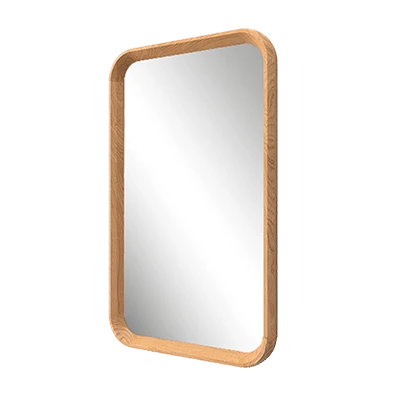
Search queries for "dressing table with mirror" and "with lighting" are frequent, but the Adele 010-001 card does not confirm the inclusion of a mirror or built-in lighting in the set. Therefore, promoting a specific product as a ready-made set with a mirror is not allowed. If a mirror and light are needed, they are designed as separate elements.
First, determine the width and height of the mirror relative to the table and wall. Then, the mark of the lower edge so that the mirror does not conflict with items on the tabletop and remains convenient for the user. If the frame is large, check its own delivery route separately: after installing Adele, it may become harder to approach the wall with a large mirror.
For backlighting, electrical outlets are needed in advance. The location of sockets, switches, cables, and power supplies is taken into account. You cannot assume that after installing the table, the wire can be easily hidden behind it: structural elements may block access to the socket, and the cable may end up pinched between the furniture and the wall.
If lighting is installed on the sides of the mirror, symmetry relative to the table's axis is checked. If overhead lighting is used, its height and possible shadows on the face are assessed. These parameters relate to the interior design project, not to the Adele's completeness.
A pouf or chair is also considered separately if the specific item is not selected and confirmed as part of the order. It requires space in front of the table and an area where the seat can be stored after use. The more compact the bedroom, the more important the dimensions of the seating item become.
How to order the Adele 010-001 dressing table without delivery errors
A buyer who wants order vanity table, can prepare a short technical specification for the manager. It is more useful than a long description of the interior because it records the parameters that affect production and delivery.
| Block | What to fix |
|---|---|
| Product | Adele 010-001, confirmed configuration |
| Material | Beech or oak |
| Finishing | Selected color/tint option |
| Product dimensions | A × B × C = 780 × 1361 × 465 mm per the card |
| Packaging | Request external dimensions of the rigid plywood box |
| Mass | Request product/cargo weight |
| Orientation | Request permissible carrying positions |
| Address | City, floor, unloading access |
| Elevator | Type, door opening, cabin dimensions |
| Complex points | Vestibules, stairs, corner corridors, narrow bedroom door |
| Unpacking | Location and requirements for box opening |
It is also useful to send photos of the most difficult point with a tape measure attached or a diagram with dimensions. A photo without scale helps understand the configuration but does not replace numbers.
If a buyer is looking for where to buy a dressing table in Moscow or buy a dressing table in St. Petersburg, the logistics check remains the same. The presence of a showroom or seller proximity does not change the geometry of a specific entrance. For delivery to another city, a transport segment is added to the route inside the building, but the key question before bringing it in remains the same: does the actual cargo dimension match the narrowest and most complex section.
There is no need to ask the manager to confirm "whether it will definitely fit" if only the width of one door has been provided. Provide the full route and request the missing packaging parameters. Then the decision is based on measurements, not assumptions.
How to prepare the entrance and apartment for delivery day
Even a correctly calculated route can be ruined by temporary obstacles. The day before delivery, walk it again. Remove shoe racks, bicycles, strollers, small consoles, and decorative items if they narrow the passage. Arrange access to the freight elevator if a key or advance booking is required in the building.
Protect the floor where the crate will be placed or turned. The protective material must not be slippery under the movers' feet. Check the lighting on the stairs and corridors: moving a large rigid crate in a dimly lit space increases the risk of hitting walls and doors.
In the bedroom, clear the unpacking area in advance. Do not place a new mirror, ottoman, or boxes with other decor in this zone until the table is installed. If the packaging is opened near finished parquet or other sensitive flooring, prepare a protective layer.
Plan the route for removing plywood and packaging materials. After the furniture is extracted, the rigid box becomes a large volume, and its parts should not block the only passage out of the room.
If temporary removal of a door, trim, or other element is expected along the route, do it in advance and only when it is safe and approved by the property owner. Destructive removal should not be planned as a standard way to compensate for unverified packaging.
Storage and use of wooden furniture after delivery
After successful delivery, the logistics task ends, but for solid wood furniture, the operational phase begins. STAVROS notes that wood is sensitive to environmental conditions and recommends maintaining temperature and humidity levels, avoiding prolonged direct sunlight, water, and proximity to heat sources.
The provided interlinking scheme includes a page storage and operation of wooden furniture. Before publishing the article, this specific URL should be additionally checked in the CMS: at the time of preparing the material, the site served the current storage page at a different address, so it is important for the editor not to leave a potentially non-working internal link unchecked.
For Adele, the practical conclusion is especially simple. Do not place the table close to a heating appliance just because there is a free wall there. Do not plan a place where water constantly gets on a painted or tinted surface. If the table is near a window, assess the duration of direct sunlight.
Also, do not use the surface as a place for hot appliances without protective solutions. A hairdryer, styler, and other devices require safe storage and connection; the electrical part should be organized so that cables are not pinched behind the furniture.
What to check upon receiving the assembled Adele 010-001
Acceptance of large painted furniture should begin before the packaging is thrown away. First, check the number of cargo items against the documents and inspect the rigid box from the outside. Dents, punctures, signs of strong impact, or wetting should be recorded with photos before opening.
On the page warranty and return of furniture STAVROS indicates: if visible damage to the packaging is detected, you should demand opening in the presence of a representative of the transport company and drawing up an act describing the violations. It is more important to do this immediately than to try to reconstruct the circumstances after the courier leaves.
After opening, check the external painted surfaces, carved decor, tabletop, fronts of the three drawers, and the operation of the sliding mechanism. Verify the selected material and finish against the order. If there are separate inserts or hardware in the kit, check them against the actual delivery documents, not based on the article's assumptions.
Do not start independently reworking a damaged part until the problem is documented. The warranty page separately indicates that violating integrity and independently modifying the product may affect warranty conditions.
After inspection, the box can be removed, but it is reasonable to keep photos of the packaging and labeling along with order documents at least for the period of initial product verification.
Mistakes when buying a solid wood dressing table
Mistake 1. Only checked the free wall
Why it happens: the buyer perceives delivery as a technical detail. Consequence: the furniture fits the room but does not fit through the entrance or the last turn. How to prevent: measure the entire route before payment.
Mistake 2. Accepted 780 × 1361 × 465 mm as the dimensions of the shipping packaging
These are the product dimensions A × B × C. The rigid plywood box has its own external dimensions, which need to be requested. Without it, the door check is incomplete.
Mistake 3. Decided that a "800 mm door" guarantees passage
The nominal size of the door leaf is not equal to the clear opening. Additionally, the orientation of the box is unknown. Measure the actual free distance.
Mistake 4. Expected to disassemble the table on site
The product card clearly states delivery in assembled form. The possibility of disassembling individual parts for carrying in is not confirmed and should not be included in the plan without manufacturer approval.
Mistake 5. Did not specify the weight
Without the weight, it's impossible to properly plan the number of movers, manual lifting up stairs, and the elevator's load capacity.
Error 6. Measured the elevator but forgot the area in front of it
The box may fit inside the cabin, but to enter, it first needs to be aligned with the door axis. A narrow landing sometimes makes this impossible.
Error 7. Ordered the mirror as if it comes with the set
The Adele card does not confirm the mirror is included. The mirror and its frame need to be selected and ordered separately if needed for the project.
Error 8. Made the same assumption about the lighting
Built-in lighting is not stated on the card. Electrical work is planned separately before furniture installation.
Error 9. Didn't leave space in front of the three drawers
The table fits by the body, but an open drawer collides with the seat or bed. Check the dynamic layout of the room.
Error 10. Didn't account for the baseboard, radiator, and curtains
Each of these elements can change the actual position of the furniture or make the chosen wall undesirable.
Error 11. Planned to unpack the crate in a narrow hallway
After removing the rigid protection, painted furniture becomes more vulnerable. The unpacking location is chosen in advance and coordinated with the actual delivery route.
Error 12. Left checking the route for the delivery day
At this point, production is already complete, the item has arrived, and there is no way to change the furniture's geometry. All critical dimensions should be confirmed before ordering.
Who should buy the Adele 010-001 vanity table
Adele suits a buyer who needs an expressive classic wooden vanity table for a bedroom, boudoir, or dressing room and who is ready to check the logistics of a large assembled item in advance. The card also indicates use in hotels, boutiques, bridal salons, and photo studios.
The choice is especially logical if the interior is already built around classic furniture, solid beech or oak is required, three storage drawers are needed, and one of the stated finishes or an agreed custom finish for the project fits.
The purchase should be postponed until additional measurements are taken if the route includes a very narrow hallway, a small elevator, a complex stair turn, or a bedroom door immediately after a corner. This does not mean that Adele definitely won't fit. It means that claiming otherwise without the crate dimensions is impossible.
The model should also not be chosen as a ready-made "table with mirror and lighting": such completeness is not confirmed by the card. If
Where to buy Adele 010‑001 dressing table
The main commercial choice here is related to the specific Adele 010‑001 product card, not to an abstract category. Before buy a dressing table, check dimensions A × B × C, material, finish, and current production status, then request the external size of the plywood box and the weight of the cargo space to verify the route.
If a bedroom is being furnished in a classic style at the same time, the furniture section helps to match Adele with other items by material and finish. But the logistics of each large assembled product should be calculated separately: the fact that a bed in disassembled form fit into the room proves nothing for a rigidly packed dressing table.
For buyers from Moscow, St. Petersburg, and other cities, the principle is the same. Before delivery is confirmed, record the floor, elevator, doors, stairs, and complex turns. After that, the order becomes not a "lucky purchase" but a project with a verified route.
Practical measurement map: what to write down on one sheet before calling the manager
To avoid sending dimensions in parts, collect them into a single table. In the first column, indicate the area; in the second, the clear width; in the third, the height; in the fourth, the depth or length of the platform; in the fifth, obstacles. Next to it, leave a column for comments from the manager or delivery service.
| Section | Width | Height | Additional size | Obstacles |
|---|---|---|---|---|
| Entrance to the building | Actual opening | Actual opening | Area in front of the door | Door closer, handles, threshold |
| Vestibule | Minimum width | Height | Distance between doors | Cabinets, radiator |
| Elevator | Door and cabin | Door and cabin | Cabin depth | Handrails |
| Stairs | March width | Free height | Turnaround area | Railings, windows |
| apartment door | Clear opening | Height | Hallway | Panel, handle |
| Corridor | Minimum width | Height | Lengths of straight sections | Baseboard, cabinet |
| Turn | Both arms | Height | Distance to opposite wall | Angle, protrusions |
| Bedroom door | Clear opening | Height | Space after the door | Door leaf, casing |
| Unpacking area | Free zone | Height | Zone length | Lighting fixtures, furniture |
Then add to this table the data that should come from the seller: external box dimensions, weight, allowable orientation, number of cargo pieces, and unpacking rules. Only after combining the two data sets — the object and the packaging — can delivery be meaningfully assessed.
If one parameter is missing, mark it as "not checked" rather than replacing it with an approximate figure. This approach seems pedantic only until the first delivery of large furniture. The cost of a mistake is re-transportation, difficult lifting, risk of damaging the finish, and the need to change the interior plan after manufacturing.
How to check the box turn before delivery: mockup, marking, and control trajectory
Straight doors are usually easier to measure than turns. That is why an L-shaped corridor, a vestibule with two doors at an angle, and a stair landing often remain "by eye." For Adele 010-001, this approach is risky: rigid packaging does not change shape during the turn, and a painted product should not be unpacked in a random place just to attempt a difficult section.
After the seller confirms the external box dimensions, a preliminary trajectory check can be done in several ways. The simplest is a scale floor plan. For example, at a scale of 1:20, each meter of the real room becomes 50 mm on paper. On a separate sheet, cut out a rectangle with the planned box dimensions at the same scale and try to move it along the diagram from the entrance to the bedroom. Such a mockup quickly shows obvious dead ends: the long side hits the outer wall of the turn before the short side clears the inner corner.
The method has a limitation: the paper plan works in two dimensions. In reality, the load can have significant height, and above there are ceilings, light fixtures, door lintels, and the underside of the stair flight. Therefore, a successful turn of a paper rectangle only means "no conflict found on the plan," but not "delivery is guaranteed."
The second method is to mark the critical area on the floor. If the box dimensions are known, outline its contour with painter's tape on a free area and assess how much space is needed for people around it. For heavy furniture, it is not enough for the geometric rectangle to pass between walls: movers must hold it, change grips, and avoid pressing the packaging against the finish.
The third way is needed for truly complex routes: send measurements and photos to a professional lifting service before the delivery day. Photos taken from the corner where both walls of the turn are visible, and shots with a tape measure, are especially useful. Separately, photograph the ceiling and upper obstacles. The words "it's quite spacious there" are almost useless; a set of dimensions and images allows discussing a specific trajectory.
If the mockup shows a conflict, do not immediately try to "win" a few centimeters by removing a baseboard or handle. First, determine how large the space deficit is and which element actually restricts movement. Sometimes the problem is not width but the length of the area. Sometimes removing a door leaf helps, but the box still does not turn due to the opposite wall. The solution should eliminate the limiting geometry, not a random element.
What to do if one section of the route does not pass
Detecting a problem before payment is a good result of the check, not a reason to ignore the measurement. If one section seems incompatible with the box, there are several options for action, but each must be confirmed before manufacturing and delivery.
First, re-check the measurement itself
Take the measurement again at several points. Old walls and door frames may not be parallel, so the minimum width can be less than the width at eye level. Measure where the widest part of the packaging will actually pass. If the door leaf is in the way, record the opening both with and without the leaf as two separate scenarios; the second can only be considered if dismantling is truly permissible.
Then clarify the packaging
If a rough figure was used earlier, stop the calculation and obtain the actual external dimensions of the cargo unit. Sometimes the customer tries to solve a problem that doesn't exist yet, or conversely considers the route suitable based on the product's own size, even though the box is larger.
Check the permissible orientation.
The possibility of turning furniture on its side or placing it closer to vertical cannot be assumed by default. The assembled product contains drawers, joints, and painted surfaces. If the manufacturer allows a specific position for carrying, that is what is used in the model. If not allowed, alternative orientation is excluded, even if it is geometrically more convenient.
Consider a different route
In a private house, this could be another entrance. In an apartment, there may be a freight elevator in a neighboring section, a service entrance, or another path through the common hall, but the availability of such a route must be coordinated with the management organization. It cannot be considered available just because it physically exists.
Do not plan unauthorized disassembly
Attempting to remove legs, a tabletop, or body elements of an already finished painted product can damage joints and finish and affect warranty terms. If the manufacturer has not confirmed disassembly as a permissible procedure, it should not be a backup logistics plan.
If after all checks the route is still incompatible, it is better to change the furniture choice or resolve logistics before starting the order. The hardest situation to fix is when the finished table has already arrived at the home and only then it turns out that the rigid box cannot make the turn.
Private bedroom, hotel, boutique, or photo studio: how delivery checks change
The Adele 010-001 card is suitable not only for private bedrooms and boudoirs, but also for hotels, boutiques, wedding salons, and photo studios. The product itself remains the same, but the logistical constraints of the venues differ.
Apartment
Here, the elevator, front door, and narrow hallways are most often critical. An additional constraint is the finished finish: painted walls, mirror panels, built-in wardrobes. It is useful to temporarily clear the entryway and ensure access to the freight elevator.
Country house
The building may have a wide entrance, but there are porch steps, a turn inside the lobby, and a staircase to the second floor. If the bedroom is upstairs, checking the interfloor staircase becomes mandatory. A large doorway on the first floor does not solve the problem of a narrow stair landing.
Hotel
In addition to geometry, the building's operating mode must be considered. The service elevator may have more space than the guest one, but its use is coordinated with the administration. Delivery sometimes has to be carried out at a set time, and the box cannot be left in the common corridor for long. For a series delivery of several tables, it is especially important to check one typical route and separately rooms with different layouts.
Boutique or wedding salon
The sales floor may have wide doors for visitors, but entry through the shopping center is limited by service corridors and unloading rules. Before ordering, it is worth clarifying which exact entrance allows furniture delivery, the access time to the ramp, and the dimensions of the service elevator.
Photo studio
Studios are often located in former industrial buildings: they may have spacious freight openings, but long corridors, steps, and non-standard elevators. For furniture that will become a permanent part of the set, it is useful to immediately check the future possibility of removal if the studio moves.
A commercial facility adds another calculation — the number of cargo spaces. If several Adele 010‑001 units are ordered, one cannot automatically assume that checking one box resolves the entire delivery. It is necessary to determine in advance where the remaining cargo will temporarily stand during sequential carrying in and whether it will block evacuation or work passages.
Pre-payment control: the decision "can be ordered" should rely on five confirmations
Before finalizing, it is convenient to do a quick control check. It does not replace all previous measurements, but shows whether a critical unknown remains in the project.
- The product is confirmed. Adele 010-001 is specifically selected, the material and finish are agreed upon, and the card size of 780 × 1361 × 465 mm is clear.
- The transport dimensions are confirmed. The external dimensions of the rigid box and the weight of the cargo unit were obtained, not assumptions.
- Orientation confirmed. It is clear in which positions the item is allowed to be carried and what cannot be done during carrying in.
- The route is confirmed. All doors, elevator, stairs, corridors, and turns were measured; the most difficult point was not left "for later."
- Room confirmed. There is space for the body, drawers, seat, passage, unpacking, and the mirror and lighting are calculated as separate elements.
If all five points are covered with real data, the buyer knows not only which dressing table they like, but also how it will get to its place. If one point remains unconfirmed, it is exactly that one that needs to be closed before payment. This approach does not make the purchase more complicated; it shifts the complexity from delivery day to the stage when the problem can still be solved without damage and rework.
FAQ about the Adele 010-001 dressing table
In what form is Adele 010-001 delivered?
The product card indicates delivery assembled and painted, in a rigid plywood box.
Can the table be ordered disassembled?
The provided data does not confirm this. Since the standard description states assembled delivery, the possibility of a different configuration must be separately agreed upon before ordering and cannot be considered guaranteed.
What is the exact size of the product?
The card specifies the size A × B × C — 780 × 1361 × 465 mm. For correct interpretation of the axes in logistics calculations, use the product drawing.
How can I find out the size of the plywood box?
Request it from the manager or manufacturer for the specific delivery. The original card does not specify the external dimensions of the box, so they cannot be calculated independently.
Will the table fit through an 800 mm door?
It is impossible to answer based on a single 800 mm figure. The actual light opening, external box dimensions, permissible orientation, and maneuvering space in front of and behind the door are required.
Can it be carried vertically?
The permissible orientation during carrying should be confirmed with the manufacturer. The article cannot assign a safe position without technical data.
Is a mirror included in the set?
The Adele 010-001 card does not confirm a mirror as part of the product. If it is required, it needs to be selected and calculated separately.
Is there built-in lighting?
In the verified specifications, built-in lighting is not declared. Electrical outlets and lighting for the mirror area are designed separately.
Does it include an ottoman?
The provided card does not confirm an ottoman as part of the Adele 010-001 set. The seating item needs to be checked as a separate position if needed.
What type of wood is the table made from?
The frame is offered in solid beech or oak. MDF, veneer, and birch plywood are also used in the elements described in the card.
How many drawers are provided?
Three. The front panels of the drawers are made of solid wood, the inner parts are made of birch plywood; Blum roller guides are specified.
What finish options are available?
The card shows white enamel RAL 9010, cherry tint, and walnut with patina. The description also mentions various enamels, transparent tints, varnishes, and patinas.
Can a different enamel color be ordered?
The description allows for enamels of various colors, but a specific non-standard configuration and its conditions must be confirmed when placing the order.
How is the lift to the floor organized?
First, provide the delivery service or manager with the floor, elevator parameters, stairs, and complex turns, and also request the weight and dimensions of the transport box. Do not assume that standard delivery automatically includes any complex manual lifting.
Where should the rigid box be unpacked?
In a pre-prepared area where there is space to safely open the packaging and inspect the painted product. Do not plan unpacking in a narrow passage just to compensate for an unsuitable route if such a method is not agreed upon.
Can the turn be checked in advance without the table itself?
Yes. After obtaining the external dimensions of the box, you can make a scaled plan or mock-up of the trajectory. For a complex three-dimensional maneuver, this is not sufficient as the only proof, but the method effectively reveals obvious conflicts on the plan.
What is more important: the size of the product or the size of the packaging?
For bringing in before unpacking, the actual external dimensions of the cargo unit are more important. For placement and use, the size of the product itself matters. Both parameters are needed, but they answer different questions.
Summary: Adele 010-001 should be purchased after checking not the wall, but the entire route
The Adele 010-001 dressing table has confirmed dimensions A × B × C of 780 × 1361 × 465 mm, is made with a frame of beech or oak solid wood, has three drawers, and is delivered assembled and painted in a rigid plywood box. It is this delivery format that makes checking delivery part of choosing the product, not a task for "later."
Before ordering, you need to obtain the external dimensions of the box, weight, and permissible orientation during carrying. Then measure the entrance, vestibule, elevator, stair landings, apartment door, hallway, turn before the bedroom, bedroom door, and unpacking area. Only after this do you check the final location: drawer opening, seat, passage, baseboard, radiator, curtains, outlets, mirror, and separate lighting.
If at least one critical point of the route remains unknown, do not replace measurement with confidence that "780 mm is less than 800 mm." For assembled furniture, such arithmetic is incomplete. A reliable purchase begins with the actual clear opening and the external dimensions of the shipping packaging.
Once the route is verified, you can calmly choose beech or oak, white enamel RAL 9010, cherry, or walnut with patina, and coordinate the remaining bedroom items. In this case, delivery ceases to be a risk discovered at the door and becomes a pre-calculated part of the project.