
























Article Contents:
- Turned wooden leg MN-148: what the buyer chooses
- Eight heights of furniture support MN-148 — from 100 to 750 mm
- 100 мм
- 150 мм
- 250 мм
- 350 мм
- 450 мм
- 650 мм
- 700 мм
- 750 мм
- Seat height formula
- When it is better to choose a lower alternative
- Why a stretcher frame is needed specifically with high supports
- "Tsarga-free construction" and "tsarga recommended" do not contradict each other
- Why a wall-mounted console differs
- Oak
- Oak
- Quality of gluing under enamel
- For tinting
- Brass
- Stainless steel
- The insert is supplied unglued
- Stud M8×60
- FUR-001 and FUR-012
- Adjustable furniture foot FUR‑019
- Quick selection matrix for eight heights before detailed calculation
- Selection algorithm if the calculation falls between two factory heights
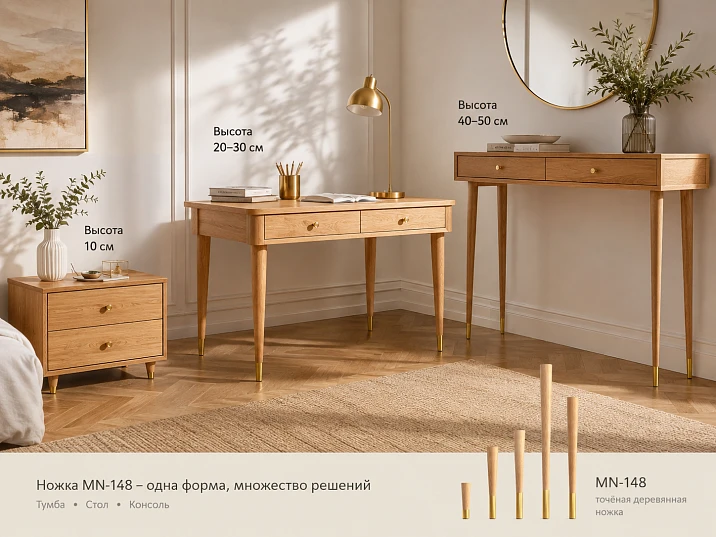
MN‑148 has eight standard heights — 100, 150, 250, 350, 450, 650, 700, and 750 mm. At first glance, this looks like a convenient range "from cabinet to table": pick a number, add legs to the cart, and assemble the furniture. In practice, the choice is more complex because the same turned wooden support changes not only the height of the item but also the mechanics of the entire structure.
For a low cabinet, the final level of the body and the clearance above the floor are critical. For a sofa, compatibility with the standard mounting, seat height, and load from people matter. For a table, the thickness of the tabletop, mounting method, and frame rigidity matter. For a tall freestanding console, there is an additional constraint: for MN‑148 above 450 mm, the manufacturer recommends a stretcher belt if the tall support is used for a dining or writing table or a freestanding console.
Therefore buy wooden legs for furniture correctly not after the question "what height do I like," but after calculating the finished item.
Basic formula:
Hfinished furniture = Hleg + Hbody/under-table + Htabletop or soft package + mounting additions, if any.
For a simple example: if the design height of the console is 800 mm, and the body together with the tabletop takes up 100 mm, arithmetically a leg of about 700 mm is needed. MN‑148 indeed has a standard height of 700 mm. But for a freestanding console, this calculation is not enough: the card requires additionally assessing rigidity and recommends a stretcher belt for tall options.
The MN‑148 also has a second selection level. The main wooden part is made of beech or oak. The decorative metal insert is offered in "brass" and "stainless steel" options. The insert is supplied unglued from the wooden base. This means the buyer must consider not only the metal color, but also the final assembly and finishing technology.
The third level is hardware. The card offers fasteners for self-installation and several floor glides, including the adjustable FUR‑019. The glide helps level out minor height differences and protects the floor, but it is not intended to correct major calculation errors. If a 150 mm leg is ordered instead of the required 250 mm, adjusting the glide will not turn it into a 250 mm one.
The correct selection sequence for MN‑148 is as follows:
-
determine the design height of the finished furniture;
-
calculate how much height is already provided by the body, tabletop, seat, or underframe;
-
obtain the calculated leg height;
-
select the nearest standard MN‑148;
-
check whether this height is acceptable for the specific structure;
-
for variants above 450 mm, separately address the issue of the apron belt;
-
choose beech or oak for the future finish.
-
choose brass or stainless steel;
-
agree on the mounting method;
-
choose a foot;
-
count the number of all identical supports;
-
only after that order a turned wooden leg MN‑148.
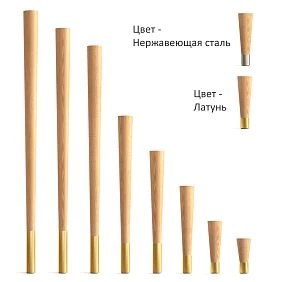
Turned wooden leg MN‑148: what the buyer chooses
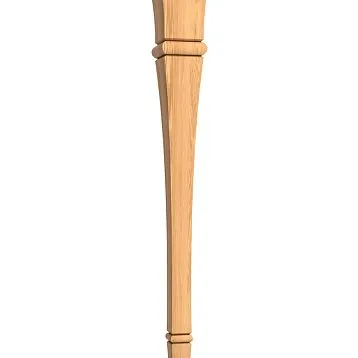
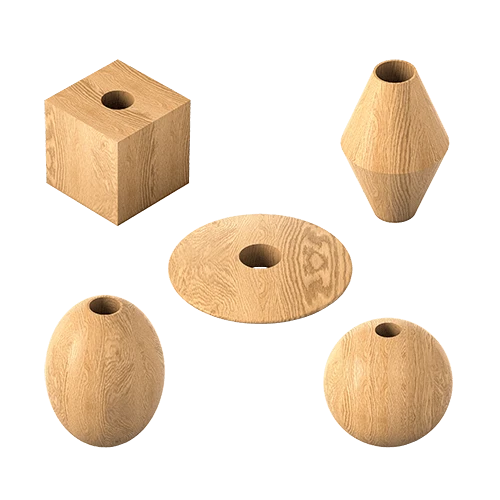
MN‑148 is a cone-shaped support made of solid wood with a decorative metal insert. The card classifies it as modern minimalist design and directly states that the base is designed for frameless constructions. But this general description cannot be taken out of context: for tall modifications, the manufacturer makes a separate clarification about the frame belt.
Size range:
| Height A | Section B × C | Material | Metal insert |
|---|---|---|---|
| 100 мм | 44 × 25 mm | Beech / Oak | brass / stainless steel |
| 150 мм | 44 × 25 mm | Beech / Oak | brass / stainless steel |
| 250 мм | 44 × 25 mm | Beech / Oak | brass / stainless steel |
| 350 мм | 44 × 25 mm | Beech / Oak | brass / stainless steel |
| 450 мм | 44 × 25 mm | Beech / Oak | brass / stainless steel |
| 650 мм | 44 × 25 mm | Beech / Oak | brass / stainless steel |
| 700 мм | 44 × 25 mm | Beech / Oak | brass / stainless steel |
| 750 мм | 44 × 25 mm | Beech / Oak | brass / stainless steel |
The cross-section of the main part is constant per the table: 44 × 25 mm. Therefore, as A increases, the height-to-cross-section ratio changes. A low leg of 100 mm and a tall one of 750 mm have completely different mechanics, although externally they remain the same model.
What needs to be specified in the order
It is not enough to write:
MN‑148 — 4 pieces.
A technically useful line looks like this:
MN‑148 / 700 × 44 × 25 mm / oak / for tinting / brass insert / 4 pcs. / fastening ___ / FUR‑019 — 4 pcs. / console construction with apron belt.
Such a record links design and construction.
Why metal is not part of the wooden blank in the sense of a ready-to-glue assembly
The card directly states that the decorative metal insert is supplied unglued with the wooden base. Therefore, before final assembly, you need to decide:
-
whether the wood is painted before joining with the insert;
-
is it necessary to protect metal from paint and varnish material;
-
in what way is the final fixation performed;
-
who is responsible for assembly;
-
can the selected technology be used with a specific finish.
The article must not invent glue for a metal insert if the card does not provide such an instruction. This joint should be clarified with STAVROS or a furniture craftsman.
Why price should not determine height
Different heights have different costs, but choosing 650 instead of 700 mm only because the position is cheaper or in stock is not allowed. Height affects:
-
the finished furniture mark;
-
stability;
-
proportions;
-
the need for additional rigidity;
-
the position of the tabletop;
-
the seating of a person.
First calculation, then price.
Eight heights of MN-148 furniture support — from 100 to 750 mm
The MN-148 size range covers almost the entire spectrum from low cabinet furniture to full dining height. But each figure has its own scenario.
Our factory also produces:
100 мм
The lowest MN-148.
Typical tasks:
-
a pedestal;
-
low dresser;
-
sofa or bench after checking standard mounting;
-
low console;
-
furniture where the body should visually remain close to the floor.
If the cabinet body is 400 mm, a 100 mm leg gives 500 mm before accounting for the top panel and mounting parts.
Example
Body: 380 mm.
Top panel: 20 mm.
MN‑148: 100 mm.
380 + 20 + 100 = 500 mm.
If you need a cabinet 500 mm high, the geometry looks logical. But the real project must still account for the support foot and the mounting method.
Get Consultation
150 мм
Provides more clearance, separates the body from the floor more strongly.
Scenarios:
-
a pedestal;
-
a dresser;
-
sofa;
-
bench;
-
ottoman;
-
low coffee table item.
Transitioning from 100 to 150 mm adds 50 mm to the finished height. For a cabinet, this is already noticeable.
250 мм
Here, the leg becomes a full part of the silhouette.
Suitable for:
-
of a high-raised chest of drawers;
-
nightstands;
-
coffee table;
-
some benches;
-
a decorative console with a low body.
Example of a cabinet
Body: 300 mm.
MN‑148: 250 mm.
300 + 250 = 550 mm
excluding the top panel and the foot.
This is exactly the scenario where a buyer can make a mistake if they only rely on the word "cabinet." One cabinet has a body of 280 mm, another 500 mm. The same leg gives a different result.
350 мм
Transition height between low furniture and a full-height tall support.
Possible tasks:
-
coffee table;
-
bench;
-
ottoman;
-
dressing table with a substantial body;
-
console with a tall upper block.
For upholstered furniture, it is mandatory to calculate not the leg, but the seat height:
Hseat = Hleg + Hframe + Hsoft package.
If the frame and soft package together give 180 mm:
350 + 180 = 530 mm.
For many benches, this is already a high seating. Therefore, 350 mm cannot be chosen only by aesthetics.
450 мм
Maximum height before the separate card restriction "more than 450 mm".
This is an important boundary. The value 450 mm itself does not fall under the wording "more than 450 mm", but 650/700/750 do.
450 mm can be used in:
-
banquettes;
-
tall coffee tables;
-
low dressing tables with a massive top block;
-
decorative structures.
But even here, the overall rigidity depends on the furniture as a whole.
650 мм
The first tall modification after the jump from 450 mm.
The card classifies legs above 450 mm as light wall-mounted consoles and dressing tables. For a freestanding table/console, there is a separate rigidity requirement.
650 mm is useful when the top block itself adds 80–150 mm.
Example
Leg: 650 mm.
Apron/carcass assembly: 80 mm.
Tabletop: 30 mm.
Summary:
650 + 80 + 30 = 760 mm.
For a writing or dining table, this is already a realistic range, but the structure must be calculated.
700 мм
One of the most practical heights for a thin top block.
If the console must have 800 mm total height, and the carcass + tabletop = 100 mm:
800 − 100 = 700 mm.
The calculation falls exactly within the standard MN‑148.
But for a freestanding console, the card recommends an apron belt because 700 mm > 450 mm.
750 мм
The highest standard MN-148.
If you add a 30 mm tabletop on top:
750 + 30 = 780 mm
provided that installation does not change the height.
For a regular table, this may turn out to be higher than the desired level. Therefore, 750 mm should only be chosen after a full vertical calculation.
Why there is no intermediate MN-148 between 450 and 650
The standard table does not include 500, 550, or 600 mm.
If the calculation gives, for example, 580 mm, you cannot automatically buy 650 and "trim 70 mm." The product card includes a metal decorative insert and finished geometry. Unauthorized modification may compromise the structure and design.
On the STAVROS website, the possibility of changing dimensions is linked to batch orders and separate approval. For a one-off project, it is better to:
-
change the cabinet;
-
change the thickness of the under-table;
-
choose a different article;
-
approve the non-standard production run, if this is serial furniture.
Wooden leg for a cabinet: how to calculate the final height
For a cabinet, an error of 50–100 mm is especially noticeable: the surface may become uncomfortable relative to the bed, sofa, or chair.
First, the desired final height is fixed.
Then:
Hleg = Hfinished cabinet − Hbody − Htop panel − other vertical additions.
Example 1: bedside cabinet
Desired height: 560 mm.
Body: 390 mm.
Top panel: 20 mm.
Calculation:
560 − 390 − 20 = 150 mm.
There is a standard MN‑148 150 mm.
This is a good scenario: the calculated and factory heights match.
Example 2: a cabinet with a body of 300 mm
Goal: 550 mm.
550 − 300 = 250 mm.
MN‑148 250 mm fits arithmetically.
But before ordering, they also check:
-
the width and depth of the body;
-
the placement of the four supports;
-
fastening zone;
-
the mass of the contents;
-
doors/drawers;
-
Stability.
Example 3: calculation gave 220 mm
Goal: 540 mm.
Body and top: 320 mm.
540 − 320 = 220 mm.
There is no standard MN‑148 220 mm.
Options:
-
take 250 mm and get furniture 30 mm higher, if acceptable;
-
rework the body;
-
choose a different article;
-
for a batch order, discuss a non-standard option.
Do not use an adjustable foot as a “minus/plus 30 mm”. Its task is fine level correction, not recalculating the entire furniture.
How to account for cleaning under the cabinet
100–150 mm create a noticeable gap. 250 mm is already a strong visual leg.
If a robot vacuum is important, check the clear gap under the lowest point of the body, not just the leg height. The apron, decorative skirt, or bottom panel can reduce the actual space.
Why the number of legs cannot be assigned only by the name "cabinet"
A small cabinet often rests on four points. A long TV cabinet may require an additional middle support if the body sags.
The decision is made by the furniture designer based on the span and load.
The article should not provide a formula "up to 1.5 m — four, after — six" without calculating the body.
Wooden sofa leg: what to check before replacing standard supports
MN-148 can be considered for a sofa only after checking the actual sofa frame construction. The mere presence of sizes 100, 150, or 250 mm does not mean that any of these supports is automatically compatible with any sofa.
The load on a sofa is more complex than on a cabinet. The supports are affected by:
-
the frame's own weight;
-
mass of soft elements;
-
weight of several people;
-
dynamic load when sitting;
-
lateral force when shifting;
-
uneven load when a person sits on the edge.
Therefore, replacing standard legs should start not with height, but with the mounting and load-bearing area.
First, measure the old support
Before ordering MN‑148, remove:
-
height of the old leg;
-
diameter or thread size;
-
seating depth;
-
mounting plate size;
-
hole position relative to the edge;
-
actual clearance under the sofa.
If the standard leg is 100 mm and MN-148 is 150 mm, the seat will rise by about 50 mm, provided other geometry remains unchanged.
For upholstered furniture, this is noticeable.
Seat height formula
Hseat = Hleg + Hframe above support + Hsoft package.
For example:
-
MN-148 = 150 mm;
-
lower sofa structure above the leg = 120 mm;
-
soft package = 180 mm.
Summary:
150 + 120 + 180 = 450 mm.
If you replace the 150 mm leg with a 250 mm one:
250 + 120 + 180 = 550 mm.
The 100 mm difference radically changes the seating position.
Why you shouldn't rely only on the popular query "buy wooden sofa legs"
The query is commercial, but the MN‑148 card does not promise universal sofa compatibility.
A proper article should state directly: MN‑148 can be considered for a sofa only after checking the mounting point and load.
If the sofa's construction is designed for a different type of support, it's better to choose a model with confirmed compatibility.
Check the number of supports
A sofa may have:
-
four external legs;
-
four external + central;
-
six or more;
-
separate supports for the transformation mechanism.
You cannot replace only the visible four and forget the internal load-bearing points.
If the standard design has a central support, its function must be preserved.
Metal insert and upholstered furniture
Brass or stainless steel in MN-148 can well connect the leg to furniture buttons, decorative trim, mechanism handles, or chair legs.
But first — mechanics, then color.
You should not choose MN-148 for a sofa just because of the beautiful brass insert if the mounting requires reworking the load-bearing frame.
When it is better to choose a lower alternative
If the sofa needs a support lower than 100 mm, MN‑148 no longer has a suitable standard height.
Then you can consider the geometric furniture leg MN‑146 with a height of 80 mm, if its design and mounting are suitable for the specific furniture.
MN‑146 is not a "default replacement for MN‑148". It is a separate product with different geometry. The purpose of the link is to show the buyer that when the height is unsuitable, there is no need to forcibly adapt MN‑148.
Wooden table leg: tabletop, underframe, and design height
For a table, the choice of MN‑148 especially depends on the entire vertical system.
Simple formula:
Htable = Hleg + Hunderframe assembly + Htabletop − possible recess.
If the leg is attached directly to the tabletop without a separate underframe in height, the formula is simplified.
But for tall MN‑148, the main structural limitation appears: for sizes over 450 mm when used in a dining or writing table, STAVROS recommends an apron belt for greater rigidity and stability.
Example of a table with a 700 mm leg
Target: 760 mm.
Tabletop: 30 mm.
Leg: 700 mm.
remains:
760 − 700 − 30 = 30 mm
for the under-table/mounting assembly, if it adds height.
This is a realistic scenario, but the geometry cannot be considered complete without the apron belt and fastening.
Example with 750 mm
Tabletop 40 mm.
750 + 40 = 790 mm
even before a possible addition of a mounting plate or apron.
If the design table height is 760 mm, such a support is already too tall.
So, 750 mm is not a "universal dining table leg."
650 mm and a thick underframe
Leg: 650 mm.
Apron belt/underframe block: 80 mm.
Tabletop: 30 mm.
650 + 80 + 30 = 760 mm.
For a specific project, this option may be better than 700 mm.
Why an apron belt is needed specifically with high supports
The longer the leg, the greater the leverage under lateral load.
When a person leans on the edge of the table or moves it, a tall leg creates a greater moment at the attachment point.
The apron belt connects the supports into a spatial frame and helps reduce swaying.
This is especially important for:
-
dining table;
-
a writing desk;
-
a standalone console;
-
furniture that is regularly moved.
"Tsar-free design" and "tsar recommended" do not contradict each other
The card first says that MN‑148 is intended for tsar-free designs.
Then it clarifies: for variants above 450 mm in tables and freestanding consoles, a tsar belt is recommended for greater rigidity and stability.
That is, the general purpose has a limitation by height and scenario.
It is important to explain this in the article, because a buyer may read only the first phrase and draw an incorrect conclusion.
Which tabletop is compatible
The MN‑148 card does not specify:
-
maximum tabletop weight;
-
maximum diameter;
-
minimum thickness;
-
allowable overhang.
Therefore, universal compatibility cannot be promised with:
-
stone;
-
solid wood;
-
glass;
-
MDF;
-
slab.
A heavy countertop requires a separate calculation of the entire structure.
Leg placement
Even four identical MN‑148 legs can provide different stability depending on the base.
If the supports are shifted significantly toward the center, the table has a narrow support area.
If too close to the edge, the mounting may fall into a weak zone of the tabletop or apron.
The position is determined by the designer.
Wooden support for a console: when an apron belt is needed
The console is a special case, because the MN-148 card itself separates two types:
-
light wall-mounted console;
-
freestanding console.
For legs above 450 mm, the manufacturer classifies them as light wall-mounted consoles and dressing tables.
For a freestanding console, it recommends an apron (stretcher) belt.
Why a wall-mounted console differs
A wall-mounted structure can receive additional stabilization from the wall if the project includes fastening.
It does not necessarily have to function as a freely standing table.
But the article should not automatically claim that any console can simply be "leaned" and considered stable.
Need to check:
-
whether it is attached to the wall;
-
in what way;
-
where are the load-bearing points;
-
does the wall allow this;
-
how the load is distributed.
Example of an 800 mm console
Target finished height: 800 mm.
Top block with drawer and countertop: 100 mm.
Calculation:
800 − 100 = 700 mm.
MN-148 700 mm exists.
Next, a decision tree:
Is the console wall-mounted and lightweight?
One can consider the standard high scenario, but still check the mounting.
Is the console freestanding?
For 700 mm, the manufacturer recommends a drawer frame belt.
Why doesn't the decorative insert automatically reinforce the structure?
The metal insert is a decorative element.
One cannot assume that the presence of brass or stainless steel in the leg turns it into a metal load-bearing support.
MN‑148 remains a wooden furniture leg with a cross-section of 44 × 25 mm.
Dressing table
The card directly lists dressing tables among the scenarios for heights above 450 mm.
But the final height is still calculated based on the cabinet body.
If there is:
-
box;
-
thick countertop;
-
mirror on frame;
-
superstructure,
choosing 700 or 750 mm changes ergonomics.
When 650 is better than 700
Suppose the upper block is 120 mm.
The goal is 780 mm.
With 650:
650 + 120 = 770 mm.
From 700:
700 + 120 = 820 mm.
If the foot pad provides slight adjustment, 650 might be closer to the design.
Adjustment is used for fine-tuning, not to compensate for 50 mm.
Beech or oak furniture leg: material and future finish
MN-148 is available in beech and oak.
The choice of material is especially noticeable due to the metal insert: wood and metal are adjacent, so the texture becomes part of the composition.
Beech
Beech is a dense, non-porous wood.
It is often chosen for:
-
enamel;
-
dense opaque painting;
-
colored finish;
-
furniture where shape matters more than wood grain.
For example, black beech MN-148 with a brass insert creates a strong contrast.
Oak
Oak is a dense, porous wood with a pronounced texture.
It is logical if the leg must retain the natural grain:
-
oil;
-
stain;
-
translucent lacquer;
-
tinting.
Oak + brass creates a warmer composition.
Oak + stainless steel creates a more graphic one.
Quality of gluing under enamel
STAVROS describes it as a blank without mandatory matching of lamellas by color and texture.
It is intended for opaque coatings.
If after ordering "under enamel" the buyer decides to leave the wood under a clear varnish, visible lamella transitions may not meet expectations.
Under Tinting
Lamellas are matched by color and texture.
This is the right choice for a semi-transparent finish.
At the same time, natural wood may still have slight tonal differences.
Why it's better to choose the insert together with the finish
You don't need to first order "oak + brass" and then decide on the color.
First create the combination:
wood + coating + metal.
For example:
-
natural oak + brass;
-
oak cold tint + stainless steel;
-
beech white enamel + brass;
-
beech black enamel + steel.
Reference sample
For an expensive table or console, it is useful to make a color sample on the same wood species and attach it to the metal insert.
The color on the screen does not replace the real material.
Additional details about wood species, "under enamel" and "under tint" can be checked on the page check materials and quality of wooden products.
Brass or stainless steel: how to choose a metal insert
The MN-148 has two decorative metal options.
Brass
Suitable if the furniture or interior already has:
-
brass handles;
-
warm hardware;
-
golden lighting fixtures;
-
bronze accents;
-
warm oak.
Brass makes the insert more noticeable.
Stainless steel
Logical next to:
-
with steel handles;
-
with chrome;
-
with nickel;
-
with aluminum;
-
with a cool modern palette;
-
with light oak;
-
with gray or black enamel.
It doesn't have to match all the metal in the room
If the kitchen has stainless steel appliances and the console in the living room has brass handles, the console legs don't have to match the appliances.
First, coordinate the metal within the piece of furniture itself.
The insert is supplied unglued
This is an important product characteristic.
It allows finishing the wood separately from the metal, but requires organizing the final assembly.
Before ordering, it is worth clarifying:
-
how the insert is secured;
-
who performs the gluing;
-
at what stage;
-
how to protect the metal during painting.
You cannot paint the metal accidentally
If the leg is coated with enamel, the metal insert is better protected if the design does not involve painting.
Especially brass: random primer or enamel will ruin the decorative effect.
When metal contrast is justified
A brass handle plus a steel insert can work if the steel is repeated in another furniture element.
But if the second metal appears only on the legs, the composition often looks random.
Mounting of leg MN-148: pin, mounting hardware, and floor glide
The MN-148 card offers fastening hardware separately. Among the recommended items are a metric pin/self-tapping screw M8×60 FUR-001-1, kits FUR-001 and FUR-012, as well as several floor glides.
This means the buyer should consider the mounting as a separate design unit.
Stud M8×60
Buy the M8×60 pin for a furniture leg can be done as a separate fastening element.
The current card shows:
-
total length 60 mm;
-
diameter 8 mm;
-
threaded part 30 mm;
-
the metric part of 30 mm.
The stud connects the wood and the threaded part of the furniture fastener.
But the presence of M8 in the recommendations doesn't mean that it's enough to drill a random hole in any cabinet body.
Need to check:
-
base thickness;
-
material;
-
the depth of the threaded zone;
-
distance to the edge;
-
presence of embedded element;
-
the direction of the grain, if the fastening goes into solid wood;
-
the lateral load from a tall leg.
FUR-001 and FUR-012
The MN-148 card also shows the FUR-001 and FUR-012 sets.
They have different assembly logic.
FUR-001 uses an M8×60 stud and a threaded insert.
FUR-012 uses an M8×60 stud and a mounting plate.
You cannot assign one of them based only on the furniture name:
-
"for a cabinet always FUR-001";
-
"for a table always FUR-012".
The correct choice depends on the base.
Why tall 650–750 mm legs are especially demanding on the top mounting
With the same cross-section of 44 × 25 mm, a tall leg creates a larger lever arm.
If the mounting area of the cabinet is weak, the problem arises not in the leg itself, but at the point where it connects to the furniture.
For the 700-mm MN-148, it is especially important:
-
presence of a rigid load-bearing zone;
-
correct position of fasteners;
-
absence of cracks;
-
sufficient thickness;
-
apron belt, if it is a freestanding table/console.
Adjustable floor support FUR-019
Buy adjustable floor support FUR-019 can be used as one of the recommended lower fittings for MN-148.
The current FUR-019 card shows dimensions of 23 × 23 × 27 mm and describes a floor support with a ball joint D25 mm, supplied with a metric threaded insert M6.
Its function:
-
minor adjustment;
-
adaptation to local floor unevenness;
-
protection of the floor covering;
-
more stable contact.
The foot pad does not replace the correct height
If the project requires 700 mm and a 650 mm leg was purchased, the foot pad should not be used as a way to "make up 50 mm."
Adjustment is intended for minor deviations.
Otherwise:
-
the visible part of the thread increases;
-
stability changes;
-
load is transferred incorrectly;
-
furniture looks technically unfinished.
Ball joint and uneven floor
FUR‑019 can adapt better to a slight surface angle than a rigid flat foot.
This is useful on:
-
old parquet;
-
tiles with a slight slope;
-
historic wooden floor.
But a large floor irregularity is corrected by the room's base or furniture design, not by screwing the foot to the maximum.
Number of feet
For four legs:
4 × FUR‑019.
For six:
6 × FUR‑019.
It is better to use the same model on all supports of one item.
When a foot is not always needed
The card offers several options, including FUR‑021, FUR‑027, FUR‑019, and FUR‑029.
The specific choice depends on the gender and the required adjustment.
You don't need to automatically buy FUR‑019 if:
-
the furniture stands on a soft carpet;
-
the structure already has another adjustment system;
-
the project provides for a different foot;
-
the lower assembly is not compatible.
First, dry assembly
Before final assembly:
-
lay out all supports;
-
install the top fasteners;
-
install the foot pads;
-
place the furniture on a flat surface;
-
check for wobbling;
-
only then perform the final adjustment.
It is useful to look in advance Advice on finishing and installation.
How to calculate the kit before ordering
When the height is chosen, the buyer must calculate not only the legs, but also all elements for each support point.
Basic formula
Nlegs = Nmounts = Nglides
if each leg uses one top mount and one glider.
For a four-support console:
-
4 MN‑148;
-
4 mounting points;
-
4 support feet;
-
4 metal inserts in the selected configuration.
Example kit for a cabinet
Cabinet:
-
body 390 mm;
-
top 20 mm;
-
design height 560 mm.
Leg:
560 − 390 − 20 = 150 mm.
Order:
MN‑148 150 × 44 × 25 / beech / for enamel / stainless steel insert — 4 pcs.
Fasteners:
FUR‑001/FUR‑012 — 4 sets per project.
Foot pads:
4 pcs. of the selected model.
Example of a writing desk
Target: 760 mm.
Tabletop: 30 mm.
Apron belt/under-table assembly: 80 mm.
Calculation:
760 − 30 − 80 = 650 mm.
MN‑148 650 exists.
Set:
-
4 × MN‑148 650;
-
apron belt;
-
4 top mounts;
-
4 support feet;
-
Tabletop.
Example of a console
Goal: 800 mm.
Body + top: 100 mm.
Leg 700 mm.
If the console is freestanding, add a stretcher belt to the specification.
If wall-mounted, the construction may differ, but the method of wall attachment must be confirmed.
Example of a bench
Leg 250 mm.
Frame 90 mm.
Soft package 100 mm.
Summary:
250 + 90 + 100 = 440 mm.
If the project requires 450 mm, the remaining millimeters may depend on the actual fit, the foot cap, and the design.
Serial project
If a workshop makes 10 identical cabinets on four legs:
10 × 4 = 40 MN‑148.
And similarly, 40 top brackets and 40 foot caps.
For a serial order, it is especially important:
-
one batch of metal;
-
one wood species;
-
one type of lamination;
-
same height;
-
stock only for a justified reason.
Reserve
For a single piece of home furniture, a spare leg is usually not needed.
For a hotel, restaurant, or serial production, one or several spare parts may be useful.
But the reserve is calculated based on risk, not on a formal "10%."
Final line of the specification
MN‑148 / A ___ × 44 × 25 mm / beech or oak / for enamel or tinting / insert brass or stainless steel / quantity ___ / mounting ___ / foot ___ / apron belt yes/no / design height of finished furniture ___ mm.
Quick selection matrix for eight heights before detailed calculation
It is convenient to use the standard range as a filter, but not as a ready-made recommendation for the type of furniture.
| MN‑148 | First scenario for testing | What to be sure to check |
| 100 мм | low cabinet, sofa, chest of drawers | seating height, standard mounting |
| 150 мм | cabinet, sofa, bench | overall height, clearance under the body |
| 250 мм | cabinet, coffee table, bench | body proportion, seat/tabletop height |
| 350 мм | coffee table, bench, tall low cabinet | final seating and center of gravity |
| 450 мм | tall bench, separate decorative structures | overall rigidity and finished height |
| 650 мм | wall console, vanity table, table with under-table block | apron belt for a freestanding table/console |
| 700 мм | console, writing/dining table after calculation | tsargu, tabletop, mounting, final height |
| 750 мм | high table/console with a thin top node | will the finished furniture turn out too high |
This matrix is only needed to create a short list of candidates.
Then the full project formula is used.
Selection algorithm if the calculation falls between two factory heights
Suppose the calculated leg turned out to be 325 mm.
The line includes 250 and 350 mm.
The difference:
-
up to 250 mm — 75 mm;
-
up to 350 mm — 25 mm.
Mistakes when buying wooden furniture legs
-
to drill;
-
to make embedded parts;
-
to fix a chip;
-
to change the mounting.
-
item number MN-148;
-
exact height A;
-
section 44 × 25 mm;
-
beech or oak;
-
for enamel or for tinting;
-
brass or stainless steel;
-
quantity;
-
fasteners;
-
thrust bearing;
-
presence of a drawer rail belt in the project, if height >450 mm and the furniture requires it.
-
the required height;
-
wood species;
-
metal;
-
deadline;
-
warehouse city;
-
quantity of the entire batch.
Mistake 1. Choosing height by furniture name
“For a table, 750 is needed.”
Why it happens: the tallest support seems table-like.
Consequence: the tabletop raises the finished height to 780–800 mm.
Prevention: calculate the entire vertical system.
Mistake 2. Not accounting for the cabinet body
The customer wants a 550 mm cabinet and chooses a 250 mm leg without measuring the 380 mm body.
Summary:
380 + 250 = 630 mm
Also without the top panel.
Prevention: first the body.
Error 3. Using 700 mm without a stretcher on a freestanding console
Reason: the card mentions frameless constructions.
Consequence: the customer misses the clarification for heights >450 mm.
Prevention: read the limitation in full.
Error 4. Considering the metal insert as load-bearing
Reason: metal is associated with reinforcement.
Consequence: the structure is calculated as if the leg were metal.
Prevention: MN-148 remains a wooden support.
Error 5. Forgetting that the insert is not glued
Reason: in the photo, the leg looks finished.
Consequence: before installation, there is no technology for fixing the insert.
Prevention: clarify the final assembly in advance.
Mistake 6. Ordering "under enamel" and then leaving the oak transparent
Reason: the decision about the finish changes.
Consequence: the lamellas were not selected for a transparent coating.
Prevention: choose "under tinting" in advance.
Mistake 7. Using an adjustable support foot for major correction
Reason: it seems that adjustment solves any height.
Consequence: the furniture stands on an excessively extended unit.
Prevention: the standard height should be close to the calculated one.
Error 8. Not counting the foot cap as part of the set
Reason: the leg already has a decorative metal insert.
Consequence: the lower contact with the floor remains unresolved.
Prevention: a separate line for each support.
Error 9. Buying an M8×60 stud without checking the housing
Reason: it is recommended by the card.
Consequence: the fastening assembly does not match the thickness or material.
Prevention: the furniture designer checks the base.
Error 10. Trimming a tall MN‑148
Reason: the required height of 550–600 mm is missing.
Consequence: the geometry and connection with the metal insert are compromised.
Prevention: choose a different model or redesign the body.
Error 11. Multiply 100 kg by four legs
STAVROS declares a vertical load of at least 100 kg per furniture leg.
But 4 × 100 kg does not automatically equal a permitted table load of 400 kg.
Finished furniture is limited by the body, fastening, and lateral stability.
Error 12. Accidentally mix brass and stainless steel in one set
Especially noticeable on four identical legs.
Prevention: lay out the set before assembly.
Error 13. Not checking the floor
The adjustable foot is convenient, but on soft parquet or other sensitive flooring, you need to check the contact surface and the floor manufacturer's recommendations.
Error 14. Painting first, then drilling
After finishing, it's harder:
Prevention: test assembly before finishing.
When the turned leg MN‑148 doesn't fit
The MN‑148 has a wide range, but it is not universal.
A height below 100 mm is needed.
The minimum for MN‑148 is 100 mm.
If you need 80 mm, consider another product, for example MN‑146 80 mm, after checking the design.
A height of 500–600 mm is needed.
These sizes are not available in the MN‑148 line.
You cannot consider 650 mm as "almost suitable" if the finished furniture will be 50–150 mm higher.
Heavy freestanding table without an apron.
If the designer fundamentally does not want an apron belt, the tall MN‑148 may not be the best choice.
You need to look for a design intended for an apronless tall table without this limitation.
Very heavy stone countertop
The card does not provide the allowable weight.
You cannot choose MN-148 based only on appearance.
A thick, massive support is needed
The cross-section of MN-148 is 44 × 25 mm.
If the furniture requires a visually or structurally more massive leg, a different item is better.
Classic carving is needed
MN-148 has a modern, minimalist character.
For a historical or ornate classical piece, the shape may be too understated.
A fully metal leg is needed
MN-148 — wood + decorative metal insert.
Queries like "buy metal table legs" do not apply to it.
A ready glued insert is needed.
The card indicates an unglued version.
If the project requires a fully ready-to-install leg without an additional technological step, clarify the availability of the service in advance or choose another product.
Where to buy wooden furniture legs and check availability
After calculating the height of MN-148, it is better to place the order as a technical specification rather than as a verbal "four tall oak legs for me."
What should be in the order line
Minimum:
Example for a bedside table
MN‑148 / 150 × 44 × 25 mm / beech / for enamel / stainless steel / 4 pcs. / mounting per drawing / adjustable foot per project.
Example for a freestanding console
MN‑148 / 700 × 44 × 25 mm / oak / for tinting / brass / 4 pcs. / drawer rail belt / top mounting ___ / FUR‑019 — 4 pcs.
Why you need to write "drawer rail belt" in the comment
If the designer has already provided for it, this information helps the manager understand the real application scenario for tall MN‑148.
If there is no drawer rail, but the height of 700/750 mm is used for a freestanding console, this is a reason to double-check the design before payment.
Checking availability
The MN‑148 card shows availability and lead times for each specific combination of height, material, and metal.
Do not carry today's quantity into the article: it changes.
Before purchasing, check:
If you need four identical oak MN‑148 700 mm, it is not enough to see that "MN‑148 is in stock" overall. The exact configuration and quantity must be in stock.
If one item is insufficient
Options:
-
wait for production;
-
order the entire batch in one configuration;
-
change the material or metal only after reviewing the project;
-
choose a different height only after a new calculation;
-
switch to another model.
Do not mix on one table:
-
three oak and one beech;
-
three brass and one steel;
-
700 and 750 mm;
-
different foot pads.
Why it is better to place batches as one order
For natural wood this helps:
-
coordinate the material;
-
perform finishing with one system;
-
check the entire set;
-
reduce the risk of tone variation;
-
get the same metal.
Especially important for oak under staining.
Finishing before final installation
If the legs are purchased unfinished, it is useful to determine in advance who performs the finish.
If the craftsman works with unfinished wooden furniture legsthe scheme typically includes:
-
control assembly;
-
fastener marking;
-
disassembly;
-
surface preparation;
-
wood finishing;
-
protection of the metal insert;
-
final assembly.
The order may vary depending on the specific coating and the method of fixing the insert.
What to check in the card before payment
Open MN-148 and compare with the project line:
Does the height match?
Does the material match?
Does the metal match?
Does the re-gluing match the finish?
Is the required quantity available?
Is the fastener selected?
Is the foot pad selected?
Does the tall structure have the required rigidity?
If at least one question has no answer, the order is not ready yet.
Why the price of a wooden furniture leg is not the only price of the project
The final assembly may include:
-
MN‑148;
-
metal insert;
-
mounting;
-
bushing/mounting plate;
-
thrust bearing;
-
apron belt;
-
finishing;
-
assembler's work.
Therefore, comparing two legs only by the card price is not enough.
If MN‑148 is not suitable
General section buy wooden legs for furniture allows switching to other heights and geometries.
This is better than:
-
trimming MN‑148;
-
removing the metal insert;
-
using 750 mm instead of the needed 600;
-
refusing the tsarg belt against the recommendation.
Delivery
Check before sending payment and delivery terms for STAVROS.
For high legs 650–750 mm, it is useful to clarify:
-
packaging size;
-
number of packages;
-
protection of decorative inserts;
-
whether metal can be separated from wood in the packaging;
-
shipping times.
Prices and stock levels in the article are not fixed precisely because the correct source of this data is the current product card on the day of purchase.
FAQ
What height of leg MN‑148 should be chosen for a cabinet?
First, determine the desired finished height of the cabinet.
Formula:
Leg height = finished furniture height − body height − top panel height − other vertical elements.
If the calculation gives 150 or 250 mm, there is a standard MN‑148 of that height.
If it turns out to be 220 mm, there is no standard size: you need to either adjust the body, or choose an adjacent height after checking the finished mark, or another article.
Will MN‑148 fit a sofa?
It can be considered, especially at low heights, but there is no universal compatibility.
Need to check:
-
mounting;
-
standard thread;
-
load-bearing area;
-
number of supports;
-
final seat height;
-
load.
If the sofa has central supports or a transformation mechanism, they cannot be ignored.
Can a 700 mm leg be installed without a stretcher?
For a light wall-mounted console or vanity table, the card allows high MN-148 as a target scenario.
For a dining/writing table and a freestanding console with a height above 450 mm, STAVROS recommends an apron belt for rigidity and stability.
Therefore, the answer depends on the type of furniture.
How does a beech furniture leg differ from an oak one?
Beech has a calmer, non-porous structure and is often used under enamel.
Oak is more porous and has a pronounced natural texture, so it is especially interesting under translucent finishes.
Neither material is universally better.
Which insert should you choose: brass or stainless steel?
Look at the other metals of the furniture piece.
Brass supports well:
-
warm handles;
-
golden hardware;
-
warm oak.
Stainless steel — cold modern hardware, chrome, nickel, aluminum.
If contrast is chosen, the second metal should be repeated in the composition.
Is the metal insert glued to the wooden base?
No. Card MN-148 directly states that the decorative metal insert is supplied unglued from the wooden base.
The final fixing method should be clarified with the manufacturer or a furniture craftsman.
Is fastening hardware included in the set?
Card MN-148 offers fastening hardware additionally and shows several recommended items.
It cannot be assumed that a pin or mounting kit is automatically included in the cost of the leg itself without checking the specific cart.
Why is an adjustable foot needed?
FUR‑019 helps:
-
protect the floor;
-
compensate for minor unevenness;
-
position furniture more precisely;
-
ensure contact on the ball joint.
It should not be used to compensate for tens of millimeters of error in leg height.
What is the size of FUR‑019?
The current card shows 23 × 23 × 27 mm; the description specifies D25 mm and a complete metric insert M6.
Before installation, check the actual lower assembly MN‑148 and the location of the metal insert.
Can the finished leg be shortened independently?
Do not rely on trimming as a standard operation.
MN‑148 has a conical geometry and a metal insert.
If the required height is not available, it is better to choose a different article or agree on a custom size for a production project.
How many legs need to be ordered for the console?
The quantity is determined by the design.
A typical small console often has four supports, but a long or complex structure may require more.
The article cannot specify the quantity without dimensions and body calculation.
Is MN‑148 suitable for a clear finish?
Yes, if suitable material and edge banding are selected.
For a semi-transparent finish, it is rational to consider oak and the "for tinting" quality.
What should be checked in the drawing before paying for the order?
Minimum:
-
A = height;
-
B × C = section 44 × 25;
-
location of the metal insert;
-
top mounting;
-
lower pivot node;
-
mounting holes;
-
position of the apron relative to the leg.
Can MN‑148 be used for a heavy dining table?
Without calculation, we cannot promise.
The card recommends an apron belt for high legs >450 mm, but does not specify a universal maximum tabletop weight.
A heavy table requires checking:
-
the countertop;
-
aprons;
-
fasteners;
-
leg positions;
-
lateral stability.
Why can't you simply multiply 100 kg by four legs?
Because the declared vertical load on one furniture leg is not equal to the permissible load of the finished item.
The table may fail earlier at:
-
mounting;
-
countertop;
-
the apron;
-
angle;
-
the body.
Can you install 750 mm on a desk?
It can be considered, but first calculate the finished height.
With a 30-mm tabletop, it already comes to about 780 mm without accounting for additional underframe.
If the project requires 750–760 mm, a 750 mm leg may be too high.
When to choose 650 mm, and when 700 mm?
Depends on the height of the upper block.
For example, if the body/apron/tabletop together give 110 mm:
-
650 + 110 = 760 mm;
-
700 + 110 = 810 mm.
The 50 mm difference is significant.
Can MN‑148 be used on a table without an apron?
For low variants, the card generally positions the model as apronless.
But for heights above 450 mm for dining and writing tables, the manufacturer separately recommends an apron belt.
What to do if you need an 80 mm leg?
MN‑148 starts from 100 mm.
You can consider another model, for example MN‑146 80 mm, after checking its geometry and mounting.
How to avoid mistakes with the metal insert when painting?
Decide before finishing:
-
whether the insert is installed before or after painting;
-
how it is protected;
-
how it is fixed;
-
whether the metal should remain clean.
Do not accidentally apply enamel to brass or steel.
Is a spare leg needed?
Usually not for a single household item.
For a serial project, commercial interior, or remote object, a spare may be useful.
What to choose if the calculation gives 600 mm?
There is no standard MN-148 600 mm.
650 mm will add 50 mm to the design height, so you can't just "round up."
You need to recalculate the cabinet or choose a different model.
Is FUR-019 suitable for any floor?
It helps protect the surface, but a specific floor may have its own requirements.
For fresh varnish, soft wood, or delicate stone, you need to consider the flooring manufacturer's recommendations.
What is the main thing to check before paying?
Five things:
-
final height;
-
structural rigidity;
-
mounting;
-
material and finish;
-
set of fittings.
Summary. MN-148 is convenient precisely because of its wide range of eight heights, but this assortment does not eliminate the calculation. For a cabinet, first subtract the height of the body. For a sofa, check the seating and standard mounting. For a table, calculate the tabletop and underframe. For tall freestanding structures, be sure to return to the recommendation for the belt rail.
After that, choose beech or oak, brass or stainless steel, fasteners and a floor glider. Then MN-148 becomes not a random decorative detail, but a calculated furniture support for a specific item.