Article Contents:
- Carved furniture leg MN-002: three sizes that cannot be considered interchangeable
- Why E and F cannot be ignored
- The chair will stop earlier
- The seating depth will change
- The dining area will actually become wider
- Passages may become narrower
- Cleaning becomes more complicated
- Scenario 1. Raise the lower edge of the apron
- Scenario 2. Change the underframe scheme itself
- Scenario 3. Accept incomplete chair tucking
- Scenario 4. Choose a different underframe
- The tabletop becomes much higher
- E and F change
- Different chairs and seating are needed
- The style is changing
- Check #1
- Check #2
- Check #3
- The apron adjoins a specific part of the support
- Carved geometry limits the fastener
- Need an angular drawing
- Oak
- Oak
- The wood species does not change A=730
- FUR-021
- FUR-027
- Why the foot does not solve the 70 mm conflict
- Beech, Standard
- Oak, Standard
- Mistake 1. Only measuring the leg height
- Mistake 2. Raising the table to 900 mm
- Mistake 3. Choosing 650 mm for the price
- Mistake 4. Not measuring the actual chairs
- Mistake 5. Designing the apron separately from the leg
- What sizes does MN-002 come in?
- What is the height of the MN-002 730?
- Is MN-002 suitable for a dining table?
- Why is the leg height not equal to the clearance under the table?
- What is an apron?
- Will a 690 mm armrest fit under a 620 mm apron?
- Can the apron be raised?
- Will the MN-002 900 mm solve the problem?
- What to choose — 650, 730, or 900 mm?
- What do E and F mean on MN-002?
- What is the F of MN-002 730 mm?
- What to choose — beech or oak?
- "Standard" or "Prestige"?
- Which floor glides are recommended?
- How is FUR-021 different from FUR-027?
- Can the table be raised by 70 mm using glides?
- How many MN-002 are needed for a table?
- How much do four MN-002 730 mm in beech "Standard" cost?
- How much do four oak "Standard" cost?
- Where to buy table legs?
- Where to buy wooden furniture legs?
- Where to buy MN-002?
- How to order MN-002 730 mm?
- How to check the current price?
- Do I need to check the width of the chair between the legs?
- What to do if the apron cannot be lifted?
- Can the chairs be left protruding?
- When is it too early to buy MN-002?
- When can MN-002 be ordered?
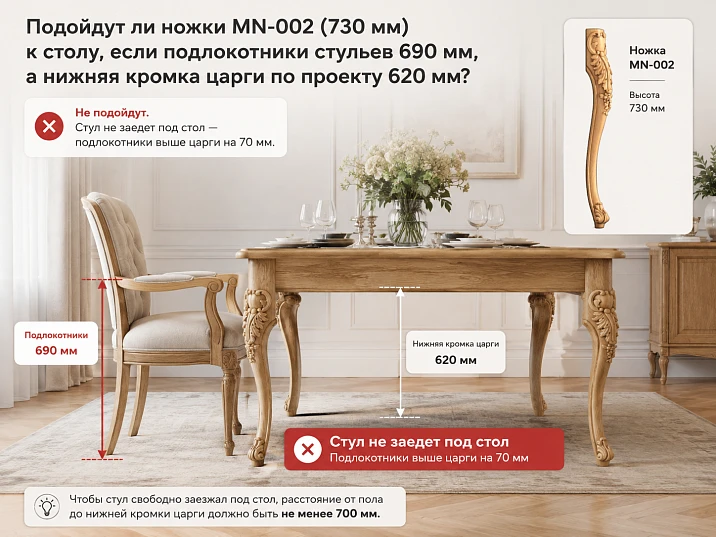
The chair is moved toward the mock-up of the future table — and it stops earlier than expected. Not because the tabletop is too low. Not because the leg is chosen at the "wrong height." The apron hits the armrest.
This is the detail that is easy to miss on a beautiful render.
The armrest of the already purchased chair ends at 690 mm from the floor. According to the current project, the lower edge of the apron belt of the future table should be at 620 mm. The difference:
690 − 620 = 70 mm.
That is, the chair will not be able to fully slide under the table: its armrest will meet the apron 70 mm earlier.
At the same time, the selected carved furniture leg MN-002 with a height of 730 mm does not create a problem by itself. Moreover, if you conditionally place a tabletop 40 mm thick on top, the upper surface of the table will be at approximately the 770 mm mark. This may look quite plausible for dining furniture. But a comfortable upper height does not yet say anything about the free space under the table.
Therefore, before buying four MN-002s, you need to decide not “730 or 900 mm”, but another question: how should the apron be designed so that the already purchased chairs actually work with this table.
It is precisely this that determines whether to keep the MN-002 730 mm, change the underframe, or accept the fact that the chairs will protrude from under the table.
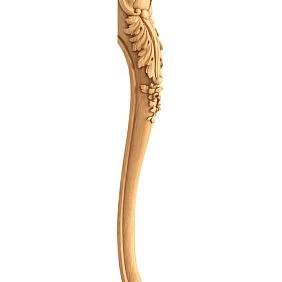
Carved furniture leg MN-002: three sizes that cannot be considered interchangeable
The MN-002 card confirms three main options:
| Option | A — height | E | F | Beech, Standard | Oak, Standard |
|---|---|---|---|---|---|
| Low | 650 мм | 51 мм | 131 мм | 8 840 ₽ | 15 030 ₽ |
| Medium | 730 мм | 57 мм | 147 мм | 11 630 ₽ | 20 150 ₽ |
| High | 900 мм | 70 мм | 181 мм | 17 770 ₽ | 32 590 ₽ |
Beech and oak are also available, with "Standard" and "Prestige" sanding finishes. The product card specifies use for tables, chairs, stools, and dressing tables, and among the recommended fittings are FUR-021 and FUR-027.
For the current project, specifically MN-002 730×57×147 mm is of interest.
If the side cut of the underframe has already been checked and the apron conflict is resolved, you can buy carved legs MN-002 730 mm in the required wood type and sanding quality.




Why E and F cannot be ignored
In this scenario, A=730 mm sets the overall height of the support, but E=57 and F=147 mm describe the geometry of the leg itself.
When an apron adjoins the carved support, the dimensions of the upper part of the leg become part of the structural joint.
Therefore, you cannot draw the apron "between the legs from a photo" and then hope that everything will fit together in production.
Our factory also produces:
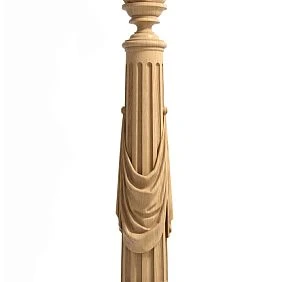
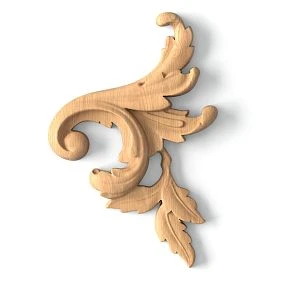
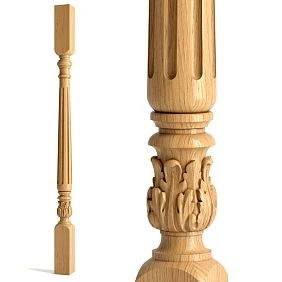
You can buy table legs in five minutes; properly designing the space under the table is no longer the case
If you open the category legs for a table to buy, you can quickly select a beautiful carved support.
But for a finished table, you need to distinguish four vertical marks:
-
top of the leg;
-
lower surface of the tabletop;
-
upper surface of the tabletop;
-
lower edge of the apron.
For a chair with an armrest, the lower edge of the apron is critical.
If the apron hangs at 620 mm, an armrest height of 690 mm does not fit regardless of how beautiful the legs are and what the upper mark of the tabletop is.
Get Consultation
What will happen in the room if you leave the apron at 620 mm
A 70 mm conflict does not mean the table cannot be used at all.
It means something else: the chair will not be able to slide in fully.
The chair will stop earlier
The armrest will hit the apron when the front part of the chair is still protruding outward.
The seating depth will change
To sit down, a person will have to push the chair further away every time.
The dining area will effectively become wider
If there are six chairs around the table, each protruding outward more, the actual footprint of the entire group increases.
Passages may become narrower
Especially if the table is placed near a kitchen island, a wall, or a passage to the next room.
Cleaning becomes more complicated
Chairs cannot be compactly tucked under the table.
That is, 70 mm is not an abstract drawing error, but a parameter of the entire layout.
Keep MN-002 at 730 mm or change the apron
If the shape of MN-002 is appealing and the table height is generally satisfactory, the first candidate for change should be not the leg, but the apron belt.
Scenario 1. Raise the lower edge of the apron
If the design allows, the apron can be made narrower in height or positioned higher.
But this cannot be decided solely by ergonomics: the apron contributes to the rigidity of the underframe. Any reduction or relocation requires a structural check.
Scenario 2. Change the underframe scheme itself
Instead of a classic wide apron belt, a different joint can be designed if it provides the necessary rigidity and matches the style.
Scenario 3. Accept incomplete chair tucking
Sometimes this is acceptable.
For example, there is enough space around the table, and the owner likes the composition specifically with chairs that remain partially outside.
Scenario 4. Choose a different underframe
If full chair tucking is essential and the current design does not allow raising the apron, it is better to reassemble the underframe before purchasing legs.
Why MN-002 900 mm is not a "simple solution"
At first glance, one wants to raise the entire table.
The 900 mm option is indeed 170 mm higher than the MN-002 730.
But that is already a different piece of furniture.
The tabletop becomes much higher
If we conditionally add a 40 mm tabletop:
900 + 40 = 940 mm.
This is already a completely different surface height.
E and F change
For the 900 mm version:
-
E = 70 mm;
-
F = 181 mm.
That is, it's not the same leg, just extended upward.
Different chairs and seating are needed
Chairs for a regular dining table may no longer match the new height.
The style changes
The proportion of the leg and the entire table becomes different.
Therefore, MN-002 900 mm is a separate project, not a "repair" of the 730 mm variant.
Why MN-002 650 mm also does not solve the problem
The low version is cheaper and more compact, but by itself it does not increase the clearance under the apron.
If the entire apron assembly lowers together with the leg, the armrest will pass even worse.
Therefore, one cannot choose between 650, 730, and 900 mm only by price or by the hope that "some variant will definitely fit."
First, the side section is designed.
The most useful drawing is the chair and table on one side section
For a user who is going to buy legs for the tabletop, it is more useful to see not a catalog, but one simple drawing.
It should include:
-
floor;
-
chair seat;
-
armrest top 690 mm;
-
leg MN-002;
-
the apron;
-
tabletop bottom surface;
-
tabletop top.
After this, the conflict becomes obvious without long explanations.
Check #1
The armrest must be below the lower edge of the apron if full insertion is required.
Check #2
Need to leave a real working clearance, not design "to zero".
Check #3
The chair must fit not only in height, but also in width between the legs.
Tabletop 40 mm and MN-002 730 mm: what will the table top be like
If a specific unit actually places the tabletop directly above the top of the leg, a preliminary calculation:
730 + 40 = 770 mm.
This is a useful approximate figure.
But it does not determine the design of the apron.
You can get a table about 770 mm high and still leave the bottom edge of the apron at 620 mm.
That is why the phrase "table height is normal" does not mean "chairs fit."
A comfortable surface and an uncomfortable underframe can exist simultaneously
This is one of the most typical furniture paradoxes.
Everything looks good from above:
-
the tabletop is at a comfortable height;
-
a nice profile;
-
proper proportions.
From below, it's bad:
-
the apron is too low;
-
knees are close to the waist;
-
armrests don't fit;
-
chairs protrude into the walkway.
Therefore, you need to evaluate not just one size, but the entire volume under the countertop.
F=147 mm for MN-002 730: why it is needed in the drawing
For the 730 mm version, the card shows F=147 mm.
This size needs to be transferred to the actual leg and apron joint.
The apron adjoins a specific part of the support
Not to a conditional vertical line.
The carved geometry limits the fasteners
You cannot design a tenon, groove, or fastener based only on a photograph.
An angular drawing is needed
It should show:
-
the leg;
-
apron;
-
tabletop;
-
fasteners;
-
possible internal angle;
-
finish dimensions.
Buying four expensive carved supports before this is premature.
Beech or oak is chosen after deciding 690/620
If the height and apron are not coordinated, the material will not fix anything.
If the joint already works, you can Buy wooden furniture legs in the required wood species.
Beech
It is rational if the project involves a covering finish or a more budget-friendly material is needed.
Oak
Chosen when the natural texture is part of the design.
The wood species does not change A=730
Both beech and oak maintain the model's design height.
"Standard" or "Prestige" — only after a constructive decision
The quality of sanding affects surface preparation.
This is especially noticeable on a carved leg due to its complex relief.
But the dispute between "Standard" and "Prestige" should not precede the question "does the chair even slide in?"
First, geometry.
Then finishing.
FUR-021 or FUR-027: the floor glide is chosen based on the floor, not on an attempt to lift the table
Card MN-002 recommends two options.
FUR-021
Round floor glide with a diameter of 19 mm.
It can be Buy FUR-021 base plate.
FUR-027
Felt floor glide with a diameter of 24 mm.
It can be buy felt glide FUR-027.
Why the floor glide doesn't solve the 70 mm conflict
The floor glide is a contact element with the floor and for operation.
Using it as a way to "raise the table" by tens of millimeters is impossible and incorrect.
Six chairs that don't fit under the table: how much space the dining room loses
Suppose each chair, due to the armrest, protrudes an additional 120 mm.
If the chairs are on both long sides, the passage visually and physically shrinks by these 120 mm on each side.
In a narrow dining room, this is already noticeable.
If on one side the distance to the wall was 900 mm, and the chair protrudes an additional 120 mm, the actual free passage becomes:
900 − 120 = 780 mm.
This is an example of a specific project, not a passage standard.
It shows something else: the problem of the tsarga turns into a problem of the room.
It is not necessary to require full pushing in of all chairs
This is also a normal solution.
If there is a lot of space around the table, chairs can stand partially outside and still be comfortable.
It is only important to accept this consciously before ordering.
It is bad to plan a compact dining room for fully pushed-in chairs, and then after assembly discover that they always stick out.
How much do four MN-002 730 mm cost
For the current card:
Beech, Standard
11 630 × 4 = 46 520 ₽.
Oak, Standard
20 150 × 4 = 80 600 ₽.
For "Prestige" the price is higher and depends on the chosen wood species.
Even without finishing and hardware, it's clear why a side cut is better done before purchase: an error in the apron can freeze tens of thousands of rubles in a beautiful but inconvenient table.
Mistakes that cause chairs to stop sliding in
Mistake 1. Only counting the leg height
Reason: A=730 seems like the main parameter.
Consequence: the lower edge of the apron ends up below the armrest.
How to avoid: build the entire side cut.
Mistake 2. Raising the table to 900 mm
Reason: wanting to quickly get more clearance.
Consequence: the entire height of the furniture changes.
How to avoid: first redesign the apron.
Error 3. Choosing 650 mm for the sake of price
Reason: the lower version is cheaper.
Consequence: the free space may become even smaller.
How to avoid: calculate the assembly, not the price of the leg.
Error 4. Not measuring the actual chairs
Reason: they use the manufacturer's catalog of chairs.
Consequence: the actual armrest differs.
How to avoid: measure the chairs you have already purchased.
Error 5. Designing the apron separately from the leg
Reason: the furniture maker and the designer work from different drawings.
Consequence: F=147 and the actual carved geometry do not fit into the node.
How to avoid: a single drawing of the under-table angle.
When MN-002 730 mm is not needed to buy yet
It is better to postpone the purchase if:
-
chairs are not physically measured;
-
only the seat height is known;
-
the lower line of the apron is not approved;
-
the chair is not tested with full sliding in;
-
the tabletop is still changing;
-
the apron is designed separately from MN-002;
-
the 900 mm option is considered as an automatic solution;
-
the width between the legs is not checked;
-
the foot pads are not selected.
When four MN-002 730 mm can already be ordered
The purchase becomes justified when:
-
the chairs are on site;
-
the armrest is measured;
-
the apron is designed;
-
its lower mark is confirmed;
-
the chair actually fits to the required depth;
-
E=57 and F=147 are marked on the assembly;
-
countertop height confirmed;
-
beech or oak is selected;
-
selected "Standard" or "Prestige";
-
selected FUR-021 or FUR-027;
-
price and availability rechecked.
After that, you can order wooden legs MN-002 with one specification.
Example:
MN-002 / A=730 mm / E=57 mm / F=147 mm / beech or oak / Standard or Prestige / 4 pcs. / countertop ___ mm / lower mark of the crossbar ___ mm / chair armrest 690 mm / selected support ___.
Where to compare alternatives
If MN-002 is not structurally suitable, you can open:
Conclusion: the problem is not in MN-002 730 mm, but in the crossbar at 620 mm
Main arithmetic of the article:
armrest = 690 mm;
lower edge of the apron = 620 mm;
conflict = 70 mm.
This is enough to understand: in its current form, the chair will not fully fit under the table.
But it does not follow from this that MN-002 730 mm is a bad or unsuitable leg.
On the contrary, it can remain in the project if the apron belt can be redesigned without losing rigidity and proportions.
And there is definitely no need to automatically switch to MN-002 900 mm: that is a different table height, different E/F geometry, and a different seating position.
The correct sequence here is human and very simple:
first move the real chair to the under-table mockup → see where it stops → change the apron → check the side section → and only then buy four carved MN-002 legs.
FAQ
What sizes does MN-002 have?
650×51×131, 730×57×147, and 900×70×181 mm in A×E×F parameters.
What is the height of MN-002 730?
730 mm.
Is MN-002 suitable for a dining table?
The card allows use for tables. Specific compatibility is determined by the under-table structure design.
Why is the leg height not equal to the free space under the table?
Because the space is limited not only by the tabletop, but also by the apron.
What is an apron?
It is an under-table element that connects the supports and contributes to structural rigidity. In this specific design, its lower edge defines the free clearance for a chair.
Will an armrest of 690 mm fit under an apron of 620 mm?
No. The armrest is 70 mm higher than the lower edge of the apron.
Can the crossbar be lifted?
If the design allows and the furniture maker confirms the rigidity of the joint.
Will the MN-002 900 mm solve the problem?
Not automatically. The overall height of the table will increase sharply, and that's a different project.
What to choose — 650, 730, or 900 mm?
Based on the final table geometry, not on price or a single leg height.
What do E and F mean on the MN-002?
These are additional leg geometry dimensions that need to be considered in the crossbar and mounting assembly.
What is the F for the MN-002 730 mm?
147 mm.
What to choose — beech or oak?
After resolving ergonomics and design. The breed does not fix the 690/620 conflict.
"Standard" or "Prestige"?
The choice depends on the requirements for surface preparation and finishing, but this is the second stage after checking the geometry.
Which floor glides are recommended?
FUR-021 and FUR-027.
How does FUR-021 differ from FUR-027?
FUR-021 is a round solid foot pad d=19 mm, FUR-027 is felt d=24 mm.
Can foot pads raise the table by 70 mm?
No. This is not a tool for changing the height of the underframe by tens of millimeters.
How many MN-002 are needed for a table?
In the four-support project under consideration, four.
How much do four MN-002 730 mm in beech "Standard" cost?
46,520 RUB at the card price at the time of checking.
How much do four oak "Standard" legs cost?
80 600 ₽.
Where to buy table legs?
In the STAVROS profile category via the link in the article.
Where to buy wooden furniture legs?
In the general STAVROS furniture legs catalog.
Where to buy MN-002?
In the specific model's card.
How to order MN-002 730 mm?
Provide A/E/F, material, sanding quality, quantity, apron parameters, and the selected foot.
How to check the current price?
Open the card right before ordering. The price may change.
Do I need to check the width of the chair between the legs?
Yes. The armrest height is only one of the parameters for full tucking in.
What to do if the apron cannot be lifted?
Accept partial tucking in of the chairs or choose a different table base design.
Can the chairs be left protruding?
Yes, if the room layout allows it and the decision is made consciously.
When is it too early to buy MN-002?
When the apron, side cut, and actual chair seating have not been confirmed.
When can MN-002 be ordered?
When the chair has been actually tested with the designed table base, the design is approved, and all dimensions are consolidated into one specification.