Article Contents:
- Hans 004-002 chair: a dedicated reading spot at a slatted wall
- When a separate chair is better than a second soft armchair
- Why the size should be checked against the drawing, not the specifications line
- Zone width
- Depth and clearance in front of the chair
- Height and visual line
- Gap to the slats
- Beech and white enamel RAL 9010
- Beech and cherry tint
- Oak and clear oil
- Oak and patina walnut tinting
- Not all material and finish combinations are equal
- Three working color schemes
- Do you need to repeat the panel wood species
- Floor lamp
- Wall sconce
- Side table
- Carpet
- Socket and cables
- Order checklist
- Why the average time of 5–10 days cannot be considered a promised date
- Why the final budget is not just the chair's price
- What to photograph and write down after trying it out
- Buy only based on a beautiful angle
- Count 558 mm as the seat width
- Press the backrest against a textured wall
- Choose wood only by the species name
- Assume any combination of finishes
- Make the corner too cramped
- Place too much decor near the slats
- Design lighting after buying all the furniture
- Consider the average lead time as a guarantee of readiness
- Buy a "reading chair" without checking the seating
- In front of a wide slatted field
- At the edge of slatted panels
- Between the window and the slatted wall
- Next to the bookshelf
- 1. Hans 004-002 — is it a chair or an armchair?
- 2. Is Hans 004-002 suitable for long reading sessions?
- 3. What size is specified for the model?
- 4. How much free space should be left around the armchair?
- 5. Can Hans be placed flush against slatted panels?
- 6. What should I choose — beech or oak?
- 7. Does the armchair have to be made of the same wood species as the panels?
- 8. What finishes are specified for Hans 004-002?
- 9. Can I order a different enamel color?
- 10. Why is it better to check the price in the product card rather than fix it in advance?
- 11. How long does manufacturing take?
- 12. What must be specified to the manager?
- 13. Does the table need the same material as the chair?
- 14. Where is the best place to put a floor lamp?
- 15. Can a sconce be placed on a slat wall?
- 16. What to do if you like the chair but the hard seat seems uncomfortable?
- 17. Is a rug needed under the reading nook?
- 18. How to understand that the nook is not overloaded?
- 19. Can I buy two Hans for a symmetrical area?
- 20. How to make a decision before payment?
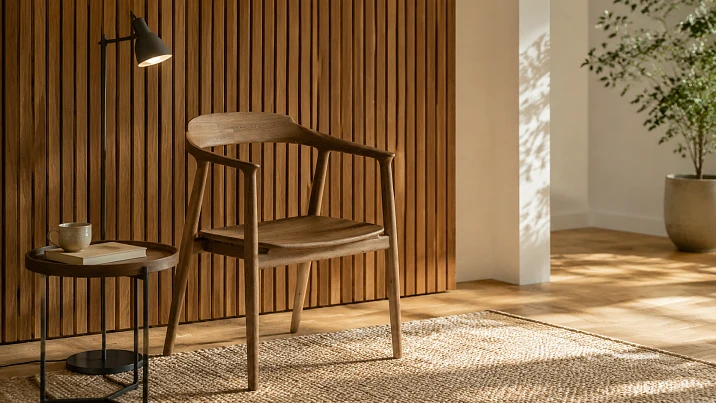
A reading corner rarely starts with buying "any comfortable chair." In a real living room, there is already a sofa, walkways, a window, a floor lamp, outlets, a coffee table, and an accent wall. If part of the wall is finished with vertical slats, the new piece should not just fit into a free corner. It is important that it does not blend into the linear pattern of the panels, does not cover the beautiful relief, and does not turn a calm area into a cramped furniture arrangement.
The Hans 004-002 chair is interesting precisely for this scenario. It is a wooden model with armrests and a semicircular backrest, not a large upholstered chair with massive sides. It allows you to designate a separate spot for a book, tea, or a leisurely conversation while maintaining the visual lightness of the wall. However, ordering Hans based only on a photo is risky: it is necessary to check the actual dimensions, seating, free space for arms and legs, the combination of wood with the panels, standard upholstery, and the availability of a specific configuration.
Neither the slatted wall nor the beautiful silhouette in itself guarantees comfort. One person is comfortable reading on a wooden seat without an additional cushion, while another needs a softer and deeper seating position. Therefore, the correct purchasing logic is as follows: first define the purpose of the corner, then check the model's dimensions in the room layout, choose the material and finish, coordinate the lighting and side table, and only then place the order.
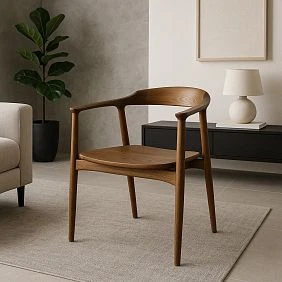
Hans 004-002 chair: a separate reading spot by a slatted wall
A sofa solves the general task of the living room: several people sit on it, watch TV, receive guests, and relax. A reading corner works differently. It is a personal zone where everything is arranged around a single seat: light falls from the shoulder side, a book rests on a small table, there is no need to stretch an extension cord across the walkway to reach a switch or outlet, and the chair's backrest does not conflict with a door or curtain.
A chair with armrests occupies an intermediate position between a regular dining chair and a bulky upholstered armchair. From a chair, it takes a compact wooden frame and a clear silhouette; from an armchair, it takes a wrapping backrest and arm support. Due to this, Hans 004-002 can be considered for a small living room, where a full-fledged upholstered armchair would overload the space, and a standard chair would look like temporary furniture.
Slatted paneling enhances the importance of the silhouette. Vertical lines already create an active background, so smooth elements are especially well perceived next to them: the semicircle of the backrest, transitions to the armrests, and the curve of the seat. The model does not have to repeat every slat. On the contrary, the rounded top line helps separate the piece from the wall and make it an independent center of a small composition.
This does not mean that Hans should be pushed flush against the panels. The textured wall should remain visible around the piece, and the wooden parts of the chair should not hit the protruding slats when sitting down or cleaning. An actual operational gap is left between the rear point of the furniture and the wall, the size of which is determined on site: taking into account the baseboard, the protrusion of the panels, the tilt of the backrest, the trajectory of moving the chair, and the user's habits.
If the wall finish has not been ordered yet, the background for the future zone can be selected in the section buy slat panels for walls for interior finishing. But the panel material should not automatically dictate the chair material. An oak wall does not require oak furniture, and painted slats do not oblige you to choose white enamel. What matters more is understanding whether you need a calm monochrome, a noticeable contrast, or a connection through a similar wood texture.




When a single chair-armchair is better than a second soft armchair
Hans is appropriate if you need to keep the floor free and the wall relief visible. Its wooden frame does not form a large solid volume. Air remains between the legs, the background is partially visible through the structure, and the semicircular backrest indicates a seating spot without a tall massive "wall" of upholstery.
This solution is especially useful in a room where a sofa already provides soft seating. A second large armchair can create a competing volume and narrow the passage. A chair-armchair adds a different type of seating: more compact, visually light, and suitable not only for reading but also for conversation, a short rest, or accommodating an additional guest.
However, the compact silhouette should not be confused with universal comfort. A person planning to read for two to three hours should test the seating in person or at least compare the model with a familiar comfortable armchair. Not only the overall dimensions matter, but also the seat height, its shape, back support, elbow position, and the feel of the wooden surface. If deep soft seating with high head support is required, Hans may not be the right type of furniture.
Our factory also produces:
What the Hans 004-002 card confirms
In the manufacturer's card, the model is called the Hans 004-002 chair-armchair. Three dimensions are specified — 558 × 779 × 537 mm. The construction is made of beech or oak. The armrests smoothly transition into a semicircular backrest, and the wooden seat has a concave shape. Several standard finish options are available for order: white enamel RAL 9010, clear oil, "cherry" tint, and "walnut with patina" tint.
| What to check | Data for Hans 004-002 | Practical action before payment |
|---|---|---|
| Article number | 004-002 | Specify the article number along with the name Hans |
| Dimensions | 558 × 779 × 537 mm | Open the drawing and verify that A, B, and C correspond to width, height, and depth |
| Material | Beech or oak | Select wood species before calculating price and lead time |
| Finishing | RAL 9010, clear oil, cherry, walnut with patina | Confirm whether the desired finish is available for the selected wood species |
| Construction | Wooden seat, armrests, semicircular backrest | Assess seating comfort if the chair is intended for extended reading |
| Production | For custom options, average lead time is 5–10 days | Get current confirmation for a specific configuration |
| Receiving | Terms depend on city and order | Specify city and request final delivery quote |
The product card should be read not as a promise of any combination, but as a configurator with options. Some standard finishes may be available for one wood species, others for another. Some combinations are made to order, and specific configurations may appear in stock. Therefore, you cannot first choose a color from an interior image and then assume it is automatically available for both beech and oak at the same price.
The current price is also determined by the configuration. For a commercial estimate, you should specify the wood type, upholstery, quantity, and city of delivery, then get the total. Prices and stock levels change; it is more reliable to refer to the current product card and the manager's confirmation rather than a figure saved in an old screenshot or publication.
After checking the dimensions and wood option, you can buy the Hans 004-002 chair-armchair in the model's product card. The link leads directly to the item, not to the general chair catalog, so it is easier not to mix up the SKU and request the right configuration when ordering.
Get Consultation
Why the size should be checked against the drawing, not the specifications line
The sequence 558 × 779 × 537 mm indicates the overall dimension, but for planning, it is important to understand what each value means. The buyer needs to know where the width is at the widest points of the armrests, where the full height is, and where the depth is from the front edge to the rear point. That is why, before ordering, you open the product drawing and compare the A, B, and C labels with the room plan.
An error in interpreting even one parameter can change the entire layout. If you accounted for the seat width in a narrow niche instead of the maximum armrest span, the chair will formally fit, but the side clearance will be uncomfortable. If you calculated the depth without the operational space at the back and front, a person will sit in the walkway or hit the wall when moving.
For a reading corner, it is not enough to draw a rectangle of 558 × 537 mm. On the plan, additionally mark:
-
free space for approaching and sitting;
-
the position of the seated person's legs;
-
space for opening an adjacent cabinet or door;
-
edge of the curtain and radiator;
-
protrusion of the floor plinth;
-
relief of slatted panels;
-
base of the floor lamp and cable;
-
dimensions of the side table;
-
possible movement of the chair during cleaning.
This is how an abstract "place for a chair" becomes a working area. Sometimes after such a check, the chair needs to be turned 10–20 degrees relative to the wall. A slight rotation makes the seating more inviting, shows the semicircle of the backrest, and reduces the feeling that the item is aligned in a row with the vertical slats.
Wooden chair with armrests 558 × 779 × 537 mm: what to check in the room
The first measurement is taken not along the wall, but in volume. The boundaries of the free area on the floor are marked, then the height of adjacent objects and the view of the chair from the main points of the room are checked. The corner may look great in a frontal sketch but obstruct the passage when viewed from the door. Or, conversely, it may seem cramped on the plan but work well due to a diagonal rotation.
Zone width
The maximum width of the chair is increased by side space. It is needed not only for a beautiful "frame" of air. A person should be able to freely lower their hands onto the armrests without hitting a table, wall, or curtain. If a floor lamp is placed to the side, its pole should not be directly at the elbow. If there is a small table nearby, convenient access is left between its edge and the armrest, but not such a large gap that one has to lean the whole body to reach a cup.
There is no universal increase in centimeters: it depends on the shape of the table, the base of the lamp, and the user's habits. A practical way to check is to mark the chair and neighboring objects with painter's tape on the floor, place a regular chair at the intended point, and act out the movement: approach, sit down, put down a book, turn on the light, stand up, and walk to the sofa.
Depth and passage in front of the chair
The front edge of the furniture should not be placed at the boundary of a transit route. A person stretches out their legs, bends down for a book, and stands up. If there is a coffee table opposite, its corner should not fall into the knee zone. If the corner is located near a passage to the balcony, the chair should not become a permanent obstacle.
The depth of the zone is measured from the most protruding point of the slatted wall or baseboard to the boundary of a safe passage. If the panels are mounted on a base and protrude relative to the adjacent smooth surface, the starting plane is considered to be the front part of the finish. Otherwise, the chair will be closer to the relief than was planned in the project.
Height and visual line
The full height of the model is important not only for seating. It determines how much of the slatted wall the backrest will cover and how the piece relates to a switch, sconce, painting, or wall shelf. The semicircular line of Hans reads well if a calm fragment of panels remains behind it. When a shelf or several small frames start directly above the backrest, the composition becomes fragmented.
If the slatted finish covers only part of the wall, check whether the top of the backrest coincides with its random boundary. Almost matching horizontals often look like a mistake. It is better to either deliberately connect the lines or separate them enough so that each reads independently.
Gap to the slats
The chair is not attached to the wall and may shift slightly. When sitting down, it is sometimes unintentionally pushed back. Therefore, the beautiful minimal gap in the visualization is not always suitable for actual use. Check the rear point of the backrest in the real position, the protrusion of the slats, the thickness of the baseboard, and the possible floor slope.
If there is wooden trim behind the chair, regular impacts can damage both the furniture and the panel. The solution is chosen not by decorative guesswork, but by space organization: increase the distance, adjust the rug's position, use appropriate protective elements on the floor, or change the chair's orientation. You cannot rely on a thin decorative slat to act as a furniture stop.
Beech or oak chair: which standard finish to choose for slat panels
The chair material is chosen not by the rule "all wood must be the same species," but by the desired result and type of finish. Beech and oak differ in grain, visual density, and how they are perceived under transparent or opaque finishes. Additionally, the material of the wall itself matters: solid wood, veneered surface, MDF for painting, or a combined system.
Beech and white enamel RAL 9010
White enamel shifts attention from the natural grain to the form. In Hans, this is especially logical if you need to emphasize the continuous line of the armrests and the semicircle of the backrest, but not add another wood tone to the room. A light painted model can separate from dark slats and simultaneously tie in with white walls, doors, or ceiling profiles.
RAL 9010 is a specific designation for the standard white enamel, but it cannot be evaluated only by screen. The color depends on lighting, adjacent white surfaces, and the degree of gloss. A "white" cabinet facade, a warm wall, and a painted chair can turn out to be three different whites. Before ordering, it is useful to compare physical samples or at least clarify the coating parameters.
White furniture also requires compositional verification. On a very light background, it can lose its outline, and next to black slats, it can become too sharp an accent. A neutral rug, a light table, or a repetition of white in a lampshade help tie the contrast together. There is no need to add many identical details: two or three supporting points are enough.
Beech and "cherry" tint
A warm tint makes the chair more noticeable and can support classic or vintage elements of the living room. Next to a slat wall, this option works if the panels do not conflict with the reddish undertone. Special attention is paid to the floor: the warm wood of the chair, the cool gray oak of the floor, and neutral slats can create a random set of shades.
The name of the tint does not replace a sample. "Cherry" describes the direction of the color, but the perception of the finish changes on specific wood and under different light. If the corner is located near a window, compare the result in daylight and evening lighting. If the person reads mainly in the evening, the light of the floor lamp becomes a priority, not the midday sun.
Oak and clear oil
Clear finish preserves the visible oak grain and turns the material into part of the design. It is a good path for a room where slat panels also showcase wood texture. But matching the species does not guarantee matching the color. Oak on the chair, panel veneer, and engineered flooring may differ in grade, cut, batch, finish, and age.
Instead of trying to achieve the illusion of one material, it is better to decide whether surfaces should be close or contrasting. If close, real samples and comparison in the room's lighting are needed. If contrasting, the difference is made obvious: for example, a light oak chair is placed against a darker wall, and its shade is repeated in a side table or frame.
Oak and walnut patina tint
Such a finish adds depth and a more pronounced decorative character. It can support a dark side table, a bookcase, or details of a classic interior. Next to slats, it is important not to get too much fine graphics: wall texture, patina, floor pattern, and books already create a rich surface.
If the background is active, more free space is left around the chair, and textiles are chosen calm. If wall panels are solid and minimalist, a more complex furniture finish can become an appropriate focal point. The decision is made based on the entire composition, not on a small fragment of wood in a catalog.
Not all material and finish combinations are equivalent
A buyer may see four finishes in the product card and assume each is available for both wood species. This must be verified before ordering. The specific combination affects price, availability, and lead time. If the desired combination is not in the interface, one should not assume it is standard or promise custom manufacturing without manufacturer confirmation.
If you want to assemble not only a chair but also a side table, console, or another item in the same stylistic direction, it is convenient to order modern wooden furniture after checking compatible materials and finishes. This does not mean the entire group must be identical: a unified collection can be built on repeating form, species, or color, rather than on full matching of every element.
How to align Hans 004-002 with the vertical rhythm of the wall
Slat panels give the room direction. The narrower the slats and the smaller the gaps, the more active the background's "frequency." Tall cabinets, linear lights, and straight legs can amplify this rhythm to the point of feeling striped. Hans softens it with the semicircular backrest, but the effect depends on placement.
If you place the chair strictly frontally and exactly in the center of a narrow panel section, the composition becomes formal. This approach suits a symmetrical interior, but for a reading nook, a slight turn toward the room or window is often more pleasant. The diagonal reveals the depth of the piece, separates the front and back legs from the verticals, and makes the seating visually open.
The wall relief is better left as a background rather than turned into a frame that barely touches the furniture. The silhouette needs air around it. Free space above the semicircular backrest is especially important: it allows the shape to be seen in full. A wall lamp, shelf, or picture should either be part of a clear composition or stay to the side.
Three working color schemes
| Diagram | Chair | Slat wall | Result |
| Monochrome | Light enamel | Light painted panels | A calm corner where shadows and contour show the form |
| Related wood tones | Oak with a clear finish | Panels with wood texture of a similar temperature | A holistic natural composition without mandatory full matching |
| Contrasting | Dark tinting or expressive oak | Light wall or panels | The armchair becomes an independent accent |
Monochrome requires precision of shades and good side lighting. A related scheme requires samples, otherwise close but mismatched wood tones may clash. Contrast is easier to read, but it needs to be supported by at least one more detail so the armchair doesn't look randomly brought into the room.
Do you need to repeat the wood species of the panels
No. The material of wall cladding and furniture material solve different tasks. Panels can be chosen based on acoustics, installation method, budget, and wall pattern. The armchair is chosen by construction, seating comfort, and available finishes. Matching the wood species is useful only when confirmed by samples and supports the overall concept.
Sometimes painted beech next to oak slats looks more convincing than two different 'oaks'. Enamel honestly separates the object from the background, while mismatched transparent finishes create an expectation of unity and immediately break it. In another interior, it's the difference in oak surfaces that adds liveliness. There is no universal rule, but there is a mandatory check of materials in the same lighting.
Modern Hans armchair: how to arrange light and a side table without covering the wall relief
A reading corner is not an armchair against a beautiful background, but a small functional system. If there's not enough light, the table is inconvenient, and the cord runs underfoot, the model will be used less often regardless of its design.
Floor lamp
A floor lamp is convenient because it doesn't require intervention in the slat wall. It can be moved after trial use and the light directed at a book. But the base takes up floor space, and the pole can conflict with the armrest. Before buying furniture, it's advisable to know the diameter and shape of the lamp's base.
For a right-handed person, the light is often placed on the left, for a left-handed person — on the right, so the hand less covers the page. This is a starting point, not a strict rule: the direction of the shade, reflected light, and habitual posture are considered. The lamp should not blind the person or create a bright reflection on the tablet screen.
If the slats have a pronounced texture, side light creates deep shadows. This is beautiful, but an active pattern should not tire the eyes near the reading area. Sometimes it's better to direct part of the light down and onto the page, leaving the wall in softer, diffused lighting.
Wall sconce
A sconce frees up the floor but requires coordinating the electrical and the base in advance. A heavy lamp cannot be attached only to decorative slats if the system is not designed for such a load. Mounting points and cable routing are designed considering the base behind the panels.
The height of the sconce is determined by the person's actual seating position and the direction of light. Relying on an abstract mark from the floor is insufficient. First, the chair position is confirmed, then on-site it's checked where the light beam will fall, whether the switch will be behind the backrest, and whether the shade will interfere when standing up.
Side table
For a book and a cup, a large coffee table isn't needed. A small side table preserves the visible wall and doesn't argue with the chair. Its height is compared with the armrest and hand movement. A table that's too low forces constant bending, one that's too high interferes with the elbow and visually covers the semicircle of the backrest.
The shape of the table can support Hans. A round tabletop continues the soft geometry, a rectangular one connects the corner with the room's architecture. More important than the shape itself are stability, a safe edge, and space for necessary items.
Carpet
A small rug marks the boundary of the zone and helps keep the chair in the chosen position. However, the front and back legs must stand stably. The combination of a thick rug edge and rigid wooden furniture can cause tilting. The thickness of the covering and how the legs sit relative to the edge are checked.
The rug also separates the chair's wood from the similarly colored floor. If the oak model blends with the oak plank, the neutral textile plane restores a readable outline without needing to change the furniture's finish.
Outlet and cables
They plan power for the floor lamp, phone or e-reader charging. The cable should not cross the approach path. If the outlet is behind panels or a future chair, access to it is checked before finishing. An extension cord constantly lying in front of the seating area can devalue a neat composition.
How to check the comfort of a chair for reading
The name "chair" describes the type of item, but does not guarantee that it will replace a soft armchair for a specific person. The seating depends on height, thigh length, habitual back position, sensitivity to a hard seat, and reading duration.
If possible, the model should be tested in person. You sit not for a few seconds, but in your usual clothes and with a simulation of a real scenario. You take a book or tablet, place your forearms on the armrests, change leg positions, check if it is easy to stand up. If two people will regularly use the chair, both need the test.
During the fitting, the following are assessed:
-
Is the width between the armrests sufficient.
-
Does the front edge of the seat press under the knees.
-
Does the backrest support the habitual body position.
-
Can you lower your shoulders while placing your hands on the armrests.
-
Don't you have to constantly hold the book too high?
-
Is it comfortable to get up without leaning on the adjacent side table?
-
Doesn't clothing slip on the chosen upholstery?
-
Is a separate removable cushion needed, and how will it change the seating position?
An additional cushion can increase subjective comfort, but it changes the seat height and depth. It raises the person relative to the backrest and armrests, and also partially hides the wooden seat. Therefore, it should not be considered an automatic solution. First, the chair is tested, then the textile is selected for the specific task.
If it's impossible to see the Hans in person, compare the drawing with furniture on which the person is already comfortable. Measure not only the overall size of the familiar chair, but also the useful seat width, armrest height, seat depth, and backrest height. After that, request the missing parameters of the model from the seller. A photo in the interior does not provide scale and does not replace this data.
Buying the Hans 004-002 chair: what to specify in the order
A commercial request should be more specific than the phrase "I need a chair like in the photo." The order should specify the configuration so the seller can confirm the cost, production, and delivery. This is especially important for a model with two types of wood and several upholstery options.
Order checklist
| Position | What to write | Why is this needed |
| Model | Hans 004-002 | Eliminates confusion with another Hans chair or similar shape |
| Quantity | For example, 1 pc. | For a reading corner, usually one item is considered, but the order must be explicit |
| Material | Beech or oak | Defines available finishes and cost |
| Finishing | Exact name of the standard version | Eliminates ambiguities like "light wood" |
| City of delivery | City and preferred delivery method | Needed for logistics calculation |
| Lead time | Please confirm the current timeframe | The average value is not the readiness date for a specific order |
| Drawing | Please confirm the dimensions and designations | Needed for the final layout check |
| Completeness | What is included in the line item | Helps verify the product's readiness for use and delivery conditions |
After receiving the response, the commercial proposal is compared with this checklist. The coating name must match, the quantity must be specified in pieces, delivery must be calculated for the required city, and the timeframe must relate to the selected combination, not to the furniture category in general.
Why the average timeframe of 5–10 days cannot be considered a promised date
The average production timeframe helps plan the project but does not replace order confirmation. The date is affected by workload, availability of the blank, selected finish, and logistics. If the corner piece must be ready for a housewarming or photo shoot, the schedule should include not only manufacturing but also approval, payment, transportation, acceptance, and possible buffer time.
An order "for an event" is planned from the reverse date. First, the day when the furniture should already be in the room is determined, then the time for delivery and inspection is subtracted. If the timeframe is critical, it is fixed in the agreed documents, not assumed from the general card text.
Why the final budget is not just the price of the chair
The corner budget may include delivery, lifting, a lamp, a table, a rug, an outlet or electrical work, floor protection elements, and textiles. This doesn't mean everything needs to be purchased at once. But if only the chair is counted, the finished area may end up more expensive than expected or lack functionally important details.
It's reasonable to split the budget into essential and optional items. Essential — the chair in the chosen configuration and delivery. Functional — light and a place for a book. Decorative — a rug, pillow, throw, wall elements. This order helps avoid saving on the key item for the sake of accessories.
When a wooden chair with armrests is better to see in person before paying
Personal fitting is especially important if the chair will be a daily reading spot, if the user is noticeably taller or shorter than average, if there is back or joint sensitivity, or if the person is used to a deep, soft chair. In these cases, even an accurate drawing doesn't answer the question of subjective comfort.
In-person inspection is also needed for complex color tasks. The screen and photo distort white, tint saturation, and wood grain. It's advisable to bring a sample of a panel, facade, or flooring. If a large sample can't be taken, use a small painted fragment or an approved reference, not a random photo on a phone.
Before the trip, check whether the showroom has exactly Hans 004-002 and in which finish. The presence of another model from the collection won't allow checking the fit. If a Hans in a different wood is available, you can evaluate the geometry on it, but color and texture are still verified separately.
What to photograph and write down after fitting
-
position of the body and arms from the side;
-
distance from the knee to the front edge;
-
view of the backrest relative to the shoulders;
-
feeling of the seat after 10–15 minutes;
-
actual shade under neutral and warm light;
-
name of the material and finish on the sample;
-
dimensions not shown on the published drawing;
-
agreed deadline and completeness.
Photos are useful only with captions. After a few days, it is easy to confuse finish options or mistake an oak photo for beech. Recording the article number and exact finish name prevents errors in remote ordering.
Mistakes when designing a reading nook at a slat wall
Buying only based on a beautiful angle
The photo shows the character of the model but hides the scale, seat firmness, actual shade, and the space behind the chair. Without a drawing, the buyer risks blocking the aisle or placing the armrest too close to the table.
Assuming 558 mm is the seat width
The product dimensions and the useful seating width are different parameters. For comfort, the internal size between armrests is needed, and for planning, the maximum external width. If a specific parameter is not specified, it should be requested.
Pressing the backrest against a textured wall
The slats are a decorative surface, not a furniture limiter. Contact can damage the coating. The chair needs an operational clearance considering its possible displacement.
Choosing wood only by the species name
Two oak products can differ noticeably. Perception is influenced by sorting, cut, tinting, oil, varnish, and lighting. Decisions are made based on samples, not the word 'oak'.
Assuming any combination of finishes
The list of coatings in the card does not mean that each is available for each wood species within the same timeframe. The specific configuration is confirmed before payment.
Making the corner too cramped
The chair, floor lamp, and table fit on the plan, but they are inconvenient to use: the elbow hits the stand, knees hit the table, and the cable lies in the walkway. A full-scale check helps see the conflict before purchase.
Placing too much decor near the slats
The textured wall is already active. A shelf, several paintings, a bright rug, an intricate floor lamp, and expressive tinting can overload a small area. It's better to define one main accent and support it with calm details.
Designing lighting after purchasing all the furniture
Then the outlet ends up behind the backrest, the sconce is on the wrong side, and the floor lamp doesn't fit between the armrest and the wall. Lighting and furniture are planned together.
Treating the average lead time as a guarantee of readiness
The phrase 5–10 days describes a production benchmark for custom orders. A project requires a confirmed date for the selected configuration and a buffer for delivery.
Buying a "reading chair" without testing the seating
The scenario doesn't change the physical properties of the model. A wooden chair-armchair can be comfortable for one person and not soft enough for another. Personal fitting or detailed size comparison remains the priority.
Who Hans 004-002 suits, and who should consider a different type of chair
Hans suits a buyer who wants a visually light wooden piece, values an open frame, a semicircular backrest, and armrests, and is ready to coordinate the material and finish with the interior. The model is especially appropriate where a massive upholstered chair would block a slatted wall or narrow the passage.
A different type of furniture is more reasonable to consider if a high backrest with head support, a very deep seat, a soft seat as a mandatory condition, an adjustable position, or pronounced support for long rest is needed. In these cases, aesthetic compatibility with the panels should not outweigh the user's requirements.
If the doubt is related not to comfort, but to choosing between two wooden models with armrests, you can once compare Hans 004-002 and Archie 003-003 in a separate article. For the current scenario, it is important not to turn such a comparison into an end in itself: the decision is made based on the specific corner, room dimensions, and seating.
How to assemble an order and not lose the main scenario
Before payment, it is useful to formulate the task in one sentence: "Need one wooden chair-armchair Hans 004-002 for daily reading by the slat wall, in the confirmed wood species and standard finish, with delivery to such-and-such city." This phrase keeps attention on real use, not on the abstract beauty of the catalog.
Then attach the zone plan, the selected configuration, and a list of questions. It is easier for the manager to check the order when the material and coating are named precisely. It is easier for the designer or assembler to coordinate the shade when there are samples of the panel, floor, and furniture. It is easier for the buyer to control the budget when the product, delivery, and other elements of the corner are listed separately.
The final sequence looks like this:
-
Check the dimensions against the drawing.
-
Mark the chair, table, and light on the floor.
-
Assess the passage and the gap to the slats.
-
Check the fit in person or request missing dimensions.
-
Choose birch or oak.
-
Agree on the available standard trim.
-
Specify the quantity and city of receipt.
-
Get the current price, lead time, and delivery terms.
-
Verify the commercial proposal against the selected configuration.
-
Place the order only after resolving discrepancies.
Thus, Hans 004-002 becomes not a random chair on a free wall section, but a central piece of a well-thought-out zone. The slatted paneling creates a backdrop and rhythm, the semicircular back softens the verticals, the light makes reading comfortable, and a small table completes the function. The main thing is not to replace verification with a beautiful photo and not to assume that the material, color, and lead time will be determined automatically.
A useful final test is to mentally remove the slatted panels from the project. If the chair still suits the person in terms of fit, dimensions, and purpose, the choice is based on function. Then mentally remove the chair: if the wall retains a finished look, the piece is not used as a way to hide a flawed finishing detail. A good corner emerges when the furniture and the backdrop are independent but enhance each other. Hans handles the fit and soft geometry, the panels handle the architectural rhythm, and the light handles the zone's function. This division of roles protects the project from decor for decor's sake.
Before payment, keep one approved specification sheet rather than multiple correspondence threads with different options. It must match the article number, wood species, exact coating name, quantity, city, cost, lead time, and method of receipt. If the material or finish changes after approval, the calculation is rechecked: the price and readiness of one configuration do not automatically transfer to another. This simple discipline is especially important for remote purchases, when the buyer, designer, and specifier discuss the decision simultaneously.
Four layout scenarios for Hans against a slatted wall
The same chair is perceived differently depending on its placement point. Therefore, choosing a "place near the panels" is too vague. It is more useful to define a specific scenario: the chair is in front of a wide slat field, at its edge, in the corner between a window and the trim, or next to a low bookshelf. Each option has its own compositional risk.
In front of a wide slat field
If panels cover most of the wall, the chair can be placed in front of them as a standalone piece. The main task is not to lose its silhouette. Against a backdrop of wood with a similar shade, the legs and backrest may visually merge with the slats. A slight rotation relative to the wall, a rug, and a difference in lightness help. For example, an oak chair does not have to be darker than the panels, but a readable difference between their tones should be maintained.
Centering the piece is not mandatory. Strict symmetry is justified when there are paired lamps or identical architectural elements around. A personal corner usually looks more natural with an offset: on one side there is a floor lamp, on the other—a side table or a clear approach. It is important that the offset looks intentional, not the result of a few missing centimeters.
On a wide wall, it is easy to place the chair too far from functional points. A beautiful backdrop does not compensate for an inconvenient outlet or the lack of space for a book. Therefore, first define the working combination of "seat—light—table," and then move it along the wall as a single module.
At the edge of the slat panels
The junction of a smooth and a textured wall is itself a strong vertical line. If you place Hans exactly on this line, half of the backrest will be against one backdrop, and half against the other. This technique can be expressive but requires precise visualization. Randomly dividing the piece in half often looks restless.
A calmer solution is to position the chair predominantly on one plane, leaving the panel boundary to the side. Then the semicircular backrest becomes a transitional element between two surfaces, without being rigidly split. On the plan, check the maximum width of the armrests, and on the wall elevation, check the position of the backrest relative to the vertical edge of the trim.
If a finishing profile is installed at the junction, its protrusion is also included in the gap calculation. The furniture should not regularly touch the end element. The exact distance is assigned after checking the actual installation, since the design thickness of the base and the actual relief may differ.
Between the window and the slat wall
The window provides natural light but creates additional constraints: curtain, radiator, windowsill, and possible draft. You cannot orient the chair only for daytime reading. In winter it gets dark early, so artificial light is still part of the scheme.
Check the curtain's trajectory. The fabric should not rest on the backrest or get pinched between the chair and the wall. If there is a radiator nearby, maintain conditions for air circulation and access to adjustment. Do not cover the heating appliance with wooden furniture without assessing the thermal regime and operating recommendations.
The position relative to the window also affects fading of the finish and books. The coating manufacturer determines care rules, and the designer plans protection from direct sunlight. The article cannot promise equal resistance of all finish options to prolonged UV; this issue is clarified for the selected configuration.
Next to the bookshelf
This is a functionally obvious place: books are nearby, and the wall forms a backdrop. But cabinet doors and pull-out elements require a clear trajectory. The plan shows not only the closed body but also the opening of the facades. The Hans armrest should not fall under the door, and the seated person should not block the only access to the shelves.
A tall cabinet and slats provide many verticals. The semicircular backrest helps soften them, but the composition can easily be overloaded with an additional tall floor lamp. In such a situation, you can consider a more minimalist lamp or a wall sconce on a prepared base. The decision depends on the electrical setup and the load-bearing structure of the wall.
If the cabinet and chair are made of wood, you don't need to match three nearly identical shades at any cost. It's better to define the hierarchy in advance: the cabinet is a calm backdrop, Hans is an accent; or the chair and cabinet are one group, and the panels are a contrasting architectural surface. A clear role for each material makes the interior more convincing than approximate matching of all samples.
How to check the corner in the morning, evening, and from the main points of the living room
Finishes and furniture change under different light. White enamel may look neutral during the day, but in the evening next to a warm floor lamp, it can appear creamy. Transparent oil highlights the oak grain, but in insufficient lighting, details may blend with dark panels. Therefore, the final choice should ideally be checked in at least two lighting scenarios.
In the morning or during the day, evaluate direct and diffused light from the window. Check whether a sharp glare appears on the finish, whether the contour of the backrest reads well, and whether one wood looks accidentally redder than another. In the evening, turn on the usual living room lighting and the intended reading lamp. What matters is not only aesthetics but also the absence of glare on the page, tablet, or glasses.
The check is carried out from several points:
-
from the entrance to the living room — the first general view;
-
from the sofa — everyday perception of the area;
-
from the passage to the window or balcony — assessment of movement obstructions;
-
from the adjacent room with the door open — checking the silhouette;
-
directly from the armchair — the user's view and the placement of light;
-
from the side — the gap to the wall and the position of the side table.
It is useful to take photos of the layout at eye level, not just from above. The plan shows passages but does not show how the semicircle of the backrest overlaps the pattern of the rail or the wall switch. The frontal elevation, side view, and plan complement each other.
If the project is carried out by a designer, the specification should include not just the article number, but the selected configuration and purpose. The wording "Hans 004-002, one reading chair, primary user — adult, floor lamp on the left, side table on the right" provides more information than a chair pictogram on the plan. It helps the electrician, assembler, and panel installer coordinate their decisions.
Acceptance of Hans 004-002 after manufacturing and delivery
The order does not end with payment. Upon receipt, you need to verify the product against the agreed configuration and inspect it before use. The specific procedure depends on the seller's and carrier's terms, so delivery and acceptance documents should be studied in advance. The general principle is simple: first, record the condition of the packaging and the product, then confirm compliance.
Check the model name, quantity, material, and finish. If the wood species cannot be confidently determined visually under opaque enamel, rely on the order documents. The color name must match the commercial offer. For tinted and transparent coatings, natural wood variation is possible, but obvious discrepancies or damage should be recorded immediately according to the seller's rules.
Inspection is carried out in good light. Pay attention to:
-
Integrity of the packaging and absence of signs of strong impact or moisture.
-
Condition of the backrest, armrests, seat, and legs.
-
Uniformity of the agreed coating, taking into account the natural texture.
-
Stability of the chair on a flat control surface.
-
Compliance of quantity and configuration with the documents.
-
Absence of contact between parts and rigid packaging elements after unpacking.
-
Presence of documents and care recommendations, if provided with the delivery.
Do not attempt to remove the detected damage yourself before contacting the seller: self-sanding, painting, or tightening connections may complicate the situation. First, take photos, keep the packaging, and follow the agreed procedure.
After acceptance, assign the chair a place on the prepared floor. Choose protective floor glides based on the flooring and recommendations: a universal pad may collect sand, leave marks, or change stability. If the room has new wooden flooring, compatibility is especially important.
The first days of use serve as a final check of the layout. Sometimes the table may need to be moved to the other side, the floor lamp pushed away, and the chair turned more toward the room. This is a normal adjustment for a living corner. The main thing is that adjustments do not require moving furniture close to the slats or routing the cable into the walkway.
FAQ about the Hans 004-002 chair-armchair near the slatted wall
1. Is the Hans 004-002 a chair or an armchair?
In the product card, the model is called a chair-armchair. It has a wooden frame, seat, armrests, and a semicircular backrest. In terms of size and visual lightness, it is closer to compact furniture than to a massive upholstered armchair. When choosing, the term matters less than the actual seating and usage scenario.
2. Is the Hans 004-002 suitable for long reading sessions?
This depends on the individual. The product card describes a wooden concave seat and a design with armrests, but long-term comfort cannot be guaranteed from a photo. If daily reading is planned, it is better to try the model in person or compare its seating dimensions in detail with furniture the user finds comfortable.
3. What size is specified for the model?
The manufacturer specifies 558 × 779 × 537 mm. Before planning, open the drawing and clarify how the labels A, B, and C correspond to width, height, and depth, and request useful seating dimensions if needed to assess comfort.
4. How much free space should be left around the chair?
There is no single value. Consider the approach, leg position, armrest span, floor lamp, side table, baseboard, and panel protrusion. It is more practical to mark out the entire area at full scale and test movements than to add conditional centimeters only to the chair's rectangle.
5. Can Hans be placed flush against slatted panels?
It is not advisable to rely on contact. The chair moves slightly during use, and protruding slats and furniture upholstery can be damaged by impacts. An operational gap is needed, determined by the actual geometry of the wall, baseboard, and backrest.
6. What should I choose — beech or oak?
The choice depends on the available finish and composition. Beech is convenient to consider for a painted solution, oak — when pronounced wood grain is important. But this is not a strict rule. It is necessary to check the standard configuration in the product card and compare physical samples with slatted panels and the floor.
7. Does the chair have to be made of the same wood species as the panels?
No. The wall material does not automatically determine the furniture material. Sometimes painted beech separates the piece from oak slats better than oak of a different shade. If the species match, the finish, texture, and color are still compared under real lighting.
8. What finishes are specified for Hans 004-002?
The product card presents white enamel RAL 9010, clear oil, cherry tint, and walnut with patina tint. The availability of a specific finish for the selected wood species should be confirmed before payment. Not all combinations can be considered automatically available.
9. Can I order a different enamel color?
Within the article, the standard white enamel RAL 9010 and the options listed on the product card are reliably confirmed. The possibility of a different color, minimum order amount, lead time, and conditions for custom execution must be separately agreed upon with the manufacturer. Such a service should not be assumed by default.
10. Why is it better to check the price on the product card rather than fixing it in advance?
The cost depends on the wood species and finish, and the data may be updated. For a purchase, you need the price of the exact configuration selected as of the order date. Delivery and accompanying corner elements are also taken into account, so an old figure from the article does not replace a current commercial offer.
11. How long does manufacturing take?
For custom-order options, the product card indicates an average lead time of 5–10 days. This is a guideline, not a guaranteed date for every configuration. Before payment, confirmation of the current lead time is requested, taking into account the wood species, finish, production load, and delivery city.
12. What must be specified to the manager?
You need to state Hans 004-002, quantity, beech or oak, the exact standard finish, and the receiving city. Additionally, it is worth requesting the current price, lead time, delivery terms, completeness, and confirmation of dimensions according to the drawing.
13. Does the table need to be made of the same material as the chair?
No. A connection can be created through shape, color, or one repeating shade. The table should primarily be stable, match in height, and not interfere with the armrest. Full matching of the wood is only one of the possible approaches.
14. Where is the best place to put a floor lamp?
On the side where the light is less blocked by the hand and doesn't glare into the eyes. But the final position is determined by the specific lampshade, user habits, and the chair's orientation. The base of the floor lamp should not interfere with the legs or stand flush against the armrest.
15. Can a wall sconce be mounted on a slat wall?
Only with a pre-prepared base and coordinated electrical work. Decorative slats themselves should not be considered a universal load-bearing structure. The mounting, cable routing, and access to connections are designed for the specific light fixture and panel system.
16. What to do if you like the chair but the hard seat feels uncomfortable?
First, assess the seating over a sufficient period of time. A removable cushion may change the feel, but it will also raise the person relative to the backrest and armrests. If softness is a mandatory requirement, it's better to compare an alternative chair type rather than try to fix an unsuitable seat after purchase.
17. Is a rug needed under the reading nook?
Not necessarily. A rug helps define the zone, separate wooden legs from similar flooring, and partially stabilize the furniture arrangement. It's important that all legs stand evenly and the edge of a thick rug doesn't create a tilt.
18. How to tell if the nook is overloaded?
Remove accessories and see if the three main elements are readable: the chair, the light, and a small side table. If the wall texture, active tinting, rug, decor, and shelf compete simultaneously, leave one main accent and make the rest calmer.
19. Can I buy two Hans for a symmetrical zone?
Technically, the quantity is determined by the order, but the composition needs to be checked against the room. Two chairs require a wider passage, a different position for the table and lighting. If the original task is a personal corner by the slatted wall, the second item should not be added just for symmetry.
20. How to make a decision before payment?
You need to confirm four things at once: the chair fits with operational clearances, the seating suits the user, the chosen wood species and finish are available, and the current price and delivery time are agreed for the required city. If at least one item remains an assumption, it is better to clarify the order first.