Article Contents:
- Why the price per meter can be misleading
- When the price per linear meter can still be compared directly
- You need to compare identical materials and identical cross-sections
- Wooden skirting board: the cost of the finished room is what matters
- Why the length of the plank affects the real cost
- Wooden moulding: the price depends on the layout pattern
- How to calculate the cost of one moulding frame
- Option A: 2.0 m planks, price 500 ₽/m
- Option B: 2.4 m planks, price 540 ₽/m
- Proposal A
- Proposal B
- 1. Normalize the product
- 2. Recalculate the quantity
- 3. Add unavoidable costs
- 4. Compare the total
- Is it enough to compare the price per linear meter?
- Why is a more expensive long plank sometimes more cost-effective?
- Can oak and beech be compared by price?
- How should the leftovers be counted?
- Should painting be included?
- What matters more — the discount or the final price?
- Should you show the supplier the entire volume?
- Where can you check specific sizes and lengths of the moulding?
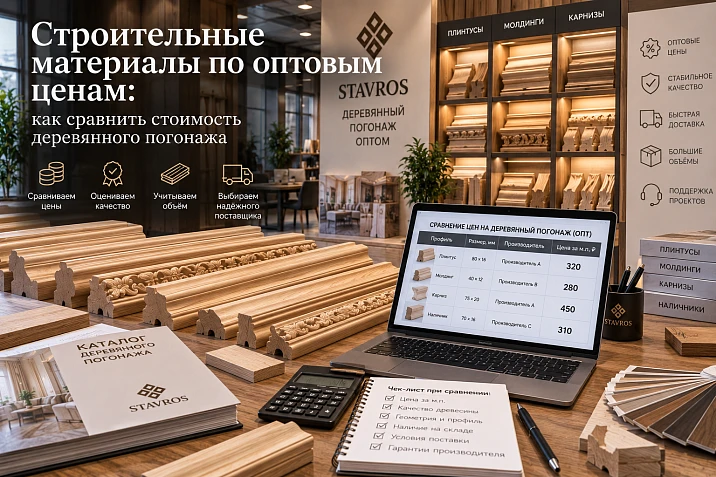
Two suppliers sent commercial proposals for the same interior project. In the first, the moulding costs roughly 500 ₽ per linear meter; in the second, 540 ₽. On the first row of the table, option A seems more cost-effective. But then it turns out: A has shorter planks, more joints on each frame, and an inconvenient leftover; B's length matches the cutting plan better. After recalculating whole pieces, the more expensive meter may result in a lower cost for the finished project.
Therefore building materials at wholesale prices you should compare not by a single column of “₽/linear m”, but by a closed specification:
material + cross-section + commercial length + number of whole pieces + cutting + usable remainder + preparation + packaging + delivery + additional works = real project cost.
The main rule is simple: first make sure that the commercial offers describe truly comparable goods, then recalculate each item according to the real geometry of the project, and only after that compare the total.
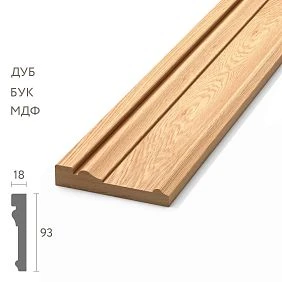
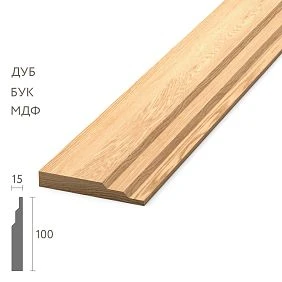
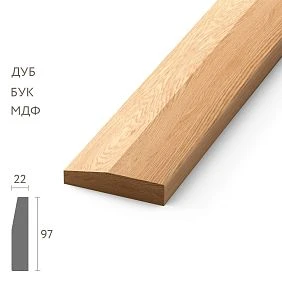
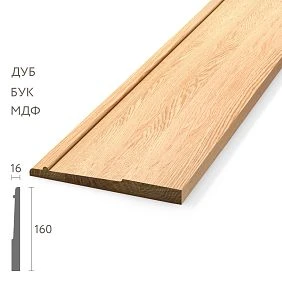
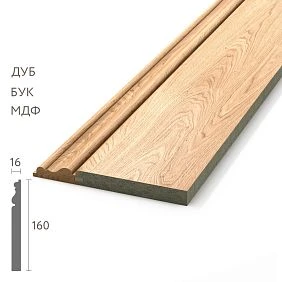
To check specific profiles, you can use the catalog STAVROS wooden molding. It contains skirting boards, moldings, and cornices made of different materials and in different commercial lengths — it is precisely these differences that often change the economics of an order.
Why the price per meter can be misleading
A linear meter is convenient as a normalized unit. It helps you quickly compare two identical products.
But a real project does not buy fractional meters, but whole planks.
Let's imagine two offers for the same profile made of the same material:
- A — length 2000 mm, conditionally 500 ₽/m;
- B — length 2400 mm, conditionally 540 ₽/m.
If the project needs one straight section of 1.8 m, A is indeed cheaper.
But if you need many pieces of 2.35–2.4 m, the 2000 mm option already requires joints or does not fit the project at all as a single piece.
The price per meter is only the first filter. The next question:
how many whole product units will you have to buy for the actual layout?




When the price per linear meter can still be compared directly
A direct ₽/m comparison is acceptable when commercial offers are truly identical in essence.
The following must match:
- the product code or fully equivalent geometry;
- the material;
- cross-section;
- product length;
- the degree of preparation;
- the packaging conditions;
- volume;
- logistics, or it is placed in an identical separate line.
For example, two suppliers offer the same oak profile 65×18×2400 mm, in the same preparation state, in the same quantity, and with separate delivery. Then 500 ₽/m versus 520 ₽/m can already be compared directly.
But as soon as one parameter changes, the price per meter is no longer sufficient.
If one offer has a length of 2000 mm and the other 2400 mm, cutting comes into play.
If the material is different, the product item itself changes.
If one product requires additional sanding or primer, the cost of bringing it to the same condition appears.
Therefore, a good buyer's table always aligns the technical part first, and only then the financial part.
Our factory also produces:



You need to compare identical materials and identical cross-sections
It is impossible to honestly compare:
- oak with beech;
- solid wood with MDF;
- profile 65×18 mm with profile 40×12 mm;
- unfinished product with finish-ready preparation;
- different commercial lengths without cutting recalculation.
For example, the current PLT-006 is presented as 100×15×2400 mm in beech/oak and 100×16×2600 mm in MDF. Formally, it is one SKU, but the commercial versions differ in material, thickness, and length.
If quote A contains oak 2400 mm and quote B contains MDF 2600 mm, the conclusion “B is cheaper per meter” does not answer the question of which solution is more advantageous for the project. First, it is necessary to confirm that both versions are acceptable for the project at all.
Get Consultation
Wooden skirting board: the cost of the finished room matters
For skirting boards, the buyer is interested not only in the price per meter, but in how much it will cost to cover the entire lower perimeter of the room.
Algorithm:
- measure the areas where skirting board will actually be installed;
- determine the commercial length;
- create a cutting plan;
- count the whole planks;
- determine usable offcuts;
- add the necessary reserve;
- multiply the number of items by the price;
- add preparation and logistics.
Suppose the net requirement is 41.4 m.
For a profile with a length of 2400 mm, the mathematical minimum:
41.4 / 2.4 = 17.25, that is, 18 planks.
This is 43.2 m of purchased material.
For a length of 2600 mm:
41.4 / 2.6 = 15.92, that is, 16 planks.
This is 41.6 m.
But these figures do not yet prove that the 2600 mm option is more cost-effective: the material or cross-section may differ, and the actual wall cutting pattern may require a different result.
Why plank length affects the real cost
Let's imagine four walls:
- 4.6 m;
- 4.6 m;
- 3.8 m;
- 3.8 m.
Total perimeter:
16.8 m.
If using 2.0 m planks, without optimizing leftovers you will need:
- for each 4.6 m wall — 3 planks;
- for each 3.8 m wall — 2 planks.
Total:
3 + 3 + 2 + 2 = 10 planks = 20 m purchased.
For 2.4 m:
- 4.6 m is covered by two 2.4 m planks;
- 3.8 m — also by two.
Total:
8 strips = 19.2 m.
Even before estimating cost, the 2.4 m option uses 0.8 m less purchased material and fewer individual planks.
It is precisely such differences that should be included in a commercial comparison.
Wooden moulding: the price depends on the layout pattern
With moulding, the total linear footage is even less indicative.
The customer is not ordering “200 metres in general,” but frames, bands, verticals, and surrounds of specific dimensions.
For each composition, the following are important:
- side lengths;
- number of corners;
- pattern orientation;
- product length;
- the ability to reuse the remainder;
- requirements for visible joints.
Therefore, two mouldings with the same price per metre can produce different totals solely because of the length of the strip.
How to calculate the cost of one molding frame
Let's take a frame of 1200×2400 mm.
Net length:
2 × 1.2 + 2 × 2.4 = 7.2 m.
Option A: 2.0 m strips, price 500 ₽/m
For two verticals of 2.4 m each, a single strip is not long enough. If the project allows a joint, each vertical must be assembled from at least two parts.
Optimized cutting requires four two-meter strips:
4 × 2.0 = 8 m.
Cost:
8 × 500 = 4 000 ₽.
At the same time, additional joints appear on the two verticals.
Option B: 2.4 m strips, price 540 ₽/m
Two verticals take two whole strips. From the third strip, you can get two horizontals of 1.2 m each.
Total:
3 × 2.4 = 7.2 m.
Cost:
7,2 × 540 = 3 888 ₽.
The result is a paradox: meter B is 8% more expensive, but the finished frame costs less in material:
4 000 − 3 888 = 112 ₽.
Moreover, the verticals come out as single pieces.
That is why commercial proposals are compared by the item in the project, not by the price per meter.
How to determine the point after which a long plank becomes more cost-effective
You can calculate the threshold price.
In the previous example, option A requires 8 m of purchase at 500 ₽/m:
8 × 500 = 4 000 ₽.
Option B requires 7.2 m.
For option B to cost exactly the same, the maximum price of its meter is:
4,000 / 7.2 = 555.56 ₽/m.
Therefore:
- at a price for B below 555.56 ₽/m, the long plank is cheaper in terms of material;
- at a price above 555.56 ₽/m, option A is cheaper only in terms of purchase cost;
- but after 555.56 ₽/m, joints, fitting, and additional work still need to be taken into account separately.
If supplier B sent 548 ₽/m, their offer is still more advantageous in terms of material.
If 570 ₽/m is already more expensive, you need to assess whether the difference is justified by fewer joints and easier installation.
This kind of calculation is especially useful when commercial offers differ in length and the price per meter is close.
Leftovers are not always waste
After cutting, pieces remain.
But the word “waste” should only be used where the leftover truly cannot be used further.
For example, 800 mm may be useless for a long wall with a skirting board, but could be quite useful:
- for a short wall section;
- for a small molding frame;
- for a finish sample;
- for the next position of the same SKU.
Therefore, in the calculation it is useful to divide the remnants into:
reusable and unused in the current project.
Only the second group is the actual lost linear meters.
How to calculate the usefulness of remnants across the entire project
The buyer's mistake is to evaluate waste for each room separately when the same profile is used throughout the entire project.
For example:
- after the living room, 1.1 m remains;
- the study requires a section of 0.9 m.
If the article number and finish match, the living room remainder can cover part of the study.
Therefore, a large project is better cut centrally.
The formula becomes:
all required segments of one SKU → overall cutting → usable remainders → number of whole planks.
This is usually more accurate than “+10% for each room.”
Wooden cornice: a cheap meter can produce an expensive ceiling contour
A cornice has long visible sections. An additional joint means not just a few more centimeters of material.
It can mean:
- additional trimming;
- pattern matching;
- fixation;
- surface finishing;
- painter's work after installation.
Therefore, for a cornice it is useful to compare:
the cost of the closed perimeter + the number of joints
and not just the price per linear meter.
The current KZ-001 exists, for example, in lengths of 2000 and 2400 mm in solid wood, as well as 2600 mm in MDF. This allows you to see, using a single SKU, how important a specific product line is.
Wholesale building materials: comparing the same specification
If the request includes building materials wholesale, it is useful to bring both commercial proposals into a single table.
| Parameter | Offer A | Offer B | | --- | --- | --- | | Item code | ___ | ___ | | Material | ___ | ___ | | Cross-section | ___ | ___ | | Strip length | ___ | ___ | | Strip price | ___ | ___ | | Price per linear m | ___ | ___ | | Required number of strips | ___ | ___ | | Purchase footage | ___ | ___ | | Remaining stock used | ___ | ___ | | Preparation | ___ | ___ | | Packaging | ___ | ___ | | Delivery | ___ | ___ | | Total | ___ | ___ |
If the first four rows do not match in meaning, the offers cannot be considered direct competitors without additional technical evaluation.
Wholesale price and discount are not the same thing
Supplier A shows:
retail price 1000 ₽, discount 20%, total 800 ₽.
Supplier B does not show a nice discount, but immediately gives:
760 ₽.
For the buyer, what matters is not the percentage amount, but the final price of a comparable item.
In this example, B is cheaper by:
800 − 760 = 40 ₽ per unit.
If 500 units are needed:
500 × 40 = 20 000 ₽.
Therefore, the discount percentage is a marketing parameter. Purchasing math starts with the final price of the agreed specification.
Materials in bulk: a large volume must be calculated in full at once
Requesting a price for 10 m when the actual requirement of the site is 700 m can only be used as a preliminary reference.
for materials in bulk it is more useful for the buyer to show the estimated full volume.
Causes:
- the supplier sees the real scale;
- serial production can be discussed;
- timelines are estimated more accurately;
- packaging is clearer;
- logistics is calculated for the actual order;
- comparison of two quotations becomes comparable.
At the same time, one cannot promise a specific wholesale discount without an official commercial offer.
Why a price without specifying the material is useless
The quotation must include:
MLD-___ / oak / size ___ / length ___ / price ___
And not:
MLD-___ / price ___
The same geometry in different materials means different product variants.
Therefore, when comparing, the buyer must first normalize the technical part, and only then look at the money.
Wholesale building materials: taking surface readiness into account
If compared wholesale building materialsit is important to understand in what condition the product is passed to the next technological stage.
The options can vary:
- additional preparation is required;
- the product is prepared for enamel;
- independent priming is needed;
- tinting is required;
- the finishing is performed by another contractor.
These states cannot automatically be considered equivalent.
If option A is cheaper by 50,000 ₽, but then requires another 70,000 ₽ for additional preparation of the entire batch, the initial savings disappear.
How to add preparation to the calculation
Formula:
product cost + mandatory preparation to the agreed condition = comparable cost.
For example:
Option A
Linear trim — 300,000 ₽.
Additional preparation — 60,000 ₽.
Total to the required condition:
360 000 ₽.
Option B
Linear trim already in the agreed preparation — 342,000 ₽.
On the first line, A is cheaper by 42,000 ₽.
After aligning the technological condition, B is cheaper by:
360 000 − 342 000 = 18 000 ₽.
This is the figure that should be compared.
Painting after purchase is also part of the project cost
Even if the finish is not included in the manufacturer's price, the buyer should see it in the overall budget.
The full chain may include:
purchase → delivery → sanding/preparation → primer → painting → drying → installation → local touch-up.
If two profiles require different labor inputs, comparing them by purchase price is incomplete.
It is better to tie the contractor's internal quote for painting to a specific SKU and linear meterage, rather than to the wording "painting of trim."
Building material in bulk: how to calculate the effective cost per usable meter
Suppose construction material wholesale 100 m were purchased at 500 ₽/m.
Cost:
100 × 500 = 50 000 ₽.
After cutting, 85 m actually went into the finished products. The remaining 15 m could not be used in the project.
Effective cost per usable meter:
50 000 / 85 = 588,24 ₽.
That is, the formal purchase price was 500 ₽/m, but the cost of a usable meter for a specific layout became approximately 588 ₽.
But this calculation is correct only if the remaining 15 m truly have no useful application. If they can be used later, they cannot be counted as a total loss.
Why a universal waste percentage cannot be set
Skirting boards, moldings, and cornices have different cutting patterns.
The percentage is affected by:
- wall lengths;
- frame dimensions;
- number of corners;
- the need for solid pieces;
- product length;
- repeatability of rooms;
- the ability to use leftovers further.
Therefore, "always 10%" is a weak purchasing model.
More correctly:
first the cutting map, then the remnants, then the reserve.
Construction materials wholesale: what to include in the full order cost
When comparing construction goods wholesale it is advisable to include in the total:
- cost of the products;
- required number of whole planks;
- project reserve;
- preparation;
- packaging;
- delivery;
- unloading, if it is paid separately;
- additional finishing;
- the cost of extra operations due to joints;
- a separate delivery for a known additional order.
Not every line will apply to every order.
But if a cost is unavoidable for one offer and absent in another, it cannot be excluded from the comparison.
Why delivery is especially noticeable on a small wholesale order
Goods worth 40,000 ₽ and delivery of 10,000 ₽:
10,000 / 40,000 = 25% of the cost of the goods.
Goods worth 400,000 ₽ with logistics of 10,000 ₽:
10 000 / 400 000 = 2,5%.
Therefore, the same transport rate carries completely different weight in the two orders.
For a small B2B order, it is sometimes more advantageous to consolidate several groups of moulding into one shipment, if this does not create storage problems and the deadlines allow.
The cost of the reorder is also part of the offer economics
If one supplier cannot cover the entire volume at once, the remainder of the project will have to be purchased in a second batch.
For example:
- main delivery — 300,000 ₽;
- separate delivery — 12,000 ₽;
- reorder — another 60,000 ₽;
- second delivery — another 8,000 ₽.
Summary:
300 000 + 12 000 + 60 000 + 8 000 = 380 000 ₽.
If another supplier covers the same volume in one batch for 372,000 ₽ including logistics, its higher initial price may turn out to be more advantageous.
Therefore, when comparing quotations, you need to ask not only "how much does the first batch cost," but also "can you cover the confirmed volume without a mandatory second order."
When two deliveries can be more cost-effective than one
Consolidation does not always win.
If the entire volume is delivered too early, additional costs arise:
- storage;
- repeated rescheduling;
- risk of damage;
- mis-sorting;
- the need to vacate the premises.
That is why logistics is also calculated per project.
One truck is cheaper than two only when early delivery does not create new expenses.
How to compare two commercial proposals without a 200-row Excel sheet
For a small product range, four steps are enough.
1. Normalize the item
SKU, material, size, length, preparation.
2. Recalculate the quantity
Required segments → cutting → whole planks.
3. Add unavoidable costs
Preparation, packaging, delivery, additional works.
4. Compare the total
Project cost = products + reserve + preparation + logistics + mandatory additional works.
If a project has 50 SKUs, the same principle simply transfers to the table.
Where false savings most often hide
The price is given for a different material.
Oak is compared with beech or MDF.
Shorter trade length.
The price per meter is lower, but more planks are needed.
Preparation is not included.
After purchase, an additional contractor appears.
Packaging or delivery is not included.
The final invoice becomes higher than the quote.
A larger reserve is needed.
A specific layout leaves inconvenient leftovers.
The required volume is not available.
Part of the project has to be purchased as a separate batch.
Joints are not taken into account.
Material savings turn into additional installation operations.
What to send to the supplier for an accurate wholesale calculation
The more precise the request, the easier it is to compare responses.
Pass on:
- exact part numbers;
- the material;
- dimensions;
- required linear meters;
- list of lengths or floor plan;
- molding frame diagrams;
- number of identical rooms;
- required preparation;
- delivery city;
- desired date;
- the need to break it down into stages.
If some parameters have not been approved, this must be stated explicitly.
Otherwise, two suppliers may calculate different technical solutions, and the buyer will compare them as if they were the same.
Final wholesale price comparison table
| Item | Requirement | Number of products | Products | Preparation | Logistics | Total | | --- | ---: | ---: | ---: | ---: | ---: | ---: | | Skirting board | ___ | ___ | ___ | ___ | ___ | ___ | | Molding | ___ | ___ | ___ | ___ | ___ | ___ | | Cornice | ___ | ___ | ___ | ___ | ___ | ___ | | TOTAL | | | ___ | ___ | ___ | ___ |
If in offer A each individual line “price/m” is cheaper, but the final “TOTAL” column is higher after cutting and preparation, then offer B is commercially more advantageous.
The buyer chooses not the lowest price per linear meter, but the lowest cost of a correctly completed specification with comparable characteristics and quality.
When price comparison cannot be concluded at all
You should not choose a winner if:
- different materials;
- different cross-section;
- different lengths, but the cutting plan has not been recalculated;
- the preparation is unknown;
- one supplier has not confirmed the volume;
- delivery is calculated for only one;
- one offer lacks mandatory packaging;
- it is unknown whether leftovers can be used;
- specifications refer to different project revisions.
First, proposals are brought to a common basis. Only then is money compared.
Mistakes when comparing wholesale offers
Mistake: choosing the lowest price per meter.
The reason is a convenient single number. The consequence is more full planks and waste. The solution is to calculate the closed project.
Mistake: comparing different materials.
The reason is the same SKU or a similar profile. The consequence is that technically different offers look like price competitors. The solution is to normalize the configuration.
Mistake: forgetting the product length.
The reason is that the price has already been converted to ₽/m. The consequence is that cutting is lost. The solution is to keep the plank length in a separate column.
Mistake: treating all leftovers as waste.
The reason — calculating each room separately. The consequence — purchasing is inflated. The solution — optimize one SKU across the entire project.
Mistake: looking at the discount percentage.
The reason — a large number looks advantageous. The consequence — the final price may be higher. The solution — compare the final cost.
Mistake: excluding preparation and logistics.
The reason — these are separate invoices. The consequence — a cheap quote becomes more expensive after purchase. The solution — account for the entire path to installation readiness.
Questions before choosing a commercial proposal
Is it enough to compare the price per linear meter?
No. You need to calculate the number of whole products and the full project cost.
Why is a more expensive long plank sometimes more advantageous?
It may better match the required cut lengths, produce less waste, and have fewer joints.
Can oak and beech be compared by price?
You can assess the budget difference, but this is not a direct comparison of identical product configurations.
How should leftovers be counted?
Separately identify reusable and actually unused items.
Should painting be included?
If it is required to achieve the desired condition of the product — yes, in the full project cost.
What matters more — the discount or the final price?
The final price of a comparable specification.
Should the supplier be shown the entire volume?
For a B2B calculation, this is usually more useful than asking for a price for a test 10 m when the actual need is hundreds of meters.
Where can I check the specific dimensions and lengths of the moulding?
In STAVROS product pages before sending the final specification.