Article Contents:
- Wooden leg MN-140: what the individual product card confirms
- High console without a stretcher: why a height of 1100 mm alone is not enough
- Furniture support MN-140 and tabletop: what data to request from the carpenter
- Mounting options for MN-140: FUR-012, FUR-044, and M8×60 stud
- FUR-012 kit for wooden leg: a ready-made pair of parts
- Mounting plate FUR-044: when a large area is really needed
- M8×60 stud FUR-001-1: a separate part requires a complete assembly
- FUR-012 or FUR-044 with a stud: how to make a commercial decision
- FUR-023 support pad for furniture leg: floor protection and 5 mm more
- Calculating MN-140 basket: one, two, and four wooden legs
- Beech or oak: how to choose a wooden leg for your finish
- Unfinished furniture leg: when to apply the finish
- Wooden leg for a bar counter and console: where the purpose boundary lies
- FUR-001, FUR-001-1, and FUR-012: three similar designations that must not be mixed in an order
- FUR-001 Kit
- FUR-001-1
- FUR-012
- MN-140 top plate 102×110 mm: why the leg orientation must be fixed before drilling the tabletop
- One test node before mass drilling: how to protect the finished countertop
- FUR-044 80×80 mm: you need to check not only the plate area, but also the free zone under the countertop
- Screws for FUR-044: there are four holes, but the fastening to the countertop has not yet appeared in the cart
- Final height of the tall console: 1100 mm legs are not yet the height of the finished furniture
- FUR-023 with a height of 5 mm: the floor protector protects the floor, but is not an adjustable support
- Tall console and baseboard near the wall: MN-140 can move the countertop away from the design line
- Tall frameless console near the wall: wall mounting needs to be decided separately from the furniture leg
- Frameless design: how the countertop becomes part of spatial rigidity
- Full specification of one MN-140 support: what should be in the basket and in the workshop sheet
- Full cost of two and four supports: beech and oak, "Standard" and "Prestige"
- Basket with FUR-012
- Basket with FUR-044 + FUR-001-1
- "Standard" or "Prestige": the price difference is less than the cost of repeated manual finishing at an inappropriate time
- Under enamel or under tinting: you need to check not the wood species, but the specific glue-up of the selected MN-140
- Fasteners are already agreed, but hardware has not arrived yet: do not drill the countertop according to dimensions from memory
- Hardware in different warehouses: the assembly date is determined by the last arrived item
- Is a spare set of fasteners needed
- Geometry
- Stiffness
- Floor
- Wall
- Service
- Stone, quartz agglomerate, or ceramic with backing
- When FUR-012 is especially convenient commercially
- When FUR-044 is especially convenient technologically
- Constructor
- Carpenter
- Finisher
- Collector
- Two MN-140 at a wall-mounted console
- Four MN-140 at a freestanding structure
- One decorative MN-140 as an additional support
- If the old plate was smaller
- If the old leg axis differs
- List of 'what is already in the workshop / what to order yet': simple control before launch
- How to order MN-140 as a full set
- Checklist for the workshop before launching the countertop
- What is the height of MN-140?
- For which furniture is the leg intended?
- What wood is MN-140 made from?
- What to choose: 'Standard' or 'Prestige'?
- What does 'under enamel' mean?
- Is fastening included in the price of the leg?
- What is included in FUR-012?
- How does FUR-044 differ from FUR-012?
- Can I choose a plate based only on price?
- Is a foot pad FUR-023 needed?
- How many legs are required for a console?
- Will one leg support the tabletop?
- Can MN-140 be used for a kitchen bar counter?
- When should hardware be ordered?
- How to avoid overpaying for extra studs?
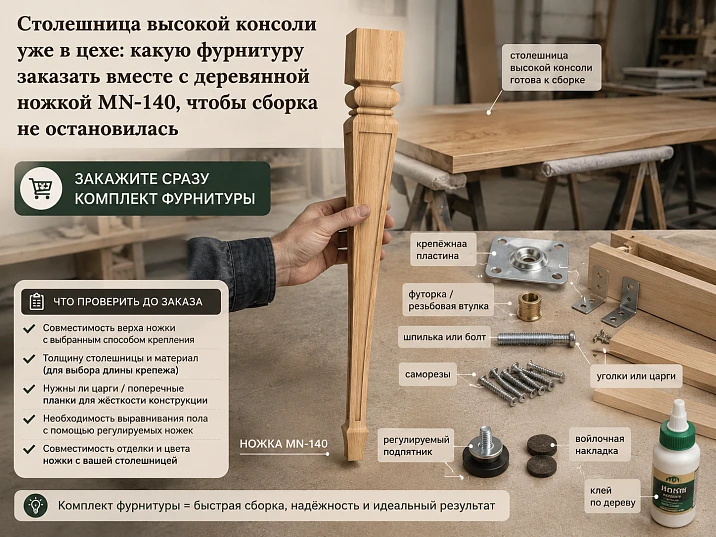
The tabletop of a tall console is approved, material is purchased, finishers are waiting for the furniture delivery date. At this stage, the client often thinks that all that remains is to choose beautiful wooden supports and pay for them. But on assembly day, it turns out: the leg is there, but the approved mounting assembly, stud, or foot pad is not. The carpenter starts selecting hardware from what is available in the workshop, deadlines shift, and the structural solution is made after the tabletop is already manufactured. With the geometric furniture leg MN-140, this risk can be eliminated before payment. The product card directly states its use in tall consoles and frameless structures, specifies M8 threaded hardware, and recommends a foot pad. At the same time, it shows several mounting options. This does not mean that any of them automatically fits any tabletop. The buyer needs to turn the list of recommendations into an approved specification for a specific piece of furniture. Let's examine how the FUR-012 kit, square plate FUR-044, and separate M8×60 stud differ, why fasteners should be chosen together with the designer, and what to add to the order so that a tall console does not remain a set of incompatible parts.
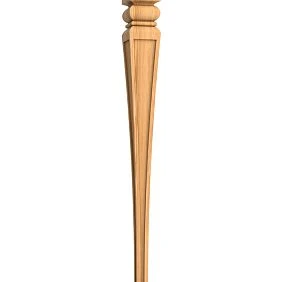
Wooden leg MN-140: what the individual product card confirms
MN-140 — a geometric solid wood furniture leg with a height of 1100 mm. The product size is specified as 1100×102×110 mm according to parameters A×D×F. The manufacturer positions the model for creating high consoles and separately states that it is intended for frameless constructions. Beech and oak are available, with two levels of sanding — "Standard" and "Prestige". The configuration selected in the card indicates gluing for enamel. This is an important detail: the grade for enamel is chosen for opaque painting, not for showcasing a color- and texture-matched lamella pattern. If the project involves transparent oil or stain, the finish option must be clarified before ordering. As of August 30, 2026, beech cost from 18,190 rubles per support in "Standard" sanding and 19,520 rubles in "Prestige". Oak — 32,330 and 33,380 rubles respectively. All four items were shown as made-to-order with an average lead time of 5–10 days. These figures change, so before purchasing you need to open the card and buy the wooden leg MN-140 only after re-checking the price, lead time, and configuration.




High frameless console: why a height of 1100 mm alone is not enough
The leg height answers only one question: at what level the lower plane of the tabletop will be, excluding the fastening unit, foot pad, and joint thicknesses. It does not determine the stability of the entire piece of furniture. For a high console, the length and depth of the tabletop, the position of the center of gravity, the number of supports, the distance between them, wall attachment, and expected lateral forces are especially important. The apron ties the supports together and helps the structure resist swaying. If it is absent, the load is transferred through the tabletop and fastening points. That is why the label "for frameless constructions" cannot be read as permission to install any number of legs under a tabletop of any size. The card describes the product's purpose but does not contain an engineering calculation of the buyer's project. Before ordering, the designer must determine how many supports are required, where they will be located, and whether an additional wall-mounted or hidden metal unit is needed. Not only vertical weight should be considered. A person may lean on the edge of a high console, bump into it while passing, or create torque when moving objects. Such scenarios cannot be assessed only by the wood species or the diameter of the pin. If MN-140 is not the only option under consideration, it is useful to first buy wooden legs for furniture after comparing models by purpose, height, shape of the top platform, and available hardware. The category helps shape the choice, and the final decision is made based on the furniture drawing.
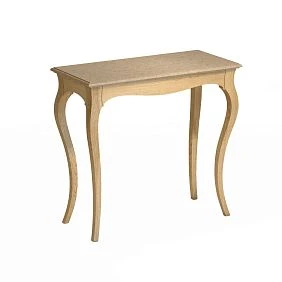
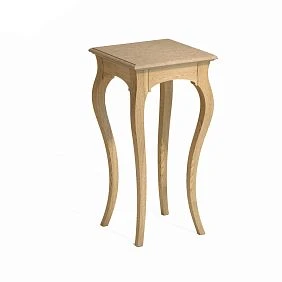
Our factory also produces:
Furniture support MN-140 and tabletop: what data to request from the carpenter
Proper purchasing begins not with choosing the "add to cart" button, but with a short technical specification. The carpenter needs to be informed of the material and thickness of the tabletop, its length and depth, the structure of the underside, the intended fastening locations, and the way the furniture will be used. If the console is adjacent to a wall, the wall material and the designed wall-mounted unit should be indicated. In response, the contractor must provide a diagram with the number of legs, fastening axes, type of hardware, and lengths of screws. It is especially important to check that the fastening holes do not intersect with the edge, internal grooves, cable channels, or decorative milling of the tabletop. The thickness of the part must allow the selected fasteners to be installed without protruding to the front side. Also ask to specify the sequence: what is installed into the leg at the factory, what is mounted to the tabletop, and what is assembled on site. Then the customer understands who to hand the pin, plate, and foot pad to. The phrase "standard fastening" is unsuitable for a specification: the article number, quantity, and purpose of each item are needed.
Get Consultation
Fastening options for MN-140: FUR-012, FUR-044, and M8×60 pin
FUR-012 kit for a wooden leg: a ready-made pair of parts
FUR-012 consists of a round mounting plate with a diameter of 37 mm with M8 thread and a metric self-tapping stud M8×60. The kit card indicates a size of 60×13×13 mm. As of the check date, the kit cost 152 rubles per piece and was available in Moscow. Its commercial advantage is obvious: the buyer receives the plate and stud in one order line. This reduces the likelihood of ordering one part of the assembly and forgetting the second. However, the presence of two parts in the kit does not prove that the round plate is suitable for a specific tabletop in terms of thickness, material, load, and hole placement. If the designer approved this particular option, one should order the FUR-012 kit for the furniture leg in a quantity equal to the number of mounting points. For two supports, usually two units of the kit are needed, for four — four, unless the drawing specifies otherwise. You should count not "per table" but according to the specification. Before payment, clarify whether the stud is installed into the leg by the manufacturer or whether this operation is performed by a carpenter. Also needed are the diameter and depth of the pilot hole, the tool, and the permissible tightening torque. Installing the hardware yourself without this data is risky: you can split the wood, strip the thread, or cause misalignment.
Mounting plate FUR-044: when a large area is really needed
FUR-044 is a square mounting plate 80×80×15 mm with an M8 threaded hole. The description clarifies that the metal part has a thickness of 2 mm, is made of stainless steel, and is equipped with four countersunk holes for flat-head screws. The card classifies it for attaching massive furniture supports, including tables without aprons, bar counters, and consoles. The large square plate distributes mounting points differently than the round plate FUR-012. However, "bigger" does not automatically mean "better." Installation requires a sufficiently flat free space under the tabletop. The four screws must go into the working thickness of the material, and the plate itself must not conflict with the edge or decorative elements. In card MN-140, FUR-044 is shown as recommended hardware, but the final compatibility of the assembly should be confirmed. After approving the drawing, you can buy the mounting plate FUR-044 separately for each support. As of August 30, 2026, one plate cost 490 rubles and was available in Saint Petersburg. The plate does not include the entire design fastening to the tabletop just because it has four holes. The type, diameter, and length of the flat-head screws are selected based on the material and thickness of the tabletop. These items need to be added to the list separately.
Stud M8×60 FUR-001-1: a separate part requires a complete assembly
The FUR-001-1 stud combines a metric M8 part and a self-tapping part. The card indicates a size of 60×8×30 mm. As of the check date, it cost 72 rubles and was available in Moscow and Saint Petersburg. A separate stud is convenient if the mounting plate has already been selected or another compatible element with M8 thread is provided. But you cannot buy it as a standalone solution: you need to understand where the metric part goes, where the wood part is screwed in, and what depth is permissible for MN-140. After agreeing on the assembly, you can buy the stud M8×60 FUR-001-1 by the number of supports with agreed reserve. If FUR-012 is selected, a separate pin is already included in the kit, and duplicating it in the main list is usually not required. The spare part is added deliberately, not due to misunderstanding of the composition.
FUR-012 or FUR-044 with pin: how to make a commercial decision
Options should be compared by completeness and design. FUR-012 costs 152 rubles and already includes a round plate d37 mm with an M8×60 pin. The FUR-044 and FUR-001-1 combination at prices as of the check date costs 562 rubles per support: 490 plus 72 rubles. The difference is 410 rubles per node before accounting for screws to the tabletop. For two supports, the hardware will be 304 rubles with FUR-012 or 1,124 rubles with FUR-044 with pin. For four — 608 or 2,248 rubles. This is basket arithmetic, not proof of equal load-bearing capacity. You cannot choose a cheaper kit if the drawing requires a larger plate, and there is no point in buying a more expensive one just for the feeling of margin. The final decision must meet five conditions: the thread is compatible with the leg; the plate fits on the underside of the tabletop; the screws match its material and thickness; the node is designed for vertical and lateral impacts; the installer is ready to work according to this scheme. If at least one item is not confirmed, the hardware order should be postponed until approval.
Floor cap FUR-023 for furniture support: floor protection and another 5 mm
The MN-140 card recommends the square floor cap FUR-023. Its size is 25×25×5 mm. It is supplied with a galvanized screw 3.5×20 and belongs to the SUPER GLIDE series. The description links the special sliding coating with the ability to move heavy structures without damaging the floor. The floor cap solves contact with the coating, but at the same time changes the node in height. Five millimeters must be taken into account in the final tabletop mark. If several supports stand on different coatings or the floor has a difference, a regular non-adjustable floor cap will not fix the geometry automatically. After checking the lower platform of the leg and the type of floor, you can order the floor cap FUR-023 by the number of supports. As of the check date, the price was 110 rubles per piece. For two legs, this is 220 rubles, for four — 440 rubles. It is also necessary to decide whether the console should move at all. Tall furniture without a tsarga may require fixation to the wall. The sliding floor cap does not cancel the design fastening and does not turn a heavy structure into an item that is safe to move without unloading.
Calculation of the MN-140 basket: one, two and four wooden supports
For purchasing, it is convenient to calculate the cost per one complete node, and then multiply by the quantity confirmed by the project. Let's take beech, "Standard" sanding and floor cap FUR-023. Option with FUR-012: 18,190 + 152 + 110 = 18,452 rubles per one support For two supports — 36,904 rubles, for four — 73,808 rubles. Option with FUR-044 and a separate pin: 18,190 + 490 + 72 + 110 = 18,862 rubles per support For two — 37,724 rubles, for four — 75,448 rubles. This calculation does not include screws for the plate, finishing materials, tabletop, wall mounting, labor, and delivery. For oak or "Prestige" sanding, it is enough to replace the cost of the leg itself, but the price should be rechecked on the day of payment. The main limitation of the calculation: the number of supports cannot be chosen based on budget. First, the designer approves the scheme, then the buyer calculates the full cart.
Material, finish, and purpose of the wooden leg MN-140
Beech or oak: how to choose a wooden support for finishing
Beech and oak differ not only in price. Oak has a pronounced porous texture and is often chosen for translucent finishes. Beech looks more uniform and suits enamel well. However, the MN-140 card in the selected configuration shows a grade for lamination under enamel. This means that with a transparent finish, possible differences in lamellas may become visually noticeable. If a tall console must be painted in a dense color, beech under enamel can be a rational option. If the goal is to show the oak grain under oil or tinting, you need to request a version prepared specifically for such a finish and confirm its availability. You should not buy an expensive wood species and then cover it with an opaque coating without a design reason. Before choosing, it is useful check the quality of sanding and lamination of the wood. "Standard" and "Prestige" describe surface preparation, while "under enamel" and "under tinting" describe the principle of lamella selection. These are different characteristics and cannot be mixed into one quality scale.
Unpainted furniture leg: when to perform finishing
MN-140 is sold in the section of unpainted legs. Finishing should ideally be designed simultaneously with the tabletop. If the leg and tabletop must match in color, test swatches are made on comparable wood and evaluated under the lighting of the future interior. Holes and metal hardware are also considered in the sequence. Sometimes it is more convenient to prepare mounting spots before the final coating but protect them from paint. In other projects, the craftsman performs a trial assembly, disassembles the product, paints the elements, and then assembles it finally. The decision depends on the coating and the technology of the joinery workshop. For comparing the assortment, you can Buy unpainted furniture legs after filtering by purpose "bar counter" or "console table". And before applying materials, it is necessary study tips for finishing a wooden leg and coordinate the primer, enamel, oil, or varnish system with the contractor.
Wooden leg for a bar counter and console: where the boundary of purpose lies
Search demand is often phrased as "buy a leg for a bar counter" because the height of 1100 mm is associated with a tall kitchen surface. The MN-140 card more accurately calls it a tall console. This distinction cannot be ignored. A bar counter in the kitchen receives regular operational load: people lean on it, stools stand nearby, and the surface may have a significant overhang. A console often adjoins a wall and is used differently. The same height does not make the structures interchangeable. If MN-140 is considered for a bar counter, request written confirmation of its application in a specific scheme. The number of supports, wall mounting, dimensions and material of the countertop, the position of seated people, and lateral loads must be known. Until then, it is correct to call MN-140 a furniture support for a tall console, not a guaranteed universal leg for any counter.
What to check upon receiving MN-140 furniture legs
Long wooden elements are inspected immediately after delivery and before painting. Verify the article number, wood species, gluing grade, sanding quality, and quantity. Measure the main dimensions, compare the top and bottom parts with the drawing, and check for the absence of transport damage. Lay out all legs of one item side by side in the same orientation. Even a geometric model made of natural wood may have visual differences. For transparent finishing, it is important to determine in advance which sides will face outward. For enamel, check the surface readiness and the amount of preparation. Hardware is accepted with a separate list: FUR-012 should not be confused with a single stud, FUR-044 with a round plate, and FUR-023 with other glides. Photograph the marking and packing list. If in doubt, do not drill or paint the product until the seller responds.
Marking and prototype of the fastening assembly before drilling the countertop
FUR-001, FUR-001-1, and FUR-012: three similar designations that must not be mixed in an order
In the MN-140 card, the FUR-001 kit, the separate FUR-001-1 stud, and the FUR-012 kit appear simultaneously. For a workshop, these are three different product items, although in all cases M8 thread and a 60 mm long stud are involved.
Kit FUR-001
The current FUR-001 card shows a kit consisting of a metric/self-tapping stud M8×60 and a metal insert M8×13. The kit size is indicated as 60×8×13 mm, and the current price is 117 rubles. This assembly differs from FUR-012 in that the mating part is an insert, not a round mounting plate.
FUR-001-1
This is only a metric stud/self-tapping screw M8×60 with dimensions 60×8×30 mm. At the time of inspection — 72 rubles. If the workshop chose the square plate FUR-044, it is the separate stud that becomes one of the parts of the assembly. Buying one FUR-001-1 without understanding the mating threaded part does not turn it into a ready-made fastener.
FUR-012
This is already a ready-made pair: a round mounting plate d37 mm with internal M8 thread and an M8×60 stud. Current price — 152 rubles.
The main practical mistake occurs when the specification simultaneously includes FUR-012 and another separate FUR-001-1 "because the leg needs a stud." In FUR-012, the stud is already included. An additional FUR-001-1 makes sense to purchase only as a separate approved element of another assembly or as a pre-agreed spare.
Top platform MN-140 102×110 mm: why the leg orientation must be fixed before drilling the tabletop
For MN-140, the top geometry is not square: the card indicates dimensions D=102 mm and F=110 mm. The difference is only 8 mm, but for a geometric support it means that rotating the leg by 90° changes the position of its faces relative to the edge of the tabletop.
Before drilling, you need to decide:
- which 110 mm side is oriented along the console facade;
- which one — in depth;
- whether all legs should face the same way;
- whether there is a visually "front" side of the wood blank;
- whether the selected orientation intersects with the edge, cable duct, or wall mounting.
If the craftsman marked the plate in the center but then rotated one leg, the structure may remain assemblable, but the geometric pattern of the supports will differ. For a high console, this is clearly visible at eye level and especially noticeable on paired supports.
It is useful to draw on the drawing not only the axis point of the leg but also a 102×110 mm rectangle with the direction labeled. Then the assembler does not make a decision about rotation after painting.
One experienced assembly before mass drilling: how to protect the finished tabletop
If the tabletop is already in the workshop, the most expensive risk is not the price of the hardware but an erroneous series of holes. Before transferring the marking to all points, it is reasonable to assemble one control assembly.
Working order:
- obtain a physical MN-140 and the selected hardware;
- check the M8 thread and actual fit;
- assemble the leg with the plate without final drilling of the entire tabletop;
- make a template for the mounting plate location;
- check the 102×110 mm orientation;
- confirm that the plate fits within the work area of the tabletop;
- check tool access;
- only after this, replicate the marking.
The control node is especially useful for FUR-044. The 80×80 mm plate has four holes, and an error in its position multiplies across the four mounting points of each support. Fixing this after final finishing is harder than moving a paper or plywood template before drilling.
This approach does not replace structural calculation. It verifies the technological assemblability of the approved project.
FUR-044 80×80 mm: not only the plate area needs to be checked, but also the free zone under the tabletop
The square FUR-044 occupies 80×80 mm. On a tall console, the underside of the tabletop may look visually simple, but the project already contains hidden elements: a reinforcing frame, cable channel, groove for backlighting, wall mounting, metal insert, or decorative chamfer along the edge.
The plate must be placed where all four mounting holes work in the base material. It cannot be positioned so that one side overhangs a cutout or two screws end up too close to the edge.
For the project list, it is convenient to record for each support:
| Support | X/Y axis | Plate | Free zone 80×80 | Conflict with other parts |
|---|---|---|---|---|
| L1 | According to the drawing | FUR-044 | Confirmed | No |
| R1 | According to the drawing | FUR-044 | Confirmed | No |
If at least in one position the area is not confirmed, you cannot assume that "the other three legs stand fine, so this one will too." The geometry of each place is checked separately.
Screws for FUR-044: there are four holes, but the fastening to the tabletop has not yet appeared in the basket
The FUR-044 card directly indicates four countersunk holes for flat-head screws. This does not mean that suitable screws are automatically included in the kit or that there is one universal length for any tabletop.
Before ordering, the workshop must determine:
- the material of the tabletop at the attachment point;
- the actual working thickness;
- the type of screw;
- diameter;
- length;
- need for pre-drilling;
- allowable depth to avoid going through to the front side.
It is better to include this line in the list separately: "FUR-044 plate screws — per workshop drawing." If left empty, on assembly day the craftsman will start looking for fasteners from the common box, and the whole point of pre-kitting will be lost.
FUR-012 also requires checking the attachment of its round plate to the base. Having a ready-made "plate + stud" kit does not eliminate the question of how exactly the mating part is fixed in a specific tabletop.
Height, floor, wall, and spatial stability of the tall console
Final height of the tall console: 1100 mm legs — not yet the height of the finished furniture
MN-140 has a height of 1100 mm. FUR-023 adds another 5 mm in foot pad height. The tabletop has its own thickness. Therefore, the final mark cannot be determined solely by the name "leg 1100".
If the foot pad is installed under the bottom plane of the leg and fully adds its nominal dimension, the geometric support height to the tabletop assembly increases to approximately 1105 mm. But the exact position of the top plane of the tabletop depends on how the plate is mounted and how the leg interfaces with the bottom surface. This is checked during the trial assembly, not derived from a photo.
For ergonomics, it is important to calculate at least three marks:
- floor → bottom of tabletop;
- floor → top of tabletop;
- floor → working/decorative line of adjacent furniture.
For example, if the tabletop is 40 mm thick, you cannot mechanically write "1100 + 5 + 40 = 1145 mm" as a finished height without confirming the upper mounting assembly. This is only a preliminary geometric check. The final dimension is taken from the assembled sample.
FUR-023 with a height of 5 mm: the floor protector protects the floor but is not an adjustable support
FUR-023 is a square floor protector 25×25×5 mm with an included self-tapping screw 3.5×20. Its sliding coating is intended for contact with the floor, but the card has no height adjustment mechanism.
This means that FUR-023 should not be used as a way to compensate for an uneven floor. If one point is lower than another by a few millimeters, four identical floor protectors will preserve this difference.
Before final assembly, it is useful to check:
- the flatness of the floor at the support points;
- whether there is a transition between two floor coverings;
- whether one leg is on a carpet or another soft layer;
- Does the project even need the adjustment capability?
If an adjustable support is necessary, that is a different structural task and a different component. You cannot "modify" FUR-023 by adding random washers without approval.
High console and baseboard at the wall: MN-140 can move the tabletop away from the design line
The console is often placed flush against the wall. But a tall floor baseboard protrudes from it and may be the first to meet the leg. Then the tabletop, designed for tight contact with the wall, will actually shift forward.
Before drilling holes, you need to measure:
- the height of the baseboard;
- its protrusion from the wall;
- the position of the leg relative to the rear edge of the tabletop;
- whether the leg can be placed in front of the baseboard;
- whether there is a separate cutout or furniture gap;
- how a wall-mounted console bracket works.
This check is especially needed for a support 1100 mm high: a slight shift at the bottom affects the position of the entire vertical. Do not trim MN-140 to fit an existing baseboard without a drawing — this changes the geometry of the finished product.
A tall console without a crossbar near the wall: the wall mounting needs to be addressed separately from the furniture leg.
MN-140 is designed for tall consoles and crossbar-free structures. However, the leg's card does not specify how a particular console is fixed to the wall and does not publish a universal limit for the lateral stability of the entire piece of furniture.
A height of 1100 mm increases the lever arm of lateral load. A person may lean on the edge, a child may pull the tabletop, a robot vacuum or furniture during rearrangement may hit the leg. Even if the vertical load on each support is acceptable, the stability of the entire item depends on the geometry and connections between elements.
Therefore, the designer must separately answer:
- is the console freestanding or wall-mounted;
- is hidden wall mounting required;
- how many fixation points;
- what wall base they correspond to;
- Is it possible to dismantle furniture without damaging the finish?
- How does the wall bracket interact with the leg plates.
Do not order wall mounting hardware "by analogy" with FUR-044: this is a different structural assembly.
Frameless design: how the tabletop becomes part of spatial rigidity
In a classic table, aprons tie the legs together and reduce their independent swaying. In a frameless console, this frame is absent. Therefore, the lower plane of the tabletop and the fastening assemblies work as a binding system.
Three commercial consequences follow from this.
First: you cannot choose a plate based only on price. If the designer approved FUR-044 due to the geometry of a specific assembly, saving 410 rubles on the support when switching to FUR-012 does not justify changing the project.
Second: the tabletop material becomes part of the calculation. Solid wood, plywood, MDF, multi-layer construction, and a stone tabletop with a substrate require different approaches to fastening.
Third: one successfully assembled test assembly does not yet confirm the stability of the entire console. A control assembly checks the installation, while a structural calculation checks the system.
Bill of materials, budget, and procurement of the complete MN-140 set
Full list for one MN-140 support: what should be in the basket and in the shop sheet
For the FUR-012 variant, the minimum list looks like this:
| Position | Quantity per one approved assembly | Comment |
|---|---|---|
| MN-140 | 1 | beech/oak, sanding, re-gluing |
| FUR-012 | 1 | round plate + M8×60 stud |
| FUR-023 | 1 | if the foot plate is confirmed |
| Fastening the plate to the tabletop | As per project | do not select on assembly day |
| Finishing materials | According to technology | primer/enamel/oil, etc. |
| Wall mounting | As per project | if required |
For the FUR-044 variant:
| Position | Quantity per one approved assembly | Comment |
|---|---|---|
| MN-140 | 1 | selected configuration |
| FUR-044 | 1 | square plate 80×80×15 |
| FUR-001-1 | 1 | Stud M8×60 |
| FUR-023 | 1 | after floor inspection |
| countersunk screws FUR-044 | 4 or according to the actual plate layout | type/length — according to the tabletop |
| Finishing | According to technology | Separate line |
| wall-mounted unit | As per project | separately from the leg |
The second table does not mean that the number of screws can be approved without a technician. It shows that four FUR-044 holes cannot be left "without a position" in the purchase list.
Total cost of two and four supports: beech and oak, "Standard" and "Prestige"
The price of one leg varies more than the cost of hardware, so it's useful to see the full range. The calculations below use current prices as of 30.08.2026 and FUR-023. Plate screws, finishing, wall mounting, labor, and delivery are not included.
Cart with FUR-012
| MN-140 | 1 leg | 2 legs | 4 legs |
|---|---|---|---|
| Beech, "Standard" | 18 452 ₽ | 36 904 ₽ | 73 808 ₽ |
| Beech, "Prestige" | 19 782 ₽ | 39 564 ₽ | 79 128 ₽ |
| Oak, "Standard" | 32 592 ₽ | 65 184 ₽ | 130 368 ₽ |
| Oak, "Prestige" | 33 642 ₽ | 67 284 ₽ | 134 568 ₽ |
Cart with FUR-044 + FUR-001-1
| MN-140 | 1 leg | 2 legs | 4 legs |
|---|---|---|---|
| Beech, "Standard" | 18 862 ₽ | 37 724 ₽ | 75 448 ₽ |
| Beech, "Prestige" | 20 192 ₽ | 40 384 ₽ | 80 768 ₽ |
| Oak, "Standard" | 33 002 ₽ | 66 004 ₽ | 132 008 ₽ |
| Oak, "Prestige" | 34 052 ₽ | 68 104 ₽ | 136 208 ₽ |
These tables don't answer whether you need two or four legs. They allow you to quickly calculate an already approved designer option and see that the savings on the mounting assembly relative to the cost of an oak leg are small.
"Standard" or "Prestige": the price difference is less than the cost of repeated manual finishing at an inappropriate time
For beech, the difference between current "Standard" and "Prestige" prices is:
19 520 − 18 190 = 1 330 ₽ per leg.
For oak:
33 380 − 32 330 = 1 050 ₽ per leg.
But you don't need to automatically choose "Prestige." If the workshop still performs deep preparation for a complex coating, its own technological cycle can offset part of the advantage. If the legs need to arrive as prepared as possible for finishing and the shop wants to reduce manual touch-up, "Prestige" may be more rational.
The decision needs to be coordinated with whoever actually paints or tints the product. The buyer should not pay for higher-grade sanding just because the word sounds better.
Under enamel or under tinting: you need to check not the wood species, but the specific lamination of the selected MN-140.
The card explains that "under enamel" and "under tinting" are not levels of sanding, but an approach to selecting lamellas.
Under enamel, lamellas can noticeably differ in tone and texture, because they are intended to be covered with an opaque material. Under tinting, lamellas are selected more carefully by color and texture, although natural variations are still possible.
Therefore, the formula "oak = clear oil" is incorrect. You can buy expensive oak in a lamination under enamel and, after applying a clear coating, get contrasting lamellas that the designer did not expect.
If the project wants visible oak, the specification should separately include:
- wood species — oak;
- the quality of sanding;
- lamination quality for transparent/semi-transparent finishing;
- specific coating system.
Fasteners are already approved, but the fittings haven't arrived yet: don't drill the countertop based on dimensions from memory
FUR-012 has a small round plate, FUR-044 is a square 80×80 mm. Even when the article number is approved, it's better to have the physical part or an official drawing before final marking.
The reasons are simple:
- the workshop might confuse FUR-044 with another square plate;
- the mounting holes must match the actual product;
- the height of the threaded assembly affects the trial assembly;
- the holes for self-tapping screws need to be seen relative to the countertop edge.
The lead time for MN-140 on order is 5–10 days, which creates a temptation to 'while the legs are being made, we'll drill the countertop.' This is only reasonable if the fittings have already been physically verified and the drawing is frozen. Otherwise, saving a few days might end up with reworking a finished part.
Fittings are in different warehouses: the assembly date is determined by the last arrived item
At the time of checking, FUR-012 is shown in Moscow, FUR-044 in Saint Petersburg, FUR-001-1 in both cities, FUR-023 in Saint Petersburg. Warehouse stock changes daily, but the example shows the main point: a set for one console can physically be assembled from several logistics flows.
Do not schedule assembly based on the deadline of one leg. The calendar should include:
- production of MN-140;
- reservation of fittings;
- shipment from warehouses;
- delivery to the workshop;
- incoming inspection;
- test assembly;
- finishing;
- final assembly.
If one element is delayed, it is better to postpone the drilling or painting date than to replace it with a "similar" one without re-approval.
Is a spare set of fasteners needed?
No need to automatically buy two FUR-012 for each leg. The hardware is inexpensive, but extra parts complicate inventory and may be accidentally used in another scheme.
A reserve is justified if:
- assembly takes place far from the supplier;
- repeat delivery is critical in terms of timing;
- one damaged stud will stop the installation;
- the workshop has pre-agreed a backup position.
For FUR-044, a backup plate makes sense only after confirming that it is exactly the same and will be stored separately. Spare countersunk screws are usually easier to include in the workshop's consumables list.
After assembly: what to check before handing over the high console to the customer
Final acceptance should check not only the appearance.
Geometry
All MN-140 are in the specified orientation. The tabletop has no visible skew. The actual height matches the project.
Rigidity
During a routine check, there is no play in the threaded connections and no visible movement of the plates relative to the tabletop. The test load and inspection method must comply with the workshop design — the article does not prescribe a universal "rocking test."
Floor
The FUR-023 feet make even contact with the surface. No leg is hanging or overloaded due to uneven flooring.
Wall
If wall fixation of the console is specified, it is completed before furniture delivery. It cannot be assumed that the customer will "screw it on later."
Service
It is clear whether the leg can be removed, the foot replaced, or the joint tightened without damaging the tabletop and finish.
When it is better not to buy MN-140 for a specific console at all
MN-140 should not remain in the project just because it was already chosen visually. A different support or a different structure is needed if:
- the height of 1100 mm does not provide the required final elevation;
- the tabletop does not allow placement of the approved plate;
- the project requires an adjustable support, and FUR-023 is non-adjustable;
- The console must be freestanding, but the lateral stability calculation is not confirmed;
- The plinth or wall-mounted unit conflicts with the position of the legs;
- A transparent finish is mandatory, and the available re-lamination of a specific item is designed for enamel;
- The number of supports has to be "guessed" instead of calculated.
In such a situation, it is better to reconsider the model before payment. An expensive wooden leg should not force the tabletop
Stone, quartz agglomerate, or ceramic with a backing
The leg must not be attached "as to wood" directly into a fragile decorative panel if the project does not provide for a corresponding load-bearing sublayer or a separate metal unit. For such tabletops, it is especially important to obtain a drawing from the tabletop manufacturer: where the load-bearing backing is located, what thickness is available for fastening, and who is responsible for the holes.
Therefore, the phrase "FUR-044 fits the console" is insufficient. It is correct to say: "FUR-044 is approved for this MN-140 and this specific tabletop construction."
Selection matrix for FUR-012 or FUR-044: what to actually compare before purchasing
| Criterion | FUR-012 | FUR-044 + FUR-001-1 |
|---|---|---|
| Mating part | round plate d37, M8 | square plate 80×80, M8 |
| Stud M8×60 | already included | purchased separately |
| Number of mounting points to the tabletop | according to the design of the complete plate | four countersunk holes |
| Required free area | More compact | need space for 80×80 mm |
| Price of the assembly without the foot | 152 ₽ | 562 ₽ |
| Screws for countertop | Check separately | Select separately |
| Main selection criterion | Not a price, but a node approved by the designer | |
This matrix is useful as a purchasing tool, but not as an engineering load-bearing table. The cards do not provide universal limit loads for the pair "MN-140 + specific countertop + specific screws." Therefore, one cannot derive the rule "FUR-044 is always stronger" solely from its size.
When FUR-012 is especially convenient commercially
When the designer has already approved a small round plate and the number of individual SKUs needs to be minimized: one kit already includes the plate and the stud. This reduces the risk of forgetting FUR-001-1.
When FUR-044 is especially convenient technologically
When there is a confirmed free plane of 80×80 mm under the countertop, the workshop wants a clear square base for marking, and the project provides for four fixation points. But together with the plate, a stud and approved screws must be added immediately.
Procurement calendar: how not to schedule assembly before the entire MN-140 node is ready
A high console often fails not because of a complex part, but because of incorrect sequencing. The countertop is ready, the legs are still being produced, the plate is in another warehouse, and the finisher is already scheduled. To avoid this situation, procurement should be managed by control dates.
| Stage | What must be covered | What not to do earlier |
|---|---|---|
| T0 — drawing | number of supports, axes, mounting type | finally drill the countertop |
| T1 — order | MN-140, main fasteners, support feet | schedule assembly "for tomorrow" |
| T2 — receiving hardware | physical plates and studs in the workshop | duplicate holes without testing |
| T3 — obtaining legs | size, orientation, sanding checked | start finishing without acceptance |
| T4 — control node | one support assembled and agreed | drill all positions |
| T5 — finishing | paint accepted, seats protected | Final assembly |
| T6 — assembly | entire list closed | hand over the product to the customer |
Such a calendar is especially useful when MN-140 is manufactured in 5–10 days. Production time can be used for a test finish card and template preparation, but not for irreversible holes based on unverified hardware.
Transfer of specifications between the designer, carpenter, finisher, and assembler
The same console passes through several hands, and each specialist sees only their part of the task. An error occurs when information is conveyed verbally.
Designer
Records the MN-140 number, axes, 102×110 mm orientation, plate type, wall mounting, and tabletop constraints.
Carpenter
Checks whether the tabletop can be manufactured with these mounting zones, approves the screws and hole technology, makes a control joint and template.
Finisher
Receives information about sanding, re-gluing, future enamel or tinting, and which threaded/mounting zones must not be covered with coating.
Assembler
It receives not a set of parts, but a specification: "L1 — MN-140 beech Prestige; FUR-044; FUR-001-1; FUR-023; side orientation per arrow; tabletop fastening such-and-such." Then no new structural solutions are accepted at the site.
For a complex order, it is useful to print one sheet for each support. On it — the number, the side of the furniture, the leg pattern, the hardware, and a photo after a trial assembly. This is especially convenient for oak under a transparent finish, when each leg is already assigned to a specific outward-facing side.
Control scenarios: when the same cart gives a different result
Two MN-140 at a wall-mounted console
Even if the designer has approved two supports, stability may be ensured by a separate wall mounting. The leg cart does not automatically include this component. Therefore, the calculation of 36,904 ₽ or 37,724 ₽ for beech is only part of the full specification.
Four MN-140 at a freestanding structure
Four supports increase the cost and the number of fastening points, but do not guarantee stability automatically. The tabletop length, leg positioning, and lateral rigidity remain subject to calculation.
One decorative MN-140 as an additional support
Sometimes a leg is used not as the sole load-bearing system, but as a visible support with a hidden metal frame. Then its hardware must be coordinated with the frame, and a simple table "one leg = one FUR-012" may not describe the actual project.
These scenarios show why the number of legs cannot be derived from the product page or the commercial budget. First the structure, then the cart.
If the tabletop is already drilled for a different fastener: do not fit MN-140 without a new drawing
The most unpleasant scenario is when the tabletop is already finished and holes have been made in it for a different leg or a different mounting plate. At this stage, you cannot assume that MN-140 "will fit anyway on M8". Thread coincidence does not mean the geometry of the mounting base matches.
First, you need to compare:
- axes of the old holes;
- actual size of the old plate;
- FUR-012 d37 or FUR-044 80×80;
- free area around the old assembly;
- residual strength of the material after the existing holes;
- possibility of shifting the leg axis without compromising the design.
If the holes do not match, the designer makes the decision: whether a new location can be used, whether reinforcement is acceptable, or whether the tabletop needs to be redone. You cannot enlarge the old holes "to make them match" or install FUR-044 over the damaged area just because its area is larger.
If the old plate was smaller
A large FUR-044 can physically cover traces of previous fasteners, but decorative coverage is not proof of structural suitability. Four new screws must work in full material.
If the old leg axis differs
Even a shift of 10–20 mm can change the visible overhang of the tabletop and the symmetry of the two supports. This is especially noticeable for geometric MN-140. The rework is checked on the facade and in plan.
If the required FUR-012 or FUR-044 is temporarily out of stock
Do not replace an approved item with a "similar M8 plate" just to meet the assembly date. Another part may differ in size, hole placement, thickness, mounting method, and required fasteners. Even the same M8 thread only confirms compatibility of the threaded pair, not the entire furniture structure.
Rational sequence:
- clarify the actual delivery time of the approved item;
- check the possibility of postponing the assembly;
- if the deadline is critical — get a specific replacement from the designer with an article number and a new scheme;
- update the tabletop drawing;
- only then buy an alternative.
For a console that is already in production, changing one cheap part can change four holes on each support. Therefore, the cost of delay is sometimes less than the cost of a "quick" rework.
Mistakes when ordering legs and fasteners
The first mistake is to buy only MN-140 and leave the selection of fasteners for the assembly day. The second is to order FUR-012 and a separate stud for each unit at the same time, without noticing that the stud is already included in the kit. The third is to choose FUR-044 only because a larger plate seems more reliable. You cannot assume that a height of 1100 mm automatically fits the ergonomics of a specific room. The final height is changed by the tabletop, the fastening unit, and the foot. You cannot assign the number of legs based on a photo, install a support without checking lateral stability, or transfer the calculation of another model to MN-140. It will also be a mistake to apply a transparent finish to a workpiece for enamel without assessing the lamellas. Also, do not order legs and hardware from different warehouses for the morning of assembly: even an item "in stock" may require time for preparation and shipping.
Launch to the workshop: completeness check and final assembly
List of "what is already in the workshop / what else to order": a simple check before launch
Before the final assembly date, a status table is useful:
| Position | Approved | In the workshop | Ordered | Physically verified |
|---|---|---|---|---|
| Tabletop | Yes | Yes | — | Yes |
| MN-140 | Yes | no/yes | Yes | after receiving |
| main mounting unit | Yes | no/yes | Yes | Mandatory |
| FUR-023 | Yes/No | no/yes | Yes | Check |
| Screws for countertop | According to the drawing | Yes/No | — | Yes |
| Wall mounting | As per project | Yes/No | — | Yes |
| Finishing materials | Yes | Yes/No | — | Test swatch |
The red line in this table is the reason not to start an irreversible operation. For example, if the "main mounting unit" is approved only verbally, and the physical plate is not yet in the workshop, it is better not to drill the countertop definitively.
Such a sheet is especially useful when the client, furniture maker, and finisher are different participants. Each sees which item is actually closed and which exists only in correspondence for now.
How to order MN-140 as a full set
First, get the console drawing. It must include the countertop, number of supports, axes, wall mounting, and the selected hardware option. Then confirm the leg material, sanding quality, and type of future finish. If FUR-012 is selected, add one unit of the kit for each mounting point to the order. If FUR-044 is approved, add a square plate, agreed stud, and suitable screws to the countertop. Add floor glides as a separate line. Don't forget consumables and a test swatch. Before payment, check which warehouse each item ships from and whether the seller can combine them into one delivery. The production time for MN-140 may be longer than preparing warehouse hardware. Therefore check payment and delivery of MN-140 should be done before the final assembly appointment. Record the specification in writing: article number, material, sanding, quantity, fasteners, floor glides, deadline, and address. Such an order can be checked before payment and again upon receipt.
Checklist for the workshop before starting the countertop
- MN-140 is selected according to the current card and drawing.
- The number of supports has been confirmed.
- The lateral stability of the high cantilever without a tsarga has been calculated.
- The attachment of furniture to the wall has been approved, if required.
- One main node has been selected: FUR-012 or FUR-044 with a compatible stud.
- Screws for the tabletop have been determined.
- The material thickness at attachment points has been checked.
- The height of the support foot of 5 mm has been taken into account.
- Beech or oak have been coordinated with the coating.
- "Standard" or "Prestige" have been included in the specification.
- The finish under enamel or tinting has been confirmed separately.
- Delivery is scheduled with a buffer for receiving.
If the workshop cannot fill several key lines, the countertop should not be finally drilled. It is better to stop production at the documentation stage than to redo a finished part.
Frequently asked questions about the wooden leg MN-140
What is the height of MN-140?
The card indicates 1100 mm. The full size is recorded as 1100×102×110 mm according to parameters A×D×F.
What furniture is the leg intended for?
The manufacturer mentions tall consoles and frameless constructions. Use in a bar counter requires checking the specific project.
What wood is MN-140 made from?
Beech and oak are available. The price is also affected by the quality of sanding.
What to choose: "Standard" or "Prestige"?
"Standard" means machine sanding, "Prestige" means more detailed hand preparation. The choice depends on the workshop's requirements for subsequent finishing.
What does 'for enamel' mean?
The slats are glued without matching by color and texture, since the surface is intended to be covered with an opaque coating.
Is the fastener included in the price of the leg?
The card shows the hardware as separate items. The order set must be assembled independently and confirmed with the seller.
What is included in FUR-012?
Round mounting plate with a diameter of 37 mm with M8 thread and a self-tapping stud M8×60.
How does FUR-044 differ from FUR-012?
FUR-044 is a square reinforced plate 80×80 mm with four holes and M8 thread. The stud and fasteners to the tabletop for it are accounted for separately.
Can I choose the plate only by price?
No. The size and layout of the plate must match the tabletop and the structural calculation.
Is the floor guide FUR-023 needed?
The MN-140 card recommends it. It is necessary to check the lower platform of the leg, the floor covering, and account for an additional 5 mm of height.
How many legs are required for the console?
The card does not set a universal quantity. It is determined by the designer based on dimensions, wall mounting, and loads.
Will one leg support the tabletop?
Based on published data, the safety of a specific scheme cannot be confirmed. A calculation of the entire structure is needed, not just the vertical capacity of one support.
Can MN-140 be used for a kitchen bar counter?
Only after confirmation by the designer. A kitchen counter and a tall console may have different operational loads.
When to order the hardware?
At the same time as the legs, but after the drawing is approved. Then the set can be checked before the assemblers arrive.
How to avoid overpaying for extra studs?
Check the contents of FUR-012: the M8×60 stud is already included in the set. A separate FUR-001-1 is added only for another approved assembly or as an agreed reserve.
Conclusion: you need to buy not a leg, but an approved assembly unit
MN-140 solves the aesthetic and dimensional problem of tall furniture: it is a geometric wooden support 1100 mm high for a console without an apron. But the readiness of the tabletop does not make the choice of fasteners a formality. FUR-012, FUR-044, M8×60 stud, and FUR-023 perform different functions and should not end up in the cart as a random set. The most rational order is this: the designer approves the number of supports and the assembly unit, the workshop checks the tabletop, the buyer chooses the material and sanding, then orders legs, fasteners, and floor glides in one specification. After that, production timelines and warehouses are coordinated. This way, the commercial request "buy furniture legs" turns into a kit that can actually be assembled. And the tall console does not stop in the workshop because of one forgotten plate or an incorrectly selected stud.