
































Article Contents:
- Conical table base STL-041: first, check the tabletop dimensions
- How to quickly determine whether STL-041 is worth considering at all
- Support for a round table: which diameter is suitable for STL-041
- How to find the center of a round tabletop before installation
- How to match the support finish with an already purchased tabletop
- Why you shouldn't buy fasteners "approximately by thickness"
- How to assess the overhang of ST-030 relative to STL-041
- Height of the finished table: what you get with a 740 mm support
- When a single STL-041 is not suitable for a long tabletop
- What to check on stone, glass, and composite tabletops
- How to check the center of gravity of a finished tabletop
- Why a central support requires especially precise marking
- Table base for a kitchen table: what else to check
- Table base for a writing and conference table
- Mistake 1. Chose the support only by photo
- Mistake 2. Called STL-041 a solid wood table base
- Mistake 3. Did not order FUR-034
- Mistake 4. Decided that fasteners are included in FUR-034
- Error 5. Selected a screw only based on the tabletop thickness
- Error 6. Assumed a 1200 mm circle was automatically safe
- Error 7. Placed the support not in the center
- Error 8. Did not check the final table height
- Error 9. Ordered oak veneer, expecting an exact match with the oak tabletop
- Error 10. Used a single central support for a long rectangle
- The tabletop is already drilled: can old holes be aligned with FUR-034
- What to do if the tabletop already has embedded inserts
- Dry assembly of STL-041 and FUR-034 before final fastening
- How to calculate the preliminary height of the finished table
- How to estimate local edge load without a complex engineering formula
- Checking floor levelness and stability of the finished table
- When the tabletop is less than 600 mm: why "less" is not always safer
- When the tabletop is 1200 mm: what to check at the upper end of the range
- What to check upon receiving STL-041 and FUR-034
- What data must not be guessed when ordering STL-041
- Scenario 1. Round oak tabletop 1000 × 40 mm
- Scenario 2. Round tabletop 1200 × 24 mm made of veneered construction
- Scenario 3. Square tabletop 900 × 900 × 30 mm
- Scenario 4. Rectangular tabletop 1000 × 600 × 25 mm
- Scenario 5. Rectangular tabletop 1600 × 800 mm
- Scenario 6. Stone tabletop 900 mm in diameter
- Scenario 7. Tabletop ST-030 already purchased
- Scenario 8. Tabletop 50 mm and already purchased chairs
- Scenario 9. Tabletop 18 mm
- Scenario 10. Tabletop 550 mm in diameter
- What is the size of STL-041?
- What material is the STL-041 table base made of?
- Can STL-041 be called a solid wood table base?
- Which round table is suitable for STL-041?
- Will a 1300 mm tabletop fit?
- What is the limit for a square tabletop?
- Can STL-041 be placed under a long rectangular tabletop?
- What tabletop thickness is acceptable?
- What is FUR-034?
- Is FUR-034 included in the STL-041 set?
- Are self-tapping screws and bolts included in the FUR-034 set?
- How to choose fasteners for a wooden tabletop?
- Can FUR-034 be attached to stone?
- Does ST-030 fit STL-041?
- What material is ST-030 made of?
- What load is specified for STL-041?
- Can STL-041 be ordered for enamel coating?
- Can the underframe be made with an oak texture?
- What is the production time for STL-041?
- Do I need to buy FUR-034 if the tabletop already has its own mounting inserts?

The tabletop is already in the workshop or has arrived at the site, but the base has not been selected yet. At this point, the underframe is often chosen by appearance: the cone looks nice, the color fits, it looks good in photos. For a finished tabletop, the order should be reversed. First, check the geometry, thickness, material, and mass of the top slab, then compare them with the support's allowable range, and only then choose the finish.
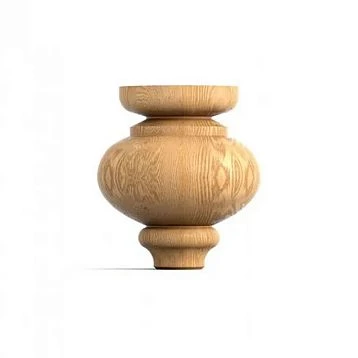
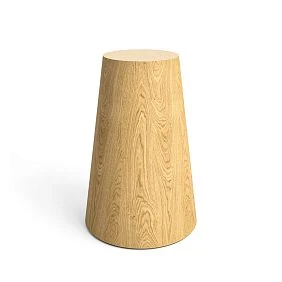
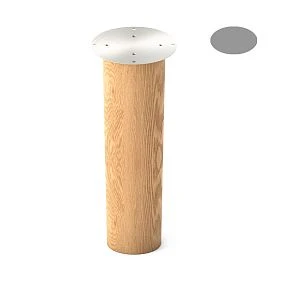
Table underframe STL-041 has dimensions of 500 × 740 × 300 mm. It is a hollow cone-shaped structure made of MDF and plywood. The basic MDF version is intended for covering enamel; veneered versions with beech or oak are also available for tinting, clear lacquer, and other finishing scenarios. The manufacturer specifies STL-041 as a support for dining, writing, and conference tables and separately recommends using the metal plate FUR-034 for connection to the tabletop.
For compatibility, not only the dimensions of the underframe itself matter. The card provides guidelines for tabletops: round shape with a diameter of 600–1200 mm, square and rectangular options up to 1000 × 1000 mm, thickness of 20–50 mm, and a uniformly distributed load of up to 150 kg with a properly executed mounting joint. These figures give a working range but do not turn STL-041 into a universal support for any slab that falls within the formal size. A long rectangular tabletop, heavy stone, asymmetric overhang, or non-standard center of gravity requires a separate calculation.
The main task before purchasing is to answer five questions: what is the tabletop's shape; what is its actual size; what is its thickness; what is it made of; how much does it weigh. After that, check where the center of gravity is, whether the support can be placed in the center, whether FUR-034 is suitable for the chosen mounting method, and which fasteners are acceptable for the top slab material. If any of these points is unknown, it is too early to order the "underframe + plate" set.
Conical underframe STL-041: first, check the tabletop dimensions
STL-041 has a compact central geometry: the upper and lower parts are connected by a conical body. This support works well where the tabletop can rest on a single central joint and the seating areas need to be kept free of four corner legs. However, the base shape itself does not answer the compatibility question. It must be compared with the specific top slab.
Before ordering, place the tabletop face down on a protected surface or use its working drawing. Record the shape, diameter or length and width, thickness in the mounting area, base material, mass, presence of reinforcements, mounting inserts, backsplash, subframe, or already made holes, geometric center, and the intended center of gravity.
The size of STL-041 — 500 × 740 × 300 mm — should also be read as data for a specific model, not as a ready table height. The final height is formed from the underframe height, the mounting joint, and the tabletop thickness. If the top slab is 24 mm thick, the finished furniture will be at least the thickness of the tabletop and the connecting joint higher than the support itself. The exact final mark should be confirmed against the assembly drawing, especially if the table is designed for already purchased chairs.
If the buyer is looking for where to buy a base for a table, for a ready-made countertop, the filter should start with compatibility, not color. The catalog has different supports, and STL-041 should only be chosen when its geometry and mounting system fit the specific slab.



How to quickly understand whether STL-041 is worth considering at all
| Countertop parameter | What to check | Result of initial check |
|---|---|---|
| Round 600–1200 mm | Diameter, weight, thickness 20–50 mm, central mounting | Fits the declared range; proceed to mounting and weight |
| Square up to 1000 × 1000 mm | Center of gravity, thickness, material, uniform overhang | Included in card reference; installation check required |
| Rectangle up to 1000 × 1000 mm | Actual length/width and center of gravity | Formally possible, but asymmetry and stability are checked separately |
| Longer than 1000 mm along one axis | Engineering support scheme | Do not automatically consider compatible |
| Thickness less than 20 or more than 50 mm | Mounting method | Outside the specified range |
| Mass is close to 150 kg or higher | Load distribution and fastening | A separate calculation is needed |
This check is needed to avoid confusing "size falls within the range" with "the set is guaranteed ready for assembly." For example, a round tabletop of 1200 mm and 40 mm thick formally meets two constraints, but if it is made of heavy stone, the mass and attachment to the stone need to be checked separately.
Our factory also produces:


Support for a round table: which diameter is suitable for STL-041
For round tabletops, the manufacturer specifies a diameter range from 600 to 1200 mm. The central conical support is especially logical for a circle: the axis of the underframe can be aligned with the geometric center of the tabletop, and the overhang around the perimeter is uniform.
If the maximum horizontal dimension of the support, 500 mm, is used as a reference external size, the visual overhang of a round tabletop can be estimated. For a circle with a diameter of 600 mm, the difference from 500 mm is 100 mm, meaning that with perfect centering, the tabletop edge protrudes approximately 50 mm beyond the maximum base dimension on each side. For a diameter of 800 mm, the overhang is about 150 mm; for 1000 mm, about 250 mm; for 1200 mm, about 350 mm. This is a geometric illustration of scale, not a calculation of permissible load.
| Tabletop diameter | Difference from 500 mm | Approximate overhang when centered |
|---|---|---|
| 600 мм | 100 мм | about 50 mm |
| 800 мм | 300 мм | about 150 mm |
| 1000 мм | 500 мм | about 250 mm |
| 1200 мм | 700 мм | about 350 mm |
The larger the diameter, the more important precise centering is. If a 1200 mm circle is shifted relative to the support axis by 30 mm, the overhang on one side becomes larger, and on the opposite side — smaller. Externally, the table may look asymmetrical, and when a load is applied to the edge, the lever arm of the force changes.
Get Consultation
How to find the center of a round tabletop before installation
If the factory center marking is absent, the circle can be marked out geometrically. On the reverse side, draw two chords, find the midpoint of each, and construct perpendiculars to them. The intersection point of the perpendiculars will give the center of the circle. For furniture production, it is easier to use a factory template or CNC coordinates.
After finding the center, apply FUR-034 and align its geometric axis with the center of the tabletop. Do not drill immediately. First, check that the plate holes do not fall into technological cavities, seams, internal inserts, or hazardous zones of the material.
Frame for a square tabletop: where the limit of 1000 × 1000 mm lies
For square and rectangular tabletops, the STL-041 card indicates a size up to 1000 × 1000 mm with correct positioning of the center of gravity. For a square, this logic is most understandable: with central installation of the support, the geometry on all four sides is symmetrical, and the overhangs can be made equal.
Let's take a 900 × 900 mm tabletop. If the maximum horizontal dimension of the underframe along one axis is 500 mm and the support is centered, the difference along that axis is 400 mm, meaning the approximate geometric overhang is 200 mm on each side. For a 1000 × 1000 mm tabletop — 250 mm on each side. These figures help assess the proportion but are not a stability calculation.
A square plate differs from a round one by the presence of corners. A person can lean precisely on a corner, creating a load farther from the central axis than in the middle of a side. Therefore, with a heavy tabletop or intensive use, not only the total mass is assessed, but also the extreme points of load application.
If the task is formulated as "buy a table frame," STL-041 should be understood as a central pedestal base of a specific geometry, not a universal frame supporting the entire surface from above. The larger and heavier the square, the more important the rigidity of the tabletop, the position of FUR-034, and the quality of the connection.
Rectangular tabletop: why a single figure "up to 1000 × 1000" is not enough
A rectangle creates a different load character. For a 1000 × 700 mm tabletop with a central support, the overhang along the long axis is greater than along the short one. If a person leans on the long edge, the moment relative to the base is higher than for a compact square.
Therefore, even within the formal limit, it is necessary to check the ratio of length to width, the position of the center of gravity, the mass of the tabletop, the rigidity of the slab itself, the purpose of the table, the expected load on the edges, and the possibility of central installation of the pedestal.
For a long rectangular conference tabletop that exceeds the stated length limit, compatibility with a single STL-041 cannot be promised without an engineering calculation. Two supports, a different frame, or a special transition structure may be required. The mere fact that the tabletop is relatively light does not eliminate the risk of rocking on a large lever arm.
Tabletop thickness 20–50 mm: why check it before choosing hardware
The STL-041 card indicates adaptation of the fastening system for tabletop thicknesses from 20 to 50 mm when using appropriate fasteners. This does not mean that the same screw length fits the entire range.
For a 20 mm tabletop, the depth margin for screwing is limited. A screw that is too long can exit onto the face surface or cause damage. For a 50 mm slab, on the contrary, a fastener that is too short may not provide sufficient working engagement. Therefore, hardware is selected after measuring the actual thickness and understanding the material.
If the tabletop has variable thickness—for example, a beveled edge or a recess from below—measure specifically the area where the FUR-034 holes will be. Nominal "40 mm at the edge" does not guarantee 40 mm in the center.
Tabletop mass and load up to 150 kg: how to correctly read the limitation
The stated up to 150 kg refers to a uniformly distributed load and a proper mounting assembly. This does not mean that 150 kg can be applied to any edge of the table or that any tabletop weighing 149 kg is automatically compatible.
For a heavy top plate, first determine the tabletop's own weight. Then add the expected operational load: dishes, equipment, books, samples, appliances. In a conference table this may be one distribution, in a kitchen table another, in an exhibition table a third.
It is especially important to distinguish between uniform and local load. If a heavy object stands directly above the center, the situation is one thing. If a person sits or leans heavily on the edge, a moment is created relative to the central support. The greater the overhang, the stronger this effect.
For stone, glass, and composite, not only the weight but also the method of fastening must be considered. The FUR-034 plate allows different fastener options, but the specific fastener is chosen for the material. A wood screw cannot be used as a universal solution for a stone slab.
MDF underframe or veneered support: which finish to order
STL-041 cannot be called a basic solid wood underframe. Its hollow structure is made of MDF and plywood. The basic MDF version is intended for covering enamels and is supplied with preparation for such a finish.
If the project requires an opaque surface—white, black, graphite, colored—it is logical to consider the MDF version under enamel. Here, the wood texture is not part of the design, so veneer is not needed just for the sake of having wood.
The veneered version is created on the same structural basis, but the surface is veneered with beech or oak veneer. This option is chosen when the wood texture must remain visible in the finish. The manufacturer allows tinting with stains, clear lacquers, and patination.
Beech is visually calmer and suitable for a smooth, more uniform texture. Oak has a more pronounced grain. If the tabletop is already purchased and has a noticeable wood texture, the underframe should be selected not by the species name but by the actual finish sample. An oak tabletop and oak veneer on the underframe do not have to automatically match in tone.
Before finishing, it is useful to check material and quality of STAVROS products, especially if the top and the base will be finished with different technologies.
How to match the base finish to an already purchased tabletop
If the tabletop is already ready, the base has to be adapted to it, not the other way around. For an enameled top plate, you can choose contrasting or matching enamel. For an oak tabletop — veneered oak with tinting in a close tone. For beech — beech or painted MDF depending on the project.
You should not choose a shade only from a photo on the website. This is especially true for clear lacquer and tinting: natural veneer reacts to stain and light differently than solid wood or another batch of veneer. If the interior is expensive and matching the tone is critical, a real sample is needed.
Patination only makes sense as part of the overall design. On the modern conical shape of STL-041, patina can become an expressive accent, but if the tabletop is minimalist and smooth, this effect should be evaluated in a visualization.
Mounting plate FUR-034 for the STL-041 base
To connect STL-041 to the tabletop, the manufacturer recommends purchasing separately mounting plate for the STL-041 base. This is a metal steel plate with a diameter of 420 mm and a thickness of 2 mm with a black moiré coating.
Mounting plate for table base STL-041 It is attached to the support through countersunk holes located along the inner diameter. Then the table base with the installed plate is connected to the lower plane of the tabletop through the outer holes. The card indicates holes with a diameter of 9 mm along the edge of the plate.
Critical limitation: fasteners are not included in the FUR-034 delivery. They are selected separately depending on the material and thickness of the tabletop. This means that the order "STL-041 + FUR-034" is not yet a complete mounting kit.
| Element | What is confirmed | What needs to be selected separately |
|---|---|---|
| STL-041 | Conical table base 500 × 740 × 300 mm | Finish treatment if necessary |
| FUR-034 | Steel, Ø 420 mm, thickness 2 mm | Hardware |
| Attachment to the support | Through inner countersunk holes | Suitable screws |
| Attachment to the tabletop | Through external holes Ø 9 mm | Metric screws or self-tapping screws for the tabletop material |
If you want Buy mounting plate FUR-034, before ordering, you need to know the material of the top plate. For wood, MDF, plywood, stone, and composite, the fastening scheme differs.
Why you can't buy fasteners "approximately by thickness"
Let's imagine a tabletop 24 mm thick. It seems obvious to take a screw shorter than 24 mm. But you need to consider the thickness of the plate itself, the head design, the working depth of screwing, possible gaps, a layer of veneer or finish, and the allowable drilling depth. The simple formula "thickness minus 2 mm" is insufficient.
For metric screws, an insert or threaded element in the tabletop is required. If they are absent, the screw cannot simply be screwed into a wooden board like a self-tapping screw. For stone, a special insert or adhesive assembly is usually needed, which must be designed by a material specialist.
Therefore, the manager or installer needs to be informed not only of the thickness but also of the exact base material. The phrase "oak tabletop" is insufficient: under the veneer there may be MDF, plywood, or another structure.
Tabletop ST-030 and underframe STL-041: a ready-made combination from the catalog
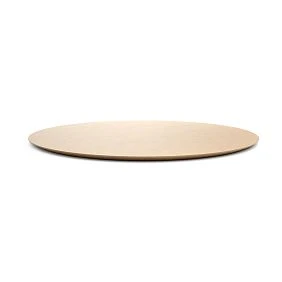
On the STL-041 card, the ST-030 tabletop is shown as a related product and is used in interior photos. ST-030 measures 1148 × 1148 × 24 mm and is available in beech or oak variants with an MDF/solid wood/veneer construction.
ST-030 tabletop in oak or beech has a round contour with a diameter of about 1148 mm and a thickness of 24 mm. By both parameters, it falls within the stated range of STL-041: round 600–1200 mm and thickness 20–50 mm.
But even for a pair of products from the same catalog, it is reasonable to confirm the set before ordering: verify the current drawings, the mounting method, FUR-034, and the selected tabletop modification. This is especially important if ST-030 has already been purchased separately and additional work has been performed on it.
If the tabletop has been trimmed, reinforced, received inserts, or changed in weight due to finishing, the original card no longer fully describes it.
How to assess the overhang of ST-030 relative to STL-041
For a circle of 1148 mm and a maximum horizontal dimension of the underframe of 500 mm, the geometric difference is 648 mm. With precise centering, the approximate overhang along the radius is about 324 mm. This gives a clear proportion: the underframe is visually compact relative to the tabletop and leaves space for legs.
But this calculation does not mean that any 1148 mm tabletop with any weight will be safe. It describes only the geometry. Stability depends on weight, center of gravity, material, rigidity, and mounting.
Height of the finished table: what you get with a 740 mm support
The height of STL-041 according to the card is 740 mm. If a tabletop of 20–50 mm is installed on top, the final table height will be higher than 740 mm by the thickness of the top plate and the mounting assembly. For example, with the ST-030 tabletop of 24 mm thickness, the geometric level is about 764 mm plus the influence of the mounting plate and the actual fit pattern.
This figure should be used as a preliminary reference, not as the final certified height. Before manufacturing furniture, check the assembly drawing. If the table must match already purchased chairs, the actual clearance under the tabletop and the seat height are critical, not just the top mark.
When one STL-041 is not suitable for a long tabletop
If the finished tabletop is longer than the stated range, highly elongated, or has an asymmetric shape, do not try to justify a single support just because its mass is less than 150 kg. The length creates a large lever arm relative to the center.
For example, a tabletop of 1600 × 700 mm may be relatively light, but a person leaning on the far end creates a significant moment. In such a situation, consider two supports, a frame along the length, or another type of underframe.
The same applies to L-shaped and shaped tabletops. The geometric center of the contour may not coincide with the center of gravity, especially if the thickness or material is distributed unevenly.
What to check for stone, glass, and composite tabletops
The card allows different tabletop materials, but for non-standard materials, the mounting assembly becomes the main issue. Stone and glass cannot be drilled and fastened the same way as solid wood or MDF.
For stone, clarify the mass, the presence of factory inserts, and the permissible fastening scheme. For glass, check the type of prepared holes, transition elements, and the risk of local stress. For composite, check the base structure and manufacturer recommendations.
If the tabletop is already purchased, request a technical data sheet or fastening recommendations for the central support from its manufacturer. This is better than selecting screws only by the hole diameters of FUR-034.
Furniture support hardware: what to add to the order
In addition to the FUR-034 itself, fasteners and auxiliary fittings may be required. General section fittings for furniture supports useful for checking compatible elements, but the specific set is determined by the material of your tabletop.
Do not buy random hardware just because it is "for furniture." The correct fasteners must match the diameter, length, head type, base material, and working load.
Where to buy a table underframe and what to add to one order
For a buyer with an already finished tabletop, the correct order consists not of a single STL-041 item, but of a set of elements whose compatibility has been verified in advance. The basic logic looks like this: underframe → mounting plate → fasteners for the tabletop → finishing → delivery.
If STL-041 is specifically needed, the order specifies the exact modification: MDF for enamel or a veneered version with beech or oak. Then FUR-034 is added. Next, the hardware issue is resolved separately. If the tabletop is wooden or based on MDF/plywood, fasteners are selected according to the thickness and structure of the base. For stone, glass, and composite, a special scheme is required.
A buyer who wants to purchase an underframe for a tabletop should know in advance whether their top panel falls within the STL-041 range. If not, it is better to choose a different support before ordering finishing and fittings.
When a broader category is needed, you can go to the section and Buy wooden base as an alternative product scenario. At the same time, STL-041 in the basic version remains a structure made of MDF and plywood, not a solid wood product.
What to tell the manager before ordering a table support
The more accurate the initial data, the lower the chance of getting a beautiful but incompatible support. Instead of saying "I have a round tabletop about a meter," prepare a short technical card.
| Parameter | What to tell | Why |
|---|---|---|
| Shape | Round / square / rectangle / non-standard | Determines the overhang character and centering |
| Size | Diameter or length × width | Comparison with the STL-041 range |
| Thickness | Actual in the mounting area | Selection of fasteners |
| Material | Solid wood, MDF, plywood, stone, glass, composite, etc. | Selecting mounting technology |
| Mass | Tabletop weight | Load testing |
| Purpose | Dining, writing, conference table | Assessment of operational loads |
| Finishing | Color, transparent tinting, veneer | Selecting STL-041 modification |
| Embedded parts | Yes / no, diagram and dimensions | Compatibility with FUR-034 |
If the tabletop is non-standard, attach a drawing below. It is the bottom plane that shows where drilling is possible, whether there is reinforcement, and whether the central area is free.
How to check the center of gravity of an already finished tabletop
For a simple round or square homogeneous top, the geometric center usually coincides with the center of gravity. But this is not always the case. If the tabletop has a heavy insert, a metal strip, a stone sector, a built-in socket column, or an asymmetric shape, the center of gravity may shift.
For a household project without complex inserts, it is enough to check the symmetry of the material and shape. For a heavy or non-standard product, an engineering calculation or consultation with the countertop manufacturer is needed. It is impossible to compensate for a shifted center of gravity by simply moving STL-041 without assessing how the overhangs and stability will change.
Why a central support requires particularly precise marking
For a four-legged table, a small error in one leg is often distributed among the other supports. With a central underframe, the entire geometry depends on a single axis. An error of 10–20 mm can be visually noticeable and change the countertop overhang.
Before drilling, mark the center of the support and the center of the top plate. First align them, then check the distances to the edges in several directions. For a circle, you can measure four radial directions; for a square, the distances to the four sides; for a rectangle, to all edges.
Only after confirming symmetry, transfer the FUR-034 holes. If the countertop is expensive, especially made of stone or veneer, it is reasonable to use a template and test drilling according to the material's technology.
Underframe for a kitchen table: what else to check
The request to buy an underframe for a kitchen table implies more intensive use than a decorative console. In the kitchen, the table regularly receives local loads: a person leans on the edge, children pull themselves up to the countertop, and heavy dishes are placed on the surface.
Therefore, for the kitchen scenario, stability, absence of excessive overhang, moisture-resistant finish, and the ability to clean around the base are especially important. If the underframe is painted with enamel, the finish must match the operating conditions. The veneered surface needs to be protected with a suitable paint and varnish system.
Also check the clearances. The central support frees up the corners, but the diameter/size of the base still takes up space under the table. Chairs should slide in so that the user's legs do not hit the cone.
Underframe for a writing and conference table
For a desk, not only stability is critical, but also the placement of legs, cables, and equipment. The conical support frees up space in the corners, but the central area is occupied by the underframe body. If a cable channel or system unit is planned under the desk, this must be taken into account in advance.
For a meeting area, the load is often distributed along the edges: people lean on their hands, place laptops and documents. If the tabletop is rectangular and long, one STL-041 may not be enough, even if the mass of the slab itself is small. It is necessary to assess the length and deflection.
STL-041 underframe and a heavy tabletop: when a separate engineering calculation is needed
A separate calculation is needed if the mass is close to the upper stated load, the tabletop is stone, the shape is highly elongated, the center of gravity is shifted, or the table will be used in a public space with intensive load.
The calculation must take into account the self-weight of the top slab, the weight of the fastening system, the position of the support, overhangs, and local loading scenarios. For a public table, it is also important to consider the case when a person accidentally leans with full weight on the edge.
You cannot read "up to 150 kg" as permission to place a 150-kilogram slab on top and then add operational load. The stated value describes the declared load capacity under certain conditions, not an unconditional margin on top of any self-weight.
What mistakes occur when buying STL-041 for an already finished tabletop
Mistake 1. Chose the support only by photo
The conical shape was liked, but the tabletop size turned out to be outside the range. Prevention: first record the diameter/length/width and thickness.
Mistake 2. Called STL-041 a solid wood underframe
The base construction is made of MDF and plywood. Veneered versions have a beech or oak veneer finish. An incorrect description creates wrong expectations about the material.
Error 3. Did not order FUR-034
The underframe arrived, but the standard recommended mounting plate is missing. Assembly is delayed.
Error 4. Assumed that fasteners are included in FUR-034
The product card clearly states the opposite: hardware is not included in the delivery and must be selected separately.
Error 5. Selected a screw only based on the tabletop thickness
Did not account for the base material, inserts, and working depth. For stone or glass, this approach is not applicable at all.
Error 6. Assumed a 1200 mm round tabletop is automatically safe
The diameter falls within the range, but the weight and local loads were not checked. Size is only one of the filters.
Error 7. Placed the support not in the center
The overhangs turned out different, and the extreme load is distributed asymmetrically.
Error 8. Didn't check the final table height
The underframe of 740 mm plus the tabletop resulted in a height that is inconvenient with already purchased chairs.
Error 9. Ordered oak veneer, expecting an exact match with the oak tabletop
Natural texture and tone vary between batches. For an exact match, a sample and a unified finishing system are needed.
Error 10. Used a single central support for a long rectangle
The formal mass was small, but the large overhang created rocking. A calculation of the length and load arms is needed.
Who STL-041 suits, and who is better off choosing a different underframe
STL-041 suits a project where a modern central cone-shaped support is needed, the tabletop fits the stated size range, the thickness is 20–50 mm, the mass and load are acceptable, and installation can be done via FUR-034 with properly selected fasteners.
The option is especially logical for a round dining table, a compact square table, a writing desk with a central support, or conference furniture, if its geometry is confirmed by calculation.
It is better to look for another solution if the tabletop is significantly longer than 1000 mm, too heavy, has a non-standard center of gravity, requires two-point support along the length, does not allow mounting via FUR-034, or its thickness falls outside the specified range.
How to order STL-041, FUR-034, and a tabletop without extra items
For an already purchased tabletop, the order usually consists of STL-041, one FUR-034, and suitable fasteners. If the tabletop has not been purchased yet, you can additionally consider ST-030 or another compatible model.
Finishing materials are added only when necessary. The MDF version requires final painting, the veneered version requires the selected tinting/lacquer system. Do not automatically purchase materials if the furniture manufacturer performs the finishing using its own technology.
Before payment, check payment and delivery of the order, especially if the tabletop and the underframe are shipped in different packages or at different times.
Checklist before payment
- The shape of the tabletop is confirmed.
- The diameter or length/width has been measured.
- The thickness at the mounting point is known.
- The base material has been established.
- The mass is known or confirmed by the manufacturer.
- The center of gravity raises no concerns.
- STL-041 fits within the allowable size scenario.
- The MDF/beech/oak modification has been selected.
- FUR-034 has been added.
- Hardware has been selected separately.
- The final table height has been checked with the chairs.
- Delivery and timelines have been agreed upon.
The tabletop is already drilled: can the old holes be aligned with FUR-034?
If the tabletop was used before, holes from another underframe may remain on the underside. They cannot be automatically used for FUR-034 just because some holes are nearby. The mounting plate has its own geometry and outer holes for attachment to the tabletop. Old points must match the new layout by coordinates and fastener type, not approximately.
First, attach FUR-034 to the bottom surface without drilling and align the center of the plate with the center of the tabletop. See where the old holes end up. Three situations are possible. First: the old points do not interfere and are outside the new layout — then they are assessed as existing defects, but the new pattern is done separately. Second: some holes almost coincide with the new pattern — they cannot be used without checking, because even a shift of a few millimeters can move the plate away from the center. Third: the old holes match the new pattern and have a suitable structure — the possibility of reuse is still confirmed based on the condition of the material and fasteners.
Work especially carefully with MDF and particleboard: re-screwing into an already damaged hole can result in lower holding strength. In solid wood, the condition of the old threaded area also needs to be assessed. If the hole is destroyed, do not compensate for it with a thicker self-tapping screw without a technical solution.
What to do if the tabletop already has inserts installed
Inserts are an advantage only when their pattern is compatible with the mounting plate. If the tabletop already has threaded bushings, a metal frame, or factory inserts, request their coordinates and thread. Then overlay the FUR-034 drawing.
If the points match, you can design the connection using metric screws of the appropriate thread and length. If they do not match, you cannot simply drill FUR-034 in new locations without assessing the strength of the plate itself and without approval. It is much better to choose an adapter pattern or another support.
For a stone tabletop, inserts are especially important. The stone itself cannot be treated as a regular wooden board for self-tapping screws. If the stone manufacturer has pre-provided a fastening system, the support must be adapted to it, not the other way around.
Dry assembly of STL-041 and FUR-034 before final fastening
Before the first hole, it is useful to perform a dry assembly. Place STL-041 on a flat surface, attach FUR-034 to the top of the support according to the drawing, and make sure the plate is in the correct position. Then turn the tabletop over onto a soft, protected surface and mark its center.
The next step is to test-fit the plate on the underside of the tabletop. Check the uniformity of distances to the edges. On a circle, it is convenient to measure several radii from the center of the plate to the edge; on a square, the distances to the four sides; on a rectangle, to the two long and two short sides.
After that, place the underframe with the plate on the layout and assess the overall dimension again. If the tabletop is transparent, thin, or has a non-standard shape, visually check the position from the front side. Only after confirming the coordinates, transfer the holes.
Such a dry fit is especially useful for an expensive countertop: an error in the center on paper is corrected in a minute, while a mistaken drilling in a finished surface is much more difficult.
How to calculate the preliminary height of the finished table
The height of the underframe STL-041 is 740 mm. To estimate the future height of the top surface, the thickness of the countertop is added to this value, and the mounting assembly is taken into account. With a 20 mm slab, the basic geometric sum is 740 + 20 = 760 mm; with 24 mm — 764 mm; with 40 mm — 780 mm; with 50 mm — 790 mm. The FUR-034 plate has a thickness of 2 mm, but its actual effect on the final mark depends on the fitting scheme, so the exact height is determined from the assembly drawing.
| Tabletop thickness | 740 mm + thickness | What to check additionally |
|---|---|---|
| 20 мм | about 760 mm | Mounting assembly and actual clearance |
| 24 мм | about 764 mm | Plate, fitting, chairs |
| 30 мм | about 770 mm | Seat level and apron elements, if any |
| 40 мм | about 780 mm | Seating ergonomics |
| 50 мм | about 790 mm | Compliance with the table's purpose |
For already purchased chairs, this is critical. Even a tabletop compatible with the mounting hardware can result in a table that is too high. Measure the seat height and compare it with the future lower plane of the tabletop. If seating comfort is not confirmed, changing the thickness of the top plate after purchasing the underframe will be too late.
How to assess local load on the edge without a complex engineering formula
A full stability calculation is performed by an engineer, but a buyer can identify risks with a simple scenario test. The farther the tabletop edge is from the central support, the longer the lever arm. Therefore, on a large round tabletop of 1200 mm, a person leaning on the edge creates a more unfavorable moment than on a 600 mm tabletop.
С
Checking floor flatness and stability of the finished table
Even a properly assembled underframe can wobble on an uneven floor. Before final installation, check the room's base with a level. This is especially relevant for stone tiles, old parquet, and public spaces.
Do not place random cardboard shims under the edge of a support as a permanent solution. If the project requires adjustable floor compensation, you need to determine in advance whether it is provided by the design or requires a separate professional solution. The STL-041 card in the configuration under consideration should not be supplemented with invented adjustable supports.
When the tabletop is less than 600 mm: why "less" is not always safer
A circle with a diameter of less than 600 mm weighs less and has a smaller overhang, so it intuitively seems safer. However, it falls outside the manufacturer's stated compatibility range. The reason may not only be load, but also proportions: a base with dimensions of 500 mm can visually and physically occupy too large a part of the tabletop.
Therefore, a tabletop of 500–550 mm cannot automatically be considered suitable just because it is small. A different support or separate project confirmation is needed.
When the tabletop is 1200 mm: what to check at the upper end of the range
A diameter of 1200 mm is at the upper end of the stated round range. For such a size, precise centering, mass, thickness, material, and load characteristics are especially important. The geometric overhang relative to the 500-mm base dimension is already significant.
If the table is used in a public space where people may lean on the edge, the upper end of the range should be seen as a reason for more thorough checking, not as a "maximum that will definitely handle everything."
What to check upon receiving STL-041 and FUR-034
Before finishing and assembly, verify the article numbers, number of cargo units, and visible packaging damage. Then check the size and selected modification of STL-041: MDF or veneered version. For FUR-034, inspect the surface, geometry, holes, and absence of deformation.
Do not start drilling the tabletop until you are sure the plate is exactly FUR-034 and matches the current drawing. Do not replace it with a similar metal plate without checking the diameter and hole pattern.
When it is better to buy a different base instead of STL-041
STL-041 is not worth buying on the principle of "liked the design, we'll adjust the tabletop later" if the top plate is already ready and clearly exceeds the limits. It is better to choose a different underframe when:
- the round tabletop is less than 600 or more than 1200 mm and there is no separate confirmation;
- a long rectangular plate requires support at two points;
- the thickness falls outside the range of 20–50 mm;
- the mass and operational load require a reinforced base;
- the central area is occupied by structural elements that do not allow the installation of FUR-034;
- existing embedded parts are incompatible with the plate scheme;
- the final height of 740 mm plus the tabletop does not fit the furniture;
- a different aesthetic or base material is needed.
Rejecting a specific model in an unsuitable project is not a lack of choice, but a normal result of compatibility checking.
What data must not be guessed when ordering STL-041
You should not independently invent the tabletop weight from a photo, the length of self-tapping screws, the type of anchor for stone, the final height to the nearest millimeter without a drawing, the permissibility of two STL-041 under one long slab, or the compatibility of a non-standard tabletop based only on total area.
If this data is not in the product card and drawing, it must be obtained from the tabletop manufacturer, the STAVROS manager, or the project designer. Actual accuracy is more important than trying to give a quick universal answer.
Practical scenarios: checking the tabletop before ordering STL-041
Scenario 1. Round oak tabletop 1000 × 40 mm
The buyer has already purchased a round oak tabletop with a diameter of 1000 mm and a thickness of 40 mm. In size and thickness, it falls within the declared range of STL-041. The next step is to find out the weight and the structure of the underside. If it is solid wood without inserts, the specialist selects fasteners through FUR-034, taking into account the 40-mm thickness and the grain direction. The plate is centered along the circumference. After that, the total height is checked: 740 mm of the support plus 40 mm of the tabletop gives approximately 780 mm before accounting for the actual mounting assembly. If low chairs have already been purchased, this level needs to be assessed before ordering.
In such a project, the mistake would not be in choosing the range itself, but in assuming that since a 1000 mm circle is "allowed," the underframe can be ordered immediately. Weight and fasteners remain separate conditions.
Scenario 2. Round tabletop 1200 × 24 mm made of veneered construction
The diameter is at the upper limit of the declared range, the thickness of 24 mm is within the allowable. When centering, the overhang relative to the 500-mm maximum horizontal dimension of the support becomes significant — approximately about 350 mm along the radius. Therefore, the weight, rigidity of the top plate, and edge load are checked especially carefully.
If the table will be used as a home dining table, the scenario is one. If it is a cafe where visitors regularly lean on the edge, the stability requirements are higher. For the same geometry, the purpose changes the practical assessment.
Scenario 3. Square tabletop 900 × 900 × 30 mm
Such a square is within the stated limit of up to 1000 × 1000 mm. With a central support installation of 500 mm, the approximate overhang on each side is about 200 mm. Next, the weight, construction, and bottom surface are checked. If there is a reinforcing bar or metal frame in the center, FUR-034 may conflict with it. Therefore, information about the size 900 × 900 alone is insufficient.
Scenario 4. Rectangular tabletop 1000 × 600 × 25 mm
By maximum size, it formally does not exceed 1000 mm. But the overhang along the long and short axes differs. If STL-041 is placed geometrically in the center and conditionally compared with the 500 mm dimension, about 250 mm of overhang remains on the long side, and about 50 mm on the short side. Such a table will be perceived differently than a square, and the load on the long edge creates a larger lever arm.
Before purchasing, you need to understand where people will sit, which side they lean on the table most often, whether there is heavy equipment, and whether the central support truly provides comfortable seating.
Scenario 5. Rectangular tabletop 1600 × 800 mm
Such a top exceeds the stated guideline in length. Even if its weight is only 45–50 kg, the figure "up to 150 kg" cannot be used as an argument in favor of a single STL-041. A long slab creates a large lever arm, and the central support may be insufficient in terms of stability or deflection. A rational next step is to calculate two supports or choose a different frame.
Scenario 6. Stone tabletop 900 mm in diameter
By diameter, the circle is within the range, but the key factors become weight and fastening. First, the mass of the stone is obtained, then it is checked whether embedded inserts are provided or whether the installation of a special fastening unit is allowed. Self-tapping screws recommended for wood are not used on stone. FUR-034 acts as a transition metal plate, but its connection to the specific stone must be designed separately.
Scenario 7. Tabletop ST-030 has already been purchased
ST-030 has dimensions of 1148 × 1148 × 24 mm. According to the card, it is a round tabletop of combined construction with MDF, solid wood, and beech or oak veneer. In diameter and thickness, it falls within the range of STL-041. However, it is still rational to confirm the current assembly pair with the manager: cross-check FUR-034, the drawing of the bottom plane, and the selected modification.
If ST-030 was placed at the site and modifications have already been made to it — for example, additional embedded inserts were installed — you cannot rely only on the original card. First, check the actual condition.
Scenario 8. Tabletop 50 mm and already purchased chairs
A thickness of 50 mm is still acceptable within the stated range, but together with a support height of 740 mm, the preliminary top mark comes out to about 790 mm plus the actual mounting assembly. For some chairs, this may result in a seating position that is too high. Therefore, the compatibility of the tabletop with the underframe cannot be reduced only to strength: the ergonomics of the finished table are also part of the purchase.
Scenario 9. Tabletop 18 mm
It is thinner than the stated range of 20–50 mm. Even if it is light and small, do not automatically assume that a thinner board "will fit even better." Fasteners and local rigidity may become an issue. A different mounting assembly or additional confirmation is required.
Scenario 10. Tabletop with a diameter of 550 mm
It is smaller than the stated minimum diameter of 600 mm. From a load perspective, a small board may seem safe, but the proportion of the underframe and the mounting plate to it may be unfavorable. FUR-034 with a diameter of 420 mm leaves a small margin to the edge of such a tabletop. Therefore, it is better to select a smaller support rather than consider the reduced size a guaranteed advantage.
What should be in the final order specification
After all checks, the specification should allow another person to assemble the order without guesswork. Example structure:
| Position | What to specify |
|---|---|
| Underframe | STL-041, 500 × 740 × 300 mm |
| Finish | MDF with enamel / beech veneer / oak veneer |
| Mounting plate | FUR-034, Ø 420 × 2 mm |
| Tabletop | Shape, exact size, thickness, material, weight |
| Hardware for the underframe | Selected according to FUR-034 scheme |
| Hardware for the tabletop | According to the material and thickness of the top plate |
| Finishing | Enamel color or tinting/lacquer system |
| Purpose | Dining / writing / conference |
| Control | Centering, final height, load |
If the "hardware" line still says "to be clarified," that is no reason to replace it with a random set of screws from a hardware store. The order can be split: first get confirmation of the fastening scheme, then purchase the exact components. The main thing is not to start irreversible drilling of the tabletop until this check is completed.
FAQ about STL-041, FUR-034, and tabletop compatibility
What is the size of STL-041?
The current product card specifies dimensions of 500 × 740 × 300 mm.
What material is the STL-041 table base made of?
The structure is hollow, made of MDF and plywood. The base version is made of MDF and is intended for covering enamel. There are veneered options with beech or oak.
Can STL-041 be called a solid wood table base?
No. That would be factually incorrect for the base construction. It is correct to refer to it as a table base made of MDF and plywood, or as a veneered option.
Which round table is suitable for STL-041?
The manufacturer specifies round tabletops with a diameter of 600–1200 mm. Additionally, thickness, weight, material, and centering are checked.
Will a 1300 mm tabletop fit?
It exceeds the stated range for round tabletops. Compatibility cannot be guaranteed without a separate calculation or another solution.
What is the limit for a square tabletop?
The product card indicates a guideline of up to 1000 × 1000 mm with proper positioning of the center of gravity.
Can STL-041 be used under a long rectangular tabletop?
Only after checking length, width, weight, center of gravity, and edge load. For a long slab, two supports or a different frame may be required.
What tabletop thickness is acceptable?
A range of 20–50 mm is specified when using appropriate fasteners.
What is FUR-034?
This is a steel mounting plate with a diameter of 420 mm and a thickness of 2 mm, recommended for connecting STL-041 to the tabletop.
Is FUR-034 included in the STL-041 set?
The card recommends purchasing the plate separately, so it should be included as a separate line item.
Are self-tapping screws and bolts included in the FUR-034 set?
No. Fasteners are not provided with the delivery and are selected separately.
How to select fasteners for a wooden tabletop?
Based on the base material, thickness at the attachment point, diameter of the plate holes, and allowable screwing depth. A universal length cannot be specified without this data.
Can FUR-034 be attached to stone?
The plate can be used in systems with different tabletop materials, but specific fastening to stone requires a specialized solution and embedded parts/anchors designed for the material.
Is ST-030 compatible with STL-041?
ST-030 has dimensions of 1148 × 1148 × 24 mm and falls within the declared range of STL-041 in terms of diameter and thickness. However, before purchasing the set, you need to confirm the current drawings and fastening scheme.
What material is ST-030?
The current product card uses MDF, solid wood, and veneer; options with beech and oak are available.
What load is specified for STL-041?
The page indicates a guideline of up to 150 kg of evenly distributed load with appropriate mounting. Local load on the edge and the weight of a heavy tabletop itself need to be considered separately.
Can STL-041 be ordered for enamel coating?
Yes. The base version made of MDF is intended for painting with opaque enamels.
Can the underframe be made with an oak texture?
Yes, a veneered version with oak is available, which can be tinted and coated with clear varnish.
What is the production time for STL-041?
The card indicates an average production time for custom orders of 5–10 days.
Do I need to buy FUR-034 if the tabletop already has its own mounting plates?
You need to compare the mounting plate layout with the FUR-034 drawing. If the existing points are incompatible, the mounting assembly must be approved separately, rather than drilling a new layout without checking.
Summary: the tabletop is first checked for geometry, then STL-041 is selected, and only then the fasteners.
If the tabletop has already been purchased, STL-041 cannot be selected based on style alone. First, compare its shape and size with the stated guidelines: round 600–1200 mm, square and rectangular options up to 1000 × 1000 mm, thickness 20–50 mm. Then determine the material and weight of the tabletop, check the center of gravity and the acceptable mounting method.
The underframe itself measures 500 × 740 × 300 mm and is made as a hollow structure of MDF and plywood. For a covering enamel, the basic MDF version is suitable; for a visible wood texture, veneered options with beech or oak are available.
For assembly, the manufacturer recommends FUR-034 — a steel plate Ø 420 × 2 mm. It connects the underframe to the tabletop, but fasteners are not included in its delivery. They need to be selected separately based on the material and thickness of the top plate.
If all parameters are confirmed, the order becomes clear: STL-041 in the desired finish + FUR-034 + calculated hardware. If the tabletop is longer, heavier, asymmetrical, or has non-standard fastening, it is better to stop before payment and confirm the engineering scheme. This is cheaper and safer than reworking an already purchased tabletop or underframe after delivery.