Article Contents:
- Why the 28 mm difference raises more questions than it seems
- Arithmetic shows only the starting point
- One size does not describe a shaped edge
- Centering must be geometric, not "by eye"
- 1128 mm is the outer dimension, not the distance between mounts
- 30 mm is the thickness to be considered before drilling
- A square shape does not cancel the check of four sides
- MDF for opaque enamel
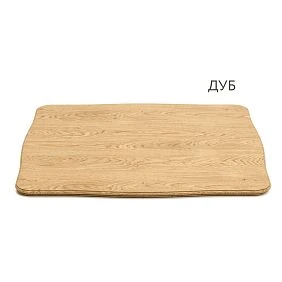
- Oak, MDF, and oak veneer for pronounced texture
- Beech, MDF, and beech veneer for a calm surface
- Step one: bring both drawings to the same scale
- Step two: align geometric centers
- Step three: compare not rectangles, but outer lines
- Step four: apply mounting zones
- Step five: fix the orientation
- Why a bottom view is needed
- Why an edge cut is needed
- Why mounting data is needed
- What the template shows in the room
- Final height of the set
- Measure the space between supports
- Check the height of the side rail
- Consider the chair being pulled away
- Four different chairs — four different results
- Set assembly is suitable if
- Ready-made furniture is preferable if
- MDF and beech underframe under enamel
- Oak veneer and oak underframe under tinting
- Beech and oak cannot be mixed randomly
- Match the gloss level
- Patina is checked on carving and profile
- Tinting requires a common standard
- Table in a classic dining room
- Table in a kitchen-living room
- Table for a meeting area
- Table under opaque colored enamel
- Table with natural oak texture
- Table for a project with already purchased chairs
- Check the full article number
- Do not choose based on a single image
- Do not replace the associated underframe with a random base
- Mistake 1. Recording a 14 mm overhang as confirmed
- Mistake 2. Ordering the tabletop and underframe at different times without a common specification
- Mistake 3. Calling a combined tabletop solid wood
- Error 4. Choosing a breed only by color name
- Error 5. Checking only the external size of the chair
- Error 6. Centering by the edge of the ornament
- Error 7. Drilling before dry assembly
- Error 8. Confirming color by screen
- Better to choose a different countertop when
- Input data
- Designer's tasks
- Which formulations to remove
- Which applications to add
- 1. Open the countertop card
- 2. Open the linked underframe card
- 3. Request drawings
- 4. Align the contours
- 5. Check the chairs
- 6. Approve the finish
- 7. Submit a complete request
- 8. Plan the receipt
- Check the marking
- Inspect the profile and surfaces
- Check the geometry without final assembly
- Protect the parts on site
- Before painting
- After painting
- Can we consider that the tabletop overhang will be 14 mm on each side?
- Is STL-020-1 compatible with ST-020-1?
- Can I buy only the ST-020-1 tabletop?
- Is ST-020-1 made of solid wood?
- Which option is better for enamel?
- Which option should I choose for a natural oak texture?
- Can I combine a beech tabletop with an oak base?
- What is the preliminary height of the finished table?
- Will any four chairs fit with the set?
- Do I need a full-size template?
- Can I drill the tabletop on site without a drawing?
- Is the mounting hardware included in the set?
- Should the countertop and under-table be ordered in one batch?
- How to check the color before painting the entire table?
- Can the set be installed in a small kitchen?
- What to do if the overhang looks too small after installation?
- What to do if chairs do not fit between the supports?
- Where to see other countertops and under-tables?
- Can delivery of the countertop and base be ordered together?
- What to check one last time before payment?
- What the furniture production receives
- What the finisher receives
- What the installer receives
- What the customer checks after assembly
- Mark two outlines instead of one
- Check diagonal routes
- Match the table with the pendant light
- Consider the rug and floor pattern
- Check the proximity to the sideboard and display case
- Evaluate the view from key points in the room
- Compare the set with ready-made models in the same scale
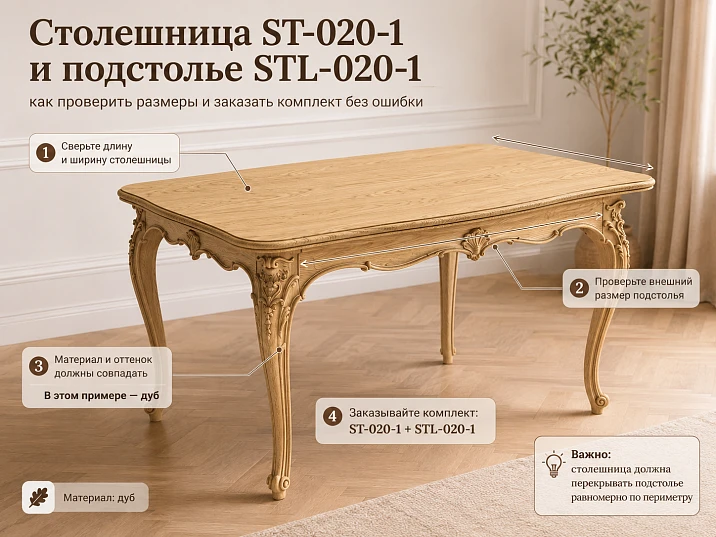
When you need to buy an MDF tabletop for a dining table, the numbers in the product card seem like the most reliable part of the choice. For model ST-020-1, the size is specified as 1128 × 1128 × 30 mm, and for the associated underframe STL-020-1 — 1100 × 1100 × 750 mm. The difference in width and depth is 28 mm. The first impulse is to divide it in half and decide that the tabletop will overhang the base by exactly 14 mm on each side. It looks convincing, but for shaped classic furniture, such a calculation doesn't confirm anything yet.
The tabletop has a complex profiled edge, and the underframe has a carved outer contour, aprons, supports, and mounting plates. Overall dimensions may be measured at different points of the products. Therefore, a 1128 mm tabletop and a 1100 mm base do not automatically turn into a ready assembly scheme. Before drilling, you need to compare the drawings, align the geometric centers, check the position of the outer decor, and only then determine the actual overhang on each side.
This is exactly the approach needed by a buyer who is going to buy an MDF tabletop ST-020-1 and arrange the table as a single furniture set. Here, it's not enough to choose a beautiful top surface. You need to understand in advance whether the associated underframe fits, where the mounting points will be, whether there is enough space for four chairs, how to coordinate the enamel or tinting, and what data to enter into the order so that the tabletop and base arrive as parts of one structure, not as two externally similar products.
Why the 28 mm difference raises more questions than it seems
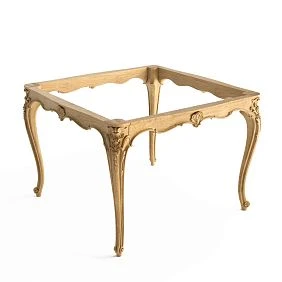
On a straight metal frame, the calculation of the overhang often indeed starts with the difference in external dimensions. In a classic carved table, the geometry is more complex. The decorative apron may approach the edge of the tabletop in the center of the side, while the corner part of the base may recede deeper. The tabletop profile also changes perception: the top plane ends at one point, the most protruding part of the carved edge at another, and the lower mounting zone at a third.
If you take only the numbers 1128 and 1100 mm, you get a mathematical difference, but not an installation diagram. It does not show:
-
along which line the underframe is measured;
-
where the lower plane of the tabletop runs;
-
how far the shaped profile protrudes;
-
where the aprons and mounting plates are located;
-
whether the axes of the products align;
-
whether pre-drilled holes are provided;
-
which fasteners are suitable for the selected tabletop version.
The buyer may see two SKUs from the same series and decide that compatibility already means full readiness for assembly without checking. Product linkage indeed makes the set a logical candidate, but it does not replace the drawing. Before buying the ST-020-1 and STL-020-1 setIt is necessary to confirm not only the names, but also the specific configuration of both parts.




Arithmetic shows only the starting point.
The preliminary formula looks like this:
(1128 − 1100) ÷ 2 = 14 mm.
This value is useful as a control reference. If, after overlaying the drawings, the actual protrusion differs significantly, the designer will immediately see where dimensions were taken along different lines. However, writing 14 mm into the working documentation before verification is not allowed. In the specification, it is better to leave the wording: "actual overhang to be clarified after aligning drawings ST-020-1 and STL-020-1."
Our factory also produces:

One dimension does not describe the shaped edge.
The thickness of ST-020-1 is 30 mm. This is a confirmed general parameter, but it does not reveal the edge profile. When viewed from the side, the shaped edge may visually appear higher, more massive, or deeper than a regular straight slab. To assess this, a profile section is needed. It helps to understand where the lower mounting plane runs and whether the decorative part might end up too close to the apron.
Get Consultation
Centering must be geometric, not "by eye."
Even square products can be shifted by a few millimeters during marking. On a simple shape, the error is almost unnoticeable. On a symmetrical classic table, it will immediately show: on one side the profile will appear wider, on the other — narrower; the under-table ornament will lose its connection with the center of the tabletop. Therefore, centers are marked on the drawing and on the parts separately, rather than determined by the outer edge after installation.
What is confirmed in the cards ST-020-1 and STL-020-1
It is useful for the buyer to first separate facts from assumptions. Facts can be entered into the specification immediately. Assumptions require a drawing, consultation, and fitting.
| Parameter | Tabletop ST-020-1 | Table base STL-020-1 |
|---|---|---|
| Part type | Square furniture tabletop | Carved table base |
| Overall dimensions | 1128 × 1128 × 30 mm | 1100 × 1100 × 750 mm |
| Shape | Square, with a figured classic profile | Square carved table base |
| Materials | MDF; oak / MDF / oak veneer; beech / MDF / beech veneer | Beech or oak |
| Surface preparation | «Prestige» | "Prestige"; specific preparation for finishing is checked in the selected configuration |
| Purpose | Top part of a furniture dining table | Load-bearing and decorative table base |
| Confirmed connection | The card offers STL-020-1 | In the card, the model is linked to the tabletop ST-020-1 |
| What cannot be determined from the general table | Actual contour from below, mounting map, exact overhang | The line of the most protruding decor and attachment points to the tabletop |
The table shows why products should be considered together. The material of the top part and the material of the base are selected separately, but the finish should bring them together into one piece. The buyer can order ST-020-1 sized 1128 × 1128 mm in MDF for opaque enamel or choose a combined structure with veneer. For the base, beech and oak are available. The combination is determined not only by budget, but also by the result needed after painting.
How to read dimensions 1128 × 1128 × 30 mm without misleading conclusions
The three numbers answer three different questions. The first two specify the maximum width and depth of the tabletop. The third shows its overall thickness. None of them by itself indicates where to place the fasteners or which part of the underside can be used as a mounting area.
1128 mm is the external dimension, not the distance between mounting points
In width, the tabletop occupies 1128 mm. This is enough to check whether the future table will fit into the room, whether it will block a passage, and how it will relate to a carpet, lamp, or wall panel. But for assembly, a bottom view is needed. Only it shows which part of the lower surface is free from the profile and suitable for fastening elements.
30 mm is the thickness to consider before drilling
The 30 mm thickness limits the allowable fastener depth. The length of a screw or other fastening element is chosen considering the thickness of the mounting part, washer, plate, and a safe margin to the top surface. You cannot take fasteners out of habit from another tabletop: an overly long element risks protruding to the upper plane, while an overly short one will not provide reliable fixation.
At the same time, the article does not specify a particular screw: the mounting scheme must be confirmed by the manufacturer or a responsible designer. In the section where you can buy materials for tabletop finishing, it is convenient to select consumables at the same time, but fasteners should be chosen only after obtaining the mounting scheme.
A square shape does not eliminate the need to check all four sides
Theoretically, a square is symmetrical. In practice, the veneer pattern, the direction of the base parts, the position of the aprons, and the chosen front view can determine the face side. Therefore, the drawing marks the orientation of the tabletop and the underframe. This is especially useful when toning: after approving the texture direction, it is undesirable to rotate the top part by a quarter turn.
Why ST-020-1 cannot be called a solid wood tabletop
The card lists three versions. The first is MDF. The second and third are combined options: oak / MDF / oak veneer and beech / MDF / beech veneer. The wording matters. The buyer is not promised a solid square of solid wood 30 mm thick. The design combines a stable base, wooden parts around the perimeter, and veneered surfaces.
This composition opens up several finishing scenarios but requires a precise description in the order. The phrase "oak tabletop" is too general. It can be understood as a solid wood product, although the card indicates a combined version. The correct entry sounds like this: "ST-020-1, oak / MDF / oak veneer, 1128 × 1128 × 30 mm, preparation quality 'Prestige'".
MDF for opaque enamel
MDF is chosen when the goal is to get a uniform color and not show the wood texture. This is a rational path for a white, gray, complex colored, or contrasting classic table. The shaped profile after painting is read through light and shadow, not the fiber pattern.
A buyer who plans to order a tabletop for enamel, needs to agree in advance on the color, gloss level, and a finishing sample for the base. A simple color number is not enough: the same enamel can look different on the horizontal surface of the tabletop and on the deep carving of the underframe.
Oak, MDF, and oak veneer for a pronounced texture
The oak variant is chosen when the finish should preserve a noticeable wood grain pattern. Tinting, transparent coating, and patina can emphasize the edge profile and tie the top to the oak underframe. However, matching the species name does not guarantee an absolutely identical shade: solid and veneered sections accept the compound differently, and the direction of the fibers changes light reflection.
Therefore, before ordering ST-020-1 with oak or beech veneer, it is useful to approve not only the tone name but also a physical sample on a material close to the future product.
Beech, MDF, and beech veneer for a calm surface
Beech provides a more even visual field. It is convenient to use under light tinting, soft classic shades, or enamel when the client wants to preserve the wooden base of the underframe but does not aim for pronounced oak pores. As in the oak variant, the tabletop remains combined, so the material description cannot be shortened to a single word.
Comparison of three ST-020-1 configurations
| Finish | When to choose | What it gives in the finished table | What to check before ordering |
| MDF | Need opaque enamel and a uniform color | Calm, uniform surface, emphasis on the shaped profile | Primer and enamel system, gloss level, finish compatibility with beech or oak base |
| Oak / MDF / oak veneer | Expressive wood texture is needed | More contrasting natural grain pattern, possibility of tinting | Tone match with oak underframe, veneer direction, test stain |
| Beech / MDF / beech veneer | Need a more uniform texture or lighter finish | Soft wood grain and calm classic character | Match with beech base, shade after tinting, selected coating system |
This table does not assign material automatically. It helps formulate the task. If a fully painted table is required, an MDF tabletop and beech underframe can be a logical combination. If natural oak needs to be shown, the top with oak veneer is usually considered together with an oak base. Mixing wood species is also possible, but then the difference should be part of the project, not an order coincidence.
How to check compatibility of ST-020-1 and STL-020-1 using drawings
Related item numbers are a good start, but installation verification begins with files. They request the tabletop drawing, underframe drawing, top view, bottom view, and section of the shaped edge. It is desirable to receive documents in scale or digital format that can be overlaid without manual recalculation.
Step one: bring both drawings to the same scale
On one sheet, 100 mm should occupy the same length as on the other. If one file is printed with fit-to-page and the other at a 1:10 scale, visual overlay will give a false result. The scale is checked against a reference dimension, not by the label in the file name.
Step two: align the geometric centers
The center of a square tabletop is at the intersection of the diagonals. The center of the underframe is determined by its base geometry, not by the most protruding thread. After aligning the centers, the real distances between the outlines on each side become visible.
Step three: compare not the rectangles, but the outer lines
A rectangle of 1128 × 1128 mm and a square of 1100 × 1100 mm provide only a check frame. Inside it, you need to see the shaped profile of the tabletop and the outer decor of the underframe. In the middle of a side, the protrusion may differ from the protrusion at the corner. That is why the average value of 14 mm should not be repeated as the final dimension.
Step four: overlay the mounting zones
After the outer contour, check the places where the underframe contacts the tabletop. On the diagram, mark the aprons, rails, pads, holes, and zones where fasteners cannot be placed. If a ready-made hole map is missing, it is agreed upon separately. A buyer who is going to order a wooden base for ST-020-1, should receive a clear answer: which surfaces are involved in the connection and who is responsible for the final layout.
Step five: fix the orientation
Both drawings have the same mark on the front side. This eliminates accidental flipping during painting, packaging, or assembly. For symmetrical furniture, such a precaution seems unnecessary until the veneer pattern or decorative base composition is oriented differently than specified in the visualization.
Which files to request before placing an order
The phrase "send a drawing" is too vague. A manager may send a general view, which is enough to get acquainted with the shape, but not for preparing the mounting. It is better to make the request specific. Then both parties understand what data the designer and assembler need.
The minimum set of documents for verification includes:
-
drawing ST-020-1 with dimensions 1128 × 1128 × 30 mm;
-
top view of the tabletop;
-
bottom view of the tabletop;
-
section of the shaped edge profile;
-
drawing STL-020-1 with dimensions 1100 × 1100 × 750 mm;
-
top view of the underframe;
-
location of aprons and mounting platforms;
-
information about pre-drilled holes, if provided;
-
recommendations for joining selected materials;
-
permissible zones for fasteners.
The format is specified separately. DWG or another editable file is convenient for the designer, while PDF with clear dimension lines is for the installer. A paper printout is useful as a control on site, but should not be the only source of dimensions.
Why a bottom view is needed
A front-facing photo shows the profile and decorative character of the tabletop. It tells almost nothing about the mounting side. The bottom view answers the key question: where the shaped edge ends and the flat plane suitable for connection to the base begins.
If the fastening zone is narrower than the assembler expects, the holes may end up too close to the edge. If there are technical features under the lower surface, they also need to be seen before drilling. That is why the solution of "just indenting equally from all four sides" is not suitable for ST-020-1 without confirmation.
Why an edge section is needed
The section shows the profile in height and depth. It allows assessing whether the apron will approach the shaped edge, which area remains flat, and how the transition from the tabletop to the underframe will look from the side. This document is especially useful for a project where the table is viewed not only from above, but also from the level of a seated person.
Why mounting data is needed
MDF and wooden bases behave differently. A combined tabletop with veneer also requires careful handling. The article does not prescribe a universal mounting scheme: its choice depends on the design, installation site, and manufacturer's recommendations. But the buyer must include the question of fasteners in order preparation. Otherwise, an important decision is postponed to assembly day, when changing details is already difficult.
Checking overhang on a full-size template
Digital overlay of drawings provides precision, while a template helps visualize the scale in the room. For a square tabletop, you can cut out a sheet or assemble a contour measuring 1128 × 1128 mm from thick paper, cardboard, or thin sheet material. Then mark the center, the direction of the front side, and the intended line of the underframe on it.
The underframe can be indicated with a second contour of 1100 × 1100 mm, but this is only a preliminary rectangle. If there is an accurate drawing of the external thread, the actual line is transferred to the template. After that, it becomes visible where the tabletop edge protrudes noticeably, and where the decorative elements of the base come closer.
What the template shows in the room
The template answers questions that are not visible in the catalog:
-
is the 1128 mm square too large for the chosen area;
-
will there be a passage left between the table and the wall;
-
can the chairs be pulled out;
-
does the center of the table align with the pendant light;
-
does the table obstruct the door opening;
-
how does the square shape work next to a kitchen island, buffet, or display case;
-
is there enough space for movement around seated people.
If the room is already finished, the template is placed on temporary supports at the height of the future countertop. This makes the assessment closer to reality: a flat surface on the floor is perceived as smaller than a top surface raised to 780 mm.
Final height of the set
The table base height is 750 mm, and the tabletop thickness is 30 mm. Simple addition gives a reference of 780 mm. However, the final height depends on the actual connection scheme: the tabletop may rest directly on the top of the base or be connected through additional elements, if provided by the design. Therefore, 780 mm is useful for a preliminary ergonomic check, but the final value is entered into the project after confirming the joint.
Compare this value with the seat height and armrest height of the chosen chairs. A high armrest may hit the apron before the seat approaches the edge. For a buyer who wants to choose chairs for a square table, it is useful to check not only the overall width of the chair, but also its side profile.
Will there be enough room for four chairs
The connected underframe positions the set as a dining table for four people. This does not mean that any four chairs will automatically fit. The carved base occupies space under the tabletop differently than four separate legs. Aprons, decorative elements, and supports form the actual seating openings.
Measure the space between the supports
For each side, there needs to be a clear opening between the nearest protruding parts of the base. It should be compared with the width of the chair at its widest point. If there are armrests, they are taken into account, not just the seat. Additionally, leave a working clearance so the chair does not catch on the carving during daily movement.
Check the height of the apron
A person should be able to freely place their knees under the table. The height of the tabletop itself does not guarantee this: the lower line of the apron may be noticeably lower than the upper surface. In the drawing, the distance from the floor to the lowest part of the apron in the seating area is noted and compared with the height of the knees and armrests.
Consider pulling the chair out
The chair takes up space not only in the pushed-in position. To sit down, it is pulled out, and there must be a passage behind the backrest. In a compact dining room, a 1128 mm square may fit, but the operational footprint will be significantly larger. A full-size template helps to see this problem before ordering.
Four different chairs — four different results
A narrow classic chair without armrests and a wide armchair give completely different seating. Therefore, the phrase "table for four people" describes the purpose of the set, but does not replace the selection of a specific model. In the catalog, you can buy classic solid wood chairs, and then transfer their dimensions to the overall plan of the dining area.
When it is better to order a ready-made table rather than assemble a set
Self-assembly of a complete set is not suitable for every project. It is justified when the customer needs a specific tabletop article, a particular carved underframe, and individual finishing. But sometimes the main task is to quickly choose ready-made furniture with an already resolved design.
It is better for the buyer buy a classic wooden table, when he does not want to separately approve drawings, fasteners, and joint color matching. A ready-made model is also more convenient in situations where project deadlines do not allow for a structural check of two articles.
There is another scenario: the interior does not require a classic carved base. Then it makes sense to look at ready-made modern tables and compare them with the ST-020-1 + STL-020-1 set in terms of scale, style, and order complexity.
Complete assembly is suitable if
-
a shaped profile ST-020-1 is specifically needed;
-
the STL-020-1 underframe matches the room's style;
-
the finish should be individual;
-
the designer is ready to check the drawings;
-
chairs are already selected or their dimensions are known;
-
the customer wants to control the material of the top and bottom parts separately.
Ready-made furniture is preferable if
-
there is no possibility to coordinate the mounting unit;
-
a known final size in advance is important;
-
a finished factory composition is required;
-
individual color is not required;
-
the task comes down to selecting a table for the room and chairs.
An honest comparison does not reduce the commercial value of ST-020-1. On the contrary, it helps the buyer choose the right route and not order a complex set for a task that is easier to solve with a ready-made table.
How to match the tabletop and underframe by material
The upper and lower parts have different sets of finishes. The tabletop can be MDF or a combined construction with veneer. The underframe is made of beech or oak. Consequently, the order involves not one but several meaningful combinations.
| Tabletop | Underframe | Suitable scenario | Main check |
| MDF | Beech | Opaque enamel, light or colored classic table | One color, gloss level, and uniform patina on smooth surfaces and carvings |
| MDF | Oak | Contrasting construction or enamel on both parts | Why was a more textured oak chosen if the texture will be covered; primer approval |
| Oak / MDF / oak veneer | Oak | Natural tinting and pronounced texture | Match of solid wood and veneer shade, grain direction, test stain |
| Beech / MDF / beech veneer | Beech | Calm wood surface or light tinting | Reaction of veneer and solid wood to the compound, evenness of shade |
| Veneered tabletop of a single wood species | Underframe of a different wood species | Intentional contrast | Approved designer reason, physical samples of both materials |
MDF and beech underframe for enamel coating
This is a clear combination for opaque finishes. Beech has a calm surface, while MDF provides a smooth plane. But even with a single color, the carving on the base will look darker in recesses. Therefore, the sample is evaluated on a three-dimensional part, not just on a flat board.
Oak veneer and oak underframe for tinting
Such a set preserves the natural character of the wood. The main challenge is not to achieve literal equality, but to achieve a coordinated tone. Veneer, solid wood on the edge, and solid wood base may differ in saturation. The test finish should include all types of surfaces.
Beech and oak cannot be mixed randomly
Different wood species can be used in the same piece of furniture, but this decision requires intent. If the tabletop is ordered with beech veneer, and the underframe is made of oak only because it happened that way during ordering, the difference will become obvious after a clear finish. Before ordering, the material is fixed in one line of the specification for the entire set.
Finish: one color does not mean a uniform appearance
A large horizontal surface reflects light differently than a carved vertical base. Therefore, a tabletop and underframe of the same color may appear different. On the tabletop, long highlights are visible; on the carving, many shadows. Matte enamel softens the contrast, while glossy enamel shows uneven light and differences in planes more strongly.
Coordinate the level of gloss
The phrase "white enamel" is incomplete. Color and degree of gloss are needed. A semi-matte tabletop next to a glossy underframe will look like a combination of two batches, even if the shade matches. The gloss level is recorded in the specification and confirmed with a sample.
Patina is checked on carving and profile
Patina is more pronounced in recesses. On the edge of ST-020-1 it will emphasize the profile, on STL-020-1 — the ornament and relief. If applied without a general map, the lower part may become visually much darker than the upper part. The test fragment should show both details side by side.
Toning requires a common reference standard
For an oak or beech set, an approved sample is needed. It is useful to specify which part is considered the reference: the tabletop, the underframe, or a separate color sample plate. Otherwise, contractors may independently match a "similar" shade but fail to assemble a unified table.
In the profile section, you can order oil for the wooden underframe or select other materials, but the system's compatibility with MDF, veneer, solid wood, and future use must be verified before applying to the entire set.
What to order together with the ST-020-1 tabletop
It is more convenient to assemble a complete order not as a list of random purchases, but as a system. Each accompanying element should have a clear function.
| What to add | Why is this needed | When to buy | What to pay attention to |
| buy STL-020-1 table base | Assemble a cohesive classic foundation | After checking the drawings and overhang | Material, outer contour, aprons, mounting zones |
| Buy a tabletop for a table | Compare ST-020-1 with other sizes and shapes | Before final approval of the article number | Dimensions, thickness, profile, material |
| Order a table base made of oak or beech | Select a base by wood species and style | Simultaneously with choosing the top part | Height, size, compatibility, finish |
| buy classic solid wood chairs | Check seating for four people | Before fixing the dining area | Width, armrests, seat height, passage |
| buy materials for tabletop finishing | Agree on enamel, tinting, or protective coating | After selecting materials | Compatibility with MDF, veneer, and solid wood |
| Order a design project for the dining area | Check table, chairs, lighting, and passages in one composition | Before a large complete order | Actual room dimensions and selected items |
| Calculate delivery of the tabletop and underframe | Plan the delivery of two large-sized parts | Before order confirmation | Packaging, address, lifting, acceptance conditions |
The table helps avoid buying unnecessary items. For example, chairs don't have to be ordered at the same time as the table, but their dimensions must be known before seating is approved. Finishing materials can be purchased later, however the coating system must be chosen in advance to correctly order part preparation.
Practical Selection Scenarios
The same ST-020-1 solves different tasks. Below are not a set of interior pictures, but specific scenarios that change the order composition.
Table in a classic dining room
Here the ST-020-1 and STL-020-1 set is revealed most naturally. The carved base supports the shaped edge, the square shape organizes four equal seats. The main check is free passage around the table and connection with the central light fixture. The finish can be enamel, tinted, or patinated, but it is approved on the full set of materials.
Table in a kitchen-living room
In the combined space, you need to check not only seating but also traffic routes between the kitchen, sofa, and exit. The 1128 mm square is convenient as a center, but operational space is required around it. A full-size template will show whether the table becomes an obstacle on the main passage.
Table for a meeting area
ST-020-1 can be considered for a small executive meeting room if four seats match the task. The placement of laptops, documents, and cables is checked. The card describes a furniture dining tabletop, so any additional features—cable outlets, power sockets, reinforcement—are designed separately and are not considered part of the standard configuration.
Table with opaque colored enamel
MDF construction allows color to become the main tool. The underframe is selected with future painting in mind. Before ordering, it is useful to obtain a sample on a flat surface and on carving: a rich shade may look significantly darker in the depth of the ornament.
Table with natural oak texture
For this scenario, an oak / MDF / oak veneer tabletop and an oak underframe are considered. The solution requires joint tinting and pattern control. If oak parquet, doors, or cabinets are already nearby, samples are compared indoors under real lighting.
Table for a project with already purchased chairs
Chair dimensions become the initial data. First, four seating contours are built, then the underframe is checked, and only after that is the tabletop finally approved. This order protects against a situation where a beautiful table is assembled, but armrests do not fit under the apron.
How not to confuse ST-020-1 with similar tabletops
The catalog contains tabletops with similar names and article numbers. An error in one digit changes the shape, length, or compatible base. It is especially easy to confuse ST-020-1 with the rectangular ST-020: the common index seems the same, but the dimensions and usage scenario differ.
Check the full article number
The specification states ST-020-1, including hyphens and the last digit. Shortening to "ST-020" is dangerous: a supplier or project participant may open a different card. The size 1128 × 1128 × 30 mm must be indicated nearby. The article number and dimensions mutually verify each other.
Do not choose based on a single image
A close-up of the shaped profile does not show the proportions of the entire surface. Square and rectangular versions may have related styling but provide a different table. Before purchasing, open the size table and drawing, rather than relying on a photo in the selection.
Do not replace the matching underframe with a random base
Another underframe may fit in overall width but have unsuitable mounting plates, height, or leg positioning. If the goal is to assemble a matching set, first check STL-020-1. An alternative is considered only through a new calculation, without transferring conclusions from this article.
For a buyer who is still comparing options, it is useful to open the section where you can view all STAVROS furniture tabletops, and compare shapes, sizes, and materials. After choosing, return to the specific card and note the article number.
Mistakes that cause the set to be redone
Mistakes rarely arise from complex math. More often, the project falls apart on simple assumptions that no one checked.
Error 1. Record a 14 mm overhang as confirmed
The number is derived from overall dimensions, but not from contour overlay. It may match the actual protrusion along one line and differ along another. The fix is simple: the drawing shows the real profile, and until it is obtained, 14 mm is used only as a preliminary reference.
Error 2. Order the countertop and underframe at different times without a common specification
Even related models can receive different material and preparation options. First, the top is ordered, a month later the bottom, and then it turns out that the finish is agreed upon differently. It is more reliable to buy furniture frames and underframes within a single combined request, where both items are listed together.
Error 3. Call a combined countertop solid wood
Such a shortening distorts the product composition. Finish, texture expectations, and the conversation with the craftsman depend on it. The order retains the card wording: oak / MDF / oak veneer or beech / MDF / beech veneer.
Error 4. Choose the wood species only by the color name
"Walnut," "honey," or "dark oak" are shade names, not structural materials. Beech can be tinted dark, oak can be covered with enamel. First, choose the material by the required texture and compatibility, then approve the finish.
Error 5. Check only the external size of the chair
The width of the chair does not show the height of the armrests and the position of the knees. For seating under a carved apron, front and side views are needed. One wide element can make the chair incompatible, even though it fits in overall width.
Error 6. Center by the edge of the ornament
On the underframe, the most protruding carving does not always coincide with the structural axis. The center is determined by the base drawing. Otherwise, the tabletop will be offset relative to the supports.
Error 7. Drill before dry assembly
First, parts are aligned without final holes, checking four sides, diagonals, and orientation. Drilling turns a preliminary decision into an irreversible one. It is especially dangerous to mark holes on an inverted tabletop without a mark for the front side.
Error 8. Approve color by screen
It is better to choose a different tabletop when
-
six or more permanent seating places are required;
-
the room is designed for a narrow rectangular table;
-
a thin modern edge is needed without a classic profile;
-
the client is looking for a standard kitchen work surface;
-
there is no way to check the mounting unit;
-
a ready-made table is needed without individual approval;
-
the underframe should be metal or extremely minimalist.
In such cases, it is more useful to buy a ready-made table instead of assembling it yourself or to choose a different tabletop and a different base. This is not a compromise, but a more accurate match to the task.
How to write a technical specification for a designer
A good technical specification fits on one page but covers all key decisions. It should not contain phrases like "make it beautiful" or "standard overhang." Every condition is verified by a number, drawing, or sample.
Initial data
-
room and installation location;
-
clearance zone dimensions;
-
article ST-020-1;
-
tabletop size 1128 × 1128 × 30 mm;
-
selected tabletop version;
-
article STL-020-1;
-
underframe size 1100 × 1100 × 750 mm;
-
selected underframe wood species;
-
dimensions of specific chairs;
-
desired finish;
-
position of the luminaire and adjacent furniture.
Designer's tasks
-
combine drawings at the same scale;
-
determine the actual overhang on all four sides;
-
show the difference between the outer profile and the mounting plane;
-
check mounting zones;
-
calculate the final height;
-
check chair seating and walkways;
-
indicate the orientation of the veneer pattern;
-
prepare an approval sheet for finishing;
-
publish a clear assembly diagram.
If the dining area is connected to panels, a ceiling light, a sideboard, and a complex floor layout, you can Order a design project for the dining area. Then the table is assessed not in isolation, but as the center of the entire composition.
What to write in the order specification
Conversational wording works until the first clarification. The invoice and specification require precision. Example entry:
Tabletop ST-020-1, 1128 × 1128 × 30 mm, MDF / oak-MDF-oak veneer / beech-MDF-beech veneer — choose one option, preparation quality "Prestige", 1 pc.
Underframe STL-020-1, 1100 × 1100 × 750 mm, beech or oak — choose one wood species, preparation quality "Prestige", 1 pc.
Finishing of both parts — according to the approved physical sample. Orientation of the tabletop and underframe — according to the drawing. Mounting scheme — after aligning the contour and mounting zones.
Which wordings to remove
Do not write "oak tabletop" if a combined option is chosen. Do not write "base as in the photo" instead of the article number. Do not write "regular white" instead of the code and sample. Do not write "overhang 14 mm" without a confirmed drawing.
Which attachments to add
The specification is accompanied by:
-
agreed drawings;
-
layout diagram;
-
finish sample or its identifier;
-
front side marking;
-
list of chairs with dimensions;
-
placement diagram in the room;
-
packaging and delivery requirements.
Such a package is especially needed by the designer, furniture manufacturer, and installation team who work separately.
How to buy ST-020-1 and STL-020-1 at STAVROS
A commercial route starts not with the cart button, but with checking the kit. This saves more time than fixing already manufactured parts.
1. Open the countertop card
In the card, you need to find out the price of the ST-020-1 countertop, select the version and double-check the size 1128 × 1128 × 30 mm. The current cost, status, and timelines are checked right before placing the order.
2. Open the card of the linked underframe
Then you should find out the price of the underframe made of beech or oak and check the size 1100 × 1100 × 750 mm. The base material is chosen together with the future finish of the top part.
3. Request drawings
Files of both parts are needed, not just the general view. The request lists top and bottom views, edge section, mounting areas, and fastening recommendations.
4. Align the contours
The designer or responsible engineer overlays the drawings, determines the overhang, axes, and mounting zones. Until this moment, no overhang figure is considered approved.
5. Check the chairs
The dimensions of the four chairs are transferred to the plan. Width, armrests, knees, and aisles are assessed. If models are not yet selected, open the classic chairs category and take the actual dimensions of the candidates.
6. Approve the finish
The materials of the top and bottom parts are fixed together. Then a physical sample of color, tint, gloss, and patina is made.
7. Submit a complete request
Instead of two independent orders, it is better to order a wooden table frame and the countertop in one specification. This reduces the risk of discrepancies in material, finish, and purpose of parts.
8. Plan the delivery
Before payment, it is useful to Calculate delivery of the tabletop and underframe, prepare a place for unloading and assign a person responsible for receiving.
Receiving the countertop and underframe before finishing
Receiving begins before painting and assembly. After applying the final coating, it is harder to distinguish a manufacturing feature from damage incurred on site.
Check the marking
The article numbers, dimensions, material, and quantity must match on the documents and packaging. For the countertop, the full specification wording is checked. For the underframe, the wood species.
Inspect the profile and surfaces
The countertop is checked under side lighting. It reveals the condition of the shaped edge, surfaces, and transitions. The part cannot be assessed only in packaging or under dim general lighting.
Check the geometry without final assembly
Parts are placed on a flat protected surface and aligned according to the approved scheme. Check all four sides, diagonals, center, and orientation. If the actual contour deviates from the project, resolve the issue before drilling.
Protect parts on site
MDF, veneer, and solid wood must not be left near wet processes, heating appliances, or an open window. Storage conditions must be stable. Position the countertop so as not to stress the shaped edge or create a risk of deformation.
Dry assembly before painting
Dry assembly is a check of mutual positioning without irreversible installation. It is especially useful for a set where overall dimensions almost match.
First, mark centers and face sides. Then place the countertop on the base using protective pads that do not damage the surface. Check:
-
whether the visual overhang is the same;
-
whether the thread comes too close to the profile;
-
whether the approved orientation matches;
-
are mounting zones available;
-
do future holes not conflict with the edge;
-
does the chair fit under the stretcher;
-
does the final height match the project.
After checking, the result is photographed from four sides and from above. The photos become an attachment to the mounting sheet. Only then are the parts disassembled for finishing.
Finishing and final assembly
The order depends on the approved system, but the general principle is the same: all operations that can change geometry or damage the finish are checked in advance.
Before painting
-
approve the location of fasteners;
-
perform trial operations on a technological sample;
-
mark the face sides;
-
check compatibility of primer and finish;
-
coordinate protection of holes and mounting areas.
After painting
-
allow the coating to reach the required readiness according to the instructions of the applied system;
-
protect surfaces with soft material;
-
do not pull parts by carved decor;
-
verify markings against the mounting sheet;
-
tighten connections evenly;
-
check the table on a flat surface.
The article intentionally does not specify the tightening torque, screw type, or specific number of fasteners. These parameters relate to the structural design and must be confirmed for the selected configuration.
Self-analysis of the project before purchase
Before ordering, it is useful to ask yourself ten direct questions. If there is no answer to at least one, the set is not yet ready for placement.
-
Is the article ST-020-1 definitely selected, and not a similar model?
-
Does the 1128 mm square fit the room along with chairs and walkways?
-
Have drawings of both parts been received?
-
Are the actual contours aligned, not just dimension rectangles?
-
Has the actual overhang been confirmed?
-
Have the mounting zones and the 30 mm thickness been checked?
-
Have the tabletop material and the underframe wood species been selected?
-
Is the general finishing sample approved?
-
Have the specific chairs been checked?
-
Are both items recorded in the same specification?
If the answers are positive, you can move from the project to the order. If not, it is better to spend time on one additional drawing than to fix the finished furniture.
Frequently asked questions about ST-020-1 and STL-020-1
Can it be assumed that the tabletop overhang will be 14 mm on each side?
No, 14 mm is only an arithmetic reference. It is derived from the difference in overall dimensions of 1128 and 1100 mm. The actual overhang is confirmed after overlaying the shaped contours and mounting zones.
Is STL-020-1 compatible with ST-020-1?
The cards link these models, so it is logical to consider them as a set. Before ordering, you still need to align the drawings, select specific materials, and confirm the mounting scheme.
Can I buy only the ST-020-1 tabletop?
Yes, the tabletop is considered a separate item. But for installation on a different base, a new compatibility check will be required. Conclusions regarding STL-020-1 cannot be automatically transferred to another frame.
Is ST-020-1 made of solid wood?
Not in all variants and not as a solid wood slab. The card offers MDF and combined versions: oak / MDF / oak veneer or beech / MDF / beech veneer.
Which variant is better for enamel?
For opaque enamel, MDF is usually considered. The final choice depends on the project, the required finish profile, and coordination with the underframe.
Which variant should be chosen for a natural oak texture?
The oak / MDF / oak veneer version combined with an oak underframe is suitable. Before finishing, a general test stain on solid wood and veneer is needed.
Is it possible to combine a beech tabletop with an oak underframe?
It is possible only as a deliberate design contrast. With a transparent finish, the wood species will differ in texture. If a uniform appearance is needed, it is easier to coordinate one wood species or opaque enamel.
What is the preliminary height of the finished table?
Adding the table base height of 750 mm and the tabletop thickness of 30 mm gives a reference of 780 mm. The final value is confirmed after checking the actual connection joint.
Will any four chairs fit the set?
No. You need to check the width, armrests, seat height, knee position, and the distance between the table base supports. The designation "for four persons" does not replace checking specific models.
Is a full-size template needed?
It is especially useful in a compact dining room. The 1128 × 1128 mm template shows the real scale, walkways, chair positions, and the connection with the light fixture.
Can the tabletop be drilled on site without a drawing?
This approach creates unnecessary risk. The thickness is 30 mm, and the mounting zones depend on the lower contour. The layout should be approved before drilling.
Is the mounting hardware included in the kit?
The specific contents of a delivery must be checked in the product card and order. You cannot assume the presence of fasteners or a universal scheme without confirmation.
Should the tabletop and table base be ordered in one batch?
This is preferable for coordinating the material, preparation, and finishing. Even if the items are technically ordered separately, they should be combined into one specification.
How to check the color before painting the entire table?
A physical color sample is needed. For a veneered tabletop and a wooden base, the sample is made on materials of both types, since they may accept the coating differently.
Can the set be installed in a small kitchen?
Yes, if not only the 1128 mm square fits, but also the area for pulling out chairs, walkways, and door openings. Checking with a template is more accurate than estimating by room area.
What to do if the overhang looks too small after placement?
Do not proceed to drilling. You should clarify whether the axes are aligned correctly and along which lines the measurements were taken. Then you can consider a different base or a different tabletop with a new calculation.
What to do if chairs do not fit between the supports?
Compare other chair models or reconsider the base. Reducing or altering the carved base without an approved project is not allowed.
Where can I see other tabletops and bases?
For comparison, you can open the categories where MDF tabletops buy и Buy a wooden table baseAnchors lead to profile sections with other models.
Can I order delivery of the tabletop and base together?
Terms and calculations depend on the current order, address, and packaging. They are specified on the payment and delivery page before confirming the set.
What should be checked one last time before payment?
Item numbers, dimensions, materials, preparation quality, drawings, actual overhang, mounting scheme, finish, chairs, and delivery conditions. All decisions must be reflected in the specification, not left in correspondence.
Checklist for furniture production and installation team
Even a well-prepared order can lose accuracy when transferred from the designer to production and then to installers. Therefore, it is useful to attach one checklist without lengthy explanations to the set. It specifies item numbers, part orientation, confirmed overhang, mounting points, and a ban on independently changing the layout.
What furniture production receives
Production receives drawings at a single scale, approved material for both parts, a finish sample, and a mutual positioning scheme. If the tabletop is chosen in a combined finish, the record must preserve the full composition. If the base is ordered in oak or beech, the wood species is stated directly. The phrase "as agreed" without attachments is insufficient.
What the finisher receives
The finisher needs a sample, color or tone code, gloss level, patina application rules, and a list of materials: MDF, veneer, solid wood on the edge, and solid wood for the underframe. He must know which areas will remain assembly zones and should not receive extra coating thickness. Before the main work, a test finish is done, and the result is evaluated next to the future chairs and other wooden interior details.
What the installer receives
The installer is given the bottom view, designation of the front side, attachment points, allowable drilling depth, and photos of the dry assembly. He should not recalculate the overhang using the formula 1128 minus 1100. His task is to reproduce the already approved scheme and, after assembly, check stability, uniformity of position, and the absence of contact between the carved profile and the aprons.
What the customer checks after assembly
The finished table is inspected from all four sides. The tabletop must be oriented according to the project, visual gaps must match the agreed layout, and chairs must fit freely into the seating zones. Then the surface is checked under side lighting, the finish performance, the absence of damage on the shaped edge, and stability on a level floor.
Such a sheet takes up little space but preserves the decisions for which the drawings were combined and the test finish was made. It completes the journey from selecting an article to a real piece of furniture and prevents replacing the precise project with the verbal phrase "place the tabletop roughly in the center."
How to check the table in the actual room layout, not just on a separate drawing
Combining ST-020-1 and STL-020-1 solves the internal geometry of the table itself but does not answer whether the product is convenient in a specific room. A square tabletop measuring 1128 × 1128 mm occupies a clear area, but the operational zone expands due to chairs, people moving, and objects around. Therefore, after checking the overhang, the set is transferred to the room plan at the same scale.
Mark two contours instead of one
The first contour is the tabletop itself. The second is the usage zone. It includes pulled-out chairs, seating space, and passage behind the back of a seated person. If only the 1128 mm square is shown on the plan, the table may seem compact. After adding four chairs, it becomes clear that it affects door leaves, passage to the kitchen, access to the sideboard, or the route between the living room and hallway.
The size of the operational contour cannot be assigned a single universal number: it depends on the depth of the specific chairs, the presence of armrests, and the room's scenario. Therefore, first choose models or at least set maximum dimensions, and then build real movement zones.
Check diagonal routes
People rarely walk around the table strictly parallel to its sides. In a kitchen-living room, movement often goes diagonally: from the work area to the sofa, from the door to the window, from the hallway to the balcony. With a square table, the corners intrude more into such routes than a round shape of comparable area. On the plan, it is useful to draw the main movement lines and see if the corner of ST-020-1 falls into the narrowest spot.
Match the table with the pendant light
A classic square table usually requires a clear center. If the light fixture is already installed, the geometric center of the tabletop is aligned with its axis or deliberately offset according to the design. The error is especially noticeable on a symmetrical model: the carved underframe, square edge, and ceiling light form several centers that begin to compete with each other.
Before ordering, check not only the position of the light fixture but also its size. A too-small shade will get lost over a 1128 mm square, while a too-wide one will visually compress the table. This issue relates to the room's composition, not the product's characteristics, so it is resolved in the dining area design.
Consider the rug and floor pattern
If the table is placed on a rug, all four chairs must remain stable when pulled out. A small rug that ends right after the chair legs creates a height difference. With a geometric parquet or tile layout, it is useful to align the tabletop's center with the floor pattern. Then the symmetry of ST-020-1 is supported by the entire interior.
Check the proximity to the sideboard and display cabinet
A deep sideboard or dish cabinet requires free opening of doors and drawers. The table may not block the facade when closed, but it can hinder access when opened. On the plan, show the doors, drawer extension, and a person standing in front of the furniture. If the passage becomes too tight, change the table position, chairs, or the dining area format itself before placing the order.
Evaluate the view from the main points of the room
STL-020-1 is not a neutral structure that can be completely hidden under the tabletop. The carved base is designed for visual perception. On the plan, mark the points from which the table is most often seen: entrance, sofa, kitchen, stairs, doorway. Then check whether the chairs cover the main elements of the carving and whether the front side of the composition is correctly oriented.
For a buyer who has decided Buy an MDF tabletop for a furniture table, such a plan helps to choose not only the material, but also the shape itself. Sometimes the check confirms ST-020-1. Sometimes it shows that the room needs a rectangular or more compact option. The decision is made before payment, not after delivery of a large part.
Compare the set with ready-made models at the same scale
Before the final choice, it is useful to place ST-020-1 with STL-020-1 and one or two ready-made tables of similar purpose on one plan. They compare not advertising photos, but actual dimensions, number of seats, position of supports, and free passage. Such a test helps to understand whether individual complete assembly is justified.
If the carved character, square shape, and the ability to choose the finish are really needed, the set gets a clear advantage. If compactness or the absence of design work comes first, a ready-made model may be more practical. In any case, the buyer gets a well-founded decision, not choosing a table just because the tabletop and underframe have similar numbers.
Why a commercial order begins with a project, not ends with it
Buying a complex furniture part is not the opposite of designing. The more expressive the profile, the more expensive the finish, and the larger the set, the greater the value of preliminary verification. The project does not delay the order, but removes the reasons why it would have to be changed.
First, the buyer examines table bases — catalog and prices, selects STL-020-1 and matches it with the tabletop. Then fixes the drawings, materials, and finish. After that, the commercial solution becomes concrete: two article numbers are known, the composition of the top part, the base wood species, chair dimensions, delivery method, and the list of accompanying materials.
This order helps the manager prepare an accurate quote, the designer issue a work sheet, the finisher make a general sample, and the installer assemble the table without improvisation. The buyer pays not for two matching names, but for an agreed furniture set that has already been verified at room scale and at installation unit scale.
From two similar squares to an assembled table
ST-020-1 cannot be chosen as an unnamed square slab, and STL-020-1 as a base that is simply placed under it in the center. The meaning of the set is revealed after verification: tabletop 1128 × 1128 × 30 mm, base 1100 × 1100 × 750 mm, two shaped contours, several materials, and one common task — to assemble a stable, proportional, and comfortable dining table.
Before ordering, you need to align the drawings, determine the actual overhang, check the mounting side, choose chairs, agree on the wood species, and make a general color sample. After that, you can order ST-020-1 and the wooden base as a set without "by eye" calculations and random decisions during installation.
STAVROS allows you to assemble a purchase along a clear route: choose a tabletop, check the related base, select chairs and finishing materials, agree on the project and delivery. The main next step is not to guess whether the overhang is 14 mm, but to get two drawings and overlay them at the same scale. After such a check, the order becomes not a set of beautiful details, but a project of a finished table.