








































































Article Contents:
- Why posts and balusters should be chosen together
- What a wooden staircase railing consists of
- Support columns
- Balusters
- Handrail
- Stringer board
- Bottom shoe (under-baluster rail)
- Fasteners
- Decorative elements
- What posts are needed for a wooden staircase
- Starting post
- Finishing post
- Intermediate (turn) post
- Regular posts within the flight
- Decorative Columns
- What to look for when choosing a post
- How to match balusters to posts
- Scale: section ratio
- Style: unity of language
- Height: consistency
- Breed: single material
- Carved posts and carved balusters: classic at its peak
- What is a carved kit for a wooden staircase
- When a carved kit is appropriate
- Coating of the carved kit
- Simple posts and square balusters: a modern staircase without excess
- The principle of "less is more precise"
- Square balusters: technical advantages
- Posts for square balusters
- How to calculate the number of posts and balusters
- Algorithm for calculating posts
- Algorithm for calculating balusters
- Calculation table for standard configurations
- Kit price: what makes up the budget
- Factors affecting the cost of balusters
- Factors affecting the cost of posts
- Estimated budget for a complete kit
- Mistakes when buying posts and balusters
- Mistake 1: bought balusters without posts from the same series
- Mistake 2: didn't count the turning posts
- Mistake 3: chose different styles
- Mistake 4: didn't account for the handrail height
- Mistake 5: forgot about the second floor railing
- Mistake 6: chose a soft wood for the main railing
- Mistake 7: didn't check the compatibility of the handrail with the baluster
- Where to buy posts and balusters for a wooden staircase
- About the Company STAVROS
- FAQ: Answers to Popular Questions
- Can you buy balusters without posts?
- What is more important: balusters or posts?
- How many posts are needed for a staircase?
- Which posts to choose for carved balusters?
- Where to buy posts and balusters for a wooden staircase?
- How to calculate the number of balusters and posts yourself?
- Which wooden balusters and posts to choose for a classic staircase?
- Can you mix carved posts and square balusters?
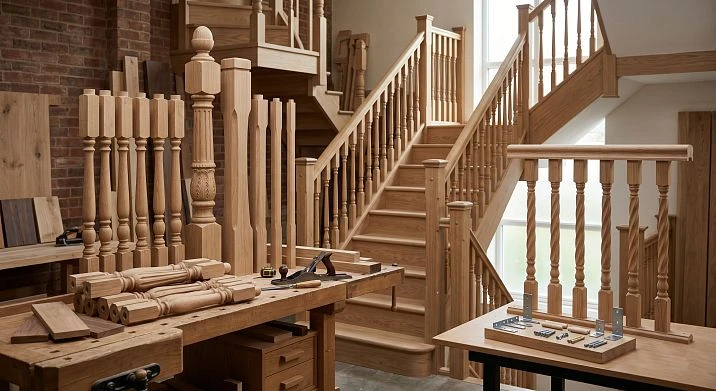
Look at any staircase that makes an impression. One that takes your breath away — not from the height, but from the beauty. There are never any random details. The posts and balusters in such a railing are not just bought separately and assembled together — they are chosen as a single system where each element enhances the other.
This is where the main mistake of most buyers lies: staircase balusters they choose separately — from different catalogs, in different styles, sometimes in different wood species. And then they wonder why the staircase looks "not right".
This article provides a detailed practical analysis: what a wooden railing system is, how to choose posts for balusters and vice versa, how to calculate a set and avoid common mistakes. For those building a house and wanting a staircase for years to come.
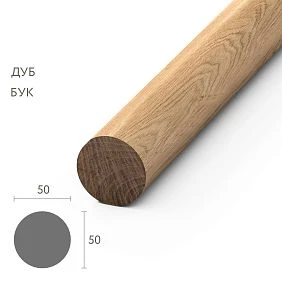
Why posts and balusters should be chosen simultaneously
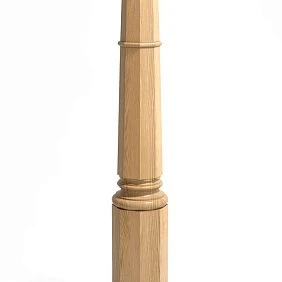
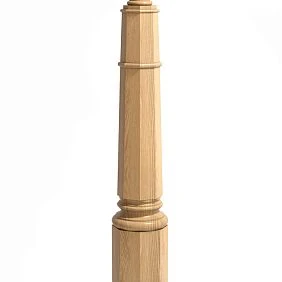
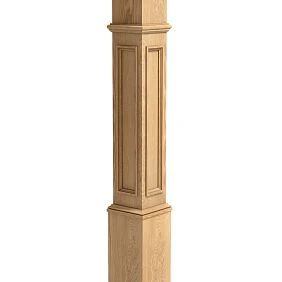
A post is the architectural accent of a staircase. It stands at the beginning and end of each flight, on the landing, at the turning point. The post sets the scale of the entire railing: its height determines the height of the handrail, its diameter or cross-section defines the "weight" of the structure, its decor establishes the stylistic tone.
Balusters are the rhythm. They fill the space between posts, creating a repeating vertical motif. If posts are the percussive accents of a musical phrase, then balusters are its main melody.
When a post and baluster are disproportionate, the railing loses logic. A massive decorated post with thin simple balusters looks disproportionate: there is a "head," but the "body" does not match. A thin minimalist post next to baroque carved balusters is another dissonance: the details speak in different voices.
Buy balusters and posts for a wooden staircase from one manufacturer, from one series — this is the only way to guarantee that the entire system will look like an architectural unity.
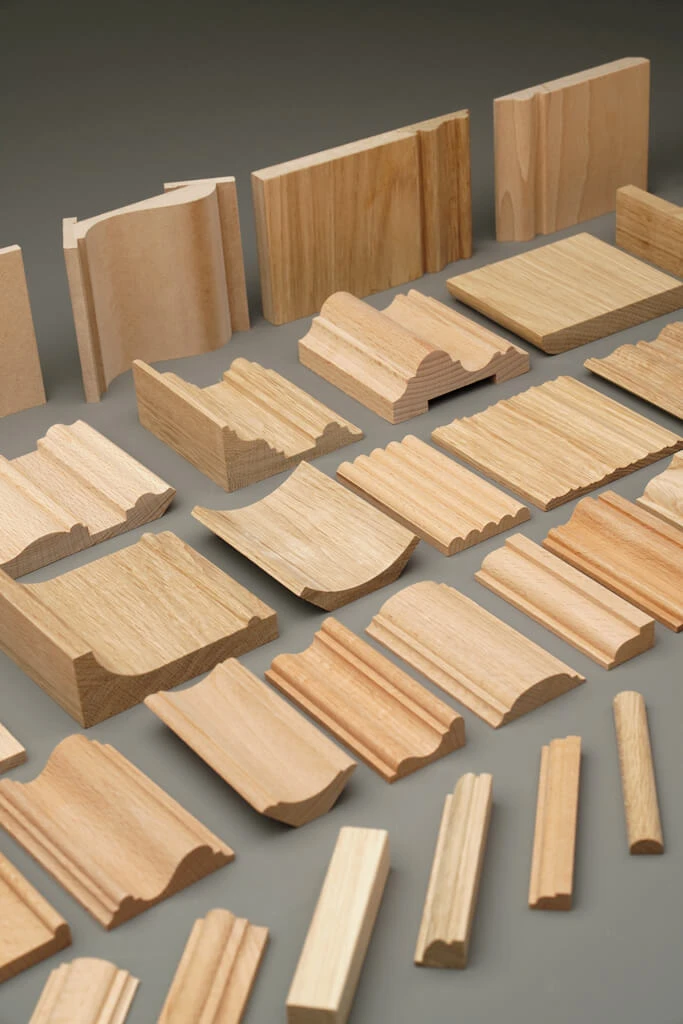
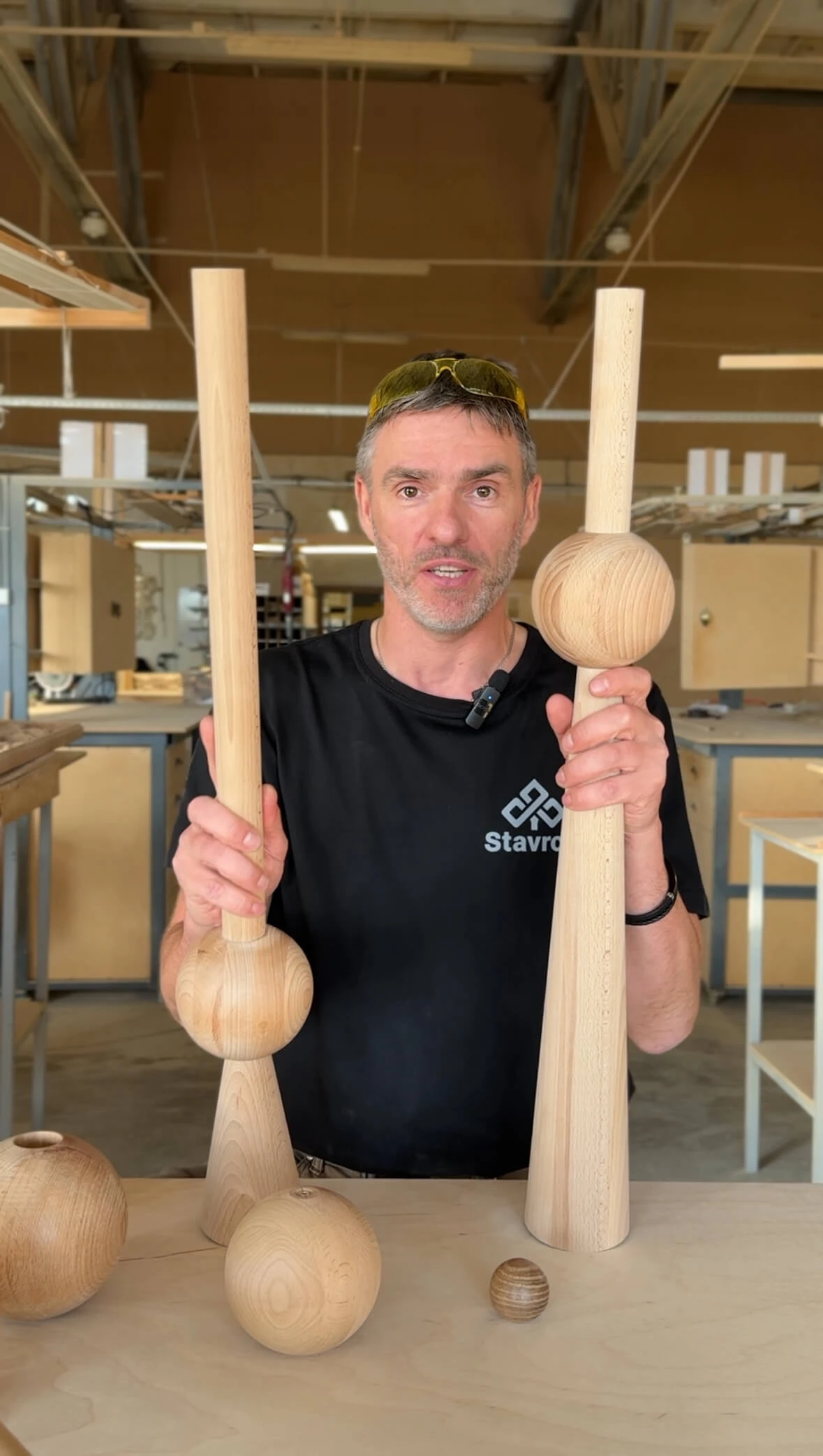
What a wooden staircase railing consists of
Before choosing specific elements, it is important to understand the entire anatomy of the system. A wooden railing is not just "balusters and handrails." It is seven or eight interdependent elements, each of which affects the final appearance and function.
Our factory also produces:
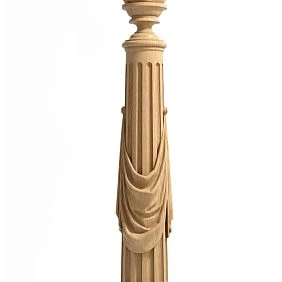
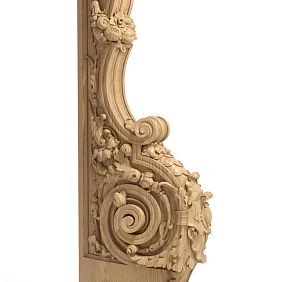
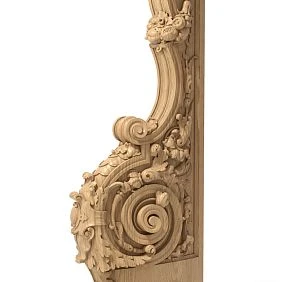
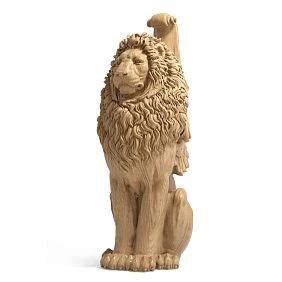
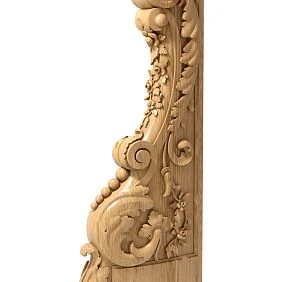
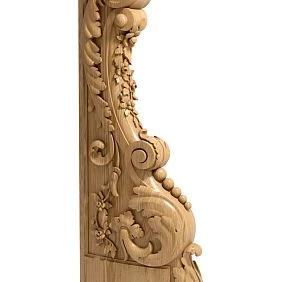
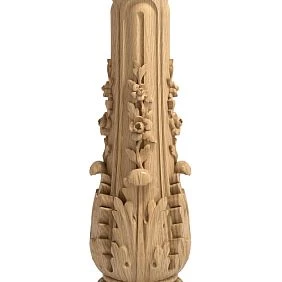
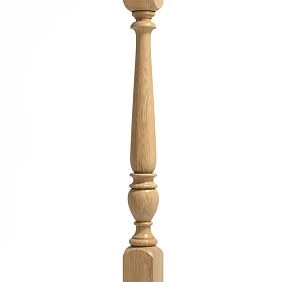
Supporting posts
Load-bearing vertical elements. They take on the load of the handrail, fix the beginning and end of the railing, and hold the structure under lateral pressure. Standard cross-sections range from 80×80 mm to 150×150 mm depending on height and load.
Get Consultation
Balusters
Filling vertical elements. They are installed between posts on tenons into the handrail and fastened from below. They do not bear the main load of the railing — but ensure safety due to the installation spacing.
Handrail
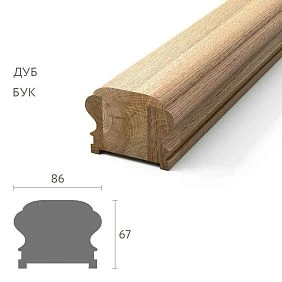
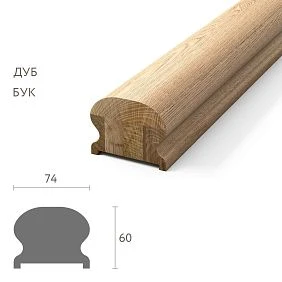
A profiled beam that is laid on top of a row of balusters and attached to the upper tenons. The tenons of the balusters fit into the groove of the handrail. Sold in linear meters, selected by profile for the tenon.
Handrail Support Block
Mounted under the lower part of the handrail when balusters are positioned non-standardly. Ensures precise spacing without milling the handrail.
Lower shoe (under-baluster strip)
A wooden strip laid on the steps and covering the bases of the balusters. Levels the bottom row, hides fasteners, and gives a finished look.
Fasteners
Studs M8–M10 with nuts, washers, PVA glue. This is not a trifle—the rigidity of the entire structure depends on the quality of the fasteners.
Decorative elements
Post caps (caps, pyramids, spheres), handrail end plugs, transition elements on landings.
Ideally, all these elements are purchased from one manufacturer as a single system. buy staircase components Systematically means eliminating incompatibility at the installation stage.
What posts are needed for a wooden staircase
Posts are not interchangeable elements. Their type depends on the position in the structure and the function performed.
Starting post
Installed at the beginning of the lower flight — on the floor. It is the main decorative accent of the entire staircase: it stands in the most visible place, the first to catch the eye. It is the starting post that sets the style of the railing and is often the most decorated element of the series.
Height of the starting post — from 900 mm to 1400 mm, cross-section from 100×100 mm. Decoration: carved capital, profiled base, turned elements on the body.
Finishing post
Installed at the end of the upper flight. Mirrors the starting post in style, often identical. Closes the railing on the other side.
Intermediate (turn) post
On the landing between flights and at turning points. It takes the load of the handrail transition from one flight to another. Usually less decorated than the starting post, but of the same series.
Intermediate posts within the flight
In long flights (more than 4–5 meters), additional support posts are sometimes installed for system rigidity. Usually of a more modest cross-section.
Decorative columns
In mansions and country houses with high ceilings, staircase wooden carved pillars 2–3 meters high turn into full-fledged architectural columns. This is no longer a fastening element — it is a sculptural accent of the interior.
What to look for when choosing a pillar
Cross-section: 80×80 mm — for small stairs and auxiliary flights; 100×100 mm — standard for a private house; 120×120 mm and larger — for spacious halls and grand staircases.
Height: calculated from the installation surface to the top attachment point of the handrail + finial. Standard — 1000–1200 mm of working part.
Shape: from strict rectangular to turned with fillets and from simple turned to ornate carved wooden pillar.
How to choose balusters for pillars
This is the main question that requires not intuition, but several specific criteria. Let's break down each one.
Scale: ratio of cross-sections
Basic rule: the diameter (or the diameter of the circumscribed circle) of the baluster should be 35–55% of the cross-section of the post.
In practice, this looks like:
-
Post 100×100 mm → baluster ø45–55 mm
-
Post 120×120 mm → baluster ø50–65 mm
-
Post 80×80 mm → baluster ø35–45 mm
If the baluster is too thin relative to the post, the railing looks "sunken," as if the posts are holding emptiness. If the baluster is too thick, the railing appears heavy and overloaded.
Style: unity of language
A carved post requires a carved or richly turned baluster. This is not a strict rule, but it is the logic of perception: a decorated element next to a simple one always overwhelms or devalues it.
Buy carved wooden balusters and combine them with massive wooden carved posts — это классический ансамбль, который работает в любом богатом интерьере.
Строгий прямолинейный столб с минимальным декором — это партнёр для of square balusters for staircases или простых точёных. Современный дом, лаконичный интерьер — комплект строгий и выразительный в своей сдержанности.
Высота: согласованность
Высота рабочей части балясины (без шипов) должна соответствовать высоте рабочей части столба до точки крепления поручня. Это звучит очевидно, но именно здесь регулярно возникают ошибки при раздельной покупке.
Если балясина на 50 мм ниже столба — поручень будет «проседать» между столбами. Это видно невооружённым глазом и выглядит как дефект монтажа.
Порода: единый материал
Buy wooden balusters из той же породы, что и столбы — это принципиальное требование для систем с прозрачной отделкой (лак, масло, морилка). Дуб и бук под одной морилкой дадут разные тона — это непреодолимо без перекраски в непрозрачный цвет.
Под покраску единая порода менее критична, но всё равно желательна: разная плотность разных пород означает разное впитывание грунта и краски, а значит — разный блеск и выравнивание поверхности.
Резные столбы и резные балясины: классика на максимуме
There are staircases built once and for all — with the expectation that fifty years later, grandchildren will look at this railing with respect. For such projects — a carved set.
What is a carved set for a wooden staircase
Buy baluster post in carved execution means ordering elements that are manufactured according to a lathe program with subsequent milling of decorative patterns.
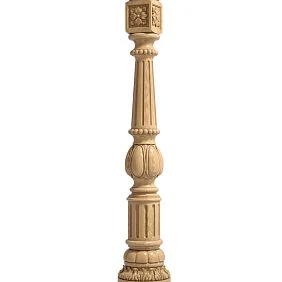
A carved post is a massive body with a cross-section of 100–150 mm and a distinct architectural structure: base (plinth or profiled base), body (turned or faceted), neck, transition, capital. Decoration may include flutes, diamonds, leaf grips, geometric ornaments.
Carved balusters complement the post. Turned-carved form: alternation of vases, tapers, decorative inserts. The scale of carving on the baluster should be proportionate to the scale of carving on the post: fine carving on balusters next to large decor on the post creates a mismatch.
When a carved set is appropriate
A classic country house with expressive wooden architecture is the prime candidate for a carved railing. Open rafters, logs or timber, massive doors — all invite rich staircase decor.
A house in neoclassical or pseudo-Russian style — carving here is not decoration but a style-forming element. Without it, the interior will look unfinished.
A grand staircase in a mansion — high ceilings, spacious hall, natural stone or parquet flooring. Here, the scale allows using posts 2.5 meters high in the form of wooden columns of carved posts with a full decorative program.
Covering of the carved set
Under clear varnish, the carving acquires sculptural volume: each element casts a shadow, the profile is fully readable. This is the best option for oak with its characteristic grain.
Under tinted oil in walnut or dark oak, the carving gains depth; dark recesses and light highlights create an almost jewelry-like effect. Very expressive.
Under white enamel, the carved set transforms into an elegant Provencal or French classic look. White carved balusters on a light staircase evoke the image of a European estate.
Simple posts and square balusters: a modern staircase without excess
The opposite scenario is no less in demand. A modern private house, minimalism, Scandinavian style, high-tech in wood: here decorative carving would be a dissonance. A different logic is needed.
The principle of less is more precise
Simple square oak posts with a cross-section of 100×100 mm, without ornamentation, with neat chamfers on the edges — this is strength. They do not distract, they hold the space. Next to them — Square balusters 45×45 mm, identical, with equal spacing. The handrail is straight, matching the color of the balusters.
Result: a staircase that looks designed — not assembled. This is a fundamental difference.
Square balusters: technical advantages
Beyond visual appeal, square balusters have technical merits that are rarely discussed.
A square cross-section of 45×45 mm without turned thinnings provides maximum strength for this nominal size. No neck means no most vulnerable spot to lateral impact. For families with children and active staircase use, this is a strong argument.
Square balusters are easier to sand for painting: flat faces can be processed with a belt sander in one pass. The result is predictable.
Installation of square balusters is also somewhat simpler: a square-section tenon locks into the groove without the possibility of rotation. More details on proper technique can be found in the guide on installation of wooden railings and balusters.
Posts for square balusters
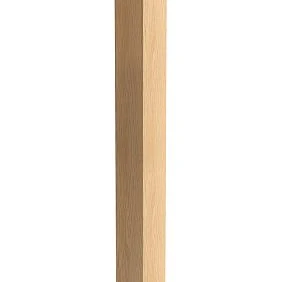
The ideal post for square balusters is straight, with minimal decoration: a slightly pronounced capital, a simple base. Or even without decoration — just a proportionally balanced beam with chamfers.
Under dark tinting (wenge, mocha, dark walnut), a square post 100×100 made of oak next to square balusters of the same tinting creates a stylish, almost furniture-like railing. Strict, jewelry-like in details.
How to calculate the number of posts and balusters
Calculation is not "by eye." An error in quantity results in a reorder, installation delays, and the risk of receiving a different batch with a different shade.
Algorithm for calculating posts
Number of posts = sum of attachment points across the entire staircase structure.
Lower flight: 2 posts (starting at the bottom + finishing at the top of the flight)
Landing: 1 post at the turning point (if the turn is 90° or 180°)
Upper flight: 1 finishing post at the upper landing of the second floor
Railing along the wall of the second floor: 1 post at the beginning and 1 at the end — minimum; for long railings, intermediate posts are added.
Formula for a typical two-flight staircase with one turning landing:
Starting (1) + intermediate on the landing (2) + finishing of the upper flight (1) + posts for the second floor railing (2–3) = 6–7 posts.
Plus a reserve: if the posts are carved and stylistically prominent — always take +1 in case of chipping or adjustment.
Baluster Calculation Algorithm
Step 1. Measure the length of each flight along the stringer (inclined line, not projection).
Step 2. Choose the installation spacing:
-
120–130 mm — families with children (safety standard: gap between balusters no more than 150 mm)
-
140–160 mm — standard
-
160–180 mm — maximum allowed for a residential building
Step 3. Calculate the quantity: flight length (mm) ÷ spacing (mm) = number of balusters. Round up.
Step 4. Sum across all flights and open railings on the second floor.
Step 5. Add 10% reserve.
Example: flight 3,600 mm + flight 3,600 mm = 7,200 mm. Spacing 150 mm. 7,200 ÷ 150 = 48 balusters. Reserve 10% = +5 pieces. Total: 53 balusters.
Calculation table for standard configurations
| Staircase configuration | Posts | Balusters (150 mm spacing) |
|---|---|---|
| Single-flight, 12 steps | 2–3 | 22–28 pcs. |
| Double-flight, 2×12 steps | 5–7 | 48–56 pcs. |
| U-shaped, 3 flights | 8–10 | 65–75 pcs. |
| Open railing for 2nd floor, 5 m | +2 | +32–34 pcs. |
Kit price: what makes up the budget
Balusters price — a variable that cannot be considered separately from the price of posts and the entire kit.
Factors affecting the cost of balusters
-
Wood type: pine — basic level, beech — medium, oak — premium
-
Shape: square and simple turned are 40–60% cheaper than carved
-
Height: standard 900–1000 mm, non-standard — more expensive
-
Sanding: basic P80 or finish P180–220 (important when ordering for varnish)
Factors affecting the cost of posts
-
Cross-section and height: 100×100×1200 mm — basic size; 120×120×1400 mm — more expensive
-
Decor: simple straight beech column and carved wooden post oak ones differ in price by 4–6 times
Estimated budget for a complete set
| Element | Pine/beech | Simple beech/oak | Carved oak |
|---|---|---|---|
| 53 balusters | 100–165 thousand rubles | 150–230 thousand rubles | 240–310 thousand rubles |
| 6 pillars | 18–36 thousand rubles | 36–60 thousand rubles | 80–150 thousand rubles |
| Handrail 10 linear meters | 12–18 thousand rubles | 18–26 thousand rubles | 26–40 thousand rubles |
| Fastening | ~5 thousand rubles | ~5 thousand rubles | ~6 thousand rubles |
| TOTAL | ~135–224 thousand | ~209–321 thousand | ~352–506 thousand |
Current Balusters buy price — in the STAVROS catalog with filtering by model and breed.
Mistakes when buying posts and balusters
Each of them is a real situation that results in rework or a compromise outcome.
Mistake 1: bought balusters without posts from the same series
“I’ll buy the posts later, first I’ll look at the balusters.” Later, the posts were found from another supplier — a different decor style, a different breed, a different tone. Under one coating — two different colors. It can no longer be redone without a complete replacement.
Solution: Buy balusters and posts for a wooden staircase in one order, from one series.
Mistake 2: didn’t count the turning posts
We counted: 2 flights = 2 starting + 2 finishing = 4 posts. Forgot about the landing between flights and the turn. As a result, 2 turning posts were not included in the order. Reorder — a different batch, a different shade.
Solution: count all points of the structure before the first order.
Error 3: used different styles
Pillars with baroque decor, balusters — minimalist square. Looks like a misunderstanding: the style conflict is immediately visible.
Solution: the style of the decor must match or organically complement — no "I liked both those and those."
Error 4: did not account for the handrail height
We bought balusters with a working height of 850 mm. The standard is a handrail no lower than 900 mm from the step surface. The difference seems small, but during installation, an uncomfortable railing height becomes apparent — especially noticeable for children and the elderly.
Solution: always check the working height of the railing according to the standard before ordering.
Error 5: forgot about the second-floor railings
We calculated balusters and posts only for the staircase section. We did not account for the open railing along the second floor above the living room or hall. That's another 3–5 meters of railing with 20–30 balusters and 2–3 additional posts.
Solution: calculate the entire perimeter of the railing, including the balcony railing of the second floor.
Error 6: chose a soft wood for the main railing
Varnished pine on the main staircase in a house with children means dents and scratches within a year. For constant load, oak or beech is the minimum standard.
Error 7: did not check the compatibility of the handrail with the baluster
Baluster tenon is 25 mm square, handrail groove is 28 mm for a round tenon. Geometry mismatch. Either replace the handrail or re-cut the tenons. Three hours of manual work for 50 balusters.
Solution: handrails and balusters made of wood You need to order from one manufacturer's system where the compatibility of the tenon and groove is guaranteed.
Where to buy posts and balusters for a wooden staircase
A system order is not just convenience. It is the only reliable strategy to get a railing that works as an architectural object, not a set of parts.
balusters for staircase to buy from a direct manufacturer means:
-
Get a free consultation on selecting a series
-
Calculate the quantity of balusters, posts, handrails, and fasteners in one request
-
Order everything from one batch with guaranteed compatibility
-
One account, one delivery, one wait
buy balusters and handrails from the same series — meaning the handrail will fit exactly on the spikes of the balusters, the posts will be proportionate, and the shade under one coating will match.
Order algorithm:
-
Describe the staircase design: number of flights, length of each, height
-
Name the interior style: classic, modern, country, minimalism
-
Specify the wood species or coating type: for varnish, for painting, tinting
-
Get a specification with the quantity and price of the complete set
-
Confirm the order — one batch, one delivery
Staircase Components for Sale from the manufacturer — it's the right decision from the start.
About the company STAVROS
STAVROS is a Russian manufacturer of solid wood products since 2002. Full production cycle: from chamber drying of the workpiece to final sanding of the finished product. All fencing elements — balusters, posts, handrails, and fasteners — are produced within coordinated series with guaranteed compatibility in spike, groove, height, and style.
The catalog includes: over 50 models of balusters (turned, carved, square, flat), wooden support posts for stairs from simple to carved decorative, handrails in a variety of profiles. Wood species: oak, beech, pine, ash.
Chamber drying to 8–10% moisture ensures stable geometry during installation and finishing without warping. Multi-pass sanding provides a ready-to-coat surface without additional preparation.
Pickup from Moscow and St. Petersburg. Delivery by transport companies throughout Russia. Free calculation of the complete set — for each project based on the specific staircase parameters.
FAQ: Answers to popular questions
Can I buy balusters without posts?
Yes, but only if the posts are already installed and you know their exact height, style, and compatibility with the planned balusters. In all other cases, order them together.
What is more important: balusters or posts?
Both elements are equally important. Posts provide structural support and stylistic scale, balusters form the rhythm of the railing and ensure safety. Without proper interaction, neither element works to its full potential.
How many posts are needed for a staircase?
For a two-flight staircase with one landing — at least 5–7 posts, considering open second-floor railings — 7–10. The exact number is calculated based on the design: each change of direction point and the end of each flight requires a post.
Which posts should I choose for carved balusters?
Wooden carved posts with a similar scale of decor and the same wood species. For a rich classic interior — posts 100×100 mm and larger with turned and carved detailing.
Where to buy posts and balusters for a wooden staircase?
In the STAVROS catalog — direct manufacturer, complete system: balusters, posts, handrails, fasteners. Free calculation of the set, Contact us to confirm shipping to your destination.
How to calculate the number of balusters and posts yourself?
Balusters: span length (mm) ÷ installation step (140–160 mm) = quantity per span. Plus 10% reserve. Posts: count all structural points — start and end of each span, landings, turns, open railings.
Which wooden balusters and posts to choose for a classic staircase?
Carved or richly turned oak balusters combined with carved massive posts from the same series. Under clear glossy varnish — this is the image of a grand classic staircase.
Can you mix carved posts and square balusters?
Formally — yes, but stylistically it is risky. A decorated post overwhelms a strict square baluster. It is better to stick to a single style key — this is the guarantee of a cohesive result.