








































































Article Contents:
- Starting stair post: why it creates the first impression
- Why the starting post defines the entire system
- How the starting post differs from support and intermediate posts
- Starting (entry) post
- End post
- Support (intermediate) post
- Load-bearing post under the stringer
- Comparison table
- What wooden stair posts can you buy
- Turned pillars: classic in its pure form
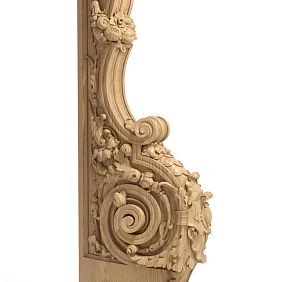
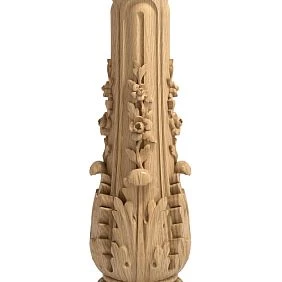
- Carved pillars: when decor becomes a statement
- Grand pillars: scale and monumentality
- By application scenarios
- Material: oak, beech, and solid wood in stair pillars
- Oak: a wood species with character
- Beech: for neat finishing and painting
- Why kiln drying is important
- Sizes and proportions: how to avoid mistakes in selection
- Post height
- Cross-section
- Compatibility with Balusters
- What to check before ordering
- Pillar, balusters, and handrail: why a staircase cannot be assembled from random parts
- Balusters: the regular posts that create rhythm
- Classic Collection: Ready-Made Style Solution
- Modern Interior: Geometry as Style
- How to Choose a Starting Post Style for Your Interior
- Classic
- Neoclassicism
- Baroque and palace style
- Russian style
- Modern Interior
- Art Deco
- Mistakes When Buying a Starting Wooden Post
- Buying a Post Without Considering the Handrail
- Choosing an Element That Is Too Thin
- Mixing different carving styles
- Not Considering the Finish
- Buying by Photo Without Dimensions
- Not Considering the Mounting Method
- Ordering Only One Post
- What to buy together with the starting post
- End and intermediate posts
- Balusters
- Handrail
- Underhandrail
- Top piece
- Fasteners and mounting elements
- Finishing materials
- Where to buy a wooden starting post for stairs
- Why STAVROS
- FAQ
- How is a starting post different from a support post?
- Which material is better for a stair post: oak or beech?
- Can I buy a post separately from balusters?
- How to choose balusters for a wooden post?
- Which post to choose for a classic staircase?
- Will a carved post suit a modern staircase?
- What to buy together with the starting post?
- Where to buy a wooden stair post?
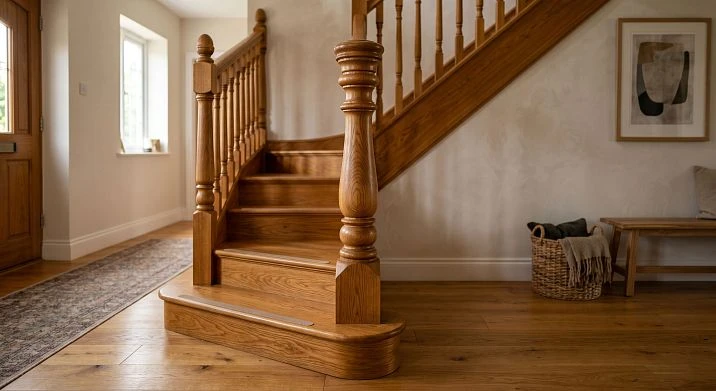
There is a special moment when a guest crosses the threshold and their gaze — before it takes in the entire staircase — lands on one specific element. Massive. Expressive. Standing at the very first step. It sets the tone for everything: the railing, the flight, the double-height space, and the overall atmosphere of the home.
The starting post for a staircase is not just a support for the handrail. It is the architectural punctuation of the home. The point where the ascent begins. The detail that is seen first and remembered longest. And that is precisely why buying a wooden stair post means making a choice that will define the look of the entire stair railing.
In this article — everything you need to know before purchasing: types of posts, differences between starting and intermediate posts, proportions, material, style, compatibility with balusters and handrails, and how properly selected parts come together as a system, not a random set of elements.
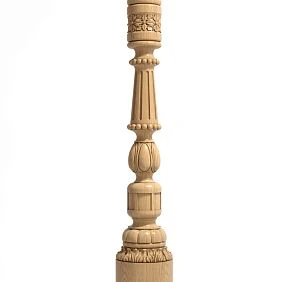
The starting stair post: why the impression begins with it
A staircase is an architectural object inside a home. One of the few items that has both structure and scale, rhythm and an entry point. And that entry point is always the starting post.
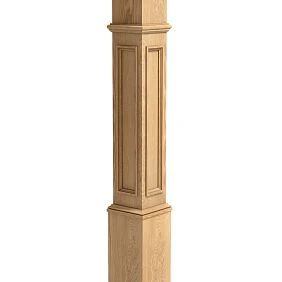
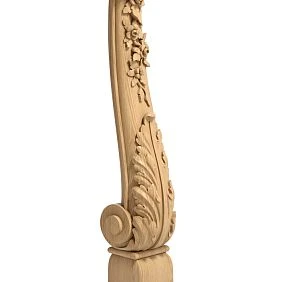
It stands at the first step. Most often — on the floor, at the base of the flight. Its height, as a rule, exceeds that of balusters: not 900 mm, like a standard spindle, but 1100–1500 mm and higher. Its cross-section is wider. Its shape is more expressive. It holds the handrail, bears the main load from the railing, and at the same time acts as an accent decorative element that is instantly read as the "main detail" of the entire structure.
When people say "buy a wooden stair post" — most often they mean exactly this one. The starting one. The first one. The entry post.
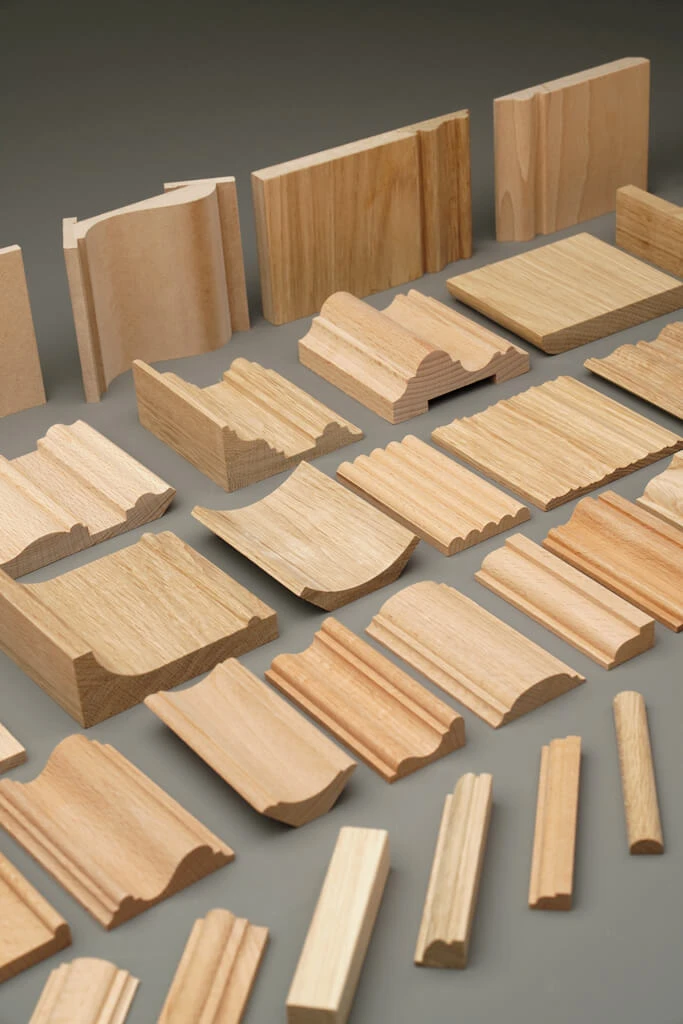
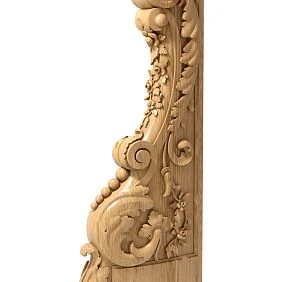
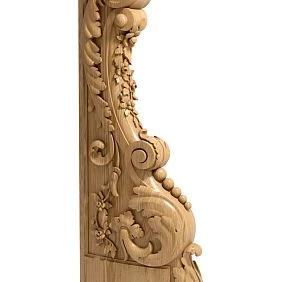
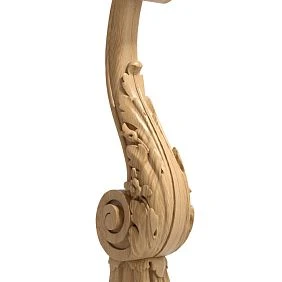
Posts for staircase STAVROS is a collection of support elements made from solid beech and oak, designed as part of a staircase system: with consideration for compatibility with balusters, handrails, and decorative finials.
Why the starting post defines the entire system
Try to mentally remove the starting post from a beautiful classic staircase. What happens? The handrail "breaks off" in mid-air. The balusters are left without an anchor. The entire rhythmic structure of the railing loses its completeness.
The starting post is the anchor of the system. The count of balusters begins from it, the handrail horizontal is built from it, and the entire decorative rhythm of the railing is tied to it. That is why the starting post for a solid wood staircase is chosen first — before the balusters, before the handrail, before the subrail. It sets the scale, shape, and style for everything that will be next to it.
Our factory also produces:
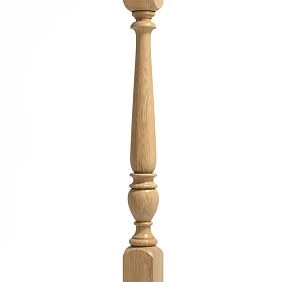
How the starting post differs from the support and intermediate posts
The terms are confusing. Let's clarify once and for all.
Get Consultation
Starting (entry) post
It stands at the first step of the flight — where the staircase begins. This is the most decoratively expressive element of the railing: it is seen first, stands in the most visible place, and carries the maximum visual load.
Typical dimensions of the starting post: height 900–1500 mm (from floor to top with finial), cross-section 100×100 mm, 120×120 mm, or 150×150 mm for grand staircases. Shape — turned, carved, geometric — depending on the style.
End post
A symmetrical mirror of the starting post. It stands at the end of the flight — near the upper landing or stair opening. Usually identical to the starting post in shape and size. Together they form the "frame" of the staircase railing.
Support (intermediate) post
Installed at points where the staircase changes direction: on landings, when the angle of the flight changes, at inflection points of the railing. Its function is structural: it redistributes load at turning points. In size, it is typically the same as the starting post, but may be simpler in decoration.
Load-bearing post for the stringer
A separate type: a post that supports the stringer from below. It is not part of the railing in the classic sense — it is a structural element of the staircase frame.
Remember the main point: the starting post for a wooden staircase and the support post are not the same thing. The first works for visual appearance, the second for structural reliability. Although in a good staircase, both perform both functions.
Comparison table
| Post type | Location | Decorative element | Section | Main function |
|---|---|---|---|---|
| Starting (entry) | At the first step | Maximum | 100×100 — 150×150 | System anchor + accent |
| End | At the top step | As initial | As initial | Railing completion |
| Intermediate | On turns, landings | Moderate | As initial | Fracture structure |
| Load-bearing | Under the stringer | Minimum or not | Under load | Frame support |
What wooden stair balusters can you buy
Variety of shapes is not a decorative whim. It is a real architectural language that either matches the interior or conflicts with it.
Turned balusters: classic in its pure form
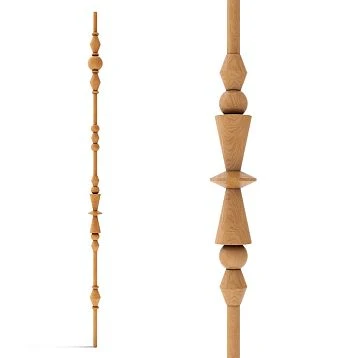
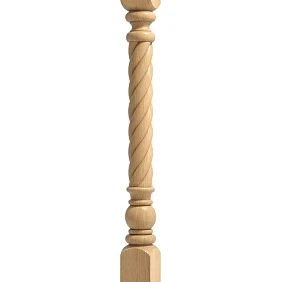
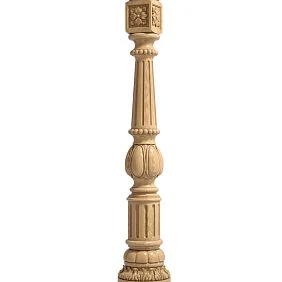
A turned baluster is a body processed on a lathe. Alternating thickenings, grips, necks, bases — all this creates a rhythmic profile that is instantly perceived as classic.
Wooden stair baluster L-055 — an example of a restrained, well-proportioned turned baluster. It is not overloaded with decor but has correct proportions. For a staircase in a modern home with classic elements, for a calm interior with wooden details — this is a precise fit in style.
Carved balusters: when decor becomes a statement
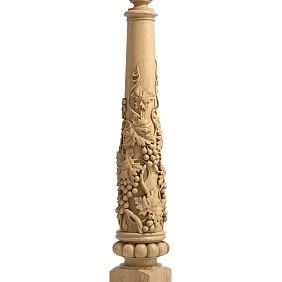
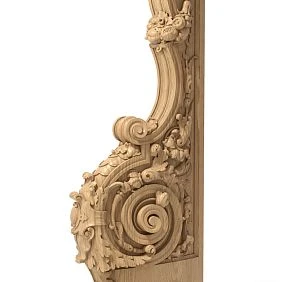
A carved baluster is a combination of a turned form and manual or machine relief. Acanthus, curls, geometric ornament, leaf motif — each pattern has a stylistic affiliation and historical biography.
Wooden stair baluster L-077 — an expressive carved element. For a classic cottage, a country house with wooden panels, a study interior — a carved baluster here is not excessive but organic.
Grand pillars: scale and monumentality
Large houses require a large staircase. And a large staircase requires a grand pillar — with a height from 1300 mm, a wide cross-section, and rich relief.
Wooden stair pillar L-107L — is exactly such an element. A grand starting pillar for a wide flight, for a double-height staircase, for a hall with high ceilings. It does what the best architectural element should do: not just exist, but be present. It creates a sense of scale and status.
By application scenarios
-
Country house, cottage: turned or carved oak pillar with oil or tinted finish. Warm texture, natural color, durability.
-
Double-height staircase: grand pillar with maximum height, expressive profile, rich decor.
-
City apartment with wooden staircase: restrained pillar, moderate decor, neat painting or light tinting.
-
Restaurant, hotel, commercial interior: maximally expressive pillar, dark-tinted or oiled oak, carved relief.
-
Classic study, library: pillar with a concise turned profile, lacquered oak.
Material: oak, beech, and solid wood in stair posts
Choosing the wood species for a post is not just a matter of taste. It involves technical characteristics, durability, and finishing logic.
Oak: a wood species with character
Oak is a dense, hard, load-resistant species. Density is about 700 kg/m³. For a stair post that bears real dynamic load (hand holds, body leans on during ascent), this is critically important.
Oak texture is large, expressive, with a characteristic pattern of medullary rays. Under clear oil or varnish, this texture "lives" and creates a unique image. Under dark tinting, the post acquires a noble, almost antique look.
A carved oak stair post is a serious choice for a serious home. Oak holds carving well: the relief remains sharp and does not blur under the coating.
Beech: for neat finishing and painting
Beech has a closed structure, uniform surface, excellent base for any coating. Density is comparable to oak (680–750 kg/m³), mechanical properties are high.
The main advantage of beech is the ideal surface for enamel or white paint. Where oak with its pronounced texture will "show through" under white coating, beech gives an even, clean color. For a neoclassical or Provencal interior with white wooden details, beech is preferred.
A wooden stair post for painting is almost always beech. For oil or tinting, it is more often oak.
Why kiln drying is important
A stair post stands in a room where temperature and humidity change. Raw material or poorly dried wood leads to deformation: cracks, twisting, geometry issues. A kiln-dried post is stable: the cross-section does not change, the carving does not crack, the coating does not peel.
When choosing a post, always check the material's moisture content. For interior use — 8–12%.
Dimensions and proportions: how to avoid mistakes when choosing
A beautiful post bought without checking dimensions is a detail that either gets lost in a wide staircase or overwhelms a narrow staircase with its massiveness.
Post height
The height of the starting post is selected considering the railing height and the presence of a finial:
| Railing height | Recommended post height (with finial) |
|---|---|
| 900 мм | 1000–1100 mm |
| 1000 мм | 1100–1200 mm |
| 1100 мм | 1200–1400 mm |
| 1200 mm (main staircases) | 1400–1600 mm |
Rule: the starting post should be 100–200 mm higher than the balusters to visually "stand out" and create proper hierarchy of elements.
Cross-section
The post cross-section is selected proportionally to the stair width:
-
width 800–900 mm → post 100×100 mm;
-
width 1000–1100 mm → post 120×120 mm;
-
width 1200 mm and wider → post 150×150 mm or larger.
A post that is too thin on a wide staircase creates visual imbalance. A post that is too massive on a narrow staircase gives a feeling of heaviness and clutter.
Compatibility with balusters
This is a key point that is often overlooked. The carving style of the post and the balusters must match. If the post has an acanthus ornament in a classic design, but the balusters are simple rectangular posts without decoration, the system does not form a unified look.
What to Check Before Ordering
-
Stair width and planned post cross-section
-
Fence height and required post height
-
Style and type of balusters (already selected or being selected simultaneously)
-
Finish coating of post and balusters (must match or intentionally contrast)
-
Mounting: into the floor, into the step, on a metal rod — different options for different structures
Post, balusters, and handrail: why a staircase cannot be assembled from random parts
This is the main practical lesson, which is worth more than any theoretical knowledge.
Stair railing is a system. Not a set of beautiful elements from different collections. It is a system where each element is designed with compatibility with the others in mind: in size, style, finish coating, and mounting method.
What happens when the system is ignored:
— a post from one collection, balusters from another, a handrail from a third manufacturer. Result: no part is visually connected to another. The staircase looks 'assembled' in the worst sense of the word.
— a post with oil finish, balusters with white enamel. Even with good individual quality — together they create chaos.
— a pillar with rich acanthus relief, balusters of square cross-section without decoration. One element «screams», the other is silent. There is no balance.
The right strategy is to choose all elements from one system or at least coordinate them by key parameters.
Balusters: regular posts that create rhythm
Buy wooden balusters for stairs — this is the next step after choosing the starting pillar. Balusters create the rhythm of the railing: a uniform repetition of vertical elements between the pillars and the handrail.
For an example of a compatible solution: the starting pillar L-077 (carved) goes well with carved balusters from the same series — the carving pattern echoes, the scale is coordinated.
Wooden baluster L-054 — an example of a classic turned baluster that works organically next to a turned starting pillar. One style family — one result.
Collection «Classic»: a ready-made style solution
Balusters of the «Classic» collection — this is a system of balusters designed specifically for classic staircases. Proportions, decor, height, cross-section — everything is calibrated for joint use with starting pillars of the classic line.
Modern interior: geometry as a style
If the staircase is designed in a modern or minimalist style, carved elements are not needed. A different logic applies here: simple forms, clean lines, geometric precision.
Square balusters are balusters without turned profiles, of rectangular or square cross-section. Paired with a strictly geometric post without decoration, this creates a modern, concise, and expressive system.
How to choose the style of the starting post to match the interior
A wooden staircase post is not a neutral detail. It takes a stance. It belongs to a certain style. It is important to ensure that this style matches the interior of the home.
Classic
A turned or carved post with a symmetrical profile and classic ornament. Oak with oil, tint, or dark lacquer finish. Balusters from the "Classic" collection. Handrail — wooden, round or oval profile.
This is a staircase with history. It looks not just expensive — it looks right for a home where the interior is designed in a classic spirit: with moldings, wooden doors, and solid furniture.
Neoclassicism
Moderate profile, restrained decor, strict proportions. Post L-055 is a good candidate: elegant, without excess. Beech with white enamel or light tint. Balusters with minimal, neat decor.
Baroque and palace style
Rich relief, expressive scrolls, possibly acanthus. Grand post L-107L — scale, depth of carving, monumentality. Oak with dark tint and lacquer. Luxurious turned balusters with rich relief.
Russian Style
Open wood texture, traditional ornament, carved character. For a country house, wooden cottage, bathhouse with access to the house. Oak with natural oil or wax. Balusters with traditional Russian pattern.
Modern interior
Geometric post without unnecessary decor. Square or rectangular cross-section with minimal turned elements. Beech under white or gray enamel, or oak under light tinting. Square balusters to match the post.
Art Deco
Verticality, rhythm, decorative symmetry. Post with a pronounced vertical line and clear geometric accents. Dark wood, contrasting handrail.
Mistakes when buying an initial wooden post
Let's analyze typical mistakes — not to reproach, but to help avoid them.
Buying a post without considering the handrail
The initial post and handrail are two elements that physically connect. The handrail rests on the post. Its width, profile, height must match the groove or support platform of the post. Incompatible dimensions mean additional joinery work or a crooked connection.
Choosing too thin an element
"Section 80×80 on a wide flight of 1200 mm" looks like a random matchstick attached to the staircase. The scale must match.
Mixing different carving styles
Acanthus ornament on the post and geometric balusters without decor — this is not "minimalism", it's a selection error. The carving on the post and the decor of the balusters must speak the same language.
Do not account for finishing
The same post model under white enamel and under oil on oak yields two completely different results. Determine the finish before ordering. Oak under white enamel is not the best choice: the texture shows through. Beech is optimal for painting.
Buying by photo without dimensions
This is the most costly mistake. A photo may not convey the actual scale of the product. Always request dimensions: height, cross-section, size of the top and bottom platforms, neck diameter.
Not considering the mounting method
The post is attached to the floor or step. The mounting method depends on the base design: anchor in concrete, stud in a wooden step, metal cup. Clarify in advance which method is intended for the specific model.
Ordering only one post
A staircase has a beginning and an end. The end post is a mirror of the starting post. Also, intermediate posts are needed at turns. Order the full set in one batch to avoid shade discrepancies.
What to buy together with the starting post
A comprehensive approach is a rule that saves money and nerves. Here is what you need to consider when ordering.
End and intermediate posts
The end post is identical to the starting post in model and size. Intermediate posts are placed at turns of the flight if the staircase is L-shaped or U-shaped.
Balusters
buying wooden balusters for the staircase — in a collection compatible with the selected post. Quantity: 2 balusters per step, spacing 120–150 mm — standard for most staircases.
Handrail
Wooden handrail — a horizontal element that the hand holds. Its profile (D45, D50 or oval) and width must match the mounting seat on the post.
Buying wooden stair railings means ordering at least a handrail and a bottom rail, which form the upper and lower horizontals of the railing. Buy wooden railings and balusters as a set — this is the most reasonable solution.
Bottom rail
A plank on which the lower ends of the balusters rest. It is installed on the steps. Ensures even placement of balusters and a neat base for the railing.
Finial
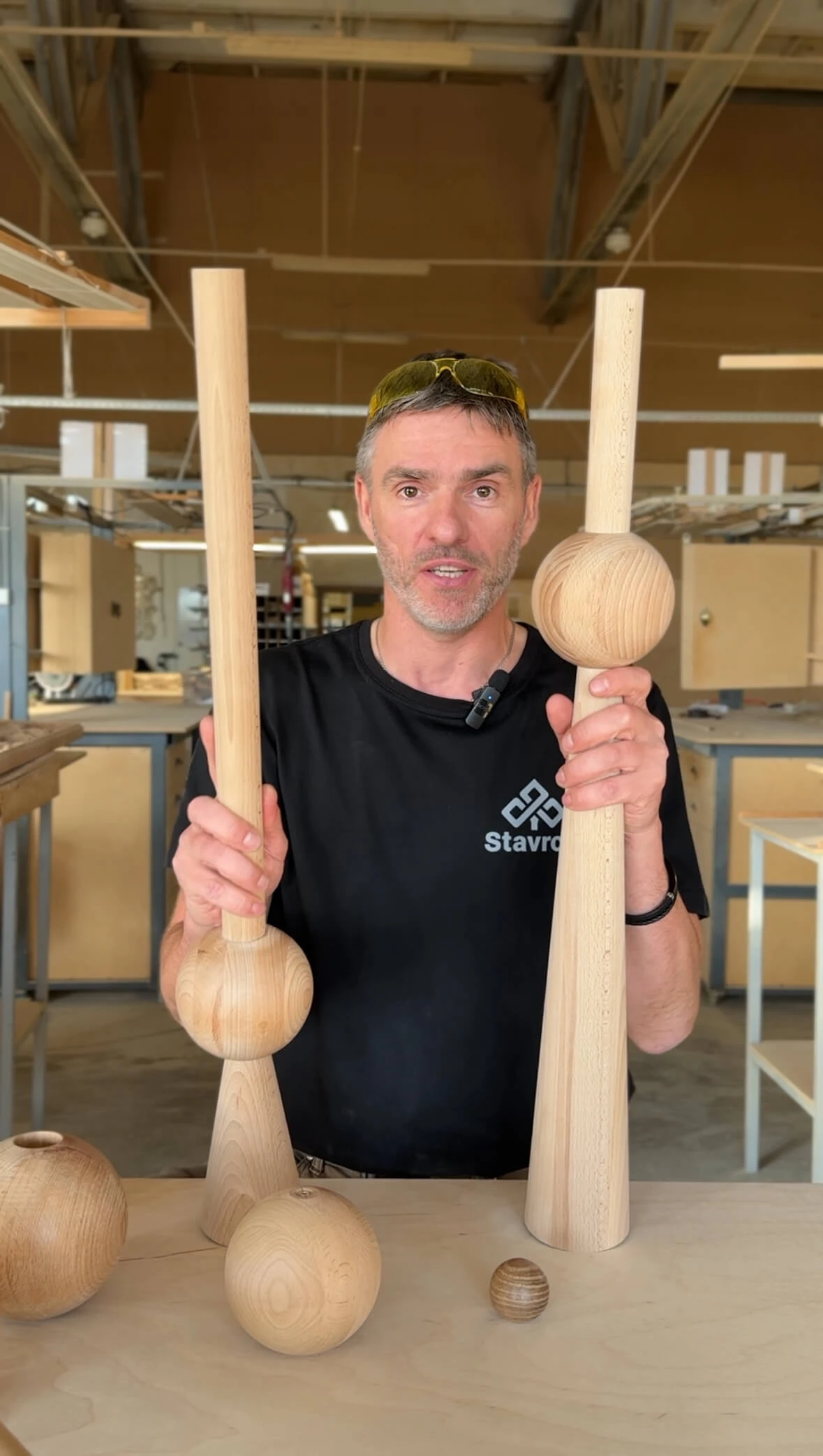
A decorative element installed on the top end of the starting post. A ball, cone, pyramid, or shaped finial — completes the vertical of the post and adds decorative expressiveness.
Fasteners and mounting elements
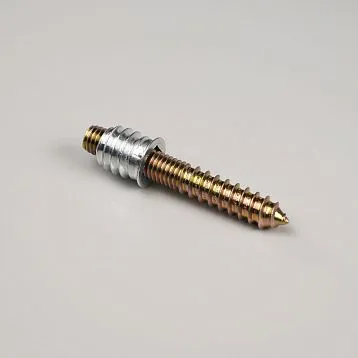
Pins, anchors, metal cups — for a specific type of base. Don't skimp on fasteners: the post bears real dynamic load.
Finishing materials
Oil, varnish, enamel, primer, brushes — all of this goes into the estimate. The post and balusters must be treated before installation: the bottom ends are especially important to prime for protection against moisture from below.
Where to buy a wooden starting post for stairs
Choosing a wooden stair post made of solid wood means choosing a supplier who has not only beautiful photos, but also a real range of compatible parts: posts, balusters, handrails, finials, fasteners.
Buying a wooden stair post within the unified STAVROS collection means getting a system, not a set of random elements. In the catalog Posts for staircase STAVROS — specific models with dimensions, wood species, compatibility with balusters and handrails. Nearby — Wooden balusters for stairs from the same collections, with the same parameters.
Why STAVROS
Buying a wooden starting stair post is a task that requires a supplier with a full range of solid wood stair components, not separate scattered parts.
STAVROS has been manufacturing and supplying wooden products for stairs and interiors since 2002. The catalog includes posts, balusters, handrails, under-rail strips, finials, and decorative elements made of kiln-dried solid beech and oak. Each part is designed for joint use: one style, compatible sizes, a unified fastening system.
All products are made of kiln-dried solid wood with a moisture content of 8–12%. Stable geometry, no deformation after installation, clear carving relief. Suitable for any finish: oil, varnish, enamel, tinting.
Among STAVROS's completed projects are the Hermitage, Konstantinovsky Palace, Alexander Palace. Rating 5.0, over 260 verified reviews. Contact us to confirm shipping to your destination. — CDEK and DPD. Showrooms in Saint Petersburg and Moscow.
FAQ
How is a starting post different from a support post?
The starting (entry) post stands at the first step and is the main decorative accent of the railing. A support post is installed at turns and landings — its role is primarily structural, although it may have the same appearance.
Which material is better for a stair post: oak or beech?
Oak — for natural finishes (oil, varnish, tinting): expressive texture, high density, durability. Beech — for painting with enamel: its closed structure provides a smooth surface for any color. Both materials are made from kiln-dried solid wood.
Can I buy a post separately from balusters?
Technically — yes. But it is better to choose the post and balusters together from compatible collections. Otherwise, the style, dimensions, and finish may not match.
How to choose balusters for a wooden post?
Match the style: carved post — carved balusters; turned post — turned balusters; geometric post — square rods. The cross-section and height of the balusters should be proportional to the post. See the section balusters for staircases.
Which post to choose for a classic staircase?
A turned or carved oak post with oil or tinting finish. For example, L-055 for restrained classics or L-107L for a formal solution.
Will a carved newel post suit a modern staircase?
It depends on the degree of 'modernity'. For loft or minimalism — no. For a modern interior with classic accents — yes, if the decor is moderate. For a purely modern style — choose a geometric post and Square balusters.
What to buy together with the starting newel post?
End and intermediate newel posts, wooden balusters for staircase, handrail, bottom rail, finials, fasteners, and finishing materials. The complete set — in the STAVROS catalog.
Where to buy a wooden newel post for a staircase?
In the section Posts for staircase STAVROS catalog — specific models made of solid beech and oak with actual dimensions and photographs.