Article Contents:
- Wooden molding MLD-021 25×15: three materials and two product lengths
- Rabbet cut is an additional operation, not a second standard profile
- Why first approve one joint, then launch a hundred identical items
- What to write in the technical specification for MLD-021 with a rabbet
- A hundred items is not automatically a hundred parts after cutting
- How much do 100 MLD-021 with a rabbet cut cost
- Own furniture workshop or rabbet at the supplier: comparing equal costs
- MDF, beech, or oak: the material changes the economics of the batch more than the operation itself
- 2400 or 2600 mm: the cutting layout is calculated before choosing a "cheap" material
- First part inspection before serial processing
- Packaging, labeling, and delivery are also included in the production purchase
- When an MLD-021 order with a quarter makes sense, and when it's better not to rush
- Final specification for the MLD-021 batch
- Questions before ordering a batch
- Is the service available from exactly 100 MLD-021 units, or is more needed?
- Can 25 frames × 4 sides be counted as 100 pieces?
- Is 185 ₽ included in the price of the molding?
- Does MLD-021 have a standard quarter size?
- Can I order several different variants of the quarter in one batch?
- Is MDF 2600 mm long always more cost-effective than beech 2400 mm in terms of cutting?
- Does "Prestige" mean that the molding is already painted?
- Can I calculate the packaging in advance as 390 ₽ × the required number of frames?
- What is more important to check before payment: the price or the quarter drawing?
- What should be passed to supply and production after placing an order?
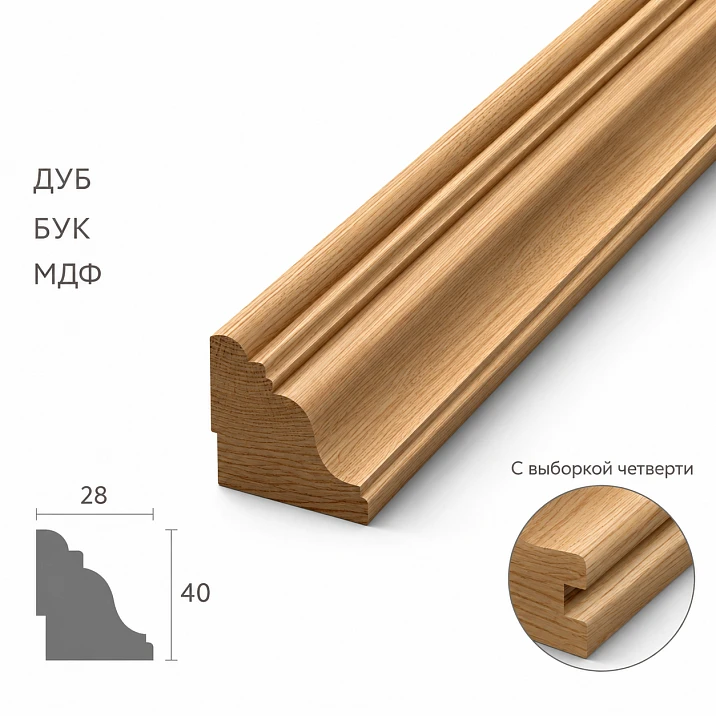
A furniture sample has already been assembled, the profile is selected, but the technological map requires a quarter on the back side of the molding. For a single part, such an operation can be done in your own workshop without worrying about serial economics. When a hundred identical blanks appear in the specification, the question changes: buy a standard MLD-021 and mill the entire batch yourself, or immediately order an additional cut according to the technical specification?
For MLD-021, this choice can be considered concretely. The product card provides for cutting a quarter according to the technical specification for orders from 100 items and indicates the cost of the operation as 185 ₽ per item. This means that for a batch of 100 commercial blanks, the known line for special processing is 18,500 ₽. But comparing only 185 ₽ with your own machine rate is not enough. The decision includes material, blank length, yield of parts from one strip, equipment setup, control, risk of serial defects, packaging, and logistics.
If the series is not yet approved, the quarter dimensions change, or the cutting is not calculated, it is too early to order special processing. If the assembly is tested, the geometry is fixed, and the same operation is repeated on the entire batch, ordering the quarter together with the molding becomes a full-fledged production alternative to your own milling.
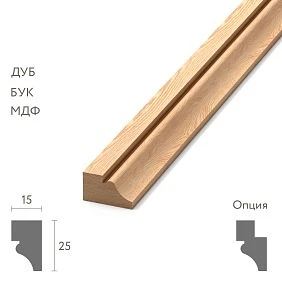
Wooden molding MLD-021 25×15: three materials and two commercial lengths
First, the product itself is fixed so that the purchase does not turn into a formulation of "a hundred similar strips." MLD-021 has the same nominal cross-section of 25 × 15 mm, but the length depends on the material. As of the check on September 7, 2026, the card lists the following options and prices.
| Execution | Size A × C × L | Price of one blank | Sanding |
|---|---|---|---|
| MDF | 25 × 15 × 2600 mm | 660 ₽ | «Prestige» |
| Beech | 25 × 15 × 2400 mm | 1 260 ₽ | «Prestige» |
| Oak | 25 × 15 × 2400 mm | 1 740 ₽ | «Prestige» |
It is precisely the length of 2400 or 2600 mm that later affects the cutting map. Therefore, materials cannot be compared only by the price of one strip: a longer blank sometimes yields more finished parts, and sometimes the extra 200 mm remains as an inconvenient offcut.
In the card, you can buy molding MLD-021 as a specific product item. In this case, MDF must be considered a separate material and not called solid wood. For beech and oak, the natural wood grain, the method of future finishing, and the requirements for batch matching are agreed upon before starting the series. The designation "Prestige" refers to the quality of sanding; it does not mean ready-made enamel, stain, or varnish.
For purchasing, it is useful to record not just "MLD-021, 100 pcs." but a full line: material, size of the commercial blank, surface quality, quantity, and additional operation. Such a record immediately separates a standard product from a variant that will be modified according to your drawing.




Cutting a rabbet is an additional operation, not a second standard profile
The MLD-021 card does not specify a ready-made "rabbet 5 × 5" or any other universal size. The manufacturer's wording is more precise: cutting a rabbet according to the technical specification. This means that the base profile remains MLD-021 25 × 15 mm, and the geometry of the additional processing must be determined by the project.
For the article, two published conditions are fundamental: the service is available for orders from 100 pcs., the cost is 185 ₽ per item. From this, one cannot derive the width, depth, processing side, tolerance, or length of the rebate. All these parameters must appear in the technical specification, and the manufacturer must confirm the technological feasibility of the specific option.
This difference is important for the estimate. The price of the molding is one line. The price of the rebate is a second. Cutting into furniture parts, final finishing, further operations, and installation are other lines. Even if the entire batch is ordered from one supplier, economically it is not a single "ready-made molding with a quarter by default."
For projects where a general selection of profiles is needed, rather than a single article, it is more logical to first buy wooden furniture molding or compare available linear products in the category. But after MLD-021 is approved, the specification must remain tied to the specific article and the specific version of the technical specification.
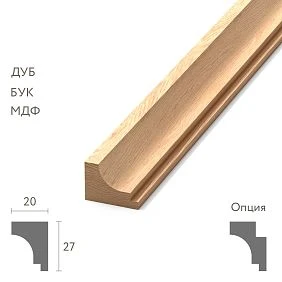
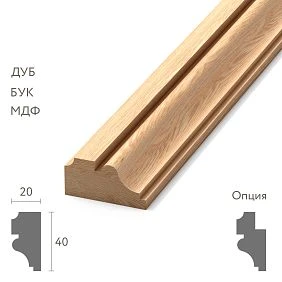
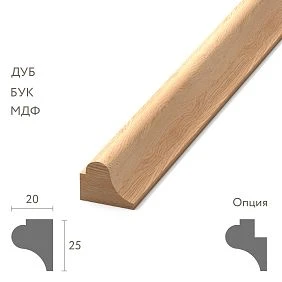
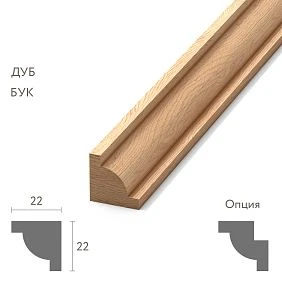
Our factory also produces:
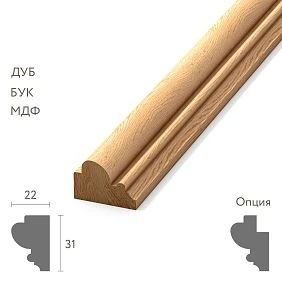
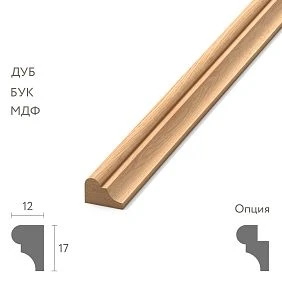
Why first approve one unit, and then launch a hundred identical items
Serial processing is beneficial for its repeatability and dangerous for the same repeatability. If an error is embedded in one sample, only one unit has to be redone. If the wrong side, depth, or length of the rebate goes into the series, the error is reproduced across the entire batch.
Before ordering, the technologist needs not a beautiful general view of the facade, but a verified mating unit. On it, they determine what exactly the quarter does: accepts an insert, overlaps an edge, forms a seating shelf, or solves another structural task. After that, the dimensions and orientation are fixed.
Before the serial count, it is worth checking at least the following parameters:
- which surface of MLD-021 is considered the face;
- on which side the rebate is made;
- width and depth of the step;
- whether the processing runs along the entire commercial length or only along a specified section;
- what happens at the ends;
- what tolerances are acceptable in your assembly;
- whether planned trimming can be performed after the routing;
- which surfaces will be visible after assembly and finishing.
The last point is often overlooked. A rabbet may be hidden after installation, but the machined edge may end up partially visible at the end, in a joint, or when the facade is opened. Therefore, the sequence “first routing, then we will deal with the finish” is weaker for a series than a pre-agreed process sheet.
A pre-production sample is useful precisely as a control of the assembly, but one cannot promise in advance that the supplier will necessarily produce it free of charge or in a separate mode. The request should include a plea to agree on the possibility and procedure for inspecting the first item or sample before launching the entire batch.
Get Consultation
What to write in the technical specification for MLD-021 with a rabbet
The technical specification must allow production to understand the operation without verbal interpretation. The phrase “make a rabbet on the back” is not enough: the profile has two sides, and the step has at least two geometric dimensions.
A working template can be formatted as follows:
SKU: MLD-021
Material: ___
Product size: 25 × 15 × ___ mm
Quantity: 100 pcs.
Grinding quality: "Prestige"
Additional operation: rabbet cutting according to the attached cross-section
Rabbet width: ___ mm
Rabbet depth: ___ mm
Processing side: indicated on the drawing relative to the front surface
Sample length: ___ mm / along the entire length — confirm
Tolerance: ___ / agree technologically
Ends and untreated areas: ___
Reference sample or first article: agree on feasibility
Batch marking: ___
It is better to attach a cross-section and orientation diagram to the technical specification, not just a photo of the furniture facade. If the dimensions of the rebate depend on another part, it is useful to specify its actual size with tolerance. The manufacturer gets clear geometry, and the buyer gets a document for accepting the batch.
Within the company, the version of the technical specification must also be unambiguous. If the technologist changed the sample depth after approval, the version number or date must change. Otherwise, procurement, production, and the supplier may have three similar files with different values.
One hundred items is not automatically one hundred parts after cutting
The card condition is formulated as a service for orders from 100 pieces. For the buyer, this is a reason to focus on one simple question: what exactly counts as one piece for the service threshold?
You cannot automatically reason: "we have 25 furniture frames, each with four sides, so that makes 100 parts and the threshold is met." These hundred parts may be cut from a significantly smaller number of initial strips. The card sells MLD-021 as commercial blanks of a certain length, and the furniture shop performs its own cutting later.
Therefore, before payment, confirmation must be obtained that the condition of 100 pcs applies specifically to the volume of goods specified in the invoice. For the calculations below, a transparent assumption is used: 100 MLD-021 blanks are ordered, each receiving additional processing at 185 ₽. This matches the arithmetic of the plan, but the final interpretation of the service must be fixed in the supplier's commercial offer.
If the project actually requires, for example, 72 initial strips, you cannot buy an extra 28 just to reach the threshold until the cost of the remainder is calculated and it is clear where it will be used. Sometimes in-house processing of a small batch turns out to be more rational than purchasing material that the furniture does not need.
How much do 100 MLD-021 with groove cutting cost
The price at the time of verification allows for a basic calculation without packaging, delivery, finishing, and further cutting. For all three materials, the cost of the operation itself is the same: 100 × 185 ₽ = 18,500 ₽.
| Material | 100 blanks without special processing | Groove cutting | Subtotal |
|---|---|---|---|
| MDF | 66 000 ₽ | 18 500 ₽ | 84 500 ₽ |
| Beech | 126 000 ₽ | 18 500 ₽ | 144 500 ₽ |
| Oak | 174 000 ₽ | 18 500 ₽ | 192 500 ₽ |
These amounts show the scale of the purchase but are not the cost of the finished furniture decor. In the full budget, packaging, delivery, possible pre-production inspection, cutting, end trimming, additional mechanical processing, finish coating, sorting, and assembly remain as separate line items.
The card indicates a rigid packaging frame costing 390 ₽ and packaging standards, but based on them, you should not independently put an exact number of frames in the estimate. The actual packaging scheme for a batch of 100 items and the number of shipping units must be confirmed in the invoice. This is especially important if the purchase is mixed or the batch will be divided by material, finish, or production timelines.
When comparing materials, another thing is visible: the groove cutting itself costs 18,500 ₽ for any of the three options, while the difference in the cost of the base material is noticeably larger. Switching from MDF to beech increases the cost of a hundred standard blanks by 60,000 ₽, and from beech to oak—by another 48,000 ₽. Therefore, the dispute over 185 ₽ per operation should not replace the decision on material and finish.
Own furniture workshop or supplier's groove cutting: comparing identical costs
The known price of an external operation is simple: 185 ₽ per item, for a hundred items — 18,500 ₽. An in-house operation is almost never described by a single rate like "a milling operator does it for 120 ₽." To make the comparison fair, the internal cost needs to be broken down.
Working formula:
The cost of your own sampling = setup + tooling + machine time + operator labor + inspection + internal movements + marking + expected rework and scrap.
If setup applies to the entire batch, it needs to be distributed across a hundred items. If a special cutter, template, or stop is used, their preparation does not disappear from the cost just because the tool remains in the workshop. If each plank passes through the area twice — for example, machining and inspection — this time should be counted separately.
There is also an organizational cost. A machine occupied with sampling a hundred long profiles is not doing other work during that time. For a busy production facility, freeing up equipment can be more valuable than the direct difference in rubles. For an idle area, on the contrary, an in-house operation may turn out to be convenient and better controlled.
Risk also needs to be compared. With a supplier, it is important to agree on the technical specification and acceptance. In your own workshop, it is easier to stop the process after the first parts, but responsibility for repeatability remains entirely within production. Neither option is "always cheaper" or "always more reliable" without calculating for a specific enterprise.
If after such a calculation you need buy furniture molding for several series, the category is used as the top level of selection. For an already approved MLD-021, the decision is made based on the cost of the full chain, not on the price of a single pass with a cutter.
MDF, beech, or oak: the material changes the batch economics more than the operation itself
Material selection cannot be made after the fact just because MDF is cheaper in the table. Serial furniture already has requirements for finish, visible edges, machining, and appearance. The economics begin after the material is acceptable per the project.
MDF in MLD-021 has a length of 2600 mm, beech and oak — 2400 mm. If all three materials are structurally suitable, the calculation compares not only the cost of a hundred planks, but also the yield of finished parts. The 200 mm difference on each blank can affect the number of purchased units.
With natural wood, sorting of visible parts and finishing are additionally considered. For opaque enamel, requirements for pattern selection may be one set, for semi-transparent coating — another. "Prestige" sanding prepares the surface but does not cancel the finishing technology of a specific furniture series.
If the buyer is looking more broadly and wants Buy wooden moldings for furniture to fit several models, one should not transfer the price or yield of MLD-021 to other profiles. Each SKU has its own dimensions and available options, and the cutting map is tied to the actual length of the specific blank.
2400 or 2600 mm: the cutting map is calculated before choosing the "cheap" material
Linear meters provide only a first reference. Serial production requires cutting by part lengths. A simple educational example shows why.
Suppose one finished part has a length of 620 mm. Without accounting for the saw kerf, end trimming, and technological allowances, four parts fit arithmetically from a 2600 mm blank: 4 × 620 = 2480 mm. From 2400 mm, four such parts no longer fit because the same 2480 mm is longer than the original strip; arithmetically, only three fit, occupying 1860 mm.
This is not a finished cutting map. Real production must add the width of the cut, end cleaning, possible end defects, grain direction, joint requirements, and allowance. But the example shows the principle: one MDF strip can yield a different output than one solid wood strip, even with the same cross-section.
For an order of 100 moldings with a quarter, this is especially important. If after a full cutting map it turns out that the project needs not one hundred but 84 source blanks, a separate fork arises: whether to buy additional material to reach the service threshold or to perform the quarter in your own workshop. If, on the contrary, 130 strips are needed, the threshold ceases to be a problem, and only the technology, timelines, and total cost are compared.
Therefore, the sequence is as follows: list of finished parts → cutting map → quantity of commercial strips → check of the 100 pcs threshold → decision on special processing. Rearranging these steps is risky.
First-part inspection before serial processing
Once the technical specification is fully agreed upon, it is useful to define the acceptance procedure for the first processed workpiece. This is not a promise of a separate free service from the manufacturer, but a requirement for the buyer to agree in advance on how the correctness of the geometry will be confirmed before mass production.
Not only the two dimensions of the rebate are checked. The control part must pass through a real assembly or a measuring template. The profile orientation, step position, mating with another part, visibility of the machined surface, possibility of subsequent cutting, and behavior after the intended finish are examined.
For serial furniture, it is useful to store the approved reference sample or measurement protocol together with the drawing version. When reordering after several months, this reduces the risk of a situation where the verbal description remains the same, but the actual version of the assembly has already changed.
If inspection shows that the rebate needs to be changed, it is cheaper to stop before launching a hundred pieces. The most expensive mistake here is not one spoiled strip, but the confident replication of incorrect geometry.
Packaging, labeling, and delivery are also part of the production purchase.
The serial batch must arrive at the workshop in a way that allows it to be identified and accepted. For a mixed order, it is useful to define labeling in advance: material, article number, technical specification version, batch, and quantity per transport unit. If individual parts of the order have different processing, labeling must prevent their mixing in the warehouse.
The packaging frame in card MLD-021 is listed separately. The exact number of frames and transport units should not be derived independently from maximum packaging standards: the seller must confirm the actual scheme for your order. The same applies to delivery time and cost—they depend on the composition, dimensions, and address.
Before setting an internal budget, it makes sense to open payment and delivery terms for a batch of moldings and include logistics as a separate line item. For a B2B order, this allows not comparing "84,500 RUB against our own milling," forgetting that the actual purchase ends only after acceptance of the batch in the workshop.
When ordering MLD-021 with a quarter makes sense, and when it's better not to rush
It is rational to consider ordering a special operation from a supplier if the series is truly repeatable, the quantity of source items reaches the threshold, the assembly geometry is approved, the technical specification does not change, and your own site is either more expensive or occupied with higher-priority work. An additional advantage appears when inspection is more convenient to perform before the trim pieces arrive at your cutting area.
Do not launch a special batch just because "there will be about a hundred parts anyway." First, calculate the source commercial blanks. Do not order a quarter if the width and depth are still under discussion, different furniture models require different steps, or the technologist plans to change the joint after the prototype.
There is also a case where in-house milling is stronger: the operation is already fine-tuned, tooling is ready, equipment is available, inspection is integrated into the route, and the project needs fewer source strips than the supplier's minimum threshold. Then purchasing extra material just to access the service may worsen the economics.
If after calculation it is more profitable to transfer the operation to the supplier, in the card you can order MLD-021 with quarter routing — but only together with the attached and approved technical specification. If the profile is not yet selected, it is more reasonable to first view all trim products, and then return to special processing of a specific article.
Final specification of the MLD-021 batch
For a beech example, the order line might look like this:
MLD-021 / beech / 25 × 15 × 2400 mm / "Prestige" / 100 pcs. / additional rabbet sampling per attached technical specification / rate 185 ₽ per item to confirm / packaging, number of places, lead time, and delivery to be calculated separately.
The order is accompanied by a cross-section with rabbet dimensions, face side orientation, tolerances, length of the processed section, end requirements, drawing version, marking, and first-part inspection procedure. If the purchase is made of MDF, the length is changed to 2600 mm; if made of oak, 2400 mm is retained and the material cost is recalculated.
Before payment, four things must be clear: how many product blanks are actually needed per the cutting plan; whether this meets the service threshold; whether the rabbet geometry is approved; and what the full cost looks like with packaging and logistics. Only after this does the batch "100 MLD-021" turn from an approximate idea into a manageable production order.
Questions before ordering a batch
Is the service available from exactly 100 MLD-021, or is more needed?
The card states the condition as "when ordering from 100 pcs.", so one hundred is the published threshold. But before payment, it is still necessary to confirm in the invoice that the selected batch and specific operation fall under this condition.
Can 25 frames × 4 sides be counted as 100 pieces?
Not automatically. Four frame sides are parts after cutting, while MLD-021 is sold as product blanks 2400 or 2600 mm long. First, the number of initial strips is calculated, then it is confirmed how the supplier counts the quantity for the special service.
Is 185 ₽ included in the price of the molding?
No, in the calculation this is a separate additional operation. For one hundred items, it adds 18,500 ₽ on top of the cost of the selected blanks.
Does MLD-021 have a standard quarter size?
The card shows a sample based on the technical specification, and universal width and depth are not set. The geometry is determined by the project and agreed upon with the manufacturer.
Can I order several different quarter variants in one batch?
This condition is not confirmed by the card. If the series includes different geometries, they need to be separated in the specification and the possibility, minimum quantity, and price for each processing version must be agreed upon in advance.
Is MDF 2600 mm long always more cost-effective than beech 2400 mm in terms of cutting?
No. The extra 200 mm is only useful when it allows you to get more needed parts, taking into account the actual saw cut, trimming, and allowances. The cutting map provides the answer, not the length itself.
Does "Prestige" mean the molding is already painted?
No. This refers to the surface sanding quality. The finish enamel, tinting, or other coating must be considered as a separate technological operation.
Can I calculate packaging in advance as 390 ₽ × the required number of frames?
The card indicates the price of the rigid packaging frame and packaging standards, but the actual number of shipping units for a specific batch is better obtained from the seller. Do not turn the maximum stacking rate into an unconfirmed final estimate.
What is more important to check before payment: the price or the quarter cut drawing?
Both parameters are needed, but an incorrect drawing is more dangerous than a small price difference: it can render the entire serial batch unusable. First, fix the joint and the technical specification version, then confirm the commercial terms.
What should be passed to procurement and production after ordering?
To procurement — invoice, article number, material, quantity, special processing conditions, packaging, and delivery. To production — the same technical specification number, control cross-section, marking rules, and further cutting map. This way, purchasing and the technological route rely on one version of data.