Article Contents:
- Why an empty room is not yet a warehouse
- First, we separate wooden trim by SKU
- Why the SKU matters more than visual similarity
- Wooden skirting board: how to store dozens of packs of the same SKU
- Wooden moulding: what to do after opening the packaging
- Wooden cornice: why it needs a separate zone
- Construction materials warehouse: dividing the space by installation phases
- ZONE A — installation now
- ZONE B — next in queue
- ZONE C — do not issue yet
- RESERVE
- Can wooden trim be stored vertically against a wall?
- Do all packages need to be opened after delivery?
- How can similar moldings be kept from getting mixed up?
- What should be done with material returned by installers?
- Should installation and service stock be stored separately?
- What length counts as a useful offcut?
- What should be placed in quarantine?
- How often should the actual remaining stock be reconciled?
- Who should issue the trim?
- Where can I view the STAVROS wooden trim assortment?
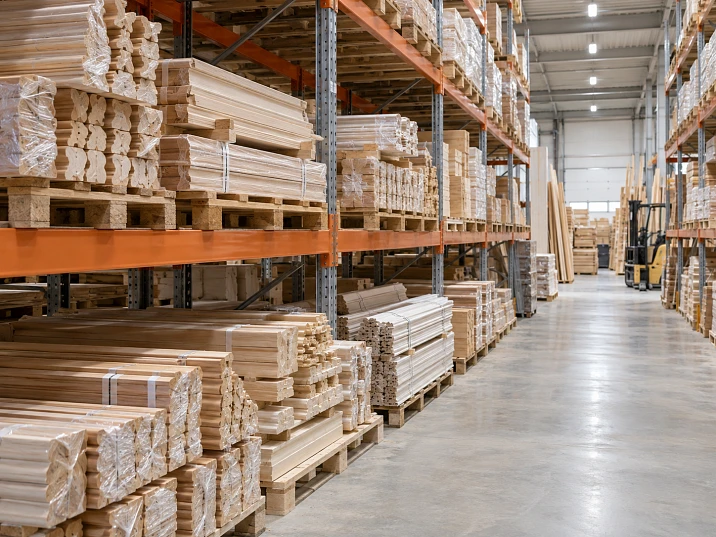
A total of 420 m of skirting board, 680 m of moulding and 190 m of cornice arrived at the site at the same time. In total — 1,290 m of wooden trim. The first floor is ready for installation, the second is still being painted, and wet works are ongoing on the third. If you simply pile the entire order in an empty room, within a few days the typical site chaos begins: similar profiles get mixed up, the reserve gets used up in the work, opened packs lose their labelling, and installers take material out of turn.
Therefore construction materials warehouse on a large site, it is not a room where "everything that was delivered just sits". Wooden trim requires a managed temporary warehouse with zones, labelling, tracking of issue, returns and a separate operational reserve.
Working scheme:
acceptance → identification → separation by article → distribution by installation queues → horizontal storage → issue according to the schedule → return of leftovers → accounting of usable offcuts → queue closure → operational reserve.
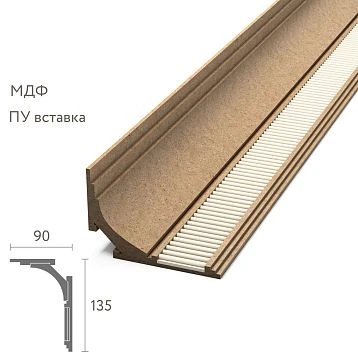
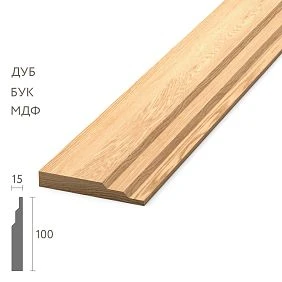
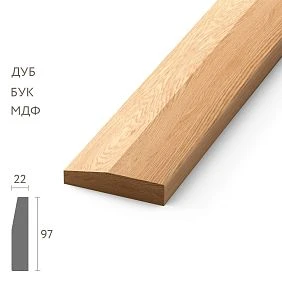
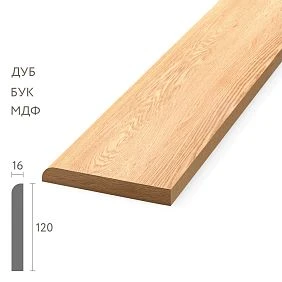
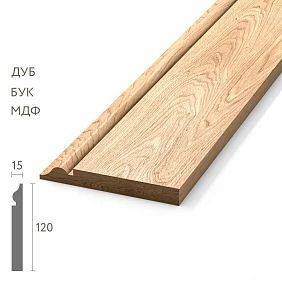
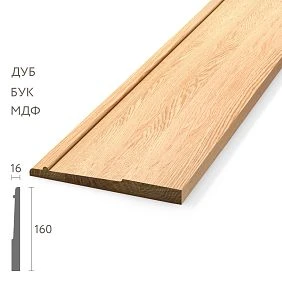
Catalog STAVROS wooden molding includes skirting boards, mouldings, cornices and other long-length profiles. On site, each of them must remain identifiable until the moment of installation.
Why an empty room is not yet a warehouse
A room becomes a storage zone only when it suits a specific material.
For wooden moulding, the following are important:
- a dry room;
- no wet processes;
- absence of construction dirt and abrasive dust;
- horizontal storage;
- support without sagging or bending;
- protection from impacts;
- preservation of packaging;
- ability to read the labeling;
- controlled dispensing;
- free passage without the need to constantly move long-length items.
If a room is used today as a skirting board storage area, and tomorrow bags of mix are brought in and tiles are cut there, it is no longer a normal area for finish work.
It is better to receive the trim after the space has been prepared, rather than looking for a corner for it after unloading.




First, we separate the wooden trim by product codes
You can't just group everything by the principle:
moldings here, baseboards there.
A single project may have several visually similar profiles.
Working identification:
MLD-XXX / oak / 2400 mm
MLD-YYY / beech / 2400 mm
PLT-XXX / oak / 2400 mm
KZ-XXX / oak / 2000 mm
A separate warehouse item is created for each product code.
If a single SKU is used in multiple zones, a floor or room code is added to the product line.
For example:
PLT-006 / DUB / FLOOR-1
и
PLT-006 / DUB / FLOOR-2
The product is identical, but the batch purpose is different.
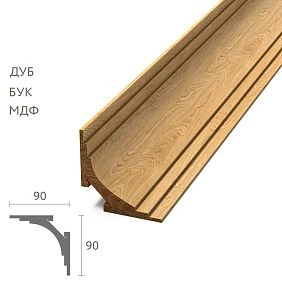
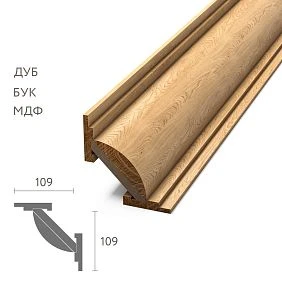
Our factory also produces:






Why the SKU matters more than visual similarity
After opening the pack, a worker may decide that two moldings are identical because they look similar in color and width.
But for the project, what is decisive is not the impression, but the product identification.
If the profile is mixed up, the problem may only appear after:
- cutting the corner;
- painting;
- installation next to an already installed part;
- transition to another room.
Therefore, in the warehouse area, names cannot be used:
wide molding
narrow baseboard
hall cornice
without SKU.
A proper warehouse entry always starts with the SKU.
Get Consultation
Wooden baseboard: how to store dozens of packs of the same SKU
Baseboard seems like the simplest long-length item, so it is often stored wherever it fits.
For large volumes, it is better to organize a separate row or rack position.
For example:
PLT-A / 36 packs / floor 1
PLT-A / 42 packs / floor 2
PLT-A / RESERVE / 4 packs
It is important that long items lie horizontally and do not sag. Heavy boxes, tools, tiles, or bags should not be stacked on top.
If the packaging has not yet been opened, it is best to keep its labeling visible.
This way, when issuing, you do not have to sort through the entire stack to find the required floor.
Wooden molding: what to do after opening the packaging
With moldings, the main problem begins when the packaging is opened.
For example:
- there were 20 strips in the pack;
- 12 were issued to the floor;
- the installers returned 3;
- 5 remained in the warehouse.
The factory pack no longer matches the actual contents.
Therefore, an opened package needs a temporary label:
MLD-050 / DUB / FLOOR-2 / was 20 / issued 12 / returned 3 / remaining 11
Check:
20 − 12 + 3 = 11.
This way, even after several operations, the warehouse knows the real remaining quantity.
If you simply place the three returned planks on top of another pack, the tracking is lost.
Wooden cornice: why it needs a separate zone
A large cornice is inconvenient to constantly move around.
It takes up more volume, and its pronounced relief needs protection from accidental impact.
Therefore, it is better not to hide the cornice under baseboards or use it as the bottom layer of a general stack.
A separate zone is useful for it:
KZ / DO NOT TRANSLATE WITHOUT ISSUANCE
Inside — division by item codes and queues.
This order reduces the number of unnecessary transfers.
On site, every additional transfer of long-length decorative profile is an extra chance to damage the surface or mix up its purpose.
Construction materials warehouse: dividing the space by installation phases
Construction materials warehouse for a large project, it is more convenient to divide not only by product type, but also by zone readiness.
For example:
ZONE A — installation now
Floor 1.
Material is available to installers.
ZONE B — next phase
Floor 2.
Release only after the first phase is closed.
ZONE C — do not release yet
Floor 3, where wet works are still in progress.
RESERVE
Operational and separately designated reserve.
This way the warehouse reflects not just the assortment, but the construction schedule.
This is especially useful when the same SKU is used on all floors.
Why the third floor's material cannot be "temporarily borrowed" by the second
Suppose the second floor is short by 6 planks.
The same SKU is on the third one.
The simplest command:
take six from the neighboring pack.
After that, the second floor is closed, and the problem quietly moves to the third.
If the transfer is really needed, it is documented:
FLOOR-3 → FLOOR-2 / PLT-006 / 6 pcs.
In the third floor's ledger, the available balance is reduced.
Then the purchaser sees the future shortage in advance and can resolve it before the next phase of installation begins.
Installation reserve and operational reserve are different things
Let's imagine the calculation:
- main volume — 500 m;
- installation allowance — 40 m;
- operational reserve — 20 m.
Total arrived at the site:
500 + 40 + 20 = 560 m.
If all 560 m are in one zone, installers perceive them as available material.
By the completion of works, no operational reserve may remain.
Therefore, the warehouse must separate:
WORK STOCK — main volume and installation reserve;
SERVICE RESERVE — reserve after handover of the facility.
It is better to physically separate the operational reserve and prohibit issuing it without a separate decision.
How to label the operational reserve
Example:
RESERVE / HOTEL-A / PLT-006 / DUB / 8 PCS
Or:
RESERVE / LOBBY / MLD-050 / OAK / 6 PCS
After a few years, the operations service will be able to understand:
- for which object the stock is reserved;
- where it was used;
- which SKU;
- which material;
- how many whole items remain.
It is useful to attach the final specification to the reserve or save it in a digital archive.
Then a random batch of wood turns into a real repair resource.
Wholesale building materials warehouse: moulding movement ledger
Even a temporary wholesale building materials warehouse on site must know four numbers:
received → issued → returned → balance.
Example:
| SKU | Material | Received | Issued | Returned | Balance | | --- | --- | ---: | ---: | ---: | ---: | | PLT-A | oak | 180 | 60 | 4 | 124 | | MLD-B | oak | 240 | 82 | 11 | 169 | | KZ-C | beech | 70 | 20 | 0 | 50 |
PLT-A check:
180 − 60 + 4 = 124.
MLD-B:
240 − 82 + 11 = 169.
Such a table already makes it possible to detect discrepancies.
If there are actually 165 MLD-B in the warehouse, but the report shows 169, four planks need to be found before the next issue.
Why returns from the floor should be accounted for the same way as issues
Installers were issued 30 planks.
They used 23.
They returned 7.
The warehouse records should show:
30 − 23 = 7 returned.
If seven planks are simply placed by the warehouse door, they physically exist, but the system does not see them.
After several issuances, two balances appear:
- accounting;
- actual.
The larger the object, the faster they are used up.
Therefore, the return must go through the same responsible person who issues the material.
What counts as a useful remnant and what counts as waste
A 600 mm offcut may be useless for a long baseboard.
For the short side of a molding frame, it is suitable.
Therefore, it is useful to allocate a separate section in the warehouse:
USEFUL REMNANTS
Each saved fragment is labeled:
MLD-050 / oak / 680 mm
Or:
PLT-006 / beech / 920 mm
It is better not to store offcuts without a product code: within a week, no one will be able to confidently determine which profile it came from.
How to determine the minimum length of a usable offcut
There is no universal number.
For one project, 400 mm is enough for short inserts.
For another, all sections are longer than 1.2 m, so 400 mm is practically useless.
The correct rule:
a usable offcut is determined by the map of future cuts for the same SKU.
Before starting the queue, you can check which short parts will still be needed.
If the minimum future segment is 650 mm, storing dozens of 200 mm pieces is pointless.
If there are frames with short sides of 300 mm, such pieces can already be useful.
Open packaging: how not to lose protection and identification
After opening, the remainder of the batch must not be turned into loose pieces.
You need to:
- keep the original label;
- combine the remaining intact planks;
- close or protect the face surfaces;
- add a temporary warehouse card;
- record the actual quantity;
- return the place to the designated zone.
If a pack belongs to FLOOR-2, it must not end up in the general "moldings" area after opening.
This preserves the link between the material and the construction sequence.
Quarantine zone for disputed and damaged packs
The temporary warehouse must have a small HOLD / QUARANTINE zone.
This is where material goes that cannot be immediately considered accepted:
- packaging is damaged;
- there is a chip or dent;
- marking is illegible;
- the item code does not match the schedule;
- the material is questionable;
- length differs from expected;
- quantity in the pack is not confirmed.
The main rule:
a disputed pack must not be returned to general stock until a decision is made.
Otherwise, within a few hours it may be issued to installers, and the original problem will disappear from view.
The quarantine card records:
date / SKU / transport unit / reason / photo / decision / responsible person.
For example:
MLD-B / place 17 / packaging end damaged / inspected / 2 planks separated / the rest approved.
This is how damage becomes a controlled warehouse operation, rather than the verbal phrase “something seemed to be dented there.”
Why quarantine is important even for minor packaging damage
Damage to the box or film does not necessarily mean damage to the moulding itself.
But the reverse is also true: a seemingly small mark can hide damage to several ends.
Therefore, the warehouse must not automatically:
write off the entire pack
or
consider everything inside to be in good condition.
First separate the location, then check the available portion of the material and record the result.
If the dispute is resolved later with the supplier or carrier, the saved marking and a photo of the specific transport unit are far more useful than a general photo of the unloading.
Why wooden trim should not arrive together with all the rough materials
If at the site they are still:
- plastering;
- making the screed;
- tiles are cut;
- move heavy blocks;
- constantly open exterior openings;
expensive decorative long-length material gets unnecessary risk.
STAVROS recommends storing wooden trim in a dry room, horizontally, and not bringing it into areas with unfinished wet processes.
Therefore, the delivery date should be tied not to when the goods are ready at the seller, but to when the site is able to safely receive them.
When to create a temporary finishing materials warehouse
A good moment comes when:
- the room is closed;
- wet processes are completed in the storage area itself;
- there is no constant construction dirt;
- there is a horizontal platform or shelving;
- heavy materials no longer pass through this room;
- a responsible person has been assigned;
- the inventory list has been prepared.
A temporary warehouse can be set up before the installation of the first phase, but not so early that it interferes with rough works for months.
Acclimatization is not a reason to open the entire site at once
There may be 600–1000 m of wood on site, while installation tomorrow starts only on one floor.
There is no practical sense in opening all batches at once just because the material has already been delivered.
Only the phase that is actually approaching the works should be prepared for installation, following the manufacturer's current recommendations on storage conditions and material conditioning.
The remaining batches are best kept identified and protected.
This reduces the risk of misgrading and mechanical damage.
Building materials warehouse: maintaining the link between the profile and the room
For the scenario building materials warehouse simple zone marking works well:
FLOOR 2 / ROOM 201–210
FLOOR 3 / CORRIDOR
LOBBY
RESTAURANT
On a large site, you can add a QR code to the digital inventory sheet, but it is not mandatory.
A regular large printed label is often more effective than a complex IT system.
The main thing is that anyone can see:
what it is → for which zone → how much there should be → whether it can be issued.
Who should have the right to issue linear stock
Free access for all finishers destroys accountability.
For a large project, it is better to appoint:
- one storekeeper;
- or two responsible persons per shift;
- or a foreman plus an appointed assistant.
Any issue is recorded.
It is not necessary to build a full-fledged ERP system.
Even an Excel spreadsheet or a paper log works, as long as no one takes material with “we’ll record it later.”
How to document issue to installers
Minimum entry:
| Date | Zone | SKU | Issued | Received by | | --- | --- | --- | ---: | --- | | ___ | FLOOR-1 | PLT-A | 24 | ___ | | ___ | FLOOR-1 | MLD-B | 18 | ___ | | ___ | LOBBY | KZ-C | 8 | ___ |
After the shift ends, returned intact items are recorded as a separate operation.
If material has been moved to another zone, this is also not an issue "in general", but a specific movement.
How to calculate the actual consumption of a queue
For one zone, the formula is:
issued − returned = actual consumption from the warehouse.
For example:
issued 80 planks;
returned 9.
80 − 9 = 71 planks.
If the project norm assumed 66, the difference is:
71 − 66 = 5 planks.
This is not automatically overconsumption: some of it may have remained on the floor as usable offcuts.
But such a signal makes you check the actual situation before opening the next batch.
Cyclical reconciliation of the actual remaining stock
On a large project, it is not enough to receive 1,290 m once and assume that the bill of materials will remain accurate until the end.
It is useful to conduct a short inventory count:
- after closing each installation phase;
- before issuing a new large batch;
- after a mass return;
- after internal movement between floors;
- before placing an additional order.
Reconciliation is not performed across all materials at once, but rather by active SKUs.
For example, according to the MLD-B statement, there should be 169 planks. In fact, 167 were found.
Discrepancy:
169 − 167 = 2 planks.
There is no need to immediately place a reorder for two units. First, check:
- whether they were left on the floor;
- whether they are lying in the usable remnants area;
- whether they were moved to quarantine;
- whether the previous issue was mistaken.
Only after this is the statement balance adjusted.
How to make adjustments without erasing history
If the actual balance differs, you shouldn't just replace 169 with 167 in the table.
It's better to make a separate entry:
Adjustment INV-04: MLD-B −2 pcs., reason ___, date ___, responsible ___
That way, it's clear later why the arithmetic "received − issued + returned" doesn't match the current stock.
For a large site, an adjustment history is more useful than a perfect table in which old errors are simply erased.
How to close the installation queue
A floor is considered warehouse-closed not when the installers have left.
You need to:
- accept whole remnants;
- account for usable offcuts;
- confirm waste;
- update actual consumption;
- reconcile warehouse balance;
- separate the operational reserve;
- only then open the next queue.
This way, one unclosed zone does not carry its errors into the next one.
Example of closing the first floor
For FLOOR-1, the following was allocated:
- 70 skirting boards;
- 110 moldings;
- 32 cornices.
After installation, the following was returned:
- 6 baseboards;
- 9 moldings;
- 2 cornices.
Stock consumption:
baseboard: 70 − 6 = 64;
molding: 110 − 9 = 101;
cornice: 32 − 2 = 30.
Now these figures can be compared with the design calculation and you can see where the deviation occurred.
If records are not kept, the first phase will simply "consume as much as it needs," and the second floor will receive an unknown remainder.
Building materials warehouse in Moscow: when a temporary zone is especially useful
for building materials warehouse in Moscow there is no need to turn the article into a separate Moscow directory.
The local nuance matters in one practical scenario: at an urban site, there may be restrictions on unloading times, vehicle access, and elevator access.
In such a situation, frequent small deliveries by a long-bed truck can sometimes be harder to arrange than accepting an agreed-upon volume in advance into a prepared warehouse zone.
But the decision depends on the site itself.
If there is no proper storage, material brought in advance creates more risks than several deliveries.
How to calculate the area of a temporary warehouse without false precision
It is impossible to give a universal formula of "1 m² per 100 linear meters," because baseboard, thin molding, and large cornice take up different volumes.
But before delivery, you can count the number of storage positions.
For example:
- 4 SKU of skirting board;
- 7 SKU of molding;
- 3 SKU of cornice;
- 4 separate queues;
- 1 operational reserve zone;
- 1 usable remnants zone;
- 1 quarantine zone.
The minimum is already:
4 + 7 + 3 + 4 + 1 + 1 + 1 = 21 logical zones/positions.
Physically, some of them may be located on the same rack.
But if the warehouse scheme provides only three locations — "baseboard / molding / cornice" — it is too coarse for such a project.
What to do if the warehouse is already overcrowded
There is no need to solve the problem by additional stacking on top of the decorative trim.
First, check:
- which batches belong to the next queue;
- what can be handed over for installation now;
- which whole remnants can be consolidated;
- which useless offcuts are due to be written off;
- whether the operational reserve is lying in the working area;
- which extraneous materials can be moved.
If there is still not enough space, it is more logical to revise the schedule of the next deliveries than to worsen the storage conditions of material already accepted.
What to keep after project handover
After installation is complete, the temporary warehouse is closed, but not everything should be sent to waste.
A prepared operational kit remains:
- several intact skirting boards, if provided for;
- Moldings;
- cornices;
- signed samples;
- final specification;
- article numbers;
- materials;
- batch or order numbers;
- storage recommendations.
It makes no sense to store random short offcuts without identification.
The operational reserve should be a deliberate kit, not leftovers that are "too much of a shame to throw away."
When a temporary warehouse at the site is not needed at all
A separate warehouse zone may be excessive if:
- the volume is small;
- all trim is installed at once;
- the delivery arrives exactly at the start of work;
- there are no multiple phases;
- the material is quickly distributed within a single room;
- the operational reserve is minimal.
In that case, a prepared dry room for short-term storage is sufficient.
But with hundreds of meters, several floors, and several SKUs, losses and mix-ups become much more likely without a warehouse system.
Mistakes in organizing a wooden trim warehouse
Mistake: storing all moldings together.
Cause — same product type. Consequence — similar profiles get mixed up. Solution — a separate line for each SKU.
Error: issuing material without recording it.
Cause — "we'll enter it later." Consequence — the ledger stops matching reality. Solution — record every issue immediately.
Error: just placing returns against the wall.
Cause — these are already "leftovers." Consequence — whole planks drop out of accounting. Solution — return them through a warehouse operation.
Error: storing the service reserve together with the working stock.
Cause — same SKU. Consequence — the reserve gets used during installation. Solution — physically separate the SERVICE RESERVE.
Error: throwing away all offcuts.
Cause — they are short. Consequence — you have to cut a new plank for a short piece. Solution — a separate zone for useful leftovers.
Error: storing unknown offcuts.
The reason — "it might come in handy." The consequence — the warehouse gets cluttered with unidentified material. The solution — keep only labeled, useful leftovers.
Mistake: bringing in finish decor during wet works.
The reason — the product is already ready. The consequence — unnecessary risk to the wood and packaging. The solution — tie the delivery to warehouse readiness.
Mistake: returning a questionable pack to the common stack.
The reason — the damage seems minor. The consequence — the material accidentally goes into installation. The solution — a separate quarantine zone.
Questions before organizing a temporary warehouse
Can wooden trim be stored vertically against a wall?
For warehouse storage, STAVROS recommends horizontal placement without bending.
Do all packages need to be opened after delivery?
There is no need to open the entire order at once. The remaining batches are best kept protected and identified until preparation for installation.
How to avoid confusing similar moldings?
Use the SKU, material, length, zone code, and actual remaining quantity on each opened pack.
What should be done with material returned by installers?
Accept it back by SKU, recount it, and enter the return in the ledger.
Should installation and service reserves be stored separately?
Yes. They have different purposes and different issuance rules.
What length counts as a usable offcut?
There is no universal length. Usefulness is determined by future cuts of the same SKU.
What should be placed in quarantine?
Packs with damage, questionable labeling, or mismatch in SKU, length, material, or quantity.
How often should the actual stock be reconciled?
After closing a queue, large issues, returns, and transfers — before the discrepancy affects the next stage.
Who should issue the trim?
A designated responsible person or a limited group, so that actual consumption remains controlled.
Where can I view the STAVROS wooden trim assortment?
In the general catalog of wooden and MDF trim products.