Article Contents:
- Curtain Rod, Window Cornice and Crown Molding: Understanding the American Terminology
- Curtain Rod
- Curtain Track
- Window Cornice
- Curtain Rod Cover
- Crown Molding
- Ceiling Medallion
- Understanding the Differences
- Curtain Hardware Is Positioned Without Considering the Ceiling
- Curtains Have Too Little Width
- Crown Molding and Window Trim Use Unrelated Styles
- Decorative Wall Panels Stop Abruptly at the Window
- The Chandelier and Ceiling Have No Visual Relationship
- 1. Exposed Curtain Rod With Coordinated Crown Molding
- 2. Concealed Ceiling-Mounted Curtain Track
- 3. Decorative Window Cornice With Polyurethane Trim
- 4. Crown Molding Plus Decorative Wall Frames
- 5. Crown Molding, Ceiling Medallion and Curtain Cornice
- Conventional Wall-Mounted Rods
- Ceiling-Mounted Tracks
- Floor-Length Curtains
- Measure the Actual Hardware
- Preliminary Extension Ranges
- Example: A 60-Inch-Wide Window
- Curtain Stack-Back
- Build the Cornice as a Separate Structure
- Add a Polyurethane Decorative Face
- Use a Medium Profile for More Relief
- Add Ornamental Trim Selectively
- Consider a Central Decorative Applique
- Paint for a Unified Appearance
- Why This Matters
- Single-Track Pockets
- Double-Track Pockets
- Manufacturer-Specific Requirements
- Concealing the Pocket With Decorative Trim
- Motorized Curtains
- What Crown Molding Adds
- Choosing the Right Size
- Ceiling Height Guide
- HIWOOD M1702: Restrained Ceiling Cornice
- HIWOOD A70V1: More Defined Crown Profile
- HIWOOD A130V1: Larger Traditional Profile
- Crown Molding Product Comparison
- Side Panels Beside the Window
- Choose the Right Profile
- Position the Frames Beyond the Curtain Stack
- Keep the Composition Related to the Window
- Beaded Molding
- Rope Molding
- Ornate Molding
- What a Ceiling Medallion Does
- STAVROS Ceiling Medallions
- CRPU-070: Compact Modular Ceiling Composition
- CRPU-069: Larger Classical Medallion
- CRPU-068: Substantial Decorative Ceiling Accent
- Medallion Comparison
- Example: STAVROS CPU-P3
- When to Use a Coordinated Kit
- When a Simpler Design Is Better
- Living Room With Large Windows
- Bedroom With an 8-Foot Ceiling
- Traditional Dining Room
- Home Office
- Tall Living Room or Foyer
- Step 1: Determine the Curtain Track Width
- Step 2: Establish the Side Frame Position
- Step 3: Choose the Frame Height
- Step 4: Choose the Molding
- Step 5: Calculate One Frame
- Step 6: Add the Horizontal Decorative Molding
- Step 7: Calculate the Number of Full Strips
- Step 8: Review the Functional Layout
- Step 1: Calculate the Perimeter
- Step 2: Select the Crown Molding
- Step 3: Calculate the Theoretical Minimum
- Step 4: Prepare the Cutting Plan
- Step 5: Allow for Installation Waste
- Crown Molding Accessories
- Example: An 8-Foot Bedroom
- Example: A 10-Foot Living Room
- Avoid Arbitrary Horizontal Bands
- Example: An 80-Inch-Wide Curtain Track
- Why Fullness Affects Cornice Dimensions
- Step 1: Measure the Complete Room
- Step 2: Select the Window Treatment
- Step 3: Establish the Hardware Locations
- Step 4: Coordinate Electrical Work
- Step 5: Plan the Crown Molding
- Step 6: Prepare Wall and Ceiling Substrates
- Step 7: Install Decorative Architectural Profiles
- Step 8: Install the Decorative Cornice
- Step 9: Install and Finish the Ceiling Medallion
- Step 10: Complete the Paint Finish
- Step 11: Hang and Test the Curtains
- Curtain Hardware Support
- Chandelier Support
- Electrical Access
- Child Safety
- Windows and Emergency Egress
- Fire Performance
- Confusing Crown Molding With a Curtain Cornice
- Expecting Polyurethane Molding to Support Heavy Curtains
- Mounting the Curtains Before Planning the Architectural Layout
- Using a Cornice That Is Too Shallow
- Ignoring Curtain Stack-Back
- Selecting an Oversized Ceiling Medallion
- Treating All STAVROS Molding as Polyurethane
- Installing Ornament Where It Interferes With Window Operation
- Using Too Many Decorative Styles
- Ordering by Linear Footage Without a Cutting Plan
- Assuming the Same Paint Works on Every Material
- For a Minimalist Bedroom
- For a Transitional Living Room
- For a Formal Dining Room
- For a Large Neoclassical Room
- Check the Material
- Check the Dimensions
- Verify Compatibility
- Calculate the Complete Order
- Consider Samples
- Confirm International Delivery
- What Is the Difference Between Crown Molding and a Curtain Cornice?
- Can You Hide a Curtain Rod Behind Polyurethane Molding?
- What Is the Best Way to Hide a Ceiling-Mounted Curtain Track?
- Can Crown Molding Be Used With Ceiling-Mounted Curtains?
- How High Should Curtain Rods Be Mounted?
- How Far Should a Curtain Rod Extend Beyond the Window?
- What Is Curtain Stack-Back?
- Can Polyurethane Molding Be Used on a Wood Cornice Box?
- What Is Beaded Molding?
- Is Rope Molding Suitable for Window Cornices?
- Is Crown Molding Necessary in a Room With Curtains?
- What Crown Molding Is Appropriate for an 8-Foot Ceiling?
- Can You Install a Ceiling Medallion Without a Chandelier?
- Does a Polyurethane Ceiling Medallion Support a Chandelier?
- Are STAVROS Ceiling Medallions Made From Polyurethane?
- Are STAVROS Crown Moldings Polyurethane?
- Can Wall Moldings Be Installed Beside Curtains?
- Can Window Cornices Be Used With Motorized Curtains?
- How Much Molding Do I Need Around a Window?
- Where Can I Buy Polyurethane Molding for Window Decor?
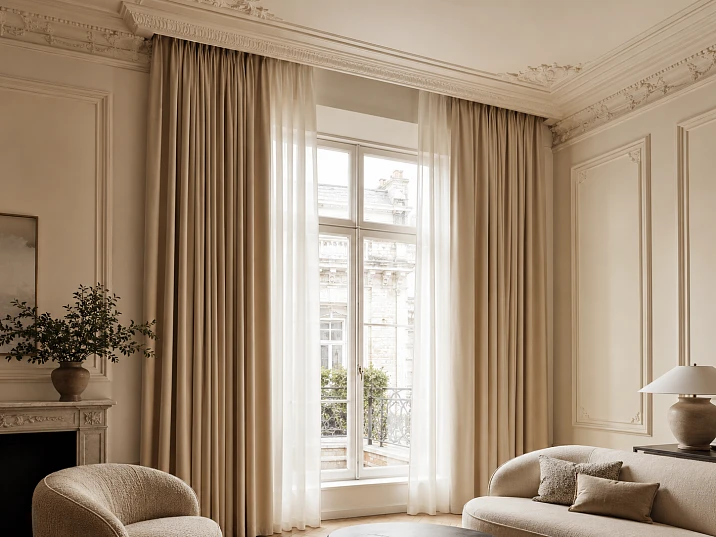
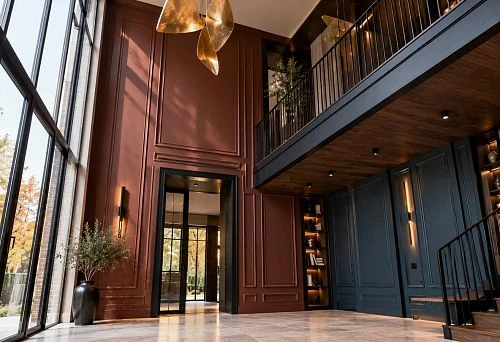
A beautifully furnished room can still feel visually disconnected when the window treatments, ceiling, lighting, and architectural trim appear to have been designed independently.
The curtains may be made from luxurious fabric. The chandelier may complement the furniture. The walls may feature carefully selected paint colors and decorative panels. Yet the upper portion of the room can lack a clear relationship between these elements.
Sometimes the problem is the curtain hardware.
A rod or track is positioned without considering the ceiling line. A heavy curtain begins at an awkward height. Decorative wall molding stops before reaching the window. Or the ceiling contains elaborate crown molding while the window treatment looks like an unrelated addition.
The solution is not necessarily to add more decoration.
It is to establish a coherent architectural composition.
Curtain rods, crown molding, window cornices, polyurethane wall trim, and ceiling medallions can be coordinated to create one continuous interior design.
The window becomes part of the room's architecture rather than an isolated opening covered with fabric.
For American homeowners, this design approach is particularly useful in traditional, transitional, modern classic, neoclassical, and selected contemporary interiors.
A bedroom with an 8-foot ceiling may benefit from floor-length curtains, discreet decorative molding, and a simple ceiling perimeter.
A formal dining room may call for a substantial window cornice, decorative wall frames, crown molding, and a coordinated chandelier medallion.
A living room with large windows may use ceiling-mounted drapery tracks, narrow polyurethane moldings, and carefully positioned ornamental accents.
The most important consideration is proportion.
Curtain hardware must support the fabric. Decorative molding must complement the window rather than obstruct it. Ceiling elements should relate to the room's height and architectural style. Electrical equipment must remain correctly installed and supported.
This guide explains how to combine these elements into an attractive, practical window treatment.
You'll learn the differences between a curtain cornice, crown molding, and curtain rod cover, how to choose appropriate dimensions for American homes, how to integrate decorative wall trim around windows, and how to calculate molding quantities before ordering.
We'll also examine real products from STAVROS, including polyurethane wall molding, decorative trim molding, polyurethane ceiling medallions, and ceiling crown molding.
These products serve different purposes. Understanding those differences is essential to creating a coordinated architectural design.
Curtain Rod, Window Cornice and Crown Molding: Understanding the American Terminology
The word cornice can mean different things in interior design.
This creates confusion when homeowners search for decorative materials online.
In the United States, a window-treatment cornice and architectural crown molding are not the same product.




Curtain Rod
A curtain rod is functional hardware.
It supports curtains and allows them to hang in front of a window.
Depending on the system, it may be mounted to the wall or ceiling.
It may feature rings, grommets, clips, or another compatible heading arrangement.
Its diameter, length, brackets, and load capacity must suit the fabric and installation.
A decorative polyurethane molding should not be used as a substitute for this supporting hardware.
Наша фабрика также производит:
Смотреть весь Каталог продукции
Curtain Track
A curtain track is a rail system that allows drapery panels to move along a defined path.
Tracks can be ceiling-mounted, wall-mounted, recessed, or incorporated into a purpose-designed pocket.
Some systems are motorized.
Tracks are often selected when a smooth architectural appearance is more important than exposing a decorative rod.
They can work particularly well with floor-length curtains and concealed window-treatment hardware.
Получить консультацию
Window Cornice
A window cornice is generally a rigid decorative treatment installed above the window.
It may be a wood or MDF box, shaped board, or another suitable fabricated assembly.
The cornice conceals the upper portion of the curtain hardware.
Its exterior may be upholstered, painted, or decorated with architectural trim.
A wood cornice box can be enhanced with appropriately installed polyurethane moldings or decorative appliques.
However, the box itself must be securely supported.
Curtain Rod Cover
A curtain rod cover is a descriptive term for an element designed to conceal the curtain rod or track.
A rigid window cornice can serve this purpose.
Other solutions include valances, architectural pockets, and specially designed concealment systems.
The exact product depends on whether the hardware should be completely hidden or merely visually integrated.
Crown Molding
Crown molding is architectural trim installed along the junction between a wall and ceiling.
It can establish a continuous decorative perimeter.
Crown molding is not inherently a curtain-support system.
Its purpose is decorative.
It may visually coordinate with a window cornice, but it should not be assumed capable of holding curtain tracks, rods, or heavy drapery.
Ceiling Medallion
A ceiling medallion is an ornamental element positioned around or near a chandelier, pendant, or other central ceiling feature.
It establishes a decorative focal point.
It is not a substitute for an approved electrical box or structural fixture support.
Understanding the Differences
| Element | Primary function | Typical material |
|---|---|---|
| Curtain rod | Supports curtains | Metal, wood, engineered hardware |
| Drapery track | Supports and guides moving curtains | Aluminum or other engineered systems |
| Window cornice | Conceals hardware and frames window treatment | Wood, MDF, upholstered assembly |
| Curtain rod cover | Hides or screens functional hardware | Varies by system |
| Crown molding | Decorates wall-to-ceiling transition | Wood, MDF, polyurethane, polystyrene or other materials |
| Wall molding | Creates architectural lines and decorative panels | Polyurethane, wood, MDF and other materials |
| Ceiling medallion | Creates ornamental focus around ceiling fixture | Polyurethane, plaster and other decorative materials |
These elements can work together, but they should not be confused with one another.
Why Window Treatments Sometimes Look Disconnected From the Room
A window treatment can be attractive by itself yet poorly integrated with its surroundings.
This usually results from one or more design relationships being overlooked.
Curtain Hardware Is Positioned Without Considering the Ceiling
A rod placed immediately above a window casing may emphasize the actual height of the opening.
If there is substantial empty wall space above it, the curtains can appear visually separated from the ceiling.
A higher mounting position may create a more continuous vertical composition.
However, the available space, ceiling construction, window operation, and hardware requirements must be considered.
Curtains Have Too Little Width
A curtain rod that ends almost at the window casing may leave insufficient room for the curtain panels to stack when opened.
The panels may cover a substantial portion of the glass.
This can reduce daylight and make the window appear visually narrower.
Extending the hardware beyond the opening may improve the composition.
The correct extension depends on the fabric, fullness, and heading system.
Crown Molding and Window Trim Use Unrelated Styles
A formal room may contain elaborate crown molding but very plain window detailing.
That contrast can be intentional.
However, if the design calls for a traditional architectural language, a more coordinated treatment may be desirable.
The window area does not need identical ornament.
It needs a compatible sense of proportion.
Decorative Wall Panels Stop Abruptly at the Window
Picture-frame molding can organize a living room wall.
But when the pattern approaches a window, the layout must account for the opening.
If panels stop at irregular distances from the window casing, the composition may appear unfinished.
Carefully proportioned side panels can resolve that problem.
The Chandelier and Ceiling Have No Visual Relationship
A ceiling medallion is not necessary in every interior.
Many modern rooms look excellent without one.
But in a formal room with ornamental crown molding and decorative window cornices, a medallion may reinforce the overall design.
The objective is consistency—not adding decoration because a ceiling appears empty.
Five Architectural Ways to Frame Curtains and Windows
There are several effective approaches to coordinating curtains with decorative trim.
The best solution depends on the ceiling height, window dimensions, and intended interior style.
1. Exposed Curtain Rod With Coordinated Crown Molding
This is a practical option for traditional and transitional homes.
The curtain rod remains visible.
A continuous crown molding creates the upper architectural perimeter.
Decorative wall molding may frame selected sections beside the window.
The curtain hardware is chosen to coordinate with the room's finish.
For example, a restrained black metal rod may work with a softly profiled white crown.
The rod does not need to match the molding material.
The design succeeds when the elements share a coherent visual scale.
2. Concealed Ceiling-Mounted Curtain Track
A ceiling-mounted track can create a clean architectural appearance.
The curtains descend from near the ceiling.
The upper hardware may be visible only from certain viewing angles.
In a more elaborate design, the track can be concealed by a purpose-built architectural pocket or cornice.
This approach works well in modern bedrooms and living rooms.
A shallow decorative line on the adjacent wall can reinforce the composition without creating heavy ornament.
3. Decorative Window Cornice With Polyurethane Trim
A rigid window cornice can conceal the rod or track.
Its front face provides an opportunity for architectural decoration.
A suitable polyurethane molding profile can establish a decorative horizontal line.
Selected polyurethane onlays may provide a focal ornament.
The underlying cornice must be designed to support its own weight and maintain the required clearance around the curtain mechanism.
4. Crown Molding Plus Decorative Wall Frames
This arrangement integrates the entire upper wall.
Crown molding establishes the room perimeter.
Decorative frames organize the walls beside the windows.
Curtains provide the softer vertical element.
The resulting design is suitable for neoclassical living rooms, traditional dining rooms, and formal bedrooms.
The wall frames should be positioned after the curtain stack-back area has been determined.
Otherwise, the open curtains may cover the decorative details.
5. Crown Molding, Ceiling Medallion and Curtain Cornice
A formal room can use all three components.
Crown molding defines the perimeter.
A ceiling medallion creates a focal point around a chandelier.
The window cornice frames the upper portion of the drapery.
Decorative wall molding can establish continuity between these elements.
This is a more elaborate composition.
It works best where room proportions and decorative style justify the additional detail.
Curtain Rod Height: How High Should Curtains Be Hung?
Curtain height strongly influences the visual proportions of a room.
A rod positioned higher than the window opening can emphasize vertical space.
However, there is no single mounting height that suits every home.
The correct location depends on the ceiling, window casing, curtain heading, hardware, and intended drop.
Conventional Wall-Mounted Rods
For many conventional residential installations, placing the rod approximately 4–6 inches above the window frame is a common starting point.
A higher position may be useful when sufficient space is available.
However, do not position the rod where it conflicts with crown molding, a ceiling fixture, or other architectural features.
The curtain hardware must be mounted to suitable support.
Ceiling-Mounted Tracks
A ceiling-mounted track can establish a different visual relationship.
The curtain begins closer to the ceiling plane.
This can be especially effective in rooms where the designer wants the curtains to appear tall and uninterrupted.
The track's mounting system must be suitable for the actual ceiling construction.
A decorative ceiling finish does not automatically provide sufficient support.
Floor-Length Curtains
For a clean modern appearance, curtain panels are often sized to stop just above the floor.
A small gap can reduce dragging and make operation easier.
Some traditional designs intentionally allow extra fabric to rest on the floor.
This is sometimes called puddling.
However, substantial puddling may be impractical for frequently operated curtains or homes where easier cleaning is a priority.
The correct finished length depends on the decorative objective.
Measure the Actual Hardware
Do not measure curtain length from the ceiling without accounting for the rod, rings, track carriers, or heading system.
A grommet curtain hangs differently from a pinch-pleat curtain.
A ceiling track and a wall-mounted rod also produce different finished drop measurements.
Select the hardware before finalizing the curtain lengths.
How Far Should a Curtain Rod Extend Beyond the Window?
A rod or track that is wider than the window can provide useful stacking space.
When the curtains are opened, more of the glass may remain visible.
This can improve daylight and the apparent width of the opening.
Preliminary Extension Ranges
For many conventional installations, extending the rod approximately 6–12 inches beyond each side of the window is worth evaluating.
However, this is not a universal requirement.
Some hardware manufacturers recommend smaller minimum extensions.
Large pleated curtains may need more stacking space.
The actual width depends on the number of panels, fabric fullness, heading style, and intended opening.
Example: A 60-Inch-Wide Window
Suppose the window opening measures 60 inches.
The design allows a 10-inch extension on each side.
The required nominal rod or track width is:
60 + 10 + 10 = 80 inches.
That provides additional space for open curtains.
But the calculation does not establish that the curtains will stack entirely outside the glass.
A heavy double-width drapery system may need additional space.
Curtain Stack-Back
Stack-back is the space occupied by curtain fabric when it is opened.
The stack-back depends on the fabric, heading, fullness, and hardware.
It is particularly important for pinch-pleat curtains and motorized drapery systems.
If a decorative wall panel is installed where the fabric stacks, it may be covered most of the day.
That should be considered before finalizing the molding layout.
Window Cornice Ideas: How to Hide a Curtain Rod With Architectural Trim
A rigid window cornice can create a deliberate upper boundary for drapery.
It is particularly suitable for interiors where the curtain rod should not remain visible.
However, the cornice requires a properly designed supporting assembly.
Build the Cornice as a Separate Structure
A window cornice may be made using suitable wood, plywood, or MDF.
The front face can be painted or otherwise finished.
Its dimensions should accommodate the track or rod, brackets, fabric heading, and normal curtain operation.
The cornice should be securely mounted to an appropriate wall or ceiling support system.
Do not rely on ornamental polyurethane trim to support the cornice.
Add a Polyurethane Decorative Face
Once the supporting box is properly designed, a decorative molding can be applied to the visible front.
For a restrained treatment, consider the STAVROS MLDPU-001 polyurethane molding.
Its profile measures approximately:
0.39 inches wide
0.24 inches in projection
102.36 inches in stock length
The fine profile can define a horizontal line without overwhelming the cornice.
Use a Medium Profile for More Relief
The STAVROS MLDPU-002 polyurethane molding measures approximately 0.87 × 0.43 × 102.36 inches.
Its stepped profile creates stronger decorative relief.
This can work on a painted cornice in a transitional or neoclassical room.
Add Ornamental Trim Selectively
The cornice may incorporate a more decorative strip.
For example, STAVROS KPU-105 beaded molding can introduce a repeating ornamental pattern.
The profile measures approximately 0.43 × 0.24 × 39.37 inches.
A longer window cornice will require the pattern and joints to be carefully planned.
The ornament should remain subordinate to the room's overall composition.
Consider a Central Decorative Applique
For a formal curtain cornice, a selected polyurethane decorative onlay may be positioned on the front face.
The applique should be proportionate to the cornice.
Its projection must not obstruct normal curtain operation or create a vulnerable protrusion.
Paint for a Unified Appearance
A cornice box made from a suitable engineered wood product can be painted to coordinate with the decorative polyurethane molding.
However, MDF and polyurethane may require different preparation.
Use a compatible coating system that performs appropriately on both surfaces.
A finish sample is particularly useful when the same paint color must appear consistent across different materials.
Curtain Cornice Box vs. Decorative Crown Molding
A window cornice and ceiling crown molding can look similar from certain angles, but they have different functions.
The window cornice conceals window-treatment hardware.
Crown molding decorates the perimeter of the room.
In some designs, a window cornice may be positioned visually near the crown.
This can create a cohesive upper architectural line.
However, the assemblies should remain functionally separate unless they are specifically designed as one engineered system.
Why This Matters
Curtains introduce operational loads.
They move.
They may be heavy.
Motorized systems create additional mounting requirements.
Ordinary decorative crown molding is not designed to replace the necessary hardware or support.
The decorative treatment should be planned around the functional curtain system.
Hidden Curtain Tracks and Ceiling Pockets
A recessed curtain track can create an elegant contemporary appearance.
The drapery appears to emerge from the ceiling.
But the ceiling pocket must accommodate more than the narrow rail itself.
The design must allow for the curtain heading, movement, stacking, and hardware access.
Single-Track Pockets
A single track can be used for one layer of drapery.
The required pocket dimensions depend on the selected system.
A simple track used with lightweight sheers may have different needs from a commercial blackout drapery system.
Double-Track Pockets
A double-track installation may combine sheer curtains and blackout drapery.
The pocket must provide enough depth for both layers to move independently.
The fabrics must not interfere with each other.
Manufacturer-Specific Requirements
For example, Lutron's guidance for certain guestroom window-treatment applications specifies a minimum interior pocket width of approximately 7 inches for single systems and 11.5 inches for dual-track systems, together with additional height and clearance considerations.
Those dimensions belong to the referenced system and application.
They should not be treated as universal pocket specifications for every residential curtain track.
The actual hardware manufacturer must provide the final requirements.
Concealing the Pocket With Decorative Trim
A decorative molding can visually define the edge of a properly designed pocket.
However, an ordinary polyurethane molding should not be assumed to have the required strength, geometry, or clearance to function as the pocket itself.
The architectural finish should be designed around a suitable supporting construction.
Motorized Curtains
Motorized drapery systems require additional coordination.
The installation may need power, control wiring, service access, and space for the drive mechanism.
Do not permanently enclose equipment that needs access for maintenance.
Plan the motor location before constructing the decorative cornice.
Crown Molding With Curtains: How to Finish the Ceiling Perimeter
Crown molding creates a continuous architectural transition between walls and ceilings.
In a room with curtains, it can establish a clear upper boundary.
It may help coordinate the window treatment with the rest of the room.
However, crown molding is not mandatory.
A modern room may intentionally use a clean wall-to-ceiling transition.
The correct design depends on the architecture.
What Crown Molding Adds
A suitable crown profile can introduce several visual effects.
It defines the ceiling perimeter.
It creates a consistent transition across the room.
It can complement door and window casing.
And it may provide a stylistic relationship with decorative wall molding or a chandelier medallion.
Choosing the Right Size
The appropriate crown profile depends on ceiling height, room dimensions, and architectural character.
For example, a relatively restrained ceiling profile may work in a room with an 8-foot ceiling.
A taller formal room may support a larger profile.
These are design tendencies rather than strict rules.
A broad crown can look appropriate in an 8-foot traditional room when the overall proportions are well designed.
Likewise, a contemporary 10-foot room may look better with a very narrow trim.
Ceiling Height Guide
| Ceiling height | Decorative direction to consider |
|---|---|
| 8 ft | Restrained profiles, carefully controlled projection |
| 9 ft | Moderate crown molding or layered decorative trim |
| 10 ft | More substantial profiles where appropriate |
| 11 ft and above | Larger architectural compositions may be possible |
The profile should be evaluated in relation to the wall height, window casing, and furniture.
STAVROS Crown Molding: Understand the Material
The STAVROS crown molding category includes HIWOOD products made from high-density polystyrene.
These should not be described as polyurethane products.
STAVROS also offers separate polyurethane wall moldings and ornamental ceiling decorations.
The distinction matters for installation and material specifications.
HIWOOD M1702: Restrained Ceiling Cornice
The HIWOOD M1702 polystyrene crown molding has listed profile dimensions of approximately 2.76 × 0.71 inches.
Its stock length is approximately 78.74 inches.
This shallow-section product can be considered for a relatively restrained ceiling perimeter.
HIWOOD A70V1: More Defined Crown Profile
The HIWOOD A70V1 polystyrene crown molding measures approximately:
Profile dimensions: 2.76 × 0.83 inches
Stock length: 78.74 inches
Material: high-density polystyrene
It can create a decorative upper line in selected bedrooms and living rooms.
HIWOOD A130V1: Larger Traditional Profile
The HIWOOD A130V1 polystyrene crown molding measures approximately:
Profile dimensions: 3.94 × 3.27 inches
Stock length: 78.74 inches
Material: high-density polystyrene
The more substantial cross-section is suited to consideration in formal spaces.
It can be evaluated alongside larger chandelier medallions and more elaborate window cornices.
Crown Molding Product Comparison
| Product | Material | Profile dimensions | Length |
|---|---|---|---|
| M1702 HIWOOD | Polystyrene | 2.76 × 0.71 in | 78.74 in |
| A70V1 HIWOOD | Polystyrene | 2.76 × 0.83 in | 78.74 in |
| A130V1 HIWOOD | Polystyrene | 3.94 × 3.27 in | 78.74 in |
These are the product's listed profile dimensions.
They should not automatically be interpreted as equivalent installed wall drops, ceiling projections, or curtain-pocket clearances without reviewing the cross-sectional drawings.
Polyurethane Wall Molding Around Windows
Curtains define the window through fabric.
Wall molding can define the architectural surface around it.
A pair of decorative frames on the wall sections beside an opening can create a symmetrical composition.
This is especially effective when the room already contains picture-frame molding on other walls.
Side Panels Beside the Window
The wall area between a window and the room corner is sometimes called a wall pier.
Depending on its width, it may accommodate a decorative rectangular frame.
A narrow pier may need only one vertical molding.
A wider pier may support a complete panel.
Choose the Right Profile
STAVROS offers polyurethane moldings in several sizes.
| Product | Face width | Projection | Length |
|---|---|---|---|
| MLDPU-001 | 0.39 in | 0.24 in | 102.36 in |
| MLDPU-004 | 0.59 in | 0.31 in | 102.36 in |
| MLDPU-002 | 0.87 in | 0.43 in | 102.36 in |
| MLDPU-003 | 1.38 in | 0.47 in | 102.36 in |
The narrow profiles can support restrained decorative compositions.
The wider options create stronger architectural relief.
Position the Frames Beyond the Curtain Stack
This is an important detail.
If the open curtains cover the molding frames, much of the decoration may disappear.
Determine the actual stack-back area before designing the side panels.
A larger wall section may permit the decorative frame to sit beyond the fully opened fabric.
A narrow wall may not.
The solution may be to reduce the frame width, relocate it, or omit the decorative frame entirely.
Keep the Composition Related to the Window
A symmetrical arrangement can make the window appear part of a larger architectural system.
However, symmetry should be measured from meaningful references.
Those may include the center of the window, the outer curtain treatment, and the available wall sections.
Do not simply place a decorative rectangle wherever there is unused wall space.
Decorative Trim Molding for Window Treatments
A simple window cornice may not need elaborate ornament.
But classical interiors can benefit from selected decorative profiles.
STAVROS offers decorative polyurethane trim with repeating patterns.
Beaded Molding
Beaded molding introduces a sequence of small rounded elements.
It may be used as a decorative border on a suitable rigid window cornice.
The STAVROS KPU-105 beaded molding measures approximately 0.43 × 0.24 × 39.37 inches.
Its short stock length requires careful joint planning on long cornice boards.
Rope Molding
Rope molding provides a twisted or braided ornamental pattern.
STAVROS KPU-125 measures approximately 0.35 × 0.20 × 39.37 inches.
It may be suitable for selected traditional decorative cornices.
However, the ornament should be proportionate to the cornice face.
Ornate Molding
Larger ornamental profiles may include floral, acanthus-inspired, or other classical relief.
These can add interest to formal window treatments.
But ornate molding, richly patterned fabric, decorative finials, and elaborate ceiling details may compete with one another.
Choose one primary decorative feature.
A simple cornice with an ornate central applique can sometimes create a stronger design than a cornice covered in multiple competing patterns.
Ceiling Medallions: Connecting Curtains, Crown Molding and Chandeliers
A chandelier often establishes the visual center of a formal room.
Crown molding defines the perimeter.
Curtains emphasize the windows.
A ceiling medallion can provide an ornamental relationship between the central light fixture and the room's architectural trim.
However, the medallion should be selected according to the actual ceiling area.
What a Ceiling Medallion Does
A ceiling medallion is decorative.
It may surround or visually emphasize the location of a chandelier.
It can introduce a floral, radial, or geometric design.
The medallion does not need to match the chandelier's diameter.
Instead, the entire decorative composition should be proportionate to the room and ceiling.
STAVROS Ceiling Medallions
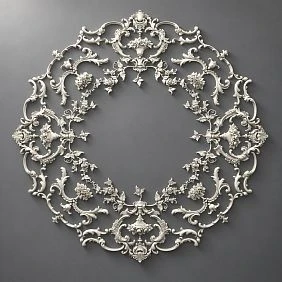
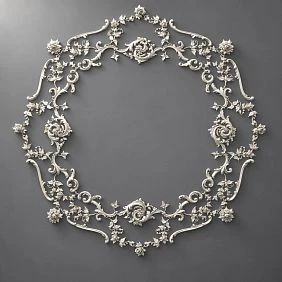
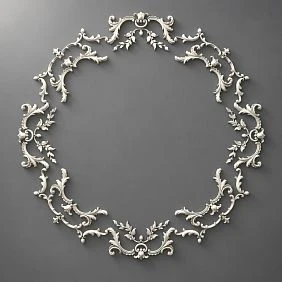
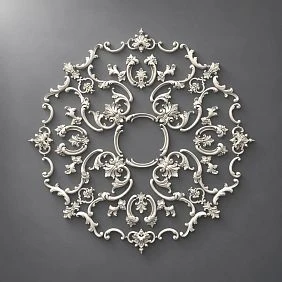
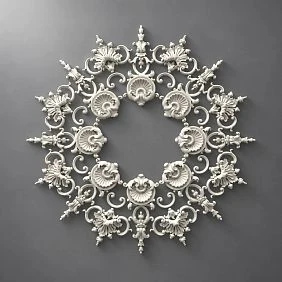
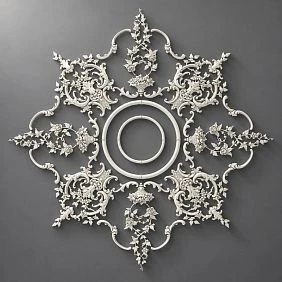
The STAVROS polyurethane ceiling medallion collection contains large modular decorative compositions.
These are not simply small circular discs placed beneath a light canopy.
Some are assembled from multiple individual polyurethane elements.
CRPU-070: Compact Modular Ceiling Composition
The STAVROS CRPU-070 ceiling medallion measures approximately:
Overall decorative layout: 30.12 × 30.12 inches
Relief depth: 0.71 inches
Material: polyurethane
Composition: 24 decorative components
This can be considered for a selected residential ceiling where the scale of the decoration is appropriate.
Its dimensions describe the complete ornamental arrangement.
They do not establish compatibility with a particular electrical box or light canopy.
CRPU-069: Larger Classical Medallion
The STAVROS CRPU-069 ceiling medallion measures approximately 35.83 × 35.83 × 0.59 inches.
It provides a larger decorative field.
This may be appropriate for a more formal dining room or living room.
The final choice should be evaluated on the actual ceiling plan.
CRPU-068: Substantial Decorative Ceiling Accent
The STAVROS CRPU-068 ceiling medallion measures approximately 52.17 × 52.17 × 0.71 inches.
This is a substantial decorative composition.
It should be used only where the room can accommodate its visual scale.
Medallion Comparison
| STAVROS medallion | Overall size | Material |
|---|---|---|
| CRPU-070 | 30.12 × 30.12 in | Polyurethane |
| CRPU-069 | 35.83 × 35.83 in | Polyurethane |
| CRPU-068 | 52.17 × 52.17 in | Polyurethane |
These products belong to a more elaborate decorative category.
A small contemporary bedroom may not require a medallion at all.
Important Safety Rule: The Medallion Does Not Support the Chandelier
A decorative ceiling medallion is not an electrical mounting system.
A chandelier requires appropriate structural support and electrical installation.
The correct method depends on the fixture's weight, mounting hardware, electrical box, and applicable local requirements.
Under relevant National Electrical Code provisions, ceiling boxes intended to support luminaires are subject to specific load requirements.
Heavier fixtures may require independent support or a box specifically listed and marked for the applicable weight.
The decorative medallion must not substitute for this support.
Do not use the polyurethane ornament itself as the attachment point for the chandelier.
Likewise, the installation must preserve the electrical box's required accessibility and comply with the fixture's instructions.
For hardwired lighting, a qualified electrician should coordinate the decorative and electrical work.
Complete Ceiling Decor Kits for Formal Rooms
Some rooms require more than a single ceiling medallion.
A formal ceiling composition may include a central decorative element, surrounding molding frames, corner ornaments, and perimeter crown molding.
STAVROS offers coordinated ceiling decor kits for these applications.
Example: STAVROS CPU-P3
The CPU-P3 ceiling decor kit combines decorative components into a classical ceiling composition.
The kit contains more than one material type.
Its listed components include polyurethane ornaments, primed MDF molding, and HIWOOD polystyrene crown molding.
This is important for procurement and installation.
Do not describe the entire kit as solid polyurethane.
The individual materials have their own substrate, joining, and finishing considerations.
When to Use a Coordinated Kit
A ceiling decor kit may be useful for a formal dining room, traditional living room, or another space where the entire ceiling is intended to have an ornamental composition.
It can provide a coherent starting point for the designer.
However, the kit dimensions must be checked against the available ceiling area.
The curtain layout and window locations also need to be considered.
When a Simpler Design Is Better
A modern bedroom or small living room may require only a restrained ceiling perimeter.
An elaborate ceiling kit is not necessary merely because the room has curtains and a chandelier.
A coherent interior can be visually successful with far fewer decorative components.
Room-by-Room Ideas for Curtains and Architectural Molding
Different rooms have different functional and visual requirements.
The window treatment should respond to those needs.
Living Room With Large Windows
A living room may use floor-length curtains on a wide rod or ceiling-mounted track.
The surrounding wall can include selected polyurethane molding frames.
Crown molding creates the ceiling perimeter.
If a central chandelier is present, a compatible ceiling medallion may complete the composition.
However, the individual elements should be proportionate to one another.
A restrained curtain fabric may pair well with more elaborate trim.
A richly patterned fabric may benefit from simpler architectural details.
Bedroom With an 8-Foot Ceiling
For a standard-height bedroom, consider a relatively simple design.
Mount the curtain hardware at an appropriate height.
Use full-length curtains.
Select narrow wall molding where needed.
Keep crown molding restrained.
The room may benefit more from vertical continuity and soft finishes than from a large ornamental ceiling composition.
Traditional Dining Room
A dining room can support a more formal decorative hierarchy.
A substantial window cornice may be combined with crown molding and a chandelier medallion.
Decorative wall frames can organize the spaces between windows.
The colors and relief patterns should be coordinated.
The objective is an architectural composition that remains balanced when the curtains are open or closed.
Home Office
A home office may use a combination of roller shades and stationary decorative drapery panels.
Architectural molding can add character around the window.
A rigid cornice may conceal suitable shade hardware.
However, the design should preserve access to controls and servicing.
Avoid placing decorative trim where it interferes with window operation.
Tall Living Room or Foyer
A room with a 10-foot ceiling may accommodate more pronounced crown molding and larger wall frames.
The curtain hardware can be positioned to reinforce the height.
A substantial ceiling medallion may be appropriate where the ceiling and chandelier justify it.
But scale still matters.
A high ceiling is not an automatic reason to use the largest decorative product.
A Practical Window Design: 60-Inch Window With Decorative Side Panels
Let's apply these principles to a specific wall composition.
Assume the window opening is 60 inches wide.
There are 36 inches of available wall on either side of the opening.
The design includes a curtain track, two decorative side frames, and one horizontal decorative molding above the window treatment.
The room has an 8-foot ceiling.
Step 1: Determine the Curtain Track Width
Suppose the track extends 10 inches beyond each side of the window.
Track width:
60 + 10 + 10 = 80 inches.
This is a preliminary layout dimension.
The curtain manufacturer must confirm that it provides adequate stacking space.
Step 2: Establish the Side Frame Position
Each wall pier is 36 inches wide.
Suppose the decorative frame begins 16 inches beyond the window edge.
Its outer width is 14 inches.
That leaves:
36 − 16 − 14 = 6 inches between the frame and the outside boundary of the wall pier.
This provides a deliberate space between the decorative frame and the edge of the curtain track's extended zone.
The actual open curtain stack must still be tested.
The decorative frame should not be placed where it will interfere with the fabric.
Step 3: Choose the Frame Height
For illustration, use decorative frames measuring:
Width: 14 inches
Height: 66 inches
Number of frames: 2
These dimensions are illustrative rather than universal.
Their actual vertical placement depends on the baseboard, ceiling trim, and window height.
Step 4: Choose the Molding
Select STAVROS MLDPU-002 polyurethane molding.
Its 0.87-inch face width creates a defined architectural frame.
Its stock length is 102.36 inches.
Step 5: Calculate One Frame
Perimeter:
2 × (14 + 66) = 160 inches.
For two frames:
160 × 2 = 320 inches.
The installation requires:
Four vertical pieces of 66 inches
Four horizontal pieces of 14 inches
Step 6: Add the Horizontal Decorative Molding
Suppose an 84-inch decorative line is positioned above the window treatment.
Total installed molding:
320 + 84 = 404 inches.
That equals:
404 ÷ 12 = 33.67 linear feet.
Step 7: Calculate the Number of Full Strips
Each MLDPU-002 strip is 102.36 inches long.
A feasible cut plan is:
| Stock strip | Cutting plan |
|---|---|
| Strip 1 | 66 + 14 + 14 in |
| Strip 2 | 66 + 14 + 14 in |
| Strip 3 | 66 in |
| Strip 4 | 66 in |
| Strip 5 | 84 in |
All the required pieces fit within five stock strips.
The nominal total purchased length is:
5 × 102.36 = 511.8 inches.
Unused length before saw kerf:
511.8 − 404 = 107.8 inches.
Therefore, five full MLDPU-002 strips are a feasible material quantity under these assumptions.
An additional reserve may be appropriate where replacement supply is difficult or installation risk is significant.
Step 8: Review the Functional Layout
Before installation, verify that the curtain stack does not conceal the frames.
Check the header molding's position relative to the actual curtain track.
Confirm that the decorative profiles do not interfere with window operation or electrical devices.
The final composition should be evaluated with the curtains both fully open and fully closed.
How Much Crown Molding Do You Need for a 12 × 15-Foot Room?
Crown molding is measured along the room perimeter.
However, the number of full strips required depends on stock length and the cutting plan.
Consider a rectangular room measuring 12 × 15 feet.
Step 1: Calculate the Perimeter
Perimeter:
2 × (12 + 15) = 54 linear feet.
In inches:
54 × 12 = 648 inches.
Step 2: Select the Crown Molding
Suppose the project uses HIWOOD A70V1 polystyrene crown molding.
The stock length is 78.74 inches.
Step 3: Calculate the Theoretical Minimum
648 ÷ 78.74 = approximately 8.23 strips.
Rounded upward:
9 full strips.
But this number should be checked against the actual wall lengths.
Step 4: Prepare the Cutting Plan
The room contains:
Two 12-foot walls, each 144 inches long
Two 15-foot walls, each 180 inches long
For each 12-foot wall, a preliminary arrangement could use:
78.74 + 65.26 = 144 inches.
For each 15-foot wall:
78.74 + 78.74 + 22.52 = 180 inches.
The required pieces can be obtained from nine stock strips.
However, this example assumes that the stated lengths are the relevant finished installation measurements.
The actual cut lengths must account for the crown molding's profile geometry, miter orientation, joint treatment, and site conditions.
Step 5: Allow for Installation Waste
Nine strips provide:
9 × 78.74 = 708.66 inches.
The room perimeter is 648 inches.
Nominal unused material:
708.66 − 648 = 60.66 inches.
This remaining length provides some allowance for cutting and minor waste.
A separate spare strip may be useful for a complex room or difficult-to-replace profile.
The correct reserve depends on the installation.
Crown Molding Accessories
Decorative corner elements are optional unless required by the chosen system.
A conventional room with four inside corners may use accurately cut joints.
Compatible decorative corner pieces can be considered when available and appropriate.
Do not assume that every cornice has a matching corner accessory.
Verify the exact profile series.
How to Coordinate Crown Molding With Curtain Length
The upper and lower proportions should be planned together.
A decorative ceiling perimeter influences the amount of visible wall above the window.
The curtain hardware also occupies part of that area.
Example: An 8-Foot Bedroom
An 8-foot ceiling is 96 inches high.
If the window casing ends at 84 inches, only 12 inches remain between the top of the casing and the ceiling.
That space must accommodate any upper wall clearance, rod or track hardware, and the visual relationship to crown molding.
A substantial cornice or oversized crown could make the composition feel crowded.
In such a room, a narrower ceiling trim and carefully positioned curtain track may be preferable.
Example: A 10-Foot Living Room
A 10-foot ceiling provides 120 inches of height.
The room may have considerably more space above the windows.
A substantial crown molding and a larger window cornice may be possible.
However, the actual window-head height still determines the available design space.
Ceiling height alone is not sufficient.
Avoid Arbitrary Horizontal Bands
Too many horizontal lines near the ceiling can fragment the wall.
A room might contain crown molding, a separate decorative frieze, an exposed curtain rod, and another molding directly above the window.
If those lines are not carefully coordinated, they may appear crowded.
Choose a clear architectural hierarchy.
The most effective design may use only one dominant upper boundary.
Curtain Fullness and Fabric Quantity
Architectural decoration cannot compensate for curtains with unsuitable fullness.
The fabric must be proportionate to the window and heading system.
Curtain fullness describes the relationship between the flat fabric width and the area it covers when installed.
A common preliminary design range for many decorative drapery styles is approximately 1.5–2.5 times fullness.
However, the correct amount depends on the fabric and heading style.
A pinch-pleat curtain, ripplefold curtain, and grommet curtain may use different fabrication requirements.
Example: An 80-Inch-Wide Curtain Track
Suppose the selected design uses approximately 2.0 times fullness.
The preliminary total flat fabric width is:
80 × 2 = 160 inches.
If using two equal panels, this suggests approximately 80 inches of flat fabric width per panel before considering fabrication allowances.
However, the actual drapery workroom or curtain manufacturer must determine the correct fabric quantity.
Pleats, seams, hems, pattern matching, and fabric width affect the final requirement.
Why Fullness Affects Cornice Dimensions
When curtains are open, their fabric folds occupy space.
A decorative cornice must provide suitable clearance.
If the cornice is too shallow, the drapery may rub against its front or side surfaces.
This can interfere with operation.
A correctly designed window cornice accommodates the actual fabric and hardware—not merely the closed curtain dimensions.
Installation Sequence: Curtain Hardware, Molding and Ceiling Decor
The sequence of work can significantly affect the quality of the finished room.
A decorative cornice should not be designed without the actual curtain hardware.
Likewise, a ceiling medallion should not be installed in a way that obstructs proper chandelier mounting.
Step 1: Measure the Complete Room
Record the ceiling height, room dimensions, window openings, wall piers, and existing trim.
Check actual site conditions.
Windows and ceilings may not be perfectly level.
Step 2: Select the Window Treatment
Determine whether the design uses an exposed rod, ceiling track, concealed system, or decorative window cornice.
Choose the intended curtain heading and approximate fabric fullness.
These decisions affect the hardware dimensions.
Step 3: Establish the Hardware Locations
Confirm the required mounting points and support.
Heavy curtains and motorized tracks may require appropriate blocking, studs, structural fasteners, or another approved method.
The supporting hardware must be installed according to its manufacturer's instructions.
Step 4: Coordinate Electrical Work
Where motorized curtains or new light fixtures are planned, complete the required electrical design before closing decorative cavities.
Do not conceal inaccessible junction boxes behind permanently installed trim.
Step 5: Plan the Crown Molding
Select the actual crown profile.
Review its cross-section and installation requirements.
Determine where it meets the curtain cornice or wall trim.
Step 6: Prepare Wall and Ceiling Substrates
Repair unsuitable surfaces.
Clean and prepare the intended bonding areas.
Follow the molding adhesive manufacturer's recommendations.
Do not assume that any primer is appropriate for every substrate.
Step 7: Install Decorative Architectural Profiles
Measure and cut the molding according to the final layout.
Dry-fit the components.
Apply approved adhesive or other specified mounting methods.
Support the components as required during curing.
Step 8: Install the Decorative Cornice
Where a rigid window cornice is used, mount its supporting structure according to the approved design.
Verify that it does not interfere with the track or curtain movement.
Decorative polyurethane profiles and onlays may then be installed on suitable surfaces.
Step 9: Install and Finish the Ceiling Medallion
Position the decorative medallion according to the ceiling plan.
Its installation must remain separate from the chandelier's structural and electrical support.
Follow the product's mounting and finishing instructions.
Step 10: Complete the Paint Finish
Finish the molding and surrounding surfaces using compatible materials.
Inspect the joints and transitions.
A consistent paint finish can visually unify materials, but it does not eliminate the need for accurate fitting.
Step 11: Hang and Test the Curtains
Install the finished curtains.
Open and close them completely.
Check the stack-back clearance.
Verify that the fabric does not snag on decorative edges.
For motorized systems, test the complete operating cycle and ensure access to required controls and service points.
Safety Considerations for U.S. Homes
Decorative treatments should not compromise the safety of the window or ceiling installation.
Curtain Hardware Support
Curtain rods and tracks carry the weight of fabric and experience forces during operation.
Their brackets must be attached using a suitable mounting method.
Decorative molding is not a substitute for structural support.
Chandelier Support
The chandelier must be supported by approved electrical and structural components.
A ceiling medallion does not carry the fixture's weight.
Electrical Access
Hardwired curtain motors and light fixtures require compliant electrical installation.
Do not conceal junction boxes or serviceable equipment behind permanently bonded decorative products.
Child Safety
Operating cords on window coverings can present strangulation hazards for young children.
The U.S. Consumer Product Safety Commission recommends cordless window coverings where children are present.
Where corded systems exist, follow current safety requirements and manufacturer instructions.
Decorative cornices must not be used to disguise hazardous or inadequately secured operating cords.
Windows and Emergency Egress
Curtains, decorative panels, and cornice structures must not obstruct windows that serve required emergency escape and rescue functions.
Applicable building requirements and the actual window operation must be considered.
Fire Performance
Polyurethane, MDF, polystyrene, textiles, and other materials have different fire-performance characteristics.
For commercial, hospitality, and other regulated installations, material suitability and code compliance may require additional documentation.
Do not assume that every decorative polymer product is approved for every occupancy or ceiling application.
Common Mistakes When Combining Curtains, Crown Molding and Decorative Trim
Confusing Crown Molding With a Curtain Cornice
Crown molding decorates the ceiling perimeter.
A window cornice conceals window-treatment hardware.
They serve different functions.
Expecting Polyurethane Molding to Support Heavy Curtains
Ordinary decorative molding is not curtain hardware.
Use a suitable rod or track mounting system.
Mounting the Curtains Before Planning the Architectural Layout
The curtain hardware may conflict with crown molding or window frames.
Plan the complete upper-wall composition first.
Using a Cornice That Is Too Shallow
Curtains need space to move.
A narrow decorative box may obstruct the fabric.
Check the actual stack-back and heading dimensions.
Ignoring Curtain Stack-Back
A beautifully designed wall frame may disappear behind the open curtain panels.
Establish stacking space before positioning the decorative details.
Selecting an Oversized Ceiling Medallion
A large ornamental composition may dominate a modest room.
Evaluate the actual ceiling area.
Treating All STAVROS Molding as Polyurethane
The catalog includes polyurethane, MDF, wood, and polystyrene products.
Check the material of every selected item.
Installing Ornament Where It Interferes With Window Operation
Window cranks, handles, blinds, and emergency opening functions must remain usable.
Decorative trim should not obstruct them.
Using Too Many Decorative Styles
A richly ornamented curtain cornice, elaborate crown molding, floral medallion, and heavily patterned curtains can create visual competition.
Choose a coherent hierarchy.
Ordering by Linear Footage Without a Cutting Plan
Stock lengths and joint locations affect the actual quantity required.
Prepare individual cut lists.
Assuming the Same Paint Works on Every Material
Different substrates may require different preparation.
Use a compatible finishing system.
What to Buy From STAVROS for a Coordinated Window and Ceiling Design
The required materials depend on the selected architectural composition.
Not every project needs every category.
The following table identifies real STAVROS product groups and their possible design roles.
| Product category | Function |
|---|---|
| Polyurethane Moldings | Wall frames, decorative lines, window cornice ornament |
| Decorative Polyurethane Trim | Beaded, rope and ornamental borders |
| Polyurethane Onlays | Ornamental accents beside windows or on suitable decorative panels |
| Polyurethane Ceiling Medallions | Decorative ceiling compositions around light fixtures |
| Ceiling Decor Kits | Coordinated ceiling frames and ornamental designs |
| HIWOOD Polystyrene Crown Molding | Architectural ceiling perimeter |
The curtain rod, track, supporting hardware, and electrical equipment are separate items to be selected for the actual window treatment.
For a Minimalist Bedroom
Consider a narrow polyurethane wall molding and a restrained ceiling cornice.
An exposed rod or simple ceiling track may provide all the window functionality required.
An elaborate medallion or decorative onlay may be unnecessary.
For a Transitional Living Room
A medium polyurethane molding can create picture-frame wall panels beside the window.
A suitable crown molding establishes the ceiling perimeter.
The curtain hardware may remain visible or be concealed by a simple cornice.
For a Formal Dining Room
A rigid window cornice may be decorated with ornamental trim.
A more substantial ceiling profile can reinforce the architectural style.
A selected ceiling medallion may create a central focal point around the chandelier.
For a Large Neoclassical Room
Coordinated wall frames, ornamental appliques, ceiling perimeter, and central ceiling decor may all be appropriate.
However, their dimensions should be established together.
Avoid choosing each decorative product independently.
Buying STAVROS Decorative Products for a U.S. Project
A reliable purchasing process begins with exact product references.
Decorative moldings that appear similar in photographs may differ substantially in profile geometry.
The correct SKU should be recorded in the project specification.
Check the Material
Distinguish polyurethane from high-density polystyrene, MDF, and wood.
The materials have different installation requirements.
Check the Dimensions
For linear molding, record the face width, projection, and stock length.
For crown molding, review the cross-sectional drawing.
For ceiling medallions, record the overall decorative dimensions and component list.
Verify Compatibility
Not every corner ornament fits every molding profile.
Check the manufacturer's compatibility information.
Calculate the Complete Order
Include each profile, ornamental accent, and required number of stock strips.
Prepare the cutting plan before ordering.
Consider Samples
A physical sample can help determine whether the molding's scale and finish suit the room.
This can be especially valuable for a large residential project.
Confirm International Delivery
The English-language STAVROS catalog displays product dimensions in inches and prices in U.S. dollars.
However, its published delivery information primarily describes Russia and certain neighboring markets.
Customers purchasing for the United States should confirm international shipping availability, freight charges, customs requirements, lead times, and commercial terms directly with STAVROS before placing an order.
U.S.-dollar pricing does not establish domestic U.S. inventory.
Frequently Asked Questions About Curtain Cornices and Crown Molding
What Is the Difference Between Crown Molding and a Curtain Cornice?
Crown molding decorates the junction between the wall and ceiling. A curtain cornice is a rigid decorative treatment above a window that conceals the curtain rod or track.
Can You Hide a Curtain Rod Behind Polyurethane Molding?
A properly designed cornice or concealment structure may incorporate decorative polyurethane molding. However, the molding itself should not be assumed capable of supporting or concealing every curtain system.
What Is the Best Way to Hide a Ceiling-Mounted Curtain Track?
A purpose-designed ceiling pocket or window cornice can conceal suitable hardware. The pocket dimensions must accommodate the track, curtain heading, fabric movement, and required access.
Can Crown Molding Be Used With Ceiling-Mounted Curtains?
Yes. Crown molding can visually coordinate with ceiling-mounted curtain tracks. The functional hardware and decorative trim must be installed according to their separate requirements.
How High Should Curtain Rods Be Mounted?
For conventional wall-mounted curtains, approximately 4–6 inches above the window casing is a common starting point. The actual position depends on the ceiling, hardware, and intended curtain length.
How Far Should a Curtain Rod Extend Beyond the Window?
An extension around 6–12 inches on each side may be worth evaluating for many residential designs. Heavy drapery or particular heading systems may need a different amount of stacking space.
What Is Curtain Stack-Back?
Stack-back is the space occupied by the curtain fabric when the panels are opened. It affects curtain rod length, track dimensions, and window cornice depth.
Can Polyurethane Molding Be Used on a Wood Cornice Box?
Yes, when the molding, adhesive, and supporting surface are compatible. The box must remain securely mounted and provide adequate clearance for the curtain system.
What Is Beaded Molding?
Beaded molding is decorative trim containing a repeated sequence of small rounded elements. It can be used on selected traditional window cornices and architectural borders.
Is Rope Molding Suitable for Window Cornices?
Rope molding can provide an ornamental accent for suitable traditional window treatments. Its scale, pattern, and joint locations must be considered.
Is Crown Molding Necessary in a Room With Curtains?
No. Crown molding is a decorative choice. Many contemporary interiors look complete without it. It is most useful when it supports the intended architectural style.
What Crown Molding Is Appropriate for an 8-Foot Ceiling?
A restrained profile is often a useful starting point. The correct choice depends on the room's width, window dimensions, door casing, and overall design.
Can You Install a Ceiling Medallion Without a Chandelier?
A decorative ceiling composition may be used independently of a chandelier when the product and design permit it. Its location and scale should be selected according to the ceiling arrangement.
Does a Polyurethane Ceiling Medallion Support a Chandelier?
No. Ordinary decorative ceiling medallions are not structural or electrical mounting equipment. The chandelier requires appropriately rated support and a compliant electrical installation.
Are STAVROS Ceiling Medallions Made From Polyurethane?
The STAVROS ceiling medallions discussed in this guide are polyurethane decorative compositions. Their individual product specifications should be checked before ordering.
Are STAVROS Crown Moldings Polyurethane?
The HIWOOD crown moldings in the referenced STAVROS crown molding category are made from high-density polystyrene, not polyurethane.
Can Wall Moldings Be Installed Beside Curtains?
Yes. Decorative frames or vertical moldings can be positioned on the wall sections beside a window. The design should account for the space occupied by the open curtains.
Can Window Cornices Be Used With Motorized Curtains?
Yes, when the cornice is specifically designed to accommodate the selected motorized system, including its dimensions, power requirements, movement, and service access.
How Much Molding Do I Need Around a Window?
Measure the finished decorative pieces and prepare a cut list. In the example above, two 14 × 66-inch side frames and one 84-inch header require 404 inches of finished molding, which can be cut from five 102.36-inch STAVROS MLDPU-002 strips.
Where Can I Buy Polyurethane Molding for Window Decor?
Explore STAVROS polyurethane moldings, decorative trim molding, and polyurethane ornamental appliques.
For ceiling compositions, review the ceiling medallion collection and crown molding catalog.
Confirm the materials, dimensions, availability, and delivery terms before purchasing.
Final Thoughts: Make Curtains Part of the Room's Architecture
A beautiful window treatment does not have to be hidden behind elaborate decoration.
In some rooms, a simple curtain rod and well-proportioned floor-length panels are enough.
In others, coordinating the window treatment with crown molding, decorative wall trim, a rigid cornice, or a ceiling medallion creates a more cohesive architectural appearance.
The objective is to establish a relationship between the window, ceiling, lighting, and surrounding walls.
A curtain track provides function.
A cornice can conceal its hardware.
Crown molding defines the ceiling perimeter.
Polyurethane wall molding introduces geometry around the window.
Decorative onlays provide carefully positioned accents.
A ceiling medallion can establish an ornamental focal point around a chandelier.
Each component has its own role.
The strongest design comes from selecting those components together rather than adding them independently.
STAVROS offers polyurethane architectural moldings, decorative trim profiles, polyurethane onlays, ceiling medallions, and coordinated ceiling decor kits for selected architectural compositions.
The catalog also includes HIWOOD polystyrene crown molding for decorative ceiling perimeters.
For a successful project, begin with the actual window and room dimensions.
Choose the curtain hardware.
Determine the panel fullness and stacking requirements.
Establish the upper architectural line.
Select the wall and ceiling profiles.
Prepare the drawings and cutting schedule.
Then install the functional supporting systems and decorative components using the appropriate methods for each.
The best curtain and crown molding design is not the one with the most ornament. It is the one in which the window treatments, architectural trim, ceiling, and lighting work together as a coherent interior.