
























Article Contents:
- The same pattern does not have to have the same size
- Think of a furniture family, not two separate surfaces
- Scale matters more than formal symmetry
- Quick specs of RPU-044
- For a cabinet, free space around the pattern is especially important
- A smaller size suits not only small furniture
- A 170 mm rosette can work as a series
- Look not at the entire cabinet, but at a specific door
- A large size is especially justified with a single center
- A depth of 23 mm also requires checking
- First, a small template on the nightstand
- Then both sizes on the cabinet
- Take a photo of the entire furniture group
- Repeat the placement principle
- The same color enhances kinship
- Don't change everything at once
- First find the decorative field
- Check two positions
- One large RPU-044
- One socket on each door
- One large in the center, small ones on adjacent elements
- Signs that a frame is not required
- Large RPU-044 inside a large frame
- Small RPU-044 inside a compact frame
- A frame can unite furniture more strongly than sockets of the same size
- How a socket differs from a linear molding
- How is a socket different from an elongated plate
- Why two sizes of one model are better than two random similar sockets
- Handle under the socket
- Handle on the side
- Large decorative handle
- First measure the inner field
- On a cabinet, the difference becomes even more noticeable
- Basic scenario
- Cabinet with two identical doors
- Two bedside tables
- Cabinet plus two tables
- Cabinet with two doors plus two tables
- Edges too close to the frame
- Socket competes with the handle
- The calm surface disappears on the facade
- Several large sockets create too frequent repetition
- Huge smooth door
- The socket is far from the viewpoint
- There are large elements nearby
- The only detail should become the main center
- Wardrobe as the main item
- Nightstands as supporting items
- Set the size to 220 mm for all furniture
- Use only 170 mm everywhere
- Choose the size based on the overall size of the item
- Do not create a mockup
- Place the socket flush against the handle
- Ignore the existing paneling
- Add moldings automatically
- Make the composition on the small cabinet as complex as on the tall cabinet
- Change the size, finish, and placement principle simultaneously
- Assume that the same SKU automatically creates a set
- Do not check the third size
- Buy quantity until the final scheme
- Very narrow facades
- Very large surface
- Furniture already has active threading
- Need an elongated vertical composition
- No free field due to handles and panels
- Situation one: the wardrobe is huge, the cabinet is small
- Situation two: the wardrobe is wide, but the doors are narrow
- Situation three: the wardrobe has one large central door
- Situation four: the cabinet is wide
- Situation five: the wardrobe has a frame, the cabinet does not
- Can RPU-044 be used on furniture?
- What size RPU-044 should I choose for a nightstand?
- What size is best for a wardrobe?
- Can I put 220 mm on the wardrobe and 170 mm on the nightstand?
- Won't it seem like they are different outlets?
- Is it necessary to use different sizes?
- Can I use the RPU-044 170 mm on a large wardrobe?
- Can I use the 220-millimeter RPU-044 on a nightstand?
- How do I make a mockup before purchasing?
- Where is the best place to put the outlet — strictly in the center?
- Do I need to install the RPU-044 on every wardrobe door?
- What to choose for a cabinet with four doors?
- Are moldings needed around RPU-044?
- Where to find moldings for RPU-044?
- Do I need to additionally purchase decor for the moldings?
- What is the price of RPU-044 170 mm?
- How much does RPU-044 220 mm cost?
- Can I order both sizes in one listing?
- How is RPU-044 different from a molding?
- Can RPU-044 be combined with other stucco decor in the room?
- Does the depth of 18 and 23 mm matter?
- How to calculate the number of RPU-044 per furniture set?
- What to do if 170 mm seems too small, and 220 mm — too large?
- Where to buy RPU-044?
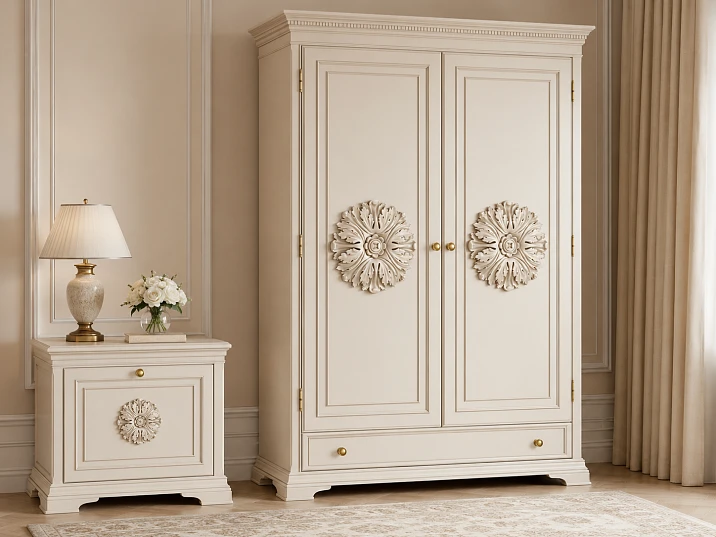
A wardrobe and a nightstand can belong to the same furniture group, stand in the same room, and have the same finish — but decor of the same size on them does not always look equally good. On a tall, wide facade, a small carved polyurethane rosette can get lost, while on a compact door, a large ornament, on the contrary, will take up almost the entire free field and start to compete with the handle, paneling, and the very shape of the furniture.
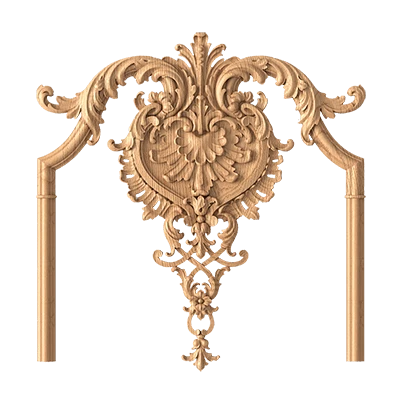
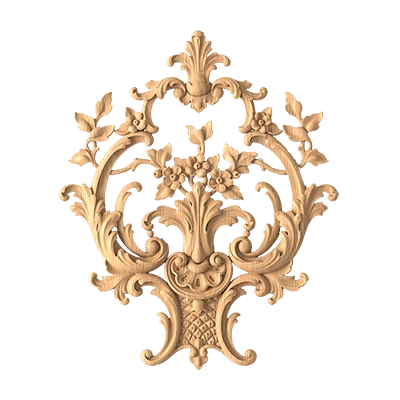
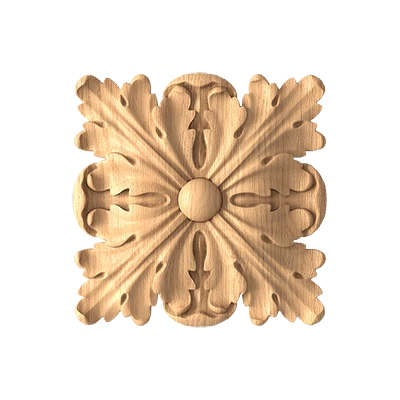
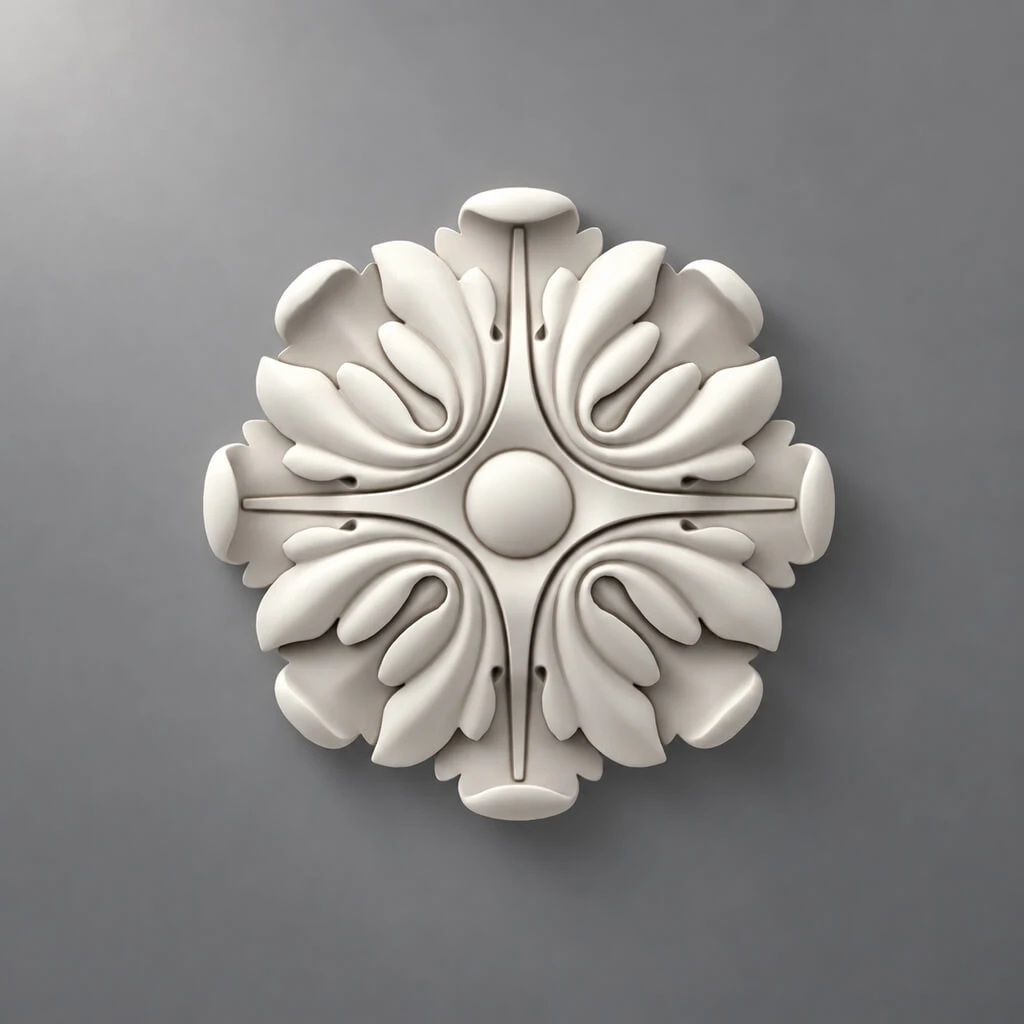
That is why, for a cohesive interior, it is useful not to follow the principle of “put the same detail on all furniture,” but a subtler technique: repeat one ornament while changing its scale. The carved decorative rosette RPU-044 has a rare and very convenient property for this — the model is available in two sizes. The smaller version has dimensions of 170 × 170 × 18 mm, the larger one — 220 × 220 × 23 mm. The pattern remains recognizable, and the size can be matched to the area of a specific furniture facade.
This makes it possible to decorate, for example, a tall wardrobe with a 220 × 220 mm rosette, and a nightstand with the 170 × 170 mm version. The furniture does not get two random different decorations. On the contrary, one decorative theme is repeated, only scaled to the item. This is often how convincing stucco decor for furniture is built: unity is achieved not by making all sizes identical, but by repeating the shape, the character of the ornament, and the overall logic of placement.
This is especially important when furniture stands nearby. A large wardrobe and a small nightstand are perceived simultaneously. If you glue 220 mm rosettes on both facades, the nightstand may look overloaded. If you use 170 mm everywhere, on a large wardrobe the ornament risks turning into a tiny dot in the middle of a large field. The two size versions of RPU-044 allow you to avoid this compromise.
If you are still just deciding on the type of decorative design, it is useful to first You can buy ready-made stucco matching the Baroque style. Calculate the quantity: linear meters of cornices and moldings, number of rosettes, pilasters, consoles, corner elements. Add a ten to fifteen percent allowance for trimming. not literally the first element you like, but after comparing the sizes and purposes of different products. When it is already clear that you need exactly a round or close-to-round central decorative motif for furniture, the choice can be narrowed down and buy carved polyurethane rosettes.
For the task at hand, the key product is one — RPU-044 — but there are two solutions within a single card. And it is the choice between 170 mm and 220 mm that determines whether the same ornament will truly unify the wardrobe and the nightstand or simply repeat without regard for scale.
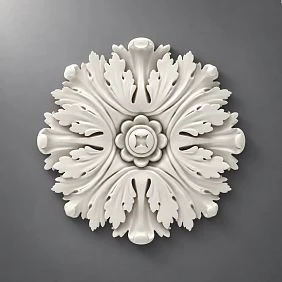
The same pattern does not have to have the same size
When furniture is styled as a set, the first thought is usually very straightforward: if a certain rosette is chosen for the wardrobe, the same one should be placed on the nightstand. Formally, everything is correct — the motif repeats. But the interior is perceived not by article numbers. A person sees proportions.
Suppose the wardrobe facade is significantly taller and wider than the nightstand door. The same rosette with a diameter or size of about 170 mm will occupy a completely different proportion on these surfaces.
On a small facade, it can become a noticeable center. On a tall door panel, it may remain a small spot.
If you take 220 mm, the situation flips. On the wardrobe, the size starts to work more convincingly, but on a compact nightstand it may prove excessive.
Hence an important principle: unified furniture decor is not necessarily the same physical size, but the same visual weight relative to each piece.
That is why two versions of RPU-044 are of interest not just as a "small and large rosette." They can be used as two scales of one decorative language.
Imagine a family of furniture, not two separate surfaces
Suppose in the bedroom there are:
-
tall cabinet;
-
two bedside tables;
-
a dresser;
-
a mirror or a decorative panel.
If you choose an ornament for each item separately, the interior gradually turns into a collection of different details.
Another way is to choose one RPU-044 motif and distribute it across scales.
For example:
-
large size 220 × 220 mm — on the central wardrobe door;
-
170 × 170 mm — on the bedside tables;
-
if necessary, the same smaller size — on individual dresser fronts.
The exact composition depends on the furniture, but the idea remains the same: the eye recognizes the repetition of the pattern, and each item gets a detail appropriate to its scale.
Our factory also produces:
Scale matters more than formal symmetry
Imagine a tall cabinet with two wide doors and a small cabinet with one door.
If you use the same 170-millimeter rosettes on all facades, you get formal unity. But the large cabinet will be perceived differently: its decorative elements may seem too small.
If you put 220 mm on each cabinet door and the same 220-millimeter piece on the small cabinet, the small furniture will start to look as if the decor simply was not adapted to its size.
Two sizes of the same RPU-044 allow you to avoid both extremes.
Get Consultation
What exactly is RPU-044 and why two sizes change the selection scenario
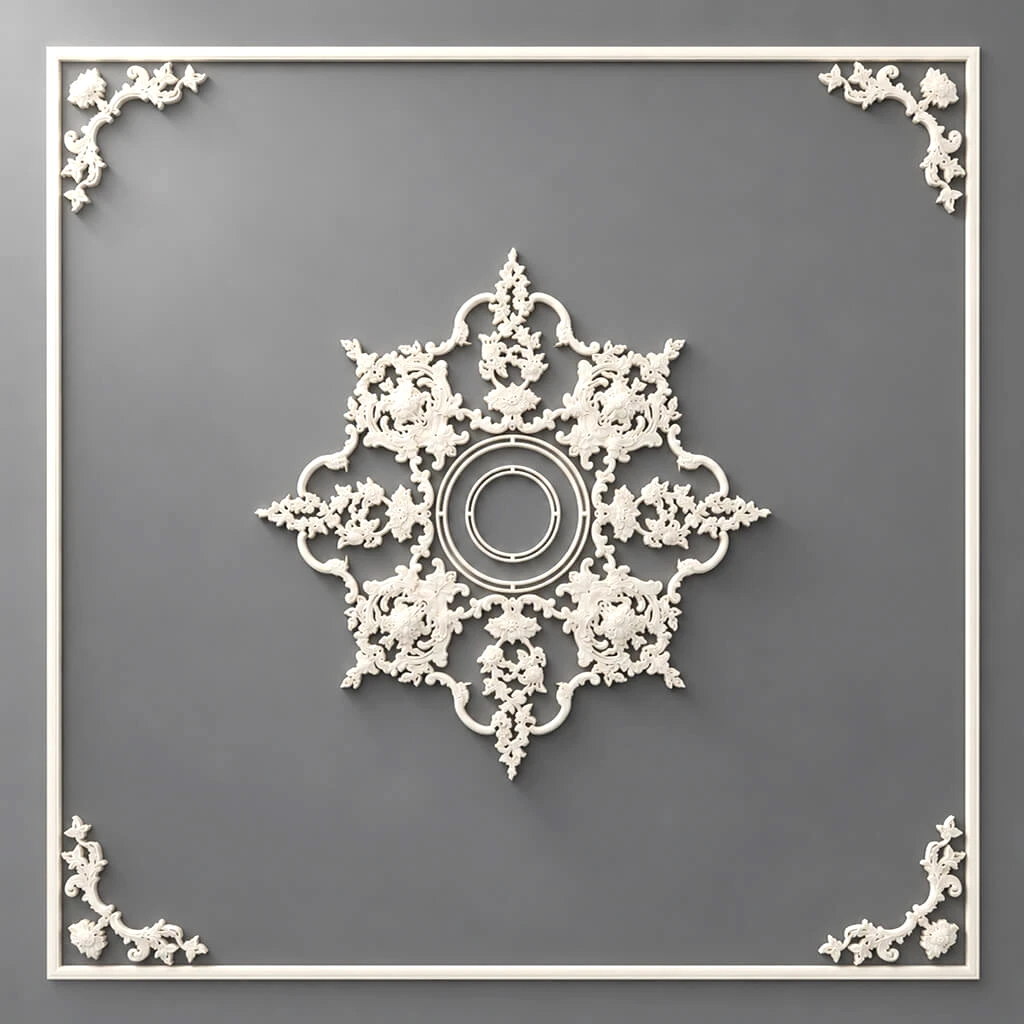
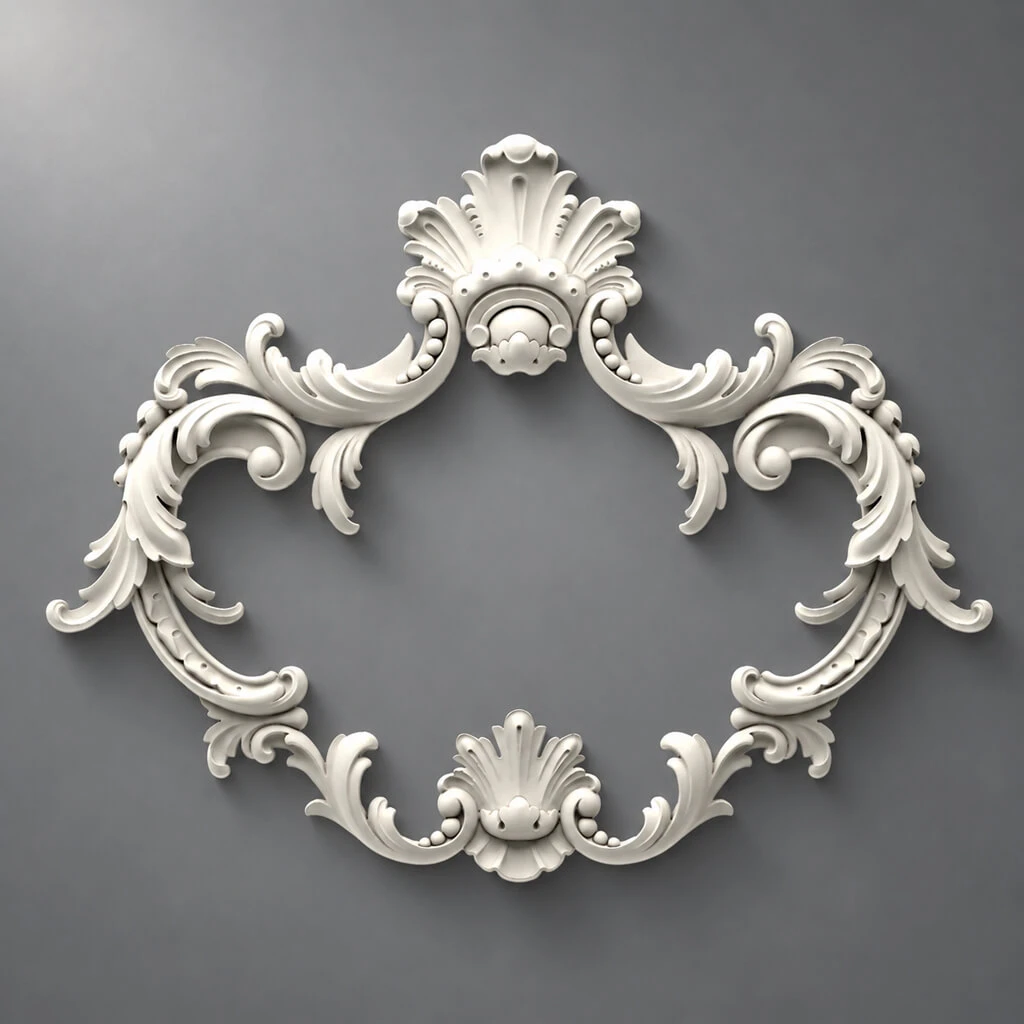
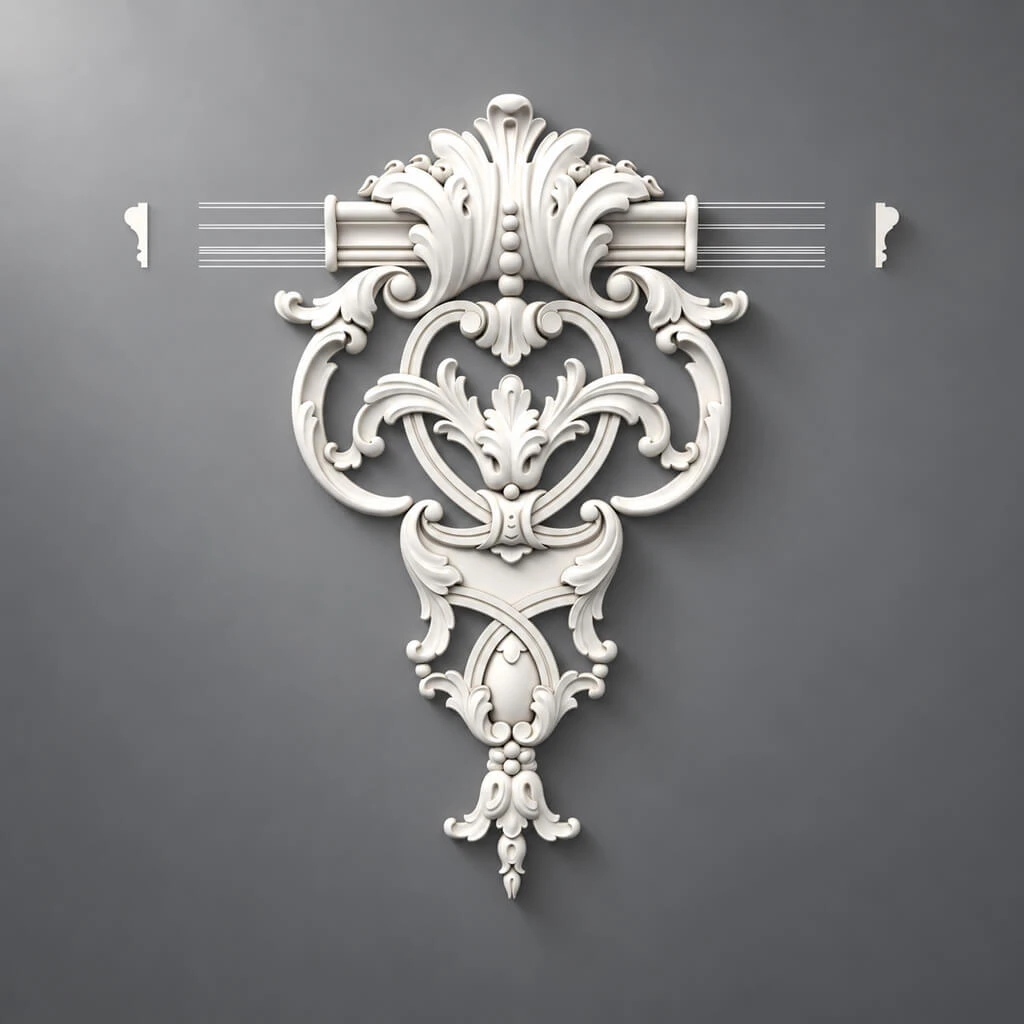
RPU-044 is a carved decorative rosette made of polyurethane, which can be considered not only in traditional ceiling design, but also for furniture, doors, and other decorative surfaces where its dimensions and pattern character fit.
In the context of this article, we are primarily interested in furniture.
The model has two confirmed variants:
-
170 × 170 × 18 mm — 2,750 ₽;
-
220 × 220 × 23 mm — 5,730 RUB.
Both size versions are in the same product card. Therefore, the buyer does not have to pick two similar sockets with different article numbers and hope that their ornament will be close enough. You can keep one pattern, changing only the scale.
If the choice has already been made and a specific model is required, you can buy the carved rosette RPU-044 made of polyurethane, having previously determined the appropriate size for each furniture facade.
Quick specifications of RPU-044
| Parameter | RPU-044, smaller size | RPU-044, larger size |
|---|---|---|
| Product type | Carved decorative rosette | Carved decorative rosette |
| Article number | RPU-044 | RPU-044 |
| Material | Polyurethane | Polyurethane |
| Size | 170 × 170 × 18 mm | 220 × 220 × 23 mm |
| Price at the time of material preparation | 2 750 ₽ | 5 730 ₽ |
| The main task in the considered interior | Decor of a more compact furniture field | Decor of a larger furniture field |
| Drawing | One motif RPU-044 | The same motif RPU-044 at a larger scale |
| Product | Order RPU-044 size 170 × 170 mm | Buy RPU-044 size 220 × 220 mm |
The difference between 170 and 220 mm seems small while the sizes exist only in a table. On furniture, the additional 50 mm in width and height are much more noticeable. The area occupied by the larger version on the facade increases significantly, and the relief has greater depth — 23 mm instead of 18 mm.
Therefore, you cannot approach the choice like this: “a larger cabinet, so we automatically take 220.” First, you need to see both sizes on specific furniture surfaces.
RPU-044 170 × 170 mm: when the smaller rosette looks more convincing
A size of 170 × 170 mm cannot be called "small" out of context. For a compact cabinet door, nightstand, or drawer, it is quite a noticeable decorative element.
The main thing is to assess the free space.
By free space, we mean not the overall size of the furniture, but the area of the facade where a rosette can actually be placed without conflicting with handles, panels, moldings, edges of the door, and other details.
Let's imagine a nightstand about the height of a bed. Its facade is much smaller than the door of a tall cabinet. It is here that the 170 × 170 mm version might be the right centerpiece: it is noticeable, but there is still background around it.
For a nightstand, free background around the design is especially important.
A carved rosette should not fill almost the entire door.
If its edges visually come too close to the frame of the facade, handle, or outer perimeter, the design loses its independence. Instead of a central decorative motif, you get an ornament squeezed between functional details.
This is especially noticeable on a small piece of furniture.
Therefore, for a nightstand, you need to measure:
-
the width of the free decorative zone;
-
the height of this zone;
-
distance to the handle;
-
distance to the facade edge;
-
the position of the existing panel, if there is one;
-
the distance to the adjacent facade or drawer.
Only after this is the 170 × 170 mm dimension compared.
The smaller size is suitable not only for small furniture
On a large cabinet, the 170 mm version can also be appropriate.
For example, if the facades are narrow and elongated. Or if several decorative elements are planned on each door. Or if the rosette is included in a molding frame that itself reduces the perceived size of the free field.
Therefore, the formula “170 — cabinet, 220 — wardrobe” is useful as a starting scenario, but not as a mandatory rule.
The 170 mm rosette can work as a series
If the wardrobe has several identical facades, each requiring a repeating central motif, the large 220 mm version can sometimes create too intense a rhythm.
Then the smaller RPU-044 allows repeating the ornament several times without turning all the furniture into a solid carved surface.
It is the number of elements that changes the acceptable scale.
One large rosette on the central door and six large rosettes on each leaf of one cabinet are completely different compositions in terms of visual load.
RPU-044 220 × 220 mm: when a large facade needs a more confident center
A tall cabinet often provides a huge free field. Especially if the facade is smooth, without complex milling, large glass, or its own ornament.
On such a surface, a 170-millimeter piece may seem too modest.
The 220 × 220 × 23 mm version creates a larger center and better matches the large plane.
But there is a trap here: the buyer sees a huge cabinet and automatically assumes that the largest version is always the right choice.
This is not the case.
Look not at the entire cabinet, but at the specific door leaf
A cabinet two meters wide may consist of four narrow facades.
In that case, the overall width of the furniture says little about the size of the socket.
Each individual door can be quite narrow, and the RPU-044 220 mm will start taking up too significant a portion of its width.
Another cabinet may have two wide doors. There, a larger socket is perceived as natural.
Therefore, the facade is measured, not the cabinet body.
A large size is especially justified with a single center
If the RPU-044 is planned to be installed only once — for example, on the central large door of the cabinet — the 220 mm version gets more space and becomes a standalone accent.
If the sockets are repeated on each door, the overall rhythm is enhanced. Then it is sometimes more advantageous to switch to 170 mm.
It comes down to a simple choice:
-
one or two sockets on a huge furniture surface — you can more confidently consider 220 mm;
-
several repeating elements — be sure to compare 220 and 170 on the full sketch.
A depth of 23 mm also requires checking
For the large variant, the third dimension is 23 mm.
This is not only a characteristic of the relief. If the socket is installed next to a protruding handle, an adjacent door, or other furniture, you need to understand the actual volume.
On a hinged facade, you must ensure that the relief does not create problems when opening and does not end up in the work area.
Comparison of RPU-044 sizes through a real customer task
| Situation | 170 × 170 × 18 mm | 220 × 220 × 23 mm |
|---|---|---|
| Small cabinet | Often more convenient as a starting option for fitting | May take up too much of the facade |
| Compact dresser | Well suited for individual doors or drawers with sufficient space | Requires a large solid facade |
| Narrow door of a tall cabinet | Often fits better in width | May prove excessive |
| Wide central door | Can look restrained or be used within a frame | Good candidate for a large center |
| Several identical fronts | Allows repeating the pattern without excessive saturation | Need to check if the repetition becomes too active |
| One rosette on a large furniture field | May visually get lost | Usually reads more noticeably |
| Small molding frame | Often easier to leave free background | May end up squeezed inside the frame |
| Large frame composition | Works as a more delicate center | Can become the main decorative element |
The table helps see the main point: the size is chosen not by the furniture item's name, but by the free space and the number of repeats.
A wardrobe does not automatically mean 220 mm. A nightstand does not automatically mean 170 mm.
But it is precisely this pair of sizes that allows solving the task much more accurately than one universal outlet.
Two paper mockups will show more than ten product photos
Before purchasing, take two sheets of paper or cardboard.
Cut out:
-
square 170 × 170 mm;
-
square 220 × 220 mm.
To check the protrusion, it is enough to remember that the actual products have a depth of 18 and 23 mm respectively. The main task of the paper templates is to assess the frontal scale.
Attach both options to the cabinet and nightstand with painter's tape.
Do not choose immediately.
First, the small template on the nightstand
Place it in the intended center.
Check:
-
whether there is free space around;
-
isn't the ornament too close to the handle;
-
does the center of the rosette coincide with the visual center of the facade;
-
is there enough space at the top and bottom;
-
doesn't the 170 mm square conflict with the panel.
Now replace it with the 220 mm template.
The difference will become obvious.
Sometimes the buyer is sure in advance that 220 mm is too large, but on a wide cabinet it unexpectedly looks better. It also happens the other way around: 170 mm turns out to be sufficient and neater.
Then both sizes on the cabinet
Don't look at the template from a distance of twenty centimeters.
Step back to where the furniture is usually seen as a whole.
On a large facade, this is fundamental. Up close, even 170 mm seems like a noticeable detail. From a few meters away, it can almost disappear.
After comparison, it will become clear which size truly holds the scale.
Take a photo of the entire furniture group
This is especially useful for the article's topic.
The cabinet and the nightstand must be in the frame simultaneously.
First, photograph both items with 170 mm templates.
Then, both with 220 mm.
After that, try the combination:
-
220 mm on the cabinet;
-
170 mm on the nightstand.
Very often, it is the third shot that best demonstrates the principle of a unified ornament with different scales.
How to place two different sizes in one room without getting the feeling of different collections
People sometimes fear that using two sizes will break the unity.
In practice, the problem more often arises in the opposite situation: one size on furniture of sharply different scales looks mechanically repeated.
Unity is formed by several features simultaneously:
-
one pattern RPU-044;
-
the same placement logic;
-
same orientation;
-
coordinated finishing;
-
a similar ratio of the rosette to the center of the facade;
-
repetition of decorative frames, if they are used.
Size is only one of the parameters.
Repeat the placement principle
If on the cabinet the RPU-044 is strictly in the center of the decorative field, and on the nightstand it is accidentally shifted toward the handle, the same ornament will not save the situation.
It is much more convincing when both outlets occupy a similar role.
For example:
-
large RPU-044 — center of the upper field of the cabinet;
-
small RPU-044 — center of the nightstand facade.
Their physical coordinates are different, but their compositional function is the same.
The same color strengthens the kinship
If both outlets receive a finish of the same character matching the furniture, the eye first reads the shape and relief.
At the same time, the large and small versions are not perceived as two different decorative items.
If one socket is made sharply contrasting and the second almost blends with the facade, the unity may weaken.
The exact finishing option depends on the project and should be checked against the surface material and the socket itself.
Don't change everything at once
If a large RPU-044 with a complex frame and contrasting finish is used on the cabinet, and a small RPU-044 without a frame and in the color of the facade on the nightstand, the connection becomes less obvious.
Sometimes this is justified, but then unity has to be maintained by other techniques.
If the goal is simple — to link the cabinet and nightstand with one decor, it's better to keep at least two or three identical features.
The center of the facade does not always coincide with the geometric center of the door
This is especially noticeable on furniture with handles.
Suppose the door is rectangular. The mathematical center is easy to find: half the width and half the height.
But nearby there is a long vertical handle. Or the decorative panel is shifted. Or the lower part of the facade is covered by an adjacent drawer.
Then the geometric center and the visually convincing place for RPU-044 may differ slightly.
First, find the decorative field.
Do not measure the entire door automatically.
Determine the area within which the socket should actually work.
If there is a molding frame, the field is defined by its inner part.
If the facade is smooth, the edges of the door leaf, the handle, and neighboring elements serve as reference points.
Check two positions.
The first is the strict geometric center.
The second is a slight offset if required by the handle or the existing facade architecture.
After that, look at the furniture from a distance.
There's no need to shift the socket for the sake of originality. But blindly obeying the mathematical center when the composition clearly requires a different position is also unnecessary.
One RPU-044 or several on a large cabinet
Large furniture provokes the desire to fill free surfaces.
"If one socket looks good, four will be even richer" — this is dangerous logic.
The quantity should follow from the structure of the cabinet.
One large RPU-044
A good option for a central large door, a single decorative field, or furniture with a pronounced axis.
The 220 mm version gets enough space here.
One socket on each door
If the cabinet has two, three, or four doors, repetition becomes rhythm.
In that case, be sure to compare both sizes. Four RPU-044 220 mm elements can be perceived as much more active than one large outlet.
The smaller 170 mm version often allows you to repeat the motif while retaining more calm background.
One large one in the center, small ones on adjacent elements
This is already a more complex composition.
For example, the central facade stands out with RPU-044 220 mm, while smaller 170-millimeter elements are repeated on adjacent furniture.
Thus, size begins to reflect hierarchy: the main piece gets a larger decorative center.
But mixing two scales within one cabinet should be done more carefully. If the facade structure does not explain the difference, a sense of randomness may arise.
The nightstand should not look like a scaled-down copy of the cabinet
A very common mistake when styling a furniture set is literal copying.
The cabinet has a large frame and a central rosette. So, on the nightstand, they make the same frame and a rosette of the same size.
But the cabinet has a different width-to-height ratio, a different handle zone, and a much smaller area.
It is much more interesting to repeat the idea rather than every millimeter.
For example:
-
on the cabinet — a large molding frame and RPU-044 220 mm;
-
on the cabinet — a more compact field and RPU-044 170 mm.
Both items belong to the same system, but each retains its own proportion.
It is precisely for such a composition that it is useful that RPU-044 is available in two confirmed sizes.
When it is better to leave RPU-044 without moldings
The carved rosette itself is expressive enough.
If the facade is small, an additional frame may simply not be needed.
This is especially relevant for the cabinet.
Let's imagine a door with sufficient free space. The RPU-044 170 mm occupies the center, leaving a calm surface around it. Adding a frame will reduce the free space and may make the composition feel tighter.
On a cabinet, a single socket without a molding can also work if the furniture has clean geometry and the 220 mm size itself is confidently readable.
Signs that a frame is not required
Look at the layout and ask four questions.
First: Is the socket clearly visible from a normal distance?
Second: Does it not look accidentally lost?
Third: Does the facade have enough of its own boundaries—edges, paneling, or other geometry?
Fourth: Does adding a line around it truly improve the furniture, or does it just make it more complex?
If the first three answers are positive and there is no confident 'yes' to the fourth, you can leave the RPU-044 as a standalone element.
When a molding frame helps the socket work better
There is also the opposite situation.
On a large smooth cabinet, even an RPU-044 220 mm can remain a single point in the middle of a huge field.
In this case, it is not necessary to look for an even larger socket.
You can change the scale of the field itself.
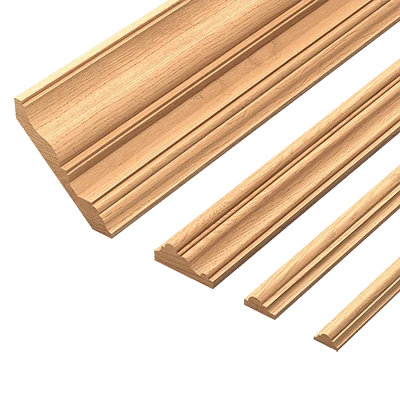
buy polyurethane moldings makes sense when you need to build a larger geometric system around the socket.
The frame sets the boundaries. After that, the eye compares the RPU-044 not with the entire cabinet door, but with the inner field of the frame.
This fundamentally changes perception.
Large RPU-044 inside a large frame
Suitable for a large door leaf if an expressive central motif is required.
At the same time, the frame should leave enough background around the socket.
Small RPU-044 inside a compact frame
This way you can decorate a nightstand or a narrower furniture facade.
If the proportions of the frames on two pieces are related, different sizes of the rosette will be perceived naturally.
A frame can unite furniture more strongly than the same size of the rosette
If the cabinet and the nightstand receive similar molding geometry, the RPU-044 ornament becomes a second level of connection.
As a result, even 220 mm on the cabinet and 170 mm on the nightstand clearly belong to the same decorative solution.
Decor for moldings is not always needed
If a frame is already built around RPU-044, there is a temptation to add something else: corner elements, central inserts, additional overlays.
On large furniture, this is sometimes justified.
But RPU-044 itself is a carved rosette. Therefore, each new element should be evaluated for competition.
buying polyurethane molding decor It is reasonable when an additional element performs a specific task: for example, it continues the frame composition on another facade or supports the overall pattern of the furniture group.
You should not add it just because "there is empty space left in the frame."
Good furniture decor does not strive to fill every centimeter. It creates hierarchy.
RPU-044 can be the main ornamental center. The molding can be the geometric boundary. Additional details can be secondary connecting elements.
If all three levels are equally active, the composition becomes heavy.
What to buy together with RPU-044 for a furniture composition
The basic scenario of the article does not require a large set.
Even purchasing two sizes of RPU-044 alone can tie the furniture together.
But depending on the project, additional categories of decorative finishing may be needed nearby.
| What to consider together | What for | When it makes sense | Link |
|---|---|---|---|
| RPU-044 170 × 170 mm | For a compact furniture field | Cabinet, small facade, repeating decor | Order RPU-044 size 170 × 170 mm |
| RPU-044 220 × 220 mm | For a larger central field | Wide cabinet door or a single large accent | Buy RPU-044 size 220 × 220 mm |
| Other rosettes | For comparing scale and pattern | If RPU-044 does not fit the proportions | buy carved polyurethane rosettes |
| Moldings | To create a decorative field around the socket | When a standalone RPU-044 gets lost on a large facade | buy polyurethane moldings |
| Decor for moldings | For a more complex frame composition | Only if the project really needs additional accents | buying polyurethane molding decor |
| General polyurethane molding | To match furniture with other areas of the room | When not only the wardrobe and nightstand are decorated | ordering polyurethane molding decor |
This table is not an offer to buy everything at once.
On the contrary, it's better to start with a minimal set. Attach two RPU-044 sizes. Understand if they are enough. And only then add moldings or other decor.
How not to confuse a carved rosette with a regular overlay and ceiling composition
The word "rosette" is sometimes automatically associated only with the ceiling.
But in this topic, RPU-044 is considered specifically as a decorative rosette for furniture.
Her task is to create a central ornamental motif on the facade.
How does a rosette differ from a linear molding?
The rosette works as the center.
Molding works as a line or a border.
If you just need to divide the facade into rectangular fields, a rosette won't replace a profile.
If you need a central carved point inside an already created field, RPU-044, on the contrary, performs exactly this function.
How does a rosette differ from an elongated overlay?
Elongated decor is more often associated with a horizontal or vertical direction.
A rosette is perceived as more centered.
Therefore, it is especially suitable for furniture facades where the middle of the field needs to be emphasized.
Why are two sizes of one model better than two random similar rosettes?
Suppose one large rosette is found for a wardrobe, and another, outwardly similar one, for a nightstand.
In individual photos they may seem related. Side by side, the differences become more noticeable: a different ornament, a different density of carving, a different character of the central part.
With RPU-044 the task is simpler: the scale changes, but the model itself remains.
This is a strong point specifically for a furniture set.
Handles and RPU-044: who should be the main element on the facade
A furniture facade has not only a decorative but also a functional part.
The handle is used every day. Therefore, its position cannot be subordinated to the rosette if the furniture is already made.
On finished furniture, the order is reversed: first we take the handle into account, then we select the placement of RPU-044.
Handle below the rosette
A classic scheme if the facade has enough height.
RPU-044 occupies the upper or central decorative area, with the handle positioned below.
It's important to leave space between them here.
Handle on the side
If the handle is installed closer to the edge, the center of the facade remains freer.
But the asymmetry of the functional element can slightly affect the visual balance. A paper template will help determine whether a strict geometric center is needed or a slight adjustment.
Large decorative handle
The more active the hardware, the more carefully the size of the rosette should be chosen.
RPU-044 220 mm plus a large shaped handle on a small facade can compete.
The smaller 170-millimeter version can better preserve the hierarchy.
Panel, milling, and ready-made relief: the rosette must fit not physically, but compositionally
On an already finished facade, there is less free space than it seems.
If the door has a panel, RPU-044 should be aligned with its inner field.
Do not place a socket so that it randomly crosses the boundaries of the milling.
First, measure the inner field
For example, the entire cabinet door is 600 mm wide.
But inside the frame profile, the free zone may be only 300–350 mm.
Then this value determines the scale.
RPU-044 220 mm will already take up a significant part of the inner field.
The smaller 170 mm will leave more breathing room.
On a cabinet, the difference becomes even more noticeable
For a small fillet, the 220mm version can almost fill the entire center.
If this is not the intended effect, it is better to switch to 170 mm.
How many sockets to order for the cabinet and the nightstand
The quantity depends on the number of decorative centers, not on the number of furniture pieces.
Basic scenario
One cabinet — one large RPU-044.
One nightstand — one small RPU-044.
Then you need:
-
1 pc. 220 × 220 mm;
-
1 pc. 170 × 170 mm.
A cabinet with two identical doors
If each door needs its own outlet, two pieces of the selected size are required.
It is not necessary to automatically take 220 mm. Two large elements create a much stronger overall pattern.
First, compare two 170-millimeter and two 220-millimeter blanks on the facades.
Two bedside tables
If the furniture is symmetrical on both sides of the bed and each side uses one outlet, 2 pcs. of RPU-044 of the appropriate size will be needed.
Cabinet plus two bedside tables
One of the most logical sets:
-
cabinet — 1 pc. RPU-044 220 mm;
-
bedside table 1 — 1 pc. RPU-044 170 mm;
-
pedestal 2 — 1 pc. RPU-044 170 mm.
Only three sockets, but of two sizes.
Cabinet with two doors plus two pedestals
Option:
-
2 pcs. of large size or the size selected for the cabinet;
-
2 pcs. of small size for the pedestals.
It should be counted after full layout.
Why you cannot choose the quantity before the mockup
A socket is not a consumable material that is counted only by area.
One large cabinet does not necessarily require more decor than a small dresser.
Sometimes one central RPU-044 220 mm does more than four small ones.
Therefore, the composition is determined first, then the quantity.
It is this order that helps avoid buying unnecessary elements.
When 220 mm is already too much
The large version of RPU-044 becomes excessive not by absolute size, but in a specific field.
There are several signs.
The edges are too close to the frame
If only a very narrow strip of background remains between the ornament and the molding, the pattern looks cramped.
The rosette competes with the handle
The handle and the central decor should have enough space.
The calm surface disappears on the facade
The carved detail should be readable against the background.
If almost the entire door turns into a single ornament, that's a completely different decorative effect.
Several large rosettes create too frequent a repetition.
One RPU-044 220 mm can look convincing.
Four such elements on adjacent panels are much more active.
When 170 mm is visually lost.
The opposite problem appears on a large furniture surface.
A huge smooth door.
If the free area is large, a small central motif may seem random.
The rosette is far from the point of view.
The farther the furniture is from the viewer, the weaker a small relief is perceived.
There are large elements nearby
A wide molding, a massive handle, or a large panel can visually overwhelm a small rosette.
A single detail should become the main focal point
If RPU-044 is used alone and should be a noticeable accent, the larger version often has an advantage.
However, even in these situations, the decision is verified with a template.
Using RPU-044 in the bedroom
A wardrobe and bedside tables are almost a textbook example for two sizes of the same model.
A tall wardrobe takes up most of the wall. The bedside tables are lower and have compact fronts.
This is exactly where the same 220-millimeter rosette on all pieces can look rough, while the same 170-millimeter one may seem too modest on the wardrobe.
The combination of sizes preserves the overall motif.
Cabinet as the main piece
A larger version may appear on it.
Cabinets as supporting pieces
The smaller RPU-044 repeats the pattern but does not draw attention away.
This is a simple example of visual hierarchy through scale.
Living room: cabinet, sideboard, and dresser
In the living room, furniture is often placed in different parts of the space.
Here, the repetition of RPU-044 helps connect the pieces, even if they are not placed close together.
But the more furniture there is, the more careful you need to be with repeating the ornament.
If a socket is placed on every drawer, every door, and every side panel, a unified motif becomes excessive.
It is better to define a few key points.
For example:
-
a large RPU-044 on the central cabinet;
-
a small one on the nightstand;
-
one small or large on the dresser depending on its width.
Entryway: a tall cabinet and a small console table
Here, the difference in scale can be especially strong.
The cabinet can reach almost to the ceiling, while the table remains low and shallow.
One socket size on both surfaces is rarely perceived the same way.
Therefore, a pair of 220/170 mm is especially logical.
But in the hallway, it's also important to consider the viewing distance. If the space is narrow, a person sees the furniture from close range. A large 220 mm socket may seem even more prominent.
A full-size template is mandatory.
Study or library
Office furniture often has many vertical fronts, sections, and repetitions.
If you use the large RPU-044 on each one, half
Set the 220 mm size on all furniture
Unification seems simple, but small fronts may end up overloaded.
The two sizes exist precisely to scale the motif.
Use only 170 mm everywhere
The opposite extreme.
On a large cabinet, the small version sometimes gets lost.
Choose the size based on the overall size of the item
A large wardrobe can have narrow doors.
A small cabinet — unexpectedly wide facade.
Measure the specific free space.
Do not make a mockup
Sizes on screen are almost always perceived differently than on real furniture.
A 170 and 220 mm square is cut out in a few minutes and removes most doubts.
Place the socket flush against the handle
The ornament begins to conflict with the functional element.
Ignore the existing panel
The socket must fit into the already formed field.
Add moldings automatically
A frame is needed only when it improves the scale or structure of the facade.
Making a composition on a small cabinet as complex as on a wardrobe
Unity does not require the same number of details.
Change size, finish, and placement principle simultaneously
Then the connection between items weakens.
Assuming that the same item number automatically creates a set
RPU-044 helps, but final unity depends on proportions and placement.
Not checking the third dimension
The 170-millimeter version has a depth of 18 mm, the 220-millimeter one — 23 mm.
This must be taken into account near handles and moving elements.
Buy quantity before final layout
Composition first, then order.
When RPU-044 in two sizes really fits
This approach is especially useful when the room has furniture of different scales, but you want to maintain a single decorative language.
For example:
- tall wardrobe and small nightstand;
- wardrobe and dresser;
- wardrobe and two bedside tables;
- central furniture and more compact side pieces;
- several facades of different widths;
- A furniture set where one piece should be the main focus, and the rest should be supporting.
Two sizes allow you to vary the scale without changing the ornament itself.
When it's better to look for other decor
RPU-044 doesn't have to fit any furniture.
Very narrow facades
Even 170 mm can be too large.
Very large surface
Sometimes even 220 mm isn't enough without a frame structure.
Furniture already has active carving
An additional rosette may be unnecessary.
Need a vertically elongated composition
The central rosette solves a different task.
There is no free field due to handles and panels
Do not force decor in just to repeat the motif.
In such a situation, it is better to open the section of decorative polyurethane rosettes and compare other models and sizes.
Practical choice: five typical situations
Situation one: the wardrobe is huge, the nightstand is small
Start with 220 mm on the wardrobe and 170 mm on the nightstand.
This is not a ready answer, but the most reasonable first approximation.
Situation two: the cabinet is wide, but the doors are narrow
Check 170 mm on each door.
The large version may be excessive despite the overall size of the cabinet.
Situation three: the cabinet has one large central door
220 mm gets the advantage as a single center.
Situation four: the nightstand is wide
Do not rule out 220 mm in advance.
Place both templates.
Situation five: the cabinet has a frame, the nightstand does not
First, try creating a related frame logic on the plinth or, conversely, check the cabinet without an additional profile.
Do not compensate for the difference only with the size of the socket.
Where to buy molding for furniture if RPU-044 is just the beginning of the project
Sometimes work starts with a single socket, and then it becomes clear that the interior requires a broader system.
If you need to compare different types of decor, you can ordering polyurethane molding decor after specific surfaces and dimensions have been determined.
To select the central decorative elements specifically, it is better to go to the category and buy carved polyurethane rosettes.
If RPU-044 has already been selected, both size versions are available in one card — this simplifies choosing a single pattern for furniture facades of different scales.
How to order RPU-044 in the required size on STAVROS
Before purchasing, you need to prepare not only the article name but also a small specification for the furniture.
For example:
| Item | Number of facades | Selected size RPU-044 | Quantity |
| Cabinet | 1 central field | 220 × 220 × 23 mm | 1 pc. |
| Cabinet 1 | 1 facade | 170 × 170 × 18 mm | 1 pc. |
| Cabinet 2 | 1 facade | 170 × 170 × 18 mm | 1 pc. |
After that, you can buy the carved rosette RPU-044 made of polyurethane in the required sizes and quantity.
Before placing the order, double-check:
- option 170 × 170 × 18 mm;
- option 220 × 220 × 23 mm;
- current price for each size;
- quantity;
- the correspondence of the selected size to a specific facade;
- the conditions specified in the product card at the time of purchase.
For a furniture set, it is especially useful not to keep everything in your head, but to write down the size distribution for each item.
FAQ: questions about RPU-044 for cabinets, nightstands, and other furniture facades
Can RPU-044 be used on furniture?
Yes, RPU-044 can be considered as a decorative carved rosette for furniture. Before purchasing, you need to check the size of the free field, the position of the handles, and the actual geometry of the facade.
What size of RPU-044 should I choose for a nightstand?
For a compact nightstand, it is reasonable to start trying with the 170 × 170 × 18 mm version, but the final choice depends on the size of the specific facade. Make paper templates of 170 and 220 mm and compare them directly on the furniture.
What size is best for a cabinet?
On a large facade, the 220 × 220 × 23 mm version often becomes the first candidate, however, narrow cabinet doors may pair better with the 170 mm version. You should focus on the separate decorative field, not the entire body.
Can I put 220 mm on a wardrobe and 170 mm on a nightstand?
Yes. This exact scenario allows you to repeat one RPU-044 pattern on furniture of different scales, adapting the physical size of the decor to the area of each facade.
Won't it seem like these are different rosettes?
Both size versions belong to the same RPU-044 model. The unity is additionally supported by the same placement logic, coordinated finishing, and similar positioning within the decorative field.
Is it mandatory to use different sizes?
No. If the wardrobe and nightstand have facades of comparable size, one size can suit both items. The two options are not meant for mandatory mixing, but for precise scale adaptation.
Can I use RPU-044 170 mm on a large wardrobe?
Yes. The smaller size may be more appropriate on a narrow door, inside a compact molding frame, or when repeating the rosette on multiple facades.
Can I use the 220 mm RPU-044 on a nightstand?
You can, if the nightstand has a sufficiently large free field. The name of the furniture item itself doesn't decide anything — a real fitting is required.
How to make a mockup before purchasing?
Cut out squares of 170 × 170 mm and 220 × 220 mm from paper or cardboard. Attach them to the facade with painter's tape, compare from a normal viewing point, and take photos of the entire furniture group.
Where is it better to place the socket — strictly in the center?
Central placement is a natural starting option, but the actual position depends on handles, panels, moldings, and the shape of the facade. First check the geometric center, then compare a slight offset if necessary.
Is it necessary to install RPU-044 on every cabinet door?
No. The quantity is determined by the composition. On a large cabinet, sometimes one central socket is better than repeating it on all doors.
What to choose for a cabinet with four doors?
First decide whether repetition on all four facades is needed. If yes, be sure to compare 170 and 220 mm: four large sockets create a much richer pattern than one.
Are moldings needed around RPU-044?
Not necessarily. If the socket itself holds the scale of the facade well, it can be used on its own. A molding frame is useful when a larger decorative field needs to be created.
Where to choose moldings for RPU-044?
You can buy polyurethane moldings after the dimensions of the future frame on specific furniture have been determined.
Do I need to additionally purchase decor for moldings?
Only if it is really needed for the chosen composition. RPU-044 is already an active carved centerpiece, so an excessive number of decorative elements can overload the facade.
What is the price of RPU-044 170 mm?
For the size 170 × 170 × 18 mm, the price indicated at the time of preparing the material is 2,750 ₽. Before ordering, the current cost should be checked in the product card.
How much does RPU-044 220 mm cost?
For the size 220 × 220 × 23 mm, the price indicated at the time of preparing the material is 5,730 ₽. The current price should be verified in the card before placing an order.
Can I order both sizes in one card?
Both considered size versions are presented in the RPU-044 card. This allows you to choose one pattern for different furniture facades without searching for similar article numbers.
How does RPU-044 differ from a molding?
RPU-044 works as a central carved decorative motif. A molding forms a line or a frame. These elements can be used together, but they serve different purposes.
Can RPU-044 be combined with other stucco decor in a room?
Yes, if the composition remains clear. For comparison with other categories, you can You can buy ready-made stucco matching the Baroque style. Calculate the quantity: linear meters of cornices and moldings, number of rosettes, pilasters, consoles, corner elements. Add a ten to fifteen percent allowance for trimming., but you should not fill every free surface with a new type of ornament.
Does the depth of 18 and 23 mm matter?
Yes. The rosette has a real relief, so before installation it is necessary to check the distance to handles, adjacent facades, and other elements that may be nearby when opening the furniture.
How to calculate the quantity of RPU-044 for a furniture set?
First, determine the number of specific decorative fields and the size for each. Then separately write down how many RPU-044 170 mm and how many 220 mm are required. Do not calculate the quantity based only on the number of furniture pieces.
What to do if 170 mm seems small and 220 mm seems too large?
Try changing not only the size of the rosette, but also the structure of the field. For example, a molding frame can reduce the perceived area of a large facade and help the smaller RPU-044 look more convincing.
Where to buy RPU-044?
You can buy the carved rosette RPU-044 made of polyurethane, having chosen the necessary size version after trying it on specific furniture.
One ornament, two scales: how to connect furniture without mechanical repetition
When a wardrobe and a nightstand stand side by side, trying to make them absolutely identical rarely helps the interior. These items have different volumes, different heights, different facades, and different roles in the room. Therefore, the stucco for furniture should also take this scale into account.
RPU-044 is interesting precisely because of the ability not to choose between unity and correct proportion. You can keep one carved motif, but use it in two physical sizes: 170 × 170 × 18 mm on a more compact field and 220 × 220 × 23 mm where the furniture requires a larger decorative center.
Before purchasing, there is no need to guess. Two paper templates provide much more information than abstract reasoning about "large" and "small" furniture. Attach both options to the wardrobe and nightstand, evaluate the free background, handles, panels, the number of repeats, and only then choose the size.
If RPU-044 itself holds the facade well, leave it independent. If even the large version seems lost on a huge wardrobe, first try changing the architecture of the field with moldings. If 220 mm takes up almost the entire door on a small nightstand, do not try to force large decor to work where 170 mm looks more natural.
In the STAVROS catalog, you can first buy carved polyurethane rosettes after comparing models, and for the furniture group in question, immediately proceed to RPU-044. In one card, both necessary size versions are available, so the wardrobe and nightstand can be decorated not as similar, but as truly related in ornament.
Before ordering, four things remain to be checked: the size of the free field of each facade, the number of sockets, the position relative to the handles, and the selected scale of 170 or 220 mm. If these parameters are defined, furniture items of different sizes will be able to share one decorative language without the feeling that the same element was simply mechanically copied from a large facade to a small one.