Article Contents:
- Quick answer: when checking Carre HL-016 makes sense
- What is Carre HL-016
- Confirmed characteristics
- 70 × 70 mm — visible outer square
- 25 mm — handle protrusion
- 16 mm — mounting parameter
- Support contour not disclosed in the size line
- Visible contour
- Support contour
- Fastening contour
- Upper cabinets
- Bottom drawers
- Corner modules
- Beech for enamel
- Oak for tinting
- Looking only at the 70 × 70 mm square
- Not removing the old handle
- Measuring the distance between the edges of the holes
- Not considering chips and wear
- Thinking HL-016 is single-screw
- Drilling next to a broken hole
- Not checking the thickness of the facade
- Placing the square on a frame offset
- Ordering the whole set without a sample
- Paint after installation
- Mix beech and oak
- Do not fix orientation
- Buying without a reserve
- What is the size of Carre HL-016?
- Will Carre cover holes from the old handle?
- Will it cover holes with a 96 mm center distance?
- And the holes are 32 mm?
- What does 16 mm mean?
- Is Carre attached with one screw?
- Do I need to buy one handle for testing?
- What to choose — beech or oak?
- Can HL-016 be installed without painting?
- Is there a ready-made version?
- Is the mounting hardware included in the price?
- How to measure old holes?
- What to do if the mark from the old bracket is wider than 70 mm?
- Can I drill next to the old hole?
- Will Carre fit a frame front?
- Can it be placed in the kitchen?
- How many handles should I order?
- Do I need to buy all handles in one batch?
- Where can I see other models?
- Where can I get technical drawings?
- How can I check the quality of preparation?
- Can old holes be covered with a decorative backing?
- Will Carre fit a wide, heavy drawer?
- Can I use old screws?
- Do I need to keep the DWG after installation?

The old bracket has been removed, but two holes, worn enamel, and a dented mark from the fastener remain on the facade. Can it buy the wooden handle Carre HL-016...place it over the damaged area and do without putty, repainting, or making a new door? Sometimes — yes. But the external square of 70 × 70 mm does not yet guarantee anything. It shows how much area the handle occupies from the front, but does not reveal the size of the rear support and does not confirm that the new mounting points match the old ones.
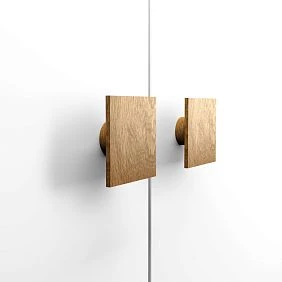
Carre HL-016 — a large square knob handle made of beech or oak, sized 70 × 70 × 25 × 16 mm. It is supplied without a ready-made finish, has a "Prestige" sanding, comes with fasteners, and DWG and 3D models are available for precise checking. The 16 mm parameter in the finished version HL-016M is related to the distance between the mountings, but before drilling the facade, the location of the points must be verified against the current drawing specifically for HL-016.
The main question of the article sounds extremely practical: will the new square handle cover the traces of the previous hardware, and can it be installed so that the facade looks refreshed rather than hastily masked? The answer depends on five things: the distance between the centers of the old holes, the overall size of the damaged area, the support contour of the new handle, the thickness of the facade, and the possibility of safely performing the new mounting.
If the old bracket had a center-to-center distance of 96, 128, 160 mm or more, a body 70 mm wide physically cannot cover both hole centers simultaneously with a standard arrangement. In such a situation, Carre HL-016 should not be presented as a universal replacement. It is much more honest to acknowledge the incompatibility in advance and find a handle with a different distance between the holes or plan a facade repair.
Quick answer: when checking Carre HL-016 makes sense
It is worth continuing the fitting when the old holes are close to each other, the damaged area fits inside the 70 × 70 mm square, the facade is not destroyed around the mounting, and the rear side is accessible for new screws. But even if these conditions are met, a transparent template or one control handle is needed first.
| Situation after removing the old handle | Preliminary conclusion |
|---|---|
| Two holes are located inside the 70 × 70 mm square | The check can be continued |
| Center distance of the old bracket is 96 mm | Carre HL-016 will not cover both centers |
| Center distance is 128 mm or more | Without facade repair, the model is not suitable |
| The holes are close, but there are large chips around | The entire damaged area needs to be assessed |
| Old points are hidden, but new ones fall near them | A furniture maker's solution is required |
| The damage is hidden, but the handle has no even support | Visual masking is not enough |
| The facade is framed, but the square falls on a transition | A different size or position is needed |
| The handle covers the mark and attaches in a strong area | You can order a test piece |
The most sensible purchasing strategy is to order one test handle, attach it to the facade, and only after a real check buy the set for the entire kitchen, cabinet, or dresser.




What is the Carre HL-016
Carre HL-016 is a surface-mounted wooden furniture handle of square shape. Its visual size is significantly larger than that of a compact round knob, so it can become an independent element of the facade. The 70 × 70 mm square does not dissolve on the door: it creates clear geometry, covers a noticeable area, and changes the character of the furniture even without replacing the body itself.
The model is suitable not only for new furniture. Its large body makes it interesting for updating old facades where traces from previous hardware remain. However, decorative coverage and mounting compatibility are different concepts. The handle may visually cover holes, but not have full contact with the facade exactly where the material is weakened.
Our factory also produces:
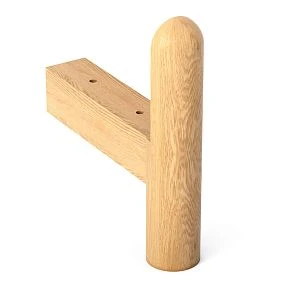

Confirmed characteristics
| Parameter | Value | What this means for the purchase |
| Article number | HL-016 | A specific Carre model is ordered |
| Type | Surface-mounted furniture knob handle | Not a long pull handle |
| Size | 70 × 70 × 25 × 16 mm | Need to check the outer square, protrusion, and fastening |
| Material | Beech or oak | The option is chosen based on the finishing method |
| Sanding | «Prestige» | Surface prepared for further finishing |
| Delivery condition | Without painting | The coating is chosen by the buyer or the workshop |
| Fastening | Included in the price | The length is still matched with the thickness of the facade |
| Technical materials | DWG and 3D model | Used for precise fitting checks |
| Ready-made alternative | HL-016M | You can choose a model with factory coating |
| Purpose | Furniture facades, drawers, doors | Specific compatibility is determined by the project |
After the table comes download drawing HL-016 and do not draw conclusions about the mounting based only on four digits in the size line.
Get Consultation
What remains on the facade after the old handle
Furniture owners often notice only two round holes. In reality, the damaged area is wider. Under the legs of the old bracket, there may be pressed rings, scuffs, rust marks, faded stripes, and chips along the edges of the drilling. On a painted facade, the surface under the handle retains its original shade, while the exposed part becomes lighter or darker over the years.
When removing old hardware, you should evaluate not the holes individually, but the entire area that the new handle must cover. It is useful to trace the damage on transparent film and measure the maximum width and height. Sometimes the centers are close together, but a long mark from the base of the bracket extends far beyond the 70 mm square.
Typical marks:
-
two mounting holes;
-
chips around the drilling;
-
dents from washers;
-
pressed-in varnish;
-
worn enamel;
-
a darker or lighter spot;
-
a metallic or rusty mark;
-
cracks near the holes;
-
residues of glue or sealant;
-
scratches from turning the handle.
If at least one defect remains visible beyond the edge of the Carre, the replacement will not look neat. Then repair, a larger model, or a handle matching the previous fit is needed.
Four sizes in the line 70 × 70 × 25 × 16 mm
The buyer sees the line and often perceives it as a simple description of a square. In fact, each parameter affects a separate part of the solution.
70 × 70 mm — visible outer square
These sizes help assess the scale of the handle on the facade and preliminarily check whether the damaged area is hidden. The square can be cut out of paper, but such a template shows only the appearance, not the actual mounting and support.
25 mm — handle protrusion
The parameter affects grip comfort, distance to the adjacent door, and possible collision with the wall. A large handle should give fingers enough space but not interfere with opening neighboring elements.
16 mm — mounting parameter
The finished HL-016M has the same size scheme, and 16 mm is indicated as the distance between the mounts. For an unpainted model, this allows the parameter to be considered as center-to-center, but the final decision before drilling is made according to the DWG. Without a drawing, it is not possible to declare Carre a single-screw button or transfer holes from a similar model.
The support contour is not disclosed in the dimension line
The rear surface may be smaller than the outer square, have cutouts, or separate contact areas. That is why the external size is not enough to assess damage coverage.
Three contours of one handle
Visible contour
The 70 × 70 mm square determines the area a person sees from the front. If old holes and scuffs are within this field, they can be visually hidden.
Support contour
This is the part of the rear surface that touches the facade and transmits force from the hand. If there is a deep dent, damaged material, or the edge of an old hole under the support, the handle can wobble even with tightened screws.
Mounting contour
These are the actual points of the new holes. They may coincide with old ones, be between them, or fall too close to a weakened area. The scheme cannot be built based on the outer square; DWG and a template are needed.
| Contour | What it shows | What error does it prevent |
| Visible | Will the defect close from the front | Buying a handle that is too small |
| Support | Is there a firm contact with the facade | Play and pressing through of the surface |
| Fastening | Where the new screws will be | Drilling in a damaged area |
Why a 70 mm square will not cover 96 mm holes
Let's imagine two centers, the distance between which is 96 mm. For both to fit inside a square 70 mm wide, the handle would have to be rotated or shifted so that one center would still extend beyond its boundary. The difference is 26 mm, and no visual rounding of the edges will eliminate it.
At 128, 160, 192, 224, and 320 mm, the incompatibility is even more obvious. Therefore, the article on standard handle sizes remains a separate reference: when a new handle must match the old center-to-center distance, it is better to choose a bracket with the right fit rather than try to hide far-apart holes with a single button.
Carre HL-016 can be checked for small distances and local damage. But even with an old spacing of 16 or 32 mm, the result depends on the position of the new points and the support part.
Scenario with old 16 mm holes
This distance looks the most promising because it matches the confirmed mounting parameter of the finished HL-016M. However, matching numbers does not replace a drawing.
Need to check:
-
whether the centers are measured equally;
-
whether the holes are positioned horizontally;
-
whether the direction of the fasteners matches;
-
whether the old points are not damaged;
-
is the diameter suitable;
-
does the screw match the thickness of the facade;
-
does the handle rest fully;
-
is one defect only partially hidden.
Even if the old holes can be reused, first try fitting one piece. The facade may have been drilled inaccurately, and the actual distance differs from the nominal one.
Scenario with old 32 mm holes
Two centers with a distance of 32 mm fit inside a 70 mm square, but this does not mean they will align with the Carre mounting. There are two possible paths: the new holes end up between the old ones, or one of the points matches and the other does not.
It is especially dangerous to drill near an old hole. A thin bridge remains between the two cavities, which can break during tightening. There is no universal minimum distance in the card; the material of the facade must be assessed by a cabinetmaker.
If the facade is expensive or has a complex coating, first create a transparent template with the actual mounting points and only then decide whether the handle fits without restoring the base.
Scenario with old 64 mm holes
Both centers can formally fit within a 70 mm square, but the margin at the edges will be minimal. Any chip, scuff, or measurement inaccuracy will be visible. Additionally, the outer square can cover the holes, while the support part cannot.
For 64 mm, the actual part is especially important. A paper square without a back contour creates false confidence. If the marks extend beyond the limits by even a few millimeters, it is better to choose a larger surface-mounted handle or restore the facade.
Scenario with old holes of 96 mm or more
Here the answer is more definitive: a 70 mm wide square does not hide both centers simultaneously. Carre HL-016 can only be used after repairing the old holes, changing the handle position, or installing an additional design backing plate, if such a part is provided by the design.
When the owner wants to completely avoid repairs, it is necessary to buy wooden furniture handles with the same center distance as the previous bracket. This will preserve the existing points and reduce the risk of damaging the facade.
How to measure old mounting holes
How to measure old mounting holes is explained in detail in the specialized material, and for Carre, several practical rules are important.
-
Remove one typical old handle, not all the hardware at once.
-
Clean the holes from screws, washers, and dirt.
-
Find the centers, not the outer edges.
-
Measure the distance with a caliper or a precise ruler.
-
Measure the diameter of each hole separately.
-
Record the maximum size of chips.
-
Trace the indented mark of the old base.
-
Measure the distance to the edge of the facade.
-
Write down the thickness of the door or drawer.
-
Take photos of the front and back sides.
Why can't you measure by the edges? The diameter of the holes may differ, and chips make the boundaries uneven. The center distance is determined only between centers.
One typical door is better than disassembling the entire kitchen
For the initial check, choose a facade that repeats in the cabinet set: a middle drawer or a standard door. It should be accessible from the back and have no exceptional damage.
This choice allows you to evaluate the model under normal conditions. If you take the smallest drawer, the handle may seem excessively large. If you choose the most damaged facade, you might mistakenly reject a suitable model for the other doors.
After the control fitting, the check is repeated on other types of facades: a tall cabinet, a wide drawer, a corner door, and elements near the wall. One sample does not give the right to automatically transfer the decision to the entire cabinet set if the sizes and construction of the doors differ.
Transparent template Carre HL-016 1:1
A paper square is useful, but a transparent template is more accurate. It should have:
-
outer contour 70 × 70 mm;
-
central axes;
-
mounting points per DWG;
-
support contour;
-
top mark;
-
facade edge line;
-
boundaries of the old damage.
The template is applied so that the old holes are visible through the material. It immediately becomes clear whether defects are hidden, where the new screws will go, and how much the handle is offset relative to the drawer.
For precise work, you can download furniture handle drawings, but the file must be printed without automatic scaling. After printing, the control size is checked with a ruler.
Why you cannot print the drawing with the "fit to page" setting
The program reduces the image to fit within the printer margins. A 70 mm square becomes, for example, 66 or 68 mm, and the mounting points shift. On screen everything looks correct, but the template gives a false result.
Control order:
-
select 100% scale;
-
disable fitting;
-
print one page;
-
measure the control size;
-
only after this cut out the contour;
-
sign the date and version of the drawing.
If the scale does not match, the template cannot be used for drilling. It can only be kept for a rough estimate of the shape, but not for installation.
The outer square and the support area are not the same thing
Let the damage fit entirely within 70 × 70 mm. This still does not mean the handle will be stable. If the support zone is smaller and falls on the edge of the old hole, uneven pressure occurs when tightening.
On a solid wood facade, this can lead to pressing through the soft coating. On a panel material, it can lead to destruction of the hole edge. On a framed door, one part of the handle may rest on the stile, while the other hangs over the panel.
Therefore, the control template HL-016 is needed not only for appearance. It is applied with the back side and the actual contact is checked. The handle must fit without wobbling, misalignment, or an attempt to pull the unevenness tight with screws.
Can you drill next to an old hole
There is no universal answer. The decision is influenced by the facade material, the diameter of the old cavity, the distance between points, the direction of the grain, the thickness of the part, and the condition of the coating.
Dangerous situations:
-
the new hole partially intersects the old one;
-
a thin wall remains between the cavities;
-
the old hole is broken by the screw;
-
there is a void inside the facade;
-
the drilling hits the edge of the panel;
-
a frame runs along the back side;
-
the material has delaminated;
-
the surface already has a crack.
If the mounting raises doubts, masking the problem with a large handle is not allowed. First, restore the strength of the facade or choose a model that uses existing points. A visually hidden hole remains part of the structure, and its condition affects the durability of the new hardware.
Facade thickness and hardware from the kit
Carre HL-016 comes with mounting hardware, but this does not mean universal compatibility of the screws with all doors. Facades differ in thickness, back construction, and the presence of recesses.
Before installation, check:
-
length of screws;
-
useful thread length;
-
thickness of the door;
-
presence of a washer;
-
handle depth;
-
possibility of full tightening;
-
absence of a stop;
-
position of heads from the rear side.
A screw that is too long may hit an obstruction and fail to pull the handle tight. A screw that is too short will engage too little thread. If different fasteners are required, they are selected according to technical documentation, not replaced with a random screw.
Frame front: the square may land on two levels
Carre looks flat and geometric, so it needs a level surface. On a frame door, the handle can simultaneously land on the stile and the recessed panel. Then part of the rear surface has no support.
Before purchasing, measure the width of the stile. If it is less than 70 mm, do not automatically center the handle on it. Sometimes the position can be changed, but this affects symmetry and grip comfort.
For a complex framed facade, a control sample is especially important. The square should look intentional, not as if it was randomly placed on the profile. If the handle crosses a decorative bevel, it is better to change the model or position than to try to compensate for the difference with spacers without a project.
Smooth facade: a simple surface does not eliminate the need for checks
On a flat door, it is easier to place a square handle, but other limitations remain: the edge, the adjacent door, rear reinforcements, and old holes.
A smooth surface highlights any inaccuracy. If the Carre is offset by a few millimeters, it is more noticeable than on a carved facade. For a series, use a single drilling template and check that all squares have the same orientation.
On solid-color enamel, faded traces of old hardware are also clearly visible. Therefore, before ordering, you need to look not only at the holes but also at the shade of the area under the removed handle.
Carre HL-016 for kitchen renovation
On an old kitchen, handles are used frequently, so the new model should be not only beautiful but also convenient for daily use. The large square changes the scale of the facades: small drawers look more graphic, and wide doors get a noticeable accent.
Before replacement, check:
-
how many types of facades are in the cabinet set;
-
which doors have staples;
-
are there push-button handles;
-
do the old holes match;
-
do the squares on corner modules not collide;
-
is it convenient to open upper cabinets;
-
is a finished coating required;
-
can the handles be finished together with the facades.
Unpainted wood cannot be left without proper protection in an actively used kitchen. If the workshop does not plan separate finishing, it is wiser look at Carre HL-016M with a finished coating.
Upper cabinets
On upper doors, the hand pulls the handle down and toward oneself. Check that the 25 mm protrusion is sufficient and that one does not have to grip only with fingertips. The square should not be too close to the bottom edge if a frame profile runs there.
Lower drawers
Here the handle receives a higher load, especially on wide drawers with dishes. One Carre may be sufficient, but the decision depends on the width, mass, and slides. For particularly heavy drawers, two grip points or another shape are considered.
Corner modules
A square handle can collide with an adjacent facade or wall. The template is checked in both open and closed positions, not just from the front.
Carre HL-016 for a dresser
A dresser often has drawers of different widths. The same square handle creates a unified rhythm, but on small upper drawers it may look larger than on lower ones.
Solutions:
-
one HL-016 centered on each drawer;
-
two handles on an especially wide drawer;
-
a combination of Carre with another model per the project;
-
omitting HL-016 on the narrowest facades.
You cannot mechanically install two handles just because the drawer is wide. You need to check grip comfort, symmetry, and new holes. For an old dresser, it is especially important whether the square hides not only the holes but also the faded mark of a long pull.
If facades are being repainted, the handle position can be changed before finishing. If the coating is preserved, Carre must completely cover the old trace.
Carre HL-016 for cabinet
On a hinged cabinet, the handle is located closer to the opening edge. The 70 mm square may approach the adjacent door or intersect the frame profile.
For paired doors, check:
-
same height;
-
mirror position relative to the gap;
-
grip convenience;
-
absence of collision;
-
distance to the edge;
-
orientation of the oak grain;
-
coating color match;
-
access to screws.
If the previous staples were long and their holes are far apart, Carre will not cover the marks without repair. In that case buy wooden furniture handles it is better with a suitable fit.
Carre HL-016 for a bedside table
On a small front, the square takes up significant space. It can become an expressive detail, but it should remain convenient and not obstruct the passage next to the bed.
Check whether the handle extends beyond the safe dimension, does not catch on clothing, and does not hit the wall when opening. If the cabinet has two narrow drawers, the template is applied to both to see the overall rhythm.
In the bedroom, the tactile nature of wood is especially noticeable. The finish should be pleasant to the touch and withstand regular hand contact.
Carre HL-016 for an old sideboard
Vintage furniture often has uneven coating, traces of old hardware, and framed doors. A large wooden knob can refresh the look, but only if its modern geometry does not conflict with the facade's architecture.
For a sideboard, a test sample is useful. The oak HL-016 can be matched with the texture of solid wood, and the beech one can be painted to match the body color. But the old furniture finish should be compared with the new sample under real lighting.
If the facade has carving or moldings, the square is checked in scale: it should not cover the decor or look too heavy.
Oak or beech: what to choose for Carre HL-016
Beech for enamel
Beech is suitable when handles are painted in the covering color of the facade. The surface becomes a single geometric element, and the wood texture is not the main effect.
The square looks especially convincing in white, gray, green, blue, or another project color, but specific coatings are not confirmed by the card. They are chosen by the workshop.
A beech handle is convenient for restoring painted furniture, where an exact color match is more important than the visible wood grain.
Oak for tinting
Oak is chosen when the wood grain needs to be preserved. On a square shape, the texture reads well and can become part of the composition.
An oak handle should be selected together with the furniture. The tone of the old body and the new wood rarely match without a test swatch.
| Criterion | Beech | Oak |
| Main Scenario | Covering enamel | Transparent or tinted finish |
| Visual effect | Clean color and geometry | Noticeable texture |
| Matching to old furniture | Through the color of the coating | Through tone and pattern |
| Batch control | Uniform color | Uniform wood character |
| What to check | Primer and enamel | Test tinting |
What does "Prestige" sanding mean?
what 'Prestige' sanding means, better to study before choosing the finish. The prepared surface simplifies further work, but does not turn the handle into a finished painted part.
Before finishing, edges, front face, back side, and holes are still checked. The coating is applied so as not to fill threaded areas or change the fit.
For a series, it is important that all handles undergo the same preparation and are painted with the same system. Otherwise, even identical squares will differ in gloss and color depth.
Unpainted Carre HL-016 or finished HL-016M
| Criterion | HL-016 | HL-016M |
| Condition | Without ready-made coating | With ready coating |
| Material | Beech or oak | Options are specified in the product card |
| Customer's work | Need custom finishing | Can move to installation faster |
| Color | Selected for the project | Selected from ready-made options |
| Test swatch | Required | Need to match the finished color |
| Repair of old furniture | Allows matching the facade color | Convenient if the ready shade fits |
| Installation | Checked against DWG | Geometry matches the facade |
Unpainted Carre HL-016 suitable for a furniture workshop and a project with a custom color. A ready-made model is chosen when additional painting is not needed.
When to choose handles for custom finishing
unpainted wooden furniture handles useful if facades are repainted entirely, special tinting is required, or handles must exactly match the furniture.
Advantages:
-
one color with the body;
-
ability to select the degree of gloss;
-
unified coating system;
-
finishing all handles in one batch;
-
oak texture control;
-
ability to produce a test sample.
There is one risk: poor-quality painting will ruin precise geometry. For a square shape, runs on edges and uneven coating thickness are especially noticeable.
When to choose ready-made handles with coating
Ready-made wooden handles with coating reduce the amount of work. This is convenient when updating furniture without full repainting.
But the finished color needs to be compared with the facade. The photo on the screen does not convey the shade accurately. It is better to get one control HL-016M and look at it next to the furniture in daylight and evening lighting.
Test sample Carre HL-016
The sample is needed not only for the color. It shows:
-
how the coating applies to the edges;
-
whether the geometry is preserved;
-
whether the holes are filled;
-
whether the gloss matches the facade;
-
how noticeable the texture is;
-
whether the surface is easy to clean;
-
whether the square does not look too heavy.
For the series, one sample is approved in writing and kept until the end of the work. All handles are painted with one system and marked by sets.
Paint the handle before or after installation
It is more convenient to finish a wooden handle separately: access opens to all sides, and the facade is protected from accidental drips. After complete drying, the coating is checked and only then installed.
Painting an already installed handle complicates protection of the facade and rear area. Fasteners may be covered by the coating, and the boundary at the base will be messy.
Recommendations for finishing wooden hardware help build the overall sequence, but the specific system depends on the chosen material.
Grip comfort: the square must work with the hand
Carre is not just a decorative overlay. The handle will be used daily. The 25 mm protrusion should be evaluated on a real facade: whether there is enough space for fingers, whether the edge feels sharp, and whether it is convenient to pull a heavy drawer.
For a light door, a large knob may be convenient. For a wide drawer with heavy contents, a different shape or two handles may be required. The solution is checked in a test assembly.
Attention should also be paid to the grip method. Some users pull the handle with fingertips, others grasp it from the side. The square shape should allow the usual movement without excessive effort and without nail contact with the facade.
How to position a square on the facade
The square shape highlights any deviations. If the handle is turned even slightly, its sides cease to be parallel to the edges of the drawer.
On the template, mark:
-
vertical axis;
-
horizontal axis;
-
the top;
-
mounting points;
-
facade lines.
For the series, a jig is used. After installing the first handle, look at the furniture from a distance and only then drill the remaining facades.
On the Carre dresser, it is often placed in the center of the drawer. On a swing door, closer to the opening edge. On a tall cabinet, the position is related to the user's height. A universal height is not needed here: it is important that the handle is accessible and supports the rhythm of the entire piece of furniture.
Can the Carre be rotated 45 degrees
Visually, the square can turn into a diamond, but such an orientation must match the mounting and the project. You cannot simply rotate the handle if the screw placement and the rear support do not allow it.
Before non-standard installation, check the DWG and the actual sample. For updating old furniture, rotation also changes the area of hole overlap and may reveal previously hidden marks.
If the diamond is used on several facades, one template is needed for all parts. Even a slightly different angle will ruin the composition more than shifting a regular round button.
What to buy together with Carre HL-016
| What to add to the order | Why | Commercial transition |
| Control HL-016 | Check old holes and support | to order one test handle |
| Full set HL-016 | Equip all facades with one batch | buy the wooden handle Carre HL-016 |
| Ready HL-016M | Do without separate painting | look at Carre HL-016M with a finished coating |
| Other models | Find fit for old holes | buy wooden furniture handles |
| Unpainted handles | Select individual finish | unpainted wooden furniture handles |
| Handles with coating | Choose ready color | Ready-made wooden handles with coating |
| Drawing | Check the fasteners and back geometry | download furniture handle drawings |
| Finish sample | Approve the color and gloss | Coordinate with the workshop |
This list does not mean you need to buy everything at once. It helps to separate three scenarios: check one unpainted handle, immediately choose a ready-made finish, or abandon Carre in favor of a different fit.
One handle or the whole set at once
Buying a single part seems like an extra step, but when repairing old furniture, it protects against a big mistake. The control Carre allows you to check:
-
overlap of holes;
-
actual support area;
-
fasteners;
-
facade thickness;
-
grip convenience;
-
adjacent leaves;
-
color;
-
Scale.
After a successful check, the set is counted. For new furniture made according to drawing HL-016, you can order the required quantity right away, but the first assembly should still be a control one.
One part is especially useful if the kitchen set has several types of facades. First, it is tried on a standard door, then on a narrow drawer and a corner module. Only after that is a decision made for the entire batch.
How to calculate the number of handles
Compile a list of all opening fronts. Do not include blank panels unless they have a decorative handle per the design.
| Group | Number of facades | Handles per facade | TOTAL |
| Top doors | ___ | ___ | ___ |
| Lower doors | ___ | ___ | ___ |
| Drawers | ___ | ___ | ___ |
| Tall cabinets | ___ | ___ | ___ |
| Commode | ___ | ___ | ___ |
| Base cabinets | ___ | ___ | ___ |
| Reserve | ___ | 1 | ___ |
Wide drawers may have two handles, but this is decided
Updating a cabinet without replacing fronts
On the cabinet, previous handles may be long. If the distance between holes is 96 mm or more, Carre will not cover them. Here it is more practical to choose a new pull with the same spacing.
If the old holes are small and close together, a square knob can transform the front. But first, check paired doors: identical placement and no collision.
On a tall cabinet, the handle should be at a comfortable height. If the previous pull was vertical and long, after replacing with Carre the grip zone will change. The user should not have to reach or bend more than before.
Carre HL-016 in new custom furniture
In a new project, there is no need to mask old defects, but you can precisely coordinate mounting, scale, and finish. The cabinetmaker uses DWG, creates a template, and drills all fronts in one operation.
The advantage of new furniture is freedom in choosing placement. The square can be aligned with lines of frames, drawers, and adjacent elements. But the 70 mm size still needs to be seen on a full-size mockup.
For a kitchen or dressing room, one standard facade is first approved. After that, its geometry is transferred to the series. This approach reduces the risk that handles on adjacent doors end up at different heights.
Carre HL-016 in a commercial interior
In a boutique, salon, hotel, or restaurant, handles are used frequently. Here, repeatability, ease of maintenance, and the ability to replace a damaged part are important.
They order a set with a spare, keep the finish code and drilling template. If the handle is painted individually, the spare part is finished together with the main batch.
For a commercial project, the frequency of opening and the force required are also checked. Heavy drawers may require a different grip shape. Carre should be chosen where its size, protrusion, and mounting are confirmed by a real test.
How not to confuse Carre HL-016 with a regular single-screw knob
The "knob" shape is often associated with a single screw. But for HL-016, the dimensional scheme includes a 16 mm parameter, and the finished model links it to the distance between mountings. Therefore, you cannot drill a single central hole without the DWG.
Differences:
-
large square 70 × 70 mm;
-
its own rear geometry;
-
landing requiring inspection;
-
fastening kit;
-
technical drawing;
-
unpainted and ready versions.
An error in classification will lead to a ruined facade. Even if the handle looks like a regular button, the mounting scheme may be different.
How not to confuse the outer dimension and the center distance
70 mm is the body width, 16 mm is the mounting parameter. These numbers serve different purposes.
| Size | What it affects |
| 70 мм | Scale, visible overlap, distance to edge |
| 70 мм | Height of the visible square |
| 25 мм | Protrusion and grip comfort |
| 16 мм | Fastening geometry, refined according to DWG |
You cannot choose a new handle only by external size, and you cannot consider the fit to be equal to the width of the body.
How not to confuse HL-016 and HL-016M
HL-016 is a blank without a finished coating. HL-016M is a finished version. The geometry is comparable, but the purchasing route differs.
For a custom color, choose HL-016. For a quick update, choose HL-016M if its finished version suits the facade. Do not order an unpainted model expecting to install it directly in the kitchen without protection.
Also, you cannot assume that the finished coating will automatically match the old furniture. The color is checked on a sample under real lighting.
When Carre HL-016 is truly suitable
Carre is suitable if several conditions are met simultaneously:
-
the old holes are located close;
-
the damage fits inside the outer square;
-
the support zone remains strong;
-
the new mounting does not damage the facade;
-
the 70 mm size fits the scale;
-
the square does not fall on the frame transition;
-
the handle does not interfere with the adjacent door;
-
there is an option to perform the finishing;
-
the model matches the furniture style;
-
the set can be purchased in one batch.
A project becomes especially successful when Carre not just hides a defect, but deliberately changes the facade composition. Then the large square looks like part of a new design, not like a patch.
When it is better to choose a different handle
Another model should be sought if:
-
old center distance 96 mm and more;
-
holes extend beyond 70 mm;
-
worn mark wider than the body;
-
support zone destroyed;
-
facade too narrow;
-
handle falls on the panel;
-
long grip required;
-
square obstructs opening;
-
impossible to protect wood;
-
design requires a different shape.
In such cases, it is better buy wooden furniture handles with a suitable fit and not turning furniture updating into complex restoration.
Main mistakes when ordering Carre HL-016
Look only at the 70 × 70 mm square
The outer contour does not show the support area and fasteners. It is suitable for a preliminary visual assessment, but not for a final decision.
Do not remove the old handle
Under it, there may be damage that is not visible at the edges. Buying based on a photo of a closed facade is almost always a guess.
Measure the distance between the edges of the holes
Need to measure the centers. The edges may be chipped and of different diameters.
Do not take into account chips and wear
The holes are hidden, but the trace of the old staple remains visible. Need to measure the maximum damaged area.
Count HL-016 as single-screw
The mounting is checked against the DWG. An error in one hole can irreparably ruin the facade.
Drill next to the broken hole
The bridge may collapse. The decision is made by the cabinetmaker after assessing the material.
Not checking the facade thickness
The included screw may not fit. Too long will not tighten the handle, too short will give a weak connection.
Place the square on the frame transition
The handle does not receive uniform support and may wobble.
Order the entire set without a sample
The error repeats on all facades. One control part is cheaper than reworking the batch.
Paint after installation
The facade and rear area get runs, and the border around the handle looks untidy.
Mixing beech and oak
The handles look inconsistent and accept the finish differently.
Do not fix orientation
The squares end up rotated differently. On smooth facades, this is immediately noticeable.
Buy without reserve
Repeating the finish later is more difficult. It is better to prepare a spare part together with the main set.
Control fitting of one HL-016
The control part must undergo not only a visual fitting. It is temporarily installed on a typical facade, the grip is checked, adjacent doors are opened, the furniture is viewed from a distance, and the back side is assessed.
| Control | Result |
| Old holes are hidden | Yes / no |
| Wear is hidden | Yes / no |
| Support is level | Yes / no |
| New points are safe | Yes / no |
| Screws fit | Yes / no |
| Grip is comfortable | Yes / no |
| Adjacent facades open | Yes / no |
| The scale fits | Yes / no |
| Color is approved | Yes / no |
| The set can be launched | Yes / no |
It is better to check on furniture in its usual position. A removed door on a workbench does not show whether the handle will hit the wall, whether it will be convenient to open the upper cabinet, and whether the squares on adjacent fronts will collide.
Check Carre on all types of fronts of one piece of furniture
A kitchen set or cabinet rarely consists of identical doors. One project may include narrow drawers, wide pull-out sections, hinged doors, tall cabinets, and corner modules. Carre suitable for one group may be inconvenient for another.
Create a map of fronts:
| Code | Facade type | Old holes | Damage | Fitting result |
| F-01 | Standard door | ___ mm | ___ × ___ mm | Suitable / not |
| F-02 | Narrow drawer | ___ mm | ___ × ___ mm | Suitable / not |
| F-03 | Wide drawer | ___ mm | ___ × ___ mm | One / two handles |
| F-04 | Pencil case | ___ mm | ___ × ___ mm | Suitable / not |
| F-05 | Corner module | ___ mm | ___ × ___ mm | Check collision |
This approach does not complicate the order, but makes it precise. The buyer sees how many Carre are actually needed, and where a different shape will have to be chosen.
What to do if Carre covers the holes but not the old mark
This is a common situation. The centers and chips are under the square, but a faded strip from the old bracket remains beyond its edge. On a glossy or light facade, it is especially noticeable.
There are four options:
-
locally restore the coating;
-
repaint the entire facade;
-
choose a larger handle;
-
select a model with the same center-to-center distance.
Do not expect that a person "won't notice" a thin strip. The new geometric handle draws the eye precisely to this area. Any residual defect next to it becomes more noticeable.
What to do if the old hole is under the support
The hidden hole itself does not always interfere. The problem arises when the edge of the support area falls on damaged material. When tightening, the handle presses unevenly and may gradually loosen.
It is necessary to assess:
-
diameter of the old cavity;
-
material condition;
-
depth of the dent;
-
contact area;
-
position of the new screw;
-
possibility of repair from the rear side.
If the surface is solid and the support is evenly distributed, the project may be acceptable. If the facade is crumbling, visual masking does not solve the structural problem.
What to do if the new mounting only partially matches
Partial matching is worse than complete mismatch. The new hole may intersect the old one, and the drill will go into a weakened cavity. The screw will not get an even wall, and the handle will shift.
You cannot correct the position by tilting the drill or increasing the diameter. Such a solution destroys precision and complicates tightening. It is better to restore the hole using furniture technology or choose a different model.
How to check Carre on a wide drawer
A wide drawer often opens with effort, especially if it contains dishes, tools, or textiles. A single square button in the center looks minimalist, but may provide uneven force on the guides.
Check:
-
box width;
-
the mass of the contents;
-
type of guides;
-
ease of one-hand grip;
-
ability to install two handles;
-
position of old holes;
-
symmetry of two Carre.
If two handles are chosen, the old holes from one long bracket rarely align with the new layout. Then the facade will almost certainly require restoration.
How to check Carre on a narrow drawer
On a small facade, a 70 mm square can take up most of the height. It visually weighs down the drawer and may come close to the top or bottom edge.
Make a simple mockup: cut out a square and hold it at viewing distance. If the handle looks larger than the decorative field of the facade, it's better to choose a different model. Scale matters as much as fit.
How to check Carre near a wall
A cabinet or nightstand door may open toward the wall. The 25 mm protrusion increases the overall size and can hit the surface before the hinge limiter engages.
Open the facade with the template, then with the test handle. Check whether it touches the wall, trim, or adjacent furniture. A impact mark will damage both the Carre finish and the wall.
How to check the handle on a corner kitchen
In a corner unit, adjacent fronts open towards each other. Large squares can intersect even with sufficient clearance between the doors.
A dynamic check is required:
-
install one test handle;
-
open the adjacent door;
-
check the maximum angle;
-
assess the hand trajectory;
-
check the handles on the upper and lower tiers.
If Carre interferes, changing the position on one front will disrupt the rhythm. Sometimes it is better to choose a more compact model for the entire corner block.
How to prepare unpainted HL-016 for finishing
The handle arrives without a ready finish, so the finishing process must be included in the order in advance. Before work, check the surface, remove dust, and protect the mounting areas.
Do not change the geometry of edges unnecessarily, aggressively sand the face, or enlarge holes. The "Prestige" sanding already provides a prepared surface level, and further operations must match the chosen system.
For oak, a tinting test is done. For beech, a primer and enamel test. The sample is evaluated next to the facade, not separately on a table.
How to mark handles before painting
For a small cabinet, marking seems unnecessary. For a kitchen with twenty facades, it saves time and prevents confusion.
Each handle is assigned a facade code:
-
K-01 — top door;
-
K-02 — bottom drawer;
-
K-03A and K-03B — two handles of the wide drawer;
-
SH-01 — cabinet;
-
Z-01 — spare part.
The marking is placed on the packaging or a temporary tag. It is not allowed to write on the face wood or use tape that will leave a mark under the coating.
How to store handles before installation
Carre has pronounced edges and a face plane. If the parts are stacked in bulk, they can scratch each other. Each handle is stored separately, maintaining the connection with the facade code.
After painting, the packaging must protect the coating but not stick to it. Installation begins only after the selected system has fully cured technologically.
How to install the set without a difference in angle
The square handle requires precise orientation. First, one reference part is installed, then a template is created that sets the position of both mounting points and the outer sides.
After fixing each element, parallelism to the facade is checked. The square must not be aligned by eye only after full tightening: the screws may already have pressed into the coating and prevent moving the handle without a trace.
How not to overtighten the fastener
Excessive tightening can press into the facade, damage the rear support, or deform the surface near the holes. Insufficient tightening leads to play.
The correct force is determined by the design and fasteners. The installer's task is to achieve a tight fit without deformation. After the first cycles of use, the handles are checked again.
How to care for wooden Carre
Care depends on the finish coating. In any case, do not use hard abrasives, metal sponges, or compounds incompatible with the finish.
The handle is wiped with a soft material. In the kitchen, dirt should be removed promptly, not allowing grease to accumulate along the edges. If the coating is damaged, repair is carried out using the same system with which the set is finished.
How to submit a request for Carre HL-016
A useful request contains not only the article number and quantity.
Example:
Carre HL-016 is required to replace the previous two-point handle. The center distance of the old holes is ___ mm. The maximum size of the damaged area is ___ × ___ mm. The thickness of the facade is ___ mm. The material of the facade is ___. Quantity — ___ pieces. Need beech/oak, version without coating or ready-made HL-016M. Please confirm the 16 mm parameter, current DWG, location of fasteners, and completeness of fittings.
Such a request allows you to quickly understand compatibility and not discuss the abstract "will the handle fit."
How to buy Carre HL-016 on STAVROS
-
Open the product card and buy the wooden handle Carre HL-016 first in a control quantity.
-
Keep the size 70 × 70 × 25 × 16 mm.
-
Study the DWG and 3D model.
-
Measure the old holes by their centers.
-
Trace the entire damaged area.
-
Make a transparent template.
-
Check the facade from the front and back.
-
choose beech or oak
-
Decide whether custom finishing is needed.
-
With a ready-made color see Carre HL-016M with a ready-made finish.
-
Calculate the number of facades and the spare.
-
Order the set as a single batch.
This route helps connect visual selection with real compatibility. The buyer is not limited to viewing a photo, but gets an accurate answer for their own facade.
Questions and answers about Carre HL-016
What is the size of Carre HL-016?
Confirmed size is 70 × 70 × 25 × 16 mm.
Will Carre cover the holes from the old handle?
Only if the entire damaged area fits under the body, and the support zone and new mounting remain secure.
Will it cover holes with a center distance of 96 mm?
No, a 70 mm wide square will not cover two centers spaced 96 mm apart at the same time.
What about 32 mm holes?
They may fit inside the body, but the HL-016 mounting may not align. A DWG check is needed.
What does 16 mm mean?
For the finished HL-016M, this parameter is related to the distance between mountings. For HL-016, the current drawing must be verified before drilling.
Is the Carré secured with one screw?
You can't claim that. The fastening scheme is checked against the DWG.
Do I need to buy one handle for testing?
For old furniture, this is the safest way. The control piece shows the bearing area, grip, and real scale.
What to choose — beech or oak?
Beech is convenient under an opaque enamel, oak — for finishes with visible texture.
Can the HL-016 be installed without painting?
The model is supplied without a ready-made coating. A suitable final protection is needed for use.
Is there a ready-made version?
Yes, it can. look at Carre HL-016M with a finished coating.
Is the fastening included in the price?
Yes, but the screw length must be matched to the thickness of the facade.
How to measure old holes?
Between centers, not between outer edges.
What to do if the trace from the old staple is wider than 70 mm?
Choose a larger model, a handle with the same mounting, or restore the facade.
Can I drill next to an old hole?
The solution depends on the material and condition of the facade. There is no universal safe distance.
Will Carre fit a framed facade?
Only if the square fully rests on a flat surface and does not hit a transition.
Can it be installed in a kitchen?
Yes, after choosing a suitable protective coating or a ready-made version.
How many handles should I order?
By the number of opening facades, taking into account models where two handles are needed, and a spare part.
Do I need to buy all handles in one batch?
Yes, this makes it easier to maintain a consistent material, geometry, and finish.
Where can I see other models?
In the catalog, where you can buy wooden furniture handles with a different shape and fit.
Where can I get technical drawings?
In the product card and the section where you can download furniture handle drawings.
How to check the quality of preparation?
Study, what 'Prestige' sanding means, and agree on the finishing system.
Can old holes be covered with a decorative backing?
Such a unit is only possible as a separate design solution. The backing is not included in the HL-016 package, so it cannot be promised without a confirmed product and drawing.
Is Carre suitable for a wide, heavy drawer?
It is necessary to check the force, guides, and convenience of a single grip point. Sometimes it is wiser to choose two handles or a different shape.
Can old screws be used?
It is better to use confirmed fasteners and match them with the thickness of the facade. Old screws may have a different length, thread, or condition.
Is it necessary to keep the DWG after installation?
Yes. The drawing and template will be useful for a spare handle, repair, or reordering.
Conclusion: a large handle does not always cover a big problem
The Carre HL-016 can completely transform an old facade: the 70 × 70 mm square hides local marks, creates modern geometry, and allows you to choose beech or oak to match your own finish. But it cannot be bought as a universal plug for any holes. With a mounting distance of 96 mm or more, the external size is physically insufficient. With a smaller distance, you still need to check the support area, fasteners, and the strength of the facade.
The correct route starts with one typical facade. Remove the old bracket, measure the hole centers, outline the damage, overlay the 1:1 template, and order one control handle. If the result is confirmed, choose HL-016 without coating or ready-made HL-016M, calculate the set and spare parts.
STAVROS provides the customer not only with a Carre card, but also with a technical drawing, a 3D model, a choice of unpainted and finished handles, information on surface preparation, and materials for proper selection. Thanks to this, furniture updating is based not on the hope that a large square will "somehow cover" the holes, but on precise verification of the size, fit, and actual surface of the facade.