Article Contents:
- What the buyer gets under the article number RPU-005
- Size 60 × 60 mm is the external dimension
- The 12 mm relief cannot be ignored
- Where the small format becomes an advantage
- Where the small format creates a problem
- Next to a ruler
- On an A4 sheet
- On a door 300 mm wide
- In a frame 400 × 600 mm
- Next to the furniture handle
- What counts as a decorative field
- Where to find the center
- Why one part cannot be placed at the junction of doors
- How to achieve symmetry
- When one piece is enough
- When a wide facade may need two pieces
- Option A. Accent only in the center
- Option B. Identical repetition
- Option C. Two side rosettes without a central one
- Checking a row of four elements
- Why a single close-up look is not enough
- How to imitate relief
- One central frame
- Two fields in height
- Two symmetrical doors
- Door with glass
- Already painted door
- Cabinet with two doors
- Cabinet with three doors
- Wardrobe with four doors
- Wardrobe with mezzanine
- Wardrobe in a narrow passage
- Dresser with three drawers
- Nightstand with one door
- Bedside table
- Sideboard
- Why the order is exactly this way
- Inner and outer dimensions of the frame
- Ratio of molding width to rosette
- Examples of thin profiles
- Three frames 400 × 600 mm
- Why the margin cannot be assigned as a single number for all projects
- One large central panel
- A row of narrow vertical panels
- Central panel and two side panels
- Lower and upper tiers
- Field wider than one meter
- High frame from floor almost to ceiling
- Large door portal
- Spacious wall without moldings
- Central ceiling decor
- Field 80 mm wide
- Small drawer
- Narrow slat or post
- Zone at the edge of the door
- Painted wall
- MDF facade
- Wooden door
- Plaster
- Wallpaper
- One socket
- Paired fronts
- Row of wall frames
- Four doors
- Bedroom door
- Pair of wardrobes in the bedroom
- Chest of drawers with four drawers
- Sideboard with four blank doors
- Wall behind the console
- Hallway with six identical panels
- Bed headboard
- Wall with mirror
- Door and wardrobe in the same room
- Mistake 1. Considering RPU-005 a kit
- Mistake 2. Ordering one part for two door leaves
- Mistake 3. Installing the socket at the door joint
- Mistake 4. Relying on an enlarged photo
- Mistake 5. Using an unconfirmed size
- Mistake 6. Mistaking RPU-005 for an electrical socket
- Mistake 7. Using it as a large medallion under a chandelier
- Mistake 8. Not making a template
- Mistake 9. Not accounting for the 12 mm relief
- Mistake 10. Installing the socket flush against the molding
- Mistake 11. Gluing the element before marking the frame
- Mistake 12. Choosing the molding after the socket
- Mistake 13. Not accounting for the handle
- Mistake 14. Installing the socket in the grip zone
- Mistake 15. Assuming all facades are the same
- Mistake 16. Ordering the quantity "approximately"
- Mistake 17. Adding a large margin instead of calculating
- Mistake 18. Not checking the direction of the ornament
- Error 19. Marking each door separately by eye
- Error 20. Not accounting for nearby furniture
- Error 21. Gluing onto weak paint
- Error 22. Gluing over an unstable base
- Error 23. Painting without a test sample
- Error 24. Using contrast on every frame without checking
- Error 25. Installing one outlet on a huge empty wall
- Error 26. Overloading a small drawer
- Error 27. Not checking the inner size of the frame
- Error 28. Not creating a molding cutting map
- Error 29. Forget about seams and corners
- Error 30. Order only RPU-005
- Error 31. Mix different painting systems
- Error 32. Install ornament before checking the facade
- Error 33. Not check the full opening angle
- Error 34. Not consider lighting
- Error 35. Place element too high
- Error 36. Place too low
- Error 37. Repeat the rosette in all fields without compositional reason
- Error 38. Use different indents
- Error 39. Not checking the current price and availability
- Error 40. Doing installation without a specification sheet
- Example for a paired cabinet
- Example for three wall frames
- Example for four doors
- Regarding RPU-005
- Along the moldings
- On the surface
- By finish
- On delivery
- What size is actually available for RPU-005?
- Can I order RPU-005 in 160 mm size?
- Is one RPU-005 a single unit or a set?
- How many elements are needed for two cabinet doors?
- Can I place one socket between two doors?
- How many RPU-005 units are needed for four facades?
- How many items should I order for three wall frames?
- Can RPU-005 be installed in only one of the four frames?
- Will RPU-005 work for a ceiling chandelier?
- Is this an electrical outlet?
- Can it be installed on furniture?
- Will the outlet work for a door?
- Can it be glued onto an already painted facade?
- Can RPU-005 be installed on wallpaper?
- How to check the size before purchasing?
- How should I account for the 12 mm thickness?
- Where should the outlet be placed on the facade?
- Is it necessary to place it strictly in the center?
- How to mark two identical leaves?
- Can RPU-005 be mixed with large overlays?
- Which molding will fit?
- Do I need to choose the molding first?
- How to calculate the length of the molding?
- Is a reserve of molding needed?
- Do I need to buy corner elements?
- Is mounting glue included in the RPU-005 kit?
- Do I need to prime the rosette?
- Can RPU-005 be painted to match the wall color?
- Can it be made gold?
- Do I need to paint the element before installation?
- Can the outlet be installed without the molding?
- Where would RPU-005 look too small?
- Where might it be too large?
- Can two outlets be used on one box?
- Do I need to order spare elements?
- Can the outlets differ after painting?
- How do I care for the finished decor?
- Can the RPU-005 be installed in a damp room?
- How do I find out the cost of four sockets?
- Can I place a quick order?
- Is there Contact us to confirm shipping to your destination.?
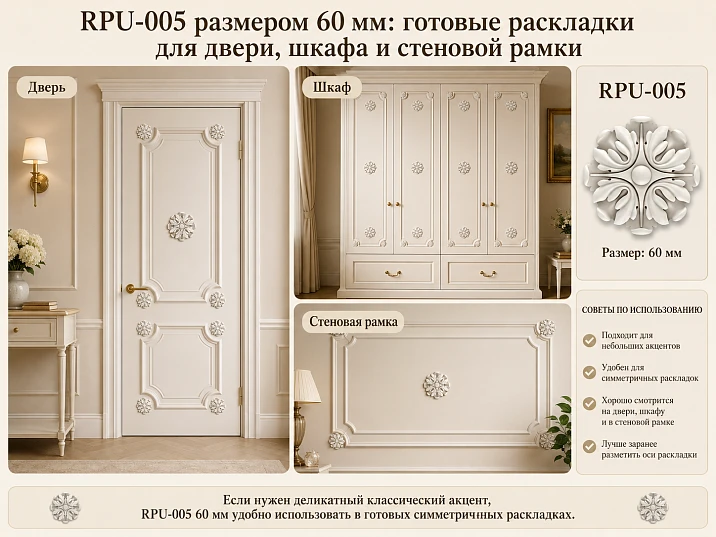
Six centimeters seem like a noticeable size while the decorative rosette lies in the palm of your hand. Once you move it to a cabinet door 500 mm wide or to the center of a tall wall frame, the perception changes. The small relief ceases to be an independent large detail and turns into a precise local accent. That is why the decorative rosette RPU-005 cannot be ordered based on a single enlarged image from the product card. First, you need to imagine it in real scale, determine the number of decorative fields, and decide where each element will be installed.
RPU-005 is an architectural rosette made of polyurethane, measuring 60 × 60 × 12 mm. It is suitable for local decoration of furniture, doors, and wall compositions. It is not an electrical socket, not a set of several ornaments, and not a large ceiling medallion for a regular chandelier. The buyer receives one separate decorative piece, 60 mm wide and high, with a relief of 12 mm.
This leads to the main ordering question: how many such elements are needed? For a single door, one rosette is usually considered. For two separate leaves, two. For three identical wall frames, you can order three rosettes or leave the accent only in the central frame and buy one. For four identical furniture fronts, four separate pieces will be required. The general rule is simple: the number of RPU-005 equals the number of decorative fields where a central accent should appear according to the design.
But counting alone is not enough. You need to make sure that the 60 mm size does not get lost inside a too spacious frame, the 12 mm relief does not interfere with opening the door, and the ornament does not intersect with the handle, lock, or molding line. Before purchasing, it is useful to make a paper square of 60 × 60 mm, attach it to the surface, and evaluate the future composition from a distance. Such a minute-long check is more reliable than trying to determine the scale from a photograph.
When the placement and quantity have already been calculated, you can buy the decorative rosette RPU-005 60 × 60 mm, add moldings, mounting and finishing materials, and then place the entire decor in one order.
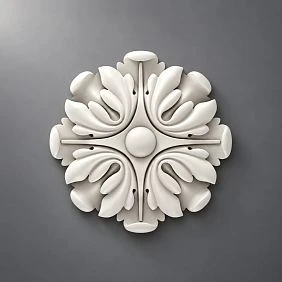
What the buyer receives under the article number RPU-005
Under one article number, a separate decorative rosette is sold. The buyer does not automatically receive a pair of elements for a two-door cabinet, a set for four wall panels, or a ready-made molding composition. The quantity in the cart should correspond to the number of rosettes actually needed.
| Parameter | Confirmed value | Practical significance |
|---|---|---|
| Article number | RPU-005 | Allows you to accurately find the desired product card and repeat the order |
| Product type | Architectural decorative rosette | Used as a local relief accent |
| Size | 60 × 60 × 12 mm | Conveys the width, height, and relief protrusion |
| Material | Polyurethane | Suitable for subsequent decorative finishing |
| Quantity in the product item | 1 separate element | For two facades, you need to specify 2 pcs., for four — 4 pcs. |
| Primary application | Walls, doors, furniture | The location is chosen based on the scale of the decorative field |
| Finishing | After installation, the element is finished according to the project | The color and finish are coordinated with the moldings and the base |
| Purchase | Add to cart or quick order | Before placing the order, specify the exact quantity |
| Delivery | Calculated based on the composition and delivery address | It is convenient to combine rosettes with moldings and materials |
On the product page, the active table shows the size 60 × 60 × 12 mm. This is the size to use in the project, bill of quantities, and calculations. The text description on the card may mention a larger variant, but as long as that size is not displayed as an available modification, it cannot be included in the order without additional confirmation.




The size 60 × 60 mm is the external dimension
When making the template, cut out a square with a side of 60 mm. It shows the maximum area the decorative rosette will occupy on the surface. The ornament itself may have a shaped contour, but the free space is checked against the external dimension.
If the free field between moldings is 100 mm wide, after conditionally placing the socket, only 20 mm will remain on each side:
100 − 60 = 40 mm;
40 ÷ 2 = 20 mm.
Such a field may be too tight, especially if the molding has a noticeable width or the ornament visually extends to its inner border.
With a field width of 200 mm, 70 mm remains around the element on each side:
200 − 60 = 140 mm;
140 ÷ 2 = 70 mm.
The socket gets more free space and is better perceived as an independent center.
Our factory also produces:
The 12 mm relief cannot be ignored
The 12 mm thickness means that RPU-005 protrudes above the plane of the wall, door, or furniture facade. On a stationary wall, this protrusion is usually evaluated in terms of light and shadow. On a movable door, it additionally affects operation.
Before ordering, check:
-
whether the decor is approaching the adjacent door leaf;
-
whether it hits the wall when opening;
-
whether it intersects with the trim;
-
whether it obstructs the drawer from sliding out;
-
whether it ends up in the constant hand-grip zone;
-
whether it catches clothing in a narrow passage;
-
whether it comes too close to the furniture handle.
The thickness of the relief is especially important for a cabinet placed flush against a side wall. A flat facade can open freely, but after adding a protruding ornament, the edge will start touching the adjacent surface.
Get Consultation
Architectural rosette, not an electrical outlet or a medallion under a chandelier
The word "rosette" is used in several meanings at once. A buyer might be looking for electrical fittings, decorative framing for a ceiling light, or a small architectural overlay. RPU-005 belongs to the third group.
It is not intended for connecting electricity. It has no electrical mechanism, contacts, wiring housing, or mounting box.
RPU-005 should also not be perceived as a full-fledged large ceiling rosette for a regular chandelier. The outer size is only 60 mm. This is a compact element that works better inside a limited decorative field:
-
in the center of a furniture panel;
-
inside a molding frame;
-
on a door leaf;
-
in a boiserie composition;
-
on a small wall panel;
-
as a repeating accent in a row of identical sections.
If large ceiling decoration is required, you need to choose decorative rosettes for the interior according to the appropriate size and purpose. You cannot increase the visual role of RPU-005 just because the product photo is taken in close-up.
Where small format becomes an advantage
Six centimeters are convenient where a large ornament would take up almost the entire surface. For example:
-
on a narrow buffet door;
-
on a small drawer;
-
inside a compact wall frame;
-
on the front of a cabinet;
-
in the center of several repeating panels;
-
on a door with a field already formed by moldings;
-
next to delicate furniture hardware.
A small rosette does not require turning the entire facade into an ornamental panel. It marks the center and leaves enough flat surface around it.
Where small format creates a problem
On a large empty surface, RPU-005 can get lost. This happens if it is installed:
-
alone on a wall several meters wide without a frame border;
-
in the center of a field more than a meter high and wide;
-
on a massive door portal;
-
above a large double door as the only decor;
-
in the center of a large ceiling under a noticeable chandelier;
-
on a wide cabinet without dividing the facade into separate fields.
The problem is not the quality of the ornament, but the mismatch of scale. In a large composition, a small detail needs support: a molding frame, repetition, a symmetrical group, or a larger neighboring decor.
Why 60 mm looks larger in photos
The product card shows the ornament so that its relief can be examined. The background takes up little space, and the item is positioned to fill almost the entire frame, so the viewer involuntarily perceives it as a medium or large format detail.
To restore the real scale, compare RPU-005 with familiar objects.
Next to a ruler
60 mm is 6 cm. On a regular ruler, this size occupies the interval from the 0 mark to the 6 mark.
Such a comparison instantly shows that the rosette is compact.
On an A4 sheet
An A4 sheet has a width of 210 mm and a height of 297 mm. A 60 × 60 mm square occupies less than a third of the sheet's width.
If you place the template in the center, a large empty field will remain around it. This experience is useful for understanding how the element will look on a furniture door.
On a door 300 mm wide
The ratio of the rosette size to the door width:
60 ÷ 300 = 0,2.
That is, the element occupies one fifth of the facade width. If it is centered, 120 mm of free space remains on each side:
300 − 60 = 240 mm;
240 ÷ 2 = 120 mm.
On such a door, the RPU-005 will be noticeable but will not fill the entire surface.
In a 400 × 600 mm frame
A socket 60 mm wide occupies 15% of the field width:
60 ÷ 400 × 100 = 15%.
Its share by height is 10%:
60 ÷ 600 × 100 = 10%.
In a frame of this size, the element looks like a compact central point. It does not replace the molding structure but complements it.
Next to a furniture handle
Handle sizes vary. Therefore, it cannot be stated in advance that the RPU-005 will be larger or smaller than the hardware. You need to place the template next to the actual handle.
If the handle-button has a noticeable base and is installed in the center of the facade, the rosette may compete with it. If the handle is located in a corner or at the edge, the central ornament gets its own place.
The main calculation rule: one decorative field — one rosette
RPU-005 is sold per piece. Its quantity is not calculated in linear meters and does not directly depend on the wall length. The buyer counts not meters, but decorative fields.
The formula looks like this:
Quantity of RPU-005 = number of fields where one central rosette is planned.
If decor is not needed in some fields, they are not included in the calculation. If the project provides for two rosettes in one field, each is counted separately.
What to consider a decorative field
A decorative field can be:
-
a separate furniture door;
-
the central part of a drawer;
-
door panel;
-
rectangle inside a molding frame;
-
independent boiserie section;
-
wall panel insert;
-
cabinet facade;
-
separate part of the composition, bounded by moldings.
Two adjacent cabinet doors are two movable fronts and, as a rule, two separate fields. Even if they look like a single plane when closed, each moves independently when opened.
Diagram 1. One door — one RPU-005
Imagine a single door of a cabinet, sideboard, or nightstand. It features one central molding frame.
Initial Data:
-
number of doors — 1;
-
number of decorative fields — 1;
-
the number of central accents is 1.
Order:
1 RPU-005.
Before purchasing, the 60 × 60 mm template is placed along the axis of the field. Then the distance to the molding, handle, and edges of the facade is checked.
Where to find the center
For a rectangular field, the geometric center is determined by the intersection of two diagonals. However, a decorative composition does not always require installation strictly at the geometric center.
The rosette can be slightly shifted upward if:
-
there is a handle in the lower part;
-
the field is visually weighted down at the bottom;
-
the upper ornament should support other furniture elements;
-
this is provided for by the overall project.
The offset must be measured and repeated on all identical facades. Installing "approximately slightly higher" will lead to differences between doors.
Scheme 2. Two cabinet doors — two RPU-005
A paired cabinet has left and right doors. Each has its own axis.
Initial Data:
-
doors — 2;
-
decorative fields — 2;
-
central accents — one on each door.
Order:
2 RPU-005.
The rosettes are placed mirror-symmetrically or identically, depending on the pattern and the project.
Why one piece cannot be placed at the junction of the doors
If you glue the rosette exactly along the line between the doors, it will end up on two movable surfaces at once. When opened, the doors will separate, and the decorative piece will not be able to move with both.
Even trying to attach it to only one door does not solve the compositional problem: half of the ornament will visually extend beyond the facade, and the adjacent door may catch the protruding relief.
For a paired cabinet, use:
-
one socket per door;
-
one socket only on one leaf, if asymmetry is provided by the project;
-
central decor on the fixed panel between doors, if such a detail exists and allows installation.
The last option cannot be transferred to a regular joint without a fixed base.
How to achieve symmetry
On both doors, measure:
-
width;
-
height;
-
position of the inner frame;
-
distance from the top edge;
-
distance from the joint line;
-
distance from the furniture handle.
It is more convenient to transfer the layout using a template. One common horizontal line helps avoid the situation where the right socket is a few millimeters higher than the left one.
Diagram 3. One wide facade — one RPU-005
A wide solid facade may belong to:
-
a dresser;
-
a bedside table;
-
a fold-down panel;
-
a sideboard;
-
built-in furniture;
-
a decorative niche.
If moldings form one central field, usually one socket is considered.
Initial Data:
-
facade — 1;
-
decorative field — 1;
-
central accent — 1.
Order:
1 RPU-005.
When one detail is enough
One rosette looks convincing if:
-
the field has clear boundaries;
-
the element does not get lost in its scale;
-
the handle does not occupy the same center;
-
there is free space around the ornament;
-
the composition does not require two symmetrical points.
When might a wide facade need two pieces
Two RPU-005 can be considered if the facade is divided into two independent fields. For example, a long drawer is decorated with two identical molding frames.
Then the calculation is performed not by the number of facades, but by the number of fields:
-
facade — 1;
-
frames — 2;
-
rosettes — 2.
You cannot install two pieces on a wide facade just because it seems empty. First, the surface is divided into logical zones.
Scheme 4. Three wall frames
Three vertical frames are located on the wall: a wide central one and two narrower side ones. Different compositions are possible.
Option A. Accent only in the center
-
central frame — 1 RPU-005;
-
left frame — without socket;
-
right frame — without socket.
Order:
1 RPU-005.
This option emphasizes the central axis of the wall. It suits the area:
-
console;
-
mirrors;
-
sofa;
-
headboard;
-
decorative panel;
-
central light fixture.
The socket does not necessarily have to be in the absolute center of the entire wall. Its position is linked to the central frame and furniture.
Option B. Identical repetition
-
left frame — 1 RPU-005;
-
central frame — 1 RPU-005;
-
right frame — 1 RPU-005.
Order:
3 RPU-005.
Repetition creates rhythm. It looks convincing when the frames are identical or have sufficiently close proportions.
Option B. Two side rosettes without a central one
This solution is less common, but possible if the central field is occupied:
-
a painting;
-
a mirror;
-
a TV;
-
wall sconce;
-
a large overlay.
Then:
-
left frame — 1 RPU-005;
-
central — without RPU-005;
-
right — 1 RPU-005.
Order:
2 RPU-005.
The composition should be symmetrical relative to the central object.
Scheme 5. Four doors or four panels
If the cabinet has four identical doors and each has central decor:
-
doors — 4;
-
fields — 4;
-
rosettes — 4.
Order:
4 RPU-005.
The same formula applies to four identical wall panels.
Checking a row of four elements
Four small rosettes are perceived not as separate accents, but as a rhythmic row. Therefore, it is necessary to check:
-
one horizontal installation line;
-
equal distance from the top edge;
-
equal position relative to the frame;
-
ornament direction;
-
identical finish;
-
no differences in margin size.
Even a slight shift of one element is noticeably stronger when three precisely aligned ones are nearby.
Diagram 6. Six facades of a kitchen sideboard
Suppose the sideboard consists of:
-
two upper glazed doors;
-
two lower hinged facades;
-
of two pull-out drawers.
Sockets are planned only on the lower doors and drawers.
Calculation:
-
upper fronts — 0;
-
lower doors — 2;
-
drawers — 2;
-
total — 4.
Order:
4 RPU-005.
This example shows why you cannot multiply the number of furniture items by a conditional number. You need to go through each front and mark where the ornament is actually provided.
Diagram 7. One cabinet, but different door sizes
Suppose the cabinet consists of:
-
two tall central doors;
-
two narrow side;
-
four mezzanine doors.
Can use RPU-005:
-
only on four mezzanines;
-
only on two central doors;
-
on all eight facades;
-
on central and side, but without mezzanines.
Each scheme gives a different quantity. A table is made before ordering.
| Group of fronts | Number of facades | Need RPU-005 | Number of sockets |
|---|---|---|---|
| Central panels | 2 | Yes | 2 |
| Side panels | 2 | Yes | 2 |
| Mezzanines | 4 | No | 0 |
| TOTAL | 8 | — | 4 |
Order:
4 RPU-005.
Paper template 60 × 60 mm: a check that saves rework
For the template, you will need thick paper or thin cardboard.
Sequence:
-
Draw a 60 × 60 mm square.
-
Cut it out precisely along the lines.
-
Draw vertical and horizontal axes.
-
Mark the center.
-
Temporarily secure the template with masking tape.
-
Close and open the facade.
-
Step back to the normal viewing distance.
-
Photograph the overall composition.
-
Check the adjacent doors.
-
Repeat the marking on all identical fields.
Why one close-up look is not enough
Up close, a person examines the relief. From a distance, they perceive rhythm, proportions, and the connection with furniture. A rosette may look expressive at 30 cm and almost disappear from three meters.
For a wall composition, three checkpoints are useful:
-
from a distance of 1 m;
-
from the entrance to the room;
-
from the main living area — the sofa, bed, or table.
How to simulate relief
A flat paper square does not show a 12 mm protrusion. For a more accurate check, you can make a three-dimensional mock-up:
-
cut out several squares from cardboard;
-
stack them to a thickness of about 12 mm;
-
secure them on the surface;
-
look at the side angle;
-
check the opening trajectory.
The mock-up will not convey the ornament, but it will show whether the protrusion interferes.
RPU-005 layout on the door
The door leaf has more functional zones than a wall panel. It contains a handle, lock, hinges, panels, glass, and possible moldings.
Before ordering molded decor for a door, measure:
-
the width of the door leaf;
-
height;
-
the size of the decorative field;
-
handle position;
-
the height of the lock;
-
distance to the edge;
-
opening direction;
-
the distance to the wall;
-
the shape of the architraves.
For inspiration, you can look at door decor ideas, and then adapt the liked principle to the scale of RPU-005.
One central frame
If the door is decorated with one elongated rectangle, the rosette can be located:
-
in the geometric center;
-
above the center;
-
inside the upper part;
-
in a separate small frame.
Installation below the center requires checking the handle. The ornament must not fall into the zone of constant hand contact.
Two fields in height
The door may have upper and lower frames.
Possible solutions:
-
one RPU-005 in the upper frame;
-
one in each frame — 2 total;
-
upper socket and other decor at the bottom;
-
lower field without ornament due to the handle.
You cannot automatically place two pieces just because there are two fields. The lower socket may end up too close to the handle or vulnerable to impacts.
Two symmetrical doors
For a double door, each leaf is considered separately. If one socket is provided on each, 2 pieces are needed.
The center of the entire opening is not a mounting point: there is a movable joint between the leaves.
Door with glass
RPU-005 is installed only on a suitable opaque part. It is necessary to check:
-
the width of the wooden or composite area;
-
the distance to the glazing bead;
-
the possibility of reliable adhesion;
-
the view from both sides;
-
the absence of contact with the glass;
-
the movement of the door.
Already painted door
Installation on a finished coating requires checking the adhesion of the selected adhesive composition. Weak paint may peel off along with the decor. Reliability is determined not only by the quality of the glue, but also by the strength of the layer underneath.
Decorative rosette on the cabinet
The cabinet is perceived as a system of facades. Even one incorrect axis is noticeable across the entire row.
In this section you can look at wardrobe design ideas and determine whether repetition is needed on each door or only an accent on the central facades.
Cabinet with two doors
The basic scheme is two identical rosettes. They are located:
-
at the same height;
-
at the same distance from the outer edges;
-
symmetrically relative to the central joint;
-
taking into account the handles.
If the handles are located near the joint, the sockets can be raised higher or placed in the center of separate molding fields.
Cabinet with three doors
Options are possible:
-
3 sockets — one on each door;
-
1 socket — only on the central one;
-
2 sockets — on the side leaves;
-
3 elements at different heights according to a pre-defined scheme.
The central accent helps highlight the middle leaf. Full repetition makes all doors equal.
Cabinet with four doors
Four identical RPU-005 create a rhythm. If the central doors are wider than the side ones, the same position relative to the outer dimension of the facade may look uneven. It is better to attach each socket to the center of its own decorative field.
Cabinet with mezzanines
The small size of 60 mm can work especially well on small upper doors. But repeating on the main and mezzanine facades requires checking the total quantity.
For example:
-
4 main doors;
-
4 mezzanine doors;
-
one socket on each field.
Total:
4 + 4 = 8 RPU-005.
If decor is needed only on top — 4 pcs.
Cabinet in a narrow passage
A 12 mm relief increases the facade protrusion. You need to open the door to a full angle and make sure that the socket:
-
does not touch the wall;
-
does not catch the trim;
-
does not hit a neighboring object;
-
is not in the path of a person moving.
RPU-005 on a dresser and nightstand
On a small piece of furniture, six centimeters are more noticeable than on a wall.
A dresser with three drawers
Possible schemes:
-
one outlet per drawer — 3 pcs.;
-
one only on the top drawer — 1 pc.;
-
one on the central drawer — 1 pc.;
-
two on wide fronts — 6 pcs.
The last option requires dividing each drawer into two compositional zones. Simply placing two outlets closer to the edges is not enough.
Cabinet with one door
One RPU-005 can become a central accent. Before ordering, check whether the handle occupies the same point.
If the handle is centered, possible solutions:
-
move the socket higher;
-
move the handle;
-
create separate top and bottom fields;
-
abandon the central ornament.
Bedside table
The socket should not end up where a person constantly touches the facade with their knee or hand. The proximity of the bed and a narrow passage are also taken into account.
Sideboard
On the RPU-005 sideboard, you can repeat:
-
on the lower blind facades;
-
on the drawers;
-
on the upper wooden frames;
-
on the side panels.
Glazed doors should not be considered automatically. They require a separate base section.
Molding frame first, rosette second
RPU-005 reads best not on an infinite empty plane, but within a clear architectural boundary. Such a boundary becomes a molding frame.
For the project, you can buy polyurethane moldings for frames, but the profile is chosen before the final position of the rosette is determined.
Why this order
The molding defines:
-
frame width;
-
height;
-
contour thickness;
-
inner field size;
-
style;
-
relief scale;
-
distance to adjacent panels.
RPU-005 must fit inside the resulting field. If you glue the socket first and then build a frame around it, the lines may run too close or the frame may not align with the furniture hardware.
Inner and outer dimensions of the frame
Let the outer dimension of the frame be 400 × 600 mm. If the molding and its position reduce the free field, the actual inner dimension will be smaller.
The RPU-005 template is applied to the inner field, not to the outer contour.
Ratio of molding width to socket
A thin profile emphasizes the small size of RPU-005 and creates a delicate composition. A wide, massive molding can visually overpower the socket.
It is impossible to set a universal ratio without trying it on. But it is useful to compare:
-
profile width;
-
size 60 mm;
-
inner area;
-
relief height 12 mm;
-
distance from the ornament to the frame.
Examples of thin profiles
For small furniture and wall frames, compact moldings can be considered. For example, MLDPU-001 has a cross-section of 10 × 6 mm and a length of 2600 mm, while MLDPU-004 is 15 × 8 mm and 2600 mm long.
The specific option is chosen based on the surface and style. Profile dimensions should be checked in the product card before ordering.
How to calculate molding for one frame
Perimeter of a rectangular frame:
P = 2 × (width + height).
For a frame 400 × 600 mm:
P = 2 × (400 + 600) = 2000 mm.
One frame requires 2 m of profile without accounting for trimming and possible defects.
If a 2600 mm strip is used, one strip is theoretically enough for the total length. But the cutting possibility depends on the sizes of the four sides:
-
600 mm;
-
600 mm;
-
400 mm;
-
400 mm.
The sum is 2000 mm. The remainder is 600 mm before accounting for the cut.
Three frames 400 × 600 mm
Net length:
2000 × 3 = 6000 mm.
Two strips of 2600 mm give 5200 mm — not enough. Three strips give 7800 mm.
Order:
-
3 molding strips;
-
3 RPU-005, if a socket is installed in each frame;
-
1 RPU-005, if the accent is only in the central one.
Why the allowance cannot be assigned as a single number for all projects
Consumption depends on:
-
corner angles;
-
side lengths;
-
cutting directions;
-
saw kerf widths;
-
tool quality;
-
craftsman's experience;
-
repeatability of frames;
-
possibility to use offcuts;
-
complex joints.
Therefore, first a cutting map is drawn up. After that, a justified reserve is added.
Frame on a furniture facade
The molding on the door must account for movement and hardware.
Check:
-
facade thickness;
-
possibility of gluing;
-
distance to edges;
-
hinges;
-
handle;
-
adjacent leaves;
-
molding protrusion;
-
RPU-005 protrusion;
-
full opening angle.
The rosette is placed after marking the frame. If the field is too small, it is better to change the frame dimensions rather than squeeze in the element with minimal margins.
RPU-005 in a wall paneling composition (boiserie)
Boiserie is built on the rhythm of panels, frames, and central elements. A small architectural rosette can:
-
mark the center of each panel;
-
highlight only the main section;
-
support symmetry;
-
connect a series of moldings;
-
repeat the motif on doors or furniture.
Before creating your own layout, it is useful to look at ready-made boiserie layouts and assess how decorative elements relate to frames of different sizes.
One large central panel
If the width and height of the field are significant, RPU-005 may be too small. Possible solutions:
-
create an internal additional frame;
-
use a group of several elements;
-
choose a larger socket;
-
replace it with a large overlay;
-
abandon the central decor.
A row of narrow vertical panels
RPU-005 works well as a repeating sign. For example, five identical frames — five sockets.
But the row may look overly frequent if the panels are placed close together. Then the accent is used through every other section:
-
first — with a socket;
-
second — without;
-
third — with;
-
fourth — without;
-
fifth — with.
Order — 3 pcs.
Central panel and two side ones
This is the most understandable three-part composition. The choice of quantity depends on the role of the center.
If the center is the main one — 1 socket. If all fields are equal — 3. If the central field is occupied by a painting — 2 side ones.
Lower and upper tiers
The wall can be divided by a horizontal molding into lower and upper frames.
Possible schemes:
-
RPU-005 only in the upper fields;
-
only in the lower;
-
in both tiers;
-
in the central sections of each tier.
The quantity is calculated based on the actual number of selected fields.
When RPU-005 will be too small
A small element will not fix a composition that is too large. Its scale should be reconsidered in the following situations.
A field wider than one meter
One 60 mm rosette occupies less than 6% of the width of a 1000 mm field:
60 ÷ 1000 × 100 = 6%.
Without additional framing, it may get lost.
A tall frame from the floor almost to the ceiling
If the field has a height of 2000 mm, the socket's share is only 3%:
60 ÷ 2000 × 100 = 3%.
Such a frame requires either a larger center or a group of elements.
Large door portal
RPU-005 is suitable for local wall decor, but does not replace a large overlay above the portal.
A spacious wall without moldings
One element will not create an architectural structure. First, you need to form a frame or a compositional group.
Central ceiling decor
The size of 60 mm does not match the role of the main medallion under a regular chandelier. For the ceiling, a special model of the required scale is selected.
When RPU-005 may be too large
Despite its compactness, on a small facade the socket can take up too much space.
Field 80 mm wide
After placement, only 10 mm remains on each side:
80 − 60 = 20 mm;
20 ÷ 2 = 10 mm.
The ornament will end up almost flush with the frame.
Small drawer
On a facade 100 mm high, the element occupies 60% of the height. The rosette may visually overload the drawer and come close to the handle.
Narrow rail or stile
RPU-005 requires a full flat area. It cannot be moved to a narrow profile just because it is in the center of the composition.
Area near the edge of the door
If the offset is small, the relief looks randomly glued on and may interfere with opening.
Socket and furniture handle: two points that can argueWhat to put in the basket along with RPU-005
The socket alone is not enough if the project includes a frame, installation, and painting.
| Position | Quantity | What it is for | What to check |
| RPU-005 | By the number of accent fields | central decorative element | Size 60 × 60 × 12 mm |
| Molding | According to the cutting map | Forming the frame | Cross-section, length, number of angles |
| Corner decor | As per project | Frame corner design | Compatibility with the profile |
| Other overlays | By composition | Additional accents | Scale next to RPU-005 |
| Mounting compound | By consumption | Fastening of elements | Compatibility with polyurethane and substrate |
| Composition for joints | According to technology | Sealing of connections and perimeter | Possibility of subsequent painting |
| Primer | By area | Preparation for finishing | Compatibility with the material |
| Paint | By area and number of layers | Unified finish | Color, gloss level |
| Painter's tape | As needed | Markup and protection | Does not damage the base |
| Template | 1 set | Transfer of axes and position | Accuracy 60 × 60 mm |
| Delivery | 1 departure | Receiving the set | Address and order composition |
Select Materials for installing stucco molding needed after determining the base and finishing system. The universal label "mounting adhesive" does not confirm the suitability of any composition.
The base is more important than the name of the adhesive
The reliability of fastening depends on several layers:
- Main surface.
- Plaster or facade material.
- Primer.
- Paint or other coating.
- Adhesive composition.
- Polyurethane rosette.
If one layer holds poorly, the entire system may come off with it.
Painted wall
Check the strength of the paint. If it is peeling, you cannot glue over it without preparation.
MDF facade
You need to consider the finish coating, thickness, and the possibility of safe preparation of the area.
Wooden door
Check the varnish, enamel, or tint. The adhesive must hold on the specific coating.
Plaster
The base must be strong, dry, and cleaned of dust.
Wallpaper
Mounting to wallpaper is risky: the decorative element is held by the strength of the sheet and adhesive layer, not by the wall itself. For responsible installation, the base under the socket is prepared separately.
Marking before installation
Marking must be done for the entire composition at once.
One socket
It is enough to determine the field axes and apply the template.
Paired facades
A common horizontal line and separate vertical axes are needed.
Row of wall frames
Marked:
- edges of all frames;
- height of centers;
- vertical axes;
- furniture position;
- sockets and switches;
- lighting fixtures;
- baseboard and cornice.
Four doors
The marking is transferred with one template. After installing the first outlet, the rest are compared not with it by eye, but with the original measurements.
Wall frame assembly sequence
- Measure the wall.
- Draw the axes.
- Determine the number of frames.
- Calculate the external dimensions.
- Choose the molding.
- Determine the internal field.
- Attach template RPU-005.
- Check the scale.
- Calculate the molding.
- Calculate the number of sockets.
- Perform a dry layout.
- Prepare the base.
- Install the moldings.
- Check the frame center again.
- Install RPU-005.
- Seal the joints according to the technology.
- Prime the prepared surfaces.
- Apply the finishing coat.
If you first glue the sockets and then change the frame sizes, the center may shift.
Sequence of furniture facade finishing
- Remove the door if the technology requires it.
- Mark the direction and location of each part.
- Check the opening.
- Draw the molding outline.
- Apply the RPU-005 template.
- Compare with the handle.
- Check the protrusions.
- Perform a trial layout.
- Prepare the surface.
- Glue the moldings.
- Install the socket.
- Allow the compounds to gain the necessary strength.
- Perform the finishing.
- Install the hardware.
- Return the facade to its place.
- Check adjacent doors.
Specific drying intervals are determined by the instructions of the selected materials.
Practical layouts for different tasks
Bedroom door
One vertical frame, one RPU-005 above the geometric center. The color matches the door. The ornament is read only by shadow.
Quantity — 1 pc.
Pair wardrobe in the bedroom
Each door has a frame and one rosette. Handles are located closer to the central joint, decor — above.
Quantity — 2 pcs.
Chest of drawers with four drawers
RPU-005 is installed only on the two upper facades. The lower ones remain plain.
Quantity — 2 pcs.
Sideboard with four solid doors
One socket in the center of each molding frame.
Quantity — 4 pcs.
Wall behind the console
Three frames, accent only in the central one. Side fields remain without sockets.
Quantity — 1 pc.
Corridor with six identical panels
Socket repeats every other frame.
Quantity — 3 pcs.
Bed headboard
Central frame occupied by soft panel, RPU-005 installed in two side ones.
Quantity — 2 pcs.
Wall with mirror
Mirror is in the center. Two sockets are placed in side frames.
Quantity — 2 pcs.
Door and wardrobe in one room
On the door — one RPU-005, on the two wardrobe doors — two. All elements are painted the same.
Quantity — 3 pcs.
Order a design project for a complex wall
If the wall includes:
- several frame sizes;
- a doorway;
- a built-in wardrobe;
- wall lamp;
- a mirror;
- a TV;
- niches;
- pilasters;
- cornice;
- plinth;
- various decorative overlays,
one paper template is not enough. It is useful to order a design project for a decorative wall, to see the proportions in advance and get a list of elements.
For the calculation you will need:
- wall dimensions;
- ceiling height;
- door positions;
- the location of outlets and switches;
- Furniture;
- photographs;
- desired style;
- color;
- selected moldings;
- estimated quantity of RPU-005.
Mistakes that cause a small socket to not work
Mistake 1. Considering RPU-005 a kit
One product unit is one separate socket.
Mistake 2. Ordering one part for two doors
Each door is an independent movable panel.
Mistake 3. Installing the socket at the door joint
When opened, the composition will separate.
Mistake 4. Relying on the enlarged photo
In reality, the outer size is 60 mm.
Error 5. Using an unconfirmed size
In the active table, you need to select 60 × 60 × 12 mm.
Error 6. Mistaking RPU-005 for an electrical outlet
This is a decorative architectural overlay.
Error 7. Using it as a large medallion under a chandelier
A size of 60 mm is too small for typical central ceiling decoration.
Error 8. Not making a template
After purchase, it may turn out that the element gets lost or does not fit.
Error 9. Not accounting for the 12 mm relief
The decor will start touching the wall or the adjacent panel.
Error 10. Installing the socket flush against the molding
The ornament lacks free space.
Error 11. Gluing the element before marking the frame
The geometric center may change.
Error 12. Choosing the molding after the socket
The inner field size will be unpredictable.
Error 13. Not accounting for the handle
Functional and decorative points begin to compete.
Error 14. Installing the socket in the grip zone
Constant touching increases the risk of dirt and damage to the finish.
Error 15. Consider all facades identical
Mezzanines, drawers, and doors may have different sizes.
Error 16. Order quantity "approximately"
Piece decor requires an exact list.
Error 17. Add a large margin instead of calculating
Extra elements will not fix an incorrect layout.
Error 18. Not checking the direction of the ornament
One rosette may end up rotated differently.
Error 19. Mark each door separately by eye
Different heights will appear in the row.
Error 20. Not accounting for furniture nearby
The opening door will hit the wall or bed with its decor.
Error 21. Gluing onto weak paint
The element will come off along with the coating.
Error 22. Gluing over an unstable base
Reliability is determined by the weakest layer.
Error 23. Painting without a test sample
The relief may look different than expected.
Error 24. Using contrast on every frame without checking
Small elements will turn into too frequent a color rhythm.
Error 25. Installing one outlet on a huge empty wall
It will get lost without a frame border.
Error 26. Overloading a small box
Six centimeters can take up most of the facade.
Error 27. Not checking the inner size of the frame
The outer dimension does not show the free field.
Error 28. Not creating a molding cutting map
The ordered linear footage will not be enough or there will be too many scraps left.
Error 29. Forgetting about joints and corners
Straight planks do not form a complete frame by themselves.
Error 30. Order only RPU-005
There will be no glue, moldings, or finishing materials on the site.
Error 31. Mix different painting systems
The socket, molding, and wall will differ in gloss and shade.
Error 32. Install the ornament before checking the facade
Old holes, damage, or hardware may change the pattern.
Error 33. Do not check the full opening angle
When closed, everything looks correct, but contact occurs during movement.
Error 34. Do not consider lighting
Weak side light barely shows the relief.
Error 35. Place the element too high
From eye level, the socket will be unnoticeable.
Error 36. Place too low
The risk of impacts and contamination increases.
Error 37. Repeat the socket in all fields without a compositional reason
The wall becomes monotonous or overloaded.
Error 38. Use different indents
The symmetry of the frames is disrupted.
Error 39. Not checking the current price and availability
Commercial parameters should be checked before placing an order.
Error 40. Doing installation without a list
The number of elements and materials is determined during the work process.
Who RPU-005 is suitable for
It makes sense to choose this model if:
- a small local accent is needed;
- the free field corresponds to a size of 60 mm;
- the product should not serve as a large panel;
- the furniture has separate decorative facades;
- the door is decorated with moldings;
- the wall frame requires a compact center;
- the project is built on the repetition of small details;
- the socket is planned to be painted together with the base;
- the quantity can be calculated exactly;
- the 12 mm protrusion does not hinder movement.
When it's better to choose a different model
Another decorative element is needed if:
- the field is too large;
- a central ceiling medallion is required;
- large decor above the door is needed;
- the surface does not have a suitable place;
- the 12 mm relief hinders opening;
- the 60 mm size is visually lost;
- the composition requires an elongated overlay;
- a corner element is needed;
- a connection with a specific molding is required;
- the ornament must cover a defect of a larger area;
- the rosette intersects with the handle or lock.
In the general catalog you can buy polyurethane rosettes of a different size and shape, if the paper template RPU-005 is not suitable.
How to calculate the cost of a full order
It is not advisable to fix the final amount in the article: prices and project composition change.
Formula:
**Quantity of RPU-005 × current price of one rosette
- Moldings
- corner decor
- Installation materials
- Materials for finishing
- Delivery
= cost of the set.**
Example for a paired cabinet
- RPU-005 — 2 pcs.;
- molding — along the perimeter of two facade frames;
- installation kit;
- primer and paint;
- delivery.
Example for three wall frames
If decor is needed in each:
- RPU-005 — 3 pcs.;
- molding — along the perimeter of three frames;
- corner elements — per project;
- compound for joints;
- mounting material;
- finishing;
- delivery.
If the socket is needed only in the central frame:
- RPU-005 — 1 pc.;
- the rest of the order composition remains unchanged.
Example for four doors
- RPU-005 — 4 pcs.;
- molding — on four facades;
- installation and finishing materials;
- delivery.
Before payment, you need to find out the current price of RPU-005 for active size 60 × 60 × 12 mm.
Ready order list
| Zone | Number of fields | RPU-005 per field | Total RPU-005 | Molding | Additional decor |
| Single door | 1 | 1 | 1 | Around the frame perimeter | As per project |
| Paired wardrobe | 2 | 1 | 2 | Two frames | As per project |
| Wide facade with one field | 1 | 1 | 1 | One frame | Optional |
| Wide facade with two fields | 2 | 1 | 2 | Two frames | As per project |
| Three wall frames, full repeat | 3 | 1 | 3 | Three frames | As per project |
| Three frames, center accent | 3 | Center only | 1 | Three frames | As per project |
| Four doors | 4 | 1 | 4 | Four frames | As per project |
| Six panels, decor every other | 6 | Every other field | 3 | Six frames | As per project |
Order verification before payment
Per RPU-005
- Is the size 60 × 60 × 12 mm specified?
- Does the quantity match the number of selected fields?
- Are all templates checked?
- Does the relief not interfere with opening?
- Is the ornament direction approved?
Regarding moldings
- Is a profile selected?
- Is the length of the strip known?
- Is the perimeter calculated?
- Is the cutting map created?
- Is a justified allowance added?
- Are the corners taken into account?
On the surface
- Is the base solid?
- Does the paint not peel off?
- Can the facade be prepared?
- Are the old holes taken into account?
- Are the handles and locks marked on the diagram?
By finish
- Is the color approved?
- Is the gloss level selected?
- Is a sample made?
- Are the socket and molding painted with the same system?
- Is the joint material compatible with the coating?
Regarding delivery
- Is the address verified?
- Are long-length moldings included in the order?
- Are the terms of receipt clear?
- Are all items shipped in one shipment?
- Has the quantity been re-checked against the statement?
After checking, you can order delivery of polyurethane decor along with moldings and materials.
Frequently asked questions about RPU-005
What size is actually available for RPU-005?
The active product table shows a size of 60 × 60 × 12 mm. This is the size to use in calculations.
Can I order RPU-005 in a 160 mm size?
Do not count on this option until it appears as an available modification in the active product table. The possibility of such an order needs to be confirmed separately.
Is one RPU-005 a single piece or a set?
This is one separate decorative rosette.
How many elements are needed for two cabinet doors?
If each door has its own central accent, you need 2 pcs.
Can one socket be placed between two doors?
It cannot be installed on a regular movable joint. A common element requires a fixed base.
How many RPU-005 are needed for four facades?
With the scheme "one socket per facade", 4 pcs will be required.
How many elements should be ordered for three wall frames?
Either 3 pcs for a full repeat, or 1 pc for an accent only in the central frame.
Can RPU-005 be installed in only one of four frames?
Yes, if the asymmetry is related to furniture, a painting, or another center of composition. Randomly highlighting one section looks like a mistake.
Will RPU-005 fit a ceiling chandelier?
Size 60 mm is too small for the role of a regular large ceiling rosette. For a chandelier, you need to look at a separate ceiling category and select the scale.
Is this an electrical outlet?
No. RPU-005 is a decorative architectural overlay.
Can it be installed on furniture?
Yes, if the surface allows for reliable mounting and the relief does not interfere with opening and hardware.
Will the rosette fit a door?
Yes. You need to check the field size, handle, lock, opening direction, and distance to the wall.
Can it be glued onto an already painted facade?
The possibility depends on the strength of the coating and the compatibility of the adhesive. A weak layer of paint needs to be removed or prepared.
Can the RPU-005 be installed on wallpaper?
Reliability will depend on the wallpaper sheet and adhesive layer. For responsible installation, it is better to prepare a solid base.
How to check the size before purchase?
Cut out a paper template 60 × 60 mm and apply it to the surface.
How to account for the 12 mm thickness?
Make a three-dimensional cardboard mock-up and check the door movement from the side.
Where to place the socket on the facade?
Along the axis of the decorative field or at another precisely calculated point, coordinated with the handle and frame.
Is it mandatory to place it strictly in the center?
No. Offset according to the project is acceptable, but it must be measured and repeated on all identical facades.
How to mark two identical doors?
Draw a common horizontal line and separate vertical axes for each field.
Can RPU-005 be mixed with large overlays?
Yes, if the elements form a hierarchy and do not compete in scale.
Which molding will fit?
The profile is chosen based on the field size, style, and surface. There is no universal item number without a project.
Do I need to choose the molding first?
Yes. It determines the inner size of the frame, after which the scale of RPU-005 is checked.
How to calculate the length of the molding?
For a rectangle, the formula is used: 2 × (width + height). Then a cutting map is created.
Is a molding allowance needed?
Yes, if angles, cuts, and possible errors justify it. The exact allowance depends on the layout.
Do I need to buy corner elements?
Only if they are provided by the selected frame system.
Is mounting adhesive included in the RPU-005 kit?
It should be considered as a separate material if the order card does not indicate otherwise.
Do I need to prime the socket?
Preparation is determined by the surface condition and the chosen painting system. Use compatible materials.
Can RPU-005 be painted to match the wall color?
Yes. In this case, the relief is read through light and shadow.
Can it be made gold?
You can choose a decorative finish compatible with the material. It is better to repeat the color in other interior details.
Do I need to paint the element before installation?
Different technologies are possible. Often the main finishing is done after fitting, taking into account the need to seal the perimeter.
Can I install a socket without a molding?
Yes, if the size matches the surface and the element does not look like a random small dot.
On a large empty wall, in a field wider than a meter, on a large portal, and in the center of the ceiling under a regular chandelier.
Where can it be too large?
On a narrow field, a small drawer, or next to a large furniture handle.
Can I use two sockets on one drawer?
Can two outlets be used on one box?
Yes, if the facade is divided into two equal compositional zones.
Do I need to order spare elements?
The reserve is determined after an exact calculation. For a large repeating series, one spare part may be useful, but this is a project decision.
Can sockets differ after painting?
Differences often arise due to uneven preparation, layer thickness, and application conditions. All elements are best painted with one system.
How to care for the finished decor?
After the coating is fully dry, the relief is carefully cleaned using a gentle method suitable for the chosen paint.
Can the RPU-005 be installed in a damp room?
The possibility depends not only on the polyurethane, but also on the substrate, adhesive, sealing, and finish coating. The entire system must suit the room's conditions.
How to find out the cost of four sockets?
Multiply the current price of one modification 60 × 60 × 12 mm by four and add related materials and delivery.
Can I place a quick order?
Current purchase options are displayed on the product card.
Is there Contact us to confirm shipping to your destination.?
Terms of receipt and cost are checked when placing an order for a specific address.
From the 60 mm template — to an exact order
RPU-005 does not require complex calculation by area or linear meters. But it requires precise compositional logic. The buyer counts the decorative fields and decides in which of them the central accent should be located.
One single door — one socket. Two separate leaves — two. Three wall frames may require one, two, or three pieces depending on the pattern. Four identical facades — four RPU-005, if the decor is repeated on each. On a wide solid facade, the number of elements is determined by the number of inner frames, not the overall width of the furniture.
Before ordering, you need to check four parameters:
- External size 60 × 60 mm.
- Relief 12 mm.
- Free space around the ornament.
- Position relative to the molding, handle, and adjacent surfaces.
After that, a general set is compiled: RPU-005, moldings, corner decor, mounting and finishing materials. In the catalog, you can choose and buy polyurethane molding for the entire composition, rather than collecting random parts from different systems.
Once the template is verified, the number of fields is counted, and the set composition is clear, you can order RPU-005 for furniture and walls in the exact quantity. STAVROS allows you to connect a small architectural rosette with moldings, overlays, and materials for further work. As a result, the 60-millimeter ornament is not lost and does not look random: it occupies a pre-calculated place in a door, cabinet, or wall frame.