Article Contents:
- Every decoration should have its own role
- Why one strong decoration is often better than five
- Where the compositional center of a furniture facade is located
- Central carved onlay: when one detail is enough
- Paired onlays instead of one large ornament
- Vertical decorations: how to design a tall cabinet without cutting it into stripes
- Horizontal decor for a chest of drawers, buffet, and upper frieze
- Corner elements and rosettes: support without overloading the center
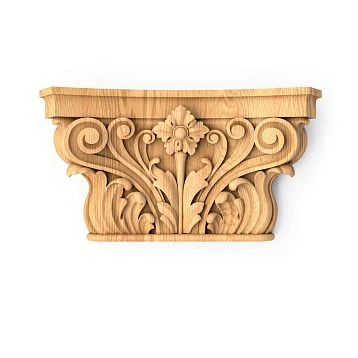
- Capital and bracket: decorative furniture architecture
- How to harmonize ornaments: acanthus, scrolls, cartouche, and geometry
- Scale: compare the product dimensions with the working area, not the entire cabinet
- Why relief depth changes the composition even with identical dimensions
- Full-size template: how to check the composition before ordering
- Three combinations that work for different tasks
- Overlay and molding: one creates emphasis, the other a boundary
- Overlay and rosettes: repeating a secondary motif
- Pilaster, capital, and cornice: a unified furniture portal
- Wardrobe with two hinged doors
- Dresser with multiple drawers
- Bedside and TV cabinet
- Buffet and display case
- Kitchen fronts
- Can carved decorations from different collections be combined?
- What should you do if the overlay you need isn't available in a mirrored version?
- Should every drawer of a chest of drawers be decorated?
- Are ready-made wooden overlays suitable for painted MDF fronts?
- What should you choose for a small cabinet: an overlay or a rosette?
- Can I order beech and oak decorations for the same piece of furniture?
- How do I place a repeat order for a workshop without confusion?
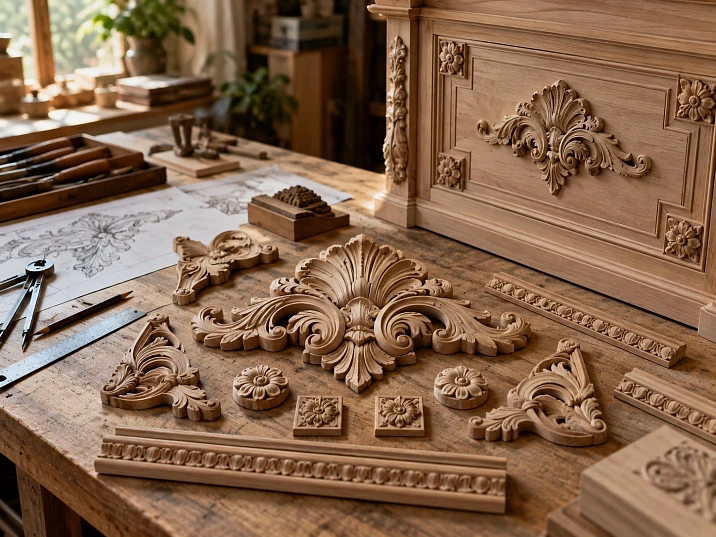
The cabinet door already has a wide molding frame, a bold cornice on top, and a large carved overlay chosen for the center. The catalog also had four suitable rosettes and a couple of corner elements. Individually, each detail looks convincing. Together, they can turn the front into a crowded gathering of ornaments: the eye jumps between the carvings, and no part of the furniture is perceived as the main one.
Carved decorations for furniture are best chosen in a certain order: first establish the main decorative accent, then decide whether it needs support, and only after that select the sizes and quantities of ready-made pieces. Sometimes one overlay is enough. Sometimes the composition is made up of two mirrored details. A tall wardrobe may need vertical elements, while a furniture portal may need pilasters, capitals, and a cornice that work as a single architectural system.
The main question before buying is not “how many carved details will fit on the front,” but “which part of the furniture should a person notice first.” The answer helps cut unnecessary items from the order, preserve open space, and prevent a situation where expensive carving hides the shape of the piece itself.
Every decoration should have its own role
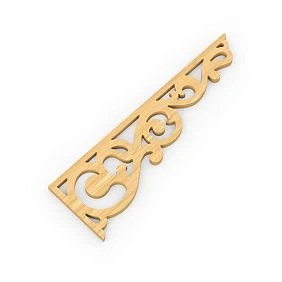
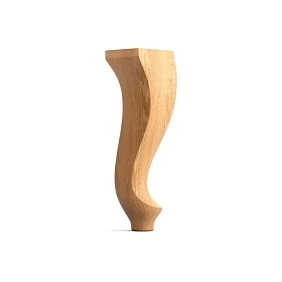
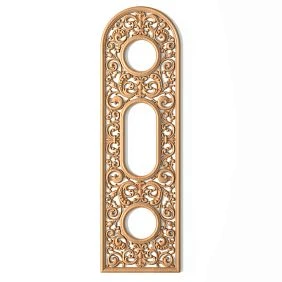
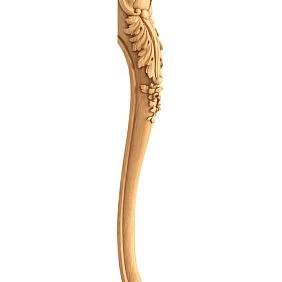
A finished wooden decor has different roles. The central overlay brings the composition together; the side elements set the direction; rosettes mark individual points; molding draws a boundary; the capital completes the pilaster; the bracket frames the transition under the projection. A mistake occurs when all these details are chosen as equal decorations without defining their mutual subordination.
It is convenient to distinguish between main, supporting, and repeating decor. The main element should be read first. The supporting one connects it to the furniture structure. The repeating one creates rhythm across several doors, drawers, or posts and does not require much visual attention to each individual detail.
| Role | Suitable elements | What they do in the composition | Typical mistake |
|---|---|---|---|
| Main accent | Central carved overlay, large cartouche, finial | Draws the eye to the selected part of the furniture | Add a second equally active ornament next to it |
| Support | Small side overlays, calm rosettes | Directs the gaze to the main accent | Choose a support larger than the main element |
| Rhythm | Identical small overlays, rosettes on facade series | Unites doors and drawers | Repeat the detail where a handle or profile already interferes |
| Boundary | Molding, decorative profile | Organizes the facade field | Make the frame more prominent than the central carving |
| Architectural termination | Capital, pilaster, cornice, decorative bracket | Connects the vertical and horizontal parts of the cabinet | Choose parts without checking their combined dimensions |
В STAVROS carved decor catalog details of all main groups are presented. But it is better to write down the composition of the future design before choosing specific article numbers. For example: "one central overlay on the top panel, a thin frame around the panel, without rosettes and corner elements." Such a formulation is far more useful than the vague wish for "more carving in a classical style."




Why one strong ornament is often better than five
Let's imagine a sideboard with two doors, three drawers, a wide cornice, and shaped handles. If you place an overlay on each door, a rosette on each drawer, and large carved details on the corners, you get many equally noticeable points. The eye no longer distinguishes the top, middle, and base. The piece loses its hierarchy.
For such a sideboard, a completely different scheme can be chosen: the main carved ornament is located on the upper frieze; the doors are supported by a thin frame; the drawers are left free because the handles do the work on them. At the same time, the entire piece of furniture is perceived as a composed design, not as a set of separately decorated surfaces.
Empty space is a full-fledged part of the decorative solution. On a calm surface, a carved line is more noticeable. If there is no unoccupied plane left around an acanthus leaf, scroll, or garland, the silhouette and shadow are lost: the small parts of the ornament merge with each other.
This is not a call to make all furniture minimalist. For a historicizing display cabinet, a formal library, or a large portal, rich decor is acceptable. But a rich composition still has order: the cornice crowns the piece, pilasters set the verticals, the central cartouche gathers the eye, and small elements do not repeat its strength. Even rich carving needs a clear structure.
The practical check is simple: cover the main element on the sketch. If the eye begins to wander aimlessly between the rosettes and corners, the supporting decor is too active. Restore the main accent, remove one group of small details, and compare both variants.
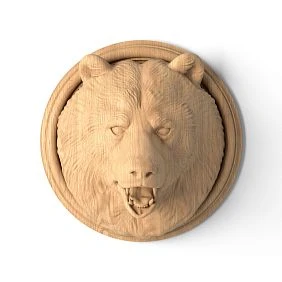
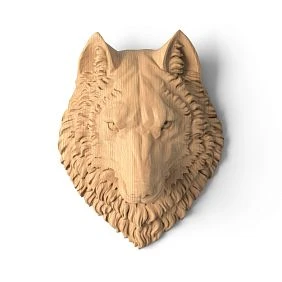
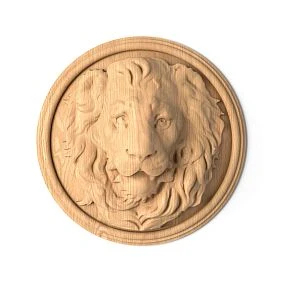
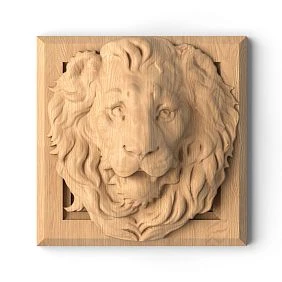
Our factory also produces:
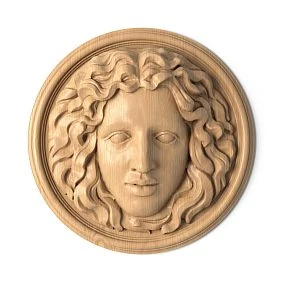
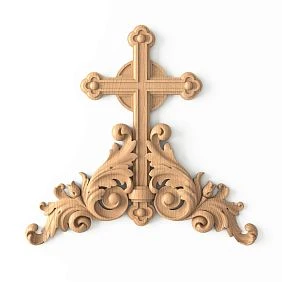
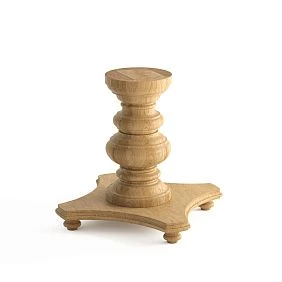
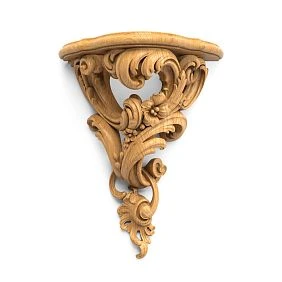
Where the compositional center of a furniture facade is located
The geometric middle does not always coincide with the place where the gaze is naturally directed. In a wardrobe with two symmetrical doors, the main center may be the line where they meet. In a chest of drawers with different drawer heights, it may be the upper frieze or the widest facade. In a display cabinet, attention often gathers near the glass part, and carved decor works better around its framing, without blocking the view.
Before selecting carved details, make a frontal sketch of the furniture and apply four layers to it: the outer dimensions, the existing frames and profiles, the handles with their working zones, and the free areas for decor. Only then mark one intended main accent.
Conditional example: a chest of drawers body 1200 mm wide has pilasters 80 mm wide at the edges. Between them, 1040 mm remains. On the upper frieze, side margins of 100 mm each are provided — meaning 840 mm is allotted for the main ornament. This value is already suitable for comparison with the width of specific overlays. The full width of the chest at 1200 mm would be misleading for such a task.
If the furniture stands against a wall sideways to the entrance, it is useful to check the composition not only from the front. From the doorway, the viewer may first see one end upright rather than the central element. This is not a reason to immediately shift the overlay off-axis. First, look at whether it needs to be supported by a calmer side detail or whether the finish contrast should be changed.
Finally, the center of the composition depends on whether the item is closed or open. In a cabinet with glass doors, the internal shelves and contents become part of the visible picture. A massive carved cartouche on the glass may cover exactly what the display case was made for. In such a case, it is better to give the main role to the framing of the opening.
Get Consultation
Central carved overlay: when one detail is enough
On a wide blind door, the upper frieze of a chest of drawers, or a solid panel of a furniture portal, one overlay can solve the entire decorative task. It indicates the direction of the ornament, creates shadow, and organizes the free space around itself. Additional rosettes and scrolls are not necessary.
Choose Carved decorative inserts for furniture better after determining the installation location. For a narrow, elongated field, a vertical shape is logical; for a low frieze, a horizontal one. A large central overlay on a low door may visually come close to the handle, even if technically both details are placed without touching.
Suppose the internal width of the decorative frame is 560 mm. An overlay 350 mm wide will leave 105 mm of free field on the left and right when centered. An overlay 500 mm wide will leave only 30 mm each. The second option is not necessarily bad, but its pattern will come almost right up to the frame. If the molding has a deep profile, the two reliefs will begin to compete. For such a field, it is wiser to first try a smaller element at full scale.
A central overlay also has a production advantage: one item is easier to account for, orient, and repeat across a series of identical fronts. But this advantage disappears if the chosen detail requires non-standard trimming or covers fasteners and technological gaps.
Here, an honest refusal to buy is appropriate. If the panel itself has a complex shaped form, and the handle is already located on its axis, a central carved overlay may turn out to be unnecessary. Sometimes it is enough to emphasize the existing profile with finishing.
Paired overlays instead of one large ornament
The two cabinet doors have a natural boundary — a vertical seam. Placing one large applique over it is tempting, but if it overlaps both doors, the furniture will no longer open properly. That is why for hinged fronts two separate pieces are more often considered, each mounted on its own door, or a decorative treatment of the fixed part of the carcass.
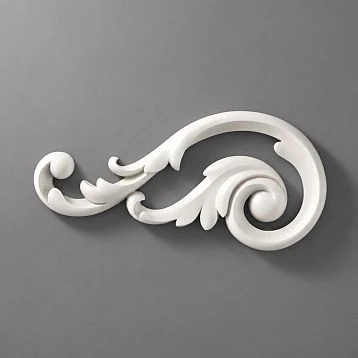
Directional plant ornaments are chosen with mirroring in mind. The left branch may reach toward the center, the right one may continue its movement. Two identical left appliques will produce a different pattern, even if the dimensions match. Before ordering, check whether the chosen model has a separate left and right version; the markings and the product image matter more than guesses from a thumbnail.
At the same time, a pair does not always mean the same scale. On an asymmetrical cabinet, one door may be wider than the other. Two equal carved pieces on unequal fields sometimes emphasize the difference in size more strongly than desired. There are two solutions: choose elements of different sizes with a common motif, or abandon the paired decoration in favor of one central piece on the fixed frieze.
For two doors 450 mm wide with a working decorative field of 310 mm each, an applique 240 mm wide will leave approximately 35 mm of free space. But before buying a pair, check that this is truly free space after accounting for handles, hinges, and frames. The problem especially often arises on the narrow locking stile near the handle.
Paired elements are convenient to try on simultaneously. In separate photos they may look coordinated, but on the assembled cabinet they may appear visually too close to the seam. When evaluating, leave a clear pause between them — or, if the concept requires a converging pattern, make it deliberate, without sacrificing the opening of the fronts.
Vertical decorations: how to style a tall cabinet without cutting it into stripes
Tall furniture sets its own direction. On a cabinet or bookcase, vertical carving can emphasize the stiles, decorate a pilaster, continue the line of the door, or connect the upper and lower parts of the carcass. But long appliques on both sides of each door sometimes create too frequent a rhythm, making the furniture seem narrower and taller than it is.
To begin, choose which verticals are truly important: the outer side panels, the central stiles, or the door frames. If three vertical dividers are already highlighted on a four-door cabinet, additional carved strips along all eight door edges may be excessive. It is enough to emphasize the outer stiles or the two central axes.
It is useful to compare the height of the entire item, the length of the vertical decoration, and the height of the free section. For example, a cabinet 2400 mm high has a working flat area on the side stile 1550 mm long: the rest is taken up by the plinth, the top cornice, and structural joints. You cannot choose an applique 1800 mm long based only on the overall height of the cabinet. It will extend onto neighboring elements that should remain independent.
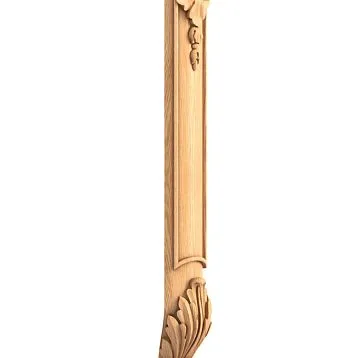
The vertical applique is joined to the pilaster with particular care. A pilaster is already an architectural detail with its own base and termination. If a large independent carving is placed on it without coordinating the pattern, it may lose its proportions. Sometimes a smooth pilaster shaft and an expressive capital on top are enough.
In the pilaster and wooden columns it makes sense to select elements as parts of the architectural design of furniture, rather than as random overlays on any surface.
Horizontal decor for a chest of drawers, buffet, and upper frieze
A chest of drawers usually has main horizontal lines: the top, the drawer boundaries, the plinth. A long overlay at the top supports this logic. But if you fill every line between the drawers with carving, the facade will begin to break up into equally active stripes.
On a wide chest of drawers, an expressive horizontal ornament can be placed under the top, leaving the drawers calmer. Then the handles do not compete with the carving. On a buffet, a large upper frieze can unite two groups of doors and serve as the main decoration of the entire piece.
Here the difference between the length of the overlay and the length of the free field is especially noticeable. For a frieze 900 mm wide, a part 550 mm long leaves 175 mm on each side if centered. A part 650 mm long leaves 125 mm on each side. With a large floral ornament, both options can look appropriate; with a very low frieze, the first may appear visually lighter.
In the STAVROS catalog there is, for example, wooden decor N-056.1 with the specified size options 550 × 70 × 14 mm and 650 × 83 × 16 mm. This is an example of how one design can change scale when moving to another modification. Check the orientation of the parameters and the shape of the product against the drawing in the specific product card: decor N-056.1.
On the facades of pull-out drawers, the relief is placed taking into account hand movement and the design of the slides. If the overlay is directly under the handle, fingers may catch on the protruding carving. If the decor covers the area where the hardware is attached, replacing it later will become more difficult. Therefore, it is often better to decorate not the drawer itself, but the fixed part of the cabinet above it.
Corner elements and rosettes: support without overloading the center
A corner overlay finishes the edge of a frame or the inner corner of a decorative field. Its advantage is that it allows the center of the facade to remain free. This is especially useful on doors with a beautiful solid wood texture, where you don't want to cover the central wood grain.
However, four large overlays at the corners can prove stronger than a single central one. If each has elaborate scrolls and deep shadow, the frame becomes a rich ornamental wreath. On a narrow door, it will visually compress the entire inner field. In such a situation, it is wiser to choose small corner elements or to decorate only the two upper corners.
wooden rosette works differently. It creates a local focal point: in the center of a frame, at the intersection of moldings, or in a sequential row. Rosettes link the composition well with the repeating geometry of the furniture if their size and relief are clearly subordinate to the main ornament.
Let's imagine a cabinet with a central carved overlay on the upper frieze and two tall doors below. If one small rosette is installed on each door, they can support the composition. If four more rosettes are added to the corners of each frame, there will already be eight additional accents. A person will read individual dots instead of a cohesive piece.
A rosette must match the installation site not only in diameter. Check the thickness, the shape of the back side, the mounting method, and the distance to other decorative details. On a molding frame, a special Decor for Molding, and not an ordinary flat rosette.
Capital and bracket: the decorative architecture of furniture
In large classical furniture, carving often works not as a standalone overlay but as part of the architecture. A pilaster sets the vertical, a capital completes it beneath the upper band, and a cornice crowns the entire case. The reader perceives this as a single system if the transitions and proportions are consistent.
For a floor-to-ceiling bookcase or a furniture portal, it is reasonable to first choose the overall silhouette: the height of the plinth, the width of the uprights, the projection of the cornice, and the dimensions of the upper part. Only after that should you select wooden capitals. A capital that is too wide on a narrow pilaster will look like a random applied "cap," while one that is too small may get lost under the cornice.
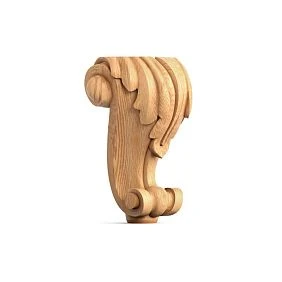
A bracket more often denotes a supporting assembly: under a shelf, a protruding part of a portal, a console, or a decorative cornice. Visually, it explains where the overhang comes from. But a decorative form by itself does not confirm the load-bearing capacity of the product. If the bracket is expected to carry a load, you need an engineering calculation, suitable fasteners, and manufacturer data specifically for that structure. Carved wooden brackets they cannot automatically be considered structural supports for a heavy shelf.
In a furniture portal with a pair of pilasters, the main rhythm is already set by the uprights, capitals, and cornice. Adding a large cartouche to every field between them is not necessary. Often a single central element above the opening completes the design better than many identical small details.
How to harmonize ornaments: acanthus, scrolls, cartouche, and geometry
Two carved elements may be close in size and material but not suit each other in pattern. Dense acanthus with broad leaves creates a complex play of shadow. A thin geometric line acts more calmly. A rocaille scroll has a different movement than a strict symmetrical plant ornament. They can be mixed only when it is clear which motif is dominant and how the others are subordinated to it.
It is convenient to consider three properties of a pattern: direction, density, and character of the line. Direction shows where the ornament moves — toward the center, upward, or to the sides. Density determines how much empty space remains within the silhouette. The character of the line — smooth leaves, rigid geometry, a volute, a garland — forms the overall language of the composition.
For example, a central cartouche may have strong symmetrical scrolls. If the side overlays repeat the same large scrolls, several competing centers appear. It is better to choose details with a simpler plant continuation or leave the side fields smooth.
Repetition does not have to be literal. An ornament of acanthus leaves can coexist with a smooth molding that supports its geometry without depicting new leaves. Conversely, adding carved grapes, a geometric rosette, and a shell in one small field requires caution: each motif has its own semantic and plastic character.
With a transparent wood finish, the ornament is read together with the direction of the grain. Even similar carved details made from different species can look alien due to differences in texture. Under opaque enamel this problem is less noticeable, but the difference in depth and character of the relief remains.
Scale: compare the dimensions of the product with the working field, not with the entire cabinet
Furniture has several dimensions at once: the overall dimensions of the carcass, the dimensions of a door or drawer, the internal field between moldings, and the actually flat area for mounting. For a carved overlay, the last measurement matters. A wide door may have a narrow panel; a tall cabinet may have a short free section between the cornice and the handle.
On STAVROS product pages, the dimensions of carved decor are designated by the letters A, B, and C. The direction of width and height must be checked against the drawing of the specific item: one should not mechanically assume the same letter means "width" for all types of decor. The third dimension indicates the projection in depth and also affects the composition.
| Comparison | What to measure | Why it's important |
|---|---|---|
| Decoration size and working area | Part dimensions and the actually flat area | The applique must not overlap an unsuitable profile |
| Decoration size and adjacent decor | Distance to molding, rosette, pilaster | Two expressive details may appear merged |
| Thickness and hardware | Relief protrusion and hand movement area | The overlay should not interfere with using the furniture |
| Size and scale of the cabinet | Overall width/height of the item and size of the main accent | Fine carving may get lost, while large carving may overpower the shape |
| Repetition across a series of fronts | Dimensions of each door and drawer | One model does not always suit fields of different sizes |
Calculation based on a conventional front. The door width is 520 mm, and the side frames take up 55 mm each. The flat part between them is 410 mm. If another 30 mm on each side is planned to remain for free perception of the ornament, the recommended width limit for fitting is 350 mm: 520 − 55 − 55 − 30 − 30 = 350 mm. This is not a construction standard or a mandatory proportion for all fronts, but a scheme for determining the initial range for selecting a product.
Specific models have different size ranges. For example, for wooden decor N-148.1, the catalog lists options 250 × 40 × 9 mm, 350 × 56 × 12 mm, and 550 × 89 × 19 mm; for N-117.1 — 160 × 315 × 9 mm, 200 × 394 × 11 mm, and 280 × 551 × 15 mm. This information is useful as a guide to how sharply the dimensions of one model can change when choosing the next size. Check the modification in the product card N-148.1 or N-117.1rather than transferring dimensions between product codes.
Why relief depth changes the composition even with identical dimensions
Two overlays 300 mm wide can differ in relief projection by several centimeters. On a flat sketch they will occupy the same space. On a real facade, one will almost blend into the surface, while the other will cast a deep shadow and become the main visual accent — even if that was not intended.
Depth should be assessed in combination with lighting. Side light emphasizes height differences; soft frontal light makes them less noticeable. Under dense enamel, the surface becomes uniform in color, but the shadow remains. With patinated finishes, the recesses darken further, which can make fine carving look richer.
There is also a practical limitation. High relief near a handle can catch fingers; on lower drawers — clothing and cleaning items. For furniture with pull-out fronts, check whether protruding decor interferes with opening the adjacent drawer. On cabinets with hinged doors, pay especially close attention to the area where the leaves meet.
If the central overlay has deep relief, it is reasonable to choose a supporting molding that is more restrained. If, however, the cornice or pilaster is meant to be the expressive element, the overlay within the field can be flat and small. The outer thickness of individual elements should not accidentally turn secondary decor into the main feature.
Full-scale template: how to check the composition before ordering
A product photo shows the pattern but does not guarantee an accurate sense of scale. On screen, a large overlay may seem compact, while a group of rosettes may be almost invisible. Checking with paper templates takes less time than redoing a finished painted facade.
- Make a frontal drawing or photograph of the cabinet, chest of drawers, or nightstand without perspective distortion. Mark the frames, handles, seams, and boundaries of moving parts.
- Mark the main free field and the place for the primary decoration. In the first version, do not add secondary details.
- Cut out the template of the main element according to the drawing or the closest possible contour at a 1:1 scale. A rectangle based on maximum overall dimensions is suitable only for a preliminary check.
- Look at the item from a normal distance: near the bed, passage, dining table, or room entrance. These are the points from which the furniture is seen every day.
- Add supporting details one group at a time: first the molding, then the rosettes or side overlays. After each added group, compare the option with the previous one.
- Check the opening and access to the hardware. Paper does not show thickness, so for protruding parts, model the depth separately with cardboard or a mockup.
- Photograph the approved scheme and record the dimensions. For several identical fronts, also save the orientation and quantity of each position.
Do not judge only by a large photo of a single fragment. Take a second shot of the entire item together with the neighboring furniture. A carved overlay that works well on a separate door may clash with the massive frame of a mirror or the decor of a cabinet standing nearby. Compatibility is decided at the level of the item and the interior, not a single ornament.
Three combinations that work for different tasks
Overlay and molding: one creates an accent, the other a border
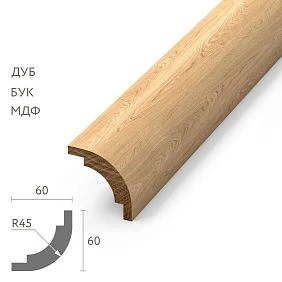
Wooden moldings can organize the front, even if they themselves have a simple profile. Their line outlines the working field. The central overlay is placed inside it, not necessarily touching the frame. The more active the carving, the calmer the profile can be.
If the composition is being designed from scratch, the order of purchase depends on the main concept. When the geometry of the panels is more important, the sizes of the frames and moldings are chosen first. When everything is built around a large cartouche, its dimensions are determined first, and only then is the free space around it calculated. But both solutions are checked in a single sketch before manufacturing the front.
Overlay and rosettes: repeating a secondary motif
One central overlay and two small rosettes can create a clear scheme on a wide frieze. Rosettes are placed where they support the rhythm of the moldings or the verticals of the cabinet. They do not have to be placed in every free corner: even a small detail, when repeated many times, gains considerable visual weight.
A good check is to remove the rosettes from the layout. If the composition becomes clearer, then they were not performing a necessary role. If the rhythm between the groups of facades disappears, the support was indeed useful.
Pilaster, capital, and cornice: a unified furniture portal
Here, people buy not individual decorations but a coordinated set of architectural parts. First, the width and position of the uprights are established, then the dimensions of the capitals, the height of the upper band, and the projection of the cornice are determined. The carved pattern is chosen after checking the joints and proportions. With this approach, an expressive capital can itself become the main decoration, and a separate large ornament above it will not be needed.
If the portal surrounds an opening or a TV niche, do not forget about the usable width and access for maintenance. Increasing the decorative uprights reduces the free space. Carved decor must not interfere with opening equipment, doors, or access to wiring.
Different furniture — different compositional solutions
Cabinet with two hinged doors
The main risk is accidentally assembling a single overlay across two movable facades or overloading the closing line. A reliable scheme: two mirrored small details on separate doors, or one accent on the fixed upper frieze. If the doors already have profile frames, additional rosettes are considered only after a general fitting.
For a built-in wardrobe, the appearance of the entire front together with the side fillers is important. With a large number of identical doors, it is sometimes better to decorate the outer zones while leaving the middle ones calm. This way the composition gets a beginning and an ending without turning into an endless repetition of the same pattern.
Chest of drawers with multiple drawers
On a chest of drawers, it is more effective to highlight the top or the fixed upper section than to repeat a large overlay on every drawer. If the drawers differ in height, the same ornament on them changes the visible proportion: on a low drawer it looks dense, on a tall one it looks lost. If repetition is necessary, choose different variations of a single motif or move the decor to the carcass.
Carved handles alone can already be a sufficient repeating element. In that case, decorative overlays on the drawers should be kept minimal or omitted entirely. Hardware is part of the composition, not a separate technical detail.
Bedside and TV cabinet
Low furniture is more often viewed from a short distance. Deep carving on the front of a cabinet may seem heavier than on a tall wardrobe, especially next to soft upholstery and calm walls. A small top accent, a thin frame, or details on the fixed plinth work better — provided they do not interfere with cleaning and using the drawers.
For a TV cabinet, consider ventilation openings, cable access, and equipment doors. Decor should not cover functional areas for the sake of a continuous pattern.
Sideboard and display cabinet
The upper and lower parts of a buffet can have different decorative roles. At the top, glass, cornice, and posts become the main elements; at the bottom, solid fronts. It is not necessary to repeat the same carved overlay on all levels. You can give the upper frieze a pronounced ornament, support it with capitals, and leave the lower part visually stable and calm.
With a display cabinet, the main risk is blocking the contents. If the furniture is intended for dishes or a collection, the carved composition should serve as a frame rather than obstruct the view.
Kitchen facades
For the kitchen, it is especially important to consider how often surfaces are touched and how easy they are to clean. Small deep carving near handles, the stove, and the worktop requires more attention when cleaning. Decorative accents are usually more convenient to place on upper finishes, columns, and individual statement fronts rather than on every pull-out drawer.
If a covering enamel is planned, wooden carved parts can be painted within the overall finish system after the technology has been approved. But before mass production, check a sample: carved areas and the flat base may absorb primer and topcoat differently.
Beech or oak: which species to choose for a unified composition
Beech is convenient for projects under opaque enamel, when the ornament, molding and base should look like one painted surface. Here, preparation, sanding and the correct finishing technology are important. If the facade will be white or colored, the expressiveness of the wood grain is not the main criterion.
Oak is often chosen for clear oil, lacquer or tinting, when the grain pattern should remain visible. On a large chest of drawers, oak overlays can support the texture of the oak top and facades. But the name of the species alone does not guarantee a complete match in shade: the cut, the original tone, the absorption of the stain and the grain pattern all differ.
Mixing beech and oak in one composition under a clear finish without a test sample is risky. After staining, they can differ noticeably even when using the same product. Under a dense enamel, the difference in species is visually smaller, but the requirements for surface preparation and joints remain.
| Furniture finishing | What to pay attention to when choosing overlays | What to check before the batch |
|---|---|---|
| Covering enamel | Uniformity of preparation, quality of sanding, characteristics of glued parts | Test stain together with the facade base |
| Transparent varnish | Wood texture, matching grain direction, shade | Samples from the actual batch |
| Oil or tinting | Difference in absorption and colour depth | A separate test on the carving and the flat surface |
| Patina | How recesses and small details darken | Whether the secondary decor becomes too contrasting |
The finish can change the compositional hierarchy. If the central ornament and the side overlays are the same color, but the central one is noticeably deeper, the main accent is determined by shadow. If, however, small rosettes are heavily darkened by patina, they may unexpectedly draw attention to themselves. Therefore, a test finish is better evaluated on a group of elements rather than on a single part.
From dry layout to final finishing
The sequence of work depends on the furniture construction and the coating system, but the composition itself must be agreed upon before irreversible operations. For new joinery furniture, a practical order usually begins with checking dimensions and dry-laying all parts on the actual fronts.
At this stage it is clear whether the actual dimensions match the sketch, whether the directional elements are positioned correctly, and whether there is enough space for handles. Then the method of fastening and finishing is approved. Some items are more conveniently pre-finished separately in order to reach complex carving; others are assembled with the base before final painting. There is no universal gluing order for all constructions and materials.
Work especially carefully with solid wood panels. In a frame-and-panel construction, the panel may move when humidity changes. The overlay must not arbitrarily bind the movable panel to the fixed frame. On veneered and board fronts, the condition of the coating and the permissible fastening technology must be checked separately. An abundant adhesive layer does not replace a level seating surface.
After the assembly is approved, make a test finish with the same primer and topcoat that are planned for the production furniture. Look at how the recesses are colored, whether the fine pattern is lost under a thick layer of material, and whether there is a noticeable transition along the edges of the overlay. Only after checking should you move the composition into production.
How to transfer the composition to a series of identical fronts
The approved first facade should become the reference sample, not just a photo in a chat. For repeatable production, it is necessary to record the exact article number of each part, its modification, dimensions, material, orientation, and installation location. Separately indicate the number of elements per one unit of furniture and for the entire batch.
The most common organizational mistake is to order a sufficient total quantity of overlays but not separate the left and right modifications. For ten two-door cabinets with one pair of directional elements on each, you will need 10 left and 10 right overlays, not just twenty arbitrary items of the same pattern.
If a chest of drawers has three drawers of different heights, each group of facades may correspond to its own dimensional modification. The specification should link the part not only to the furniture model but also to the specific zone. Otherwise, when reordering, the craftsman will receive the correct items but in incorrect quantities.
| Designation | Where is it installed | Function in the composition | Article | Dimensions according to the drawing | Orientation | Quantity per item |
|---|---|---|---|---|---|---|
| D-01 | Top wardrobe frieze | Main accent | Specify after selection | A × B × C | Central | 1 |
| D-02 | Left leaf | Support | Specify after selection | A × B × C | Left | 1 |
| D-03 | Right leaf | Support | Specify after selection | A × B × C | Right | 1 |
| D-04 | Side posts | Rhythm | Specify after selection | A × B × C | Paired or symmetrical | 2 |
This table is an example of a specification form, not a list of existing product article numbers. For each row, add the wood species, sanding option, finish, exact link to the product card, and the number of the approved drawing. When the set is accepted, it is convenient to designate it as approved and use it only after checking for design changes.
Useful for joinery workshops terms of cooperation with manufacturers и section with drawings and materials for download. Having a drawing is especially important when ordering elements that must be repeated across several dozen facades.
How to calculate the number of ornaments and avoid buying too many
The quantity depends on the composition, not on the total area of the furniture. A wardrobe with four doors may have one main ornament on the frieze and two supporting overlays on the outer stiles — three pieces in total. Another project calls for one overlay on each door, plus four rosettes — already eight pieces. No scheme is correct outside a specific sketch.
For a series, the formula is simple: the number of parts of one type per item × the number of identical items = the requirement for that position. But directional elements are counted separately. If each of the eight display cabinets has two capitals, two brackets, and one central overlay, you will need 16 capitals, 16 brackets, and eight overlays. After calculating, check which positions differ in size or orientation.
The reserve should not be assigned arbitrarily as a percentage for all wooden items. Finished carved parts are usually not cut as linear profile. Additional quantity may be needed for a control sample, finish testing, or an agreed production reserve, but it is calculated based on the actual technology and delivery terms. Complex paired elements cannot be replaced with random surplus from the other side.
For moldings, the calculation is different: determine the length of the sections, the number of corners, the joint pattern, and possible waste when trimming. Therefore, in one specification it is better to keep piece carved items and linear materials separately. This reduces the risk of error when purchasing a complete set for furniture.
One style for a wardrobe, chest of drawers, and cabinet: repeat the motif, not the entire pattern
If several pieces from the same furniture group are placed in a room, there is a temptation to put identical carved overlays on all of them. But a central cartouche suited to a tall wardrobe will look disproportionate on a small bedside table. Cohesion is achieved not by literally repeating a single detail, but by coordinating the direction of the ornament, the wood species, the finish, and the placement of accents.
Let's imagine a bedroom where a 2300 mm tall wardrobe is paired with a 1100 mm wide chest of drawers and two 450 mm wide bedside tables. On the wardrobe, a carved top cornice can be the main feature; on the chest of drawers, a central horizontal element; and on the bedside tables, identical handles and a simple molding are enough. The presence of carving should not be a mandatory feature of every piece. Visual unity is created by the proportions of the profiles, the repetition of a similar floral motif, and a consistent finishing method.
It is useful to draw up a short chart for the entire furniture group. In one column — the pieces, in the second — the main accent, in the third — the repeated unifying feature. For example, the wardrobe's main feature is a cartouche, the chest of drawers has an overlay on the frieze, and the bedside table has a smooth line of the top profile. What remains common are the fine leaves in the carving, the same enamel color, and the similar molding height. This allows the furniture to look related without making it monotonous.
There is also a practical reason not to duplicate everything indiscriminately. On a chest of drawers, a person sees the carving almost at arm's level; a tall wardrobe cornice is perceived from below; on a bedside table, the decor is seen from arm's length. The same deep relief in all three places will produce a different result. Scale should be checked from real viewing points.
When ordering a set, separate the items that are repeated throughout the group from the details intended for only one piece. Then replacing the wardrobe model will not entail an unnecessary purchase of new rosettes for all the bedside tables. Such a schedule is convenient both for the workshop and for the owner who will be buying additional pieces later.
When it is better to forgo carved decorations
Sometimes the texture of solid wood, the shape of the panel, or the profile of the facade already provide sufficient decoration. If expressive wood is covered by a large overlay, the furniture may lose its own pattern. On narrow facades, where a handle and a molding are located close together, there is physically no good field left for relief.
You should also not buy the chosen detail when it forces you to cover a moving joint, hides hardware screws, interferes with drawer extension, or requires attachment to an unreliable surface. On furniture being restored, the condition of the old structure and finish is checked first. A new decoration should not become a way to hide wood decay or a wobbly joint.
Another limitation is a foreign pattern. If a wardrobe has a strict geometric composition, and the chosen carved detail is a dense asymmetrical floral cartouche, it can be used only after a thorough check of the overall design. Sometimes a neat wooden molding or a small rosette will work better.
Finally, forgo secondary decorations if the main element is already doing its job. Removing two rosettes from the sketch can give the composition more integrity than buying yet another overlay.
Where to buy carved furniture decorations and how to assemble an order
To purchase ready-made wooden decorations, start with the general catalog of STAVROS carved decor. If the composition needs a main central or side element, go to the section carved wooden inserts. For spot accents, the following are available Wooden sockets; for the architectural framing of cabinets and portals — Capitals, pilasters и Brackets.
If you plan to buy carved wooden decor for several types of furniture at once, first draw up a single scheme for each item. For a cabinet, a couple of appliques may be enough; for a chest of drawers, one horizontal element; for a large portal, a coordinated set of architectural details. With this approach, the order includes the items you need, rather than everything you liked in the photos.
Before paying, check in each product card the article number, specific size, material, surface preparation quality, required orientation, availability, and current price. The cost of the final composition consists of the price of each selected part, its quantity, installation materials, finishing, and delivery. If some elements are made to order, the furniture production schedule should be coordinated with their delivery times.
Ready-made carved items allow you not to carve each ornament from scratch, but they do not eliminate design. Their advantage is revealed when the craftsman knows in advance which detail is the main one, which are subordinate to it, how much free space remains, and how everything will be assembled into a single furniture composition.
Frequently Asked Questions
Can carved decorations from different collections be combined?
It is possible if the character of the pattern, the scale, and the purpose of the parts match. The collection name alone does not guarantee harmony. Compare the orientation of the ornament, the density of the carving, the depth of the relief, and the future finish on a single sketch. For a small facade, mixing several expressive motifs is especially risky.
What should you do if the overlay you need isn't available in a mirrored version?
You shouldn't automatically flip an asymmetrical ornament: the direction of the leaves and the top-bottom orientation of the pattern may end up wrong. Check whether you can use a symmetrical model, choose a different pair, or shift the main accent to a fixed part of the carcass.
Should every drawer of a chest of drawers be decorated?
No. If the main decorative work is done by the top frieze, the handles, or the side posts, the drawer fronts can remain smooth. Repeated decor is justified when it creates a clear rhythm and doesn't interfere with the hardware's operation.
Are ready-made wooden overlays suitable for painted MDF facades?
The decision depends on the coating, the condition of the base, the size and weight of the piece, and the mounting method. Before ordering, check the compatibility of the finish and the permitted installation technology. You shouldn't assume that any ready-made MDF coating can reliably hold a large carved piece.
What should you choose for a small cabinet: an overlay or a rosette?
If the free field is short and a handle, a small rosette, or a restrained molding is located nearby, a smaller applique is often more convenient than a large one. If the cabinet has a wide fixed frieze, a compact horizontal ornament can be placed on it. The final decision depends on the exact size of the area.
Can decorations made of beech and oak be ordered for the same piece of furniture?
Technically, combining materials is possible, but under a transparent finish, differences in texture and shade may be noticeable. For a uniform result, prepare test samples. Under opaque enamel, it is especially important to align the quality of preparation and the coating, not just the wood species.
How do you place a repeat order for a workshop without confusion?
Keep an approved list with article numbers, modifications, dimensions, orientation, finish, and quantity per furniture unit. When placing a new order, verify the data against the current product cards and check whether the facade dimensions or hardware in the project have changed.
A good composition is not determined by the amount of carving. It is enough for the main accent to be noticeable, for the supporting elements to explain the structure of the furniture, and for the open areas to give the design space. Then carved decorations look like parts of one piece rather than a randomly assembled set of ready-made parts.