








































































Article Contents:
- What is a non-standard window in the context of decor
- The main principle: the architrave should work for the window's proportion, not against it
- Architraves for small windows: bathhouse, outbuildings, bathroom
- Why a small window is a separate task
- What to choose
- Bathhouse: a special case
- Architraves for narrow windows: verticality as a decorative resource
- What a 'narrow window' means in an architectural sense
- How to work with the proportion of a narrow window
- Narrow window and brackets
- Trim for tall windows: how to handle the length
- What's the problem with tall windows
- Connecting elements: invisible seam
- Vertical ornament for a tall window
- Different windows on one facade: how to create unity
- When the facade turns into a puzzle
- Unified ornament — a key tool
- How to adapt the width
- Facade Hierarchy
- Mansard and Gable Windows: Decor on a Steep Slope
- Horizontal Dormer Windows
- Gable Window
- Windows Near the Porch and Entryway
- What Additional Elements to Use with Non-Standard Windows
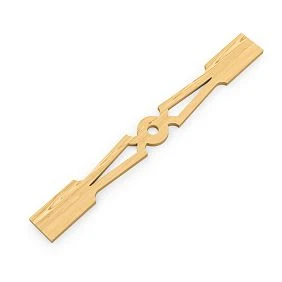
- Connecting elements
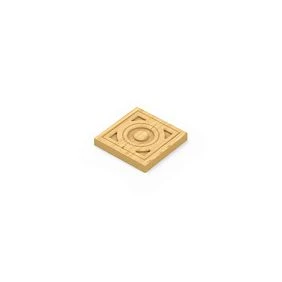
- Decorative rosettes
- Wooden frame
- Top Trim and Pediments
- Elements for Porch and Canopy
- How to Choose Trim if Windows on the House Are Different Sizes: Practical Table
- How to Choose Trim if the House is Old and Windows Are Different
- Color of trim on non-standard windows: special considerations
- For a small window
- For a narrow window
- For different windows on the same facade
- Typical mistakes when choosing trim for non-standard windows
- Same trim width for all windows
- Too rich ornament for small openings
- Ignoring window height when calculating length
- Unthought-out joints
- Mixing ornaments
- Purchase without measurements
- Painting without edge treatment
- Ready-made trims for non-standard windows: why they work
- Calculating a kit for a non-standard window: step by step
- Where to see examples and how to get inspired
- Quality and material: what lies behind a ready-made trim
- Frequently Asked Questions
- Which trims to choose for a small window in a bathhouse?
- Can carved trims be used for narrow windows?
- What if the windows in the house are of different sizes?
- Are ready-made trims suitable for non-standard windows?
- Are rosettes and connecting elements needed?
- How to calculate the number of trims for a non-standard window?
- What color to choose for trims on a small window?
- STAVROS: precise decor for any window
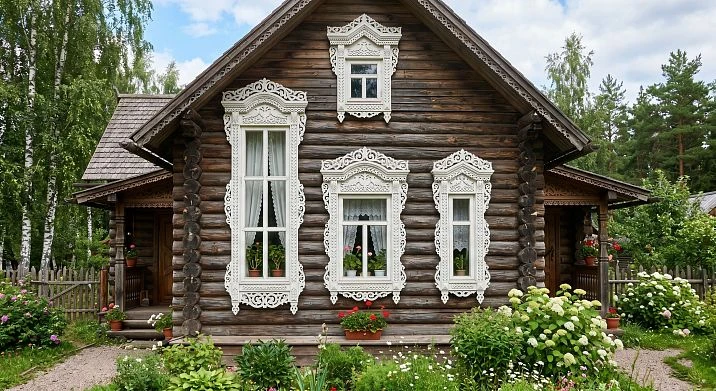
The task seems simple only at first glance: buy trims, nail them, done. But what to do if the windows on your house are nothing like the standard 1200×1400? If the bathhouse has a tiny opening of 500×600, the veranda has a narrow elongated window under the ceiling, and the main facade has several windows of different sizes that somehow need to be brought to a single decorative denominator?
It is at this moment that many stop and don't know what to do next. Yet the answer exists — and it is much simpler than it seems. Carved trims for non-standard windows — this is not a separate category of products, it is the correct principle of selection. And this principle can be learned.
This is exactly what this article will cover in detail, with specific examples and practical logic.
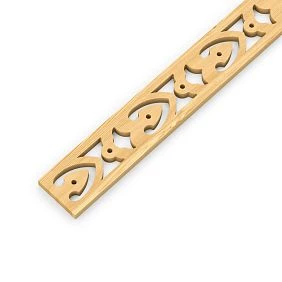
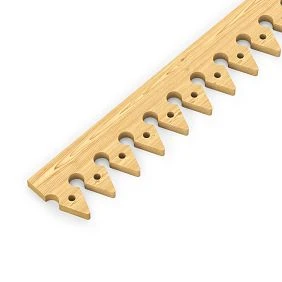
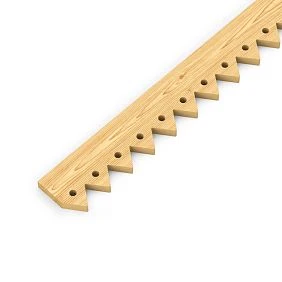
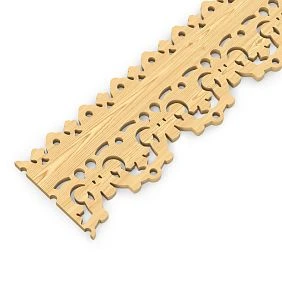
What is a non-standard window in the context of decor
First of all, let's agree: from a decor perspective, a "non-standard" window is any window for which you cannot simply take the first trim you see and hang it without thinking. This could be:
-
Small window — opening 500×600 mm, 600×800 mm. Typical for baths, utility buildings, bathrooms, attic rooms.
-
Narrow and tall window — opening 400–600 mm wide with a height of 1400–1800 mm. Characteristic of verandas, old wooden houses, stairwells.
-
Wide panoramic window — not a frequent guest in a wooden house, but found on verandas and living rooms of modern construction.
-
Windows of different heights on one facade — an old house where the windows of the first and second floors have different proportions.
-
Windows near the porch or entrance group — they enter into a decorative dialogue with the door and canopy, and need to be considered as a system.
-
Mansard or gable windows — often have non-standard sizes or are located in a space where standard installation is impossible.
Each of these cases requires its own approach. Not a special product — but a special way of thinking about proportion.




The main principle: the casing should work with the window's proportion, not against it.
This is the very foundation on which everything else is built. Remember it — and half the task is already solved.
A casing is a frame. Its role: to highlight the window, give it completeness, create a clear boundary between the opening and the wall. But the frame works correctly only when it is proportionate to what it frames. A wide gilded frame around a small watercolor looks ridiculous. A thin strip around a large canvas — helplessly. The same story here.
For a small window, a narrow casing with a neat ornament. For a tall one, elongated side elements with a clear vertical rhythm. For a wide one, a larger-scale frame. For different windows on the same facade, the same ornament in different size versions.
This principle solves most tasks. Now let's look at each type of non-standard window in detail.
Our factory also produces:
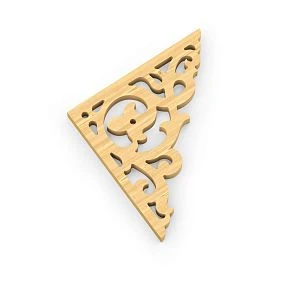
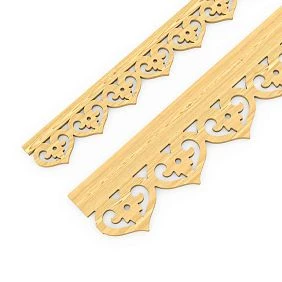
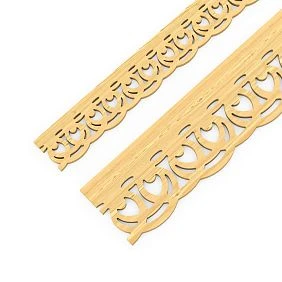
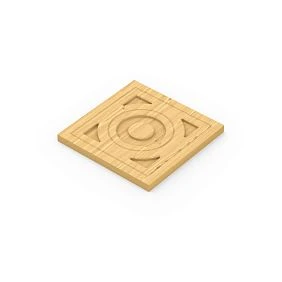
Casings for small windows: bathhouse, outbuildings, bathroom
Get Consultation
Why a small window is a separate task
A small window does not need a monumental frame. But it needs it just as much as a large one—just on a different scale. Without a casing, even a small opening looks unfinished: the gap around the frame, exposed mounting seam, bare slope.
A common mistake: they take 'what's available'—a wide casing with a rich ornament—and hang it on a small bathhouse window. The result is predictable: the frame takes up more space than the window itself. The visual 'weight' of the decor presses on the opening, and instead of a neat design, you get an overloaded point on the facade.
What to choose
For small windows—up to 800 mm wide and up to 1000 mm high—the optimal casing width is 60–90 mm. No more. The ornament should be simple: a geometric pattern, a simple plant motif, a neat cut-out design without fine detailing.
The principle 'simplicity of ornament—purity of execution' works well. On a small window, it is the cleanliness of the design, the accuracy of corner cuts, and even painting that create the impression of professional, well-considered decor.
Corner rosettes for small windows are desirable. They cover the joints and create a sense of completeness, which is especially important on a small opening.
Bathhouse: a special case
A bathhouse is a structure where function is more important than decor. But that doesn't mean there should be no decor. On the contrary: a neat trim on the bathhouse window instantly gives the building a lived-in, well-kept look.
For a bathhouse made of timber or rounded logs buy house carving you can use the same series as for the main house — only in a narrower format and with a calmer ornament. Unity of style with different sizes creates a sense of a well-thought-out ensemble, not a random set of buildings.
Trims for narrow windows: verticality as a decorative resource
What 'narrow window' means in an architectural sense
A narrow window is a window whose width is significantly less than its height. For example, 400×1400 mm or 500×1600 mm. Such windows are found on verandas, in stairwells, on the end facades of wooden houses.
A narrow window itself carries a vertical rhythm — it draws the eye upward. This is a resource that can be used in decor.
How to work with the proportion of a narrow window
The side trims of a narrow window are long vertical elements. They set the rhythm. If the ornament of the side trims has a pronounced vertical character — repeating vertical elements, narrow cut-out details — it enhances the upward pull of the opening. This is good.
The upper casing of a narrow window is a horizontal element. It "closes" the vertical line, creating a finish. For a narrow window, it is better to make the upper casing slightly calmer in ornament than the side ones — this preserves the priority of vertical movement.
Width of the casing for a narrow window: if the window is 400 mm wide, a casing width of 120 mm will be too large — the casings will take up more than half of the total opening width. Guideline: the total width of two side casings should not exceed 30–35% of the window width itself. For a 400 mm window, this means a casing no wider than 60–70 mm.
Narrow window and brackets
Brackets next to a narrow window are a powerful decorative tool. A bracket installed above a narrow window under a cornice or canopy creates a vertical support point that completes the entire decorative "column" from the windowsill to the top line. wooden decorative elements — brackets of different sizes and ornaments — complement a narrow window where a single casing is not enough.
Casings for tall windows: how to handle the length
What is the problem with tall windows
A tall window is a window with a large opening height: 1600 mm, 1800 mm, 2000 mm or more. They are less common in wooden houses than in urban buildings, but they still exist: large windows in the living room, panoramic windows of the veranda, tall openings in houses with a raised first floor.
A standard casing 2000 mm long covers most tall openings. But if the window height exceeds 1800 mm — you need to either select elements with a length margin or use connecting parts for extension.
Connecting elements: invisible seam
A connecting element is an overlay that covers the joint of two architraves during vertical extension. Selected in a pattern matching the main architrave, it is virtually invisible in the overall composition.
Rule: the connecting element should be placed at a level where the joint is least noticeable. Usually, this is an area slightly above the middle of the window — where the gaze glides without pausing, and the joint does not catch the eye.
Vertical pattern for a tall window
For tall openings, patterns with a pronounced vertical structure work especially well: repeating elements running from bottom to top create a unified rhythm that supports the window's proportion. A flat horizontal pattern on an elongated window will look like an awkward pause.
The upper architrave of a tall window can be slightly more decorative — it 'crowns' the vertical line and creates an upper accent. Here, the use of a rosette or a small overlay at the top corner point is appropriate.
Different windows on one facade: how to create unity
When the facade turns into a puzzle
This is perhaps the most challenging scenario. An old wooden house that was built in several stages. Or a house where the owners replaced windows at different times with different ones — 'whatever was available'. Or a house with an extension where the windows are originally of a different size. The result: a facade where windows of 600×800, 1200×1400, and 900×1600 mm coexist.
How to bring this to a common decorative denominator?
A unified pattern is a key tool
The main rule: the ornament must be the same on all windows. It is the ornament that creates the visual unity of the facade. If all the window casings have the same pattern — even if they vary in width and length — the facade is perceived as cohesive and well-thought-out.
This works because the human eye first reads the pattern, then the size. "It's the same ornament as on the large window" — that's how perception works. The difference in casing width with the same pattern does not break unity but creates rhythmic variety.
How to adapt the width
For large windows — wider casing (110–130 mm). For medium ones — medium casing (90–110 mm). For small ones — narrow casing (60–90 mm). The ornament remains the same. This approach is recommended when working with a facade where windows differ in size.
Facade hierarchy
Different window sizes on the same facade are not a flaw but an opportunity to create architectural hierarchy. The large window of the main facade is the main accent. Smaller ones are supporting elements. The decor should reflect this logic: the more important the window, the slightly more expressive its framing can be.
Windows in the attic and under the gable: decor on a steep slope
Attic windows are a separate story. They are often located in a space with limited height, integrated into the roof slope, and have non-standard shapes or non-standard installation conditions.
Horizontal attic windows
If the attic window is horizontally positioned in the roof slope — a standard casing does not work here. But if the window is vertical, set into the end wall of the attic or a small gable — the casing works exactly the same as on any other facade. You just need to select it according to the size of the opening.
Window in the gable
A window in the gable is often small and decorative. It "closes" the facade from above, creating the final visual accent. The casing here is chosen to be neat and not too large. A combination of a narrow casing with a small upper overlay works well — it creates an accent that matches the accent position of the window itself.
For the gable, also suitable are Wooden decorative inlays on the tympanum — they create a decorative background against which the window looks especially expressive.
Windows near the porch and entrance group
Windows located directly next to the entrance are an area of increased attention. This is where the gaze lingers the longest: a person approaches the door, slows down, looks around. And it is here that the decor should be especially well thought out.
For such windows, it is appropriate to choose a casing slightly more ornate than on the rest of the facade. Not necessarily wider or more complex in pattern — but, for example, with a corner rosette of a more refined design or with a small upper accent.
Connection with the door casing is mandatory: the window and door framing elements must be from the same series. The door casing is usually wider — after all, the door opening is wider than the window. But the pattern is the same.
Brackets in the entrance area and side windows create a vertical rhythm that unites the door and windows into a single decorative group. carved facade decor — brackets, overlays, connecting parts — allows you to assemble this area into a cohesive, lively composition.
What additional elements to use with non-standard windows
The casing is the beginning of the conversation. For non-standard windows, additional elements are especially important: they compensate for unusual proportions, cover technical gaps, and create a sense of completeness where a single casing is not enough.
Connecting elements
For tall openings requiring casing extension, a connecting overlay with a unified pattern. A standard casing 2000 mm long plus a connecting element plus an additional segment — and the tall window is neatly framed without visible joints.
Decorative rosettes
Corner rosettes are especially important when framing non-standard windows. On a small window, the rosette "closes" the proportion, creating a finish. On a tall window with a connecting element, the rosette in the upper corner emphasizes the completion of the vertical. On a window with a non-standard top shape, the rosette helps to neatly fit the decor into the existing geometry.
Wooden molding
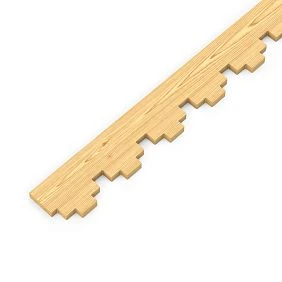
wooden baguette for facade decoration — a profiled batten that creates architectural clarity. It is especially valuable for non-standard windows: where the slope is uneven or the gap between the frame and the wall is non-standard, the batten creates a straight, neat line before installing the casing.
For narrow and tall windows, a batten around the perimeter of the opening adds a "layer" and visually increases the width of the frame without resorting to a wide casing.
Top strips and sandriks
A horizontal top strip above the window — a sandrik — is an architectural element that "crowns" the window frame. On non-standard windows, especially narrow and tall ones, it creates a horizontal "stop" that completes the vertical. This is a classic architectural solution, familiar from historic wooden houses.
For small windows, a simple horizontal strip with a small ornament is already a sufficient accent. For main windows, you can add a small carved canopy.
Elements for the porch and canopy
If a non-standard window is located near a porch or under a canopy, brackets and overlays on horizontal beams create a decorative system where the window is part of a unified ensemble. This is especially important for windows near the entrance: they should not "fall out" of the decorative context of the porch.
How to choose trim if the windows on the house are of different sizes: a practical table
Let's consider several typical situations and practical solutions:
| Window type | Opening width | Recommended casing width | Ornament | Additional Elements |
|---|---|---|---|---|
| Small (bathhouse, bathroom) | up to 700 mm | 60–80 mm | Simple geometric or floral | Corner rosettes |
| Narrow, elongated | 400–600 mm | 60–80 mm | Vertically oriented | Top plank |
| Standard | 1000–1300 mm | 90–120 mm | Any in facade style | Sockets, brackets |
| High | 900–1200 mm, height from 1600 mm | 90–110 mm | With vertical rhythm | Connecting element, top socket |
| Wide (veranda) | from 1400 mm | from 120 mm | Expressive, rich | Brackets, top accent |
| Main (front) | 1200–1500 mm | 110–140 mm | Rich, figured | Sockets, brackets, overlays |
How to choose architraves if the house is old and the windows are different
This is the most common situation. A wooden house from the 1950s–1980s. Windows have been replaced, added, and remodeled at different times. The result is three or four different sizes on one facade.
The approach here is the same as described above: a unified ornament, adapted width. But additionally, you should pay attention to the condition of the slopes. On old windows, slopes are often uneven, with differences in level, covered with several layers of paint. Before installing new architraves, the slopes need to be put in order: cleaned, leveled, and primed.
After that, installing architraves of different widths creates that very effect of a "new facade on an old house" that everyone who has gone through this renovation talks about.
Color of architraves on non-standard windows: special considerations
The color theme for non-standard windows requires one additional consideration: the color of the architrave should work to visually align proportions where necessary.
For a small window
A light trim on a dark facade visually enlarges the window. A dark trim on a dark facade makes it smaller. If a small window needs to be "opened up" and made more noticeable, choose a contrasting, light option.
For a narrow window
Dark trims on a light facade of a narrow window enhance the vertical rhythm. Light ones soften it. If you want to emphasize the elongation of the window, a dark color will do that. If you want to neutralize it, choose a shade closer to the facade.
For different windows on the same facade
A uniform color for all trims is a mandatory condition when windows are of different sizes. It is the uniform color together with the uniform ornament that creates the integrity of the facade. If the colors are different, no ornamental commonality will save the facade from the impression of chaos.
Typical mistakes when choosing trims for non-standard windows
The same trim width for all windows
Taking the same trim for all windows is the simplest approach. But if the windows are different in size, the same trim width disrupts the proportion: on a small window it will be too wide, on a large one too narrow. The width needs to be adapted.
Too rich an ornament for small openings
An openwork, richly detailed ornament on a 600×600 mm window is not beauty, it's overload. Small windows require simplicity of ornament. This is not a compromise — it's a rule of proportion.
Ignoring window height when calculating length
Buying 2000 mm long trim and discovering on site that the opening height is 1900 mm, requiring the side trim to be extended, is an unpleasant situation. Always measure the window opening height, account for the need for connecting elements, and order them in advance.
Unplanned joints
Corner joints of trim on non-standard windows are a special consideration. On a standard rectangular window, the corners are right angles at 45 degrees. But if the window has non-standard proportions or is located in a non-standard place, the joint may require a non-standard solution. A rosette will neatly cover any joint — it's a simple and reliable solution.
Mixing ornaments
On one facade — geometric ornament on small windows and floral on large ones. This is a typical 'piecemeal' mistake: each trim was chosen separately, without thought for the overall picture. One ornament — one facade story. Always.
Purchasing without measurements
Especially critical for non-standard windows. 'Approximately 600×800' is not a measurement. Accurate dimensions are needed: opening width, opening height, distance from the opening edge to the building corner, width of the facade surface between windows.
Painting without edge treatment
For non-standard windows, especially with extension of the casing using a connecting element, there are more places where the wood is exposed. Every joint, every end is a potential point of moisture ingress. Treat all ends and joints with an antiseptic and a finishing coating.
Ready-made casings for non-standard windows: why they work
Many people think: a non-standard window means non-standard products are needed. Custom order, long wait, high price.
In fact, this is not the case. A standard casing 2000 mm long easily adapts to most non-standard openings:
-
Cutting to the required length is a simple operation on a miter saw.
-
Extension using connecting elements covers any non-standard height.
-
Width selection — from several options in the catalog, the one needed for a specific window size is chosen.
-
Corner rosettes cover any joints regardless of proportions.
This means that Buy Carved Door Stops you can use items from the standard catalog — and they will perfectly fit non-standard windows. The main thing is to take measurements correctly and calculate the set correctly.
Calculation of a kit for a non-standard window: step by step
Here is a practical sequence for calculating trims for a non-standard window.
Step 1. Measure the opening. Width (W) and height (H) of the window opening — from the outside, along the edge of the frame or slope.
Step 2. Determine the width of the trim (n). Guided by the principles above: for small windows — 60–80 mm, for standard ones — 90–120 mm, for large ones — from 120 mm.
Step 3. Calculate the side trims. Two elements with the height of the opening H plus 100–150 mm at the bottom (covering the lower slope) and 100 mm at the top. Total length of each side trim ≈ H + 200–250 mm. If this is more than 2000 mm — connecting elements and additional pieces are needed.
Step 4. Calculate the top trim. Length ≈ W + 2n + 100–150 mm (overhang on the sides).
Step 5. Add rosettes. 2–4 corner rosettes per window.
Step 6. Add connecting elements (if extension is needed).
Step 7. Add a margin of 5–10% for waste during cutting.
This simple scheme works for any type of non-standard window.
Where to see examples and how to get inspired
Before placing an order, it's helpful to see ready-made solutions. The section Ideas for using carved decor is an excellent source of inspiration. There you can see real examples of window framing in different proportions, combinations of architraves with brackets and overlays, and color schemes. This helps to grasp the scale and logic before making a final decision.
Good solutions for non-standard facades always rely on a few basic principles — and the best way to understand these principles is to see them in action.
Quality and material: what lies behind a ready-made architrave
A non-standard window typically means increased installation demands: non-standard cuts, possible joints, complex angles. All of this requires precise, stable products. A cheap architrave made from raw lumber will deform during non-standard installation even before painting.
Details about what the products are made of and how they are produced are covered in the section Materials and quality of STAVROS products. Key points: glued pine panel without knots or resin pockets, CNC production with manual finishing, standard thickness 18 mm, standard length 2000 mm.
This means: precise dimensions, stable geometry, readiness for cutting without chipping, a good surface for applying any finish coating. This is exactly the material needed for working with non-standard windows, where accuracy is especially important.
Frequently asked questions
Which architraves to choose for a small window in a bathhouse?
For a small bathhouse window, narrow trims with a width of 60–80 mm and a neat, simple ornament are suitable. You should not overload a small opening with a wide plank or a rich pattern — this visually presses on the window. It is better to choose a clean geometric or simple floral motif and complement it with corner rosettes for neat joints.
Can carved trims be used for narrow windows?
Yes, carved trims work great for narrow windows too. The main thing is to choose the right width (no more than 60–80 mm for a window width of 400–500 mm) and an ornament with a vertical rhythm. The top horizontal plank or a small pediment completes the vertical and creates a finished frame.
What to do if the windows in the house are of different sizes?
Choose a single ornament and adapt the trim width for each opening: narrow for small ones, medium for standard ones, wide for large ones. Single ornament + single color = single facade, even if the windows are different.
Are ready-made trims suitable for non-standard windows?
Yes. Standard trims with a length of 2000 mm are cut to the required size. Connecting elements are used for high openings. Corner rosettes are used for non-standard joints. Almost all non-standard cases are solved by a combination of ready-made elements.
Are rosettes and connecting elements necessary?
Corner rosettes are needed for neat finishing of joints at the corners of the window. Connecting elements are needed for extending the length in high openings. Both elements make the installation clean and finished. They are especially important for non-standard windows.
How to calculate the number of trims for a non-standard window?
Measure the width and height of the opening. Two side trims with a length of H + 200–250 mm, one top trim with a length of W + 2×trim width + 100–150 mm. Add rosettes (2–4 pieces) and connecting elements if necessary. Allowance for cutting — 5–10%.
What color to choose for window trim on a small window?
If you want to visually enlarge a small window, choose a light trim on a dark facade. The contrast "opens" the opening. If you need a calm, delicate look, choose a trim in the same color as the facade or slightly lighter. A uniform color for all trims on the house is mandatory.
STAVROS: precise decor for any window
The company STAVROS produces wooden carved decor for facades of wooden houses, bathhouses, gazebos, verandas, and country buildings. The catalog includes House Carving in several ornamental series, brackets, rosettes, connecting elements, Wooden decorative inlays, wooden baguette for facade decoration and other elements of the facade decor system.
All products are made from glued pine panels without knots or resin pockets, manufactured on CNC with manual finishing. Standard length 2000 mm, thickness 18 mm — parameters optimal for working with any window openings, including non-standard ones. Precise dimensions and stable geometry allow for straight cuts, neat joints, and clean installation.
For a house with non-standard windows — small, narrow, tall, or different sizes — the STAVROS catalog offers the required width, desired ornament, and all accompanying elements for a complete set. The entire assortment, Ideas for using carved decor and ordering with Contact us to confirm shipping to your destination. — on the STAVROS website.