






























































Article Contents:
- What Are Carved Furniture Elements and Why Are They Needed
- What Carved Furniture Elements Can Be Bought in Moscow
- Carved Overlays: The Main Tool of Furniture Decor
- Carved Rosettes: An Accent in One Point
- Carved Moldings and Cornices: Structure and Completion
- Capitals, Pilasters, and Columns: High-Class Decor
- Brackets, Corners, and Additional Carved Details
- For Which Furniture Are Carved Elements Suitable
- For cabinets: from minimum to full system
- For dressers: rhythm as a principle
- For sideboards: precision instead of saturation
- For kitchen fronts: a three-component system
- For buffets and display cabinets: representative level
- For restoring classic furniture
- How to choose carved elements for furniture: 7 main criteria
- By furniture style
- By purpose: position determines type
- By shape: silhouette readability
- By degree of decorativeness
- By size and proportions: the law of proportionality
- By material: oak, beech, for enamel or for tinting
- Combination with other elements
- Which materials are best for carved furniture decor
- Why wood is the only truly correct choice
- When to choose for enamel
- When to choose for tinting
- How to combine carved elements with each other
- One collection — one style
- Overlays and sockets: center and periphery
- Moldings and cornices: structural level
- Capitals, legs, brackets: vertical system
- Rule of three: maximum for a standard facade
- Common mistakes when choosing carved elements for furniture
- Purchase without measurement
- Too large decor
- Mixing ornamental motifs
- Mismatch with Furniture Style
- Lack of a compositional plan
- Excessive amount of carving
- Where to buy carved furniture elements in Moscow
- STAVROS catalog: systematic selection with filters
- Pickup and delivery
- Showroom in Moscow: live contact with the material
- Order and consultation
- Who carved furniture elements are especially suitable for
- For private buyers
- For furniture workshops and manufacturers
- For interior designers
- For restorers
- For custom furniture manufacturers
- Checklist before buying carved furniture elements
- FAQ: answers to common questions
- Which carved furniture elements are most in demand in Moscow?
- What to choose for facades: overlays, rosettes or cornices?
- Are carved elements suitable for furniture restoration?
- What carved elements are used for classic furniture?
- Can multiple types of carved decor be combined on one facade?
- How to choose the size of a carved element for a facade?
- What materials are best for carved furniture decor?
- Where to Buy Carved Furniture Elements in Moscow?
- Are carved details suitable for kitchen facades?
- How to avoid overloading furniture with carved decor?
- Conclusion

Wood carving on furniture is not archaic or overcomplication. It is a language with which furniture converses with the interior. A correctly chosen carved element turns an ordinary wardrobe into an item with character, a chest of drawers into an accent object in the room, a kitchen set into a classic ensemble. An incorrectly chosen one creates a sense of randomness or excess.
Buying carved elements for furniture in Moscow today is not a problem. The problem is choosing correctly: the right type, the right size, the right ornament, the right material, for the right style. This is exactly what the detailed article is about.


What are carved elements for furniture and why are they needed
Carved furniture elements are solid wood products with three-dimensional relief ornamentation that are attached to the surfaces of furniture fronts, cases, doors, drawers, and panels. They create the visual image of the object: they set the style, structure the plane, and place accents.
Carving in furniture decoration has existed for thousands of years. It has survived style changes, technological revolutions, and the emergence and disappearance of dozens of competing materials. The reason is simple: no alternative material reproduces the living relief of wood with the same accuracy, holds the sharp edges of the ornament as long, or accepts the finish as organically as solid wood.
Carved wooden furniture decor is not only needed 'for beauty' in an abstract sense. It performs specific functions:
-
Structures the facade — organizes the plane of the door, defines the center, perimeter, proportions
-
Denotes style — one ornamental motif is instantly read as belonging to classic, baroque, empire, or neutral neoclassical
-
Creates a visual hierarchy — the main element stands out, secondary ones support it
-
Connects furniture with the interior — decor from furniture, doors, and wall panels from the same collection creates a unified image of the space




What carved furniture elements can be bought in Moscow
The 'carved furniture elements' category is not one type of product. It is a whole system where each element solves its own task. To choose correctly, you need to understand what exactly is included in this assortment.
Our factory also produces:


Carved overlays: the main tool of furniture decor
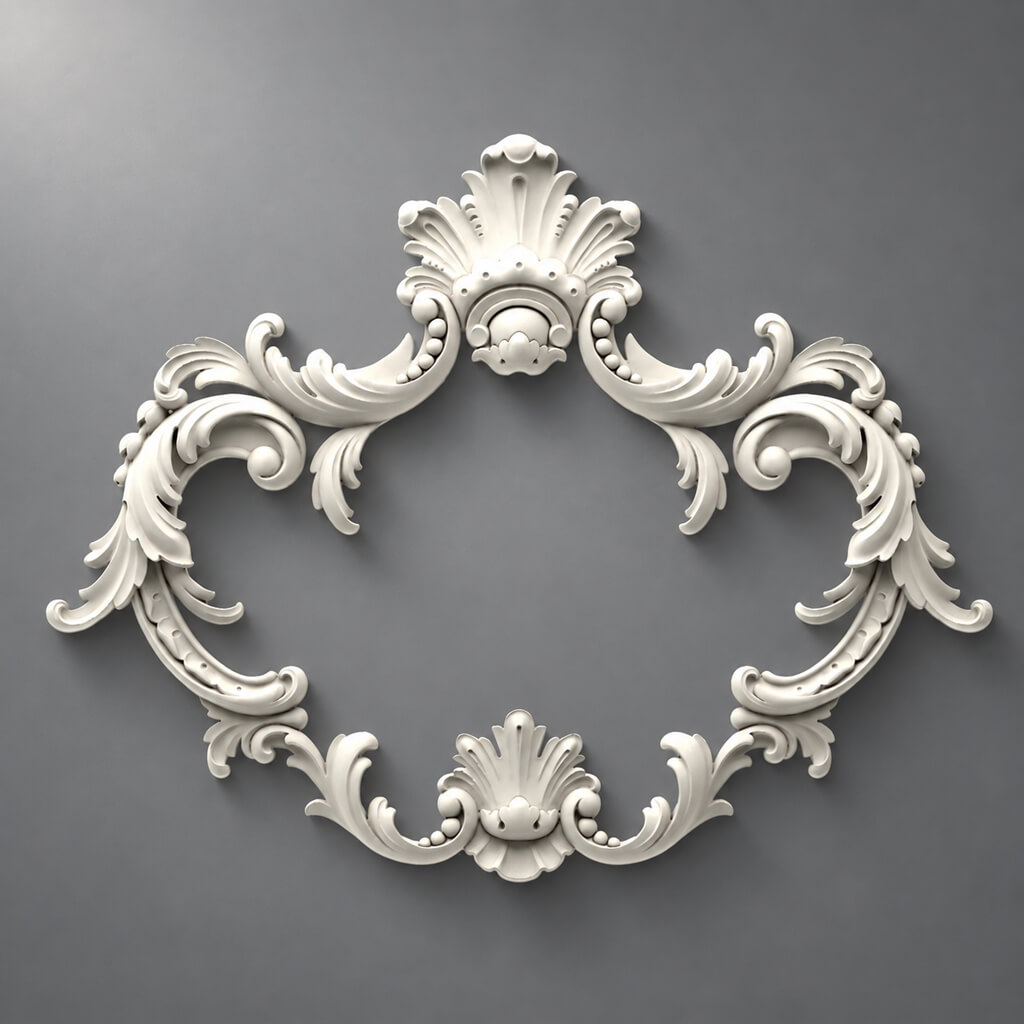
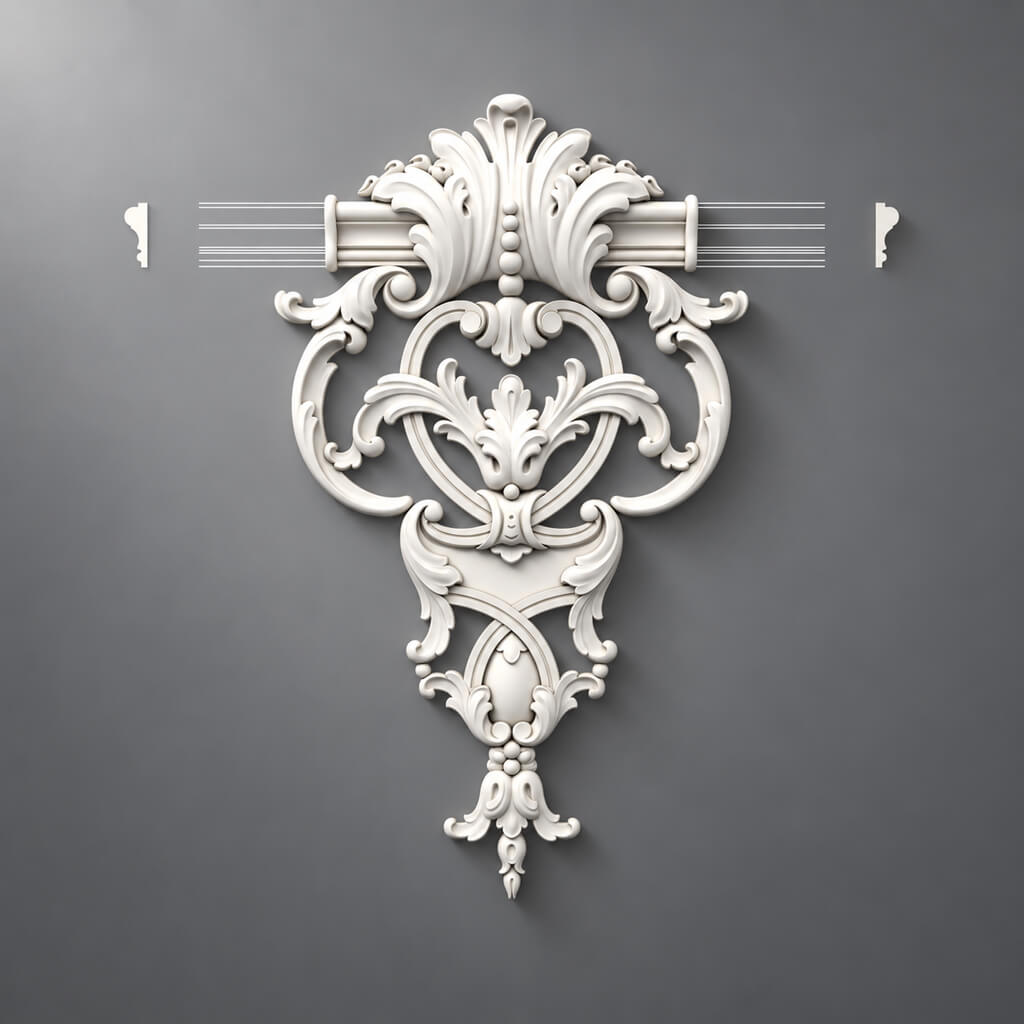
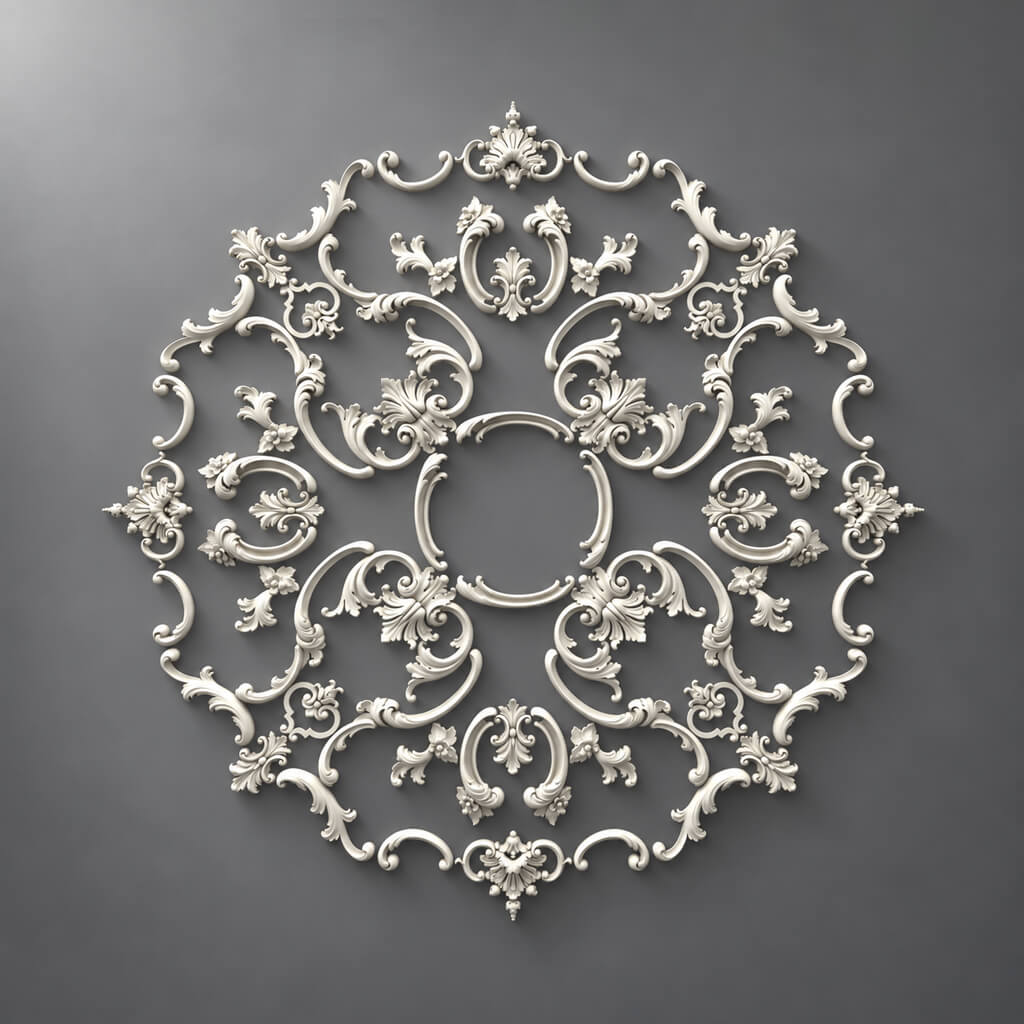
Decorative carved overlays— the widest and most in-demand category. These are voluminous, relief products made from solid oak or beech, which are attached directly to the surface of the furniture front.
The STAVROS catalog features over 400 overlay models. Sizes: from miniature 3×3 cm to large ornamental panels 40×25 cm. Relief depth: from 5 to 28 mm. Price — from 920 rubles per element.
Types by position on the front:
-
Central — the main decorative accent in the geometric center of the door
-
Corner (L-shaped) — for corner positions in molding frame systems
-
Symmetrical paired — mirrored pairs for symmetrical decoration of wide planes
-
Horizontal — for dresser drawers and waist-level positions
-
Constructor overlays — with a recess for a molding profile, seamlessly integrated into the frame system
Ornamental motifs: acanthus leaves, floral garlands, rocaille, cartouches, shells, heraldry, geometric ornaments, the author's collection 'Summer Garden'.
Get Consultation
Carved rosettes: accent at a single point
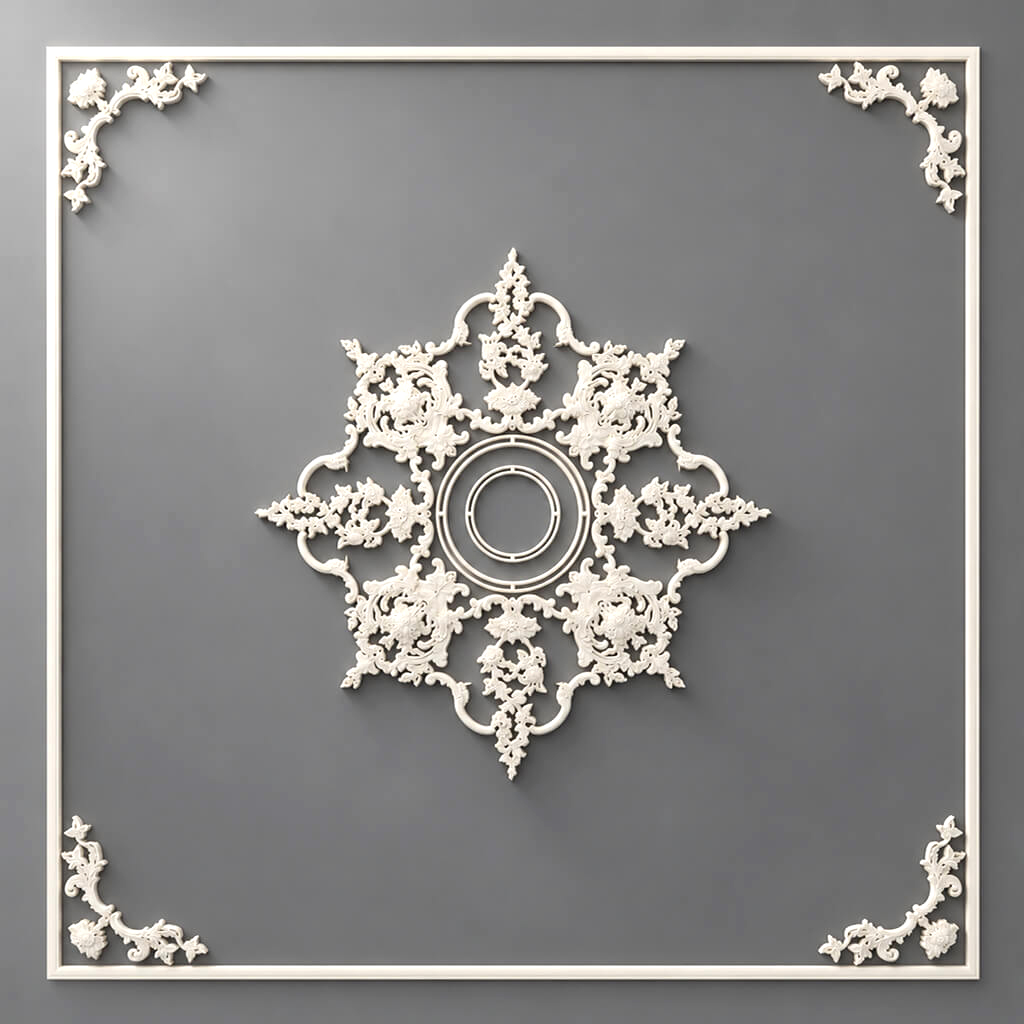
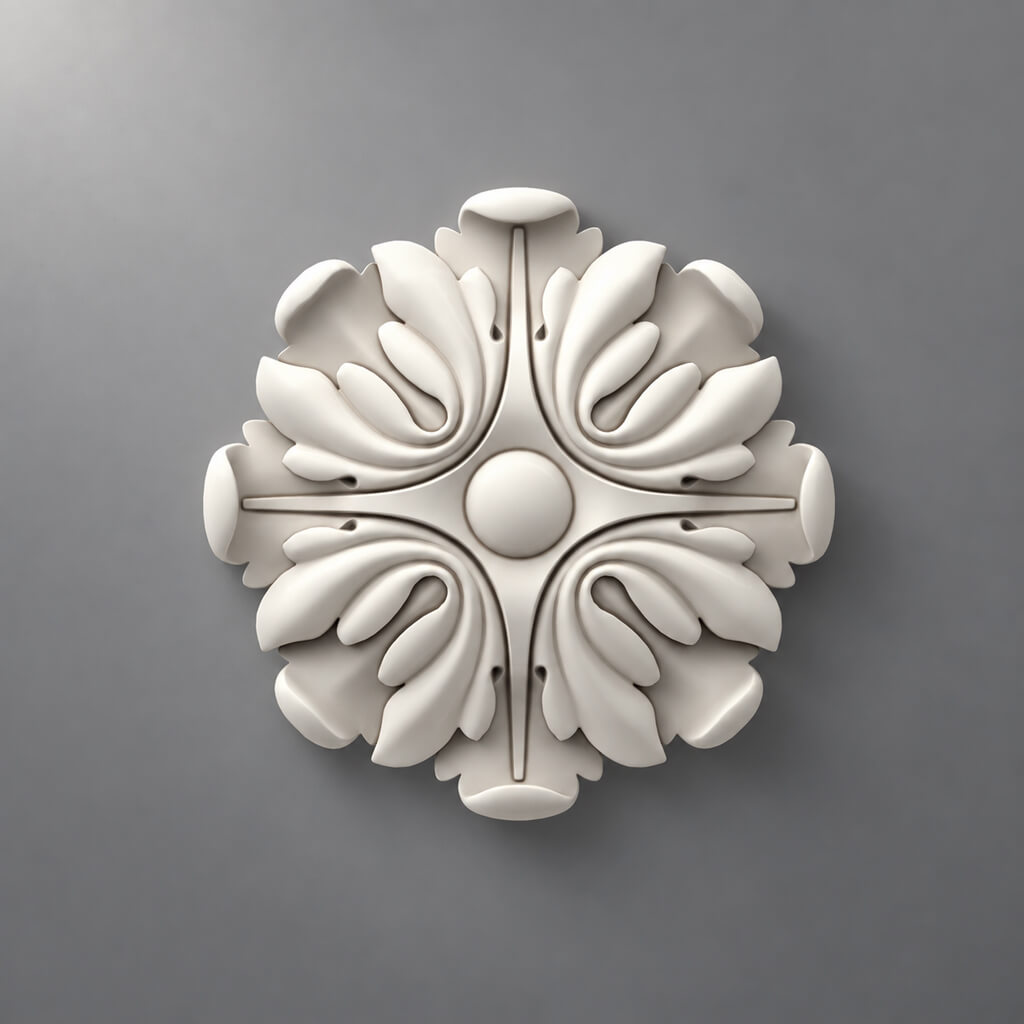
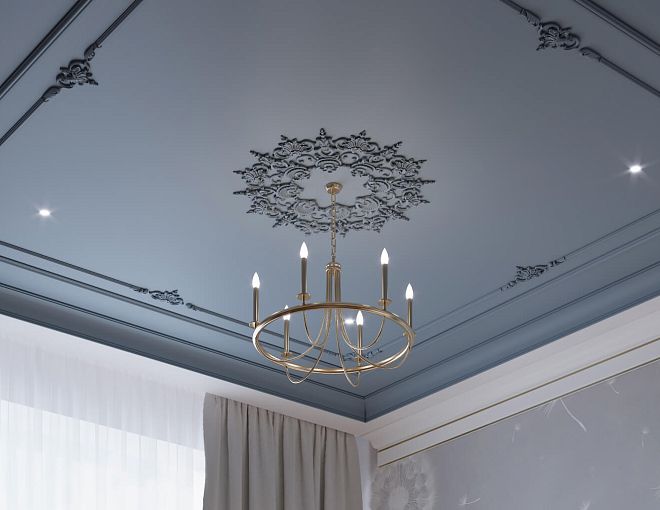
Wooden sockets— round, oval, or square carved elements with symmetrical ornamentation. The rosette is historically one of the oldest decorative motifs, dating back to ancient architecture.
In furniture decor, the rosette functions as a focal center: it is installed strictly in the center of the front or at a key point of the decorative system. Sizes — from 5 to 25 cm. Small rosettes — for cabinets and small drawers. Large ones — for representative cabinet and buffet fronts.
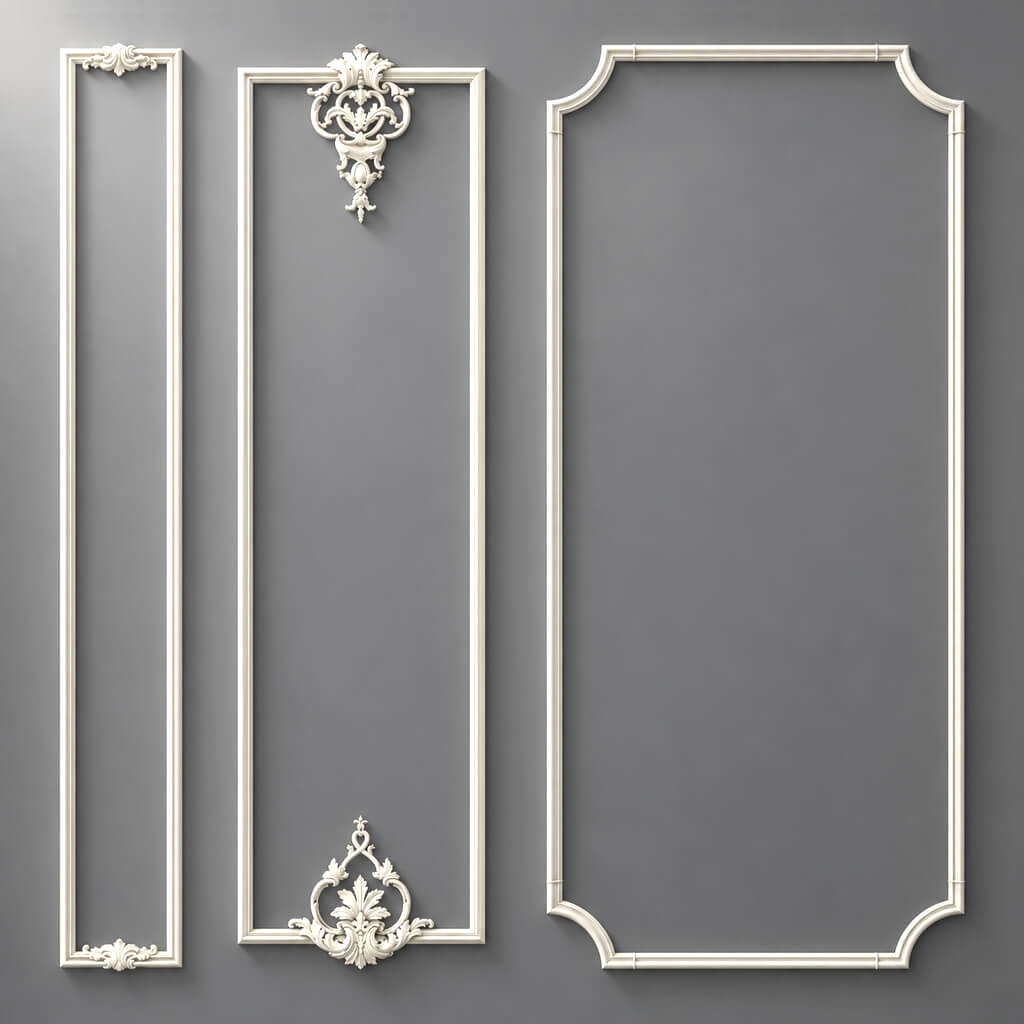
Classic scheme: carved rosette in the center + molding frame around the perimeter of the door. The frame organizes the space, the rosette anchors its center. Together — decorative facade architecture, tested by centuries.
Carved moldings and cornices: structure and completion
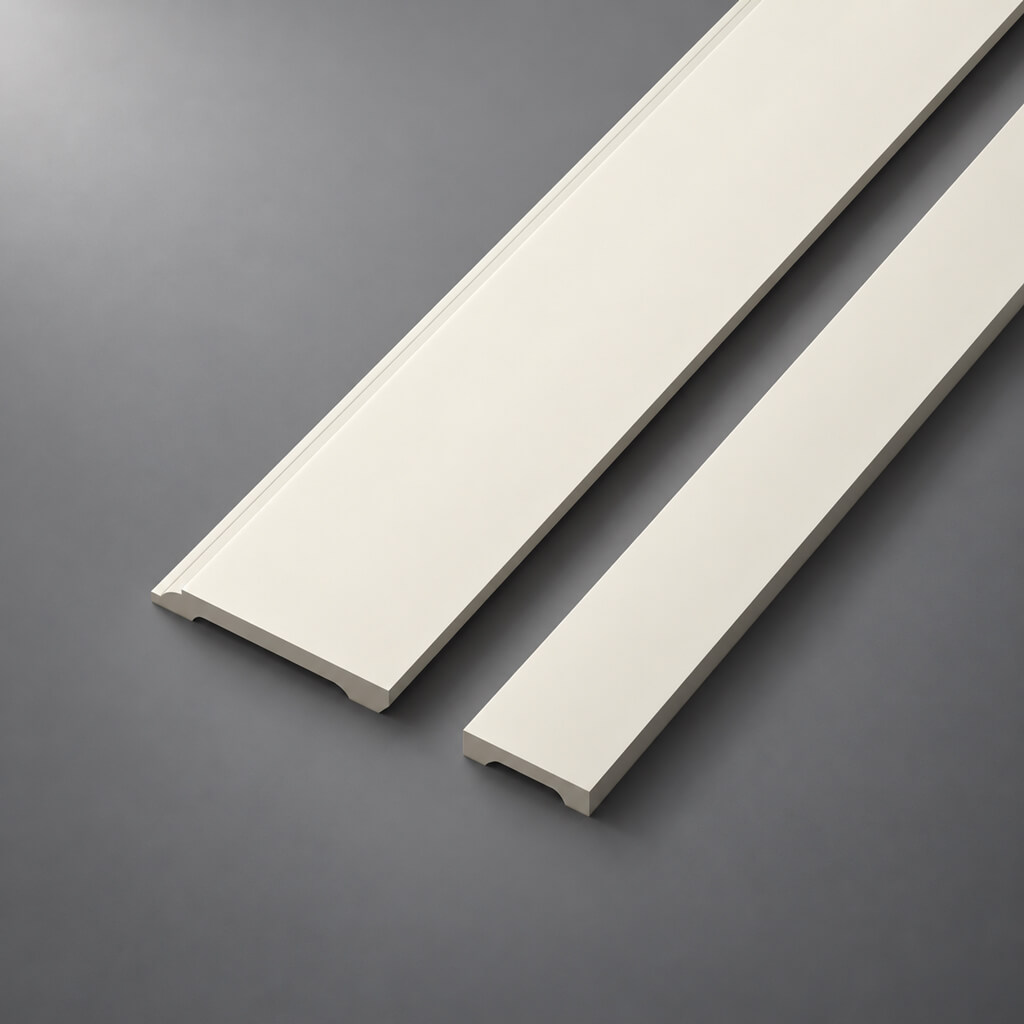
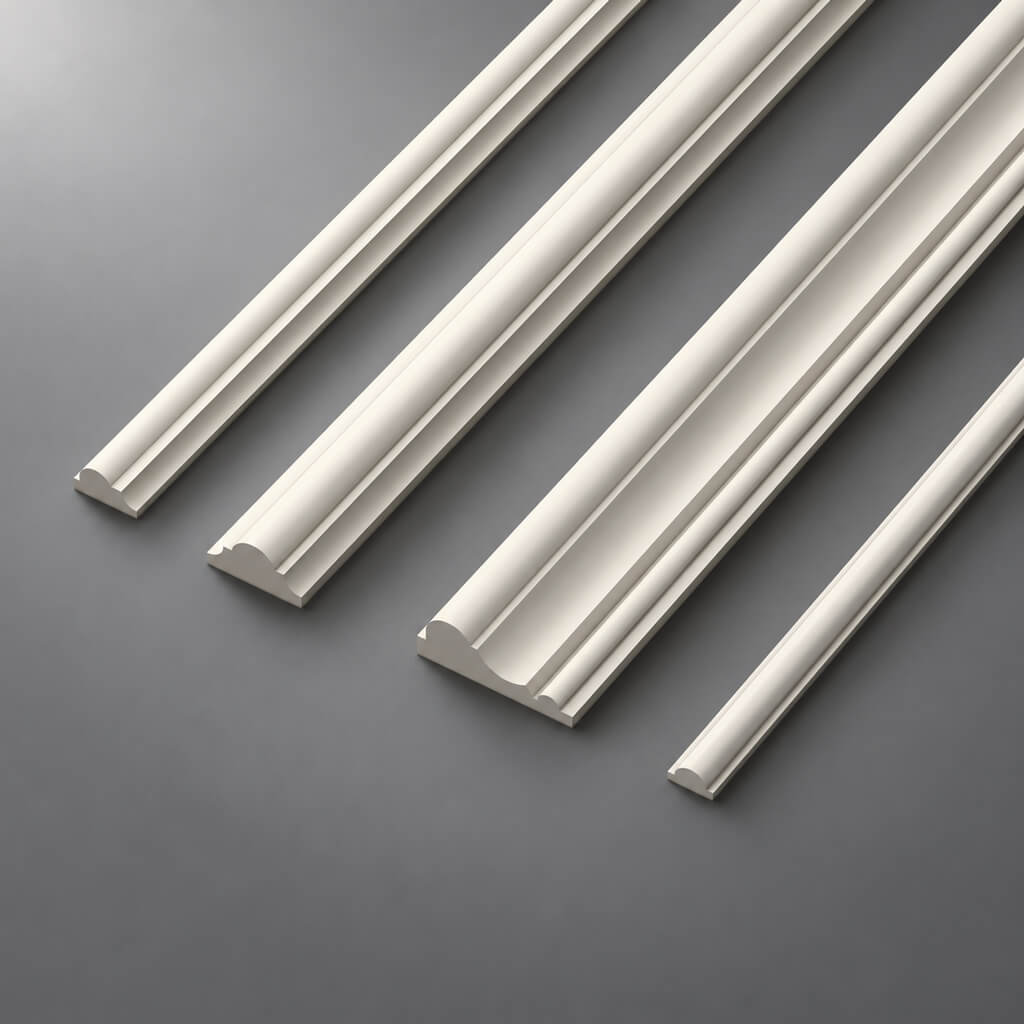
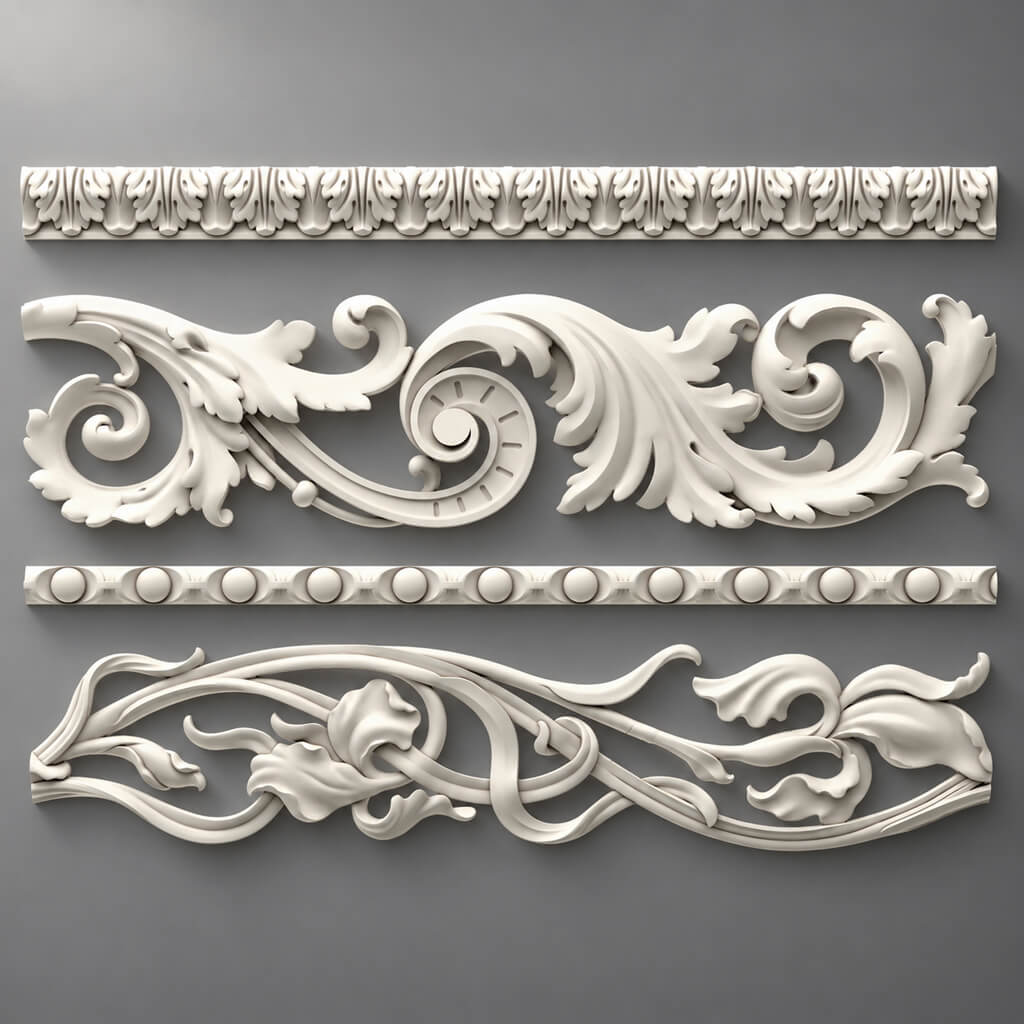
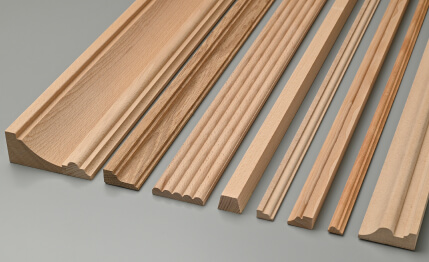
Wooden moldings— linear carved profiles for creating frames, horizontal belts, and decorative structure on a plane. Molding turns a flat door into a classic paneled facade with a center and perimeter.
Types of moldings:
-
Frame — around the perimeter of the door, the foundation of a classic facade
-
Horizontal band — divides zones of a tall cabinet
-
Corner — finishes panel joints in case furniture
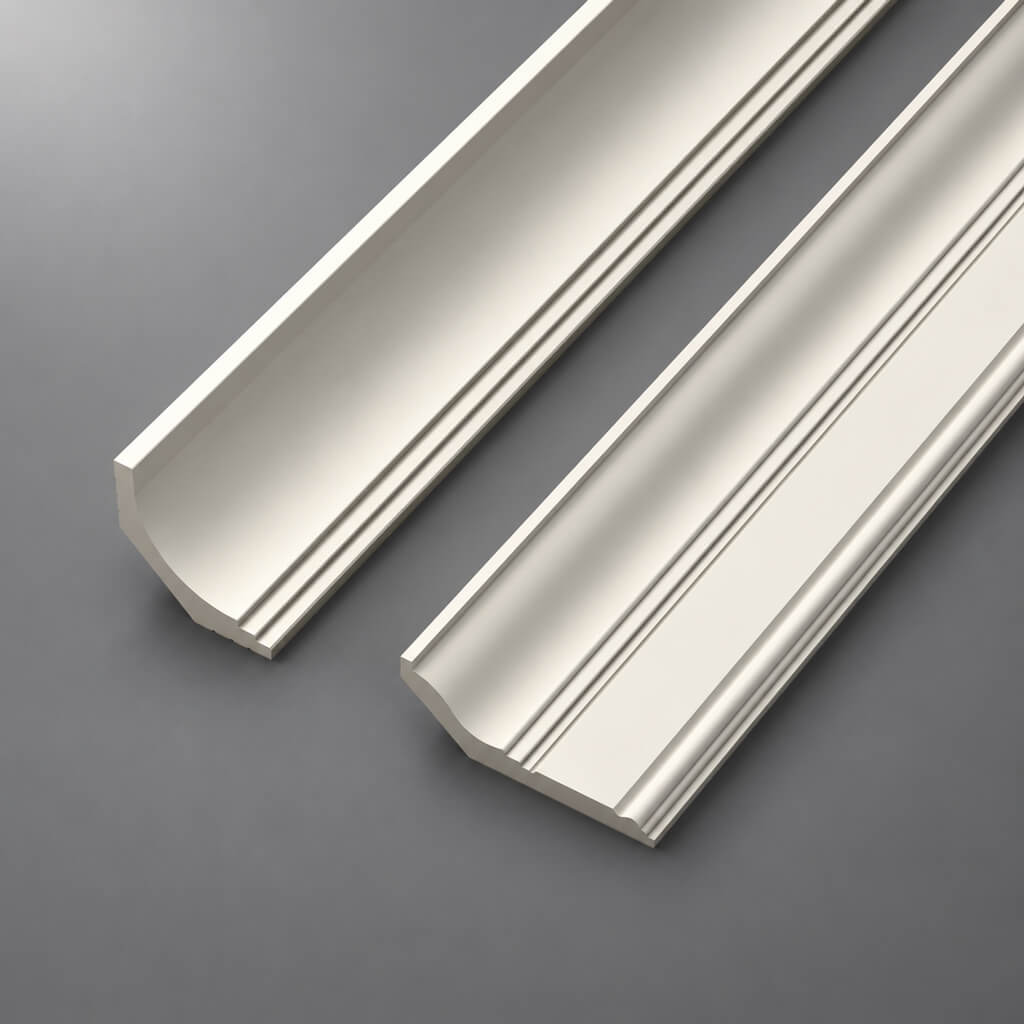
decorative cornices— carved upper finishing profiles for cabinets, buffets, kitchen sets. The cornice does what cannot be done otherwise: it completes the case 'correctly'. Without a cornice, a tall cabinet ends abruptly at the ceiling. With a carved cornice — it is completed as an architectural object.
Capitals, pilasters, and columns: high classic decor
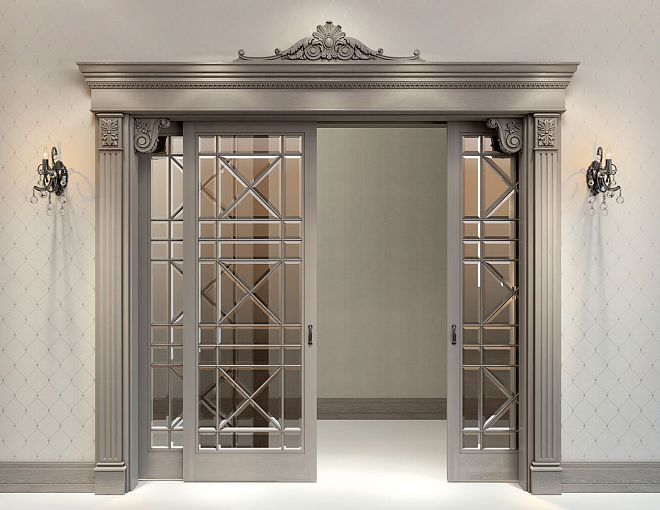
furniture capitals— carved finishes of vertical pilasters and columns. Ionic, Doric, Corinthian forms adapted for furniture production.
Pilasters — vertical flat decorative columns on the side surfaces of cabinets and corner areas of case furniture. They visually break up the monolithic plane and create a sense of rhythmic colonnade.
decorative columnsand balusters are used in buffets, open shelving, bar counters, library furniture. This is the architectural level of furniture carved decor — for representative interiors and large-scale projects.
Brackets, corner pieces, and additional carved details
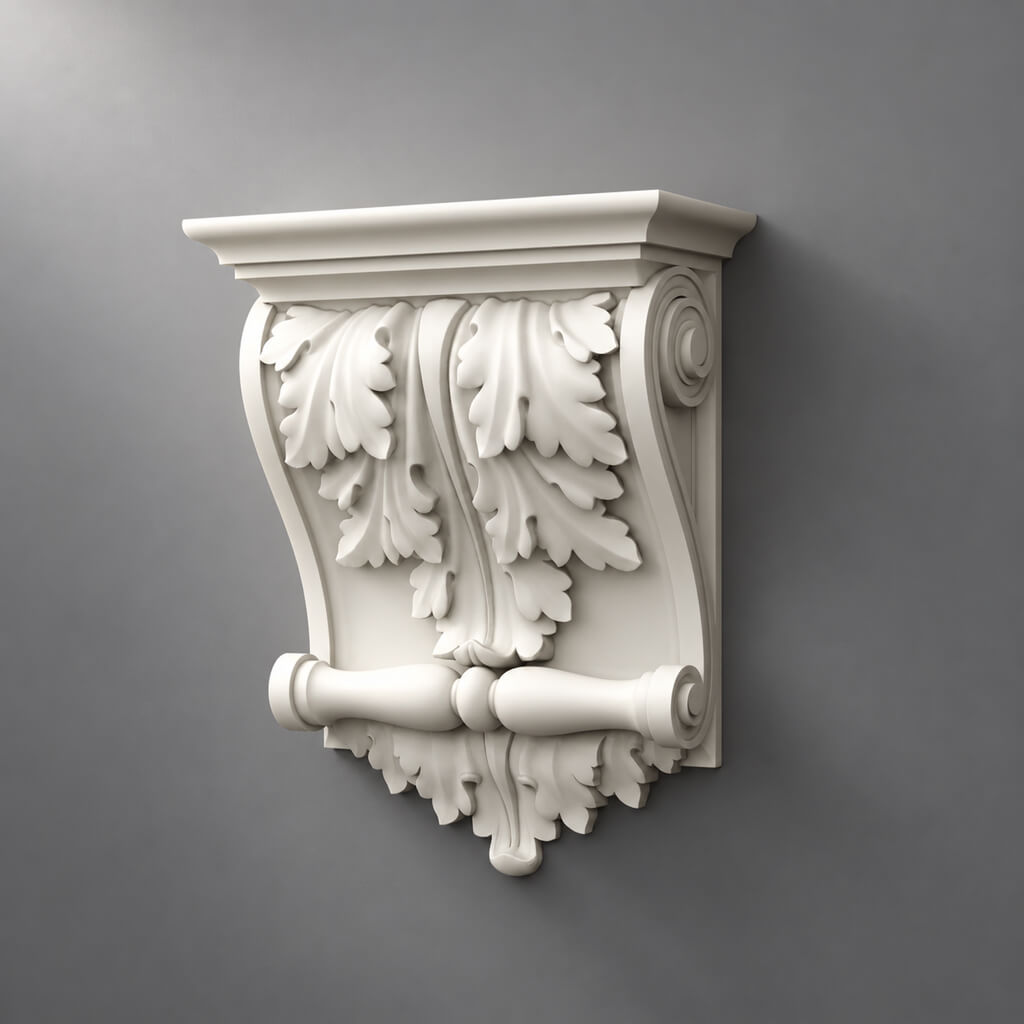
Decorative brackets— carved support-decorative elements for shelves, cornices, protruding structures. A carved bracket under a shelf is both a functional support and a decorative accent.
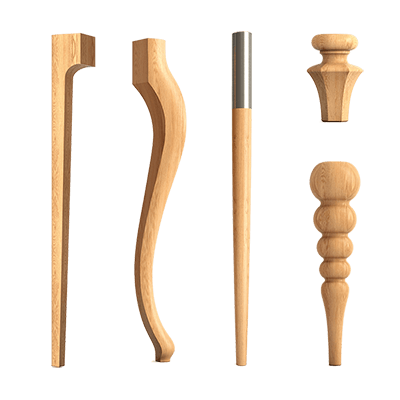
CarvedFurniture legs— turned or carved supports for objects. The concave cabriole leg, the tapered turned leg, the leg with acanthus decor — each type carries a stylistic message. A proper carved leg completes the object's appearance from below, just as a cornice completes it from above.
For which furniture carved elements are suitable
For cabinets: from minimum to full system
The cabinet is the main object for carved furniture decor. Its facade occupies a significant part of the wall and creates the first impression of the room.
Minimal solution: a molding frame around the perimeter of the door. Even this radically changes the cabinet's appearance — a standard flat surface turns into a classic paneled facade.
Full system: molding frame + central carved overlay or rosette + corner elements at frame intersections + decorative carved cornice. The cabinet gains architectural elaboration.
For tall cabinets up to the ceiling: decorative pilasters, breaking up the monolithic plane vertically, and a horizontal molding belt at two-thirds of the body's height.
For chests of drawers: rhythm as a principle
A chest of drawers is a horizontal stack of drawers. Here, carved decor works on the principle of rhythm: the same element on each drawer, strictly centered, of the same size, with the same ornament. This creates a vertical rhythm—the eye moves downward and finds order.
For chests of drawers, horizontal carved wooden overlays are especially appropriate—they emphasize the horizontal nature of the piece and are well-proportioned to the rectangular planes of the drawers.
Arbitrary mixing of different elements on the drawers of a single chest of drawers is a typical mistake. Not 'variety,' but disorder.
For cabinets: precision instead of richness
A bedside table, a TV stand, a console in the hallway—small pieces with small fronts. One delicate carved element in the center of the door. A small rosette, coordinated with the decor of a nearby cabinet. Or a thin molding along the perimeter—without an overlay. A cabinet does not require an abundance of carved decor. It requires precision.
For kitchen fronts: a three-component system
The kitchen is a high-demand zone. Wooden carved decor is used here under one mandatory condition: material with furniture moisture content of 8 ± 2% and reliable coating with several layers of water-resistant varnish.
A three-component system for a classic kitchen: molding frames on each front + small carved overlays on key doors + a decorative carved cornice along the upper perimeter of the set. This scheme completely transforms the look of the kitchen—a neutral set of drawers becomes a classic set with a unified decorative logic.
For buffets and display cabinets: a representative level
A buffet and a display cabinet are large pieces with high decorative potential. It is for them that the entire arsenal of carved decor is appropriate: pilasters with capitals, carved cornices with deep profiles, overlays with highly complex ornaments, decorative brackets under shelves and glass doors.
A sideboard with full carved decor is furniture that aspires to be the centerpiece of a room. And as a rule, it achieves that.
For restoring classic furniture
Restoration is a special scenario with maximum requirements for the material. It is necessary to reproduce a lost part, restore a broken ornament, replace worn molding on an antique item.
And only solid wood fully meets this task: it matches the original in behavior under finish, accepts the same paint, varnish, patina, expands and contracts with changes in humidity just like the original wood.
The STAVROS range features historical ornamental motifs characteristic of furniture in classical styles of the 18th–19th centuries: acanthus, rocaille, cartouches, garlands, shells. This allows for selecting carved elements for restoration with high accuracy of correspondence.
How to choose carved elements for furniture: 7 main criteria
By furniture style
Carved decor enhances style — it does not create it. A mismatch between the ornamental motif and the style of the furniture cannot be corrected by any quality of craftsmanship.
| Furniture style | Ornamental motif | Relief character |
|---|---|---|
| Baroque | Acanthus, garlands, cartouches, shells | Deep, lush |
| Rococo | Rocaille, asymmetry, flowers | Light, airy |
| Empire | Acanthus, strict symmetry, geometry | Clear, substantial |
| Neoclassical | Moderate floral motifs | Restrained |
| Provence / Country | Simple plant motifs | Soft, flat |
| Modern Classic | One delicate element | Minimal carving |
If the furniture style is not obvious — focus on the hardware. Baroque handles require baroque carved elements. Simple bracket handles call for restrained flat decorative details.
By purpose: the position determines the type
Before choosing the shape and ornament, you need to answer the question: where exactly is the element being installed?
-
Center of the facade — a rosette or central overlay as the main accent
-
Corner of a frame system — a corner overlay, coordinated with the molding
-
Horizontal belt — a linear overlay for a row of drawers
-
Drawer front – a small element proportionate to the plane
-
Top finish of the cabinet — a carved cornice
-
Side surface — a pilaster with a capital
Position defines the type. Type narrows down the choice of specific models.
By shape: silhouette readability
The shape of a carved element defines its 'voice' from a distance:
-
Vertical — on narrow, tall fronts, they elongate the plane
-
Horizontal — on drawers, they emphasize horizontality
-
Square and round — neutral, universal for central positions
-
Corner (L-shaped) — strictly for corner positions of frames
-
Asymmetric — for authorial non-standard solutions
By degree of decorativeness
Three levels of saturation of carved decor — three different results:
-
Restrained — flat or low-relief. For modern classics, neutral solutions
-
Moderate — classic ornaments with 5–10 mm relief. For neoclassicism, classic furniture of medium richness
-
Accent — deep relief 12–28 mm. For Baroque, Empire, and executive interiors.
The level of saturation is chosen depending on the overall decorative 'noise' of the interior. In a modest space, deep carved decor creates conflict. In a formal hall, a restrained flat profile gets lost.
By size and proportions: the law of proportionality
The central carved element occupies 20–30% of the facade width. This is a visual law, the violation of which is immediately noticeable.
Practical calculation:
-
30 cm facade → 6–9 cm overlay or rosette
-
50 cm facade → 10–14 cm
-
70 cm facade → 14–20 cm
-
90 cm facade and larger → large elements or composite systems
Always evaluate the size in the context of a specific facade, not as a separate item.
By material: oak, beech, for enamel or for tinting
Carved decorative elements for STAVROS furniture are made from kiln-dried solid oak and beech, moisture content 8 ± 2%. Details — on the page Materials and Quality.
Oak — hard, with a pronounced coarse texture. For tinting while preserving texture, dark saturated interiors, executive offices.
Beech — uniform, fine-textured, takes paint excellently. For dense enamel painting, neoclassical, Provence style.
Enamel blank — lamellas without color matching. Tonal differences are concealed by a dense coating. More affordable in price.
Tinting blank — lamellas matched by color and texture. For transparent or semi-transparent finishing.
Two levels of surface processing: 'Standard' (machine sanding, for primer and dense paint) and 'Prestige' (machine + manual sanding of hard-to-reach areas, for premium finishing).
Regarding combination with other elements
Carved decorative elements work as a system, not individually. Overlay + molding frame + corner elements + cornice — this is a system. And all its parts must belong to the same ornamental family. In the STAVROS catalog, elements of each series are initially developed as compatible — this eliminates the error of mismatched parts when selecting from one collection.
Which materials are best for carved furniture decor
Why wood is the only truly correct choice
The market offers polyurethane overlays, MDF profiles, plastic rosettes. They are cheaper. Sometimes visually similar. But fundamental differences make the choice obvious.
The wood is painted in a uniform tone with the furniture facade. When the facade and the carved element are the same material, varnish and paint are applied without a visible seam. Two different materials under one coating will show a visible boundary after a few years: different thermal expansion inevitably manifests itself.
Wood can be restored. Solid wood can be sanded, repainted, and patinated as many times as needed. A polyurethane part is replaced entirely if mechanically damaged.
Wood holds sharp edges of ornament. MDF crumbles on thin carved elements. Polyurethane does not reproduce deep undercutting with surgical precision. Solid oak maintains the sharp profile of an overlay for decades without degradation.
Wood is a living material. Its texture, tone, and warmth are irreproducible by any imitations. That is why carved wooden decor is perceived as a value, not as decorative packaging.
When to choose for enamel
A blank 'for enamel' is the right choice if:
-
the furniture is painted in a solid color (white, gray, colored);
-
cost affordability is important;
-
several layers of primer are planned before the final coating.
When to choose for tinting.
A blank 'for tinting' is the right choice if:
-
the furniture is finished with a transparent or semi-transparent composition;
-
The vitality of the natural wood grain is important;
-
The interior is built in natural tones — walnut, oak, American cherry.
An important nuance from STAVROS: when finishing for tinting, it is recommended to use a tinting composition, not a clear varnish. This ensures an even color across the entire surface, despite the natural tonal differences between the lamellas — an inevitable property of a living material.
How to combine carved elements with each other
One element on the facade is an accent. Several elements are either a system or chaos. The difference is determined by several principles.
One collection — one style
All carved elements on one piece of furniture are from the same catalog series. This eliminates mismatches in ornamental motifs, relief scale, and artistic design. In the STAVROS catalog, each series is a family of compatible products: central overlays, corner elements, coordinated moldings.
Overlays and rosettes: center and periphery
An overlay and a rosette on one facade are possible, but with a clear delineation of roles. The rosette is strictly in the center. Overlays are on the sides or in corner positions. Two accent forms compete for attention: one must be the main one, the other must support it.
The optimal classic scheme: a carved rosette in the center + four corner overlays at the intersections of the molding. Simple, proven, flawless.
Moldings and cornices: the structural level
The molding frame creates the structure of the facade. The carved cornice completes the body. They are the architectural framework on which the rest of the decor is placed.
Coordination: if the cornice has an ornament, the overlays should have the same motif. If the cornice is smooth, the overlays can be carved, but moderate. A carved cornice + rich carved overlays is a 'competition' that must be resolved by scale: one element is large, the other is delicate.
Capitals, legs, brackets: the vertical system
Carved pilasters with capitals and figuredFurniture legs— vertical accents that set the rhythm along the height of the item. Their ornamental language must match the language of the overlays and moldings.
Carved legs in the Empire style + capitals with Ionic order + overlays with acanthus ornament — a cohesive, stylistically consistent system. This is what to strive for.
Rule of three: maximum for a standard facade
Three types of carved elements on one facade is the optimum for most classic solutions. Molding frame + central overlay or rosette + corner elements. This is enough. Four or more types risk 'cluttering' the facade. Exception: monumental furniture with facades 2.5 m high or more.
Common mistakes when choosing carved elements for furniture
Purchase without measurement
A carved element is chosen 'by eye' from a photograph — and ends up either tiny on a large facade, or overwhelming on a small door. Measurement is the first step before any selection.
Oversized decor
A large overlay on a small facade doesn't create a sense of richness. It creates discomfort. 20–30% of the facade width is the optimal range for a central element.
Mixing ornamental motifs
Baroque acanthus in the center of the facade + corner elements from a geometric series — two different decorative languages. They don't create richness — they create conflict. One motif for the entire piece.
Mismatched furniture style
Rich carved decor on furniture in a modern classic style creates a stylistic contradiction. Carved elements enhance the existing style — but do not create a new one.
Lack of a compositional plan
One element is purchased, a month later — another, another month later — a molding from a different series. The result is a set of details without a common logic. The correct approach: first, plan the entire decorative system of the facade, then order everything necessary as a set.
Excessive amount of carving
Five types of carved elements on one door — visual noise, not 'rich decor'. One properly chosen carved element is better than five disparate ones. Decorative restraint is a sign of good taste.
Where to buy carved furniture elements in Moscow
STAVROS catalog: systematic selection with filters
Full catalogSTAVROS carved furniture elementsincludes over 4,000 items made of solid oak and beech:
-
Carved overlays for facades — over 400 models
-
Wooden rosettes
-
Moldings and decorative profiles
-
Carved cornices
-
Capitals and pilasters
-
Decorative brackets
-
Figurative furniture legs
-
Decorative columns and balusters
Catalog filtering: by product type, collection, shape, ornament, availability in Moscow. This allows narrowing down the selection to the required type of elements for a specific task in just a few clicks.
Pickup and delivery
If available at the Moscow warehouse — pickup in Moscow. Order placement conditions, payment, and delivery — on the page "Payment and Delivery". Delivery is carried out throughout Russia by transport companies or by courier in Moscow.
Showroom in Moscow: live contact with the material
Wooden carved decor needs to be seen and touched. A photograph conveys the shape — but not the tactility of the relief, the liveliness of the texture, or the scent of wood.
At the STAVROS showroom in Moscow, you can:
-
Compare the quality of 'Standard' and 'Prestige' in person
-
Assess the actual scale of the products
-
Apply elements to samples of your furniture
-
Get specialist consultation for selection tailored to a specific project
Showroom address: Volokolamskoye Highway, 3. Contacts, working hours, directions — on the page "Contacts. Moscow".
Order and Consultation
Orders are placed through the online store or via the toll-free phone number 8-800-555-46-75. Orders start from a single item. A manager will help you select carved elements for your specific piece of furniture, calculate the number of parts, determine the type of blank, and the level of processing.
Who Carved Furniture Elements Are Especially Suitable For
For private buyers
Want to update a cabinet without replacing it? Turn a chest of drawers into a bedroom accent piece? Give a kitchen set a classic character?Wooden Carved Elements for Fronts— the most effective tool for transforming furniture without replacing it. Purchase from a single item, results — visible immediately.
For furniture workshops and manufacturers
Carved wooden furniture decor — a professional component for furniture manufacturers and workshops. Wide range, stable availability in the Moscow warehouse, possibility for wholesale orders.
For interior designers
For design projects requiring coordinated decor for furniture, doors, and wall panels, the STAVROS assortment allows creating comprehensive decorative systems from a single source. Carved overlays, rosettes, moldings, cornices, columns, brackets — in a unified ornamental design.
For restorers
For the restoration of antique furniture, solid wood is the only material compatible with the original in all finishing parameters. The wide selection of historical ornamental motifs in the catalog ensures high accuracy of matching when restoring classical pieces.
For Custom Furniture Manufacturers
Custom carved furniture elements are a competitive advantage. A wardrobe with carved decor made of solid oak is perceived fundamentally differently than a wardrobe without decor. It's a different price segment, different positioning, a different client.
Checklist before purchasing carved elements for furniture
-
For which piece of furniture — wardrobe, chest of drawers, kitchen, cabinet, sideboard?
-
Exact dimensions of each facade?
-
Furniture style and corresponding ornamental motif?
-
One accent element or a full decorative system?
-
How will the furniture be finished — enamel or toning?
-
Oak (for toning) or beech (for enamel)?
-
Standard or Prestige in terms of processing quality?
-
Has the availability of required items in Moscow been checked?
FAQ: answers to frequently asked questions
Which carved furniture elements are the most in demand in Moscow?
The most popular are carved overlays for facades (central and corner), wooden moldings for frame systems, carved rosettes as accent elements, and cornices for finishing cabinet bodies.
What is better to choose for facades: overlays, rosettes, or cornices?
The best results come from a system, not just one type of product. A molding frame around the perimeter + a central overlay or rosette + a cornice is a classic scheme. If you need a single element — for the central position, choose an overlay or rosette that matches the furniture style.
Are carved elements suitable for furniture restoration?
They are perfectly suitable. Only solid wood behaves under finishing identically to the original wooden parts of antique furniture. The STAVROS catalog features historical ornamental motifs — acanthus, rocaille, garlands, cartouches.
What carved elements are used for classic furniture?
Acanthus overlays, floral rosettes, cornices with profiled ornamentation, pilasters with capitals, carved brackets, shaped legs. All from one collection with a coordinated motif.
Can multiple types of carved decor be combined on one facade?
Yes, provided three conditions are met: one collection, clear roles for each element (main and supporting), no more than three types on a standard facade.
How to select the size of a carved element for a facade?
Central element — 20–30% of the facade width. Measure the door width, multiply by 0.25 — this gives the approximate optimal size.
What materials are best for carved furniture decor?
Only solid wood — oak or beech. Oak — for tinting while preserving the texture. Beech — for dense enamel painting. No synthetic alternative provides the same durability, restorability, and visual quality.
Where to buy carved furniture elements in Moscow?
STAVROS — a manufacturer with CNC production and manual finishing. Catalog with over 4,000 products, warehouse in Moscow with pickup option, showroom at Volokolamskoye Shosse, 3. Orders from a single item. Phone: 8-800-555-46-75 (free).
Are carved elements suitable for kitchen fronts?
Yes, with proper preparation: solid wood with furniture moisture content of 8 ± 2%, coating with water-resistant varnish in several layers. Use the 'for enamel' blank made of beech for kitchen furniture with dense painting.
How to avoid overloading furniture with carved decor?
Rule of three: no more than three types of carved elements on one front. One main accent, the others are supporting. A unified ornamental motif. The central element — no more than 30% of the front width.
Conclusion
Buy carved elements for furniture in Moscow— means not just adding decor, but making a decision about what the image of the furniture and space will be. Wood carving speaks a language that is understood without translation: here they thought about details, here they value quality, here the interior comes together into a cohesive story.
STAVROS — a manufacturer of wooden furniture decor with its own CNC production. Over 4,000 products made of solid oak and beech:carved appliqués, Outlets, Moldings, Crown Molding, Capitals, Brackets, Furniture legs. Blanks for enamel and for tinting. Two quality levels — Standard and Prestige. Orders from a single item. Showroom: Volokolamskoye Shosse, 3. Free phone: 8-800-555-46-75.
STAVROS — where every detail contributes to the image.