










































































Article Contents:
- RPU-057 on a smooth facade: why one small detail can completely change furniture
- What exactly is the carved decorative rosette RPU-057
- The main question: is one RPU-057 enough without a molding frame
- Overlay decor instead of facade milling: what is the real difference
- Don't order from a photo: first cut out a 70 mm circle
- The center of the facade is more important than the center of the entire chest of drawers
- If there is no handle yet
- If the handle is already installed in the center
- If two handles are used
- Drawers of the same width
- Chest of drawers with central doors
- Nightstand with one door
- Small sideboard or cabinet
- First level — only RPU-057
- Second level — RPU-057 and a molding frame
- Third level — a system of several types of decor
- Scenario 1. White dresser with four identical smooth drawers
- Scenario 2. Tall bedside table with one door
- Scenario 3. Wide dresser with two handles on each drawer
- Scenario 4. The dresser is already painted and there is no desire to change the color
- Scenario 5. The dresser should become significantly more classic
- Can I make a classic dresser using only RPU-057 without moldings?
- Is RPU-057 an overlay or a rosette?
- How do I know if the 70 mm size fits my drawer?
- Is it necessary to place the rosette exactly in the center?
- What to do if there is already a handle in the center?
- Can I install RPU-057 on already painted furniture?
- How does applied decor differ from routing?
- Do I need to paint RPU-057 to match the dresser color?
- How many rosettes are needed for a dresser?
- Do I need to buy molding along with RPU-057?
- Where can I see other polyurethane rosettes?
- Can RPU-057 be used on a cabinet or wardrobe?
- Will one RPU-057 fit a large door?
- Can RPU-057 be combined with other polyurethane elements?
- What matters more before ordering: the style of the rosette or the size?
- Where can I order exactly RPU-057?
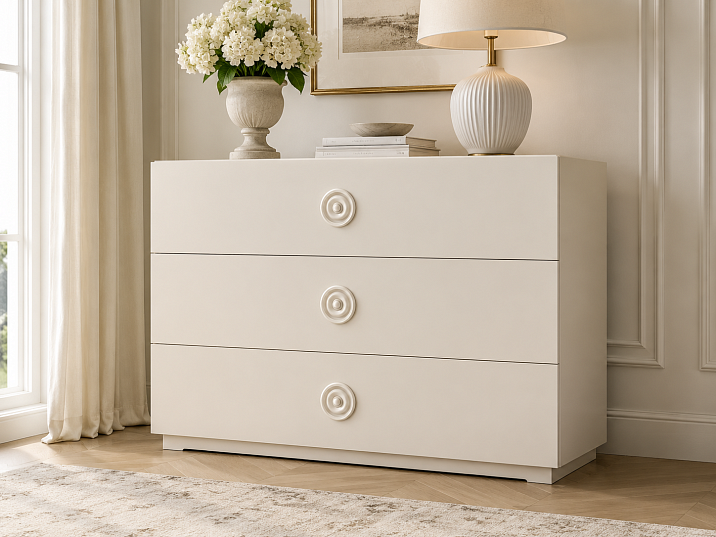
The dresser is already assembled. The facades are even, smooth, and painted — technically, there's nothing to fault in the furniture. But visually, something is missing: the surfaces look too plain, especially if there are already classic doors, a cornice, shaped legs, brass handles, or more expressive wall finishes around. A natural question arises: is it necessary to order new facades, mill the old ones, or build complex moldings on them?
Not always. For a small facade, sometimes one precisely chosen relief center is enough. In this role, RPU-057 can be considered — a carved decorative rosette made of polyurethane, 70 mm in size. This is a ready-made overlay element that allows you to change the character of a smooth surface without making a new door or drawer.
But there is one catch here. A beautiful polyurethane rosette by itself does not yet guarantee that a dresser will look classic. On one facade, a 70-millimeter ornament brings the composition together literally in one motion. On another, it seems like a randomly glued detail. Everything is decided by scale, axis, handle position, amount of free space, pattern of neighboring facades, and how consistently the decor repeats across the entire piece.
Therefore, the question is not "can a rosette be glued to a dresser?" Of course, an applied decorative element can be considered for such a task. The real question is different: when is one RPU-057 truly enough for a smooth facade to acquire a classic character, and when will additional architecture be required around it?
This is exactly what should be decided before ordering.

RPU-057 on a smooth facade: why one small detail can change furniture at all
A smooth facade has a strong side — a clean plane. It also becomes its weakness when furniture must work not as a neutral modern volume, but as part of a classic, neoclassical, or eclectic interior.
A classic facade is perceived not only thanks to complex carving. The eye primarily reads the hierarchy of the surface: there is an outer border, a central field, an accent point, symmetry, repetition of elements. Even a small round detail placed in the right place creates a center that did not exist before.
And here, the RPU-057 format is interesting precisely for its compactness. 70 mm is not a huge decorative medallion that completely dominates the furniture. It is a size that can be viewed as a local relief accent on a drawer or door.
If you want to see the element itself right away, you can buy the carved rosette RPU-057 after a preliminary scale test on a specific facade.
The meaning of such a solution is especially clear on finished furniture. The owner of a dresser usually faces three options.
The first is to change nothing. This is reasonable if the smoothness supports the entire interior.
The second is to completely redo the facades: add paneling, perform milling, order new doors or drawers. This path is justified when a deep restructuring of proportions is required.
The third is to use stucco decor on a smooth furniture facade as an additional top layer. This is where RPU-057 appears: the surface structurally remains the same, but its visual structure changes.
This is a fundamental difference. We are not trying to turn a flat door into a real joinery panel. We create a decorative composition on it that can be perceived as significantly more complex than the original.




What exactly is the carved decorative rosette RPU-057
First of all, it is important not to mix different types of products. In this article, RPU-057 is considered specifically as a carved decorative rosette made of polyurethane, not as a molding, an overlay of unspecified purpose, or part of wooden carving.
Its key confirmed size is 70 mm.
| Parameter | What the buyer needs to know |
|---|---|
| Article number | RPU-057 |
| Correct name | Carved decorative rosette made of polyurethane |
| Size | 70 мм |
| Material | Polyurethane |
| Type of decor | Overlay relief decorative element |
| Article scenario | Decor for a finished smooth furniture facade |
| Main task | Create a decorative center without milling the facade |
| Before ordering | Check the scale, handle position, facade surface, and chosen mounting method |
| Product card | order rosette RPU-057 made of polyurethane |
The 70 mm figure alone says little until it is compared with the furniture. In the catalog photo, the product exists separately. On the facade, it is always in relation to its width, height, handle, neighboring drawers, and edges.
Therefore, when choosing RPU-057, you need to think not so much in centimeters as in proportion.
Imagine a tall drawer with a large clean field. The rosette becomes a small central accent. Now transfer the same element to a very narrow drawer front—and it already begins to occupy a significant part of the surface. The article number is the same, the size is the same, but the impression is completely different.
That is why you cannot choose decor based only on a photo of the product.
Our factory also produces:


The main question: is one RPU-057 enough without a molding frame
The short answer is yes, in some cases it is enough.
But the word "enough" here does not mean "glued any socket anywhere and got a classic." RPU-057 must take on the role of a compositional center. For this, the smooth facade must provide it with enough space.
Standalone point decor works best where the surface already has a clear shape and good proportions. The even rectangle of the box itself creates the external geometry. The socket adds an internal center. Two levels of composition may be enough.
The situation changes when the door is very large. A small central ornament is surrounded by a large empty field, and there is no visual connection between it and the boundaries of the facade. Then the feeling is not of a designed facade, but of a small applique on a large plane.
This is exactly where it will come in handy buy polyurethane moldings and consider a frame construction: the molding creates a boundary for the inner field, and the rosette gets a logical place inside that boundary.
This results in two different approaches.
| Solution | When it looks convincing | When it may not work |
|---|---|---|
| Only RPU-057 | Small or medium facade with a clear central zone | Large empty field without other decorative connections |
| RPU-057 + handle | When the handle and socket are separated vertically or aligned on one axis | If elements collide or compete for the center |
| RPU-057 + molding frame | For a more architectural classic facade | On a very small drawer, the composition may become overloaded |
| Several rosettes | With a repeating facade system | A random number quickly disrupts the rhythm |
| A completely smooth facade | For a minimalist interior | When all surrounding furniture is built on classical detailing |
The main thing is not to add decor automatically. Sometimes the absence of molding makes the solution lighter and more modern. Sometimes it is precisely the frame that is missing for the rosette to stop looking lonely.
Get Consultation
Applied decor instead of facade milling: what is the real difference
Milling and overlay relief solve a similar aesthetic task by different means.
Milling changes the facade itself. The surface receives recesses, chamfers, inner fields, grooves, or a profile. If the furniture is already painted and assembled, such a rework usually involves far more operations than adding a separate decorative element.
Overlay decor works the opposite way. The base remains flat. Relief appears on top.
This does not mean that one method is "correct" and the other is "simplified." They simply produce different visual effects.
With milling, the shadow goes into the surface.
With a rosette, the relief comes forward.
With a molding, an applied line appears.
With a combination of molding and rosette, a full-fledged surface architecture emerges.
If the task is formulated as "how to decorate a smooth dresser facade without making a new door," applied polyurethane decor deserves special consideration precisely because it does not require redesigning the entire furniture structure.
Before purchasing, it is worth looking not only at the specific model but also at the entire section Moldings for FurnitureThis helps to understand whether one RPU-057 will be enough or the furniture requires a more complex system.
Don't order by photo: first cut out a 70 mm circle
The most useful tool for choosing RPU-057 costs almost nothing. It is paper.
Cut out a circle with a diameter of 70 mm and hold it against the facade at the intended installation spot.
Of course, a paper circle won't convey the pattern or depth of the relief. But it will show the main thing — the scale.
This is much more reliable than trying to imagine 70 mm mentally.
Stand not right next to the dresser, but at the distance from which the furniture is usually seen in the room. Look at the mock-up. Then step back even further.
Ask yourself a few simple questions.
Is this center visible?
Does it seem too small?
Does it unexpectedly take up a large part of the drawer?
Is there enough free surface around it?
Isn't there a handle, keyhole, edge, or other part nearby?
If there are several identical drawers on a dresser, don't apply the circle to just one, but immediately make paper mockups for the entire row. It is precisely repetition that often completely changes the impression.
One RPU-057 is perceived as an accent.
Four identically placed sockets already create a rhythm.
Six sockets on drawers of different heights can produce another effect: the furniture begins to look much more decorative than expected from a single detail.
Therefore, the quantity cannot be decided separately from the overall scheme.
The center of the facade is more important than the center of the entire dresser.
One of the most common compositional errors arises from an incorrectly chosen axis.
Let's imagine a wide dresser with three drawers. The entire piece has a common geometric center. But each front panel also has its own axis.
If RPU-057 is intended to decorate a single drawer, you usually need to focus primarily on the geometry of that front, rather than the center of the entire body.
It sounds obvious, but on real furniture the situation quickly becomes more complicated.
The handle may be offset.
The front may be asymmetrical.
Two drawers may have different widths.
There may be vertical decorative strips along the edges.
Above the central drawer there may be a countertop with a pronounced overhang.
Therefore, before final fixing, it is useful to mark the vertical and horizontal axes of each facade with painter's tape.
The socket should be considered at the intersection of these lines, and then the position should be adjusted taking into account the handle.
If the handle is not yet available
This is the most convenient scenario. You can first design the entire composition: determine the location of RPU-057 and only then decide where the furniture handle will be.
You have more freedom.
If the handle is already installed in the center
Then the center is occupied.
This is exactly where it would be a mistake to try to literally place the socket in the same spot. You need to choose a composition: the socket above the handle, below it, around it — if the geometry of the specific product allows such an idea at all — or use a different design principle.
Don't assume in advance that the decorative center must coincide with the center of the handle.
The main thing is that the two elements don't look like randomly colliding objects.
If two handles are used
On a wide drawer, two handles already create a horizontal composition. A natural central zone appears between them.
It is there that the paper mock-up of RPU-057 is especially useful. In some proportions, the rosette perfectly completes the symmetry. In others, the distances turn out to be too tight.
The decision is made only on the specific facade.
Where the RPU-057 rosette can work especially well
The theme starts with a dresser, but the logic itself is much broader. Compact polyurethane decor for interiors can be used wherever there is a suitable flat surface and an artistic task.
On the dresser, four scenarios are especially interesting.
Drawers of equal width
This is the most straightforward system. The rosette is repeated at the same point on each facade.
If you maintain the same axes, the furniture gains rhythm. Even a small ornament begins to be perceived not as a separate sticker, but as part of the design.
Dresser with central doors
If the lower or middle part of the furniture is closed by a pair of doors, each door can be given its own decorative center, or a common composition can be built relative to the pair.
Here it is important not to mix two systems. If the doors are independent, the decor should support their independence. If they are visually perceived as a single field, single placement requires particularly careful fitting.
Cabinet with one door
On a small door, a single RPU-057 can be a sufficient decorative accent. Here, the advantage of a compact accent is especially clear: there is no need to automatically surround it with several rows of ornament.
A small sideboard or cabinet
The higher the facade, the stricter the scale should be assessed. 70 mm remains 70 mm, while the free surface around it grows.
On a large door, a rosette can work as a central element within a molding frame, rather than as the only decor.
For a wider selection by product type, you can open the section buy polyurethane rosettes and compare options according to your own compositional task.
One accent or a frame: how to understand what the facade is missing
There is a simple visual test.
Remove the furniture handle from the mental image and look only at the rectangle of the facade with a 70 mm circle in the center.
If the composition already seems assembled, the frame may be unnecessary.
If the circle seems to "float" on a large surface, it needs additional connection with the facade geometry.
A molding can serve as such a connection.
polyurethane moldings buy in this case means not adding decor for the sake of quantity, but the possibility of building a second level of composition: the rectangular frame organizes the field, and the round RPU-057 becomes its center.
This is especially relevant for a tall door.
Imagine a facade with a height conditionally several times greater than the width of the rosette. Without a frame, a large neutral space remains between the element and the edges. The molding visually reduces this space, although the physical size of the door itself does not change.
But for a small drawer, the situation is the opposite.
There, the molding rectangle, the rosette, and the handle may turn out to be three competing details on a very limited surface.
Therefore, the formula "a classic facade must necessarily have a frame" is too crude.
Sometimes a more convincing classical detail is one correctly placed rosette.
Why repetition matters more than the amount of decor
The classical character of furniture is formed not only by ornament. Order is of great importance.
If on the top drawer of RPU-057 it is centered, on the second it is shifted toward the handle, on the third it is randomly raised higher, the eye will notice these discrepancies before the beauty of the pattern itself.
Therefore, for a series of identical facades, a base point is first determined.
For example:
-
the same distance relative to the horizontal axis;
-
the same alignment to the center of the facade;
-
the same logic relative to the handle;
-
the same number of elements on identical parts.
And only after that do they decide whether an additional one is needed buy polyurethane decor.
Rhythm can make a modest design look visually more expensive than a chaotic pile-up of larger details.
This is especially noticeable on the dresser. The item itself is already built on repeating horizontals: tabletop, drawers, base, legs. Rosettes can support this order.
RPU-057 and the handle: who is the main one here
A furniture facade has a functional center and a decorative center. Sometimes they coincide. Sometimes they do not.
The handle is needed for daily use. Therefore, it cannot be viewed only as a beautiful point in the composition.
If RPU-057 is placed nearby, you need to check not only the appearance, but also the ease of gripping the handle with your hand.
Fingers should not constantly touch the relief decor. You should not place the rosette in the active contact zone just because it looks symmetrical in the photo.
Before installation, it is useful to open and close the drawer several times, holding a paper mock-up in the intended place for the rosette.
This is a simple test that shows more than a static visualization.
If the hand passes freely, you can evaluate the aesthetics further.
If the mockup ends up right under your fingers, it's better to change the composition.
There are three possible directions:
-
shift the decorative element;
-
change the position or type of handle within the project;
-
abandon the socket on a specific facade and leave the decor only on other furniture elements.
The last option should not be considered a defeat. The decorative system must conform to the use of furniture, not hinder it.
Can RPU-057 be used on an already painted dresser
It is precisely for such a situation that the topic is especially interesting: the furniture is ready, but the decorative relief is missing.
However, the painted surface requires verification.
You can't assume that any mounting compound works equally well with any paint, varnish, or other coating. Before final installation, it's necessary to understand what exactly is applied to the facade, how firmly the coating adheres to the base, and whether the chosen fixation method is compatible with it.
If the surface is peeling, the decorative element will not adhere to the facade itself, but actually to a weak layer of the finish.
Therefore, preparation begins not with the adhesive, but with assessing the substrate.
STAVROS has separate Materials for furniture assembly and finishing. The specific composition should be selected considering the facade material, existing coating, and recommendations for the chosen mounting material.
Do not act on the principle "since polyurethane is light, any adhesive will do." The cost of a mistake is a ruined painted surface.
Painting the rosette to match the facade color: the most subtle way to integrate it
If the goal is precisely to make a smooth dresser start to be perceived as more architectural, classic furniture, a strong technique is to unify the surface and the applied relief with a single color.
With this approach, the eye first reads the volume, not the contrast of materials.
The rosette no longer looks like a separately purchased element and begins to be perceived as part of the surface.
This works especially convincingly where the relief should be noticeable through light and shadow.
A white facade with a white rosette.
A deep gray facade with a rosette of the same shade.
A complex, calm color and uniform painting of all decorative elements.
The main thing here is not the specific shade, but the unity of the finish.
Before painting, you need to consider the technology of the existing coating and the recommendations for the materials used. You cannot automatically transfer the painting scheme of one surface to another.
If the dresser is already fully finished, it is reasonable to first conduct a test on a separate element or another safe area of the system, rather than experimenting on the central door.
Contrasting RPU-057: more striking, but much more demanding
Contrast seems tempting.
Dark dresser — light rosette.
Light facade — golden or dark center.
Patinated detail on a flat surface.
This technique immediately makes the ornament more noticeable. At the same time, it more strongly highlights any mistake in scale or placement.
A rosette painted in the color of the facade can be perceived as part of the architecture.
A contrasting rosette turns into almost a separate decoration.
These are two different effects.
If the furniture should only slightly approach classic style, a unified color is usually calmer.
If a pronounced decorative center is needed, contrast is acceptable, but it is better to test it with a mockup. For this, even the final paint is not needed: a paper circle of the corresponding color will already show how much the facade will change.
What happens to a smooth dresser after adding relief
Interestingly, a small detail changes not only the place where it is installed.
It makes the entire facade be perceived differently.
Before decoration, the eye sees a rectangle.
After the appearance of RPU-057, a center and periphery emerge.
If there are several rosettes, a rhythm appears.
If a molding is added, a field boundary appears.
If everything is painted in one color, the relief is read through shadows.
That is why a decorative rosette for a furniture facade can produce a noticeable result with a small physical size.
But this only works when its position follows the geometry of the furniture.
How to determine the appropriate number of RPU-057
The number is almost always determined by the number of facade fields, not by the desire to "add more decor."
Let's imagine a chest of drawers with four identical drawers.
The clearest scheme is four identically placed rosettes.
But if the top drawer is divided into two separate sections, and the bottom three are wide, the system already requires a choice. You can support each independent field. You can highlight only large facades. You can completely abandon sockets on small top drawers if 70 mm takes up too much space.
Therefore, there is no simple formula like "one rosette per chest of drawers."
There is a more useful principle:
identical facades should receive identical decorative logic.
If one of them is styled differently, the reason should be visible: a different size, a different function, a different position in the composition.
Random exceptions look like mistakes.
When one socket for the entire dresser is truly justified
This option is possible if the furniture has one obvious compositional center.
For example, a central door among neutral side elements.
Or one large facade that, by the item's architecture, should be the main one.
In this case, RPU-057 becomes a sign of hierarchy: not all surfaces are equal, one of them is accentual.
But if we have four completely identical boxes in front of us and only one of them gets a socket without a visible reason, the question arises: why this one?
Classical composition loves explainability.
Symmetry does not have to be absolute, but the viewer must understand the intent.
How not to turn a dresser into a "collection of beautiful details"
After choosing the first socket, there is a temptation to add something else: molding, corners, additional overlays, a decorative handle, a shaped leg, patina.
Each individual idea can be good. Together they easily start to argue.
To avoid this, it is useful to define the main level of decor.
If RPU-057 becomes the main element, the molding should help it, not compete with it.
If the main pattern is created by a complex molding frame, the socket can be just the final touch.
If the handle itself is very decorative, perhaps the embossed center should be made calmer.
This rule is especially useful when you are looking decorative polyurethane elements. The catalog inevitably offers more beautiful details than a single piece of furniture requires.
The buyer's task is not to use everything they like, but to assemble one system.
Three levels of decorating a smooth facade
For practical selection, it is convenient to mentally divide solutions into three levels.
The first level is only RPU-057
Minimal intervention.
The smooth facade retains its modern cleanliness, but gains an ornamental center.
This option is appropriate when you want not historical richness, but a light classical touch.
The second level is RPU-057 and a molding frame.
The composition becomes more architectural.
The frame organizes the field. The rosette fixes the center.
This is a path for facades where one small element looks insufficiently connected to the overall geometry.
The third level is a system of several types of decor.
The rosette, moldings, additional decorative inserts, handles, and other elements are selected as a unified design.
This approach already requires a particularly precise scheme. It is useful to look in advance at which Relief Decoration exists in one product system, and only then assemble the set.
The higher the saturation level, the more important the preliminary sketch.
What to buy together with RPU-057
The question "what to buy together" does not mean that every socket necessarily requires a whole basket of additional parts.
The point is different: check in advance whether your composition is complete.
| What to consider | What for | When it is really needed | Where to go |
|---|---|---|---|
| RPU-057 | Central relief accent | When the 70 mm size fits the facade | carved rosette RPU-057 70 mm buy |
| Other rosettes | Compare scale and pattern | If RPU-057 looks too large or too small according to the layout | polyurethane rosette |
| Polyurethane molding | Create a frame around the central field | When the rosette gets lost on a large facade | buy polyurethane moldings |
| Additional decor | Support the frame composition | For richer classic style | decorative polyurethane elements |
| Installation and finishing materials | Prepare installation and subsequent finishing | Selected to match the specific base and coating | Materials for furniture assembly and finishing |
This table is useful primarily as a filter against unnecessary purchases.
If a 70 mm paper circle already looks good on the facade, there is no need to automatically add a molding.
If the rosette gets lost, then it makes sense to consider a frame.
If the frame itself looks complete, there is no need to add several more ornamental elements just to make it look richer.
How not to confuse RPU-057 with other types of decor
The word "rosette" is used broadly in interior design. Therefore, before ordering, it is important to stick to the exact name of the specific product.
RPU-057 is a carved decorative rosette made of polyurethane, 70 mm in size.
Its properties should not be automatically transferred from a large ceiling rosette, nor should it be considered a molding.
A molding is a linear element. It creates a contour.
A rosette is a local element. It creates an accent.
Decor for moldings can work at joints or as part of a frame system.
A large ceiling element solves a different compositional task.
For this article, the local application of RPU-057 on smooth furniture is important.
If you want to compare it with other options of the same type, it is better to open the category buy polyurethane rosettes, rather than choosing a random piece from another group just because it also has a round ornament.
A classic dresser does not have to be overloaded
There is a persistent stereotype: if furniture is classic, it must have a lot of carving.
In practice, the sense of classicism often arises from much calmer things — proportions, symmetry, rhythm, repetition, a clear axis, and moderate relief.
Therefore, the question in the title is quite meaningful: can classic decor be made only with RPU-057 rosettes?
Yes, if the task is to add a classic character rather than imitate a complex historical joinery construction.
This is an important distinction.
A single applied rosette does not turn a flat facade into a real paneled door. But it can change its stylistic perception.
And sometimes just that degree of intervention is enough.
For neoclassicism, less is often more.
A neoclassical interior particularly well demonstrates the value of moderation.
It can combine smooth large surfaces and individual classic motifs.
A chest of drawers with flat facades does not necessarily need to be completely rebuilt. You can preserve the geometry, add RPU-057, paint the decor in the color of the base, and get relief that is noticeable only when the light changes.
This approach works completely differently from contrasting decorative appliqué.
The rosette does not shout.
It manifests as a shadow.
If the composition requires another line, a molding appears.
If not, the surface remains free.
That is why it is wiser to start not with the maximum set, but with a mock-up of the minimal solution.
Traditional classicism may require more architecture.
A classic interior with pronounced cornices, paneled doors, profiled casings, and rich furniture demands a different scale of requirements.
Against its background, a smooth door with one small RPU-057 can sometimes look too simple.
Then the rosette retains its value but changes its role.
She becomes the center of the framing composition.
A molding appears around it.
The free field is shrinking.
The facade receives several levels of relief.
If this scenario is closer, you can in advance buy polyurethane decor not based on the principle of "what you liked," but after constructing a precise scheme on the facade.
And what if the dresser is modern?
This is not an automatic prohibition.
A modern piece of furniture can be deliberately decorated with a classic element—as a stylistic contrast.
But it is necessary to understand that such a result will no longer be pure classic.
For example, a laconic rectangular dresser, simple handles, and one ornamental relief can give an eclectic solution.
If the interior supports such a mix, it is a quite meaningful path.
If, however, the entire room is built on strict minimalism and the absence of decor is part of the concept, RPU-057 may look out of place.
Not every smooth facade needs to be saved from smoothness.
Sometimes smoothness is its main advantage.
Where else to look for ideas specifically for dressers and nightstands
Before making a final choice, it is useful to look not only at isolated decor, but at the furniture as a whole.
The website has a separate section ideas for styling dressers and nightstands, where you can evaluate how decorative details interact with facades, legs, handles, and the overall proportions of the item.
There is also a specific KMD-049 chest of drawers decoration idea. It does not replace the scheme with RPU-057 discussed here, because it solves a different decorative task, but it is useful as a reminder: a dresser is always perceived as a whole.
A person does not see a "rosette on the facade."
He sees the tabletop, the body, the drawers, the legs, the handles, the decor, and the space around them all at once.
Bedroom: decor must work from a distance
A dresser in the bedroom is often not in a walk-through area, but against a wall and is perceived from a distance — from the bed, the entrance, or the opposite part of the room.
In this scenario, fine relief is evaluated not only up close.
Make a paper mockup of RPU-057, temporarily attach it, and look at the furniture from the main viewpoints.
If the 70 mm circle visually disappears, there are two possible explanations.
The first is that the facade is too large for an independent central element.
Second, the problem is not the size of the socket, but the absence of a frame that would help assemble the field.
The decision cannot be made only by standing fifty centimeters from the dresser.
Living room: furniture enters into dialogue with the room's architecture
In the living room, a dresser or cabinet often coexists with doors, wall panels, cornices, baseboards, and other noticeable elements.
Here an additional task arises: the decorative language of the furniture should at least not argue with the room's architecture.
If the walls are already decorated with relief, you can look Polyurethane wall decor and compare the general character of the ornament with the planned furniture piece.
This does not mean that the wall and furniture must have identical elements.
Rather, you need to check the level of decorative saturation.
If the walls are complex and the furniture is completely plain, a single rosette can establish a visual connection.
If both walls and furniture are covered with a large number of different ornaments, the room may lose a clear hierarchy.
Entryway: beauty should not be subject to constant touching
In the entryway, furniture is used actively.
Drawers open frequently, people pass by, and keys and bags are placed on the cabinet.
Therefore, the decorative center needs to be checked for ergonomics especially carefully.
The most beautiful spot on the frontal sketch is not always convenient in everyday use.
If RPU-057 ends up right where fingers land every time when grabbing the handle, the composition should be reconsidered.
The relief should decorate the furniture, not create a daily obstacle.
Commercial interior: repetition becomes the main tool
Small dressers, consoles, cabinets, or nightstands can also appear in showrooms, hotel spaces, offices, and showrooms.
Repeatability is especially important here.
If several items form one group, decorative elements should be arranged according to a common system.
RPU-057 is more convenient to consider not as an individual decoration of each item, but as part of the visual language of the room.
The same rosette on several facades creates a recognizable motif.
But before ordering a series, it is wise to first test one real sample of the composition.
What to check before ordering RPU-057
Purchasing takes minutes. Fixing a failed composition takes much longer.
Therefore, before
Mistake No. 3. Ignoring the handle
A composition without a handle can be magnificent.
After installing the fittings, it falls apart.
Therefore, the socket, handle, and possible frame should be evaluated together.
If the furniture is already assembled, it's even easier: all functional elements are in place, and you can immediately see the real constraints.
Mistake #4: Buying molding for "classic style" right away
Molding can indeed make a facade more architectural.
But its presence is not a mandatory condition for a good composition.
On a small box, an additional frame may be unnecessary.
First, check RPU-057 yourself.
Only if the facade clearly lacks a boundary for the inner field, proceed to the section where you can buy polyurethane moldings.
Mistake #5: Decorating each facade differently
One socket in the center.
On the neighboring drawer, two.
There's also a molding on the door.
Different position on the lower front.
Without overall logic, the dresser becomes an exhibition of samples.
Better to choose one main principle and repeat it.
Mistake #6: Making contrast before checking the composition.
Contrast color sharply increases the significance of RPU-057.
If the size or position is chosen poorly, contrast will highlight the problem.
First achieve good geometry in a neutral layout.
Then decide on the color.
Mistake #7: Considering applied decor as a replacement for any carpentry rework
RPU-057 allows adding relief.
But it does not change the facade's construction.
If the goal is to achieve a deep genuine panel, a complex profile around the entire perimeter, or a completely different door geometry, a single rosette cannot solve such a task.
It is important to acknowledge this before purchasing.
Mistake No. 8. Not checking the base
Even a perfect composition is meaningless if the surface is not ready for the chosen installation method.
Pay special attention to old painted facades, unknown coatings, and furniture that has undergone several renovations.
Select Materials for furniture assembly and finishing for a specific surface, not just for the name of the decorative piece.
When RPU-057 is truly worth choosing
This solution is especially interesting when the furniture already exists and you don't want to change the facades themselves.
It is also suitable when a local classic relief is needed without a complex frame system.
A good candidate is a chest of drawers with several identical smooth drawers, on which you can repeat one compositional scheme.
Another successful scenario is a small cabinet or door with a well-defined free center.
RPU-057 should also be considered for furniture intended for a single subsequent painting, if the project provides for appropriate preparation and the chosen finishing technology is compatible with the materials.
Finally, this is an interesting option for a person who wants to first make a minimal change, see the result, and only then decide whether additional moldings are needed.
When it is better to choose a different path
There are situations where a single RPU-057 will not solve the problem.
A very large facade may require a more large-scale composition.
On a narrow 70 mm strip, they may be too noticeable.
Complex classic furniture around may require a full frame structure.
An active decorative handle can sometimes already take on the role of the central accent.
Covering an old facade may require serious preparation before installation.
Finally, if the task is specifically to create a true deep panel, you need to consider a structural change to the facade, not just applied decoration.
An honest answer sometimes sounds like "RPU-057 is not needed here."
And it's better to understand this before ordering.
Practical scenarios: which solution to choose
Scenario 1. White dresser with four identical smooth drawers
Start with four paper circles of 70 mm.
Place each at the geometric center of the corresponding facade.
If the handles are in the center, test the position of the outlets relative to them.
If the composition looks cohesive, you can do without molding.
This is the case where repetition does the main work.
Scenario 2. Tall bedside table with one door
One central element may be sufficient.
But be sure to evaluate the empty space above and below.
If RPU-057 seems lost, try marking a rectangular frame with painter's tape. This will instantly show whether molding is needed.
Scenario 3. Wide dresser with two handles on each drawer
The center between the handles naturally attracts attention.
RPU-057 can emphasize it.
But check the distances by hand — the decorative element should not interfere with using the hardware.
Scenario 4. The dresser is already painted and you don't want to change the color
The main task shifts from design to technological compatibility.
First, determine the existing coating and assess the condition of the surface.
Only then choose the mounting system.
Scenario 5. The dresser should become significantly more classic
One socket may not be enough.
In this case, it's better to consider the combination of "RPU-057 + molding" and study decorative polyurethane elements as part of a more cohesive system.
Standalone outlet or kit: final comparison
| Criterion | Only RPU-057 | RPU-057 + molding | More complex set |
| Visual richness | Moderate | Medium | High |
| Preserving smooth field | Maximum | Partial | Minimal |
| Demanding on layout | High | Very High | Very High |
| Suitable for small facades | Often | Depends on size | Not always |
| Suitable for large doors | Depends on proportions | Often better | For a complex stylistic task |
| Role of RPU-057 | Main accent | Frame center | One of the system elements |
| Risk of overload | Low | Medium | Higher |
| The need for a preliminary sketch | Desirable | Required | Required |
This table clearly shows the main principle: the more decorative elements you add, the less room remains for randomness.
The minimal variant is easier to correct at the mockup stage.
A complex system requires a project.
Why RPU-057 is better evaluated on a real facade, not just in visualization
Computer visualization is useful, but it has a weak point: the scale on the screen easily deceives.
The facade in the program can occupy the entire monitor.
In the room, it is several meters away from a person.
The shadow in the visualization can be enhanced.
In reality, it depends on the lighting.
Therefore, the best order is as follows:
first, the diagram;
then, a paper mockup;
then, the actual decorative element;
and only after verification — the final repetition on the remaining facades.
If the furniture is valuable or the finish is complex, a trial fitting is especially important.
You don't have to do the entire dresser in one go.
When it comes to several identical facades, there's a sensible way to reduce risk: test the composition on one element before mass repetition.
This does not mean chaotically decorating only one drawer forever.
It's about a test.
Position, color, relation to the handle, shadow character—everything is better assessed on a real sample.
After that, the decision is scaled to the remaining identical facades.
If you are just choosing a model, you can first buy the carved rosette RPU-057 in the quantity needed for testing, considering the current product card conditions, and form the final order scheme after trying it on.
Why the article is specifically about RPU-057, not about "decorating a dresser in general"
General furniture decor is a huge topic.
You can change the legs.
You can change the handles.
You can add wooden carvings.
You can create complex frames.
You can completely redo the facades.
But then the original buyer's task is lost: what should a person do who already has a smooth facade and doesn't want to have it remade?
RPU-057 is interesting here not abstractly as beautiful molding.
It is interesting as a specific element 70 mm in size that can be checked on a finished surface and make a clear decision: whether such an accent is enough or not.
For a more general study of the topic, there is a separate material about decor for furniture facades made of polyurethaneHere, however, the task is much narrower: to determine the role of one specific socket.
How to buy RPU-057 on STAVROS without extra items in the order
First, open the card and double-check the exact name and current parameters of the selected item.
The main product transition is — buy the carved rosette RPU-057.
Then proceed not from the catalog, but from your own facade.
If 70 mm fits, determine the number of identical decorative centers.
If the size is questionable, compare other options in the category polyurethane rosette.
If the central accent gets lost, check the frame option and polyurethane molding.
If the project becomes more complex, look at decorative polyurethane elements.
If the facade is already painted, separately address the installation issue through the appropriate materials category.
Thus, the cart is built from the task, not from the desire to add everything you like to the dresser.
FAQ: questions about RPU-057 on smooth dresser facades
Is it possible to make a classic dresser using only RPU-057 without moldings?
Yes, this option is possible if the 70 mm size correlates well with the facade and the rosette gets a clear compositional place. It can look especially convincing on small and medium facades, where there is not too much empty space around the decorative center. On a large door, a frame or other additional decor may be required.
Is RPU-057 an overlay or a rosette?
The correct name within this article: RPU-057 is a carved decorative rosette made of polyurethane, size 70 mm. It is better to stick to the exact product name and not mix it with moldings or other decor groups.
How do I know if the 70 mm size fits my drawer?
Make a paper circle with a diameter of 70 mm and temporarily attach it in the intended place. Then look at the front from the distance from which you usually see the dresser. Such a mock-up does not show the relief, but it very accurately reveals a scale error.
Is it mandatory to place the rosette exactly in the center?
If we are talking about a separate symmetrical front, the geometric center is a good starting point. But the final position depends on the handle and other elements. It is important to build the composition relative to the specific front, not automatically relative to the entire dresser body.
What to do if there is already a handle in the center?
Do not try to mechanically combine two elements. Make a mock-up and check the position of RPU-057 above or below the handle, or reconsider the composition. The decorative element should not interfere with the grip of the handle.
Can RPU-057 be installed on already painted furniture?
Decorating a finished facade is possible, but the condition and type of coating must be checked before installation. The chosen mounting material must match the base and existing finish. A peeling or unstable surface must first be brought to a condition suitable for further work.
How does applied decor differ from milling?
Milling changes the facade plane itself, creating a recessed pattern. RPU-057 adds relief on top. Therefore, applied decor is especially interesting when the facade is already made and the task does not require a full structural rework.
Do I need to paint RPU-057 to match the color of the dresser?
Not necessarily, but a uniform paint helps visually connect the applied relief with the facade. A contrasting solution makes the rosette much more noticeable and requires a more precise composition. The painting technology must be selected considering the materials and existing coating.
How many rosettes are needed for a dresser?
The quantity depends on the number of independent facade fields and the chosen rhythm. For identical drawers, it is usually better to use a single design principle. If facades differ in size, each group must be evaluated separately.
Do I need to buy molding along with RPU-057?
No. First, test the rosette yourself. Molding makes sense to add when the central element gets lost on a large surface or when the interior requires a more architectural classic facade.
Where can I see other polyurethane rosettes?
You can compare options in the section buy polyurethane rosettes. This is useful if, after trying on the 70 mm version, it turns out that a different scale or a different decorative character is needed.
Can RPU-057 be used on a cabinet or wardrobe?
The main limitation is not the name of the furniture piece, but the presence of a suitable facade field, the correct scale, and the possibility of safe installation. Therefore, the same fitting principle applies to the door of a cabinet, sideboard, or small wardrobe.
Will one RPU-057 fit a large door?
Possibly, but this is exactly the case that must be checked with a mockup. The larger the free surface, the higher the chance that a single 70 mm element will look lost. In that case, a molding frame or another decorative system helps.
Can RPU-057 be combined with other polyurethane elements?
Yes, if the composition is planned in advance. For a more complex system, you can look at decorative polyurethane elements, but the new parts should support RPU-057 and the facade geometry, not compete with them.
What matters more before ordering: the style of the rosette or the size?
Both parameters are important, but a scale error cannot be fixed with a beautiful pattern. So first check 70 mm on the actual facade, then evaluate the ornament, color, and combination with the rest of the interior.
Where can I order exactly RPU-057?
The main product card is here: carved rosette RPU-057 70 mm buy. Before placing an order, check the current information in the card, the quantity for your scheme, and the requirements for future installation.
Should you ultimately keep a smooth facade or add RPU-057?
If the dresser looks good in the interior without decor, there is no need to change it just because molding exists.
But if the furniture seems too flat next to more classic elements of the room, redoing the facades is not the only way.
The carved decorative rosette RPU-057 made of polyurethane, 70 mm in size, allows for a much more delicate scenario: keep the existing surface, but give it a relief center.
First, the layout.
Then the axis.
Then checking the handle.
Then decide on the quantity.
And only after that — the question of whether a molding is needed.
It is in this order that one small detail ceases to be just decoration and begins to work as part of the furniture.
If after trying it on the facade already looks finished, nothing needs to be added. If too much visually empty space remains around RPU-057, you can move on to polyurethane relief and assemble a more developed frame composition.
The main advantage of this approach is that the choice is made not based on an abstract idea of "classics," but on the actual piece of furniture.
STAVROS allows you to go through this path sequentially: look at a specific RPU-057, compare Polyurethane Rosettes, if necessary, select moldings and other elements, and then assemble exactly the level of decor that your dresser needs.
No more.
And no less.