










































































Article Contents:
- NPU-501 is exactly a decorative overlay, not a shortened molding
- 58 × 300 × 11 mm: why the size should be transferred directly to the door
- Main parameters of NPU-501
- First — symmetry
- Second — free field
- Third — correct height position
- The overlays look too small
- There is no visual connection between the decor and the door edges
- The rest of the interior is very classic
- An imitation of paneled architecture is needed
- Several decorative fields are planned
- Delicate
- More decorative
- Kit depending on the fitting result
- The owner of an already renovated apartment
- The one who bought simple smooth doors in advance
- A lover of neoclassicism
- A designer who values the empty plane
- The one who wants to first try a small change
- For a pronounced traditional classical interior
- For very large door leaves
- If other doors are already paneled
- If you want to imitate a real frame architecture
- Very narrow door leaf
- Minimalist interior without ornament
- Door with active milling
- Panel with glass of complex geometry
- Door with decorative handle and rich casing
- Photo A
- Photo B
- Maintain the distance between NPU-501
- Maintain the proportion relative to the door leaf

A smooth interior door is already installed and painted. The color is satisfactory, the door leaf is even, and there is no desire to replace it for a classic interior. But after finishing the renovation, something else becomes noticeable: next to furniture, cornices, stucco decor, or classic details, a completely smooth door looks too plain. A clear idea arises — not to assemble a full panel system from molding on the door leaf, but to add only two vertical decorative elements.
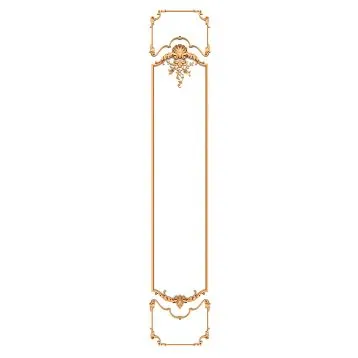
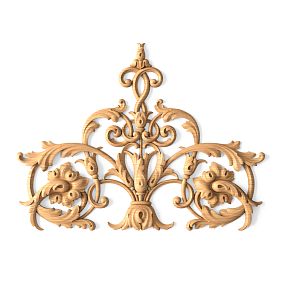
Suitable for this scenario decorative overlay NPU-501 made of polyurethane. The size of one overlay is 58 × 300 × 11 mm. The format is elongated, vertical, so a pair of NPU-501 can indeed be considered as standalone decor for the upper part of a smooth door.
But the main question is not whether two overlays can be physically installed.
The main question is different:
will two NPU-501s by themselves look like a complete classical composition, or will it turn out after fitting that they still need a molding frame?
There is no universal answer here that "two are enough for any door."
On one door panel, two vertical overlays provide exactly the level of decor that was missing: symmetry, ornament, and light and shadow appear, while the door itself retains a calm smooth surface.
On another door, these same two pieces may look too small and lonely. Then the problem is solved not by increasing their number, but by the appearance of an architectural boundary — a frame made of molding.
Therefore, the decision should be made not based on a photo of one NPU-501, but on a full-size layout of two elements on a specific door panel.
And the good news is that this does not require immediately buying a large set of stucco molding.
First, you can check the simplest option: 2 × NPU-501.
If the composition looks complete, molding is not needed.
If the decor seems to "hang" on a large smooth surface, then it makes sense to move to the second scenario: two NPU-501s plus a molding frame.
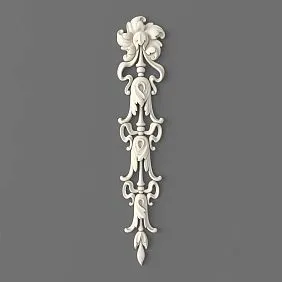
NPU-501 is precisely a decorative overlay, not a shortened molding.
For proper design, it is important not to mix categories.
NPU-501 is a vertical decorative overlay made of polyurethane.
This is not a molding.
Not a baguette.
Not trim.
Not a panel.
Not a finished door panel.
The molding forms a long line. It can be used to assemble a rectangular or other frame, trace a contour along the door leaf, or divide the surface into fields.
NPU-501 works differently.
This is a ready-made, self-contained ornamental element measuring 58 × 300 × 11 mm. It does not need to be continued with linear meters to make sense. A single overlay already has a complete pattern, while two allow you to build a symmetrical composition.
That is why the scenario of “two NPU-501s without molding” is viable at all.
If it were only about a linear profile, without a frame it could indeed look unfinished. But the decorative overlay does not have to be inside the molding contour.
It can be a standalone accent.
The only question is scale and placement.




58 × 300 × 11 mm: why the size needs to be transferred directly to the door
From a photo, the NPU-501 may seem quite large.
On a real door leaf, the perception changes.
The width of 58 mm makes it quite narrow.
A height of 300 mm is already quite noticeable and forms a pronounced vertical line.
The relief of 11 mm means that after installation it will not be a painted ornament, but a real three-dimensional element interacting with light.
The pair provides two elongated vertical points.
But the door itself is much larger than each of them.
Therefore, the main compositional risk is not to overload the leaf, but on the contrary, to make the decor too small relative to the free area.
Our factory also produces:

Main parameters of NPU-501
| Parameter | Value | What this means when designing a door |
|---|---|---|
| Product type | Decorative overlay | can be used independently, the frame is not mandatory by definition |
| Article number | NPU-501 | allows you to select a specific product without mixing it with other overlays |
| Material | Polyurethane | refers to polyurethane molded decor |
| Width | 58 мм | the overlay remains visually narrow |
| Height | 300 мм | creates a noticeable vertical accent |
| Relief | 11 мм | forms volume on a smooth surface |
| Recommended scenario for this article | two symmetrical overlays at the top of the door | the simplest way to check the decor without a frame |
| Product card | buy decorative overlay NPU-501 | before ordering, the parameters of the specific product are verified |
These numbers are better not just memorized.
They need to be drawn.
Get Consultation
The most useful test before buying: two paper rectangles 58 × 300 mm
No complex design project is needed for the test.
Make two strips of paper or thin cardboard measuring 58 × 300 mm.
Attach them to the door with masking tape.
For now, without the ornament image.
Just two rectangles.
Already at this stage it will become clear:
-
whether the height of 300 mm is sufficient;
-
aren't 58 mm too narrow;
-
how far apart should the elements be placed;
-
where is the visual center of the upper part of the door;
-
does the handle get in the way;
-
isn't the lower part left too empty;
-
does the composition require an additional frame.
Then you can draw a rough silhouette of the ornament inside the strips or use a product image printed at actual scale.
Such a mock-up is much more useful than trying to determine everything "by feel" on the website.
Answer in one paragraph: two NPU-501 may indeed be sufficient
If the door is already painted, you don't want to build full panel frames on it, and the interior only requires a small classical accent, two symmetrical NPU-501 can work perfectly as a standalone composition.
Especially if:
-
the door is smooth;
-
the color of the panel is calm;
-
the decor is located in the upper field;
-
the two overlays have a clear common axis;
-
there is enough free surface around them;
-
the handle does not conflict with them;
-
there is not a large amount of other door molding nearby.
That is, molding is not a mandatory condition for a classic character.
A classic impression can be achieved through:
-
symmetry;
-
verticality;
-
ornament;
-
correct fields;
-
proportionality.
And the frame is just one of the tools to enhance this system.
Why two overlays sometimes look more finished than a frame
There is a common belief: if it's a classic door, panels are a must.
In practice, this is not always the case.
A full molding layout immediately increases the number of lines on the panel.
Appear:
-
two verticals of the frame;
-
top horizontal line;
-
lower horizontal;
-
sometimes several separate rectangles;
-
inner decor.
If the door itself is in a calm modern interior with individual classical details, such a system may be excessive.
Two NPU-501s give a different result.
The door remains smooth at its core.
But an ornament appears on it.
This technique is especially good for neoclassicism, modern classicism, and transitional interiors, where you don't want to turn every door into a complex palace panel.
When the absence of a frame looks intentional
Standalone NPU-501s should be perceived not as "the frame was forgotten to be installed," but as a complete pair.
Three conditions are necessary for this.
First — symmetry
The two overlays must have a clear relationship to each other.
Second — free space
They need space around them.
Third — correct vertical positioning
If the pair simply hangs somewhere in the middle of a smooth surface, the composition may look random.
When the elements are in a meaningful upper zone, they begin to be perceived as a decorative finish.
Why exactly two, not one
One vertical NPU-501 can also be used as a decorative element in various compositions.
But on a standard single-leaf smooth door, one overlay creates a completely different effect.
It can work along the central axis.
This is very concise.
But two elements form a more pronounced classical principle:
the left part — the door axis — the right part.
Symmetry appears.
It is precisely the pair that allows making a smooth panel visually more complex without introducing a rectangular molding frame.
Why you shouldn't immediately buy four overlays
The logic of "two is beautiful, four is even richer" works poorly.
Four NPU-501 units will already require a more complex structure.
For example:
-
two on top;
-
two on the bottom.
But then the top and bottom pairs must have clear relationships.
A large empty field appears between them, or, on the contrary, too many identical vertical elements.
If you want to decorate the top and bottom of the door, it is often more logical to consider a frame system made of of polyurethane moldings, rather than endlessly increasing the number of individual overlays.
Therefore, for the original scenario, two pieces is the correct starting point.
Option No. 1: only two NPU-501s
This is the minimum set.
The door remains smooth.
At the top there are two vertical overlays.
Result:
-
a bit of classic ornament;
-
symmetry;
-
minimum of new lines;
-
There is no need to calculate the frame perimeter;
-
less risk of overloading a small canvas.
This scenario should be tried first.
If the door looks complete after a full-size mockup, there is no need to complicate it.
Option No. 2: two NPU-501 inside one molding frame
Second level.
A single large rectangular outline is created around the pair.
Now the NPU-501 are perceived not as freely placed elements, but as the content of a decorative panel.
The result becomes:
-
more architectural;
-
more classic;
-
stricter;
-
more formal.
This option is good when the overlays seem lost without a frame.
To implement it, you already need buy polyurethane moldings and calculate the actual geometry of the frame.
Option No. 3: two NPU-501 on top plus a separate bottom frame
A more traditional door composition.
The upper field receives an ornament.
The lower one gets a calmer paneled frame without an additional overlay.
This way the door starts to resemble a classic framed panel more strongly.
But this is no longer the "no moldings" scenario.
It should only be chosen when two NPU-501s really don't sufficiently connect the top and bottom.
Option No. 4: one NPU-501 on each leaf of a double door
For a double-leaf panel, the rules change.
Instead of two overlays on one leaf, you can use one on each.
Then symmetry is built relative to the central joint of the doors.
This can look much calmer than four elements.
But first, each leaf needs to be measured separately.
You cannot transfer the layout of a single-leaf door to a double-leaf door just because the overall opening is wider.
Option No. 5: two NPU-501 on each leaf
This is already a pronounced decorative scenario.
Four elements in total.
It makes sense on a sufficiently wide and tall double-leaf door, where each leaf can be perceived as an independent decorative panel.
For narrow leaves, four vertical elements can create an overly frequent rhythm.
A full-size mockup is mandatory.
How to understand that two NPU-501 are large enough for the door
You don't need to start with the total area of the panel.
Better to assess the upper working field.
This is part of the door:
-
above the handle;
-
between the side edges;
-
below the top edge;
-
free from other decorative details.
Then place two 58 × 300 mm rectangles inside.
If the eye immediately understands that this is a deliberate pair, the scale is suitable.
If the elements literally disappear on a huge plane, there are three possible solutions:
-
slightly change the distance between them;
-
create a frame;
-
choose a different, larger decor.
Do not automatically add two more NPU-501.
How to understand that two overlays are too large
The opposite problem is also possible.
If there is too little space from the elements to the side edges of the door, the overlays start to press against the boundaries.
If the upper ends almost touch the edge of the panel, the composition lacks air.
If there is too little space between two NPU-501, they start to be perceived as one wide ornamental block.
Then it is useful to:
-
increase the distance;
-
lower the pair slightly;
-
consider one central overlay;
-
choose a different model.
Don't attach to the door edges prematurely
The simplest calculation looks like this:
door width;
minus two overlays of 58 mm;
divide the remaining space into fields.
But first you need to decide which fields are actually needed.
For example, a conditional door has a width of 800 mm.
Two NPU-501 occupy:
58 × 2 = 116 mm.
remains:
800 − 116 = 684 mm.
These 684 mm need to be distributed between:
-
left margin;
-
the gap between the overlays;
-
right margin.
Option with three equal gaps:
684 ÷ 3 = 228 mm.
That is, conditionally:
228 mm — NPU-501 — 228 mm — NPU-501 — 228 mm.
This is only a mathematical starting point.
Not a rule.
On a real door, the central gap can be made different.
Why equal intervals do not always look better
Classic symmetry does not mean that absolutely all distances must match.
Two overlays can be placed closer to each other, forming a single decorative center.
Then the side margins become wider.
Or vice versa — the overlays spread toward the sides, leaving more space in the center.
Which option is better?
It depends on the shape of the ornament and the door handle.
Therefore, it is useful to make three layouts:
-
a narrow pair;
-
medium;
-
widely spaced.
And photograph each one.
Symmetry is not just the same distance to the edges
To make two NPU-501 look truly professional, check:
-
same height;
-
same orientation;
-
identical side margins;
-
equal alignment relative to the door's central axis;
-
equal distance from the top edge;
-
equal positioning relative to the molding frame, if it appears later.
Any difference is especially noticeable on a smooth surface.
There is no other texture that could hide a small mistake.
First, find the central axis of the door
Not the doorway.
Not the wall.
Not the trim.
And the canvas itself.
Especially if the trims have different widths or the opening is visually shifted.
Two NPU-501 should relate primarily to the door.
Equal distances are measured to the right and left from the central axis.
Only after this is the overall appearance with the trims and wall checked.
Why a handle can completely change the layout
A handle is a small object, but on a smooth door it is very noticeable.
Especially if:
-
long;
-
vertical;
-
contrasting color;
-
decorative.
If the NPU-501s are positioned too low, one of them may come into direct visual conflict with the handle.
For example, the right vertical trim will end up almost directly above it.
Then the composition ceases to be visually symmetrical, even though the elements are mathematically positioned correctly.
Therefore, the handle must always be included in the sketch.
Why the upper part of the door is often more convenient
If two NPU-501s are placed above the handle, several advantages emerge.
The upper zone is usually:
-
more free;
-
better visible;
-
less intersects with functional hardware;
-
naturally suits vertical decorative elements.
Moreover, the upper ornament can be perceived as a kind of completion of the panel.
But "higher" does not mean "as close to the edge as possible".
A free field at the top is mandatory.
Can two NPU-501 be placed at the center of the height?
It is possible as a design scenario, but the handle must be taken into account.
If the pair is exactly in the middle of the door, it becomes a central medallion block.
For some modern interiors, this is interesting.
For a classic composition, the upper placement often looks more natural, especially if the lower half of the panel should remain calm.
Again, there is no universal standard.
The bottom part of the door without decor is not incompleteness
The buyer might think:
"If there are two overlays on top, the bottom is empty. So, something else needs to be added."
Not necessarily.
The empty bottom part helps the top decor stand out.
Especially if the NPU-501 itself is quite intricate in its ornament.
There is no need to strive to fill every square centimeter.
In modern classic, empty space is especially important.
Two NPU-501s on a white door: what happens visually
A white or near-white smooth door is one of the most straightforward scenarios.
If the overlays are painted in the same color, the ornament manifests through light and shadow.
From the front, the decor looks calm.
With side lighting, the 11-millimeter relief becomes more noticeable.
As a result, the door remains monochrome but ceases to be completely flat.
This is a good option if the task sounds like:
"I want a classic character, but I don't want the stucco molding to look like a glued-on decoration."
A light door and contrasting NPU-501
A completely different scenario.
For example, overlays darker than the panel.
Then the 58-millimeter width ceases to be visually small.
Each NPU-501 becomes a graphic sign.
The pair reads much more actively.
In this case, the absence of a frame can even be an advantage: a frame would add another contrasting line and could overload the door.
That is, a contrasting color sometimes reduces the need for molding.
Colored door and NPU-501 in matching tone
Deep green, blue, gray, beige, or another painted background can work very well with monochrome molding.
When the color is the same, the NPU-501 seems to become part of the panel itself.
The main expressive means remains the shadow.
This is one of the most versatile ways to use Polyurethane Decor on an already painted door, without making the composition too ornate.
At the same time, the specific preparation and painting system should be selected taking into account the existing door coating and the finishing materials used.
Contrast on a colored door: first a mockup, then a decision
On a dark blue door, the white NPU-501 will be noticeable from the other end of the room.
On a green door, a golden or other accent shade can completely change the style.
This can be beautiful.
But this is no longer a delicate modernization.
Contrast turns two small overlays into one of the main elements of the door composition.
Therefore, before choosing contrast, you need to make sure that the dimensions and placement themselves are already ideal.
Color should not be used to compensate for a weak layout.
Already painted door: why the condition of the coating matters more than the color itself
Since the web already has a finish coating, the installation issue cannot be resolved based solely on the NPU-501 material.
Polyurethane overlay.
But the second participant in the connection is the existing painted surface.
It is necessary to assess:
-
how durable the coating is;
-
whether there is any peeling;
-
whether there is any contamination;
-
whether the area is damaged;
-
whether the selected mounting material allows working with such a surface.
It is pointless to glue decor to a non-durable coating: in that case, the weak link becomes not the overlay itself or the adhesive, but the paint layer.
Therefore, installation begins with an assessment of the door leaf.
There is no need to automatically remove all the paint.
The fact that the door is already painted does not imply the need to completely strip it.
This would defeat the purpose of the 'refresh an existing door without major rework' scenario.
The specific preparation of the installation area is determined by:
-
the type of coating;
-
the condition of the surface;
-
the instructions of the chosen installation compound.
A single universal technology cannot be given for all paints and all doors.
Do not hide the condition of the door under the overlay.
Sometimes you want to use the NPU-501 exactly over the damaged area.
If the defect is purely cosmetic, such a design technique can be evaluated separately.
But if the surface is peeling, cracking, or has another weak base, the coating problem itself is solved first.
A decorative element does not turn a bad base into a good one.
Molding is not needed if two NPU-501s already create a hierarchy.
How to understand this?
Look at the door and mentally name three levels:
-
the panel;
-
two overlays;
-
the handle.
If they read clearly and don't compete, the composition already works.
A frame is needed when that's not enough.
For example, two overlays look too isolated from the rest of the door's architecture.
Then molding becomes a connecting element between the decor and the panel boundaries.
The first sign that a frame isn't needed: the overlays are clearly visible but don't dominate.
This is the ideal state for the minimal option.
You notice the decor.
But first, you still see the door as a single panel.
If you add a frame, it may draw attention to itself.
Especially on a small door.
The second sign: the interior already contains many linear frames
Let's imagine:
moldings on the walls;
cabinets have framed fronts;
a mirror in a profiled frame;
Noticeable platbands.
If you also surround the door with several rectangles, the number of frames may become excessive.
Two free NPU-501 in this case provide the necessary ornamental connection, but keep the door lighter.
Third sign: the door is modern in proportions
It is not necessary to hide the origin of a modern smooth door leaf.
Sometimes it is more interesting to emphasize the combination:
modern base;
classic ornament.
Two NPU-501 work exactly this way.
A full paneled system tries to change the door architecture more significantly.
This is a different level of intervention.
When a molding frame is really needed
There are several signs.
The overlays look too small
Especially on a wide or tall panel.
There is no visual connection between the decor and the door edges
The ornament seems to float in emptiness.
The rest of the interior is very classic.
A door with two free accents can seem overly modern.
An imitation of paneled architecture is needed.
Then the frame is the main tool.
Several decorative fields are planned.
Without molding, they are difficult to structure.
The frame should appear for a reason, not "for solidity."
This is a key principle.
One cannot assume that more stucco automatically makes the door visually more expensive.
Sometimes the opposite happens.
Too wide molding around two small NPU-501 creates a heavy frame, inside which the overlays themselves look random.
Therefore, if a frame is needed, its scale is selected relative to:
-
door width;
-
58-mm NPU-501;
-
height 300 mm;
-
platband;
-
handles;
-
other profiles in the room.
How to check the frame without buying molding
Use painter's tape.
First, two paper templates NPU-501 remain on the door.
Create a rectangle of tape around them.
Take a look.
Then make a frame:
-
slightly wider;
-
slightly higher;
-
more elongated;
-
more compact.
Photograph the options.
If the door without the tape looks lighter and finished, molding is not needed.
If after the rectangle appears the decor unexpectedly "comes together", it's worth moving on to choosing a profile.
One large frame or two small ones
If two NPU-501s are placed as a pair, the most logical first frame option is one common contour around both.
Two separate narrow frames around each overlay create significantly more vertical lines.
Such a solution can be beautiful, but it already makes the door very decorative.
It's better to start with one common frame.
Why the frame around each NPU-501 may turn out to be too narrow
The width of the overlay itself is 58 mm.
If you make a separate rectangle around it, you need to leave margins.
This results in a rather narrow elongated panel.
Two such panels side by side resemble paired pilaster elements.
This is a strong architectural effect.
It is not needed for every smooth door.
One common top frame keeps the pair together
If two NPU-501s are placed within one rectangle, the eye perceives them as a single decorative block.
This is a more natural evolution of the original 'two overlays' idea.
That is, the frame enhances an existing pair rather than turning it into two independent objects.
A full door made of moldings is a different purchasing scenario
If after trying it on you start adding:
-
top frame;
-
bottom frame;
-
central belt;
-
second pair of overlays;
-
corner elements,
then the original task has changed.
You are no longer asking:
"Will two NPU-501s be enough?"
You are designing a full-fledged classic door system.
In this case, you need to look not only at the overlays, but at the entire range and You can buy ready-made stucco matching the Baroque style. Calculate the quantity: linear meters of cornices and moldings, number of rosettes, pilasters, consoles, corner elements. Add a ten to fifteen percent allowance for trimming. as a coordinated set.
This is normal.
It's only important to realize in time that the project has moved into a different category of complexity.
Two NPU-501 as the most rational first stage
The advantage of a pair is that it allows you to test the idea with a minimal number of elements.
You don't need to calculate first:
-
a few meters of molding;
-
corner cuts;
-
two or three frames;
-
additional decor.
Only three questions need to be answered:
-
where the pair is located;
-
what the interval is;
-
how it looks on the canvas.
If the answer is satisfactory, the task is complete.
Why you can't just calculate the cost of two overlays and compare it with a new door
Such a comparison oversimplifies the task.
The purpose of the article is not to prove that two NPU-501s are cheaper than replacing the door.
The buyer already has a ready painted canvas.
Therefore, other scenarios are compared:
-
leave the door as is;
-
add two NPU-501s;
-
add NPU-501 and molding;
-
completely redo the decorative architecture.
The choice depends not only on the cost of goods, but also on the desired result and the scope of intervention.
What exactly makes a door "classic"
Not the amount of stucco molding.
A classic impression arises from several features:
-
symmetry;
-
vertical and horizontal hierarchy;
-
ornament;
-
proportions;
-
sufficient margins;
-
repeatability on other interior elements.
Two NPU-501 units provide two features at once:
ornament + symmetry.
This is sometimes enough, especially if the other features are already present in the room.
If the trim is classic, a frame may not be needed.
Let's imagine that an expressive trim is already installed around the door.
It itself creates an architectural perimeter.
Then another rectangle directly on the door leaf may be redundant.
Two NPU-501 panels are linked to the classic trim through ornament, while the door itself remains calm.
This is a very good example of a situation where the architectural frame already exists — just not on the door leaf itself.
If the trim is minimalist, the solution depends on the interior.
On a simple door with simple trim, two carved overlays will contrast more strongly.
In a modern classic interior, this can be interesting.
In a more traditional space, there may be a feeling of a lack of linear structure.
Then molding really helps.
Repeating NPU-501 on several doors
If there are three identical doors in a hallway, one is decorated with two NPU-501s, and the rest remain smooth, the first one becomes an accent.
This is normal if it leads, for example, to a living room or another significant room.
If all doors should have equal status, it's better to repeat the decor identically.
And here commercial calculation comes into play.
Three single doors with two overlays each:
3 × 2 = 6 NPU-501.
But first, one door is always assembled entirely.
Only after checking do they repeat the composition.
Do not order NPU-501 for the whole house at once without a test door
Even if the sizes of all panels are the same.
On a real object, they differ:
-
lighting;
-
wall color;
-
viewing distance;
-
furniture;
-
adjacent casings.
Assemble one typical door.
Look at it for a few days.
After that, it is much easier to decide whether to carry the decor further.
Bedroom door: two NPU-501s are usually better than four
The bedroom requires a calm environment.
If a smooth door is already painted in a soft color, a pair of vertical panels at the top can add enough classic character.
Four elements and several molding frames can make the door leaf too formal.
Especially if the bedroom already has:
-
a soft headboard;
-
wall moldings;
-
cornice;
-
decorative sconces.
The door to the living room can handle a more complex composition
The living room is often a more formal space.
If the door is in a prominent area, two NPU-501 without a frame may be too delicate.
Then it's worth first trying one common molding frame around the pair.
If that's enough, the lower part of the door can be left smooth.
It's not necessary to build two panels right away.
Entryway: viewing distance decides everything
In a narrow corridor, a person sees the door from a distance of one to two meters.
The NPU-501, measuring 58 × 300 mm, is read well here.
From the far perspective of a large hall, the same decor looks smaller.
Therefore, the question 'are two enough' depends not only on the door size, but also on the distance from which it is usually perceived.
A door opposite the entrance requires especially precise symmetry
If the door leaf is visible immediately upon entering the apartment or room, small errors become more noticeable.
Two NPU-501 units automatically create a strong axis.
Check:
-
center of the door leaf;
-
equal indents;
-
same height;
-
handle position;
-
verticality of each element.
Such a door should be marked especially carefully.
A door on the side of the main route allows for more delicate decor
If a person usually sees it at an angle, a too complex frame may not be needed at all.
The NPU-501 relief is quite active in side light and at an angle.
Therefore, a minimal scheme with two elements may turn out to be more expressive than expected from the frontal layout.
What to do with glass inserts
If the door is not completely smooth but has glass, NPU-501 needs to be aligned with its geometry.
The glass insert already forms its own frame and center.
In that case, free decorative elements may be unnecessary.
Or, conversely, two NPU-501 units can be placed in the lower or side smooth field.
But that is a different layout.
The scheme of a smooth blank panel cannot be transferred automatically.
NPU-501 on a hidden door
An interesting contrast.
A hidden door usually aims to blend into the wall.
A carved overlay does the exact opposite — it emphasizes the panel.
Therefore, first you need to decide whether the idea of a hidden door is preserved.
If the task now is to make it a decorative object, NPU-501 may be appropriate.
If the door is to remain as unobtrusive as possible, a decorative pair contradicts the original intent.
Can the NPU-501 be placed near the edge of the panel?
Technically, the position is determined by the project, but visually, placing it too close to the edge is risky.
The overlay needs free space.
If it literally touches the edge, the ornament appears cut off.
Moreover, the door edge itself is a strong vertical line.
The NPU-501 is better either deliberately linked to it or moved far enough away for the element to be perceived as independent.
Can two overlays be placed very close to the center?
Yes.
This will result in a narrow decorative pair.
From a distance, it will be perceived almost as a single central vertical motif.
This fits the door
Acanthus ornament and the door: why surroundings matter
NPU-501 belongs to the group of overlays with acanthus ornament.
Such a pattern is naturally perceived alongside classical and neoclassical motifs.
But it does not have to be repeated literally throughout the entire room.
It is enough to support it at the level of a common language:
- plant forms;
- classic handles;
- soft plasticity of furniture;
- cornices;
- Frame panels.
If you want to compare other elements of the same ornamental group, you can buy polyurethane overlays with acanthus ornament after viewing the available options.
There is no need to add acanthus to every point of the interior
There is a risk of literal selection:
NPU-501 on the door;
acanthus on the cabinet;
acanthus on the wall;
acanthus on the mirror;
acanthus on every molding.
This way the interior loses hierarchy.
The door overlay should support the overall style, not create a mandatory template for all other surfaces.
The decorative overlay and handle do not have to be the same in style.
Is the handle more modern?
This is not automatically a problem.
Mixing a modern door leaf, minimalist hardware, and classic floral decor can be interesting.
But extremes do not combine well.
A very technical handle next to the richly gold-accented NPU-501 can create too sharp a conflict.
Monochrome helps again.
If the door handle is already decorative, the NPU-501 can be made calmer
For example, the handle has a complex shape or noticeable finish.
Then it is better not to highlight the overlays with strong contrast.
Let them work with relief.
This way the handle remains a functional accent, and the NPU-501 forms a classic background.
If the handle is minimalist, a pair of overlays can become the main decor
In this case, the door gets a very simple hierarchy:
smooth panel;
two NPU-501;
a small laconic handle.
This is often exactly the case where a molding frame is no longer needed.
What to do with the hinge side
With frontal design, hinges may be unnoticeable, but the door is still a moving object.
The decor should not interfere with normal operation of the panel or interact with adjacent surfaces.
The relief size of NPU-501 is 11 mm, so before final installation it is useful to check whether the chosen placement creates conflicts when opening in a specific structure.
Especially if decorative elements are placed unusually close to the edges.
11 mm is a noticeable relief for a smooth door
On a flat panel, even a few millimeters create a shadow.
11 mm is already a pronounced depth.
This is one of the reasons not to conclude the need for moldings based only on a flat paper mockup.
The paper shows the size.
But it doesn't show the volume.
After the real relief appears, the two NPU-501s will look more active.
Therefore, if the paper templates already seem expressive enough, it might be better not to add the frame until trying on the actual parts.
Molding will add another level of relief.
This needs to be remembered.
Now the door has two levels:
the panel;
NPU-501.
After the frame, a third will appear:
the panel;
molding;
the overlay.
The chiaroscuro will become more complex.
For a classic door, this can be an advantage.
For a small panel, it's an overload.
How to choose a molding if a frame is still needed
You shouldn't start with the widest or most ornate one.
NPU-501 already contains a decorative pattern.
The role of the frame is to structure the field.
Therefore, it's often more useful to first look at relatively calm polyurethane moldings for a door frame.
When choosing, compare:
- profile width;
- its relief;
- protrusion;
- attitude to the 58-millimeter overlay;
- style of the platbands;
- size of the door leaf.
The molding should not be visually heavier than the door itself
Especially if the door is narrow.
If the profile is large, it significantly reduces the inner free field.
Inside, two NPU-501 remain, and instead of a light classical composition, a massive frame is obtained.
Therefore, laying out the molding with painter's tape is a mandatory intermediate step.
The frame is calculated after choosing its external size
You can't just measure the perimeter of the door and buy the same amount of molding.
The frame is located inside the panel.
You need to determine:
- its width;
- height;
- indents;
- number of frames;
- the nature of the corners.
Only after this is the length of the profile calculated.
Conditional example of calculating one frame
Suppose, on a specific project, after the layout, a frame of a conditional size is selected:
500 × 700 mm.
Perimeter:
500 + 700 + 500 + 700 = 2400 mm.
That is, for straight sections, nominally 2.4 m of profile is required before accounting for the connection scheme and the specific method of corner finishing.
This is just an example of the methodology.
Actual dimensions are determined on the specific door.
If there are two frames, the calculation changes
For example:
top 500 × 700 mm;
bottom 500 × 500 mm.
Perimeter of the first:
2400 mm.
Second:
500 + 500 + 500 + 500 = 2000 mm.
Total:
4400 mm of straight profile before accounting for design features.
It's clear how quickly the “let's add a small molding” option turns into a full set.
That's why it's worth first checking two NPU-501 without a frame.
What to order in the minimal scenario
If everything looks good after the mockup:
2 × NPU-501.
Plus materials suitable for the specific base and installation technology.
That's all.
There's no need to automatically buy moldings, additional overlays, and corners.
This is the main commercial advantage of the minimal scheme: the cart stays small and clear.
What to order in the framed scenario
If the composition looks unfinished without a frame:
- 2 × NPU-501;
- selected molding;
- mounting materials;
- if necessary, other frame system elements, if they are provided for by the specific project.
In this case you can buy polyurethane molded decoration it is more convenient as a system, comparing several product groups.
What to order for a double door
At least two options are possible.
Delicate
1 × NPU-501 per leaf.
Two in total.
More decorative
2 × NPU-501 per leaf.
Only four.
The choice is determined by the width of each leaf, not the overall size of the door unit.
Table: what to actually buy
| Scenario | NPU-501 | Molding | When to choose |
| Minimal decor for a single-leaf door | 2 pcs. | No | the pair already looks complete |
| Top classic panel | 2 pcs. | one common frame | overlays without a contour get lost |
| Full paneled door | from 2 pcs. | Multiple frames | requires pronounced classical architecture |
| Double door, calm variant | 2 pieces total | not required | one overlay per leaf |
| Double door, decorative variant | 4 pcs. | according to the layout | each leaf is designed as an independent field |
| Several identical doors | 2 per each | by the selected system | after checking one test door |
What to buy together with NPU-501
The first and main element is buy decorative overlay NPU-501.
If after the mockup NPU-501 seems too small, too large, or does not match the pattern, there is no need to change the door to a specific article. It is better to look at the entire section and Buy decorative polyurethane overlays.
If you like the acanthus style specifically, you can compare polyurethane overlays with acanthus ornament.
If after fitting it becomes obvious that the pair needs an architectural boundary, the next step is buy polyurethane moldings.
For a more comprehensive design of the door, furniture, and adjacent walls, you can open the general catalog and You can buy ready-made stucco matching the Baroque style. Calculate the quantity: linear meters of cornices and moldings, number of rosettes, pilasters, consoles, corner elements. Add a ten to fifteen percent allowance for trimming..
Set depending on the fitting result
| What to look at | Why | When required |
| NPU-501 58 × 300 × 11 mm | main vertical door decor | always in the scenario under consideration |
| Polyurethane decorative appliques | Compare other sizes and shapes | if NPU-501 does not match the proportions |
| acanthus overlays | preserve a similar character of the ornament | if a different scale is needed |
| Moldings made of polyurethane | add an architectural frame | only if two free overlays look unfinished |
| Polyurethane moldings | assemble a comprehensive door or interior decor | if the project goes beyond two elements |
| decorative polyurethane elements | complicate the already selected molding system | only for a more developed frame composition |
Do not buy decor for moldings if there is no molding in the project at all
This seems obvious, but in the catalog it is easy to get carried away with additional details.
If the final decision is:
two NPU-501 on a smooth door without a frame, —
decor for moldings is not needed at all.
Internal linking to such products is useful only for an alternative scenario where the buyer has already decided to build a full system.
Do you need to buy mounting material at the same time
It is advisable to determine it before installation, but the specific product is chosen based on the actual door covering and composition requirements.
You should not be guided only by the word "polyurethane."
What matters is what the pad is attached to:
- painted surface;
- varnish;
- enamel;
- other finish coating.
The base and its condition are just as important as the material of the NPU-501 itself.
First dry layout, then installation
This is a mandatory step for a pair.
You need to apply both NPU-501s at the same time.
Not just one.
One overlay doesn't indicate paired symmetry.
Checked:
- height;
- distance to center;
- distances to sides;
- top margin;
- relation to handle;
- view from several meters.
Only after this is the position fixed.
Do not mount the first NPU-501 until the final marking of the second is done.
If the first one is already secured, it becomes a fixed point.
Any error in its position is then transferred to the entire pair.
It is much easier to mark both zones first.
And check several times.
Painter's tape helps set the lower and upper levels.
You can draw temporary horizontal guides:
- along the lower points;
- along the upper ones.
Then check the vertical axes of each overlay.
This makes it much easier to see a difference of even a few millimeters.
Use not the edge of the door, but a single coordinate system
If the panel has minor features or the trim creates an optical illusion, you cannot constantly change the reference points.
First, determine the central vertical line.
Then make one horizontal mark.
All dimensions are measured from these.
This way, the paired composition becomes more stable.
What to do if the handle visually shifts the right NPU-501
Sometimes mathematically perfect symmetry appears asymmetrical to the eye due to the hardware.
There is no need to immediately move one overlay separately.
Then the true geometric symmetry will be destroyed.
It is better to try:
- Raise the entire pair;
- change the distance between elements;
- Reduce color contrast;
- Choose a different level.
Both NPU-501s should remain a system.
Why can't the left one be higher than the right one for the sake of "dynamics"
Of course, asymmetric compositions are possible in modern design.
But then the main reason to use a pair of NPU-501s as a simple way to make a smooth door more classic disappears.
For the scenario in question, symmetry is one of the key tools.
If asymmetry is desired, that is already a different decorative idea.
Where the middle of each overlay should be
There is no universal height in millimeters from the floor.
This depends on the door.
It is pointless to write:
"Step back so many centimeters."
Need to consider:
- the height of the panel;
- the top edge;
- the handle;
- the possible bottom panel;
- Baseboards;
- adjacent doors.
The correct size is determined by visual fitting.
A conditional example of a door 800 mm wide
Not as a standard, but as a calculation method.
Two NPU-501:
58 + 58 = 116 mm.
684 mm remains.
Suppose it is decided to leave a central gap of 200 mm.
Then the side margins:
684 − 200 = 484 mm.
484 ÷ 2 = 242 mm.
We get:
242 mm — NPU-501 — 200 mm — NPU-501 — 242 mm.
This scheme can be transferred to the door and evaluated.
The same door with a central gap of 120 mm
684 − 120 = 564 mm.
564 ÷ 2 = 282 mm.
It turns out:
282 — 58 — 120 — 58 — 282.
The pair becomes more compact, and the side fields grow.
Visually, the two overlays are more strongly united.
Central gap of 300 mm
684 − 300 = 384 mm.
384 ÷ 2 = 192 mm.
Now the elements are separated.
Everyone feels more strongly about their half of the panel.
That's why you can't say "place two overlays symmetrically" and consider the instructions complete.
There are many symmetric options.
A conditional example of a narrower door
Let's say the panel is 700 mm.
Two NPU-501 again take up 116 mm.
584 mm remains.
If the central gap is 180 mm:
584 − 180 = 404 mm.
202 mm on each side.
The composition can still be quite free.
But the actual result is determined not only by mathematics: you need to consider the door handle and visual height.
On a very wide panel, two NPU-501 may require a frame
The larger the smooth field, the higher the risk that two narrow overlays will get lost.
This does not mean that you need to increase the distance between them to infinity.
At some point, it is better to create a common frame that will unite the pair and visually increase the scale of the decorative block.
It is here polyurethane moldings for a door frame become a truly functional purchase.
On a narrow door, a frame, on the contrary, may be unnecessary
If the panel is small, two NPU-501 already occupy a noticeable part of the upper field.
Adding a molding reduces the free space.
The door starts to look tightly filled.
So the dependency is simple:
not "classic = frame,"
but the more free space and the weaker the pair is connected to the panel, the more reason to consider a frame.
Tall door: the problem is not only in the top field
If the panel is very tall, the NPU-501 pair can look great at the top, but below there will be a huge empty space.
This is not necessarily bad.
The vertical format of the door itself already creates an effect.
However, if the empty bottom starts to look random, there are several solutions:
- lower the pair;
- add a bottom molding frame;
- make one common elongated frame;
- choose larger decor.
Adding a second pair of NPU-501 is just one option and not always the best.
Two overlays on top and a smooth bottom — modern classics
This is probably the most logical styling for the original task.
The main door shape remains modern.
No imitations of complex joinery construction.
But a traditional floral motif appears in the upper part.
It is this combination that best meets the request:
“I don’t want to redo the door, but I want to make it more classic.”
Full panels are already an attempt to change the architecture of the door leaf.
Here it is important to distinguish between "decorating" and "rethinking."
Two NPU-501s decorate.
A molding system of several rectangles rethinks the smooth door leaf as a classic paneled door.
This may be necessary.
But the price of the solution is more details, more calculations, and a more pronounced stylistic change.
Can you first install the NPU-501 and add the frame later?
From a design perspective, such a sequence can be considered.
This is precisely why the pair scenario is convenient.
First, you see a door with two decorative elements.
If the composition is completely satisfactory, you stop there.
If it is obvious from the layout even before installation that a frame is needed, it is wiser to design it right away.
But you should not specifically install overlays without a final scheme, counting on "we'll outline it with a molding somehow later."
The size of the future frame affects the exact position of the NPU-501.
If the likelihood of a frame is high, mark it out in advance with tape.
Even if you do not plan to buy the molding yet.
Draw a possible outline.
Check whether the NPU-501s are in the correct place both with and without the frame.
If the position suits both scenarios, the project becomes more flexible.
The NPU-501 also gets lost inside a frame that is too large.
The frame is not a magical scaling solution.
Imagine a huge vertical rectangle almost the size of the door, with two narrow NPU-501 units at the top inside it.
There is still a lot of empty space.
Then you need to change either the size of the frame or the structure of the margins.
Therefore, the frame is designed around the composition, not around the entire available surface.
The NPU-501 looks cramped inside a frame that is too small.
The other extreme.
If the molding runs almost along the contour of the ornament, there is no margin left.
The overlay starts to compete with the profile.
The decorative pattern is complex, and the frame is also embossed — there is no pause between them.
It's better to slightly increase the interior space or choose a calmer molding.
Acanthus ornament and molding: not necessarily both need to be complex
This is a common configuration mistake.
The buyer chooses a beautiful NPU-501.
Then looks for the "most classic" molding.
Gets two active patterns next to each other.
It's much more useful to determine the main element.
If the main one is NPU-501, the frame can be calmer.
If the main one is a rich profile frame, the overlays can be used more delicately.
The door should match the wall, but not copy it
If there are molding frames on the wall, it is not necessary to repeat their exact size on the door.
You can support the principle itself.
For example:
wall — frames;
door — only two NPU-501.
Common polyurethane Relief Decoration connects the surfaces, but each remains independent.
If there is no stucco on the walls at all
Then two NPU-501 become a more unexpected element.
Need to check if there is a classic motif anywhere else:
- Furniture;
- textiles;
- lighting fixtures;
- handles;
- Window sills.
If not, the decor may look like a single stylistic quote.
This is not necessarily bad, but it should be intentional.
Can the NPU-501 be repeated on furniture
Yes, it is precisely the repetition on adjacent furniture that can connect the door decor with the interior.
For example:
two NPU-501s on the door;
one similar vertical motif on each tall furniture facade.
But the quantity needs to be controlled.
It is not necessary to turn the overlay into a signature mark of every surface in the room.
Can the NPU-501 be used on a wall panel next to the door
This option also helps connect the door with the interior.
If a smooth panel is located nearby, one or two vertical overlays can support the door motif.
Then a molding frame directly on the door becomes even less necessary.
The same decor on the door and furniture especially requires the same scale.
The size of NPU-501 is unchanged — 58 × 300 × 11 mm.
On the door leaf, it is perceived in one way.
On a narrow furniture facade, it appears much larger.
Therefore, repeating the same article does not mean identical placement.
Each surface is designed separately.
How not to confuse NPU-501 with decor for moldings
NPU-501 is an independent decorative overlay.
Section decorative elements for moldings contains products of a different logic: they are intended for interaction with molding systems.
If the door is decorated with only two NPU-501 without a frame, additional decor for moldings is not needed.
This is important both for terminology and for the cart.
How not to confuse NPU-501 with linear molding
Linear molding has an elongated format and is often measured by length.
NPU-501 is a complete element 300 mm long.
It does not need to be "continued" with a second overlay butt-to-butt.
Two NPU-501 are installed as two independent ornaments.
How not to confuse NPU-501 with a baguette
A baguette works as a frame.
NPU-501 should not surround the object along the perimeter.
It itself is a decorative object.
If a contour is needed, a different profile type is chosen for that.
How not to confuse NPU-501 with a ready-made door panel
The panel defines a large architectural part of the door leaf.
NPU-501 is significantly smaller and works as an applied decorative accent.
The two parts do not physically turn the door into a paneled construction.
They only create a classic visual direction.
Mistake #1: buying two NPU-501s without making a template
58 × 300 mm look different on each door.
Five minutes with paper give more benefit than a dozen interior photos.
Mistake #2: focusing only on the center of the door
The handle and other details also affect perception.
You need to look at the whole composition.
Mistake #3: placing the NPU-501 too close to the top edge
The ornament lacks breathing room.
It looks squeezed by the casing and the edge.
Mistake #4: lowering the pair too much
Then the elements may conflict with the handle and lose their role as top decor.
Mistake #5: making too small a gap between the overlays
Two independent ornaments merge.
Mistake #6: spreading them far apart without reason
The pair ceases to be perceived as a pair.
Each element randomly hangs on its own half of the door.
Mistake #7: automatically adding a frame
First, you need to see the version without it.
Mistake #8: choosing a complex ornamental molding next to a complex overlay
Decorative patterns compete.
Mistake #9: trying to make the entire door classical only by the quantity of NPU-501
If a complex paneled architecture is required, it is better to use moldings.
Mistake #10: ignoring existing coverage
Installation is done not on an abstract "door leaf", but on a specific painted surface.
Mistake #11: making a color decision before layout
First, size and position.
Then, color.
Mistake #12: making contrast decor that already looks too active
Contrast will only worsen the problem.
Mistake #13: repeating four NPU-501 on a small door
Quantity does not replace proper scale.
Mistake #14: installing NPU-501 on all doors without checking one
A typical door should become a control sample.
Mistake #15: forgetting to look at the door in the open position
In the open position, the background, lighting, and viewing angle change.
Mistake #16: evaluating only from a distance of half a meter
The door is usually visible from the hallway or the room in its entirety.
Step back.
Mistake #17: trying at all costs to leave the option without a frame
Minimalism is not an end in itself.
If the pair is objectively lost, molding is needed.
Mistake #18: on the contrary, considering a frame mandatory for the word "classic"
A classic impression can also be created by one symmetrical ornamental pair.
Mistake #19: buying decorative elements from different systems just because each one is beautiful individually
On the door, compositional compatibility is important.
Mistake #20: forgetting that the door moves
Decor should not interfere with operation and interaction with adjacent surfaces.
When two NPU-501 without a frame is the best option
The scenario is especially successful if:
- the door is already well painted;
- you don't want to seriously redo it;
- the interior is closer to modern classic;
- a small dose of floral ornament is needed;
- the pair reads well on the layout;
- the architraves already provide enough architectural structure;
- the panel is not too large relative to the two elements;
- the handle does not interfere with the upper composition;
- we want to preserve a lot of smooth surface.
In such a situation order the NPU-501 overlay made of polyurethane in the quantity of two pieces may be a completely sufficient solution.
When two NPU-501 look too lonely
Signs:
- a huge smooth field around;
- the door is very tall;
- the interior is emphatically classic;
- The platband is too simple;
- The pair itself visually "hangs" without connection to the geometry of the door leaf.
Then let's try a molding frame.
But first on the mockup.
When it's better to choose a different overlay rather than add molding
This is an important fork in the road.
Sometimes the problem isn't the absence of a frame.
The problem is that NPU-501 is too small or too narrow for a specific door.
Then outlining it with molding only masks the scale mismatch.
Better to open Polyurethane decorative appliques and compare other elements.
When it's worth keeping the NPU-501 and adding a molding
If the size and pattern themselves are appealing, the pair looks good, but it lacks a connection to the overall door architecture.
That is, I don't want to change the overlays.
Only the outline is needed.
This is a perfect reason for a frame.
When it's better to completely abandon the molding
If after the mockup the door without the NPU-501 looks calmer and more cohesive.
This is also a correct result.
Not every smooth door requires additional decoration.
Especially if there are already active walls, furniture, and trim around.
Who would appreciate a minimal scheme with two NPU-501
The owner of an already renovated apartment
Don't want to turn the property into a construction site again.
The one who bought simple smooth doors in advance
Now they need to be tied to a more classic interior.
A lover of neoclassicism
Need an ornament without being overloaded.
A designer who values a clean flat surface
Two details provide an accent but do not destroy the smooth background.
For those who want to first try a small change
A pair is a much more manageable experiment than a full molding system.
Who should immediately consider a molding frame
For a pronounced traditional classic interior
There, a single pair may not be enough.
For very large door panels
Small decor needs architectural support.
If other doors are already paneled
A new smooth door must be connected to the existing system.
If you want to imitate real frame architecture
Here, the molding solves the task more precisely.
Who the NPU-501 might not suit at all
Very narrow panel
Two vertical elements may feel cramped.
Minimalist interior without ornamentation
The acanthus motif itself may be unnecessary.
Door with active milling
A smooth surface is no longer sufficient.
Panel with glass of complex geometry
Free zones need to be designed separately.
Door with decorative handle and rich casing
The ornament may already be enough.
Practical scenario No. 1: a regular smooth door, want a bit more classic
Procedure:
- print two templates 58 × 300 mm;
- place symmetrically;
- look without a frame;
- leave for several hours;
- look at daylight and evening light.
If the door looks finished — an order for two NPU-501 is placed.
No need to look for a problem that doesn't exist.
Practical scenario #2: two NPU-501 are lost
We don't buy two more.
First, mark one common frame with painter's tape.
If it connects the pair with the panel, open the section of polyurethane moldings and select a profile.
Practical scenario #3: the frame looks heavier than the overlays
Remove it.
This means the original option was better, or a more delicate profile is required.
Don't leave the frame just because time has already been spent designing it.
Practical scenario #4: the door is tall, the bottom seems empty
First, try lowering the top pair slightly.
If the problem persists, make a layout of a simple bottom frame without the additional NPU-501.
This way the door gets architecture but does not double the ornament.
Practical scenario #5: two identical doors side by side
You can decorate only one if it is specifically an accent door.
If the doors are equal, it is better to repeat the pattern.
Four NPU-501s — two per panel.
Practical scenario #6: double door
Start with one NPU-501 per leaf.
That is two overlays for the entire unit.
If there is little decor, try a layout of four.
Not the other way around.
Practical scenario #7: white door and white overlay
The most calm option.
The ornament is visible through shadows.
Molding may be completely unnecessary.
Practical scenario #8: dark door and overlays in tone
Another good monochrome scenario.
The relief can be especially expressive with side light.
Practical scenario #9: contrasting NPU-501
The pair becomes the main decoration.
The frame is often no longer required or must be very subtle.
Practical scenario #10: door next to a molding wall
If the wall already contains many frames, two free NPU-501s can support the classic theme without another rectangle.
This is one of the strongest arguments for the option without molding.
How to choose between the two options in ten minutes
Take two photos.
Photo A
Only two NPU-501 templates.
Photo B
The same two templates plus a frame made of painter's tape.
Don't look at them right away.
Set them aside for a few minutes.
Then open them side by side.
Ask:
- where the door looks more solid;
- where the ornament reads better;
- where there is more air;
- which option is better connected to the interior;
- whether the frame becomes the main object.
Very often the solution becomes obvious.
Why a photograph is sometimes more useful than looking in person
When you stand near the door and rearrange templates, your attention is focused on small details.
In the photo, the entire door is reduced.
You begin to see the proportions as a whole.
This is especially useful for comparing a version with a frame and without it.
What does "finished result" mean
Not necessarily rich.
Finished is when you no longer want to remove or add another element.
Two NPU-501s can produce this effect.
If after their appearance there is a constant feeling:
"Need something else around," —
The composition is not finished yet.
Then the frame makes sense.
Don't make a decision right after staring at an empty door for a long time.
After months of living with a perfectly smooth surface, any decorative detail initially seems very active.
Give the layout some time.
In a day, the perception will be calmer.
This is especially important before deciding to add a frame.
Perhaps two NPU-501s already provide enough decor; the eye just hasn't gotten used to it yet.
Can only one side of the door be decorated?
If it's about the surface of the panel on one room's side, yes—different sides of the door can participate in different interiors.
But the installation, operation, and appearance of a specific product on an actual structure need to be thought through separately.
It is not necessary to automatically repeat the decorative program on both sides if the rooms have different styles.
If the two sides are painted in different colors
NPU-501 can have a separate color logic on each side.
But these are already two independent compositions.
There is no need to force them to be identical just because of the common door leaf.
How to design a series of doors in a corridor without a palace feel
Very simple:
the same color;
the same trims;
two NPU-501 per side;
no additional frames.
This results in a repeatable classic detail, but the majority of doors remain smooth.
This is a good way to create a system without overloading a narrow corridor.
How to make the series more ceremonial
Next level:
identical pair of NPU-501;
identical single top frame;
the lower part is calm.
This creates an architectural repetition.
The main thing is to precisely maintain all dimensions on different doors.
Why it's important to make a template for a series
Don't mark each door anew "approximately the same way."
Create one template:
- central axis;
- height;
- position of each NPU-501.
Transfer it to identical door leaves.
This way the interior looks systematic.
What to do if the doors have different widths
You cannot automatically transfer the same side margins.
There are two approaches:
Maintain distance between NPU-501
Then the side fields change.
Maintain proportion relative to the canvas
Then the distance between the overlays may change.
Which option is better is determined by how visible the doors are simultaneously.
If they are placed side by side, a unified internal rhythm is often more important.
If the door heights differ
The same thing.
300 mm of the NPU-501 itself remain unchanged.
On a taller door, the element appears smaller.
A frame may be needed there, although on a low canvas two overlays worked without it.
Therefore, even within a single apartment, different solutions may be used.