Article Contents:
- What is the carved post L-003 and why direction is so important
- Confirmed specifications of the models
- Comparison of options for purchase
- View from the bottom step
- View from the upper landing
- View on the floor plan
- Main viewpoint
- Mark the installation point
- Specify the direction of ascent
- Determine the open and visible sides
- Match the top view
- Check not only the letter but the entire order
- Staircase with one open edge
- Asymmetric landing
- Replacing a Damaged Element
- Single decorative column in the hall
- Wide entrance to the staircase
- Symmetrical staircase landing
- Paired portal in the hall
- Two symmetrical flights
- Ornament directed towards the center
- Ornament directed outward
- How to choose between two schemes
- Beech for enamel
- Oak for tinting
- Can I order one pillar in beech and another in oak
- When to choose "Prestige"
- Why a pair should be ordered in the same finish
- Match the height with the handrail line
- Check the side volume
- Consider the viewing distance
- The staircase runs along the wall
- The entrance to the staircase is open from both sides
- One pillar needs replacement
- The staircase is located in the central hall
- Commercial interior for a restaurant or hotel
- Classic interior
- Neoclassicism
- Interior with natural oak
- Modern eclecticism
- Baluster
- Wooden handrail
- Pair of overlays
- Kit table
- A post and a baluster are not the same thing
- Carved post, smooth turned support
- Left post, left overlay
- One article number and a mirror pair
- Do a dry fit
- Do not start finishing until the side is checked
- Coordinate the fastening with a specialist
- Protect the thread on the object
- Mistake: Choosing based on a single front photo
- Mistake: Thinking that "left" means the left side of a person
- Mistake: Buying two identical SKUs for a pair
- Mistake: Choosing the side based on material or price
- Mistake: Mixing beech and oak in a symmetrical pair without a project
- Error: Cannot check dimensions of volumetric thread
- Error: Cannot order posts separately from handrails and balusters
- Error: Cannot finish products before fitting
- Error: Cannot rely on an inaccurate description fragment
- Error: Mistaking for a regular round post
- Worth considering the series if
- Better to look at other posts if
- When consultation is needed
- What do the letters in the article numbers of posts mean
- How does it differ in size
- Which side to look at the staircase when choosing a post
- How to choose a post if the staircase goes up from right to left
- Are two different article numbers needed for a symmetrical pair
- Can I install two posts
- Can I turn the right post to get the left version
- Which baluster to match with the posts
- Which material to choose - beech or oak
- Can I order one post in beech and the other in oak
- When to choose the "Prestige" finish
- Do I need to finish the posts before installation
- How to check the thread direction from the drawing
- What to do if the product card mentions the opposite article
- Will it work for a small staircase
- What to buy together with the posts
- Where to see other wooden posts
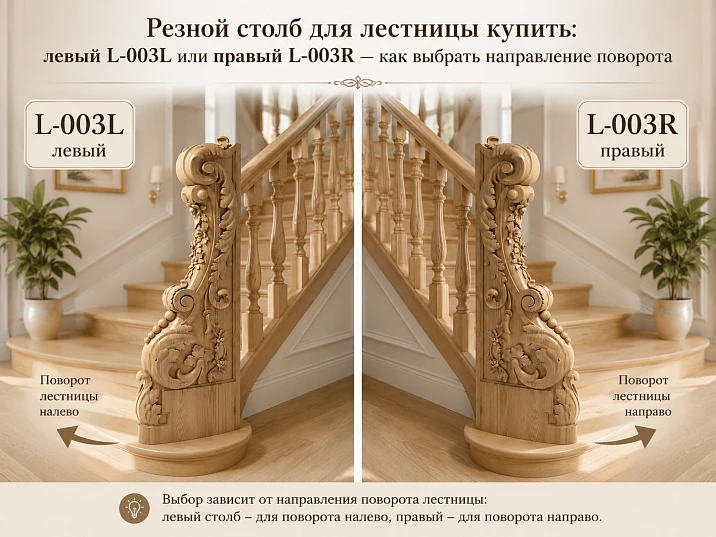
A carved stair post is chosen not only by height, wood species, and ornament pattern. In paired models, there is another parameter that is easy to underestimate: the direction of the design. Posts L-003L and L-003R have the same dimensions, the same product purpose, and the same set of materials, but the large carved decor is mirrored. Therefore, outwardly similar products cannot be considered interchangeable.
The error appears after unpacking or trying on. The decorative sheet ends up facing the wall, the two supports do not form a mirror pair, and the staircase entrance looks as if one side of the composition was accidentally flipped. Fixing such a situation is more difficult than checking the article number, top view, and direction of ascent in advance. That is why, before buying a carved wooden post, you should look not only at the front photo but also at the drawing.
Models L-003L and L-003R are suitable for classic stair railings, expressive entry nodes, landings, and paired portal solutions. They are made from beech or oak, have dimensions of 1242 × 110 × 451 × 1212 mm, and differ primarily in the mirror orientation of the carving. The variant with the letter L is chosen for the left direction according to the drawing, the variant with the letter R for the right. For a symmetrical composition, a set of two different article numbers is usually needed.
Below, we will break down how to determine the side without guesswork, when one post is enough, when a pair is needed, how beech and oak differ, how to match posts with balusters, handrails, and overlays, and what to check in the product cards before ordering on STAVROS.
Short answer. L-003L and L-003R have the same size, materials, and overall pattern, but the carving is mirrored. The side cannot be determined only by the words "left of the stairs" or "right of the flight": the reference point changes depending on whether a person looks from below, above, or at the plan. Mark the direction of ascent, find the main visible side, and compare it with the top view of the product. For a symmetrical staircase entrance, one L-003L and one L-003R are usually ordered.
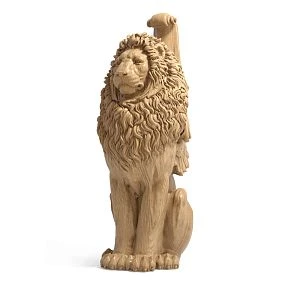
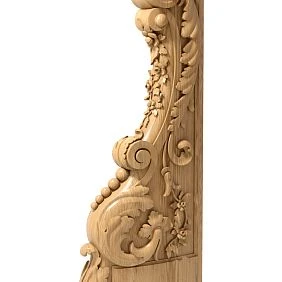
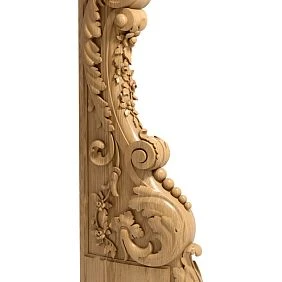
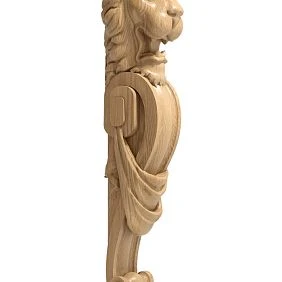
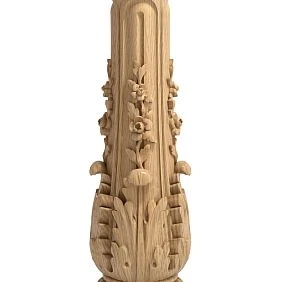
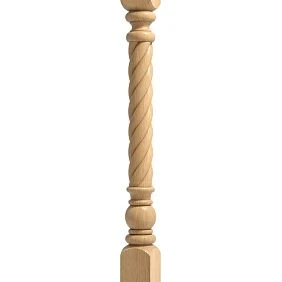
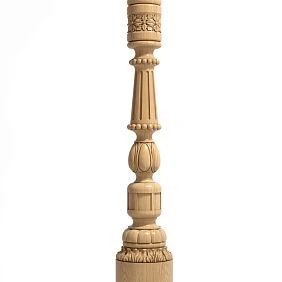
What is the carved post L-003 and why the direction is so important
A stair post is a large vertical railing element that completes or begins a section of handrails, sets the scale of the entire structure, and connects steps, balusters, and handrails into a single system. In simple stairs, the support can be laconic and almost invisible. In a classic interior, it often becomes the main decorative element of the entry node: a person sees it even before stepping onto the first step.
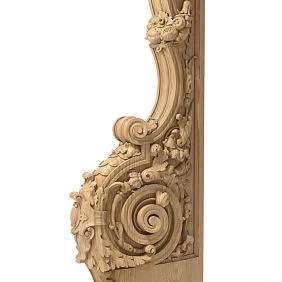
The L-003 series is built on exactly this principle. It is neither a regular smooth beam nor a fully round turned column. The product combines a supporting shape with a large volumetric ornament featuring an acanthus leaf, floral motifs, and volutes. The carving is perceived not as a small overlay on the surface, but as part of the silhouette. Therefore, the rotation of the pattern affects not only the detail but also how the viewer reads the entire staircase.
When a single column is used, the direction determines where the decorative part 'opens': toward the room, toward the flight, toward the central axis of the entrance, or toward the wall. When two columns are installed, the error becomes even more noticeable. Properly selected L-003L and L-003R form a mirror pair. Two identical L-003L or two identical L-003R will repeat the same rotation and disrupt symmetry.
This is why the question 'which column to buy' cannot be decided solely by a beautiful product angle. The front-facing photo shows the character of the carving but does not always allow for an accurate understanding of the spatial direction. It is more reliable to open the drawing, find the top view, and compare it with the staircase plan. This approach is especially important if the product is ordered for an already built flight, replaces an existing support, or is part of a set with paired overlays.




Confirmed model specifications
| Characteristic | L-003L | L-003R |
|---|---|---|
| Product type | Left carved column | Right carved column |
| Size | 1242 × 110 × 451 × 1212 mm | 1242 × 110 × 451 × 1212 mm |
| Material | Beech or oak | Beech or oak |
| Surface preparation | "Standard" or "Prestige" | "Standard" or "Prestige" |
| Option for beech | For enamel | For enamel |
| Option for oak | For tinting | For tinting |
| Decor | Acanthus leaf, flowers, volutes | Same ornament in mirror direction |
| Single purchase | Yes | Yes |
| Pair purchase | Together with L-003R | Together with L-003L |
| Compatible baluster | L-010 | L-010 |
| Main selection criterion | Left direction from top view | Right direction from top view |
The four size values should be treated as exact data from the card, rather than trying to assign each number a role without a drawing. Before ordering, open the diagram of the specific model and compare all designations with the staircase project. This is especially important when replacing an old post, where the mounting dimensions, handrail height, and position of adjacent parts are already set.
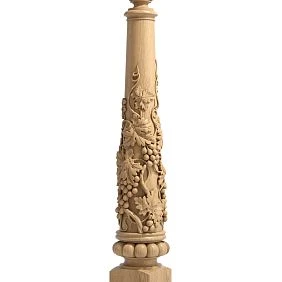
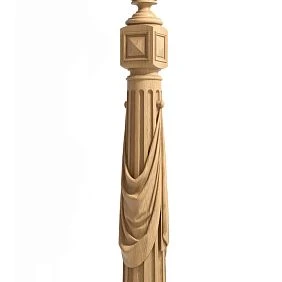
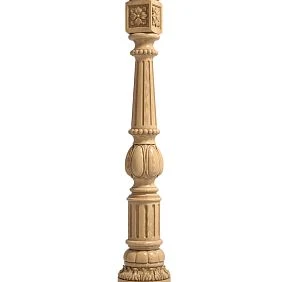
Our factory also produces:
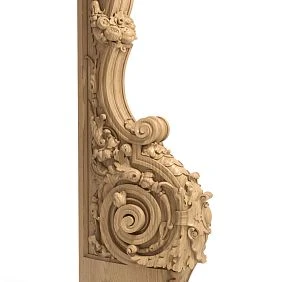
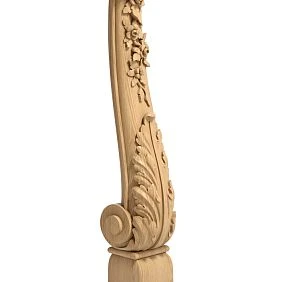
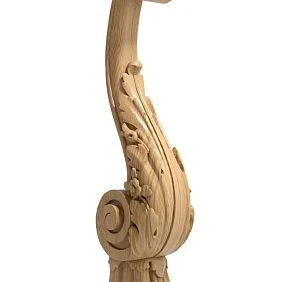
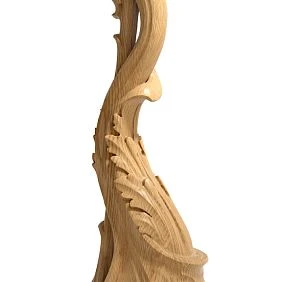
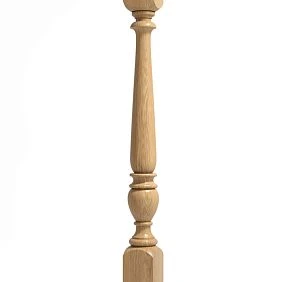
How is L-003L different from L-003R
The main difference between the models is not related to quality, price category, or scale. It is the same artistic idea executed in two mirror versions. The letter L in the article indicates left orientation, the letter R indicates right orientation. However, the words "left" and "right" cannot be interpreted as a universal hint without reference to the drawing.
Both models have the same dimensions: 1242 × 110 × 451 × 1212 mm. Beech and oak are available for each. Surface preparation is selected in the "Standard" or "Prestige" option. Beech is considered for enamel, oak for tinting. Therefore, the material and quality of sanding determine the future finish, not the installation side.
The ornament is built on an acanthus leaf, flowers, and volutes. These motifs have a pronounced movement: the leaf can open towards the center of the composition or away from it, the curl can continue the line of the handrail or contrast with it. If you imagine the two models side by side, L-003R looks not like a different design, but like a mirror reflection of L-003L.
Get Consultation
Comparison of options for purchase
| Selection criterion | L-003L | L-003R |
|---|---|---|
| Carving direction | Left according to the drawing | Right according to the drawing |
| When to buy one | For a single unit with the required left turn | For a single node with the required right rotation |
| When to buy in a pair | Together with L-003R | Together with L-003L |
| Suitable for replacement | If previously installed L-003L | If previously installed L-003R |
| Material | Beech or oak | Beech or oak |
| Finishing | Beech under enamel, oak under tinting | Beech under enamel, oak under tinting |
| What to check first | Top view and letter L | Top view and letter R |
| What does not determine the choice | Price, height, wood species | Price, height, wood species |
If required carved stair post L-003L, it cannot be replaced with the right-hand version just because the dimensions match. Similarly carved stair post L-003R it does not become left-handed after being rotated in the photo: the spatial logic of the three-dimensional carving is preserved.
This is especially important in orders where posts are included in the specification along with other mirrored parts. If the project includes paired overlays, the direction of all elements must be coordinated. Otherwise, each individual part will look good, but the overall composition will appear disjointed.
Why you cannot choose a post based solely on the words "left" and "right"
In everyday conversation, people often say: "I need the post to the left of the stairs" or "the right post will be by the wall." These phrases seem clear until a second project participant appears. The customer looks at the flight from the hallway, the craftsman from the side of the steps, the designer from the top view plan, and the manager sees only the article number and drawing. Each may have their own point of reference.
The word "left" changes meaning if a person turns around. A post that is on the left when ascending will be on the right when descending. In a photo from the opposite side, it will also change position. Therefore, the side of location and the direction of the carving are not the same thing.
View from the bottom step
For a person approaching the staircase from below, the left edge of the flight is indeed on the left. But this is only the position of the element in space. It does not yet answer the question of whether the acanthus leaf should face the center of the entrance or outward. On the same left side, both L-003L and L-003R may be needed, depending on the orientation of the product on the plan and the artistic intent.
The lower perspective is useful for assessing which post will become the main visual accent. From here, it is clearly visible whether the carving blocks the passage, supports the handrail line, or if a large leaf turns toward the wall. However, the final decision still needs to be confirmed from the top view.
View from the upper landing
When descending, the familiar "left" and "right" swap places. If you rely only on verbal description, it is easy to order the opposite article. Therefore, in the specification, it is better to write not "post on the left" but the full model designation: L-003L or L-003R. A diagram with the direction of ascent and a marked viewpoint can be added nearby.
The upper landing is also important because the post may be visible not only from the hall but also from the second floor. If the carving has a pronounced volume, you need to check which side will face the landing. Sometimes the composition must work equally well from below and above, so the choice is made not based on one perspective but on the entire trajectory of movement.
View on the room plan
The top view eliminates the main confusion. On it, you can mark the bottom step, the ascent arrow, the open edge of the flight, the wall, the landing, and the installation point of the post. After that, the top view from the product card is compared with the actual installation point.
This method is useful even for a small private staircase. It is not necessary to make a complex architectural drawing. A clear diagram showing the direction of the flight and where the carving is most often viewed from is sufficient. The more expensive and noticeable the detail, the more justified this preliminary check is.
Main viewpoint
In some projects, the post stands near the staircase but is perceived primarily from the living room. In other cases, it greets a person from the hallway. In a spacious hall, two posts can form a portal, while in a narrow corridor, one support is read almost frontally. The main viewpoint determines where it is best to direct the large leaf and volute.
However, it cannot be assumed that the thread should always face outward or always be assembled toward the center. Both solutions can be correct. In a portal composition, ornaments are often directed toward each other to emphasize the central axis. In an open composition, they are, on the contrary, turned outward to visually widen the entrance. The choice depends on the project, not on a universal rule.
How to choose L-003L or L-003R according to the drawing
A reliable choice begins not with a guess from a photo, but with comparing two diagrams: the staircase plan and the top view of the post. This method helps to equally accurately select a single element, a mirror pair, or a replacement for an already installed part.
Mark the installation point
First, mark the exact location on the plan where the support will be placed. If there are two posts, mark both points. Indicate the walls, the opening, the bottom step, and the landing. Such a diagram immediately shows whether the node is symmetrical, whether one side is against the wall, and how open the second side is.
To replace an existing part, it is useful to photograph the old post from several sides, but it is better to use the photo as a supplement. The main information is the article number, if it is preserved in the documents, and the actual direction of the pattern relative to the flight.
Indicate the direction of ascent
The plan needs an arrow from the bottom step to the top landing. Without it, the words "left side" and "right side" remain ambiguous. The arrow fixes the orientation and allows all order participants to look at the diagram in the same way.
If the staircase is turning, mark not only the first flight but also the landing or the winder section. The post may relate to the entrance to the first flight, to the turning landing, or to the completion of the railing. For each location, the direction is assessed separately.
Determine the open and visible sides
The open side of the pillar faces the room, while the closed side can be placed against a wall. In most cases, it is the open side that requires special attention to the decorative direction. However, even against the wall, the carving should not press into the adjacent surface or lose its expressive part.
Note where the pillar is most often seen. This could be the entrance door, the sofa area, the center of the hall, the upper gallery, or the corridor. If there are multiple viewpoints, choose the main one and check the additional ones. A large carved pillar should support the movement of the space, not appear randomly positioned.
Match the top view
Open the model drawing and find the top view of the product. Then, mentally or on a printout, overlay it onto the installation location. If the left direction matches the project, you can buy the left pillar L-003L. If a mirror rotation is needed, choose the right pillar L-003R.
Do not rely on the image thumbnail. Three-dimensional carving can create an optical illusion, especially if the photo is taken at an angle. The drawing provides a more accurate representation of the geometry and direction.
Check not only the letter but the entire order
Before placing the order, compare the card name, the article number in the URL, the letter L or R, and the drawing. If purchasing a pair, the order must contain two different article numbers: one L-003L and one L-003R. Two identical products do not form a mirror pair.
It is also useful to check the material and surface preparation. It is better to order both posts in a pair from the same wood species and with the same finish. The difference between them should only be directional, not random due to different textures or finishes.
When one carved post is enough
Not every staircase requires a symmetrical pair. One post can be a completely justified solution if the structure has one open edge, adjoins a wall, or needs a replacement of a single element. The main thing is not to consider a single purchase as a simplified option. The direction of the carving here is often more noticeable because there is no second post nearby to balance the composition.
Staircase with one open edge
If one edge of the flight is closed by a wall and the railing is only on the other side, the starting post becomes an independent focal point. It meets a person at the first step, supports the handrail, and sets the character for the entire railing. In this case, the model is chosen based on the open edge and the main viewpoint.
It is necessary to check where the large leaf is directed: towards the passage, towards the flight, or away from it. Incorrectly oriented carving can visually narrow the entrance or hide an expressive part against the wall. That is why even a single post is chosen based on the top view, not on the usual phrase "it will stand on the right."
Asymmetrical landing
In private homes, the staircase is often built into a complex space: there is a door, column, niche, or furniture nearby. Two posts with identical roles may be unnecessary, while one expressive element helps to tie together an asymmetrical node. Here, the connection with the interior is especially important.
If the carving faces the main room, the post becomes part of the overall decorative system. If it is turned towards a narrow technical passage, most of the effect is lost. Before ordering, it is useful to evaluate the actual traffic route and check where a person will see the product the longest.
Replacement of a damaged element
During restoration or repair, you cannot choose a "similar" post based only on height. If an L-003L was previously installed, replacing it with an L-003R will change the direction of the ornament even if the dimensions match exactly. The best guide is the exact article number in the old specification or comparing the existing element with a top view.
For replacement, you also need to check the material. Oak and beech differ in texture and behavior during finishing. Even if the new post is painted, differences in surface preparation and the condition of adjacent parts can affect the final appearance. It is better to agree on all parameters before dismantling the old support.
Single decorative post in the hall
Sometimes a carved post is used not as a strict pair at the entrance, but as a separate accent near a staircase landing or open gallery. In such a scenario, the direction is chosen based on the main room. The ornament should "work" for the space, not turn away from it.
The single option is especially demanding on scale. The size 1242 × 110 × 451 × 1212 mm makes the L-003 a noticeable detail. Before ordering, it is worth checking whether there is enough space for the voluminous carving and whether it conflicts with the door leaf, furniture, light fixture, or walkway line.
When a mirror pair of L-003L and L-003R is needed
A paired purchase is justified where the staircase has two open edges or the entrance is built as a symmetrical composition. One L-003L and one L-003R create a sense of completeness: the forms mirror each other, and the viewer understands that the direction was chosen deliberately.
Wide entrance to the staircase
If the bottom step or landing is open on two sides, two posts mark the boundaries of the entrance. They can be directed towards each other or opened outward. Both solutions look convincing when they are symmetrical and coordinated with the handrails.
In such a node, you cannot simply order two identical items. Repeating one rotation will create a diagonal movement that will be noticeable at first glance. For a mirror pair, you will need buy mirror column L-003L and the corresponding mirror column L-003R.
Symmetrical landing
On the landing, columns can complete two sections of railing or form an entrance to the central area. Here, not only the supports themselves are important, but also the distance between them, the position of the balusters, and the handrail line. The mirror pattern helps connect the left and right parts.
If the landing is visible from below and above, check both angles. Sometimes ornaments that look beautifully gathered towards the center from the hall appear less successful from the second floor. In that case, consider an option where the carving opens outward. The decision is made based on the project and drawings, not on the side name.
Paired portal in the hall
Two carved columns can be perceived as a portal even without a separate arch. They mark the transition from the hallway to the stair hall, frame a wide opening, or support the classic axis of the room. In this case, symmetry is especially important.
Typically, columns are linked with paired overlays and identical finishes. If birch under enamel is chosen, both products must have the same color and the same degree of surface preparation. If oak under tinting is used, the shade and wood grain should be coordinated as a single composition.
Two symmetrical flights
In a house with two opposing flights or a split staircase, posts may repeat at several points. This requires not just a pair, but a system of mirrored elements. For each point, the direction must be separately indicated on the plan, because the same side relative to the hall does not always mean the same article.
The more complex the staircase, the more important the specification. It is better to include full model names, the quantity of each article, material, and finish. The phrase "four carved posts" is insufficient: it does not protect against direction errors.
Carving toward the center or outward: two correct scenarios
Buyers often look for a universal answer: which way should the carved leaves on paired posts face. There is no such rule. In some interiors, the forms are better gathered toward the center; in others, they should open outward. The correct option is determined by the task the staircase entrance serves.
Ornament directed toward the center
When two posts stand on either side of a wide passage, the carving can be turned toward each other. This technique emphasizes the central axis, draws attention to the first step, and creates a portal feel. It is especially appropriate if the staircase is strictly centered in the hall, and furniture and lighting also support symmetry.
With central orientation, it is important that large elements do not overload the passage. The actual width between supports and how much the voluminous carving protrudes into the space must be considered. A drawing helps assess the geometry more accurately than a frontal photograph.
Ornament directed outward
In another scenario, the carving diverges from the center and visually opens the entrance. This can be useful if the staircase is wide, the room has multiple directions of movement, or the posts need to connect the flight with side areas of the hall. The outward turn makes each support independent and emphasizes the width of the composition.
This option may also work better if the center is already occupied by an expressive step, carpet, light fixture, or other accent. The posts do not compete for the middle but support the edges. However, even here, a top view should be checked to ensure the outward direction does not face a wall or furniture.
How to choose between two schemes
Make two simple sketches. In the first, direct the thread toward the center; in the second, outward. Compare them from the main viewpoint. Pay attention not only to the beauty of the design but also to practicality: passage width, door placement, handrails, balusters, and adjacent decor.
If the decision raises doubts, it is helpful to prepare a plan and images of both models for consultation. Such a question is best resolved before ordering, because the material and dimensions of L-003L and L-003R are the same, and correcting the direction after manufacturing or finishing cannot be done by simply swapping the names.
"Round wooden pillar" and L-003: why it is important not to confuse the shape
In searches, buyers often use the broad phrase "round wooden pillar." It can refer to a turned support with a round cross-section, a column, an oversized baluster, or a carved pillar with voluminous rounded parts. L-003R and L-003L cannot be described as simple fully round posts.
The models have a complex silhouette. They combine a constructive vertical line and large carved decor. Therefore, choosing solely by the word "round" can lead to incorrect expectations. If a smooth pillar for a minimalist railing is needed, the L-003 series may be too expressive. If the goal is to emphasize a classic entrance and achieve voluminous carving, a regular turned support will not provide such an effect.
Before purchasing, it is useful to view all starting and support pillars and compare models by silhouette, scale, and finish character. A wide catalog helps to understand whether a carved L-003 is truly needed or if a more restrained support is better.
The difference is also important for installation. A smooth turned post is perceived as symmetrical around its axis, while directed carving requires precise orientation. Even if the base allows rotation of the element, the artistic direction cannot be assessed without reference to the staircase. For L-003, the side is part of the model, not a random position during installation.
Beech or oak: which material to choose
Both models are available in beech and oak. The type of wood affects not the direction, but the future finish and surface character. The choice should be made simultaneously for all visible elements of the staircase: posts, balusters, handrails, and decorative overlays. Mixing wood types is only possible as a deliberate design technique, but for a mirror pair, it is usually more rational to use one material.
Beech for enamel
Beech is suitable when the posts are planned to be painted with opaque enamel. This solution allows the carving to be tied to white, black, or colored interior elements, making the pattern more graphic and reducing the role of the natural wood grain.
Opaque finish is especially convenient for classic and neoclassical interiors, where the staircase must match the color of doors, panels, or ceiling decor. The carved relief remains expressive due to light and shadow, rather than contrast of fibers.
When choosing beech, it is important to coordinate the same surface preparation for L-003L and L-003R. If one post has more thorough sanding, after painting the difference may appear in highlights and carving details. Paired elements should be perceived as a single set.
Oak for tinting
Oak is chosen when it is necessary to preserve the visible wood texture and use tinting. It works well in interiors where the staircase is connected to oak steps, handrails, flooring, or furniture. The carving gains additional depth: light changes not only on the relief but also on the natural pattern of the material.
For paired posts, it is important to evaluate not an individual sample, but the entire group of parts. The tinting must be coordinated in shade, and the direction of fibers and natural differences in the wood should be perceived as part of a living material. One cannot expect complete visual identity of two products from oak, but the finish should unify them.
Can I order one post in beech and the second in oak?
Technically, the models are available in both wood types, but a mirror pair made of different materials rarely looks cohesive. Beech for enamel and oak for tinting imply different finishing methods. One post will be perceived as a painted architectural element, the other as a product with emphasized texture.
Such a combination is only acceptable in a complex custom project where the difference is planned in advance. For a regular symmetrical entrance, it is better to choose one wood type, one finish, and one level of surface preparation. Then the eye will focus on the mirror pattern, not on the random difference in materials.
"Standard" or "Prestige": what changes surface preparation?
The model cards specify the "Standard" and "Prestige" options. When choosing, it's important to understand them not as different designs, but as levels of surface preparation. The exact scope of work should be checked in the current card and, if necessary, clarified with a manager, especially if a transparent or complex finish is planned.
When to choose "Prestige"
More thorough preparation is justified when the cleanliness of the product's carving is especially important, the product is viewed from close range, or a finish that highlights every detail is planned. In a spacious hall, a column may be visible from several points, and on the upper landing, a person approaches it closely.
For oak under tinting, the surface quality is especially noticeable because a transparent finish does not hide the wood. Before ordering, it is worth clarifying which execution is recommended for the chosen technology. Do not rely solely on the level name; the decision should take into account the actual finishing method.
Why a pair needs to be ordered in the same execution
Even a small difference in preparation can become apparent after painting or tinting. One column will reflect light differently, some areas of the carving will be smoother, and the color depth will be uneven. This is especially undesirable because the products should look like mirror parts of a single whole.
In the specification, indicate not only two article numbers but also the same material and execution. Such control is easier than trying to level out paired items already on site.
How to assess the size and scale of a column before purchase
The size ××× mm indicates that it is a large and noticeable element. It should not get lost next to a massive handrail, but it should also not accidentally block the passage. Before ordering, it is important to check the drawing and understand how the volumetric part fits into the real space.
Compare the height with the handrail line
The post works together with the railing. Its upper part must align with the design height of the handrail and the connection point. You cannot choose a support separately and then try to adjust the entire staircase to it. For a new structure, the model is included in the design in advance. When replacing, the dimensions are checked against the existing assembly.
Check the side volume.
The front width does not give a complete picture of the protruding thread. The four-digit size in the card and the top view help to assess where the most voluminous part is located. This is important near a door, wall, furniture, or narrow passage.
Draw the outline on the floor with painter's tape or mark it on the plan. This simple technique helps to understand whether the sheet will be too close to the movement path. For paired installation, check the free width between the two posts.
Consider the viewing distance.
Large thread reveals itself at a distance. In a spacious hall, it sets the scale; in a narrow passage, it may feel too rich. This does not mean it cannot be used in a compact room, but the composition needs to be supported with calm balusters and not overload adjacent surfaces.
If the post is viewed from a close distance, the quality of preparation and neat finishing are especially important. If the main angle is distant, the silhouette and direction come to the forefront.
Practical selection for different staircase situations.
The same models can solve different tasks. Below are typical scenarios where the choice between one and a pair is determined not by a general rule but by the staircase configuration.
The staircase runs along the wall.
When the march adjoins the wall, an expressive post is usually needed on the open side. First, determine from where it is viewed: from the hallway, living room, or the bottom step. Then match the required turn with the top view.
Do not automatically choose for the left side of the room. If the staircase is turned differently, the right option may better direct the thread into the open space. The article name confirms the drawing; do not replace it.
The staircase entrance is open on both sides.
Here, a mirror pair is most often needed. One and one mark the boundaries of the entrance and maintain symmetry. Then the artistic question is resolved: direct the thread toward the center or outward.
Before ordering, check the actual passage width and the position of the handrails. If the volumetric parts are turned inward, they should not visually compress the entrance. If outward, they should not conflict with walls or furniture.
A replacement of one post is needed.
For repairs, the exact match of the article and direction becomes crucial. Photograph the existing element from above, find the old specification, and compare the ornament. Do not choose a replacement only by height and wood species.
Also check the finish. New oak under tint may differ from the old one in shade, and beech under enamel will require color matching. Sometimes it is more reasonable to update the finish of adjacent parts than to try to perfectly replicate the old surface on only one element.
The staircase is located in the central hall.
In a large space, the posts are visible from several directions. Here it is important to evaluate not only the entrance but also side angles, the view from the second floor, and the connection with the room's architecture. A mirror pair often looks more convincing because it emphasizes the central axis.
At the same time, large decor should not compete with other dominant elements. If the hall already has rich stucco molding, a complex door, or a massive chandelier, the column finishing can be made more restrained. If the walls are calm, the carving can become the main motif.
Commercial interior of a restaurant or hotel
In a public space, the staircase should be expressive and understandable at first glance. Paired carved columns help mark the entrance, support the classic style, and connect the railing with the hall interior.
But here, design requirements for loads, installation, and safety are especially important. The article helps choose a direction and set; however, the final structural solution must be coordinated with project specialists. In the cards, you need to check dimensions and materials, and determine the fastening method based on the base and project documentation.
How to use it in the interior
A carved column does not exist separately from the space. Its expressiveness depends on the color of the walls, floor, steps, lighting, and neighboring details. The right choice of direction helps fit the ornament into the interior; the material and finish determine the character.
Classic interior
In classic style, it supports symmetry, deep profiles, and complex wooden decor. Beech under enamel can be combined with painted doors, panels, and cornices. Oak under tinting connects the columns with steps, parquet, and wooden furniture.
Paired solutions are especially appropriate here. If the entrance to the staircase is located in the center, they can work as an architectural frame. Balusters and handrails are best selected in one system so that the columns do not look like separately placed sculptures.
Neoclassicism
In a neoclassical interior, carving is often used in doses; it can become the main complex element, while the balusters and walls remain calmer. Opaque enamel makes the ornament graphic and helps avoid the excessive heaviness of natural wood.
The direction is especially noticeable here because the composition is usually clean and symmetrical. A mirroring error will stand out more. Before purchasing, it is worth checking not only the two posts but also the paired overlays if they are included in the design.
Interior with natural oak
Oak under tinting is suitable for homes where wood plays a leading role. The posts can support oak steps and handrails, and the carving adds depth without transitioning to painted architecture.
To prevent the interior from becoming too heavy, it is useful to control the saturation of the tone and the number of carved elements. One bright accent at the entrance to the staircase often looks more convincing than uniformly complex decor on every baluster.
Modern eclecticism
In an eclectic space, a carved post can be combined with minimalist walls, modern lighting, and simple furniture. The contrast works if the piece is chosen deliberately and is not surrounded by many random motifs.
For such an interior, a monochrome enamel is especially useful. It preserves the relief but brings it closer to architectural form. The direction is chosen so that the carving supports the movement of the space and does not look like a museum piece placed without connection to the staircase.
What to buy together with
A carved post sets the character of the staircase but does not complete the railing on its own. For a cohesive result, it needs to be connected with balusters, a handrail, and, if necessary, paired decorative overlays. Buying as a set helps to coordinate the material, scale, and direction in advance.
Baluster
In the accompanying products for both models, it is indicated. It can be used as a starting point for selecting vertical filling. Useful before ordering.Buy a baluster for the posts.Only after checking the dimensions, material, and quantity according to the project.
If the project is not yet approved, it is worthSelect balusters for the carved post.In the general category, large is better combined with details that support its scale, but not necessarily repeating the entire ornament.
Wooden handrail.
The handrail connects the posts and balusters into a single line. Its profile, material, and connection method should be included in the project. CanSelect a handrail for the posts.And compare options from oak or beech.
Don't choose a handrail solely by color. Proportions, grip comfort, compatibility with the railing, and finish are important. If the posts are ordered from oak for tinting, it's usually logical to select the handrail in the same wood species. For beech under enamel, you can coordinate a single painted set.
Paired overlays and
Left and right directions are found not only in posts. For an extended composition, you canbuy a left overlayиbuy a right overlayThey help maintain the mirror principle on adjacent surfaces.
When selecting overlays, the same logic applies: left and right parts cannot be considered interchangeable. Their direction must be matched with the installation location and the overall pattern. If the posts are directed towards the center, the overlays can continue this movement; if outward, they support an open scheme.
Kit table
| What to add to the purchase | Why this is needed | What to check |
|---|---|---|
| Baluster | Forms the vertical filling of the railing and supports the post style | Dimensions, quantity, material, finish |
| Wooden balusters | Allows comparing other options for the project | Scale, wood species, installation step according to the project |
| Wooden handrail for stairs | Connects the railing and completes the flight line | Profile, material, connection to the post |
| Left overlay | Supports left direction of decorative pattern | Side size installation location |
| Right overlay | Creates a mirror pair | Side size installation location |
| Finishing materials | Needed for enamel or tinting | Compatibility with beech or oak and selected technology |
| Fasteners and mounting solutions | Ensure installation in a specific unit | Base project specialist recommendations |
The table does not replace the working specification. The number of balusters, the length of the handrail, and the method of fastening are determined by the staircase design. However, such a list helps not to forget that a post is part of a system, not a separate purchase.
How not to confuse with similar products
The name "wooden post" combines different products. Some are used as conical supports, others have a turned shape, and others are built with large carvings. Before ordering, it is important to understand what exactly the project requires.
A post and a baluster are not the same thing
A baluster is usually repeated many times and forms the infill of the railing. A post is larger, completes a section, and takes on the main compositional role. You cannot replace it with a row of identical balusters just because the height seems similar.
If a complete set is needed, first determine the number and position of the posts, then select the balusters. For a series, you can considera carved baluster for a classic staircaseand check its parameters in the product card
Carved post and smooth turned support
A smooth or turned model is usually more neutral in direction and does not have a pronounced left or right turn. If the project requires a calm railing, large acanthus decor may be excessive. If an expressive classic entrance is needed, a smooth support will not provide the required scale.
Beneficialselect carved stair postafter comparing several models, consider outside the catalog context
Left post, left overlay
The letter appears in different parts but does not make them interchangeable — a volumetric stair post — a decorative overlay. They have different functions, sizes, and installation locations. Only the principle of directional pattern remains common.
One article and a mirror pair
The most common confusion is ordering two identical posts for a symmetrical entrance. Identical sizes create a false impression that one element can simply be rotated. But mirroring is embedded in the carving itself. For a pair, two different articles are needed.
Preparation for installation and finishing
Model selection ends not in the cart but in the finished stair assembly. To avoid ruining the correct direction in subsequent stages, you need to preserve the marking, verify the location before finishing, and coordinate the installation with the project.
Do a dry fit
Before final finishing, it is useful to place the posts in their design position without irreversible operations. Such a dry fit shows where the carving is oriented, whether the volume obstructs the passage, and how the product connects with the handrail.
For a pair, mark the places and do not remove the markings until orientation is complete. In a workshop, two identical-sized products are easy to confuse, especially if they are lying horizontally or already covered with primer.
Do not start finishing until the side is checked.
After enameling or tinting, correcting an error becomes more expensive. First, you need to confirm that each post is in its place, the ornaments form the chosen pattern, and the connections with the handrail are provided correctly.
For beech, agree on an opaque finishing system. For oak, agree on tinting and a transparent protective coating within the chosen technology. Specific materials and number of layers depend on the project and the contractor's recommendations; they cannot be determined solely by the general name of the wood species.
Agree on the fastening with a specialist.
The installation method depends on the base, the staircase structure, and the design node. It is impossible to promise a universal fastener for any object in advance. Before ordering, it is necessary to understand where the embedded part is located, how the post connects to the handrail, and what operations are performed before the final finishing.
If the staircase is already built, the master must assess the possibility of replacement without damaging adjacent elements. If the structure is new, it is better to include the posts in the working documentation before manufacturing the railing.
Protect the thread on the object.
Large decor has protruding parts that require careful storage and movement. Before installation, it is better to keep the product in conditions recommended for wooden parts, protect it from impacts, and not use it as a temporary support for tools.
After installation, care depends on the finish. Enamel and tinted oak require different products, so you need to follow the recommendations for the specific coating. The general principle is one: do not use aggressive cleaning that can damage the surface and get into the relief.
Errors when buying
Error: Choosing based on a single frontal photo
The frontal view shows the beauty of the carving but can hide its spatial rotation. Due to perspective, the left and right options look almost identical. Solution: be sure to open the top view and compare it with the plan.
Error: Thinking that "left" means the place to the left of a person
The reference point changes when going up and down. The article denotes the product variant, not its household position in the room. In the specification, write or attach a diagram.
Error: Buying two identical articles for a pair
Two or two will repeat one turn. For a mirror pair, a set is needed. Before payment, check the quantity of each item in the cart.
Error: Choosing the side based on material or price
Beech and oak "Standard" and "Prestige" are available for both models. These parameters do not help determine the direction. First, choose according to the drawing, then the material and surface preparation.
Error: Mixing beech and oak in a symmetrical pair without a project
Different breeds imply different textures, and in this case, different typical finishing scenarios: beech for enamel, oak for tinting. Random mixing will ruin the integrity. For a pair, it's better to use one material.
Error: Not checking the dimensions of the 3D carving.
The buyer sees the height but does not evaluate the side protrusion. As a result, the sheet ends up close to the wall or passage. Use drawings and mark the dimensions on the plan.
Error: Ordering posts separately from the handrail and balusters.
Even correctly chosen items may not form a system if adjacent parts are not coordinated in material and scale. Before purchasing, assemble a set: posts, balusters, handrail, overlays, and mounting solutions.
Error: Finishing products before fitting.
After the final coating, markings are harder to read, and correcting errors becomes expensive. First, dry fitting and direction check, then finishing.
Error: Relying on an inaccurate fragment of the description.
If the card text contains a cross-reference to another article, the product name, article number, letter, or image and top view take priority. If in doubt, it's better to clarify the model before placing an order.
Error: Mistaking it for a regular round post.
This is a large carved model with directional ornament. It requires a different approach than a neutral turned post. Compare options in the category to avoid getting a solution that is too complex or, conversely, too simple for the project.
Who it suits and who should choose another option
It is worth taking a closer look at the series if
You need an expressive starting or support post for a classic staircase. The project involves large floral ornament, acanthus leaves, flowers, and volutes. There is enough space in the interior for the carving to be perceived from the right distance. You are ready to agree on the direction, material, and finish in advance.
The models are especially suitable for a symmetrical entrance where a mirror pair can be used, as well as for a single open edge that needs a strong decorative accent. Beech with enamel is suitable for painted architecture, oak with tinting for interiors with visible wood.
It is better to look at other posts if
The staircase is extremely minimalist, and the interior does not contain classic motifs. The passage is very narrow, and voluminous carving obstructs movement. A neutral support is needed that can be perceived equally from all sides without directional ornament. The project does not allow precise determination of the top view and element position.
In such a situation, it is more reasonable toview all starting and support postsand choose a calmer model. The goal of the purchase is not to pick the most complex decor, but to find a post that truly suits the staircase.
When consultation is needed
Contact a manager or designer if the staircase is turning, posts are used on multiple landings, the room drawing differs from the standard, or there is doubt in the card due to the designation. Prepare a plan, direction of ascent, photos, and a list of accompanying details. The more accurate the initial data, the lower the risk of confusion.
How to buy carved posts on
It is better to start the purchase with a project, not with color selection. First, determine the number of installation points, the side of each product, and the need for a mirror pair. Then choose the material and finish, after which coordinate the balusters, handrail, and overlays.
If you need one post, open the card of the corresponding article and compare it with the top view. For the left direction, use the cardof the post for enamel or other confirmed finishFor the right direction — the cardof the post for tinting or selected finishThe wording of the finish depends on the material: beech is considered for enamel, oak — for tinting
If the project is not yet tied to a specific model, you canbuy wooden stair postsafter comparing the catalog, broad queries like "buy wooden post" are best started with the category; it allows you to evaluate different silhouettes and not limit yourself to one series
before ordering, check
- the full article number of each item — or
- quantity: one post or a mirror pair
- size ××× mm and its designation on the drawing
- material: beech or oak
- surface preparation: "Standard" or "Prestige"
- planned finish: beech for enamel, oak for tinting
- compatibility with baluster, handrail, and overlays
- Thread position in top view
- Installation method in a specific project
- Current parameters, availability, and lead times in the card or from the manager
This order helps move from a general desire to buy wooden posts to an exact order without accidental article substitution. As a result, the buyer receives not a set of beautiful parts, but an agreed-upon staircase assembly.
Final selection or kit
Choose if the top view confirms a left-hand thread at a specific installation point. Choose if the project requires a mirror right-hand turn. For a symmetrical entrance of two open edges or a paired portal, a kit of one and one is usually needed.
Do not try to determine the side only by where the post stands relative to a person. Mark the direction of ascent, the main viewpoint, and the open side of the flight. Then compare the plan with the product drawing. Material, finish, and preparation level are selected after the article is determined.
For a solid staircase, it is better to consider posts together with handrails and paired overlays. This makes it easier to match the scale, wood, and mirror pattern. If the configuration is complex, prepare a diagram and clarify the selection before ordering.
Questions about
What do the letters in the article numbers of posts mean?
Indicates the left variant of a directional thread — a right mirror variant. The letters refer to the model and its top view, not to which side a person stands near the staircase.
How does it differ in size
According to confirmed data, the dimensions are identical ××× mm. The difference lies in the mirror direction of the ornament.
Which side to look at the staircase when choosing a post
Do not use a single random angle. Mark the direction of ascent on the plan, determine the main viewpoint, and compare the installation location with the top view of the product.
How to choose a post if the staircase rises from right to left
The direction of the flight alone does not determine the article number. You need to know where the post stands, which side is open, and where the decor should be directed. After that, compare the diagram with the...
Are two different article numbers needed for a symmetrical pair
Yes. For a mirror pair, one of each is usually ordered. Two identical article numbers will repeat the same direction.
Is it possible to install two posts
It is possible if the project deliberately requires a repeated left turn, but such a pair will not be mirrored. For a symmetrical entrance, a different approach is usually needed.
Can I turn the right post to get the left version?
No. The three-dimensional carving is made mirrored in two separate models. Rotating the product in space does not change the internal direction of the ornament as a mirrored version would.
Which baluster should I choose for the posts?
In the related products, it is indicated. Before ordering, you need to check its dimensions, material, and quantity according to the project. You can also look at the general category of balusters.
Which material to choose — beech or oak?
Beech is considered for enamel and is suitable for opaque painting. Oak is for tinting when you need to preserve the visible wood texture. For a mirrored pair, it is better to use the same wood species.
Can I order one post in beech and the other in oak?
Such a combination is only possible as a pre-planned design solution. For a regular symmetrical pair, it is not recommended because the materials and standard finish will differ.
When to choose the "Prestige" version?
When particularly careful preparation of the thread is important, the product will be viewed closely or a finish that emphasizes the surface is planned. It is better to check the exact differences in versions in the product card and clarify before ordering.
Do the posts need to be finished before installation?
The sequence depends on the project and installation technology. But the direction and location of each item must be checked before final finishing. A dry fit with preservation of markings is useful.
How to check the thread direction from the drawing?
Find the top view, mark the direction of ascent and the location of the post on the staircase plan, then match the shape. For a pair, check that the two views are mirror images.
What to do if the opposite item is mentioned in the product card description?
Refer to the product name, item number letter by letter, or image and top view. If doubt remains, clarify the model with the manager before placing the order.
Will it work for a small staircase?
This depends on the actual space. The model is large and has voluminous thread, so you need to check the dimensions, passage width, and viewing distance. In a compact interior, it can work as a single accent if the surrounding details are calm.
What to buy together with the posts?
Usually, balusters, handrails, paired overlays, finishing materials, and installation solutions are considered. The specific set is determined by the project, and links to confirmed products and categories are provided above.
Where to view other wooden posts
Can be openedcatalog of oak and beech postsand compare with other models by silhouette, scale, and degree of ornamentation
Conclusion
And — two independent mirror versions of one carved stair post. They have the same dimensions, materials, and general character of ornament, but different directions. It is this detail that decides whether the post will support the entrance to the stairs or be turned the wrong way.
An informed choice starts with a plan. Mark the installation location, direction of ascent, open side, and main viewpoint. Then compare the top view of the two cards. For one open edge, a corresponding single article is needed. For a symmetrical entrance — one and one.
After choosing the side, coordinate beech or oak, "Standard" or "Prestige", enamel or tinting, balusters, handrail, and paired overlays. Before ordering, double-check the articles and drawings. This approach allows